Rafael Correa, the Press, and Whistleblowers
By ADAM CHIMIENTI | CounterPunch | June 25, 2013
Once again, we are witnessing a growing frustration with “tiny” Ecuador. The United States government is clearly not happy with what would be the latest diplomatic slap in the face coming from the South American country, i.e. the pending arrival of NSA whistleblower Edward Snowden in the coming days. Beyond the United States’ government though, the US press corps are also seemingly up in arms. Why are they so angry? Well, it appears that they are indignant over the perceived hypocrisy of President Rafael Correa.
According to an article from The Atlantic (and another similar one from NPR here), the Ecuadorian leader “has created a safe space for foreigners like Assange — and now possibly Snowden –[but] he doesn’t do the same for dissenters within his own country.” News agencies like NBC News and The Atlantic think this is “interesting” and want to know ‘Why Ecuador?’ Such inquiries naturally turn to the NGOs, who are also less than pleased with this unruly little country. Freedom House, the Committee to Protect Journalists and others are upset that this very week, the one-year anniversary of Assange being holed up in the Ecuadorian Embassy in London (and the same week that the Snowden asylum request is being reviewed), the Ecuadorian National Assembly has passed a Communications Bill that detractors claim is a major blow to a free press.
Claims of Hypocrisy
For several of the opposition figures and US-based observers, Ecuador’s new media legislation has sealed the deal on the stasi-like state that they imply or openly charge Correa has been dreaming about for years. In other words, transparency advocates like Assange and Snowden are compromising their credibility by associating with the Correa government. Ileana Ros-Lehtinen, the right-wing terrorist supporter/US Congresswoman representing Miami, has been busy tweeting as much. The Ecuadorian government, however, asserts that the bill is meant to place more media power in the hands of public groups and move away from privately owned media monopolies.
Meanwhile, the Council of Hemispheric Relations, Center for Strategic and International Studies, and the Heritage Foundation all say that Ecuador must be punished for this latest insult to the US government. James Roberts of Heritage lashed out at the South American leader on June 24, writing in the National Review Online:
“Rafael Correa has demonstrated a blatant disregard for international standards of justice. That kind of conduct may not be surprising from a man who seeks to don the mantle of Chávez, but it should not be rewarded with trade preferences.”
It doesn’t take much imagination to understand how a figure like Correa would have been dealt with a few decades back, but it appears that the more heavy-handed approach is not really possible at the moment, much to the dismay of the powerful and connected.
Returning to the issue of freedom, has the defiant president of Ecuador used the National Assembly to pass a law that NPR, The Atlantic and others tell us will be used to make the country less transparent and more hostile to journalists who only wish to be free to monitor the government and act as a check on state power? Well, let’s hold off on the most absurd elements of irony here for a moment and address the issue at hand.
About a Coup
It should certainly not be regarded as a good thing if the case was simply a cut-and-dry example of authoritarian overreach. Freedom of the press, as we are learning with the Snowden case, has seemingly never before been so important, or so contentious for that matter. However, the Ecuadorian issue is not so simple and it was certainly complicated after a day of crisis nearly three years earlier when factions of the National Police and armed forces attacked the president of Ecuador on September 30, 2010. The event was widely regarded as a coup attempt. What exactly went down is still somewhat unclear. There was a dramatic showdown between Correa himself and police officers that were angered by a supposed attempt to cut their pay. What is for certain, though, is that it was a countrywide, well-coordinated attempt to shut down the National Assembly, the two major airports in Guayaquil and Quito and eventually a hospital where the president was being treated for wounds. Furthermore, the plotters were also attacking journalists throughout the country, and most of these were pro-government reporters working for public media outlets.
The opposition press has taken an active role in attempts to discredit Correa since he first ran for president. He has elaborated on his views of the press and they are certainly not very congenial. In 2012, during a public TV interview in Spain, Correa said, “one of the main problems around the world is that there are private networks in the communication business, for-profit businesses providing public information, which is very important for society. It is a fundamental contradiction.”
One of the issues that NGOs and journalists have cited in their litany of complaints about Ecuador’s endangered freedom of the press actually stems from the 2010 police and military uprising. During the chaos that ensued during the alleged coup attempt, one reporter from the paper of record in Guayaquil took the opportunity to claim that Correa had ordered police to fire on a crowd of innocent onlookers caught up in the melee, presumably aiming to provoke anti-government sentiments. The claim turned out to be completely unsubstantiated. The government fined the journalist and his paper El Universo some $40 million for defamation but later withdrew the charges. Consider what might have happened in the US if the Los Angeles Times or Washington Post would have falsely claimed that Barack Obama had personally ordered military or police forces to fire on a crowd of protesters and innocent people were injured as a result somewhere in Washington, D.C It would be difficult to imagine a reporter and his editors ever committing such a stupid move, but if they had, there would have been some serious consequences. Alas, this is not really too shocking in the context of a sensationalist Latin American press.
Televised and Untelevised Revolutions
That dramatic Ecuadorian affair is reminiscent of the 2003 documentary film The Revolution Will Not Be Televised,directed by the Irish filmmakers Kim Bartley and Donnacha Ó Briai. The pair happened to be in Caracas, Venezuela during one of several 21st century Latin American coup attempts thus far. The film provided a key glimpse into the nature of media in the region, so often dominated by pro-US elites. It showed the efforts expended by private media outlets to incite anger and get people out in the streets in order to challenge the power of anti-Washington governments.
Right up until his death, it was a sort of requirement for US and European governments, journalists and NGOs to claim that Hugo Chávez Frías was a dictator for not renewing the license of RCTV. The outlet, owned by Marcel Granier, was one of the most virulent anti-government television stations operating on the state-owned airwaves and the Venezuelan government eventually forced them over to cable television. The criticism of the allegedly authoritarian leader served to cover up the very questionable coverage by corporate media. Indeed, one anti-Chávez commentator honestly noted six months ago that the idea that Chavez ever controlled the Venezuelan media was a myth. He pointed out that back in April 2002,
“Coup plotters collaborated with Venezuelan media figures before the coup. The media refused to show statements by officials condemning the coup d’état. When the coup d’état failed, the private Venezuelan networks refused to broadcast the news that Chávez had returned to power.”
“Correa is a Very Smart Guy”
The Venezuelan experience did not escape the attention of the rather astute and confident Correa. Neither did the fact that, only 15 months prior to the attempted coup in Ecuador, there was a successful coup in Honduras, removing the president of that country, Manuel Zelaya, by gunpoint in the middle of the night. This was considered to be illegal by President Obama himself, although soon after the offending and illegitimate new government of Roberto Micheletti was accepted by his administration and is still backed to this day by Washington (under current President Porfirio Lobo). This support comes despite a terrible record of human rights abuses and, yes, a genuine threat to a the flow of crucial information. Journalists have been censored and intimidated since the 2009 coup in Tegucigalpa and, what’s worse, have frequently been murdered by the government and its allies. Honduras consistently ranks as one of the most dangerous places in the world to be a journalist. The double standards are blatant and many would like to see the opinion-makers from the States take a closer look in the mirror.
Popular Support and Popular Media
Anyone who would have spent some time watching The Revolution Will Not Be Televised would have also learned what President Hugo Chávez, then only a mere three years into his presidency, meant to the millions of impoverished and the historically marginalized majority in Venezuela. This did not stop the State Department and its allies from focusing on how best to rid Venezuela of its president. (Incidentally, while doing an internship for the State Department in the fall of 2001, I was invited by the Public Diplomacy department to work on ideas on how to get the message out to Venezuelan people about the dangerous nature of President Chávez.) That coup attempt failed, as the one in Ecuador would eight and a half years later, mainly because the people staunchly backed the president of the Republic.
At the time of the 2002 coup attempt, Chávez was wildly popular and the same was true of Rafael Correa in September 2010; two weeks before the coup attempt, polls found that he had the support of 67% of respondents in the capital Quito and nearly 60% in his native Guayaquil, the second largest city. Correa actually got a nice bump in approval ratings after the whole affair and, more recently, he has just won a major reelection bid in February of this year precisely because he has brought political and economic stability to the country of 15 million people. Poverty has been reduced dramatically since Correa took office. Public works projects have resulted in huge improvements to the country’s infrastructure and, more importantly, there is a sense of independence from the yoke of neocolonialism so prevalent in years past.
It appears that Correa and the government may have some good reasons to increase the influence of publicly owned media companies and challenge private corporate media elites. This foray into press control is a dangerous game, however, especially since there appear to be some genuine concerns from indigenous and environmental activists who oppose the government’s expansive plans for an economy based primarily on extraction. Often, those who disagree with Correa are dismissed as childish Marxists, or more alarmingly, terrorists. There must be more attempts to reach a humane and considerate consensus on some of these crucial issues, especially as the Chinese enter the fray in search of resources to fuel their economic needs and a gateway into South America (and Ecuador recovers from two major oil spills so far this year). There are clearly opportunities, but also responsibilities to the environment and the people that live outside of the metropoles.
With such considerations in mind, is there a reason to agree with the opinion-makers in the US who would dub Correa as a dictator, increasingly revealing his dangerous nature?
One of Correa’s main antagonists is Martin Pallares, a senior political editor at one of the major national newspapers El Comercio. Pallares recently said, “I think freedom of press in Ecuador is gravely threatened by a system managed by the government. They have the objective to discredit the media, affect their credibility. And they also want to characterize the press like political adversaries and destabilization agents.” In a very important sense, the media should or even must by its nature act like political adversaries. Destabilization is a different story however. In the case of the coups in Latin America, there is typically interference by Western powers, especially the United States, and this often serves to destabilize governments Washington deems troublesome (through the funding of local civil society groups via the National Endowment for Democracy, USAID and, of course, the CIA). The message is often that these groups are just trying to further democratic causes, but this belies an obvious mission by colluding corporate and government powers that is evident throughout the many anti-democratic interventions and support of such leaders in postwar history (from Iran in 1953 to both the Maldives and Paraguay in 2012).
Felonious Journalists
Returning to the issue of irony, here you have several of the leading news outlets in the US reporting on the lack of media freedom in Ecuador, yet ignoring the major issues raised by leakers, journalists, and publishers such as Bradley Manning, Julian Assange, Glenn Greenwald and Edward Snowden. In effect, these major corporate outlets are legitimizing or are even themselves guilty of demonization of these individuals who have put everything on the line to get the public talking about some serious violations of human rights and privacy, and the dangerous encroachment of the corporate state. One has to wonder if the fact that many of these commentators themselves are getting paid major corporate money has anything to do with their take on the Snowden/Ecuador affair.
If you watched the Sunday morning talk show highlights, you should be able to draw your own conclusion. One jaw-dropping example of the corporate media’s lack of objectivity in this discussion was the meticulously staged interview that George Stephanopoulos did with General Keith Alexander, the man who has access to the personal data of nearly anyone he so chooses to target. There were several moments in which the responses to some of the host’s softball questions were so weak (lots of babbling about dots) that it was unbelievable that Stephanopoulos didn’t pounce. Yet, why he did not or would not do such a thing is evident considering the establishment’s treatment of the recently departed journalist Michael Hastings, loathed for his refusal to play footsie with the biggest fish in the game. That sort of behavior simply cannot be tolerated.
Also on the talk show rounds, there was David Gregory’s aggressive and ethically revealing accusation thrown at guest Glenn Greenwald in the form of a ‘tough question’. Gregory actually asked Greenwald why he shouldn’t be charged with a crime, and The Guardian columnist sharply replied that it was “pretty extraordinary that anybody who would call themselves a journalist would publicly muse about whether or not other journalists should be charged with felonies”, with no evidence of wrongdoing. But there you have the attitude that the establishment needs to maintain close ties; it mustn’t be overly adversarial and never threaten the stability of the government or a particular administration, even if that means sitting on stories such as the spying on US citizens, like The New York Times was guilty of in 2004 when it delayed publication of a story on government surveillance after being approached by the Bush Administration.
Indy (media) to the Rescue
Modern professional journalism often leaves us wanting for more. Thankfully, we have the independent media outlets that are often way ahead on exposing some of the more heinous crimes of the times. This helps millions around the world identify the mantras of the media elite in the United States: 1) the corporate bias is never to be exposed or acknowledged; 2) it should never be overly adversarial to the government; and 3) a “journalist” should always attempt to divert from important issues that arise from whistleblowing by attacking the whistleblower’s character.
Of course, all of these conventions go out the window when it comes to perceived enemies, in which case the media, NGOs, corporations and the US government always work together in delegitimization and destabilization efforts. Snowden has followed Assange’s lead and is headed to Ecuador not simply because, as The Atlantic has suggested, both parties feel persecuted or they want to ‘poke the US in the eye’. The reason why Ecuador has offered asylum and why Snowden was seeking it from them is because they believe that there is hope in the future, beyond the grossly excessive power of the United States and its presumed worldwide dominion. The whistleblowers and the Ecuadorian leaders, like countless others around the world, believe that the only hopeful way forward is to shatter the antiquated and dangerous notions inherent in establishment journalism, corporate supremacy, and US hegemony. I guess it is no surprise that the privileged classes vehemently disagree.
Adam Chimienti is a teacher and a doctoral student originally from New York. He can be reached at ajchimienti@gmail.com.
Related articles
- Huffington Post Misguidedly Attacks Rafael Correa
- Reporting Ahead of Ecuadorean Elections Fits a Familiar Narrative
- The Ecuadorian Coup: Its Larger Meaning
- Behind the Coup in Ecuador – The Attack on ALBA
- Target: Ecuador
- Ecuador Will Cease Participation In School Of The Americas
- Ecuador to maintain foreign policy, ties with Iran: FM
Correa Reiterates Warning Against U.S. Interference
Prensa Latina | May 8, 2013
 Quito – President Rafael Correa reiterated his warning to U.S. Ambassador, Adam Namm, to comply with his diplomatic role instead of involving himself in anti-government political activities.
In conversations with reporters in the city of Guayaquil, the Ecuadorian president discounted the expulsion of the U.S. ambassador for now, but recommended that he be more considerate with this country.
Correa described the U.S. ambassador’s participation in an activity organized by a journalists’ guild opposed to the government, as “rude,” where the alleged lack of freedom of speech in Ecuador was criticized.
“Why don’t the other ambassadors participate?” Correa asked. “Rarely have we seen so much betrayal of a calling by the U.S. ambassador, who is really trying to create an uncomfortable situation,” the president said.
Citing Namm’s words that Washington is very concerned, Correa replied that he could go home and worry from there.
“This fact, I think, was a slip by the ambassador, which says a lot about his vision. He believes that he comes to impose conditions, and who has told him that is his role?” Correa asked.
According to Correa, the action is scarcely relevant, but warned against it continuing. “Make no mistake, we are facing immense power,” he said.
Related article
Ecuador: Correa Confirms Interest in Joining Mercosur
By Emily Tarbuck | The Argentina Independent | February 21, 2013
With Rafael Correa emerging victorious for a third and final term in Sunday’s presidential elections, the leader of the Alianza País party spoke to Argentine newspaper Página 12 about Ecuador becoming part of the Mercosur agreement, their relationship with Argentina, and same-sex marriage. During the interview, he also announced that his party obtained “97 or 98 seats” in the National Assembly, though the final results of the recount are yet to be announced by the National Electoral Council.
In the interview, Correa first discussed the strengthening of ties with Argentina by “further deepening the bilateral relationship” through trade, and agreed with President Cristina Fernández de Kirchner’s condemnation of the “total surrender of our countries at the hands of transnational corporations”. Correa went on to say however that the relationship between the two countries is more than commercial because “with Argentina we have the same political vision”.
Throughout the interview Correa expressed his hope to join Mercosur, and when asked if the dollarisation of Ecuador would hinder the incorporation into the agreement, Correa agreed that it is “an obstacle for any integration process and trade liberalisation”. However, he insisted that “we are very interested in joining Mercosur… and they are very interested in integrating Ecuador”.
Speaking of the impending expiration of the Andean Trade Promotion and Drug Eradication act (ATPDEA), Correa said, “Andean countries have a responsibility [to join these agreements] because they are the biggest producers of drugs! But the US say nothing of the responsibility they have for consuming them.” He went on to say that this agreement is “a new form of pressure for countries that do not behave according to the mentality of the US”, and that “if [the act is] extended, fine, if not, we will know how to succeed.”
As the interview progressed, Correa was questioned on the topic of same-sex marriage, in which he responded that, “the Constitution says that marriage is an institution between people of a different sex”. Correa said that although “we promote many rights and the non-discrimination of any person for any reason… the Constitution clearly says that marriage is between a man and a woman.”
Finally, when asked if the continuation of his government would mean a less restrictive abortion law, Correa said that, “personally I will not promote any law that goes beyond the two cases that are already covered in the current legislation, in the case of a violation of a woman with intellectual disabilities and in the case of rape, when a child is violated.”
You can read the interview in full here.
Related articles
Reporting Ahead of Ecuadorean Elections Fits a Familiar Narrative
By Dan Beeton | CEPR Americas Blog | February 17, 2013
International media reporting ahead of Ecuador’s elections today has sounded familiar themes, understating the achievements of the Rafael Correa government and attributing Ecuador’s recent economic and social progress to “luck” or happenstance, and high oil prices. Correa is depicted as an enemy of press freedom, despite the fact that Ecuadorean media is uncensored and the majority of it opposes the government; and despite his granting of political asylum to Julian Assange. He is also depicted as a member of Latin America’s “bad left” who has ambitions of regional leadership should “bad left” leader Hugo Chávez succumb to illness or otherwise be unable to continue in office.
A common theme in press accounts is that the Correa administration’s social programs are “funded by the country’s oil proceeds.” While some reporting has gone deeper and noted that “Correa has taken on big business and media groups, imposing new contracts on oil companies and renegotiating the country’s debt while touting his poverty reduction efforts,” others have not. “High prices for oil exports resulted in higher revenues which the government invested in social programs and public infrastructure,” the Christian Science Monitor reported in a Friday article. The New York Times’ William Neuman presented a contradictory picture of the economic importance of Ecuador’s petroleum sector, writing that “Ecuador is the smallest oil producer in the Organization of the Petroleum Exporting Countries, yet oil sales account for about half of the country’s income from exports and about a third of all tax revenues, according to the United States Energy Information Administration,” just before stating in the next paragraph that “Mr. Correa has taken advantage of high oil prices to put money into social programs, earning him immense popularity, especially among the country’s poor.”
Petroleum exports have been important to Ecuador’s economy for a long time; this did not suddenly come about with Correa. While Correa was favored by high oil prices during most of his six years in office, the collapse of oil prices in 2008 was a major blow to the economy. Also, an important change during Correa’s first term has been the Ecuadorean government’s relationship with foreign oil companies. Correa notably has driven a much harder bargain than his predecessors, “imposing a windfall profits tax for concessions made to companies for the exploitation of domestic natural resources” that “raised over $500 million for the government in 2010,” as our latest paper notes. A raft of financial and regulatory reforms have also put a considerable amount of revenue in the government’s coffers, contributing to the increase from 27 percent of GDP in 2006 to more than 40 percent in 2012. Stimulus spending – 5 percent of GDP in 2009 – boosted the economy and allowed Ecuador to get through the global recession with minimal damage, losing only about 1.3 percent of GDP during three quarters of recession, despite being one of the hardest hit countries in the hemisphere by external shocks. Non-petroleum sectors such as construction, commerce and services have also been important drivers of growth in recent years, including in 2011, when Ecuador had some of the highest real GDP growth in the region at 7.8 percent, second only to Argentina in South America.
As we have pointed out, this additional revenue has in turn allowed the Correa government to ramp up social spending in ways that are significantly improving Ecuadoreans’ living standards. While much news coverage has reported that state spending has boosted Correa’s popularity and may explain his huge lead (some 20 – 50 percentage points, according to polls) over his opponents coming into the election, some reporting has characterized this – as with last year’s election coverage of Venezuela’s state spending– as a form of vote-buying. “Public policies and subsidies are needed to temporarily keep certain sectors content,” the Christian Science Monitor quotes an analyst as saying. “[T]hey also give him votes.” The Associated Press described this as state “largesse,” a term that Merriam-Webster’s dictionary defines as “liberal giving (as of money) to or as if to an inferior; also: something so given.” The media seems at times to forget that the purpose of economic development is to raise peoples’ living standards.
The New York Times presented Ecuador’s recent economic progress by using a passive voice: “[Correa] has governed during a period of relative prosperity,” which not only understates the impact of the Correa administration’s policies but also the challenges presented over the past several years – most notably the global recession, which collapsed not only oil prices but remittances, on which Ecuador was also heavily dependent.
Some reporting has understated some of the ways in which the government’s policies have impacted Ecuadoreans’ lives. For example, the Associated Press reported that “The bulk of [Correa’s] backers are poor and lower-middle class Ecuadoreans who in 2010 represented 37 and 40 percent, respectively, of the country’s population according to the World Bank.” Bloomberg’s Nathan Gill, meanwhile, wrote:
As the head of a nation where about one in three of its 15.4 million citizens live in poverty, Correa defaulted on $3.2 billion of bonds in 2008 and pushed through laws nationalizing the country’s oil reserves during his first two terms in office. While the moves provided short-term gains, the 49-year-old Correa, an ally of Venezuela’s Hugo Chavez, is now paying the cost with stagnant crude output and declines in private investment needed to boost slumping growth.
In fact, as we noted in our new paper, “The national poverty rate fell to 27.3 percent as of December 2012, 27 percent below its level in 2006,” (before Correa came to office). (The New York Times’ Neuman noted this accomplishment: “In a country of 14.6 million people, about 28 percent lived in poverty in 2011, down from 37 percent in 2006, the year before Mr. Correa took office, according to World Bank data.”)
Nor are Ecuador’s recent gains “short term,” as Gill described them. The data shows sustained progress on reducing unemployment and poverty, for example.
Other common themes include that Correa has clamped down on freedom of press. Such statements are often ironically followed by mention of Correa’s granting of political asylum to Wikileaks founder Julian Assange, such as in the Christian Science Monitor sub-header “President Correa has been criticized internationally for limiting press freedoms and granting Julian Assange asylum in Ecuador’s London embassy.” Readers of AFP might be led to believe Assange was granted asylum in order to “irritat[e] the United States …after the anti-privacy group released tens of thousands of secret US military and diplomatic reports.”
Press coverage has emphasized that Correa is “an ally of Venezuela’s Hugo Chavez,” rather than a friend or “ally” of Brazilian President Dilma Rousseff, for example. This meme positions Correa as “part of a group of leftist presidents in the region that include Mr. Chávez in Venezuela and Evo Morales in Bolivia,” also known as the “bad left” in Washington policy circles and among media commentators. (Brazil has always been considered part of the “good left,” despite the Brazilian government’s longstanding support for Chávez, Morales and other “bad left” leaders and opposition to various U.S. government projects and policies.)
Another theme has been whether Correa seeks to be – or has the potential to be – a “successor” to the “ailing” Hugo Chávez in a “regional leadership role.” The New York Times’ Neuman wrote on Friday that “[A new four-year term] may also give Mr. Correa a chance to raise his international profile. With the ailing president of Venezuela, Hugo Chávez, sidelined by cancer, Mr. Correa is arguably the most vocal leftist leader in the region.” No evidence for Correa’s supposed regional leadership ambitions is presented, other than that “He made international headlines last year when he defied Britain by granting asylum to Julian Assange, the founder of WikiLeaks.”
Related article
- Ecuador’s Correa breezes to 2nd re-election (businessweek.com)
Correa wins re-election by a landslide
MercoPress | February 18, 2013
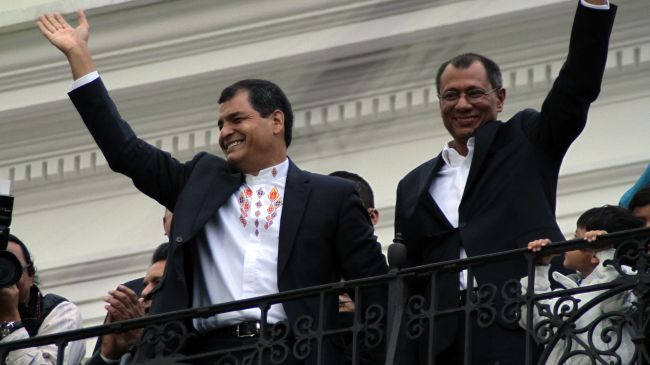
President Rafael Correa swept to a re-election victory on Sunday promising to strengthen state control over Ecuador’s economy and continue using booming oil revenues to build roads, hospitals and schools in rural areas and shanty towns.
Correa won 58% of the votes compared with 24% for runner-up Guillermo Lasso, according to preliminary results released by the electoral authority based on almost 40% of the votes counted. Correa was so confident of his victory that he appeared on state TV less than an hour after polls closed.
“Nobody can stop this revolution,” a jubilant Correa told supporters from the balcony of the Carondelet presidential palace, after claiming victory. He added “we are making history; we are building our own homeland which is Ecuador and the great homeland which is Latin America.“
The populist US-trained economist took power in 2007 and has won strong support among the majority of the population of the country which is poor.
Correa, 49, may now be in line to become Latin America’s main anti-American voice and de facto leader of the ALBA bloc of populist governments as Venezuelan President Hugo Chavez has been silenced during his battle with cancer. Correa said he dedicated his victory to Chavez.
The principal challenge in Correa’s new four-year term will be wooing investors needed to boost stagnant oil production and spur the mining industry. A 3.2 billion dollars debt default in 2008 and aggressive oil contract negotiations scared many off.
Critics view Correa as an authoritarian leader who has curbed media freedom and appointed aides to top posts in the judiciary.
But the fractured opposition failed to make a consolidated challenge. It fielded seven candidates, making it easy for Correa, and he is now on track for a decade in office.
That is rare stability in a country where three presidents were pushed from office by coups or street protests in the decade before Correa took power in 2007. He is already the longest-serving president in Ecuador since the return to democracy in the 1970s following a military dictatorship.
Correa’s success has hinged in part on high oil prices that allowed for liberal state spending, including boosting cash handouts to 2 million people, and spurred solid economic growth.
He has promised to diversify the economy away from its dependence on oil, in part by bringing in new investment for the mining sector. Despite promising reserves of gold and copper, mining operations have barely gotten off the ground.
In a news conference on Sunday after polls closed, Correa played down the need for more foreign investment. He insisted the ultimate goal was to ensure economic growth rather than ”mortgaging“ the country to bring in cash from abroad.
”We welcome foreign investment, and we’re already getting plenty of it,“ Correa said. ”Ecuador is one of the most successful economies in Latin America.”
Ecuadorans also chose a new Congress on Sunday.
The ruling Alianza Pais party was expected to win a majority in the legislature, which would let Correa push ahead with controversial reforms, including a media law and changes to mining legislation, without having to negotiate with rivals.
The results of the vote for Congress are not expected to be known for several days.
Related articles
Ecuador’s Financial Reforms Help Explain Why Voters Likely to Re-Elect Correa
By Alex Main | CEPR Americas Blog | February 14, 2013
On Sunday Ecuadorians will head to the polls to vote for a president and vice president, members of the National Assembly, mayors, and other elected officials. As we’ve done ahead of other elections in Latin America, CEPR has published a report offering some economic context to help understand the choices that voters are likely to make.
The report, entitled Ecuador’s New Deal: Reforming and Regulating the Financial Sector, focuses on the innovative financial reforms that have been implemented since President Rafael Correa took office in 2007. The report explains how these measures helped Ecuador recover from some of the hemisphere’s worst shocks during the world recession. It also shows how the reforms contributed to a substantial increase in government revenue much of which has been channeled toward health, education, housing and other social spending. Given these advances, it is not surprising that the latest polls put Correa at 50 percentage points ahead of his closest opponent.
Earlier today, CEPR issued the following press release outlining the contents of the paper:
A new paper from the Center for Economic and Policy Research (CEPR) examines the financial reforms carried out by the Rafael Correa administration, reforms which the paper concludes are in large part responsible for the economic success Ecuador has experienced over the past several years, including its successful counter-cyclical policies during the global recession after 2008. The paper, “Ecuador’s New Deal: Reforming and Regulating the Financial Sector,” examines the Correa government’s taking control of the Central Bank, implementation of capital controls, increased taxation of the financial sector, and other regulatory reforms. It concludes that these played a major role in bringing about Ecuador’s strong economic growth, increased government revenue, a substantial decline in poverty and unemployment, and other improvements in economic and social indicators.
Ecuador will hold presidential elections on Sunday, February 17. Correa is almost certain to be re-elected; Reuters reports that he “has a lead of as much as 50 percentage points over the nearest of his seven rivals in opinion polls.”
“Ecuador has gone against the conventional wisdom and shown that there are alternatives,” CEPR Co-Director Mark Weisbrot and lead author of the paper said. “By pursuing policies that have prioritized economic development, employment, and poverty reduction over financial and foreign interests, Ecuador has surmounted some of the problems that had previously held it back, and that have hampered progress in other countries.”
The paper notes that by the last quarter of 2012, unemployment had fallen to 4.1 percent, its lowest level on record (for at least 25 years), while the national poverty rate fell to 27.3 percent as of December 2012, 27 percent below its level in 2006.
The paper finds that financial reforms contributed significantly to an unprecedented rise in government revenue under Correa, from 27 percent of GDP in 2006 to more than 40 percent in 2012. This not only allowed for vitally important expansionary fiscal policy, but also a large increase in social spending. The biggest increase was in housing, but there were also significant increases in health care spending and other social spending. The government’s most important cash-transfer program (the Bono de Desarollo Humano) increased by one-fourth, and education funding more than doubled, as a percent of GDP, from 2006-2009.
The paper concludes that “What is most remarkable is that many of these reforms were unorthodox or against the prevailing wisdom of what governments are supposed to do in order to promote economic progress. Taking executive control over the central bank, defaulting on one-third of the foreign debt, increasing regulation and taxation of the financial sector, increasing restrictions on international capital flows, greatly expanding the size and role of government – these are measures that are supposed to lead to economic ruin. The conventional wisdom is also that it is most important to please investors, including foreign creditors, which this government clearly did not do.”
“While not all of Ecuador’s reforms went against orthodox policy advice,” Weisbrot said, “many of them did – and they succeeded. It should be no surprise that Correa is such a popular candidate heading into this Sunday’s elections.”
The paper notes that “Ecuador’s success shows that a government committed to reform of the financial system, can – with popular support – confront an alliance of powerful, entrenched financial, political, and media interests and win. The government also took on powerful international interests as well, in its foreign debt default, its renegotiation of oil contracts, and its refusal to renew the concession for one of the United States’ few remaining military bases in South America.” It notes that this success indicates that developing countries may have more and better policy options than is commonly believed to be the case.
Featured Video
The First Pyrrhic Victory of the Vietnam War
or go to
Aletho News Archives – Video-Images
Frlom the Archives
The 52 Major Jewish American Organizations and Israel Celebrate Passover with the Slaughter of 25 Muslim, Christian and Secular Palestinians
By James Petras • Unz Review • April 8, 2018
Introduction
As of April 7, nearly three thousand unarmed Christian, Muslim and secular Palestinians have been wounded, over three dozen are in critical condition and at least twenty-five unarmed protestors, including children have been assassinated by hundreds of Israeli snipers and heavily armed troops shooting tank shells into crowds of civilians protesting their decades of incarceration by the racist Israeli state.
The Israeli government praised the ‘restraint and morality’ of the IDF, as did the fifty-two Major Jewish American Organizations (MJAO) who largely control the US Congress. These grotesque massacres began during the Christian Holy Week on Good Friday and Easter, coinciding with the Jewish Passover. The self-righteous officials of the MJAO and their relatives and friends broke matzos at joyful Seders as the blood of Palestinians soaked into ground at the fence containing the largest open-air prison camp in history, Gaza.
While tribal loyalties bonded the Israeli and Jewish American leaders, the politicians of the Western oligarchic electoral regimes refrained from criticizing the shocking display of brute force and even defended Israel’s cold blood mass killings of Palestinian civilians in their Gaza prison.
This paper will discuss and analyze the reasons for Israel’s willing Western accomplices and the centrality of its fifth column in the United States. … continue
Blog Roll
 Aletho News
- Top US Counterterrorism Official Resigns in Protest of Operation Against Iran
- Just Get Out! Now!
- Unpacking glaring contradictions in US-Zionist justifications for war against Iran
- Iranian model of warfare bleeds US dry while Persian Gulf states watch and learn: Analyst
- IRGC orders ‘defeated’ US to evacuate industrial facilities in region
- Hegseth’s call for ‘no mercy’ to Iranians deemed war crime
- Iran War Exposes Limits of US Military Power – Journalist
- Even The Neo-Cons Admit The Iran War Is Failing
- Inside the Caucasus Drone Corridor Fueling Tensions With Iran
- ‘Not our war’: Trump’s naval coalition to reopen Strait of Hormuz dead in the water
- If Americans Knew
- Top US counterterror advisor resigns in protest of “war manufactured by Israel” – Not a ceasefire Day 158
- ‘I Liked the House’: When Israeli Soldiers Turn Palestinian Homes into Barracks
- ‘They Were All I Had’: Lebanese Father Buries Parents, 4 Daughters Killed by Israeli Bombing
- Israel and its supporters are causing attacks on Jewish institutions. Case in point: Michigan synagogue tragedy.
- These are the casualties and cost of the war in Iran 2 weeks into the conflict
- Chicago Teachers Union accuses AIPAC of swaying elections with ‘dark money’
- Predictions of another 9/11, amid Israel-US killing spree – Not a ceasefire Day 157
- As US-Israel war on Iran rages, Gaza faces massive dust storm – Not a ceasefire Day 156
- No let-up in attacks on Gaza as Israel takes on Iran, Lebanon – Not a ceasefire Day 155
- ‘Of Course’: IDF Drops Case Against Soldiers Accused of Raping Palestinian Prisoner
- No Tricks Zone
- Storing Green Energy To Last Germany 10 Days Would Require A 60-Million Tonne Battery
- New Studies: UK Sea Levels Were 4 Meters Higher Than Today During The Mid-Holocene
- Destructive Green New Deal: German Energy And Metal Group Warns Of Drastic Crisis
- New Study Documents A 20-Year Pause In Arctic Sea Ice Decline – Driven By Internal Variability
- Wake-up Call: Survey Shows Majority Of Germans Now Favor Postponing Climate Targets!
- Televised! Leading German Political Candidate Tells Schoolchildren CO2 Makes Sun Hotter!
- New Study: A Century Warming Of 1.1°C Is ‘Commonplace’ And ‘Not Unusual’ During This Interglacial
- New Study: ‘Internal Noise’ And Volcanic Forcing Can Trigger 10-15°C Warming Within Decades
- Glaciers Worldwide Are Suddendly Surging, Experts Blame Warming!
- Surprising Discovery: Sahara Is Greening…Billions Of Trees Where Once Thought To Be Barren
 Aletho News