Arms firms implicated in illegal US drone strikes ‘bought influence’ at NATO summit – Reprieve UK
RT | September 8, 2014
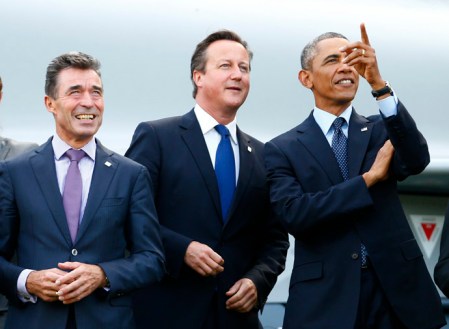
Arms firms that provide core military components for drones deployed by the US to conduct covert strikes in violation of international law allegedly bought access to NATO’s summit in Wales last week, a British human rights charity says.
The defense companies concerned doled out up to £300,000 to ‘exhibit’ their military wares at the conference in Newport. Among the firms present were General Dynamics, Raytheon, Lockheed Martin and MBDA, according to a British government press release.
General Dynamics manufacture Hellfire missiles utilized in most US drone strikes, while Raytheon make the targeting system for the Reaper drone deployed by the CIA and other actors to conduct strikes across the globe. Lockheed Martin operates as a contractor to provide select support services for both the Reaper and Predator, and MBDA is a European company that manufactures the unmanned aerial vehicle (UAV) Brimstone – a variant of the Hellfire missile.
The US drone program has received widespread public criticism both at home and abroad. Critics say attacks carried out in foreign countries, including Yemen and Pakistan, are in violation of both international and US law.
Although US drone strikes have culminated in hundreds of civilian casualties, they are subject to little oversight, according to Reprieve. President Barack Obama has refused to formally acknowledge the program’s existence.
Reprieve’s Legal Director Kat Craig said it’s “deeply worrying” that a group of firms who potentially profit most from this breach of international law were able to buy access into an international global summit like NATO.
“It is unacceptable that the US’ drone campaign, and the UK’s support for it, has been allowed to remain in the shadows for so long”, he added.
“President Obama must be far more open about it – as must his European allies, especially the UK and Germany, about the support they provide.”
Craig suggested the drone manufacturers’ presence at NATO signaled their inherent capacity to buy political influence “behind closed doors,” highlighting the opaque, illicit and legally questionable nature of much of the global arms trade.
Wall Street wins again: Bank of America settlement with US government is insufficient, critics say
RT | August 22, 2014
While the US government touted its “record” settlement reached this week with Bank of America for mortgage fraud that helped fuel the 2008 recession, the details of the agreement indicate yet another light punishment for an offending Wall Street titan.
Bank of America agreed to a $16.65 billion settlement with federal authorities for selling toxic mortgages and misleading investors, the US Justice Department announced Thursday.
“This historic resolution – the largest such settlement on record – goes far beyond ‘the cost of doing business,’” Attorney General Eric Holder said in a statement.
“Under the terms of this settlement, the bank has agreed to pay $7 billion in relief to struggling homeowners, borrowers, and communities affected by the bank’s conduct. This is appropriate given the size and scope of the wrongdoing at issue,” Holder added.
Yet the $7 billion in “relief” is considered a “soft money” fine, in which the bank will reduce some homeowners’ mortgages. Very few homeowners are eligible for the refinancing pursuant to the settlement, AP reported. Those who are eligible may need to wait years to see any settlement aid, as payouts will be ongoing through 2018.
Those already in the hole following a lost home due to foreclosure or a short sale – when a lender takes less money for a home than what the borrower owes – are unlikely to benefit from the terms of the settlement.
Outside of the $7 billion for consumers, the Bank of America settlement includes a $5 billion cash penalty and $4.6 billion in remediation payments. Large portions of the deal will be eligible to claim as business expenses, allowing the mega bank to treat them as tax write-offs.
The Bank of America settlement includes the appointment of an independent monitor to review the consumer relief portion of the agreement. It is yet to be determined when the monitor will be named.
The deal echoes similar agreements the government reached with other Wall Street players, like JPMorgan Chase and Citigroup, for crimes committed surrounding the recent economic recession.
JPMorgan Chase came to a $13 billion settlement in November. The $4 billion supposedly offered to homeowner relief has yet to benefit many in need, according to the advocacy group Home Defenders League. Citigroup reached a $7 billion deal with the government.
Critics of these deals have blasted the US government for its ongoing, lax attitude regarding mass crimes committed by powerful banks that, they say, are not adequately punished for wrongdoing.
“[T]he latest round of settlements deals with misconduct that even though the banks are getting off on the cheap again, the underlying abuses don’t strike at the heart of the too big to fail mortgage securitization complex,” said Yves Smith at Naked Capitalism.
“So the [Obama] Administration can feign being a little more bloody-minded. Even so, the greater and greater proportion in recent deals of funny money relative to real dough show that this is simply another variant of an exercise in optics.”
No major bank executive has faced criminal charges following the mortgage crisis. Without significant retribution for banks and executives that knowingly passed off fraudulent mortgages, Wall Street players will continue to act with impunity, argued Dean Baker, economist and director of the Center for Economic & Policy Research.
“Knowingly packaging and selling fraudulent mortgages is fraud. It is a serious crime that could be punished by years in jail,” Baker wrote. “The risk of jail time is likely to discourage bankers from engaging in this sort of behavior.”
William D. Cohan, a former senior mergers and acquisitions banker, wrote in the New York Times that, not only has the government barely punished those on the hook for Wall Street crimes, the Justice Department has also offered “sanitized” versions of events that led up to the crimes in its accounts given to the public following investigations.
“The American people are deprived of knowing precisely how bad things got inside these banks in the years leading up to the financial crisis, and the banks, knowing they will be saved the humiliation caused by the public airing of a trove of emails and documents, will no doubt soon be repeating their callous and indifferent behavior,” Cohan wrote.
Bank of America resisted the settlement at first, claiming nearly all bad mortgage securities under scrutiny came from Countrywide and Merrill Lynch. Both firms were purchased by Bank of America amid the 2008 financial crisis.
A federal judge in Manhattan ruled in a separate case that Bank of America was liable for the pre-merger mortgages, issuing a penalty of $1.3 billion. The ruling pushed the bank to agree to the settlement. Bank of America CEO Brian Moynihan said Thursday that the deal is “in the best interests of our shareholders and allows us to continue to focus on the future.”
Meanwhile, consumers advocates said the faulty mortgages will continue to haunt homeowners and their own vision of the future.
“It is hard to see how these settlements provide relief commensurate with the harm caused,” said Kevin Stein, associate director of the California Reinvestment Coalition, according to AP. “Countless families and communities have been devastated by predatory loans that should not have been made.”
Following the Thursday announcement of the settlement, Bank of America’s stock rose more than 4 percent.
Oligarchy, not democracy: Americans have ‘near-zero’ input on policy – report
RT | April 15, 2014
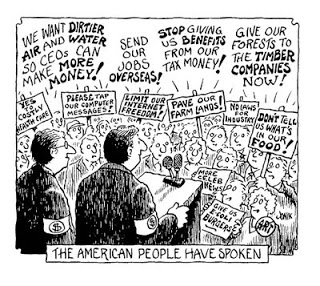
The first-ever scientific study that analyzes whether the US is a democracy, rather than an oligarchy, found the majority of the American public has a “minuscule, near-zero, statistically non-significant impact upon public policy” compared to the wealthy.
The study, due out in the Fall 2014 issue of the academic journal Perspectives on Politics, sets out to answer elusive questions about who really rules in the United States. The researchers measured key variables for 1,779 policy issues within a single statistical model in an unprecedented attempt “to test these contrasting theoretical predictions” – i.e. whether the US sets policy democratically or the process is dominated by economic elites, or some combination of both.
“Despite the seemingly strong empirical support in previous studies for theories of majoritarian democracy, our analyses suggest that majorities of the American public actually have little influence over the policies our government adopts,” the researchers from Princeton University and Northwestern University wrote.
While “Americans do enjoy many features central to democratic governance, such as regular elections, freedom of speech and association,” the authors say the data implicate “the nearly total failure of ‘median voter’ and other Majoritarian Electoral Democracy theories [of America]. When the preferences of economic elites and the stands of organized interest groups are controlled for, the preferences of the average American appear to have only a minuscule, near-zero, statistically non-significant impact upon public policy.”
The authors of “Testing Theories of American Politics: Elites, Interest Groups, and Average Citizens” say that even as their model tilts heavily toward indications that the US is, in fact, run by the most wealthy and powerful, it actually doesn’t go far enough in describing the stranglehold connected elites have on the policymaking process.
“Our measure of the preferences of wealthy or elite Americans – though useful, and the best we could generate for a large set of policy cases – is probably less consistent with the relevant preferences than are our measures of the views of ordinary citizens or the alignments of engaged interest groups,” the researcher said.
“Yet we found substantial estimated effects even when using this imperfect measure. The real-world impact of elites upon public policy may be still greater.”
They add that the “failure of theories of Majoritarian Electoral Democracy is all the more striking because it goes against the likely effects of the limitations of our data. The preferences of ordinary citizens were measured more directly than our other independent variables, yet they are estimated to have the least effect.”
Despite the inexact nature of the data, the authors say with confidence that “the majority does not rule — at least not in the causal sense of actually determining policy outcomes.”
“We believe that if policymaking is dominated by powerful business organizations and a small number of affluent Americans, then America’s claims to being a democratic society are seriously threatened,” they concluded.
Kicking the can: Budget deal will not solve Washington’s problems
RT | October 18, 2013
Despite a deal to lift the debt ceiling and end the government shutdown, the United States is far from a respite, as it won’t address the underlying, internal issues that have usurped its power in the world, economics professor Rodney Shakespeare told RT.
RT: The default is averted. That’s good news, isn’t it?
Rodney Shakespeare: Nothing has been averted. Instead, there’s going to be some sort of meeting between the Democrats and the Republicans, who are two sides of the same coin. And there are three subjects, which they’ll refuse to discuss. The first is the out of control military budget, which ought to be cut to one tenth of what it is at the moment to bring it in line with comparable nations. The second thing is that the system works by exporting jobs. They’ve exported the jobs to about 56,000 enterprises over the last 11 years. That’s five million jobs – and each job creates another three. That’s roughly 15 million jobs which aren’t coming back. And the third thing, which they aren’t going to discuss at this ‘wonderful’ meeting between the Democrats and the Republicans – they will not discuss the core of the issue, which is a corrupt banking system, whose center is the Federal Reserve. Instead, what they’ll do is they’ll blame everything on the poor. So, you see, nothing has been put off. Nothing has been solved. Nothing has been addressed. The situation goes on and ultimately it’s going to result in the final collapse of the dollar. But that may be a year or two off at the moment.
RT: It’s only a temporary fix for the US debt ceiling. But what happens when America is on the verge of running out of cash again?
RS: The same thing is going to happen as is happening at this moment, except that another two or three months will have passed, in which they’ve failed to address the underlying issues and their vanity and the essence of the corruption of the system will not have been addressed. So, you’re going to find at some point that they’ll then…the world will wake up to the overall level of the American debt, which is now just at the point when it becomes unrepairable. And when that happens, you’ll get a sudden, irrevocable slide in the dollar. So, they’ll kick the can down the road for a bit.
RT: It may also be difficult for the rest of the world to understand why there had to be so much last-minute drama in Washington, DC before they reached an agreement. A domestic squabble that held the rest of the world to economic ransom – can the global community afford to risk that again?
RS: The world community should continue doing what it’s quietly doing at the moment: starting to organize it in ways which are separate [from] and outside the West. They should do it in their banking agreements. I’m pleased to say that the BRICs are creating on optic fiber cable, so that the banking can be done away from the West. They should do it by creating different national and central banks, which put out interest-free money. They should make agreements among themselves, particularly among the non-allied nations. This should be political agreements and financial agreements. They must accept that the West now…its economic powers have declined; its political powers have declined. And as of America’s moral authority? Forget it! They are putting out a poisonous depleted uranium. They’re attacking. They’re assassinating. They have no moral authority whatsoever. Everybody else should get on with organizing themselves away from the pariah states, which are now the US, Israel, Saudi Arabia, with their poodles, which are the UK and France. I say to the rest of the world: Get on with it. Organize yourselves and give up this corrupt, out-of-date system, which no longer is providing adequate leadership.
Related article
- RT: Losing faith: Global financiers look to de-Americanize (jhaines6.wordpress.com)
US media failed to cite pundits’ ties to defense industry in Syria strike debate
RT | October 11, 2013
Nearly two dozen of the commentators who appeared on major media outlets to discuss a possible US military strike on Syria had relationships with contractors and other organizations with a vested interest in the conflict, according to a new report.
The Public Accountability Initiative, a non-profit research group dedicated to “investigating power and corruption at the heights of business and government,” determined that 22 of the pundits who spoke to the media during the public debate over whether the US should bomb Syria appeared to have conflicts of interest. Seven think tanks with murky affiliations were also involved in the debate.
Some analysts held board positions or held stock in companies that produce weapons for the US military, while others conducted work for private firms with the relationships not disclosed to the public.
Perhaps the most notable example is that of Stephen Hadley, a former national security advisor to President George Bush who argued in favor of striking Syria in appearances on CNN, MSNBC, Fox News and Bloomberg TV. He also wrote an editorial in The Washington Post with the headline, “To stop Iran, Obama must enforce red lines with Assad.”
Nowhere in those appearances was it disclosed, according to the report, that Hadley is a director with Raytheon, a weapons manufacturer that produces the Tomahawk cruise missiles the US almost certainly would have used had it intervened in Syria. Hadley earns an annual salary of $128,5000 from Raytheon and owns 11,477 shares of Raytheon stock. His holdings were worth $891,189 as of August 23.
“We found lots of industry ties. Some of them are stronger than others. Some really rise to the level of clear conflicts of interest,” Kevin Connor, co-author of the report, told The Washington Post. “These networks and these commentators should err on the side of disclosure.”
The report found that, out of 37 appearances of the pundits named, CNN attempted to disclose that individual’s ties a mere seven times. In 23 appearances on Fox News there was not a single attempt to disclose industry ties. And in 16 appearances on NBC or its umbrella networks, attempts at disclosure were made five times.
Retired General Anthony Zinni, former Commander-in-Chief of US Central Command, made multiple appearances on CNN and CBS. He is an outside director at BAE Systems, which is among the largest military service companies in the world and one that received $6.1 billion in federal contracts in 2012, serves on the Advisory Board of DC Capital Partners, a private equity firm that invests in defense contractors, and a Distinguished Senior Advisor at the Center for Strategic and International Studies.
Zinni advocated a strike not just on Syria, but told CNN’s Candy Crowley that American hesitation in the Middle East has pushed US adversaries to act.
“Knowing the Iranians, they see everything as a potential opportunity to exploit,” he said. “And I’m sure they are calculating much how they could take advantage of this and maybe push the edge of the envelope.”
The retired general, speaking to the Post via email, said his membership is publicly available online.
“The media who contact me for comment should post any relevant info re my background including my board positions if they desire,” he wrote.
This report comes after Syria researcher Elizabeth O’Bagy was fired from the Institute for the Study of War think-tank for lying about her credentials. Multiple US lawmakers, most notably Secretary of State John Kerry, cited an opinion piece O’Bagy wrote in the Wall Street Journal when calling for a military intervention. It was soon revealed that O’Bagy did not disclose her ties to a lobby group advocating for Syrian opposition forces when penning the column for the Journal.
Related article
- they’re shameless, mindless, unprecedented nitwits, all of them (niqnaq.wordpress.com)
Worldwide corruption on the rise as public trust plummets – report
RT | July 10, 2013
A report by Transparency International has revealed the extent of worldwide corruption over the last two years, with Israel and Greece showing the highest levels among developed countries. Politicians are considered the most corrupt among all sectors.
The Global Corruption Barometer 2013, conducted by the Berlin-based anti-corruption watchdog, is a sampling of over 114,000 opinions of people from 107 countries. The survey asked participants about corruption and the institutions engaged in it.
The report shows that corruption numbers have increased over the last two years, along with the number of people exhibiting distrust toward their governments and law enforcement agencies.
Before the 2008 financial meltdown, 32 per cent of people believed their governments to be effective at tackling corruption. That figure has now fallen to just 23 per cent. Transparency International said in a press release that the report “shows a crisis of trust in politics and real concern about the capacity of those institutions responsible for bringing criminals to justice.”
The survey asked participants to rank the corruption levels of various institutions from 1 to 5, with 1 being “not corrupt at all” and 5 being “extremely corrupt.”
Political parties were perceived to be the most corrupt institutions worldwide, scoring 3.8 out of 5. Police forces came in second place with a score of 3.7. Public officials, civil servants, and the parliament and judiciary came in third place, scoring 3.6.
The media came in ninth place, although it was voted to be the most corrupt sector in Britain. The UK media has lost the respect of many residents in recent years – around 69 per cent of survey participants now believe the media is corrupt, compared to just 39 per cent in 2010.
“This very sharp jump is in large part due to the series of scandals around phone hacking, the Leveson Inquiry, and the concentration of media ownership,” said Robert Barrington, head of the British wing of Transparency International.
Business and private sectors, along with the healthcare sector, came in at eighth on the corruption scale, with the education system not far behind. The military and NGOs took the 10th and 11th places.
Although religion came in last place on the corruption scale, it still ranked among the most corrupt in certain countries, including Israel, Japan, Sudan and South Sudan.
Of all OECD members surveyed, the corruption levels of Greece and Israel came in first and second place respectively, with their political and cultural institutions ranking at the top of the corruption meter.
Over 80 per cent of Israelis believe that one must have contacts very high up in the public sector in order to get anything done. Transparency International says it sees “deep-rooted failures of governance” in Israel. A similar figure was seen in Lebanon, Russia, and Ukraine.
Arab countries have seen a rise in corruption since their 2011 uprisings, although public anger against corrupt officials was what sparked the Arab Spring in the first place. The expectation of having cleaner, more transparent regimes did not match the countries’ political and business realities.
Of the four countries that experienced regime change in the aftermath of the Arab Spring, Egypt, Tunisia and Yemen feel that corruption has only increased since 2011. While 64 per cent of Egyptians think corruption is on the rise, a staggering 80 per cent of Tunisians believe that to be the case within their country. Eighty-four per cent of Lebanese citizens believe corruption to be on the rise in within their nation, while only around half of Libyans believe that corruption is worsening.
Egypt leads the pack in anti-police sentiments, largely because police violence has injured so many people over the past year. The 80 per cent disapproval rating dropped to only 45 per cent when Egyptians were asked about the military, which just several days ago ousted former Islamist-backed president Mohamed Morsi.
To glean more analysis on the increasing slide into corruption and public distrust of political institutions, RT talked to Finn Heinrich, who is director of research at Transparency International in Berlin. He sees the world as split into two major trends. The first is petty corruption and bribery in the southern hemisphere – mostly Africa, where citizens feel there is no other way to take care of one’s day-to-day needs. The second is corruption on a more official level, which is witnessed in the northern and western parts of the world – mainly in business and politics governed by financial greed.
As a way out of the situation, Heinrich believes “you really need to be in it in a long-term. You can’t expect quick gains from the fight against corruption. So, I think what we see in many of those countries are the upheavals which you find in many countries, including many post-communist countries, after revolution where old systems are no longer intact and new systems are yet to be built. So, corruption is on the rise. We hope that the new leaders, compared to their predecessors, are really taking the challenge of setting up systems of transparency and accountability much more serious.”
Heinrich thinks that only an integral and comprehensive effort can last, and that effort must include both the government and its citizens.
Transparency International is the world’s foremost organization on fighting corruption. It has 90 chapters worldwide, which aim to raise awareness and establish methods of tackling corruption and measuring its harmful effects.
‘Vitoria!’ Mass protests force Brazil congress to reject ‘bill of discontent’
RT | June 26, 2013
Brazil’s legislative body has thrown out a proposed constitutional amendment, which was a key grievance of protesters across the country. The government is also planning to introduce a range of political reforms to appease demonstrators.
In what in being seen as a victory for people power, the measure was defeated on Tuesday by Congress by 430 votes to nine; with the Rio Times saying the protests were “largely fueled by social media and citizen journalists.”
The amendment, known as PEC 37, would have limited the power of state prosecutors to investigate crimes.
The protesters had argued that PEC 37 might have opened the way to more corruption; a problem which is endemic in Brazil.
Brazil ranks 69 out of 174 countries on the 2012 Transparency International index, a score that indicates significant problems with corruption.
The defeat of PEC 37 will keep public prosecutors at the forefront of the fight against corruption. If the amendment had become law, it would have granted power to carry out criminal investigations exclusively to the police.
Critics to the bill argued that it would have prevented prosecutors from conducting fair, impartial and effective criminal investigations, particularly into organized crime and corruption, in which the police themselves have been embroiled. In December last year 63 police officers were arrested after a yearlong bribery investigation.
The police in Brazil are amongst the most corrupt in the world and have been mired in recent years in a number of corruption scandals.
Congress also voted Tuesday to funnel all revenue and royalties from newly-discovered oil fields off the Brazilian coast into education and health.
The new fields are among the largest finds in recent years and, once fully operational, are expected to produce tens of billions of barrels of oil; although they are located deep on the ocean floor and extracting the oil will require expensive new technology and carries huge risks.
Protestors also voiced their anger at other issues, which they say the government is mishandling, including soaring levels of corruption, poor public services and the huge cost of staging the 2014 World Cup and 2016 Summer Olympics, both to be held in Brazil.
The government, though, has promised a range of initiatives, which they say will combat corruption and improve public services.
A referendum proposing political reform is meant to address campaign financing and political representation, and the government says a vote may take place as soon as September 7.
A controversial plan to bring in foreign doctors to reverse a shortfall in the country is being pushed through despite the objections of Brazilian medical practitioners and an increase in public transport fares in many cities has also been scrapped. The President of the Senate, Renan Calheiros, has even proposed free transport for students.
Yet it is still unclear whether or not these hasty political concessions are having an impact. Protests are due to continue in the city of Belo Horizonte Wednesday, with tens of thousands of people expected to take part.
In a security nightmare for police, the demonstration will take place at the same time as the semifinal of the Confederation Cup between Brazil and Uruguay. One protest group has said it plans to protest outside the national team’s hotel.
Last Saturday there were violent clashes in Belo Horizonte during another protest and President Rousseff has warned against a repeat of violence.
Court blocks NYPD bid to fire whistleblower as commissioner brags of ‘awesome powers’
RT | June 21, 2013
The New York City Police Department’s latest attempt to fire Adrian Schoolcraft, the whistleblower who secretly recorded evidence of corruption among his superiors over three years ago, was blocked this week in federal court.
Schoolcraft has said he began wearing a microphone to defend himself against citizens’ allegations that he used racial slurs while policing the streets of Bedford-Stuyvesant, a poor and primarily African-American section of Brooklyn. By wearing the device from June 1, 2008 until October 15, 2009, though, he soon began recording directions from NYPD higher-ups who pressured officers to fill monthly arrest quotas, which is illegal.
“He wants three seat belt [summonses], one cell phone, and 11 others,” one police sergeant is heard saying on the tape. “I don’t know what the number is, but that’s what [an executive officer] wants.”
Upon complaining of corrupt policies and wrongful arrests, Schoolcraft has said, he began receiving threats from fellow police officers and was eventually reassigned to a desk job.
Three weeks after he told the NYPD the damning recordings existed, Schoolcraft’s home was raided by a large group of officers who forcibly checked him into a psychiatric ward in Queens citing suicidal tendencies. Approximately twelve of Schoolcraft’s superiors were on hand at his home. Reportedly among them was Paul Browne, a top aide to Commissioner Ray Kelly, whose presence would indicate Kelly knew of and approved of the raid.
After Schoolcraft refused treatment, the officers guarding him at a Queens hospital handcuffed him to a bed and prevented him from using a telephone. He was held there for three days until his father tracked him down and signed him out. The Schoolcraft family later received a bill for $7,185 for his stay at the facility.
Schoolcraft eventually turned over his recordings, including of the night when he was dragged to the hospital, to the Village Voice, which dubbed the audio “The NYPD Tapes.” In 2009 and 2010, the NYPD charged Schoolcraft with approximately two dozen charges of leaving work early, failing to respond to department summonses, failure to obey an order, being away without leave, and others.
The department could have tried and fired Schoolcraft in early 2010, the Voice reported, but presumably suspended him instead because of the bad publicity that would come as a natural result of dismissing a man for exposing corruption.
“I think within the precinct, he was probably seen as a little bit eccentric,” Graham Rayman, a reporter for the Village Voice, told This American Life in 2010. “And also, he wasn’t going with the program. And anyone who doesn’t go with the program is automatically marked.”
For nearly four years he has been on leave without pay, waiting for the start of a federal lawsuit he filed against the department for intimidation and retaliation.
In response, the NYPD filed its own administrative suit seeking to fire Schoolcraft, a move Schoolcraft’s lawyers said will unduly influence the verdict in the original suit. The department was blocked from filing that suit this week.
“You have the power to arrest, to take away someone’s liberty. You have the power and the authority to use force and sometimes deadly force,” Kelly said this week in a speech to this year’s graduating class of the NYPD academy. “Now these are awesome powers.”
The commissioner, quoted by CBS, also said that different ethnic groups are “not always happy” with the department and that “all it takes is one errant police officer” to undermine the “great institution” that has been built by generations.
Related articles
- Judge in Whistleblower Cop Case Blocks City Move to Fire Him (blogs.villagevoice.com)
- NYPD Cop Arrests Man for Photographing Police Station from Public Sidewalk (photographyisnotacrime.com)
Featured Video
America Racing to Strategic Defeat in Iran
or go to
Aletho News Archives – Video-Images
From the Archives
Should Europeans ‘Thank’ the Americans for Destroying Nord Stream?
By Robert Bridge | Strategic Culture Foundation | September 29, 2022
With an investigation continuing into the destruction of the Nord Stream gas pipeline that provided energy supplies to Europe from Russia, there appears to be just one prime suspect, and that should surprise nobody.
Following the sabotage of the Nord Stream 1 and 2 gas pipelines, former Polish Foreign Minister Radoslaw Sikorski already seemed to know the identity of the perpetrator when he tweeted out: “Thank you, USA.”
At first glance, it seemed that Sikorski was speaking sarcastically, berating Washington for carrying out an attack that will have severe repercussions for the people of Europe. After all, how could anyone see any good coming from the termination of Europe’s primary source of gas reserves with winter just around the corner? It was Sikorski’s homeland of Poland, after all, that urged its citizens to collect firewood in the face of dwindling gas reserves.
In fact, the Polish diplomat was speaking one-hundred percent literally… continue
Blog Roll
 Aletho News
- Growing insecurity, soaring prices fuel protests in north as regime bans evacuation: Sources
- Iran denies responsibility for ‘depraved’ attack on Kuwait desalination plant
- Bring The Troops Back. End This War Now!
- Can we please stop calling Israel the ‘only democracy in the Middle East’ now?
- US should start removing its troops for Germany, proposes AfD co-leader Chrupalla
- Iran Red Crescent: 600 educational centers attacked in US-Israeli ‘war crimes’
- Russian Oil Tanker Arrives in Cuba Amid U.S. Blockade
- America Racing to Strategic Defeat in Iran: Lt Col Daniel Davis
- FTC Warns Visa, Mastercard, PayPal, Stripe Over Political Debanking
- Russian tanker approaches Cuba despite US oil blockade
- If Americans Knew
- Israeli police block Catholic cardinal from entering Church of the Holy Sepulchre on Palm Sunday
- Israel is assassinating journalists again, more than any other nation, anywhere, ever – Not a ceasefire Day 170
- Over 300 US service members wounded, majority have brain injuries – Not a ceasefire Day 169
- Researchers at Human Rights Watch Resign Over Blocked Report on Palestinian Refugee Return
- Jewish Groups Are Backing a War Americans Don’t Want
- Eric Fingerhut Thinks He’s the President of the Jews
- Top Jewish Philanthropists, Rabbis Urge Israeli President to Take Action Against ‘Jewish Extremists’
- Don’t Be Fooled. Zionist Leaders Have Always Wanted to Control Southern Lebanon
- Israel’s widespread use of torture is a core element of its genocide against the Palestinian people
- In Israel’s War on Iran, Many Middle East US Bases Rendered “All But Uninhabitable”
- No Tricks Zone
- New Study Finds Warming Saves Lives…Cold Temperatures 12 Times More Deadly Than Excess Heat
- German Science Blog Accuses PIK Climate Institute Of Hallucinating Climate Tipping Points
- Devastating Assessment Of Comirnaty Vaccine By Former Senior Pfizer Europe Toxicologist
- New Study: CO2 Is ‘Effectively Negligible’ As An Explanatory Climate Change Factor Since 2000
- Former Pfizer Toxicologist Dr. Helmut Sterz Tells Bundestag Hearing Pfizer Vaccine Should Have Never Been Approved
- Energy Expert: Germany’s Nuclear Phaseout Was A “500 Billion Euro Mistake”
- New Research: South Australia’s Mid-Holocene Sea Surface Temperatures Were 4°C Warmer Than Today
- Storing Green Energy To Last Germany 10 Days Would Require A 60-Million Tonne Battery
- New Studies: UK Sea Levels Were 4 Meters Higher Than Today During The Mid-Holocene
- Destructive Green New Deal: German Energy And Metal Group Warns Of Drastic Crisis
 Aletho News