Project Artichoke: 70 Years Ago, CIA Discussed Hiding Mind-Control Drugs in Vaccines
By Michael Nevradakis, Ph.D. | The Defender | February 24, 2026
In the 1950s, the CIA brainstormed ways to secretly perform mind control on humans — including concealing drugs in vaccines and widely consumed food products, a newly unearthed CIA document revealed. The Daily Mail first reported the story on Monday.
The seven-page document, “Special Research for Artichoke,” is dated April 23, 1952. It describes a series of ideas for how to develop chemicals designed to alter human behavior and thought.
The proposals contained in the document were part of the CIA’s top-secret Project Artichoke, which ran from 1951 to 1956, according to the Daily Mail.
The document, declassified in 1983, recently circulated on social media. However, it was not published in the CIA’s online reading room until last year.
“Some of the suggestions are controversial,” the document states. The proposals included administering drugs in secret as part of a “long-range approach to subjects.”
According to the document:
“This study should include chemicals or drugs that can effectively be concealed in common items such as food, water, coca cola, beer, liquor, cigarettes, etc.
“This type of drug should also be capable of use in standard medical treatments such as vaccinations, shots, etc.”
CIA experimented on humans as part of Project Artichoke
The document also included a special field of research for “bacteria, plant cultures, fungi, poisons of various types, etc.,” that are “capable of producing illnesses which in turn would produce high fevers, delirium, etc.”
This included “species of the mushroom” that “produce a certain type of intoxication and mental derangement.”
Also among the proposals was a suggestion to research “diet” or “dietary deficiencies” on prisoners and on people undergoing interrogation, including using “specially canned foods having elements removed.”
The document included proposals for both short-term and long-term use on humans. Drugs deemed most suitable for long-term use would be designed to produce an “agitating effect (producing anxiety, nervousness, tension, etc.) or a depressing effect (creating a feeling of despondency, hopelessness, lethargy, etc.).”
According to The Daily Mail, the CIA experimented on humans as part of Project Artichoke. The experiments often involved “vulnerable subjects, including prisoners, military personnel and psychiatric patients.” The experiments were usually performed “without informed consent.”
According to Ben Tapper, a Nebraska chiropractor who was included in the “Disinformation Dozen” list in 2021 for questioning vaccine safety, the document exposes “a disturbing reality that government agencies have historically explored ways to manipulate human behavior through chemical and biological means, including concepts involving food and medical interventions.”
“This is not speculation or conspiracy, and it should deeply concern every American who values bodily autonomy and informed consent,” Tapper said.
Precursor to the CIA’s MK-Ultra mind control experiments?
The Daily Mail cited CIA documents suggesting that U.S. intelligence agencies were concerned that enemy nations had developed their own mind and behavioral control techniques. This led the agency to prioritize the development of its own methods.
Project Artichoke “served as a precursor” to the MK-Ultra program, which the CIA launched in 1953. That program “broadened mind-altering experiments on a larger scale,” the Daily Mail reported.
Many of the documents related to this type of experimentation were destroyed in 1973, “leaving the full extent of the research and how far it progressed unknown.”
Naomi Wolf, Ph.D., CEO of Daily Clout and author of “The Pfizer Papers: Pfizer’s Crimes Against Humanity,” told The Defender that the documents further confirm a long history of intelligence agency research targeting human thought and behavior.
“Sadly, it’s long been established that our intelligence agencies, and those of our enemies, have sought to alter human consciousness and behavior, often without the subjects’ consent. The existence of MK-Ultra, the clandestine project into which Project Artichoke evolved, is well documented,” Wolf said.
John Leake, vice president of the McCullough Foundation and author of the forthcoming book, “Mind Viruses: America’s Irrational Obsessions,” said, “Researchers have long suspected that the Church Committee’s revelation of the CIA’s notorious MK-Ultra mind control experiments, mostly using LSD, had the effect of obscuring the agency’s much larger Project Artichoke.”
Leake cited evidence suggesting that a 1951 mass poisoning in Pont-Saint-Esprit, France, in which 250 residents experienced severe hallucinations and seven people died, was a Project Artichoke experiment. The outbreak was officially attributed to contaminated bread from a local bakery.
Leake said the 1952 document is “consistent with the suspicion that the CIA was seeking to discover mind control methods for even large populations.”
In 2024, a Reuters investigation revealed that the CIA operated a secret propaganda campaign involving vaccines in the Philippines. The campaign attacked what the agency perceived as China’s “growing influence” in the country by targeting the Chinese-made Sinovac COVID-19 vaccine through the use of phony online accounts spreading “anti-vax” messaging.
Michael Rectenwald, Ph.D., author of “The Great Reset and the Struggle for Liberty: Unraveling the Global Agenda,” said the Project Artichoke revelations “make it clear that the CIA has posed an enormous threat to U.S. citizens, in addition to the horrors it unleashes on non-U.S. target governments and populations.”
Project Artichoke wanted to enlist help from Army’s Chemical Warfare Service
The 1952 Project Artichoke document also included a recommendation to involve the U.S. Army Chemical Warfare Service in the project’s efforts, citing its experience with “exhaustive studies along these lines.”
This proposal bears a resemblance to recent suggestions that COVID-19 — and the response to the pandemic — were coordinated at high levels of government, military and intelligence agencies.
Last year, former pharmaceutical research and development executive Sasha Latypova and retired science writer Debbie Lerman released the “Covid Dossier,” presenting evidence of the “military/intelligence coordination of the Covid biodefense response in the US, UK, Australia, Canada, the Netherlands, Germany, and Italy.”
According to Latypova and Lerman, “Covid was not a public health event” but “a global operation, coordinated through public-private intelligence and military alliances and invoking laws designed for CBRN (chemical, biological, radiological, nuclear) weapons attacks.”
Leake said “it is far from clear” that the Church Committee hearings of 1975 “put a complete end to CIA covert programs.” He cited the possible laboratory development of the SARS-CoV-2 virus as an example.
“The laboratory creation of SARS-CoV-2 with gain-of-function techniques developed at the University of North Carolina-Chapel Hill, and the U.S. military’s involvement in developing and distributing of mRNA COVID-19 vaccines, should … be regarded as possible outgrowths or even continuations of Project Artichoke,” Leake said.
Experts question similarities between Project Artichoke, COVID vaccines
In a Substack post today, epidemiologist Nicolas Hulscher drew a potential connection between Project Artichoke and the development of COVID-19 vaccines. Hulscher cited recent peer-reviewed studies that identified the vaccines’ adverse impact on neurological health and “surging rates of cognitive decline.”
Hulscher wrote:
“Disturbingly, since 2021, over 70% of humanity received a neurotoxic agent masquerading as a ‘vaccine.’ The same goals outlined in the CIA document (vaccines/drugs capable of covertly inducing anxiety, depression, and lethargy) are now being observed in COVID-19 vaccinated populations. …
“… If the CIA was secretly discussing covert methods to alter human behavior in the 1950s, it would be no surprise if similar classified projects emerged in the decades that followed.”
A 2024 paper published in the journal Molecular Psychiatry investigated psychiatric adverse events among over 2 million people in South Korea. The study found that “COVID-19 vaccination increased the risks of depression, anxiety, dissociative, stress-related, and somatoform disorders, and sleep disorders while reducing the risk of schizophrenia and bipolar disorder.”
A 2025 study published in the International Journal of Innovative Research in Medical Science found “alarming safety signals regarding neuropsychiatric conditions following COVID-19 vaccination, compared to the influenza vaccinations and to all other vaccinations combined.”
This included increases in schizophrenia, depression, cognitive decline, delusions, violent behavior, suicidal thoughts and homicidal ideation.
“The fact that mRNA vaccines were designed to cross the blood-brain barrier and inflame the brain — or at least, they were known to do so, during their manufacture and distribution — should give us pause in light of this news,” Wolf said.
Wolf said the latest revelations, “while shocking, provide all the more reason for us to be critical of opaque, coercive or untested vaccination programs, additives in food and water, and toxic or opaque geoengineering programs.”
Tapper said the revelations reinforce “the urgent need to protect individual liberty, medical freedom, and ethical boundaries in science and public health.”
“The lesson here is simple: vigilance is necessary when governments claim authority over the human body and mind,” Tapper said.
This article was originally published by The Defender — Children’s Health Defense’s News & Views Website under Creative Commons license CC BY-NC-ND 4.0. Please consider subscribing to The Defender or donating to Children’s Health Defense.
Epstein Pitched JPMorgan Chase on Plan to Get Bill Gates ‘More Money for Vaccines’
By Michael Nevradakis, Ph.D. | The Defender | February 10, 2026
In the years leading up to the COVID-19 pandemic, Bill Gates and key figures from the Gates Foundation regularly interacted with Jeffrey Epstein, discussing ways to finance and develop a global pandemic preparedness and vaccination network.
The communications between Gates and Epstein were included in the “Epstein Files” released Jan. 30 by the U.S. Department of Justice (DOJ). Last year’s passage of the bipartisan Epstein Files Transparency Act prompted the release.
Sayer Ji told The Defender the files show that Epstein “functioned as a switchboard” connecting “hedge funds, central banks, billionaires, academic institutions and global health initiatives.”
Ji published his analysis of health- and medical-related information in the files in a series of Substack articles and posts on X.
Seamus Bruner, director of research at the Government Accountability Institute, said the files revealed the workings of a network of “Controligarchs on steroids, but with shocking new receipts.”
Bruner said the files showed that Epstein helped develop “the architecture for pandemic profiteering” years before the COVID-19 pandemic.
The documents largely date from the 2010s — after Epstein’s 2008 conviction for soliciting underage sex and his inclusion on a registry of sex offenders.
Ji noted that months before the start of the COVID-19 pandemic, many of the same actors who appear in the Epstein files participated in Event 201 — a simulation of a global pandemic caused by a coronavirus.
The pandemic preparedness infrastructure built in the years before the pandemic helped lead to this simulation, Ji wrote.
According to The Hill, members of the U.S. Congress began reviewing unredacted versions of the documents on Monday.
Rep. Thomas Massie (R-Ky.), who co-sponsored the Epstein Files Transparency Act along with Rep. Ro Khanna (D-Calif.), told The Defender the documents’ release is about justice, not politics.
“Rep. Ro Khanna and I have tried to keep the Epstein files from being political. The Democrats want to make it about Trump, and the Republicans want to make it about the Clintons. We want to make it about the survivors and getting them justice and transparency,” Massie said.
Gates, Epstein and the ‘architecture behind pandemics as a business model’
Ji’s series of Substack posts revealed what he described as “a 20-year architecture behind pandemics as a business model — with Bill Gates at the center of the network,” along with multinational financial institutions like JPMorgan Chase.
The documents, dating from 2011 to 2019, illustrate an “architecture whose foundations predate the COVID-19 era by more than a decade,” Ji wrote. He said they constitute evidence of “a major Wall Street bank asking a convicted sex offender to define the architecture of a Gates-linked charitable fund.”
The documents included several emails outlining the development of a Gates-led charitable fund. A Feb. 17, 2011, email from JPMorgan Chase’s Juliet Pullis to Epstein included questions from the “team that is putting together some ideas for Gates.”
Epstein’s reply outlined how this fund could be structured. The proposal would be developed further in the following months.
In a July 26, 2011, email from Epstein to JPMorgan Chase executive Jes Staley, on which Boris Nikolic, Gates’ chief science and technology adviser, was copied, described a “silo based proposal that will get bill [Gates] more money for vaccines.”
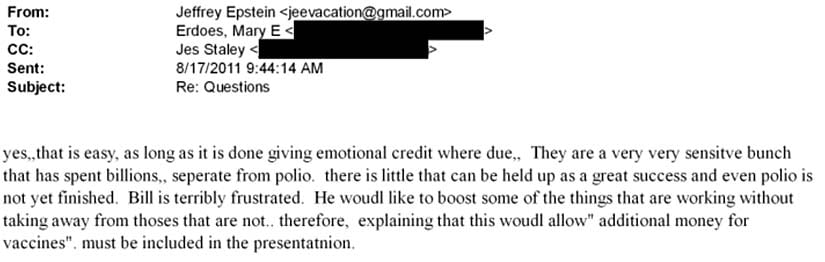
By Aug. 17, 2011, Staley and Mary Erdoes, then-CEO of JPMorgan Asset and Wealth Management, were discussing more details of the proposed fund, including developing “an offshore arm — especailly for vaccines” and projecting “billions of dollars” in donations within two years.
In a response later that day, Epstein said Gates was “terribly frustrated” at the slow pace of establishing the fund. He said Gates was insistent that “additional money for vaccines” be included in an upcoming presentation about the fund.
By Aug. 31, 2011, JPMorgan Chase had apparently developed a proposal called “Project Molecule,” where the bank would partner with the Gates Foundation to develop a perpetual charitable fund for pandemic preparedness and surveillance, vaccine promotion and disease eradication.
According to Ji, the proposal contains many of the ideas Epstein had previously discussed with JPMorgan Chase executives. It also contained plans to spend millions of dollars to purchase oral polio vaccines for Afghanistan and Pakistan, a rotavirus vaccine for Latin America, and a meningitis vaccine for Africa.
The proposal suggested that Melinda Gates chair the fund’s strategic program/grant and distribution committee and that Erdoes, Warren Buffett, Jordan’s Queen Rania and Seth Berkley, CEO of Gavi, the Vaccine Alliance, also participate. The Gates Foundation funded Gavi’s launch in 1999 and holds a permanent seat on its board.
Ji wrote that while Epstein’s name does not appear in the Project Molecule proposal, it acts as the “institutional translation of the architecture he was sketching informally.”
By 2013, these efforts appear to have led to the launch of the Global Health Investment Fund. A confidential Sept. 23, 2013, briefing described the fund as “the first investment fund focused on global health drug and vaccine development.” The fund promised investors annual returns of 5%-7%.
Among the attendees at the fund’s September 2013 launch were JPMorgan Chase CEO Jamie Dimon and representatives of Pfizer, Merck and GlaxoSmithKline (now GSK).
Gates could ‘work with anyone on earth’ but ‘chose a registered sex offender’
According to Ji, Nikolic’s involvement is significant. In August 2013, Gates and Epstein signed an agreement, in which Gates “specifically requested” that Epstein “personally serve” as Nikolic’s representative. The letter noted Epstein’s “existing collegial relationship” with Gates.
“This agreement was executed five years after Epstein’s conviction for soliciting a minor for prostitution,” Ji wrote. “Gates had the resources to work with anyone on earth. He chose a registered sex offender — and put it in writing.”
The documents showed that a month earlier — on July 18, 2013 — Epstein authored a draft email apparently intended for Gates. It references Epstein’s friendship with Gates, his disappointment that Gates sent him an “unfriendly strongly worded email,” and referenced sordid communications the two apparently previously shared.
“TO add insult to the injury you them implore me to please delete the emails regarding your std, your request that I provide you antibiotics that you can surreptitiously give to Melinda and the description of your penis,” Epstein wrote.
In a video posted on X, Michael Kane, director of advocacy for Children’s Health Defense, said that while it’s unknown whether Epstein ever sent that email to Gates, “the next month they’re in a contract together.”
“I think Bill Gates got the message,” Kane said.
In November 2023, a federal judge approved a $290 million settlement between JPMorgan Chase and over 100 women who accused Epstein of sexual abuse. The women alleged that JPMorgan Chase continued doing business with Epstein despite internal warnings over a span of several years.
“JPMorgan banked Epstein for years despite clear red flags — over $1 billion in suspicious transactions flagged internally and ignored. They knew. They didn’t care,” wrote The Truth About Cancer.
Did Epstein play role in launch of the ‘biosecurity state’?
According to Ji, the documents provide a roadmap for how a pandemic preparedness infrastructure was developed and how it helped make Event 201 possible.
“By the time Event 201 convened, the architecture … was no longer conceptual. It had been funded, structured, bonded, insured, staffed, and legally papered. What remained was the rehearsal,” Ji wrote.
September 2014 documents show that Gates disclosed his upcoming meeting with President Obama to Epstein, just as an adviser to then-Israeli Prime Minister Ehud Barak sent Epstein an invitation to a private, off-the-record reception with Obama the following month.
Ji said the communications occurred during “the week Ebola was formally reclassified as a threat to international peace and security.” He said the timing is significant, as this “was the week the biosecurity state was born.”
According to Ji, these developments helped activate the infrastructure outlined in Project Molecule, where Epstein acted as a node for Ebola-related project proposals.
This included Epstein receiving a United Nations (U.N.) diplomat’s proposal for the development of a “Nexus Centre for peace and health” that would take “into account the serious impact of Ebola,” and a proposal by a group of scientists for a pre-symptomatic Ebola detection system using PCR testing.
The scientists behind the proposal — affiliated with a U.S. military biolab at Fort Detrick, the Centers for Disease Control and Prevention and the National Institutes of Health — asked Epstein to send the proposal to Gates and the Gates Foundation.
By October 2014, Epstein was warning Kathy Ruemmler, then White House counsel to Obama, of the political cost if Obama didn’t take action on Ebola. By 2015, Epstein was acting as an intermediary in efforts to convene global experts who would “discuss how we can most effectively address and prevent pandemics.”
The proposal, by the International Peace Institute’s Terje Rød-Larsen, led to the convening of a May 2015 closed-door meeting in Geneva, Switzerland, titled “Preparing for Pandemics: Lessons Learned for More Effective Responses.” The World Health Organization (WHO), World Bank and U.N. were involved with the meeting.
The meeting’s agenda included sessions addressing “how pandemics should be anticipated, how authority should be exercised, how multiple stakeholders should be coordinated, and — critically — what legal, institutional, and financial mechanisms must be put in place in advance to enable rapid, centralized response,” Ji wrote.
According to Ji, the COVID-19 pandemic response has its roots in the 2014 Ebola response, as Ebola “was the first disease to formally justify the suspension of normal political and sovereign constraints on a global scale. … When the next global health emergency arrived — COVID-19 — the playbook was already written.”
“Epstein appears in the background of precisely these formative conversations — serving as a connector between global finance, philanthropic capital, and biological risk governance,” Ji told The Defender.
Epstein involved in ‘strain pandemic simulation’ two years before COVID
By 2017, these conversations led to proposals for pandemic simulations.
In a January 2017 iMessage thread between Epstein and an unidentified physician seeking help in finding a new job, the physician cited “expertise with public health security.”
The physician, who had experience at the U.N., WHO, Gates Foundation and World Bank, said he “just did pandemic simulation,” which could become a “big platform.”
Referring to Gates, the physician told Epstein, “He hates mental health but he’s crazy about vaccines and autism stuff. That could be start to a more broad conversation.”
A March 2017 email chain, which included Epstein and Gates, discussed efforts by the then-bgC3, Gates’ private strategic office, to develop “Follow-up recommendations and/or technical specifications for strain pandemic simulation.”
Ji noted that in 2017, the Coalition for Epidemic Preparedness Innovations (CEPI) was launched at the World Economic Forum (WEF), with Gates Foundation funding and a goal of creating “pandemic-busting vaccines” within 100 days. Later that year, the World Bank issued the first-ever pandemic bonds.
Event 201, held just six weeks before the first publicly acknowledged COVID-19 cases were announced, involved the Gates Foundation, WEF and the Johns Hopkins Center for Health Security. Global financial institutions, media organizations and intelligence agencies also participated.
The simulation focused on the response to a novel coronavirus outbreak by governments, pharmaceutical companies, media outlets and social media platforms.
Ji said the Epstein Files don’t show that COVID-19 was planned or manufactured, or that Event 201 led to COVID-19. Instead, they prove that “the institutional infrastructure to capitalize on exactly this kind of crisis was already built, tested, staffed, and insured.”
This article was originally published by The Defender — Children’s Health Defense’s News & Views Website under Creative Commons license CC BY-NC-ND 4.0. Please consider subscribing to The Defender or donating to Children’s Health Defense.
This is How We Should Have Responded to COVID-19
By Dr Alan Mordue and Dr Greta Mushet | The Daily Sceptic | January 24, 2026
Since March 2020 there has been an almost continuous refrain that the UK was not prepared for the COVID-19 pandemic – across the mainstream media, at the UK Covid Inquiry and most recently by Dominic Cummings in a Spectator interview. So much so that it seems to have become an accepted ‘truth’ regardless of the actual facts. Nevertheless there are facts, even in the postmodern dystopian world we now live in.
Firstly, we did have a detailed UK Influenza Pandemic Preparedness Strategy published in 2011 and it was explicit in saying that it could be adapted to respond to other respiratory virus pandemics, and gave as an example the first Severe Acute Respiratory Syndrome virus (SARS). Secondly, there was further national guidance in 2013 and 2017 to update the strategy. Thirdly, this national guidance helped all four nations and each local health board or authority to develop their own pandemic plans which were regularly reviewed and updated. Fourthly, we had many systematic reviews of the evidence for non-pharmaceutical interventions (NPIs) to minimise transmission, one published only a few months before the COVID-19 pandemic started. And finally, the UK scored second in a global assessment of countries’ pandemic preparedness in 2019.
So, the ‘unprepared’ mantra was not the whole truth and arguably we were comparatively well prepared. However, in the event all this preparation did prove to be useless – but only because we decided to abandon it all in March 2020. We binned our pandemic plans and ignored the careful reviews of the evidence and the experience gained responding to previous pandemics. No doubt the UK strategy will be updated, but whatever is produced could be just as easily discarded next time. So what can be done?
Perhaps what we need is something more accessible, something that reflects the ethical and democratic foundations of our country, and, given how important this is for the whole of society, something that is shared widely – well beyond public health departments, the office of the Chief Medical Officer (CMO), the Scientific Advisory Group for Emergencies (SAGE) and the NHS. Core principles on how we should respond to a pandemic that are shared, understood and agreed with the public, perhaps through their representatives in Parliament, might give us some scientific, ethical and governance guardrails. They might help to improve and protect accountability and also stand a better chance of surviving beyond a few weeks when the next pandemic hits.
If so, what might such principles contain? Here we offer some suggestions with commentary on how they were applied, or not, during the Covid-19 pandemic, grouped under four headings – epidemiological, medical, ethical, and democratic. Many of these principles don’t appear in the UK Strategy, or those of the four nations or local pandemic plans … and for very understandable reasons. Prior to 2020 they were taken for granted, they were so obvious that they did not need stating, they were the principles and codes that the public health specialty and the medical profession had followed for decades if not centuries, they were the way we conducted ourselves in our liberal democratic society. The Covid-19 pandemic response changed all that – we now clearly need to restate our commitment to core, indeed fundamental, principles.
Epidemiological principles

The first task in epidemiology is to assess the scale and severity of a new disease or health problem, examine how it varies by time, place and person (age, sex, occupation etc.), and compare it with other diseases. This helps to ensure that any response is proportionate and identifies those at greater and lower risk, as well generating hypotheses about potential causes.
In the context of a respiratory viral pandemic, data on case and infection fatality ratios are paramount. These were available early in the COVID-19 pandemic and before the first UK lockdown. Instead of these data being reported accurately, compared to previous pandemic data and carefully explained to the population (for example here), public messaging was alarmist and seemed designed to instil fear not reassure, and made little reference to those at lower risk (see Laura Dodsworth’s 2021 book A State of Fear). In a future pandemic the public should expect such data, the media should demand them, the CMO should have a responsibility to identify and collate them, and government responses should be calibrated based upon them.
Then to ensure accurate monitoring of the developing pandemic within the country and valid comparison to earlier pandemics the standard definitions for confirmed cases, hospitalisations and deaths should be employed. This did not happen in the COVID-19 pandemic with new definitions adopted, definitions that for all three exaggerated the statistics. This was compounded by inappropriate widespread testing using a PCR test insufficiently specific and using inappropriate cycle thresholds.
There was a further concern that arose during the pandemic response on the epidemiological front: the use and impact of modelling studies. Whilst such studies can be helpful they cannot be interpreted without understanding their underlying inputs, assumptions and methods. They are ‘what if’ studies – for example, what if we assume that the number of cases will grow exponentially without any seasonal effect, what if we assume no existing immunity in the population from other coronaviruses, etc. The Imperial College modelling study published in March 2020 seems to have had a significant impact on the push for the first lockdown, but it had not been peer-reviewed and seems to have been insufficiently debated and challenged; of course, it is now widely considered to have been flawed. Modelling studies are not reality, they are not facts, they are not evidence, they are better viewed as ‘what if’ scenarios and their assumptions and results should be rigorously challenged. Their presentation to politicians without critical analysis and careful interpretation amounts to professional negligence.
Medical principles

Science and medicine only develop through open debate and a willingness to consider alternative views, even if they are contrary to the current orthodoxy. This did not happen during the COVID-19 pandemic, as the oft repeated term ‘The Science’ demonstrates. There is no such thing: there is rarely a consensus and science is never settled, we only ever have the current disputed theories which remain until better ones come along. Any pandemic response should be open to challenge and wide debate so that we are not limited to the knowledge and experience of only a few prominent scientific and medical government advisors. The thoughtful and detailed letters addressed to the Medicines and Healthcare Products Regulatory Agency (MHRA) and Joint Committee on Vaccination and Immunisation (JCVI) from often in excess of 100 doctors and scientists on the merits or otherwise of Covid vaccination of children were a case in point, and were ignored or summarily dismissed. Public health messages to the population certainly need to be clear and if possible consistent to maximise understanding, but this does not preclude an open and vigorous debate within the medical and scientific community, something that is essential if we are to develop an optimal response.
In 1979 Archie Cochrane, widely regarded as the father of evidence-based medicine, made his famous comment that: “It is surely a great criticism of our profession that we have not organised a critical summary, by speciality or subspeciality, adapted periodically, of all relevant randomised controlled trials.” The international Cochrane Collaboration, named after him and designed to address this criticism, produced a series of systematic reviews on the effectiveness of physical interventions to interrupt or reduce the spread of respiratory viruses such as school and business closures, social distancing measures and restrictions on large gatherings. Despite the limited evidence for effectiveness and the relatively poor quality of the evidence from these reviews and similar conclusions from a WHO review published in September 2019, almost all these measures were applied to the whole population from March 2020, including a ‘lockdown’ of healthy people.
We copied the response of a totalitarian state despite a lack of evidence and despite the fact that these same systematic reviews drew attention to the widespread harms that would be caused by implementing these measures across the whole population. These harms are beginning to be appreciated across multiple areas – in terms of mortality and physical health particularly of older people, the social development of young children, the mental health and education of young people, businesses across the country as well as jobs, the economy and the benefits system.
An evidence-based approach also required a thorough review of the evidence on the benefits and harms for the prevention and treatment of COVID-19 in individuals. The limited data on the effectiveness of the novel gene technology ‘vaccines’ (and see Clare Craig’s 2025 book Spiked – A Shot in the Dark) and on their side-effects, with no data at all on long term harms, pointed clearly towards their use only in those at higher risk with full disclosure on what was known and what was not. In the event, of course, they were recommended and pushed on most of the population including those at insignificant risk. Furthermore, ‘safe and effective’ was far from a full disclosure of the evidence on benefits and risks.
By contrast, the use of re-purposed drugs such as ivermectin with known anti-viral and anti-inflammatory effects, extensive evidence on effectiveness and a well-documented safety profile, was actively discouraged.
In all these areas, doctors should be acting as advocates for their patients, informing them as best they can and helping them to make decisions on their treatment and care, as required by the General Medical Council’s guidance ‘Good Medical Practice.’ However, as already discussed, the informing was cursory and partial, and the contact often non-existent or via leaflet or video-call.
If they are to regain public trust the medical profession and public health authorities must do better next time, and patients and the public must demand better information and better discussion and engagement with medical staff to help them make decisions.
Ethical principles – informed consent for individuals

The Greek philosopher and physician Hippocrates developed his Oath around 400 BC. It urged doctors to act with beneficence – that is, to help their patients and prevent harm – and non-maleficence – that is to do no harm themselves or primum non nocere. The term appropriateness brings these two concepts together – an appropriate treatment is one that has been chosen because its benefits outweigh its harms in the particular patient.
As outlined above, evidence-based medicine involves the careful assessment of the evidence, ideally from randomised controlled trials, to quantify these benefits and harms. Whilst the patient advocacy role of doctors involves them in informing and supporting their patients to make informed decisions on their treatment and care.
Although this process sounds simple and straightforward, it is not. It seems to be taken more seriously in surgical practice, after notable legal cases, but less so in medical practice with the prescribing of drugs and vaccines. Certainly in the pandemic consenting practices for vaccination were cursory, to the point of being non-existent – public information heralding the ‘safe and effective’ vaccines was at best partial, and coercion was widespread via national advertising that deliberately sought to shame and manipulate, via vaccine mandates, and via bans from venues without proof of vaccination (or negative Covid antigen tests).
Large relative risk reductions of 70% for the Astra Zeneca ‘vaccine’ and 95% for the Pfizer ‘vaccine’ were trumpeted, but not the smaller, less convincing absolute risk reductions of around 1-2%. And there was no attempt to directly compare benefits and risks and harms, the key information a patient needs to give fully informed consent.
The wholesale abandonment of standard codes of practice for informed consent during the pandemic was truly shocking. To regain public trust the medical profession needs to take this key responsibility more seriously and particularly improve practice in relation to long term medications and vaccinations.
Democratic principles

The UK Strategy of 2011 did emphasise the importance of accurate and timely information to the public, and stressed that uncertainty and any alarmist reporting in the media could create additional pressures on health services. Despite this, the early epidemiological data on the scale and severity of the COVID-19 pandemic, a comparison with previous pandemics and clear identification of those at higher and lower risk were not shared with the public and carefully explained. The data that were given were far vaguer and the messages seemed designed to raise anxiety rather than contain it and modulate it to appropriate levels. Government advisors seem to have entirely lost sight of these crucial epidemiological data that are so essential to enable the government to calibrate its response and ensure it was proportionate. Data reflecting reality seem to have been overshadowed by modelling data reflecting potential future scenarios – fiction rather than fact influenced key decisions.
Whatever national response is being contemplated to a pandemic, there needs to be a clear separation of the medical and scientific evidence on the benefits and risks of specific interventions on the one hand, and the political value judgements and decisions on the other. Governmental advisors must present options and their benefits, risks, harms and likely costs to ministers, and in a democracy it is for ministers to decide as they are accountable to the electorate. This relationship is akin to the doctor-patient relationship – the doctor informs the patient and supports him or her to make his or her own decision but does not lead or coerce. This line may have been blurred during the COVID-19 pandemic. Moreover, government advisors seemed reluctant to identify, and where possible quantify, the risks, harms and costs that might flow from the options they put to ministers despite some, like lockdowns, being unprecedented in their severity and scope.
In turn ministers and politicians more generally have a responsibility to ensure that their advisors present them with the epidemiological data and the data on the benefits, risks and costs of recommended options. Ministers also have a responsibility to ensure that differences of opinion on how best to respond within the medical and scientific community are fully aired and discussed. This is crucial to arrive at an optimal response and to avoid groupthink. Only if ministers do these things can they take decisions on behalf of their population and give fully informed consent.
Crucially ministers have a particular responsibility to protect the basic freedoms we enjoy in a democratic society – freedom of speech, association and movement and individual bodily autonomy when it comes to medical treatments. Any infringement of such basic freedoms demands a clear, unambiguous and overwhelming justification, must be subject to challenge in Cabinet and Parliament, and must be the least restrictive as is possible to achieve the aim – in extent, impact and time. This is such a fundamental issue that we perhaps need to develop a framework to guide and constrain actions: defining the types of evidence and high thresholds that are required; limiting powers in terms of their impact, duration and the number of people affected; and outlining checks and balances, with perhaps an automatic independent review afterwards. We have such a clear and rigorous framework for compulsory detention under the Mental Health Acts when one individual is affected: we need at least as rigorous a framework when the freedom of millions is at stake.
There has also been considerable criticism of how the usual democratic governance systems were subverted and avoided during the pandemic, including the use of emergency legislation by the executive without appropriate challenge within Parliament. These governance systems are essential to enable questioning and challenge by MPs and select committees with the aim of improving decision making, and to ensure a clear justification for measures taken and transparency to facilitate accountability. This did not happen during the COVID-19 pandemic as clearly outlined in The Accountability Deficit by Kingsley, Skinner and Kingsley (2023).
In all of these four areas – epidemiological, medical, ethical and democratic – principles were violated during the COVID-19 pandemic with dire consequences for health, basic freedoms, quality of life, education, business and the economy, and for democracy and society itself. Before 2020 it would have seemed unnecessary to state such core principles. Now, having set a precedent when we abandoned them, it seems absolutely essential not only to restate them but to discuss them widely and if possible to reaffirm our commitment to uphold them before another pandemic hits.
Dr Alan Mordue is a retired consultant in public health medicine and Dr Greta Mushet is a retired consultant psychiatrist and psychotherapist.
The UK Covid Inquiry: Propaganda to protect the ‘pandemic’ narrative
By Gary L. Sidley | Propaganda In Focus | January 9, 2026
On the 20th of November, 2025, the UK Covid Inquiry published a report on Module 2 of its ongoing review titled, ‘Core decision-making and political governance’. Despite, to date, spending around £192 million of taxpayers’ money on an in-depth investigation into the management of the 2020 ‘pandemic’, this 800-page tome indicates that the overarching conclusion of the Inquiry will most likely be that the unprecedented and net harmful government responses (lockdowns, mask mandates, vaccine coercion) were all necessary, and the only problems related to the timings of the interventions and process failures. As such, this Module 2 report can be reasonably construed as a propaganda exercise primarily intent on preserving the core elements of the dominant, fundamentally flawed, covid narrative.
In the words of the oft-quoted Edward Bernays, propaganda involves ‘the conscious and intelligent manipulation of the organized habits and opinions of the masses’. It is clear that this Module 2 report, and the UK Covid Inquiry as a whole, strive to do just that. With the primary goal of protecting the ‘pandemic’ story – that in early 2020, a uniquely lethal pathogen spread carnage across the world, and unprecedented and draconian restrictions on our day-to-day lives were essential to prevent Armageddon – the inquiry has incorporated a range of manipulation techniques designed to promulgate this state-sanctioned ideology. The two most prominent opinion-shaping strategies deployed by the Inquiry have been the suppression of dissenting perspectives, and a narrowing of the Overton window.
Suppression of dissenting perspectives
In her initial selection of ‘core participants’ for the Inquiry, Chairperson Baroness Hallett signalled her intention to marginalise voices that were likely to be critical of the official covid narrative. Those granted core status benefitted from the opportunity to make opening and closing statements, and to suggest lines of questioning to the witnesses, whereas those groups excluded were limited to submitting written evidence in the hope that it would be considered by the Inquiry team. Organisations who had been openly opposed to the mainstream public health responses during the covid event – for example, Us For Them (who repeatedly highlighted the devastating impact of the restrictions on our nation’s children) and the Health Advisory & Recovery Team (a group of scientists and clinicians concerned about ‘pandemic’ policy and guidance recommendations) – were unsuccessful in their applications.
Consideration of those groups who were permitted to be core participants for Module 2 clearly shows a preponderance of stakeholders who were highly likely to be on board with the central tenets of the official covid narrative. In addition to the expected establishment figures (representatives from various government departments, the Office of the Chief Medical Officer, the UK Health Security Agency) and four ‘Covid-19 Bereaved Families for Justice’ groups, it is difficult not to conclude that other core participants were selected on account of their fervour for more and earlier restrictions. For instance, despite ‘long covid’ being a highly contested concept, three groups representing the victims of this assumed malady were awarded core status. Similarly, the British Medical Association (who energetically campaigned for longer lockdowns and stricter mask mandates) also managed to secure a place in Baroness Hallett’s inner circle.
Despite this crude censorship, a significant amount of critical commentary did reach the Inquiry, in the form of both live testimony and written statements. Crucially, however, these counter narratives were de-emphasised by the Inquiry team and – subsequently – were not reflected in its conclusions. One blatant example of a dissenting voice being prematurely curtailed was the interview with Carl Heneghan, Professor of Evidence-Based Medicine and longstanding critic of the dominant covid narrative. When Heneghan asserted that expert interpretation of published research constitutes valid evidence for the Inquiry, Hallett retorted, ‘Not in my world it doesn’t … if there is anything further, please submit it in writing’. This abruptness contrasts sharply with the deferent, sometimes sycophantic, way establishment witnesses were managed by the Inquiry team.
Narrowing the Overton window
It was apparent from the start of the UK Covid Inquiry that Baroness Hallett and her legal team had decided which public health decisions made during the covid event were open to critical scrutiny and which were not. This contraction of the Overton window ensured that crucial elements of the official narrative were shielded from critical analysis.
To illustrate, three pre-determined assumptions – foundational to the official covid story – seemed to fall into this protected category:
1. Lockdowns were necessary
The headline-grabbing conclusion in the Module 2 report was that locking down a week earlier would have saved 23,000 lives. This absurd deduction was not based on robust science or real-world studies, but drawn from the fantasy realm of mathematical modelling. An in-depth analysis of covid-era decision making (which is what the Inquiry was supposed to be) would have given prominence to a detailed cost-benefits evaluation of lockdowns, a process that would have revealed the substantial harms of this unparalleled pandemic restriction. The key reason for the omission of this vital analysis was the Inquiry’s premature assumption that lockdowns were an effective public health tool, essential for the containment of a – purportedly – novel virus.
More specifically, Baroness Hallett and her team adopted a classic propaganda strategy, commonly referred to as ‘unanimity’. With the presumption that all right-thinking people recognise that lockdowns save lives, the Overton window was squeezed to become merely a question of timing; any testimony straying outside of this range of acceptability was ignored – or, at best, reduced to background noise – while, in contrast, speculations about the life-saving benefits of an earlier societal shutdown were amplified.
2. The mass vaccination programme was a great success
Despite increasing recognition that the covid vaccines were less efficacious, and more harmful, than initially claimed, the Inquiry appears to have adopted the foundational assumption that these novel products were safe and effective, and anyone who believed otherwise must constitute a deviant minority at odds with the unanimous opinion of right-thinking people. Indications for the constant presence of this guiding notion are brazen. Thus, Hugo Keith KC (the lead counsel to the Inquiry) has, at various points during his interactions with witnesses, described the vaccines as ‘entirely effective… undoubted successes… with lifesaving benefits that vastly outweighed the very rare risk of serious side effects’. Similarly, Baroness Hallett – at the press conference announcing the findings of Module 2 – hailed the vaccine programme as a ‘remarkable achievement’.
3. Community masking was not associated with any appreciable negative consequences
It was evident at an early stage in the Inquiry that another untouchable premise was that the masking of healthy people in community settings was a sensible precaution that could only have net benefits. Thus, when Professor Peter Horby, the chair of NERVTAG (a high-profile SAGE advisory group), gave evidence in October 2023 he reiterated his group’s 2020 conclusion that the evidence for mask effectiveness in reducing viral transmission was ‘weak’; Lady Hallett interjected, saying, ‘I’m sorry, I’m not following … if there’s a possible benefit, what’s the downside? Horby responded to this challenge by suggesting that respect for institutional science was at stake – in keeping with the majority of the establishment scientists, he failed to highlight the considerable harms associated with routine masking.
The Inquiry’s pre-formed assumption that compelling people to wear face coverings was a public health intervention free of negative consequences was confirmed by the Module 2 report with its emphatic conclusions that:
‘The experience of the Covid-19 pandemic has shown that wearing a face covering has minimal disadvantage for the majority of the population.’
‘In any future pandemic where airborne transmission is a risk, the UK government and devolved administrations should give real consideration to mandating face coverings for the public in closed settings.’ (p. 288)
In conclusion, the overarching take-home message from the Inquiry to date is that public health strategy adopted by the government in response to the emergence of a novel virus in 2020 was essentially the correct one, and any criticism of the official covid narrative should be confined to process issues, such as the timing of restrictions. Devoid of any forensic analysis of their costs and benefits, Lady Hallett and her team have concluded that lockdowns, mRNA vaccines, and mask mandates all achieved positive outcomes and should therefore be repeated when we encounter the next ‘pandemic’. By amplifying voices supportive of the official covid narrative, while marginalising critical viewpoints, the Inquiry has succeeded in strengthening its – apparently pre-determined – perspective that, irrespective of any harms caused, the restrict-and-jab approach was, ultimately, for the greater good.
Most commentators who have been sceptical of the official covid narrative will not be surprised by the Inquiry’s conclusions. Given that the political elites, along with prominent public health mandarins, enthusiastically endorsed the calamitous restrictions and vaccine rollout (and continue to do so) the damage to the establishment of drawing different, more condemnatory, inferences would have been immense. From the perspective of our global leaders, the Inquiry to date is – no doubt – serving its primary purpose of concealing the true ramifications of the covid response from the general population.
Gary Sidley, PhD, is a former NHS consultant clinical psychologist with over 30-years’ experience of clinical, professional and managerial practice in adult mental health. In 2000, he obtained his PhD for a thesis exploring the psychological predictors of suicidal behaviour and has multiple mental health publications to his name, including academic papers, book chapters, and his own book, ‘Tales from the Madhouse: An insider critique of psychiatric services). Since the start of the covid event, he has written many articles critiquing the government’s nudge-infused messaging and mask mandates, including pieces for the Spectator, the Critic and Self & Society. More of his articles can be found on his ‘Manipulation of the Masses’ Substack.
NEW FAUCI EMAILS EXPOSE ATTACK ON NATURAL IMMUNITY
The HighWire with Del Bigtree | January 22, 2026
Newly revealed emails show Dr. Anthony Fauci privately acknowledged that natural immunity may provide stronger protection than COVID vaccination, even as he publicly dismissed it during the mandate period. As Senator Rand Paul calls for criminal referrals, the larger issue is whether the DOJ will pursue Fauci—or protect the COVID-era establishment instead.
The vindication (and brutal punishment) of Dr. Reiner Fuellmich
By Stephen Karganovic | Strategic Culture Foundation | December 23, 2025
Alongside the powers that be everywhere, Google’s still anonymous AI is also a pious believer in the virtues of free expression. It proclaims boldly and for all the right reasons that free speech is vital to democracy, in which it also claims to believe. It reminds us also, which is good to know, that freedom of expression promotes an informed citizenry and self-governance and ensures government accountability. Furthermore, that open dialogue and debate facilitate the “marketplace of ideas,” which is a vital condition for social progress and provides society with a much-needed “safety valve.” And finally, that the unhindered right to express one’s thoughts, beliefs, and values without fear is a fundamental aspect of human dignity and self-fulfilment. Amen, amen, amen.
In theory, all would heartily salute those noble sentiments. And that includes even some of their most ruthless violators, such as the German government.
For over a year after kidnapping him abroad, the German government kept prominent German lawyer Dr. Reiner Fuellmich in prison on contrived charges and under extraordinarily harsh and inhuman conditions, which were seemingly designed just to torment him. In Germany, for Dr. Fuellmich at least, the right to express one’s thoughts with dignity (never mind self-fulfilment) in the manner so movingly preached by Google’s AI avatar went out the window many moons ago.
How many are there who still remember who Dr. Fuellmich is and what he stands for, let alone are aware of his current plight?
For those who do not, a brief note is in order. Shortly after the sudden appearance of the Covid affair in 2019, Dr. Fuellmich, a prominent trial attorney from Gottingen, gained public attention by raising sensible questions about the nature and origin of the commotion which was becoming global in scope. Identical questions were on the minds of many, but few were capable of articulating them in legal terms as effectively as he was. Initially, his questions were formulated rather timidly, barely overstepping the unspoken bounds of permissible inquiry. There was nigh a suggestion of any “conspiracy theory” or frontal challenge to the integrity of the system that in a matter of weeks had improvised, for purposes then still unknown, a global health emergency which was the pretext for unprecedentedly comprehensive social disruptions and the imposition of hitherto inconceivable restrictions on elementary human liberties.
As prominent professionals in the medical and other fields began also to sound the alarm and to raise questions from their respective areas of expertise, it became obvious to those who followed Reiner Fuellmich’s public pronouncements that both the direction and tone of the Covid inquiry he and his associates were pursuing were beginning to change. The issues he was now beginning to raise were no longer merely technical. Increasingly, as he dug deeper he was calling into question the bona fides of the political, media, and pharmaceutical intimidation machine that was invoking a supposed pandemic to implement a global lock-down regime, with compulsory mass injection of untested “therapeutic” substances.
Dr. Fuellmich’s basic questions about the “pandemic” are well worth recapitulating:
- “One: is there a corona pandemic, or is there only a PCR test pandemic, specifically, does a positive PCR test result mean that the person tested is infected with COVID-19, or does it mean absolutely nothing, in connection with the COVID-19 infection;
- “Two, do the so-called anti-corona measures, such as the lockdowns, facemasks, social distancing, and quarantine regulations serve to protect the world’s population from corona, or do they serve only to make people panic, so they believe, without asking any questions, that their lives are in danger, so that in the end, the pharmaceutical and technology companies can generate huge profits from the sale of PCR tests, antigen and antibody tests and vaccines, as well as the harvesting of our genetic fingerprints; and
- “Three, is it true that the German government was extensively lobbied, more so than any other government, by the chief protagonists of the so-called corona pandemic? Germany is known as a particularly disciplined country and was therefore to become a role model for the rest of the world, for its strict, and therefore, successful adherence to the corona measures.”
When, compelling as they evidently were, those interrogatories remained ignored in the public arena (whilst Dr. Fuellmich himself was being ridiculed and vilified just for asking) there began a perceptible shift in the scope and focus of his inquiry. His razor sharp legal mind was activated in the highest degree. The Establishment’s stonewalling on mostly softball issues gradually led him to undertake an unsparing in-depth scrutiny of the systemic background of the global Covid affair, fully intending to go to the root of it and leaving no stone unturned. Dr. Fuellmich threw the gauntlet when he announced that he was assembling evidence of crimes against humanity on a massive scale and of sufficient weight to convene a Medical Nuremberg II, with parallel criminal and class action proceedings that he intended to initiate in the judicial system of the United States and also before the European Court of Human Rights.
Dr. Fuellmich had stepped on some very sensitive and hostile toes. Clearly no such lunacy as he was contemplating could possibly be allowed. Plans were laid immediately to derail him by means of one of those shabby, low life operations in which secret services excel. Informants were planted in the target’s immediate circle to snitch on him and under false witness to furnish compromising evidence. A secret indictment (lettre de cachet, as this practice was known under the ancien regime in France and which recently was revived by the Hague Tribunal) for a purported money laundering scheme was duly prepared and German authorities waited for the convenient opportunity to catch their unsuspecting prey. That opportunity presented itself two years ago when Dr. Fuellmich, as a German citizen, appeared on the premises of the German consulate in Mexico (technically German territory, of course) to solicit a routine consular service. There, he was apprehended and promptly packed off to Germany to be disposed of as the German authorities saw fit. The only saving grace is that he was not snuffed and chopped up like the dissident journalist at the Saudi consulate in Istanbul.
Following an unprecedented, almost two-year, pre-trial incarceration under medieval conditions that was seemingly devised especially for him (the old “flight risk” ruse was cited as the official rationale for this harsh measure) in April 2025 Dr. Fuellmich was finally sentenced to three years and nine months in prison on the bogus charges filed against him. On the surface, everything appears neat and proper. Technically, he was condemned for a crime of moral turpitude. His real “offence” against the vindictive globalist Establishment, the irrefutable public exposure of its totalitarian and population-reduction agenda and its corrupt liaison with the nefarious pharmacological mafia and compulsory promotion of its lethal products, was not even alluded to in the course of those proceedings. Yet, while Dr. Fuellmich is rotting in prison, every one of the principal claims for which he actually was imprisoned is now being scientifically corroborated.
The so-called “covid vaccines” are now known to be associated with heart damage, exactly as Dr. Fuellmich and numerous other researchers insistently warned during the “pandemic” (also here). As predicted by Dr. Fuellmich and his research team, a surge of life threatening blood clots has been correlated with the mass injection of untested “vaccines.” There has also been a marked acceleration of deadly cancer conditions. As further evidence of the fraudulence of the “pandemic emergency,” a peer reviewed study has demonstrated that 86% of allegedly PCR-positive “Covid cases” were not even real infections. That had originally been stated by Dr. Fuellmich, to widespread derision at the time. It is a fact that dismantles the scientific foundation used to justify lockdowns, social distancing, and vaccine mandates. And perhaps the most damning fact of all, Japanese scientists have demonstrated that contrary to disinformation about infected bats and unsanitary Chinese markets when the pandemic broke out, all known Covid variants are in fact of laboratory origin. That raises obvious and legitimate questions about criminal intent both on the level of the proposed “cures” and of the fabricated health emergency itself that those cures presumably were developed to resolve.
The vicious treatment allotted to the distinguished German lawyer Dr. Reiner Fuellmich is comparable to the persecution of figures like Giordano Bruno. It gives the lie to the collective West’s pharisaical pretence of freedom of expression. The dark stain it leaves will be indelibly recorded as a shameful episode in the history of German jurisprudence.
USAID linked to pharma testing on Ukrainians – Russian MOD
RT | December 12, 2025
The US Agency for International Development (USAID) could have been involved in testing pharmaceutical drugs on Ukrainians, a senior Russian military official said on Friday. The agency was officially closed by the administration of US President Donald Trump this summer.
According to Major General Aleksey Rtishchev, the head of Russia’s Nuclear, Biological and Chemical Protection Troops, US officials have acknowledged defense-related work at biological laboratories in Ukraine.
He named, among others, former National Security Council spokesman John Kirby, former senior State Department official Victoria Nuland, and Health Secretary Robert F. Kennedy Jr.
Rtishchev noted that Cornell University organic chemistry professor Dave Collum told American journalist Tucker Carlson in an interview in August that pharmaceutical drugs had been tested on the Ukrainian population in 38 laboratories.
“To ensure secrecy, the customers behind such research are not military agencies but civilian agencies and non-governmental organizations. One such organization is the US Agency for International Development (USAID), which was dismantled by a decision of US President Donald Trump,” Rtishchev said.
According to the major general, USAID also provided funding for Event 201, a pandemic simulation exercise that focused on how to respond to a coronavirus outbreak. “I would like to note that these exercises were held in October 2019… shortly before the start of the Covid-19 pandemic,” he said.
Russia’s claims that USAID was involved in unlawful activity were reinforced, Rtishchev added, by comments made by billionaire Elon Musk, who previously headed a US government efficiency agency and has called USAID a “criminal organization.”
Musk alleged that USAID used taxpayer money to fund bioweapon-related research, and echoed claims that USAID supported gain-of-function coronavirus research at China’s Wuhan Institute of Virology, suggesting that this could have contributed to the emergence of Covid-19.
Russia has raised concerns in the past about Pentagon-backed biological laboratories in Ukraine and other countries near its borders, suggesting that they are involved in bioweapons research.
How the Covid Inquiry Protected the Establishment
By Trish Dennis | Brownstone Institute | November 28, 2025
After four years, hundreds of witnesses, and nearly £200 million in costs, the UK Covid Inquiry has reached the one conclusion many expected: a carefully footnoted act of self-exoneration. It assiduously avoids asking the only question that truly matters: were lockdowns ever justified, did they even work, and at what overall cost to society?
The Inquiry outlines failure in the abstract but never in the human. It catalogues errors, weak decision-making structures, muddled communications, and damaged trust, but only permits examination of those failings that do not disturb the central orthodoxy.
It repeats the familiar refrain of “Too little, too late,” yet anyone paying attention knows the opposite was true. It was too much, too soon, and with no concern for the collateral damage. The government liked to speak of an “abundance of caution,” but no such caution was exercised to prevent catastrophic societal harm. There was no attempt to undertake even a basic assessment of proportionality or foreseeable impact.
Even those who approached the Inquiry with modest expectations have been startled by how far it fell below them. As former Leader of the UK House of Commons, Jacob Rees-Mogg recently observed, “I never had very high hopes for the Covid Inquiry… but I didn’t think it would be this bad.” Nearly £192 million has already been spent, largely enriching lawyers and consultants, to produce 17 recommendations that amount, in his words, to “statements of the obvious or utter banality.”
Two of those recommendations relate to Northern Ireland: one proposing the appointment of a Chief Medical Officer, the other an amendment to the ministerial code to “ensure confidentiality.” Neither insight required hundreds of witnesses or years of hearings. Another recommendation, that devolved administrations should have a seat at COBRA, reveals, he argues, “a naiveté of the judiciary that doesn’t understand how this country is governed.”
Rees-Mogg’s wider criticism goes to the heart of the Inquiry’s failures, as it confuses activity with accountability. Its hundreds of pages record bureaucratic process while ignoring substance. The same modeling errors that drove early panic are recycled without reflection; the Swedish experience is dismissed, and the Great Barrington Declaration receives a single passing mention, as if it were an eccentric sideshow. The report’s underlying message never wavers: lockdowns were right, dissent was wrong, and next time the government should act faster and with fewer restraints.
He also highlights its constitutional incoherence. It laments the lack of “democratic oversight,” yet condemns political hesitation as weakness. It complains that ministers acted too slowly, while elsewhere chastising them for bowing to public pressure. The result, he says, is “schizophrenic in its approach to accountability.” Behind the legal polish lies an authoritarian instinct, the belief that bureaucrats and scientists know best, and that ordinary citizens cannot be trusted with their own judgment.
The conclusions could have been drafted before the first witness entered the room:
- Lockdowns were necessary.
- Modelling was solid.
- Critics misunderstood.
- The establishment acted wisely.
It is the kind of verdict that only the British establishment could deliver about the British establishment.
The Inquiry treats the question of whether lockdowns worked as if the very question were indecent. It leans heavily on modeling to claim that thousands of deaths could have been avoided with earlier restrictions, modeling that is now widely recognised as inflated, brittle, and detached from real-world outcomes. It repeats that easing restrictions happened “despite high risk,” yet fails to note that infection curves were already bending before the first lockdown began.
Here Baroness Hallett makes her headline claim that “23,000 lives could have been saved” if lockdowns had been imposed earlier. That number does not come from a broad evidence base, but from a single modelling paper written by the same scientist who, days later, broke lockdown to visit his mistress because he did not believe his own advice or modeling figures. Treating Neil Ferguson’s paper as gospel truth is not fact-finding. It is narrative protection.
Even Dominic Cummings, Boris Johnson’s most influential adviser in early 2020, has accused the Inquiry of constructing what he calls a “fake history.” In a detailed post on X, he claimed it suppressed key evidence, ignored junior staff who were present at pivotal meetings, and omitted internal discussions about a proposed “chickenpox-party” infection strategy. He argued that the Inquiry avoided witnesses whose evidence would contradict its preferred story, and he dismissed the “23,000 lives” figure as politically spun rather than empirically credible. Whatever one thinks of Cummings, these are serious allegations from the heart of government, and the Inquiry shows little interest in addressing them.
It quietly concedes that surveillance was limited, urgency lacking, and spread poorly understood. These admissions undermine the very certainty with which it endorses lockdowns. Yet instead of re-examining its assumptions, the Inquiry sidesteps them. To avoid reconsidering lockdowns is to avoid the very heart of the matter, and that is exactly what it does.
During 2020 and 2021, fear was deployed and amplified to secure compliance. Masks were maintained “as a reminder.” Official documents advised that face coverings could serve not only as source control but as a “visible signal” and “reminder of COVID-19 risks,” a behavioural cue of constant danger.
The harms of lockdown are too numerous for a single list, but they include:
- an explosion in mental health and anxiety disorders, especially in children and young adults
- a surge in cancers, heart disease, and deaths of despair
- developmental regressions in children
- the collapse of small businesses and family livelihoods
- profound social atomisation and damage to relationships
- the erosion of trust in public institutions
The Inquiry brushes over these truths. Its recommendations focus on “impact assessments for vulnerable groups” and “clearer communication of rules,” bureaucratic language utterly inadequate to address the scale of the damage.
It also avoids the economic reckoning. Pandemic policy added 20 percent of GDP to the national debt in just two years, a cost already passed to children not yet old enough to read. That debt will impoverish their lives and shorten life expectancy, since wealth and longevity are closely linked.
Whenever Sweden is mentioned, a predictable chorus appears to explain away its success: better healthcare, smaller households, lower population density. Yet it is also true that Sweden resisted panic, trusted its citizens, kept schools open, and achieved outcomes better than or comparable to ours. The Inquiry refers vaguely to “international differences” but avoids the one comparison that most threatens its narrative. If Sweden shows that a lighter-touch approach could work, the entire moral architecture of Britain’s pandemic response collapses, and that is a question the Inquiry dares not ask.
The establishment will never conclude that the establishment failed, so the Inquiry performs a delicate dance:
- Coordination was poor, but no one is responsible.
- Communications were confusing, but the policies were sound.
- Governance was weak, but the decisions were right.
- Inequalities worsened, but that tells us nothing about strategy.
It acknowledges everything except the possibility that the strategy itself was wrong. Its logic is circular: lockdowns worked because the Inquiry says they worked; modeling was reliable because those who relied on it insist it was; fear was justified because it was used; Sweden must be dismissed because it challenges the story.
At times, reading the report feels like wandering into the Humpty Dumpty chapter of Through the Looking-Glass, where words mean whatever authority decides they mean. Evidence becomes “established” because the establishment declares it so.
A serious, intellectually honest Inquiry would have asked:
- Did lockdowns save more lives than they harmed?
- Why was worst-case modeling treated as fact?
- Why were dissenting voices sidelined?
- How did fear become a tool of governance?
- Why did children bear so much of the cost?
- Why was Sweden’s success dismissed?
- How will future generations bear the debt?
- How can trust in institutions be rebuilt?
Instead, the Inquiry offers administrative tweaks, clearer rules, broader committees, and better coordination that studiously avoid the moral and scientific questions. An Inquiry that evades its central task is not an inquiry at all, but an act of institutional self-preservation.
Perhaps we should not be surprised. Institutions rarely indict themselves. But the cost of this evasion will be paid for decades, not by those who designed the strategy, but by those who must live with its consequences: higher debt, diminished trust, educational loss, social fracture, and a political culture that has learned all the wrong lessons.
The Covid Inquiry calls itself a search for truth, but the British establishment will never allow something as inconvenient as truth to interfere with its instinct for self-preservation.
Trish Dennis is a lawyer, writer, and mother of five based in Northern Ireland. Her work explores how lockdowns, institutional failures, and social divides during Covid reshaped her worldview, faith, and understanding of freedom. On her Substack, Trish writes to record the real costs of pandemic policies, honour the courage of those who spoke out, and search for meaning in a changed world. You can find her at trishdennis.substack.com.
The Global Purge Of Independent Leaders (2020-2022)
A chronological overview of leadership changes and the policy pivots that followed
Health And Truth and Mark Stronge | October 28, 2025
From early 2020 onward, a repeating script unfolded: a head of state voiced skepticism of lockdowns, PCR testing, or experimental mRNA vaccines; international agencies scolded them; chaos or “illness” struck; and within weeks new officials delivered full compliance and suddenly unlocked frozen aid money. The alignment was worldwide—different cultures, same choreography.
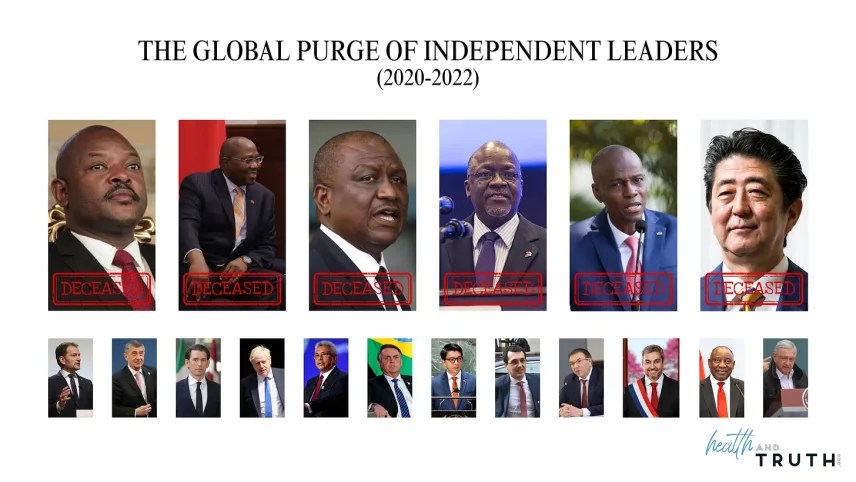
1. Burundi – Pierre Nkurunziza
In Burundi, President Pierre Nkurunziza expelled the World Health Organization from his country in May 2020, saying foreign interference was undermining national sovereignty. He kept the nation open while neighboring states imposed severe restrictions. Merely two weeks after that decision he was dead, officially of a “heart attack,” though associates described him as being in vibrant health. His successor, Évariste Ndayishimiye, reversed course immediately, reopened WHO offices, and signed new vaccine and funding arrangements that brought Burundi back into the international fold.
- Backdrop: In spring 2020 the government halted WHO field work, accusing it of interfering with domestic affairs. Burundi rejected external pandemic restrictions and held public gatherings normally.
- Event: Nkurunziza died suddenly 8 June 2020 while still in office; official cause – cardiac arrest.
- Immediate shift: Successor Évariste Ndayishimiye re‑opened WHO offices, declared COVID‑19 a “national priority,” invited vaccine partnerships, and received roughly $24 million in rapid IMF assistance.
- Result: Burundi signed onto COVAX distribution in 2021 after having been one of the continent’s last hold‑outs.
2. Eswatini – Ambrose Dlamini
In Eswatini (formerly Swaziland), Prime Minister Ambrose Dlamini resisted extreme lockdown policies, insisting that starving citizens to stop a virus was immoral. In December 2020 he was taken to South Africa “for observation” and declared dead soon afterward. The royal government that replaced him moved quickly to impose strict curfews, accept COVAX vaccines, and collect foreign emergency aid.
- Backdrop: The businessman‑turned‑PM favoured balanced restrictions, warning that closing trade would worsen poverty.
- Event: Tested positive for SARS‑CoV‑2, transferred to South Africa, and died 13 Dec 2020.
- Aftermath: King Mswati III and his cabinet adopted curfews, mandatory masking, and joined regional COVAX planning.
- Economic follow‑up: The African Development Bank confirmed a $10 million grant under the COVID‑19 Response Support Programme in early 2021.
3. Ivory Coast – Hamed Bakayoko
A similar disappearance occurred in Ivory Coast. Hamed Bakayoko, the charismatic prime minister, had publicly encouraged herbal treatments and questioned the accuracy of PCR diagnostics. In March 2021 he died in Germany of “cancer,” barely eight months after his predecessor suffered a similar fate. His passing removed the last voice questioning WHO dependence. President Alassane Ouattara’s administration proceeded to import AstraZeneca doses through COVAX, and by summer the country was being praised for its “responsible leadership.”
- Backdrop: The popular Prime Minister promoted herbal remedies and localized treatment efforts while maintaining open borders for trade.
- Event: Died 3 Mar 2021 in Germany where he was under cancer treatment; preceded by the death of previous PM Amadou Gon Coulibaly eight months earlier.
- Aftermath: President Alassane Ouattara named Patrick Achi acting PM; by May, 504 000 AstraZeneca doses had been deployed through COVAX.
- Funding: World Bank approved $300 million for emergency health and education programmes that quarter.
4. Tanzania – John Magufuli
The next to fall was Tanzania’s John Magufuli, Africa’s most outspoken skeptic of mass testing and vaccines. He mocked the system by demonstrating that fruit and goats tested positive for COVID. After vanishing from public view in March 2021, the vice‑president announced that he had died of heart failure. His replacement, Samia Suluhu Hassan, promptly reversed every one of his policies, accepted a $600 million IMF “emergency” loan, reopened the gates to foreign pharmaceutical programs, and declared a massive vaccination drive before year’s end.
- Backdrop: Highly skeptical of PCR testing accuracy and mass vaccination; prioritized economic continuity.
- Event: Absent from view in March 2021 for two weeks; Vice President Samia Suluhu Hassan announced his death 17 March (heart failure).
- Aftermath: New administration reinstated public health briefings, reopened WHO cooperation, applied for IMF Rapid Credit Facility ($600 million approved Sept 2021).
- Policy transformation: Vaccine programmes, mask campaigns, and international data reporting began within ninety days.
5. Haiti – Jovenel Moïse
Then came Haiti, where Jovenel Moïse had rejected donated vaccine shipments, explaining that the country faced deeper issues of water and poverty. On July 7 2021, he was executed in his home by an armed team whose origins remain murky. Within three weeks, Haiti received half a million Moderna doses from COVAX and enjoyed renewed flows of Inter‑American Development Bank and USAID funding. The national policy flipped overnight.
- Backdrop: Refused early COVAX vaccine delivery, arguing sanitation and nutrition were greater priorities.
- Event: Assassinated 7 Jul 2021 by a commando team; political motives still contested.
- Aftermath: First COVAX shipment of 500 000 Moderna doses landed 14 July 2021.
- Financial context: Inter‑American Development Bank and USAID re‑released more than $60 million in suspended grants under the “COVID‑19 Recovery Program.”
6. Japan – Shinzo Abe → Yoshihide Suga → Fumio Kishida
In Japan, Prime Minister Shinzo Abe avoided harsh lockdowns and refused to make vaccination compulsory. In August 2020 he resigned citing chronic illness, a convenient exit for global interests irritated by Japan’s autonomy. His successor Yoshihide Suga approved emergency authorization for the Pfizer vaccine within weeks, and after political struggles Fumio Kishida continued the same line, expanding booster programs and digital health passes. When Abe, now a private citizen and public skeptic of global centralization, was assassinated in July 2022, the last independent conservative bastion in Japan’s establishment disappeared. The current government invested ¥4.5 trillion—about $40 billion—in mRNA infrastructure partnerships with Western firms.
- Backdrop: Abe resisted extreme lockdowns and mandatory passes; preferred voluntary distancing.
- Resignation: Aug 2020 due to chronic illness; Suga took over and immediately authorized Pfizer vaccine imports (Feb 2021).
- Transition: Kishida succeeded Suga Oct 2021 after election; expanded booster campaigns and health‑pass apps.
- Abe’s assassination: 8 Jul 2022 in Nara; investigation officially attributed to a personal grudge.
- Post‑event: Japan pledged ¥4.5 trillion (≈ $40 billion) in bio‑innovation investment partly for mRNA research.
7. Slovakia – Igor Matovič
Slovakia followed the pattern in March 2021 when Igor Matovič, who had attempted to purchase Russia’s Sputnik V vaccine outside the European Union’s centralized supply, was forced out after furious criticism from Brussels. His successor Eduard Heger rejoined the EU’s procurement framework and in return unlocked €6.3 billion in recovery funds.
- Backdrop: Purchased Sputnik V without EU approval to widen supply options.
- Event: Coalition crisis culminated March 2021 in his resignation.
- Aftermath: New PM Eduard Heger froze Sputnik imports, conformed to EU purchasing pool, and unlocked €6.3 billion EU Recovery Funds.
8. Czech Republic – Andrej Babiš
Nearby, the Czech Republic saw Prime Minister Andrej Babiš lose power at the end of 2021 after refusing to maintain endless pandemic states of emergency. His replacement Petr Fiala implemented vaccine passports and mass‑testing decrees soon afterward, bringing the nation into perfect accord with EU directives.
- Backdrop: Initially resisted heavy lockdowns, favored voluntary vaccination.
- Event: Lost October 2021 election amid strong pro‑mandate media push.
- Aftermath: Petr Fiala government mandated digital health passes (“Tečka” app) and extended state‑support contracts with Pfizer/Moderna.
9. Austria – Sebastian Kurz
Austria lost Sebastian Kurz the same year. Once a rising star who had questioned perpetual lockdowns, Kurz resigned under the weight of a corruption scandal in October 2021. Within days his successor announced Europe’s first universal vaccine mandate and qualified the country for €4.5 billion in European Stability Mechanism funding.
- Backdrop: Pushed for reopening and questioned perpetual emergency powers.
- Event: October 2021 resignation after prosecution alleged misuse of party funds.
- Aftermath: Successor Alexander Schallenberg announced universal vaccination January 2022; European Stability Mechanism distributed ≈ €4.5 billion in recovery funding.
10. United Kingdom – Boris Johnson
In the United Kingdom, Boris Johnson’s government had ended restrictions in mid‑2021 and refused to make vaccine passports a permanent condition of daily life. The press then exploded with “Partygate” scandals over gatherings during lockdown. Johnson resigned in 2022, replaced by Rishi Sunak, who restored Britain to full WHO cooperation and financed a £2 billion digital‑health‑ID system intended to prevent “misinformation.”
- Backdrop: Repealed many restrictions July 2021 (“Freedom Day”), angering zero‑COVID advocates.
- Event: Forced resignation mid‑2022 after “Partygate.”
- Aftermath: Rishi Sunak government supported the WHO pandemic‑treaty process and invested £2 billion in NHS digital ID infrastructure through Palantir‑backed data platforms. Within weeks of taking office, Downing Street announced negotiations with Moderna to establish a permanent mRNA‑manufacturing base — a 10‑year “strategic partnership” followed with construction of a mRNA vaccine research, development, and manufacturing centre in Harwell Science Park (Oxfordshire), projected to produce up to 250 million doses a year in a future outbreak. This collaboration was framed as part of the UK’s “100‑Day Mission” to deliver vaccines within 100 days of identifying a new pathogen; the mission itself originated from G7 and G20 pandemic‑preparedness pledges.
11. Sri Lanka – Gotabaya Rajapaksa
Half a world away in Sri Lanka, President Gotabaya Rajapaksa argued that global supply sabotage and debt were worse problems than COVID. By mid‑2022 coordinated protests and economic chaos forced him to flee abroad. Within weeks, the IMF approved a $3 billion bailout that required health‑security reforms and the adoption of digital‑surveillance frameworks under WHO supervision.
- Backdrop: Advocated reopening, claimed economic sabotage larger threat than virus.
- Event: Mass protests July 2022 amid fuel and food shortages.
- Aftermath: New interim government signed a $3 billion IMF agreement mandating fiscal reform and health‑security modernization.
12. Brazil – Jair Bolsonaro
Brazil completed the second‑wave phase of this storyline. President Jair Bolsonaro ridiculed mask mandates, called lockdowns a luxury for the rich, and questioned vaccine safety. After two furious years of constant hostility from media conglomerates and international NGOs, he lost the 2022 election. Lula da Silva took office, rejoined WHO initiatives, and secured a $1.2 billion World Bank “preparedness” loan.
- Backdrop: Dismissed lockdowns as “hysteria,” resisted vaccine coercion.
- Event: Lost 2022 election to Lula da Silva after two years of hostile media coverage.
- Aftermath: Brazil re‑entered WHO initiatives, COVAX procurement, and secured World Bank Preparedness Loan ($1.2 billion).
13. Madagascar – Andry Rajoelina
Along the African coast to Madagascar, President Andry Rajoelina had introduced his own herbal remedy, COVID‑Organics, and rejected Western pharmacology. In 2021 an attempted coup shook the island, and under global pressure Rajoelina signed new agreements restoring WHO cooperation that same year so donor funding could return.
- Backdrop: Promoted herbal tonic “COVID‑Organics” (artemisia‑based), claiming national self‑reliance.
- Event: July 2021 coup attempt; several senior officers arrested.
- Aftermath: Rajoelina accepted WHO cooperation and external medical aid later that year, restoring aid flows suspended in 2020.
14. Romania – Vlad Voiculescu Minister of Health
Appointed in December 2020 under Prime Minister Florin Cîțu, Voiculescu quickly became one of Eastern Europe’s most outspoken advocates for data transparency within the vaccine‑procurement process.
He questioned:
- why the European Commission’s contracts with Pfizer/BioNTech and Moderna were heavily redacted;
- the procedure for reporting adverse events and hospital bed usage;
- and financial allocation for Romania’s “Green Certificate” system.
In April 2021, Voiculescu alleged irregularities in the way national statistics on Covid mortality were reported (he said hospital figures were being “massaged” to fit EU targets).
Within 48 hours, Prime Minister Cîțu dismissed him (14 April 2021). That dismissal fractured the ruling coalition and was widely interpreted as pressure from Brussels and Bucharest business lobbies to restore “credibility” with EU health authorities.
- Backdrop: In 2021 Romanian minister objected to secrecy of EU vaccine contracts.
- Event: Dismissal and cabinet reshuffle.
- Aftermath:
- Florin Cîțu — Prime Minister (National Liberal Party), an economist trained in the US and a former banker, had emphasized cooperation with the European Commission’s Recovery Facility.
- Immediately after Voiculescu’s removal, Cîțu approved the formal implementation of the EU Digital COVID Certificate
- He signed Romania’s Recovery and Resilience Facility plan for €29 billion (approved September 2021).
- Cîțu later lost internal party support and was replaced by Nicolae Ciucă (2021 December).
- Raed Arafat — Secretary of State, Chief of the Department for Emergency Situations, a longtime figure in Romanian health management (specialist of Palestinian background), spearheaded the nationwide lockdown operations.
- He became polarizing — praised for emergency coordination but criticized for advocating strict curfews and mandatory digital passes.
- Through his influence, Romania aligned with EU Civil Protection Mechanisms and WHO technical advisories.
- Government enforced EU Digital COVID Certificates.
- Brussels released tranches of Recovery and Resilience Facility funds (€29 billion total plan).
- Florin Cîțu — Prime Minister (National Liberal Party), an economist trained in the US and a former banker, had emphasized cooperation with the European Commission’s Recovery Facility.
15. Bulgaria – Kostadin Angov
Appointed during the closing months of Prime Minister Boyko Borisov’s third administration, acting Health Minister Kostadin Angov (2020 – 2021) faced severe criticism from Brussels for Bulgaria’s slow vaccine rollout and limited transparency regarding distribution data. Angov and Borisov’s cabinet were accused of delaying orders through the EU’s joint procurement scheme, preferring to wait for additional safety results before committing to large Pfizer/Moderna contracts.
By late March 2021, Bulgaria had one of the lowest vaccination rates in the European Union and was publicly rebuked by the European Commission for “failure to utilize allocated supply quotas.”
Backdrop: By early 2021, Bulgaria’s center‑right government under Boyko Borisov had lost support amid apparent corruption scandals unrelated to health policy but amplified by public anger over uneven lockdown enforcement and vaccine delays. Multiple cabinet ministers, including acting Health Minister Angov, were called before parliamentary committees to justify the government’s refusal to impose stricter green‑pass rules or to publish full statistics on vaccine deliveries.
Event: In April 2021, Borisov’s GERB party failed to form a coalition following a general election; the president appointed Stefan Yanev as caretaker prime minister, and Stoycho Katsarov — a former deputy minister and health‑reform activist — assumed the health portfolio. Katsarov announced immediate compliance with EU digital pass protocols and promised rapid adoption of the COVID Certificates system, stating that “communication with Brussels must be restored through transparency and vaccination.”
Aftermath: Within three months of the caretaker cabinet’s installation, Bulgaria joined the EU Digital Green Certificate scheme (July 2021), issued its own national app, and implemented tightened entry controls for public venues. The European Commission then approved Bulgaria’s €6 billion Recovery and Resilience Facility allocation (approved December 2021) after earlier postponements linked to “governance deficiencies.”
Katsarov and Yanev argued the shift was strictly technocratic, yet domestic media framed it as the price of unlocking EU funds frozen under Borisov. Moreover, WHO country officers held joint press briefings in Sofia throughout autumn 2021, publicly graduating Bulgaria from a “non‑compliant” to a “fully aligned EU‑health partner.” Later that year a second caretaker cabinet retained the same policies to preserve continued Brussels cooperation.
Government Outcome: By the end of 2021 Bulgaria had moved from partial defiance to complete compliance with EU and WHO health requirements. The turnover of Borisov’s administration and replacement with technocratic caretaker officials effectively cleared the way for release of European recovery funds for health‑system modernization and digital infrastructure projects.
Summary of Sequence
- Initial reluctance to join EU vaccine mandates and delays in accepting digital certificate standards.
- Electoral defeat of incumbent government after months of European pressure and domestic unrest.
- Caretaker administration’s rapid embrace of EU and WHO frameworks.
- Approval of €6 billion in Recovery Funds and re‑establishment of good standing with Brussels.
16. Paraguay – Mario Abdo Benítez
Paraguay’s experience exemplifies how smaller Latin American economies were forced to align pandemic policies with international credit conditions. President Mario Abdo Benítez’s government initially emphasized economic stability over draconian lockdowns, warning that strict restrictions would devastate informal workers who make up more than 60% of the labour market. However, as domestic protests intensified and foreign creditors tightened lending conditions, the administration conceded to the IMF’s stipulations that pandemic‑response financing be tied to specific “public‑health governance commitments.” Once those commitments were accepted, loan disbursements resumed, showing how financial contingency mechanisms coerced health‑policy conformity.
- Backdrop: Through 2020 and early 2021 Paraguay maintained one of South America’s least restrictive lockdown regimes. The government was reluctant to mandate vaccinations or fully close borders with Brazil and Argentina.
- Event: In March 2021 mass protests erupted in Asunción over shortages of medical supplies and alleged corruption in procurement; opposition parties launched a failed impeachment attempt against President Abdo Benítez.
- Aftermath: To restore credit stability, the finance ministry agreed to conditions attached to an IMF Rapid Financing Instrument (≈ $274 million) earmarked for health expenditure auditing and expansion of surveillance systems. By late 2021 Paraguay was fully aligned with WHO and Pan American Health Organization recommendations.
- Outcome: Government stability was restored after external financing resumed, but policy autonomy remained limited by credit conditionality.
17. South Africa – Cyril Ramaphosa
South Africa began as a reluctant participant in strict global pandemic protocols. President Cyril Ramaphosa voiced concerns that extended lockdowns could fuel unrest and economic collapse, and he pushed for Africa‑wide vaccine intellectual‑property waivers rather than Western purchases. Nevertheless, as international ratings agencies threatened downgrades and IMF/World Bank assistance was made contingent on “strengthened public‑health governance,” South Africa shifted its course, introducing some of the continent’s strictest workplace vaccine rules.
- Backdrop: From early 2020 to mid‑2021 Ramaphosa’s cabinet clashed with business unions and community organizations over the cost of lockdowns versus public‑health benefit. Debt pressures soared following a 10% GDP contraction in 2020.
- Event: The National Treasury secured a $4.3 billion IMF loan (July 2020) and a World Bank loan of $750 million (Jan 2022) containing performance benchmarks for pandemic containment and “human capital protection”.
- Aftermath: By December 2021 South Africa announced mandatory vaccination for public‑sector employees and participation in the WHO vaccine passport initiative. Foreign aid disbursement and sovereign bond ratings stabilized only after these steps.
- Outcome: Policy alignment improved credit access but deepened domestic inequality and led to significant civil‑liberty litigation and ongoing parliamentary inquiries into procurement transparency.
18. Mexico – Andrés Manuel López Obrador
Mexico under Andrés Manuel López Obrador (AMLO) presented one of the last major cases of gradual capitulation to WHO and multilateral financial pressures. Initially AMLO resisted mandatory lockdowns and booster campaigns, insisting that national public‑health policy should focus on nutrition and poverty reduction. However, a combination of supply‑chain disruption, dollar liquidity concerns, and lobbying from international philanthropic networks (CEPI, GAVI, and the Gates Foundation) eventually pushed Mexico toward full policy compliance by 2022.
- Backdrop: Throughout 2020 Mexico’s Health Secretary Jorge Alcocer and Under‑secretary Hugo López‑Gatell advocated moderate restrictions and non‑coercive vaccine rollout. The country’s mortality surged during mid‑2021, provoking foreign and domestic pressure for a policy shift.
- Event: Facing threat of credit downgrades, the Finance Ministry began talks with the World Bank and IMF for infrastructure loans linked to public‑health reform. In December 2021 Mexico signed a joint memorandum of understanding with WHO and CEPI for “bio‑pharmaceutical collaboration and vaccine development capacity”.
- Aftermath: Through 2022 Mexico aligned its vaccine certification systems with the COVAX framework and expanded digital health records for the Ministry of Health, unlocking up to $1 billion in World Bank Covid‑response financing.
- Outcome: By 2023 Mexico was publicly touted by WHO offices as a “model for integrated pandemic response,” demonstrating how international credit leverage transformed a once‑independent policy line into strict adherence with global health‑security standards.
Summary of Observable Trends
- Chronology: Deaths of Nkurunziza, Dlamini, Bakayoko, Magufuli, and Moïse opened the sequence (Jun 2020 – Jul 2021). Political collapses in Europe, Asia, and the Americas followed through 2022.
- Policy effect: Every successor endorsed WHO recommendations and entered international funding arrangements that had been unavailable under predecessors.
- Financial trigger: Aid packages—IMF Rapid Credit, World Bank preparedness loans, EU Recovery mechanisms—were routinely disbursed within 30–90 days of the leadership change.
Key Takeaway
From 2020 to 2022, the result was unmistakable: national autonomy collapsed beneath a synchronized agenda linking public‑health compliance to economic salvation. Countries that resisted early, especially in Africa, suffered the hardest blows—five sitting leaders dead in one year. More powerful nations experienced subtler coups through scandal, protest, or economic blackmail, all producing the same end state.
What emerged from these parallel crises was not medical harmony but political homogenization. Each successor declared a “renewed partnership with science,” welcomed new funding from the IMF, World Bank, or GAVI, and ushered in digital‑compliance systems that now define post‑pandemic governance.
By the end of 2022 nearly every government on Earth—rich or poor, democratic or autocratic—had been brought into alignment. Differing flags, languages, and histories no longer prevented one shared choreography: resistance punished, obedience financed, and sovereignty quietly exchanged for a coordinated global script.
- IMF Press Release – Rapid Credit Facility for Burundi (June 2020).
- Reuters / AP Report – Death of Eswatini Prime Minister (Dec 2020).
- African Development Bank – COVID‑19 Response Support Programme (2021).
- World Bank – Ivory Coast Emergency Support Project (2021).
- IMF Press Release No. 21/210 – Tanzania RFI (Sept 2021).
- Associated Press – “President of Haiti Assassinated at Home” (July 2021).
- IDB Official Statement on Haiti Relief Funding (2021).
- Japan Cabinet Office – Resignation of PM Abe (Aug 2020).
- Nikkei Asia – “Japan Invests in mRNA Manufacturing” (2022).
- 1European Commission – Next Generation EU Fund Allocation to Slovakia (2021).
- Czech News Agency – Election Results and Policy Changes (2021).
- Austrian Prosecution Service – Kurz Investigation Report (2021).
- EU Council Press Release – Austria ESM Allocation (2022).
- UK Parliamentary Record – Digital Health Infrastructure Funding (2022).
- IMF Staff Report – Sri Lanka Extended Fund Facility (March 2023).
- World Bank – Brazil Pandemic Preparedness Loan (2022).
- WHO Madagascar Country Office – Cooperation Agreement (2021).
- European Commission – Romania RRF Approval (2021).
- European Commission – Bulgaria RRF Approval (2021).
- IMF Country Report – Paraguay Pandemic Financing (2021).
- IMF Country Report – South Africa Fiscal Support Arrangements (2021).
- WHO / CEPI Press Release – Mexico Cooperation Agreement (2022).
- IMF Country Report – Paraguay Rapid Financing Instrument 2021.
- BBC News Latin America – “Protests Rock Paraguay Over Pandemic Supplies,” March 2021.
- Finance Ministry of Paraguay – Press Release on IMF Commitments April 2021.
- South African Reserve Bank Annual Report 2021.
- IMF Press Release No. 20/315 – South Africa Loan Approval; World Bank Loan Press Brief 2022.
- Reuters – “South Africa Adopts Mandatory Public‑Sector Vaccination Policy,” December 2021.
- El Universal – “López‑Gatell Sabemos que no habrá vacunación obligatoria,” 2020.
- WHO / CEPI – Memorandum on Mexico Vaccine Collaboration, December 2021.
- World Bank – “Mexico COVID‑19 Emergency Response Project,” 2022.
Spain’s COVID restrictions declared unconstitutional, over 90k fines struck down
By Andreas Wailzer | LifeSiteNews | October 10, 2025
More than 90,000 COVID fines have been overturned so far after the Spanish constitutional court declared the draconian 2020 COVID measures unconstitutional.
As Spanish news outlet The Objective reported, 92,278 fines have been annulled as of September 3, 2025, following the declaration of certain provisions of the 2020 state of emergency decree, which was in effect during the first COVID-19 lockdown, as unconstitutional.
However, these penalties only represent the first wave of fines set to be annulled, with many more expected to follow. During the strict lockdown under the state of alarm in 2020, more than 1 million penalties were imposed nationwide, and an estimated 1.3 million people were fined for violating the prohibitive restrictions.
In its ruling, the Constitutional Court determined that certain sections of Article 7 of Royal Decree 463/2020, which pertains to the general prohibition on movement, implied an unjustified suspension of the fundamental right to freedom of movement, rather than merely a limitation. This suspension exceeded the power of the declared state of alarm, the court found. The court determined that such a severe restriction could only have been implemented under a stricter state of emergency, which requires more rigorous parliamentary proceedings.
This ruling now retroactively applies to all penalties issued during the 2020 lockdown, putting a significant burden on the administrative state. The Objective reports that “enforcement has been slow and uneven depending on each territory,” showing that the refunds could take months or years.
The Objective reiterates that the 92,278 cases revoked to date “are just the tip of the iceberg of a regulatory crisis” stemming from the draconian lockdown policies imposed by the Spanish government in 2020.
The Nature of hypocrisy: pharma-funded journals smearing independent voices
Nature alleges that I endanger public health, but it is the journal — steeped in pharma money — that ought to be looking inward.
By Maryanne Demasi, PhD | October 1, 2025
When an editor from Nature emailed me this week, it wasn’t a neutral request for comment. It was a prelude to a hit piece — filled with defamatory accusations and framed around a predetermined narrative.
According to the email, I was being lumped into an “anti-vaccine movement,” accused of “endangering public health,” and “profiting from disseminating misinformation.”
No evidence was provided. No articles were cited. No definition of “anti-vaccine” was offered. No complainants were named. Just blanket accusations intended as a character assassination.
Conflict of interest at the heart of Nature
And who is casting these stones?
Nature — a journal that publishes vaccine research while pocketing revenue from pharmaceutical advertising and sponsored content.
To then assign an editor to target independent journalists who scrutinise that very industry is a glaring conflict of interest.
A medical journal acting as both mouthpiece and judge of what counts as “misinformation” is like a tobacco company funding lung health studies while attacking anyone who questions them.
The hypocrisy is staggering.
On its own website, Nature boasts of partnerships with Johnson & Johnson, Merck, AstraZeneca and other vaccine companies, dressing them up as “pioneering collaborations” to “support science.” It even publishes paid advertising features.

Meanwhile, I’ve never taken a cent from the drug industry. My work is sustained by readers who choose to support independent journalism.
Yet Nature accuses me of “profiting” — as if being funded by the public is more corrupting than raking in thousands, if not millions, from the very companies you’re supposed to scrutinise.
To test how deep the rot runs, I’ve requested that Nature disclose its advertising revenue for the past decade, broken down by pharmaceutical corporations, government agencies, and NGOs.
I will publish those figures if and when they are provided.
Loaded language
Nature’s email branded me part of an “anti-vaccine movement.” But what does that actually mean?
Is questioning regulatory capture “anti-vaccine”?
Is demanding the timely publication of safety signals “anti-vaccine”?
Is exposing the failures of the vaccine injury compensation scheme “anti-vaccine”?
Is pointing out the poor oversight of vaccine trials “anti-vaccine”?
By that logic, critics of arsenic in drinking water would be “anti-arsenic,” and anyone calling for safer driving would be “anti-car.” The absurdity is obvious, yet the label is useful to silence debate.
And the email’s language was revealing.
Phrases like “scientific consensus” and “peer-reviewed science” are waved around like trump cards, but in practice they are red flags — appeals to authority rather than evidence.
‘Consensus’ can be manufactured. And ‘peer review’ is no shield against corruption when journals themselves are compromised.
I have documented journal–pharma ties, the retraction of inconvenient studies, and the use of pharma-funded “fact checks” masquerading as science to discredit politically uncomfortable findings.
So when an editor of Nature hides behind these clichés instead of addressing the evidence I present, it tells you everything. This isn’t about protecting science, it’s about protecting a narrative.
And I’m clearly not the only target.
Dr Robert Malone — also a Substack publisher and now a member of the CDC’s Advisory Committee on Immunisation Practice — received the same media request from Nature.
The journal’s smear campaign extends even to those who now sit on America’s top vaccine advisory body.
Nature insists that “anti-vaccine stances are supported by a small body of evidence compared to the larger weight of evidence for vaccination.”
But that’s probably because journals act as gatekeepers, blocking challenges to orthodoxy and shutting out novel viewpoints. Studies that raise concerns are rejected, buried or retracted, while industry-friendly findings sail through unopposed.
It isn’t the science that’s lacking — it’s the willingness of journals to let inconvenient results see the light of day. The house of cards is collapsing, and that is why the attacks on dissent are more aggressive than ever.
And those attacks often come from self-proclaimed experts who are themselves conflicted, embedded in institutions sustained by the teat of industry, and unwilling to disclose their own conflicts.
Pot calling the kettle black: the Proximal Origin scandal
Notably, while Nature postures as a guardian against “misinformation,” it bears responsibility for one of the pandemic’s most notorious scandals.
In March 2020, Nature Medicine — part of the Nature portfolio — published “The proximal origin of SARS-CoV-2,” which declared the virus could not have been engineered in a lab.
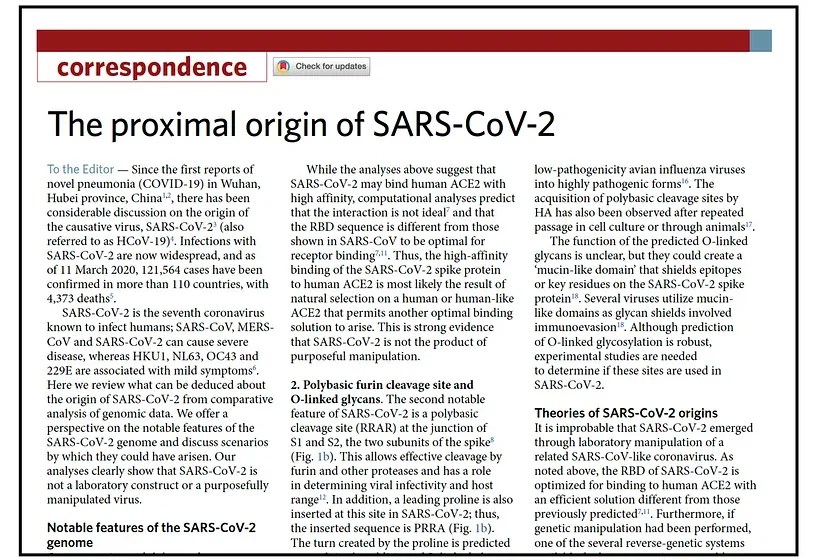
The paper was splashed across headlines and weaponised to dismiss the lab-leak theory as a “conspiracy.”
But private emails and Slack chats told another story. The authors harboured serious doubts and admitted a lab origin could not be ruled out.
Hundreds of scientists now call the paper a ‘political tract’ dressed up as science, and thousands have petitioned for its retraction. Yet Nature Medicine refuses, brushing it aside as a “point of view” piece.
If that isn’t misinformation, then what is?
Even the White House has distanced itself. Its website now acknowledges that the Proximal Origin paper was used to suppress debate, and alleges the authors were nudged by Dr Fauci to push the “preferred” zoonotic origin narrative.
Time for accountability
Make no mistake, this is ‘the system’ at work.
Powerful journals with financial ties to industry unleashing hatchet men to smear independent journalists and scientists, rather than engaging with evidence.
I won’t play along. My job is to hold institutions accountable, not to curry their favour. If Nature wants to brand that “misinformation,” so be it. History shows that today’s heresy is often tomorrow’s truth.
This goes to the heart of the corruption of medical publishing — a system Robert F. Kennedy Jr has repeatedly warned about, and one that now demands scrutiny at the highest levels.
With Dr Jay Bhattacharya at the helm of the National Institutes of Health, there is finally an opportunity to investigate the conflicts of interest, selective censorship, and financial entanglements that journals like Nature have normalised.
When those who profit from pharma partnerships claim the authority to police what lies “outside the scientific consensus,” public trust in science collapses.
And that collapse is not the fault of independent journalists asking hard questions. It is the fault of journals that serve industry interests over science.
Featured Video

U.S. General Caine Warns: STRIKING IRAN is a HUGE RISK
or go to
Aletho News Archives – Video-Images
From the Archives
Stealth Bombers and Bunker Busters
Analysis of the so-called 12-Day War, and the triumphantly celebrated Operation Midnight Thunder

By William Schryver | imetatronink | November 28, 2025
The GBU-57 is a big fat gravity bomb with fins. To achieve effective precision, a B-2 bomber must drop it on its intended target from no further than about five nautical miles — essentially right on top of the target.
Its penetration depth is claimed to be 200 feet. But that capability has NEVER been tested against a seriously hardened deep-underground target encased in layers of high-performance concrete, and topped with a few dozen meters of solid rock. In that sort of real-world scenario, the GBU-57 would be lucky to drill down 50 feet, if that.
It was always ridiculous silly talk to suggest the GBU-57 was the wonder weapon it was made out to be. There is a good reason the US only produced a couple dozen of them and then stopped: they understood its acute limitations in a non-permissive combat environment.
And, notwithstanding the hyperbolic Israeli propaganda, there was never any credible evidence that Iranian medium- and long-range air defenses against fixed-wing aircraft were attrited to any significant degree. And Iranian short-range air defenses were increasingly effective against long-range Israeli drones with each passing day.
As for the B-2: it is a big fat subsonic aircraft. It flies at airliner speeds. A strike on Fordow would entail flying at least 500 miles in and out of Iran. … continue
Blog Roll
 Aletho News
- Project Artichoke: 70 Years Ago, CIA Discussed Hiding Mind-Control Drugs in Vaccines
- Drug traffickers trained in Ukraine attack state forces in Mexico
- The tragic reality of Brazilian mercenaries in the Ukrainian conflict
- Zelensky Refused to Discuss Druzhba Pipeline Issue – Fico
- U.S. General Caine Warns: STRIKING IRAN is a HUGE RISK /Glenn Diesen & Lt Col Daniel Davis
- Israel designates five Palestinian media outlets as ‘terrorist organizations’
- Israel, not America, first: Carlson’s Huckabee interview lays bare US foreign policy priorities
- Israeli troops executed Palestinian aid workers at ‘point blank range’: Report
- Iran war What if today’s Iran is resigned to a long, hellish war with the US?
- Why Israel Is Escalating Its War Crimes Against Lebanon
- If Americans Knew
- The NY Times on the “MAGA” Split Over Israel & USS Liberty
- In Gaza, Ramadan without mosques, imams – Not a ceasefire Day 137
- Footage Shows Israeli Troops Waiting in Ambush, Then Opening Fire on a Palestinian Teen
- The US is on the brink of a major new war that Trump has not even bothered explaining
- Latest Epstein document dump is one more cover-up
- No Protection, No Justice: US Citizens Killed with Impunity by Israel
- Maria Farmer: Epstein Victim Reveals Explosive Information Covered Up by Media
- Average of five Palestinians killed by Israel every day in Gaza since ceasefire – Not a ceasefire Day 136
- Palestinian church leaders admonish Christian Zionist Mike Huckabee – Not a ceasefire Day 135
- Ominous messaging from Trump’s “Board of Peace” – Not a ceasefire Day 134
- No Tricks Zone
- Surprising Discovery: Sahara Is Greening…Billions Of Trees Where Once Thought To Be Barren
- New Research Reaffirms Clouds, Aerosols, And Surface Solar Radiation Are ‘Driving The Climate System’
- Germany: Electric Car Catches Fire At Charging Station, Sets Off Local “Inferno”, Widespread Damage
- New Study: Canada’s New Brunswick Was 1°C Warmer Than Today During The Medieval Warm Period
- Coal Power Back In Trend As Globe Tries To Keep Pace With Growing Demand For Power
- New Study: A 4°C Warmer Beaufort Sea Had ‘No Sea Ice’ 11,700 – 8200 Years Ago
- Unfudging The Data: Dutch Meteorological Institute Reinstates Early 20th Centruy Heat Waves It Had Erased Earlier
- German Gas Crisis…Chancellor Merz Allegedly Bans Gas Debate Ahead of Elections!
- Pollen Reconstructions Show The Last Glacial’s Warming Events Were Global, 10x Greater Than Modern
- Germany’s Natural Gas Storage Level Dwindles To Just 28%… Increasingly Critical
 Aletho News