Western coverage distorts Argentina’s media law
By Ramiro Funez | NACLA | January 28, 2014
Argentine President Cristina Fernández de Kirchner is currently battling allegations of corruption, and when Argentina’s Supreme Court upheld in October a media law that takes on press monopolies while promoting diversity in media ownership, journalists in the English-speaking North covered it as a blow to press freedom.
The Audiovisual Services Act, originally introduced by Kirchner in 2009, replaced the Radio Broadcasting Law of 1980, put in place by the military regime that ruled the country from 1976 to 1983. The junta used the 1980 law, which promoted the corporatization of news information, to speed up the privatization and monopolization of media in Argentina after independently reported stories undermined military rule, according to the Argentine Information Secretariat’s 1981 report, Argentine Radio: Over 60 Years on the Air
Although the return of constitutional rule in 1983 granted journalists more political freedoms, it largely ignored economic ones. Even after the collapse of the military dictatorship, the 1980 law allowed wealthy business owners, many of whom had been sympathetic to the regime and its pro-market stance, to dominate journalism in Argentina.
Clarín, founded in 1945 and today one of Argentina’s most recognized daily newspapers, fared well throughout the junta’s administration, eventually surpassing the sales of its main competitor, Papel Prensa. In 1999, the newspaper’s publisher reorganized itself as Grupo Clarín, managing to acquire over 200 newspapers and several cable systems across the country to become Argentina’s largest corporate media organization (Reuters, 10/32912). The organization currently has a market share of 47 percent and holds 158 licenses (Financial Times, 10/29/2013).
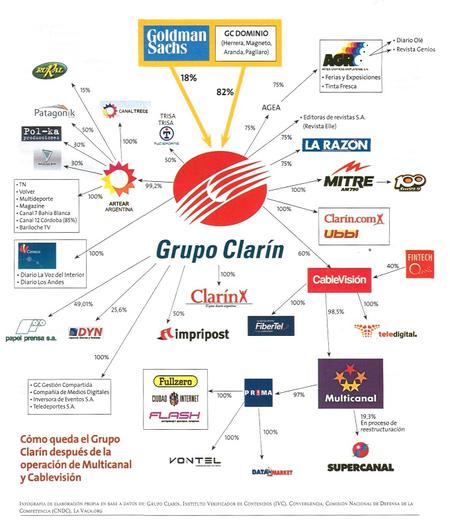
The Kirchner-backed media law places limits on the size of media conglomerates in an attempt to diversify ownership of news distribution: media companies will now be limited to a maximum of 35 percent of overall market share. The new law also imposes a national limit of 24 broadcast licenses per company, meaning the group will have to sell off dozens of operating licenses or have them auctioned by the state (Christian Science Monitor, 10/30/13).
Many Western reporters covering Argentina, however, dismiss the danger of concentrated corporate control of journalism, instead focusing on the perceived danger that government regulation of media could silence political opposition—echoing claims made by Grupo Clarín and other private conservative organizations.
U.S. news stories covering the Supreme Court’s decision to uphold the media law tended to read like press releases for Grupo Clarín, leading with the consequences it will have on the monolithic media conglomerate. That angle was an easy sell to corporate news outlets that have an interest in focusing on governmental limits on journalism without discussing the problems of a privatized, highly concentrated news market.
The Washington Post (11/1/13), for example, headlined its editorial on the topic “In Argentina, a Newspaper Under Siege,” presenting Grupo Clarín as the victim of a governmental attempt to silence opposition. “Sadly, however, Ms. Fernández and her cronies still pose a threat to the country’s democratic institutions,” the Post wrote:
That became clear Tuesday, when the Argentine Supreme Court, under heavy pressure from the president’s office, upheld a law aimed at destroying one of South America’s most important media firms, Grupo Clarín.
The company operates one of Argentina’s biggest newspapers, called Clarín, which has been one of the few media outlets to challenge Ms. Fernández’s policies. The law would force the company to auction off cable television and Internet businesses that provide most of its revenue, thus reducing potential funding for Clarín’s newsroom.
The article victimizes Grupo Clarín, giving readers the impression the Argentine government established the limits with the intentions of “destroying” the group. Yet the Post fails to mention that the United States also has a history of issuing similar outlet restrictions, like the Telecommunications Act of 1996 that placed a 35 percent limit on market ownership. Although the Federal Communications Commission (FCC) raised that limit to 45 percent in 2003 during a private reevaluation, the agency still has the power to regulate media ownership.
The Post editorial board also linked the media law to Kirchner’s attempts to nationalize major companies in other industries, including travel and energy, saying that she and her late husband, whom she succeeded as president, have sought to “concentrate power in their own hands.”
The Wall Street Journal (11/5/13) chimed in:
In the past few years, the government has shifted nearly all its public advertising money to media outlets that provide it with positive coverage—a move the Supreme Court has condemned, to little effect… Leading newspapers like Clarín and La Nación also say they are suffering from an ad boycott orchestrated by the government—an allegation the government denies.
The Journal ignores the fact that the Kirchner administration continues to direct public advertising to smaller conservative media groups within the Association of Argentine Journalism (CITE); diversified media ownership, rather than ideology or partisan affiliation, is the criterion for government subsidy. Despite the fact that there is an alleged “ad boycott orchestrated by the government,” both Grupo Clarín and La Nación continue to receive more revenue from private advertisers than any other media outlet in Argentina, according to a 2011 report published by the Comisión Nacional de Comunicaciones.
The Associated Press (11/4/13), reporting on Grupo Clarín’s recent decision to break itself up into six parts in order to comply with the law, presented the legislation as little more than a politically motivated attack on one corporation:
The licenses are essential to Clarin’s cable television networks, and synergy between the finances and news content of the group’s TV and radio stations, websites and newspaper are key to its power. Many government supporters want nothing less than Clarín’s defenestration as a viable opponent.
The Associated Press’s framing in the aforementioned article takes the side of Grupo Clarín: They write that Clarín’s unregulated licenses are “key to its power” without airing arguments against the corporate consolidation of public news information. They also make the assumption that Kirchner constituents “want nothing less than Clarín’s defenestration” without providing quotes from pro-media regulation activists in Argentina aside from government officials.
And the Miami Herald (10/23/13) published a column by Roger Noriega of the American Enterprise Institute, formerly of the George W. Bush State Department. Noriega argued that the law was aimed at “silencing the independent media” and that nothing less than “the fate of the free press” was at issue. “Of course, it is all too predictable that these divested media licenses will fall into the hands of compliant Kirchner cronies,” wrote Noriega. “This transparent tactic is lifted from the playbook of leftist caudillos in Venezuela, Ecuador, Bolivia and elsewhere.”
A quick sift through Noriega’s column reveals that his definition of “independent media” elides the dependency that media organizations like Grupo Clarín and La Nación have on funding from private corporations that have personal profit-making agendas—a dependency that forces both groups to embrace the political ideologies of their sponsors in order to maintain steady revenue. A truly “independent media” would be free of both government and corporate domination. It is also evident that his notions of a “free press” are founded upon free-market, neoliberal principles, championing corporate domination of political news coverage. His tactic of utilizing the term “free press” in correlation with unregulated, monopolized, and corporatized news media seems to hail straight from the playbook of McCarthyist lexicon, to borrow a few words from his comparison.
Overall, corporate journalistic monopolization and the concentration of news media is more of a threat to press freedom in Argentina than government regulation is. The domination of public discourse by media groups with private, corporate interests is dangerous to readers who are oftentimes unaware of the advertising revenue models of organizations like Grupo Clarín; in its obligations to maximize profits, it has strategic incentive to promote the interests of its commerical sponsors rather than the people of Argentina searching for objective news coverage.
Many Western journalists have painted Kirchner as an authoritarian leader desperate for control over news coverage in order to maintain a positive image, without realizing that in modern times, media ownership is just as influential as government suppression of speech. While many conservative Argentines have blindly sided with groups like Grupo Clarín in criticizing the government’s large advertising presence in news organizations that are friendly with the incumbent administration, they have failed to recognize that there is a difference in advertising intentions and content between the Kirchner administration and private corporations: the former publicizes information about social welfare programs available to citizens, while the latter promotes products whose profits benefit the small percentage of Argentines who have seemingly little at stake in quality social programming.
The Supreme Court of Argentina and the Kirchner administration have recognized that progressive interpretations of freedom of speech include democratic and popular control over mass information and national discourse. They have also recognized the need for public diversity in media ownership that fosters economic freedoms within journalism, allowing any citizen, regardless of ideology and economic background, to have just as amplified of an opinion as a corporate news organization does—all without violating political rights.
Organizations that have claimed otherwise, or that echo the cries of victimization made by Grupo Clarín, fail to analyze alternative qualities of freedom of speech.
Ramiro S. Fúnez is a Honduran-American political journalist and activist earning his master’s degree in politics at New York University. Follow him on Twitter at @RamiroSFunez.
Related article


Beyond the Military: Investigating the Civilian Role in the Argentine Dictatorship
By Tess Bennett | The Argentina Independent | December 17, 2013
Last Friday, after 13 months and 400 witness testimonies, the mega-lawsuit in Federal Court of Tucumán found 37 of 41 defendants guilty of crimes against humanity during the 1976-83 dictatorship in Argentina. In the historic trial, known as Jefatura II-Arsenales II, four civilians were among the accused: two were pardoned and two were convicted for their involvement in the dictatorship.
María Elena Guerra, a civilian and ex-police officer, and Guillermo Francisco Lopez Guerrero, a civil intelligence agent, joined a select few civilians who have been found guilty of crimes committed during the brutal seven-year military regime, in which some 30,000 people were kidnapped and killed or ‘disappeared’.
Since the trials were reopened in 2003, hundreds of members of the military have been sentenced to prison for crimes committed during the dictatorship. However, it was only in December last year that James Smart, a former government minister of the Province of Buenos Aires, became the first civilian to be convicted of crimes against humanity committed during the dictatorship. He was sentenced to life in prison for crimes committed in six clandesine detention centres.
These landmark rulings demonstrate how, after 30 years of democratic rule, the way Argentines, politicians, and the legal system examine crimes from this period has evolved, with the focus turning more recently to the role of businesses and civilians in the human rights atrocities of that period.
Human rights groups have long used the term ‘civic-military dictatorship’ to acknowledge the complicity and support of some civilian sectors. But the title has become increasingly common in recent years under the Cristina Fernández de Kirchner administration, opening the door for a number of emblematic trials investigating the role of these civilians, with the aim of bringing the impunity of the powerful to an end.
Causes of the Coup: A New Economic Model
Human rights groups argue that economic motives were behind the 24th March 1976 coup, saying it can no longer be argued that the objective was only to combat “subversion”. They believe so-called “captains of industry” collaborated with military leaders to perpetrate crimes against humanity for economic gain.
Last week, Banco de la Nación Argentina officially recognised Roberto Hugo Barrera as the 31st employee still missing – disappeared – after being kidnapped during the dictatorship. The institution has been an important player in the drive to highlight the economic motives behind the so-called ‘National Reorganisation Process’ implemented by the military junta.
Graciela Navarro, President of the Commission of the Banco de la Nación Personnel for Memory, Truth and Justice told The Argentina Independent that when identifying what occurred in 1976, it is first important to understand that there was no “war.”
“There were operations of some armed groups, but these were isolated. There was never a war here. It was always state terrorism,” she said, alluding to the still oft-used term ‘Dirty War’ by foreign press.
According to Navarro, certain civilian sectors used the military to implement a neo-liberal economic model. “It was necessary to implement an economic model of exclusion to benefit economic groups that utilised the Armed Forces as a instrument of social discipline – for repression, for fear, to deal with any resistance movement.
“The true causes of the coup were economic, because of this we say civic-military dictatorship,” she added.
Marta Santos, a former Central Bank employee and friend of one of the five known desaparecidos (missing) who worked at the institution, echoes this view.
“This dictatorship, this military force, needed the support of civilians in key parts of the state and in the private economy… In this sense we say that dictatorship was civic-military because it pursued neo-liberal economic interests of private [business] and the state,” says Santos, who today is part of a team working with the Central Bank to investigate if there are more unknown desaparecidos who worked there.
Civilians in Government
Santos says it is important to denounce civilian collusion with the military junta in the defence of democracy, to ensure these institutions can never again prop up a dictatorship. She names José Alfredo Martínez de Hoz as the prime example of civilian involvement.
Former president of the steel company Acindar – which operated one of the country’s first clandestine torture and detention centres on its premises in 1975 – Martínez de Hoz was economy minister from 1976 to 1981, in charge of ushering in a new economic paradigm based on the principles of neo-liberalism. During this period, it was common for businessmen close to the economy minister to assume key government roles, helping to fuse civil society to the military junta. His policies sowed the seeds for financial collapse, providing a brief period of prosperity but leading to a deep recession in 1981 and saddling the nation with a burdensome external debt that would cause problems long after the return to democracy.

José Martínez de Hoz – 1976
Martínez de Hoz was under house arrest when he died in March this year, being investigated for his alleged role in the kidnap of father and son, Federico and Miguel Gutheim. The family owned the cotton export company Sadeco, and were allegedly coerced into making business deals that favoured the dictatorship.
He was also linked to the kidnap of René Carlos Alberto Grassi, director de Industrias Siderúrgicas Grassi (a rival company of Acindar) and president of the Bank of Hurlingham, in September 1978. Grassi was held in Campo de Mayo for a year after his abduction, and eventually Industrias Siderúrgicas Grassi was absorbed by Acindar. One month before the abduction, Martínez de Hoz had asked to buy the Bank of Hurlingham and was declined.
From the early days of the dictatorship there was a strong repression of workers, but the kidnap of Grassi was significant; he did not pose a threat as an opposition force to the regime, his value was economic.
Martínez de Hoz was pardoned by Menem in 1990, though this was annulled 16 years later when the Gutheim case was reopened. Up until his death, he denied any involvement in the kidnappings and was a remorseless defender of the dictatorship-era economic policies.
The investigation of Martínez de Hoz is an early example of a civilian investigated for abuses committed during the reign of the military junta. In recent years, many more legal battles concerning civilian’s roles in the dictatorship have come to the surface.
Thirty Years of Reconstruction
Horacio Verbitsky, president of CELS and co-author of the 2013 book ‘Cuentas pendientes: los cómplices económicos de la dictadura’, which examines the links between economic powers and state repression, argues the economic influence of civilians who were complicit in the dictatorship continued throughout the first two decades of democracy. Verbitsky argues that economic powers could have endangered the stability of democracy, which limited the possibility of pursuing justice for their responsibility during the dictatorship.
Argentina’s first president after the return of democracy, Raúl Alfonsín, had the complex task of addressing human rights abuses in the face of a weak economy and massive external debt, which had ballooned from US$7.87bn in 1975 to US$43bn in 1982.
“It is not easy to build democracy in a setting where political culture and civic habits have been degraded by authoritarianism. Nor is it easy to build democracy in the midst of a deep economic crisis exacerbated by the need to repay a huge foreign debt that the old dictatorial regime had contracted and irresponsibly misspent,” Alfonsín said in 1992, after his term had ended prematurely in 1989.

Videla and other military chiefs are found guilty of crimes against humanity in 1985.
The neo-liberal economic paradigm that dominated the nineties – a time that corresponded with the amnesty offered to those responsible in the dictatorship – deepened the economic model launched in 1976, taking it to the economic and political crisis of 2001.
Graciela Navarro believes that since Nestor Kirchner took office in 2003 there have been two distinct periods relating to the last civic-military dictatorship, the first being the recovery of the memory of those who had been tortured or disappeared, and the end of impunity for military leaders. “When Cristina was elected,” Navarro believes, “it was possible to begin to examine the true causes of the coup, which were economic, and charge those who are responsible.
“The military has been judged,” adds Navarro, “but many civilians, if not them then their children, are owners of the large economic groups… this is difficult. These are the interests that Cristina is dealing with.”
Pending Cases
After years of impunity, Argentina’s legal system has begun to investigate the role of officials, powerful businessmen, and mulitnationals who may have collaborated with the military in state terrorism. According to the Centre for Legal and Social Studies (CELS), as of September 2013 there were a total of 261 civilians accused of involvement in the human rights abuses of the era.
Several high profile and emblematic cases involving civilians, and their business interests, are currently making their way through the legal system.
Papel Prensa: On 2nd November, 1976, three newspapers – Clarín, La Nación, and La Razón – obtained the majority shares in Papel Prensa, the company which produces newsprint for the industry, soon after owner, businessman and banker David Graiver, died in a plane crash in Mexico in August 1976. Graiver’s widow, Lidia Papaleo testified in 2010 that at that time she was stripped of the factory after receiving death threats against her and her young daughter. In March 1977, Papaleo was abducted and tortured until she was released on July 24, 1982.
The case concerning the sale of Papel Prensa was opened in August 2010 after President Fernández presented a report in the Casa Rosada titled “Papel Prensa: The Truth” denouncing the “illegal appropriation” of the business. Most recently, the case has been in the headlines after the discovery of official minutes from the dictatorship that mention Papel Prensa 13 times between September 1976 and November 1977.
According to Defence Minister Agustín Rossi, the minutes make it “clear that for the Junta, Papel Prensa was a part of the same theme as the detention of [ex-owners] the Graiver family… this appears clearly in the minutes.” Copies of the documents are now in the hands of Federal Judge Julián Ercolini, who has jurisdiction over the case.
Ledesma: Also working its way through the legal system is a case involving president of sugar company Ledesma, one of Argentina’s most powerful businesses, for his involvement in kidnappings during the ‘blackout night’, when over 400 people were kidnapped in the province of Jujuy following an electricity outage on 20th July, 1976.
President of Ledesma Carlos Blaquier and former general manager Alberto Lemos are accused of providing the vehicles that were used for transporting the victims. This month, the Federal Court of Salta confirmed that there is sufficient evidence that the company Ledesma collaborated in the kidnapping of their workers to dismantle the labour union. As a result, Blaquier and Lemos will be put on trial, which is set to begin in April 2014. The court upheld that Blaquier will be prosecuted as a “necessary participant” in twenty cases of illegal deprivation of liberty and Lemos is accused of being a “secondary participant” to the kidnappings.
Ford: During the dictatorship, the Ford Falcon became known as a vehicle commonly used by kidnappers. But the company is also accused of more direct involvement in the human rights abuses of the time.
In May, charges were laid against three ex-directors of Ford Motors Argentina for their role in the disappearance of 24 workers from the plant. Former plant manager Pedro Müller, ex-leader of labour relations Guillermo Galarraga, and ex-security chief Héctor Sibilla are accused of having given to military commanders in the area “personal data, photographs, and addresses” of workers at the factory between 24th March and 20th August, 1976.
The three men are also accused of having allowed the military to use the factory as a detention centre where they carried out the interrogation of the workers. According to Judge Alicia Vence, the workers were “tied up with their faces covered and beaten.”
Although 24 workers survived the kidnapping and torture, only twelve are still alive today. The formal legal process began in 2001 but the first reports of the events date back to 1984.
Mercedes Benz: The families of 17 workers from the Mercedes Benz plant who were kidnapped and tortured have bought a civil case against the parent company of the car maker, Daimler Chrysler, in the US. Mercedes-Benz Argentina is alleged to have identified workers who were kidnapped and sent to the clandestine torture centre, Campo de Mayo, during the dictatorship.
The investigation began in 2004 and has been rejected by US courts on previous occasions, with the US Supreme Court currently determining if the case falls under its jurisdiction. A decision is expected in the coming months on whether multinational corporations can be sued in US courts for alleged human rights abuses abroad.
In Argentina, the lawsuit for kidnapping and torture of the 17 workers, 14 of whom are still missing, was initiated by journalist Gabriela Weber in 2002 and in 2006 was transferred to Federal Court in San Martín under the charge of Judge Alicia Vence. So far no one has been formally charged or arrested.
The car maker is also accused of the appropriation of three children, and the adoption and substitution of identity of Paula Logares, the first grandchildren reclaimed by the Abuelas de Plaza de Mayo in 1987.
Argentine President Urges Re-think of UN Security Council
By Alison Depsky | The Argentina Independent | August 6, 2013

President Fernández speaking before the UN Security Council
(photo:Presidencia/Télam/e)
While leading the session of the UN Security Council earlier today, President Cristina Fernández de Kirchner made a call to “revise the functions of UN organisms, in particular the Security Council.”
The president took a stance against the right to veto of the permanent member states, while reiterating the need to negotiate with the United Kingdom over the Malvinas.
President Fernández is currently head of the council for the month of August.
In her discussion about the UN itself, she emphasised that the organisation, which was created after the cold war, now needed to adapt to “a new world with a new reality.” Fernández argued that the United States, France, UK, Russia, and China should not necessarily continue to have the right to veto just because they have had it up until now. “The old methods are not going to give solutions [today],“ she said.
“Peace and security are not military concepts. Many believe that peace is only gained through weapons, but I believe that there are multiple examples that show that what really constructs societies are values and ideals.”
Fernández also claimed that, since the UN now reaches its decisions by consensus “there is no need to exercise a veto.” Her request was made in the context of a call to “strengthen” cooperation between regional organisations such as the CELAC, the African Union and the League of Arab States to the United Nations.
Regarding the Falklands/Malvinas the president said her government’s stance is not based on a whim. “We simply want the United Nations resolution to be enforced and for our two countries to sit down and discuss this.”
“One can have different opinions about something that has not been resolved by the UN, but a problem arises when the assembly is not looking at differing views,” she argued.
Fernández added that the Malvinas are “only an example”, and affirmed that she did not wish to introduce further controversy to this debate. “These are ideas, I’m not so arrogant as to say they are the absolute truth,” she said.
President Fernández also met with UN Secretary-General Ban Ki-moon yesterday to discuss the Falklands/Malvinas issue and the recent global espionage scandal.
Related article
- Mercosur complains to Ban Ki-moon on US global espionage and EU affront towards Bolivia’s Evo Morales (alethonews.wordpress.com)
US Congress calls for sanctions against Argentina over growing Iran ties
Press TV – July 15, 2013
Members of the US Congress have called for the imposition of sanctions against Argentina over its growing ties with Iran and Buenos Aires’ bid for joint investigations with Tehran into the 1994 AMIA Jewish center bombing.
In a letters to US Secretary of State John Kerry and US Attorney General Eric Holder, the Congressmen cited growing economic and diplomatic relations between Iran and Argentina as grounds for slapping sanctions against Buenos Aires.
A memorandum of understanding (MoU) signed by Iran and Argentina to probe the bombing at the Argentine Israelite Mutual Association (AMIA) was cited as another reason to take action against Buenos Aires.
The July 10 letter to Kerry said the US Congressmen found it “extremely troubling” that Argentina had agreed to a joint effort with Iran to investigate the AMIA bombing, which left 85 people dead.
Iranian Foreign Minister Ali Akbar Salehi and his Argentinean counterpart, Hector Timerman signed the MoU in Addis Ababa, Ethiopia, on January 27.
Under intense political pressure from the US and Israel, Argentina had previously accused Iran of having carried out the bomb attack. The Islamic Republic has categorically denied any involvement in the terrorist bombing.
Earlier in July, Washington reacted fiercely when Argentina prevented AMIA case special prosecutor Alberto Nisman from taking part in a US Congress meeting to level allegations against Iran.
Nisman had collected a 500-page indictment in which he accused the Islamic republic of “infiltrating” regional countries to spread an “intelligence network”.
In a letter personally addressed to Argentine President Cristina Fernandez de Kirchner, American lawmakers expressed disappointment over the veto of Nisman’s visit to the US Congress and questioned the “veracity” of the South American country’s intentions to probe the 1994 AMIA attack through the MoU with Iran.
Related article
Argentina should be self-sufficient in energy in five/six years says YPF
MercoPress | March 18, 2013
Argentina’s energy self-sufficiency can be expected in five to six years said Miguel Galuccio, CEO of YPF, the oil and gas corporation which was nationalized a year ago when the government of President Cristina Fernandez seized a 51% majority from Spain’s Repsol.
CEO Miguel Galuccio is hoping to develop the Vaca Muerta shale deposits CEO Miguel Galuccio is hoping to develop the Vaca Muerta shale deposits
“We can think of recovering self-sufficiency in oil and gas in 5 to 6 years”, said Galuccio who pointed out that “much depends on planning, an investment plan and putting all our energy to substitute all we are purchasing now with local energy which will be far cheaper”.
YPF is planning to invest 5bn dollars in “exploration and production of gas and oil” said Galuccio. “We need to transform those reserve resources so that they become exploitable. In 2013 we are planning to drill 113 wells to generate the sufficient scale production so that it becomes profitable”.
“If we can manage to exploit Vaca Muerta we can think of a 20/25 year horizon in reserves” he added in reference to the non conventional shale oil reserves in the province of Neuquen considered some of the largest in the world.
However despite the long path to self sufficiency that lies ahead, Galuccio said that YPF has managed to stop the decline of production after several years. According to YPF crude production last year was up 2.2% compared to a downfall of 7.6% in 2011, while gas production was down 2.3% compared to a contraction of 10.2% in 2011.
YPF that has announced a long term investment of 7bn dollars annually from 2013 to 2017 is currently under the Argentine government control since las May when Congress approved a bill nationalizing 51% of Repsol shares, which nevertheless retains 12% of the current package.
Argentine president defends AMIA deal with Iran
Tehran Times | March 3, 2013
 TEHRAN – Argentine President Cristina Fernandez has defended an agreement between Iran and Argentina to set up an international “truth commission” to investigate the bombing of the Argentine Israeli Mutual Association (AMIA) building in Buenos Aires in 1994 that killed 85 people, the Buenos Aires Herald reported on Friday.
Fernandez has said, “My commitment with this case is to know the truth, not only what happened abroad but what happened here too. I want to know who were the ones to cover up, to hide evidence; I deserve to know it as an Argentinean and the victims and their families deserve it too.”
According to the report, she has also condemned the “complicity” of Jewish community leaders in the AMIA attack.
Argentina’s Congress approved an agreement with Iran to probe the AMIA bombing on Thursday.
The two governments signed a memorandum of understanding in January on how to deal with the attack in which Argentine court authorities have accused a number of Iranians of involvement. Iran has denied any link to the bombing.
The pact signed with Tehran has been criticized by Israel and Jewish groups, who fear it could end up weakening the case against Iran. They also see it as a diplomatic victory for Iran.
The agreement stipulates that a commission – made up of five foreign legal experts – will outline plans for Argentine judicial officials to travel to Tehran to question Iranians accused of having links to the attack.
Commission members will analyze the documents presented by both nations’ judicial authorities and “issue a report containing recommendations on how to proceed with the case” according to the memorandum.
Argentine President Cristina Fernandez had previously said it could shed new light on the case after years of deadlock.
Fernandez has close ties with other Latin American leaders who are on good terms with Tehran, such as Venezuela’s Hugo Chavez.
Her supporters have hailed the memorandum of understanding as a historic opportunity.
Argentina’s Senate also approved the agreement last week.
Related articles
Argentine president “shaken” by AMIA attack warning
Pagina 12* | February 9, 2013
 President Cristina Fernández Kirchner said she was “shaken” by the Asociación Mutual Israelita Argentina (AMIA) President Guillermo Borger’s statement yesterday that the memorandum of understanding which Argentina signed with Iran to bring clarification to the 1994 bombing of the Jewish center “would give rise to a third attack.”
Through Twitter, the president asked “what is it that you know to (make) such a terrible statement?” and she considered that “the people and the Judiciary should and deserve to know what (he) knows.”
Yesterday, when asked about the agreement, which as of Wednesday will be debated by three Senate committees, Borger warned that “to advance in the agreement is to open the door to a third attack, it would be total submission.” The review was in line with the president of the Delegación de Asociaciones Israelitas Argentinas (DAIA), Julio Schlosser, who also rejected the memorandum and considered the official text lacking in the “clarity that the cause deserves.”
In a series of messages on her Twitter account, president Fernández went on to question Borger’s claims and asked: “If a terrorist attack did occur because of Argentina’s agreement with Iran, who would be the intellectual and physical mastermind?”
She added: “It’s clear that it could never be the signatory countries. Could it be those who have rejected the agreement? Countries, people, or intelligence services? Who?”
President Fernández said that she considers Borger to be “a respectable person” but nevertheless said she read his statements “with great concern.” For this reason she said that “the Argentine people in general and the Judiciary in particular should and deserve to know what you know Guillermo Borger,” to have made that warning.
* Translation by Aletho News
Related articles
US State Department condemns Argentine expropriation of YPF Oil Company
Press TV – April 20, 2012
The US has joined Spain and Britain in condemning Argentina’s expropriation of the Spanish-owned oil and gas company, YPF, Press TV reports.
US State Department spokesman Mark Toner condemned Argentina’s nationalization of the oil company, saying his country views the act with negativity.
Toner also warned that the move would ultimately hurt Argentina’s economy.
However, the Argentine government has responded firmly to the criticism, arguing that the decision was taken based on the country’s national interests.
“The project aims at certain states’ rules to lead a strategic company. We do not govern on behalf of the US and the Spanish people,” Argentine Interior Minister Florencio Randazzo said.
Argentine President Cristina Fernandez has slammed the company for failing to re-invest in local oil and gas production, which forced Buenos Aires to pay more than USD 9 billion to import fuel last year.
On Monday, Fernandez announced the decision to reclaim YPF, which was formerly a state-owned Argentine oil company, at a meeting with her cabinet and provincial governors. She said that Argentina had to take back the oil company since it is the only nation in Latin America “that does not manage its natural resources.”
The move to declare YPF Gas a public utility by taking 51 percent of its shares is an extension of the takeover of YPF Oil Company, the major subsidiary of Repsol.
Repsol President Antonio Brufau said on Tuesday that the company would take legal action against Argentina, seeking compensation of about $10 billion.
Meanwhile, the Spanish government has also criticized the move by claiming that Argentina is taking a risk of becoming “an international pariah” if it takes control of the YPF, in which Repsol has a 57.4 percent stake.
Related articles
- Argentina to nationalize Spanish owned oil firm (alethonews.wordpress.com)
- Argentina seeks Petrobras collaboration in YPF (theglobeandmail.com)
Argentina to nationalize Spanish owned oil firm
Press TV – April 16, 2012
The Argentine government says it will present a bill to the country’s senate for the nationalization of the YPF oil company which is owned by Spanish firm Repsol.
Argentine President Cristina Fernandez said on Monday that the bill would allow the government to expropriate 51 percent of YPF shares, while the country’s oil producing provinces would get 49 percent.
“This president is not going to answer any threat, is not going to respond to any sharp remark, is not going to echo the disrespectful or insolent things said,” Fernandez said.
YPF has been under heavy pressure from the Argentine government over the past two months for not investing enough in the country’s oil fields.
The move has already been criticized by the Spanish government. Spanish officials say Argentina risks becoming “an international pariah” if it takes control of the YPF, in which Repsol has a 57.4 percent stake.
Spain is Argentina’s largest foreign investor and YPF is Argentina’s biggest oil company.
Related articles
- Repsol YPF ups Argentine shale deposit potential (seattletimes.nwsource.com)
Featured Video

Bombing Hitler’s Hometown
or go to
Aletho News Archives – Video-Images
From the Archives
‘Conspiracy Theory’ Now Fact: Greater Israel Has Arrived
By Kit Klarenberg | Mint Press News | January 28, 2025
Ever since Tel Aviv’s 1948 creation, much has been said and written about ‘Greater Israel’ – the notion Zionism’s ultimate end goal is the forcible annexation and ethnic cleansing of vast swaths of Arab and Muslim lands for Jewish settlement, based on Biblical claims this territory was promised to Jews by God. The mainstream media typically dismisses this concept as antisemitic conspiracy theory, or at most the fringe fantasy of a minuscule handful of extremist Israelis.
In reality … continue
Blog Roll
 Aletho News
- Pro-Israel terrorist arrested before assassination of pro-Palestinian activist
- Bombing Hitler’s Hometown
- German journalist threatened with homelessness as German court upholds EU sanctions in landmark free speech case
- US Tells Allies That Ukraine-Bound Arms Could be Sent to Middle East
- Organized terrorism: Iran condemns killing of its diplomats in Lebanon
- Why could Gaza enter the regional war?
- Hamas official rejects Mladenov Plan linking disarmament to Gaza reconstruction
- Two Primary Elections for the Soul of ‘America First’
- Japan Clings to US Vassalage Despite Energy Crunch Caused By Iran War
- US Seeks Control Over Global Energy Infrastructure – Kremlin
- If Americans Knew
- Researchers at Human Rights Watch Resign Over Blocked Report on Palestinian Refugee Return
- Jewish Groups Are Backing a War Americans Don’t Want
- Eric Fingerhut Thinks He’s the President of the Jews
- Top Jewish Philanthropists, Rabbis Urge Israeli President to Take Action Against ‘Jewish Extremists’
- Don’t Be Fooled. Zionist Leaders Have Always Wanted to Control Southern Lebanon
- Israel’s widespread use of torture is a core element of its genocide against the Palestinian people
- In Israel’s War on Iran, Many Middle East US Bases Rendered “All But Uninhabitable”
- ‘Burn the lawn’: Israel pursues ‘Rafah model’ in southern Lebanon
- A genocide here, an amputation there
- Reports: Iran mobilizing 1M fighters, Israel-US run low on ammo, Israeli army faces shortage – Not a ceasefire Day 168
- No Tricks Zone
- Devastating Assessment Of Comirnaty Vaccine By Former Senior Pfizer Europe Toxicologist
- New Study: CO2 Is ‘Effectively Negligible’ As An Explanatory Climate Change Factor Since 2000
- Former Pfizer Toxicologist Dr. Helmut Sterz Tells Bundestag Hearing Pfizer Vaccine Should Have Never Been Approved
- Energy Expert: Germany’s Nuclear Phaseout Was A “500 Billion Euro Mistake”
- New Research: South Australia’s Mid-Holocene Sea Surface Temperatures Were 4°C Warmer Than Today
- Storing Green Energy To Last Germany 10 Days Would Require A 60-Million Tonne Battery
- New Studies: UK Sea Levels Were 4 Meters Higher Than Today During The Mid-Holocene
- Destructive Green New Deal: German Energy And Metal Group Warns Of Drastic Crisis
- New Study Documents A 20-Year Pause In Arctic Sea Ice Decline – Driven By Internal Variability
- Wake-up Call: Survey Shows Majority Of Germans Now Favor Postponing Climate Targets!
 Aletho News