NATO returning to ‘historic role as war fighting command’ to counter Russia – top US general
RT | May 4, 2017
The commander of NATO and US forces in Europe has called for yet more armored vehicles and troops to be deployed on the continent to counter what he calls “a resurgent Russia.”
Testifying before a Senate appropriations subcommittee on Tuesday, General Curtis M. Scaparrotti, head of United States European Command (EUCOM) – in charge of all US forces in Europe, as well as NATO’s Supreme Allied Commander – accused Russia of threatening regional and global security.
“Today we face the most dynamic European strategic environment in recent history,” he said in his testimony. “In the east, a resurgent Russia had turned from partner to antagonist as it seeks to undermine the Western-led international order and reassert itself as a global power.”
“Accordingly, we are adjusting our plans, our posture, our readiness to remain relevant to combat the threats we face,” he added. “In short, we are returning to our historic role as a war fighting command.”
Two American combat brigades are permanently stationed in Europe: the 2nd Cavalry Regiment in Germany and the 173rd Airborne in Italy, which make up around 10,000 of the 60,000-strong American troop presence in Europe. Scaparrotti says more troops are needed – specifically more armored and infantry divisions to counter Russia’s western flank, as well “enablers” like engineers, aviation and fire support staff for the European Reassurance Initiative.
“Russia’s posture is not a light force, it’s a heavy force,” he continued.
“In order to have the posture that is both credible and of the right composition, we need more armored forces… to make sure that we do have a force of enough size that enables us to deter Russia.”
“Five or six years ago, we weren’t concerned about being ready [to fight] today,” Scaparrotti added. “That has changed.”
During the Senate hearing, Scaparrotti also called for more funding to improve local capabilities for infrastructure capable of moving and housing troops.
The European Reassurance Initiative was launched in 2014 in the wake of the political crisis in Ukraine and the perceived Russian intervention there, leading to the most vocal members of NATO – Poland and the Baltic states – claiming that they would be Moscow’s next target. This prompted leading members of the alliance to agree on troop deployments. In March, 800 British soldiers began arriving in Estonia, while Germany sent troops and tanks to Lithuania. Earlier in April, 1,350 NATO soldiers arrived in northeastern Poland in line with the planned buildup.
Russia has consistently criticized the NATO buildup on its doorstep, describing it as a threat to regional security.
“We deplore that deployment, for it raises tensions in Europe along the border between NATO and Russia. Russia doesn’t pose any threat to Estonia nor any other NATO member state,” Russian Ambassador to the UK Alexander Yakovenko recently told the Daily Mail.
Top US general in Europe urges arming Ukraine

RT | March 28, 2017
Washington must do more to deter “Russian aggression,” including sending lethal weapons to the government in Ukraine and engage in information warfare across the board, the top US commander in Europe told lawmakers.
“I personally believe that we need to consider lethal defensive weapons for Ukraine,” General Curtis M. Scaparrotti, head of the US European Command (EUCOM) told the House Armed Services Committee on Tuesday.
“I haven’t discussed that specific issue with most of our partners,” Scaparrotti admitted when he was asked about the NATO allies’ opinion on arming Kiev. The general is also the NATO Supreme Allied Commander in Europe (SACEUR).
“Russia seeks to undermine this international system and discredit those in the West who have created it,” Scaparrotti argued in his opening remarks, calling for “demonstrating strength in every area” when it comes to dealing with Moscow.
He also accused Russia of threatening every country in its vicinity, stoking ethnic tensions in the Balkans, “complicating” US operations against Islamic State (IS, formerly ISIS/ISIL) in Syria and violating the Intermediate-Range Nuclear Forces (INF) Treaty by deploying land-based cruise missiles.
For its part, Moscow has rejected insinuations it was violating the 1988 treaty.
“There have not been violations from our side,” Russian Foreign Minister Sergey Lavrov told Argumenty i Fakty weekly, answering accusations about the breach of the INF. “The United States claim the opposite, but they do not provide any information that could be verified in order to clarify the situation.”
At the hearing on Tuesday, however, Scaparrotti and the lawmakers were of the same mind that Russia was an adversary and a threat in every respect. In addition to arming the government in Ukraine and building up the US military presence in Europe, the general advocated information warfare as well.
“Going forward, we must bring the information aspects of our national power more fully to bear on Russia, both to amplify our narrative and to draw attention to Russia’s manipulative, coercive, and malign activities,” he said.
Scaparrotti’s predecessor, General Philip M. Breedlove, had worked for years with State Department and other Washington insiders to push the Obama administration to be more belligerent towards Russia, according to his private emails released by DCLeaks in July 2016, shortly after Breedlove’s retirement. Last week, Breedlove testified before the Senate Armed Services Committee, calling once again for arming the government in Kiev.
Potential NATO Commander Threatens Russian Jets That Buzz US Warships
Sputnik – April 23, 2016
After a US warship sailing near Russian waters in the Baltic Sea prompted a close flyby response from two Russian fighter jets, one US Army general has issued a threat to Moscow, should such an incident occur again.
Last week, the USS Donald Cook reported that two Russian Su-24s conducted repeated flyovers of the vessel as it sailed through the Baltic Sea. Pentagon officials decried the maneuvers as “unsafe and unprofessional.”
“This was more aggressive than anything we’ve seen in some time,” one official told Defense News, speaking on condition of anonymity.
Russian envoy to NATO Alexander Grushko stressed that the US destroyer represented a potential security threat and added that Russia would continue to take “all necessary measures [and] precautions to compensate US attempts to use military force.”
But the US continues to paint Russia as the aggressor in the incident, and on Thursday, Army Gen. Curtis M. Scaparrotti, possibly setting the tone for his anticipated tenure, escalated the rhetoric.
President Barack Obama’s nominee to become the next NATO and US European Command commander, Scaparrotti was testifying before the Senate Armed Forces Committee on Thursday when he was asked by Arizona Senator John McCain if the US should reaffirm to Russia that it would take action to protect American lives.
“Sir, I believe that should be known, yes,” Scaparotti said, according to Business Insider.
Referencing the Baltic Sea incident, Indiana Senator Joe Donnelly then asked if Russia should be warned that “next time it doesn’t end well for you.”
Scaparotti agreed.
“We should engage them and make clear what’s acceptable. Once we make that known, we have to enforce it,” he said.
“I think they’re pushing the envelope in terms of our resolve. It’s absolutely reckless, it’s unjustified and it’s dangerous.”
If confirmed as NATO commander, Scaparotti stated his first course of action would be to review America’s rules of engagement for the region.
The nominee’s aggressive posturing seems unnecessary, given that the USS Donald Cook was operating close to Russian waters and nearly 4,000 miles from home.
Writing for The American Conservative, political commentator Pat Buchanan criticized the US for using its Navy to provoke rival nations.
“In the South China Sea, US planes overfly, and US warships sail inside, the territorial limits of islets claimed by Beijing. In South Korea, US forces conduct annual military exercises as warnings to North Korea… US warships based in Bahrain confront Iranian subs and missile boats in the Gulf,” he wrote.
“Yet in each of these regions, it is not US vital interests that are threatened, but the interests of allies who will not man up to their own defense duties, preferring to lay them off on Uncle Sam. And America is beginning to buckle under the weight of its global obligations.”
Read more:
Broke and Paranoid…How the US Risks Nuclear War
US, Swedish Forces Conduct Training Exercise in Baltic Sea
Russian Envoy to NATO Affirms Continued Responses to US Military Pressure
Featured Video
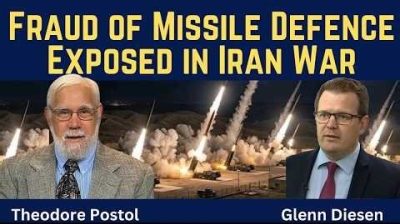
Ted Postol: Fraud of Missile Defence Exposed in Iran War
or go to
Aletho News Archives – Video-Images
Frlom the Archives
Containing the United States
By Edward S. Herman | Z Magazine | September 2016
“Containing the United States” is, of course, a ridiculous and self-contradictory idea in the U.S. and Western ideological and propaganda system. We all know that the United States had to “contain” the Soviet Union from 1945 to 1991, and since then has had the task of containing Russia and China. Only they threaten, bully, aggress and worry countries like Poland and Vietnam. Obama has had to reassure them both of our steadfast stand against Russian and Chinese military attacks. NATO has, of course, expanded greatly over the past several decades, despite the deaths of the Soviet Union and Warsaw Pact, but only to contain the renewed Russian — and Iranian, Libyan, Syrian and other — military threats; and we have “pivoted” to Asia, supported Japanese rearmament, bolstered our own forces in that area and jousted with the Chinese in their coastal waters solely to contain China. Earlier we had been obliged to contain North Vietnam, or was it the Soviet Union in Vietnam? Or China? Or “communism”? Or maybe all of them? Or none of them, but just needing an excuse to enlarge power?
The parallel propaganda has taken many forms. One is accepting as a premise that the United States only acts defensively and has no internal forces and interests that drive it to enlarge its sphere of control. I noted in an earlier article how Paul Krugman claims that internal Russian problems may well be the explanation of Russian “aggression,” but how at the same time it never occurs to him that the huge U.S. transnational corporate interests and “defense” establishment, and the pro-Israel lobby’s activities, might possibly make for an expansionist dynamic here.2 This reflects the standard establishment perspective that we are good and only react to evil. This was the view sustaining and justifying the invasion and occupation of Iraq from 2003. That attack was taken here as not evil but a response to evil, even if involving lies and mistakes, hence not describable as “aggression.” … continue
Blog Roll
 Aletho News
- When Tel Aviv decides, Washington fights
- Top official: Iran ready for a long war with US, no more diplomacy
- How Iran’s Toxic Rain Reveals US-Israel Discord
- Trump Admits He Is Destroying Iran For Israel
- Iran’s latest move in the GCC countries was a stroke of genius
- Blackmail and death threats, Zelensky embarrasses the EU, but there’s no condemnation
- Israel threatens to kill Iran’s new leadership
- Possible Scenarios for the Middle East
- The Horizon of the War. “Italy is being Dragged Into the War against Iran”
- A Second Vietnam War? Hanoi Waits and Prepares
- If Americans Knew
- Corporate Media Go All Out To Support The US-Israeli War On Iran
- US-Israel war on Iran is creating a steady growing number of amputees
- Israel planned this war on Iran for 40 years. Everything else is a smoke screen
- The wrong question about the war in Iran
- ‘Your Tax Dollars Being Used to Raise Your Gas Prices’: US-Israel Bomb Major Iranian Oil Depots
- ‘Bogus Evidence’: Former Nuclear Watchdog Head Debunks US Justification for Iran War
- EXPLAINER – Dimona: What to know about Israel’s nuclear site
- Fires and toxic air in Iran (thanks, Israel) – Not a ceasefire Day 150
- At Israel’s hands, Iran is burning, Lebanon and Gaza are crumbling – Not a ceasefire Day 149
- Israel is using the ‘Gaza doctrine’ in Lebanon and Iran
- No Tricks Zone
- Wake-up Call: Survey Shows Majority Of Germans Now Favor Postponing Climate Targets!
- Televised! Leading German Political Candidate Tells Schoolchildren CO2 Makes Sun Hotter!
- New Study: A Century Warming Of 1.1°C Is ‘Commonplace’ And ‘Not Unusual’ During This Interglacial
- New Study: ‘Internal Noise’ And Volcanic Forcing Can Trigger 10-15°C Warming Within Decades
- Glaciers Worldwide Are Suddendly Surging, Experts Blame Warming!
- Surprising Discovery: Sahara Is Greening…Billions Of Trees Where Once Thought To Be Barren
- New Research Reaffirms Clouds, Aerosols, And Surface Solar Radiation Are ‘Driving The Climate System’
- Germany: Electric Car Catches Fire At Charging Station, Sets Off Local “Inferno”, Widespread Damage
- New Study: Canada’s New Brunswick Was 1°C Warmer Than Today During The Medieval Warm Period
- Coal Power Back In Trend As Globe Tries To Keep Pace With Growing Demand For Power
 Aletho News