Druze Gather in Israeli-Occupied Golan Heights to Mark Support for Assad
© REUTERS / Ammar Awad
Sputnik – 06.10.2018
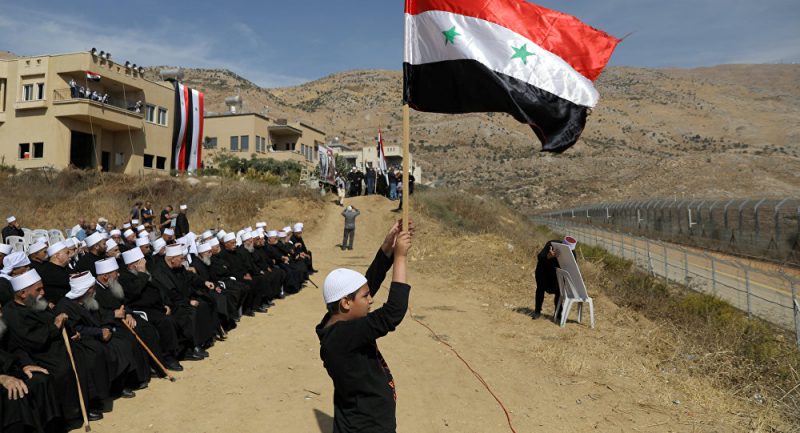
Gathering along a fence separating them from the Syrian-controlled side of the Golan Heights, Druze commemorated the anniversary of the start of the 1973 Arab Israeli War while celebrating Syria’s successes in its recent war against the terrorists.
Carrying Syrian flags, portraits of President Bashar Assad, binoculars and megaphones, the Druze community in the village of Massade chanted loyalty to the Syrian government, with troops and civilians on the other side of the border shouting and waving back.
Local resident Emil Masoud told Reuters that the rally was meant to “celebrate the final stages of the war… and to celebrate with our people in Syria the final stage of victory.”
The village of Massade, part of Syria’s Quneitra District, has been under Israeli occupation since the Arab-Israeli War of 1967.
Israel occupied 1,200 square kilometers of the 1,800 square-kilometer Golan Heights during the Six-Day War, and formally annexed it in 1981. The UN Security Council condemned the decision and called the move to impose Israeli “laws, jurisdiction and administration” over the territory “null and void and without international legal effect.”
During the conflict in Syria, much of southern Syria, including the Syrian-controlled portion of the Golan Heights, was occupied by Islamist militants, including Daesh (ISIS), a terrorist group outlawed in Russia and many other countries. This summer, Syrian forces won back control of their southern border areas from the terrorists.
Last week, Syrian Foreign Minister Walid Muallem called on the international community to compel Israel to abide by UN Security Council resolutions, including the one on the Golan Heights, and stressed Damascus’ determination to fully liberate the Golan Heights, “just as we liberated southern Syria from terrorists.”
Taliban Praises Recent Talks With Washington as ‘Very Helpful’
Sputnik – August 13, 2018
The Arch enemies entered into talks following the successful implementation of a three-day ceasefire in June for the Muslim holiday of ‘Eid al-Fitr.’
A Senior Taliban official has described peace talks held last month with the US as “very helpful” in envisaging a path out of Afghanistan’s seventeen year old war.
The leader, from an organisation within the Taliban called ‘Quetta Shura,’ has been quoted as saying that both sides intend to hold the next round of talks in September, and that these “will be more specific and focused on key issues.” He also added that, “once the breakthrough is started it will be stunning for all.”
The comments come on the heels of a string of reports since the end of July, which describe an unprecedented face-to-face meeting held in the Qatari capital, Doha, between a Taliban delegation and officials from the US State Department, led by senior diplomat Alice Wells. Representatives from the Islamist insurgency were quick to laud discussions at that time too, describing them as “very positive.”
While Washington officials with detailed knowledge of the negotiations remain tight-lipped, Taliban delegates who were in attendance let a few of the specifics loose: allegedly, a key US demand is for Washington to maintain a military presence in Afghanistan while peace talks are ongoing. While initially hostile to such a suggestion, reports suggest that the insurgency’s leadership council has since suggested that it could be open to the idea on the condition that the US plays an active political role in the peace process.
The Taliban has long refused to hold discussions with Ashraf Ghani’s government in Kabul until it is given the opportunity for direct talks with the US. However, leading talks for reconciliation between the central government in Kabul and the Taliban has long been anathema to Washington, which has maintained that it would not heavily involve itself in “Afghan-led, Afghan-owned” negotiations. Echoing that sentiment in early July, Secretary of State Mike Pompeo proclaimed that the Trump administration would “support, facilitate and participate in peace discussions, but peace must be decided by the Afghans and settled among them.”
Yet, as time has ticked by, reports suggest that President Donald Trump has grown impatient with the tactical stalemate on the ground and NATO’s inability to retake chunks of territory controlled by the Taliban. According to the Special Inspector General for Afghanistan Reconstruction, as of January 30 2018, approximately 56.3% of Afghanistan was under the Taliban’s sway. Frustration at such a reality may have culminated in the US president’s decision to dispatch envoys to Afghanistan in early July to open up channels for backdoor diplomacy.
The US’ sudden willingness to sit down with the Taliban has likely been bolstered by the group’s apparent commitment to extirpating foreign terrorist groups from Afghan territory — namely Daesh. This month, a Taliban onslaught reportedly caused 200 Daesh fighters to surrender in the North of the country. Additionally, the group are advancing on a Daesh stronghold in the eastern province of Nangarhar, where a large-scale battle is expected to take place.
Despite the optimism among the Taliban’s echelon, fighting with the Afghan Security Forces continues unabated. In the early hours of Friday, the group’s fighters launched an assault for control of the eastern city of Ghazni. According to the country’s 1TV television station, so far 100 people have been killed. In an effort to repel the advance, the US Air Force launched a series of air strikes on Taliban positions, raising questions as to how likely it is that these old foes are ready to sit down at the negotiating table.
Syrian Army Uncovers Massive Haul of Western-Made Weapons for Rebels
© Sputnik / Michael Alaeddin
Sputnik | July 4, 2018
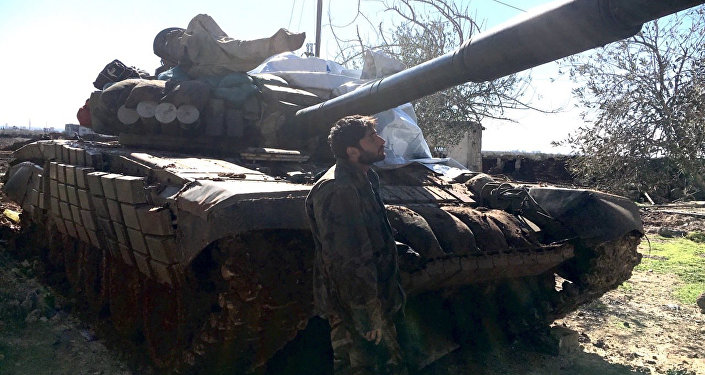
The Syrian Army has gotten its hands on another huge cache of weapons and ammunition, including US-made TOW anti-tank missile systems, chemical warfare, minesweeping and communications equipment and even armored vehicles. Some of the supplies appear to be brand new, as if militants did not get the chance to use them against government forces.
The weapons and equipment were surrendered to Syrian troops by militants in Daraa, southwest Syria, who handed over the haul in accordance with a recently signed reconciliation agreement.
The Syrian Arab News Agency posted a video report of the find, with footage showing everything from tanks and armored personnel carriers to RPG launchers, shells, gasmasks, minesweepers, mortars, heavy machinegun emplacements and TOW launchers, along with boxes which appear to be supplies for Free Syrian Army militants from the United States.
Over two dozen towns and villages in southwestern Syria accepted a surrender deal with Damascus following days of negotiations brokered by the Russian military. The deal saw militants from the Free Syrian Army giving up their fight against the government and siding with the army in their operation to mop up the remnants of Nusra Front and Daesh forces in the region. The Syrian military launched an offensive in southern Syria in recent weeks amid constant militant shelling of the cities of Daraa and As-Suwayda.
The Israeli military reportedly drew “red lines” on Sunday amid the fighting, demanding that Damascus stick to a 1974 disengagement agreement which provides for a buffer zone between the two countries. Israel has beefed up its presence near the Golan Heights with tanks and artillery, but promised to stick to a policy of non-intervention in the Syrian conflict.
Washington’s Syrian Chess Game Leaves Iraqi Forces Battling ISIS Dead
By Whitney Webb | Mint Press News | June 26, 2018
Last Sunday, June 17, local Syrian media reported that the U.S. coalition had bombed Syrian Arab Army installments in the town of Al-Hariri. The bombing killed dozens of Syrian Arab Army (SAA) soldiers as well as 22 fighters from the Iraqi paramilitary group known as the Popular Mobilization Forces (Hashd al-Sha’abi, PMF), which has been collaborating with the Syrian government to wipe out Daesh (ISIS) fighters around the Syrian-Iraqi border city of Abu Kamal in the Deir Ez-Zor governorate.
Soon after the strike, however, the U.S. denied responsibility for the attack, with Pentagon spokesman Adrian Rankine-Galloway asserting that the bombing was “not a U.S. or coalition strike,” while an anonymous U.S. official told Agence France-Presse, and later CNN, that Israel had been responsible for the strike. Israel declined to comment on the allegations.
While Israel was widely blamed for the strike following those media reports, new evidence gathered by Iraq’s PMF from the site of the strike has shown that the attack may, in fact, have been carried out by the U.S. coalition. After collecting fragments of missiles used in the strike, the group – which is sponsored by the government of Iraq – determined that the U.S. had carried out the strike by firing missiles at the SAA/PMF position from a location near the Iraqi border city of Al-Qa’im. U.S. culpability for the attack would mean that it is the second time in less than a month that the U.S.-led coalition has attacked pro-government fighters targeting Daesh within Syria.
The head of PMF’s military operations, Abu Munather Al-Husseini, asserted that the U.S.-led Joint Operations Command (JOC), also known as the U.S. coalition, had been informed by the Iraqi military of the PMF’s location prior to the strike. Thus, if the PMF’s analysis of the strike site is indeed correct, the U.S. coalition had intentionally and deliberately targeted the PMF as well as the SAA in conducting the strike.
As MintPress reported soon after the attack, the strike was launched from U.S.-occupied territory, meaning that either the U.S.-led coalition conducted the attack but publicly denied responsibility, or that Israel was responsible for the attack and “independently” launched the strike from Syrian territory occupied by the U.S.-led coalition. The PMF’s analysis of the strike site has now determined that the former was most likely the case, given that the group had waited to point the finger at Israel or the U.S. until concluding its analysis of the attack.
PMF’s leadership lambasted the U.S. for allegedly carrying out the strike and targeting its forces, while also urging retaliation against the U.S. for repeatedly interfering in its efforts to wipe out Daesh in Syria as well as Iraq. Indeed, just days before the strike, the PMF had successfully launched a major offensive against Daesh in the area of Syria where the strike later took place.
In a statement released on Sunday, PMF Deputy Commander Abu Mahdi al-Muhandis warned of retaliation against the U.S., stating:
We tell the Americans that we as the Hashd [PMF], including all of its formations, follow the Iraqi government. We will not remain silent about this attack. […] Remaining silent on this incident, saying that ‘that position is outside the Iraqi territory, hence we have nothing to do with it’ is forfeiting the blood of our martyrs.
U.S. chess game with ISIS as pawn
U.S.’ actions near Abu Kamal betray the fact that it is seeking to expand the portion of Syria’s Northeast that it currently occupies, an area that accounts for 30 percent of Syria’s total land mass and includes the majority of the country’s oil, gas, fresh water, and agricultural resources. The U.S. has long had its eye on the strategic border town, as it is the main border crossing between Syria and Iraq. More importantly, it is the only border crossing that connects Syrian government-controlled territory with Iran, through Iraq.
A major U.S. goal in its occupation of Syria has been disrupting this land bridge, but continued Syrian government control of Abu Kamal makes this impossible. Were the U.S. to take control of Abu Kamal, it would control Syria’s most important border crossings, as it already controls the Syrian-Jordanian border crossing at al-Tanf.
The U.S.’ interest in Abu Kamal and its recent targeting of forces fighting Daesh in the area suggest that a Daesh takeover of the city is likely to be used by the U.S. as the pretext for the expansion of Syrian territory, a tactic the U.S. has used before in Syria. The possibilities of a Daesh takeover of Abu Kamal have been openly noted by influential U.S. think tanks, such as the Center for a New American Security (CNAS), which recently mused that Daesh control over Abu Kamal would serve U.S. interests in the region, as it would allow the U.S.-occupied zone of Syria to “spread by osmosis.”
For that reason, the recent reappearance of Daesh (ISIS) in Abu Kamal is significant. Indeed, Daesh launched its largest military offensive in several months in Abu Kamal earlier this month, with 10 suicide bombers helping clear the way for Daesh militants to take over parts of the city. The offensive killed 25 Syrian soldiers and allied fighters, according to monitors. Daesh attacked from the U.S.-occupied zone of Syria, despite the fact that the U.S. has long justified its illegal presence in Syria by claiming that it is fighting the terror group. However, Russian and Syrian military sources have asserted that the U.S. is not fighting Daesh in the region, but protecting them.
The strikes on pro-Syrian government forces around Abu Kamal also come amid reports that indicate the U.S. is fortifying its military positions within occupied Syria by constructing military bases along the Euphrates river in proximity to Syrian military installments throughout the Deir Ez-Zor region and by transferring “a large volume of arms and equipment, including missiles, military vehicles and bridge equipment” to those same areas in recent weeks.
Given that the U.S. may soon lose its influence in Southern Syria and its control over the al-Tanf border crossing, thanks to the Syrian government’s offensive in the Dara’a governorate, it is likely the U.S. will continue to fortify its position in the country’s Northeast and expand its efforts to dislodge the SAA and its allies from Abu Kamal in a last-ditch attempt to prolong the conflict and succeed in its efforts to occupy and partition Syria.
Whitney Webb is a staff writer for MintPress News and a contributor to Ben Swann’s Truth in Media. Her work has appeared on Global Research, the Ron Paul Institute and 21st Century Wire, among others. She has also made radio and TV appearances on RT and Sputnik. She currently lives with her family in southern Chile.
US-led warplanes strike northeastern Syria, kill four civilians
Press TV – June 13, 2018
Four civilians have been killed when the US-led coalition purportedly fighting the Daesh Takfiri terrorist group conducted an airstrike against Syria’s northeastern province of Hasakah.
Local sources, requesting anonymity, told Syria’s official news agency SANA that the aerial attack targeted residential buildings in al-Hardan village, which is located in the southeastern part of the province, on Wednesday, causing the fatalities.
A dozen civilians lost their lives and several others sustained injuries on Tuesday, when US-led military aircraft bombarded Tal Shayr village in the same Syrian province.
The US-led coalition has been conducting airstrikes against what are said to be Daesh targets inside Syria since September 2014 without any authorization from the Damascus government or a UN mandate.
The military alliance has repeatedly been accused of targeting and killing civilians. It has also been largely incapable of achieving its declared goal of destroying Daesh.
Syria’s Ministry of Foreign Affairs and Expatriates, in two separate letters addressed to United Nations Secretary General Antonio Guterres and the rotating President of the UN Security Council Vasily Nebenzya on June 5, condemned the continuing attacks by the US-led coalition against innocent Syrians, and its assaults on the sovereignty, unity and territorial integrity of the conflict-plagued Arab country.
The letters further noted that the “illegal” US-led coalition continues to perpetrate massacres against Syrian civilians, leaving scores of people, including elderly people, women and children, dead over the past few days and destroying homes as well as civilian properties and infrastructure in targeted villages.
The Syrian foreign ministry added that the US-led coalition is devoid of any international legitimacy, and has bombarded people in the provinces of Hasakah, Raqqah and Dayr al-Zawr after they did not agree to support US-backed Syrian Democratic Forces (SDF) militants.
“The United States has organized these militants in a bid to target the positions of the Syrian army, and recapture areas liberated by the Syrian army soldiers and their allies from the menace of terrorism,” the letters pointed out.
They noted, “The United States has on occasions offered direct support to Daesh Takfiri terrorist group – the latest of which was on May 24 when US-led fighter aircraft struck Syrian army military sites between Albu Kamal border town and Hmeimim Air Base less than 24 hours after government forces thwarted Daesh assaults on its positions.”
Chomsky Among “Progressives” Calling for US Military Involvement in Syria
By Whitney Webb | Mint Press News | April 26, 2018
On Monday, the New York Review of Books published an open letter and petition aimed at securing Western support for putting pressure on Turkey to end its occupation of Afrin, opposing further Turkish incursions into Syria, and backing autonomy for Rojava — the region of Northern Syria that has functioned autonomously since 2012 after its administration was taken over by U.S-allied Kurdish factions. Authored by the Emergency Committee for Rojava, it has since been signed by well-known progressive figures such as Noam Chomsky and Judith Butler in its bid to organize efforts for the fulfillment of the group’s demands.
Those demands are entirely focused on U.S. government policy. The petition asks the government to “impose economic and political sanctions on Turkey’s leadership, . . . embargo sales and delivery of weapons from NATO countries to Turkey, . . . insist upon Rojava’s representation in Syrian peace negotiations,” and – most paradoxically of all — “continue military support for the SDF [Syrian Democratic Forces],” the Kurdish-majority group that has acted as a U.S. proxy and has been accused of ethnic cleansing in its bid to construct a Kurdish ethnostate in Northern Syria.
The group’s first three demands are reasonable, in the sense of seeking to punish Turkey for its illegal invasion of Syrian territory. However, they are also rather fanciful, in the sense that the U.S. government is highly unlikely to stop weapons sales or to sanction Turkey, which it needs to court in order to prevent Ankara from pivoting towards Russia. Indeed, the U.S. — by refusing to support the Kurds during the battle for Afrin – made it clear that its “alliance” with Syrian Kurds is opportunistic and very much secondary to the U.S.’ relationship with Turkey.
The third demand is equally unlikely to come about, as Turkey has previously called the involvement of Syrian Kurds in peace talks unacceptable and has essentially issued an “it’s either us or them” ultimatum. In addition, past attempts to invite the Kurds to participate in the peace talks have been rejected by Western nations, including the United States, in order to please Turkey.
More recently, Kurds themselves refused to attend peace talks earlier this year over the Turkish occupation of Afrin in light of the lack of international response to that event. However, even prior to the occupation of Afrin, Syrian Kurds had declared they were “not bound” by any decisions made during Syrian peace talks, thereby weakening the peace process.
Yet, beyond the impractical nature of the petition’s first three demands, the final demand – that the U.S. continue military support for the Syrian Democratic Forces – is by far the most unusual, in the sense that well-known progressive figures, in signing this petition, are asking for the continued U.S. occupation of Syria and for increased military and financial support for the U.S. proxy forces, the SDF.
While most progressive figures, likely including those who signed the petition, would never publicly call for extending a U.S.-led military occupation, this petition shows that the war propaganda in Syria – particularly as it relates to the Kurds – has been highly effective in subverting the progressive anti-war left as it relates to the Syrian conflict.
Indeed, the Kurds in Syria have long been romanticized by Western media for having built “the world’s most progressive democracy” and for being trailblazers for gender equality and gay rights. While the Kurds have incorporated some progressive policies, the realities on the ground are more nuanced. Furthermore, the U.S.’ “support” for Rojava, which the petition seeks to extend, is hardly helping progressive or even Kurdish causes.
Distinguishing the Kurds and the SDF
Since the rise of Daesh (ISIS) in the Syrian conflict, Western media has placed the Kurds on a pedestal and has long treated them as the only “effective” fighters against the terrorist group. However, praising the local Kurdish militias for their fighting prowess has since given way to praising the Syrian Democratic Forces (SDF), even though the two could not be more different.
While the SDF does boast a significant portion of Kurds among its ranks, it is not expressly Kurdish and is an umbrella group of several militias. Though this itself is not concerning, the identities of many of its Arab fighters do give cause for concern. For instance, one of the groups operating under the SDF’s banner is the Deir Ezzor Military Council (DMC) — a group whose fighters were former members of Daesh and al-Nusra (Syria’s Al-Qaeda affiliate), who were “retrained” by U.S. forces in Northern Syria after surrendering to the SDF and U.S.-backed forces in Raqqa. In addition, tribes that were formerly allied with Daesh have joined forces with the SDF over the past year.

The loosely-knit coalition of Syrian rebel groups, including Kurdish factions, known as the Syrian Democratic Forces (SDF), are armed, trained and backed by the U.S. (SDF Photo)
In addition to hosting former members of Daesh and other terror organizations among its ranks, the SDF also regularly collaborates with Daesh in Northeastern Syria in targeting Syrian and Russian forces. Though the Kurds and Daesh are ostensible “enemies,” they have been shown to move amongst each other like allies, and Kurds have even worked alongside Daesh in coordination with U.S. special forces. Perhaps, then, it is little surprise that the SDF allowed Daesh terrorists to leave Raqqa peacefully last June as they took the city.
This collaboration with groups like Daesh, which the SDF has been praised in the West for fighting, has led to major defections of Kurds from the SDF — including SDF’s former spokesman Talal Silo, who accused the group of making secret deals with terrorists.
Along with their troubling ties and collaboration with Daesh, the SDF have participated in war crimes in Syria, in tandem with U.S. forces, and have been accused of ethnic cleansing in order to justify the establishment of a Kurdish ethnostate in Arab-majority areas of Northern Syria.
For instance, in the battle for Raqqa, the SDF — along with the U.S.-led coalition — committed war crimes, such as using chemical weapons and cutting off water supplies to Raqqa, which is still without water nearly a year after its “liberation.” The SDF also played a key role in the operation that left, by some estimates, as many as 8,000 dead and 160,000 more driven from their homes. The operation also left 80 percent of the city completely uninhabitable, and as many as 6,000 bodies are still believed to be buried in the rubble six months after the joint U.S-led coalition/SDF operation concluded.
Some journalists, such as Andrew Korybko, asserted that Raqqa’s civilian population was directly targeted because it was highly unlikely that any Arab, or non-Kurd for that matter, living in Arab-majority Raqqa would freely choose to live in a “Kurdish-dominated statelet” as a second-class citizen instead of choosing to have equal standing within the Syrian Arab Republic. In other words, the operation was, in part, targeting civilians who could resist Raqqa’s annexation by the U.S.-backed Kurds instead of Daesh forces, who were allowed to escape and were later re-assimilated into the SDF. The UN, however, has claimed that the SDF’s removal of Arab populations from Raqqa was done out of “military necessity” and thus did not constitute “ethnic cleansing.”
Have progressives thought through what they’re asking for?
Aside from the SDF, asking the U.S. to maintain its support of the group also means asking the U.S. to continue its illegal occupation of Syria. As MintPress has previously reported, the U.S.’ occupation of Syria is aimed at partitioning the country and preventing Syria’s Northeast from again coming under the control of the Syrian government.
Though partition has also been a goal of some U.S.-allied Kurdish nationalists, who have sought to use the division of Syria as a launching pad for an independent “Kurdistan,” the U.S. in recent months has made it clear that the partition of Northeastern Syria will not benefit the Kurds as much as Wahhabi Sunnis whose ideology is virtually indistinguishable from that of Daesh.
Early last week, the Wall Street Journal reported that Trump’s new National Security Advisor John Bolton was working with U.S.-allied Middle Eastern nations to form an “Islamic coalition” that would replace the U.S. troops currently present in Northeastern Syria with an army composed of soldiers from nations like Saudi Arabia, Qatar and Egypt. This coalition would be a permanent military “stabilizing force” in the region.
In addition to pushing for foreign Arab soldiers to police Rojava, the Trump administration has also sought Saudi commitment to funding the reconstruction of the region. Saudi Arabia — known for its deplorable treatment of religious and ethnic minorities, and funding terror groups like Daesh — and its Gulf allies are highly unlikely to support the Kurds’ nationalist aims as well as their “progressive” direct democracy and promotion of gender equality and gay rights. Indeed, Saudi Arabia is the complete opposite of the Western progressive view of the Kurds, as it is a dictatorial monarchy well known for its repression of women and minorities and execution of members of the LGBT community. However, it is also the country that the U.S. is seeking to give the leading role in governing the area of Syria it currently occupies.
In effect, by asking for the continuation of U.S. military presence in Syria in order to aid the SDF, the Emergency Committee for Rojava is actually undermining the “progressive” Kurds they seek to support — and aiding yet another U.S. government attempt at nation-building, which is likely to result in a Wahhabist enclave that would differ little from a Daesh-led “caliphate.”
The Emergency Committee for Rojava’s efforts come amid major attempts aimed at defending and extending the U.S.’ illegal involvement in Syria. However, this petition is aimed at Western progressives, the group that has historically opposed illegal U.S. military occupations and wars in the past. Given how it has enticed well-known members of the progressive community, the petition shows that the push for Western “humanitarian” intervention in Syria is stronger than ever.
Illegal foreign presence in Syria serves to revive terrorism front: Iranian official
Press TV – April 25, 2018
Iran’s top security official says the illegitimate military presence of certain countries in Syria is meant to put the Takfiri terrorists, who have suffered defeat in the region, back on their feet.
Secretary of Iran’s Supreme National Security Council Ali Shamkhani made the remarks on Tuesday during a meeting with his Russian counterpart, Nikolay Patrushev, in Sochi, where he is to attend a security conference of senior officials from more than 100 countries.
“Through their illegitimate military presence in Syria, some countries have only further complicated the circumstances on the ground there, and are practically taking steps towards the reinforcement of the defeated front of Takfiri terrorism,” he said.
The two officials discussed a wide range of issues, including bilateral anti-terror cooperation, insecurity in Afghanistan, and the threat facing the region from the relocation of terrorists to the Central Asian country following their defeat in Syria and Iraq.
Shamkhani also spoke in condemnation of an April 9 Israeli strike against the T-4 airbase in central Syria, which killed more than a dozen people, including seven Iranian military advisors.
He said the attack on the people, who are in Syria for anti-terrorism military advisory assistance at the request of the legal government, “exposed the identity of the real supporters of terrorists.”
The official also condemned a recent coordinated attack by the US, the UK, and France against Syria, saying the strikes showed the West is seeking out excuses to damage the standing mechanisms for finding a political solution to the crisis in the Arab country.
The Russian official, for his part, said the conference in Sochi is meant to explore ways to replace militarism and violence with dialog and understanding.
Some countries, he added, resent successful Iran-Russia cooperation, and have launched “full-scale and suspicious” efforts at hurting their ties.
Patrushev said the US is continuously trying to deliver economic and political blows to Iran and Russia to restrict their joint efforts to restore stability to the region, adding, however, that Washington will fail to achieve its goal.
Iran and Russia have been both assisting Syria in its counter-terrorism offensive and mediating, together with Turkey, a diplomatic process to help restore calm to the Arab country.
On the contrary, the United States and its allies have been launching attacks on Syria since 2014, claiming they seek to root out Daesh without getting the Syrian government’s approval or a UN mandate.
The US and its allies have defied the Damascus government’s call to leave Syrian soil despite the collapse of the Takfiri terror group late last year.
In recent months, Russia has on various occasions reported that the US military is allowing Daesh members to leave its former strongholds in the Middle East to Afghanistan, where the terrorists have carried out bloody acts of violence.
Iran has also censured the US for supporting Daesh, with Leader of the Islamic Revolution Ayatollah Seyyed Ali Khamenei saying in January that Washington has been transferring Daesh to Afghanistan to rationalize its military presence in the region.
Russia backs Iran deal
Elsewhere in his remarks, the Russian official condemned Washington for failing to stay committed to its obligations under the 2015 nuclear deal.
The Russian Federation decisively backs the preservation and implementation of the deal and believes that Iran should be able to enjoy the benefits of the accord, officially called the Joint Comprehensive Plan of Action (JCPOA).
Daesh Resumes Training Child Soldiers in Deir ez-Zor Safe Zone – Reports
Sputnik – 23.03.2018
 According to Arab media, the Daesh terrorist group is using the de-escalation zones controlled by the US-led international coalition to reorganize and launch fresh strikes on the Syrian government army in a bid to return its former bases in al-Mayadeen and abu-Kamal.
The Arabic-language al-Manar news outlet, citing sources affiliated with the Syrian government’s armed opposition, reported that Daesh has resumed training children for its deadly operations in the Deir ez-Zor province, allegedly protected by the US and the Syrian Democratic Forces (SDF). Daesh is reportedly preparing to attack the Syrian army after the US-backed SDF declared an end to operations against the terrorist group, and following the US military expanding its presence in the region.
The terrorist group has allegedly established a military base in order to train what it described as “The Caliphate’s Lion Cubs” in Syria’s Deir ez-Zor province, adjacent to Iraq, Arab media reported. The training center for child soldiers has allegedly been set up under the supervision of the former commander of Daesh bases in Raqqa, Abu Mohammed al-Fransi; the group is said to have been recruiting a large number of Syrian and foreign children to conduct suicide operations.
Recently, the Syrian government accused Washington of providing support for Daesh and other terrorist groups in the country, including intelligence allowing the militants to attack Syrian army positions. Syrian state media, such as the SANA news agency, have also repeatedly reported that US helicopters evacuated Daesh jihadists from several areas across Deir ez-Zor, with wounded militants allegedly being sent to receive medical assistance from Medecins Sans Frontieres doctors.
According to Damascus, US air power has purportedly been used on numerous occasions to rescue terrorist leaders from elimination at the hands of the government army, and even to stage “accidental” attacks on Syrian troops as they advanced against the terrorists.
The US-led anti-Daesh coalition kicked off its campaign in Syria in 2014 without a UN mandate or the country’s government’s consent. Damascus has repeatedly denounced the offensive as a violation of its sovereignty, reiterating that Washington and its allies were never invited into the country by the internationally recognized government of President Bashar al-Assad.
UK, US De Facto Confirmed Support of Syria Terrorists – Russian Diplomat
Sputnik – 05.03.2018
The United Kingdom and the United States de facto confirmed their support of terrorists in Syria by rejecting Russian amendments for the UN Human Rights Council resolution on the situation in Eastern Ghouta, Russian permanent representative to the UN Office in Geneva Gennady Gatilov told Sputnik.
“The amendments which we introduced should have been supported by all states which do not want the conflict to escalate, and those who sincerely want to achieve the resolution of the Syrian crisis and elimination of the terrorist threat. But the conclusion may be drawn that those who initiated this resolution are not interested in the resolution of the Eastern Ghouta crisis, and de facto continue supporting militants turning a blind eye to their crimes,” he said.
In a separate comment, Aleksei Goltiaev, a Senior Counselor at the Russian mission to the UN Office Geneva, said Monday that Moscow considers the UN HRC statement on the situation in Syria’s Eastern Ghouta “disconnected from the situation on the ground.”
The council voted in favor of adopting the UK-proposed draft resolution, rejecting amendments proposed by Russia. As many as 29 members of the council voted in favor of adopting the document, four officials voted against and 14 abstained.
Moscow proposed adding clauses to the resolution that states condemn all terrorist acts in Syria, including those in East Ghouta, and refuse to provide any support for terrorists on the territory of the country. Therefore, the refusal of the HRC members to accept Russia’s amendments shall be regarded by Moscow as an outright demonstration of support for terrorists.
In addition, Moscow had appealed to the states participating in the vote to add to the text of the resolution a paragraph on the crimes of militants against civilians in East Ghouta and to include a clause on humanitarian corridors to ensure the safe evacuation of civilians.
The draft resolution set forth by the UK condemns the massive violation of human rights in Syria. In particular, London proposed condemning attacks on medical facilities and civilian infrastructure, “airstrikes against civilians,” and the “alleged use of chemical weapons in East Ghouta.”
The vote in the HRC on the UK-proposed draft comes after, on February 24, the UN Security Council unanimously adopted resolution 2401 introducing a 30-day truce on the entire territory of Syria to ensure the safety of humanitarian aid and the medical evacuation of those injured. However, the ceasefire regime does not cover military operations against the Daesh, al-Qaeda, and Jabhat Fatah al-Sham (formerly known as al-Nusra Front) terrorist groups.
The humanitarian situation in the suburb east of the Syrian capital has drastically deteriorated since February 18, when Syrian government forces launched an operation codenamed “Damascus Steel,” in a bid to clear the region of militants. According to the Russian military, the terrorist groups in the region are purposely struggling to escalate the situation in East Ghouta, preventing civilians from leaving the area and provoking retaliatory fights against the Syrian government.
READ MORE:
Chlorine attack reported in Syria after Russian warning
Press TV – February 26, 2018
A suspected new chemical attack has reportedly hit the Damascus suburb of Eastern Ghouta just after Russia warned that militants were planning a gas attack there to pin it on the Syrian government.
Militant sources were quoted as saying that several people suffered symptoms consistent with exposure to chlorine gas in the al-Shayfouniya area on Sunday, and one child was killed.
The so-called Syrian Observatory for Human Rights, which is sympathetic to militants, said 14 civilians had suffered breathing difficulties after a Syrian warplane struck the village in the Eastern Ghouta region.
The London-based center quoted victims, ambulance drivers and others as saying that they had smelt chlorine after “an enormous explosion” in the area.
“At least 18 victims were treated with oxygen nebulizing sessions,” Reuters news agency quoted an unidentified militant source as saying.
The Syrian government has consistently denied using chemical weapons in the war that will soon enter its eighth year.
For years, foreign-backed militants have appeared to release chemical substances in the areas close to the site of government airstrikes and capture the aftermath on videos.
On Sunday, videos released by militants depicted a child’s corpse wrapped in a blue shroud, and several bare chested men and young boys appearing to struggle for breath, with some holding nebulizers to their mouths and noses.
The suspected gas attack came just after the Russian Defense Ministry warned Sunday that militants were preparing to use toxic agents in Eastern Ghouta so they could later accuse Damascus of employing chemical weapons.
Last April, the United States fired 59 Tomahawk cruise missiles at Syria in response to what it claimed was a chemical weapons attack that killed more than 100 people.
The Syrian army is currently in the midst of an operation to drive violent Takfiri militants out of Eastern Ghouta from where they launch mortar attacks on Damascus.
A ceasefire announced by the UN Security Council on Saturday does not apply to the areas held by Daesh, al-Qaeda and al-Nusra Front along with “individuals, groups, undertakings and entities” associated with the terrorist groups.
On Sunday, Iran’s Chief of Staff Major General Mohammad Baqeri said that the architects of the ceasefire had it passed at the UN in order to forestall the Syrian army’s eradication of terrorists in the Damascus suburbs.
“The West and supporters of the terrorists insisted that this ceasefire be put in place,” he said of the resolution which demands a 30-day ceasefire across Syria to allow for humanitarian aid deliveries and medical evacuations.
“We will adhere to the ceasefire resolution; Syria will also adhere,” Baqeri said, while noting that parts of the suburbs of Damascus, which are held by the terrorists, are not covered by the ceasefire and clean-up operations will continue there.
The Syrian government surrendered its stockpiles of chemical weapons in 2014 to a joint mission led by the UN and the Organization for the Prohibition of Chemical Weapons (OPCW), which oversaw the destruction of the weaponry.
Western governments and their allies however have never stopped pointing the finger at Damascus whenever an apparent chemical attack has taken place.
In April, a suspected sarin gas attack hit the town of Khan Shaykhun in the northwestern Syrian province of Idlib, taking at least 80 lives. Accusing Damascus, the US then launched several dozen Tomahawk cruise missiles at a Syrian air base.
Earlier in February, French President Emmanuel Macron said if the use of chemical weapons against civilians were proven in Syria, “France will strike.”
Featured Video
Theodore Postol: Iran’s Missiles & Drones Were Underestimated
or go to
Aletho News Archives – Video-Images
From the Archives
What is the Israeli Lobby in Australia Doing in Interfaith Dialogue?
By Ali Kazak | Dissident Voice | October 11, 2015
For years Israel and its lobby around the world have been trying to normalise their relations with Arabs and Muslims without solving the Palestine Question.
One of the methods they resorted to in the last few years is using human rights and community organizations such as interfaith dialogue and Multiculturalism to achieve this objective and to: isolate the Palestinians, marginalise the Palestine question, end Israel’s isolation, and prevent criticism of Israel, knowing that these organisations will be the first to stand against Israel’s violations, racial and religious discrimination.
The group responsible for this task in Australia is The Australia/Israel & Jewish Affairs Council (AIJAC); its Director of International & Community Affairs, Jeremy Jones is in charge of lobbying religious community organizations, specifically Muslims and Christians. Consequently he convened the Faith Communities for Reconciliation, founding participant in the Australian Partnership of Religious Organisations and the Australian National Dialogue of Christians, Muslims & Jews.
AIJAC is a private political propaganda group. It is recognised as the main Israeli lobby in Australia. It coordinates its activities and works intimately with the Israeli embassy in Canberra and different institutions in Israel. It is privately funded by some Jewish businessmen. It monitors closely Australian politicians, the media, ethnic and religious groups, (especially Arabs and Muslims), unions and academics on their stands towards Israel and the Palestine question. … continue
Blog Roll
 Aletho News
- The Most Important Bet You’ve Never Heard Of
- The killing of three Indonesian soldiers in Lebanon should remind Jakarta that Israel does not want peace
- Defeated and delusional: Netanyahu’s remarks reveal $80bn war failure, says analyst
- Iran’s friends are about to make life much more difficult for Israel and the US
- The war of liberation of the Arab and Islamic peoples expands across the Gulf
- Envoy warns UN on Trump’s threat to ‘obliterate’ Iran’s civilian infrastructure
- The Larak Corridor: Iran’s Rial Gate With No US, No Israel, and No Way Around
- ‘Economic terrorism’: Steel facilities hit again in US-Israeli strike
- ‘War Crime’: Iran condemns attacks on Arak, Ardakan nuclear sites
- Two-thirds of Americans want quick end to Iran war even if goals unmet
- If Americans Knew
- Gaza families reunite years after babies evacuated amid Israel’s war
- International Rescue Committee warns Gaza’s children face grave protection risks
- Iran’s Alleged 47-Year War on America: Debunking the 1,050 American Deaths Canard
- Israel wants US to bomb more of Iran’s civilian structures (113,000 is not enough) – Not a ceasefire Day 173
- Ann Coulter Rips Into Fox News for Iran War Coverage
- Joe Kent Urges Americans To Call White House and Congress To Object To Sending Troops Into Iran
- DNC Resolution to Reject AIPAC Funding Puts Democratic Leaders in the Hot Seat
- Swedish foundation to build 400 schools as over 650,000 Gaza children remain without education for 2 years
- Israeli army admits photshopping image of slain Lebanese journalist
- This is how Israel is systematically killing health workers under the cover of war in Lebanon
- No Tricks Zone
- New Study Finds Warming Saves Lives…Cold Temperatures 12 Times More Deadly Than Excess Heat
- German Science Blog Accuses PIK Climate Institute Of Hallucinating Climate Tipping Points
- Devastating Assessment Of Comirnaty Vaccine By Former Senior Pfizer Europe Toxicologist
- New Study: CO2 Is ‘Effectively Negligible’ As An Explanatory Climate Change Factor Since 2000
- Former Pfizer Toxicologist Dr. Helmut Sterz Tells Bundestag Hearing Pfizer Vaccine Should Have Never Been Approved
- Energy Expert: Germany’s Nuclear Phaseout Was A “500 Billion Euro Mistake”
- New Research: South Australia’s Mid-Holocene Sea Surface Temperatures Were 4°C Warmer Than Today
- Storing Green Energy To Last Germany 10 Days Would Require A 60-Million Tonne Battery
- New Studies: UK Sea Levels Were 4 Meters Higher Than Today During The Mid-Holocene
- Destructive Green New Deal: German Energy And Metal Group Warns Of Drastic Crisis
 Aletho News