Sanctions against Russia turning Germany into ‘kamikaze’ – MP
RT | September 2, 2023
Western sanctions have failed to destabilize Russia and are now backfiring on the countries that imposed them, including Germany, Sevim Dagdelen, a German MP from the Left Party (Die Linke) wrote in an op-ed for the Berliner Zeitung published on Friday.
According to the lawmaker, Russia’s economy has successfully weathered the restrictions and is steadily adjusting to the new economic realities.
“In order to ruin Russia, it was hoped that the punitive measures that violate international law will have a long-lasting effect. But the reality is different. Even the Russian auto industry is recovering. Chinese companies are stepping in for the German manufacturers who leave Russia,” Dagdelen wrote.
“Contrary to what was hoped, Russia has not been ruined. The consequences of the sanctions are evident, but on our side. While Germany’s economy collapsed by 0.3% in the last quarter and stagnation is also threatening the Eurozone, Russia is now forecast to grow by 2.5% this year. As is often the case, a merciless idealism characteristic of the German ruling party obscures the view of reality.”
According to the lawmaker, the sanctions are strengthening Russia while the German government “is ruining domestic economy with open eyes.”
“The federal government acts here like a kamikaze pilot, replacing politics with dubious morality and is happy about a friendly nod from Washington,” she stated, noting that double-digit inflation in Germany is the product of sanctions, as well as the “ever increasing military support for Ukraine.” Dagdelen also noted that the sanctions war has prompted the largest redistribution of capital in the country, with large corporations boosting profits while ordinary German consumers suffer from a drop in real wages and a cost-of-living crisis.
The lawmaker criticized the government that “wants nothing to do with diplomacy” and urged Berlin to distance itself from Washington and NATO. She suggested closer ties with BRICS, a G7 rival economic bloc of countries that includes Russia and that will represent nearly 40% of global GDP after it officially admits new members at the beginning of next year. According to Dagdelen, Germany should “react accordingly to the new multipolarity.”
“Germany and Europe need a sovereign foreign policy that is no longer subordinate to the US and NATO. Supporting the BRICS peace initiative would be a first step towards freeing ourselves from the socially and politically fatal paternalism of the US. It would represent a step towards democratic sovereignty. No war is our war, not even this one.”
Anti-NATO protests in Europe likely to increase
By Lucas Leiroz | September 5, 2022
The consequences of the anti-Russian sanctions are causing revolt and indignation among European citizens. In recent days, thousands of protesters have taken to the streets of Prague demanding an end to the coercive measures against Russia. Similar situations have been also seen in other important cities of Europe. Intelligence agencies already predict that the situation will worsen in the near future, with serious risks of an escalation in internal tensions in European countries. Indeed, these facts make it clear that the European people absolutely reject the interventionist ambitions of the EU and NATO.
On the 3rd of September, one of the biggest mass protests in recent years was seen in the streets of Prague. Current problems such as rising gas prices and security crises have taken thousands of Czech citizens to the streets in protests against the EU and NATO. Official Czech government sources claim 70,000 people attended the demonstrations, but protest organizers say the actual number of participants exceeded 100,000.
Members of different political ideologies and different social movements participated in the event. Nationalists, conservatives, social reformers, leftists, and moderate liberals have united in the common cause of combating negative foreign influence on the Czech government, which is leading the country to adopt an anti-Russian international policy that greatly harms the interests of the population. Not by chance, the slogan of the protesters was “Czech Republic First”, which succinctly expresses the popular and patriotic urges of the activists.
As expected, the main demand was that the Prime Minister Petr Fiala coalition impose limits on the price of gas as a way of controlling the worsening of the energy crisis. Some groups involved have openly called for a circumvention of EU policies, so that Prague could negotiate directly with Moscow for energy supplies. In fact, some groups seemed to hold more moderate opinions and others more radical, however all converged on the need for the Czech Republic to maintain an independent foreign policy that prioritizes national interests, instead of simply adhering to sanctions packages planned by think tanks in Brussels, London and Washington.
A common cause for all participants was the demand for absolute military neutrality, which is an extremely important issue considering that the Czech government was the first to violate NATO’s self-imposed rule of not taking direct action in the Ukrainian conflict. In April, before all other countries in the Western alliance, Prague sent a wide range of war equipment to Ukraine, mainly tanks and other armored vehicles. Until then, the West was only sending financial and humanitarian aid to Ukraine, but Prague started an unlimited military escalation, which has resulted in the prolongation of the conflict with the sending of Western weapons.
In an official statement, Fiala said citizens have the right to protest, but arrogantly asserted that the Czech people are being manipulated by pro-Russian forces. The head of government simply ignored the wishes of the people he was chosen to represent, which is a very problematic issue and reveals a serious status of democracy crisis in the country. No action was announced after the protests, with Prague continuing to suffer all the consequences of anti-Russian sanctions.
Prague, however, was not the only place to witness popular revolt against Western interventionism. In Germany, the day before, violent protests took place in some cities, most notably in Kassel, where 200 protesters faced heavy police brutality as they protested against the supply of weapons to Kiev. Eight protesters were arrested after violent clashes. Also, it is necessary to remember that similar situations had already occurred in many regions of Europe in recent months. In Madrid, the June NATO summit was responded to with large protests by the Spanish population, for example. And, according to the German intelligence, this situation of popular indignation will only get worse and worse.
Sources from security departments in Germany allege that the country is close to facing violent protests. German intelligence seems to have obtained privileged information that different parties would be coming together exceptionally in order to demand solutions to the energy crisis. The mass protests would be being organized by absolutely antagonistic groups, such as Die Linke and AfD, and would still be receiving support from more moderate organizations, such as the CDU’s Christian Democrats.
The German situation reflects the same scenario seen in Spain and the Czech Republic: antagonistic ideologies and parties are ignoring their rivalries and uniting for a common cause. In practice, this tends to make the protests really massive and strong, attracting citizens from all ideological affiliations.
“So what we saw during the coronavirus pandemic might look like a children’s party in comparison to what is to come”, a German intelligence officer commented during an interview to Die Welt about the protests to come.
For all European countries, the question is the same: abandon the sanctions or face social chaos. The coercive measures against Moscow do not benefit European citizens and do not influence the military scenario in Ukraine, so they simply have no reason to exist. Either European countries adopt a sovereign stance and prioritize their own interests in foreign policy, or the bloc will suffer irreversible damage in its social structures.
Lucas Leiroz is a researcher in Social Sciences at the Rural Federal University of Rio de Janeiro; geopolitical consultant.
We Don’t Need EU Army, We Need a ‘European Home’ With Russia: Die Linke
Sputnik – November 17, 2018
Following years of floating within the bloc, the idea of Europe creating joint military forces is on the agenda after the French President and German Chancellor called on their EU allies to unite. While the EU leadership backed the initiative, it got a mixed response among European politicians.
Deputy Chair of left-wing Die Linke’s parliamentary group Heike Haensel has lambasted the idea of creating a European army, which was backed by French President Emmanuel Macron and German Chancellor Angela Merkel. In her article for the German outlet Der Tagesspiegel, the left-wing politician insists that European policy needs a radical new beginning.
“People in Germany and Europe do not need armoured roads, weapons and armies, but crisis-proof jobs, stable social systems and decent pensions. Instead of a “European army” we need a common “European home” with Russia. That would be a true vision of a peaceful union,” she wrote.
She stated that the EU and its members have more acute challenges to spend the taxpayers’ money resolving, which “will have catastrophic consequences, not only for Europeans.” The politician pointed at problems within the Union and its member states, including growing employment and utter futility, child poverty, housing shortages and welfare problems, which are successfully exploited. She lambasted the EU leadership for focusing on more deregulation, welfare cuts and militarization instead of solving these issues.
According to her, the militarization is prompting the EU states to increase their military spending. In addition to the NATO-prescribed target of 2 percent of GDP for military budgets, up to 5.5 billion euros of taxpayers’ money is to be spent annually by the “European Defence Fund” for arms technology.
“As if this was not enough, French President Emmanuel Macron, Chancellor Angela Merkel and German coalition politicians are pushing the creation of an EU army. According to Macron, the project is to withstand Russia, China and the United States. But it must be clear that military Eurochauvinism is not an alternative, or a reforming force in the existing world order. On the contrary, the upgrade of a “military-centred EU” around France and Germany wastes resources and increases the danger of conflict,” Haensel says.
She insists that billions of euros have flown into a senseless and dangerous arms race, and should be spent on social and ecological investments as well as fighting the causes of mass migration.
In early November, French President Emmanuel Macron called for creating a European army that would be independent of the US. The German Chancellor has backed his proposal, stressing recently that “Europe must take its fate in its own hands.” She also proposed the establishment of a “European security council” in order to coordinate the process. According to her, it could be a “good supplement to NATO.” Supported by the European Commission, the idea was branded “insulting” by Donald Trump.
However, the idea of a single EU army has been floated for at least several years. Since 2013, Berlin has overseen efforts towards closer EU defence integration through the Framework Nations Concept, which envisages that Germany should share its troops and capabilities with other European countries.
Immigration Divides Europe and the German Left
By Diana Johnstone | Consortium News | June 19, 2018
Freedom of movement is the founding value of the European Union. The “four freedoms” are inscribed in the binding EU treaties and directives: free movement of goods, services, capital and persons (labor) among the Member States.
Of course, the key freedom here is that of capital, the indispensable condition of neoliberal globalization. It enables international finance to go and do whatever promises to be profitable, regardless of national boundaries. The European Union is the kernel of the worldwide “Open Society”, as promoted by financier George Soros.
However, extended to the phenomenon of mass immigration, the doctrine of “free movement” is disuniting the Union.
A German Crisis
Starting in 2011, millions of Syrian refugees fled to neighboring Turkey as a result of the Western-sponsored war to overthrow the Assad regime. By 2015, Turkish president Erdogan was insisting that Europe must share the burden, and soon was threatening the European Union with opening the floodgates of refugees if his conditions were not met.
In August 2015, German Chancellor Angela Merkel announced that Germany would accept all genuine refugees. Germany had already taken in over 400,000 refugees, and another 400,000 were assumed to be on the way – if not more. Although addressed to Syrians, Merkel’s invitation was widely interpreted as an unlimited invitation to anyone who wanted to come Germany for whatever reason. In addition to a smaller number of refugee families, long lines of young men from all points east streamed through the Balkans, heading for Germany or Sweden.
The criminal destruction of the government of Libya in 2011 opened the floodgates to immigrants from Africa and beyond. The distinction between refugees and economic migrants was lost in the crowd.
Germans themselves were sharply polarized between those who welcomed the commitment to Christian charity and those who dreaded the probable effects. The differences were too highly charged emotionally, too subjective to be easily discussed in a rational way. Finally, it depends on whether you think of immigrants as individuals or as a mass. Concerning individuals, compassion reigns. You want to get to know that person, make a friend, help a fellow human being.
As a mass, it is different because you have to think also of social results and you do not know whom you are getting. On the one hand, there are the negative effects: labor market competition which lowers wages, the cost of caring for people with no income, the potential for antisocial behavior on the part of alienated individuals, rivalry for housing space, cultural conflicts, additional linguistic and educational problems. But for those whose ideal is a world without borders, the destruction of the oppressive nation state and endless diversity, unlimited immigration is a welcome step in the direction of their utopia.
These conflicting attitudes rule out any consensus.
As other EU countries were called upon to welcome a proportionate share of the refugee influx, resentment grew that a German chancellor could unilaterally make such a dramatic decision affecting them all. The subsequent effort to impose quotas of immigrants on member states has run up against stubborn refusal on the part of Eastern European countries whose populations, unlike Germany, or Western countries with an imperialist past, are untouched by a national sense of guilt or responsibilities toward inhabitants of former colonies.
After causing a growing split between EU countries, the immigrant crisis is now threatening to bring down Merkel’s own Christian Democratic (CDU) government. Her own interior minister, Horst Seehofer, from the conservative Bavarian Christian Social Union, has declared that he “can’t work with this woman” (Merkel) on immigration policy and favors joining together with Austria and Italy in a tough policy to stop migration.
The conflict over immigration affects even the relatively new leftist party, Die Linke (The Left).
A good part of the European left, whatever its dissatisfaction with EU performance, is impregnated with its free movement ideology, and has interiorized “open borders” as a European “value” that must be defended at all costs. It is forgotten that EU “freedom of movement” was not intended to apply to migrants from outside the Union. It meant freedom to move from one EU state to another. As an internationally recognized human right, freedom of movement refers solely to the right of a citizen to leave and return to her own country.
In an attempt to avoid ideological polarization and define a clear policy at the Left party’s congress early this month, a working group presented a long paper setting out ideas for a “humane and social regulated leftist immigration policy”. The object was to escape from the aggressive insistence on the dichotomy: either you are for immigration or you are against it, and if you are against it, you must be racist.
The group paper observed that there are not two but three approaches to immigration: for it, against it, and regulation. Regulation is the humane and socially beneficial way.
While reiterating total support for the right of asylum including financial and social aid for all persons fleeing life-threatening situations, the paper insisted on the need to make the distinction between asylum seekers and economic migrants. The latter should be welcomed within the capacity of communities to provide them with a decent life: possibilities of work, affordable housing and social integration. They noted that letting in all those who hope to improve their economic standing might favor a few individual winners but would not favor the long-term interests either of the economic losers or of the country of origin, increasing its dependence and even provoking a brain drain as educated professionals seek advancement in a richer country.
There was hope that this would settle the issue. This did not happen. Instead, the party’s most popular leader found herself the target of angry emotional protests due to her defense of this sensible approach.
Sahra and Oskar
As elsewhere in Europe, the traditional left has drastically declined in recent years. The long-powerful German Social Democratic Party (SPD) has lost its working-class base as a result of its acceptance, or rather, promotion of neoliberal socioeconomic policies. The SPD has been absorbed by the Authoritarian Center, reduced to junior partner in Angela Merkel’s conservative government.
Die Linke, formed in 2007 by the merger of leftist groups in both East and West Germany, describes itself as socialist but largely defends the social democratic policies abandoned by the SPD. It is the obvious candidate to fill the gap. In elections last September, while the SPD declined to 20%, Die Linke slightly improved its electoral score to almost 10%. But its electorate is largely based in the middle class intelligentsia. The party that captured the most working-class votes was the Alternative für Deutschland (AfD), considered far right populist – largely because its growing success at the polls is due to popular rejection of mass immigration.
There are two way of looking at this.
One way, the Clintonite way, is to dismiss the working class as a bunch of deplorables who do not deserve to have their interests defended. If they oppose immigration, it can only be because they have impure souls, besmirched by racism and “hate”.
Another way is to consider that the grievances of ordinary people need to be listened to, and that they need to be presented with clear, well-defined, humane political choices, instead of being dismissed and insulted.
This is the viewpoint of Sahra Wagenknecht, currently co-leader of Die Linke in the Bundestag.
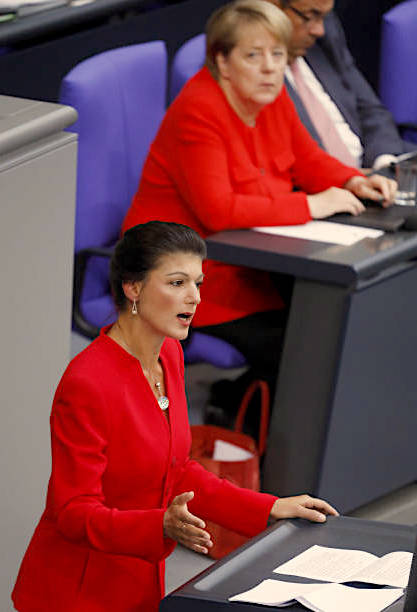
Wagenknecht in the Bundestag (Photo – Michele Tantussi/Getty Images)
Wagenknecht was born in East Germany 48 years ago to an Iranian father and German mother. She is highly educated, with a Ph.D. in economics and is author of books on the young Marx’s interpretation of Hegel, on “The Limits of Choice: Saving Decisions and Basic Needs in Developed Countries” and “Prosperity Without Greed”. The charismatic Sahra has become one of the most popular politicians in Germany. Polls indicate that a quarter of German voters would vote for her as Chancellor.
But there is a catch: her party, Die Linke. Many who would vote for her would not vote for her party, and many in her own party would be reluctant to support her. Why? Immigration.
Sahra’s strongest supporter is Oskar Lafontaine, 74, her partner and now her husband. A scientist by training with years of political experience in the leadership of the SPD, Lafontaine was a strong figure in the 1980s protest movement against nuclear missiles stationed in Germany and remains an outspoken critic of U.S. and NATO militarism – a difficult position in Germany. In 1999 he resigned as finance minister because of his disagreement with the neoliberal policy turn of SPD Chancellor Gerhard Schoeder. He is a consistent critic of financial capitalism and the euro, calling for a change of European monetary policy that would permit selective devaluation and thus relieve the economically weaker member states of their crushing debt burden.
After leaving the SPD in 2005, Lafontaine went on to co-found Die Linke, which absorbed the post-East German Party of Democratic Socialism led by lawyer Gregor Gysi. A few years later he withdrew into the political background, encouraging the rising career of his much younger partner Sahra Wagenknecht.
Lafontaine can be likened to Jeremy Corbyn in Britain and Jean-Luc Mélenchon as a left leader who has retained basic social and antiwar principles from the past and aspires to carry them into the future, against the rising right-wing tide in Europe.
The Wagenknecht-Lafontaine couple advocate social policies favorable to the working class, demilitarization, peaceful relations with Russia and the rest of a multipolar world. Both are critical of the euro and its devastating effects on Member State economies. They favor regulated immigration. Critical of the European Union, they belong to what can be called the national left, which believes that progressive policies can still be carried out on the national level.
The Globalizing Left
Die Linke is split between the national left, whose purpose is to promote social policies within the framework of the nation-state, and the globalization left, which considers that important policy decisions must be made at a higher level than the nation.
As co-leader of the Linke fraction in the Bundestag, Wagenknecht champions the national left, while another woman, the party co-chair Katja Kipping, also an academic of East German origin, speaks for the globalization left.
In a July 2016 article criticizing Brexit, Kipping made it clear that for her the nation is an anachronism unsuitable for policy making. Like others of her persuasion, she equates the nation with “nationalism”. She also immediately identifies any criticism of mass immigration with scapegoating: “Nationalism doesn’t improve our lives, it makes the poor only poorer, it takes nothing from the rich, but instead blames refugees and migrants for all present misery.”
The idea that social reform must henceforth take place only on the European level has paralyzed left parties for decades. The most extreme of the globalizing left shove their expectations even beyond the European Union in hopes of eventual revolution at the global level, as preached by Antonio Negri and Michael Hardt in their joint books Empire and Multitude.
According to Negri, an alarmingly influential Italian theorist who has been dead wrong ever since the 1970s, the final great global revolution will result from the spontaneous self-liberation of the “multitude”. This is a sort of pie in the sky, projecting hopes beyond the here and now to some desirable future made inevitable by the new immaterial means of production (Negri’s boneless imitation of Marxism). Whether or not they have read him, many anarchist anti-globalist notions of The End Times are in harmony with Negri’s optimistically prophetic view of globalization: it may be bad now, but if it goes far enough, it will be perfect.
Since the globalization left considers the nation state inapt to make the revolution, its abolition is seen as a step in the right direction – which happens to coincide with the worldwide takeover of international financial capital. Its core issue, and the one it uses to condemn its adversaries in the national left, is immigration. Katya Kipping advocates “open borders” as a moral obligation. When critics point out that this is not a practical suggestion, the globalization left replies that it doesn’t matter, it is a principle that must be upheld for the future.
To make her policy line even more unrealistic, Kipping calls for both “open borders” and a guaranteed minimum income for everyone.
It is easy to imagine both the enthusiastic response to such a proposal in every poor country in the world and its horrified rejection by German voters.
What can motivate leaders of a political party to make such flagrantly unpopular and unrealizable proposals, guaranteed to alienate the vast majority of the electorate?

Kipling: Globalized immigration in line with international finance. (Getty)
One apparent source of such fantasy can be attributed to a certain post-Christian, post-Auschwitz bad conscience prevalent in sectors of the intelligentsia, to whom politics is more like a visit to the confession booth than an effort to win popular support. Light a candle and your sins will be forgiven! Many local charitable organizations actually put their beliefs in practice by providing material aid to migrants. But the task is too great for volunteers; at present proportions it requires governmental organization.
Another, more virulent strain of the open border advocates is found among certain anarchists, conscious or unconscious disciples of Hardt and Negri, who see open borders as a step toward destroying the hated nation state, drowning despised national identities in a sea of “minorities”, thereby hastening the advent of worldwide revolution.
The decisive point is that both these tendencies advocate policies which are perfectly compatible with the needs of international financial capital. Large scale immigration by diverse ethnic communities unwilling or unable to adapt the customs of the host country (which is often the case in Europe today, where the host country may be despised for past sins), weakens the ability of society to organize and resist the dictates of financial capital. The newcomers may not only destabilize the situation of already accepted immigrant populations, they can introduce unexpected antagonisms and conflicts. In both France and Germany, groups of Eritrean migrants have come to blows with Afghan migrants, and other prejudices and vendettas lurk, not to mention dangerous elements of religious fanaticism.
In foreign policy, the globalization left tends to accept the political and media mainstream criticism of Wagenknecht as a Putin apologist for her position regarding Syria and Russia. The globalist left sometimes seems to be more intent on arranging the rest of the world to suit their standards than finding practical solutions to problems at home. Avoiding war is also a serious problem to be dealt with at the national level.
Despite the acrimonious debates at the June 8 to 10 party congress, Die Linke did not split. But faced with the deadlock on important questions, Wagenknecht and her supporters are planning to launch a new trans-party movement in September, intended to attract disenchanted fugitives from the SPD among others in order to debate and promote specific issues rather than to hurl labels at each other. For the left, the question today is not merely the historic, “What is to be done?” but rather a desperate, Can anything be done?
And if they don’t do it, somebody else will.
Diana Johnstone is the author of Fools’ Crusade: Yugoslavia, NATO, and Western Delusions. Her new book is Queen of Chaos: the Misadventures of Hillary Clinton. The memoirs of Diana Johnstone’s father Paul H. Johnstone, From MAD to Madness, was published by Clarity Press, with her commentary. She can be reached at diana.johnstone@wanadoo.fr .
Germany’s Die Linke Calls for Improvement in Russia Relations
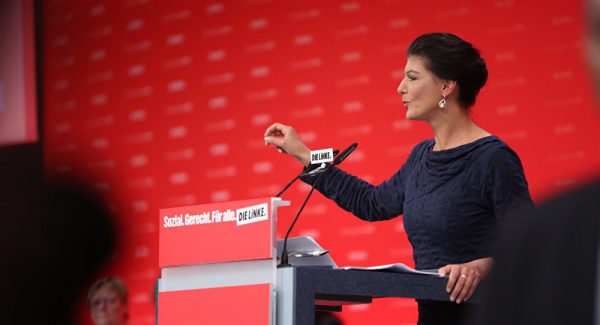
Sputnik – June 12, 2017
Germany’s Die Linke party, which held its party conference in Hannover last weekend, is seeking to pursue a policy of “good neighborliness” and improve relations with Russia, the party’s leader in the Bundestag Sahra Wagenknecht told Sputnik.
The leftist Die Linke is the third-largest party in the German Bundestag, with 64 seats. On Friday, the party began its three-day conference in Hannover, where party members debated its manifesto ahead of federal elections to be held on September 24. On the sidelines of the conference, Sahra Wagenknecht, co-leader of Die Linke in the Bundestag, told Sputnik Deutschland that one of the party’s foreign policy ambitions is to improve relations with Russia.
“We want to improve the relationship with Russia, we want a new approach in the tradition of détente politics, a policy of good neighborliness. This means taking mutual interests seriously and mutually accepting legitimate interests. Europe and Russia have a history that can’t be erased, and Russia has always been the victim of raids and wars, not least, and worst of all, by Germany in the Second World War,” Wagenknecht said.
“That is why I can well understand that many people feel threatened when they see German soldiers on the Russian border again. We do not want that, we want peace in Europe and peace is only possible with Russia and not against Russia.”
Wagenknecht said her party rejects the unsubstantiated allegations made in the US that Russia influenced the result of last year’s presidential election, to the detriment of Democratic candidate Hillary Clinton.
Rather, Clinton’s failure to be elected President was a result of her shortcomings as a candidate from the establishment, at a time when voters are keen for something different.
“This debate is going on in all seriousness and it is really curious. I really have to say: Whoever ascribes to Russia the power to essentially decide who will lead the American nation and who will become President, is completely crazy.”
“Of course, there is no substance [to the allegations]. I think there has to be a serious discussion about why someone like Donald Trump was able to be elected. That is also where we are regarding social issues and social problems, there is an absence of perspective. Above all, the election in the USA was an anti-election. The people there did not want any ‘more of the same,’ they did not want Hillary Clinton. This is the truth and everything else is really ridiculous,” Wagenknecht said.
In her speech to the party conference, Wagenknecht called on the German left to provide an alternative to establishment politics and emulate the recent success of the UK’s Labour Party, which succeeded in last week’s general election with a socialist agenda. Against expectations, Labour Party leader Jeremy Corbyn increased his party’s share of the vote by 9.6 per cent and gained an extra 30 seats in parliament.
Wagenknecht drew an unfavorable comparison between Corbyn and German Social Democrats (SPD) leader Martin Schulz.
“Die Linke would immediately elect a German Jeremy Corbyn as Chancellor; It is not, unfortunately, in our power to make Martin Schulz into a Jeremy Corbyn,” Wagenknecht told the conference.
In conversation with Sputnik, the party co-chair said that Corbyn had won by taking “classical Social-Democratic positions” such as renationalization of privatized public services and utilities as well as investment in education and healthcare.
“He was vilified as somebody who wants to return to the past. This is a reproach which we hear in Germany again and again: If someone wants to restore the welfare state, then one is supposedly backward. But Corbyn was not bothered at all by all the insults and defamations. He was treated very badly, also by the media, but he pulled through, he said clearly, ‘this is what I want.’ He also had credibility, which is probably the most decisive. It is not just about the promises which are made to voters but also about whether or not to believe him.”
“Martin Schulz doesn’t have any of that. He doesn’t have any credibility or [political] demands. Everything is to force a continuation of the grand coalition. So, you don’t win elections, but one is also out of the game when it comes to making a new coalition with left-wing participation. This is absurd, because we don’t want to continue the recent policy,” Wagenknecht said. The politician said that her party would consider entering into coalition only if it could find a suitable partner.
“Sure, we want to govern if we have an absolute majority. If we have partners with the same goals, we want to govern. But we do not want to go into a government in which, in the end, we have to do the opposite of what we have promised the voters. There are enough of those kinds of parties, which have no credibility, which can’t be trusted by their voters. We won’t be like that,” Wagenknecht declared.
Featured Video
John Mearsheimer: US Already lost Iran war – No off-ramp in sight
or go to
Aletho News Archives – Video-Images
Frlom the Archives
70 Neocons Petition Congress To Effectively Allow Israel To Say When The US Should Attack Iran
By Damian Lataan | January 10, 2014
Seventy senior Israeli-centric neoconservatives have written an open letter to Congress imploring them to do more to ensure Iran complies with the conditions of any agreement finally reached with the P5+1 over Iran’s nuclear program.
While the neocons are ostensibly asking Congress to ensure compliance, it is clear that their real aim is to convince members of Congress to support the bill currently passing through the Senate which calls for tighter sanctions against Iran in the event of any waywardness on Iran’s part.
The neocons are eager to see the bill currently passing through the Senate with enough support to make it veto-proof, not so much because they are concerned about Iran’s so-called nuclear weapons program – there’s still not a skerrick of hard evidence that Iran has a nuclear weapons program – but, rather, because embedded within the bill is this clause:
… if the Government of Israel is compelled to take military action in legitimate self-defense against Iran’s nuclear weapon program, the United States Government should stand with Israel and provide, in accordance with the law of the United States and the constitutional responsibility of Congress to authorize the use of military force, diplomatic, military, and economic support to the Government of Israel in its defense of its territory, people, and existence…
Essentially, the clause is an automatic trigger for the US to attack Iran at any time the Israelis choose to launch a first strike – regardless of whether President Obama is in favour or not.
Partial list… continue
Blog Roll
 Aletho News
- ‘Heinous crime’: Iran denounces Israeli assassination of 4 Iranian diplomats in Lebanon
- John Mearsheimer: U.S. Already Lost Iran War – No Off-Ramp in Sight
- UK Parliament Plans ISP Blocking and Age Verification Powers
- World cannot remain silent as US and Israel attack ‘heritage of humankind’: Iran
- Emirati billionaire rebukes US senator over call for Gulf states to join war with Iran
- Op. True Promise 4: Iran’s missile blitzkrieg dismantles US war machine in West Asia
- Aramco CEO warns ‘catastrophe’ imminent if Strait of Hormuz remains shut
- What If Iran Says No?
- Trump Threatens to ‘Hit’ Iran ‘Twenty Times Harder’ Over Strait of Hormuz Oil Flows
- Spare the hypocrisy: Baghaei slams Ursula’s support for US
- If Americans Knew
- Israel Decided the War, But Trump’s America Fights and Pays the Bill
- Conscientious Objector Group: Phone ‘Ringing Off Hook’ As Huge Mobilization Underway
- U.S. support for Israel continues to plummet, despite media’s best efforts
- Threats and missiles fly, death tolls soar in Iran, Lebanon, Gaza – Not a ceasefire Day 151
- Lebanon: Israel’s White Phosphorous Use Risks Civilian Harm
- Corporate Media Go All Out To Support The US-Israeli War On Iran
- US-Israel war on Iran is creating a steady growing number of amputees
- Israel planned this war on Iran for 40 years. Everything else is a smoke screen
- The wrong question about the war in Iran
- ‘Your Tax Dollars Being Used to Raise Your Gas Prices’: US-Israel Bomb Major Iranian Oil Depots
- No Tricks Zone
- New Study Documents A 20-Year Pause In Arctic Sea Ice Decline – Driven By Internal Variability
- Wake-up Call: Survey Shows Majority Of Germans Now Favor Postponing Climate Targets!
- Televised! Leading German Political Candidate Tells Schoolchildren CO2 Makes Sun Hotter!
- New Study: A Century Warming Of 1.1°C Is ‘Commonplace’ And ‘Not Unusual’ During This Interglacial
- New Study: ‘Internal Noise’ And Volcanic Forcing Can Trigger 10-15°C Warming Within Decades
- Glaciers Worldwide Are Suddendly Surging, Experts Blame Warming!
- Surprising Discovery: Sahara Is Greening…Billions Of Trees Where Once Thought To Be Barren
- New Research Reaffirms Clouds, Aerosols, And Surface Solar Radiation Are ‘Driving The Climate System’
- Germany: Electric Car Catches Fire At Charging Station, Sets Off Local “Inferno”, Widespread Damage
- New Study: Canada’s New Brunswick Was 1°C Warmer Than Today During The Medieval Warm Period
 Aletho News