5 Things You Really Need to Know About the Plot to Oust Brazil’s President Roussef
teleSUR | April 13, 2016
Brazil, Latin America’s largest economy and most populous nation, could be on the verge of major political change that could have ramifications not just across the region but globally.
A committee of the lower house of Congress voted 38-27 on Monday April 10 to recommend the impeachment of leftist President Dilma Rousseff.
The president could soon be ousted from her post in what could be the first impeachment of a Brazilian president since 1992 when Fernando Collor de Mello faced massive protests over corruption charges and resigned moments before his conviction by the Senate.
It’s Aimed at a President Elected by Millions
Dilma Rousseff is Brazil’s first woman president and took office on Jan. 1, 2011 after scoring a resounding victory in the presidential election held in October 2010 under promises she will improve the education system and cut inequality.
Rousseff’s victory in 2011 was also largely attributed to her close association with her predecessor, Luiz Inacio Lula da Silva, also of the Workers Party.
After a successful first term she was re-elected in 2014 seeing off Aécio Neves from the Brazilian Social Democracy Party (PSDB) amassing 52 percent of the electorate’s vote and 54 million vote.
The Workers Party, known as the PT, has now been in power for over a decade, much to the chagrin of the country’s conservative political forces.
Former President Lula da Silva has publicly suggested that efforts to impeach Rousseff are driven by politicians who want to take a shortcut to the presidency.
“Anyone who wants to become president, instead of trying to take down the president, they can run in an election. I ran three of them and didn’t get angry,” said Lula in a recent interview.
Political Opponents of Dilma Have a Majority in the Body That Will Decide Her Fate
The speaker of the lower chamber of Congress, Eduardo Cunha, a political opponent of Rousseff, accepted a petition for impeachment in what was described by the president’s supporters as a vengeful move. Cunha, who is under investigation for undeclared Swiss bank accounts totalling U.S. $5 million, only began impeachment proceedings when lawmakers from the PT voted to open an investigation.
A vote in the full lower house, which comprises of 513 lawmakers, is expected to take place on Sunday. If two-thirds vote in favor, the impeachment will be sent to the Senate. Should the Senate move forward with the impeachment process, Rousseff will immediately be suspended for up to six months while the Senate decides her fate.
In this scenario, Vice President Michel Temer – who comes from the same PMDB party as Cuhna, the man who helped push the call for impeachment – will take office as acting president.
The PT only has 57 lawmakers in the lower house, the PMDB has 67 while the rest are made up of smaller parties whose affiliations will be vital in deciding her fate.
Rousseff’s government has seen a number of defections, including the PMDB, the Progressive Party, and the Social Democratic Party, making it very likely that the lower house will vote for impeachment.
A total of 342 of the 513 lawmakers need to approve of Rousseff’s impeachment in order for the process to proceed to the Senate. The Senate will hold a simple-majority vote whether or not to convene a trial.
The Brasilia-based consultancy Arko Advice said committee votes for impeachment were higher than expected and it raised to 65 percent the odds of Rousseff being ousted by Congress.
The Senate trial would be overseen by the chief justice of the Supreme Federal Tribunal, Ricardo Lewandowski, and two-thirds of the 81 senators must vote for conviction to remove Rousseff from office. If no decision is reached within 180 days, the suspension of the president ends.
Like the lower house, the PT does not command a majority in the Senate, holding only 11 of the seats, meaning that many of Rousseff’s adversaries will be those deciding her fate.
The First Vote for Impeachment Was Dominated by Those Facing Corruption Charges
The committee, largely of comprising of Rouseff opponents, voted on Monday 38-27 in favor of continuing the impeachment process of the President. Amazingly, 36 out of the 65 members of the impeachment commission themselves are accused of corruption. Of those 36, 20 voted in favor of impeachment.
In other words, people accused of corruption voted to open an investigation into a president who has not been found guilty of any wrongdoing.
This is why Rousseff’s supporters say that impeachment without proof of a crime is a coup.
If Ousted, Economic Shock Therapy Will Be Implemented
Brazilian law stipulates that if a trial is convened in the Senate, the president must automatically step down. That means Temer could very soon be the president of Brazil, even if only on a temporary basis.
His party, the PMDB, has already revealed what they intend to do with power.
In a report revealed by “O estado de Sao Paulo,” the PMDB indicated that they would implement sweeping austerity reforms, including cuts to the lauded “Bolsa Familia” program.
The report also said the PMDB would consider cutting a large housing program for the poor and displaced workers and a program to make college education more accessible.
This Impeachment Process Isn’t Even About Corruption
Pressure began mounting on Rousseff in 2015 after Brazil’s once impressive economy shrank by 3.8 percent, the biggest decline since 1981 and a multi-billion dollar corruption scandal was exposed in the country’s state-run oil company Petrobras.
In the past two years, over 100 people have been arrested for their alleged involvement, including senators and top executives at Petrobras and members from both sides of the political spectrum. Dilma though has not been formally investigated.
Yet the investigation into the corruption scandal has taken a political course, with the lead investigator, Sergio Moro, coming under heavy criticism for his alleged anti-PT bias. Most of the politicians under investigation are not members of the PT, yet the cases involving the PT receive the most attention from the press and investigators.
Rousseff’s potential impeachment is totally unrelated to her or PT’s dealings with the state run oil company. Rather Rousseff is accused by her political opponents of breaking fiscal laws. They allege she manipulated government accounts to make the country’s deficit seems smaller than it was ahead of the 2014 presidential election to garner support for her re-election campaign.
The government maintains that the audit court is criticizing steps taken by the government to maintain social programs for Brazil’s poor, such as the widely-praised Bolsa Familia.
The Forces Behind the Attempted Coup in Brazil
By Mark Weisbrot | The Hill | April 5, 2016
If you are following the news of political turmoil in Brazil, it may be difficult to get a grasp of what is really going on. This often happens when there is an attempted coup in the Western Hemisphere, and especially when the U.S. government has an interest in the outcome. Usually the information about that interest, and often Washington’s role, is the first casualty of the conflict. (Twenty-first century examples include Paraguay in 2012, Haiti in 2011 and 2004, Honduras in 2009, Ecuador in 2010 and Venezuela in 2002.)
First, there is no doubt that this is a coup in progress. It is an attempt by Brazil’s traditional elite — which includes, as one of the most important players, most of the major media — to reverse the outcome of Brazil’s 2014 presidential elections. Exhibit A is the grounds on which they hope to impeach President Dilma Rousseff of the Workers’ Party (PT by its Portuguese initials). It has nothing to do with corruption, or any serious offense.
The charge is that the government used borrowed money in 2014 to maintain the appearance that the primary budget surplus was within its target. But this is something that other presidents had done, and is hardly a serious offense. A comparison: When the Republicans in the U.S. Congress threatened to shut down the government over the debt ceiling in 2013, the Obama administration used a number of accounting tricks to extend the deadline, and there was little controversy over this.
The charges against Lula are also dubious, even if they turn out to be true. Most importantly, the accusers have not shown any connection to the big “Lava Jato” (car wash) corruption scandal — or any other corruption. Lula is accused of owning some beachfront property, which he denies owning, that was renovated by a Brazilian construction company; and of receiving money from various corporations for speeches. Most importantly, however, these are things that took place after he left the presidency. Although Bernie Sanders has rightly made an issue of Hillary Clinton’s receipt of millions of dollars from corporations for speeches, it is not illegal in the U.S. — or Brazil.
The main judge investigating these cases, Sergio Moro, had to apologize to the Supreme Court for leaking to the press wiretapped conversations between Lula and Dilma, as well as between Lula and his attorney, and between his wife and their children. The detention of Lula for questioning, with advance leaks to the media and involving 200 police despite the fact that Lula had always voluntarily submitted to questioning, also left no doubt as to the political nature of the investigation.
If Moro had any evidence linking Dilma or Lula to actual corruption, it is likely that some of it would have been released by now, given that he has leaked personal and private wiretapped conversations just to embarrass them. Brazil’s anti-democratic, corrupt elite is trying to take the country back to its pre-democratic past, when the electorate could not interfere with their choice of leaders.
Unfortunately, that is not all that long ago: The dictatorship that lasted until 1985 was installed in a 1964 U.S.-backed coup, to which the current efforts bear some resemblance. About the U.S. role today: It is no secret that Washington would like to get rid of all of the left governments in the region. In President Obama’s trip to Argentina last week, and other public statements from U.S. officials, they made it clear how happy they were to welcome the new right-wing government there. They also reversed their policy, implemented against the prior, left government, of blocking loans to Argentina from international lenders like the Inter-American Development Bank and World Bank.
Of the coups mentioned above, evidence of the U.S. role is documented beyond a reasonable doubt in all of them except Ecuador, where there is no hard evidence. But since there has almost never been a coup in this hemisphere against a left government without some U.S. involvement, it is no wonder that many Ecuadoreans believe the U.S. was (and remains) involved there, too. And such speculation is not unreasonable in Brazil, where Washington intervened in 2005 in support of a legislative effort aimed at undermining the Workers’ Party government.
The massive spying on Brazil —and especially Petrobras — that Edward Snowden and Glenn Greenwald revealed in 2013, also points in this direction. It could be a coincidence that all this information about Petrobras was gathered by the U.S. government just prior to the scandals at the state-controlled oil company; or perhaps Washington shared some information with its allies in the Brazilian opposition. And there is no doubt that, like President Mauricio Macri in Argentina, the biggest players in this coup attempt — people like former presidential candidates José Serra and Aécio Neves — are U.S. government allies. Of course the PT government would not be in so much trouble today, even with the media leading the charge, if the economy – which shrank by an estimated 3.8 percent last year — were in better shape.
And that, unfortunately, is due mainly to their own mistakes; beginning at the end of 2010, they embarked on a series of spending cuts, interest rate increases, and other measures that stalled the economy, followed by even harsher austerity in 2015 that caused a deep recession with no end in sight. Unemployment has risen from a record low of 4.3 percent in December 2014 to 8.2 percent today. This didn’t have to happen; with more than $360 billion in foreign currency reserves, Brazil is not constrained by the balance of payments, and therefore could recover with expansionary macroeconomic policies.
Dilma and Lula are on the ropes and up against some powerful enemies, but it would be premature to count them out. They have faced tougher battles; unlike their adversaries and the big media companies that supported the dictatorship, they were imprisoned during its rule. If they can survive the current coup attempt, they will have a chance to fix the economy and return to their legacy — which is, after all, one of considerable economic and social progress.
Attempts to impeach Brazil president illegal: Attorney general
Press TV – April 5, 2016
Brazil’s attorney general has slammed impeachment proceedings against President Dilma Rousseff as illegal, saying such a bid is nothing more than an attempted coup d’état.
Jose Eduardo Cardozo, the government’s main legal advisor, defended Rousseff before the impeachment committee of Brazil’s lower house of Congress, dismissing the allegations leveled against the embattled president.
Opposition lawmakers, who are seeking to remove Rousseff, accuse her of taking out unauthorized government loans to hide a growing budget deficit.
Cardozo told the 65-member committee that such claims, even if true, could not be dealt with as an impeachment case, saying the “process was compromised from the start and as such it is invalid.”
“As such, impeaching her would be a coup, a violation of the constitution, an affront to the rule of law, without any need to resort to bayonets,” he added.
The hearing was the final plea by Rousseff’s administration against the impeachment. The committee will likely issue its recommendation this week.
If the impeachment passes the lower house, the president would be suspended for up to six months while facing trial in the Senate. Meantime, Vice President Michel Temer would replace her as acting president.
Rousseff, however, vowed that she would stand firm and would not bow to the pressure to bring her down. Her predecessor and ally Luiz Inacio Lula da Silva has also pledged to support Rousseff.
The impeachment process began last December after lower house speaker Eduardo Cunha accepted the opposition request for such a move.
Cardozo said Cunha’s decision was motivated by his desire for political revenge against Rousseff, his bitter political rival.
The political crisis has brought Brazil to the brink of economic collapse as it is entangled in a deep recession and corruption allegations.
With the Rio de Janeiro Olympics just four months away, the Latin American country has been the scene of counter rallies in and against the government over the last few weeks, some of which even turned violent.
In the latest of such rallies, anti-government protesters took to the streets on Monday, denouncing the officials for not having decided over the impeachment bid.
Langley’s Latest Themed Revolution: the Yellow Duck Revolution in Brazil

BY Wayne MADSEN | Strategic Culture Foundation | 24.03.2016
The latest themed revolution concocted by the Central Intelligence Agency’s «soft power» agents in the Brazilian federal and state legislatures, corporate media, and courts and prosecutors’ offices – all spurred on with the financial help of George Soros’s nongovernmental organizations – is the «Yellow Duck Revolution».
Large inflatable yellow ducks – said to represent the economic «quackery» of President Dilma Rousseff and her Workers’ Party government – have appeared at US-financed street demonstrations in Brasilia, Rio de Janeiro, and Sao Paulo. The main coordinators of these protests are found in Brazil’s largest corporate federations and corporate-owned media conglomerates and all of them have links to domestic non-profit organizations like Vem Pra Rua (To the Street) – a typical Soros appellation – and Free Brazil Movement, in turn funded by the usual suspects of the National Endowment for Democracy (NED), US Agency for International Development (USAID), and Soros’s Open Society Institute.
After trying to mount an electoral defeat of Brazil’s progressive leftist president, Dilma Rousseff, through a combination of presidential candidate assassination (the aerial assassination of Eduardo Campos in 2014 to pave the way to the presidency for the Wall Street-owned Green candidate Marina Silva, Campos’s vice presidential running mate), «rent-a-mob» street demonstrations, and corporate media propaganda, the Langley spooks are now trying to run Rousseff from office through a «Made in America» impeachment process. Aware that Rousseff’s progressive predecessor and mentor, Luiz Inacio Lula da Silva, has been targeted by Brazilian prosecutors on the CIA’s payroll, for arrest and prosecution for bribery, she appointed him to her government with ministerial rank and prosecutorial immunity. Lula only became a target because he signaled his desire to run for the presidency after Rousseff’s term ends in 2019.
The Workers’ Party correctly points out that the legislative impeachment maneuvers against Rousseff and the judicial operations against both Rousseff and Lula emanate from Washington. The same «color of law» but CIA-advanced operations were directed against presidents Cristina Fernandez de Kirchner in Argentina, Rafael Correa in Ecuador, Evo Morales in Bolivia, Nicolas Maduro in Venezuela, Fernando Lugo in Paraguay, and Manuel Zelaya in Honduras. In the cases of Lugo and Zelaya, the operations were successful and both leaders were removed from power by CIA-backed rightist forces.
Street protests against Rousseff have, since they began in 2014, taken on the typical Soros themed revolution construct. As with the disastrous Soros-inspired and CIA-nurtured Arab Spring protests in Egypt, Libya, Syria, and Tunisia and Euromaidan protest in Ukraine, the Vem Pra Rua movement and the associated Free Brazil Movement are basically nothing more than politically-motivated capitalist campaigns relying on Facebook, Twitter, and pro-insurrection television and radio networks, newspapers, and websites.
In addition to the inflatable yellow ducks, street protests have been marked by quickly-manufactured inflatable dolls of Lula in black and white prison garb and a placard cartoon drawing of Rousseff with a red diagonal «No» sign drawn through it. Street protest devices, which also include green and yellow banners and clothing, are telltale signs of significant amounts of money backing the psychological warfare gimmickry.
Brazilian prosecutors on Langley’s payroll arrested the popular Lula after staging a massive police raid on his house. Police also arrested the former First Lady of Brazil, Lula’s wife Marisa Leticia. Lula said he felt that he was kidnapped by the police. In 2009, Honduran troops actually kidnapped President Manuel Zelaya in the middle of the night and detained him in a military cell prior to expelling him from the country. That operation, like the one against Lula and Rousseff, was backed not only by the CIA and NSA, but by the US Southern Command in Miami. The Honduran coup was also backed by the Supreme Court of Honduras. To prevent a further political arrest of her predecessor, Rousseff made Lula her chief of staff, a cabinet position that affords Lula some protection from continuing prosecutorial harassment and legal proceedings by the federal court.
On March 16, Judge Sergio Moro, who is in charge of Operation «Lava-jato» («Car wash»), the two-year investigation of Petrobras and the alleged bribery involving Rousseff and Lula, released two taped intercepts of phone calls between the president and former president. The bugged phone conversation involved Rousseff’s plans to appoint Lula as her chief of staff, a Cabinet rank, as a way to afford him some protection from the CIA’s judicial-backed coup operation now in play. Rousseff previously served as Lula’s chief of staff. Classified National Security Agency documents leaked by whistleblower Ed Snowden illustrate how the NSA has spied on Rousseff’s office and mobile phones. President Obama claimed he ordered an end to such spying on world leaders friendly to the United States. Obama’s statement was false.
Judge Sergio Moro’s name appears in one of the leaked State Department cables. On October 30, 2009, the US embassy in Brasilia reported that Moro attended an embassy-sponsored conference in Rio de Janeiro held from October 4-9. Titled «Illicit Financial Crimes», the conference appears have been an avenue for the CIA and other US intelligence agencies to train Brazilian federal and state law enforcement, as well as other Latin American police officials from Argentina, Paraguay, Panama, and Uruguay, in procedures to mount bogus criminal prosecutions of Latin American leaders considered unfriendly to the United States. The State Department cable from Brasilia states: «Moro… discussed the 15 most common issues he sees in money laundering cases in the Brazilian Courts».
One item that was not on the agenda for the US embassy seminar was the NSA’s covert spying on the communications of Rousseff, Lula, and the state-owned Brazilian oil company Petrobras. In a technique known as prosecutorial «parallel construction», US prosecutors given access to illegally-intercepted communications, have initiated prosecution of American citizens based on the selective use of warrantless intercepts. If such tactics can be used in the United States, they can certainly be used against leaders like Rousseff, Lula, and others. The Operation Car wash intercepts of the Rousseff-Lula phone conversations that were released by Judge Moro to the media may have originated with NSA and its XKEYSCORE database of intercepts of Brazilian government and corporate communications conducted through bugging operations codenamed KATEEL, POCOMOKE, and SILVERZEPHYR.
In what could be called the «Obama Doctrine», the CIA has changed its game plan in overthrowing legitimate governments by using ostensibly «legal» means. Rather than rely on junta generals and tanks in the street to enforce its will, the CIA has, instead, employed prosecutors, judges, opposition party leaders, newspaper editors, and website administrators, as well as mobs using gimmicks – everything from inflatable yellow ducks, paper mâché puppets, and freshly silk screen-printed t-shirts, flags, and banners – as themed revolution facilitators.
As shown by the leaked State Department cables, the CIA has identified a number of agents of influence it can rely on for providing intelligence on both Rousseff and Lula. These sources have included the senior leadership of the Workers’ Party; officials of Petrobras eager to see their company sold off to the highest-bidding foreign vultures; Brazilian Central Bank executives; and Brazilian military intelligence officers who were originally trained by US intelligence and military agencies.
In addition to BRICS member Brazil, other BRICS nations have also seen the US increasing its efforts to organize themed revolutions. South Africa is on the target list, as are Russia and China.
Who’s Protesting in Brazil and Why?
By Bryan Pitts – NACLA – 04/09/2015
Reading the English-language press these days, one could be forgiven for thinking that Brazil is in the throes of a democratic uprising against a singularly corrupt government, a politically incompetent president, and a floundering economy. Since late last year, the center-left Worker’s Party (PT) government headed by President Dilma Rousseff has been rocked by an ever-widening scandal involving over-inflated contracts and kickbacks to government-allied politicians at the state-owned oil giant Petrobrás. Indignant PT militants—rather than lamenting corruption in a party that once ran on its anti-corruption credentials—have tended to attack the media for highlighting PT corruption after ignoring abuses during the 1995-2002 administration of Fernando Henrique Cardoso, as well as similar scandals in state governments controlled by the opposition Party of Brazilian Social Democracy (PSDB).
In part due to the collapse of Petrobrás’s stock, down 67% since the start of September, the Brazilian currency has plunged nearly 40% against the dollar since then. Inflation over the last year has reached nearly 8%, the highest since 2005, inviting Brazilians to nervously recall the hyperinflation of the 1980s and early 1990s. On March 15, nationwide demonstrations organized on social media gathered anywhere from 300,000 to two million protesters in dozens of cities. They brandished signs saying, “Out with the PT!” and demanded Rousseff’s impeachment, although the one-time head of Petrobrás has not been implicated in the kickback scheme and can constitutionally only be impeached for crimes committed during her presidency. In the wake of the demonstrations, the percentage of Brazilians rating her government as “excellent” or “good” dropped to an abysmal 12%, while 64% rated it “poor” or “terrible.” This disapproval rating is the highest for any president since Fernando Collor de Mello’s 68% on the eve of his own impeachment for corruption in 1992. (Incidentally, Collor, now an opposition senator, is one of 47 politicians currently under investigation for their role in the Petrobrás scandal.)
Foreign media outlets have seized on Rousseff’s supposedly lackluster response to the Petrobrás scandal and Brazil’s gloomy macroeconomic outlook to speculate whether the collapse of the PT’s economic and political model, which has relied on cautiously redistributive policies and moderately increased government involvement in the economy, is imminent. Their sense of hope is palpable: “Brazil’s poor turn their back on Rousseff,” one headline gleefully reported on March 16. Another article insisted that the protests’ “cheerfully democratic multitudes” sought contrition from Rousseff for her party’s graft and economic mismanagement, but that the President had so far ignored their indignation. An opinion piece in a British daily expressed hope that “popular dissatisfaction” would persuade Rousseff to take the steps needed to solve Brazil’s economic problems – a reduced role for state credit agencies, increased independence for Petrobrás and monetary authorities, tax reform, brakes on special interests, and increased openness to foreign trade. The New York Times added an editorial on March 20 blasting Rousseff’s foreign policy, which, it suggested, should draw closer to the United States – despite Eric Snowden’s revelations of NSA spying on Rousseff’s communications.
It’s no secret that most foreign correspondents are neither politically well connected nor fluent in Portuguese. Part of the explanation for their bias, then, comes from their dependence upon Brazil’s notoriously one-sided media, owned by a few elite families and corporate groups. The major newspapers are all staunchly anti-government, their reporting on Rousseff’s administration universally negative. The Globo television network dedicated much of its March 15 programming to recruiting attendees for what it called, “peaceful demonstrations against corruption, with women, the elderly, and children asking for democracy and out with Dilma.” Indeed, the Brazilian and foreign press are engaged in an endless echo chamber of self-validation: foreign journalists get their information from anti-government media outlets, which then breathlessly report the foreign “analysis” in order to invalidate their own bias. For example, a March 21 story in the Folha de S. Paulo and Veja reported favorably on the New York Times’ foreign policy editorial. If foreigners say it, it must be true.
Perhaps the most notorious recent example of press bias occurred when Brian Winter, Reuters’ chief Brazil correspondent, interviewed Fernando Henrique Cardoso. Published in Portuguese by Reuters Brasil, the story contained a paragraph admitting that one of the Petrobrás officials involved in the corruption scheme claims that it dated to Cardoso’s administration. The paragraph was followed by a parenthetical note, apparently penned by one of the Brazilian editors, that accidentally remained undeleted: “We can take this part out if you want.” To his credit, Winter didn’t remove the paragraph, but the gaffe shows the inner-workings of the Brazilian branch of an American media outlet, where protecting the opposition and attacking the PT trumps even a casual relationship with the truth. Although the article was hastily corrected (without any indication that it had been modified), it was too late: attentive readers had already posted the gaffe to Twitter, under the hashtag #PodemosTirarSeAcharMelhor.
Amidst predictions of Rousseff’s demise, the mainstream media has consistently downplayed, and occasionally outright ignored, one fact: the social backgrounds of protesters. It is not “the Brazilian people” who are in the streets, but rather a very specific segment of the population whose economic interests are historically opposed to those of the majority. They are largely middle and upper class and, consequently, mainly white. In the 2014 elections they sensed that their time had come to get rid of the PT, only to see their favored candidate, former Minas Gerais PSDB governor Aécio Neves, lose in Brazil’s closest-ever presidential contest. Despite the very real and serious flaws of the current government, this discontent with the PT finds its true source in centuries of elite fear of popular mobilization and a deep resentment of the gains working class people have made since Lula took office in 2003.
Of course, if one asks the demonstrators in the streets why they are protesting, no one will say that it’s because the poor aren’t as poor anymore. Indeed, 44% of demonstrators in Porto Alegre told pollsters that they were attending to speak out against corruption. And, responding to a question that permitted multiple answers, 58% indicated that their greatest disappointment lies with the political class overall, as compared to 44% that identified the PT and 29% Rousseff. A further 78% argued that political parties, including the opposition, should have no role in their movement. Could it be the case that the demonstrations were, in fact, overwhelmingly democratic and targeted primarily at corruption? Several clues indicate that this is not the case.
Although they represented a small minority of demonstrators, a vocal contingent was not satisfied with calls for impeachment. In a chilling scene for those who remember the repression unleashed during Brazil’s 1964-1985 military dictatorship, protesters carried signs emblazoned with slogans like “Military intervention now” and “SOS Armed Forces.” A banner in Rio de Janeiro featured a swastika and read, “Armed Forces, liberate Brazil.” Another read (in English), “Army, Navy, and Air Force. Please save us once again of [sic] communism.” “The best communist is a dead communist. Dilma, Maduro, Hugo, Fidel, Cristina, Lula: the world’s garbage.” Their signs were eerily reminiscent of the media’s enthusiastic response to Brazil’s 1964 coup, when the country’s press overwhelmingly cheered the military’s ouster of João Goulart—another mildly-leftist, so-called “communist” president—as a victory for democracy.
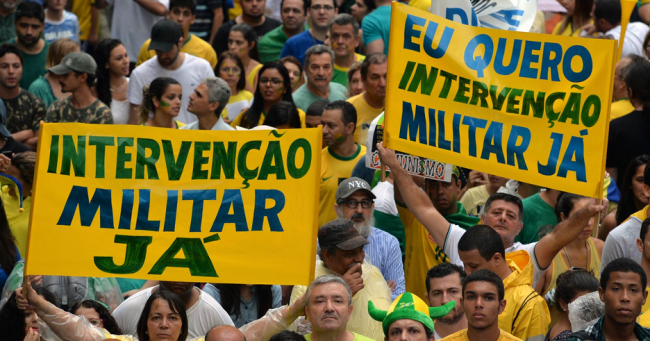
Protesters in São Paulo Plead for a Military Coup, March 15, 2015 (Source: Nelson Almeida / AFP)
In response to the pleas for military intervention, a spokesman for Revoltados ON LINE, a grassroots group that helped organize the protests and has 750,000 Facebook likes, commented, “The people asking for [military] intervention want to remove the PT from power. That is the sole focus. The participation of a variety of groups strengthens the group as a whole.” Though a military coup still looks unlikely, it is widely known that many in the military are incensed with the Rousseff administration over the final report of the National Truth Commission, which blasted the armed forces for torture and disappearances during its rule.
If those waxing nostalgic for dictatorships of yore were in the minority, what of the rest of the protesters? Despite attempts to highlight the supposed multi-class composition of the crowds on March 15, they represented, above all, Brazil’s white, university-educated economic elite. As Gianpaolo Baiocchi and Marcelo K. Silva recently pointed out, in Porto Alegre, nearly 70% of protesters were college-educated, in contrast with 11% of the general population, while over 40% belonged to the top income brackets, which make up but 3% of the population. Photographs confirm this; in a country with a high correlation between skin color and economic class, where over half of the population identifies as black or brown, the crowds had a decidedly lighter hue. A viral Tumblr account poked fun at the similarities with the upper-class, yellow-and-green-clad crowds that attended pricey World Cup matches last year by challenging visitors to determine if the photographs posted came from a March 15 demonstration or the World Cup.
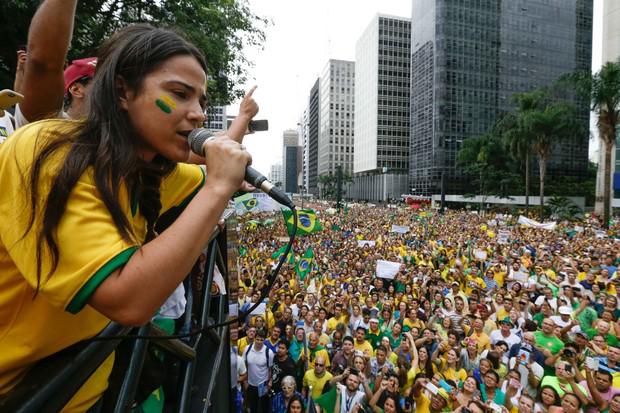
Singer Wanessa Camargo performs the National Anthem for a largely white crowd in São Paulo, March 15, 2015 (Source: Vanessa Carvalho / BPP / AGNEWS)
Of course, the fact that the demonstrations largely consisted of white middle- and upper-class Brazilians does not automatically mean that they were anti-democratic. At the same time, it would be a grave mistake to interpret the class composition of the crowds outside the context of Brazil’s historic inequalities of class, race, and region. What does it mean if the majority of demonstrators demanding the ouster of a moderately redistributive center-left party come from the social classes and regions that have least benefited from its policies? What problems do they see with corruption, the PT, or Rousseff that are insufficient to motivate the working classes or people from the impoverished Northeast of the country to take to the streets?
Since the colonial period, political and economic power has been wielded by a tiny European-descended elite, and since the collapse of the Northeastern plantation sugar economy in the nineteenth century, economic power has been concentrated in the Southeast and South, especially in the coffee and industrial powerhouse of São Paulo—today the epicenter of the opposition. An influx of European immigration in the late nineteenth and early twentieth centuries only heightened the disdain light-skinned, prosperous Southeasterners felt for their mixed-race Northeastern and Northern countrymen and women, and after the 1950s, that prejudice was turned against Northeastern migrants who came to work in the region’s expanding industries. Brazil’s middle class of government bureaucrats, small business owners, and professionals, tied to the landowning and industrial elite by socialization and patronage, has in turn largely identified with elite interests. Whenever Brazilian leaders, be they the populist dictator and later elected president Getúlio Vargas (1930-1945, 1950-1954), or the left-leaning would-be reformer João Goulart (1961-1964), have proposed reforms that would decrease inequality and broaden political representation, they have been ousted by an indignant elite and middle class – at precisely the moments when the minimum wage was growing the fastest.
The leveling results of the last 12 years are striking, if still far short of what Brazil needs to comprehensively address income inequality. In January 2003, the Inter-union Department of Socioeconomic Statistics and Studies (DIEESE) calculated that in order to provide a living wage, the minimum wage should be 6.93 times what it actually was; by February 2015, the ratio had fallen to 4.03. The unemployment rate when Lula took office was 11.2%; today, it is 5.9% (though it has risen from 4.4% in November 2014). At the same time, the gains were not evenly spread out; between 2001 and 2013, the income of the poorest 10% of the population grew at nearly three times the rate of that of the richest 10%. The result was a Gini coefficient that, while still among the highest in the world at 0.527 in 2012, reached its lowest level since 1960. In sum, then, though economic growth between 2003 and 2014 benefited the whole population, it benefited the poor and working class the most, largely as a result of real increases in the minimum wage. As economist Luiz Carlos Bresser Pereira, a cabinet minister under Cardoso, put it, “This hatred [against the PT] is a result of the fact that the government revealed a strong and clear preference for workers and the poor.”
The persistence of prejudice against the poor and Northeasterners manifested itself most clearly on social media in the wake of the 2014 elections—when the Northeast voted overwhelmingly for Rousseff. “These Northeastern sons of bitches need to die in a drought; good-for-nothings, sucking on the government’s teat, ignorant sons of bitches,” read one tweet. “Northeasterners don’t have a brain, they have no culture; it’s the slum of Brazil,” read another. Even former president Cardoso, a one-time leftist sociologist and champion of the struggle against the military dictatorship, grumbled, “The PT relies on the least informed, who happen to be the poorest.” Much like in the United States, in the wake of government efforts to reduce inequality, the wealthy and middle class have reacted with racially inflected charges of laziness, dependency, and ignorance. And so far it has largely been the same social groups who voted for Neves and blasted Northeasterners who have been participating in the demonstrations against Rousseff.
If the March 15 demonstrations expressed the concerns of the middle class and elite, what are the implications for Rousseff’s government? First, despite Rousseff’s dismal approval ratings, the PT’s base of support in the working class and poor is not ready to abandon it. The PT has retained their support through policies like the wildly popular conditional cash transfer program Bolsa Família, the expansion of the federal university system, and race and class-based quotas in college admissions that have yielded tangible improvements in their daily lives. Unless the economy deteriorates to the point where the working class and poor join the demonstrations – and even Brazil’s small leftist press admits that this is not impossible – it’s hard to imagine the protests gaining further traction. Second, despite the common class interests of the demonstrators, a message decrying working class gains is not politically feasible. In the absence of this message, which in fact is the real motivator of the protests, the demonstrators are left in the tenuous position of calling for the ouster of the PT through a legally invalid impeachment, with no agreement at all about, or what should, happen afterwards.
The same groups that organized the March 15 demonstrations are planning another round for April 12. Will they attract working class support? What developments in the Petrobrás scandal might affect their success? Will calls for military intervention become more prominent or fade into the background? One thing remains certain: In the absence of a mass working-class defection from the PT, proof of crimes justifying impeachment, or military interest in a coup, the prospects for a change in government are remote. Yet this is unlikely to dampen the hopes of wealthy and highly educated protesters, who will continue to use corruption as an excuse to protest against the socioeconomic ascension of those they see as their inferiors. As sociologist Jesse de Souza pointedly explains, “What distinguishes Brazil from the United States, Germany, and France, who we admire so much,” isn’t the level of corruption, “but the fact that we accept maintaining a third of the population in subhuman conditions.” The PT governments of the last 12 years made progress toward improving those conditions, but in the process they threatened the Brazilian elite’s deeply ingrained sense of superiority. Whether conscious or not, class and regional prejudice—not corruption—is the driving force behind the demonstrations.
Bryan Pitts is visiting assistant professor of History at Duke University and a Fulbright Scholars postdoctoral fellow at the Instituto de Ciência Política of the Universidade de Brasília (UnB).
NSA spying fallout: Brazil-US talks fail
BRICS Post | January 31, 2014
Brazil on Thursday said the US has not been able to satisfactorily answer the spying charges or eke out a “permanent solution” to restore bilateral ties damaged by the revelations.
Brazilian Foreign Minister Luiz Alberto Figueiredo met Thursday with US National Security Advisor Susan Rice in Washington.
According to a report by the Brazilian daily O Globo, the talks failed to resolve the matter.
The Brazilian Minister said his meeting with Rice did not signify a permanent solution to the tension between the two countries, created by reports of massive US government snooping amid continued revelations based on documents leaked by the former NSA contractor Edward Snowden.
“A conversation at this level will not lead to an improvement in relations,” Figueiredo said, stressing, however, that the dialogue between the two sides will continue.
During the talks, Rice presented the US government’s defense of its espionage scheme, said Figueiredo, adding those explanations now need to be relayed to President Dilma Rousseff. The Brazilian President had earlier canceled a state visit to the US after the spying charges were first reported.
America has failed to provide clarifications that the Brazilian government required, Figueiredo added.
Bilateral ties were hit after leaked NSA files revealed the US intelligence agency intercepted Brazilian communications and spied on Rousseff and her aides and on the state-owned Petrobras, the largest company in Brazil and one of the 30 biggest businesses in the world.
Rousseff had earlier said the US spying program was “economic espionage”. In November last year, the “right to privacy” resolution, drafted by Brazil and Germany, was passed by the UN rights committee.
Related article

Washington and São Paulo: Spying and a Fading Friendship

Rousseff and Kirchner at the UN, 2013. – Roberto Stuckert Filho
By Mark Weisbrot | NACLA | January 30, 2014
The only thing missing from Brazilian President Dilma Rousseff’s speech at the UN General Assembly last month was “it still smells like sulfur.” For those who don’t remember, these were the immortal words of Venezuela’s President Hugo Chávez in 2006, describing the podium where “the Devil”—his name for President George W. Bush—had spoken the day before. Chávez’s speech received hearty applause and prompted some New Yorkers to hang a banner from a highway overpass that said “Wake Up and Smell the Sulfur.”
Dilma’s speech also got a lot of applause at the General Assembly, and because she spoke immediately before President Barack Obama, her remarks were even more pointed. She presented a stinging rebuke to the Obama administration’s mass surveillance operations, at home and abroad:
“As many other Latin Americans, I fought against authoritarianism and censorship, and I cannot but defend, in an uncompromising fashion, the right to privacy of individuals and the sovereignty of my country. In the absence of the right to privacy, there can be no true freedom of expression and opinion, and therefore no effective democracy. In the absence of the respect for sovereignty, there is no basis for the relationship among nations. We face, Mr. President, a situation of grave violation of human rights and of civil liberties; of invasion and capture of confidential information concerning corporate activities, and especially of disrespect to national sovereignty.”
Dilma also took a swipe at Obama’s previously planned—and then cancelled due to popular demand—bombing of Syria: “[W]e repudiate unilateral interventions contrary to international law, without Security Council authorization.”
Her remarks were a reminder, and for some a new discovery, that the differences among the left-of-center governments of South America on hemispheric and foreign policy issues were mostly a matter of style and rhetoric, not of substance. The speech came in the wake of the cancellation of Dilma’s scheduled October state visit to the White House, which would have been the first by a Brazilian president in nearly two decades. It was another blow to the Obama administration’s tepid efforts to improve relations with Brazil, and with South America in general.
At this moment, U.S.-South American relations are probably even worse than they were during the George W. Bush years, despite the huge advantage that President Obama has in terms of media image, and therefore popularity, in the hemisphere. This illustrates how deeply structural the problem of hemispheric relations has become, and how unlikely they are to become warmer in the foreseeable future.
The fundamental cause of the strained relationship is that Washington refuses to recognize that there is a new reality in the region, now that a vast South American majority has elected left governments. In Washington’s foreign policy establishment—including most think tanks and other sources of analysis and opinion—there has been almost no acknowledgement that a new strategy might be necessary. Of course, most of the foreign policy establishment doesn’t care much about Latin America these days. And there is no electoral price to be paid for stupidity that leads to worsening relations with the region. On the contrary, the main electoral pressure on the White House comes from the far right, including neocons and old-guard Cuban-Americans. And Obama is not above caving to these interests when the White House and State Department are not already on their side. But among those who do care about Latin America—from an imperial point of view—the lack of imagination is breathtaking.
The establishment has, over the past 15 years, sometimes adopted a “good left, bad left” strategy that sought first and foremost to try and isolate Venezuela, often lumping in Bolivia, Ecuador, and sometimes Argentina as the “bad left.” But in the halls of power, they really do not like any of the left governments and are hoping to get rid of them all. In 2005, according to State Department documents obtained under the Freedom of Information Act, the U.S. government promoted legislation within Brazil that would have weakened the Workers’ Party, funding efforts to promote a legal change that would make it more difficult for legislators to switch parties. This would have strengthened the opposition to Lula’s Workers’ party (PT) government, since the PT has party discipline but many opposition politicians do not.
So it is not surprising that Brazil has been, according to the documents revealed by former NSA contractor and whistleblower Edward Snowden, the top Latin American target for U.S. spying. It is a lot like all the other left governments that Washington would like to get rid of, only bigger. It is true that countries with U.S.-allied governments like Mexico were also targeted, but in the context of Brazil’s alliance with other left governments, the large-scale espionage there—which reportedly included monitoring of Dilma’s personal phone calls and emails—takes on a different meaning.
In the past decade of Workers’ Party government, Brazil has lined up fairly consistently with the other left governments on hemispheric issues and relations with the United States. When the Bush administration tried to expand its military presence in Colombia, Brazil was there with the rest of the region in opposition. The same was true when Washington aided and abetted the overthrow of “targets of opportunity” among the left governments: Honduras in 2009 and Paraguay in 2012—although in these cases Washington and its allies still prevailed. Brazil also supported other efforts at regional integration and independence, including UNASUR (the Union of South American Nations), which has played an important role in defending member countries from right-wing destabilization attempts as in Bolivia in 2008, or in the April elections in Venezuela, where the Obama administration supported opposition efforts to overturn the results with obviously false claims of electoral fraud (A CEPR study showed that the probability of getting the April 14 election day audit results confirming Nicolás Maduro’s win, if the vote had actually been stolen, was less than one in 25 thousand trillion).
Lula made a conscious decision that Brazil would look more to the south and less to the United States as a leader in its foreign and commercial policy. In an interview with the Argentine daily Pagina 12 this past October, he explained how important the turning point of Mar del Plata was, when the proposed Free Trade Area of the Americas (FTAA) was finally buried at the Summit of the Americas in 2005:
“It was fundamental that we had stopped this proposal to form the FTAA, at Mar del Plata. It was not a true project of integration, but one of economic annexation. With its sovereignty affirmed, South America looked for its own path and a much more constructive one. . . . When we analyze this history of South America we can see that it is one great conquest. If we had not avoided the FTAA, the region would not have been able to take the economic and social leap forward that it did in the past decade. Argentina, Brazil, and Venezuela played a central role in this process. Néstor Kirchner and Hugo Chávez were two great allies in accomplishing this.”
In 2002, when Lula was elected, Brazil’s exports to the United States were 26.4% of its total exports. By 2011, they were down to 10.4%. Meanwhile, China’s economy is by some measures already bigger than the U.S. economy, and it may well double in size over the next decade. That projection, which would require only a 7.2% annual rate of growth, is quite probable, as likely as any ten-year projection for the United States—perhaps even more so. The United States will become increasingly less important to Brazil, and to South America generally. Given that Washington still does not respect Latin American sovereignty, much less the goals and aspirations of its democratic governments, the steady decline of U.S. economic power has to be seen as a good thing for the region.
Mark Weisbrot is co-director of the Center for Economic and Policy Research, in Washington, D.C. He is also president of Just Foreign Policy.
Related articles
Brazil ditches Boeing jets, grants $4.5 bln contract to Saab
‘NSA ruined it!’
RT | December 18, 2013
Brazil has rejected a contract for Boeing’s F/A-18 fighter jets in favor of the Swedish Saab’s JAS 39 Gripens. The unexpected move to reject the US bid comes amid the global scandal over the NSA’s involvement in economic espionage activities.
The announcement for the purchase of 36 fighters was made Wednesday by Brazilian Defense Minister Celso Amorim and Air Force Commander Junti Saito. The jets will cost US$4.5 billion, well below the estimated market value of around US$7 billion.
Saito said the development of the fighters will occur in conjunction with Embraer and other unspecified companies.
The 12 Mirage aircraft currently in use by the Brazilian Air Force (FAB) will be retired at the end of this year. They were acquired by Brazil in 2005. As it waits for the new fighters, the FAB will use the F5 style, which will stay viable up to 2025.
During a visit in Brasilia last week, French President Francois Hollande was accompanied by an entourage that included the president of Dassault Group, stirring speculation that the French jet manufacturer had the edge over Saab and Boeing.
Competition over which company would win the right to supply Brazil with the fighter jets began in the late 1990s during Fernando Henrique Cardoso’s administration, continued during Luiz Inácio Lula da Silva’s time in office and into current President Rousseff’s term. A FAB report in 2010 indicated a preference in Saab, though then-President Lula leaned toward the cheaper Dassault jet, Rafale.
Boeing was considered to have the inside track to win the contract earlier this year, yet revelations of intrusive surveillance of global officials’ communications, including those of Brazilian President Dilma Rousseff, by the US government’s National Security Agency led to distrust of the American company.
“The NSA problem ruined it for the Americans,” a Brazilian government source told Reuters.
The Chicago-based Boeing’s bid was rejected because of Saab’s better performance and cost of its aircraft as well as “willingness to transfer technology,” defense minister Celso Amorim said, as cited by Bloomberg.
‘Economic espionage’ fallout
Brazil is currently probing reports released by former NSA contractor Edward Snowden that the spy agency monitored the personal communications of President Rousseff and hacked into government ministries to gather information. Among the institutions targeted by NSA espionage were state oil giant Petrobras and the Ministry of Mines and Energy, contradicting claims by Washington that it did not engage in “economic espionage.”
Rousseff lambasted US spying on her country during the UN General Assembly in September, calling it a “breach of international law.” She further warned that the NSA surveillance, revealed since June, threatened freedom of speech and democracy.
“Meddling in such a manner in the lives and affairs of other countries is a breach of international law and as such it is an affront to the principles that should otherwise govern relations among countries, especially among friendly nations,” Rousseff said.
Just before her address at the UN summit, Rousseff canceled a state visit to Washington, scheduled to take place in October, because of indignation over spying revelations. Rousseff has stated she wants an apology from US President Barack Obama.
Snowden has promised to aid Brazil in a probe into the NSA’s spying program in the country.
“A lot of Brazilian senators have asked me to collaborate with their investigations into suspected crimes against Brazilian citizens,” said Snowden, in an open letter published by Brazilian paper Folha de S.Paulo. Snowden hinted in the letter that he may ask Brazil for asylum.
“The American government will continue to limit my ability to speak out until a country grants me permanent political asylum,” wrote Snowden.
The whistleblower is currently under temporary asylum in Russia. Brazil plans to host a global summit on internet governance in April 2014.
Brazil resident Glenn Greenwald, the former Guardian journalist renowned for publishing Snowden’s leaks, criticized on Wednesday European Union governments’ muted response to the revelations about the NSA’s mass surveillance apparatus. He also contradicted Washington’s claim that no economic espionage is involved amid NSA spying.
“What a lot of this spying is about has nothing to do with terrorism and national security. That is the pretext. It is about diplomatic manipulation and economic advantage.”
Related article
Brazil and Germany Proposed UN Resolution Against Mass Surveillance
By Katitza Rodriguez | EFF | November 12, 2013
On November 7th, Brazil and Germany jointly proposed a preliminary version of a resolution on online privacy at the UN General Assembly. At a time when public outrage over the reach and scope of U.K. and U.S. mass surveillance is at an all time high, the draft resolution is the first official recognition by the UN of the threat that mass surveillance poses to human rights. The draft resolution is significant in many respects but particularly because it condemns “human rights violations and abuses that may result from the conduct of any surveillance of communications, including extraterritorial surveillance of communications… in particular massive surveillance.”
The draft resolution calls upon all states:
- To end privacy violations and prevent further privacy incursions and ensure that national laws, practices and procedures conform to existing international human rights obligations,
- To establish independent national oversight mechanisms capable of maintaining transparency and accountability for state surveillance of communications,
- Requests the United Nations High Commissioner for Human Rights to submit a report to the General Assembly on the protection of the right to privacy.
If adopted, this will be the first General Assembly resolution on the right to privacy since 1988. This represents an excellent opportunity for states to update their understanding of international human rights law in the context of the massive technological developments that have taken place over the last 25 years.
While introducing the draft resolution, the Permanent Mission of Germany to the United Nations New York drew attention to the 24th session of the U.N. Human Rights Council (HRC) side event organized last September by Germany and Norway. During this meeting, member states engaged in a robust debate of online surveillance. EFF, Privacy International, Human Rights Watch, Access, APC, Article 19 and a coalition of 290 NGOs presented formally the International Principles on the Application of Human Rights to Communications Surveillance, a set of principles that provide States with a framework to evaluate whether current or proposed surveillance laws and practices are consistent with human rights. These principles have been cited in the new Mexican telecom reform bill, in op-eds and editorials in different countries, refered by policy makers in Sweden and the United Kingdom, and translated in more than 31 languages. During the 24th HRC, we also submitted an official statement calling on states to ensure that advances in technology do not lead to disproportionate increases in states’ interference with the private lives of individuals.
A few weeks earlier, during the opening of the 68th session of the United Nations General Assembly, the Brazilian President, Dilma Rousseff, made clear the indignation and repudiation in public opinion around the world regarding the revelations of a global network of electronic espionage:
“In Brazil, the situation was even more serious, as it emerged that we were targeted by this intrusion. Personal data of citizens was intercepted indiscriminately. Corporate information – often of high economic and even strategic value – was at the center of espionage activity. Also, Brazilian diplomatic missions, among them the Permanent Mission to the United Nations and the Office of the President of the Republic itself, had their communications intercepted.”
We hope that member states join Brazil and Germany in explicitly condemning mass surveillance by supporting the draft resolution as is currently written, and stay vigilant against watering-down of the text by countries who would continue their ubiquitous spying. Now is the time for all concerned citizens to call upon their governments to conform to the principles signed by 290 NGOs. If your organization hasn’t signed it yet, it can do so here. It’s time to defend the Necessary and Proportionate Principles at the United Nations, and in every other regional or national policy space.
Rousseff slams US failure to apologise over spying
BRICS POST | November 7, 2013
Brazilian President Dilma Rousseff said Wednesday that Washington’s refusal to tender an apology for the spying led to her cancelling her crucial state visit to the United States.
“I was going to travel. We said there was only one way to solve the problem, and it was an apology for what happened and a promise that it would not happen again,” she said in a local radio interview.
The trip was initially scheduled to begin on October 23.
The lack of apology from Washington created an impasse, she said, adding that she did not want to run the risk of having a new spying scandal break during her visit, which would be an embarrassment for both sides.
Rousseff also reiterated her charges against the US, saying the NSA surveillance program is economic espionage borne out of commercial and strategic interests.
She said reports of the NSA intercepting communication of state-oil giant Petrobras have belied US claims of the PRISM program being directed to thwart terrorism.
In Wednesday’s interview, Rousseff also responded to a recent story in the Brazilian daily Folha de Sao Paulo, accusing Brazil’s intelligence agency of spying on diplomats from Russia, Iran and Iraq in 2003 and 2004.
She said the agency’s operations did not involve privacy violations as no phone calls or emails were tapped.
Rousseff had attacked the United States in her opening speech at the United Nations General Assembly (UNGA) in September.
“Brazil, Mr President, knows how to protect itself. We reject, fight and do not harbour terrorist groups,” she said.
“As many other Latin Americans, I fought against authoritarianism and censorship and I cannot but defend, in an uncompromising fashion, the right to privacy of individuals and the sovereignty of my country,” she added.
Earlier on Tuesday Brazil made public a draft bill that will allow the government to prevent internet companies like Google and Facebook from storing data about Brazilian citizens outside the country.
Simultaneous revelations regarding the UK embassy housing a secret listening post in Berlin made Germany summon the British Ambassador to respond to the allegations.
With inputs from Agencies
Related article
Featured Video
American Military Failure in Afghanistan
or go to
Aletho News Archives – Video-Images
Frlom the Archives
Iran War: United States Military Versus Israel Firsters
By James Petras | November 27, 2007
Why must Jewish organizations be and be seen as the loudest drum-beaters of all? Why can we not bring ourselves to say that military intervention is not on the table at all? Why not stash it under the table, out of sight and mount instead a diplomatic assault? – Leonard Fein, Forward
Introduction
As the White House and Congress escalate their economic sanctions and military threats against Iran, top military commanders and Pentagon officials have launched a counter-offensive, opposing a new Middle East War. While some commentators and journalists, like Chris Hedges (Truthdig, November 13, 2007), privy to this high stakes inter-elite conflict, attribute this to a White House cabal led by Vice President Cheney, a more stringent and accurate assessment puts the Zionist Power Configuration (ZPC) in the center of the Iran war debate.
There is a great deal riding in this conflict – the future of the American empire as well as the balance of power in the Middle East. Equally important is the future of the US military and our already heavily constrained democratic freedoms. The outcome of the continuous and deepening confrontation between top US military officials and the Israel Firsters over US foreign policy in the Middle East has raised fundamental questions over self-determination, colonization, civilian primacy and military political intervention, empire or republic. These and related issues are far from being of academic interest only; they concern the future of the United States. … continue
Blog Roll
 Aletho News
- Hezbollah Returns: It Didn’t Start a War, It Is Ending One
- EU states seek ‘talks’ with Iran for access to Strait of Hormuz: Report
- Trump on Hormuz: “Others must take care of it” after US falters
- Who Is closer to collapse?
- A War that Backfired: Why the US-Israeli Campaign Is Strengthening Iran
- How Zionist Control Is Hurting US Interests
- Iran warns it may target US missile launch sites in UAE cities
- American Military Failure in Afghanistan
- Friendly Skies of Georgia: Are Israeli-Linked Drones Launching False Flags from Georgian Territory?
- The Three Big Lies about Mammography Screening
- If Americans Knew
- No let-up in attacks on Gaza as Israel takes on Iran, Lebanon – Not a ceasefire Day 155
- ‘Of Course’: IDF Drops Case Against Soldiers Accused of Raping Palestinian Prisoner
- Don’t Fall for the Regime Change Talk. Israel Is ‘Mowing the Lawn’ in Iran
- Will Israel and the US wreck the Gulf States along with Iran?
- US so far burned through ‘years’ of munitions in Iran war: Report
- How the Israeli Tail Wags the American Dog
- Outdated intel likely led to deadly U.S. strike on Iranian elementary school, sources say
- Pentagon insider says high U.S official Douglas Feith reported to Netanyahu
- In fond memory of Walid Khalidi, the historian of Palestine
- 6 more Americans killed, as Israel ‘mows the lawn’ in Iran – Not a ceasefire Day 154
- No Tricks Zone
- Storing Green Energy To Last Germany 10 Days Would Require A 60-Million Tonne Battery
- New Studies: UK Sea Levels Were 4 Meters Higher Than Today During The Mid-Holocene
- Destructive Green New Deal: German Energy And Metal Group Warns Of Drastic Crisis
- New Study Documents A 20-Year Pause In Arctic Sea Ice Decline – Driven By Internal Variability
- Wake-up Call: Survey Shows Majority Of Germans Now Favor Postponing Climate Targets!
- Televised! Leading German Political Candidate Tells Schoolchildren CO2 Makes Sun Hotter!
- New Study: A Century Warming Of 1.1°C Is ‘Commonplace’ And ‘Not Unusual’ During This Interglacial
- New Study: ‘Internal Noise’ And Volcanic Forcing Can Trigger 10-15°C Warming Within Decades
- Glaciers Worldwide Are Suddendly Surging, Experts Blame Warming!
- Surprising Discovery: Sahara Is Greening…Billions Of Trees Where Once Thought To Be Barren
 Aletho News