Takeaways from Korean summit
By M K Bhadrakumar | Indian Punchline | April 27, 2018
From the Indian perspective, the Korea summit at Panmunjom today heralding the ‘end of the Korean war’ is a poignant occasion. The Kashmir issue, which is almost of the same vintage, now remains as the only other decades-old flashpoint in international security since World War II. Arguably, the Korean problem is far more complicated than the Kashmir issue. The Kashmir issue is a bilateral issue whereas in the Korean problem, there are overlapping templates at the bilateral, regional and international level. Both are ‘nuclear flashpoints’.
But the Korean War (1950-1953) was far more catastrophic than all the wars India and Pakistan ever fought over Kashmir. The military casualties (dead, wounded or missing) exceeded 1 million while the civilian casualties are estimated to be several millions.
The key passages of the Panmunjom Declaration jointly issued by the leaders of South and North Korea – Moon Jae-in and Kim Jong Un – read as follows:
- The two leaders solemnly declared before the 80 million Korean people and the whole world that there will be no more war on the Korean Peninsula and thus a new era of peace has begun.
- South and North Korea confirmed the common goal of realising, through complete denuclearisation, a nuclear-free Korean peninsula. South and North Korea shared the view that the measures being initiated by North Korea are very meaningful and crucial for the denuclearisation of he Korean peninsula and agreed to carry out their respective roles and responsibilities in this regard. South and North Korea agreed to actively seek the support and cooperation of the international community for the denuclearisation of the Korean Peninsula.
A signed joint statement was issued after several hours of talks between Moon and Kim (including one-on-one discussion as they strolled through the gardens and sat privately against the leafy backdrop with a serene atmosphere, deep in conversation, animatedly, but out of earshot). The joint statement is largely aspirational and doesn’t spell out concrete steps. But it flags the general idea that “the South and North have confirmed their common goal of realizing a nuclear-free Korean peninsula.” The highlights are:
- They will hold talks on formally establishing a peace treaty
- Agreed to “urgently resolve” humanitarian issues of divided families
- The two sides will work together to “ease the sharp military tensions on the Korean peninsula” and defense ministers will meet in May
- Starting May 1, all propaganda activities, including loudspeakers and leaflets, will be halted.
- Moon will visit Pyongyang in the autumn. They agreed to establish an inter-Korean joint liaison office in Kaeseong.
Kim noted, “We hope we will not repeat our mistake of the past. I hope this will be an opportunity for the two Korean peoples to move freely from North to South. We need to take responsibility for our own history.”
Of course, there are still huge strategic and political divisions between North Korea on one side and South Korea and the United States on the other side. But this is a good start, since there has been a concrete commitment by Kim on denuclearization.
All the key players in the region have welcomed the agreement, including China and Japan. Russia’s Foreign Ministry says it is ready to facilitate cooperation between North and South Korea, in railways, gas and electrical energy.
China has taken care not to distract from the meeting at Panmunjom. The Chinese coverage of PM Modi’s meeting with President Xi Jinping at Wuhan has been noticeably restrained. China’s foreign ministry spokesman Lu Kang has been quoted as saying,
- “Today, the leaders of South and North Korea held their summit successfully. (They) announced a joint declaration on their common understanding of inter-Korean relations, easing military tension on the Korean Peninsula, denuclearizing the peninsula and a permanent peace.
- The positive outcome of the summit is helpful for inter-Korean reconciliation and cooperation, peace and stability on the peninsula and the political resolution of Korean Peninsula issues.”
Trump’s first reaction to the Panmunjom meeting has come when he tweeted, “After a furious year of missile launches and Nuclear testing, a historic meeting between North and South Korea is now taking place. Good things are happening, but only time will tell!”
South Korea is showering all praise on President Trump and giving him credit for what happened today at Panmunjom. It is a wise strategy, since South Korea is essentially creating a positive momentum for Trump’s forthcoming summit with Kim and flattering the US president’s vanities at the same time. Put differently, South Korean president Moon is ensuring that Trump gets the Nobel Prize for Peace this year – and getting Trump to believe he earned it. But the real winner is Moon himself in taking a great leap forward in his life’s mission of inter-Korean reconciliation.
Full text of the Panmunjom Declaration for Peace, Prosperity and Unification of the Korean Peninsula is here.
No Remorse For Hillary
By Craig Murray | April 25, 2018
I am hopeful that the commendable discovery process involved in US litigation will bring to light further details of the genesis of Christopher Steele’s ludicrous dossier on Trump/Russia, and may even give some clues as to whether Sergei Skripal and/or his handler Pablo Miller were involved in its contents.
The decision by the Democratic National Committee to sue the Russian Government, Wikileaks, Julian Assange personally and the Trump campaign is an act of colossal hubris. It is certain to reveal still more details of the deliberate fixing of the primary race against Bernie Sanders, over which five DNC members, including the Chair, were forced to resign. It will also lead to the defendants being able to forensically examine the DNC servers to prove they were not hacked – something which astonishingly the FBI refused to do, being instead content to take the word of the DNC’s own private cyber security firm, Crowdstrike. Unless those servers have been wiped completely (as Hillary did to her private email server) I know that is not going to go well for the DNC.
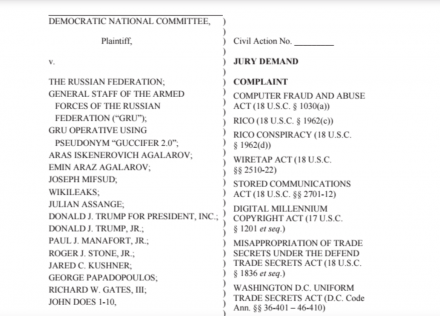
I cannot better Glenn Greenwald’s article on why it is a terrible idea to sue Wikileaks for publishing leaked documents – it sets a precedent which could be used to constrain media from ever publishing anything given them by whistleblowers. It is an astonishingly illiberal thing to undertake. Nor is it politically wise. The media has done its very best to ignore as far as possible the actual content of the leaks of DNC material, and rather to concentrate on the wild accusations of how they were obtained. But the fundamental crookedness revealed in the emails is bound to get some sort of airing, not least as the basis of a public interest defence.
I have often been asked if I regret my association with Wikileaks, given they are held responsible for the election of Donald Trump. My answer is that I feel no remorse at all.
Hillary Clinton lost because she was an appalling candidate. A multi-millionaire, neo-con warmonger with the warmth and empathy of a three week dead haddock and an eye for the interests of Wall Street, who regarded ordinary voters as “deplorables” (a term she used not just once, but frequently at fund-raisers with the mega-wealthy). Hillary Clinton conspired with the machine that was supposed to be neutrally running the primaries, to fix the primaries against Bernie Sanders. The opinion polls regularly showed that Sanders would beat Trump, and that the only Democratic candidate who Trump could beat was Clinton. Egomania and a massive sense of entitlement nevertheless led her not just to persist to get the candidacy, but persist to rig the candidacy. She then proceeded to ignore major urban working class battleground states in her campaign against Trump and focus on more glamorous places. In short, Hillary was corrupt rubbish. Full stop, and not remotely Wikileaks’ fault.
Wikileaks did not go out to get the evidence against Hillary. They were given it. Should they have withheld the knowledge of the rigging of the field against Bernie Sanders from the American people, to let Clinton benefit from the corruption? For me that is a no-brainer. It would have been a gross moral dereliction to have done so. It is also the case that Wikileaks can only publish what they are given. Had they been given dirt on Trump, they would have published. But they were not given any leaks on Trump.
I should put in an aside here which might surprise you. I like Anthony Weiner. I have never met him, but I watched the amazing 2016 fly on the wall documentary Weiner and he came across as a person of genuine goodwill, passion and commitment, undermined by what is very obviously a pathological illness. I realise that was not the general reaction, but it was mine.
But – and now I am going to really annoy people – I have to say that from an international perspective, rather than an American domestic perspective, I am also not in the slightest convinced that Trump has been worse for the World than Clinton would have been. Trump has not, to date, initiated any new military intervention or substantially increased any military conflict during his Presidency. In fact his current actions more closely match his words about non-intervention during his election campaign, than do his current words. Despite hawkish posturing, he has not substantially increased American military intervention in Syria.
My reading of the reported chemical weapon attack on Douma is this. Whether it was a false flag chemical attack, a pro-Assad chemical attack, or no chemical attack at all I do not know for sure. But whichever it is, it was used to attempt to get Trump to commit to a major escalation of American involvement in the war in Syria. So far, he has not done that. The American-led missile attack was illegal, but fortunately comparatively restrained, certainly in no way matching Trump’s rhetoric. All the evidence is, and there is a great deal of evidence from Libya and Afghanistan, that Clinton would have been far more aggressive.
That leaves the dichotomy between Trump’s rhetoric and his actions. Certainly there is every sign of a sharp tilt to the neo-cons. His apparent preference in his press conference with Macron today for an extended presence of France, the former colonial power, and US troops in Syria is deeply troubling. His sacking of the sensible Tillerson from the State Department, and his appointment of the odious John Bolton as National Security Adviser all appear to be terrible signs. But still, nothing has actually happened. There is a reading that Trump is placating the neo-cons with position and rhetoric while his actions – in Syria and in what a hating political class fails to acknowledge has all the makings of a diplomatic coup in North Korea – go in a very different direction.
It is beyond doubt that Hillary, who cannot open her mouth without denouncing Russia for causing her own entirely self-inflicted failure – would be taking the new Cold War to even worse extremes than it has already reached, to the delight of the military-industrial complex and her Wall Street friends. It is open to debate, but I would contend that it is very probable that President Hillary would have launched a major attack on Syria by now, just like she presided over as Secretary of State in Libya.
So my answer is this. Firstly, Clinton caused her own downfall by arrogance, and by failing to grasp the alienation of ordinary people from neo-liberal policies that impoverished them while the rich grew massively richer. Secondly, I strongly suspect that if Hillary were President, more people would be dead now in the Middle East.
So no, I have no regrets at all.
With eye on Pompeo, Zarif reaches New York
By M K Bhadrakumar | Indian Punchline | April 23, 2018
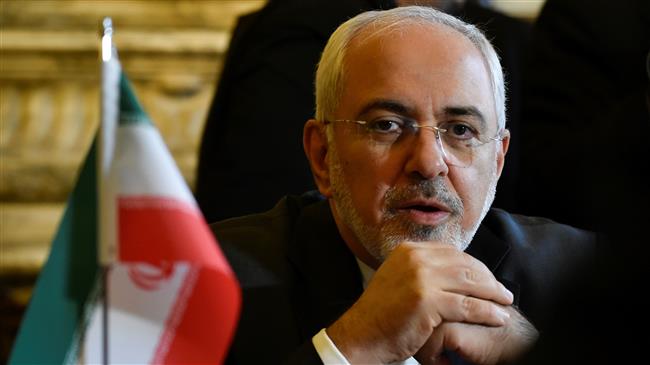
As the May 12 deadline draws close for Trump to waive the sanctions against Iran, as required under the Joint Comprehensive Plan of Action or (JCPOA), Tehran has carried the war of words into the enemy camp. Foreign Minister Mohammad Javad Zarif arrived in New York over the weekend on a six-day visit, ostensibly to attend High-Level Meeting on Peace-building and Sustaining Peace at the United Nations on April 24-25.
But in reality he is on a Track 1.5 mission to reach out to the US audience as well as to be simply available on call on American soil through next week when the leaders of two key allies of the US – French President Emmanuel Macron an German Chancellor – are scheduled to meet Trump in Washington to discuss policy options with regard to the JCPOA, amongst other things.
The big question is whether President Donald Trump would instruct his top officials to establish direct contact with Zarif in New York on the sidelines of the UN meet. Tehran is drawing encouragement from the remarks last Thursday by Mike Pompeo, CIA Director and Secretary of State-designate at his confirmation hearing in the US Senate.
Pompeo told the US senators, “I want to fix this (JCPOA) deal. That’s the objective. I think that’s in the best interests.” Alongside, he acknowledged that Iran was not pursuing a nuclear weapon program even before the nuclear deal; nor will it be in future. Pompeo emphasized that as CIA Director, he didn’t find any evidences that Iran violated the nuclear deal and he believes that Tehran cannot expand its program even shortly after a hypothetical US withdrawal from the JCPOA. Even more intriguing was Pompeo’s remark,
- If there’s no chance that we can fix it (nuclear deal), I will recommend to the president that we do our level best to work with our allies to achieve a better outcome and a better deal. Even after May 12, there’s still much diplomatic work to be done.
Pompeo signaled that Trump may not make a final decision by the May 12 deadline and may instead opt to continue the consultations with European allies with a view to “fixing the flaws of the JCPOA”.
A commentary in the influential Tehran Times noted on Saturday that “the White House hasn’t come to a determined and clear decision on how to deal with the JCPOA yet,” The Iranians never branded Trump as a one-dimensional man. Besides, Tehran is greatly experienced in moving past US rhetoric.
Zarif fired his opening salvo soon after reaching New York when he told CBS’ Face the Nation moderator Margaret Brennan in a fascinating interview that Tehran has kept a number of options ready, “including options that would involve resuming (the nuclear program) at a much greater speed,” but will “make the necessary decision when we see fit.” (Full transcript is here.)
Zarif underscored that Tehran cannot be expected to “unilaterally and one-sidedly implement the deal.” Plainly put, Iran will not accept any unilateral move to scrap the JCPOA. President Hassan Rouhani has also warned from Tehran that the range of Iran’s policy options include “what they (US) cannot imagine.”
Interestingly, Zarif also told the CBS that Tehran is open to a prisoner swap if there is a “change of attitude” on the part of the US. Zarif said, “The United States needs to approach this from a position of dealing with another sovereign government. And if that approach led to change, then the United States would see a difference.”
Pressed by Brennan on whether the Iranians were open to an exchange, Zarif offered an opening: “It is a possibility, certainly from a humanitarian perspective, but it requires a change in attitude.” Zarif just signaled that he’s ready to meet with American counterparts.
Trump has a job cut out for Pompeo. To be sure, Israel must be panicking.
Abolish the FBI, America’s KGB
By Jacob G. Hornberger | FFF | April 18, 2018
In his ongoing fight with President Trump, former FBI Director James Comey is now speculating that the reason that President Trump hasn’t adopted the fierce anti-Russia mindset of the U.S. national-security establishment is because the Russians might have secret dirt on the president and are blackmailing him into establishing normal relations between the United States and Russia.
There is another possibility — one also involving blackmail of the president — that unfortunately Comey doesn’t seem to consider: that the U.S. national-security establishment, including the FBI, has acquired secret dirt on the president and has blackmailed him into embracing and supporting their forever wars and their permanent control over the U.S. government and the American people.
Before one cries “Conspiracy theory, Jacob!” let us keep in mind two things:
First, if the Russian Deep State is capable of blackmail, as Comey suggests, so is the U.S. Deep State. I haven’t seen anyone in the establishment press say, “Conspiracy theory, James!” in response to Comey’s assertion. That’s because the establishment press believes that blackmail by the Russian Deep State is a reasonable possibility. It’s only when it comes to the U.S. Deep State that they react with horror and exclaim, “My Deep State would never do such a nefarious thing. It’s only the Russian Deep State that would do such thing.”
Second, the FBI was founded on dirt and blackmail. That’s what J. Edgar Hoover, the longtime FBI director specialized in — spying on people with the intent of discovering their dark secrets and then blackmailing them with it, with the intent of maintaining Hoover’s and the FBI’s ever-expanding power within the U.S. government and ever-growing control over American society.
Don’t forget COINTELPRO, the infamous FBI program that involved illegal surveillance of the American people, just like the KGB did to the Russian people. In fact, President Truman even compared the FBI to the Gestapo, the national police force of the Nazi regime, writing “We want no Gestapo or Secret Police. F.B.I. is tending in that direction.”
For an excellent example of the use of secret dirt and blackmail on the part of the FBI, just recall what these people did to Martin Luther King (who they now conveniently extol as a great American). They illegally spied on him because they were convinced that he was part of a worldwide communist conspiracy to take over America and the world. In the process of doing that, they learned that King had apparently engaged in extra-marital relations. They then used that illegally acquired dirt to blackmail King into hopefully committing suicide. It was all done under the supervision and with the full support of none other than the FBI director himself, J. Edgar Hoover.
The crimes that the FBI enforces, like kidnapping or transporting underaged girls across state lines for nefarious reasons, were always just a veneer to justify the existence of a national police force that specialized in illegal surveillance, dirt, and blackmail. They wanted to make it look like law enforcement was what the FBI was all about. In reality, the FBI was about secret surveillance, acquiring dirt on people, and then blackmailing them to maintain Hoover’s and the FBI’s grip on power.
Ancient history? Come on! They have named their building after their icon. It’s called the J. Edgar Hoover Building. Any normal person would be ashamed of having had a scoundrel and blackmailer in charge of his agency. Not the FBI. They glorify Hoover. They revere him. They honor him by having their building named after him.
In his presidential campaign, Trump made it clear that he was opposed to the forever wars in which the U.S. national-security establishment has embroiled America. Trump was going to put a stop to them. He was going to bring the troops home. He was questioning America’s roll in NATO, the Cold War dinosaur that should have gone out of existence with the end of the Cold War.
But once he got into office, Trump flipped completely. He became one of them. His presidency, insofar as foreign policy is concerned, is nothing more than a continuation of Bush-Obama.
Was it because Trump suddenly became a believer in the Pentagon’s and CIA’s forever wars and interventionist, imperialist foreign policy? Or could it be because the FBI, the NSA, or the CIA is blackmailing Trump into supporting their forever wars with secretly acquired dirt regarding either Trump’s business practices or his personal life or both?
Or consider the JFK-assassination related records, which the CIA and other federal agencies have succeeded in keeping secret from the American people for more than 50 years. The law required the National Archives to release them to the public last October. President Trump made two public announcements all the way up to the release date stating that he intended to follow the law and release the records.
At the last minute, Trump changed his mind and ordered that the records could be kept secret, at least for another six months. Was that change of heart because he suddenly became convinced that “national security” would be gravely threatened by the release of 50-year-old records? Or could it be that the Deep State blackmailed him into changing his mind by threatening the release of long-secret dirt that they had discovered about him and his personal or business life?
Our American ancestors had it right: A free society and a national police force are not reconcilable. The same holds true with a national-security state. That’s why the United States had no FBI, Pentagon, military-industrial complex, CIA, and NSA for more than a century.
It’s time to restore a limited-government republic to our land. It’s time to restore liberty to America. It’s time to abolish the FBI and dismantle America’s Deep State. It’s time to return to founding principles.
For more information, see:
Yes, The FBI Is America’s Secret Police by James Bovard
Has the FBI “Become America’s Secret Police, Like the KBG? by Louis Jacobson
‘We don’t do Twitter diplomacy, need serious approach’ – Putin’s spokesman to Trump over Syria rant
© Jaap Arriens / Global Look Press
RT | April 11, 2018
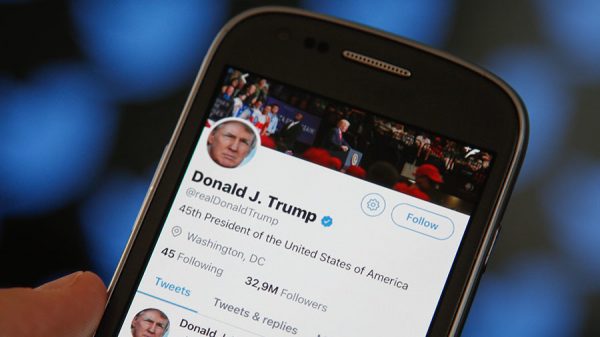
Vladimir Putin’s spokesman Dmitry Peskov dismissed Donald Trump’s attempts to talk to Russia through a barrage of tweets on Wednesday, and warned that the US president risked worsening “an already fragile situation.”
“We don’t do Twitter diplomacy. We are proponents of a serious approach,” Peskov told the media in Moscow. “We still think it is important to avoid steps that could harm what is already a fragile situation.”
In his earlier missives, Trump veered between intimidation and encouragement towards Moscow. He warned Russia to “get ready” for “nice, new and ‘smart’” missiles as a result of supporting Bashar Assad, who he described as “a Gas Killing Animal who kills his people and enjoys it.” This suggested that a US military response to the alleged use of chemical weapons in Syria on April 7 is imminent.
However, Trump later wrote that there is “no reason” for the relationship between the Kremlin and the White House to be “worse now than it has ever been,” and asked “all nations to work together.” He also enjoyed a sideswipe at the “Fake & Corrupt Russia Investigation” for causing “much of the bad blood with Russia.”
Syrian Air Defenses respond to ‘missile attack’ on airbase in Homs – state media
RT | April 9, 2018
A military airport in Homs province has been targeted in a “missile attack,” SANA reports. Although Syrian air defense systems allegedly intercepted at least eight projectiles, several people were reportedly injured and killed.
Several missiles were launched at Syria’s T-4 air base in the east of Homs province, SANA reports, citing a military source. According to the agency, the attack has “probably” been carried out by the United States.
There are several “martyrs and wounded” as a result of the strike, SANA added, without specifying the number of casualties.
While the US Defense Department is “aware” of reports of an alleged missile strike, it has dismissed reports of any US involvement.
“At this time, the Department of Defense is not conducting air strikes in Syria,” the Pentagon told Reuters in a statement. “However, we continue to closely watch the situation and support the ongoing diplomatic efforts to hold those who use chemical weapons, in Syria and otherwise, accountable.”
According to Lebanon’s Al Mayadeen broadcaster, the missiles were coming from the Mediterranean Sea, through Lebanese airspace. Meanwhile, Al Masdar News is reporting that “unknown jets” have entered Syrian airspace from Lebanon, and is speculating that the jets could be Israeli. In response, the Syrian Air Defense system at Mezzeh Air Base was activated, the report added.
Almost precisely a year ago, on April 7, 2017, the US carried out a strike against Syria’s Shayrat Airbase, launching a volley of 59 Tomahawk cruise missiles from the Mediterranean Sea. Back then, Washington justified the attack as a necessary response in the wake of reports of a deadly chemical attack in Idlib province, without waiting any on any investigation into the incident.
The latest news comes as Damascus faces fresh accusations of allegedly targeting civilians in a chlorine attack, which were put forward by the controversial White Helmets group, which is always to the fore in Western media coverage of the Syrian conflict.
Damascus, meanwhile, has denied the accusations, while the Russian Foreign Ministry denounced the latest reports as another example of a “continuous series of fake news about the use of chlorine and other chemical agents by the government forces.”
Amid escalating tensions, the Joint Chiefs of Staff and the US Central Command (CENTCOM), have allegedly been compiling lists of potential targets and attack options to present to Trump and his national security team, senior US military officials told Israel’s i24NEWS.
Israeli officials had, throughout Sunday, advocated striking targets in Syria, calling on Washington to retaliate against Damascus in response to the alleged Douma chemical attack. The charge was led by the Israeli Strategic Affairs and Public Security Minister Gilad Erdan, who told the Army Radio on Sunday that he personally hopes that the US would take military action against the Syrian government. Among an array of politicians, Israeli opposition leader Isaac Herzog also called on the US to take “decisive military action” against Syria. The idea of Israel’s intervention in Syria was also supported by the Israeli Chief Rabbi Yitzhak Yosef, who urged his followers “to try and stop this massacre.”
Donald Trump’s fury, meanwhile, focused on Damascus and the Syrian president Bashar Assad, whom the US president called an “animal.” The US leader also lashed out against Iran and Russia for supporting Assad, saying there is a “big price” to pay for the latest chemical attack.
Trump has already held talks with his French counterpart Emmanuel Macron, after which both leaders decided to form a united front against Russia at the upcoming United Nations Security Council meetings, planned for Monday. Macron previously indicated that France might consider unilateral actions, including a military strike if chemical weapons were ever used in Syria again.
A Trump-Putin summit is just what’s needed
By M K Bhadrakumar | Indian Punchline | April 2, 2018
The Chinese commentators consistently paint a pessimistic outlook for the troubled relations between Russia and the West, which no doubt form a crucial template of Beijing’s foreign policy. China is a “stakeholder” in the tensions between Russia and the West. Beijing must be acutely conscious that there has always been a significant (albeit not influential currently) school of opinion in the West, including in the United States, that a rapprochement with Russia will make sound long-term strategy to effectively contain China’s rise, which must be the West’s top priority.
Nonetheless, a news analysis by Xinhua with a Moscow dateline has simply gone overboard in making some hasty conclusions about the state of play in the backdrop of the Skripal spy case that has suddenly invaded the centre stage of Russia’s ties with the West:
· With the inertia of the sanctions spiral going on, Russia and the West are expected to continue the hostility in the diplomatic sphere and even expand it to other areas that are more painful for both sides in the foreseeable future.
· Although the question hanging over the spy-poisoning attack remains unanswered, one thing is for sure: Russia’s reputation has been damaged in the eyes of the international community while the alliance between the United States and Europe has been consolidated… It is widely expected that the tensions between Russia and the West will not ease off anytime soon.
Is the state of play so hopeless? Xinhua has exaggerated. Things look gloomy but are not beyond salvation. Russia’s tensions with the West are actually not so serious as China’s own tensions with the West. But then, China is much smarter than Russia in its diplomacy in finessing these tensions. China also has the advantage that it was not a Cold-War adversary of the West in the sense in which the former Soviet Union got pitted in the “bipolar” world. China did splendidly well to exploit the rivalry between the US and USSR.
Russia is the main target today, because it is also the only power that has the capability to maintain global strategic balance and it has an ideological position with regard to the US’ hegemony, which it is determined to uphold no matter the costs involved — although Russia is not a communist country any more. Besides, Russia is not like any other country. It is a European power historically, culturally, economically and politically. And Russia’s habitation and name in a common European home profoundly impacts the US’ transatlantic leadership role.
China being an Asiatic country can run with the hare and hunt with the hound – making the best of both worlds by keeping a quasi-alliance with Russia while also on parallel track going in top gear to tap into the western markets to get fatter and richer. China’s supreme advantage is that it lacks any ideology (other than nationalism and self-interests). Russia takes a principled stance but China keeps its head under the parapet if its interests are not affected. If the tensions run high in Russia’s relations with the West, China is its beneficiary.
However, Russia’s tensions with the West over the Skripal case are more complex than what Xinhua has reported. It is discernible that European countries have been reluctantly dragged into the Skripal case. (Blood is thicker than water, after all.) The big question is how far the US collaborated with Britain. In my assessment, the jury is still out.
There are unanswered, unanswerable questions. The most important thing is that the Skripal case might have got dovetailed with the “anti-Trump” project of the Washington establishment. In particular, was this the swan song of Lt. Gen. HR McMaster (who was expecting dismissal for the past several weeks)? Is it a counterattack by the “Deep State” to keep Trump off balance just when he began making moves to put together a new team in his cabinet with a view to force his will on foreign policies?
Has there been an orchestrated (Anglo-American) attempt involving the intelligence agencies to force Trump’s hands? How much is the Skripal case entangled with the campaign over Trump’s “collusion” with Russia? Most important, where exactly does Trump himself stand in all this?
To my mind, Trump is not seeking confrontation with Russia, and if anything, his phone call to British PM Theresa May might have had a salutary effect on London, which has since noticeably piped down on the Skripal file. Read the White House readout of the phone call, here. There is no trace whatsoever here that Trump is traveling on a path of confrontation with the Kremlin.
In fact, neither Trump nor Vladimir Putin wants this “to be going beyond hysteria over diplomacy” – to borrow words from Xinhua. Trump has always had great conceptual clarity in his mind that it is China – and not Russia – that is the US’ real adversary.
Any longtime observer of Russian-American relations would know that most of the time things are never really what they’ve appeared to be on surface. The two big powers are greatly experienced in navigating through choppy waters. Therefore, it comes as no surprise to me that TASS has just at this juncture highlighted the prospect of a summit between Trump and Vladimir Putin.
Given the longstanding media culture in Moscow, it is inconceivable that the state news agency would have carried such a report on its own volition reflecting on the Kremlin leader. There is, for sure, some very serious “signaling” going on.
Trump, Israel and the America First Scam
Trump’s Jerusalem decisions with the idea of putting America first is nothing but a scam being played on American people
By Bob Johnson | Veterans Today | December 23, 2017
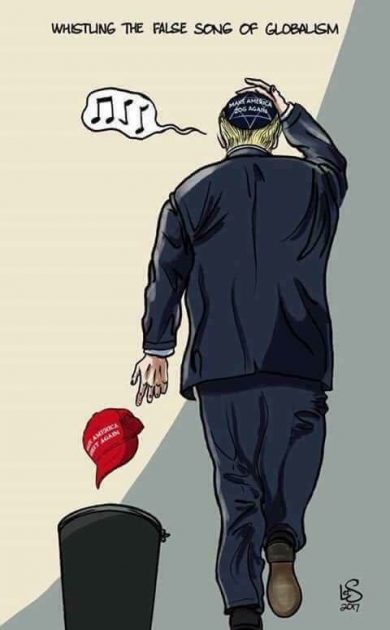 On Wednesday the White House Press Secretary Sarah Huckabee Sanders equated Donald Trump’s declaration that Jerusalem is Israel’s capital and his decision to move the US Embassy in Israel from Tel-Aviv to Jerusalem with putting America first.
To equate Trump’s Jerusalem decisions with the idea of putting America first is nothing but a scam being played on American people who genuinely care about other Americans and about America.
Today, when Trump signed the tax bill into law, he made a comment about rebuilding America’s infrastructure. He pointed out how the US spent over $7 trillion in the Middle East and said that money could have been used to improve the infrastructure across America. This statement of Trump’s, coming on the heels of his Jerusalem decision, shows he just doesn’t get it. Either that, or he is playing the fool.
Surely Trump knows that Israel and its powerful lobby decide key US decisions in US foreign policy for the Middle East. I’d be shocked if when candidate Trump met with his biggest campaign contributor, billionaire American Jewish casino mogul Sheldon Adelson, that Adelson did not make it very clear to Trump that Israel and the Israel lobby call the shots in regards to US Middle East foreign policy.
Pleasing Adelson is probably Trump’s motivation for claiming that Jerusalem is Israel’s capital, for the decision to move the US embassy to Jerusalem and for Trump torpedoing the nuclear agreement with Iran.
Trump’s overwhelming desire to please Adelson, Israel and the Israel lobby does NOT at all put America first. This ungodly trinity that Trump works to please wants US politicians to start a new war for Israel’s benefit, this time against Iran. In 2013 at Yeshiva University in New York Adelson said regarding the US and Iran:
“You pick up your cell phone and you call somewhere in Nebraska and you say ‘OK, let it go,’ and so there’s an atomic weapon goes over, ballistic missiles in the middle of the desert that doesn’t hurt a soul, maybe a couple of rattlesnakes and scorpions or whatever. And then you say, ‘See? The next one is in the middle of Tehran.’”
Trump must know that using the people in the American military to fight wars for the Jewish state of Israel is in no way, shape or form putting America first. US politicians from both parties voted to use American troops and American tax dollars for Israel’s benefit when they launched the war against Iraq in 2003.
Now the same forces of Israel, its lobby and Israel first individuals like Adelson are moving us down that same road to a new war for Israel’s benefit. These Israel first forces are moving Americans in the US military “as a lamb to the slaughter” to quote a phrase from the Hebrew/Jewish authors of the Bible.
Since our thoughts and beliefs determine our actions, if we really want to break free from this deadly cycle of religious inspired violence, we need to work to change the thinking of people who are currently under the spell of the “revealed” religions.
The American founder and Deist Thomas Paine made this clear when he wrote in his outstanding book on God, Deism and religion, The Age of Reason that we need a revolution in religion based on our innate God-given reason and Deism.
Poll Shows US Voters Prefer Russia as Friend, Not Enemy, Echoing Trump’s Call
Sputnik – 17.11.2017
American voters agree by a two-to-one margin that a friendly US posture toward Russia would be a greater asset to the United States and the world than the present policy of hostility toward Moscow, according to a poll by Rasmussen reports.
In conducting the poll, Rasmussen read the following quote to survey participants, without identifying President Donald Trump as the speaker, and asked voters whether they agreed or disagreed: “Having Russia in a friendly posture, as opposed to always fighting with them, is an asset to the world, and an asset to our country, not a liability.”
According to Rasmussen, 52 percent agreed that having Russia as a friend is a good idea, 27 percent disagreed, while 21 percent said they were undecided.
The poll that had surveyed 1,000 likely voters has been released just days after US President Donald Trump has reiterated his stance on ties with Russia after his second meeting with President Vladimir Putin, saying that positive relations between Washington and Moscow “is a good thing.”
Russia in its turn has repeatedly expressed readiness to cooperate with the US on global issues on the basis of equality and mutual respect.
While Moscow has denied claims of interference in the US November 2016 election, Trump has called the ongoing probe into the alleged meddling conducted separately by Congress and Special Counsel Robert Mueller a “witch hunt.”
READ MORE: Trump to Continue to Look for Ways to Work With Russia
Featured Video
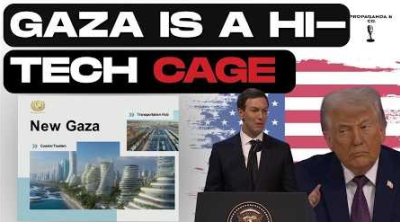
Your Enslavement Begins in Gaza: The ‘Board of Peace’
or go to
Aletho News Archives – Video-Images
From the Archives
The US: The Century of Lost Wars
By James Petras | Global Research | September 12, 2018
Introduction
Despite having the biggest military budget in the world, five times larger than the next six countries, the largest number of military bases – over 180 – in the world and the most expensive military industrial complex, the US has failed to win a single war in the 21st century.
In this paper we will enumerate the wars and proceed to analyze why, despite the powerful material basis for wars, it has led to failures. … continue
Blog Roll
 Aletho News
- Zelensky rejects territorial concessions to Russia
- German leader of EU’s largest faction sounds the alarm of possibility of right-wing forces coming to power in France, Poland
- Putin: Developing Russia’s nuclear forces ‘absolute priority’
- Hungary Blocks 20th Package of Anti-Russia Sanctions, $106B Loan to Ukraine – Szijjarto
- NATO Must Return to 1997 Borders for Peace in Ukraine – Finnish Politician
- Your Enslavement Begins in Gaza: The ‘Board of Peace’
- Israeli FOIA Data Reveals Massive Heart Injury Spike in Children Immediately After mRNA Shot Rollout
- What is Zionism? And what is anti-Zionism?
- Hungary’s Blocking of EU Loan to Ukraine May Jeopardize IMF Funding – Reports
- Pax Judaica Explained | Prof. David Miller
- If Americans Knew
- Average of five Palestinians killed by Israel every day in Gaza since ceasefire – Not a ceasefire Day 136
- Palestinian church leaders admonish Christian Zionist Mike Huckabee – Not a ceasefire Day 135
- Ominous messaging from Trump’s “Board of Peace” – Not a ceasefire Day 134
- ‘Christians Out’: Jerusalem Church Tagged With Hate Graffiti, Police Investigating
- Israeli Settlers Kill American Teen
- ‘We returned from hell’: Palestinian journalists recount torture in Israeli prisons
- No mercy for Gaza in Ramadan – Not a ceasefire Day 133
- The Israeli Government Installed and Maintained Security System at Epstein Apartment
- Tucker Carlson interrogated in Israel, has passport seized after interviewing US ambassador
- 6,000 Amputees in Gaza Face Impossible Recovery amid Israeli War Ultimatum
- No Tricks Zone
- New Research Reaffirms Clouds, Aerosols, And Surface Solar Radiation Are ‘Driving The Climate System’
- Germany: Electric Car Catches Fire At Charging Station, Sets Off Local “Inferno”, Widespread Damage
- New Study: Canada’s New Brunswick Was 1°C Warmer Than Today During The Medieval Warm Period
- Coal Power Back In Trend As Globe Tries To Keep Pace With Growing Demand For Power
- New Study: A 4°C Warmer Beaufort Sea Had ‘No Sea Ice’ 11,700 – 8200 Years Ago
- Unfudging The Data: Dutch Meteorological Institute Reinstates Early 20th Centruy Heat Waves It Had Erased Earlier
- German Gas Crisis…Chancellor Merz Allegedly Bans Gas Debate Ahead of Elections!
- Pollen Reconstructions Show The Last Glacial’s Warming Events Were Global, 10x Greater Than Modern
- Germany’s Natural Gas Storage Level Dwindles To Just 28%… Increasingly Critical
- New Study Rebuts The Assumption That Anthropogenic CO2 Molecules Have ‘Special’ Properties
 Aletho News