Obama, Like Ike, ‘Avoided Military Adventures’? Not Quite
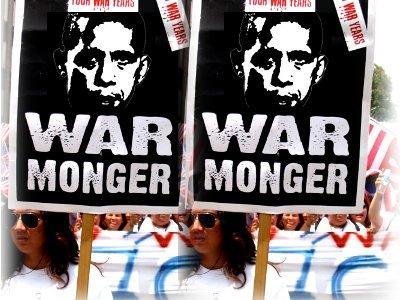
By Peter Hart | FAIR | July 16, 2013
New York Times reporter Peter Baker has a piece today (7/16/13) about Barack Obama and Dwight Eisenhower that presents a somewhat confusing picture of both.
The article is about how Obama wields power–or, in the eyes of some critics, fails to take advantage of the “bully pulpit.”
The real point of the piece is to draw a parallel to Dwight Eisenhower’s “hidden hand” approach. According to an author of an Eisenhower book, Baker writes, “Mr. Obama was like the former president in avoiding major international conflict, relying more on covert action and letting Congress take the lead in legislation.”
Baker explains:
Just as Eisenhower, the 34th president, pulled troops out of Korea and avoided other military adventures, Mr. Obama has pulled out of Iraq, is leaving Afghanistan, has limited intervention in Libya largely to airstrikes and has resisted being drawn directly into the civil war in Syria.
Let’s try a rewrite–especially on the Obama years.
Obama withdrew troops from Iraq on the schedule inherited from Bush. His administration wanted to keep some troops there, but the Iraqi government would not allow it.
To say that Obama “is leaving Afghanistan” ignores the fact that he massively escalated the Afghan War, sending tens of thousands of additional troops to the country–essentially tripling the size of the U.S. military in the first 2 years of his term.
To say that Obama “limited intervention in Libya largely to airstrikes” is an odd way to describe what was a rather extensive bombing campaign in violation of the War Powers Act.
Baker does note that the White House has decided to formally begin arming the Syrian rebels–it is somewhat unclear how and/or when that will happen–and the CIA has reportedly been coordinating arms shipments into the country.
And, of course, one has to factor in ongoing drone wars in countries like Yemen, Afghanistan and Pakistan.
It is possible that these do not count as “military adventures,” but I think you’d have hard time explaining that to anyone in those countries.
As for Eisenhower, when the Times refers vaguely to “covert operations” during his term, one might want to spell out that the CIA was instrumental in the overthrow of governments in Iran, Guatemala and Congo, and that the CIA was deeply involved in supporting anti-government rebels in Indonesia fighting the Sukarno government–including dropping supplies to the rebels. His hands may have been “hidden,” but there’s no reason to not let the record speak for itself 50 years later.
The Myth of American Pressure
By Osamah Khalil | al-Shabaka policy brief | 26 October 2010
Recent reports that the Obama administration offered Israel a series of incentives to continue its limited ten-month moratorium on settlement building have sparked an outcry among Palestinians and their supporters. Although the concessions for halting the construction of new settlements for only 60 days are unprecedented, Washington’s inability to maintain consistent pressure on Israel fits into a much broader historical pattern. The conventional wisdom is that when Washington has exerted pressure on Israeli governments they have eventually succumbed to American demands. However, a closer reading of the historical record and declassified American archival documents reveals a more complex dynamic between the two allies.
In this policy brief, Al-Shabaka Co-Director Osamah Khalil examines four major crises in the “special relationship” between the U.S. and Israel: the 1949 Lausanne Conference; the 1956 Suez Crisis; the October 1973 War; and the 1991 Madrid Peace Conference. He demonstrates that while Israel has on occasion publicly acceded to American demands, privately it has received concessions and agreements that rewarded its intransigence and improved its negotiating position at the expense of Palestinian rights. Khalil argues that American pressure was negligible when compared to the policy options available to the different presidential administrations. Finally, he offers recommendations for Palestinians and their supporters.
The Lausanne Conference
The pattern of public American pressure and private concessions to Israel was established early on. In April 1949, the Lausanne Conference was convened in order to translate the separate armistice agreements between Israel and Egypt, Lebanon, Syria, and Transjordan signed after the 1948 Palestine War into a final peace. Among the key issues to be negotiated was the fate of over 750,000 Palestinian refugees who were either expelled by or fled from Zionist militias during the war. In accordance with UN General Assembly Resolution 194, Washington advocated for a substantial repatriation of Palestinian refugees to their homes. Israel, however, was reluctant to consider repatriating more than a token number of refugees.
Israel’s intransigence at Lausanne led to a sharp exchange of letters between President Truman and Israeli Prime Minister David Ben-Gurion. Truman was incensed by a report that American attempts to negotiate an agreement were being rebuffed by Tel Aviv and that Israeli officials had informed American representatives that they intended to “bring about a change in the position” of the administration “through means available to them in the United States.”1 Truman’s letter warned that should Israel continue to reject America’s “friendly advice,” Washington would “regretfully be forced to conclude that a revision of its attitude toward Israel has become unavoidable.”2
Although the Israelis appeared to reject Truman’s claims, their position at Lausanne softened over the next two months, including an offer to repatriate 100,000 refugees.3 However, the number was still deemed insufficient by the Arab states and by Secretary of State Dean Acheson. Acheson called for the Israelis to repatriate a “substantial number” of refugees — roughly 250,000 — with the remainder to be resettled in the neighboring Arab states where they had sought shelter and to receive some compensation.4
A State Department memorandum drafted after the Israeli reply to Truman recommended four actions for the administration to pursue, including: blocking the release of the remainder of a $100 million Export-Import loan, removing the tax-exempt status that U.S.-based Jewish groups enjoyed to raise funds for Israel, refusing Israeli requests for technical assistance and expertise, and not supporting the Israeli position in international organizations.5 Of these recommendations, the Truman administration opted to delay, but not block, the release of the remainder of the loan. In addition, the State Department decided not to use Israel’s application for membership to the United Nations -– a key Israeli goal -– as an opportunity to pressure Tel Aviv at Lausanne. Rather, Washington believed that Israel’s admission to the UN would compel concessions by the Arab states in the negotiations.6
By late August the loan issue escalated. Responding to an inquiry by the Israeli government, the Export-Import Bank replied that it had approved the loan and the delay was due to the State Department. Eliahu Elath, Israel’s ambassador to the U.S., responded angrily to the news, and informed an American delegation at a luncheon in Washington that such actions “could only be interpreted as attempted duress.” Elath added that “such tactics would not succeed. In fact, they could be expected to have the opposite result.”7
Acheson discussed the situation with President Truman the day after the luncheon. By early September, $2.35 million of the $49 million was released to Israel.8 This amateurish attempt at diplomatic pressure was the last one the Truman administration would undertake with Israel. It would also establish a consistent pattern of American behavior toward Israel: although Washington had an array of policy options available, the Truman administration and its successors lacked the political will to employ them effectively and consistently.
Suez 1956: A Successful Example?
The most prominent example of the successful application of American pressure on Israel was during the 1956 Suez War. Using Egyptian President Gamal Abdel Nasser’s nationalization of the Suez Canal as a pretext, France, Britain, and Israel jointly planned and invaded Egypt in late October. In a rare moment of Cold War superpower agreement, Washington and Moscow demanded that the invasion end and the tripartite forces withdraw. Indeed, the Dwight D. Eisenhower administration considered a series of actions to pressure Israel that were similar to those presented to President Truman. While Israel agreed to withdraw under American and Soviet pressure, far from damaging U.S.-Israeli relations, the Suez crisis led to closer cooperation.9
Of particular importance was the understanding reached between the U.S. and Israel over the Straits of Tiran, the narrow waterway which connects the Gulf of Aqaba and the Red Sea. Secretary of State John Foster Dulles concurred with Israel’s position that it had the right to send ships through the Straits and an attempt by Egypt to renew the blockade would be an act of war, giving Israel the right of self-defense under the UN Charter. The long-term implications of this agreement would be profound. As tensions increased in the spring of 1967, Nasser’s decision to close the Straits would be cited by Israel as the rationale for its surprise attack on Egypt in June 1967.10 During the Suez crisis, Lyndon Johnson was Majority Leader of the U.S. Senate and he opposed the Eisenhower administration’s pressure on Israel to withdraw from the Sinai without a peace agreement.11 Eleven years later as President, Johnson was unwilling to repeat what he viewed as Eisenhower’s mistake.12
In the wake of the Suez War, Nasser’s influence grew dramatically not just in the region but across the “Third World.” However, Eisenhower and Secretary of State John Foster Dulles were convinced that Egypt had become an unwitting pawn of the Soviet Union and were unmoved by Nasser’s claims of a policy of “positive neutrality” in the Cold War. Although publicly aimed at preventing the influence of “International Communism” in the “general area of the Middle East,” what became known as the Eisenhower Doctrine had a much more specific target: containing Nasser. While Ben-Gurion’s hopes for a formal military alliance with the U.S. were never realized during the Eisenhower administration, due largely to American plans for a regional defense pact that was hindered by the Arab-Israeli conflict, the U.S. and Israel found common cause in diminishing Nasser. As Washington sought support throughout the region for the Eisenhower Doctrine, Israel began to develop its “periphery pact,” developing alliances with non-Arab countries, including Turkey, Iran, and Ethiopia.13
The Kissinger Era
Unlike the Suez crisis, the October 1973 War led to a tense superpower showdown. The initial Egyptian and Syrian attack managed to surprise the Israeli military causing heavy casualties, however, Israel counterattacked and eventually took the offensive. When the Egyptian Third Army was almost encircled, Moscow threatened to intervene unless a cease-fire was declared. While the combination of American pressure and Soviet threats finally forced Israel to halt its advance, Washington interceded largely because of the possibility of a superpower confrontation.
Although the cease-fire revealed how effectively American pressure on Israel could be applied when larger American interests were at risk, the U.S.-led negotiations conducted over the next two years demonstrated the implications of such actions on Palestinian rights. Secretary of State Henry Kissinger focused his efforts on Egypt, relying on “step-by-step” shuttle diplomacy rather than a comprehensive negotiation involving all parties, and was reluctant to expand the negotiations to include the Syrians or the Palestine Liberation Organization (PLO).14 This was more than just a tactical approach. Washington perceived Egypt to be the most prominent Soviet ally in the region, and Kissinger hoped to drive a wedge between Moscow and Cairo. He found a willing partner in Egyptian President Anwar Sadat, who also sought to break with the Soviet Union and end hostilities with Israel.15
The negotiations were augmented by significant shipments of U.S. military aid to Israel. Kissinger argued that the aid was designed to make Israel feel more secure and willing to make concessions, especially as Moscow was rearming Syria and Egypt. Yet in negotiating the second Sinai disengagement, Israel’s position hardened. Although Kissinger emphasized the benefits of removing the most prominent and populous of the Arab states bordering Israel from the Arab-Israeli conflict and the Soviet orbit, Israeli Prime Minister Yitzhak Rabin was unmoved. By March 1975, Kissinger was frustrated by Israeli intransigence and returned to Washington, leading President Gerald Ford to call for a “reassessment” of U.S. policy in the region.16
Washington’s reassessment lasted roughly three months. Although existing arms contracts were honored, new shipments to Israel were halted during this period and Kissinger met with leading foreign policy specialists to discuss a new comprehensive approach to achieving peace. However, the Israeli government countered with its own pressure. In May, seventy-six U.S. senators signed a letter to Ford, calling on him to be “responsive” to Israel’s request for $2.59 billion in military and economic aid. Ford would later write that although the senators claimed the letter was “spontaneous,” that “there was no doubt in my mind that it was inspired by Israel.”17 In his memoirs, Rabin would concede that the letter was the result of an Israeli public relations campaign.18 Without domestic political support, Ford and Kissinger abandoned the reassessment and resumed negotiations.19
The Sinai II agreement was signed in September, but only after significant concessions by Washington. This included $2 billion in aid to Israel and abandoning any attempts for substantial negotiations on the Syrian or Jordanian fronts. In other words, Israel’s occupation of the West Bank and Golan Heights were further entrenched not to win an Israeli withdrawal from the Sinai Peninsula, but merely in order to establish a buffer zone between Israeli and Egyptian forces. In addition, Israel won a commitment from Washington to prevent future Soviet intervention in the region as well as placement of American civilian monitors in the Sinai. Most damaging to Palestinian interests was the secret memorandum of understanding Kissinger signed with Israel related to the PLO. Although the PLO was recognized by the UN and the Arab League as the “sole legitimate representative of the Palestinian people,” Washington agreed not to “recognize or negotiate with” the PLO as long as it refused to recognize Israel’s right to exist and rejected UN Security Council (UNSC) Resolutions 242 and 338.20 Kissinger’s success helped set the stage for the 1978 Camp David Accords negotiated by President Jimmy Carter.21
Madrid 1991
From the perspective of Washington, the end of the Cold War and the success of the U.S.-led coalition in expelling Iraqi forces from Kuwait appeared to offer an opportunity to finally resolve the Arab-Israeli conflict. In the spring of 1991, Secretary of State James Baker began galvanizing support for an international peace conference. However, Israeli Prime Minister Yitzhak Shamir was reluctant to participate in the conference, and even more resistant to the “land for peace” formula. At the same time, Israel requested $10 billion in loan guarantees to assist with the settlement of Jewish immigrants from the Soviet Union. In an attempt to pressure the Shamir government, President George H.W. Bush requested that Congress delay approval of the loan guarantees for 120-days. However, when Congressional leaders rebuffed the request, Bush held an unprecedented news conference in September where he denounced the influence of the Israel lobby on Capitol Hill.22 The gambit appeared to work, as Israel agreed to attend the conference as well as to the presence of a joint Palestinian-Jordanian delegation.23
Held at the end of October in Madrid, Spain, the conference marked the first time Israelis and Palestinians would engage in direct negotiations. However, with the U.S. unwilling to serve as more than a facilitator of the meetings, the negotiations bogged down and eventually became victim to the Israeli and American political calendars. Shamir’s Likud party was voted from power in June 1992 and the loan guarantees were eventually approved by Congress in October. A month later, Bush lost his bid for reelection.24
Ultimately, the Madrid process would be undone not only by American inattention and Israeli intransigence but also by the PLO, which chose to sign a secret agreement negotiated in Oslo, Norway unbeknownst to the Palestinian negotiating team in Washington. Instead of demanding an end to the occupation and an independent state, PLO Chairman Yasser Arafat settled for an interim agreement that initially guaranteed limited autonomy for the Gaza Strip and the West Bank city of Jericho.25 Final status talks were to be concluded within five years, during which Israel was to maintain overall sovereignty for the OPT.26
Although it is often cited as another example of successful American pressure on Israel, in reality the Bush administration obtained few concessions from Shamir’s government and even fewer tangible results. While the loan guarantees were delayed, they were eventually approved and the Bush administration’s attempts to freeze settlement construction were unsuccessful. Nor did Shamir’s attendance at the conference constitute his acceptance of the “land for peace” formula, as he admitted in an interview with the Israeli paper Ma’ariv after the June 1992 election. Shamir explained that, “I would have carried on autonomy talks for ten years and meanwhile we would have reached a half million people in Judea and Samaria [i.e., the West Bank].”27 Indeed, Shamir’s strategy has been adopted by successive Israeli governments.
Lessons Learned and Recommendations
What lessons can Palestinians and their supporters draw by examining these crisis moments in U.S.-Israeli relations? Perhaps most important is to differentiate between the perception that pressure is being applied by Washington and the reality. In each of the historical cases, both the U.S. and Israel had an interest in overstating the political pressure brought to bear. For Washington, the audience was typically the Arab states who looked to the United States as the only power capable of securing concessions from Israel. On occasion, as with Bush’s 1991 press conference, the discussion of the Israel lobby was also for domestic consumption. Meanwhile, Israel’s attempts to exaggerate American pressure have been aimed not just at its own domestic audience and the competition between the major political parties, but toward its American supporters as well.
While the influence of the Israel lobby in these crisis moments particularly on Congress cannot be dismissed, it should not be overstated either. In each case, the different Presidential administrations had an array of policy options available to them, but they were unwilling or unable to muster the political will to adopt more aggressive approaches. This behavior was often driven by the desire of American policymakers for the most politically expedient solution, dictated largely by the political calendar and intensified media attention, rather than a long-term resolution. As a result, Israel benefited from the reticence of the different administrations and their pre-existing biases toward supporting the Israeli position.28 Moreover, Israel used Washington’s desire to achieve its strategic goals regionally and internationally in order to obtain concessions at the expense of the weakest party in the conflict — the Palestinians.
American pressure on Israel has been successful when larger American interests have been at risk. For example, during the 1956 and 1973 Wars in the midst of the Cold War competition with the Soviet Union, Washington had very immediate and definite interests at stake which required it to press its demands in earnest. Moreover, Israel also had an interest in preventing the intervention of Soviet forces into the region, which made it more receptive to American pressure. Without a superpower competitor, the threat to American interests from Israeli actions might be substantial, but from the perspective of Washington they were not unmanageable or insurmountable. In other words, when the Palestinians and their supporters among the Arab states were angered by American policies or actions in support of Israel, once they agreed to a process mediated by the U.S. they had nowhere else to go –- and Washington knew it. This was particularly true of the regimes that relied on American military and economic aid to secure their rule, who found that the price for their participation in the peace process was an increasing number of concessions demanded by Washington in order to placate Israel.
Kissinger’s influence on today’s policymakers cannot be underestimated. His reliance on piecemeal, interim negotiations accompanied by high-level shuttle diplomacy has become the standard for successive administrations. Indeed, the apparent lesson learned is that the U.S. State Department must appear to be actively engaged, even when the results of such public activity are negligible. This has been repeatedly demonstrated in the attempts over the past decade to revive the Oslo Peace Process, in which merely the appearance of process is now considered more important than the actual process or achieving peace.
While Washington was able to extract some concessions from Israel over the years, these were eclipsed by Arafat’s decision to accept the deeply flawed Oslo Accords. Although the PLO was weak as an organization in 1993, the Palestinian cause was arguably at its height in international sympathy and support due to the first intifada and the diplomatic efforts surrounding the PLO’s acceptance of the two-state solution and 1988 Declaration of Independence. Rather than attempting to galvanize popular support among its Palestinian base and internationally around its goals, Arafat and the Tunis-based leadership opted for its own short-term and ultimately self-defeating solution. In short, the Palestinian leadership saved itself and the Israeli occupation at the expense of its own people inside and outside of Palestine.
The historical pattern described in this brief has also been observed with the Obama administration. Both the administration and the Netanyahu government have advanced the perception that President Obama has put unprecedented pressure on the Israelis to halt the construction of settlements in the OPT. Yet over the past year it has become evident that like its predecessors, the Obama administration has sought to reward Israeli intransigence and violations of Palestinian rights by increasing and expanding its support for Israel, rather than curtailing it. This included additional funding for the “Iron Dome” project, Washington’s shielding of Israel at the UN after the assault on the Freedom Flotilla, and supporting Israel’s admission into the Organization for Economic Cooperation and Development (OECD).29 Moreover, the recently reported concessions for a mere 60-day extension of the settlement “freeze,” including maintaining Israeli control over the Jordan River Valley, once again demonstrates Israel’s ability to secure private concessions at a time of supposedly heightened American pressure.30
What then constitutes real pressure? As the Truman and Eisenhower administrations determined, the U.S. has a number of ways to pressure Israel, or any other state, which is reliant on it for military, political, and economic support. This includes blocking or suspending the delivery of economic and military aid, removing the tax-exempt status from U.S. based donations for groups that donate to Israel, denying requests for technical or military assistance and expertise, and withholding support for Israel in international and regional organizations. To date, Washington has rarely considered these options. Rather, it has chosen to reward Israel’s intransigence with increasing amounts of aid, in the vain hope that if Israel feels secure it will be willing to make concessions.
At a minimum, Palestinians and their supporters should advocate for the U.S. to deny tax deductible status to organizations that fund and support Israeli settlements in the OPT. They should also continue to insist that Washington hold Israel accountable to U.S. and international law, including continued settlement activity and construction of the wall in the West Bank and East Jerusalem, the use of American weapons on Palestinian civilians, the repeated violations of Palestinian human rights, as well as to live up to its commitments as a member of the UN and the OECD, and as a signatory to numerous international treaties. The real pressure that Palestinians must look to and rely on is not from Washington toward Israel, but from the Palestinian people to the world community by continuously asserting that only by realizing their rights can a just and lasting peace be achieved.
Notes
[1] “” (hereafter FRUS, 1949) (Washington, DC: Government Printing Office, 1977): 1061.
[2] “FRUS, 1949.” 1072-1074.
[3] “FRUS, 1949,” 1125. The Israeli response further angered Truman, who told Undersecretary of State James E. Webb that he had informed “Jewish leaders who had called him” that “unless they were prepared to play the game properly and conform to the rules they were probably going to lose one of their best friends.”
[4] “FRUS, 1949,” 1013-1015, 1207.
[5] “FRUS, 1949,” 1110.
[6] Admission to the UN was a top diplomatic priority for Israel in 1949. In meetings with Truman and State Department officials, the Israelis stressed their desire to be conciliatory at Lausanne on the question of refugees but noted that UN Membership was needed to secure the precarious position of the fledgling state. See “FRUS, 1949,” 943-948.
[7] “FRUS, 1949,” 1328-1331.
[8] In response to complaints by the American representative at the Lausanne conference, who had not been notified of the decision to release the funds, Acheson offered a tepid defense of the State Department’s actions and an empty threat that future reviews of loan allocations could occur and that Israel should not “construe such action as either direct or indirect political pressure.” “FRUS, 1949,” 1375, 1388-1389.
[9] Avi Shlaim, The Iron Wall: Israel and the Arab World (Boston: W.W. Norton, 2001): 181.
[10] Shlaim has a fuller discussion of these events and the negotiations between the US and Israel, 178-185.
[11] “FRUS, Arab-Israeli dispute, 1955-1957,” 139-140. Johnson dispatched a letter to Dulles stating that he was “disturbed” by reports that the UN was considering sanctions against Israel but not the Soviet Union. He called for “a determined effort” by the UN and US to “go to the root causes of the troubles in the Middle East,” which included cross-border raids by Palestinians from Gaza. Johnson stated that “it is not utterly unreasonable for Israel to request guarantees by the United Nations that these attacks against her will not once more be prevalent, once she has withdrawn her troops from” Gaza and the Sinai, (“Letter from Senator Lyndon B. Johnson to the Secretary of State“).
[12] William Quandt, Peace Process: American Diplomacy and The Arab-Israeli Conflict Since 1967, Third Edition (Washington, Berkeley: Brookings Institute and the University of California Press, 2005): 44-52. Quandt discusses the influence of the Suez War on Johnson’s perceptions of the Arab-Israeli conflict.
[13] For an analysis of the Eisenhower Doctrine, see Salim Yaqub, Containing Arab Nationalism: The Eisenhower Doctrine and the Middle East (Chapel Hill: University of North Carolina Press, 2004).
[14] As National Security Adviser during President Richard Nixon’s first term, Kissinger largely ignored the Arab-Israeli conflict. Already Nixon’s most trusted advisor on foreign affairs, in the second term, serving as both Secretary of State and National Security Adviser, Kissinger’s power and influence was enhanced further by the Watergate crisis, which distracted the President.
[15] Quandt, 133; Shlaim, 313. In the build-up to the war, one of the signs missed (or ignored) by the United States and Israel was the expulsion of 15,000 Soviet advisers from Egypt in July 1972. Thus, relations between Moscow and Cairo were already strained before the war and Sadat was even more receptive to American overtures in its aftermath.
[16] Quandt, 159-163. Among Rabin’s demands was that Sadat sign a separate peace and declare an end to the state of belligerency between Egypt and Israel.
[17] Gerald R. Ford, A Time to Heal: The Autobiography of Gerald R. Ford (New York: Harper and Collins, 1979): 287. In discussing his decision for a “reassessment,” Ford wrote that it “jolted the American Jewish community and Israel’s many friends in Congress. The Israeli lobby, made up of patriotic Americans, is strong, vocal and wealthy, but many of its members have a single focus. I knew I would come under intense pressure soon to change our policy, but I was determined to hold firm” (247).
[18] Yitzhak Rabin, The Rabin Memoirs (Boston: Little, Brown and Company, 1979): 261-263. Rabin stated that the reassessment was “an innocent-sounding term that heralded one of the worst periods in American-Israeli relations.” While Rabin’s assessment of the situation may have been dubious, other Israeli officials have sought to emphasize this historical example for their own purposes. For example, in March, the Israeli newspaper Yedioth Ahronot reported that Israeli Ambassador Michael Oren claimed in a call with other Israeli diplomats that because of tensions between the Obama administration and the government of Israeli Prime Minister Benjamin Netanyahu “Israel’s ties with the United States are in their worst crisis since 1975 … a crisis of historic proportions,” (“Israeli envoy sees “historic crisis” with US: Report,” Reuters, 15 March 2010).
[19] Quandt, 163-166.
[20] Quandt, 166-169. UNSC Resolutions 242 and 338 were passed in response to the June 1967 and October 1973 Wars respectively. The “land for peace” formula embodied in the resolutions has served as the framework for a peaceful settlement of the Arab-Israeli conflict for the past 37 years. Resolution 242 called for Israel’s withdrawal from the occupied territories in exchange for peace with neighboring Arab states. Because the resolution did not mention Palestinian self-determination or the rights of the Palestinian refugees it was rejected by the PLO, but was adopted Arab states as the basis for a peace agreement. UNSC Resolution 338 called for an end to hostilities and the resumption of negotiations based on Resolution 242.
[21] There is insufficient space to discuss the Camp David negotiations and agreement but it is worth noting that the benefits to Israel and the implications for Palestinian rights of the Accords far outweighed Israeli Prime Minister Menachem Begin’s concessions under pressure by the Carter administration to finalize an agreement.
[22] In his comments on the loan issue, Bush stated that “we’re up against very strong and effective, sometimes, groups that go up to the Hill working the other side of the question. We’ve got one lonely little guy down here doing it,” “Excerpts from President Bush’s News Session on Israeli Loan Guarantees,” The New York Times, 13 September 1991.
[23] Quandt, 303-310.
[24] Quandt, 310-317. The Madrid process was already floundering before Bush lost the 1992 election. It was eventually put on hold after Israel expelled more than 400 Palestinians from the occupied West Bank and Gaza Strip into southern Lebanon in December. During the 1992 election, Democratic Party candidate Governor Bill Clinton criticized Bush’s stance on the loan guarantees. In its first nine months in office, the administration of President Bill Clinton was focused largely on domestic issues and was less willing to publicly pressure Rabin’s Labor government.
[25] See my article “Pax Americana: The United States, the Palestinians, and the Peace Process, 1948-2008,” New Centennial Review 8 (2008), for a discussion of the PLO’s willingness to negotiate on the issue of representation.
[26] The Oslo accords and their implications on Palestinian rights and aspirations will be discussed in a future al-Shabaka policy brief, but it should be noted that the pattern observed in this brief of public US pressure resulting in private concessions to Israel continued during the Oslo process.
[27] An English translation of this quote was reported by David Hoffman, “Shamir Plan was to Stall Autonomy,” Washington Post, 27 June 1992. In an interview seven years later with the Middle East Quarterly, Shamir claimed he was misquoted by Maariv. Yet the interview revealed how limited his conception was of what would constitute a “comprehensive agreement” and what autonomy, if any, there would be for the Palestinians. See Daniel Pipes, “Yitzhak Shamir: A Lifetime of Activism, Middle East QuarterlyJune 1999.
[28] It should be noted that a fuller discussion of the influence of the Israel lobby on US decision making is outside the scope of this brief and additional research is required in order to discuss the cultural, political, economic and strategic factors that influence American policy toward the Arab-Israeli conflict.
[29] In July, US Assistant Secretary of State Andrew Shapiro announced that the Obama administration was expanding the amount of security aid Israel will receive in 2010 to $2.775 billion, “the largest such request in US history.” Shapiro explained that that administration hoped its “expanded commitment to Israel’s security will advance the process by helping the Israeli people seize this opportunity and take the tough decisions necessary for a comprehensive peace.” Natasha Mozgovaya, (“ US official: More US aid will help Israel make “tough” decisions,” Haaretz, 16 July 2010).
[30] Mark Landler, Helene Cooper and Ethan Bronner, “US Presses Israelis on Renewal of Freeze, The New York Times, 1 October 2010). By early November, press reports indicated that the Obama administration negotiated a package of incentives with Netanyahu for a “one-time-only” ninety-day extension of the settlement freeze in the occupied West Bank, excluding East Jerusalem. This reportedly included additional military aid and advanced weaponry, as well as US support at the UN and other international bodies against Palestinian attempts to obtain recognition for an independent state without a final peace agreement. The agreement was pending approval by Netanyahu’s cabinet (Ethan Bronner and Mark Landler, “A 90-day Bet on Mideast Talks,The New York Times, 14 November 2010).
Related articles
- Romney Breaks With Every GOP President, Pledges To Never Criticize Israel (thinkprogress.org)
Featured Video

No Threat Can Force Iran’s Surrender /Trita Parsi & Lt Cl Daniel Davis
or go to
Aletho News Archives – Video-Images
From the Archives
An Expert Military Analysis of War with China
Actually, None is Necessary
By Fred Reed • Unz Review • December 13, 2020
The Correlation of Armed Forces: U.S. goods and services trade with China totaled an estimated $634.8 billion in 2019. Exports were $163.0 billion; imports were $471.8 billion. The U.S. goods and services trade deficit with China was $308.8 billion in 2019. Trade in services with China (exports and imports) totaled an estimated $76.7 billion in 2019. Services exports were $56.5 billion; services imports were $20.1 billion. The U.S. services trade surplus with China was $36.4 billion in 2019.
There is talk within the Washingtoniat of a possible war with China. Steve Bannon, who apparently was dropped on his head as a child, actually favors such a war. We hear the usual shoo-the-boobs alarm about how the Chinese are doing something terrible and we must gird our loins and American values and show them what for, bow wow, woof. The danger is that the current game of who-blinks-first in Asian waters might actually provoke a shooting war. You know the kind of thing: One warship refuses to get out of the way of another, a collision ensues, some retard lieutenant who signed up on waivers opens fire, and we’re off and running. It is not a good idea to let children play with matches.
The said war is discussed either in emotional terms by idiots or in purely naval terms by those familiar with such things, so we hear of the First Island Chain and the Second Island Chain and whose missiles against the other’s missiles and so on. This would be appropriate if we were fighting World War Two again. Which we aren’t. Let’s take a quick-and-dirty look at how such a war might go.
To begin the war, America would overestimate itself and underestimate China. This is doctrine in the Pentagon. … continue
Blog Roll
 Aletho News
- Theodore Postol: Iran’s Missiles & Drones Were Underestimated
- Iran To Target Military Industrial-Tech Complex That Facilitated Gaza Genocide
- Collapsing Empire: The Resistance Disarms ‘Israel’
- Suicide Should Not Be a Government Service
- Rethinking America’s greatest threat: Iran vs. Israel-Firsters
- Iran accuses adversaries of false flags to strain Turkey ties
- Poland rules out sending Patriot missiles to US/Israel amid war on Iran
- Tehran approves new Hormuz plan with major restrictions
- No Threat Can Force Iran’s Surrender /Trita Parsi & Lt Cl Daniel Davis
- UK’s New Pandemic Plan Would Turn Big Tech Into a Mass Location Tracking Network
- If Americans Knew
- Ann Coulter Rips Into Fox News for Iran War Coverage, Compares to False Rigged 2020 Election Reporting
- Joe Kent Urges Americans To Call White House and Congress To Object To Sending Troops Into Iran
- DNC Resolution to Reject AIPAC Funding Puts Democratic Leaders in the Hot Seat
- Swedish foundation to build 400 schools as over 650,000 Gaza children remain without education for 2 years
- Israeli army admits photshopping image of slain Lebanese journalist
- This is how Israel is systematically killing health workers under the cover of war in Lebanon
- Carrying life under fire: Israeli invasion of Lebanon leaves pregnant women facing deadly risks
- Champagne all around for the new death penalty (for Palestinians) law – Not a ceasefire Day 172
- Why are Palestinian books struggling to be seen on Amazon?
- The Line Between Affinity and Conspiracy
- No Tricks Zone
- New Study Finds Warming Saves Lives…Cold Temperatures 12 Times More Deadly Than Excess Heat
- German Science Blog Accuses PIK Climate Institute Of Hallucinating Climate Tipping Points
- Devastating Assessment Of Comirnaty Vaccine By Former Senior Pfizer Europe Toxicologist
- New Study: CO2 Is ‘Effectively Negligible’ As An Explanatory Climate Change Factor Since 2000
- Former Pfizer Toxicologist Dr. Helmut Sterz Tells Bundestag Hearing Pfizer Vaccine Should Have Never Been Approved
- Energy Expert: Germany’s Nuclear Phaseout Was A “500 Billion Euro Mistake”
- New Research: South Australia’s Mid-Holocene Sea Surface Temperatures Were 4°C Warmer Than Today
- Storing Green Energy To Last Germany 10 Days Would Require A 60-Million Tonne Battery
- New Studies: UK Sea Levels Were 4 Meters Higher Than Today During The Mid-Holocene
- Destructive Green New Deal: German Energy And Metal Group Warns Of Drastic Crisis
 Aletho News