State AGs aid Bloomberg quest for ‘green’ energy that threatens planet, wildlife and people
 When you’ve built a financial information and media empire and become the world’s seventh richest person, you get to say dumb things, like suggesting that farming is easy: “You dig a hole, put a seed in, put dirt on top, add water – and up comes the corn.”
Being ultra-wealthy also shields Michael Bloomberg from any fallout from the climate and energy policies he pursues so zealously. He will doubtless be able to afford electricity at any price for his multiple mansions, from any source, backed up by thousands of battery modules to cover the repeated blackouts his policies will unleash. The other 99.9% won’t be so fortunate.
Mr. Bloomberg bankrolls campaigns against coal and natural gas; supports efforts to populate the Biden Administration with rogue regulators equally intent on “transforming” America’s energy system, society, and living standards; and champions ESG principles for financial firms, companies, and investors. His company even has Sustainability and ESG & Climate divisions. Mr. Bloomberg serves as UN Special Envoy on Climate Ambition and Solutions, enabling him to advance his agendas internationally.
ESG (Environmental Social Governance) helps unelected asset managers use their control over trillions of investment dollars to pressure companies, lenders, and consumers to embrace far-left activist versions of public welfare and justice, even if it causes clients’ portfolio values to decline. ESG is a subversive way to bypass legislatures, voters and democratic processes, to impose unpopular political and ideological agendas, often in violation of fiduciary obligations.
ESG opposes fossil fuels, insisting they are causing climate cataclysms. Any company in that business, or offering to finance a drilling project, gets blackballed. But companies building or financing “clean, green” energy score in the ESG stratosphere – even though most such projects destroy vast swaths of wildlife habitats, involve slave and child labor, and leave widespread toxic pollution in their wake. ESG human rights, ecological, and climate justice principles are duplicitous and hypocritical.
As New York City mayor, Mr. Bloomberg infamously advocated exorbitant taxes on large sugary drinks, claiming they lead to obesity and thus to diabetes, cancer, heart disease, and premature death. He simply wanted to help poor people live longer, he asserted, by making Big Gulps less affordable.
It’s thus puzzling that he now wants to banish reliable, affordable gas heat and coal- and gas-generated electricity for heating and air conditioning – in favor of pricey, weather-dependent wind and solar power backed up by outrageously expensive batteries. Those policies shorten lives.
Even if manmade or natural climate change causes average global temperatures to climb 2-3 degrees, modern technologies will keep us safely comfortable. But if laws, policies, and ESG pressures make heating and AC inaccessible or unaffordable, indoor temperatures can soar 15-25 degrees in summertime and drop as precipitously in wintertime. People die – and cold is far deadlier than heat.
When people, especially the elderly, cannot heat their homes properly, they can perish from hypothermia or illnesses they would likely survive if they weren’t so cold. The Economist calculated that expensive energy may have killed 68,000 more Europeans than Covid did last winter.
LIHEAP (Low Income Home Energy Assistance Program) will help the poorest families – until the subsidy money runs out – but not middle/working classes, and not small businesses.
Even worse, three billion people worldwide still do not have access to reliable, affordable electricity. Message to climate zealots like Mr. Bloomberg: Access to intermittent, unpredictable wind/solar electricity doesn’t count, especially if it’s only enough to charge a cell phone or power a lightbulb or one-cubic-foot refrigerator. Lack of access to sustained, affordable energy kills.
The billionaire’s legal power grab is even more insidious and dangerous to democracy.
In 2017 he began covertly funding New York University Law School’s State Energy and Environmental Impact Center, which provides grants to progressive (Democrat) state attorneys general, enabling them to hire “special assistant” AGs or “fellows.”
The Center’s mission is to provide “direct legal assistance” to interested AGs “on specific administrative, judicial or legislative matters involving clean energy, climate change and environmental interests of regional and national significance,” when AGs say they lack sufficient public funds to hire such help.
NYU now says, “the fellows’ sole duty of loyalty is to the attorney general in whose office they serve.” However, these partisan Bloomberg grants pay salaries and “generous benefits packages” to “special assistants” whose functions are dictated by the Center; address specified “regional and national” issues normally beyond the purview of state AGs; are routinely coordinated with energy and climate activists and donors to those causes; and often launch “public nuisance” or RICO litigation against oil companies, to the detriment of targeted industries and the consumers and ratepayers who depend on their products, within the AGs’ home states and in distant states and communities.
It is the Bloomberg agenda that is being served, by grants that effectively conscript and coopt the public authority and power of the attorney general’s offices.
As a 2022 report by the American Tort Reform Foundation notes, “These SAAGs are private attorneys placed in public positions to exercise government authority. Yet, they are not independent or impartial because their mandate is to carry out an overtly political agenda funded by wealthy private donors.”
This “unique” arrangement, the Foundation continues, “allows well-heeled individuals and organizations to commandeer state and local police powers to target opponents with whom they disagree, raising the specter of corruption and fundamental unfairness in what should be public enforcement of the law.”
Those same considerations also appear to raise fundamental ethical, legal, and constitutional issues. They certainly raise questions about laws governing gifts, campaign contributions, and bribes – and where Bloomberg-funded lawyers are involved in prosecutions, serious due-process concerns.
And yet the NYU Center has already placed at least 11 special assistants in eight state attorney general offices, which have filed at least 20 lawsuits against a few selected oil companies, charging them with “climate denial” or causing planetary warming, rising seas, more frequent and intense hurricanes and tornadoes, and other “offenses.”
This litigation ignores the actions of hundreds of other oil and gas companies across the globe; steadily rising emissions from China, India, and other rapidly developing nations; the role of natural forces and emissions from wind turbine, solar panel and battery mining, processing, and manufacturing; the lack of evidence to support claims of a climate “crisis” or more frequent and violent storms; and the fact that these issues should be litigated in federal courts or relegated to a democratic political process.
The US Supreme Court recently had an opportunity to quash this rampant litigation but chose not to review the state and local cases and send them to federal courts. The seemingly endless lawsuits and acrimony are creating a legal, constitutional, scientific and public policy nightmare for businesses, consumers, courts, states, and the nation.
Rest assured, billionaires like Bloomberg, Gates, Kerry, Zuckerberg, and Soros – who demand that we commoners give up our cars, gas stoves and furnaces, steaks, air travel, and suburban homes – don’t intend to give up anything.
Let’s hope the pro-America governors, AGs, legislators, judges, and business groups battling ESG and other woke campaigns tackle this NYU Impact Center hornets nest as well.
August 30, 2023
Posted by aletho |
Economics, Malthusian Ideology, Phony Scarcity | ESG, Human rights |
Leave a comment
Four months after The Guardian and other European media outlets revealed the world’s leading carbon credit certifier sold worthless offsets to major corporations, the head of Washington-based Verra has stepped down.
“I am writing to let you know that after nearly 15 fantastic years as the CEO of Verra, I have decided to step down,” Verra’s CEO, David Antonioli, wrote in a LinkedIn post last week. He’s leaving the role after dominating the multi-billion dollar carbon offset market for years and certifying over a billion dollars in credits through its verified carbon standard (VCS).
Antonioli expressed gratitude towards the current and past employees and was proud of Verra’s accomplishments as the world’s leading standard-setter for climate action and sustainable development. He did not give a reason for his abrupt departure.
Antonioli’s exit comes four months after The Guardian, German weekly Die Zeit, and SourceMaterial, a non-profit investigative journalism organization, revealed a damning report on how Verra approved tens of millions of dollars of worthless offsets to Disney, Shell, Gucci, and other big corporations.
The report found Verrra issued “phantom credits” to major corporations that don’t represent genuine carbon reductions. Some corporations purchased these fraudulent credits and labeled their products as “carbon neutral.”
Days after The Guardian’s report in January, Antonioli rejected the findings, calling them “outlandish claims” and heavily defended Verra’s certification of carbon credits. But after all that, Antonioli is still stepping down.
Meanwhile, “Some firms are moving away from offsetting-based environmental claims, such as Gucci, which has removed a carbon neutrality claim from its website that heavily relied on Verra’s carbon credits,” The Guardian said.
Diego Saez Gil, the CEO of Pachama, a carbon offsetting firm, said Verra should update its programs to improve the company’s integrity. He told The Guardian :
“This is a pivotal moment for carbon markets. In order to scale the critical funding required for carbon sequestration at a planetary scale, we must ensure integrity, transparency, and real benefits for local communities and biodiversity. A new generation of innovative players is collaborating with standard bodies, academics, corporates, and communities, creating a new era of carbon markets that gives me hope.”
Despite having previously purchased “worthless” carbon offsets, companies such as JPMorgan, Disney, and BlackRock continue their ESG commitments. In particular, JPMorgan pledged hundreds of millions of dollars to purchase credits for carbon removal.
Insiders have spoken up about the murky ESG industry. Take, for example, an insider who told Bloomberg in 2021 that TotalEnergies SE orchestrated a “carbon-neutral” liquified natural gas shipment with China National Offshore Oil Corp on math that was “guesswork” and involved lots of “googling.”
Recall Elon Musk tweeted one year ago, “ESG is a scam. It has been weaponized by phony social justice warriors.”
As we noted earlier this year, “Carbon Credits Are The Biggest Scam Since Indulgences… How You Can Avoid Being Fleeced.”
June 1, 2023
Posted by aletho |
Corruption, Deception | ESG |
Leave a comment
Florida Governor Ron DeSantis (R) on Monday announced a proposal to eliminate ESG banking and prohibit the financial sector from implementing social credit scores that would otherwise prevent Floridians from obtaining loans, lines of credit and opening bank accounts.
“Today’s announcement builds on my commitment to protect consumers’ investments and their ability to access financial services in the Free State of Florida,” said DeSantis in a statement. “By applying arbitrary ESG financial metrics that serve no one except the companies that created them, elites are circumventing the ballot box to implement a radical ideological agenda. Through this legislation, we will protect the investments of Floridians and the ability of Floridians to participate in the economy.”
The proposal “seeks to protect Floridians from the woke ESG financial scam” by:
- Prohibiting big banks, trusts, and other financial institutions from discriminating against customers for their religious, political, or social beliefs — including their support for securing the border, owning a firearm, and increasing our energy independence.
- Prohibiting the financial sector from considering so called “Social Credit Scores” in banking and lending practices that aim to prevent Floridians from obtaining loans, lines of credit, and bank accounts.
- Prohibiting banks that engage in corporate activism from holding government funds as a Qualified Public Depository (QPD).
- Prohibiting the use of ESG in all investment decisions at the state and local level, ensuring that fund managers only consider financial factors that maximize the highest rate of return.
- Prohibiting all state and local entities, including direct support organizations, from considering, giving preference to, or requesting information about ESG as part of the procurement and contracting process.
- Prohibiting the use of ESG factors by state and local governments when issuing bonds, including a contract prohibition on rating agencies whose ESG ratings negatively impact the issuer’s bond ratings.
- Directing the Attorney General and Commissioner of Financial Regulation to enforce these provisions to the fullest extent of the law.
“That is a way to try to change people’s behavior. It’s a way to try to impose politics on what should just be economic decisions,” said DeSantis, of ESG. “We are also not going to house in either the state or local government level deposits. And we have a lot of deposit, we got a massive budget surplus in Florida, you have deposits all over the place that go in where state and local government use financial institutions, none of those deposits will be permitted to be done in institutions that are pursuing this woke ESG agenda.”
As Florida’s Voice notes,
The proposal would also aim to make sure ESG will not “infect decisions” at both the state and local governments, such as investment decisions, procurement and contracting, or bonds.
House Speaker Paul Renner said Bob Rommel, R-Naples, will introduce the bill in the House.
“The biggest thing that I think ESG represents is a total hijacking of democracy,” said Renner.
“We’re lucky here in the state of Florida, that we’ve got a governor who will stand up to things like ESG, when others will not.”
February 14, 2023
Posted by aletho |
Malthusian Ideology, Phony Scarcity | ESG, Florida, United States |
Leave a comment
Samizdat – 14.09.2022
ST. PETERSBURG, Russia – A significant investment shortage into traditional energy sources caused by the Western sanctions and environmental, social, and governance (ESG) policy has caused a global production deficit of 5-6 million barrels per day, Russian First Deputy Energy Minister Pavel Sorokin said on Wednesday.
“The current situation on the energy market is not a result of the last few months but a consequence of the policy that was being created by the West during the last decade. The sanctions, which were imposed not only on Russia but on other countries, as well as the green agenda and the ESG policy of the last 10-15 years caused a significant shortage of investments into traditional energy sources. It has deprived the world of 5-6 barrels of oil per day, according to our estimates,” Sorokin said at the 11th St. Petersburg International Gas Forum.
The official also said that traditional energy sources are short of at least 250-270 billion euros ($25.1- $27 billion) in investments per year, adding that the slowdown in demand for oil and gas in the developing countries in Latin America, Africa and in the Asia-Pacific region affect the global economy, increasing the risks of economic recession.
The 11th St. Petersburg International Gas Forum (SPIGF), which is taking place from September 13-16 in the Expoforum Convention and Exhibition Centre, is hosting more than 80 events with the participation of 700 speakers from 20 countries. It aims to outline prospects for the further development of the sector, according to the organizers.
Among the main events of the SPIGF 2022 convention program are the international scientific and practical conference “Underground Gas Storage: Reliability and Efficiency” and plenary session “Gas Engine Fuel: a Reliable Solution in the Face of New Social-Economical and Environmental Challenges.”
September 14, 2022
Posted by aletho |
Economics, Malthusian Ideology, Phony Scarcity | ESG, Sanctions against Iran |
Leave a comment
A shipping expert gives his views on the latest climate regulations for international shipping:
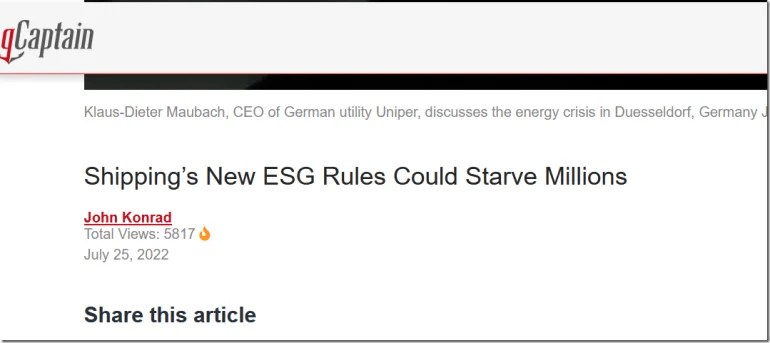
A new report found that more than 75% of ships will not meet the International Maritime Organization’s (IMO) new Environmental social and corporate governance (ESG) index aimed at decarbonizing the industry. This means that many ship owners will be forced to slow ships down to reduce emissions but doing so could deepen the global food and energy crisis by reducing available ship capacity.
“IMO decarbonization targets will cause ships to slow down delaying food shipments and people will starve,” a global security analyst told gCaptain. “How many people will die as a result of the IMO’s ESG efforts is unknown at this time. I don’t think most shipowners even understand the severity of the EEXI threat but it could be millions of lives.”
IMO EEXI ESG INDEX
“Prior to any efficiency modifications, more than 75% of the fleet — including bulkers, tankers, and containerships — will not be compliant with the Energy Efficiency Existing Index (EEXI) that will enter into force next year,” said cargo analyst Joey Daly, in the new VesselsValue report.
The challenge of decarbonization will extend to all areas of shipping, and EEXI alone will present a myriad of challenges to owners, operators and financiers. Simon Hodgkinson, who heads loss prevention at West P&I, has suggested that the new rule could be one of the most significant new shipping regulations in years. He believes it has the potential to shift the entire industry.
The International Maritime Organization’s Energy Efficiency Existing Index is a voluntary, incentive-based system that encourages ships to improve their energy efficiency. The Index uses a vessel’s speed, cargo-carrying capacity, and other factors to calculate a numerical score. The higher the score, the more energy efficient the vessel. More specifically EEXI (Energy Efficiency Existing Ships Index) is a measure of a ship’s CO2 emissions per transport work. It is similar to the Energy Efficiency Design Index (EEDI), which has been in force since 2013, but applies to existing ships rather than new ones.
The Index is designed to motivate shipowners and operators to invest in energy efficiency measures that will reduce fuel consumption and greenhouse gas emissions.
Ships have to attain EEXI approval once in a lifetime, by the first periodical survey in 2023 at the latest.
Slow Steaming
Ship owners can meet the target by building new eco-friendly ships, investing in new decarbonization technology, and upgrading existing ships to burn cleaner fuels like LNG, or by slow steaming.
Slow steaming is a technique used by shippers to reduce fuel consumption and emissions by slowing down vessels. The process involves sailing at a slower speed, typically around 50% of the vessel’s maximum speed. This can be done by reducing the revolutions per minute (RPM) of the propellers.
While older ships can be retrofitted with devices to lower emissions and meet EEXI requirements, analysts say the fix most ship owners will take is just to go slower, with a 10% drop in cruising speeds slashing fuel usage by almost 30%, according to marine sector lender Danish Ship Finance.
“They’re basically being told to either improve the ship or slow down,” said Jan Dieleman, president of Cargill Ocean Transportation, the freight division of commodities trading house Cargill, which leases more than 600 vessels to ferry mainly food and energy products around the world.
This strategy also reduces the amount of wear and tear on the vessel, which can help extend the life of the ship. But there is one ancillary effect: a potentially massive reduction in fleet capacity.
Full story here.
As I understand it, the new regulations are voluntary, so will likely be ignored by many countries. However, shipping lines ignoring the diktat may find themselves punished by banks and insurers, operating to strict ESG rules:
“As the IMO prepares to rate the energy efficiency of ships on a EEXI scale of A to E, shipping companies will come under increasing pressure to meet these targets not just from regulators but also from banks.
In 2019, a group of banks committed to efforts to cut carbon emissions when lending to shipping companies. This group of banks established the Poseidon Principles, a global framework that is consistent with IMO policies on environmental grounds. As of today, 28 banks have signed on to the Poseidon Principles.
The Poseidon Principles are fairly new but are already having a ripple effect on finance and insurance, as banks and other lenders begin to factor in a company’s carbon emissions when making lending decisions.
What this means for shipowners is that even if they find a way around the IMO’s ESG regulations, steaming at normal speeds could increase their carbon scores and have a negative effect on financing options and stock prices”
This demented obsession with decarbonisation brings a painful dilemma:
Slow steaming means in effect less global shipping capacity, leading to a potential bottleneck on supplies. As the article explains:
“Is a reduction of capacity really a troubling problem? Yes.
Nobody is calculating the price of a good ESG score in terms of human lives,” said one global security analyst who wished to stay anonymous. “The question is no longer if people will starve to death because of IMO decarbonization targets. The question is how many?”
The most troubling fact from our conversations with global security analysts was that millions could die before famine even sets in.“
And longer shipping times mean higher journey costs, despite the savings on fuel, adding to the cost of everything we import.
The alternative, of course, is to simply build more ships to bring shipping capacity back into equilibrium. The building of these ships will, of course, carry an enormous carbon footprint of its own, eliminating any potential savings from fuel efficiency for many years to come.
And China?
Any discussion about international shipping must take into account the role of China, who are believed to control the world’s second-largest shipping fleet by gross tons and constructed over a third of the world’s vessels in 2019.
Will they follow these rules?
One of the reasons for their global dominance of shipping lies in a complicated and opaque system of formal and informal state support that is unrivalled in size and scope, and which includes subsidised finance from state banks, who are unlikely to be concerned with ESG.
While China may pay lip service to these new regulations, given their total disregard for ESG in other industries, I would strongly suspect that they will just carry on building up their shipping industry, taking advantage of the West’s weakness.
And the West’s economic dependence on China will grow ever more dangerous.
August 4, 2022
Posted by aletho |
Economics, Malthusian Ideology, Phony Scarcity, Supremacism, Social Darwinism | ESG |
Leave a comment
ESG stands for “Environmental, Social, Corporate Governance” and has been likened to a globalized Social Credit Scoring system for business. If you have a high ESG score, it will be easy to qualify for credit, to get the best deals with vendors and to participate in the global supply chain.
Alas, if you don’t have a high ESG score, you won’t be in business long unless you change your behavior and knuckle under to its demands.
So, how is ESG determined and who sets the rules and guidelines?
First, ESG has nothing to do with the physical aspects of a company, like capital, cash flow or profit. Rather, it concerns intangible factors such as how closely you, your vendors and customers adhere to Sustainable Development and climate change policies.
According to Forbes,
“The story of ESG investing began in January 2004 when former UN Secretary General Kofi Annan wrote to over 50 CEOs of major financial institutions, inviting them to participate in a joint initiative under the auspices of the UN Global Compact and with the support of the International Finance Corporation (IFC) and the Swiss Government. The goal of the initiative was to find ways to integrate ESG into capital markets.”
One year later (2005), an environmental policy wonk, Ivo Knoepfel, wrote a a major paper, Who Cares Wins: Connecting Financial Markets to a Changing World. This 58 page report contained “recommendations by the financial industry to better integrate environmental, social and governance issues in analysis, asset management and securities brokerage.”
The corporate collaborators, far from real people like ordinary citizens, included all the big names one might suspect: World Bank Group, Morgan Stanley, HSBC, Goldman Sachs, Deutsche Bank, UBS, Mitsui Sumitomo Insurance, Citigroup and others.
And just like that, ESG was born.
The report summarizes ten innocuous and subjective principles that read much like the UNs’ Sustainable Development Goals (SDGs):
U.N. Global Compact Principles
Human Rights
Principle 1: Businesses should support and respect the protection of internationally proclaimed human rights within their sphere of influence; and
Principle 2: make sure that they are not complicit in human rights abuses.
Labour
Principle 3: Businesses should uphold the freedom of association and the effective recognition of the right to collective bargaining;
Principle 4: the elimination of all forms of forced and compulsory labour;
Principle 5: the effective abolition of child labour; and
Principle 6: eliminate discrimination in respect of employment and occupation.
Environment
Principle 7: Businesses should support a precautionary approach to environmental challenges;
Principle 8: undertake initiatives to promote greater environmental responsibility; and
Principle 9: encourage the development and diffusion of environmentally friendly technologies.
Anti-Corruption
Principle 10: Businesses should work against corruption in all its forms, including extortion and bribery.*
Who decides ESG standards and scores? It is repeatedly stated that financial analysts are the key operatives:
-
- “We invite financial institutions to expand the scope of ESG integration in research to other asset classes impacted by ESG factors, beyond equity.” Beyond equity implies a rating system for bonds, corporate debt and other financial instruments.”
- “We encourage analysts to further advance the development of valuation methodologies to better deal with qualitative information and uncertain impacts related to ESG issues.”
- “Financial analysts should expand their understanding and analysis of these factors to other industries.”
- “Financial analysts should improve their understanding and integration of ESG issues in emerging markets research.”
- “Financial analysts and investment professionals should take a leading role because they are the specialists best placed to show how ESG issues impact company and investment value.”
To put this in perspective, the financial analyst position at a large financial institution is typically an entry-level job for people just out of college. In reality, they are coached by ESG policies to act like “fact checkers” as they examine these non-tangible aspects of a company. With the stroke of a pen then can upgrade or downgrade a company according to its ESG compliance, but no two analysts would likely come to the same exact conclusion.
Nevertheless, with subjective ESG research reports in hand, senior executives then call on pension funds, mutual funds, hedge funds, investment funds, etc., to divest themselves of low scoring companies and reinvest in high scoring companies. If they refuse to cooperate, they are branded with a lower ESG score of their own. Lending institutions are approached to examine the ESG value of their loan portfolios. Not high enough to satisfy the “fact checkers”? Then stop loaning money to low ESG companies, or risk being downgraded yourself!
It gets worse from here. The report calls for government force to mandate disclosure:
“We also believe that regulatory frameworks requiring a minimum degree of disclosure and accountability on ESG issues would improve the availability and comparability of data, and therefore support integration in financial analysis.”
And for stock exchanges to inform rank-and-file investors and institutions alike:
“Stock exchanges, for instance, could include ESG criteria in listing particulars for companies. Both voluntary and market-friendly regulatory approaches are needed to improve disclosure. Both should be flexible enough to allow for diversity of approaches and providers, rather than relying on rigid prescriptions.”
Conclusion
ESG is a globalist scam, and having just said that, my score probably went to zero. It is designed to drive investments and company operating policies into Sustainable Development, aka Technocracy. It is also a circular design that once started, reinforces itself with every spin around the financial universe.
Next up will be ESG for individuals, which goes one step further into how you actually think about these things.
What? You own an investment in a dirty old low-ESG company? Own a gas-guzzling car? Big house? Too much grass in your front yard? Work for a low-ESG company? Post social media pictures that lampoon global warming or mask mandates? Well, that shows that you just don’t care, so boom, down goes your score. Now, try to get financing for that new car you want to buy, or get underwritten for a new life insurance or homeowner’s policy.
You get the idea.
Patrick Wood is a leading and critical expert on Sustainable Development, Green Economy, Agenda 21, 2030 Agenda and historic Technocracy. He is the author of Technocracy Rising: The Trojan Horse of Global Transformation (2015) and co-author of Trilaterals Over Washington, Volumes I and II (1978-1980) with the late Antony C. Sutton.
COPYRIGHT COHERENT PUBLISHING, LLC 2016-22
March 11, 2022
Posted by aletho |
Civil Liberties, Economics | ESG, Human rights |
Leave a comment


 Aletho News