Ukraine and EU sign free trade zone deal
RT | June 27, 2014
Ukraine has signed the economic part of the Association Agreement with the EU, with Georgia and Moldova also joining the pact, even though big economic risks lie ahead.
The signing of the economic part of the agreement comes after 8 months of violent unrest in Ukraine, which broke out in Kiev and spread across the country in November after then-President Viktor Yanukovich decided to reject the trade agreement in favor of trilateral talks.
The document contains 31 signatures – Ukraine, all 28 EU member states, as well as that of the President of the European Council Herman Van Rompuy, and European Commission President Jose Manuel Barroso. The agreement will only come into force when it is ratified by every national parliament in the EU. It is expected that the ratification process will be complete by this fall.
Georgia and Moldova also signed both political and economic parts of the Association Agreement. Ukraine signed a political part of the agreement in March, shortly after Crimea rejoined Russia.
“By signing the association agreement, Ukraine, like European nation, which shares the same rules of law, stresses its sovereign choice to become a member of the EU Association Agreement in the future,” said Ukraine’s President Poroshenko before the signing ceremony. The Ukrainian President sees the trade document as a stepping stone to eventual EU statehood.
Friday signing the Free Trade Agreement will open up trade barriers between the former Soviet states, but doesn’t guarantee them EU membership, a main goal of the three governments.
“It is their sovereign right, but the Russian Federation will have to take measures in case it negatively effects the local market,” Dmitry Peskov, Putin’s spokesperson said, commenting on the agreements signed between the EU and Ukraine, Georgia and Moldova.
Russia has warned these “measures” could include $500 billion in lost trade and possible bans on Ukrainian imports.
“There is no economic growth to be had by suddenly having western European goods dumped at low cost on your marketplace,” Patrick Young, an expert on emerging markets, told RT.
In order to fully implement the free trade zone, it could cost Ukraine’s already fragile economy an additional $104 billion, according to a previous estimate by Yanukovich. This will include adopting hundreds of new trade laws and thousands of new laws to comply with EU standards.
In 2013, EU exports to Ukraine were worth $33 billion (23.9 billion euro), dominated by industrial equipment, chemicals, and manufactured goods.
Ukraine exported 13.8 billion euro worth of goods to the EU, mostly materials like iron, steel, and minerals. Agricultural and food products are also substantial exports.
The Association Agreement and Deep and Comprehensive Free Trade Area (DCFTA) will replace the current Partnership and Cooperation Agreement Ukraine signed with the EU in 1998.
Eastern Ukraine, which rejects the new Ukrainian government’s authority, is skeptical of Kiev’s European ambition, as is the EU itself.
“EU is not ready to integrate at this stage a country like Ukraine,” Jose Barroso, President of the European Commission said before the talks.
Brussels started the Eastern Partnership initiative to incorporate six former Soviet Republics into the EU free trade zone. Ukraine, Moldova, and Georgia have followed Poland’s example, whereas Armenia, Belarus, and Azerbaijan are likely to opt for closer trade links with Russia.
Trilateral trade talks between the EU, Russia, and Ukraine will take place on July 11. Russia has made it very clear that by signing the trade agreement Ukraine can no longer enter the Eurasian Customs Union, which already includes Belarus and Kazakhstan.
Bulgaria halts Russia’s South Stream gas pipeline project
RT | June 8, 2014
Bulgaria’s prime minister, Plamen Oresharski, has ordered a halt to work on Russia’s South Stream pipeline, on the recommendation of the EU. The decision was announced after his talks with US senators.
“At this time there is a request from the European Commission, after which we’ve suspended the current works, I ordered it,” Oresharski told journalists after meeting with John McCain, Chris Murphy and Ron Johnson during their visit to Bulgaria on Sunday. “Further proceedings will be decided after additional consultations with Brussels.”
McCain, commenting on the situation, said that “Bulgaria should solve the South Stream problems in collaboration with European colleagues,” adding that in the current situation they would want “less Russian involvement” in the project.
Russia’s Energy Ministry said it had not yet received any official notification from Bulgaria on work on the project being suspended.
Earlier this week, EU authorities ordered Bulgaria to suspend construction on its link of the pipeline, which is planned to transport Russian natural gas through the Black Sea to Bulgaria and onward to western Europe. Brussels wants the project frozen, pending a decision on whether it violates the EU competition regulations on a single energy market. It believes South Stream does not comply with the rules prohibiting energy producers from also controlling pipeline access.
The EU is also asking for an investigation into how contracts were awarded for work on the pipeline in Bulgaria. Brussels sent the Bulgarian government a letter of formal notice asking for information, to which Sofia had one month to reply.
Russia’s energy giant Gazprom’s South Stream pipeline requires European approvals as its route would pass through the territory of several EU countries.
In Bulgaria, the ruling Socialists support the South Stream project, while Movement for Rights and Freedom leader Lyutvi Mestan told parliament on June 5 that Bulgaria should defend its strategic interests “in cooperation, not in confrontation” with Europe.
Earlier Serbia has said it has no plans to delay the start of construction of its leg of the South Stream pipeline, scheduled for July. Serbian Energy Minister Aleksandar Antic said that the position was not decisive: “I believe the European Commission and member states will find a solution because this is a European project in the best interests of energy security.”
Hungarian Prime Minister Viktor Orban also said June 5 that the pipeline should be built, as there was no alternative to the project.
No Returning to G8: Russia
The BRICS Post | June 4, 2014
Russia said Wednesday that it was open for cooperation with major Western powers, but ruled out a return to the Group of Eight (G8), made up of the seven most industrialized nations, known as G7, and Russia.
“Such a format does not exist for now,” Kremlin spokesperson Dmitry Peskov told a Russian radio station.
Russia would, however, continue to participate in the Group of 20, which includes the most developed and major developing countries of the world, Peskov said.
Leaders of G7 declared in March that they would boycott the G8 summit in Sochi, where they were scheduled to have met with Russia this week. Instead, they gathered in Brussels for a two-day G7 summit.
The expulsion of Russia from the G8 came three days after Crimea accession to Russia.
Peskov said Russian President Vladimir Putin will not have a bilateral meeting with US President Barack Obama even though both leaders are attending the 70th anniversary of D-Day Landings in France’s Normandy on Friday.
“We are not making such preparations … Participants of war memorial events will stay together, in one group,” Itar-Tass news agency quoted him as saying.
He, however, did not rule out possible brief talks between Putin and Ukrainian President-elect Petro Poroshenko.
The Kremlin earlier confirmed that Putin, on his first visit to a Western country since the start of the Ukraine crisis, would have separate meetings with British Prime Minister David Cameron and German Chancellor Angela Merkel in Normandy.
The US and EU have imposed travel bans and asset freezes on dozens of Russians over what they called Russia’s “meddling” in Ukraine’s affairs.
The European Union, however, would be troubled by Russia’s attempts to veer away from gas exports to the bloc by moving towards energy-hungry China.
Russia has had some success in diverting attention away from the troubling sanctions with the successful negotiations that led to the inking of a massive $400 billion gas deal with China last month and also the signing of the treaty to form the Eurasian Economic Union (EEU) with Russia, Kazakhstan and Belarus, a combined $2.7 trillion economy and vast energy resources.
NATO troops and bases not welcome in Slovakia and Czech Republic
RT | June 5, 2014
Two Eastern European nations, Slovakia and the Czech Republic, have refused to host foreign troops and military bases. The prime ministers of both countries have consecutively spoken against the proposal voiced by US President Barack Obama.
Following the example of their neighbor the Czech Republic, the prime minister of Slovakia stated that his country is ready to meet its obligations as a NATO member state, but stationing foreign troops on its territory is out of the question.
Slovak PM Robert Fico said he “can’t imagine foreign troops being deployed on our territory in the form of some bases.”
The proposal to host more NATO troops in Eastern Europe was voiced by Obama on his current tour of Europe.
Speaking at a news conference in Warsaw, Obama said America is stepping up its partnership with countries in Eastern Europe with a view to bolstering security.
Initially, it was Poland that asked for a greater US military presence in Eastern Europe.
In April, Polish Defense Minister Tomasz Siemoniak called on the Pentagon to deploy as many as 10,000 American troops in his country.
Three Baltic States welcomed the idea back in April. To begin with, a small contingent of American troops began to arrive in Lithuania, Latvia and Estonia to take part in military training.
Two countries opposed deployment of any foreign soldiers on their territory.
On Tuesday, Czech Prime Minister Bohuslav Sobotka said his country sees no need to allow foreign military presence on its territory.
Last month, Defense Minister Martin Stropinsky sparked a political storm in the Czech Republic by recalling the 1968 invasion as the biggest reason not to host NATO troops in the country in a Reuters interview.
Slovakia’s Fico joined in the debate Wednesday, saying that for his country such a military presence is a sensitive issue because of the Warsaw Pact troops’ invasion into Czechoslovakia in 1968.
“Slovakia has its historical experience with participation of foreign troops. Let us remember the 1968 invasion. Therefore this topic is extraordinarily sensitive to us,” he said.
Fico said that Slovakia is committed to fulfill its obligations towards NATO despite military budget cuts and that allies would be allowed to train on Slovak territory anyway.
Czechoslovakia split into the Czech Republic and Slovakia in 1993.
The Czech Republic entered NATO in 1999, whereas Slovakia joined the alliance later, in 2004.
Fico’s Smer party, which has an absolute majority in Slovakia’s parliament, has been advocating warmer relations with Russia.
See also:
‘Peed in public, behave like occupiers’: Latvian mayor complains about NATO sailors
EU Safety Institutions Caught Plotting an Industry “escape route” Around Looming Pesticide Ban
By Jonathan Latham, PhD | Independent Science News | May 26, 2014
EU documents newly obtained by the nonprofit Pesticide Action Network of Europe reveal that the health commission of the European Union (DG SANCO), which is responsible for protecting public health, is attempting to develop a procedural “escape route” to evade an upcoming EU-wide ban on endocrine disrupting pesticides. Endocrine disrupting chemicals (EDCs) are those that alter hormonal regulation at very low doses to cause effects on behavior, reproduction, and gender, as well as cancer and birth defects.
In 2009, under the European Union’s then-new chemical REACH legislation, a continent-wide ban on endocrine disrupting pesticides was agreed. The European Commission (EC) was charged with taking various steps to protect public safety. These included officially defining what constitutes an endocrine disrupting effect and designating acceptable chemical detection methods. The deadline to present these criteria for ensuring protection against endocrine disrupting pesticides expired on December 14, 2013.
Instead of providing the needed safety guidance, however, the EU’s Health Commission (DG SANCO) appears to be drafting a procedural “escape route” around the endocrine disrupting ban. This legal maneuvering is being done behind closed doors and with the collaboration of some EU member states and the European Food Safety Authority (EFSA, an independent EU agency created to assess food risks for the Commission).
As initially revealed by the Pesticides Action Network of Europe (PAN Europe), only Sweden is opposing this escape route, which they consider to be an abandonment of the original democratic mandate. According to a report by Agence France Presse (AFP) Sweden is now going to sue the EU due to mounting evidence that harmful impacts of endocrine disruption are already being felt. AFP quotes Swedish environment minister Lena Ek:
“In some places in Sweden we see double sexed fish. We have scientific reports on how this affects fertility of young boys and girls, and other serious effects.”
The documents obtained by PAN Europe show that the lobbying to undermine the ban is being led by EFSA. This is in direct conflict with the missions of both EFSA and DG SANCO which are to protect public health.
The crisis has come about because EDCs are the subject of a large body of independent academic research showing that certain synthetic chemicals are already causing developmental disabilities and cancer among humans and wildlife through non-traditional (i.e. hormonal) toxicological routes. This evidence is why the ban was instigated. Because of the strength of the evidence and the low doses involved (Vandenberg et al 2012), any rigorous and effective rules to protect the public are likely to result in widespread bans and restrictions on commonly used industrial, agricultural, and household chemicals. This is one reason why AFP also reported the Swedish Minister as saying that EU commissioners were under strong industry pressure.
Tony Tweedale, a Brussels-based independent consultant to NGOs, explained to Independent Science News, there is a second reason for industry pressure:
“That hormones are often disrupted at very low doses threatens to upset industry’s decades-long total control of risk assessment which is based, for example on insensitive tests.”
While missing their mandated December deadline for providing safety rules, DG SANCO and EFSA chose to perform an economic impact assessment of potential regulations instead. Now this economic impact assessment is itself 9 months late. Sweden and others have interpreted these delays as stalling a collectively agreed action.
Before the Swedish lawsuit was announced Sweden had already expressed its concerns to the European Commission in letters to DG SANCO (published on the PAN Europe website). These letters reveal that Sweden believes the failure of DG SANCO to proceed according to the rules is deliberate and that DG SANCO is instead focused on drafting the illegal escape clause. This, believes Sweden, would likely take the form of a general derogation for pesticides that may be endocrine disruptors (1). It would be a legal technicality that effectively allowed pesticides which would have been banned to be exempt from the ban (2).
Simultaneous with Sweden’s announcement to take the European Commission to court, PAN Europe uncovered a letter from a representative of the EFSA Scientific Committee (which is helping to draw up the new scientific criteria). In this letter, which is addressed to advisors of Jean-Manuel Barroso (head of the European Commission), the EFSA official says that the permanent science advisors to EFSA are opposing the ban and aim to use traditional risk assessment to undermine it. Traditional risk assessment is the approach favoured by the pesticide industry.
Also in the letter, the EFSA science advisor complains of the pesticide legislation having no “control route” or “socio-economic route” to save endocrine disrupting pesticides from a ban. The anonymous writer suggests that an existing ‘negligible exposure’ option (EC 1107/2009, Annex II, 3.6.5) can be manipulated to keep such pesticides on the market. It is use of this ‘negligible exposure’ option that is opposed by Sweden, which believes that because negligible exposure is not well defined it is in danger of becoming a generic exemption (i.e. a derogation) for the use of endocrine disrupting chemicals.
The existence of this letter confirms Sweden’s interpretation of the intentions of EFSA and DG SANCO; the ‘negligible exposure’ option is indeed being lined up as a loophole for avoiding likely science-based bans on endocrine disruptors.
In the view of PAN Europe:
“By unilaterally changing the rules, DG SANCO is sidelining the EU Parliament and choosing economic interests over their own mission to protect people and the environment.”
Science Director of The Bioscience Resource Project, Allison Wilson, concluded:
“The public will be astounded and appalled to find that the institutions tasked with protecting them are secretly working against them. EFSA has shown itself to be untrustworthy and should be disbanded. Deep rethinking appears necessary since it is not only the EU that has failed to construct institutions capable of safely regulating toxic substances. Perhaps we should question the wisdom of economies dependent on synthetic chemicals and high risk products.” (3)
Footnotes
(1) A derogation is a partial or temporal suspension of a law.
(2) The list of pesticides Sweden thinks likely to be banned can be found here.
(3) See: Robinson C., Holland N., Leloup D., Muilerman H. (2013) Conflicts of interest at the European Food Safety Authority erode public confidence. J Epidemiol Community Health 2013;67:717-720 doi:10.1136/jech-2012-202185
References
Vandenberg LN, Colborn T, Hayes TB, Heindel JJ, Jacobs DR Jr et al. (2012) Hormones and endocrine-disrupting chemicals: Low-dose effects and nonmonotonic dose responses. Endocr Rev 33: 378-455.
‘Ukraine must pay gas debts’ – EU Energy Commissioner
RT | May 26, 2014
EU Energy Commissioner Guenther Oettinger said Ukraine needs to begin repaying its $3.5 billion gas debt to Russia and proposed a fair ‘market price’ of between $200-$400 per 1,000 cubic meters to resolve the dispute.
“The bills are on the table, and they must be paid,” Oettinger said on German radio station SWR on Monday after holding talks in Berlin with Russian Energy Minister Alexander Novak and Gazprom Deputy CEO Aleksandr Medvedev.
Oettinger suggests Ukraine use some of the $3.2 billion from its first IMF aid tranche and other EU assistance programs to start paying off its debt to Gazprom.
Ukraine owes Russian state-owned Gazprom more than $3.5 billion, as it has not paid its gas bills in full since July 2013. Russia has even given Ukraine 10 billion cubic meters of gas free of charge, as much as Russia delivers to Poland in a year.
President Vladimir Putin said that Russia is only ready to discuss a new gas discount for Ukraine once it starts paying off its debt.
Oettinger said that a “fair and suitable market price” to resolve the dispute would be between $200-$400, which the commissioner considers “common for the European market.”
Kiev has said it is ready to pay Russia as long as Gazprom lowers its current rate of $485 per 1,0000 cubic meters. The price climbed when Gazprom canceled two gas discounts from the $268.50 per 1,000 cubic meters rate it paid in the first three months of 2014.
After June 1, Ukraine will have to prepay for any gas deliveries, as Gazprom said it won’t let any more debt accumulate.
“There are some barriers to indulgence, some things we cannot afford,” Russian President Vladimir Putin said speaking at the 18th annual St. Petersburg Economic Forum on Saturday.
Europe sources about one third of its total energy supply from Russia, 50 percent of which flows through Ukraine. Any possible disruption therefore not only affects the pipeline host country, but all of Europe.
“We all know who is to blame – the transit country, Ukraine has abused its position. Ukraine insists on benefits it is not entitled to,” Putin said at the forum on Saturday.
Oettinger has been a major player in brokering a deal between the two embittered nations, but so far no concrete negotiation has been reached.
Kiev denies OSCE mission access to LifeNews detained journalists
RT | May 21, 2014
Ukrainian authorities are not letting the OSCE special monitoring mission visit the detained journalists from Russia’s LifeNews channel, Andrey Kelin, Russia’s permanent representative to the organization, said.
“At our request, the OSCE mission is demanding a meeting with the journalists, but the Kiev authorities forbid them from doing,” Kelin told ITAR-TASS news agency.
Russia will continue pushing for action on the part of the OSCE (Organization for Security and Co-operation in Europe) aimed at releasing the LifeNews crew, he added.
According to the representative, the situation around journalists, Oleg Sidyakin and Marat Saichenko, “continues to deteriorate.”
“We know that they’re accused of terrorism, with other far-fetched charges being pressed against them,” he explained.
Russia intends to raise the issue of “grave violation of the rights of journalists in Ukraine” at a meeting of the OSCE Permanent Council on Thursday, he stressed, adding that the “same question will be asked by delegations from other countries as well.”
Russia’s permanent mission has passed the address from the country’s National Broadcasting Association to the OSCE leadership, in which the violations against Russian journalists by Kiev’s coup-imposed government are described, Kelin said.
There are more and more concerns about the obstruction of the media in Ukraine in anticipation of the presidential election in the country on May 25, he concluded.
Sidyakin and Saichenko were detained on Sunday soon after they released a scandalous video, which showed a UN-marked helicopter being used by the Ukrainian army in a military operation in the rebelling eastern regions.
On Tuesday, RT’s contributor Graham Phillips was arrested by Ukrainian forces at a checkpoint in the city of Mariupol. He was released after almost 36 hours of detention by various Kiev security forces.
On Monday, The OSCE’s representative on freedom of the media, Dunja Mijatovic, has addressed Kiev in a letter, urging it to “stop intimidating and threatening members of the media” and release the journalists.
In the last couple of days, journalists from various Russian media outlets were also prevented from entering Ukraine, including Zvezda, NTV, Channel One and TVC channels as well as a crew from RT’s Arabic channel.
NATO Aims To Repeat Its Libya ‘Success’ In Ukraine
By Daniel McAdams | Ron Paul Institute | May 17, 2014
As NATO and its US masters edge the US and EU closer to war with Russia over Ukraine, it might be appropriate to have a look at NATO’s last “success” story.
Yesterday in Libya, where NATO bombs fell just over three years ago to “liberate” the people from Gaddafi, Islamist militias in Benghazi were under helicopter and warplane attack by a paramilitary force headed by former general Khalifa Haftar. The former general first emerged in Libya back in 2011, having left his long-time home base in the US state of Virginia where his ties to the CIA were an open secret.
Yesterday’s attack by Haftar’s paramilitary group was said to have been joined by some of the Libyan armed forces. At the same time, Libya’s acting prime minister, Abdullah al-Thinni, condemned the attacks as “a coup against the revolution.” The acting prime minister continued, “Air force units that bombed targets in Benghazi today did so illegally, without any orders from us.”
Ironically, the Islamist militias under attack in Benghazi — presumably at the behest of the Obama administration — were not long ago instrumental to the US and NATO when they started the uprising against Gaddafi.
So who runs the government in Libya when some armed forces units attack “the revolution” in Benghazi at the command of a CIA-affiliated former general?
As the Interventions Watch blog points out, claims that Gaddafi was bombing Benghazi from the air provided the main trigger for the NATO attack on Libya. So what will western cheerleaders for that attack say when now a CIA-affiliated militia and parts of the country’s armed forces are actually bombing Benghazi from the air?
If the 2011 NATO attack on Libya was such a success, why is chaos the only thing that reigns in Libya? And why are US military assets being moved from Spain to Sicily over fears of increasing unrest in Libya?
With this great “success” under its belt, we can hardly wait for NATO’s next act: a war with Russia over Ukraine.
Portugal leaves bailout program with 214bn euro debt, 4% lower GDP
RT | May 17, 2014
Portugal exited its international bailout program on Saturday, regaining its economic sovereignty, which it lost after the European debt crisis. However, the country’s GDP is four percent lower than in 2010, a year before it asked for financial help.
The country will become the second eurozone country to leave the bailout after Ireland. Portugal underwent three years of painful austerity, in order to receive a 78-billion euro loan (106 billion US dollars), to help a nation that was on the verge of bankruptcy.
However, not everything has gone smoothly for Portugal, with the end of the bailout coming at a time when data has shown the country’s economy contracted by 0.7 percent in the first quarter of 2014. Overall, the country’s GDP is four percent lower than in 2010, a year before they asked the International Monetary Fund for financial help.
The Iberian country is 214 billion euros in debt (293 billion US dollars), which is the third highest in the eurozone. The Portuguese government has focused on trying to increase exports, but this has been hampered by volatile markets abroad. There have been some positive signs, such as the Portuguese government’s success in reducing unemployment from its peak of 17.5 percent in 2013, to 15.1 percent at present, while borrowing costs are at an eight-year low.
The drop in unemployment has been aided by new rules, which make it much easier for firms to hire and fire workers. Labor costs in Portugal fell by 8 percent to 11.60 euros between 2011 and 2013, according to the EU statistics agency, Eurostat.
Nicholas Spiro, managing director at Spiro Sovereign Strategy in London, said: “It is still a job half done. The danger is that the reforms grind to a screeching halt. There is a very high risk that that happens.”
With the bailout, Portugal has also sold assets, raised taxes on everything from wages to diesel cars and reduced budget spending by 12 billion euros since 2010. According to Bloomberg, the government said on January 9 it raised 8.1 billion euros from asset sales, more than the proceeds of about 5 billion euros projected in the bailout program.
Last year, it sold shares in its postal service, CTT-Correios de Portugal SA, in the country’s first initial public offering since 2008, and also sold airport operator ANA-Aeroportos de Portugal SA. Earlier it sold stakes in utility EDP-Energias de Portugal SA and in REN-Redes Energeticas Nacionais SA, Portugal’s power and natural gas grid operator.
Although Berlin and Brussels have hailed Portugal’s clean exit from its EU bailout, it has not been popular at home.
“There is a great need in Brussels and Berlin and other capitals to present Portugal and Ireland as success stories. They will claim that their reforms in Portugal have been a success- well, they haven’t, they have destroyed the society and economy,” Rui Tavares, an independent Portuguese MEP told RT in April.
Portugal’s high unemployment has forced the workforce to look abroad for work opportunities, increasing emigration.
During the past 3 years, the work force has defected for more robust neighboring economies in record numbers. In 2012, this reached a new high of 120,000 émigrés, which was coupled with Portugal’s lowest birth rate.
Another harrowing reality is that while many people are struggling with tough austerity measures, a disproportionate amount of people are getting richer and richer. In Portugal, the top 20 percent make six times more than the bottom 20 percent.
Russia disappointed over additional EU sanctions
RT | May 13, 2014
Moscow expressed disappointment over the EU’s newly imposed sanctions against Russia, stressing that it is not worthy of the European Union.
“Instead of trying to solve the situation through de-escalation, disarmament of the Right Sector, improvement of dialogue between Kiev’s authorities and Ukrainian regions, EU colleagues are demonstrating a one-sided and one-dimensional policy, not worthy of the European Union,” Itar-Tass quoted Deputy Foreign Minister Sergey Ryabkov as saying.
Further sanctions were introduced on Monday following the results of referendums that have been announced in Donetsk and Lugansk Regions, showing the majority of voters support self-rule, amid an intensified military operation by Kiev which resulted in several deaths.
EU foreign ministers have expanded their sanctions over Russia’s actions in Ukraine, adding two Crimean companies and 13 people to the bloc’s blacklist, EU diplomats stated.
The sanctions will come into effect Tuesday. Earlier, 48 Russians and Ukrainians were targeted by EU asset freezes and visa bans over Crimea joining Russia in March.
Among the individuals banned entry to the EU are the chief prosecutor of Crimea and Internet sensation Natalia Poklonskaya and her colleague from Sevastopol, Igor Shevchenko. Also the list includes influential individuals such as the deputy head of the presidential administration, Vyacheslav Volodin, the Commander of airborne troops Vladimir Shamanov, State Duma deputy Vladimir Pligin, Crimean administration chiefs and six pro-autonomy activists in eastern Ukraine, reported Itar-Tass.
Following the referendum results, Donetsk People’s Republic has proclaimed itself a sovereign state and has asked Moscow to consider its accession into Russia, the Republic’s council said.
Russia is taking its time before reacting to Donetsk People’s Republic’s plea while calling for dialogue between Kiev and the eastern regions.
Russia sets 4 conditions in return for aid to Ukraine
RT | April 12, 2014
Ukraine should recognize Crimea’s independence, reform the country’s constitution, regulate the crisis in its eastern regions and guarantee the rights of Russian speakers if it wants to get financial help from Moscow, Russia’s finance minister has said.
“If Ukraine fulfils these four conditions, then Russia will be able to propose further steps on additional help both on financial and gas issues,” Finance Minister Anton Siluanov said after meeting with his German counterpart, Wolfgang Schauble, in Washington.
Deescalating tensions in eastern Ukraine should be peaceful, based on Ukraine’s legislation, “without discrimination against Russian-speaking population, without victims and bloodshed,” Siluanov said.
It is necessary for Ukraine to conduct constitutional reform, hold legitimate presidential elections and “form a government with which one may negotiate,” he said.
Ukraine’s gas debt is now estimated at over $2.2 billion. On Thursday, President Vladimir Putin wrote letters to the leaders of 18 European countries, including Germany and France, warning that Ukraine’s debt crisis had reached a “critical” level and could threaten transit to Europe. He also called for urgent cooperation, urging Russia’s partners in the West to take action.
According to German Chancellor Angela Merkel “there are many reasons to seriously take into account this message […] and for Europe to deliver a joint European response.”
In total, Moscow has subsidized Ukraine’s economy to the tune of $35.4 billion, coupled with a $3 billion loan tranche in December. Due to Ukraine’s gas debts, Gazprom revoked all discounts and is now charging $485 per 1,000 cubic meters of gas, a price Ukraine says it will not be able to pay.
The deteriorating economic situation is coupled with escalating tensions in Ukraine. The country’s Interior Ministry promised a harsh response to the riots in the east, especially in the “separatist regions” of Donetsk, Lugansk and Kharkov. The coup-appointed authorities said they would arrest all violators, “regardless of the declared slogans and party affiliation.”
Eastern and southern Ukraine have been showing discontent with the new government in Kiev for weeks. Tensions escalated Monday when protesters in several cities started seizing local administration buildings. Major protests took place in the cities of Donetsk, Kharkov and Lugansk, while smaller actions and some clashes were reported in Odessa and Nikolayev.
After Donetsk activists proclaimed the region independent and demanded a referendum on its future status, Ukraine’s coup-imposed president Aleksandr Turchinov ordered the sending in of armed personnel and armored vehicles to the east.
At least 70 activists have been arrested in the course of the crackdown launched by Ukraine’s Interior Ministry in the eastern city of Kharkov. Most of them remain in prison, with 62 people detained for at least two months.
Sanctions are ‘counterproductive’ for all
At the G20 finance ministers’ meeting in Washington, sanctions against Russia’s alleged interference into Ukraine’s affairs dominated the background. While speaking with journalists, Siluanov said that he was against US and EU sanctions against Russian and that the widening of such sanctions would be “counterproductive” for all sides.
In the latest series of sanctions, leading Crimean officials were targeted; those, according to the US Treasury, who were responsible for organizing the March 16 referendum, which led to the peninsula leaving Ukraine and joining Russia.
Among the seven officials forbidden from entering the US or engaging in economic activity with America-based companies are acting Sevastopol governor Aleksey Chaliy, the head of the Crimean security service Pyotr Zima, and Mikhail Malyshev, the head of the electoral commission that oversaw the poll.
Additionally, US-based assets of Chernomorneftegaz, the former subsidiary of the Ukrainian state gas company located on the Crimean peninsula, will be frozen.
The US, the EU and several international groups have imposed sanctions on senior Russian officials. The US also introduced measures including a ban on exporting defense items and services to Russia to pressure Moscow over recent events in Ukraine.
The G7 group has voiced its readiness to introduce additional sanctions against Russia, if Moscow continues to “escalate” the turmoil in neighboring Ukraine, US Treasury Secretary Jack Lew said.
Meanwhile, the Russian Foreign Ministry and parliament have repeatedly denounced the policy of sanctions as inappropriate and counter-productive.
Some Russian MPs have suggested the possibility of retaliatory sanctions against US businesses, but these ideas have not been implemented as they might harm all the countries.
“Sanctions hurt all countries. We do not intend to introduce reciprocal sanctions,” Deputy Prime Minister Igor Shuvalov told reporters during the International Eastern Forum in Berlin.
Meanwhile, the meeting between Russia, Ukraine, EU and the US to discuss the ongoing political crisis in Ukraine will take place on April 17 in Geneva, the office of EU foreign policy chief Catherine Ashton said. Proposals for Ukraine’s constitutional reforms will also be presented in Geneva. However, Russian FM Sergey Lavrov on Tuesday expressed concern that Ukraine’s southeastern regions were not being invited to take part directly in the discussions on a new constitution for the country.
Siluanov said that similar concerns were voiced on Friday during a meeting with Treasury Secretary Lew.
He added that “Russia is ready to participate in supporting Ukraine together with the IMF and the European Union.” He also told Lew that Russia was concerned about Ukraine’s unpaid debt for supplies of natural gas.
The Future of Transnistria in context of the Ukrainian crisis
Ari Rusila’s Balkan Blog | April 2, 2014
“Transnistrian claim for independence is being met with a certain degree of sympathy and understanding by some of the western experts. As an example, a Finnish political analyst and blogger Ari Rusila can be named; he usually presents the Transnistrian de facto statehood in quite a positive light, admitting, in particular, that “Transnistria called my attention first because of its quite ready statehood elements without outside recognition, second because of changed circumstances in respect for international law after Kosovo unilateral declaration of independence and thirdly because I predicted that Trandnistria could be the next tinderbox of separatism between Georgian conflict and coming troubles in Ukraine”. He believes that Transnistria, if compared with Kosovo, has had in fact much more reasons to be recognised internationally.”
The quote above is from a paper Transnistrian Conflict: State of Affairs and Prospects of Settlement prepared for the International conference “Frozen Conflicts” in Europe (1st September 2012, Bled, Slovenia) by Natalia Belitser and the сitation is based on my articles published in 2008.
Transnistria as next Crimea?
 As the crisis in Ukraine continues to simmer, tensions in the country’s western neighbor Moldova are beginning to rise. Seeking to capitalize on President Putin’s eagerness to use the protection of Russian speaking populations in the region as a pretext to expand his territorial claims, members of two separate enclaves in Moldova are looking toward Moscow for protection.
Now after the uprising and coup in Ukraine and reunification of Crimea with Russia, tensions have grown to encompass Ukraine’s neighbor Moldova, which like Ukraine has been making efforts to integrate further with the West. Moldova has signed the EU association and free trade agreements at the November 2013 Vilnius summit, during which former Ukrainian President Viktor Yanukovich rejected the deals. The Moldovan government has also supported the Western-backed uprising in Ukraine. Western experts worry that the next “Crimea” could be the breakaway region of Transnistria. Many locals there don’t share that fear, and if the last referendum holds, a large majority would welcome a Russian annexation.
Transnistria (aka Transdniestria aka Pridnestrovie) – is a new and emerging country in South Eastern Europe, sandwiched between Moldova and Ukraine.
 The official language of Transnistria is Russian, not Moldovan, while the vast majority of schools teach the Cyrillic alphabet instead of the Roman alphabet used in the rest of the country. Recently Transnistria adopted Russian legislation, a clear signal of the region’s preference for joining Moscow’s Customs Union.
Most recently, Russian military exercises held on March 25 in Moldova’s breakaway territory of Transdniestria have stoked these tensions. From its side the parliament of Transdniestria has sent a proposal to the Russian State Duma asking for Russian legislation to join the breakaway Republic to Russia. The document originated as a feedback to a new draft law in Russia facilitating the accession of the new subjects to the Russian Federation. The talks within the 5+2 format (Russia, Moldova, Transdniestria, Ukraine, the OSCE and observers from the EU and the US) are scheduled for 10-11 April 2014.
Transnistria – and Gagauzia – are joining to the same club with Abkhazia and South Ossetia as de facto states, namely political entities that have achieved enduring ‘internal sovereignty’ – but lack ‘external sovereignty’ in the international system. As Crimea is annexed to Russia and these other “states” can follow to join Russia or continue as de facto states, this development is creating a Northern Black Sea corridor, front-line or buffer zone.
Good Moldavia-Transdniestria cooperation since 2009 and 2011 elections
New prospects for conflict settlement have appeared after parliamentary elections of 2009 in the Republic of Moldova. The new pro-Western team – the Alliance for European Integration (AEI) – that substituted the Communist Party ruling the country from 2001, proved much more pragmatic and willing to deal with its breakaway region than their predecessors pursuing rather an isolationist policy. In 2011 presidential elections President Igor Smirnov, who had been in power since Transnistria declared independence in 1990, failed to be re-elected, and was replaced by opposition MP, younger leader of the ‘Revival’ movement and former speaker of the Supreme Council Yevgeny Shevchuk. These political changes engendered hopes for the settlement process to acquire a positive momentum.
The power changes in Transnistria give a positive boost to the peace process: the official negotiation process re-started after six years interruption in November 2011 in Vilnius, Lithuania, to be followed by a meeting on February 2012 in Dublin, Ireland and on April 2012. Finally the Document of principles and procedures and agenda of negotiations were agreed in Vienna, whereas on July 2012 this Document was signed. It included such issues as freedom of movement of passengers and cargo, traffic of trains, education issues, etc. Also a new approach (joint initiative of Russia and Germany, Meseburg, 2010) by the EU and Russia to resolve the conflict was the setting up of a joint Political and Security Committee (EU-R-PSC) at minister level. Related to security issues it was stated that the EU and Russia will cooperate in particular towards a resolution of the Transnistria conflict with a view to achieve tangible progress within the established 5 + 2 format (Russia, Ukraine, Moldova, Transnistria, OSCE, EU, US). This cooperation could include a joint EU-Russia engagement, which would guarantee a smooth transition of the present situation to a final stage.
The main approach of the resumed negotiations and to the settlement process in general focuses on Confidence Building Measures (CBMs). This means that political aspects of the settlement, for example a mutually accepted status of Transnistria, are not yet touched. Instead status there has been attempts to make concrete steps of issues that both sides of the conflict are interested in. These kinds of initiatives have already been following:
- Engaging the sides into direct dialogue;
- Establishing joint Working/Expert Groups on confidence building measures;
- Conducting meetings at a higher level (for example, between Prime-minister of the RM Vlad Filat and leader of Transnistria Yevgeny Shevchuk, also between the heads of foreign ministries Eugen Carpov and Nina Stanski);
- Elaborating and implementing national and international social and economic development projects etc.
The direct dialogue at a higher level has been clear contrast to previous lack of any kind of dialogue lasting for years. There has been a dozen WGs e.g. on economy, agriculture and environment, transport, railways, civil status acts, social and humanitarian aid, health, education, combating organised crimes and emergencies, telecommunications, and customs, whereas the WG on demilitarisation and security is not yet operating.
Growing dispute between parties started by unilateral actions by both parties during Spring 2013. First Moldova established migration control of citizens in six checkpoints, second Transnistria started to mark a border in the Security Zone or line of demarcation after the Transnistrian war (1992).
Tools against Transnistria by Chisinau and Kiev
Arsenal of tools, on that, with the support of Western “ideological-political sponsors” can count in Chisinau and the Kiev could be as following:
- further tightening of border crossing for the residents of Transnistria, the introduction of a total ban on border crossings by social groups and citizens (It is noteworthy in this regard that, that the admission of foreign citizens on the territory of Moldova is liberalized; Ukrainian officials should examine stats for financial gains and losses of the Moldovan side of Ukrainian companies, eg, air carriers);
- blocking of export-import operations of the Transnistrian side, transit of Transnistrian goods, that is well within the common “European” subjects as a way to European integration, with a demand for the full functioning of the Transnistrian Moldovan business rules;
- ban on border crossings by vehicles with Transnistrian number;
- refusal to issue permits for the Transnistrian passenger transport;
- Moldovan law on the placement of the Ukrainian checkpoints with full access to all databases and law carry out administrative functions, etc..
Russia ready if needed
NATO warns that a pro-Russian enclave of Moldova could be Moscow’s next target after Crimea. NATO’s top military Commander Europe Philip Breedlove said on 23rd March 2014 that Russia has a large force on Ukraine’s eastern border and is worried it could pose a threat to Moldova’s separatist Transnistria region.Russia launched a new military exercise, involving 8,500 artillery men, near Ukraine’s border 10 days ago. Breedlove said the Russian tactic should lead the 28-nation Western military alliance to rethink the positioning and readiness of its forces in eastern Europe so that they were ready to counter Moscow’s moves.
How the Russian forces would get there. Transnistria is landlocked and to go there by land would require Russian troops to travel through much of western Ukraine. However, Russian forces based in the Eastern side of the Black Sea and Crimea could conceivably stage an airlift. Since it fought a brief separatist war to breakaway from Moldova in 1991, Transnistria has been home to “peacekeeping” garrison of around 1,000 Russian troops. One option is also that Russia includes Odessa in a “security belt” that would presumably stretch from Crimea to Transnistria.
In Moldova the appetite for European integration among Moldova’s 3.5 million people had weakened even before the crisis in Ukraine and a parliamentary election later this year may bring a return of the pro-Russian Communist Party that was forced from power in 2009. Moldova falls under the EU’s Neighborhood Policy, which contains no explicit similar promise of membership like the countries of the Western Balkans .
Gagauzia had a referendum too
 Following a 1991 declaration of independence, Comrat (Gagauzia’s capital) agreed to remain a part of Moldova, after Chisinau agreed to grant the region the legal status of a “special autonomous zone”. Chisinau’s control was challenged in February 2014 when Gagauzia held a referendum to join the Russia-led Eurasian Customs Union. The referendum followed Chisinau’s decision to enter a Free Trade Agreement with the European Union in November 2013–the same agreement former Ukrainian President Victor Yanukovich snubbed when he opted for the customs union with Moscow. Gagauzia has a population of about 155,000 people, mostly ethnically Gagauz, Turkic-speaking Orthodox Christians. Many locals fear that Chisinau’s EU-integration agenda masks an intention to unite Moldova with neighboring Romania.
An overwhelming majority of voters in a referendum – with turnout more than 70 % – held in the autonomous Moldovan region of Gagauzia have voted for integration with a Russia-led Customs Union: 98.4 percent of voters chose closer relations with it. In a separate question, 97.2 percent were against closer EU integration. In addition, 98.9 percent of voters supported Gagauzia’s right to declare independence should Moldova lose or surrender its own independence. Moldova’s government claims that referendum in Gagauzia is unconstitutional and had no legal legitimacy.
Although the security situation in Gagauzia remains calm, on 26 March, the executive committee in Comrat announced its decision to establish independent police stations in Comrat, as well as in its northern and southern cities of Briceni and Cahul. Moscow has demonstrated support for Gagauzia following the referendum. The regions governor, Mihail Formuzal visited Moscow in March 2014 and got the impression that Russia was prepared to expand partnerships with Gagauzia and “provide the necessary support”. Despite an embargo against wine produced in Moldova, Russia began importing it from Gagauzia, likely as an attempt to encourage additional good will toward its benefactor.
Bottom line
It easy to say that incorporating Transnistria – as well Gagauzia, Abkhazia, South Ossetia and Crimea – into Russia (and Nagorno-Karabakh into Armenia) is against international law (whatever it is) or some international agreements. Although Russia moving into eastern Ukraine could be–as the West says–invasion-occupation-annexation. However in my opinion these actions are more legitimate or justified than U.S.expansionism, secret wars and interventions around the globe.
The other possible scenarios than unification with Russia for Transnistria are e.g:
- Status quo maintained aka “frozen conflict” continues;
- Re-integration of the Republic of Moldova with condition of establishing a confederation including Moldova, Transnistria and Gaugazia as entities, this could be a pragmatic option for Ukraine too;
- Transnistria gaining its independence and state sovereignty recognized internationally;
- Joining Ukraine, which option after coup in Kiev seems most unlikely option to me.
In my opinion even without international recognizion Transnistria meets the requirements for sovereign statehood under international law, as it has a defined territory, a population, effective elected authority, and the capability to enter into international relations. It is currently seeking international recognition of its de facto independence and statehood. As long as Transnistria’s status is unresolved, it will be a serious political obstacle to Moldova’s joining the EU, which does not want another “divided state” like Cyprus on its hands.
Related article

Featured Video
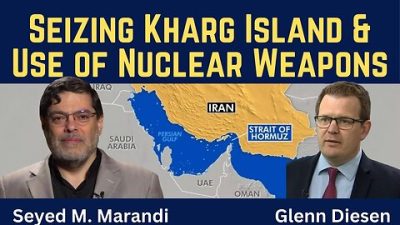
Marandi: Threat of Seizing Kharg Island & the Use of Nuclear Weapons
or go to
Aletho News Archives – Video-Images
Frlom the Archives
Provoking a Path to Persia
The Saban Center’s prescient paper on war with Iran
By Maidhc Ó Cathail | October 20, 2011
In June 2009, the Saban Center for Middle East Policy published “Which Path to Persia?—Options for a New American Strategy toward Iran.” Writing in a tone strikingly reminiscent of the Project for a New American Century’s infamous pre-9/11 paper “Rebuilding America’s Defenses,” the six co-authors noted that, “It seems highly unlikely that the United States would mount an invasion without any provocation or other buildup.” For a think tank specifically established by media mogul Haim Saban to protect Israel, this could prove to be a formidable obstacle impeding their desired march—of U.S. troops—to Tehran.
“In fact, if the United States were to decide that to garner greater international support, galvanize U.S. domestic support, and/or provide a legal justification for an invasion, it would be best to wait for an Iranian provocation, then the time frame for an invasion might stretch out indefinitely,” Saban’s think-tankers ruefully observed.
“With only one real exception, since the 1978 revolution, the Islamic Republic has never willingly provoked an American military response, although it certainly has taken actions that could have done so if Washington had been looking for a fight. Thus it is not impossible that Tehran might take some action that would justify an American invasion. And it is certainly the case that if Washington sought such a provocation, it could take actions that might make it more likely that Tehran would do so (although being too obvious about this could nullify the provocation). However, since it would be up to Iran to make the provocative move, which Iran has been wary of doing most times in the past, the United States would never know for sure when it would get the requisite Iranian provocation. In fact, it might never come at all.”
Seemingly undeterred by Iran’s frustrating unwillingness to provide the requisite provocation, the analysts continued to examine this option… continue
Blog Roll
 Aletho News
- Ukrainian Embassy in Beirut sheltering top Mossad agent
- Palestinian family displaced after settlers violently attack them in Humsa, Jordan Valley
- The EU never learns – except for the wrong lessons
- Iran attacks on UAE leaves RSF militia high and dry
- Hosting Washington’s war: Bahrain faces the consequences
- The US fell for its own Iran propaganda
- Seyed M. Marandi: Threat of Seizing Kharg Island & the Use of Nuclear Weapons
- Is there even an off ramp?
- Michael von der Schulenburg: Europe’s Self-Defeating Iran War Policy
- Sorry, The New Republic, Climate Change Isn’t Causing Somali Migration. Blame Civil Strife and Poverty.
- If Americans Knew
- ‘Of Course’: IDF Drops Case Against Soldiers Accused of Raping Palestinian Prisoner
- Don’t Fall for the Regime Change Talk. Israel Is ‘Mowing the Lawn’ in Iran
- Will Israel and the US wreck the Gulf States along with Iran?
- US so far burned through ‘years’ of munitions in Iran war: Report
- How the Israeli Tail Wags the American Dog
- Outdated intel likely led to deadly U.S. strike on Iranian elementary school, sources say
- Pentagon insider says high U.S official Douglas Feith reported to Netanyahu
- In fond memory of Walid Khalidi, the historian of Palestine
- 6 more Americans killed, as Israel ‘mows the lawn’ in Iran – Not a ceasefire Day 154
- Are we on the precipice of World War III?
- No Tricks Zone
- New Studies: UK Sea Levels Were 4 Meters Higher Than Today During The Mid-Holocene
- Destructive Green New Deal: German Energy And Metal Group Warns Of Drastic Crisis
- New Study Documents A 20-Year Pause In Arctic Sea Ice Decline – Driven By Internal Variability
- Wake-up Call: Survey Shows Majority Of Germans Now Favor Postponing Climate Targets!
- Televised! Leading German Political Candidate Tells Schoolchildren CO2 Makes Sun Hotter!
- New Study: A Century Warming Of 1.1°C Is ‘Commonplace’ And ‘Not Unusual’ During This Interglacial
- New Study: ‘Internal Noise’ And Volcanic Forcing Can Trigger 10-15°C Warming Within Decades
- Glaciers Worldwide Are Suddendly Surging, Experts Blame Warming!
- Surprising Discovery: Sahara Is Greening…Billions Of Trees Where Once Thought To Be Barren
- New Research Reaffirms Clouds, Aerosols, And Surface Solar Radiation Are ‘Driving The Climate System’
 Aletho News