Massive new debt hides years of negative GDP growth in EU and USA
By Jon Hellevig | Oriental Review | September 29, 2014
Finland – In a groundbreaking study Awara Group reveals that the real GDP growth of Western countries has been in negative territory for years. Only by massively loading up debt have they been able to hide the true picture and delay the onset of an inevitable collapse of their respective economies. The study shows that the real GDP of those countries hides hefty losses after netting the debt figures, which gives the Real-GDP-net-of-debt.
The moral of the study is that GDP growth figures as such reveal very little about the underlying dynamics of an economy if one does not simultaneously attempt to analyze what part of the growth is credited to simply artificially fueling the economy with new loans.
The study has found that the Western countries have lost the capacity to grow their economies. All they have left is a capacity to pile up debts. By massively accumulating new debt, they are able to keep up a semblance of at least sluggish growth, or of hovering around the zero growth mark.
If this massive debt would go towards investments, then there would be nothing wrong with it. But, it is not. The debt is going towards financing the losses in the national economies and essentially it all is wasted on consumption that the countries in reality cannot afford. The Western countries act like a 19th century heir to aristocratic wealth, borrowing from year to year to keep up the former lifestyle, while the estate is relentlessly dwindling. Sooner or later the prodigal heir would be forced to face reality and sell the remaining property to stave off the creditors, downgrade his dwellings, and rein in spending. Inevitably, the European countries and the USA will have to curb their excessive consumption, too, but for the time being they are putting off the final reckoning with new debt rather the way a drunkard reaches for the morning after drink to put off sobering up. In the case of the EU and the USA, we are speaking about a debt binge that has been going on for a decade.
While the situation has been generally bad for the last decade or so, it took a dramatic turn for the worse, or should we say for the catastrophic, following the onset of the global financial crisis in 2008. The shocking figures depicting the virtual crippling of the Western economies from 2009 to 2013 are illustrated in Chart 1. It depicts the development of real-GDP-growth per country in years 2005 to 2013. The chart shows that during this period Russia has been able to deliver real non-debt fueled GDP growth, whereas the Western countries are running huge deficits. The accumulated growth of the Russian economy from 2005 to 2013 was 147% while the Western countries accumulated losses from 16.5% (Germany) to 58% (USA). In the case of Russia, the real-GDP-net-of-debt figure is also corrected to adjust for the calculation error caused by an erroneous GDP deflator that Russian Statistics Agency (Rosstat) has used. We have discussed the persistent problem of Russia’s GDP growth having been underestimated due to the use of a wrong GDP deflator in the study Awara Group Research on the Effects of Putin’s Tax Reforms 2000-2012 on State Tax Revenue and GDP

Chart 2 shows the real GDP growth net-of-debt after deducting the growth of public debt from the GDP figure. Net of debt we see the scale of the Western economies, for example the Spanish economy, which amounts to the staggering figure of minus 56.3%. This while the conventional official method of crediting GDP growth with growth of debt would give only minus 6.7%.

The analysis shows that by these measures Russian economic growth, unlike that of the Western countries, has been comparatively healthy and not debt-driven. Russia has in fact a resoundingly positive ratio by these measures, where GDP growth has exceeded growth of debt by a staggering 14 times (1400%). The figure is astonishing when compared with the Western countries that have been flooded with new debt.

Chart 3 shows how much the accumulation of debt in the Western countries exceeds the official GDP growth. The USA is leading the pack with an increase in the debt load in years 2004 to 2013 of USD 9.8 trillion (in the chart in euros, EUR 7 trillion). In those years, the growth of the USA public debt exceeded the GDP growth 9 times (900%), which is illustrated by Chart 4, comparing the proportion of growth of debt to that of growth of GDP.
The comparison of growth of debt to growth of GDP reveals the UK, as the country that has amassed the most amount of new debt relative to GDP growth, having a new-debt-to-GDP-growth ratio of 9 to 1; in other words UK has taken on 900% new debt relative to the GDP growth. But the picture is grim for all the Western countries surveyed, less so for Germany, while Russia’s debt increase amounts to only a fraction of the GDP growth.

The analysis shows that by these measures Russian economic growth, unlike that of the Western countries, has been comparatively healthy and not debt-driven. Russia has in fact a resoundingly positive ratio by these measures, where GDP growth has exceeded growth of debt by a staggering 14 times (1400%). The figure is astonishing when compared with the Western countries that have been flooded with new debt.
The above figures are adjusted taking into account public debt (general government debt), but the situation is even worse when we consider the effect of private debt on the GDP. New debt of corporations and households have at least doubled private debt of most of the Western countries since year 1996 (Chart 5).

Reviewing these figures, it becomes evident that in reality Western economies have not grown in the past decade, rather the countries have massively inflated their debt load. With these levels of debt reached this cannot continue for long. There is a real risk that the bluff will be called sooner rather than later dropping the Western economies to GDP levels that they can carry without debt leverage. But in that situation they will not be able to serve the accumulated debts leading to catastrophe scenarios.
We have not included Japan and China in the analysis due to the difficulties attributed to finding consistent data for all the input variables. For those countries we have come across problems of fractured data that do not capture all the relevant years; inconsistent data across the samples we looked at; and uncertainties about conversion of the input data into euros. (We are sure that major research houses could overcome such problems, having greater and more sophisticated resources than ours). This exclusion of Japan and China is regrettable as Japan is the country worst affected by the problem of debt-fueled GDP growth, having a public debt to GDP ratio of well above 200%, and would therefore have been very instructive for our purposes.
Japan has been essentially living on debt since the early 1990’s. However, some of the more irrational Western analysts want to take Japan as a prime example to follow, arguing that since Japan has been able to pile up debt for some 25 years now, all the Western countries would be able to do it as well for the foreseeable future. In this they fail to grasp that Japan earlier had the luxury of being the sole country living on such exorbitant levels of debt. Japan has enjoyed great support from the Western countries to be able to continue that practice, not least for political reasons. Another important consideration against the idea that Western countries could continue to accumulate debt is that they have, since the early 1990’s, rapidly lost their economic hegemony in terms of share of world trade and global GDP. I have written about this in a recent article entitled Why the West is Destined to Decline.
The West is fast shrinking in economic significance relative to the rest of the world. This is demonstrated by comparing the GDP of the Western powers as represented by the G7 countries (USA, Japan, Germany, France, UK, Italy and Canada) with the GDP of emerging powers. As recently as 1990, the combined GDP of the G7 was overwhelming in relation to that of today’s 7 emerging powers: China, India, Russia, Brazil, Indonesia, Mexico and South Korea (not necessarily constituting one political block). In 1990, the G7 countries had a combined GDP of USD 14.4 trillion and the emerging 7 had a GDP of USD 2.3, but by 2013 the tables had been turned, as the G7 had USD 32 trillion and the emerging 7 had USD 35 trillion. (Chart 6).

With the challenge of the ever increasing share of world economy belonging to the emerging countries, it becomes clear that the Western countries will not be able to profit sufficiently from world trade to service their debt loads.
For the time being the Western countries benefit from the privilege of having currencies that the rest of the world still largely trusts as reserve currencies. In essence, the USD and the euro enjoy a kind of monopoly status. This is what allows Western countries to gain access to cheap debt and fuel their economies with central bank financing (quantitative easing or “printing of money”). But the risk is that, with the deteriorating debt situation and diminishing share of the global economy, they will forfeit this privilege, perhaps even in the near future. What would follow from this is sharply more expensive financing and inflation, with hyperinflation as the eventual outcome. In this scenario – which I consider inevitable over the next 5 to 10 years – the economies of Western countries would essentially collapse.
The problem is that there is no way of averting this scenario, because the Western powers have lost their competitive advantages as economic powers. Eventually, their economies must shrink to match their resource and population bases. (I have written about this in the article referred to above). But it seems that the ruling Western elites have no intention of facing up to these realities. They will try to keep up a semblance of prosperity with ever new debt, as long as they can. The political parties of the West have been essentially converted into voting machines with one singular concern – that of winning the next elections. To do that they will continue to engage in what amounts to bribing of the electorate – creating new debt that fuels the national economy.
But there is no way to turn back this historical tide. Just as the aristocrat of the old regime eventually squandered his legacy, so will the Western powers. This inevitability of the process is what makes it really scary, because I am afraid that the Western elite might be tempted to bail itself out from this doomsday scenario with a war of epic proportions. We are now truly approaching the Armageddon between the West, with its desperate economic circumstances, and the emerging world powers.
Jon Hellevig is a business consultant and economic and political observer. He is the co-editor and co-author of Putin’s New Russia and several books on philosophy and political and social sciences.
‘Sanctions war’ has nothing to do with Ukraine; it’s just a pretext – Rusal CEO
RT | September 19, 2014
The Ukrainian conflict was just a trigger for the sanctions, which demonstrated the failure of all previous efforts to set up healthy relations between Russia and the West, Russian tycoon and head of Rusal, Oleg Deripaska, told RT in Sochi.
“I think the sanctions have nothing to do with Ukraine. Ukraine was just a reason. [The sanctions] were a failure of any attempt which was taken in the past to build normal relations between Europe and Russia – from both sides,” Deripaska told RT at the Investment Forum in Sochi.
Oleg Deripaska said the West started pressing Russia before the first sanctions were imposed – just ahead of the Sochi Olympics.
“We should give a lot of credit to Sochi, [as it showed] a different world, [despite] whatever appeared in the Western press,” he said.
Asked if people across the globe are more anti-Russia than ever, Deripaska answered that “it’s not people, it’s [about] various lobbying groups and various interests.”
“You remember all the complaints before the Olympics. They’ve been intentionally stopping any efforts from the Russian side to be normal, to look normal in the West. My view is we should go down as deep as possible, as quick as possible, and then touch the bottom and go up, and think what’s actually common between us, if there is any chance to have this Portugal-Vladivostok trade zone and opportunities to live together.”
New EU economic sanctions to hit Russian oil, defense investments – report
RT | September 4, 2014
The European Union is looking at introducing more economic sanctions against Russia over its alleged role in Ukrainian conflict, targeting the country’s oil and defense industries with investment bans, according to a new report.
EU diplomats have started drawing up new economic sanctions in Brussels, indicating that they could be passed as soon as Friday, The Telegraph reported, citing a three-page document.
The confidential document was reportedly handed over to ambassadors from several European countries this week.
It calls to “prohibit debt financing (through bonds, equities and syndicated loans) to defense companies and to all companies whose main activity is the exploration, production and transportation of oil and oil products and in which the Russian state is the majority shareholder.”
The new wave of sanctions could potentially ban state-controlled Russian oil and defense companies from raising funds in European capital markets, cutting off foreign investment.
“This extension would significantly increase the burden placed on the Russian state to finance its companies,” the document suggests.
The sanctions would affect Rosneft – Russia’s largest oil producer – in turn impacting British energy company BP, which has a 20 percent stake in the company.
Moreover, Russia’s oil prospectors could be blocked off from accessing exploration, production and refinery services.
“Measures could be extended… to provision of future associated services (such as seismic campaign-related services, drilling, well testing, logging and completion services, supply of floating vessels etc) for deep water, oil exploration and production, Arctic oil exploration and production or shale oil projects in Russia,” said the paper.
That may even include “prohibiting the provision of new additional technologies, for instance refining technologies needed to upgrade crude oil to EURO 4 standards.”
The banking sector will also be targeted further, making borrowing money from the EU even more difficult for Russian state-owned companies.
“Possible measures [include] prohibiting EU persons from participating in syndicated loans to major Russian State owned banks and other entities with a view to further restraining access to capital and closing a possible gap in the current regulation,” said the EU document. “[Also] lowering the maturity beyond which certain debt instruments are restricted bringing it form the current 90 days to 30 days.”
READ MORE: France says it cannot deliver Mistral warship to Russia over Ukraine
Some of the measures not being considered at this time, but reportedly being held in reserve, include bans on the purchase of newly issued Russian government bonds and a boycott of non-industrial diamonds.
Aside from the economic measures, other forms of sanctions are also being considered.
“Beside economic measures, thought could be given to taking coordinated action within the G7 and beyond to recommend suspension of Russian participation in high profile international cultural, economic or sports events (Formula One races, UEFA football competitions, 2018 World Cup etc),” according to the document.
AFP reported, citing a source, that the World Cup boycott idea is being considered as a “possibility for later on, not now.”
On Wednesday the president of FIFA, Sepp Blatter, said there was no chance of the 2018 World Cup being taken away from Russia.
“We are not placing any questions over the World Cup in Russia,” the head of world football’s governing body said at an event near Kitzbuehel, Austria, according to the DPA news agency. “We are in a situation in which we have expressed our trust to the organizers of the 2018 and 2022 World Cups.”
“[A boycott] has never achieved anything,” Blatter stressed.
Meanwhile, President Putin has outlined a seven-point plan to stabilize the situation in the crisis-torn region of eastern Ukraine.
Putin also expressed hope that final agreements between Kiev and the militia in southeastern Ukraine could be reached and secured at the coming meeting of the so-called contact group on September 5.
The military conflict has killed 2,593 people since mid-April and displaced over a million Ukrainians, most of whom sought refuge in Russia.
So far, attempts at temporary ceasefires between Kiev and self-defense forces in the past months have failed to improve the situation in southeastern Ukraine. The fighting has continued, with both sides blaming each other for breaking the truce.
US prepares military drill in W. Ukraine for mid-September
RT | September 3, 2014
The US and its allies are preparing to stage a military exercise in western Ukraine, close to the Polish border, in mid-September. The joint drill will involve over 1,000 troops from the US and Europe, as well as from Ukraine.
Initially planned for mid-July, the exercise – code-named ‘Rapid Trident’ – was halted due to a significant escalation in the conflict between Kiev and the southeastern regions of Ukraine.
Now, as the fighting between the two sides continues, the US Army’s European Command (EUCOM) plans to go ahead and stage the exercise on September 16-26.
“At the moment, we are still planning for [the exercise] to go ahead,” US Navy Captain Gregory Hicks, spokesman for EUCOM, announced on Tuesday.
The annual exercise will take place at Yavoriv training center in the city of Lvov, near Ukraine’s border with Poland.
Around 200 US personnel will be involved in the drill, as well as 1,100 others from Ukraine, Azerbaijan, Britain, Canada, Georgia, Germany, Latvia, Lithuania, Moldova, Norway, Poland, Romania, and Spain, EUCOM said.
In addition to staging air force exercises, the United States is moving tanks and 600 troops to Poland and the Baltic states of Estonia, Latvia, and Lithuania for joint maneuvers in October, Reuters reports. The new deployment will replace a more lightly armed force of paratroopers.
Rapid Trident 2014 is designed to “promote regional stability and security, strengthen partnership capacity and foster trust while improving interoperability between the land forces of Ukraine, and NATO and partner nations,” according to the US Forces in Europe website.
The exercise will be mainly focused on command post drills, patrolling, and dealing with improvised explosive devices.
Despite the involvement of many NATO members, Rapid Trident is not formally a NATO drill.
The Ukrainian-American exercises have taken place in Lvov since 2006 under the framework of NATO’s broader ‘Partnership for Peace,’ which Ukraine is part of.
This year’s drill will mean the first significant deployment of US troops and other personnel to Ukraine since the crisis erupted.
Last year’s Rapid Trident, which focused on “airborne and air-mobile infantry operations,” according to a report on the Rapid Trident website, brought together 17 NATO countries for joint exercises.
The announcement comes just two days before the NATO 2014 summit is set to open in Wales. The alliance’s expansion to Eastern Europe is expected to become one of the main discussions and the 28-member bloc expects, despite internal opposition, to agree on the “more visible NATO presence in the East.”
The White House said the US and its allies are set to discuss plans to significantly increase the readiness of NATO response forces.
White House spokesman Josh Earnest told reporters that the meetings within the summit are expected to involve discussions on potential trainings, exercises, and other issues regarding infrastructure and other needs in Eastern Europe.
Back in June, US President Barack Obama pledged to invest $1 billion in stepping up America’s military presence in Eastern Europe amid the Ukraine crisis. Also that month, Washington vowed additional military help to Ukraine, as well as the potential training of its law enforcement and military personnel.
NATO planning rapid-deployment force of 10,000 troops to counter Russia – report
RT | August 30, 2014
NATO is reportedly working towards the creation of an expeditionary force composed of 10,000 troops from seven different member states as a result of escalating tensions with Russia over the conflict in Ukraine.
According to the Financial Times,the force’s creation will be spearheaded by Britain and involve contributions from Denmark, Latvia, Estonia, Lithuania, Norway, and the Netherlands. Canada is also interested in joining the group, but it’s not known what its final decision will be.
Although no formal announcement has been made, British Prime Minister David Cameron is expected to declare its formation at the upcoming NATO summit in Wales on September 4th.
Many specifics have yet to be worked out or announced, but planners are reportedly implementing ways to increase the number of soldiers involved even more if necessary. Air and naval units will be integrated into the group, as well as ground troops led by British commanders.
As noted by the Times, the creation of the force comes as a response to Russia’s involvement in the ongoing Ukrainian crisis, with the ultimate goal being to “create a fully functioning, division-sized force for rapid deployment and regular, frequent exercises.” NATO has accused Russia of deploying more than 1,000 troops into Ukraine to bolster separatists in the eastern part of the country.
Russia, however, insists that it does not have troops operating inside of Ukraine and has dismissed NATO’s assertions.
Despite the fact that NATO has opted not to act militarily in Ukraine – unnamed sources told Foreign Policy on Friday that there are no plans to confront Russia with anything more than stronger sanctions – Jonathan Eyal of the London-based Royal United Services Institute said the group needs to demonstrate that its eastern European members are just as integral to the alliance as other states.
“We need to end the idea of different zones of security in Europe,” he told the Financial Times. “We need to be talking about prepositioning, regular rotation of troops and making it very clear that we do not accept that the eastern Europeans are in some different category of membership of NATO.”
The revelation also arrives just a few days after NATO’s Secretary-General Anders Fogh Rasmussen expressed interest in forming “a more visible presence” in Eastern Europe in the form of facilities capable of rapidly receiving “response forces” needed to counter Russia.
For his part, Russia’s envoy to NATO, Aleksandr Grushko, said any attempt to push stretch further into the region would impact Moscow’s own security planning.
Bulgaria halts South Stream gas pipeline project for second time
RT | August 18, 2014
All operations on Russia’s Gazprom-led project South Stream have been suspended, as they do not meet the requirements of the European Commission, Bulgaria’s Ministry of Economy and Energy said on its website.
“Minister of Economy and Energy Vasil Shtonov has ordered Bulgaria’s Energy Holding to halt any actions in regards of the project,” the ministry said. This specifically means entering into new contracts.
There has been mounting pressure from the EU to put the project on hold, and now the European Commission will be consulted each step of the way to make sure it complies with EU law.
European ‘anti-monopoly’ laws prohibits the same company to both own and operate the pipeline. However, Gazprom and Bulgaria had previously struck a bilateral agreement regarding that aspect of the project.

This is the second time Bulgaria has called for a suspension of the South Stream project. In early June, the country’s Prime Minister Plamen Oresharski ordered the initial halt.
Bulgaria is the first country traversed by the pipeline on land, after a section that runs beneath the Black Sea from Russia. The branch that begins in Bulgaria is planned to continue through Serbia, Hungary, Slovenia and Austria.
Other participating countries have confirmed their commitment to the South Stream’s construction.
Gazprom’s $45 billion South Stream project, slated to open in 2018 and deliver 64 billion cubic meters of natural gas to Europe, is a strategy by Russia meant to bypass politically unstable Ukraine as a transit country, and help ensure the reliability of gas supplies to Europe.
The American Aggression Enablement Act and the US’ Eurasian Thrust (I)
By Andrew KORYBKO | Oriental Review | August 1, 2014
Congressional Hawks have been peddling the idea of a “Russian Aggression Prevention Act” since the beginning of May, but it has only been during the recent media-inspired hysteria that it began to gain traction. If passed into law, it would amount to a sweeping NATO offensive across all of Russia’s former soviet western periphery and would be the first official act of the ‘New Cold War’. Much has been written about the overall thematic consequences for US-Russian relations by Paul Craig Roberts and Patrick Buchanan illustrating how the US plans to use the legislation to subvert the Russian government from within via its support for ‘NGOs’ (and the prioritized ‘refugee’ status for journalists, ‘dissidents’, and various activists that is included in the document). What has not been explored, however, are some of the finer, yet no less important, aspects of the Act’s implementation. Whether it be NATO expansion into the Balkans or the destabilization of the Caucasus, bill S. 2277 more accurately could be described as the American Aggression Enablement Act (AAEA), as it represents a surge of US offensive military capability against Russian interests in its western flank.
Part I: The NATO Tumor Grows
The AAEA represents the cancerous growth of NATO throughout all of its targeted territories. Some of its most important details are that the EU and NATO are working hand-in-hand, NATO aims to swallow the Balkans, and the Missile Defense Shield (MDS) is to proceed at full speed ahead, with all of the resultant consequences thereof.
Good Cop, Bad Cop:
Although not explicitly stated in the AAEA itself, if one steps back and examines the overall context of the document, it is obvious that the EU and NATO have been working in lockstep to advance each other’s goals. In fact, an overall pattern can be ascertained:
(1) The EU makes some form of outreach to the targeted state(s) (e.g. The Eastern Partnership)
(2) Economic links between the EU and the target are nominally institutionalized (e.g. an EU Association Agreement)
(3) Shadow NATO (via major non-NATO ally status) moves in to defend the economic integration process
The EU presents the friendly, ‘humanitarian’ face to disarm the targeted state’s population while Shadow NATO inconspicuously attempts to absorb the country. This is the tried-and-tested technique of ‘good cop, bad cop’.
The Balkans or Bust:
The US is aggressively promoting its Armed Forces and NATO’s expansion into the Balkans as part of the AAEA. It stipulates that Obama must increase military cooperation with Bosnia, Montenegro, Kosovo, Macedonia, and Serbia, besides Azerbaijan and prescribed major non-NATO allies Ukraine, Georgia, and Moldova. Although it is unlikely that Serbia will be integrated into the fold (it is a strong Russian ally and vividly remembers the bloody bombings of 1999), the move still represents a major expansion of US military influence in Europe. One must keep in mind that the formerly forgotten-about Balkans are now at the forefront of this ‘New Cold War’, with the US and some European actors trying to sabotage Russia’s South Stream gas project which, ironically, certain EU members had agreed to in the first place. Bosnia, Montenegro, Kosovo, and Macedonia are all entities abutting Serbia, which is planned to be one of the hubs of South Stream, so their inclusion into the enhanced NATO security framework suggested by the AAEA can be seen as surrounding Serbia prior to destabilizing it once more. In the context of bitter energy geopolitics, the US’ seemingly unexpected push into the Balkans makes absolute sense.
Missile Defense and NATO’s Northern Expansion:
Included in the AAEA is the directive to accelerate the rollout of the Missile Defense Shield (MDS). This was already envisioned to have land, sea, and space components per the phased adaptive approach framework. What makes the AAEA different, however, is that it wants to ‘poke Russia in the eyes’ and go forward with something that Moscow has already stated would certainly be a red line. Russia holds this stance because it believes that a MDS would neutralize its nuclear second-strike capability, thereby giving the US a monopoly on carrying out a nuclear first strike and shattering the mutual assured destruction concept that kept the peace between the two nuclear titans for decades.
Russia’s response thus far has been to deploy Iskander missiles to the Baltic enclave of Kaliningrad. One of the dual purposes of the US’ MDS is to goad Russia into taking more such defensive actions that could then be propagandized as ‘offensive’, thereby exaggerating ‘the Russian threat’ and contributing to fear mongering among the Swedish and Finnish citizenry. The end result is to push these countries deeper into the NATO apparatus. Finland has already said that it could hold a referendum on joining as early as April 2015 after the next round of parliamentary elections, with its Defense Minister already actively lobbying for this to happen. Sweden, on the other hand, already engages in such close cooperation with NATO that it’s already a shadow member in its own right, and Foreign Minister Carl Bildt is one of the most prominent Russophobic policy makers on the continent. Because of a joint agreement on military security, Finland can only join NATO together with Sweden, meaning that if any move is made, it would likely be a ‘double whammy’ to get the two states in at once. It goes without saying that if Russia would not allow NATO to be deployed in Georgia or Ukraine, it most definitely would not allow it to be deployed along the Russo-Finnish border, further increasing the chances of yet another crisis in NATO-Russian relations sometime down the line.
To be continued… Part II
Hague court had no authority in Yukos case, ruling politicized – Moscow
RT | July 28, 2014
The Hague’s arbitration court was not legally empowered to view the case of Yukos Oil Company v. Russia, and the court’s “one-sided” ruling disregards previous Strasbourg court decisions on the issue, the Russian Finance Ministry said in a statement.
Viewing the case, filed by shareholders of former Russian oil giant Yukos against the Russian government, was not in the jurisdiction of the Permanent Court of Arbitration (PCA) in the Hague, as Russia has not ratified the Energy Charter Treaty, the ministry said on Monday.
The statement, following the court’s sensational Monday ruling that ordered Russia to pay $50 billion in damages, also provided a detailed list of issues, which, according to the ministry, make the decision “opportunistic” and “politically biased.”
First of all, The Hague court ignored the previous decisions of the Strasbourg-based European Court of Human Rights (ECHR), which in September 2011 ruled that the Russian authorities had carried out “legitimate” and not politically motivated actions against Yukos “to counter the company’s tax evasion,” the ministry noted. The ruling contradicted Yukos shareholders’ claims that the company’s assets were purposefully expropriated by Moscow.
The Russian Finance Ministry meanwhile blasted the arbitration ruling as based on “one-sided investigation with one-sided application of evidence.”
The Hague court in effect reviewed the decisions of Russian courts on Yukos “as if the arbitration court was an additional authority for appealing the court orders,” the ministry said. It has made “theoretical speculations not supported by evidence” over the motivation of the Russian authorities’ actions in the case of Yukos, it added.
The international body failed to note that the people who controlled Yukos, including the oil tycoon Mikhail Khodorkovsky released from jail in December, were apparently aware of financial machinations aimed at a mass-scale tax evasion in favor of the company, the ministry stressed. The tax evasion scheme, which involved the creation of numerous bogus companies, was not properly considered in the court.
The arbitration court went as far as to judge “what Russian tax legislation should be like” as opposed to what it required in reality, the ministry said. The court refused to pass several controversial issues on taxes for review by Russian, UK or Cyprus competent authorities despite relying on the Energy Charter Treaty that outlines a need for such reviews, it added.
While in effect saying The Hague court decision was not legally binding for Moscow, the ministry added that “the Russian Federation will challenge the arbitration court’s decisions in the courts of the Netherlands.”
According to the ministry, “the arbitration court failed to approach the adjudication with common sense, which is required from the judges in such situations,” which resulted in an nonobjective and biased decision.
“Such an approach undermines the authority of the Arbitration court and the Energy Charter Treaty, which are being applied in increasingly politicized manner and, as in this case, have become the objects of abuse on behalf of domestic investors trying to evade taxes,” the ministry said.
ECHR is expected to announce a fresh decision on Yukos’ multi-billion dollar claim against Russia on Thursday, as the defunct company’s shareholders have filed a separate application with the Strasbourg court, Reuters reported.
Background: ‘Mega-arbitration’: Court orders Russia to pay $50bn in Yukos case
Russia, Serbia agree €2.1bn South Stream construction deal
RT | July 9, 2014
Serbia has signed a 2.1 billion euro contract with Gazprom subsidiary Centrgaz to construct the South Stream pipeline across its territory. There is increasing pressure from the EU to suspend the project because it claims it breaks competition law.
Centrgaz will be involved in the design, procurement, construction and installation activities, personnel training and commissioning, while Serbian subcontractors will carrying out some of the work, according to South Stream.
The signing ceremony was held in Serbia on Tuesday between South Stream Serbia and Centrgaz.
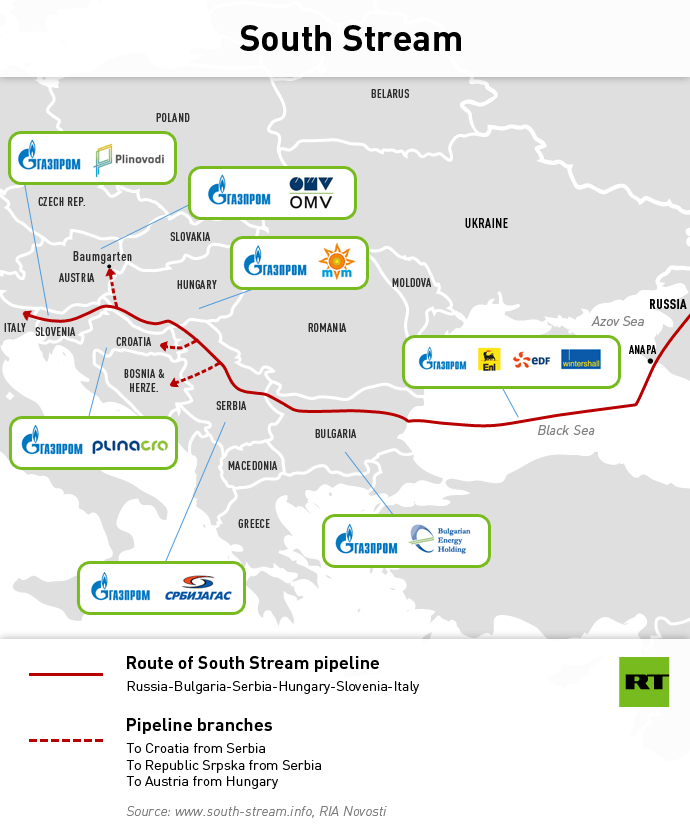 Gas should be flowing through the Serbian part of the pipeline by the end of 2016, according to RIA Novosti.
There has been mounting pressure from the EU to put the project on hold, as it is seen to breach European law.
Serbia had appeared to have halted the construction process, following Bulgaria’s move, however both countries later denied they were not going forward.
Most of the participating countries have confirmed their commitment to South Stream construction.
On Wednesday Russia and Italy said they would continue work on South Stream and were ready “to settle all of the issues, including those that concern dialog with the European Commission,” according to Russian Foreign Minister Sergey Lavrov.
On Tuesday, Slovenia’s Foreign Minister Karl Erjavec said the country wanted “South Stream to pass through our territory.”
Further support for the Russian-led project came from Bulgaria on Monday, when the Prime Minister Plamen Oresharski said it was one of the country’s priority projects. The comment was made after a meeting with Russian Foreign Minister Sergey Lavrov in Sofia. “I believe that we have enough arguments to continue the project,” Oresharski said, adding that the government will work as hard as it can to continue it within the European legislation.
Russian Prime Minister Dmitry Medvedev said the deal on the Serbian part of South Stream would “… mean the transition of our relations with Serbia to a new phase.”
South Stream is a Gazprom project expected to deliver 63 billion cubic meters of Russian gas annually to Europe bypassing Ukraine, which has proved unreliable as a transit partner. The on land part of South Stream goes through Bulgaria, Serbia, Hungary, Slovenia and Austria.
NATO arming Ukraine with Soviet weapons
RT | July 4, 2014
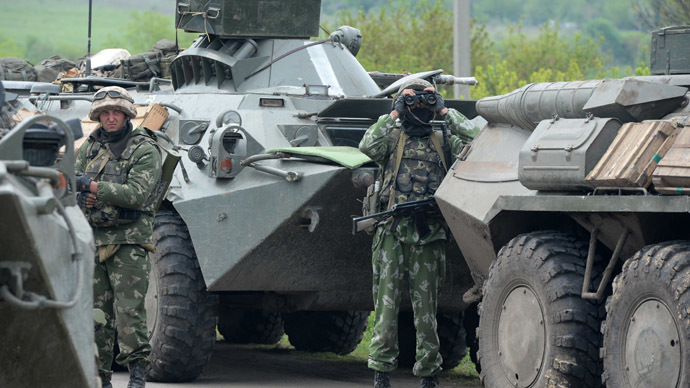
NATO’s newest Eastern European members are handing over their Soviet arms stockpiles to the Ukrainian army, Russia’s Deputy PM Dmitry Rogozin says, adding that the alliance is in danger of pouring gasoline on the flames of that country’s civil war.
Rogozin, who supervises the Russian military industry, has tweeted that NATO is asking its newest members to get rid of operable Soviet military equipment and send it to Ukraine, to aid the miserable state of the country’s military hardware.
“In turn, the US is ready to compensate for the “losses” of the newly co-opted NATO member states. The American military-industrial complex must be happy,” Rogozin wrote in his Twitter account.
“By the way, this is NATO’s commonplace to put out civil wars’ fire with aviation kerosene,” Rogozin added.
Over the months of Ukraine’s hot political crisis, NATO member states, primarily the US, announced they are planning non-lethal aid to Ukrainian troops, supplying uniforms and tents, and even promising to deploy a number of military instructors to train the Ukrainian army to fight the adherents of federalization of the country in Eastern Ukraine.
Political commentator Mikhail Rostovsky told RIA Novosti news agency that the “US and EU are thinking not about Ukraine but about the neutralization of Russia.”
Rostovsky compared the current policies of the European and American leaders with that of British PM Margaret Thatcher and French President François Mitterrand towards the reunification of East and West Germany in 1990.
Speaking loudly about “the European choice for Ukraine,” the EU and US politicians are essentially seeking ways to drive a wedge between Moscow and Kiev to neutralize what they regard as Russia’s possible “imperial ambitions,” Rostovsky said. “We’re dealing with politics dictated by fear: God forbid the Kremlin’s imperial instincts got awakened! This is a matter of principle to deny the Kremlin such an opportunity and break Ukraine away from Russia.”
Rostovsky said he fully agreed with German Foreign Minister Frank-Walter Steinmeier, who told Der Spiegel in late April that Europe has slid “into the worst crisis since the end of the Cold War.”
“Those who can remember the fall of the Berlin Wall know what we’ve accomplished over the past 25 years. The gains we’ve made almost everywhere in Europe in terms of peace, freedom and prosperity are now at risk,” Steinmeier said, adding that that it was important to take “every measure to prevent things [in Ukraine] from getting worse.”
Sikorski and Dziewulski: The Strategy and Tactics of the Neo-Commonwealth
By Andrew Korybko | Oriental Review | June 10, 2014
As the war in the southeast of (former) Ukraine rages on, more proof is emerging of active Polish participation there. This participation has thus far been indirect (i.e. no official Polish military units), although this does not mean that it is no less lethal. Not only has Poland been complicit in training urban terrorists in the run-up to the EuroMaidan chaos, but it has also sent loads of mercenaries to forcibly put down the anti-coup protesters rising up against the junta. Now, photographic proof linking Poland to the Ukrainian madness has arisen. Jerzy Dziewulski, the security advisor to former Polish President Aleksander Kwasniewski, was photographed last week with Turchynov in Slavyansk. Dziewulski is a notorious counter-terrorism expert, having been trained in the US, Israel, France, and Germany, and he currently runs his own private ‘security’ organization. Despite Sikorski playing dumb about the presence of Polish mercenaries in Ukraine and saying he’d “report the fact to the country’s prosecution office”, Dziewulski’s photo with Turchynov proves that he is lying. In reality, Sikorski and Dziewulski represent Poland’s strategic and tactical interference in Ukraine’s civil conflict, and one can no longer be separated from the other.

Reports of mercenary teams operating in (former) Ukraine started sprouting up on the eve of the Kievan junta’s punitive operation in April, but only recently has proof begun to emerge of Poland’s contribution to this force. The late-May report about Polish mercenaries being shipped to Ukraine was almost immediately challenged by Sikorski, despite Russia’s Deputy Foreign Minister stressing that foreign mercenaries, “particularly from Poland”, are active on the ground. Sikorski is now just as easily dismissing the actual capturing of these mercenaries and their Polish commanders, with the Polish Foreign Ministry simply stating that such information is “black propaganda”. This shouldn’t come as a surprise since Sikorski is on record nearly a week prior speaking about the illegality of these mercenaries in the first place, and thus, he will never confirm that they exist. Now that the photo of Dziewulski (dressed in full combat fatigues, helmet, and appearing to have a pistol holstered to his chest) with Turchynov in Slavyansk has hit the internet, it is impossible to deny Poland’s participation in that conflict zone.
To properly understand the significance of the photo in catching the Polish government red-handed, a few words must be said about Dziewulski. As taken from his website, he is an anti-terrorism expert who founded Poland’s Commission for Special Services (special forces). He is licensed in mine warfare, pyrotechnics, and as a sniper. He underwent operational training in Israel, the US, Germany, and France, even training with the State Department and the Bureau of Alcohol, Tobacco, and Firearms during his time in America. He advertises himself as the premier expert on all things related to security, including the use of security companies (read: private military companies) and the “customization of security plans” (read: directing the mercenary offensives). Considering his previous intimate association with Kwasniewski, it is highly probable that he is an important cog in Poland’s national security complex. This makes it all the less likely that Sikorski would not know about such a high-profile government-connected individual’s militant involvement in a festering conflict next door.

What has transpired is that Sikorski and Dziewulski have commandeered Polish policy towards Ukraine and now present a unified two-pronged offensive against the people in Donbass. Sikorski, maneuvering for the EU’s top foreign policy spot, has almost completely overshadowed Poland’s own Prime Minister, whom 69% of Europeans can’t even recognize. Sikorski’s approach is to present the high-level strategy that Poland uses to advance its interests in the lands of the former Polish-Lithuanian Commonwealth (the revival of which the Yanukovich-era head of Ukraine’s security services credits as motivating Polish participation in the February coup). Dziewulski represents a more underhanded and, prior to the photo’s publication, covert approach towards the east. He is the on-the-ground militant power that tactically carries out Sikorski’s strategy. His extensive previous experience could even possibly mean that it is he who is controlling the legions of mercenaries scouring Donbass (and thus responsible for any war crimes carried out by them. After all, it is not likely that Turchynov would waste his time being photographed with an insignificant (which we know Dziewulski is not) figure near the front lines of his offensive. Sikorski and Dziewulski together thus form a unified and aggressive combination of ‘brains and brawn’ that represent the arm and hammer of the ‘Slavic Turkey’s’ Neo-Commonwealth plans.
Andrew Korybko is the American Master’s Degree student at the Moscow State University of International Relations (MGIMO).
Bulgaria halts Russia’s South Stream gas pipeline project
RT | June 8, 2014
Bulgaria’s prime minister, Plamen Oresharski, has ordered a halt to work on Russia’s South Stream pipeline, on the recommendation of the EU. The decision was announced after his talks with US senators.
“At this time there is a request from the European Commission, after which we’ve suspended the current works, I ordered it,” Oresharski told journalists after meeting with John McCain, Chris Murphy and Ron Johnson during their visit to Bulgaria on Sunday. “Further proceedings will be decided after additional consultations with Brussels.”
McCain, commenting on the situation, said that “Bulgaria should solve the South Stream problems in collaboration with European colleagues,” adding that in the current situation they would want “less Russian involvement” in the project.
Russia’s Energy Ministry said it had not yet received any official notification from Bulgaria on work on the project being suspended.
Earlier this week, EU authorities ordered Bulgaria to suspend construction on its link of the pipeline, which is planned to transport Russian natural gas through the Black Sea to Bulgaria and onward to western Europe. Brussels wants the project frozen, pending a decision on whether it violates the EU competition regulations on a single energy market. It believes South Stream does not comply with the rules prohibiting energy producers from also controlling pipeline access.
The EU is also asking for an investigation into how contracts were awarded for work on the pipeline in Bulgaria. Brussels sent the Bulgarian government a letter of formal notice asking for information, to which Sofia had one month to reply.
Russia’s energy giant Gazprom’s South Stream pipeline requires European approvals as its route would pass through the territory of several EU countries.
In Bulgaria, the ruling Socialists support the South Stream project, while Movement for Rights and Freedom leader Lyutvi Mestan told parliament on June 5 that Bulgaria should defend its strategic interests “in cooperation, not in confrontation” with Europe.
Earlier Serbia has said it has no plans to delay the start of construction of its leg of the South Stream pipeline, scheduled for July. Serbian Energy Minister Aleksandar Antic said that the position was not decisive: “I believe the European Commission and member states will find a solution because this is a European project in the best interests of energy security.”
Hungarian Prime Minister Viktor Orban also said June 5 that the pipeline should be built, as there was no alternative to the project.
Featured Video
John Mearsheimer: US Already lost Iran war – No off-ramp in sight
or go to
Aletho News Archives – Video-Images
Frlom the Archives
With apparently fabricated nuclear documents, Netanyahu pushed the US towards war with Iran
By Gareth Porter | The Grayzone | April 29, 2020
President Donald Trump scrapped the nuclear deal with Iran and continued to risk war with Iran based on Israeli Prime Minister Benjamin Netanyahu’s claim to have proven definitively that Iran was determined to manufacture nuclear weapons. Netanyahu not only spun Trump but much of the corporate media as well, duping them with the public unveiling of what he claimed was the entire secret Iranian “nuclear archive.”
In early April 2018, Netanyahu briefed Trump privately on the supposed Iranian nuclear archive and secured his promise to leave the Joint Comprehensive Plan of Action (JCPOA). That April 30, Netanyahu took the briefing to the public in a characteristically dramatic live performance in which he claimed Israel’s Mossad intelligence services had stolen Iran’s entire nuclear archive from Tehran. “You may well know that Iran’s leaders repeatedly deny ever pursuing nuclear weapons…” Netanyahu declared. “Well, tonight, I’m here to tell you one thing: Iran lied. Big time.”
However, an investigation of the supposed Iranian nuclear documents by The Grayzone reveals them to be the product of an Israeli disinformation operation that helped trigger the most serious threat of war since the conflict with Iran began nearly four decades ago. This investigation found multiple indications that the story of Mossad’s heist of 50,000 pages of secret nuclear files from Tehran was very likely an elaborate fiction and that the documents were fabricated by the Mossad itself. … continue
Blog Roll
 Aletho News
- US failures in Iran reveal Russia is key to South Korea’s strategic security
- ‘All ports in Persian Gulf will be legitimate targets if Iranian ports are attacked’
- 40 Years of Endless War, Data Point by Data Point
- Department of War Using Palantir AI to Pick Targets in Iran
- American bases do not protect – they attack the peoples of the Persian Gulf
- ‘We’ve Obliterated Their Missiles’
- Syrian president vows ‘absolute support’ to disarm Hezbollah
- Ukraine attacking Russian gas pipeline to stop deliveries to Europe – Defense Ministry
- ‘Heinous crime’: Iran denounces Israeli assassination of 4 Iranian diplomats in Lebanon
- John Mearsheimer: U.S. Already Lost Iran War – No Off-Ramp in Sight
- If Americans Knew
- Israeli strategic plans to “remake the Middle East” from the 1950s and since
- Honoring Gaza’s women who refused to let the world look away
- 97% of victims of war on Iran are Iranian, 98% of victims in war on Gaza are Gazans – Not a ceasefire Day 152
- Early Iran strikes cost $5.6 billion in munitions, Pentagon estimates
- Israel Decided the War, But Trump’s America Fights and Pays the Bill
- Conscientious Objector Group: Phone ‘Ringing Off Hook’ As Huge Mobilization Underway
- U.S. support for Israel continues to plummet, despite media’s best efforts
- Threats and missiles fly, death tolls soar in Iran, Lebanon, Gaza – Not a ceasefire Day 151
- Lebanon: Israel’s White Phosphorous Use Risks Civilian Harm
- Corporate Media Go All Out To Support The US-Israeli War On Iran
- No Tricks Zone
- Destructive Green New Deal: German Energy And Metal Group Warns Of Drastic Crisis
- New Study Documents A 20-Year Pause In Arctic Sea Ice Decline – Driven By Internal Variability
- Wake-up Call: Survey Shows Majority Of Germans Now Favor Postponing Climate Targets!
- Televised! Leading German Political Candidate Tells Schoolchildren CO2 Makes Sun Hotter!
- New Study: A Century Warming Of 1.1°C Is ‘Commonplace’ And ‘Not Unusual’ During This Interglacial
- New Study: ‘Internal Noise’ And Volcanic Forcing Can Trigger 10-15°C Warming Within Decades
- Glaciers Worldwide Are Suddendly Surging, Experts Blame Warming!
- Surprising Discovery: Sahara Is Greening…Billions Of Trees Where Once Thought To Be Barren
- New Research Reaffirms Clouds, Aerosols, And Surface Solar Radiation Are ‘Driving The Climate System’
- Germany: Electric Car Catches Fire At Charging Station, Sets Off Local “Inferno”, Widespread Damage
 Aletho News