Facebook Continues Censorship Crackdown by Purging Police Accountability Pages
Sputnik – July 30, 2019
In October 2018, Facebook conducted a mass purge of pages connected to alternative and independent news platforms and journalists without warning or explanation, some of which had hundreds of thousands if not millions of followers.
Among those affected were a host of pages promoting police accountability and documenting brutality, criminality and corruption on the part of law enforcement officials, such as Cop Block, Filming Cops and Police the Police, the latter boasting over five million followers. The individuals running these pages were undeterred, and quickly established ‘2.0’ successors, which gradually began regaining the footprint their fallen forebears boasted.
However, Facebook has now struck anew, deleting the replacements on the basis “it looks” like the pages’ activities don’t follow the social media giant’s internal policies.
“The implications of such a move to censor those who expose the police state are horrifying. Before it was deleted last year, Police the Police was the largest police accountability group on the internet and now, despite making back a lot of that ground, it is no longer. For years, we have exposed criminal cops and shined light into the darkness where other media outlets were scared to go. Police the Police and these other pages taught people how to flex their rights, film the police, and to not be afraid to stand up to the police state,” Free Thought Project, the online news outlet behind ‘Police the Police’, said in a statement.
The publication suggests the latest censorship blitz is related to the institution of ‘Blue Lives Matter Laws’ in US states, which elevate former and serving police officers to a protected status under ‘hate crime’ legislation, meaning authorities are now lumped in with “historically persecuted categories” like race, gender, creed, religion, and sexual orientation have been. As a result, criticism of police, even if constructive, could potentially be considered a hate crime, with significant penalties for offenders.
“Simply reporting on police crimes has apparently become a violation in the eyes of Facebook. Unless we fight back in the form of sharing information deemed ‘wrong think’ by the censors, this problem will only continue to get worse. We must continue to alert our fellow humans to this censorship before it becomes the norm. We must use this recent purge as our Streisand moment and turn this massive and blatant act of censorship around as a tool to expose the tyrants behind it,” Free Thought Project concluded.
Atlantic Censors
An alternative explanation for Facebook’s resistance to establishment-critical content could be the organisation’s intimate ties with ‘think tank’ Atlantic Council, an offshoot of NATO with a board of directors that’s a veritable ‘who’s who’ of contentious political figures old and new, including Henry Kissinger, Condoleezza Rice, Colin Powell, Robert Gates, Michael Hayden and David Petraeus, among others, funded by a number of Western governments and Ukrainian oligarchs such as Victor Pinchuk.
The pair launched an initiative to combat ‘fake news’ on Facebook in May 2018, although critics have suggested far from battling false information and propaganda, the alliance in fact simply blocks dissenting views from the social network. It has also seen a number of real people – including popular anti-interventionist Maram Susli (‘SyrianGirl’), Ukrainian concert pianist Valentina Lisitsa, and British pensioner Ian Shilling – labelled bots and banned from the platform, albeit temporarily.
The leak in December 2018 of a 1,400-page rulebook outlining Facebook’s internal censorship policies amply validates the view the social media monopoly isn’t concerned with battling ‘disinformation’, and cares far more about silencing views elite individuals and organisations simply don’t like. One section of the file outlines every group and individual the company has deemed a “hate figure” – algorithms and paid human moderators are required to remove any post praising, supporting or representing any of the entities listed.
“Human Right Activists” Celebrate Facebook-Twitter Censorship
By Joseph Thomas – New Eastern Outlook – July 26, 2019
All Facebook and Twitter accounts associated with Bangkok-based geopolitical analyst Tony Cartalucci have been deleted. The extent to which both American-based tech companies went to target Cartalucci could be seen in a recent Reuters article reporting on it.
Written by Thai Reuters correspondent Patpicha Tanakasempipat, the article titled, “Facebook removes fake accounts from Thailand, Russia, Ukraine, Honduras,” referred to the author claiming:
The accounts removed in Thailand used “fictitious personas” to promote narratives about Thai politics, U.S.-China relations, protests in Hong Kong, and criticism of democracy activists in Thailand, Gleicher said.
“We were able to determine conclusively that some of the activities of this network was linked to an individual based in Thailand associated with New Eastern Outlook, a Russian government-funded journal based in Moscow,” Gleicher said.
The article cited “coordinated inauthentic behavior” and hailed the move as countering “deceptive political propaganda.”
No mention was made of how writing anonymously is “inauthentic behavior” nor were any examples provided of what was deemed “deceptive political propaganda” and why.

Matthew Tostevin, a Reuters correspondent also based in Southeast Asia and whose Twitter profile unironically invokes the hashtag, “Journalism is Not a Crime” celebrated the systematic, coordinated censorship, claiming in a tweet:
“Tony Cartalucci” Facebook and Twitter accounts inaccessible after Facebook said it had erased accounts of a network linked to “an individual based in Thailand associated with New Eastern Outlook, a Russian government-funded journal”.
The term “associated with” is often used to imply impropriety without providing any actual evidence of it. Tostevin’s defence of Facebook-Twitter censorship fails to explain how getting paid to write articles is wrong, especially considering Tostevin himself makes his living doing precisely that for London-based Reuters.
Human Rights Watch’s Thai representative, Sunai Phasuk, himself a verified recipient of foreign government funds, also celebrated rather than opposed Facebook and Twitter’s coordinated censorship.

In his tweet (translated from Thai), he claimed:
The end of IO [information operation]! Facebook and Twitter suspend the accounts of Tony/Anthony Cartalucci (source of “slim” information) as well as related accounts for using a fake identity, disseminating false information, creating hatred for democratic parties and human rights activists/linked to Russian IO.
The term “slim” is a derogatory term used by supporters of Thaksin Shinawatra, an ousted billionaire politician now living abroad as a fugitive and guilty of the worst human rights violations in contemporary Thai history.
Sunai not only reveals a complete lack of impartiality as a supposed human rights advocate, but also is clearly promoting censorship of information he and his foreign sponsors deem “false.”
Regarding claims of using a “fake identity,” Cartalucci himself has repeatedly stated over several years that the name “Tony Cartalucci” is a pen name and that he writes anonymously, as many authors throughout history have, particularly those writing about sensitive political topics.
From Reuters to Human Rights Watch employees, attempts to “dox” Cartalucci and others presenting differing perspectives has become a disturbing trend.
Facebook and Twitter now deleting accounts of anonymous writers only serves to further chill the free speech “human rights advocates” like Sunai claim to defend.
Others celebrating Cartalucci’s suspension from Facebook and Twitter include BBC correspondent Jonathan Head.
West’s Losing Battle Amid the Information War
Facebook and Twitter have targeted many other alternative media sites and individuals, often using accusations of being “Russian-funded” to smear targets and justify censorship. Conversely, should governments overseas targeted by US or British-funded sites or individuals attempt to shut them down, they are depicted as “authoritarian” and guilty of indisputable “censorship.”
Such hypocrisy over free speech, media freedom and censorship stems from the much wider hypocrisy that drives Western foreign policy in general.
Other examples include decrying “Iranian aggression” while the US surrounds Iran with military bases built on nations the US illegally invaded and now occupy, or the US decrying unfounded claims of Russian interference in its domestic politics while openly funding opposition groups targeting Moscow.
The accounts of organisations and individuals across the West, including Reuters, the BBC, and HRW guilty of “disseminating false information” regarding “weapons of mass destruction” in Iraq, Russian interference in US elections, claims of sarin gas used in Syria or covering up Western interference in the domestic politics of nations worldwide not only remain unscathed by Facebook and Twitter’s “fake news” campaign, but the sole beneficiaries in an increasingly crowded information sphere where the alternative media has otherwise challenged their monopoly over information.
Facebook and Twitter are both suffering severely from attempts to control the flow of information on both platforms. A desire for alternatives is sought out not only by persecuted political activists being purged from both platforms, but from a wide and growing range of ordinary individuals who feel both social media platforms have become too invasive.
Cartalucci will likely continue writing and those who remain on Facebook and Twitter will likely continue promoting his articles. All the move to purge individuals and organisations from social media platforms will do is accelerate the search for alternatives.
Since Facebook and Twitter’s censorship fails to address the fundamental shortcomings of Western foreign policy that people like Cartalucci expose and have gained attention from Facebook and Twitter censorship for, such censorship is a bandaid at best. At worse, it is delaying the inevitable conclusion of an information war neither social media platform (nor the special interests they represent) are winning.
Joseph Thomas is chief editor of Thailand-based geopolitical journal, The New Atlas and contributor to the online magazine “New Eastern Outlook”.
Israeli Spyware Can Steal Private Data From Apple, Google, Facebook – Reports
Sputnik – July 20, 2019
Israel-based NSO Group became the focus of public attention this spring, when the media reported that its software products are being used to hack WhatsApp messenger, as well as spy on the owners of Android and iOS smartphones.
Spyware from NSO Group can obtain user data from Apple, Google, Facebook, Amazon and Microsoft servers, according to an article in The Financial Times.
While NSO has consistently rejected any espionage or hacking allegations, the company has never denied the development of such technology, prompting many questions among experts.
According to the Financial Times, the infected smartphone provides NSO’s Pegasus software with authentication keys for Google Drive, Facebook Messenger and iCloud cloud services. With this technology, Pegasus manages to bypass two-step authentication and email notification.
Users are not notified of suspicious activity.
Some information security experts doubt the effectiveness of Pegasus, but representatives of Amazon and Facebook have already promised to investigate and strengthen the security measures of their cloud services, if necessary.
It was revealed in May that WhatsApp had been targeted by NSO, according to Forbes.
Judge, jury & executioner: Facebook policy permits death threats against ‘dangerous individuals’
RT | July 10, 2019
Facebook has issued an ominous new policy permitting death threats and calls for violence – so long as they’re directed against “dangerous” individuals or organizations, or someone accused (but not convicted) of a crime.
Facebook has updated its “community standards” to carve out a few exceptions to its “no death threats” policy. Calls for “high-severity violence” are now permitted, as long as they’re directed at individuals “covered in the Dangerous Individuals and Organizations policy” or individuals “described as having carried out violent crimes or sexual offenses” by media reports. After all, are people banned from Facebook really people at all?
The change was spotted on Tuesday by commentator Paul Joseph Watson, who along with his former Infowars boss Alex Jones was one of a handful of mostly-conservative personalities banned from Facebook in May under its “Dangerous Individuals” policy. Back then, even mentioning one of the banned names could get a user banned – unless the mention was derogatory.
Facebook has apparently taken that “hate the haters” tactic and run with it. While the “Dangerous Individuals” policy supposedly only covers “terrorist activity, organized hate, mass or serial murder, human trafficking, and organized violence or criminal activity,” none of the commentators banned – including Watson, Jones, conservative political performance artist Milo Yiannopoulos, and Nation of Islam leader Louis Farrakhan – were involved in any of those activities. But, Watson discovered, a person wearing an Infowars t-shirt is enough to get a photo removed from Instagram, and photos that include banned individuals – even if their faces are blurred out – have been deleted as well.
Equally ominous is Facebook’s decision to dispense with the concept of “innocent until proven guilty” that forms the core of the US legal system (Facebook is based in Menlo Park, California, and at least theoretically subject to US laws). Individuals need only be accused in the media of violent crimes and sexual offenses to become fair game for death threats – not convicted in court. For a company that claims to take the threat of “fake news” very seriously, Facebook is surprisingly cavalier about the potential for media misinformation to lead to violence.
But then, Facebook never even tried to prove Watson, Jones or any of the other banned users were “Dangerous Individuals,” either – its policy has always been that banned users are guilty until proven innocent, as any user who’s ever been forced to jump through its tech support hoops to restore a banned account can attest.
“The largest social media company in the world with over 2 billion users literally says it’s fine to incite violence against me, despite this being illegal,” Watson wrote at Summit.news, pointing out that sending death threats or threats of violence is, in fact, a crime under UK law (as it is under US law and the laws of most developed countries with substantial Facebook-using populations). “They are painting a target on my back.”
Facebook even tracks off-platform behavior to determine whether users should be blacklisted as “hate agents,” according to internal documents seen by Breitbart, meaning merely showing up at the same event as a “dangerous individual” can potentially earn a user the designation. The site’s list of “hate agents” is reportedly quite exhaustive and includes British politicians Carl Benjamin and Anne Marie Waters as well as conservative commentators like Yiannopoulos and Candace Owens. Because all this classification goes on in secret, users have no chance to appeal their un-personing, and may never even know they are being judged, until they start receiving Facebook-approved death threats of their own.
Also on rt.com:
‘No future for dissidents’ on social media: Paul Joseph Watson reflects on Facebook ban
How NeoCon Billionaire Paul Singer Is Driving the Outsourcing of US Tech Jobs to Israel
By Whitney Webb | MintPress News | June 11, 2019
WASHINGTON — With nearly 6 million Americans unemployed and regular bouts of layoffs in the U.S. tech industry, major American tech companies like Google, Microsoft and Intel Corporation are nonetheless moving key operations, billions in investments, and thousands of jobs to Israel — a trend that has largely escaped media attention or concern from even “America first” politicians. The fact that this massive transfer of investment and jobs has been so overlooked is particularly striking given that it is largely the work of a single leading neoconservative Republican donor who has given millions of dollars to President Donald Trump.
To make matters worse, many of these top tech companies shifting investment and jobs to Israel at record rates continue to collect sizable U.S. government subsidies for their operations while they move critical aspects of their business abroad, continue to layoff thousands of American workers, and struggle to house their growing company branches in Israel. This is particularly troubling in light of the importance of the tech sector to the overall U.S. economy, as it accounts for 7.1 percent of total GDP and 11.6 percent of total private-sector payroll.
Furthermore, many of these companies are hiring members of controversial Israeli companies — known to have spied on Americans, American companies, and U.S. federal agencies — as well as numerous members of Israeli military intelligence as top managers and executives.
This massive transfer of the American tech industry has largely been the work of one leading Republican donor — billionaire hedge fund manager Paul Singer, who also funds the neoconservative think tank American Enterprise Institute (AEI), the Islamophobic and hawkish think tank Foundation for Defense of Democracies (FDD), the Republican Jewish Coalition (RJC), and also funded the now-defunct Foreign Policy Initiative (FPI).
Singer’s project to bolster Israel’s tech economy at the U.S.’ expense is known as Start-Up Nation Central, which he founded in response to the global Boycott, Divest and Sanctions (BDS) movement that seeks to use nonviolent means to pressure Israel to comply with international law in relation to its treatment of Palestinians.
This project is directly linked to Israeli Prime Minister Benjamin Netanyahu, who in recent years has publicly mentioned that it has been his “deliberate policy” to have former members of Israel’s “military and intelligence units … merge into companies with local partners and foreign partners” in order to make it all but impossible for major corporations and foreign governments to boycott Israel.
In this report, MintPress identifies dozens of former members of an elite Israeli military intelligence unit who now hold top positions at Microsoft, Google and Facebook.
Singer’s nonprofit organization has acted as the vehicle through which Netanyahu’s policy has been realized, via the group’s close connections to the Israeli PM and Singer’s long-time support for Netanyahu and the Likud Party. With deep ties to Netanyahu, the American Israel Public Affairs Committee (AIPAC), and controversial tech companies — like Amdocs — that spied on the American government, this Singer-funded organization has formed a nexus of connections between the public and private sectors of both the American and Israeli economies with the single goal of making Israel the new technology superpower, largely at the expense of the American economy and government, which currently gives $3.2 billion in aid to Israel annually.
Researched and developed in Israel
In recent years, the top U.S. tech companies have been shifting many of their most critical operations, particularly research and development, to one country: Israel. A 2016 report in Business Insider noted that Google, Facebook, Microsoft, Amazon and Apple had all opened up research and development (R&D) centers in recent years, with some of them having as many as three such centers in Israel, a country roughly the size of New Jersey. Other major tech companies that have also opened key operation and research centers in Israel include Sandisk, Nvidia, PayPal, Palantir and Dell. Forbes noted last year that the world’s top 10 tech companies were now “doing mission-critical work in Israel that’s core to their businesses back at HQ.”
Yet, some of these tech giants, particularly those based in the U.S., are heavily investing in their Israeli branches while laying off thousands of American employees, all while receiving millions of dollars in U.S. government subsidies funded by American taxpayers.
For example, Intel Corporation, which is the world’s second largest manufacturer of semiconductor computer chips and is headquartered in California, has long been a major employer in Israel, with over 10,000 employees in the Jewish state. However, earlier this year, Intel announced that it would be investing $11 billion in a new factory in Israel and would receive around $1 billion in an Israeli government grant for that investment. Just a matter of months after Intel announced its major new investment in Israel, it announced a new round of layoffs in the United States.
Yet this is just one recent example of what has become a trend for Intel. In 2018, Intel made public its plan to invest $5 billion in one of its Israeli factories and had invested an additional $15 billion in Israeli-created autonomous driving technology a year prior, creating thousands of Intel jobs in Israel. Notably, over that same time frame, Intel has cut nearly 12,000 jobs in the United States. While this great transfer of investment and jobs was undermining the U.S. economy and hurting American workers, particularly in the tech sector, Intel received over $25 million dollars in subsidies from the U.S. federal government.
A similar phenomenon has been occurring at another U.S.-based tech giant, Microsoft. Beginning in 2014 and continuing into 2018, Microsoft has laid off well over 20,000 employees, most of them Americans, in several different rounds of staff cuts. Over that same time period, Microsoft has been on a hiring spree in Israel, building new campuses and investing billions of dollars annually in its Israel-based research and development center and in other Israeli start-up companies, creating thousands of jobs abroad. In addition, Microsoft has been pumping millions of dollars into technology programs at Israeli universities and institutes, such as the Technion Institute. Over this same time frame, Microsoft has received nearly $197 million in subsidies from the state governments of Washington, Iowa and Virginia.
Though Israeli politicians and tech company executives have praised this dramatic shift as the result of Israel’s tech prowess and growing reputation as a technological innovation hub, much of this dramatic shift has been the work of the Netanyahu-tied Singer’s effort to counter a global movement aimed at boycotting Israel and to make Israel a global “cyber power.”
Start-Up Nation Central and the Neocons
In 2009, a book titled Start Up Nation: The Story of Israel’s Economic Miracle, written by American neoconservative Dan Senor and Jerusalem Post journalist Saul Singer (unrelated to Paul), quickly rose to the New York Times bestseller list for its depiction of Israel as the tech start-up capital of the world. The book — published by the Council on Foreign Relations, where Senor was then serving as Adjunct Senior Fellow — asserts that Israel’s success in producing so many start-up companies resulted from the combination of its liberal immigration laws and its “leverage of the business talents of young people with military experience.”
“The West needs innovation; Israel’s got it,” wrote Senor and Singer. In a post-publication interview with the blog Freakonomics, Senor asserted that service in the Israeli military was crucial to Israel’s tech sector success, stating that:
“Certain units have become technology boot camps, where 18- to 22-year-olds get thrown projects and missions that would make the heads spin of their counterparts in universities or the private sector anywhere else in the world. The Israelis come out of the military not just with hands-on exposure to next-gen technology, but with training in teamwork, mission orientation, leadership, and a desire to continue serving their country by contributing to its tech sector — a source of pride for just about every Israeli.”
The book, in addition to the many accolades it received from the mainstream press, left a lasting impact on top Republican donor Paul Singer, known for funding the most influential neoconservative think tanks in America, as noted above. Paul Singer was so inspired by Senor and Singer’s book that he decided to spend $20 million to fund and create an organization with a similar name. He created the Start-Up Nation Central (SUNC) just three years after the book’s release in 2012.
To achieve his vision, Singer – who is also a top donor to the Republican Party and Trump – tapped Israeli economist Eugene Kandel, who served as Netanyahu’s national economic adviser and chaired the Israeli National Economic Council from 2009 to 2015.
Senor was likely directly involved in the creation of SUNC, as he was then employed by Paul Singer and, with neoconservatives Bill Kristol and Robert Kagan, co-founded the FPI, which Singer had long funded before it closed in 2017. In addition, Dan Senor’s sister, Wendy Singer (unrelated to either Paul or Saul), long-time director of Israel’s AIPAC office, became the organization’s executive director.
SUNC’s management team, in addition to Eugene Kandel and Wendy Singer, includes Guy Hilton as the organization’s general manager. Hilton is a long-time marketing executive at Israeli telecommunications company Amdocs, where he “transformed” the company’s marketing organization. Amdocs was once highly controversial in the United States after it was revealed by a 2001 Fox News investigation that numerous federal agencies had investigated the company, which then had contracts with the 25 largest telephone companies in the country, for its alleged role in an aggressive espionage operation that targeted the U.S. government. Hilton worked at Microsoft prior to joining Amdocs.
Beyond the management team, SUNC’s board of directors includes Paul Singer, Dan Senor and Terry Kassel — who work for Singer at his hedge fund, Elliott Management — and Rapheal Ouzan. Ouzan was an officer in the elite foreign military intelligence unit of Israel, Unit 8200, who co-founded BillGuard the day after he left that unit, which is often compared to the U.S.’ National Security Agency (NSA). Within five months of its founding, BillGuard was backed by funding from PayPal founder Peter Thiel and former CEO of Google, Eric Schmidt. Ouzan is also connected to U.S. tech companies that have greatly expanded their Israeli branches since SUNC’s founding — such as Microsoft, Google, PayPal and Intel, all of which support Ouzan’s non-profit Israel Tech Challenge.
According to reports from the time published in Haaretz and Bloomberg, SUNC was explicitly founded to serve as “a foreign ministry for Israel’s tech industry” and “to strength Israel’s economy” while also aiming to counter the Boycott, Divest and Sanctions (BDS) movement that seeks to use a nonviolent boycott to end the illegal military occupation of the West Bank and Israeli apartheid, as well as the growth of illegal Jewish-only settlements in occupied Palestinian territory.
Since its founding, SUNC has sought to transfer tech jobs from foreign companies to Israel by developing connections and influence with foreign governments and companies so that they “deepen their relationship with Israel’s tech industry.” Though SUNC has since expanded to include other sectors of the Israeli “start-up” economy, its focus has long remained on Israel’s tech, specifically its cybersecurity industry. Foreign investment in this single Israeli industry has grown from $227 million in 2014 to $815 million in 2018.
In addition to its own activities, SUNC appears to be closely linked to a similar organization, sponsored by Coca Cola and Daimler Mercedes Benz, called The Bridge, which also seeks to connect Israeli start-up companies with large international corporations. Indeed, SUNC, according to its website, was actually responsible for Daimler Mercedes Benz’s decision to join The Bridge, thanks to a delegation from the company that SUNC hosted in Israel and the connections made during that visit.
Teaming up with Israel’s Unit 8200

Members of Israel’s signals intelligence Unit 8200 work under a Saudi flag. Photo | Moti Milrod
Notably, SUNC has deep ties to Israel’s military intelligence unit known as Unit 8200 and, true to Start Up Nation’s praise of IDF service as key to Israel’s success, has been instrumental in connecting Unit 8200 alumni with key roles in foreign companies, particularly American tech companies. For instance, Maty Zwaig, a former lieutenant colonel in Unit 8200, is SUNC’s current director of human capital programs, and SUNC’s current manager of strategic programs, Tamar Weiss, is also a former member of the unit.
One particularly glaring connection between SUNC and Unit 8200 can be seen in Inbal Arieli, who served as SUNC’s Vice President of Strategic Partnerships from 2014 to 2017 and continues to serve as a senior adviser to the organization. Arieli, a former lieutenant in Unit 8200, is the founder and head of the 8200 Entrepreneurship and Innovation Support Program (EISP), which was the first start-up accelerator in Israel aimed at harnessing “the vast network and entrepreneurial DNA of [Unit] 8200 alumni” and is currently one of the top company accelerators in Israel. Arieli was the top executive at 8200 EISP while working at SUNC.
Another key connection between SUNC and Unit 8200 is SUNC’s promotion of Team8, a company-creation platform whose CEO and co-founder is Nadav Zafrir, former commander of Unit 8200. In addition to prominently featuring Team8 and Zafrir on the cybersecurity section of its website, SUNC also sponsored a talk by Zafrir and an Israeli government economist at the World Economic Forum, often referred to as “Davos,” that was attended personally by Paul Singer.
Team8’s investors include Google’s Eric Schmidt, Microsoft, and Walmart — and it recently hired former head of the NSA and U.S. Cyber Command, retired Admiral Mike Rogers. Team8 described the decision to hire Rogers as being “instrumental in helping strategize” Team8’s expansion in the United States. However, Jake Williams, a veteran of NSA’s Tailored Access Operations hacking unit, told CyberScoop:
“Rogers is not being brought into this role because of his technical experience. … It’s purely because of his knowledge of classified operations and his ability to influence many in the U.S. government and private-sector contractors.”
In addition to connections to Unit 8200-linked groups like Team8 and 8200 EISP, SUNC also directly collaborates with the IDF in an initiative aimed at preparing young Israeli women to serve in Unit 8200. That initiative, called the CyberGirlz Club, is jointly funded by Israel’s Defense Ministry, SUNC and the Rashi Foundation, the philanthropic organization set up by the Leven family of Perrier-brand water, which has close ties to the Israeli government and IDF.
“Our aim is to bring the girls to this process already skilled, with the knowledge needed to pass the exams for Unit 8200 and serve in the military as programmers,” Zwaig told Israel National News.
Seeding American tech
The connections between SUNC and Unit 8200 are troubling for more than a few reasons, one of which being that Unit 8200, often likened to the U.S.’ NSA, closely coordinates with Israel’s intelligence agency, the Mossad, and is responsible for 90 percent of the intelligence material obtained by the Israeli government, according to its former commander Yair Cohen. Cohen told Forbes in 2016, that “there isn’t a major operation, from the Mossad or any intelligence security agency, that 8200 is not involved in.” For obvious reasons, the fact that an organization founded by an American billionaire is actively promoting the presence of former military intelligence officers in foreign companies, specifically American companies, while also promoting the transfer of jobs and investment to that same country, is very troubling indeed.
Particularly troubling is the fact that, since SUNC’s founding, the number of former Unit 8200 members in top positions in American tech companies has skyrocketed. Based on a non-exhaustive analysis conducted by Mintpress of over 200 LinkedIn accounts of former Israeli military intelligence and intelligence officers in three major tech companies, numerous former Unit 8200 alumni were found to currently hold top managerial or executive positions in Microsoft, Google and Facebook.
At Microsoft, managers for at least 15 of the company’s products and programs — including Microsoft’s lead managers for engineering, product strategy, threat analytics and cloud business intelligence — publicly listed their affiliation with Unit 8200 on their LinkedIn accounts. In addition, the general manager of Microsoft’s Israeli Research and Development Center is also a former member of Unit 8200. In total, of the 200 accounts analyzed, 50 of them currently worked for Microsoft.
Similarly, at Google, 28 former Unit 8200 members at the company were identified from their LinkedIn accounts. Among them are Google’s Engineering Director, its strategic partner manager, two growth marketing leads, its lead technical manager, and six product and program managers, including Google’s manager for trust and safety search.
Facebook also has several Unit 8200 members in prominent positions, though fewer than Google and Microsoft. MintPress identified at least 13 Unit 8200 alumni working for Facebook, including its director of engineering, lead manager for express wi-fi, and technical program manager. Notably, Facebook has spent the last several years collaborating with Israel’s government to censor Israel’s critics.
Of course, there is likely much more influence of Unit 8200 on these companies than this non-exhaustive analysis revealed, given that many of these companies acquired several Israeli start-ups run by and staffed by many Unit 8200 alumni who subsequently went on to found new companies and start-ups a few years or shortly after acquisition. Furthermore, due to the limitations of LinkedIn’s set-up, MintPress was not able to access the complete list of Unit 8200 alumni at these three tech companies, meaning that the eye-opening numbers found were generated by a relatively small sample.
This jump in Unit 8200 members in top positions in tech companies of global importance is actually a policy long promoted by Netanyahu, whose long-time economic adviser is the chief executive at SUNC. During an interview with Fox News last year, Netanyahu was asked by Fox News host Mark Levin if the large growth seen in recent years in Israel’s technology sector was part of Netanyahu’s plan. Netanyahu responded, “That’s very much my plan … It’s a very deliberate policy.” He later added that “Israel had technology because the military, especially military intelligence, produced a lot of capabilities. These incredibly gifted young men and women who come out of the military or the Mossad, they want to start their start-ups.”
Netanyahu further outlined this policy at the 2019 Cybertech conference in Tel Aviv, where he stated that Israel’s emergence as one of the top five “cyber powers” had “required allowing this combination of military intelligence, academia and industry to converge in one place” and that this further required allowing “our graduates of our military and intelligence units to merge into companies with local partners and foreign partners.” The direct tie-ins of SUNC to Netanyahu and the fact that Paul Singer has also been a long-time political donor and backer of Netanyahu suggest that SUNC is a key part of Netanyahu’s policy of placing former military intelligence and intelligence operatives in strategic positions in major technology companies.
Notably, just as SUNC was founded to counter the BDS movement, Netanyahu has asserted that this policy of ensuring Israel’s role as a “cyber power” is aimed at increasing its diplomatic power and specifically undermining BDS as well as the United Nations, which has repeatedly condemned Israel’s government for war crimes and violations of international law in relation to the Palestinians.
Building the bi-national surveillance state
Top U.S. tech companies have filled top positions with former members of Israeli military intelligence and moved strategic and critical operations to Israel, boosting Israel’s economy at the expense of America’s, and SUNC’s role in this marked shift merits scrutiny.
A powerful American billionaire has built an influential organization with deep connections to the U.S.-Israel lobby (AIPAC), an Israeli company that has been repeatedly investigated for spying on the U.S. government (Amdocs), and the elite Israeli military intelligence unit (Unit 8200) that has used its influential connections to the U.S. government and the U.S. private sector to dramatically shift the operations and make-up of major companies in a critical sector of the U.S. economy.
Further consider that U.S. government documents leaked by Edward Snowden have flagged Israel as “leading threat” to the infrastructure of U.S. financial and banking institutions, which use much of the software produced by these top tech companies, and have also flagged Israel as a top espionage threat. One U.S. government document cited Israel as the third most aggressive intelligence service against the U.S. behind Russia and China. Thus, Paul Singer’s pet project in Start-Up Nation Central has undermined not only the U.S. economy but arguably U.S. national security as well.
This concern is further exacerbated by the deep ties connecting top tech companies like Microsoft and Google to the U.S. military. Microsoft and Google are both key military contractors — Microsoft in particular, given that it is set to win a lucrative contract for the Pentagon’s cloud management and has partnered with the Department of Defense to produce a “secure” election system known as ElectionGuard that is set to be implemented in some U.S. states for the 2020 general election.
Whitney Webb is a MintPress News journalist based in Chile. She has contributed to several independent media outlets including Global Research, EcoWatch, the Ron Paul Institute and 21st Century Wire, among others. She has made several radio and television appearances and is the 2019 winner of the Serena Shim Award for Uncompromised Integrity in Journalism.
Internet Free Speech All but Dead
Unelected, unnamed censors are operating across the Internet to suppress “unapproved” content.

By Philip Giraldi | Global Research | June 8, 2019
The Internet was originally promoted as a completely free and uncensored mechanism for people everywhere to exchange views and communicate, but it has been observed by many users that that is not really true anymore. Both governments and the service providers have developed a taste for controlling the product, with President Barack Obama once considering a “kill switch“ that would turn off the Internet completely in the event of a “national emergency.”
President Donald Trump has also had a lot to say about fake news and is reported to be supporting limiting protections relating to the Internet. In May, a “net neutrality” bill that would have prevented service providers from manipulating Internet traffic passed in the House of Representatives, but it is reported to be “dead on arrival” in the Senate, so it will never be enacted.
Social networking sites have voluntarily employed technical fixes that restrict some content and have also hired “reviewers” who look for objectionable material and remove it. Pending European legislation, meanwhile, might require Internet search engines to eliminate access to many unacceptable old posts. YouTube has already been engaged in deleting existing old material and is working with biased “partners” like the Anti-Defamation League (ADL) to set up guidelines to restrict future content. Many users of Facebook will have already undoubtedly noted that some contacts have been blocked temporarily (or even permanently) and denied access to the site.
Google now automatically disables or limits searches for material that it deems to be undesirable. If Google does not approve of something it will either not appear in search results or it will be very low on the list. And what does come up will likely favor content that derives from those who pay Google to promote their products or services. Information that originates with competitors will either be very low in the search results or even blocked. Google is consequently hardly an unbiased source of information.
In May 2017 Facebook announced that it would be hiring 3,000 new censors, and my own experience of social networking censorship soon followed. I had posted an article entitled “Charlottesville Requiem” that I had written for a website. At the end of the first day, the site managers noticed that, while the article had clearly attracted a substantial Facebook readership, the “likes” for the piece were not showing up on the screen counter, i.e., were not being tabulated. It was also impossible to share the piece on Facebook, as the button to do so had been removed.
The “likes” on sites like Facebook, Yahoo! news comments, YouTube, and Google are important because they automatically determine how the piece is distributed throughout the site. If there are a lot of likes, the piece goes to the top when a search is made or when someone opens the page. Articles similarly can be sent to Coventry if they receive a lot of dislikes or negative marks, so the approvals or disapprovals can be very important in determining what kind of audience is reached or what a search will reveal.
In my case, after one day my page reverted to normal, the “likes” reappeared, and readers were again able to share the article. But it was clear that someone had been managing what I had posted, apparently because there had been disapproval of my content based on what must have been a political judgment.
A couple of days later, I learned of another example of a similar incident. The Ron Paul Institute (RPI) website posts much of its material on YouTube (owned by Google) on a site where there had been advertising that kicked back to RPI a small percentage of the money earned. Suddenly, without explanation, both the ads and rebate were eliminated after a “manual review” determined the content to be “unsuitable for all advertisers.” This was a judgment rendered apparently due to disapproval of what the institute does and says. The ability to comment on and link from the pieces was also turned off.
Dissident British former diplomat Craig Murray also noted in April 2018 the secretive manipulation of his articles that are posted on Facebook, observing that his “site’s visitor numbers [were] currently around one-third normal levels, stuck at around 20,000 unique visitors per day. The cause [was] not hard to find. Normally over half of our visitors arrive via Facebook. These last few days, virtually nothing has come from Facebook. What is especially pernicious is that Facebook deliberately imposes this censorship in a secretive way.
“The primary mechanism when a block is imposed by Facebook is that my posts to Facebook are simply not sent into the timelines of the large majority of people who are friends or who follow. I am left to believe the post has been shared with them, but in fact it has only been shown to a tiny number. Then, if you are one of the few recipients and do see the post and share it, it will show to you on your timeline as shared, but in fact the vast majority of your own friends will also not receive it. Facebook is not doing what it is telling you it is doing—it shows you it is shared—and Facebook is deliberately concealing that fact from you. Twitter has a similar system known as ‘shadow banning.’ Again, it is secretive and the victim is not informed.”
More recently, pressure to censor Internet social networking and information sites has increased, coming both from government and from various interested constituencies. In late May, Facebook founder and CEO Mark Zuckerberg met with French President Emmanuel Macron to discuss how to eliminate “hate speech” on the Internet.
The two men agreed that the United States Internet model, in spite of already being heavily manipulated, is too laissez faire, and expressed an interest in exploring the French system where it is considered acceptable to ban unacceptable points of view. Zuckerberg suggested that it might serve as a good model for the entire European Union. France is reportedly considering legislation that establishes a regulator with power to fine Internet companies up to 4% of their global revenue, which can in some cases be an enormous sum, if they do not curb hateful expressions.
So unelected, unnamed censors are operating all around the Internet to control the content, which I suppose should surprise no one, and the interference will only get worse as both governments and service providers are willing to do what it takes to eliminate views that they find unacceptable—which, curiously enough, leads one to consider how “Russiagate” came about and the current hysteria being generated in the conventional media and also online against both Venezuela and Iran. How much of the anger is essentially fake, being manipulated or even fabricated by large companies that earn mega billions of dollars by offering under false pretenses a heavily managed product that largely does what the government wants? Banning hate speech will be, unfortunately, only the first step in eliminating any and all criticisms of the status quo.
The Trust Project: Big Media and Silicon Valley’s Weaponized Algorithms Silence Dissent

Trust Project founder Sally Lehrman speaks at the 2018 organization of News Ombudsmen conference. Photo | ONO
By Whitney Webb | MintPress News | June 7, 2019
After the failure of Newsguard — the news rating system backed by a cadre of prominent neoconservative personalities — to gain traction among American tech and social media companies, another organization has quietly stepped in to direct the news algorithms of tech giants such as Google, Facebook, and Microsoft.
Though different from Newsguard, this group, known as “The Trust Project,” has a similar goal of restoring “trust” in corporate, mainstream media outlets, relative to independent alternatives, by applying “trust indicators” to social-media news algorithms in a decidedly untransparent way. The funding of “The Trust Project” — coming largely from big tech companies like Google; government-connected tech oligarchs like Pierre Omidyar; and the Knight Foundation, a key Newsguard investor — suggests that an ulterior motive in its tireless promotion of “traditional” mainstream media outlets is to limit the success of dissenting alternatives.
Of particular importance is the fact that the Trust Project’s “trust indicators” are already being used to control what news is promoted and suppressed by top search engines like Google and Bing and massive social-media networks like Facebook. Though the descriptions of these “trust indicators” — eight of which are currently in use — are publicly available, the way they are being used by major tech and social media companies is not.
The Trust Project’s goal is to increase public trust in the very same traditional media outlets that Newsguard favored and to use HTML-embedded codes in favored news articles to promote their content at the expense of independent alternatives. Even if its effort to promote “trust” in establishment media fail, its embedded-code hidden within participating news sites allow those establishment outlets to skirt the same algorithms currently targeting their independent competition, making such issues of “trust” largely irrelevant as it moves to homogenize the online media landscape in favor of mainstream media.
The Trust Project’s director, Sally Lehrman, made it clear that, in her view, the lack of public trust in mainstream media and its declining readership is the result of unwanted “competition by principle-free enterprises [that] further undermines its [journalism’s] very role and purpose as an engine for democracy.”
Getting to know the Trust Project
The Trust Project describes itself as “a consortium of top news companies” involved in developing “transparency standards that help you easily assess the quality and credibility of journalism.” It has done this by creating what it calls “Trust Indicators,” which the project’s website describes as “a digital standard that meets people’s needs.” However, far from meeting “people’s needs,” the Trust Indicators seem aimed at manipulating search engine and social-media news algorithms to the benefit of the project’s media partners, rather than to the benefit of the general public.
The origins of the Trust Project date back to a 2012 “roundtable” hosted by the Markkula Center for Applied Ethics at Santa Clara University, a center funded by former Apple CEO Mike Markkula. That roundtable became known as the Roundtable on Digital Journalism Ethics and was created by journalist Sally Lehrman, then working at the Markkula Center, in connection with the New Media Executive Roundtable and Online Credibility Watch of the Society of Professional Journalists. Lehrman has explicitly stated that the Trust Project is open only to “news organizations that adhere to traditional standards.”
The specific idea that spurred the creation of the Trust Project itself was born at a 2014 meeting of that roundtable, when Lehrman “asked a specialist in machine learning at Twitter, and Richard Gingras, head of Google News, if algorithms could be used to support ethics instead of hurting them, and they said yes. Gingras agreed to collaborate.” In other words, the idea behind the Trust Project, from the start, was aimed at gaming search-engine and social-media algorithms in collusion with major tech companies like Google and Twitter.

Sally Lehrman discusses the Trust Project at 2018 WordCamp For Publishers
As the Trust Project itself notes, the means of altering algorithms were developed in tandem with tech-giant executives like Gingras and “top editors in the industry from 80 news outlets and institutions,” all of which are corporate, mainstream media outlets. Notably, the Trust Project’s media partners, involved in creating these new “standards” for news algorithms, include major publications owned by wealthy oligarchs: the Washington Post, owned by the world’s richest man, Jeff Bezos; the Economist, directed by the wealthy Rothschild family; and the Globe and Mail, owned by Canada’s richest family, the Thomsons, who also own Thomson Reuters. Other Trust Project partners include The New York Times, Mic, Hearst Television, the BBC and the USA Today network.
Other major outlets are represented on the News Leadership Council of the Markkula Center, including the Financial Times, Gizmodo Media, and The Wall Street Journal. That council — which also includes Gingras and Andrew Anker, Facebook’s Director of Product Management — “guides the Trust Project on our Trust Indicators.”
These “Trust Indicators” are the core of the Trust Project’s activities and reveal one of the key mechanisms through which Google, Twitter and Facebook have been altering their algorithms to favor outlets with good “Trust Indicator” scores. Trust Indicators, on their face, are aimed at making news publications “more transparent” as a means of generating increased trust with the public. Though a total of 37 have been developed, it appears only eight of them are currently being used.
These eight indicators are listed and described by the Trust Project as follows:
- Best Practices: What are the news outlet’s standards? Who funds it? What is the outlet’s mission? Plus commitments to ethics, diverse voices, accuracy, making corrections and other standards.
- Author/Reporter Expertise: Who made this? Details about the journalist, including their expertise and other stories they have worked on.
- Type of Work: What is this? Labels to distinguish opinion, analysis and advertiser (or sponsored) content from news reports.
- Citations and References: What’s the source? For investigative or in-depth stories, access to the sources behind the facts and assertions.
- Methods: How was it built? Also for in-depth stories, information about why reporters chose to pursue a story and how they went about the process.
- Locally Sourced? Was the reporting done on the scene, with deep knowledge about the local situation or community? Lets you know when the story has local origin or expertise.
- Diverse Voices: What are the newsroom’s efforts and commitments to bringing in diverse perspectives? Readers noticed when certain voices, ethnicities, or political persuasions were missing.
- Actionable Feedback: Can we participate? A newsroom’s efforts to engage the public’s help in setting coverage priorities, contributing to the reporting process, ensuring accuracy and other areas. Readers want to participate and provide feedback that might alter or expand a story.
How the Trust Project makes these indicators available to the public can be seen in its new project, the Newsroom Transparency Tracker, where it provides a table of “transparency” for participating media outlets. Notably, that table conflates actual transparency practices with simply providing the Trust Project with outlet policies and guidelines related to the above indicators.
For example, The Economist gets a perfect transparency “score” for having provided the Trust Project links to its ethics policy, mission statement and other information requested by the project. However, the fact that those policies exist and are provided to the Trust Project does not mean that the publication’s policies are, in fact, transparent or ethical in terms of their content or in practice. The fact that The Economist provided links to its policies does not make the publication more transparent, but — in the context of the Newsroom Transparency Tracker’s table — it provides the appearance of transparency, though such policy disclosures by The Economist are unlikely to translate into any changes to its well-known biases and slanted reporting towards certain issues.
Trust Indicators manipulate big tech algorithms
The true power of the Trust Indicators comes in a form that is not visible to the general public. These Trust Indicators, while occasionally displayed on partner websites, are also coupled with “machine-readable signals” embedded in the HTML code of participating websites and articles used by Facebook, Google, Bing and Twitter. As Lehrman noted in a 2017 article, the Trust Project was then “already working with these four companies, all of which have said they want to use our indicators to prioritize honest, well-reported news over fakery and falsehood.” Gingras of Google News also noted that the Trust Indicators are used by Google as “cues to help search engines better understand and rank results … [and] to help the myriad algorithmic systems that mold our media lives.”
A press release from the Trust Project last year further underscores the importance of the embedded “indicators” to alter social-media and search-engine algorithms:
While each Indicator is visible to users on the pages of the Project’s news partners, it is also embedded in the article and site code for machines to read — providing the first, standardized technical language that offers contextual information about news sites’ commitments to transparency.”
Despite claiming to increase public knowledge of “news sites’ commitments to transparency,” the way that major tech companies like Google and Facebook are using these indicators is anything but transparent. Indeed, it is largely unknown how these indicators are used, though there are a few clues.
For instance, CBS News cited Craig Newmark — the billionaire founder of Craigslist, who provided the Trust Project’s seed funding — as suggesting that “Google’s search algorithm could rank trusted sources above others in search results” by using the project’s Trust Indicators.
Last year, the Trust Project stated that Bing used “the ‘Type of Work’ Trust Indicator to display whether an article is news, opinion or analysis.” It also stated that “when Facebook launched its process to index news Pages, they worked with the Trust Project to make it easy for any publisher to add optional information about their Page.” In Google’s case, Gingras was quoted as saying that Google News uses the indicators “to assess the relative authoritativeness of news organizations and authors. We’re looking forward to developing new ways to use the indicators.”
Notably, the machine-readable version of these Trust Indicators is available only to participating institutions, which are currently corporate, mainstream publications. Though WordPress and Drupal plug-ins are being developed to make those embedded signals to search engines and social media available to smaller publishers, it will be made available only to “qualified publishers,” a determination that will presumably be made by the Trust Project and its associates.
Richard Gingras, in a statement made in 2017, noted that “the indicators can help our algorithms better understand authoritative journalism — and help us to better surface it to consumers.” Thus, it is abundantly clear that these indicators, which are embedded only into “qualified” and “authoritative” news websites, will be used to slant search-engine and social-media news algorithms in favor of establishment news websites.
The bottom line is that these embedded and exclusive indicators allow certain news outlets to avoid the crushing effects of recent algorithm changes that have seen traffic to many news websites, including MintPress, plummet in recent years. This is leading towards a homogenization of the online news landscape by starving independent competitors of web traffic while Trust Project-approved outlets are given an escape valve through algorithm manipulation.
The tech billionaires behind the Trust Project
Given the Trust Project’s rich-get-richer impact on the online news landscape, it is not surprising to find that it is funded by rich and powerful figures and forces with a clear stake in controlling the flow of news and information online.
According to its website, the Trust Project currently receives funding from Craig Newmark Philanthropies, Google, Facebook, eBay founder Pierre Omidyar’s Democracy Fund, the John S. and James L. Knight Foundation (often abbreviated as the Knight Foundation), and the Markkula Foundation. Its website also states that Google was “an early financial supporter” and that it had originally been funded by Craig Newmark, the founder of Craigslist. As previously mentioned, the Trust Project’s co-founder is Richard Gingras, current Google vice president of News. The Trust Project’s website described Gingras’s current role with the organization as “a powerful evangelist” who “can always be counted upon for expert advice and encouragement.” Newmark’s current role at the Trust Project is described as that of a “funder and valued connector.”
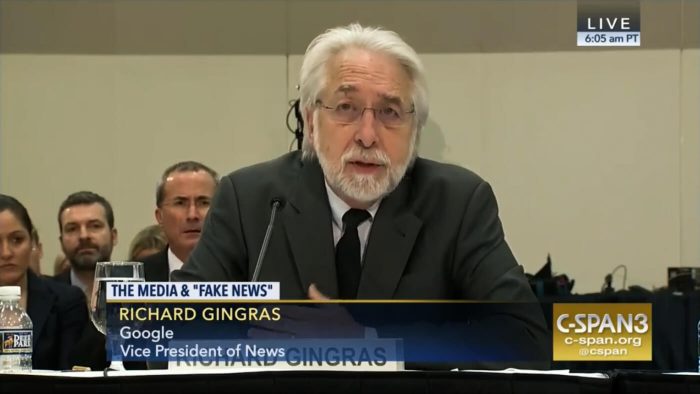
Google VP Richard Gingras testifies at a British Committee Hearing on “Fake News”
Newmark, through Craig Newmark Philanthropies, who provided the initial funding for the Trust Project, and has also funded other related initiatives like the News Integrity Initiative at the City University of New York, which shares many of the same financiers as the Trust Project, including Facebook, Omidyar’s Democracy Fund, and the Knight Foundation. The Trust Project is listed as a collaborator of the News Integrity Initiative. Newmark is also very active in several news-related NGOs with similar overlap. For instance, he sits on the board of the Electronic Frontier Foundation (EFF), a longtime recipient of massive grants from the Omidyar Network, and Politifact.com, which is funded in part by Omidyar’s Democracy Fund.
Newmark is currently working with Vivian Schiller as his “strategic adviser” in his media investments. Schiller is a member of the Council on Foreign Relations, former head of news at Twitter, and a veteran of well-known mainstream outlets like NPR, CNN, The New York Times and NBC News. She is also a director of the Scott Trust, which owns The Guardian.
The Markkula Foundation, one of the key funders of the Trust Project, exercises considerable influence over the organization through the Markkula Center for Applied Ethics, which originally incubated the organization and whose News Leadership Council plays an important role at the Trust Project. That council’s membership includes representatives of Facebook, The Wall Street Journal, The Washington Post, Financial Times and Google, and “guides the Trust Project on our Trust Indicators and advises on core issues related to information literacy and rebuilding trust in journalism within a fractious, so-called post-fact environment.”
Both the Markkula Foundation and the Markkula Center for Applied Ethics were founded by A. M. “Mike” Markkula, former CEO of Apple. The Markkula Center’s Journalism Ethics program is currently headed by Subramaniam Vincent, a former software engineer and consultant for Intel and Cisco Systems who has worked to bring together big data with local journalism and is an advocate for the use of “ethical-AI [artificial intelligence] to ingest, sort, and classify news.”
The John S. and James L. Knight Foundation is another interesting funder of the Trust Project, given that this same foundation is also a key investor in Newsguard, the controversial, biased news rating system with deep connections to government insiders and self-described government propagandists. There is considerable overlap between Newsguard and the Trust Project, with the latter citing Newsguard as a partner and also stating that Newsguard’s demonstrably biased ratings use the project’s “trust indicators” in its full-length reviews of news websites, which Newsguard calls “nutrition labels.” In addition, becoming a Trust Project participant is a factor that “supports a positive evaluation” from Newsguard, according to a press release from last year.
Notably, Sally Lehrman, who leads the Trust Project, described the project’s trust indicators for news as ”along the lines of a nutrition label on a package of food” when the Trust Project was created nearly a year before Newsguard launched, suggesting some intellectual overlap.
A previous MintPress exposé revealed Newsguard’s numerous conflicts of interest and a ratings system strongly biased in favor of well-known, traditional media outlets — even when those outlets have a dubious track record of promoting so-called “fake news.” It should come as no surprise that the Trust Project’s goal is to increase public trust in the very same traditional media outlets that Newsguard favored and to use HTML-embedded codes in news articles to promote their content at the expense of independent alternatives.
A familiar face in the war against independent media
The Democracy Fund, another top funder of the Trust Project and a bipartisan foundation that was established by eBay founder and PayPal owner Omidyar in 2011 “out of deep respect for the U.S. Constitution and our nation’s core democratic values.” It is a spin-off of the Omidyar Network and, after splitting off as an independent company in 2014, became a member of the Omidyar Group. The fund’s National Advisory Committee includes former Bush and Obama administration officials and representatives of Facebook, Microsoft, NBC News, ABC News and Gizmodo Media group.
The Democracy Fund’s involvement in the Trust Project is notable because of the other media projects it funds, such as the new media empire of arch-neoconservative Bill Kristol, who has a long history of creating and disseminating falsehoods that have been used to justify the U.S. war in Iraq and other hawkish foreign policy stances. As a recent MintPress series revealed, Omidyar’s Democracy Fund provides financial support to Kristol’s Defending Democracy Together initiative and also supports Kristol’s Alliance for Securing Democracy, a project of the German Marshall Fund think tank that is best known for its cryptic Hamilton68 “Russian bot” dashboard. Omidyar’s Democracy Fund has also donated to the German Marshall Fund’s Defending Digital Democracy project and directly to the German Marshall Fund itself. In addition, Charles Sykes, a co-founder and editor-at-large of Kristol’s new publication The Bulwark, is on the Democracy Fund’s National Advisory Committee.
An acolyte of Kristol’s who works at the German Marshall Fund, Jamie Fly, stated last October that the coordinated social-media purges of independent media pages known for their criticisms of U.S. empire and U.S. police violence was “just the beginning” and hinted that the German Marshall Fund had a hand in past social media purges and, presumably, a role in future purges. Thus, the Democracy Fund’s links to neoconservatives who promote the censoring of independent media sites that are critical of militaristic U.S. foreign policy jibe with the fund’s underlying interest in the Trust Project.
Omidyar’s involvement with the Trust Project is interesting for another reason, namely that Omidyar is the main backer behind the efforts of the controversial Anti-Defamation League (ADL) to become a key driver of which outlets are censored by Silicon Valley tech giants. The ADL was initially founded to “stop the defamation of the Jewish people and to secure justice and fair treatment to all” but critics say that over the years it has begun labeling critics of Israel’s government as “anti-Semites.”
For example, content that characterizes Israeli policies towards Palestinians as “racist” or “apartheid-like” is considered “hate speech” by the ADL, as is accusing Israel of war crimes or attempted ethnic cleansing. The ADL has even described explicitly Jewish organizations that are critical of Israel’s government as being “anti-Semitic.”
In March 2017, the Omidyar Network provided the “critical seed capital” need to launch the ADL’s “new Silicon Valley center aimed at tackling this rising wave of intolerance and to collaborate more closely with technology companies to promote democracy and social justice.” That Omidyar-funded ADL center allowed the ADL to team up with Facebook, Twitter, Google and Microsoft — all of whom also collaborate with the Trust Project — to create a Cyberhate Problem-Solving Lab. Since then, these companies and their subsidiaries, including Google’s YouTube, have relied on the ADL to flag “controversial” content.
Given the fact that the Trust Project shares with the ADL a key funder (Pierre Omidyar) and several external tech partners, it remains to be seen whether there is overlap between how major tech companies like Google and Facebook use the Trust Indicators in its algorithms and the influence of the ADL on those very same algorithms.
Outsourcing censorship
Of course, the most interesting and troubling donors of the Trust Project are Google and Facebook, both of which are using the very project they fund as a “third party” to justify their manipulation of newsfeed and search-engine algorithms. Google’s intimate involvement from the very inception of the Trust Project tags it as an extension of Google that has since been marketed as an “independent” organization tasked with justifying algorithm changes that favor certain news outlets over others.
Facebook, similarly, funds the Trust Project and also employs the “trust indicators” it funds to alter its newsfeed algorithm. Facebook’s other partners in altering this algorithm include the Atlantic Council — funded by the U.S. government, NATO, and weapons manufacturers, among others — and Facebook has also directly teamed up with foreign governments, such as the government of Israel, to suppress accurate yet dissenting information that the government in question wanted removed from the social-media platform.
The murkiness between “private” censorship, censorship by tech oligarchs, and censorship by government is particularly marked in the Trust Project. The private financiers of the Trust Project that also use its product to promote certain news content over others — namely Google and Facebook — have ties to the U.S. government, with Google being a government contractor and Facebook sporting a growing body of former-government officials in top company positions, including a co-author of the controversial Patriot Act as the company’s general counsel.
A similar tangle surrounds Pierre Omidyar, funder of the Trust Project through the Democracy Fund, who is extremely well-connected to the U.S. government, especially the military-industrial complex and intelligence communities. And partnering with media outlets like the Washington Post, whose owner is Jeff Bezos, spawns more conflicts of interests, given that Bezos’ company, Amazon, is also a major U.S. government contractor.
This growing nexus binding Silicon Valley companies and oligarchs, mainstream media outlets and the government suggests that these entities have increasingly similar and complementary interests, among which is the censorship of independent watchdog journalists and news outlets that seek to challenge their power and narratives.
The Trust Project was created as a way of outsourcing censorship of independent news sites while attempting to salvage the tattered reputation of mainstream media outlets and return the U.S. and international media landscape to years past when such outlets were able to dominate the narrative.
While it seems unlikely that’s its initiatives will succeed in restoring trust to mainstream media given the many recent and continuing examples of those same “traditional” media outlets circulating fake news and failing to cover crucial aspects of events, the Trust Project’s development of hidden algorithm-altering codes in participating websites shows that its real goal is not about improving public trust but about providing a facade of independence to Silicon Valley censorship of independent media outlets that speak truth to power.
Whitney Webb is a MintPress News journalist based in Chile. She has contributed to several independent media outlets including Global Research, EcoWatch, the Ron Paul Institute and 21st Century Wire, among others. She has made several radio and television appearances and is the 2019 winner of the Serena Shim Award for Uncompromised Integrity in Journalism.
Election? What Election? EU Elite Will Censor Their Way Out of This Mess (or Die Trying)
By Helen Buyniski | Aletho News | June 7, 2019
The neoliberal establishment is wringing its hands in the wake of European elections that proved a resounding victory for populist parties across the continent, casting around for someone to blame but utterly incapable of realizing their own interference has doomed them. Doubling down on the censorship, they are determined to provoke the catastrophe they need to make free speech history.
The NGO-industrial complex was operating at maximum capacity in the weeks leading up to the election, shutting down hundreds of Facebook pages deemed “fake” or “hate speech” in the hope of controlling the messages reaching voters before they made the terrible mistake of voting for a candidate who represents their interests.
Led by Avaaz, which claims to be a “global citizens’ movement monitoring election freedom and disinformation,” this well-heeled fifth column whipped the press into paranoid frenzies with reports like “Fakewatch,” which breathlessly documented 500 “suspicious” pages and groups it claims are “spreading massive disinformation.” The groups have little in common other than their alleged “link[s] to right-wing and anti-EU organizations,” a capital offense for the promoters of “democracy,” which can only be permitted where it doesn’t stray from the center-left path of most #Resistance.
“Far-right and anti-EU groups are weaponizing social media at scale to spread false and hateful content,” the study warns, gloating that after sharing its findings with Facebook, the platform shut down an “unprecedented” number of pages on the eve of the election (77 out of the 500, according to VentureBeat, which has credulously signal-boosted every utterance of Avaaz as if it is divine truth from the Oracle of Delphi). Avaaz’s reports frame the problem as an affliction of the right wing only, even though disinformation is second nature to political operatives at both ends of the spectrum (and, more importantly, in the sanctified center).
The Computational Propaganda Project, an Oxford-based research group, made no secret of its elitist leanings, declaiming, “On Facebook, while many more users interact with mainstream content overall, individual junk news stories can still hugely outperform even the best, most important, professionally produced stories,” as if users have no choice but to consume “professionally-produced” Oxford-approved material or wallow in junk content. And Facebook’s own statistics bear out the hypothesis that coordinated inauthentic behavior has surged – the site removed almost 3.4 billion “fake” accounts from October 2018 to March 2019, more than the number of actual users.
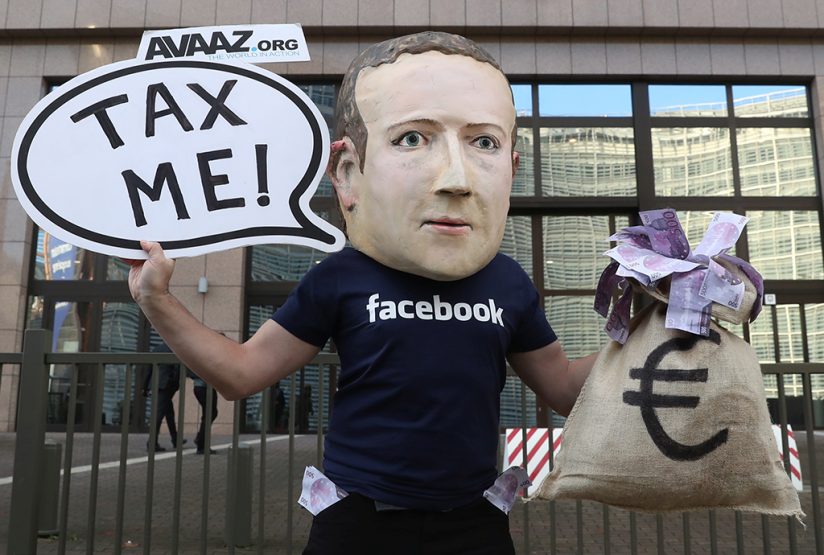
Activist wearing a mask depicting Facebook CEO Mark Zuckerberg demonstrates during the EU finance ministers meeting at EU headquarters in Brussels, Belgium, December 4, 2018. REUTERS/Yves Herman
But Facebook is not simply targeting fake accounts for takedown. Last Sunday, as Europeans prepared to head out to the polls, Facebook froze the largest group used by the Yellow Vests to organize protests and share information, silencing its 350,000+ members at a critical moment in French politics. More than one group member, reduced to commenting on existing posts, pointed out that President Emmanuel Macron met with Facebook chief executive android Mark Zuckerberg three weeks earlier to discuss a first-of-its-kind collaboration in which French government officials are being given access to material censored from users’ newsfeeds, essentially permitting them direct control of what the French are allowed to see on social media. Facebook, then, is providing France with the same techno-fascist services it provides the US government: Facebook will take on the burden of actually censoring dissent, thus skirting any pesky free-speech laws that might otherwise trip up a government that attempted to do the same.
Avaaz focused on the Yellow Vests in its coverage of the French elections, complaining RT France was getting huge quantities of views compared to native French media – perhaps because native French media have been doing Macron’s bidding and attempting to minimize the protests. By framing RT as a perpetrator of “information warfare,” the NGO was making a deliberate effort to have it deplatformed under one of Macron’s controversial police-state laws passed in 2018, by which any outlet spreading so-called “false information” can be gagged for three months leading up to an election. Yet Macron’s own interior minister, Christophe Castaner, lied on Twitter when he claimed the Yellow Vests had attacked the Pitié-Salpêtrière hospital in Paris, and RT was the first outlet to publish the truth about the incident. Who is the disinfo agent?
When the election results came in, Avaaz and its political allies in the neoliberal center could only gape in disbelief. Surely they had wiped La Liga and the Front National (now National Rally) from social media, salting the earth in their wake? How had they won? And what happened in Germany, where Angela Merkel’s CDU performed worse than ever in European election history? Merkel could blame YouTube – 70 influential video stars put out a call to their followers to shun her coalition – but the creators also called for shunning the far-right AfD, so the platform couldn’t be demonized as a tool of the ever-present Nazi Threat. That didn’t stop her party from trying, of course – CDU party leader Annegret Kramp-Karrenbauer complained about online “propaganda” and promised to “tackle this discussion quite aggressively.”
The populist parties won in large part because of the establishment’s unseemly embrace of fascist tactics, from the UK’s totalitarian information warfare disguised as “protecting citizens” or France’s visceral police violence, maiming protesters as if for sport. Europeans voted out of disgust with an establishment so insecure in its control of the narrative that it has sought to annihilate all signs of dissent, dismissing euroskepticism as Russian astroturfing and xenophobia and plugging its ears to the legitimate grievances of its subjects. The National Rally may have beat Macron’s jackbooted thugs, who in the past two months have hauled half a dozen journalists in for questioning by intelligence agencies for publishing stories that embarrassed the regime, but nearly half of French voters refused to vote for anyone at all, according to an Ipsos poll, and Germany’s Greens mopped the floor with Merkel’s coalition among young voters.

The triumph of Nigel Farage’s Brexit party in the UK is the product of a populace wrestling with cognitive dissonance, forced to realize that the “constitutional monarchy” they believed they lived in isn’t so constitutional after all, having jettisoned its democratic mask to cling to the EU under the guise of good old British pragmatism. Even passionate Remainers are happy to see Theresa Maybe go, though it remains to be seen whether her successor will be any more inclined to honor the result of 2016’s referendum. Meanwhile, the Guardian’s embarrassing attempt to shame Farage over a handful of appearances on the Alex Jones show – the paper claimed any reference to “globalists” and “new world order” were dog-whistles for the dreaded “antisemitic conspiracy theories” – proves the establishment media will never regain narrative primacy as long as alternatives exist. Jones, for all his flaws (and they are legion), has a massive audience; the Guardian, despite being propped up by the UK government’s Operation Mockingbird-esque “Integrity Initiative” (and the award for most ironic name ever goes to…), does not.
With the vast American election-fraud apparatus scrambling to prepare itself for 2020, now enabled by Pentagon-funded, Unit-8200-approved Microsoft “election security” software from the makers of the wrongthink-babysitter browser plugin NewsGuard, the US ruling class seems to be poised to make the same mistake as its global peers. Facebook, working hand in hand with the Atlantic Council, has banned and shadowbanned legions of anti-neoliberal activists over the past year, selectively applying (and inventing) new rules in an effort to keep popular content-creators jumping through hoops instead of influencing the discourse. Facebook has been allowed its place of privilege because as a “private corporation” it is legally permitted to violate users’ free speech rights in ways the US government cannot. But if Facebook can’t deliver a victory for the “right guys” this time around, it will be punished. Indeed, a massive anti-trust probe appears to be in the offing, 14 years of Zuckerberg apologies notwithstanding.
The site learned back when it tried to roll out a “disputed” tag for “wrongthink” stories that people were actually more likely to click on those stories; it learned the lesson again when its hugely expensive Facebook Watch news show featuring Anderson Cooper flopped last year. Zuckerberg is on the record begging for government regulation; will Facebook and Twitter use the outcome of this round of elections as a springboard for further crackdowns?
YouTube already has – thousands of creators found their channels demonetized and riddled with takedown notices this week in what has been dubbed the #VoxAdpocalypse after a pathologically whiny Vox blogger became the face of the mass deplatforming, but the censorship appears to be more of a response to Macron’s Orwellian “Christchurch call” to censor “extremism” – that ill-defined conveniently-variable catch-all whose borders are perpetually expanding to engulf all inconvenient speech – aided and abetted by the ADL than Google taking pity on a thin-skinned professional victim.
A sinister coalition of MEPs, “civil society” groups, and the Transatlantic Commission on Election Integrity – a who’s who of war criminals, psychopaths, and oligarchs that includes Michael Chertoff, John “death squad” Negroponte, Victor Pinchuk, and Anders Fogh Rasmussen – has already demanded “parliamentary inquiries into the impact of the use and abuse of technology platforms on democracy and elections.” It’s no coincidence that several of these “election integrity” enthusiasts sit on the board of NewsGuard, which is currently trying to weasel into the EU’s internet regulatory framework by playing up the “disinformation” threat.
The blue-check intelligentsia has been trying for years to convince the hoi polloi that “conspiratorial” thinking is somehow detrimental to democracy. Former Obama labor secretary Robert Reich told Buzzfeed exactly that – “If we become a conspiracy society, we all carry around a degree of paranoia and that’s not healthy for democracy.” But this divorces cause from effect, as if “conspiracy theorists” have formulated their theories out of whole cloth – as if there isn’t evidence for these theories piled knee-deep, as if once-trusted institutions haven’t proven themselves time and again to be as trustworthy as tabloid tales of Elvis risen from the grave. If paranoia is unhealthy for democracy, how is a media incentivized to lie, misdirect and obfuscate any better?
The populist wave has been conflated with an uptick in “hate” in an attempt to delegitimize and demonize it. Outside of groups like the ADL, whose statistics are easily debunked, there is no credible evidence bigotry is on the rise, but as an actual Nazi once said, tell a big enough lie often enough, and it might as well be real. Beginning around 2012, the establishment media began relentlessly flogging the “white privilege” narrative in an effort to fan the flames of interracial conflict. Political science doctoral student Zach Goldberg performed an analysis of several terms using the LexisNexis database and found evidence of heavy narrative manipulation – “whiteness” was mentioned in four times as many news articles in 2017 as in 2012, “white privilege” was mentioned ten times as often in 2017 as in 2012, and “racism” was mentioned ten times as often in the New York Times alone in 2017 as in 2012. Yet even as the media has seemingly talked of nothing else, actual prejudice – by whites against non-whites, at least – has declined since 2008, according to a University of Pennsylvania study published last month, and the FBI’s own statistics show hate crimes against most minority groups are on the decline. Because few European governments separate “hate crimes” from “normal” crime statistics, information on bigotry in Europe often comes solely from NGOs and “civil society” groups that rely for their funding on the perception that Hate is on the march. Populists are capable of prejudice like anyone else, but it is their defining characteristic – a “prejudice” against oligarchy – that motivates the smears churned out by the media.
Protest votes like Trump and Brexit are cries for help from a disenfranchised populace. The European elections boasted the highest turnout in decades, and the ruling class ignores the results at its peril. When the election ritual no longer satisfies a population’s need to feel it is exerting its free will on society, we get public hexings of political figures, people reasoning black magic is more likely to solve their problems than voting. This is the same desperation that leads people like Arnav Gupta to set themselves on fire in front of the White House. Europeans have demonstrated unequivocally that they are sick of unaccountable dictatorship from Brussels, where EC President Jean-Claude Juncker, never one for sympathy with the little guy, sneers at the “populist, nationalists, stupid nationalists” who are “in love with their own countries.” They are sick of being displaced from their homes by a seemingly endless tide of migrants, just as those migrants themselves are displaced from their homes by a seemingly endless tide of American wars. Both groups are victimized by the IMF’s neoliberal austerity policies, epitomized by Juncker, who has done more than perhaps any one person to help Europe’s corporate “citizens” dodge taxes while nickel-and-diming the humans.
Instead of addressing these legitimate grievances, those in power on both sides of the Atlantic tighten the screws on online discourse – out of sight, out of mind. YouTube declares conspiracy theorizing a form of hate speech and plays whack-a-mole with a documentary confirming everyone’s long-standing suspicions that “save-the-migrants” NGOs are cashing in on the desperate human tide. Big Tech promises to work even more closely with Big Brother to crack down on dissident speech, tarring its victims as Nazis while hoping no one will point out such collusion is one of the defining characteristics of fascism.
These measures are guaranteed to further radicalize the discontent. Deleting social media accounts does not delete the people behind them, and France has already proven that starving a protest movement of media attention only makes it angrier. The ruling class may welcome their rage, aiming to use the inevitable outbreak of violence to choke off the last avenues of free expression, but once the guillotines come out, it isn’t the masses’ heads that will be rolling in the streets.
Facebook Jail for truth tellers
By Gilad Atzmon | June 1, 2019
Once a day the Palestinian poet Nahida Izzat is being thrown into the FB Jail for 30 days for telling the truth about Palestine and the crime that has been committed against her people for almost a century. Nahida has never promoted violence or written any type of hate speech. The routine is pretty exhausting. She receives a FB notification about her suspension, she then appeals and after a few hours FB lifts her suspension.
The Palestinian poet is subject to a relentless vilification campaign by both Zionists and Anti Zionist Zionists (AZZ). Yesterday, Nahida was suspended again. This time her crime was posting a clip of a Palestinian man who just lost his home to an Israeli bomb. Nahida provided an English translation of the Gazan victim.
Nahida’s post read:
Do you want to know how people in Gaza feel?
Here it is: “Even if they destroy all our homes,
We are with the Resistance
Even if they kill every single one of us
We are with the Resistance Even if they kill our children
We are with the Resistance”
FB has now rejected Nahida’s appeal on the ridiculous ground that the above “goes against our community standards on hate speech”
Apparently reporting on a war crime committed by Israel and providing a first hand account of the destruction and the anguish inflicted on Palestinian refugees is considered ‘hate speech’ according to the authoritarian social network.
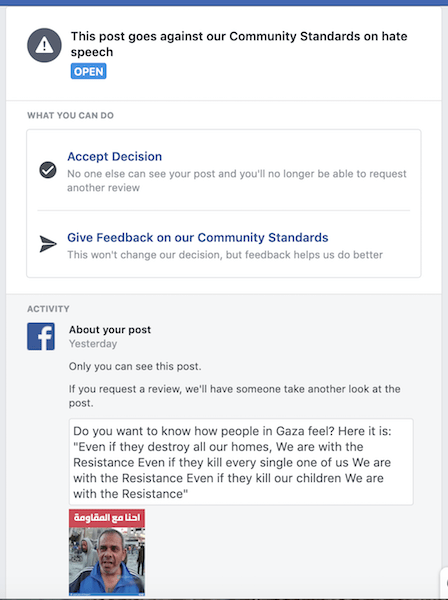
Facebook Removes Page of Ecuador’s Former President on Same Day as Assange’s Arrest
By Elias Marat | The Mind Unleashed | April 11, 2019
Facebook has unpublished the page of Ecuador’s former president, Rafael Correa, the social media giant confirmed on Thursday, claiming that the popular leftist leader violated the company’s security policies.
In a statement republished by Ecuadorean newspaper El Comercio, a company spokesperson said:
“Protecting the privacy and security of people is central to Facebook [and] we have clear policies that do not allow the disclosure of personal information such as phone numbers, addresses, bank account data, cards, or any record or data that could compromise the integrity physical or financial of the people in our community.”
The move comes on the same day that Ecuador’s government allowed British security personnel to enter their embassy in London to arrest journalist and WikiLeaks founder Julian Assange, who has been sought by U.S. officials for years due to his role in releasing scandalous information implicating Washington in a range of crimes, including war crimes.
Goodbye to the Internet: Interference by Governments Is Already Here
By Philip M. GIRALDI | Strategic Culture Foundation | 21.03.2019
There is a saying attributed to the French banker Nathan Rothschild that “Give me control of a nation’s money and I care not who makes its laws.” Conservative opinion in the United States has long suspected that Rothschild was right and there have been frequent calls to audit the Federal Reserve Bank based on the presumption that it has not always acted in support of the actual interests of the American people. That such an assessment is almost certainly correct might be presumed based on the 2008 economic crash in which the government bailed out the banks, which had through their malfeasance caused the disaster, and left individual Americans who had lost everything to face the consequences.
Be that as it may, if there were a modern version of the Rothschild comment it might go something like this: “Give me control of the internet and no one will ever more know what is true.” The internet, which was originally conceived of as a platform for the free interchange of information and opinions, is instead inexorably becoming a managed medium that is increasingly controlled by corporate and government interests. Those interests are in no way answerable to the vast majority of the consumers who actually use the sites in a reasonable and non-threatening fashion to communicate and share different points of view.
The United States Congress started the regulation ball rolling when it summoned the chief executives of the leading social media sites in the wake of the 2016 election. It sought explanations regarding why and how the Russians had allegedly been able to interfere in the election through the use of fraudulent accounts to spread information that might have influenced some voters. In spite of the sound and fury, however, all Congress succeeded in doing was demonstrating that the case against Moscow was flimsy at best while at the same time creating a rationale for an increased role in censoring the internet backed by the threat of government regulation.
Given that background, the recent shootings at a synagogue in Pittsburgh and at mosques in Christchurch New Zealand have inevitably produced strident demands that something must be done about the internet, with the presumption that the media both encouraged and enabled the attacks by the gunmen, demented individuals who were immediately labeled as “white supremacists.” One critic puts it this way, “Let’s be clear, social media is the lifeblood of the far-right. The fact that a terror attack was livestreamed should tell us that this is a unique form for violence made for the digital era. The infrastructure of social media giants is not merely ancillary to the operations of terrorists — it is central to it [and] social media giants assume a huge responsibility to prevent and stop hate speech proliferating on the internet. It’s clear the internet giants cannot manage this alone; we urgently need a renewed conversation on internet regulation… It is time for counter-terrorism specialists to move into the offices of social media giants.”
It’s the wrong thing to do, in part because intelligence and police services already spend a great deal of time monitoring chat on the internet. And the premise that most terrorists who use the social media can be characterized as the enemy du jour “white supremacists” is also patently untrue. Using the national security argument to place knuckle dragging “counter-terrorism specialists” in private sector offices would be the last thing that anyone would reasonably want to do. If one were to turn the internet into a government regulated service it would mean that what comes out at the other end would be something like propaganda intended to make the public think in ways that do not challenge the authority of the bureaucrats and politicians. In the US, it might amount to nothing less than exposure to commentary approved by Mike Pompeo and John Bolton if one wished to learn what is going on in the world.
Currently I and many other internet users appreciate and rely on the alternative media to provide viewpoints that are either suppressed by government or corporate interests or even contrary to prevailing fraudulent news accounts. And the fact is that the internet is already subject to heavy handed censorship by the service providers, which one friend has described as “Soviet era” in its intensity, who are themselves implementing their increasingly disruptive actions to find false personas and to ban as “hate speech” anything that is objected to by influential constituencies.
Blocking information is also already implemented by various countries through a cooperative arrangement whereby governments can ask search engines to remove material. Google actually documents the practice in an annual Transparency Report which reveals that government requests to remove information have increased from less than 1,000 per year in 2010 to nearly 30,000 per year currently. Not surprisingly, Israel and the United States lead the pack when it comes to requests for deletions. Since 2009 the US has asked for 7,964 deletions totaling 109,936 items while Israel has sought 1,436 deletions totally 10,648 items. Roughly two thirds of Israeli and US requests were granted.
And there is more happening behind the scenes. Since 2016, Facebook representatives have also been regularly meeting with the Israeli government to delete Facebook accounts of Palestinians that the Israelis claim constitute “incitement.” Israel had threatened Facebook that non-compliance with Israeli deletion orders would “result in the enactment of laws requiring Facebook to do so, upon pain of being severely fined or even blocked in the country.” Facebook chose compliance and, since that time, Israeli officials have been “publicly boasting about how obedient Facebook is when it comes to Israeli censorship orders.” It should be noted that Facebook postings calling for the murder of Palestinians have not been censored.
And censorship also operates as well at other levels unseen, to include deletion of millions of old postings and videos to change the historical record and rewrite the past. To alter the current narrative, Microsoft, Google, YouTube, Twitter and Facebook all have been pressured to cooperate with pro-Israel private groups in the United States, to include the powerful Anti-Defamation League (ADL). The ADL is working with social media “to engineer new solutions to stop cyberhate” by blocking “hate language,” which includes any criticism of Israel that might be construed as anti-Semitism by the new expanded definition that is being widely promoted by the US Congress and the Trump Administration.
Censorship of information also increasingly operates in the publishing world. With the demise of actual bookstores, most readers buy their books from media online giant Amazon, which had a policy of offering every book in print. On February 19, 2019, it was revealed that Amazon would no longer sell books that it considered too controversial.
Government regulation combined with corporate social media self-censorship means that the user of the service will not know what he or she is missing because it will not be there. And once the freedom to share information without restraint is gone it will never return. On balance, free speech is intrinsically far more important than any satisfaction that might come from government intrusion to make the internet less an enabler of violence. If history teaches us anything, it is that the diminishment of one basic right will rapidly lead to the loss of others and there is no freedom more fundamental than the ability to say or write whatever one chooses, wherever and whenever one seeks to do so.
Featured Video
Chinese jet fuel and the myth of energy independence
or go to
Aletho News Archives – Video-Images
Book Review
Former Insiders Criticize Iran Policy as U.S. Hegemony
By GARETH PORTER | CounterPunch | February 27, 2013
“Going to Tehran” arguably represents the most important work on the subject of U.S.-Iran relations to be published thus far.
Flynt Leverett and Hillary Mann Leverett tackle not only U.S. policy toward Iran but the broader context of Middle East policy with a systematic analytical perspective informed by personal experience, as well as very extensive documentation.
More importantly, however, their exposé required a degree of courage that may be unparalleled in the writing of former U.S. national security officials about issues on which they worked. They have chosen not just to criticise U.S. policy toward Iran but to analyse that policy as a problem of U.S. hegemony. … continue
Blog Roll
 Aletho News
- Chinese jet fuel and the myth of energy independence
- Ukraine Sea Drone Fired From Libya Hit Russian Tanker in Mediterranean
- IRGC: Iranian forces launched no attacks during ceasefire hours
- Trump Administration Moves To Automate U.S. Military Draft Registration
- Spain orders reopening of Tehran embassy, condemns Israel’s carpet bombing of Lebanon
- Israel faces ‘unsustainable’ strategic crisis following 40-day war against Iran: Analyst
- Iran restricts Hormuz access to 15 vessels per day under ceasefire terms: Report
- The ‘Opposition Party’ Has Done Nothing to Stop the Iran War and Much to Goad Trump Into Continuing It
- Moscow backs Tehran on status of Lebanon in US-Iran deal
- How UK Regulator Ofcom Quietly Bypassed International Law to Police American Speech
- If Americans Knew
- Amnesty: Urgent – Protect Lebanese civilians from brutal escalation in Israeli attacks
- Is The War Against Iran Over?
- Inside the Israeli army’s propaganda wing
- Hundreds of Gaza Amputees Stranded in Legal Limbo
- The gallows law: Israel moves toward executing Palestinian children
- Tucker Carlson: The Path to Peace requires ending ‘special alliance’ with Israel
- This is ceasefire? Israel’s biggest massacre yet in Lebanon, another journalist killed in Gaza – Daily Update
- Tucker Carlson on Israel: This Is the Behavior of an Ally? Really?
- Gazans face a triple crisis: severe shortages of water and bread, healthcare in tatters
- NY Times reports how Netanyahu took the US into Iran War
- No Tricks Zone
- An Inconvenient Tree: Uncovered In Alps… Europe Much Warmer Than Today 6000 Years Ago
- New Study Reports A 60% Slowdown In Greenland’s Ice Loss Rate In The Last Decade
- Low Intensity Tornado Wrecks Major Solar Farm, Creating A Potential Toxic Dump
- New Study Finds Warming Saves Lives…Cold Temperatures 12 Times More Deadly Than Excess Heat
- German Science Blog Accuses PIK Climate Institute Of Hallucinating Climate Tipping Points
- Devastating Assessment Of Comirnaty Vaccine By Former Senior Pfizer Europe Toxicologist
- New Study: CO2 Is ‘Effectively Negligible’ As An Explanatory Climate Change Factor Since 2000
- Former Pfizer Toxicologist Dr. Helmut Sterz Tells Bundestag Hearing Pfizer Vaccine Should Have Never Been Approved
- Energy Expert: Germany’s Nuclear Phaseout Was A “500 Billion Euro Mistake”
- New Research: South Australia’s Mid-Holocene Sea Surface Temperatures Were 4°C Warmer Than Today
 Aletho News