Facebook Bans Zero Hedge
By Tyler Durden – Zero Hedge – 03/11/2019
Over the weekend, we were surprised to learn that some readers were prevented by Facebook when attempting to share Zero Hedge articles. Subsequently it emerged that virtually every attempt to share or merely mention an article, including in private messages, would be actively blocked by the world’s largest social network, with the explanation that “the link you tried to visit goes against our community standards.”
We were especially surprised by this action as neither prior to this seemingly arbitrary act of censorship, nor since, were we contacted by Facebook with an explanation of what “community standard” had been violated or what particular filter or article had triggered the blanket rejection of all Zero Hedge content.
To be sure, as a for-profit enterprise with its own unique set of corporate “ethics”, Facebook has every right to impose whatever filters it desires on the media shared on its platform. It is entirely possible that one or more posts was flagged by Facebook’s “triggered” readers who merely alerted a censorship algo which blocked all content.
Alternatively, it is just as possible that Facebook simply decided to no longer allow its users to share our content in retaliation for our extensive coverage of what some have dubbed the platform’s “many problems”, including chronic privacy violations, mass abandonment by younger users, its gross and ongoing misrepresentation of fake users, ironically – in retrospect – its systematic censorship and back door government cooperation (those are just links from the past few weeks).
Unfortunately, as noted above, we still don’t know what event precipitated this censorship, and any attempts to get feedback from the company with the $500 billion market cap, have so far remained unanswered.
We would welcome this opportunity to engage Facebook in a constructive dialog over the company’s decision to impose a blanket ban on Zero Hedge content. Alternatively, we will probably not lose much sleep if that fails to occur: unlike other websites, we are lucky in that only a tiny fraction of our inbound traffic originates at Facebook, with most of our readers arriving here directly without the aid of search engines (Google banned us from its News platform, for reasons still unknown, shortly after the Trump victory) or referrals.
That said, with Facebook increasingly under political, regulatory and market scrutiny for its arbitrary internal decisions on what content to promote and what to snuff, its ever declining user engagement, and its soaring content surveillance costs, such censorship is hardly evidence of the platform’s “openness” to discourse, its advocacy of free speech, or its willingness to listen to and encourage non-mainstream opinions, even if such “discourse” takes place in some fake user “click farm” somewhere in Calcutta.
Government to Facebook Pipeline Reveals a Corrupt Mix of Social Media and the State
By Matt AGORIST | The Free Thought Project | February 2, 2019
As the Free Thought Project has previously reported, the phrase “Facebook is a private company” is not accurate as they have formed a partnership with an insidious neoconservative “think tank” known as the Atlantic Council which is directly funded and made up of groups tied to the pharmaceutical industry, the military industrial complex, and even government itself. The Atlantic Council dictates to Facebook who is allowed on the platform and who is purged.
Because the Atlantic Council is funded in part by the United States government—and they are making decisions for Facebook—this negates the claim that the company is private.
Since our six million followers and years of hard work were wiped off the platform during the October purge, TFTP has consistently reported on the Atlantic Council and their ties to the social media giant. This week, however, we’ve discovered something just as ominous—the government to Facebook pipeline and revolving door.
It is a telltale sign of a corrupt industry or company when they create a revolving door between themselves and the state. Just like Monsanto has former employees on the Supreme Court and Pharmaceutical industry insiders move back and fourth from the FDA to their companies, we found that Facebook is doing the same thing.
Below are just a few of corrupt connections we’ve discovered while digging through the list of current and former employees within Facebook.
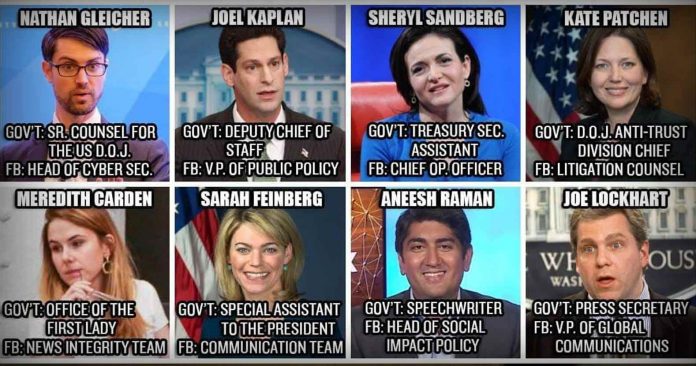
Facebook’s Head of Cybersecurity Policy—aka, the man who doles out the ban hammer to anyone he wishes—is Nathaniel Gleicher. Before Gleicher was censoring people at Facebook, he prosecuted cybercrime at the U.S. Department of Justice, and served as Director for Cybersecurity Policy at the National Security Council (NSC) in the Obama White House.
While Facebook may have an interest in seeking out Gleicher’s expertise, this man is an outspoken advocate of tyranny.
After deleting the pages of hundreds of antiwar and pro-peace media and activist outlets in October, last month, Facebook made another giant move to silence. This time, they had no problem noting that they went after pages whose specific missions were “anti-corruption” or “protest” movements. And it was all headed up by Gleicher.
“Some of the Pages frequently posted about topics like anti-NATO sentiment, protest movements, and anti-corruption,” Gleicher wrote in a blog post. “We are constantly working to detect and stop this type of activity because we don’t want our services to be used to manipulate people.”
Seems totally legit, right?
The list goes on.
In 2017, as the Russian/Trump propaganda ramped up, Facebook hired Joel Benenson, a former top adviser to President Barack Obama and the chief strategist for Hillary Clinton’s failed 2016 presidential campaign, as a consultant.
While filling team Zuck with Obama and Clinton advisers, Facebook hired Aneesh Raman, a former Obama speechwriter who now heads up Facebook’s “economic impact programming.”
Highlighting the revolving door aspect of Facebook and the US government is Sarah Feinberg who left the Obama train in 2011 to join Facebook as the director of corporate and strategic communications. She then moved on after and went back to Obama in 2015 to act as the administrator of the Federal Railroad Administration (FRA).
David Recordon also highlights the revolving door between Facebook and the government. Recordon was the former Director of IT for Obama’s White House. He was also Engineering Director at Facebook prior to his role at the White House, and returned to the position after the 2016 election. He is currently Engineering Director for the Chan-Zuckerberg initiative.
Starting to see a pattern of political influence here? You should. But just in case you don’t, the list goes on.
Meredith Carden—who, you guessed, came from the Obama administration — joined the Facebook clan last year to be a part of Facebook’s “News Integrity Team.” Now, she’s battling fake news on the platform and as we’ve shown, there is a ridiculous amount of selective enforcement of these so-called “standards.”
In fact, there are dozens of former Obama staffers, advisers, and campaign associates who quite literally fill Facebook’s ranks. It is no wonder the platform has taken such a political shift over the past few years. David Ploufe, Josh W. Higgins, Lauryn Ogbechie, Danielle Cwirko-Godycki, Sarah Pollack, Ben Forer, Bonnie Calvin, and Juliane Sun, are just some of the many Facebook execs hailing out of the Obama era White House.
But fret not right wingers, Facebook likes their neocons too.
Jamie Fly, who was a top adviser to neocon Florida Senator Marco Rubio and who started his career in US political circles as an adviser to the George W. Bush administration, actually took credit for the massive purge of peaceful antiwar pages that took place last October.
“They can invent stories that get repeated and spread through different sites. So we are just starting to push back. Just this last week Facebook began starting to take down sites. So this is just the beginning,” Fly said in December.
Fly backs up his words with the fact that he works with Facebook’s arm of the Atlantic Council to ensure those dangerous antiwar folks don’t keep pushing their propaganda of peace and community.
And yes, this list goes on.
Joel David Kaplan is Facebook’s vice president of global public policy. Prior to his major role within Facebook, Kaplan took the place of neocon extraordinaire Karl Rove as the White House Deputy Chief of Staff for George W. Bush. Before that, from 2001 to 2003 he was Special Assistant to the President for Policy within the White House Chief of Staff’s office. Then he served as Deputy Director of the Office of Management And Budget (OMB).
Myriah Jordan was a special policy assistant in the Bush White House, who was hired on as a policy manager for Facebook’s congressional relations team—aka, a lobbyist. Jordan has moved back and forth between the private sector and the US government multiple times over his career as he’s made millions greasing the skids of the state for his corrupt employers.
So there you have it. Facebook, who claims to be a private entity, is quite literally made up of and advised by dozens of members of government. We’re ready for a change, are you?
As voice after voice gets purged from social media, still think there’s no censorship?
By Nebojsa Malic | RT | February 28, 2019
For a civilization that considers freedom of speech one of its fundamental principles and universal human rights, the West sure does a lot of censorship – and no, farming it out to ‘private companies’ does not change what it is.
It happened again on Tuesday: British activist Tommy Robinson was erased from Facebook and Instagram. The social media behemoth said it has to act “when ideas and opinions cross the line and amount to hate speech that may create an environment of intimidation and exclusion for certain groups in society.”
As online polemicists are fond of saying, “citation needed!” Yet Facebook offers none: no evidence of specific violations, not even a definition of “hate speech,” just an arbitrary standard – and a threat of further bans for people who “support… hate figures.” Whatever that means.
How did journalists – those paladins of free speech, the fabled Fourth Estate, the valiant protectors of values that would die in darkness without their intrepid efforts – greet this news? Did they object to a British citizen being muzzled and wax about the dangers to digital democracy? Oh no, they rejoiced: Finally, what took so long?!
The same process repeated itself later in the day, when Twitter banned Jacob Wohl. The self-described supporter of US President Donald Trump had reportedly boasted about setting up fake accounts to influence the 2020 election. That is regarded as the sin-above-all-sins by social media executives, terrified of Congress blaming them for Hillary Clinton losing the White House to Trump in 2016, even though 99 percent of US media considered it rightfully hers.
Here’s the thing, though: Twitter still hasn’t banned Jonathon Morgan, CEO of New Knowledge, a company that was proven to have set up thousands of fake accounts to swing the Senate race in Alabama to the Democrats, and later paid by the Senate to blame Russia for its tactics.
Let’s also remember the suspension of several Facebook pages belonging to Maffick Media, an outfit that partners with Ruptly, a RT subsidiary. After the “Twitter police” at the German Marshall Fund and CNN raised a fuss about these pages having “Kremlin ties,” Facebook blocked them until they agreed to put up a notice about being “funded by Russia.”So they did, even though there is no such rule that would be universally applied.
Surely it is entirely a coincidence that a CNN reporter went around actively badgering social media outlets to ban Alex Jones, way back in August 2018, and would not stop until they all did?
But wait, there is more! It was confirmed on Tuesday that retired Navy SEAL Don Shipley, known as a crusader against “stolen valor,” got his YouTube channel deleted earlier this month. There were no details as to why, but this was right after Shipley had exposed Nathan Phillips – the Native American activist who claimed he was victimized by Kentucky high school students, in what turned out to be fake news – as falsely claiming he served in Vietnam.
Columbia University researcher Richard Hanania offered an interesting analysis a couple of weeks ago, showing that of the 22 prominent figures suspended by Twitter in recent years, 21 were supporters of President Donald Trump, and only one – Rose McGowan – was a Democrat. McGowan had clearly violated the platform’s rule against doxxing, and was reinstated after she deleted the post. Many of those 21 Trump supporters were not so lucky, getting permanent bans from the platform. So he asked:
Are we to believe that while prominent figures on the left encourage uncivil and even violent tactics… their online behaviour is, with the solitary exception of Rose McGowan, universally exemplary?
What are the odds? Astronomical, actually – Hanania showed that conservatives would have to be four times as likely to violate Twitter rules for even a 5 percent chance of producing the 21-1 ratio. Yet those who routinely cite statistical “disparate impact” to cry racism are perfectly fine claiming there is no bias here? Really?
But [insert social media giant here] is a private company! They can do what they want! So cry the sudden champions of capitalism and deregulation, who in their previous breath claimed Trump abolishing Net Neutrality rules would break the internet. Make up your mind, folks!
In the McCarthyite atmosphere whipped up after the 2016 US presidential election, the social media that once promised unprecedented freedom of expression have turned into the tools of censorship – and not on behalf of a governing party, either, but the bipartisan political establishment united in opposition to an outsider president and anyone who dares support him, or criticize their conduct.
By the way, the “terrible dictator” Trump hasn’t lifted a finger to stop this persecution, let alone sic the IRS or the FBI on his critics.
The idea behind free speech is not that all opinions are valid, but that they ought to be debated rather than imposed by force. Another fundamental principle of western civilization is that the law ought to apply equally to everyone.
One does not have to agree with Robinson, Wohl, Shipley, Maffick, Jones – or Trump, for that matter – to realize that a world in which there is one set of rules for “us” and another for “them,” in which it doesn’t matter what is done but Who is doing it to Whom, is not a land of liberty but something quite different.
Facebook’s Purge Of Maffick Media’s Pages Is A Message To Everyone

By Andrew KORYBKO – Oriental Review – 26/02/2019
Facebook imposed double standards to censor popular Russia-connected pages.
The US-based social media platform removed several pages managed by Maffick Media, a company partly owned by RT-subsidiary Ruptly, on the alleged basis that they were misleading their audience about their connections to Russia. The company’s CEO Anissa Naouai suggested that CNN was tipped off about this beforehand by a US government-funded think tank that helped coordinate this infowar operation, decrying what she described as a loophole that allows for state censorship. Facebook, for its part, claims that it’s trying to improve so-called “transparency” on its site by rolling out new standards behind the scenes that have yet to go live or be implemented in full.
In principle and provided that Facebook is telling the truth, the idea is sound enough, though only if it’s universally applied and done so without discriminating against anyone in particular like Maffick Media, which regrettably wasn’t the case in this instance. The US government seems to have been working indirectly through one of its many partially funded think tanks in order to coordinate this infowar operation while retaining so-called “plausible deniability” in the face of Anissa’s censorship claims. The selective enforcement of transparency standards speaks to the fact that the US wants to send an intimidating message to all Alternative Media outlets that they could be next.
That in and of itself is a dystopian thought to countenance, but the larger issue at play is the topic of “cyber sovereignty” and whether non-US-based users – including companies – have any universal rights on American platforms, which they seemingly do not. As disturbing as it may be, there’s practically nothing that anyone can do to ensure the fair and equal application of Facebook’s ever-changing rules (including secret ones that have yet to be publicly announced like the excuse that was used to censor Maffick’s pages), nor any recourse to rely upon whenever this doesn’t happen. Simply put, victims of injustice are literally out of luck.
Thankfully, however, Maffick isn’t just any random company but has created content that generated over 2,5 billion views and had tens of millions of subscribers. Furthermore, Anissa was able to utilize her professional contacts with RT to draw global attention to what happened, thereby putting pressure on Facebook to address the situation unlike how they might have otherwise ignored it had she not been able to successfully do this. No matter what ultimately happens and whether or not Facebook ever impartially imposes new so-called “transparency” standards all across the board including with regards to US government-linked entities, it nevertheless established a dark precedent by censoring Maffick Media.
The post presented is the partial transcript of the CONTEXT COUNTDOWN radio program on Sputnik News, aired on Friday Feb 22, 2019.
Facebook unblocks RT-linked pages but makes them comply with rules ‘no one else’ has to follow
RT | February 25, 2019
Social media giant Facebook has restored several RT-linked pages more than a week after it blocked them without prior notice. The pages were only freed-up after their administrators posted data about their management and funding.
The Facebook pages of InTheNow, Soapbox, Back Then and Waste-Ed – all operated by the Germany-based company Maffick Media, which is 51 percent owned by RT’s video agency Ruptly – were made accessible again as of Monday evening.
All the accounts were previously suspended by Facebook, which issued no warning before taking action against the pages, even though their administration had not violated any of the social media giant’s existing regulations.
The social network then said in a statement that it wants the pages’ administrators to reveal their “ties to Russia” to their audience in the name of greater transparency while still refraining from contacting the accounts’ managers directly. FB’s measure was taken following a CNN report, which accused the pages of concealing their ties to “the Kremlin,” even though their administrators had never actually made a secret of their relations to Ruptly and RT.
Maffick CEO Anissa Naouai said what Facebook had done was “blatant censorship.” She also said she believes that the move was prompted by the pages’ popularity and by their critical stance on several US policies, and the US-backed coup attempt in Venezuela in particular.
Facebook only contacted her on February 20, after staying silent for about five days, Naouai said. The blocking was apparently explained away by reference to a “new policy.”
Later, she also revealed that the social media giant agreed to unblock the pages, but only after their administration updated “our ‘About’ section, in a manner NO other page has been required to do.” The accounts now indeed feature information related to their funding and management, visible under the pages’ logos.
“I guess you could say we are making Facebook history or are the victims of blatant double standards.”
No other pages besides the four RT-linked ones have been forced to comply with the “new policy” so far, Naouai says.
The blocking of the accounts had been slammed by journalists and popular social media commentators. The head of the world’s largest media union, the International Federation of Journalists (IFJ), denounced it as an “act of censorship opposed by the IFJ.”
Journalist Glenn Greenwald, co-founder of The Intercept, also criticized Facebook’s actions as “highly disturbing.” Popular social and political commenter and stand-up comedian Jimmy Dore told RT that the “ultimate goal” of such actions is to “expand the security state’s control over social media.”
Why UK report on ‘digital gangster’ Facebook is a thinly veiled call for censorship
RT | February 18, 2019
A new UK 108-page report on “disinformation and fake news” online strongly reprimands Facebook for its ongoing misuse of personal data — but also casually promotes unprecedented levels of political censorship on social media.
The report, which is the culmination of an 18-month investigation by a UK parliamentary committee, lambastes Facebook over its failure to protect its users’ data and accuses it of deliberate breaches of privacy and anti-competition laws. It offers numerous examples of Facebook sins, including the Cambridge Analytica scandal, which saw the shady firm mine the personal data of 50 million users without permission.
The report also accuses CEO Mark Zuckerberg of showing “contempt” towards the UK parliament for refusing three requests to appear before the committee and admonishes Facebook for behaving like a “digital gangster.”
Grand intentions?
Despite its wide-ranging criticisms, however, it is immediately evident that the overarching goal of the report appears to be to force Facebook to engage in censorship to the benefit of Western governments. It focuses heavily on “malign forces” posting content which is intended to cause “disruption and confusion” online. Lest there be any confusion about the identity of those malign forces, the word “Russian” is used 51 times in the report.
While the authors claim to be interested in ensuring a “plurality of voices” online, they are extremely quick to resort to forms of censorship as a solution to the existence of content that does not adhere to certain approved narratives.
Censorship solution
There have been multiple examples in recent months of Facebook willingly and enthusiastically working in conjunction with US government-funded think tanks to target content critical of the US government, including its temporary removal of the English-language page belonging to Telesur, a Venezuela-based outlet which questions US policy in Latin America.
Facebook’s removal of that page happened weeks after it partnered with the US government-funded Atlantic Council to combat “inauthentic” content online.
The report admits that while it’s impossible to completely rid the internet of this politically inconvenient content, governments must focus on “the enforcement of greater transparency in the digital sphere” so that citizens “know the source” of information.
Facebook’s recent suspension of pages partly owned by RT video agency Ruptly (purportedly due to their failure to prominently disclose its funding) would surely please the UK committee. The problem is, these new transparency rules are being arbitrarily applied to pages publishing content critical of Western governments, while content funded by those governments so far is subject to no such oversight.
Further proving that the (thinly veiled) intent of the report is censorship of foreign (i.e., Russian) media, the report praises a French law which allows the French national broadcasting agency “to suspend television channels controlled by or under the influence of a foreign state” if they disseminate “false” information.
Discredited sources
The British report has some glaring flaws and inconsistencies, including its use of the New Knowledge cybersecurity firm as a credible source of information on Russian influence online, despite the fact that it was recently exposed by the New York Times for faking a Russian disinformation campaign in order to influence a local US election. Nonetheless, the report describes New Knowledge as an “information integrity company.”
It also praises NewsGuard, an app with deep ties to the US government, which applies trust ratings to news websites. As RT has documented before, however, NewsGuard applies its criteria selectively and exhibits clear bias against content critical of US policies. It is also lobbying to have its ratings installed by default on computers in schools and universities around the US — and even to have them installed by default on smartphones.
Ironically, the report criticizes people for giving credence to information which “reinforces their views” while dismissing content which they do not agree with as “fake news.”
Russian influence, or online democracy?
The report also takes a look at the “influence” Russian media may have had on the 2016 Brexit referendum, specifically outlets like RT and Sputnik. In an admission which is unintentionally quite funny, the report states that articles which had the “heaviest anti-EU bias” are the ones that went “most viral” online during the campaign.
Of course, by highlighting the fact that so many people were enthusiastically sharing content critical of the EU, the report inadvertently concedes that anti-EU sentiment was widespread, rather than some kind of evil plot by Russia to “sow discord” in the West.
The report also notes, however, that Culture Secretary Jeremy Wright MP admitted that he has seen no convincing evidence that Russian interference has had any “material impact” on how people choose to vote. Similarly, in the US, little evidence has been presented to suggest that so-called Russian online influence had any impact whatsoever on the outcome of the 2016 election.
Nonetheless, the report suggests that the UK government should launch new investigations into past elections, including the Brexit referendum and the Scottish independence referendum in 2014 to dig for elusive evidence of Russian interference.
Say goodbye to ‘harmful’ content
To ensure that social media companies comply with all its various demands, the report recommends that “a new category of tech company is formulated” which tightens their liabilities and would see those companies assume legal liability for content identified as “harmful.” It also advocates the establishment of a “compulsory Code of Ethics” setting out exactly what constitutes harmful content.
The British government should also “explore the feasibility” of adopting a UK version of the US Foreign Agents and Registration Act (FARA), it says. FARA requires persons acting “as agents of foreign principals in a political or quasi-political capacity” to disclose this information publicly. Ironically, a similar ‘foreign agents’ law in Russia was heavily criticized by Western media and politicians for targeting dissenting voices.
US government-funded outlets like Voice of America (VOA) and Radio Free Europe/Radio Liberty (RFERL) both wrote reports critical of the law, with VOA even suggesting it had “echoes of Stalin-era denunciations” of dissidents. No such outrage emerged from those outlets when RT was forced to register as a “foreign agent” in the US last year.
Finally, the report suggests that companies like Facebook should also be required to finance digital literacy learning as “the fourth pillar of education” alongside reading, writing and math.
If this report is anything to go by, there is no doubt that learning to identify (and ignore) content critical of Western governments would be a major element of such “digital literacy” courses.
Blocked RT-Linked Facebook Accounts Sign of Geopolitical Confrontation
Sputnik – 18.02.2019
Margarita Simonyan, the editor-in-chief of Sputnik and RT, said that Facebook’s suspension of accounts operated by Maffick Media over ties to RT was a sign of “open geopolitical confrontation,” where media platforms are being used as “tools.”
“Obviously, things will be getting only worse. Nobody even tries to believe in any freedom or talk about any freedom. This has already become an open geopolitical confrontation, where media platforms… serve as tools,” Simonyan said.
The editor-in-chief of RT pointed out that Facebook had no complaints about the videos on the suspended pages or their content in general.
“However, since CNN contacted [Facebook] and asked ‘how could you allow these Russians to communicate with our population,’ Facebook removed this account,” Simonyan said.
According to the RT editor-in-chief, CNN acted as “the right hand… of the State Department, NATO and everything linked to that.”
CNN admitted it had been tipped off about Maffick Media’s funding by the Alliance for Securing Democracy, an advocacy group that is part of the German Marshall Fund (GMF) policy research centre. The fund considered an “undesirable organization” under the Russian law, receives some of its funding from the US and German governments, NATO and other organizations. According to CNN, the ASD does not receive financing from the GMF and is supported through private funds and grants, rather than by governments.
Facebook said it would ask the three suspended accounts — Soapbox, Back Then and Waste-Ed — to submit information on their affiliations.
“People connecting with Pages shouldn’t be misled about who’s behind them. Just as we’ve stepped up our enforcement of coordinated inauthentic behaviour and financially motivated spam over the past year, we’ll continue improving so people can get more information about the Pages they follow,” a Facebook spokesperson said in a statement, as quoted by RT.
Moscow considers the blocking of Facebook pages related to RT unacceptable, adding that these authoritarian actions violate the principles of freedom of expression. Moreover, Russia is waiting for a response from “OSCE structures” to these actions, the Russian Foreign Ministry said in a statement.
However, the social network has not, until now, required accounts to disclose information about their parent companies. Maffick remarked in its statement that plenty of media outlets supported in part by governments do not post information about their funding on their Facebook pages.
Last week Facebook suspended pages of projects run by Maffick Media, an independent journalistic group that is partly owned by the Ruptly video agency, which is a subsidiary of RT. Facebook did not give Maffick Media any prior warning. According to Maffick’s statement, the social network was “pressured” into doing this by CNN, which ran a story on Maffick Media and its perceived ties to the Kremlin.
Facebook Shuts Down Private Page of Head of Sputnik Latvia
Sputnik – 14.02.2019
RIGA – Facebook has deleted a private account of Sputnik Latvia editor-in-chief Valentins Rozencovs after it broadcast a pro-Riga mayor rally.
“Facebook has recently opened a 150-member Riga office and is still hiring. It monitors what people in the Baltics post on the social network website. A staffer or someone who aspires to be one must have informed them about the broadcast from my account, causing it to be shut”, he said.
The airing of last Saturday’s massive rally in support of embattled Riga Mayor Nils Usakovs was watched and reposted by thousands of people. The leader of the popular leftist Harmony party survived a no-confidence vote this Monday, called by right-wing opposition over graft claims.
Rozencovs’ account on Facebook was first purged in January when the California-based social networking giant removed over 500 pages and accounts linked to Russia, citing perceived attempts to manipulate people in the Baltics and elsewhere.
Sputnik global editor-in-chief Margarita Simonyan said the fact that Rozencovs’ private page was targeted again after broadcasting a rally in support of Usakovs was no coincidence. The mayor of the Latvian capital is routinely described in Western media as being pro-Kremlin.
Last July, Valentins Rozencovs said that he had been detained in Riga by the security police upon his arrival from Moscow and released almost 12 hours later. He noted that security services questioned him about his work as Sputnik Latvia’s senior editor and the outlet’s work in the country.
Facebook, Twitter delete accounts linked to Iran, Russia, Venezuela with anti-west content
Press TV – February 1, 2019
Facebook and Twitter say they have taken down hundreds of accounts they claim have been part of “coordinated influence operations” from Iran, Russia and Venezuela.
Facebook said it had removed 783 pages, groups, and accounts for “engaging in coordinated inauthentic behavior tied to Iran.”
The accounts, some of which had been active since 2010, had garnered about 2 million followers on Facebook and more than 250,000 followers on Instagram.
The decision came after the Atlantic Council’s Digital Forensic Research Lab said the accounts had been designed to amplify views “in line with Iranian government’s international stances.”
“The pages posted content with strong bias for the government in Tehran and against the ‘West’ and regional neighbors, such as Saudi Arabia and Israel,” the center wrote in a blog post.
Several of the accounts focused on sharing content supporting Palestinians and condemning Israeli crimes in French, English, Spanish and Hebrew, while others were critical of Saudi policies, it said.
Twitter separately announced that it had deleted thousands of “malicious” accounts from Russia, Iran and Venezuela. The accounts had “limited operations” targeting the US midterm elections in November, the company alleged, and the majority were suspended prior to election day.
Back in August 2018, Facebook targeted hundreds of accounts allegedly tied to Iran and Russia under the pretext of fighting what it calls “misinformation” campaigns.
Among the accounts was one belonging to the Quest 4 Truth (Q4T) Iranian media organization, which promotes Islamic values.
A similar move was taken by Google against 39 YouTube channels at the time.
The channels reportedly belonged to the Islamic Republic of Iran Broadcasting (IRIB), which condemned the move as a “coordinated” campaign and a “clear example of censorship” aimed at preventing the dissemination of truth and alternative viewpoints online.
Three months later in October, Facebook deleted 82 more Iranian accounts, claiming that it had detected “coordinated activity” between the accounts earlier in the month.
In September 2018, Iranian Foreign Minister Mohammad Javad Zarif harshly criticized Twitter for blocking the accounts of “real Iranians” but overlooking the “regime change” propaganda spewing out of Washington.
He said the accounts of real Iranians, including TV presenters and students, have been shuttered for allegedly being part of an “influence operation.”
Earlier in January, the detention of Press TV anchor Marzieh Hashemi in the United States raised deep concerns among the world’s media activists and journalists, who launched a social media campaign with the hashtags #FreeMarziehHashemi and #Pray4MarziehHashemi in support of the detained journalist.
Hashemi’s long detention without charge finally ended last Wednesday when she was released from a Washington jail. The newscaster’s ordeal is apparently over but Hashemi is taking a firm stance against the practices of the US judicial system.
Following her release, she said in a filmed statement that public support definitely played a part in her release and vowed to further protest rights violations in the US.
Featured Video
Chinese jet fuel and the myth of energy independence
or go to
Aletho News Archives – Video-Images
Book Review
Former Insiders Criticize Iran Policy as U.S. Hegemony
By GARETH PORTER | CounterPunch | February 27, 2013
“Going to Tehran” arguably represents the most important work on the subject of U.S.-Iran relations to be published thus far.
Flynt Leverett and Hillary Mann Leverett tackle not only U.S. policy toward Iran but the broader context of Middle East policy with a systematic analytical perspective informed by personal experience, as well as very extensive documentation.
More importantly, however, their exposé required a degree of courage that may be unparalleled in the writing of former U.S. national security officials about issues on which they worked. They have chosen not just to criticise U.S. policy toward Iran but to analyse that policy as a problem of U.S. hegemony. … continue
Blog Roll
 Aletho News
- NATO’s Slow Fracture: How Trump’s Iran War Exposed the Instrument of Hegemony
- Chinese jet fuel and the myth of energy independence
- Ukraine Sea Drone Fired From Libya Hit Russian Tanker in Mediterranean
- IRGC: Iranian forces launched no attacks during ceasefire hours
- Trump Administration Moves To Automate U.S. Military Draft Registration
- Spain orders reopening of Tehran embassy, condemns Israel’s carpet bombing of Lebanon
- Israel faces ‘unsustainable’ strategic crisis following 40-day war against Iran: Analyst
- Iran restricts Hormuz access to 15 vessels per day under ceasefire terms: Report
- The ‘Opposition Party’ Has Done Nothing to Stop the Iran War and Much to Goad Trump Into Continuing It
- Moscow backs Tehran on status of Lebanon in US-Iran deal
- If Americans Knew
- Amnesty: Urgent – Protect Lebanese civilians from brutal escalation in Israeli attacks
- Is The War Against Iran Over?
- Inside the Israeli army’s propaganda wing
- Hundreds of Gaza Amputees Stranded in Legal Limbo
- The gallows law: Israel moves toward executing Palestinian children
- Tucker Carlson: The Path to Peace requires ending ‘special alliance’ with Israel
- This is ceasefire? Israel’s biggest massacre yet in Lebanon, another journalist killed in Gaza – Daily Update
- Tucker Carlson on Israel: This Is the Behavior of an Ally? Really?
- Gazans face a triple crisis: severe shortages of water and bread, healthcare in tatters
- NY Times reports how Netanyahu took the US into Iran War
- No Tricks Zone
- An Inconvenient Tree: Uncovered In Alps… Europe Much Warmer Than Today 6000 Years Ago
- New Study Reports A 60% Slowdown In Greenland’s Ice Loss Rate In The Last Decade
- Low Intensity Tornado Wrecks Major Solar Farm, Creating A Potential Toxic Dump
- New Study Finds Warming Saves Lives…Cold Temperatures 12 Times More Deadly Than Excess Heat
- German Science Blog Accuses PIK Climate Institute Of Hallucinating Climate Tipping Points
- Devastating Assessment Of Comirnaty Vaccine By Former Senior Pfizer Europe Toxicologist
- New Study: CO2 Is ‘Effectively Negligible’ As An Explanatory Climate Change Factor Since 2000
- Former Pfizer Toxicologist Dr. Helmut Sterz Tells Bundestag Hearing Pfizer Vaccine Should Have Never Been Approved
- Energy Expert: Germany’s Nuclear Phaseout Was A “500 Billion Euro Mistake”
- New Research: South Australia’s Mid-Holocene Sea Surface Temperatures Were 4°C Warmer Than Today
 Aletho News