American Pravda: The ADL in American Society
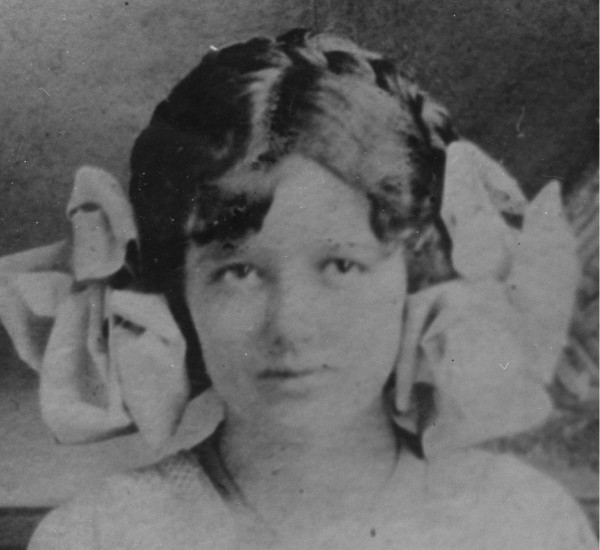
13-year-old Mary Phagan, the girl raped and murdered by Leo Frank, the founding hero of the ADL
By Ron Unz • Unz Review • October 15, 2018
In our modern era, there are surely few organizations that so terrify powerful Americans as the Anti-Defamation League (ADL) of B’nai B’rith, a central organ of the organized Jewish community.
Mel Gibson had long been one of the most popular stars in Hollywood and his 2004 film The Passion of the Christ became among the most profitable in world history, yet the ADL and its allies destroyed his career, and he eventually donated millions of dollars to Jewish groups in desperate hopes of regaining some of his public standing. When the ADL criticized a cartoon that had appeared in one of his newspapers, media titan Rupert Murdoch provided his personal apology to that organization, and the editors of The Economist quickly retracted a different cartoon once it came under ADL fire. Billionaire Tom Perkins, a famed Silicon Valley venture capitalist, was forced to issue a heartfelt apology after coming under ADL criticism for his choice of words in a Wall Street Journal column. These were all proud, powerful individuals, and they must have deeply resented being forced to seek such abject public forgiveness, but they did so nonetheless. The total list of ADL supplicants over the years is a very long one.
Given the fearsome reputation of the ADL and its notorious hair-trigger activists, there was a widespread belief that my small webzine would be completely annihilated when I first launched my recent series of controversial articles in early June by praising the works of historian David Irving, long demonized by the ADL. Yet absolutely nothing happened.
During the next three months my subsequent articles directly challenged nearly every hot-button issue normally so fiercely defended by the ADL and its lackies, so much so that a friendly journalist soon described me as the “Kamikaze from California.” Yet despite my 90,000 words of text and the 13,000 comments I had attracted, the continuing silence of the ADL was absolutely deafening. Meanwhile, my articles were read more than half a million times, with the following being a list of the most provocative pieces:
- The Remarkable Historiography of David Irving
June 4, 2018 • 1,700 Words • 570 Comments - American Pravda: The JFK Assassination, Part II – Who Did It?
June 25, 2018 • 8,000 Words • 985 Comments - American Pravda: Oddities of the Jewish Religion
July 16, 2018 • 7,800 Words • 1,637 Comments - American Pravda: The Bolshevik Revolution and Its Aftermath
July 23, 2018 • 6,900 Words • 913 Comments - American Pravda: The Nature of Anti-Semitism
July 30, 2018 • 5,500 Words • 666 Comments - American Pravda: Jews and Nazis
August 6, 2018 • 6,800 Words • 554 Comments - American Pravda: Holocaust Denial
August 27, 2018 • 17,600 Words • 2,323 Comments - American Pravda: 9/11 Conspiracy Theories
September 10, 2018 • 11,000 Words • 2,355 Comments
When divine wrath fails to smite the heretic and terrifying enforcers of official dogma seem to have suddenly lost their taste for battle, others gradually begin to take notice and may grow emboldened. Eventually leading pro-Russian and Libertarian websites such as Russia Insider and LewRockwell began republishing some of my most controversial American Pravda articles, thus bringing my factual claims to the attention of broader audiences. After the conclusion of the my series, I began directly ridiculing my strangely timorous ADL opponents, publishing a short column entitled “Has the ADL Gone Into Hiding?” which led the redoubtable Paul Craig Roberts to describe me as “the bravest man I know.”
Apparently the combination of all these factors at long last grew too worrisome for the ADL, and stirring from their secret hiding place, its activists have now finally released a short and rather milquetoast response to my material, one which hardly much impresses me. A few days ago, they Tweeted out their column, together with a photo of their new nemesis.
California businessman Ron Unz has long been funding anti-Israel activists. Now, he’s embracing hardcore #antiSemitism, denying the Holocaust & claiming Jews run the media & worship Satan. Learn more from our experts: https://t.co/KnngID3YCh
— ADL (@ADL_National) October 8, 2018
The ADL may boast an annual budget of $60 million and have many hundreds of full-time employees, but its research skills seem sorely lacking. I discovered that they opened their rebuke by denouncing me as a notorious “anti-immigrant activist.” This seems an extremely odd claim given that I have published perhaps a quarter-million words on that contentious topic over the last twenty-five years, nearly all of it online and fully searchable, and my views have never been characterized in that fashion. To cite just one example, my article “California and the End of White America” appeared as a 1999 cover-story in Commentary, the flagship publication of The American Jewish Committee, and surely anyone reading it would be greatly puzzled by the ADL’s description. Indeed, just a few years earlier, I had been a top featured speaker at the October 1994 pro-immigrant protest in downtown Los Angeles, a 70,000 strong political rally that was the largest such gathering in American history to that date.

Over the years, my political activities have been the subject of many thousands of articles in the mainstream media, including a half-dozen front-page stories in the New York Times, and these would provide a similar picture, as did the New Republic cover story chronicling my California successes. Moreover, my views on immigrants haven’t changed all that much over the years as demonstrated by my more recent articles such as “The Myth of Hispanic Crime,” “Immigration, Republicans, and the End of White America” and “A Grand Bargain on Immigration?” Perhaps the intrepid ADL investigators should acquaint themselves with a powerful new technological tool called “Google.”

I was equally unimpressed that they so hotly denounced me for substantially relying upon the writings of Israel Shahak, whom they characterized as viciously “anti-Semitic.” As I had repeatedly emphasized, my own total lack of Aramaic and Hebrew necessarily forces me to rely upon the research of others, and the late Prof. Shahak, an award-winning Israeli academic, certainly seems a fine source to use. After all, famed linguist Noam Chomsky had lauded Shahak’s works for their “outstanding scholarship,” and numerous of our other most prominent public intellectuals such as Christopher Hitchens, Edward Said, and Gore Vidal had been similarly lavish in their praise. Furthermore, one of Shahak’s co-authors was Norton Mezvinsky, a prominent American academic specializing in Middle Eastern history, himself hardly an obscure figure given that both his brother and sister-in-law served in Congress and his nephew later married Chelsea Clinton. And as far as I’m aware almost none of Shahak’s explicit claims about the Talmud or traditional Judaism have ever been directly challenged, while the online availability of his first book allows those so interested to conveniently read it and decide for themselves.

The ADL similarly denounced me for taking seriously the theories of Ariel Toeff, another Israeli academic. But Prof. Toeff, son of the Chief Rabbi of Rome, certainly ranks as one of the world’s leading scholarly authorities on Medieval Jewry, and working together with his graduate students and other colleagues, he had devoted many years of effort to the research study in question, drawing upon extensive primary and secondary sources produced in eight different languages. I found his 500 page book quite persuasive, as did Israeli journalist Israel Shamir, and I have seen no credible rebuttals.
Now the work of all these prominent academics and intellectuals may not necessarily be correct, and perhaps I am mistaken in accepting their factual claims. But I would need to see something far more weighty than a casual dismissal in a few paragraphs contained within an anonymous ADL column, whose author for all I know might have been some ignorant young intern.
Those glaring flaws aside, most of the ADL’s remaining catalogue of my numerous heretical positions seemed reasonably accurate, though obviously presented in a somewhat hostile and derogatory fashion and sorely lacking any links to my original pieces. But even this desultory listing of my mortal transgressions was woefully incomplete, with the ADL strangely failing to include mention of some of my most controversial claims.

For example, the authors excluded all reference to my discussion of the thoroughly documented Nazi-Zionist economic partnership of the 1930s, which played such a crucial role in laying the basis for the State of Israel. And the ADL similarly avoided mentioning the nearly 20,000 words I had allocated to discussing the very considerable evidence that the Israeli Mossad had played a central role in both the JFK Assassination and the 9/11 Attacks. Surely this must be one of the few times that the ADL has deliberately avoided leveling the charge of “conspiracy theorist” against an opponent whom they might have so easily slurred in that fashion. Perhaps they felt the evidence I provided was too strong for them to effectively challenge.
The worrisome incompetence of ADL researchers becomes particularly alarming when we consider that over the last couple of years that organization has been elevated into a content gatekeeping role at America’s largest Internet companies, helping to determine what may or may not be said on the most important Social Media platforms such as Facebook, YouTube, and Twitter.
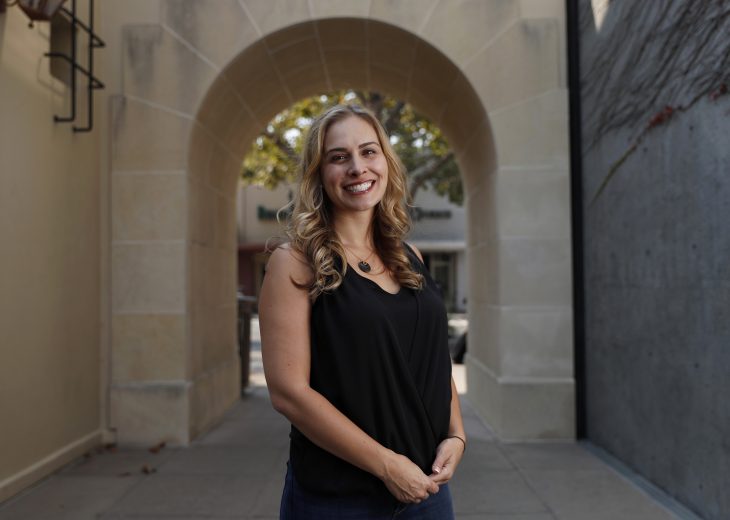
Brittan Heller, director of technology and society for the Anti-Defamation League, photographed in Palo Alto, Calif., on August 27, 2018. (Nhat V. Meyer/Bay Area News Group)
My local paper is the San Jose Mercury News and a couple of weeks ago it published a major profile interview with Brittan Heller, the ADL Director tasked with policing “hate speech” across the America-dominated portions of the Internet. She seemed like a perfectly pleasant young woman in her mid-thirties, a Stanford English major and a graduate of Yale Law, now living in Silicon Valley with her husband and her two cats, Luna and Stella. She emphasizes her own experience as a victim of cyber-harassment from a fellow college student whose romantic overtures she rejected and the later expertise she had gained as a Nazi-hunter for the U.S. government. But does that resume really provide her with the god-like knowledge suitable for overriding our traditional First Amendment rights and determining which views and which individuals should be allowed access to some two billion readers worldwide?
There is also a far more serious aspect to the situation. The choice of the ADL as the primary ideological overseer of America’s Internet may seem natural and appropriate to politically-ignorant Americans, a category that unfortunately includes the technology executives leading the companies involved. But this reflects the remarkable cowardice and dishonesty of the American media from which all these individuals derive their knowledge of our world. The true recent history of the ADL is a remarkably sordid and disreputable tale.
In January 1993, the San Francisco Police Department reported that it had recently raided the Northern California headquarters of the ADL based upon information provided by the FBI. The SFPD discovered that the organization had been keeping intelligence files on more than 600 civic organizations and 10,000 individuals, overwhelmingly of a liberal orientation, with the SFPD inspector estimating that 75% of the material had been illegally obtained, much of it by secret payments to police officials. This was merely the tip of the iceberg in what clearly amounted to the largest domestic spying operation by any private organization in American history, and according to some sources, ADL agents across the country had targeted over 1,000 political, religious, labor, and civil rights organizations, with the New York headquarters of the ADL maintaining active dossiers on more than a million Americans.
Not long afterward, an ACLU official who had previously held a high-ranking position with the ADL revealed in an interview that his organization had been the actual source of the highly controversial 1960s surveillance on Martin Luther King, Jr., which it had then provided to FBI Director J. Edgar Hoover. For many years Hoover had been furiously denounced in the national media headlines for his use of tapes and other secret information on King’s activities, but when a local San Francisco newspaper revealed that an ADL spying operation had actually been the source of all that sordid material, the bombshell revelation was totally ignored in the national media and only reported by fringe organizations, so that today almost no Americans are aware of that fact.
I am not aware of any other private organization in American history that has been involved in even a sliver of such illegal domestic espionage activity, which appears to have been directed against almost all groups and prominent individuals—Left, Right, and Center—suspected of being insufficiently aligned with Jewish and Israeli interests. Some of the illegal material found in ADL possession even raised dark suspicions that it had played a role in domestic terrorist attacks and political assassinations directed against foreign leaders. I am no legal expert, but given the massive scale of such illegal ADL activities, I wonder whether a plausible case might have been made to prosecute the entire organization under RICO statutes and sentence all of its leaders to long prison terms.
Instead, the resulting government charges were quickly settled with merely a trivial fine and a legal slap on the wrist, demonstrating the near-total impunity provided by massive Jewish political power in modern American society.
In effect, the ADL seems to have long operated as our country’s privatized secret political police, monitoring and enforcing its ideological doctrines on behalf of Jewish groups much as the Stasi did for the Communist rulers of East Germany. Given such a long history of criminal activity, allowing the ADL to extend its oversight to our largest Social Media platforms amounts to appointing the Mafia to supervise the FBI and the NSA, or taking a very large step towards implementing George Orwell’s Ministry of Truth on behalf of Jewish interests.
In his 1981 memoirs, the far right Classics scholar Revilo P. Oliver characterized the ADL as “the formidable organization of Jewish cowboys who ride herd on their American cattle” and this seems a reasonably apt description to me.
Although I had long recognized the power and influence of the ADL, a leading Jewish-activist organization whose leaders were so regularly quoted in my newspapers, until rather recently I had only the vaguest notions of its origins. I’m sure I’d heard the story mentioned at some points, but the account had never stuck in my mind.
Then perhaps a year or two ago, I happened to come across some discussion of the ADL’s 2013 centenary celebration, in which the leadership reaffirmed the principles of its 1913 founding. The initial impetus had been the vain national effort to save the life of Leo Frank, a young Jew unjustly accused of murder and eventually lynched. Not long before, Frank’s name and story would have been equally vague in my mind, with the man half-remembered from my introductory history textbooks as a notorious early KKK victim in the fiercely anti-Semitic Deep South of the early twentieth century. However, not long before seeing that piece on the ADL I’d read Albert Lindemann’s highly-regarded study The Jew Accused, and his short chapter on the notorious Frank case had completely exploded all my preconceptions.
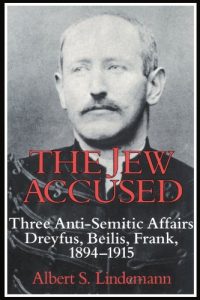
First, Lindemann demonstrated that there was no evidence of any anti-Semitism behind Frank’s arrest and conviction, with Jews constituting a highly-valued element of the affluent Atlanta society of the day, and no references to Frank’s Jewish background, negative or otherwise, appearing in the media prior to the trial. Indeed, five of the Grand Jurors who voted to indict Frank for murder were themselves Jewish, and none of them ever voiced regret over their decision. In general, support for Frank seems to have been strongest among Jews from New York and other distant parts of the country and weakest among the Atlanta Jews with best knowledge of the local situation.
Furthermore, although Lindemann followed the secondary sources he relied upon in declaring that Frank was clearly innocent of the charges of rape and murder, the facts he recounted led me to the opposite conclusion, seeming to suggest strong evidence of Frank’s guilt. When I much more recently read Lindemann’s longer and more comprehensive historical study of anti-Semitism, Esau’s Tears, I noticed that his abbreviated treatment of the Frank case no longer made any claim of innocence, perhaps indicating that the author himself might have also had second thoughts about the weight of the evidence.
Based on this material, I voiced that opinion in my recent article on historical anti-Semitism, but my conclusions were necessarily quite tentative since they relied upon Lindermann’s summary of the information provided in the secondary sources he had used, and I had the impression that virtually all those who had closely investigated the Frank case had concluded that Frank was innocent. But after my piece appeared, someone pointed me to a 2016 book from an unexpected source arguing for Frank’s guilt. Now that I have ordered and read that volume, my understanding of the Frank case and its historical significance has been entirely transformed.
Mainstream publishers may often reject books that too sharply conflict with reigning dogma and sales of such works are unlikely to justify the extensive research required to produce the manuscript. Furthermore, both authors and publishers may face widespread vilification from a hostile media for taking such positions. For these reasons, those who publish such controversial material will often be acting from deep ideological motives rather than merely seeking professional advancement or monetary gain. As an example, it took a zealous Trotskyite leftist such as Lenni Brunner to brave the risk of widespread vilification and invest the time and effort to produce his remarkable study of the crucial Nazi-Zionist partnership of the 1930s. And for similar reasons, we should not be totally surprised that the leading book arguing for the guilt of Leo Frank appeared as a volume in the series on the pernicious aspects of Jewish-Black historical relations produced by Louis Farrakhan’s Nation of Islam (NOI), nor that the text lacked any identified author.
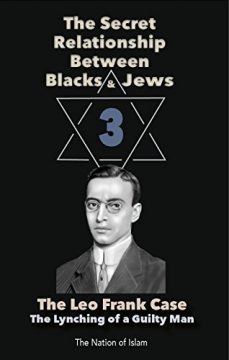
Anonymous works published by heavily-demonized religious-political movements naturally engender considerable caution, but once I began reading the 500 pages of The Leo Frank Case: The Lynching of a Guilty Man I was greatly impressed by the quality of the historical analysis. I think I have only very rarely encountered a research monograph on a controversial historical event that provided such an enormous wealth of carefully-argued analysis backed by such copious evidence. The authors seemed to display complete command of the major secondary literature of the last one hundred years while drawing very heavily upon the primary sources, including court records, personal correspondence, and contemporaneous publications, with the overwhelming majority of the 1200 footnotes referencing newspaper and magazine articles of that era. The case made for Frank’s guilt seemed absolutely overwhelming.
The basic outline of events is not disputed. In 1913 Georgia, a 13-year-old pencil company worker named Mary Phagan was last seen alive visiting the office of factory manager Leo Frank on a Saturday morning to collect her weekly paycheck, while her raped and murdered body was found in the basement early the next morning and Frank eventually arrested for the crime. As the wealthy young president of the Atlanta chapter of B’nai B’rith, Frank ranked as one of the most prominent Jewish men in the South, and great resources were deployed in his legal defense, but after the longest and most expensive trial in state history, he was quickly convicted and sentenced to death.
The facts of the case against Frank eventually became a remarkable tangle of complex and often conflicting evidence and eyewitness testimony, with sworn statements regularly being retracted and then counter-retracted. But the crucial point that the NOI authors emphasize for properly deciphering this confusing situation is the enormous scale of the financial resources that were deployed on Frank’s behalf, both prior to the trial and afterward, with virtually all of the funds coming from Jewish sources. Currency conversions are hardly precise, but relative to the American family incomes of the time, the total expenditures by Frank supporters may have been as high as $25 million in present-day dollars, quite possibly more than any other homicide defense in American history before or after, and an almost unimaginable sum for the impoverished Deep South of that period. Years later, a leading donor privately admitted that much of this money was spent on perjury and similar falsifications, something which is very readily apparent to anyone who closely studies the case. When we consider this vast ocean of pro-Frank funding and the sordid means for which it was often deployed, the details of the case become far less mysterious. There exists a mountain of demonstrably fabricated evidence and false testimony in favor of Frank, and no sign of anything similar on the other side.
The police initially suspected the black night watchman who found the girl’s body, and he was quickly arrested and harshly interrogated. Soon afterward, a bloody shirt was found at his home, and Frank made several statements that seemed to implicate his employee in the crime. At one point, this black suspect may have come close to being summarily lynched by a mob, which would have closed the case. But he stuck to his story of innocence with remarkable composure, in sharp contrast to Frank’s extremely nervous and suspicious behavior, and the police soon shifted their scrutiny toward the latter, culminating in his arrest. All researchers now recognize that the night watchman was entirely innocent, and the material against him planted.
The evidence against Frank steadily mounted. He was the last man known to have seen the young victim and he repeatedly changed important aspects of his story. Numerous former female employees reported his long history of sexually aggressive behavior toward them, especially directed towards the murdered girl herself. At the time of the murder, Frank claimed to have been working alone in his office, but a witness who went there reported he had been nowhere to be found. A vast amount of circumstantial evidence implicated Frank.
A black Frank family servant soon came forward with sworn testimony that Frank had confessed the murder to his wife on the morning after the killing, and this claim seemed supported by the latter’s strange refusal to visit her husband in jail for the first two weeks after the day of his arrest.
Two separate firms of experienced private detectives were hired by Frank’s lavishly-funded partisans, and the agents of both eventually came to the reluctant conclusion that Frank was guilty as charged.
As the investigation moved forward, a major break occurred as a certain Jim Conley, Frank’s black janitor, came forward and confessed to having been Frank’s accomplice in concealing the crime. At the trial he testified that Frank had regularly enlisted him as a lookout during his numerous sexual liaisons with his female employees, and after murdering Phagan, had then offered him a huge sum of money to help remove and hide the body in the basement so that the crime could be pinned upon someone else. But with the legal noose tightening around Frank, Conley had begun to fear that he might be made the new scapegoat, and went to the authorities in order to save his own neck. Despite Conley’s damning accusations, Frank repeatedly refused to confront him in the presence of the police, which was widely seen as further proof of Frank’s guilt.
By the time of the trial itself, all sides were agreed that the murderer was either Frank, the wealthy Jewish businessman, or Conley, the semi-literate black janitor with a first-grade education and a long history of public drunkenness and petty crime. Frank’s lawyers exploited this comparison to the fullest, emphasizing Frank’s Jewish background as evidence for his innocence and indulging in the crudest sort of racial invective against his black accuser, whom they claimed was obviously the true rapist and murderer due to his bestial nature.
Those attorneys were the best that money could buy and the lead counsel was known as the one of the most skilled courtroom interrogators in the South. But although he subjected Conley to a grueling sixteen hours of intense cross-examination over three days, the latter never wavered in the major details of his extremely vivid story, which deeply impressed the local media and the jury. Meanwhile, Frank refused to take the stand at his own trial, thereby avoiding any public cross-examination of his often changing account.
Two notes written in crude black English had been discovered alongside Phagan’s body, and everyone soon agreed that these were written by the murderer in hopes of misdirecting suspicion. So they were either written by a semi-literate black such as Conley or by an educated white attempting to imitate that style, and to my mind, the spelling and choice of words strongly suggests the latter, thereby implicating Frank.
Taking a broader overview, the theory advanced by Frank’s legion of posthumous advocates seems to defy rationality. These journalists and scholars uniformly argue that Conley, a semi-literate black menial, had brutally raped and murdered a young white girl, and the legal authorities soon became aware of this fact, but conspired to set him free by supporting a complex and risky scheme to instead frame an innocent white businessman. Can we really believe that the police officials and prosecutors of a city in the Old South would have violated their oath of office in order to knowingly protect a black rapist and killer from legal punishment and thereby turn him loose upon their city streets, presumably to prey on future young white girls? This implausible reconstruction is particularly bizarre in that nearly all its advocates across the decades have been the staunchest of Jewish liberals, who endlessly condemned the horrific racism of the Southern authorities of that era, but then unaccountably chose to make a special exception in this one particular case.
In many respects, the more important part of the Frank case began after his conviction and death sentence when many of America’s wealthiest and most influential Jewish leaders began mobilizing to save him from the hangman. They soon established the ADL as a new vehicle for that purpose and succeeded in making the Frank murder case one of the most famous in American history to that date.
Although his role was largely concealed at the time, the most important new backer whom Frank attracted was Albert Lasker of Chicago, the unchallenged monarch of American consumer advertising, which constituted the life’s blood of all of our mainstream newspapers and magazines. Not only did he ultimately provide the lion’s share of the funds for Frank’s defense, but he focused his energies upon shaping the media coverage surrounding the case. Given his dominant business influence in that sector, we should not be surprised that a huge wave of unremitting pro-Frank propaganda soon began appearing across the country in both local and national publications, extending to most of America’s most popular and highly-regarded media outlets, with scarcely a single word told on the other side of the story. This even included all of Atlanta’s own leading newspapers, which suddenly reversed their previous positions and became convinced of Frank’s innocence.
Lasker also enlisted other powerful Jewish figures in the Frank cause, including New York Times owner Adolph Ochs, American Jewish Committee president Louis Marshall, and leading Wall Street financier Jacob Schiff. The Times, in particular, began devoting enormous coverage to this previously-obscure Georgia murder case, and many of its articles were widely republished elsewhere. The NOI authors highlight this extraordinary national media attention: “The Black janitor whose testimony became central to Leo Frank’s conviction became the most quoted Black person in American history up to that time. More of his words appeared in print in the New York Times than those of W.E.B. Du Bois, Marcus Garvey, and Booker T. Washington—combined.”
Back a century ago just as today, our media creates our reality, and with Frank’s innocence being proclaimed nationwide in near-unanimous fashion, a long list of prominent public figures were soon persuaded to demand a new trial for the convicted murderer, including Thomas Edison, Henry Ford, and Jane Addams.
Ironically enough, Lasker himself plunged himself into this crusade despite apparently having very mixed personal feelings about man whose cause he was championing. His later biography reveals that upon his first personal meeting with Frank, he perceived him as “a pervert” and a “disgusting” individual, so much so that he even hoped that after he managed to free Frank, the latter would quickly perish in some accident. Furthermore, in his private correspondence he freely admitted that a large fraction of the massive funding that he and numerous other wealthy Jews from across the country were providing had been spent on perjured testimony and there are also strong hints that he explored bribing various judges. Given these facts, Lasker and Frank’s other major backers were clearly guilty of serious felonies, and could have received lengthy prison terms for their illegal conduct.
With the New York Times and the rest of the liberal Northern media now providing such massive coverage of the case, Frank’s defense team was forced to abandon the racially-inflammatory rhetoric aimed at his black accuser which had previously been the centerpiece of their trial strategy. Instead, they began concocting a tale of rampant local anti-Semitism, previously unnoticed by all observers, and adopted it as a major grounds for their appeal of the verdict.
The unprincipled legal methods pursued by Frank’s backers is illustrated by a single example. Georgia law normally required that a defendant be present in court to hear the reading of the verdict, but given the popular emotions in the case, the judge suggested that this provision be waived, and the prosecution assented only if the defense lawyers promised not to use this small irregularity as grounds for appeal. But after Frank was convicted, AJC President Marshall and his other backers orchestrated numerous unsuccessful state and federal appeals on exactly this minor technicality, merely hiring other lawyers to file the motion.
For almost two years, the nearly limitless funds deployed by Frank’s supporters covered the costs of thirteen separate appeals on the state and federal levels, including to the U.S. Supreme Court, while the national media was used to endlessly vilify Georgia’s system of justice in the harshest possible terms. Naturally, this soon generated a local reaction, and during this period outraged Georgians began denouncing the wealthy Jews who were spending such enormous sums to subvert their local criminal justice system.
One of the very few journalists willing to oppose Frank’s position was Georgia publisher Tom Watson, a populist firebrand, and in one of his editorials he reasonably declared “We cannot have… one law for the Jew, and another for the Gentile” while he also lamented that “It is a bad state of affairs when the idea gets abroad that the law is too weak to punish a man who has plenty of money.” A former Georgia governor indignantly inquired “Are we to understand that anybody except a Jew can be punished for a crime.” The clear facts indicate that there was indeed a massive miscarriage of justice in Frank’s case, but virtually all of it occurred in Frank’s favor.
All appeals were ultimately rejected and Frank’s execution date for the rape and murder of the young girl finally drew near. But just days before he was scheduled to leave office, Georgia’s outgoing governor commuted Frank’s sentence, provoking an enormous storm of popular protest, especially since he was the legal partner of Frank’s chief defense lawyer, an obvious conflict of interest. Given the enormous funds that Frank’s national supporters had been deploying on his behalf and the widespread past admissions of bribery in the case, there are obviously dark suspicions about what had prompted such a remarkably unpopular decision, which soon forced the former governor to exile himself from the state. A few weeks later, a group of Georgia citizens stormed Frank’s prison farm, abducting and hanging him, with Frank becoming the first and only Jew lynched in American history.
Naturally, Frank’s killing was roundly denounced in the national media that had long promoted his cause. But even in those quarters, there may have been a significant difference between public and private sentiments. No newspaper in country had more strongly championed Frank’s innocence than the New York Times of Adolph Ochs. Yet according to the personal diary of one of the Times editors, Ochs privately despised Frank, and perhaps even greeted his lynching with a sense of relief. No effort was ever made by any of Frank’s wealthy supporters to bring any of the lynching party to justice.
Although I have now come to regard the NOI volume as the most persuasive and definitive text on the Frank case, I naturally considered conflicting works before coming to this conclusion.
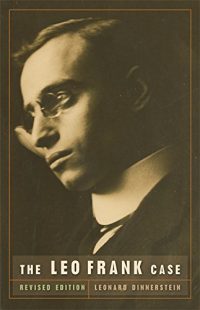
For nearly a half-century, the leading scholarly account of the incident had probably been Leonard Dinnerstein’s book The Leo Frank Case, first published in 1966, and Dinnerstein, a University of Arizona professor specializing in Jewish history, entirely supported Frank’s innocence. But although the work won a national award, carries glowing blurbs from several prestigious publications, and has surely graced the reading lists of endless college courses, I was not at all impressed. Among other things, the book appears to be the original source of some of the most lurid examples of alleged anti-Semitic public outbursts that apparently have no basis in reality and seem to have been simply fabricated by the author given his lack of any citations; the NOI authors note these stories have been quietly abandoned by all recent researchers. Even leaving aside such likely falsifications, which were widely cited by later writers and heavily contaminated the historical record, I found the short Dinnerstein work rather paltry and even pitiful when compared to that of its NOI counterpart.
A far longer and more substantial recent work was Steve Oney’s 2003 And the Dead Shall Rise, which runs nearly 750 pages and won the National Jewish Book Award, the Southern Book Critics Circle Prize, and the American Bar Association’s Silver Gavel, probably establishing itself as today’s canonical text on the historical incident. Oney had been a longtime Atlanta journalist and I was favorably impressed by his narrative skill, along with the numerous fascinating vignettes he provided to illustrate the Southern history of that general era. He also seemed a cautious researcher, drawing heavily upon the primary sources and avoiding much of the falsified history of the last century, while not entirely suppressing the massive evidence of bribery and perjury employed by the Frank forces.
But although Oney does mention much of this information, he strangely fails to connect the dots. For example, although he occasionally mentions some of the funds spent on Frank’s behalf, he never attempts to convert them into present-day equivalents, leaving a naive reader to assume that such trivial amounts could not possibly have been used to pervert the course of justice. Furthermore, his entire book is written in chronological narrative form, with no footnotes provided in the text, and a large portion of the content being entirely extraneous to any attempt to determine Frank’s guilt or innocence, contrasting very sharply with the more scholarly style of the NOI authors.
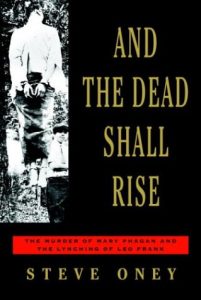
To my mind, a central element of the Frank case was the massive financial temptations being offered by Frank’s Jewish backers, and the huge number of Atlanta citizens, both high and low, who apparently shifted their positions on Frank’s guilt in eager hopes of capturing some of that largess. But although this obvious theme was heavily emphasized in the NOI book, Oney seems to mostly avoid this obvious factor, perhaps even for personal reasons. Print publications have suffered massive cutbacks in recent years and I noticed on the book flap that although Oney is described as a longtime Atlanta journalist, he had subsequently relocated to Los Angeles. Once I checked, I immediately discovered that Oney’s book had became the basis for an independent film entitled The People v. Leo Frank, and I wonder whether his hopes of capturing a sliver of Hollywood’s vast lucre may not have encouraged him to so strongly suggest Frank’s innocence. Would an account of Leo Frank as rapist and murderer ever be likely to reach the silver screen? The quiet influence of financial considerations today is no different today than they were a century ago, and this factor must be taken into account when evaluating historical events.
The NOI authors devote nearly all of their lengthy book to a careful analysis of the Frank case provided in suitably dispassionate form, but a sense of their justifiable outrage does occasionally poke through. In the years prior to Frank’s killing, many thousands of black men throughout the South had been lynched, often based on a slender thread of suspicion, with few of these incidents receiving more than a few sentences of coverage in a local newspaper, and large numbers of whites had also perished in similar circumstances. Meanwhile, Frank had received benefit of the longest trial in modern Southern history, backed by the finest trial lawyers that money could buy, and based on overwhelming evidence had been sentenced to death for the rape and murder of a young girl. But when Frank’s legal verdict was carried out by extra-judicial means, he immediately became the most famous lynching victim in American history, perhaps even attracting more media attention than all those thousands of other cases combined. Jewish money and Jewish media established him as a Jewish martyr who thereby effectively usurped the victimhood of the enormous number of innocent blacks who were killed both before and after him, none of whom were ever even recognized as individuals.
As Prof. Shahak has effectively demonstrated, traditional Talmudic Judaism regarded all non-Jews as being sub-human, with their lives possessing no value. Given that Frank’s backers were all followers of Reform Judaism, it seems quite unlikely that they followed this doctrine or were even aware of its existence. But religious traditions of a thousand years standing can easily become embedded within a culture, and such unrecognized cultural sentiments may have easily shaped their reaction to Frank’s legal predicament.
Influential historical accounts of the Frank case and its aftermath have contained lurid tales of the rampant public anti-Semitism visited upon Atlanta’s Jewish community in the wake of the trial, even claiming that a substantial portion of the population was forced to flee as a consequence. However, a careful examination of the primary source evidence, including the contemporaneous newspaper coverage, provides absolutely no evidence of this, and it appears to be entirely fictional.
The NOI authors note that prior to Frank’s trial American history had been virtually devoid of any evidence of significant anti-Semitism, with the previous most notable incident being the case of an extremely wealthy Jewish financier who was refused service at a fancy resort hotel. But by totally distorting the Frank case and focusing such massive national media coverage on the case, Jewish leaders around the country succeeded in fabricating a powerful ideological narrative despite its lack of reality, perhaps intending it to serve as a bonding experience to foster Jewish community cohesion.
As a further example of the widely promoted but apparently fraudulent history, the Jewish writers who have overwhelmingly dominated accounts of the Frank case have frequently claimed that it sparked the revival of the Ku Klux Klan soon afterward, with the group of citizens responsible for Frank’s 1915 lynching supposedly serving as the inspiration for William Simmons’ reestablishment of that organization a couple of years later. But there seems no evidence for this. Indeed, Simmons strongly emphasized the philo-Semitic nature of his new organization, which attracted considerable Jewish membership.
The primary factor behind the rebirth of the KKK was almost certainly D.W. Griffith’s overwhelmingly popular landmark 1917 film Birth of a Nation, which glorified the Klan of the Reconstruction Era. Given that the American film industry was so overwhelmingly Jewish at the time and the film’s financial backers and leading Southern distributors came from that same background, it could be plausibly argued that the Jewish contribution to the creation of the 1920s Klan was a very crucial one, while the revenue from the film’s distribution throughout the South actually financed Sam Goldwyn’s creation of MGM, Hollywood’s leading studio.
In their introduction, the NOI authors make the fascinating point that the larger historical meaning of the Frank case in American racial history has been entirely lost. Prior to that trial, it was unprecedented for Southern courts to allow black testimony against a white man, let alone against a wealthy man being tried on serious charges; but the horrific nature of the crime and Conley’s role as the sole witness required a break from that longstanding tradition. Thus, the authors argue not unreasonably, that the Frank case may have been as important to the history of black progress in America as such landmark legal verdicts as Plessy vs. Ferguson or Brown vs. Board. But since almost the entire historical narrative has been produced by fervent Jewish advocates, these facts have been completely obscured and the case entirely misrepresented as an example of anti-Semitic persecution and public murder.
Let us now summarize what seems to be the solidly established factual history of the Frank case, quite different than the traditional narrative. There is not the slightest evidence that Frank’s Jewish background was a factor behind his arrest and conviction, nor the death sentence he received. The case set a remarkable precedent in Southern courtroom history with the testimony of a black man playing a central role in a white man’s conviction. From the earliest stages of the murder investigation, Frank and his allies continually attempted to implicate a series of different innocent blacks by planting false evidence and using bribes to solicit perjured testimony, while the exceptionally harsh racial rhetoric that Frank and his attorneys directed towards those blacks was presumably intended to provoke their public lynching. Yet despite all these attempts by the Frank forces to play upon the notorious racial sentiments of the white Southerners of that era, the latter saw through these schemes and Frank was the one sentenced to hang for his rape and murder of that young girl.
Now suppose that all the facts of this famous case were exactly unchanged except that Frank had been a white Gentile. Surely the trial would be ranked as one of the greatest racial turning points in American history, perhaps even overshadowing Brown v. Board because of the extent of popular sentiment, and it would have been given a central place in all our modern textbooks. Meanwhile, Frank, his lawyers, and his heavy financial backers would probably be cast as among the vilest racial villains in all of American history for their repeated attempts to foment the lynching of various innocent blacks so that a wealthy white rapist and murderer could walk free. But because Frank was Jewish rather than Christian, this remarkable history has been completely inverted for over one hundred years by our Jewish-dominated media and historiography.
These are the important consequences that derive from control of the narrative and the flow of information, which allows murderers to be transmuted into martyrs and villains into heroes. The ADL was founded just over a century ago with the central goal of preventing a Jewish rapist and killer from being held legally accountable for his crimes, and over the decades, it eventually metastasized into a secret political police force not entirely dissimilar to the widely despised East German Stasi, but with its central goal seeming to be the maintenance of overwhelming Jewish control in a society that is 98% non-Jewish.
We should ask ourselves whether it is appropriate for an organization with such origins and such recent history to be granted enormous influence over the distribution of information across our Internet.
Pages purged by Facebook were on blacklist promoted by Washington Post
By Andre Damon | WSWS | October 13, 2018
Media outlets removed by Facebook on Thursday, in a massive purge of 800 accounts and pages, had previously been targeted in a blacklist of oppositional sites promoted by the Washington Post in November 2016.
The organizations censored by Facebook include The Anti-Media, with 2.1 million followers, The Free Thought Project, with 3.1 million followers, and Counter Current News, with 500,000 followers. All three of these groups had been on the blacklist.
In November 2016, the Washington Post published a puff-piece on a shadowy and up to then largely unknown organization called PropOrNot, which had compiled a list of organizations it claimed were part of a “sophisticated Russian propaganda campaign.”
The Post said the report “identifies more than 200 websites as routine peddlers of Russian propaganda during the election season, with combined audiences of at least 15 million Americans.”
The publication of the blacklist drew widespread media condemnation, including from journalists Matt Taibbi and Glenn Greenwald, forcing the Post to publish a partial retraction. The newspaper declared that it “does not itself vouch for the validity of PropOrNot’s findings regarding any individual media outlet.”
While the individuals behind PropOrNot have not identified themselves, the Washington Post said the group was a “collection of researchers with foreign policy, military and technology backgrounds.”
PropOrNot, which remains active on Twitter, publicly gloated about Facebook’s removal of the pages on Thursday. “Russian propaganda is VERY VERY MAD about their various front outlets & fellow travellers getting suspended by @Facebook &/or @Twitter,” it wrote. The tweet tagged The Anti Media and The Free Thought Project, and included a Russian flag emoji next to an emoji depicting feces.
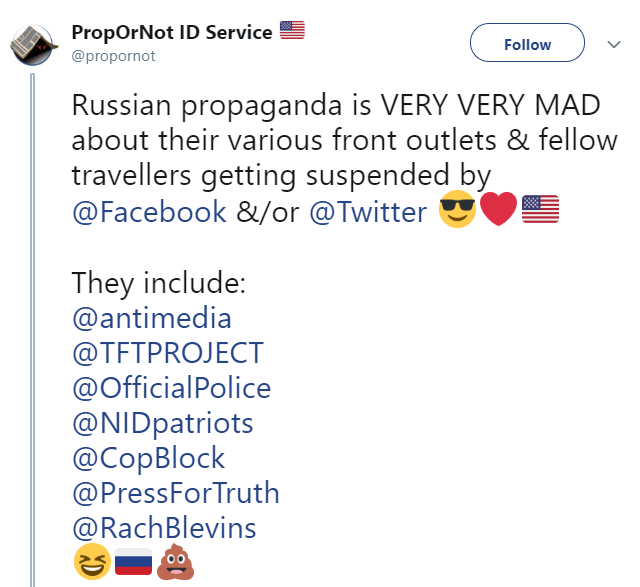
PropOrNot did not attempt to reconcile its own narrative that the targeted organizations were front groups for the Kremlin with Facebook’s official claim that they operated independently of any government but sought to “stir up political debate” for financial motives. This is because both accusations are hollow pretexts for political censorship.
In a separate post, PropOrNot added: “Well, look at that… @Facebook removed some of the most important gray/black Russian propaganda outlets from their platform! Bravo @Facebook – better late than never, so a BIG thank you for this.”
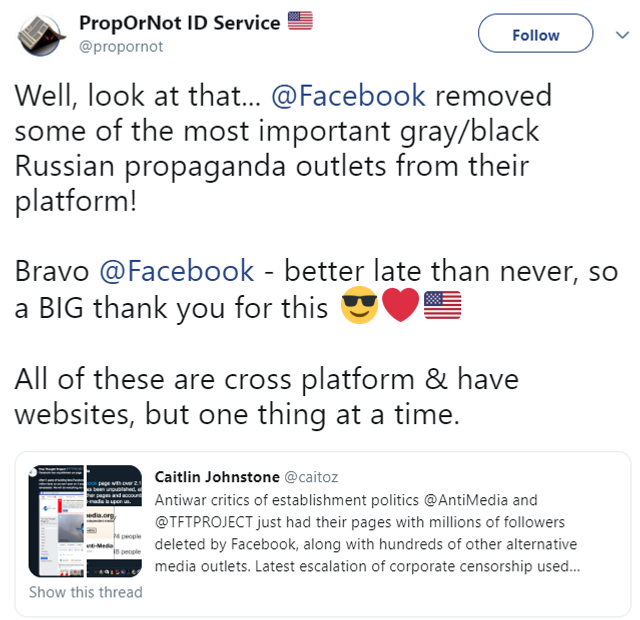
It added, ominously: “All of these [organizations] are cross platform & have websites, but one thing at a time.”
These comments by PropOrNot make clear where the censorship measures supervised by the US government and implemented by the internet companies are going. While these organizations still “have websites,” the authorities are handling “one thing at a time.”
The clear implication is that censorship will not end with Google’s manipulation of its search platform or the removal of accounts by Facebook and Twitter. The ultimate aim is the total banning of oppositional news web sites.
The publication of the PropOrNot blacklist and its promotion by the Washington Post helped trigger a wave of censorship measures against oppositional news sites by the major technology companies, working at the instigation of the US intelligence agencies and leading politicians.
Last year, the World Socialist Web Site reported that it an other sites, including Global Research, Counterpunch, Consortium News, WikiLeaks and Truthout, saw their search traffic plunge after search giant Google implemented a change to its search ranking algorithm.
In the subsequent period, search traffic to these sites has fallen even further. Search traffic to Counterpunch has fallen by 39 percent, and Consortium News has fallen by 51 percent.
These developments confirm the analysis made by the World Socialist Web Site in its open letter to Google alleging that it was censoring left-wing, anti-war and socialist websites.
“Censorship on this scale is political blacklisting,” the letter declared. “The obvious intent of Google’s censorship algorithm is to block news that your company does not want reported and to suppress opinions with which you do not agree. Political blacklisting is not a legitimate exercise of whatever may be Google’s prerogatives as a commercial enterprise. It is a gross abuse of monopolistic power. What you are doing is an attack on freedom of speech.”
On Tuesday, Google admitted in an internal document that it and other technology companies had “gradually shifted away from unmediated free speech and towards censorship and moderation.” The document stated that an aim of the censorship was to “increase revenues” under conditions of growing government and commercial pressure.
The document acknowledged that such actions constitute a break with the “American tradition that prioritizes free speech for democracy.”
Banned alternative media speak to RT after mass Facebook purge
RT | October 13, 2018
Some 800 anti-establishment accounts and pages have been yanked from Facebook in a sweeping crackdown the social media giant framed as a fight against spammers. RT talked to those who were targeted in the cleansing.
Among the hundreds of pages and accounts Facebook and Twitter took down were those both on the political left and right, ranging from conspiracy theorists and police brutality watchers, to news outlets with non-mainstream angles, While their content could be at times described as controversial, the bulk of the banished pages boasted large followings and outreach.
RT spoke to some of the voices silenced by the Facebook move. Here is what they had to say.
Jason Bassler, The Free Thought Project, 3.1mn followers
The Free Thought Project bills itself as a “hub for free thinking conversations.” Both its Facebook and Twitter accounts were shut down in the pre-midterms purge. Jason Bassler, who co-founded the project in 2013, told RT that what Facebook did is an act of political censorship and has nothing to do with its stated goal to clean up its platform from spam.
“If that was just spam, if that was just irrelevant garbage they wouldn’t be so threatening, they would not ban us, they would not care, we would not have been on their radar.”
By spinning the story as a fight against unworthy news trash, Facebook itself is misleading users with its own version of fake news, he said: “This is nothing more than political censorship and trying to eradicate certain political ideologies.”
Nicholas Bernabe, founder of The Anti-Media, 2.1mn followers
Nicholas Bernabe, blogger and entrepreneur behind the independent news aggregator The Anti-Media, believes that “the most troubling” thing in Facebook’s treatment of media pages is that tech giants are now trying to police cultural dialogue by posing as politically neutral.
“That could actually be perceived as Facebook itself meddling in elections, because we are only a few weeks away from the midterms and they go and target 800 politically-oriented media pages for deletion.”
He added that the majority of the banned pages held “very anti-establishment, very anti-authoritarian views,” that appealed to those whose take on election is very different from what mainstream media has to offer.
Matt Savoy, The Free Thought Project, 3.1mn followers
It is hard to overestimate the implications for those that were swept up in the purge, Matt Savoy of The Free Thought Project said. Many of the affected websites will be out of business and “thousands of people will be out of work.”
“This is like a death blow. Facebook was a source of how we were able to get our links out and drive traffic to the website, and we no longer have it. The few remaining employees that we have, they are going to be gone.”
Journalists did not have any time to prepare for the looming crackdown, Savoy said, and at first the staff thought it was a mere glitch.
Matt Bergman, Punk Rock Libertarians, 190,000 followers
Matt Bergman, who founded the Punk Rock Libertarians in 2010, told RT that his ‘The Daily Liberator’ podcast was taken down from Facebook without any explanation. Bergman’s own account was also briefly suspended, as well as those of other page admins.
The purge is the result of the pressure Congress put on Mark Zuckerberg, and its first targets were independent outlets “right of the dial,” since it’s easier to get away with banning relatively small outlets than major channels like RT, he argued.
“Their terms of service agreement is probably a million words long. Nobody has ever read it all the way through and I would think that if they wanted to they can ban CNN, they can ban you guys, if they wanted to, they can ban anybody.”
Bergman said he is filing an appeal in a bid to restore the account.
Dan Dicks, Investigative Journalist, 350,000 followers
Vancouver-based investigative journalist Dan Dicks, who writes for The Press for Truth, said the Facebook crackdown was “clearly political” as it saw tech companies assuming the role of “the gatekeepers of political thought.”
“What we are dealing with here today is the silencing of anybody who goes against the status quo right now, does not matter right or left side of the political spectrum.”
Conspiracy theorist Alex Jones, expunged from Facebook and Twitter, might have been “the first domino to fall,” but now the crackdown has widened to affect smaller outlets that vie for minds of the people on par with mainstream media, he said.
The crackdown on anti-establishment voices will come back to bite Facebook, UK Labour Party activist and political theorist Dr. Richard Barbrook argued.
Facebook and other tech companies who feel compelled to impose more “traditional media censorship” are likely to see a mass exodus from their platforms, he believes.
“The problem is if they are doing it too much, people would be gone somewhere else, where they don’t have network effects working against them,” Barbrook told RT.
Facebook pulls alt-media pages, dismisses as spam ahead of 2018 elections
RT | October 12, 2018
Facebook is again being called out for purging political accounts too far left and right of center, after it removed more than 800 pages just in time for the 2018 midterm elections. Some had millions of followers.
Many of the affected pages were supposedly sharing links between groups using fake accounts, which then clicked “Like” on the posts, artificially upping their engagement numbers. This “inauthentic behavior” violates Facebook’s anti-spam policies and goes against “what people expect” from Facebook, the company said.
While some of the deleted pages have been known to run content of questionable credibility at times, Facebook did not expressly accuse them of spreading “fake news” – or actually provide a list of names or examples of postings at all. However, under the platform’s new policies, simply spreading “news” is frowned upon: it has recently tweaked its algorithm to prevent users’ feeds from being dominated by news stories.
Twitter was in an uproar this afternoon as many voices on the left and right alike saw their pages removed without cause.
On the Left, AntiMedia and the Free Thought Project were among the victims. AntiMedia’s Twitter account was suspended shortly after they posted about their removal from Facebook.
Press For Truth was also dropped.
Right Wing News and Nation In Distress were some of the conservative pages that got the axe. Free Thought Project, AntiMedia, and Nation In Distress had millions of followers each, while many others had hundreds of thousands of followers.
Among those dragged under in the ‘inauthentic behavior’ purge is RT America correspondent Rachel Blevins, who says she took years to build up a following by posting her reports and articles – though RT content is probably not very popular with Facebook staff these days.
In August, the aggressively pro-NATO think tank Atlantic Council announced it was joining Facebook as a “fact-checking” partner. A press statement from the social media platform gushed that the think tank, which boasts such esteemed warmongers as Henry Kissinger and Michael Chertoff on its board, would serve as the “eyes and ears” of Facebook, so the platform could play a “positive role” in ensuring democracy was practiced correctly in the future.
Since the Atlantic Council arrived on the scene to protect Facebook users from themselves, accounts that post anti-establishment political content have noticed a massive drop in engagement on their posts – if they haven’t been kicked off the platform altogether. In August, Facebook deleted 652 accounts after cybersecurity firm FireEye claimed they were linked to Iran.
After it emerged that political research firm Cambridge Analytica had used publicly-available user data to target possible Trump voters, CEO Mark Zuckerberg dismissed the idea that social media manipulation played a significant role in the 2016 US presidential election. Since then, however, the company has been playing catch-up, trying to preempt government regulation by banning and blocking any user who deviates from an increasingly narrow centrism.
Remembering the days when Facebook was all about cat videos and clickbaity headlines, one cannot help but link the sense of social responsibility it’s suddenly developing to how US lawmakers have set their sights on social media platforms. In April, Zuckerberg had to endure House and Senate hearings, taking cringe-worthy questions from politicians who at time seemed to barely know what a social network is and how it works.
Meanwhile, mainstream media fearmongering is already kicking in. The New York Times – an outlet Facebook is unlikely to delist for posting misleading content anytime soon – has cited “experts” to accuse these domestic US pages of “emulating the Russian strategy of 2016” by creating and amplifying clickbait.
Shutting Down Free Speech in America: Government and Lobbyists Work Together to Destroy the First Amendment
By Philip Giraldi | American Herald Tribune | September 24, 2018
During the past several years, there has been increased pressure coming from some in the federal government aided and abetted by powerful advocacy groups in the private sector to police social and alternative media. It is a multi-pronged attack on the First Amendment which has already limited the types of information that Americans have access to, thereby narrowing policy options to suit those in power
The process has been ostensibly driven by concerns over alleged Russian interference in the 2016 election, but it is really about who controls and limits the public’s right to know what is going on out of sight in Washington and New York City, where politics and money come together. If one is interested in the free flow of information and viewpoints that comes with the alternative media, it certainly does not look that way. Robert Parry described it as a deliberate process of “demonizing and silencing dissent that questions mainstream narratives.”
Last October top executives from Facebook, Google and Twitter were summoned to Capitol Hill for a discussion of their role in what is alleged to be Russia’s influence on the presidential campaign and went back home contrite and promising to improve. They have indeed improved by punishing members whose views have been found to be unacceptable, blocking them and suspending their access to the sites. Meanwhile, the federal government for its part has attempted to silence independent non-U.S. based voices by declaring Russian media outlets RT America and Sputnik to be “foreign agents,” requiring them to register under the Foreign Agents Registration Act of 1938 (FARA). It is an unprecedented action against a news agency and invites quid-pro-quo for U.S. media operating overseas, leaving the American public more ignorant of world affairs than it already is.
Qatar based Al-Jazeera, which has been particularly targeted by Jonathan Greenblatt of the Anti-Defamation League (ADL) as “a major exporter of hate against the Jewish people,” will also be required to register with FARA to comply with the new National Defense Authorization Act. Al-Jazeera, it should be noted, has employed undercover investigative journalism to expose the corruption of Britain’s government by Israeli supported Jewish groups. It’s similar series on the activity of Zionist lobbyists in America is on hold due to threats from Jewish organizations to severely punish the network if the documentary should ever be aired.
More recently Facebook has been active in removing accounts and advertising, much of it pro-Palestinian or otherwise critical of Israel, but also to include highly respectable Telesur’s “The Empire Files,” which looked at the consequences of U.S. sanctions on Venezuela. Anything that criticizes the corporate worldview is fair game for censorship. American Herald Tribune, which is critical of U.S. foreign policy in many areas, has recently had its Gmail shut down while Google also stopped servicing ads on its website. Its Facebook page was also closed, all done without any warning or explanation.
One of the organizations most interested in limiting conversations about what is going on in the world is the ADL which claims that it is “the world’s leading organization combating anti-Semitism and hate of all kinds,” though it clearly excludes incitement or even physical harm directed against Palestinian Arabs resentful of the Israeli occupation of their country. Its definition of “hatred” is really quite selective and is focused on anyone criticizing Israel or Jewish related issues. Its goal is to have any such speech or writing categorized as anti-Semitism and, eventually, to have “hate crime” legislation that criminalizes such expressions.
It is particularly ironic that Israel, which has now declared that it is in no way subject to international law, has itself proposed across the board censorship of the most prominent social media platforms on a global scale by creating an “international coalition that would make limiting criticism of Israel its primary objective.” It would operate through a “loose coalition… [that] would keep an eye on content and where it is being posted, and members of the coalition would work to demand that the platforms remove the content… in any of their countries at the request of members.”
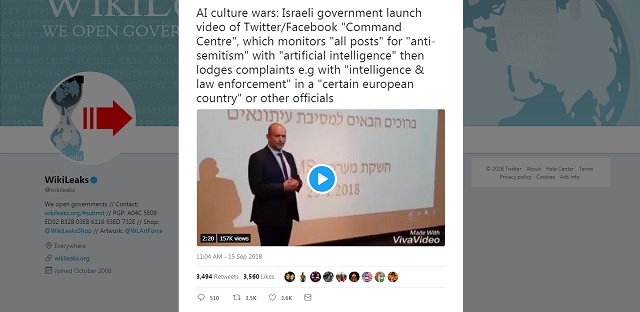
More recently, Israel has been exposed by Wikileaks as hosting a conference describing how it now has a Command Center that uses Artificial Intelligence (AI) to scan the internet worldwide looking for “anti-Semitic” content. For Israel, anti-Semitic content means any criticism of its government or its behavior towards the Arabs. It reportedly pulls 200,000 posts a day and then reviews them using AI for content considered to be unacceptable. The roughly 10,000 posts determined to be anti-Semitic are then passed on to “intelligence and law enforcement agencies” in countries that have hate speech legislation for further action. The Israeli government also complains directly to the social media source to have the material taken down and works through Jewish organizations in cities and countries where there is considerable “anti-Semitic” activity to pressure governments to act even if there is no legal basis.
As most genuine independent journalism is currently limited to the alternative media, and that media lives on the internet, the ADL and those who are acting in collusion with the Israeli government are focusing on “cyberhate” as the problem and are working with major internet providers to voluntarily censor their product. On October 10th, 2017 the ADL issued a press release out of its New York City offices to explain just how far the censorship process has gone. The organization boasted of the fact that it was working with Facebook, Google, Microsoft and Twitter “to engineer new solutions to stop cyberhate.” Apple is not identified by name in the press release but one should presume that it is also involved, as well as YouTube, which is owned by Google. When you consider that the associates in this venture with ADL are vast corporations that control huge slices of the communications industry, the consequences of some kind of corporate decision on what constitutes “hate” become clear. Combatting “cyberhate” will inevitably become across-the-board censorship for viewpoints that are considered to be unacceptable, including any criticism of Israel.
ADL will be the “convener” for the group, providing “insight on how hate and extremist content manifests – and constantly evolves-online.” Which means it will define the problem, which it calls the “spew[ing] of hateful ideologies” so the corporate world can take steps to block such material. And “the initiative will be managed by ADL’s Center for Technology and Society in Silicon Valley.”
Facebook already employs thousands of censors and there is literally no limit to how far those who want to restrict material that they consider offensive will go. To be sure, most groups who want to limit the flow of information do not have the clout or resources of ADL with its $64 million annual operating budget so its “cyberhate” campaign will no doubt serve as a model that others will then follow. For ADL, reducing criticism of Israel is a much-sought-after goal. For the rest of us, it is a trip into darkness.
Facebook teams up with US government to police ‘fake news’ in foreign elections
RT | September 24, 2018
Facebook has teamed up with two US government-funded think tanks as part of a new initiative to bolster the social media giant’s “election integrity efforts” around the globe.
The new partnership with the International Republican Institute (IRI) and the National Democratic Institute (NDI) was revealed by Facebook in a call with reporters last week and reported by Reuters — but the company’s choice of partners has since raised a few eyebrows. Both think-tanks are funded by the US government, through the National Endowment for Democracy (NED).
Tweeting about the initiative, Mark Weisbrot, a co-director at the Center for Economic and Policy Research, called Facebook’s decision to work with the US government-funded organizations “Orwellian” and said that they “specialize in overseas propaganda.” Weisbrot also criticized Reuters reporting of the news which focused on Facebook’s supposed fake-news busting efforts and seemed lacking in “any awareness” of who the two groups were.
During the telephone Q&A with reporters focusing on the upcoming elections in the US and Brazil, Facebook’s Elections and Civic Engagement Samidh Chakrabarti, said that “preventing election interference” on the platform has been “one of the biggest cross-team efforts” the company has seen. But is teaming up with government-funded think tanks really the best way to prevent election interference on Facebook?
Asked by CNBC reporter Salvador Rodriguez to elaborate on the partnership, Katie Harbath, who heads up Facebook’s Global Politics and Government Outreach team, said she wanted to be clear that Facebook’s work with the IRI and NDI is only focused “internationally” and that it has nothing to do with domestic elections in the US. Harbath said the two organizations have “a lot of experience in working in elections and in many countries around the globe” and that Facebook can learn from them about “election integrity risks” that exist in other countries.
That knowledge might prompt a sign of relief from American journalists, but given the US government holds a very real stake in the outcome of many other elections worldwide, it still seems a little odd that Facebook should be using US government-funded organizations to help it decide what constitutes fake news in foreign elections, or to “slow the global spread of misinformation” as Reuters put it.
It’s not the first time Facebook has chosen a dubious partner to help it out in its fight against fake news, either. The social media giant also entered a similar partnership with the Atlantic Council, a think tank funded by the US and other NATO governments, as well as by a slew of US weapons manufacturers.
Shortly after its partnership with the Atlantic Council was revealed, Facebook temporarily deleted the English-language page of the Venezuela-based news outlet Telesur without explanation. Telesur is one of the only English-language media sources providing an alternative view on events in Venezuela.
Facebook has also been criticized for capitulating to demands and threats made by the Israeli government by deleting the accounts of a number of accounts run by Palestinian activists.
Nonetheless, Facebook has said it is setting up a “war room” ahead of major elections in Brazil next month. The war-like rhetoric echoes a Washington Post op-ed by Facbook CEO Mark Zuckerberg last month, in which he said Facebook was in an “arms race” against “bad actors” and that the platform needed to improve its “defenses”.
Amy Studdart, a senior advisor at the IRI, told Reuters that the details of its partnership with Facebook had not been fully worked out, but said the organization would help Facebook employees “understand how their platform is being used on the ground all around the world.”
The NED and its affiliates have been criticized as engines of “regime change” around the world, and one of its founders famously noted in 1991 that “a lot of what we do now was done covertly by the CIA 25 years ago.”
Researcher Takes on Google’s Subversive Electioneering

Sputnik – September 21, 2018
Big tech companies like Google have the power to “shift upwards of 12 million votes with no one knowing they’re doing so,” a research psychologist told Radio Sputnik Thursday, underscoring the influence profit-making firms can have on public elections.
That, he said, is too much power for “just a couple of executives” and is why tech giant monopolies need to be thought of as public utilities and not private entities.
“Research I have been directing in recent years suggests that Google, Inc., has amassed far more power to control elections — indeed, to control a wide variety of opinions and beliefs — than any company in history has ever had,” research psychologist Robert Epstein says.
In 2015, Dr. Robert Epstein, senior research psychologist at the American Institute for Behavioral Research and Technology, wrote a groundbreaking paper about the Search Engine Manipulation Effect (SEME), published in the Proceedings of the National Academy of Sciences of the United States of America.
“Google’s search algorithm can easily shift the voting preferences of undecided voters by 20 percent or more — up to 80 percent in some demographic groups — with virtually no one knowing they are being manipulated,” Epstein wrote in Politico at the time.
That kind of a margin could tilt an election, he noted. Indeed, Epstein’s research shows that Google manipulated search results to display pro-Hillary Clinton results higher on the page than others.
With Google reaching a billion users last year, according to The Verge, and the company collecting over $100 billion a year in revenue, the tech giant has acquired an unheard-of power over how we think and how we access information.
Epstein spoke with Radio Sputnik’s Loud & Clear Thursday about the next phase of his studies: an “electronic cat and mouse game,” a system for collecting, monitoring and analyzing data that can identify and quantify “every single manipulation, every single kind of bias there is,” to hold tech giants accountable.
”I’ve calculated that the big tech companies can shift upwards of 12 million votes with no one knowing they’re doing so without and leaving a paper trail for the authorities to track,” Epstein told Sputnik.
Google claims user activity causes the manipulation, but Epstein said his research found that it affected both red and blue states and that the first 10 results in searches were consistently biased towards Hillary Clinton.
“All reasonable people… will agree that no private company should have the power to decide what content billions of people around the world will see or will not see. Just think about that issue. Whoever that power should be given to, it’s certainly not to a private company in Mountain View, California; it’s just not. We might need entities that are spin offs from the United Nations, we might need nonprofits, nonpartisan groups… we can all agree it can’t be in the hands of a private company. That’s absurd.”
“The search engine itself is an index to what’s on the internet; it’s an index, basically, to all knowledge. Well, the internet doesn’t belong to Google. The internet belongs to the world, and the index to the internet must be public. And by public I don’t just mean public like, USA; it has to be controlled internationally. There has to be transparency; a lot of cooperation is going to be necessary. And I’m not saying it’s going to be easy, but the fact is, that index has to be public — period.”
“In terms of laws or regulations or antitrust actions, there’s some things in motion. There’s lots going on in the EU in that regard; people are gearing up in Washington, DC. Right now there are hearings, there’s talk about antitrust actions — I think some things will happen. I don’t think law or regulation is going to help us very much, because law and regulation moves very slowly. Painfully slowly — sometimes, in fact, it gets stalled, completely stalled. Whereas tech, though, tech moves lightning fast,” Epstein said.
“There is a solution here — in some ways it’s a lighter touch because it doesn’t involve changes in laws and regulations — and that is monitoring. I successfully developed and implemented, deployed a monitoring system in 2016 that was written up in the Washington Post… I’m working now with business partners and with academics on three continents to scale up and broaden what we did in 2016. You have to envision here, probably within the next year, the beginnings of what I call a ‘worldwide ecology of passive monitoring systems.’ That is: systems that can’t be detected, that will show us 24/7 what these big tech companies are showing people or what they’re telling people through these new audio devices.”
“By collecting that data, by monitoring it, by analyzing it rapidly, we will be able to detect, very precisely, when Mark Zuckerberg sends out a targeted ‘go out and vote’ message, for example, that could easily flip an election. We’ll see whether there is bias in search results or search suggestions. We will actually be able to quantify shadowbanning, very precisely, on Twitter and elsewhere. So every single manipulation, every single kind of bias there is, we’ll be able to capture it at the moment. You see, it’s all ephemeral content; it’s transitory. It comes, it goes, it’s gone, it’s not stored anywhere, and then we speculate about what’s going on,” he said.
“Well, with monitoring systems in place, we won’t have to speculate. I believe that these systems will make the big tech companies accountable to the public for the first time. And there’s another advantage here: whereas law and regulation is always behind whatever’s going on, monitoring systems basically are their new technologies. We’re fighting tech with tech, and monitoring systems can keep up with whatever is happening in technology. As technology changes, matures, whatever, the monitoring systems change and mature; they adapt. A cat and mouse game, an electronic cat and mouse game that never stops, maybe goes on for decades.”
Noting how the first companies that provided services such as electrical power, fire departments and roads were initially private but are today thought of as ubiquitous public utilities, Epstein told hosts Walter Smolarek and John Kiriakou that “that’s what happening now with these big tech companies, particularly the search engines, but I would argue we could even put Facebook into that category as well. Once a market is dominated by a monopoly, once the barriers to entry are so large that really no one can get in, and that’s where we are now, and once we become dependent on these services, once they become essential services, which certainly Google’s search engine is, once that happens we have to look at it through a different lens. And that’s happened over and over again in recent history, and I think that’s where we are right now.”
“There is a big difference though,” between older monopolies like Standard Oil and AT&T and internet companies like Google and Facebook, he said. “Those companies were doing things that, for the most part, we could see and we could understand. Whereas what Google and Facebook and Twitter are doing — a lot of what they’re doing we can’t see, we can’t understand. That’s what my discoveries have been about for more than five years. We’re talking about extremely powerful tools for altering people’s thinking.”
“Let’s think about Google for what it really is: a surveillance machine,” he said.
“Let’s think about its real effect, which is the control of thinking and behavior and opinion. Basically it’s the most powerful mind control machine that has ever — ever — been invented in human history.”
“That brings me to the key question: what if the mind control machine doesn’t want you thinking bad things about the mind control machine?”
“This is not AT&T,” he said. “It’s a different beast entirely — and it’s a scary beast.”
Epstein said there wasn’t much recourse in the field of the law. He noted that Google gets sued — a lot — and you can view the catalog of cases brought against the tech giant at Google Crimes, but “when these cases go to court, 99 times out of 100 Google wins, hands down. Because we don’t have laws and regulations that protect us from these companies, and over and over again, the courts rule that these companies are protected, either by [Section 230 of the Communications Decency Act of 1996] or by the First Amendment right to free speech.”
Epstein noted that court rulings repeatedly recognized Google’s right to free speech as a private company. He further pointed out that Google, with “one of the highest profit margins of any country in history,” can simply shrug off any fines leveled against it for its conduct — such as the European Union did earlier this year, when it fined Google $5.1 billion, or last year when it leveled a $2.7 billion fine against it for having biased search results.
Epstein told Radio Sputnik about what he called “a landmark article” by him that will be published in the periodical Fast Company in the next few days, which is presently titled, “How Big Tech Could Quietly Hijack Democracy: A Researcher Describes 10 Ways that the Big Tech Companies Can Shift Millions of Votes in the Midterm Elections Without Anyone Knowing.”
“These are not old-fashioned techniques,” he said, like mudslinging ads or untrue billboards and TV ads. “This is all clandestine, this is all invisible to users and all involves ephemeral content, which means it doesn’t leave a paper trail. And it’s all in the hands of just a couple of executives in the northwest corner of the United States. And it’s affecting not just people here, it’s affecting billions of people around the world… Something is wrong with this system.”
See also:
Google Seeks to Dictate Truth Using Dubious New Technology
Google’s Pro-Clinton Search Bias Reflects US Tech Firms’ Ties to ‘Deep State’
Facebook Turns Into Manipulative Tool of US Intelligence – Moscow
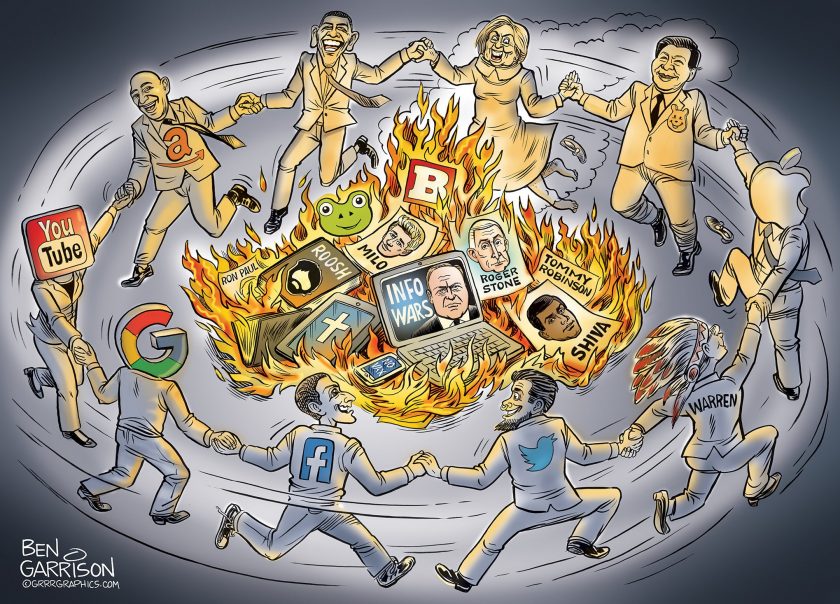
Sputnik – 20.09.2018
ST PETERSBURG – Facebook is transforming into a manipulative tool of the US intelligence services and a lever to influence the domestic policy of other states, Russian Foreign Ministry spokeswoman said.
“Facebook continues to follow the path of stricter censorship… [Facebook], which was presented and has established itself as a means of free communication and exchange of various kinds of content, is now being transformed into an instrument of US intelligence agencies to cleanse the information space of materials that are unwanted by Washington,” Russian Foreign Ministry spokeswoman Maria Zakharova told a briefing on Thursday.
As an example, she named the agreement between Facebook and the Atlantic Council stated to be aimed to help monitor attempts to spread “disinformation” in elections around the world.
She further called the process “a manipulation and a deception” stressing that “the fighters for free democratic elections and the purity of the information space themselves are engaged in interference in affairs of other states and in the dissemination of false information.”
In addition, she said that under the pretext of fighting fake news, Facebook planned to check the personal data of users, as well as audio and video materials.
After the 2016 US presidential election, Facebook said it would take a number of steps to improve transparency, including stricter rules for ad placement, fact-checking photos, videos and links, as well as adding technology to get rid of fake accounts and improve security.
The United States has accused Moscow of meddling in its 2016 presidential election, with Russian authorities denying the accusations as groundless.
Facebook’s Atlantic Council censors are more interested in tanks than thinking
RT | September 13, 2018
Like all foreign policy and military think tanks, the Atlantic Council exists to manufacture consent for the goals of its paymasters. It hit the jackpot when the world’s largest social media network put it in charge of censorship.
While the ubiquitous presence of Atlantic Council lobbyists across the information space already imperilled fair discourse, Facebook’s May move empowered it to endanger freedom of expression. And founder Mark Zuckerberg’s reference to an information “arms race” in a Washington Post op-ed last weekend exposes the grim reality behind the move.
That said, the spin has been impressive. Headlines such as “US think tank’s tiny lab helps Facebook battle fake social media (Reuters )” and “Facebook partners with Atlantic Council to improve election security (The Hill )”.
But the truth is very different. The Atlantic Council is effectively NATO’s propaganda wing. And it’s funded by arms manufacturers, various branches of the US military, and Middle Eastern autocratic regimes, among others, as it promotes the alliance’s agenda – which was best described by its first secretary-general, Hastings Ismay, as “to keep the Russians out, the Americans in, and the Germans down.”
Let’s be clear. If people don’t believe in the “Russian threat,” NATO is essentially rendered useless. Promoting tensions with Europe’s largest country is an existential matter for The Atlantic Council. And now Facebook has effectively placed the lobby group in charge of political censorship on its platform. This presents chilling dangers to free speech and should worry anybody who believes in fairness and balance in the media. Especially after Zuckerberg admitted in the Washington Post piece how his company is being used by US authorities to control information and combat “foreign actors.” The tech boss also boasted that “we’ve worked with law enforcement to take down accounts in Russia.”
Roll of horror
Founded in 1961, with the mission of “encouraging the continuation of cooperation between North America and Europe that began after the Second World War,” the Atlantic Council slowly evolved from being a sort of forum for socialising to a pseudo-academic lobby group. While it professes to be a “think tank,” its lack of genuine debate and tolerance for dissent means in practice this description isn’t accurate in the classical sense of the term, as the Atlantic Council is clearly more interested in creating a market for tanks than thinking.
Funding comes from dozens of foreign governments and also individual vested interests. They include arms makers Lockheed Martin, Raytheon, and Boeing, plus wealthy private backers such as Ukraine’s Viktor Pinchuk and Saudi billionaire Bahaa Hariri. State institutions who plough in funds vary from the National Endowment for Democracy to the British Foreign Office and the US Army itself.
The money is mainly used to hire lobbyists, who are known as “fellows.” And some of them are occasionally outsourced to cutouts like the Digital Forensic Research Lab (DFRLab) – the department which works with Facebook.
Some of the Atlantic Council’s hires have significant media profiles. For instance, Dmitri Alperovitch (of DNC hack fame), Anders Aslund (a radical economist who has predicted Russia’s collapse twice, and been wrong both times), Michael Carpenter (Joe Biden’s, usually misinformed, Russia-baiting sidekick), Borzou Daragahi (Middle East correspondent of Buzzfeed ), Maxim Eristavi (a pro-American Ukrainian activist), Evelyn Farkas (a rabidly anti-Russian Obama adviser), and Michael Weiss (a CNN ‘Russia analyst’ who has never been to Russia and can’t speak Russian). The DFR Lab is comprised of 11, almost uniformly young, tech enthusiasts from the US and Eastern Europe and previously worked to support NATO narratives in Ukraine and Syria.
Some are long-time Atlantic Council bodies, and others are some fresh recruits. The main men are Eliot Higgins, the founder of Bellingcat, which specialises in media-friendly investigations of wars from the perspective which suits British and American interests, Aric Toler (a former private intelligence specialist who spent time in Russia on State Department-funded study programmes) and Ben Nimmo, a one-time NATO press officer.
Other censors include ex-Obama administration and NATO staff, with the managing editor, Graham Brookie, having previously worked at the US National Security Council. There is nobody listed as an employee who could be considered, in any way, neutral on Russia. This betrays the unit’s confidence in how the mainstream media won’t scrutinise them, as normally you’d expect at least one token dissenter.
Different times
In normal circumstances, Facebook’s engagement of the Atlantic Council to decide standards of permissible information would seem bizarre. But, in the current US climate, Zuckerberg’s motivations are quite obvious. Betrayed by the speed with which he engaged the pressure group shortly after his testimony to Congress on “election meddling” was widely derided by the establishment last Spring. And how better to avoid a repeat, and turn down the heat, than to engage the ultimate DC insider institution?
After all, an organisation that has helped to rehabilitate George W. Bush can probably rescue any reputation in the American capital.
Some of the stuff the Atlantic Council itself gets away with serves to show its power over the mainstream media. For instance, when Nimmo himself earlier this year ludicrously insisted grammar mistakes were “proof” that social media users critical of NATO were paid Kremlin trolls, and later when he smeared a British man by labelling him a Russian bot, the popular press didn’t bother to question whether he was a fit and proper person for Facebook to engage as a censor. Even after the victim appeared on Sky News to prove he was a real person. Thus, what should have been a warning of the dangers of DFR Lab was essentially ignored.
At the time, after Nimmo, instead of apologising, wrote “interesting to see the real face of Ian56789, rather than the David Gandy one, at last (referring to his Twitter avatar). Not a troll factory account. Rather, a pro-Kremlin troll(definition based on [sic] use of someone else’s picture, systematic use of Kremlin narratives, and repetitive abusive behaviour),”
WikiLeaks challenged the lobbyist. “You literally produced, with money from weapons companies and dictatorships, a fake news story that spread all over the world, defaming a very British retiree, who wants to reduce arms company profits, as a Kremlin bot,” its editors wrote. “So who’s the paid troll?”
Again, despite WikiLeaks’ prominence, no mainstream outlets connected the dots.
Higgins and Nimmo also focused on attempting to discredit the Twitter user ‘Partisan Girl’ (real name Maram Susli). Susli herself insisted an associate of Higgins had even written to her university accusing of her of plotting to make Sarin gas, and she provided evidence to back up her claims.
Susli was also insulted by Atlantic Council “fellow” Michael Weiss. After a group of pro-Syrian jihadist agitators accused her of having had cosmetic surgery, she responded with a photo of herself as a child to prove them wrong. Weiss interjected by asserting how the young Maram looked like a prostitute, writing “so, your parents raised you as a streetwalker? Honey, no wonder you are pro-Assad.”
Reminder: A bunch of pro regime change people who accused @Partisangirl of having cosmetic surgery. When she responded with a photo of herself as a child proving them wrong, Michael Weiss compared the photo of her as a child to looking like a prostitute. He’s a sick demon. pic.twitter.com/nJ6ekYdQ28
— Eisa Ali (@TheEisaAli) April 22, 2018
The CNN contributor seems to have a habit of commenting on women’s physical attributes. A few months earlier, well-known Lebanese American journalist Rania Khalek accused Weiss of promoting a smear about her appearance on Twitter, falsely claiming she used funds donated to her journalistic work to get a nose job. The fact he has received no blowback, in this ‘MeToo’ era, again speaks volumes.
Deflecting dunces
Meanwhile, Higgins himself has been shy about taking on real experts. In Spring, he refused to debate Theodore Postol, Professor Emeritus of Science, Technology, and International Security at MIT, instead labelling him “an idiot.” Which led to a strange situation where a man with no training in science, whose background is in finance and administration, was smearing a skilled specialist from one of the world’s best universities. Perhaps this is the confidence a man gains by working for NATO’s propaganda adjunct.
His colleague, Weiss, also has a habit of insulting academics with genuine bona fides, running a long campaign of character assassination against Stephen Cohen. Cohen is professor emeritus of Russian studies at Princeton University and New York University.
Of course, to advance the goals of its paymasters, the Atlantic Council also needs to shape the media narrative, and influence journalists, which is presumably why it has engaged the likes of CNN Chief National Security Correspondent Jim Sciutto and Buzzfeed Foreign Editor Miriam Elder to moderate panels, in what amount to very profound conflicts of interests.
Nevertheless, while plenty of its press outreach is smooth, sometimes it can appear clumsy and amateurish. Take this tweet from lobbyist Agnia Grigas, for instance. Firstly, she misrepresents Vladimir Putin’s stated goal of making Russia a top five economy by using raw GDP, where the country currently scores badly due to weak exchange rates. In reality, economic experts regard purchasing power parity as a fairer snapshot of fiscal heft and by this measure, Russia was only $163 billion behind fifth-place Germany last year ($4,007.831 billion v $4,170.790 billion, IMF)so it doesn’t have much catching up to do. What Grigas does next with her disinformation is instructive. Because she tags the Financial Times’ news editor, Peter Spiegel, on the tweet alongside other Atlantic Council lobbyists . Which blurs the lines between supposedly independent media and propaganda, dressed up as scholarship.
Tail wags dog
Anyway, now that you’ve seen the nature of these lobbyists, let’s circle back to the DFR Lab/Facebook link up, and the extraordinary power the social media giant has handed to this gang. Only last month, the same Reuters report quoted at the outset dropped this nugget.
“Facebook is using the group to enhance its investigations of foreign interference. Last week, the company said it took down 32 suspicious pages and accounts that purported to be run by leftists and minority activists. While some U.S. officials said they were likely the work of Russian agents, Facebook said it did not know for sure.”
Read the last line again. “Facebook said it did not know for sure.” But the accounts were removed anyway. Presumably, at the Atlantic Council’s behest.
Here we see the fallout of Mark Zuckerberg’s knee-jerk reaction to pressure from congressional leaders and prominent media talking heads. Instead of asserting his independence, the Facebook founder buckled. And the stakes are impossibly high. Put plainly, this amounts to a merger of the US national security state and Silicon Valley. With implications far beyond American shores.
Read more:
Iranian Bots and the Facebook Stasi: Manufacturing Consent for the Endless War
By Helen Buyniski | Helen of desTroy | September 3, 2018
If at first you don’t succeed, try, try again. The American Empire doesn’t handle failure well, and their repeated failures to oust Syrian president Bashar al-Assad have driven them into a frenzy where good judgment and logic are a thing of the past. Russian military intelligence predicts a false-flag chemical attack in Idlib which will be pinned on the Assad regime and used to justify “retaliation” orders of magnitude greater than April’s Tomahawk tantrum. This time, if the words of the Wicked Witch of the UN are any indication, Iran and Russia will also be blamed. While the US has mostly abandoned hope for regime change in Syria, it will not look a gift horse in the mouth, and is gathering aircraft carriers and bombers to the region while pumping out tear-jerking propaganda about Idlib residents fearing for their lives. If the false flag fails, they can always send those bombers to Iran…
Such an attack is very much on the table, with the groundwork being laid in the pro-war press. John Bolton promised the MEK, a “corrupt, criminal cult” of Iranian exiles which bribed its way off the State Department’s list of terrorist organizations in 2012, regime change by 2019, and the clock is ticking. Attempts to foment a color revolution have failed repeatedly, because Iranians aren’t stupid and remember what happened the last time the US overthrew their government. But Benjamin Netanyahu has been baying for Iranian blood for almost three decades, and Bolton cares little for more clear-headed military personnel’s warnings that invading Iran would be a costly, unwinnable nightmare – Real Men Go To Tehran, as they used to say in the halcyon days of the Axis of Evil.
Prelude to War: Iranian Bots
The ruling class understands Americans are wary of another Middle Eastern war and must be convinced they’re under attack. Hence the new bogeyman, just in time for Election 2018: Iranian Meddling. Twitter, Facebook, and Google took time out from deplatforming anti-establishment commentators to delete over a thousand accounts between them after cyber-security firm FireEye released a report detailing a far-reaching “Suspected Iranian Influence Operation.” With only “moderate confidence,” FireEye pointed to “coordinated inauthentic behavior” geared toward “shaping a message favorable to Iran’s national interests” as the smoking gun. Washed-up former intelligence operatives Ron Hosko and Larry Pfeiffer (ex-FBI and ex-CIA, respectively) smugly added that if we hadn’t let Russia get away with their (still unproven) interference in the 2016 election, Iran would never have been so emboldened as to pour $12,000 of cold, hard cash into this social media offensive in order to portray itself favorably to western audiences.
Facebook, eager to behave, took down 652 offending accounts before the government could even react to the news. FireEye’s report points accusingly to the accounts’ promotion of “anti-Saudi, anti-Israeli, and pro-Palestinian themes, as well as support for specific US policies favorable to Iran,” implying Facebook users should be suspicious of anyone else espousing these views (and warning Iranian and Palestinian sympathizers and other pro-peace activists to shut up, or they’re next). An important step in laying the groundwork for an unpopular war is to “other” and ultimately demonize the enemy, and FireEye’s suggestion that those with pro-Iranian views aren’t even real humans is classic wartime propaganda for the digital age. In addition to three groups of Iranian accounts, FireEye claims it caught some Russians “attempt[ing] to influence politics in Syria and the Ukraine.” This group “was linked to sources that Facebook said the US had linked to Russian military intelligence.” How many hops of truth distortion are too many for even the terminally credulous establishment media?
Perhaps anticipating users’ bewilderment – the offending accounts had broken no laws, were promoting no political candidates, and in many cases had not even bought ads – Zuckerberg explained around a mouth full of jackboot that “These were accounts that were misleading people about who they were and what they were doing. We ban this kind of behavior because authenticity matters. People need to be able to trust the connections they make on Facebook.” Lest users make the mistake of trusting Facebook, however, he added that the company would be “working more closely with law enforcement, security experts and other companies,” turning over more user data than ever in its quest to make privacy obsolete. When law enforcement calls on Facebook to create a backdoor in its Messenger program – thus defeating the purpose of “encrypted chat” – does anyone really expect Zuckerberg to stand fast for privacy rights?

Not to be outdone, Twitter deleted 770 accounts based on the FireEye report, noting that only 100 of these ostensibly Iranian accounts had misrepresented their location and not even all of these had shared “divisive social commentary,” while a single account had purchased $30 in ads. This means over 600 Twitter accounts were deleted for the crime of geography alone (collateral damage?). But Twitter has always gone above and beyond the call of duty, announcing in May that to promote “healthy” conversations it would begin de-ranking users for engaging in “suspicious behavior.” Users who tweeted at many accounts, had multiple complaints against them, or retweeted material tweeted by banned accounts were shadowbanned indefinitely as persona non grata. Since November, Twitter and Facebook have both been turning over information on users who post “divisive” content of the sort promoted by “Russia-linked accounts” to congressional investigators even though a creator of “Russian bot tracker” Hamilton68 admits the accounts his tool tracks are not necessarily bots, or even Russian – “some are legitimately passionate people,” as if passion is an un-American trait.
Last year, the FBI launched a Foreign Intelligence Task Force to work with US tech firms to combat “foreign influence actors.” With bots and their ilk operating all over the world, the decision to single out Russia and Iran has obvious foreign policy motivation (Bolton also claims that China and North Korea are up to no good on social media). All of this avoids naming the elephant in the room. Even though Israel meddles loudly and proudly in US elections, Facebook openly collaborates with Netanyahu’s government. Beyond removing posts and banning accounts, Facebook even turns over user information to Israeli authorities to facilitate prosecution of Palestinian activists for “incitement,” sometimes over nothing more than a “like” or a “share.” Adding insult to injury, Israel’s Ministry of Strategic Affairs has weaponized the diaspora’s ennui – often caused in no small part by young Jews’ discomfort with the crimes their government commits in their name – with the social media equivalent of a Predator drone. Act.IL is an app that allows the user to participate in the “brigading” (mass-reporting for spurious violations) of hapless strangers for “incitement” – supporting the BDS movement, say, or implying that Palestinians are human rather than a “lawn” to be “mowed.” In a rare case of instant karma, the app was found to be leaking users’ email addresses. A nation where the government and citizen “enforcers” are working together to silence dissent sounds like an authoritarian nightmare, but this is our “democratic” Middle Eastern ally.
Origins of Totalitarianism
Israel is the missing link that explains how “sowing discord” – an offense few Americans had ever heard of until 2016 – entered our national vocabulary. The modern “fake news” panic has its roots in the totalitarian tradition. Words like “inciting,” “fomenting,” and “sowing” “discord” and “subversion” are very versatile weapons in the hands of authoritarian regimes. This language was previously uncommon in the US, but its emergence became inevitable when the “new Pearl Harbor” of 9/11 opened the door to the creation of the modern American police state. Social media are now just extra bars on the cage – the tools we once believed could liberate us, during the promising early months of Occupy Wall Street and the Arab Spring, are now used to silence us. The US, following a blueprint for legal censorship set by post-WW2 Europe, is taking on the totalitarian trappings of China, of Burma, of the central Asian “stans” and of Saudi Arabia. Kazakhstan calls it “inciting national discord,” with the variations “ethnic discord” and “religious discord” applicable as needed to whatever activist, journalist, or trade unionist the regime needs to put on ice for a few years. It’s called “inciting religious hatred” or “ethnic hatred” in Azerbaijan, which also permanently bans 5 major media outlets for reasons of “national security.” Uzbekistan arrests journalists for “extremism.” China targets activists of all stripes for “inciting subversion.” Burma, which is cracking down hard on the press as it seeks to keep its Rohingya ethnic cleansing quiet, criminalizes “speech that is likely to cause fear or harm and incites classes or groups to commit offenses against each other.” Egypt detains lawyers, journalists and activists under charges of “propagating false news.” Saudi Arabia recently put a Shi’a religious leader to death for “sowing discord” and “undermining national unity.” American dissenters, this is your future.
I have already explained how the Great Deplatforming represents the triumph of the repressive concept of Hate Speech over Free Speech, and how this – not Trump blustering about that wall he’ll get around to building someday – is what fascism looks like. The US government uses friendly corporations as workarounds for the constitutional limits on its power. This technique was deployed against the Second Amendment in Citibank and Bank of America’s post-Parkland refusal to process financial transactions from firearm manufacturers, and is being deployed against the First Amendment here. Such corporate-state fascism is very effective, and the ruling class has seen fit to share it with the other “Five Eyes” intelligence partners, all of whom share information gathered by their Panopticon surveillance agencies. This week, ministers from the US, UK, Canada, Australia and New Zealand met in Australia to condemn hostile nations who “sow discord, manipulate public discourse, bias the development of policy, or disrupt markets” through their manipulation of social media platforms; they also implored Big Tech to allow law enforcement “targeted” access to users’ encrypted data. Flexing the thuggish muscles of the world’s greatest carceral state, the group acknowledged “individual rights must be protected” (and presumably snickered before adding) “privacy is not absolute” and warning that encryption was being exploited by criminals.
The Iranian Meddling affair is a perfect distraction from the real malfeasance at Facebook, where Zuckerberg is bringing back Stasi-style crowdsourced secret policing. The company is assigning “trust ratings” to users based in part on their willingness to report their friends for posting “fake news,” fostering a climate of distrust and fear meant to instill reflexive self-censorship. As in East Germany, the central authorities can’t possibly police everyone all of the time, and it is much more advantageous for them to outsource surveillance to the people, since one who cannot trust his neighbor will not unite with him to overthrow the state. Accordingly, Facebook admits that “some users” abuse Facebook’s reporting system, dubbing stories or users they don’t like “fake news” – but don’t worry about those miscreants, because Facebook compensates for their actions with thousands (!) of other measures that go into calculating the trust rating. No user can see his or her own report – that would be telling – so we’re encouraged to tread carefully to avoid running afoul of the ever-shifting Rules. Jordan Peterson, conservatism’s favorite intellectual, delivers his marching orders in a video he posted last week – “nothing is ever simple,” he pleads as he tells his fans that he’s reached an understanding with Zuckerberg, a “very straightforward person” who really just wants to keep his users safe from bad guys like ISIS recruiters. And Iran. Because they’re terrorists, you know?
The police state is no longer necessary when you have internalized the police. “Media censorship is a shift in the flow of information, while self-censorship is a shift in consciousness.” When the government has convinced citizens to do its job – reporting friends and neighbors for “hate speech,” “sowing discord,” and “incitement” on social media, for example – a free society is impossible.
Featured Video
Chinese jet fuel and the myth of energy independence
or go to
Aletho News Archives – Video-Images
Book Review
Former Insiders Criticize Iran Policy as U.S. Hegemony
By GARETH PORTER | CounterPunch | February 27, 2013
“Going to Tehran” arguably represents the most important work on the subject of U.S.-Iran relations to be published thus far.
Flynt Leverett and Hillary Mann Leverett tackle not only U.S. policy toward Iran but the broader context of Middle East policy with a systematic analytical perspective informed by personal experience, as well as very extensive documentation.
More importantly, however, their exposé required a degree of courage that may be unparalleled in the writing of former U.S. national security officials about issues on which they worked. They have chosen not just to criticise U.S. policy toward Iran but to analyse that policy as a problem of U.S. hegemony. … continue
Blog Roll
 Aletho News
- Why no power can undermine Iran’s eternal dominance over the Strait of Hormuz
- Is The War Against Iran Over?
- Iran war will leave long-term ‘scar’ on Wall Street, investors warn
- How Iran decimated US power projection in West Asia: Military lessons of 40-day war
- Iran’s report details US-Israeli war crimes in targeting schools, hospitals, livelihoods
- NATO’s Slow Fracture: How Trump’s Iran War Exposed the Instrument of Hegemony
- Chinese jet fuel and the myth of energy independence
- Ukraine Sea Drone Fired From Libya Hit Russian Tanker in Mediterranean
- IRGC: Iranian forces launched no attacks during ceasefire hours
- Trump Administration Moves To Automate U.S. Military Draft Registration
- If Americans Knew
- TCN: Is Israel Blackmailing President Trump?
- Israel killed at least 303 Lebanese yesterday – who were they? Daily Update
- Amnesty: Urgent – Protect Lebanese civilians from brutal escalation in Israeli attacks
- Is The War Against Iran Over?
- Inside the Israeli army’s propaganda wing
- Hundreds of Gaza Amputees Stranded in Legal Limbo
- The gallows law: Israel moves toward executing Palestinian children
- Tucker Carlson: The Path to Peace requires ending ‘special alliance’ with Israel
- This is ceasefire? Israel’s biggest massacre yet in Lebanon, another journalist killed in Gaza – Daily Update
- Tucker Carlson on Israel: This Is the Behavior of an Ally? Really?
- No Tricks Zone
- An Inconvenient Tree: Uncovered In Alps… Europe Much Warmer Than Today 6000 Years Ago
- New Study Reports A 60% Slowdown In Greenland’s Ice Loss Rate In The Last Decade
- Low Intensity Tornado Wrecks Major Solar Farm, Creating A Potential Toxic Dump
- New Study Finds Warming Saves Lives…Cold Temperatures 12 Times More Deadly Than Excess Heat
- German Science Blog Accuses PIK Climate Institute Of Hallucinating Climate Tipping Points
- Devastating Assessment Of Comirnaty Vaccine By Former Senior Pfizer Europe Toxicologist
- New Study: CO2 Is ‘Effectively Negligible’ As An Explanatory Climate Change Factor Since 2000
- Former Pfizer Toxicologist Dr. Helmut Sterz Tells Bundestag Hearing Pfizer Vaccine Should Have Never Been Approved
- Energy Expert: Germany’s Nuclear Phaseout Was A “500 Billion Euro Mistake”
- New Research: South Australia’s Mid-Holocene Sea Surface Temperatures Were 4°C Warmer Than Today
 Aletho News