While Facebook gets all the hate, Verizon continues to show it’s no better, and potentially much worse for privacy
By Karl Bode | TechDirt | May 2, 2018
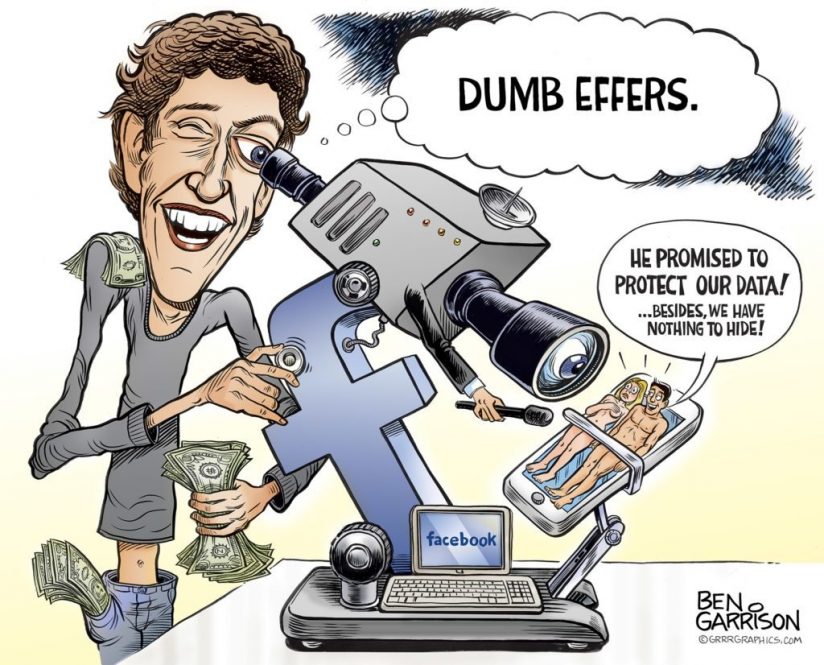
Facebook certainly deserves ample criticism for its lax privacy standards and its decision to threaten news outlets that exposed them. That said, we’ve noted a few times now that the uneven press fixation on Facebook obscures the fact that numerous industries routinely engage in much worse behavior. That’s particularly true of broadband providers (and especially wireless carriers), who routinely treat consumer privacy as a distant afterthought, with only a fraction of the total volume of media hyperventilation we saw during the Facebook kerfuffle.
Facebook’s casual treatment of your data isn’t some errant tech industry exception, it’s the norm, making #quitFacebook an arguably pointless gesture if you still own a stock mobile phone. In the telecom industry, a disdain for consumer privacy is a cornerstone of their entire business model(s). Companies like AT&T and Verizon aren’t just bone grafted to our government’s domestic surveillance apparatus, they collect and sell everything from browsing to location data to absolutely anyone and everyone–with little to no real oversight, and opt out tools that may or may not actually work.
Verizon has been particularly busy on the anti-privacy front. You’ll recall that the company was fined by the FCC for modifying wireless user data packets to track users around the internet without telling them. The company was engaging in this behavior for two years before security researchers even discovered it, and it took another six months of media criticism for Verizon to offer a simple opt out. Despite the wrist slap, a more powerful variant of this technology is still very much in play at Oath (AOL & Yahoo), Verizon’s effort to compete with Google and Facebook in the media advertising wars.
Not long after that, Verizon played a starring role in gutting modest FCC privacy rules protecting consumers (spurred in part by Verizon’s tracking tech). Those rules, which Verizon lobbyists dismantled last year, simply required that ISPs be transparent with what data they’re collecting and who they’re selling it to. When California tried to mirror the FCC’s discarded privacy policies, Verizon, Facebook and Comcast lied to lawmakers, falsely claiming that modest privacy protections would harm children, increase internet popups, and embolden extremism. None of it was true.
More recently, Verizon has been facing numerous lawsuits over Yahoo hacks that exposed the data of roughly three billion consumers. And while this was before Verizon’s ownership (Verizon wasn’t informed of the hacks during negotiations, netting it a $350 billion discount), the company has since been actively trying to prevent customers from suing Oath (Yahoo) or Verizon over future breaches by using fine print to mandate binding arbitration:
“The new Oath terms of service “contain a binding arbitration agreement and class action and jury trial waiver clauses…, which are applicable to all US users,” the terms say.
Congress has considered legislation to ban many mandatory arbitration clauses, but it hasn’t followed through yet and the practice remains legal.
The AOL terms already contained a binding arbitration clause and class-action waiver before Verizon bought that company. But the Yahoo terms didn’t previously contain such clauses.”
Thanks to AT&T’s Supreme Court victory in 2011 using contract fine print to erode consumer legal rights is now something we view as the norm. And while everybody can agree that the class action system has numerous problems, the system of binding arbitration is a terrible solution. Under binding arbitration, the arbiter rules for the company they work for the vast majority of the time, leaving consumers shit out of luck. While class actions often only net lawyers a nice new boat, they at least occasionally result in substantive change. Arbitration, in turn, is often more like consumer theater than justice.
The reality is that informed and empowered consumers are more likely to opt out of efforts to monetize their online behavior. And however breathlessly companies like Verizon and Facebook pretend to be dedicated to consumer privacy or policy solutions, they’re going to fight tooth and nail against any policies — even reasonable ones — that could potentially hamstring that revenue. But however bad Facebook is and has been on privacy, Verizon routinely offers a master class when it comes to undermining efforts at anything even vaguely resembling a solution.
Blocked By Facebook and the Vulnerability of New Media
By Craig Murray | April 26, 2018
This site’s visitor numbers are currently around one third normal levels, stuck at around 20,000 unique visitors per day. The cause is not hard to find. Normally over half of our visitors arrive via Facebook. These last few days, virtually nothing has come from Facebook:
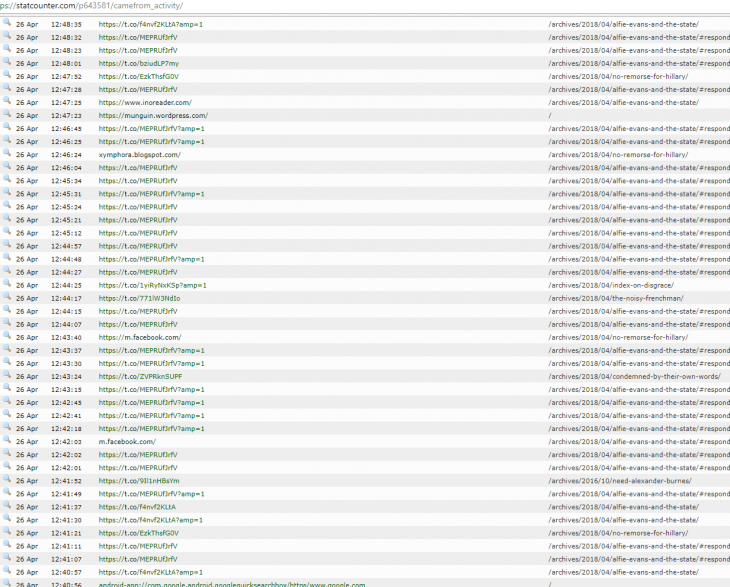
What is especially pernicious is that Facebook deliberately imposes this censorship in a secretive way. The primary mechanism when a block is imposed by Facebook is that my posts to Facebook are simply not sent into the timelines of the large majority of people who are friends or who follow. I am left to believe the post has been shared with them, but in fact it has only been shown to a tiny number. Then, if you are one of the few recipients and do see the post and share it, it will show to you on your timeline as shared, but in fact the vast majority of your own friends will also not receive it. Facebook is not doing what it is telling you it is doing – it shows you it is shared – and Facebook is deliberately concealing that fact from you.
Twitter have a similar system known as “shadow banning”. Again it is secretive and the victim is not informed. I do not appear to be shadow banned at the moment, but there has been an extremely sharp drop – by a factor of ten – in the impressions my tweets are generating.
I am among those who argue that the strength of the state and corporate media is being increasingly and happily undermined by our ability to communicate via social media. But social media has developed in such a way that the channels of communication are dominated by corporations – Facebook, Twitter and Google – which can in effect turn off the traffic to a citizen journalism site in a second. The site is not taken down, and the determined person can still navigate directly to it, but the vast bulk of the traffic is cut off. What is more this is done secretly, without your being informed, and in a manner deliberately hard to detect. The ability to simply block the avenues by which people get to see dissenting opinions, is terrifying.
Furthermore neither Facebook nor Twitter contact you when they block traffic to your site to tell you this is happening, let alone tell you why, and let alone give you a chance to counter whatever argument they make. I do not know if I am blocked by Facebook as an alleged Russian bot, or for any other reason. I do know that it appears to have happened shortly after I published the transcript of the Israeli general discussing the procedures for shooting children.
West Uses Skripal Row to Boot Russia From Syrian Chemical Weapons Issue – Moscow
Sputnik – 04.04.2018
Blaming Skripal’s poisoning on Moscow, Western states are trying to push Russia aside from discussion of cases of chemical weapons usage in Syria, according to the Russian Foreign Ministry’s spokeswoman.
On Issue of Chemical Weapons
Ministry spokeswoman Maria Zakharova noted that chemical weapons remain a key issue in the decision-making process for all countries, as the legitimacy of Bashar Assad’s power in Syria is always being linked to it by Western countries and the US-led coalition.
“Before, we were told that Assad just had to leave, because he was bad but then this concept was abandoned. Now they say that he is bad and must leave because he violates international law using chemical weapons in Syria,” she said.
The representative went on saying that the West is trying to play the same card in the current row over Skripal’s poisoning.
“Thus, inventing the story about the alleged use of chemical weapons by Russia on British soil, Western countries are trying to push Russia aside from the legal field of discussion of issues pertaining to the chemical weapons in Syria. Under the pretext that there is nothing to talk about with Russia, as they claim Russia has used chemical weapons in Europe,” Zakharova added.
Earlier in the day, the British side presented its own version of why Russia proposed to convene an extraordinary session of the Organization for the Prohibition of Chemical Weapons (OPCW) Council. According to the UK permament representative to the OPCW John Foggo, Russia wants to use the organization’s meeting scheduled for April 4, the date on which a year ago a chemical attack in Syria’s Khan Sheikhoun took place, in order to make a political statement.
“For all of us gathered here, it is very sad to admit that chemical weapons attacks continue not only in Syria. Today marks exactly one month since the usage of the nerve agent here in Europe,” he said.
After the alleged use of chemical weapons in Syria’s Eastern Ghouta in January, US Secretary of State Rex Tillerson accused Damascus of using chemical weapons and also claimed that Russia was responsible for the victims because of its engagement in Syria.
The Russian Foreign Ministry back then said that Washington was spreading propaganda against Moscow in an attempt to demonize the Syrian government and subsequently topple it, underscoring that the information on the chemical attacks used by the United States was uncorroborated.
In October 2017, the OPCW report alleged that the Syrian government was responsible for the April 4 sarin attack on the Syrian city of Khan Sheikhoun, claiming that the nerve gas used during the attack had been taken from stockpiles belonging to the Syrian government. However, the latter was destroyed as part of a 2013 deal with the US and Russia — a process the OPCW itself signed off on as having been completed that November.
Damascus has constantly denied being in possession of chemical weapons, the destruction of which had been confirmed by the OPCW.
On Russian Media
Russia would like to receive clarifications from the US State Department after accounts of Russian media outlets were blocked on Facebook, Russian Foreign Ministry spokeswoman said.
“We expect an official reaction to this situation from US authorities … we would very much like to hear official comments from the US State Department,” she told a briefing.
She called on Facebook to specify its issues with Russian media accounts and explain reasons behind its decision to block them.
On Tuesday, Russia’s Federal News Agency (FAN) said that Facebook had blocked its official page without any warning. Also on Tuesday, Facebook CEO Mark Zuckerberg said that the company blocked more than 270 accounts and pages run by Russia’s Internet Research Agency.
On Russian Vessel Detained in Ukraine
Moscow summoned the Ukrainian temporary charge d’affaires in Russia on Wednesday to protest the detention of a Russian ship and to demand the release of its crew as well as the return of the vessel, the Russian Foreign Ministry said.
“On April 3, the charge d’affaires ad interim of Ukraine in the Russian Federation was summoned to the Russian Foreign Ministry where he was handed a protest note in connection with the illegal detention of Russian fishing vessel Nord by the Ukrainian Border Guard Service on March 25 in the Sea of Azov, the transfer of the vessel to the port of Berdyansk and illegal custody of its 10 Russian crew members,” spokeswoman Maria Zakharova noted.
According to Zakharova, Moscow demanded the immediate release of the illegally detained crew and the return of the vessel to its legitimate owner.
On March 26, Ukrainian border guards detained the Russian ship Nord, claiming that its crew had violated the sea border. The Russian Foreign Ministry demands the Ukrainian side to return the captured ship, which is in the Ukrainian port of Berdyansk, and to release the crew.
READ MORE:
Russia’s Offer for Joint Probe Into Skripal Case ‘Perverse’ – UK OPCW Delegation
Russia Concerned, Outraged Over US Claims on Attacking Syria — Moscow
Facebook, Instagram Delete Dozens of Russia-Linked Accounts
Russian Navy Disproves Dangerous Manoeuveres between Russian and UK Vessels
Facebook Blocks Hezbollah’s Electoral page for Second Time
Al-Manar | March 29, 2018
Facebook on Wednesday blocked Hezbollah’s electoral page for the second time within 24 hours.
“Facebook administration has blocked our page for the second time within 24 hours,” ‘Nahmi Wa Nabni’ (We Defend, Establish), the official name of Hezbollah’s campaign on social media said in a statement.
‘Nahmi Wa Nabni’ is tasked with displaying some of Hezbollah’s achievements ahead of the parliamentary elections on May 6, 2018.
Earlier on Tuesday, Facebook blocked the first page established by ‘Nahmi Wa Nabni’. The newly-created page was rapidly re-followed by resistance supporters. But it seems that the high following records of a pro-resistance page did not please the Facebook administration.
In its Wednesday statement, ‘Nahmi Wa Nabni’ vowed to go ahead with its electoral campaign on social media, especially on Facebook platform.
Facebook fails to remove Corbyn death threat as it ‘doesn’t go against standards’
RT | March 29, 2018
Facebook has refused to take down a post calling for Labour leader Jeremy Corbyn to be assassinated. The threat was posted on a Tory-supporting Facebook page, Evolve Politics reports.
The post from the page ‘Conservative memes for Tory Teens’ reads: “I think we should order hits on Russia’s spies,” before going on to say “let’s start with Jeremy Corbyn.”
Evolve Politics signaled the post to Facebook, which got back to them with a generic message saying the post does not contravene its ‘Community Standards.’
The post had already been reported to the police and the social media giant, but was not removed. When one user commented that the post had been reported to authorities, one administrator dismissively said: “It was just a joke, chill.”
He then added: “Why do you hate freedom of speech?” – to which the original commentator said: “Free speech is great as long as it is not advocating violence. When it does advocate violence it breaks the law. Anyway must be nearly your bedtime. Nite nite.”
One of the administrators then told the news outlet that he had mental health issues, and that the page had helped him through. He added he would be taking the page down due to “threats” directed at him, his family and fellow Tories.
“Hay yeah I would like to say that this fb page as it lasted really helped with my depression, I have been struggling with it for a while and this page really helped me, I was a big fan of politics and enjoyed taking part, unfortunately due to threats to myself, my family and Torys [sic] in general I am taking down my meme page, idk what I’ll do now, maybe I’ll find happiness maybe I won’t and do something stupid, but that doesn’t matter does it? As long as you got a kick out of it that all that matters, especially from a page run by 1 person posting crappy memes with no where near 1000 followers but I’m glad u think it’s a big deal.“
Facebook is still to reply to Evolve Politics request for comment over whether it is an accepted policy to keep posts which carry a menace to politicians.
READ MORE:
Top barrister claims to have ‘unambiguous’ confirmation that BBC codes negative Corbyn messages
Facebook Scandal Blows Away ‘Russiagate’
By Finian CUNNINGHAM | Startegic Culture Foundation | 23.03.2018
Now, at last, a real “election influence” scandal – and, laughably, it’s got nothing to do with Russia. The protagonists are none other than the “all-American” US social media giant Facebook and a British data consultancy firm with the academic-sounding name Cambridge Analytica.
Facebook’s chief executive Mark Zuckerberg is being called upon by British and European parliamentarians to explain his company’s role in a data-mining scandal in which up to 50 million users of the social media platform appear to have had their private information exploited for electioneering purposes.
Exploited, that is, without their consent or knowledge. Facebook is being investigated by US federal authorities for alleged breach of privacy and, possibly, electoral laws. Meanwhile, Cambridge Analytica looks less an academic outfit and more like a cheap marketing scam.
Zuckerberg has professed “shock” that his company may have unwittingly been involved in betraying the privacy of its users. Some two billion people worldwide are estimated to use the social media networking site to share personal data, photos, family news and so on, with “friends”.
Now it transpires that at least one firm, London-based Cambridge Analytica, ran a profitable business by harvesting the publicly available data on Facebook for electioneering purposes for which it was contracted to do. The harvested information was then used to help target election campaigning.
Cambridge Analytica was reportedly contracted by the Trump campaign for the 2016 presidential election. It was also used during the Brexit referendum campaign in 2016 when Britons voted to leave the European Union.
This week the British news outlet Channel 4 broadcast a stunning investigation in which chief executives at Cambridge Analytica were filmed secretly boasting about how their firm helped win the US presidential election for Donald Trump.
More criminally, the data company boss, Alexander Nix, also revealed that they were prepared to gather information which could be used for blackmailing and bribing politicians, including with the use of online sex traps.
The repercussions from the scandal have been torrid. Following the Channel 4 broadcast, Cambridge Analytica has suspended its chief executive pending further investigation. British authorities have sought a warrant to search the company’s computer servers.
Moreover, Zuckerberg’s Facebook has seen $50 billion wiped of its stock value in a matter of days. What is at issue is the loss of confidence among its ordinary citizen-users about how their personal data is vulnerable to third party exploitation without their consent.
Cambridge Analytica is just the tip of an iceberg. The issue has raised concerns that other third parties, including criminal identity-theft gangs, are also mining Facebook as a mammoth marketing resource. A resource that is free to exploit because of the way that ordinary users willingly publish their personal profiles.
The open, seemingly innocent nature of Facebook connecting millions of people – a “place where friends meet” as its advertising jingle goes – could turn out to be an ethical nightmare over privacy abuse.
Other social media companies like Amazon, Google, WhatsApp and Twitter are reportedly apprehensive about the consequences of widespread loss of confidence among consumers in privacy security. One of the biggest economic growth areas over the past decade – social media – could turn out to be another digital bubble that bursts spectacularly due to the latest Facebook scandal.
But one other, perhaps more, significant fallout from the scandal is the realistic perspective it provides on the so-called “Russiagate” debacle.
For well over a year now, the US and European corporate news media have been peddling claims about how Russian state agents allegedly “interfered” in several national elections.
The Russian authorities have consistently rejected the alleged “influence campaigns” as nothing but a fabrication to slander Russia. Moscow has repeatedly asked for evidence to verify the relentless claims – and none has been presented.
The US congress has carried out two probes into “Russiagate” without much to show for their laborious endeavors. A special counsel headed up by former FBI chief Robert Mueller has spent millions of taxpayer dollars to produce a flimsy indictment list of 19 Russian individuals who are said to have run influence campaigns out of a nondescript “troll farm” in St Petersburg.
It still remains unclear and unconvincing how, or if, the supposed Russian hackers were linked to the Russian state, and how they had any impact on the voting intentions of millions of Americans.
Alternatively, there is plausible reason to believe that the so-called Russian troll farm in St Petersburg, the Internet Research Agency, may have been nothing other than a dingy marketing vehicle, trying to use the internet like thousands of other firms around the world hustling for advertising business. Firms like Cambridge Analytica.
The whole Russiagate affair has been a storm in a teacup, and Mueller seems to be desperate to produce some, indeed any, result for his inquisitorial extravaganza.
The amazing thing to behold is how the alleged Russian “influence campaign” narrative has become an accepted truth, propagated and repeated by Western governments and media without question.
Pentagon defense strategy papers, European Union policy documents, NATO military planning, among others, have all cited alleged “Russian interference” in American and European elections as “evidence” of Moscow’s “malign” geopolitical agenda.
The purported Russiagate allegations have led to a grave deepening of Cold War tensions between Western states and Russia to the point where an all-out war is at risk of breaking out.
Last week, the Trump administration slapped more sanctions on Russian individuals and state security services for “election meddling”.
No proof or plausible explanation has ever been provided to substantiate the allegations of a Russian state “influence campaign’. The concept largely revolves around innuendo and a deplorable prejudice against Russia based on irrational Cold War-style Russophobia.
However, one possible beneficial outcome from the latest revelations of an actual worldwide Facebook election-influence campaign, driven by an ever-so British data consultancy, is that the scandal puts the claims against Russia into stark, corrective perspective.
A perspective which shows that the heap of official Western claims against Russia of “influencing elections” is in actual fact negligible if not wholly ridiculous.
It’s a mountain versus a hill of beans. A tornado versus a storm in a teacup. Time to get real on how Western citizens are being really manipulated by their own consumer-capitalist cultures.
Face it: Cambridge Analytica story proves Facebook doesn’t give a toss about privacy or democracy
By Danielle Ryan | RT | March 20, 2018
Mainstream media have obsessed over Russia’s alleged use of Facebook to swing the 2016 US election. In reality, it was actually a shady British data-mining firm that was running pro-Trump Facebook propaganda campaigns
Irony doesn’t feel like strong enough a word.
Which is worse: Russia allegedly buying a few hundred Facebook ads, with the goal of ‘sowing unrest’ in the United States, by exploiting already emotional and divisive issues like gun control and race relations, or Facebook allowing a dodgy British company to mine the data of millions of its users, without the users’ explicit knowledge or consent, and then using that data for political purposes?
If you need a recap: British firm Cambridge Analytica (CA), working with the Trump campaign, harvested private information from 50 million Facebook users without their knowledge — and then used that information in an attempt to influence the election in Trump’s favor. CA was reportedly paid $5 million by the Trump campaign for their efforts. Oh, and former Trump White House chief strategist Steve Bannon used to head the company.
So now we find out, after all the hand-wringing about how Russia elected Trump through its evil social media manipulations, that there were, in fact, other, perhaps for more influential, forces at play.
“We exploited Facebook to harvest millions of people’s profiles. And built models to exploit what we knew about them and target their inner demons. That was the basis the entire company was built on,” said CA whistleblower Christopher Wylie.
There are so many levels of irony to this story, it’s hard to know where to begin.
But let’s start with this: At the same time that Cambridge Analytica was mining Facebook data to help Trump, top executives at Facebook were actively working to help Trump opponent Hillary Clinton. Leaked emails between Facebook Chief Operating Officer Sheryl Sandberg and Clinton campaign chairman John Podesta revealed that Facebook provided research to Clinton in 2015. According to the emails, Sandberg “badly” wanted Clinton to win and she met privately with the candidate on multiple occasions.
Here’s where it gets really interesting, though. Cambridge Analytica doesn’t discriminate. After Trump’s election, the data firm’s parent company SCL Group won a contract from the US State Department to — wait for it — help combat propaganda on Facebook.
You know, it’s almost like Cambridge Analytica and Facebook each are companies primarily interested in money and which act with no moral qualms whatsoever. One can even imagine, if they try hard enough, that while Facebook executives personally seem to prefer Democrats, the company would help anyone, so long as a big fat check was involved.
Since the Cambridge Analytica scandal broke, thanks to Wylie, Facebook has tried to play the victim — and quite successfully, too, given that most of the focus has been on CA and its dirty tricks and not the fact that it is a giant data company like Facebook that allows it to happen in the first place.
Facebook claims that it was misled by CA and acted to suspend the firm from its platform. But Facebook is no victim. The social media giant still insists CA’s use of the data from 50 million of its users’ accounts was not a data breach because, somewhere within the tangle of Facebook’s intentionally complicated privacy settings, users had technically consented to having their data mined.
Don’t let Facebook’s faux outrage at CA’s behavior fool you. In the midst of all this drama, a former high-level staffer on Barack Obama’s 2012 presidential campaign has come out and admitted that Facebook allowed the Obama campaign to do much the same thing to help him, that Cambridge Analytica did to help Trump four years later.
Carol Davidsen wrote on Twitter that Facebook staff were very open and candid with the Obama campaign, writing that “they allowed us to do things they wouldn’t have allowed someone else to do because they were on our side”.
Those activities included “suck[ing] out the entire social graph” — in other words an individual user’s entire network of Facebook friends — in an effort to target more potential voters through friends lists.
“The privacy policies at that time on Facebook were – if they opted in, they could tell us who all their friends were. So, they told us who all their friends were. We were actually able to ingest the entire social network of the US that’s on Facebook, which is most people,” Davidsen wrote.
So who is really more to blame here? A company like Cambridge Analytica, that uses political bribes and honey traps to discredit people — or a social media giant that sells the personal data of its users to the highest bidder? Or… Russia?
I’m inclined to agree with NSA whistleblower Edward Snowden, who wrote on Twitter: “Facebook makes their money by exploiting and selling intimate details about the private lives of millions, far beyond the scant details you voluntarily post. They are not victims. They are accomplices.”
Speaking of whistleblowers, it’s been interesting to see how the media has treated the Cambridge Analytica whistleblower vs. how they treat whistleblowers like Julian Assange, Chelsea Manning — and Snowden himself. When the whistleblower reveals information that suits the prevailing narrative, they are lauded as brave heroes and truth seekers. When they reveal something that doesn’t quite fit the story they are promoting, whistleblowers suddenly become abominable traitors deserving of no mercy.
Now comes the question of what should be done about all this sneaky business on Facebook. Luckily, I have a couple of suggestions.
First and foremost, Washington should immediately sanction the UK over the now-blatant attempts of a British company to meddle in and influence the American presidential election. I mean, it only seems fair. All sorts of accusations should be immediately levelled at the British government. Most importantly, absolutely no effort should be made to separate Cambridge Analytica from either Downing Street or the British public in general.
Second, the media should spend weeks, if not months, analyzing the motives of dodgy British political operatives and their efforts to secure a Trump victory. Journalists should get to work whipping up massive anti-British fervor and use any opportunity they can to get “the British” into their headlines about evil online influence campaigns.
In all honesty, there really is not much difference between Cambridge Analytica and Facebook. They both use our data for political and financial purposes — Facebook just seems to do it all on a far wider and more consistent basis.
It was only in January that Facebook admitted in a series of official blog posts, that it had a “moral duty” to understand how its technology was being used and to figure out “what can be done to make communities like Facebook as representative, civil and trustworthy as possible.” In response to allegations of Russian meddling and ‘fake news’ on the platform, Facebook said it was taking “steps in partnership with third-party fact checkers to rank these stories lower”.
That’s right: Employing unidentified “fact checkers” was supposed to help solve the fake news problem, while companies like Cambridge Analytica were out there hoovering up data from millions of users without their knowledge and using it for political propaganda purposes. But Facebook, we’re supposed to believe, knew nothing about that.
Facebook doesn’t really care a toss about your privacy or your democracy — and if this Cambridge Analytica scandal doesn’t make that clear, nothing will.
Danielle Ryan is an Irish freelance journalist. Having lived and worked in the US, Germany and Russia, she is currently based in Budapest, Hungary. Her work has been featured by Salon, The Nation, Rethinking Russia, Russia Direct, teleSUR, The BRICS Post and others. Follow her on Twitter @DanielleRyanJ, check out her Facebook page, or visit her website: danielle-ryan.com
Read more:
Social media bow to pressure and censor dissident voices
By Nebojsa Malic | RT | February 27, 2018
Twitter, YouTube and Facebook, accused of enabling US President Donald Trump’s rise to power through “Russian meddling,” are facing pressure to de-platform heretics. This has raised fears for the safety of free speech in the US.
At the Conservative Political Action Conference (CPAC) this past weekend, media crusader James O’Keefe headlined an hour-long panel on social media censorship, arguing that it targeted mostly conservatives.
“They really make sure you don’t see any differing views,” O’Keefe said at the panel.
Last week, the blogging platform Medium deleted a number of accounts, including those of Mike Cernovich, Jack Posobiec and Laura Loomer, described by The Hill as “prominent far-right figures.” The purge took place after Medium replaced a commitment to free speech in its terms of service in favor of fighting “online hate, abuse, harassment, and disinformation.”
Though Medium would not comment on individual account bans, it is notable that Cernovich’s account was deleted after he was named in a Newsweek article that blamed the “alt-right,” overseas social media bots and “Russians” for the ouster of Senator Al Franken (D-Minnesota) over sexual misconduct. Newsweek retracted the story after criticism that it could not be substantiated.
A number of YouTube creators have complained that the video platform has demonetized basically anything that isn’t deemed “family friendly,” including political dissent. Another crackdown followed the school shooting in Parkland, Florida, after the top-ranking video on the site featured accusations that some of the students were “crisis actors.”
Yet if YouTube simply censored any videos even referring to conspiracy theories, that would surely present a new problem. After all, wouldn’t it also undermine efforts to debunk them?
Conservative critics accuse the social media giants of being run by Democrats. There is certainly evidence pointing in that direction, from the involvement of Alphabet (Google’s parent company) CEO Eric Schmidt with Hillary Clinton’s 2016 campaign and the Obama presidency, to Twitter’s admission it censored the hashtags about WikiLeaks’ publication of revealing emails from Clinton’s campaign chief John Podesta in the run-up to the November 2016 vote. Those emails also revealed the commitment of several Facebook executives to get Clinton elected.
After Clinton lost to Trump, however, the three social media giants found themselves in the crosshairs of Congress. Many Republicans joined the chorus of Democrats accusing the social networks of enabling alleged “Russian” activity.
“You created these platforms… and now they’re being misused,” Senator Dianne Feinstein (D-California) told the executives of Facebook, Google, and Twitter during a hearing in October 2017. “And you have to be the ones who do something about it — or we will.”
So far, “doing something” seems to consist mostly of purging “Russian bots,” as identified by the either the social media companies themselves or an alliance of Democrats and neo-conservatives ousted from power by Trump, and now seeing Russians behind every hashtag.
The people who formed Hamilton68 are DC’s worst warmongers & liars. They are long-time disinformation agents. *Bill Kristol* put the group together. They follow only 600 Twitter accounts, secretly designated by them as “pro-Russian.” And US media uncritically swallows every claim
— Glenn Greenwald (@ggreenwald) February 23, 2018
Censorious actions also include what activists call “de-platforming” of people singled out for unacceptable or offensive opinions by the ad-hoc online mobs. For example, after the Florida school shooting angry Twitterati have successfully badgered a number of businesses into canceling discounts they previously offered to members of the National Rifle Association (NRA). Amazon also found itself under pressure to drop the “NRA TV” channel from its platform.
In a recent interview, former Google engineer James Damore speculated that the climate at social media companies have an atmosphere which resembles college campuses. Such locations which have also seen crackdowns on freedom of expression in recent times.
“It was very much like a college campus,” Damore told the Washington Examiner. “And they tried to make it like a college campus where you would live at Google essentially, where they have all your food and all the amenities, and once you start living there you aren’t able to disconnect, and so you feel like my words were a threat against your family. That was part of the fervor, I think.”
Damore was purged from Mountain View over a memo in which he questioned the company’s practices when it came to diversity.
While the social media companies may hope the lawmakers would be appeased by an occasional purge of unpopular voices, another danger is headed their way: the legacy media, is aiming to recapture its hold on audiences.
On Monday, CNN president Jeff Zucker addressed the Mobile World Congress in Barcelona. His thrust was that government should look into Google and Facebook “monopolies” if journalism is to survive.
“In a Google and Facebook world, monetization of digital and mobile continues to be more difficult than we would have expected or liked,” Zucker said, according to Variety. “I think we need help from the advertising world and from the technology world to find new ways to monetize digital content, otherwise good journalism will go away.”
Tempting as it would be to quip about CNN’s tenuous relationship with “good journalism.” At this time, doing so would be self-defeating as the chances are it would get one quicklybe a short-cut to getting purged from Google, Twitter or Facebook.
Social media giants crack down on RT under Senate pressure
RT | January 26, 2018
Facebook, Google and Twitter are taking action against RT in response to pressure from the Senate Intelligence Committee, but have found very little to indicate ‘Russian meddling’ in the 2016 elections, new documents show.
Google Search, for example, has labels “describing RT’s relationship with the Russian Government” and the company is “working on disclosures to provide similar transparency on YouTube,” according to a letter sent to the committee by Google’s VP and general counsel Kent Walker.
Twitter has “off-boarded” RT and Sputnik “and will no longer allow those companies to purchase ad campaigns and promote Tweets on our platform,”said the letter from the company’s acting general counsel Sean Edgett.
The letters were provided following the October 31, 2017 hearing at which the senators grilled social media executives on alleged Russian meddling in the 2016 presidential election via their products and services.
Senator Joe Manchin (D-West Virginia) was interested to know whether any of the companies accepted advertising from RT or Sputnik. Unlike Twitter, Facebook and Google continue to carry ads from both outlets. Google’s Walker wrote that such ads remain subject to “strict ads policies and community guidelines,” and that “to date, we’ve seen no evidence that they are violating these policies.”
Walker added that Google took RT out of its Preferred Lineup on YouTube. In November, Eric Schmidt, chairman of Google’s parent company Alphabet, told an international forum that he planned to “de-rank” RT and Sputnik in displayed search results.
Facebook’s general counsel Colin Stretch wrote that RT and Sputnik can “use our advertising tools as long as they comply with Facebook’s policies, including complying with applicable law.”
Committee chairman Richard Burr (R-North Carolina) asked whether any of the companies provide any data to the Russian government. Twitter said it had received requests for data, but did not comply with any of them. Facebook said it had received 28 requests for data between 2013 and 2017, but that it “did not provide any data in response.”
Google said it had “not complied with every request” but declined to provide any specifics, referring the senators to its Transparency Report. RT’s analysis of that data shows that Google received 237 requests in the first half of 2016 and provided responses in 7 percent of cases. Another 234 requests came in the second half of the year, with a 15 percent response rate. There were 318 requests in 2017 with a 10 percent response rate.
Senator Kamala Harris (D-California) was very interested to hear what the social media companies are doing with the revenue supposedly earned from “Russian” advertising. Edgett’s letter confirmed Twitter’s commitment to donate the $1.9 million that RT had spent globally on ads to “academic research into elections and civic engagement.” He did not specify the organizations that would benefit from this funding.
Although Stretch said that revenue from ads running on pages managed by the Internet Research Agency (IRA, usually described in the Western press as the “St. Petersburg troll farm”) was “immaterial,” he revealed that Facebook has contributed “hundreds of thousands of dollars” to the Defending Digital Democracy Project, an outfit based at the Harvard Kennedy School of Government “that works to secure democracies around the world from external influence.”
Furthermore, the investments Facebook has made to “address election integrity and other security issues” have been so significant that “we have informed investors that we expect that the amount that we will spend will impact our profitability,” Stretch added.
Google said the total amount of revenue from “Russian” ads amounted to $4,700, while the company has contributed $750,000 to the the Defending Digital Democracy Project.
The outfit is run by Eric Rosenbach, former assistant secretary of defense in the Obama administration. According to the Belfer Center at Harvard University, Rosenbach recruited Hillary Clinton’s former campaign manager Robby Mook and Mitt Romney’s 2012 campaign manager Matt Rhoades to co-chair the project.
Among the project’s advisers is Marc Elias of Perkins Coie, the law firm that has represented Clinton and the DNC, and was revealed to have paid for the notorious “Steele Dossier.” Another member of the project’s senior advisory group is Dmitri Alperovitch, CEO of Crowdstrike, the private company hired by the DNC which originated the accusation that Russia hacked into the party’s emails. Alperovitch is also a senior fellow at the Atlantic Council, a think tank associated with anti-Russian reports and partially funded by the US military, NATO, and defense contractors like Lockheed Martin and Boeing.
Read more:
Featured Video

Chinese jet fuel and the myth of energy independence
or go to
Aletho News Archives – Video-Images
Book Review
Former Insiders Criticize Iran Policy as U.S. Hegemony
By GARETH PORTER | CounterPunch | February 27, 2013
“Going to Tehran” arguably represents the most important work on the subject of U.S.-Iran relations to be published thus far.
Flynt Leverett and Hillary Mann Leverett tackle not only U.S. policy toward Iran but the broader context of Middle East policy with a systematic analytical perspective informed by personal experience, as well as very extensive documentation.
More importantly, however, their exposé required a degree of courage that may be unparalleled in the writing of former U.S. national security officials about issues on which they worked. They have chosen not just to criticise U.S. policy toward Iran but to analyse that policy as a problem of U.S. hegemony. … continue
Blog Roll
 Aletho News
- What is fueling unrest across the EU?
- Why no power can undermine Iran’s eternal dominance over the Strait of Hormuz
- Is The War Against Iran Over?
- Iran war will leave long-term ‘scar’ on Wall Street, investors warn
- How Iran decimated US power projection in West Asia: Military lessons of 40-day war
- Iran’s report details US-Israeli war crimes in targeting schools, hospitals, livelihoods
- NATO’s Slow Fracture: How Trump’s Iran War Exposed the Instrument of Hegemony
- Chinese jet fuel and the myth of energy independence
- Ukraine Sea Drone Fired From Libya Hit Russian Tanker in Mediterranean
- IRGC: Iranian forces launched no attacks during ceasefire hours
- If Americans Knew
- DNC Shoots Down Resolutions Calling Out AIPAC and Limiting Arms to Israel
- TCN: Is Israel Blackmailing President Trump?
- Israel killed at least 303 Lebanese yesterday – who were they? Daily Update
- Amnesty: Urgent – Protect Lebanese civilians from brutal escalation in Israeli attacks
- Is The War Against Iran Over?
- Inside the Israeli army’s propaganda wing
- Hundreds of Gaza Amputees Stranded in Legal Limbo
- The gallows law: Israel moves toward executing Palestinian children
- Tucker Carlson: The Path to Peace requires ending ‘special alliance’ with Israel
- This is ceasefire? Israel’s biggest massacre yet in Lebanon, another journalist killed in Gaza – Daily Update
- No Tricks Zone
- An Inconvenient Tree: Uncovered In Alps… Europe Much Warmer Than Today 6000 Years Ago
- New Study Reports A 60% Slowdown In Greenland’s Ice Loss Rate In The Last Decade
- Low Intensity Tornado Wrecks Major Solar Farm, Creating A Potential Toxic Dump
- New Study Finds Warming Saves Lives…Cold Temperatures 12 Times More Deadly Than Excess Heat
- German Science Blog Accuses PIK Climate Institute Of Hallucinating Climate Tipping Points
- Devastating Assessment Of Comirnaty Vaccine By Former Senior Pfizer Europe Toxicologist
- New Study: CO2 Is ‘Effectively Negligible’ As An Explanatory Climate Change Factor Since 2000
- Former Pfizer Toxicologist Dr. Helmut Sterz Tells Bundestag Hearing Pfizer Vaccine Should Have Never Been Approved
- Energy Expert: Germany’s Nuclear Phaseout Was A “500 Billion Euro Mistake”
- New Research: South Australia’s Mid-Holocene Sea Surface Temperatures Were 4°C Warmer Than Today
 Aletho News