FBI director says Russia is engaged in ‘very active efforts’ to sink Biden & rehashes 2016 claims… but provides no evidence
RT | September 17, 2020
Russia is reprising its still-unproven 2016 election meddling efforts, this time targeting Democratic challenger Joe Biden, according to FBI Director Christopher Wray, who gave no evidence to support his crowd-pleasing claims.
Wray told the House of Representatives that Russia is taking a “very active” role in the 2020 US election, claiming Moscow “continues to try to influence our elections, primarily through what we call malign foreign influence” during a Thursday hearing on national security threats.
According to the FBI director, the Russians’ primary goal seems to be not only to “sow divisiveness and discord,” but to trash Democratic nominee Joe Biden – along with “what the Russians see as a kind of anti-Russian establishment” – through social media, “use of proxies,” state-run media, and “online journals.”
Wray contrasted 2020’s alleged meddling with that of 2016, which he claimed involved “an effort to target election infrastructure,” presenting no evidence to back up either current or past claims – other than that the FBI or other intelligence agencies had made the same claims in the past. There is no actual evidence that Russia interfered with election infrastructure in 2016.
While four years of similarly flavored conspiracy theories blaming Russia for Donald Trump’s 2016 win have come up empty-handed, the paucity of real-world evidence for ‘Russian meddling’ has not stopped Wray and other US intel officials from hyping it up as a major threat to the integrity of the democratic process.
The National Counterintelligence and Security Center suggested last month that, while Russia would interfere in the election in favor of Trump, China and Iran would meddle on behalf of Biden – implying Americans couldn’t vote at all without doing the bidding of a foreign nation.
Former Director of National Intelligence Dan Coats even suggested Congress create another election integrity body to supervise the vote in November, apparently concerned the existing authorities – all 54 of them, one for each state plus four federal entities tasked with keeping meddlers, foreign and domestic, shut out – weren’t enough.
Wray insisted the FBI was not only working closely with its state and federal counterparts, but also interfacing on a daily basis with social media companies – though he did not go into detail regarding what information the tech giants were handing over to law enforcement (or vice versa).
During his testimony before Congress, Wray also broke with the Trump administration’s viewpoint on the subject of Antifa, insisting the often-violent leftist group was “more of an ideology than an organization.” However, he admitted “we have seen folks who subscribe or identify with the Antifa movement, who coalesce regionally into small groups or nodes, and they are certainly organized at that level.” Trump has called for Antifa to be declared a terrorist organization.
Dark web voter database report casts new doubts on Russian election hack narrative
By Gareth Porter | Grayzone | September 13, 2020
A new report showing that US state-level voter databases were publicly available calls into question the narrative that Russian intelligence “targeted” US state election-related websites in 2016.
A September 1 report in the Moscow daily Kommersant on a “dark web” site offering a database of personal information on millions of registered American voters undermines one of the central themes of the Russia hysteria pervading US politics.
Democratic politicians and corporate media pundits have long accepted it as fact that Russian intelligence “targeted” US state election-related websites in 2016. But the Kommersant report shows that those state registered voter databases were already available to anyone in the public domain, eliminating any official Russian motive for hacking state websites.
Kommersant reported that a user on a dark web Forum known as Gorka9 offered free access to databases containing the information of 7.6 million Michigan voters, along with the state voter databases of Connecticut, Arkansas, Florida and North Carolina.
There are differences between the Michigan database described by Gorka9 and the one that the State of Michigan releases to the public upon request. Tracy Wimmer, the spokesperson for the Michigan Secretary of State, said in an e-mail to Grayzone that when the Michigan voter registration database is released to the public upon request, the state withholds “date of birth (year of birth is included), driver’s license number, the last four digits of someone’s social security number, email address and phone number….” However, Gorka9’s description of the Michigan data includes driver’s license numbers, full dates of birth, social security numbers and emails.
In fact both un-redacted and redacted state voter files are obviously widely available on the dark web as well as elsewhere on the internet. Meduza, a Russian-language news site based in Riga, Latvia, published the Kommersant story along with an “anonFiles” download portal for access to the Michigan voter database and a page from it showing that it is the officially redacted version. The DHS and the FBI both acknowledged in response to the Kommersant story that “a lot of voter registration data is publicly available or easily purchased.”
Criminal hackers have been seeking to extract such personal information from online state personal databases for many years — not only from voter registration databases but from drivers license, health care and other databases. Oregon’s chief information security officer, Lisa Vasa, told the Washington Post in September 2017 that her team blocks “upwards of 14 million attempts to access our network every day.”
Ken Menzell, the legal counsel to the Illinois state Board of Elections, told this writer in a 2017 interview that the only thing new about the hack of the state’s voter database in 2016, in which personal data on 200,000 Illinois registered voters was exfiltrated, was that the hackers succeeded. Menzell recalled that hackers had been “trying constantly” to get into every Illinois personal database ever since 2006.
The motive for the hackers was simple: as observed by Andrey Arsentiev, the head of analytics and special projects at the private security partnership, Infowatch, databases can be mined for profits on the dark web, primarily by selling them to scam artists working on a mass scale. Gorka9 was offering state voter files for free because the owner had already squeezed all the potential profit out of selling them.
For the Russian government, on the other hand, such databases would be of little or no value. When FBI counterintelligence chief Bill Priestap was asked by a member of the Senate Intelligence Committee in June 2017 how Moscow might use personal voter registration data, the only explanation he could come up with was that the Russian government and its intelligence agencies were completely ignorant of the character of U.S. state voter databases. “They took the data to understand what it consisted of,” Priestap declared.
Priestap was obviously unaware of the absurdity of the suggestion that the Russian government had no idea what was in such databases in 2016. After all, the state voter registration databases had already been released by the states themselves into the public domain, and had been bought and sold on the dark web for many years. The FBI has steered clear of the embarrassing suggestion by Priestap ever since.
Priestap’s inability to conjure up a plausible reason for Russia to hack U.S. election sites points to the illogical and baseless nature of the claims of a Russian threat to the U.S. presidential election.
DHS creates the Russian cyber campaign against state election sites
Back in 2016, the Department of Homeland Security did its best to market the narrative of Russian infiltration of American voting systems. At the time, the DHS was seeking to increase its bureaucratic power by adding election infrastructure to its portfolio of cybersecurity responsibilities, and exploiting the Russian factor was just the ticket to supercharge their campaign.
In their prepared statement to the Senate Intelligence Committee in June 2017, two senior DHS officials, Samuel Liles and Jeanette Manfra, referred to an October 2016 intelligence report published by the DHS Office of Intelligence and Analysis. They stated it had “established that Internet-connected election-related networks, including websites, in 21 states were potentially targeted by Russian government cyber actors.” That “potentially targeted” language gave away the fact that DHS didn’t have anything more than suspicion to back up the charge.
In fact DHS was unable to attribute any attempted election site hack to the Russian government. On October 7, 2016, in fact, DHS Secretary Jeh Johnson and Director of National Intelligence James Clapper stated explicitly that they could not do so. Liles and Manfra appeared to imply such an attribution, however, by associating DHS with a joint assessment by CIA, FBI and NSA released January 7, 2017, that contained the statement, the “Russian intelligence obtained and maintained access to elements of multiple US state or local electoral boards.”
But the meaning of that language was deliberately vague, and the only additional sentence related to it stated, “Since early 2014, Russian intelligence has researched US electoral processes and related technology and equipment.” That was far from any finding that Russia had scanned or hacked election-related websites.
In September 2017, under pressure from governors, DHS finally notified state governments about the cyber incidents that it had included in its October 2016 intelligence report as examples of “potential” Russian targeting. Now, it abandoned its ambiguous language and explicitly claimed Russian responsibility.
One state election official who asked not to be identified told this writer in a 2018 interview that “a couple of guys from DHS reading from a script” had informed him that his state was “targeted by Russian government cyber actors.”
DHS spokesman Scott McConnell issued a statement on September 28, 2017 that DHS “stood by” its assessment that 21 states “were the target of Russian government cyber actors seeking vulnerabilities and access to U.S. election infrastructure.” But McConnell also revealed that DHS had defined “targeting” so broadly that any public website that a hacker scanned in a state could be included within that definition.
The dishonest tactics the DHS employed to demonstrate plausible evidence of “targeting” was revealed by Arizona Secretary of State Michelle Reagan’s spokesperson Matt Roberts, who told this writer in an interview, “When we pressed DHS on what exactly was targeted, they said it was the Phoenix public library’s computer system.” Another 2016 hacking episode in Arizona, which the FBI originally believed was a Russian government job, was later found to be a common criminal hack. In that episode, a hacker had targeted a local official with a phishing scheme and managed to steal their username and password.
Ironically, DHS had speculated in its initial intelligence report “that cyber operations targeting election infrastructure could be intended or used to undermine public confidence in electoral processes and potentially the outcome.”
That speculation, reiterated by corporate media, became a central feature of the Russiagate hysteria that electrified the Democratic Party’s base. None of the journalists and politicians who repeated the narrative stopped to consider how unsubstantiated claims by the DHS about Russian penetration of the US election infrastructure was doing just that – lowering public confidence in the democratic process.
The hysteria surrounding the supposed Russian threat to elections is far from over. The Senate Intelligence Committee report released in July 2019 sought to legitimize the contention by former Obama cyber security adviser Michael Daniel that Russia “may have” targeted all fifty states for cyber attacks on election-related sites. In explaining his reasoning to the Senate committee’s staff, Daniel said: “My professional judgment was we have to work on the assumption [Russians] tried to go everywhere, because they’re thorough, they’re competent, they’re good.”
The New York Times eagerly played up that subjective and highly ideological judgment in the lede of a story headlined, ‘Russia Targeted Election Systems in All 50 States, Report Finds.’
As for DHS, it appeared to acknowledge by implication in an October 11, 2018 assessment excerpted in the Senate Committee report that it could not distinguish between a state-sponsored hack and a criminal hack. This August, the senior cybersecurity adviser for the Cybersecurity and Infrastructure Security Agency (CISA), Matthew Masterson, said, “We are not and have not seen specific targeting of those election systems that has been attributable to nation-state actors at this time…. We do see regular scanning, regular probing of election infrastructure as a whole, what you’d expect to see as you run IT systems.”
Despite these stunning admissions, DHS has faced no official accountability for deliberately slanting its intelligence assessment to implicate Russia for common criminal hacking activity. No matter how shoddy its origins and development have proven to be, the narrative remains too politically useful to be allowed to die.
FBI says reports of Antifa arson in Oregon are ‘Conspiracy Theories,’ but someone is starting fires
RT | September 12, 2020
As wildfires burn throughout Oregon and close in on Portland, a number of arrests and reports suggest that some of these fires may have been started intentionally. The FBI has dismissed reports of arson as “conspiracy theories.”
Multiple wildfires are ripping through Oregon, with local media reporting seven dead as of Friday. Governor Kate Brown has evacuated more than 40,000 people, and the state’s emergency management director, Andrew Phelps, said on Friday that authorities are preparing for a “mass fatality event.”
Phelps also warned that the fires are “knocking on the doorstep” of Portland. With the sky over the city blotted out by ash and smoke, Mayor Ted Wheeler declared a state of emergency on Thursday night.
Portland has been an epicenter of ‘Black Lives Matter’ and antifa riots since May, and rumors circulating online have accused some of these activists of starting the fires intentionally. The FBI attempted to squash these rumors on Friday, declaring them “conspiracy theories and misinformation,” and urging citizens to only share “validated information from official sources.”
However, reports of arson have not come solely from anonymous Twitter accounts and conspiracy cranks. Hours after the FBI’s tweet was posted, the Multnomah County Sheriff’s Office announced that deputies had discovered spent fireworks next to a bush fire in Corbett, a few minutes’ drive from Portland.
Multiple suspects have been arrested and charged with arson within the city itself, with the arrestees usually linked to the ongoing protests and riots. Previously, Molotov cocktails have been thrown at police officers, buildings set on fire, and powerful fireworks launched at federal agents protecting the city’s Justice Center and courthouse.
However, law enforcement officers have caught several arsonists outside Portland too. A man was charged on Friday with multiple counts of arson after allegedly setting a wildfire near Phoenix in southern Oregon on Tuesday. Officers arresting the man found him standing near a large blaze that was threatening several houses, and discovered two ounces of methamphetamine on his person. His political leanings are unknown.
In central Oregon, a 44-year-old man was arrested on Tuesday on suspicion of arson, with deputies accusing him of torching nearly 400 acres of land west of the city of Eugene.
While law enforcement officials say they’ve been flooded with false calls blaming the fires on Antifa arsonists, a fire that began in Ashland is under criminal investigation after human remains were found at its origin point. The fire quickly spread, and merged with the same blaze that the alleged Phoenix arsonist was arrested and charged for starting.
Further north in Washington state, a man was charged on Friday with starting a fire alongside a rural highway two days earlier. The suspect, identified as 36-year-old Jeffrey Acord, live-streamed his arrest on Facebook, but denied starting the fire. Acord had professed support for Black Lives Matter on Facebook, and had previously been arrested with a cache of weapons at a protest in Seattle in 2014.
It is not known, however, if his alleged fire-starting on Wednesday was politically motivated.
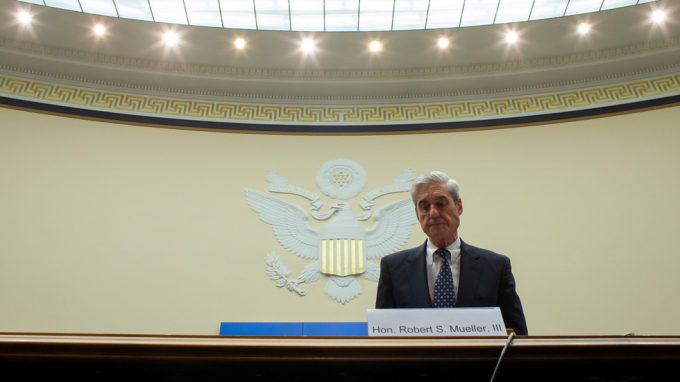
Mueller’s team WIPED over 30 cell phones before turning them over to inspector general
Obstruction of justice?
RT | September 10, 2020
Over a dozen members of Special Counsel Robert Mueller’s Russiagate-investigating team “accidentally” wiped their phones before they could be inspected and “lost” the phone of disgraced FBI lawyer Lisa Page with anti-Trump texts.
Mueller and his team were tasked with investigating accusations of President Donald Trump’s “collusion” with Russia during the 2016 election, but found no evidence of it. In their final report they tried to insinuate that Trump was guilty of obstruction of justice, but stopped short of outright saying so.
An 87-page document, released by the Justice Department on Thursday under the Freedom of Information Act, reveals that Mueller’s investigators “accidentally” or deliberately wiped their devices when the DOJ inspector-general asked for them.
At least 12 officials, whose names are redacted, claimed to have accidentally erased all data from their phones. Five officials are mentioned by name: Andrew Weissman, James Quarles, Greg Andre, Kyle Freeny and Rush Atkinson. Their phones allegedly wiped themselves or reset after too many wrong password entries.
As many as 31 phones may have been affected, including the devices that had been “reassigned.”
Weissman was Mueller’s principal deputy. He is generally considered to have actually been in charge of the ‘Russiagate’ probe, especially after the former FBI director couldn’t recall much of anything during his July 2019 testimony before Congress.
Another discovery in the document was that the phone belonging to FBI lawyer Lisa Page got “lost” by the Mueller team, and the name of the official who had custody of it: Christopher Greer. It was eventually retrieved, but the IG report found that it had been wiped two weeks after Page had left the special counsel team.
Page was involved both in the early stages of the special counsel investigation and the original ‘Crossfire Hurricane’ probe of the Trump campaign – alongside Agent Peter Strzok, with whom she had an extramarital romantic relationship. Both were quietly removed from Mueller’s team after the discovery of text messages that disparaged Trump voters and even referred to “stopping” his election via an “insurance policy.”
Russiagate without end: US appeals court REVERSES earlier decision to end Flynn criminal case
RT | August 31, 2020
A full-bench US federal appeals court has reversed an earlier decision to dismiss the ‘Russiagate’ case against former National Security Advisor Michael Flynn, returning it to the judge who refused to let the charges be dropped.
In a 8-2 ruling on Monday, the DC Circuit Court of Appeals sided with Judge Emmet Sullivan, and sent the case back to him for review. Sullivan had been ordered by a three-judge panel in June to drop the case against Flynn immediately, but hired an attorney and asked for an en banc hearing instead.
Flynn’s attorney Sidney Powell said the split was “as expected” based on the tone of the oral arguments, pointing to a partisan divide on the bench, and added it was a “disturbing blow to the rule of law.”
The former top lawyer for the Barack Obama administration, Neal Katyal, hailed the decision as “an important step in defending the rule of law” and argued the case should not be dismissed because Flynn had pleaded guilty.
Flynn had indeed pleaded guilty to one charge of lying to the FBI, but Powell moved to dismiss the charges due to the failure of his previous attorneys – a law firm with ties to the Democrats – and the government to disclose evidence that could set him free. After producing documents revealing that the FBI set out to entrap Flynn, had no valid cause to interview him in the first place, and the prosecutors improperly extorted him into a plea by threatening to charge his son, the Justice Department moved to drop all charges.
Sullivan had other ideas, however. In a highly unusual move, he appointed a retired judge – who had just written a diatribe about the case in the Washington Post – to be amicus curiae and argue the case should not be dropped. It was at this point that Powell took the case to the appeals court, citing Fokker, a recent Supreme Court precedent that Sullivan was violating.
Ignoring the fact that Sullivan had appointed the amicus and sought to prolong the case after the DOJ and the appeals court both told him to drop it, the en banc panel argued the proper procedure means he needs to make the decision before it can be appealed.
One of the judges, Thomas Griffith, actually argued in a concurring opinion that it would be “highly unusual” for Sullivan not to dismiss the charges, given the executive branch’s constitutional prerogatives and his “limited discretion” when it came to the relevant federal procedure, but said that an order to drop the case is not “appropriate in this case at this time” because it’s up to Sullivan to make the call first.
The court likewise rejected Powell’s motion to reassign a case to a different judge.
Conservatives frustrated by the neverending legal saga have blasted the appeals court’s decision as disgraceful. “The Mike Flynn case is an embarrassing stain on this country and its ‘judges’,”tweeted TV commentator Dan Bongino. “We don’t have judges anymore, only corrupted politicians in black robes.”
While Flynn was not the first Trump adviser to be charged by special counsel Robert Mueller’s ‘Russiagate’ probe, he was the first White House official pressured to resign over it, less than two weeks into the job.
With Mueller failing to find any evidence of “collusion” between President Donald Trump’s campaign and Russia, Democrats have latched onto Flynn’s case as proof of their ‘Russiagate’ conspiracy theory. The latest argument is that the effort to drop the charges against Flynn is politically motivated and proof of Attorney General Bill Barr’s “corruption.”
Barr is currently overseeing a probe by US attorney John Durham into the FBI’s handling of the investigation against Trump during and after the 2016 election, with the evidence disclosed during the Flynn proceedings strongly implicating not just the senior FBI leadership but senior Obama administration figures as well.
After Beirut blast, Israel revives tales of Hezbollah ammonium nitrate terror plots
By Gareth Porter | The Grayzone | August 26, 2020
Israeli officials have exploited the massive explosion at the Port of Beirut this August to revive a dormant propaganda campaign that had accused the Lebanese militia and political party Hezbollah of storing ammonium nitrate in several countries to wage terror attacks on Israelis.
The Israeli intelligence apparatus had planted a series of stories from 2012 to 2019 claiming Hezbollah sought out ammonium nitrate as the explosive of choice for terrorist operations. According to the narrative, Hezbollah planned to covertly store the explosive substance in locations from Southeast Asia to Europe and the US — only to be foiled repeatedly by Mossad. In each one of those cases, however, the factual record either contradicted the Israeli claims or revealed a complete dearth of evidence.
The narrative first debuted in the Israeli press after a June 2019 story in the British pro-Israel daily The Telegraph on alleged Hezbollah storage of the explosive around London. The Times of Israel introduced for the first time the much broader theme that Hezbollah planned to use the explosive for “huge, game-changing attacks on Israeli targets globally.”
Next, “new details” appeared in the Hebrew daily Yedioth Ahronoth from “unnamed Israeli intelligence officials,” disclosing how Israel had supposedly stymied ammonium nitrate-based terror plots by Hezbollah in London, Cyprus and Thailand.
Following the calamity of the Beirut explosion, the narrative story was opportunistically revived in the Israeli media, with The Times of Israel summarizing an Israeli Channel 13 report citing an “unsourced assessment” that Hezbollah “apparently planned to use the ammonium nitrate stockpile that caused a massive blast at Beirut’s port this week against Israel in a ‘Third Lebanon War’.”
A review of the supposedly open-and-shut cases in both Thailand and Cyprus, however, reveals serious questions about the evidence used to accuse Hezbollah suspects and the role of the Mossad in those cases. It also shows that an alleged Hezbollah plot involving ammonium nitrate in New York City was contrived by the FBI and Justice Department without any real evidence.
Thailand: Muddling the Issue, Bending the Law
The arrest of Hussein Atris, a dual Swedish-Lebanese citizen, in Bangkok on January 13, 2012 occurred after the Mossad received a report that a terrorist attack was due to occur in the middle of that month. The Israeli intelligence agency had given the Thai police a list of 14 or 15 suspects — all Iranian or Lebanese — to be placed under surveillance, including Atris.
But it was Atris who received the bulk of attention. After his arrest, he told police about goods he had stored in a commercial building in Bangkok. Shortly after his arrest, he was taken out of his cell to a house where he was interrogated by three Mossad agents, as was typical of Mossad operations in countries where Israel cultivated close relations with law enforcement. On January 17, Thai police visited the commercial building near Bangkok and reportedly found 4.8 tons of urea fertilizer and 40 liters (100 pounds) of ammonium nitrate.
Atris was immediately charged by the police with “possession of prohibited substances.” But in fact, the ammonium nitrate that Atris had stored in the building was not illegal; it was merely a component of frozen gel packs for sore muscles commonly bought and sold wholesale and retail all over the world.
The boxes of gel packs were stored along with electric fans, slippers and copy paper on the second floor of the building. And as Atris explained to his interrogators and to a reporter from the Swedish dailyAftonbladet who interviewed him in jail, he had been purchasing various goods in Asia and exporting them to other countries like Liberia. He had already arranged for a freighter to ship the goods he had stored there, as the chief of Bangkok metropolitan police confirmed in an interview with the New York Times.
The Mossad interrogators refused to accept the explanation by Atris and accused him of lying about his business. Further clouding the picture, police found two tons of urea fertilizer in bags labeled as cat litter on the same floor as the cold packs. But Atris told an interviewer he had never dealt with fertilizer in his business, and that he believed “it must have been placed in our storage facility by someone, probably Mossad.”
Mossad and its Thai allies were committed to the idea that Atris was a Hezbollah operative from the beginning, even though they apparently had no actual hard evidence to back it up. The claim of Hezbollah membership was nevertheless sold successfully to cooperative local and national news media. A Reuters story headlined “Thailand: Hezbollah man arrested in terror scare.” When he was brought to trial in 2013, Atris firmly denied any links to Hezbollah, and the court ultimately found that there was no evidence to support the contention by the police and Mossad that he was in any way involved with the Lebanese movement.
International press coverage of the case blurred details in a way that incorrectly suggested terrorist intent. When Atris’s case went to trial in July 2013, Agence-France Presse falsely reported that he and “unidentified accomplices” had “packed more than six tons of ammonium nitrate into bags,” thus confusing the already commercially-packaged cold packs with the urea fertilizer, which was not an illegal substance under Thai law and which he specifically denied owning. Time magazine distorted the case more seriously by referring to the bags of urea fertilizer as “chemicals being assembled into explosives… in bags labeled as kitty litter.”
In the end, Atris was convicted of “illegal possession” of ammonium nitrate, which was a banned substance under Thai law. However, the country had not intended for the provision to apply to frozen gel packs for pain relief, which are commonly traded in bulk internationally.
Despite the absence of any evidence that Atris was either a Hezbollah agent or a terrorist, the US State Department bowed to its Israeli allies and declared him to be “a member of Hezbollah’s overseas terrorist unit.”
Cyprus: The mysterious appearance of ammonium nitrate
In 2015, the Cypriot government’s prosecuted Canadian-Lebanese Hussein Bassam Abdallah for allegedly being part of a Hezbollah ammonium nitrate terrorist plot after police found 420 boxes of the fertilizer in the house where he was staying. Yet virtually no details about the case were ever released because the entire legal process took place behind closed doors. What’s more, Abdallah’s defense was never made public.
Furthermore, information from the Kuwaiti daily Al-Jarida, which Israelis have often used to disseminate propaganda into the Arab Middle East, raises serious questions about the origin of the ammonium nitrate found in the house where Abdallah was staying. The newspaper published a story citing a “private source” who said that Mossad agents had been tracking Abdallah, following his every movement and intercepting all his phone calls from Cyprus. The Mossad surveillance continued, according to the story, “until he obtained the materials and fertilizer, after which Cypriot authorities were informed [and] raided his place of residence and arrested him and seized two tons of [ammonium nitrate].…”
By reporting an apparent Mossad account that the ammonium nitrate was not at the house until just before Mossad tipped off the police, the Al-Jarida account obviously suggested that the timing of its appearance was not merely coincidental.
This was not the first time that Mossad-related evidence against one of its targets turned out to be highly suspect. Two Iranian men who were visiting Mombasa, Kenya in 2012 were charged with having buried 15 kg of the explosive RDX on a golf course. However, they had been interrogated — and one of them allegedly drugged — by three Mossad agents. Though Kenyan police had supposedly been carrying out constant surveillance on them for the entire length of their stay, no direct evidence of the Iranians ever possessing RDX came to light. That anomaly resulted in the case against the Iranians being thrown out by Kenya’s Court of Appeal , and suggested that Mossad itself had planted the explosive on the golf course.
In Abdallah’s case, the evidence also indicated the use of a classical prosecution tactic was employed to force him to admit to a Hezbollah ammonium nitrate terrorism plot: forcing a plea bargain on him by the threat of a much longer sentence if he refused to plead guilty.
After the first week of interrogation, a Cypriot security official told a journalist that Abdallah denied all charges against him and was not “cooperating” — meaning he was not admitting what both Israel and Cyprus wanted him to. Weeks later, however, following a trial closed to the public, Abdallah admitted to all eight charges against him. The semi-official Cyprus News Agency reported he had given the police a statement that the ammonium nitrate was to have been used for terrorist attacks against Jewish or Israeli interests in Cyprus. In return he was given a six-year sentence instead of the 14 years he would have received without the deal.
Abdallah’s defense lawyer, Savvas A. Angelides, pressed his client to accept the plea bargain, advancing the political interests of Cyprus as a close ally of Israel. For his part, Angelides had his eyes on a high-level national security posting in his country’s government. Sure enough, in early 2018, the lawyer was appointed Defense Minister of Cyprus.
The idea that Hezbollah obtained ammonium nitrate for use in New York City – another Israeli contention – was not supported by any evidence whatsoever. In this case, a Lebanese-American named Ali Kourani stood accused of hatching a Hezbollah terror plot. But the closest the US Justice Department could come to linking to ammonium nitrate was a statement in its criminal complaint against him.
It claimed that in May 2009, Kourani “entered China at an airport in Guangzhou, the location of Guangzhou Company-1, i.e., the manufacturer of the ammonium nitrate-based First Aid ice packs sized in connection with thwarted IJO attacks in Thailand and Cyprus.” The suggestion that a trip to Quangzhou somehow counted as evidence of an effort to procure ammonium nitrate for Hezbollah terrorism was patently absurd.
London and Germany: Mossad’s phantom Hezbollah explosives
The next apparent Israeli intel dump arrived in the form of a June 2019 story in the Telegraph UK, a right-wing Murdoch-owned daily which loyally follows Israeli propaganda lines. According to the report, in 2015, the UK MI5 intelligence service and London’s Metropolitan Police were tipped off by the Mossad about thousands of ice packs containing three tons of ammonium nitrate in warehouses in Northwest London. The Telegraph revealed that London police had arrested one man “on suspicion of plotting terrorism” but had eventually released him without charges. That detail was the giveaway that the British had come to realize that they had no evidence linking cold packs or their owner to any Hezbollah terrorist plot — contrary to the Israel narrative.
The Telegraph’s suggestion that MI5 decided not to prosecute to disrupt the threat isn’t credible, because no one was ever prosecuted. And its implication that the British government kept quiet about the episode because it was protecting the Iran nuclear deal did not apply once Trump tore up the agreement in 2018. The British government, which banned Hezbollah in February 2020, has never suggested that the Lebanese militia had been plotting to use ammonium nitrate from warehouses in the UK to carry out terrorist attacks.
According to a report this May by Israel’s Channel 12, days before Germany announced its banning of Hezbollah from the country, Mossad had gathered information on alleged Hezbollah terrorism-related activities in Germany. The supposed plotting consisted of the identification of warehouses in southern Germany where the Mossad said Hezbollah was storing ‘hundreds of kilograms” of ammonium nitrate.
After the information was presented to German intelligence and law enforcement agencies, according to the report, the German Interior Ministry announced in April 2020 that it was banning Hezbollah. It simultaneously raided four mosque associations accused of being close to Hezbollah. But German law enforcement never announced any action regarding warehouses supposedly holding ammonium nitrate, indicating that the German government found nothing that backed up the claims by Mossad.
Hoping to seize the Beirut explosion as a historic propaganda opportunity, the Israelis clearly believe they can fashion a new and more powerful narrative by knitting together false claims related to these episodes. Their objective is to achieve their longtime objective of forcing Hezbollah out of the Lebanese government by implicating it in the calamitous blast. So far, Western corporate media appears inclined to accept the baseless Israeli claims on face value. The day after the blast in Beirut, the Washington Post reported that Hezbollah “has long shown an interest in acquiring [ammonium nitrate] for use in a variety of terrorist plots.”
‘We Have Absolute Proof’ DNC Leaks Were Not Hacked, NSA Whistleblower Says
Sputnik – 12.08.2020
Because the National Security Agency is tapped into data transfer points throughout the United States, via its mass surveillance programmes, if there was any evidence that the DNC servers were hacked then they would have the evidence to prove it, a former technical director at the agency explains.
Documents published by WikiLeaks that belonged to the Democratic National Committee (DNC) could not have been hacked via the internet and must have been initially downloaded from within the US, according to an investigation by members of Veteran Intelligence Professionals for Sanity (VIPS).
Bill Binney, a cryptogropher and former technical director at the US National Security Agency (NSA), blew the whistle on the agency’s mass surveillance programmes after serving with them for 30 years. Mr Binney detailed for Sputnik why the forensic evidence proves that key claims of Russiagate (regarding Russian officials hacking the DNC servers) are a “farce”.

© Photo : Bill Binney
Sputnik: A recent investigation by you and some of your colleagues at Veteran Intelligence Professionals for Sanity determined that the Democratic National Committee documents published by WikiLeaks in 2016 could not have been hacked by actors outside the US and instead had to have been downloaded onto a USB or CD-ROM.
Bill Binney: Yes, that’s right. And we have forensic evidence to prove it.
Sputnik: Could you please break down, for the average layperson, exactly how you came to this conclusion?
Bill Binney: Well, we did it by looking at the published DNC emails by WikiLeaks. In other words, the original assertion was that the DNC data was hacked externally, from Russia or by the Russians in Europe or something, and then transferred to WikiLeaks to publish so they could influence the election.
We looked at the DNC emails that were documented by WikiLeaks on the web. And that came down in three groups. One came down on 23rd of May 2016 and the other 25th of May 2016 and then one on the 26th of August of 2016. All of those three batches of emails had last modified times ending in an even number and even second, rounding up to the second, not including milliseconds. So, that meant to us that that was the property of the FAT (file allocation table) format. It’s a programme that when you read data to a thumb drive or CD ROM, and the programme indexes stuff on the [CD] and the thumb drive, for example, it then also rounds off the last modified time to an even number. That tells us very simply that there is 35,813 emails, all with the same property FAT file formatting saying that hey this was read [ie downloaded] to a thumb drive or a CD ROM before WikiLeaks got it to publish. Which meant it was physically transported to WikiLeaks. So, for us, that meant it was not a hack. Period.
We also had [CEO of cyber security firm Crowdstrike] Shawn Henry give testimony, I think it was the 7th of January of 2017, the secret testimony that just came out, where he said ‘we had indications that the data was exfiltrated, but we didn’t see the data exfiltrated’. Well, the indications that it was [exfiltrated], is this a FAT file format, to my mind. I mean, Shawn Henry never said specifically why his people were saying that. So for us, the only thing he could be [basing] it on what was last modified time.
Sputnik: So, just to be clear, when information is downloaded onto a CD roam or thumb drive, you’re saying that there’s a particular process, which means that, the last modified time will be recorded in such a way onto those files that is different than if those files were hacked and taken from a server across international boundaries or across a very long distance.
Bill Binney: Right. And we had provided all this data to the courts. Also we’ve included the Podesta emails, which show how a hack could occur and what the last modified times looked like. And that’s a, that’s also published by WikiLeaks, I think on the 21st of September [2016], that’s the date for that, that they put it out there. And the modified times of those files… close to 10,000 of them I think, run through even and odd numbers and various times, including milliseconds, things of that nature. So all that stuff, all that data, we provided to several courts, and several sets of lawyers to introduce as evidence in court and we were prepared to testify to that in court.
Sputnik: And is it not possible for the last modified time to be changed somehow or modified itself?
Bill Binney: Sure, but I don’t know of a programme that does, other than FAT, I mean, keeping in mind, you’re talking about 35,813 files. If you want to change them, you can go in and do them individually one at a time. I don’t know of any other programme that does it automatically, which is what what’s happened here, because it’s just a straightforward consistency. Humans make errors. If they go in and do something like that, they’ll make errors somewhere in the files. We didn’t see any errors at all. So that’s a program doing [it].
Sputnik: How many people from VIPs would you say were involved in this investigation that you conducted?
Bill Binney: Probably about six and a couple of auxiliaries, as we call them, in the UK cooperating with us. And we had a couple other people from outside VIPS helping us because they were also interested in getting to it too. Also, people who retired from commercial companies, running fiber lines and things like that.
Sputnik: If you were still working at the NSA and you were tasked to investigate an alleged hack would you have additional technical resources if you worked for the government, then if you’re doing it independently?
Bill Binney: Yeah, absolutely. This is one of the reasons why I started in August of 2016 saying that this entire Russiagate story was a farce. And that basically came out by knowing the capacity of NSA. The capabilities of them being able to capture stuff on the web. I mean, [the NSA] have over almost a hundred tap points inside the United States, all loaded up with fiber optic lines… You know, it can take everything off those lines and capture it. [A]nd that was true across the US as well as all the external points exiting and entering where you exit and enter the US.
And you’ll notice that NSA never said they saw any of the data transferring anywhere on any line. And that’s because it didn’t, it went on a thumb drive, you know, that’s the difference. That was one of the main reasons I said that this was not a hack. Because if it was NSA would have it. Like they did when the Chinese hacked one of the places over here in the US about six years ago. The government said, the hack came from this building in Shanghai.
Sputnik: And is there any kind of a practical or legal consideration as to why the NSA can’t publish its findings regarding the DNC servers?
Bill Binney: Actually, there isn’t, if the president approves, I mean, he can declassify anything he wants.
Sputnik: So where do you go from here? Is there more to investigate in relation to this subject or is this the end of the matter for you?
Bill Binney: As far as I’m concerned, we have absolute proof that this whole thing […] Russiagate, is a fabrication. It was a fabrication of the FBI, CIA and the DOJ primarily, but also included the State Department and [Department for Homeland Security] and a number of other departments.
Sputnik: There are those that argue Julian Assange will have a fair trial in the US should he be extradited. What can you tell us about the U.S. District Court for the Eastern District of Virginia, where Mr Assange would be tried?
Bill Binney: That’s a court that’s pro CIA because it’s in that jurisdiction of CIA. This is why they picked that court because it’s pro CIA and whatever national security issues come up, they will always go with that national security. So, you have a prejudiced judge in a court to begin with.
Sputnik: Would there be a jury with 12 men and women?
Bill Binney: Pulled from the area and most of them work for the government. So, you know, you just look at it. I mean, that should be a disqualifier as a jury from my point of view. But also think of it this way: Julian Assange published data he was given. So has the New York Times, The Guardian, all the major publications, the Washington Post, they’ve all done that. So why aren’t they being charged also?
Sputnik: Well, the US government is claiming that the first amendment does not apply to foreign journalists.
Bill Binney: Well then why don’t they go after The Guardian ?
Sputnik: Maybe they’re next?
Bill Binney: [I]f you accept their premise – of the US government – that means that any journalist anywhere in the world, publishing any article that exposes crimes by the US government, the US government can charge them with conspiracy to violate national security. So, every reporter in the world is now liable based on that [premise].
This interview has been edited for concision and clarity
Political Legitimacy Dies in 2020
By James Bovard | American Institute for Economic Research | July 28, 2020
The American political system may be on the eve of its worst legitimacy crisis since the Civil War. Early warning signals indicate that many states could suffer catastrophic failures in counting votes in November. The election will occur amidst the vast economic devastation inflicted by a political class that responded to COVID by seizing almost unlimited power. And Deep State federal agencies have already proven that they will trample the law to sabotage election results.
America could soon see a hundred-times worse replay of the Florida presidential balloting 20 years ago in the Bush-Gore showdown. Some Florida counties had antiquated voting equipment while others had harebrained ballot designs that confounded voters. The Florida Supreme Court ordered a manual recount of disputed votes but the Supreme Court, in a 5-to-4 decision, stopped the recount because it could result in “a cloud upon what [George W. Bush] claims to be the legitimacy of his election,” Justice Antonin Scalia wrote. Two days, the same Supreme Court majority blocked any subsequent recounting because it was “not well calculated to sustain the confidence that all citizens must have in the outcome of elections.” Unfortunately, “legitimacy via blocked recounts” may also be the epithet for the 2020 presidential election.
Because of the pandemic, many states are switching primarily to mail-in voting even though experiences with recent primaries were a disaster. In New York City, officials are still struggling to count mail-in ballots from the June primary. Up to 20% of ballots “were declared invalid before even being opened, based on mistakes with their exterior envelopes,” the Washington Post noted, thanks largely to missing postmarks or signatures. In Wisconsin, more than 20,000 “primary ballots were thrown out because voters missed at least one line on the form, rendering them invalid.”
Some states are mailing ballots to all the names on the voting lists, providing thousands of dead people the chance to vote from the grave. President Trump claims that the shift to mail-in voting could result in “the most corrupt vote in our nation’s history.” Trump is often wrong on issues but even a New York Daily News article tagged the recent primary results a “dumpster fire.” Delayed election results and potentially millions of disputed ballots could minimize support for whoever is designated the next president.
Elections supposedly choose which candidates are selected to follow the law and uphold the Constitution, but COVID shutdown dictates vividly how political power is now practically unlimited. Michigan governor Gretchen Whitmer prohibited “all public and private gatherings of any size” (prohibiting people from visiting friends) and also prohibited purchasing seeds for spring planting in stores after she decreed that a “nonessential” activity. Oregon Governor Kate Brown banned the state’s four million residents from leaving their homes except for essential work, buying food, and other narrow exemptions, and also banned all recreational travel – even though much of her state had almost zero COVID cases.
In the name of reducing risks, politicians entitled themselves to destroy tens of millions of jobs. Permitting governors to shut down churches was not on the ballot but that didn’t stop many states from banning worship services at the same time politicians cheered mass protests that scorned “stay-at-home” orders.
The media has often whitewashed the damage from COVID power grabs in part because every restriction was supposedly justified by “science.” After New York Gov. Andrew Cuomo dictated that nursing homes must admit COVID patients, more than 6,000 elderly nursing home residents were killed by the coronavirus. Cuomo has yet to reveal which “science” textbook spawned this policy (which several other states also imposed). Were those state governments grossly incompetent or were they murderous? It doesn’t matter because Trump made rude comments about N.I.H. honcho and media darling Anthony Fauci. What’s the point of voting for politicians who merely need to invoke dubious statistical extrapolations to sow death and economic devastation?
Finally, does the presidential election even matter? Deep State federal agencies are a Godzilla that have established their prerogative to undermine if not overturn election results. The FBI has achieved saint-like status among many liberals for its efforts to topple Trump. For almost three years, the nation’s political life was roiled by an investigation driven by false allegations that the Trump campaign colluded with Russia in the 2016 election. As George Washington University professor Jonathan Turley observed last week, the media continues to ignore “one of the biggest stories in decades. The Obama administration targeted the campaign of the opposing party based on false evidence.” Obama officials who exploited the CIA and other intelligence agencies to illicitly target Trump campaign officials have laughed all the way to million-dollar book advances.
During the Trump impeachment effort, the establishment media openly cheered the Deep State. New York Times columnist James Stewart assured readers that the secretive agencies “work for the American people,” New York Times editorial writer Michelle Cottle hailed the Deep State as “a collection of patriotic public servants,” and Washington Post columnist Eugene Robinson captured the Beltway’s verdict: “God bless the Deep State!” The media has almost completely abandoned its watchdog role, and its veneration will make it easier for the FBI, CIA, and National Security Agency to ravage not just elections but also Americans’ rights and liberties in the coming years.
Even before the voting starts, surveys show that for the first time “a majority of Americans (55 percent) are dissatisfied with their system of government,” the Atlantic reported. The percentage of Americans who “expressed trust in government in Washington” has fallen from 73% in 1958 to only 17% now, according to the Pew Research Center. But those numbers could quickly become far more ominous for our political ruling class.
What happens if Trump continues to repel many if not most potential voters, and then Biden comes across in the presidential debates as clueless and doddering as did Special Counsel Robert Mueller in a congressional hearing last July? How many Americans will feel forced to choose between a scoundrel and an idiot?
Many pundits and professors presume that a Biden victory in November will magically re-legitimize the American political system. But almost all the problems of recent years will continue or intensify. The Centers for Disease Control and the Food and Drug Administration, both of which horribly botched the nation’s response to COVID, will continue bollixing public health crises. U.S. foreign policy will continue to be reckless and self-defeating, with American pretensions to global hegemony becoming ever more ludicrous. Deficit spending will continue to spin out of control, spiraling closer to the day when the Federal Reserve’s sorcery fails to entrance financial markets. Unfortunately, both Democrats and Republicans appear willing to bankrupt the nation to perpetuate their own power.
Federal legitimacy hinges on the Constitution, but there is not a snowball’s chance in hell that either Trump or Biden will “make America constitutional again.” As Thomas Jefferson declared in 1786, “An elective despotism was not the government we fought for.” What’s the point of voting if “government under the law” is not a choice on Election Day? American political legitimacy will continue plummeting as long as politicians scorn any legal and constitutional limits on their power.
James Bovard is the author of ten books, including Public Policy Hooligan, Attention Deficit Democracy, The Bush Betrayal, and Lost Rights: The Destruction of American Liberty. He has written for the New York Times, Wall Street Journal, Playboy, Washington Post, New Republic, Reader’s Digest, and many other publications. He is a member of the USA Today Board of Contributors, a frequent contributor to The Hill, and a contributing editor for American Conservative.
Cybereason Announces New Plans to “Accelerate” Access to US Govt Networks Ahead of 2020 Election
By Whitney Webb | The Last American Vagabond | July 27, 2020
A cybersecurity firm tied to Israeli intelligence’s Unit 8200 that simulated a series of terrorist attacks occurring on the U.S. 2020 election has announced a new hire with deep ties to the U.S. intelligence and defense communities with the goal of gaining greater access to U.S. government networks.
A cybersecurity company tied to Israeli intelligence and a series of unnerving simulations regarding cyber-terrorist attacks on the upcoming U.S. elections has recently announced a new hire who plans to aid the company in further penetrating the U.S. public sector. Last Wednesday, the company Cybereason announced that it had hired Andrew Borene as its Managing Director for its recently launched U.S. public sector business. Borene, who boasts longstanding ties to the U.S. intelligence community and the Pentagon, “will accelerate Cybereason’s partner and customer presence in the U.S. public sector,” according to a Cybereason press release.
“My goal is to build a strong business for Cybereason within the U.S. public sector and I am planning to recruit a group of direct support executives, veterans and alumni of the elite [U.S.] military units and agencies that have defended our nation in the information age. I’ll also work to establish a network of the best channel and delivery partners for federal, state and local governments,” Borene said per the press release.
Eric Appel, Cybereason’s General Manager for North American Sales, stated that “We’re excited about Andrew joining Cybereason and the opportunity in the U.S. public sector for Cybereason to make a profound impact on helping the nation’s federal civilian, military, state and local government agencies…”
Borene will likely be successful in his ability to recruit a sales team of prominent alumni from the U.S. intelligence and defense communities to market Cybereason’s products throughout the U.S. government. Prior to joining Cybereason, Borene was a senior advisor to the Intelligence Advanced Research Projects Activity (IARPA), the intelligence community’s “DARPA” equivalent that is housed within the Office of the Director of National Intelligence (ODNI). He served in that capacity on behalf of intelligence contractor Booz Allen Hamilton. Prior to that, Borene served as Associate Deputy General Counsel to the Pentagon and was previously a military intelligence officer for the U.S. Marine Corps.
Borene’s private sector experience is also significant, as he was a senior executive at IBM. Notably, the current Chief Information Officer for the CIA, Juliane Gallina, had served alongside Borene as a top IBM executive prior to taking her current position at the agency. In addition, Borene also boasts ties to Wall Street as a veteran of Wells Fargo’s investment banking division.
In addition, Borene has deep ties to Washington’s foreign policy establishment as a “life member” of the Council on Foreign Relations (CFR) and to the national security-think tank nexus through his senior fellowship at the National Security Institute (NSI). NSI’s board includes former NSA directors, Keith Alexander and Michael Hayden (also a former CIA director); former Deputy Defense Secretary and “architect” of the Iraq War, Paul Wolfowitz; former director of the Defense Intelligence Agency, David Shedd; and a variety of other former top intelligence and defense officials as well as Silicon Valley executives and venture capitalists.
Notably, Borene is the latest addition to Cybereason with ties to the U.S. intelligence and defense communities as the company’s advisors include Robert Bigman, former Chief Information Security Officer for the CIA as well as Peter Sherlock, the former Chief Operating Officer of MITRE corporation, a major intelligence and defense contractor connected to the Ptech-9/11 controversy.
Cybereason: a front for Israeli Military Intelligence
Cybereason’s announcement of its hire of Andrew Borene coincided with its launch of its new “U.S. public sector business,” meaning that Cybereason now seeks to have its cybersecurity software running on even more of the U.S. government’s most classified networks. Cybereason, for years, has already been running on several sensitive U.S. government networks through its partnerships with IT contractors for intelligence and defense, such as Lockheed Martin (also a Cybereason investor), WWT and Leidos. However, Borene’s hire and this new publicly announced pivot towards the U.S. public sector clearly demonstrates the company’s interest in further deepening its presence on U.S. government networks.
Cybereason’s pivot is concerning for several reasons. First, its co-founders are alumni of Israel’s Unit 8200, an elite unit of the Israeli Intelligence corps that is part of the IDF’s Directorate of Military Intelligence and is involved mainly in signal intelligence, surveillance, cyberwarfare and code decryption. It is also well-known for its surveillance of Palestinian civilians and for using intercepted communications as blackmail in order to procure informants among Palestinians living under occupation in the West Bank.
In addition, all three Cybereason co-founders, after leaving Unit 8200, went on to work for two private Israel-based tech/telecom companies with a notorious history of aggressive espionage against the U.S. government: Amdocs and Comverse Infosys (the latter is now known as Verint Systems Inc.). This raises the possibility that Cybereason software could potentially be used as a backdoor by unauthorized actors, given that the company’s co-founders all previously worked for firms that have a history of placing backdoors into U.S. telecommunications and electronic infrastructure as well as aggressively spying on U.S. federal agencies.
Also notable is the fact that the company’s current CEO and co-founder Lior Div was much more than the average Unit 8200 officer during his time in the unit, as he “served as a commander [in Unit 8200] and carried out some of the world’s largest cyber offensive campaigns against nations and cybercrime groups. For his achievements, he received the Medal of Honor, the highest honor bestowed upon Unit 8200 members,” according to his biography. Troublingly, in an interview that Div gave to TechCrunch last year, Div stated that his work at Cybereason is “the continuation of the six years of training and service he spent working with the Israeli army’s 8200 Unit.”
This is particularly noteworthy given that Israel’s government has openly admitted that an on-going intelligence operation, first initiated in 2012 – the year Cybereason was founded, involves Israeli military intelligence and intelligence operations that had previously done “in house” (i.e. as part of Unit 8200, Mossad, etc.) being spun off into private companies, specifically start-ups in the “cyber” realm.
This operation is part of Israeli Prime Minister Benjamin Netanyahu’s “deliberate policy” to have former members of Israel’s “military and intelligence units … merge into companies with local partners and foreign partners” in order to make it all but impossible for major corporations and foreign governments to boycott Israel and to also to ensure that Israel becomes the world’s dominant “cyber power.”
One notable report on this policy, published by Israeli outlet Calcalist Tech, interviewed dozens of Israeli military, intelligence and government officials and noted that “since 2012, cyber-related and intelligence projects that were previously carried out in-house in the Israeli military and Israel’s main intelligence arms are transferred to companies that in some cases were built for this exact purpose.” The article also states that beginning in 2012, Israel’s intelligence and military intelligence agencies began to outsource “activities that were previously managed in-house, with a focus on software and cyber technologies.”
“Simulating” the Cancellation of the 2020 Election
In light of Cybereason’s background and the “acceleration” of their presence on U.S. government networks, the timing of their redoubled efforts to court the U.S. public sector add additional layers of concern given that it precedes the U.S. 2020 election by a matter of months. Since last year, Cybereason has conducted multiple simulations focused on the 2020 election, which were attended by federal officials from the FBI, DHS and the U.S. Secret Service and all of which ended in disaster. In those simulations, the 2020 election was ultimately canceled and martial law was then declared due to the chaos created by a group of hackers led by Cybereason employees.
Notably, Cybereason stood to gain nothing financially from the simulations given that their software could not have prevented the attacks waged against the U.S.’ electoral infrastructure in the exercise and the company framed their hosting of the simulations as merely “altruistic” because of their professed desire to help “protect” U.S. election infrastructure. The attacks conducted in the simulations by Cybereason employees included creating power grid blackouts, the use of deep fakes to sow confusion, creating havoc with municipal sewage systems and crashing self-driving cars into voters waiting in line to cast their ballots, killing 32 and injuring over a hundred people.
In the months since I first wrote about Cybereason and their 2020 “doomsday” simulations back in January, U.S. government officials and mass media alike have been warning that these same types of attacks that Cybereason simulated are likely to come to pass on this upcoming election day, scheduled for November 3rd of this year. More recently, in less than a week, headlines like “Election Security Experts Expect ‘Chaos’ Unless Action Taken,” “New York’s Pandemic Voting ‘Chaos’ Set to Go Nationwide in November,” and “Foreign adversaries ‘seeking to compromise’ presidential campaigns, intel warns,” among others, have been published in major U.S. media outlets.
While these narratives have asserted that China, Russia and/or Iran will be to blame for such attacks, it is worth noting that a tight-knit web of Israeli state-owned and private companies tied to Israeli military intelligence now run the software controlling key parts of the power grid in New York, California and elsewhere in the U.S.; are the main global producers of deep fakes; and the main providers of “security” software for self-driving and semi-self-driving cars, the quantity of which on U.S. streets has grown dramatically as a result of the coronavirus crisis.
With Cybereason’s newly announced push to run its software on critical U.S. government networks at both the federal and state levels, the company’s history of simulating terror attacks on critical U.S. infrastructure and their openly admitted and on-going ties to Israeli military intelligence deserve more scrutiny than ever as the U.S. election draws closer.
Trump, Kennedy, and the Russia Collusion Delusion
By Jacob G. Hornberger | FFF | July 15, 2020
President Trump’s commutation of Roger Stone’s jail sentence has brought the Russia collusion delusion back into the limelight.
Special prosecutor (and former FBI Director) Robert Mueller, the lawyer in charge of conducting an in-depth investigation into whether Trump colluded with the Russians to win the 2016 presidential election, immediately fired a salvo against Trump’s commutation in an op-ed defending his investigation that was published in the Washington Post.
Mueller’s op-ed was then followed by an op-ed by one of his senior prosecutors, Andrew Weismann, in yesterday’s New York Times, which called for summoning Stone before a grand jury to force him to tell the truth about why he lied. Weissmann’s idea is that if Stone fails to tell the truth again, he should again be prosecuted and punished for perjury, preferably after Trump is defeated in November.
What about Clapper?
Mueller and Weissmann can wax eloquent all they want about the importance of testifying truthfully to Congress or federal investigators. But their words ring hollow given what happened to James R. Clapper Jr., the former director of national intelligence. He knowingly, deliberately, and intentionally testified falsely to Congress about the mass secret surveillance that the NSA was conducting on the American people. U.S. prosecutors turned a blind eye toward his perjury and did nothing to indict or prosecute him. Why go after Stone (or, for that matter, Martha Stewart) and do nothing against Clapper?
The Russia collusion delusion
What is really going on here? It’s the Russia collusion delusion that is at the center of this entire controversy. Mueller, Weissmann, and their Inspector Clouseau cohorts were convinced from the beginning that there was a conspiracy between Donald Trump and the Russians to rig the U.S. presidential election in favor of Trump. Even worse, they, along with members of the FBI and the national-security establishment, obviously convinced themselves that as part of the deal, Trump may well have become an unregistered covert agent of the Russian government.
Anyone who thinks that the U.S. Cold War mindset ended with the dismantling of the Soviet Union in 1989 is loving in la la land. Sure, the Berlin Wall came crashing down, Soviet troops withdrew from Eastern Europe, and the Warsaw Pact and the Soviet Union dismantled. But the anti-Soviet, anti-Russian mindset that afflicted U.S. officials for 45 years, especially those in the national-security establishment, never disappeared. As long as Russia has maintained a sense of independence from U.S. control, it has continued to be considered a grave threat to U.S. “national security.”
The fact is that the U.S. national-security establishment — or what President Eisenhower referred to as the military-industrial-congressional complex — will never permit a U.S. president to establish normal and friendly relations with Russia. And any president who does so will automatically be considered suspect, just as Trump has been. If he goes too far in that direction, he runs the risk of being considered a grave threat to “national security.”
Kennedy: a threat to “national security?
That is, of course, what happened with President Kennedy. After the Cuban Missile Crisis, he made no bones about it. He threw the gauntlet down to the U.S. national security establishment. In his famous Peace Speech at American University 3 1/2 months before he was assassinated, he suddenly announced that he was declaring an end to the Cold War. He also stated that he intended to establish a relationship of peaceful co-existence with the Soviet Union and the communist world. He told the audience and the world that despite philosophical differences, there was no reason why America and Russia could not work together with a peaceful and friendly relationship. He then entered into secret personal negotiations to that end with Soviet Premier Nikita Khrushchev.
As part of his plan, Kennedy announced a partial withdrawal of U.S. troops from Vietnam. He told aides that as soon as he won the 1964 election, he would pull out the rest. He also entered into a nuclear test-ban treaty with the Soviets. He proposed a joint trip to the moon, which would have meant sharing rocket technology with the Soviets. It doesn’t take a rocket scientist to figure out what the next logical step was going to be — the dismantling of the Cold War apparatus and a restoration of a limited-government republic.
Imagine how all of that went over with the U.S. national-security establishment, which was already convinced that there was a communist conspiracy based in Moscow to take over the world, including the United States. The notion that the free world could live in peaceful harmony with the communist world was considered naive folly at best and treason at worst. In the eyes of the U.S. national security establishment, ending the Cold War, which likely would have led to the dismantling of the U.S. national security state, was equivalent to simply surrendering the United States to the communists.
After all, don’t forget that this was the very reason why the U.S. government was converted after World War II into a national-security state — to enable U.S. officials to exercise the same omnipotent, dark-side powers employed by the communists in order to prevent their supposed conspiracy from succeeding.
Don’t forget also that sympathy and empathy with communism or the Russians was precisely the reason U.S. national-security state officials initiated regime change operations against foreign presidents and prime ministers both before and after the Kennedy assassination: Mossadegh in Iran, Arbenz in Guatemala, Lumumba in Congo, Castro in Cuba, and Allende in Chile.
How could U.S. national-security state officials just ignore a U.S. president who suddenly had become a threat to national security, a much graver threat in fact than the foreign officials they had ousted from power in regime-change operations.
Given their conviction that Kennedy’s actions were going to result in a communist takeover of the United States, what were U.S. officials supposed to do — just let it happen? For all they knew, Kennedy had become a covert agent of the Soviets, just as U.S. officials in our time have become convinced that Trump became a covert agent of the Russians.
What Kennedy was doing was certainly not an impeachable offense, and so they couldn’t remove him from office that way, as they tried to do with Trump. Moreover, it was clear that Kennedy would almost certainly defeat Barry Goldwater in the 1964 election.
What to do? Follow the Constitution and let America fall to the communists? Or do here in the United States what had to be done in Iran, Guatemala, Congo, Cuba, and Chile to protect “national security”?
See also:
JFK’s War with the National Security Establishment: Why Kennedy Was Assassinated by Douglas Horne
The Kennedy Autopsy by Jacob Hornberger
The Kennedy Autopsy 2: LBJ’s Role in the Assassination by Jacob Hornberger
Regime Change: The JFK Assassination by Jacob Hornberger
The CIA, Terrorism, and the Cold War: The Evil of the National Security State by Jacob Hornberger
CIA & JFK: The Secret Assassination Files by Jefferson Morley
“The National Security State and JFK,” a FFF conference featuring Oliver Stone and ten other speakers
“Altered History: Exposing Deceit and Deception in the JFK Assassination Medical Evidence,” a five-part video by Douglas P. Horne
“The JFK Assassination,” a video series by Jacob Hornberger
How an Israeli Spy-Linked Tech Firm Gained Access to the US Gov’t’s Most Classified Networks
By Whitney Webb |
Unlimited Hangout| July 15, 2020
If the networks of the U.S. military, the U.S. intelligence community and a slew of other U.S. federal agencies were running the software of a company with deep ties, not only to foreign companies with a history of espionage against the U.S. but also foreign military intelligence, it would — at the very least — garner substantial media attention. Yet, no media reports to date have noted that such a scenario exists on a massive scale and that the company making such software recently simulated the cancellation of the 2020 election and the declaration of martial law in the United States.
Earlier this month, MintPress News reported on the simulations for the U.S. 2020 election organized by the company Cybereason, a firm led by former members of Israel’s military intelligence Unit 8200 and advised by former top and current officials in both Israeli military intelligence and the CIA. Those simulations, attended by federal officials from the FBI, DHS and the U.S. Secret Service, ended in disaster, with the elections ultimately canceled and martial law declared due to the chaos created by a group of hackers led by Cybereason employees.
The first installment of this three part series delved deeply into Cybereason’s ties to the intelligence community of Israel and also other agencies, including the CIA, as well as the fact that Cybereason stood to gain little financially from the simulations given that their software could not have prevented the attacks waged against the U.S.’ electoral infrastructure in the exercise.
Also noted was the fact that Cybereason software could be potentially used as a backdoor by unauthorized actors, a possibility strengthened by the fact that the company’s co-founders all previously worked for firms that have a history of placing backdoors into U.S. telecommunications and electronic infrastructure as well as aggressive espionage targeting U.S. federal agencies.
The latter issue is crucial in the context of this installment of this exclusive MintPress series, as Cybereason’s main investors turned partners have integrated Cybereason’s software into their product offerings. This means that the clients of these Cybereason partner companies, the U.S. intelligence community and military among them, are now part of Cybereason’s network of more than 6 million endpoints that this private company constantly monitors using a combination of staff comprised largely of former intelligence operatives and an AI algorithm first developed by Israeli military intelligence.
Cybereason, thus far, has disclosed the following groups as lead investors in the company: Charles River Ventures (CRV), Spark Capital, Lockheed Martin and SoftBank. Charles River Ventures (CRV) was among the first to invest in Cybereason and has been frequently investing in other Israeli tech start-upsthat were founded by former members of the elite Israeli military intelligence Unit 8200 over the last few years. Spark Capital, based in California, appears to have followed CRV’s interest in Cybereason since the venture capitalist who co-founded Spark and led its investment in Cybereason is a former CRV partnerwho still has close ties to the firm.
While CRV and Spark Capital seem like just the type of investors a company like Cybereason would attract given their clear interest in similar tech start-ups coming out of Israel’s cyber sector, Cybereason’s other lead investors — Lockheed Martin and SoftBank — deserve much more attention and scrutiny.
Cybereason widely used by US Government, thanks to Lockheed
“A match made in heaven,” trumpeted Forbes at the news of the Lockheed Martin-Cybereason partnership, first forged in 2015. The partnership involved not only Lockheed Martin becoming a major investor in the cybersecurity company but also in Lockheed Martin becoming the largest conduit providing Cybereason’s software to U.S. federal and military agencies.
Indeed, as Forbes noted at the time, not only did Lockheed invest in the company, it decided to integrate Cybereason’s software completely into its product portfolio, resulting in a “model of both using Cybereason internally, and selling it to both public and private customers.”
Cybereason CEO and former offensive hacker for Israeli military intelligence — Lior Div — said the following of the partnership:
Lockheed Martin invested in Cybereason’s protection system after they compared our solution against a dozen others from the top industry players. The US firm was so impressed with the results they got from Cybereason that they began offering it to their own customers – among them most of the top Fortune 100 companies, and the US federal government. Cybereason is now the security system recommended by LM to its customers for protection from a wide (sic) malware and hack attacks.”
Rich Mahler, then-director of Commercial Cyber Services at Lockheed Martin, told Defense Daily that the company’s decision to invest in Cybereason, internally use its software, and include the technology as part of Lockheed Martin’s cyber solutions portfolio were all “independent business decisions but were all coordinated and timed with the transaction.”
How independent each of those decisions actually was is unclear, especially given the timing of Lockheed Martin’s investment in Cybereason, whose close and troubling ties to Israeli intelligence as well as the CIA were noted in the previous installment of this investigative series. Indeed, about a year prior to their investment in the Israeli military intelligence-linked Cybereason, Lockheed Martin opened an office in Beersheba, Israel, where the IDF has its “cyberhub”. The office is focused not on the sales of armaments, but instead on technology.
Marilyn Hewson, Lockheed Martin’s CEO, said the following during her speech that inaugurated the company’s Beersheba office:
The consolidation of IDF Technical Units to new bases in the Negev Desert region is an important transformation of Israel’s information technology capability… We understand the challenges of this move. Which is why we are investing in the facilities and people that will ensure we are prepared to support for these critical projects. By locating our new office in the capital of the Negev we are well positioned to work closely with our Israeli partners and stand ready to: accelerate project execution, reduce program risk and share our technical expertise by training and developing in-country talent.”
Beersheba not only houses the IDF’s technology campus, but also the Israel National Cyber Directorate, which reports directly to Israel’s Prime Minister, as well as a high-tech corporate park that mostly houses tech companies with ties to Israel’s military intelligence apparatus. The area has been cited in several media reports as a visible indicator of the public-private merger between Israeli technology companies, many of them started by Unit 8200 alumni, and the Israeli government and its intelligence services. Lockheed Martin quickly became a key fixture in the Beersheba-based cyberhub.
Not long before Lockheed began exploring the possibility of opening an office in Beersheba, the company was hacked by individuals who used tokens tied to the company, RSA Security, whose founders have ties to Israel’s defense establishment and which is now owned by Dell, a company also deeply tied to the Israeli government and tech sector. The hack, perpetrated by still unknown actors, may have sparked Lockheed’s subsequent interest in Israel’s cybersecurity sector.
Soon after opening its Beersheba office, Lockheed Martin created its Israel subsidiary, Lockheed Martin Israel. Unlike many of the company’s other subsidiaries, this one is focused exclusively on “cybersecurity, enterprise information technology, data centers, mobile, analytics and cloud” as opposed to the manufacture and design of armaments.
Haden Land, then-vice president of research and technology for Lockheed Martin, told the Wall Street Journal that the creation of the subsidiary was largely aimed at securing contracts with the IDF and that the company’s Israel subsidiary would soon be seeking partnership and investments in pursuit of that end. Land oversaw the local roll-out of the company’s Israel subsidiary while concurrently meeting with Israeli government officials. According to the Journal, Land “oversees all of Lockheed Martin’s information-systems businesses, including defense and civilian commercial units” for the United States and elsewhere.
Just a few months later, Lockheed Martin partnered and invested in Cybereason, suggesting that Lockheed’s decision to do so was aimed at securing closer ties with the IDF. This further suggests that Cybereason still maintains close ties to Israeli military intelligence, a point expounded upon in great detail in the previous installment of this series.
Thus, it appears that not only does Lockheed Martin use Cybereason’s software on its own devices and on those it manages for its private and public sector clients, but it also decided to use the company’s software in this way out of a desire to more closely collaborate with the Israeli military in matters related to technology and cybersecurity.
The cozy ties between Lockheed Martin, one of the U.S. government’s largest private contractors, and the IDF set off alarm bells, then and now, for those concerned with U.S. national security. Such concern makes it important to look at the extent of Cybereason’s use by federal and military agencies in the United States through their contracting of Lockheed Martin’s Information Technology (IT) division. This is especially important considering Israeli military intelligence’s history of using espionage, blackmail and private tech companies against the U.S. government, as detailed here.
While the exact number of U.S. federal and military agencies using Cybereason’s software is unknown, it is widespread, with Lockheed Martin’s IT division as the conduit. Indeed, Lockheed Martin was the number one IT solutions provider to the U.S. federal government up until its IT division was spun off and merged with Leidos Holdings. As a consequence, Leidos is now the largest IT provider to the U.S. government and is also directly partnered with Cybereason in the same way Lockheed Martin was. Even after its IT division was spun off, Lockheed Martin continues to use Cybereason’s software in its cybersecurity work for the Pentagon and still maintains a stake in the company.
The Leidos-Lockheed Martin IT hybrid provides a litany of services to the U.S. military and U.S. intelligence. As investigative journalist Tim Shorrock noted for The Nation, the company does “everything from analyzing signals for the NSA to tracking down suspected enemy fighters for US Special Forces in the Middle East and Africa” and, following its merger with Lockheed and consequential partnership with Cybereason, became “the largest of five corporations that together employ nearly 80 percent of the private-sector employees contracted to work for US spy and surveillance agencies.” Shorrock also notes that these private-sector contractors now dominate the mammoth U.S. surveillance apparatus, many of them working for Leidos and — by extension — using Cybereason’s software.
Leidos’ exclusive use of Cybereason software for cybersecurity is also relevant for the U.S. military since Leidos runs a number of sensitive systems for the Pentagon, including its recently inked contract to manage the entire military telecommunications infrastructure for Defense Information Systems Agency (DISA). In addition to maintaining the military telecom network, Cybereason is also directly partnered with World Wide Technologies (WWT) as of this past October. WWT manages cybersecurity for the U.S. Army, maintains DISA’s firewalls and data storage as well as the U.S. Air Force’s biometric identification system. WWT also manages contracts for NASA, itself a frequent target of Israeli government espionage, and the U.S. Navy. WWT’s partnership is similar to the Lockheed/Leidos partnership in that Cybereason’s software is now completely integrated into its portfolio, giving the company full access to the devices on all of these highly classified networks.
Many of these new partnerships with Cybereason, including its partnership with WWT, followed claims made by members of Israel’s Unit 8200 in 2017 that the popular antivirus software of Kaspersky Labs contained a backdoor for Russian intelligence, thereby compromising U.S. systems. The Wall Street Journal was the first to report on the alleged backdoor but did not mention the involvement of Unit 8200 in identifying it, a fact revealed by the New York Times a week later.
Notably, none of the evidence Unit 8200 used to blame Kaspersky has been made public and Kaspersky noted that it was actually Israeli hackers that had been discovered planting backdoors into its platform prior to the accusation levied against Kaspersky by Unit 8200. As the New York Times noted:
Investigators later discovered that the Israeli hackers had implanted multiple back doors into Kaspersky’s systems, employing sophisticated tools to steal passwords, take screenshots, and vacuum up emails and documents.”
Unit 8200’s claims ultimately led the U.S. government to abandon Kaspersky’s products entirely in 2018, allowing companies like Cybereason (with its own close ties to Unit 8200) to fill the void. Indeed, the very agencies that banned Kaspersky now use cybersecurity software that employs Cybereason’s EDR system. No flags have been raised about Cybereason’s own collaboration with the very foreign intelligence service that first pointed the finger at Kaspersky and that previously sold software with backdoors to sensitive U.S. facilities.
SoftBank, Cybereason and the Vision Fund
While its entry into the U.S. market and U.S. government networks is substantial, Cybereason’s software is also run throughout the world on a massive scale through partnerships that have seen it enter into Latin American and European markets in major ways in just the last few months. It has also seen its software become prominent in Asia following a partnership with the company Trustwave. Much of this rapid expansion followed a major injection of cash courtesy of one of the company’s biggest clients and now its largest investor, Japan’s SoftBank.
SoftBank first invested in Cybereason in 2015, the same year Lockheed Martin initially invested and partnered with the firm. It was also the year that SoftBank announced its intention to invest in Israeli tech start-ups. SoftBank first injected $50 million into Cybereason, followed by an additional $100 million in 2017 and $200 million last August. SoftBank’s investments account for most of the money raised by the company since it was founded in 2012 ($350 million out of $400 million total).
Prior to investing, Softbank was a client of Cybereason, which Ken Miyauchi, president of SoftBank, noted when making the following statement after Softbank’s initial investment in Cybereason:
SoftBank works to obtain cutting edge technology and outstanding business models to lead the Information Revolution. Our deployment of the Cybereason platform internally gave us firsthand knowledge of the value it provides, and led to our decision to invest. I’m confident Cybereason and SoftBank’s new product offering will bring a new level of security to Japanese organizations.”
SoftBank — one of Japan’s largest telecommunications companies — not only began to deploy Cybereason internally but directly partnered with it after investing, much like Lockheed Martin had done around the same time. This partnership resulted in SoftBank and Cybereason creating a joint venture in Japan and Cybereason creating partnerships with other tech companies acquired by SoftBank, including the U.K.’s Arm, which specializes in making chips and management platforms for Internet of Things (IoT) devices.
SoftBank’s interest in Cybereason is significant, particularly in light of Cybereason’s interest in the 2020 U.S. election, given that SoftBank has significant ties to key allies of President Trump and even the president himself.
Indeed, SoftBank’s Masayoshi Son was among the first wave of international business leaders who sought to woo then-president-elect Trump soon after the 2016 election. Son first visited Trump Tower in December 2016 and announced, with Trump by his side in the building’s lobby, that SoftBank would invest $50 billion in the U.S. and create 50,000 jobs. Trump subsequently claimed on Twitter that Son had only decided to make this investment because Trump had won the election.
Son told reporters at the time that the investment would come from a $100 billion fund that would be created in partnership with Saudi Arabia’s sovereign wealth fund as well as other investors. “I just came to celebrate his new job. I said, ‘This is great. The US will become great again,’” Son said, according to reports.
Then, in March of 2017, Son sent top SoftBank executives to meet with senior members of Trump’s economic team and, according to the New York Times, “the SoftBank executives said that because of a lack of advanced digital investments, the competitiveness of the United States economy was at risk. And the executives made the case, quite strongly, that Mr. Son was committed to playing a major role in addressing this issue through a spate of job-creating investments.” Many of SoftBank’s investments and acquisitions in the U.S. since then have focused mainly on artificial intelligence and technology with military applications, such as “killer robot” firm Boston Dynamics, suggesting Son’s interest lies more in dominating futuristic military-industrial technologies than creating jobs for the average American.
After their initial meeting, Trump and Son met again a year later in June 2018, with Trump stating that “His [Son’s] $50 billion turned out to be $72 billion so far, he’s not finished yet.” Several media reports have claimed that Son’s moves since Trump’s election have sought to “curry favor” with the President.
Through the creation of this fund alongside the Saudis, SoftBank has since become increasingly intertwined with Saudi Crown Prince Muhammad bin Salman (MBS), a key ally of President Trump in the Middle East known for his authoritarian crackdowns on Saudi elites and dissidents alike. The ties between Saudi Arabia and SoftBank became ever tighter when MBS took the reins in the oil kingdom and after SoftBank announced the launch of the Vision Fund in 2016. SoftBank’s Vision Fund is a vehicle for investing in hi-tech companies and start-ups and its largest shareholder is the Public Investment Fund of Saudi Arabia. Notably, Son decided to launch the Vision Fund in Riyadh during President Trump’s first official visit to the Gulf Kingdom.
In addition, the Mubadala Investment Company, a government fund of the United Arab Emirates (UAE), gave $15 billion to the Vision Fund. UAE leadership also share close ties to the Trump administration and MBS in Saudi Arabia.
As a consequence, SoftBank’s Vision Fund is majority funded by two Middle Eastern authoritarian governments with close ties to the U.S. government, specifically the Trump administration. In addition, both countries have enjoyed the rapid growth and normalization of ties with the state of Israel in recent years, particularly following the rise of current Saudi Crown Prince Muhammad bin Salman and Jared Kushner’s rise to prominence in his father-in-law’s administration. Other investments in the Vision Fund have come from Apple, Qualcomm and Oracle’s Larry Ellison, all tech companies with strong ties to Israel’s government.
The Saudi and Emirati governments’ links to the Vision Fund are so obvious that even mainstream outlets like the New York Times have described them as a “front for Saudi Arabia and perhaps other countries in the Middle East.”
SoftBank also enjoys close ties to Jared Kushner, with Fortress Investment Group lending $57 million to Kushner Companies in October 2017 while it was under contract to be acquired by SoftBank. As Barron’s noted at the time:
When SoftBank Group bought Fortress Investment Group last year, the Japanese company was buying access to a corps of seasoned investors. What SoftBank also got is a financial tie to the family of President Donald Trump’s senior advisor and son-in-law, Jared Kushner.”
According to The Real Deal, Kushner Companies obtained the financing from Fortress only after its attempts to obtain funding through the EB-5 visa program for a specific real estate venture were abandoned after the U.S. Attorney and the Securities and Exchange Commission began to investigate how Kushner Companies used the EB-5 investor visa program. A key factor in the opening of that investigation was Kushner Companies’ representatives touting Jared Kushner’s position at the White House when talking to prospective investors and lenders.
SoftBank also recently came to the aid of a friend of Jared Kushner, former CEO of WeWork Adam Neumann. Neumann made shocking claims about his ties to both Kushner and Saudi Arabia’s MBS, even asserting that he had worked with both in creating Kushner’s long-awaited and controversial Middle East “peace plan” and claimed that he, Kushner and MBS would together “save the world.” Neumann previously called Kushner his “mentor.” MBS has also discussed on several occasions his close ties with Kushner and U.S. media reports have noted the frequent correspondence between the two “princelings.”
Notably, SoftBank invested in Neumann’s WeWork using money from the Saudi-dominated Vision Fund and later went on to essentially bail the company out after its IPO collapse and Neumann was pushed out. SoftBank’s founder, Masayoshi Son, had an odd yet very close relationship with Neumann, perhaps explaining why Neumann was allowed to walk with $1.7 billion after bringing WeWork to the brink of collapse. Notably, nearly half of SoftBank’s approximately $47 billion investments in the U.S. economy since Trump’s election, went to acquiring and then bailing out WeWork. It is unlikely that such a disastrous investment resulted in the level of job creation that Son had promised Trump in 2016.
Given that it is Cybereason’s top investor and shareholder by a large margin, SoftBank’s ties to the Trump administration and key allies of that administration are significant in light of Cybereason’s odd interest in 2020 U.S. election scenarios that end with the cancellation of this year’s upcoming presidential election. It goes without saying that the cancellation of the election would mean a continuation of the Trump administration until new elections would take place.
Furthermore, with Cybereason’s close and enduring ties to Israeli military intelligence now well-documented, it is worth asking if Israeli military intelligence would consider intervening in 2020 if the still-to-be-decided Democratic contender was strongly opposed to Israeli government policy, particularly Israel’s military occupation of Palestine. This is especially worth considering given revelations that sexual blackmailer and pedophile Jeffrey Epstein, who targeted prominent U.S. politicians, mostly Democrats, was in the employ of Israeli military intelligence.
Notably, Cybereason’s doomsday election scenarios involved the weaponization of deep fakes, self-driving cars and hacking Internet of Things devices, with all of those technologies being pioneered and perfected — not by Russia, China or Iran — but by companies directly tied to Israeli intelligence, much like Cybereason itself. These companies, their technology and Cybereason’s own work creating the narrative that U.S. rival states seek to undermine the U.S. election in this way, will all be discussed in the conclusion of MintPress’ series on Cybereason and its outsized interest in the U.S. democratic process.
Featured Video

U.S. General Caine Warns: STRIKING IRAN is a HUGE RISK
or go to
Aletho News Archives – Video-Images
From the Archives
Stealth Bombers and Bunker Busters
Analysis of the so-called 12-Day War, and the triumphantly celebrated Operation Midnight Thunder
By William Schryver | imetatronink | November 28, 2025
The GBU-57 is a big fat gravity bomb with fins. To achieve effective precision, a B-2 bomber must drop it on its intended target from no further than about five nautical miles — essentially right on top of the target.
Its penetration depth is claimed to be 200 feet. But that capability has NEVER been tested against a seriously hardened deep-underground target encased in layers of high-performance concrete, and topped with a few dozen meters of solid rock. In that sort of real-world scenario, the GBU-57 would be lucky to drill down 50 feet, if that.
It was always ridiculous silly talk to suggest the GBU-57 was the wonder weapon it was made out to be. There is a good reason the US only produced a couple dozen of them and then stopped: they understood its acute limitations in a non-permissive combat environment.
And, notwithstanding the hyperbolic Israeli propaganda, there was never any credible evidence that Iranian medium- and long-range air defenses against fixed-wing aircraft were attrited to any significant degree. And Iranian short-range air defenses were increasingly effective against long-range Israeli drones with each passing day.
As for the B-2: it is a big fat subsonic aircraft. It flies at airliner speeds. A strike on Fordow would entail flying at least 500 miles in and out of Iran. … continue
Blog Roll
 Aletho News
- Drug traffickers trained in Ukraine attack state forces in Mexico
- The tragic reality of Brazilian mercenaries in the Ukrainian conflict
- Zelensky Refused to Discuss Druzhba Pipeline Issue – Fico
- U.S. General Caine Warns: STRIKING IRAN is a HUGE RISK /Glenn Diesen & Lt Col Daniel Davis
- Israel designates five Palestinian media outlets as ‘terrorist organizations’
- Israel, not America, first: Carlson’s Huckabee interview lays bare US foreign policy priorities
- Israeli troops executed Palestinian aid workers at ‘point blank range’: Report
- Iran war What if today’s Iran is resigned to a long, hellish war with the US?
- Why Israel Is Escalating Its War Crimes Against Lebanon
- Iran in the face of the armed diplomacy of imperialism
- If Americans Knew
- In Gaza, Ramadan without mosques, imams – Not a ceasefire Day 137
- Footage Shows Israeli Troops Waiting in Ambush, Then Opening Fire on a Palestinian Teen
- The US is on the brink of a major new war that Trump has not even bothered explaining
- Latest Epstein document dump is one more cover-up
- No Protection, No Justice: US Citizens Killed with Impunity by Israel
- Maria Farmer: Epstein Victim Reveals Explosive Information Covered Up by Media
- Average of five Palestinians killed by Israel every day in Gaza since ceasefire – Not a ceasefire Day 136
- Palestinian church leaders admonish Christian Zionist Mike Huckabee – Not a ceasefire Day 135
- Ominous messaging from Trump’s “Board of Peace” – Not a ceasefire Day 134
- ‘Christians Out’: Jerusalem Church Tagged With Hate Graffiti, Police Investigating
- No Tricks Zone
- Surprising Discovery: Sahara Is Greening…Billions Of Trees Where Once Thought To Be Barren
- New Research Reaffirms Clouds, Aerosols, And Surface Solar Radiation Are ‘Driving The Climate System’
- Germany: Electric Car Catches Fire At Charging Station, Sets Off Local “Inferno”, Widespread Damage
- New Study: Canada’s New Brunswick Was 1°C Warmer Than Today During The Medieval Warm Period
- Coal Power Back In Trend As Globe Tries To Keep Pace With Growing Demand For Power
- New Study: A 4°C Warmer Beaufort Sea Had ‘No Sea Ice’ 11,700 – 8200 Years Ago
- Unfudging The Data: Dutch Meteorological Institute Reinstates Early 20th Centruy Heat Waves It Had Erased Earlier
- German Gas Crisis…Chancellor Merz Allegedly Bans Gas Debate Ahead of Elections!
- Pollen Reconstructions Show The Last Glacial’s Warming Events Were Global, 10x Greater Than Modern
- Germany’s Natural Gas Storage Level Dwindles To Just 28%… Increasingly Critical
 Aletho News