Aletho News

ΑΛΗΘΩΣ

“Tear Up Texas”: FBI Encouraged a 2015 Shooting & Did Nothing to Stop It

Remembering the Curtis Culwell Center attack in which an undercover FBI agent encouraged shooters, followed them to the attack site, and didn’t stop them.

By John Leake | Courageous Discourse™ | July 23, 2024

The most plausible hypothesis for the July 13, 2024 assassination attempt in Butler, Pennsylvania is that Thomas Matthew Crooks was already on the radar of the Secret Service, Department of Homeland Security, or the FBI in the days before he went to the event with his rifle.

Most likely, he indulged in some online chatter with others whose true identity he himself did not know. In the course of this chatter, he identified himself as being passionately interested in shooting rifles and frequently practiced firing his rifle at a range—a representation that could be easily verified. A good investigator would also examine the hypothesis that he somehow—probably in veiled language—indicated he was interested in shooting Donald Trump.

Instead of discouraging this fantasy, someone on the other side of the chat encouraged it, and encouraged him to attend the scheduled rally in Butler to take a shot at Trump. Again, the language was probably veiled—something along the lines of, “I hear there’ll be a nice shooting range at the Butler Show Grounds this Saturday between the American Glass Research building and the stage.”

Contemplating this hypothesis reminded me of the Curtis Culwell Center attack in Garland, Texas on May 3, 2015. The perpetrators had been monitored by the FBI for years, as they were suspected of consorting with Islamic terrorists and probably planning a terrorist attack on American soil.

The would-be shooters, who lived in Phoenix, Arizona, thought they were exchanging text messages with a fellow Islamic terrorists. In fact they were texting with an undercover FBI agent who encouraged them to attack an event scheduled at the Curtis Culwell Center. As the agent memorably put it in a text message, “Tear Up Texas.”

The two perpetrators then loaded their car in Phoenix and hit the road to Arlington. Again, unbeknownst to them, they were being tracked the entire time. On the day of the convention, they parked by the Curtis Culwell Center, got out of their car with their loaded weapons, and walked towards the entrance—with the FBI undercover agent following right behind them.

While the undercover agent did nothing to intervene, a local security guard saw the armed men approaching, and he took decisive action, using his own sidearm to neutralize the men before they could enter the convention center with their semi-automatic rifles and innumerable loaded magazines. Had the security guard not intervened, God knows how many people in the building would have been shot.

Not long after the incident, it was discovered that the undercover FBI agent had encouraged the shooters, followed them to the event, and done nothing to intervene. The security guard—who was shot and wounded but survived his injury—sued the FBI and Department of Justice, which dodged liability when their declaration of sovereign immunity was upheld in court.

Readers who are interested in learning more about the Curtis Culwell Center attack may check out this 2018 news report on the lawsuit.

A proper investigation of the Butler, Pennsylvania assassination attempt on Donald Trump would start with the hypothetical proposition at least one federal law enforcement agent knew about Thomas Matthew Crooks before he attended the rally. Crooks drove to the rally without encountering any intervention and then climbed onto the roof of the American Glass Research building with his rifle—again with no law enforcement intervening to stop him.

July 23, 2024 Posted by | Deception | , | Leave a comment

What? 3 police snipers were staged inside the building from which Crook took his shots.

By Meryl Nass | July 16, 2024

Consider JFK, RFK assassinations: there was a patsy and there were the real shooters. The Deep State does not rely on its patsy to do the job. It relies on at least 2 distance shooters or a point blank hit. Because it cannot afford to fail.

And yet it just did. Thanks to Providence. Look at the freefall the Democrats are now experiencing. Because the whole world knows who did this. After all the attacks during Trump’s earlier Presidency, the extraordinary lawfare attacks during his campaign, and now this attempted assassination, it does not take a rocket scientist to say Qui Bono (who benefits?).

And Biden, cool as another cuke, gives himself a pass over his inflammatory language 5 days before the hit: “I didn’t say crosshairs, I said bullseye!” in interview with Lester Holt.

I dredged up this interesting quote from February 2020:
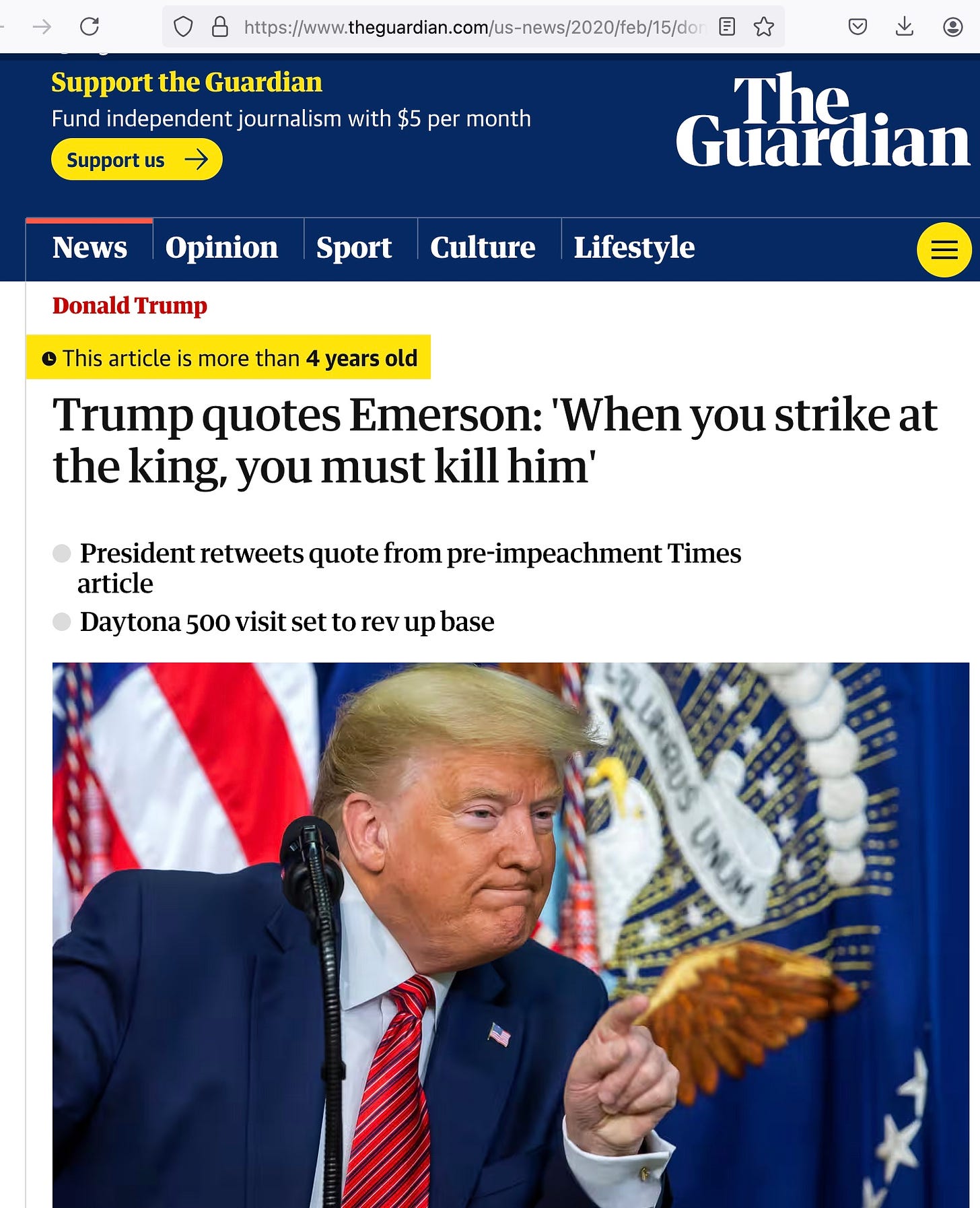
Now for the claims about another shooter, etc.

Jeff Childers:

The FBI may say the investigation is over and Matthew Crooks acted utterly alone, just another lone gunman, but everybody else seems to be ignoring the ailing law enforcement agency. CBS ran a live update yesterday headlined, “Three snipers were stationed inside building used in Trump assassination attempt.”  In a story broken by the local Beaver County paper, we learned yesterday that three local Beaver County sharpshooters who should have been stationed on the building, were instead inside the building, and it gets worse.

Snipering usually works much better from an elevated position, and isn’t super effective from the ground. I’m not an expert, but it seems obvious.

Anyway, the cops spotted assassin Crooks, several times. Each time Crooks was acting incredibly sketchy and even once used a rangefinder. The Beaver County police stayed put, but called it in to the command post — all while Crooks continued prowling around on the ground. They knew exactly where he was —well before he took the shot— called it in more than once, and even took pictures of him, but still didn’t stop the shooting. CBS:
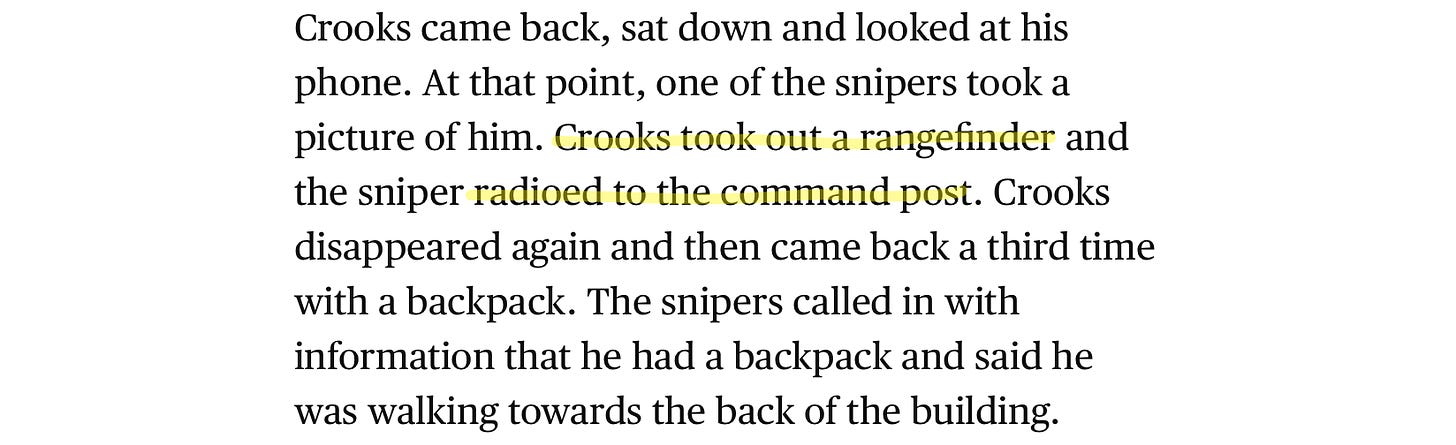
image 2.png

image 5.png

Whatever reason. Another unconfirmed wrinkle developed yesterday on social media, with no mention in any of the confirmed reporting. They could just be confused by the fog of war, but at least two witnesses interviewed by local reporters claimed there was a second shooter on the water tower.
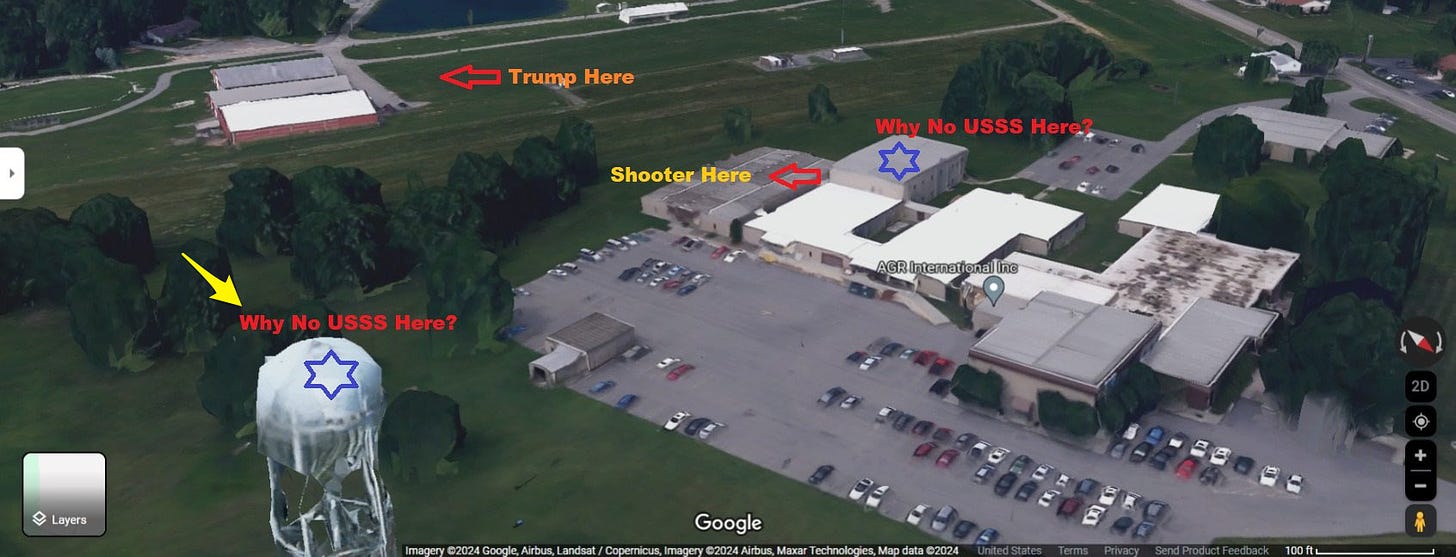
image 3.png

Here is witness clip one. And here is witness clip two.

Here is a top-down map showing the potential shooting angles.
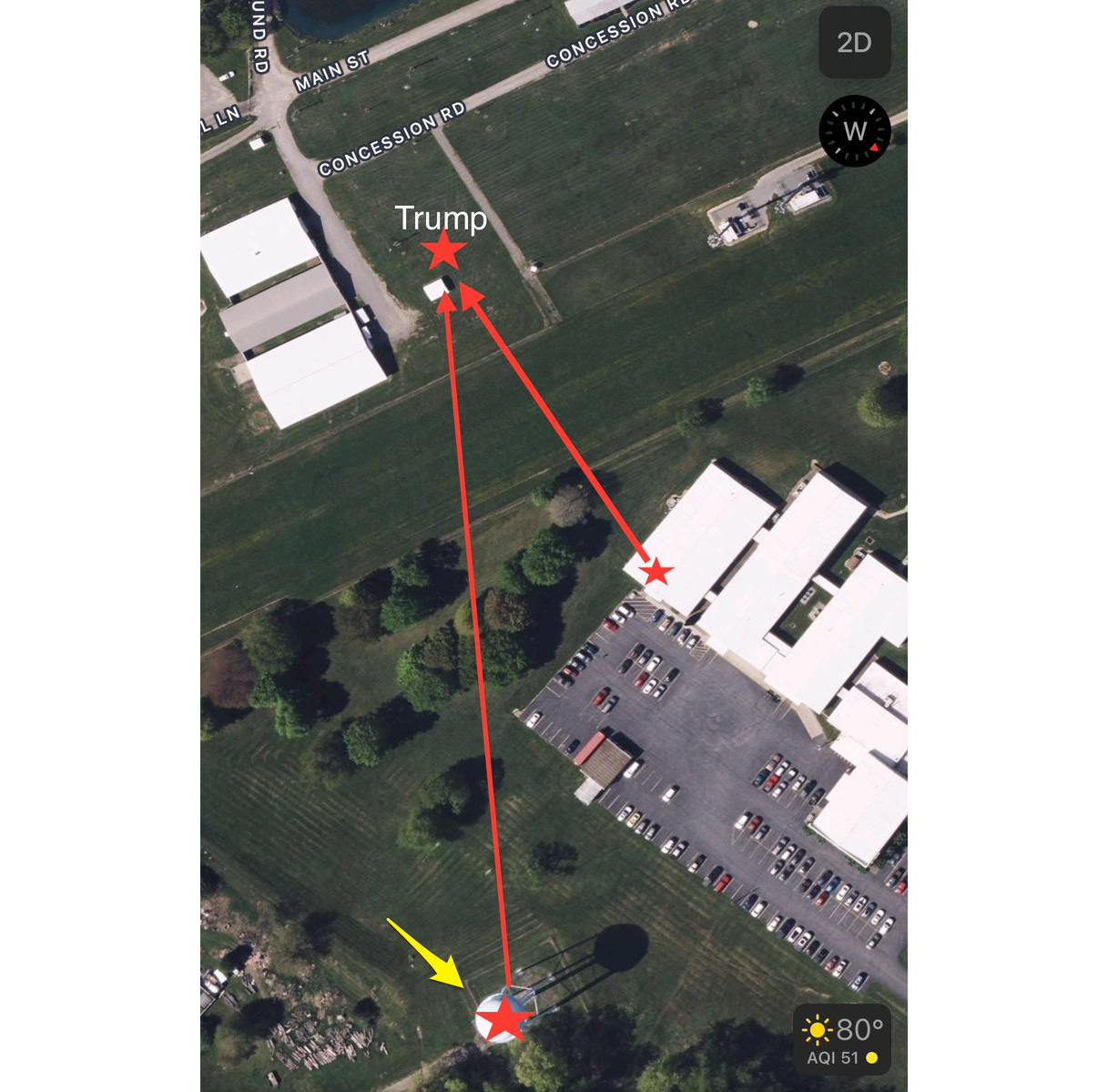
image 4.png

Who knows? It’s much too early to rule anything in or out. But even though the FBI is wrapping up its “thorough” research, multiple other investigations are already underway. You can expect this thing will get a lot of attention. For instance, in its article, the BBC reported that the House Oversight Committee has already confirmed Secret Service Directory Kimberly Cheatle to testify and requested all the rally records:

image 6.png

Finally, the New York Post interviewed a trained Canadian sniper who holds the current record for the longest kill. I was especially gratified that a professional, military-trained sniper agreed with C&C’s assessment: it seems unlikely unemployed drifter Crooks could possibly have planned and executed the sophisticated operation without some help, regardless of what the FBI says:

image 7.png

Homeland Security Secretary Alejandro Mayorkas — who oversees the Secret Service — conceded on “Good Morning America” yesterday that “a direct line of sight like that to the former president” should never have been possible. “That’s why President Biden directed an independent review of the incident,” Mayorkas quipped. By “independent,” the impeached Secretary meant a totally controlled internal FBI whitewash by the same field office that “debunked” the Hunter Biden laptop.

July 16, 2024 Posted by | Civil Liberties, Deception | , | 4 Comments

Trump classified documents case dismissed

RT | July 15, 2024

Special Counsel Jack Smith’s prosecution of former US President Donald Trump over the alleged mishandling of classified documents has been thrown out, on grounds that Smith’s appointment was not legal.

Smith was appointed by Attorney General Merrick Garland to investigate Trump for supposedly keeping classified documents at his Florida home after leaving the White House, as well as probing an alleged conspiracy to overturn the 2020 election.

“None of the statutes cited as legal authority for the appointment gives the attorney general broad inferior-officer appointing power or bestows upon him the right to appoint a federal officer with the kind of prosecutorial power wielded by Special Counsel Smith,” Judge Aileen Cannon wrote.

The “strained statutory arguments, appeals to inconsistent history, or reliance on out-of-circuit authority” by Smith have not persuaded the court otherwise, Cannon added.

The FBI raided Trump’s residence in Mar-a-Lago, Florida in August 2022, confiscating several boxes of documents. According to the Washington Post, some of the materials related to US nuclear secrets, Iran’s missile program, and Washington’s intelligence activities in China.

A federal grand jury in Miami, Florida indicted Trump for mishandling the documents in September 2023. Trump pleaded not guilty and argued that he had done nothing wrong, since he was the ultimate declassification authority.

Court documents unsealed in May this year showed that the Department of Justice had authorized the use of “deadly force when necessary” during the raid.

President Joe Biden also faced an investigation over taking classified documents with him after leaving the White House in 2017. As Barack Obama’s vice president, he did not actually have the authority to possess the files. However, Special Counsel Robert Hur said in February that he would not prosecute the case, as a Washington jury would probably not convict Biden as he seemed like an “elderly man with a poor memory.”

Last month, the US Supreme Court affirmed that presidents had absolute immunity from prosecution for any official actions, that they were still liable for unofficial conduct, but that courts could not speculate about motivation when making that determination.

Smith’s other case against Trump in the Washington, DC federal court remains open for now.

July 15, 2024 Posted by | Civil Liberties | , , | Leave a comment

Former FBI and Twitter Lawyer Jim Baker Joins Election Task Force Advocating for Social Media Censorship
By Didi Rankovic | Reclaim The Net | July 5, 2024

From presidential election to another election, to Covid – to another election. That is how members of particular, mostly flying-under-the-radar power centers in the US have been moving over the last decades.

From time to time, however, circumstances demand that they show their faces: one is James “Jim” Baker, a former FBI lawyer whose “censorship portfolio” includes the infamous case of endorsing the Hunter Biden laptop story suppression – while he was on Twitter’s payroll.

And while there – Baker also wanted to know how come President Trump was not censored for a post saying – “Don’t fear Covid.”

Well, Baker also seems to be staying true to himself – unfortunately, his “truth” appears to be to never miss the chance to support the wrong thing (the “RussiaGate” saga happens to be among them). Right now, he has joined something called “the National Task Force on Election Crises.”

It’s a crisis, alright. A crisis of online censorship that can, and does, produce multiple “election” crises and a rapid erosion of trust in legacy media and political institutions.

The group’s parent operation is the Protect Democracy Project.

There’s nothing particularly innovative about the group’s lobbying talking points: remove or downgrade “election misinformation” and make sure removing and labeling content (as false) is done ASAP by social and news media (time is clearly of the essence, at this point…)

As for the electoral process itself – which ended up highly and even dangerously contested perhaps for the first time in US democratic history in 2020 – the group Baker is now affiliated with seems to want the reasons by and large leading to that to remain intact.

Namely, things like “(preventing) cyber or other attacks by foreign adversaries or domestic disrupters, promot(ing) pre-canvassing of absentee ballots” – and working to discourage legal challenges to the election process.

Looks like Baker might be just the right man for the wrong job.

July 5, 2024 Posted by | Civil Liberties, Deception, Full Spectrum Dominance | , | Leave a comment

What 10 Years of U.S. Meddling in Ukraine Have Wrought (Spoiler Alert: Not Democracy)

By Aaron Maté | RealClearInvestigations | April 30, 2024

In successfully lobbying Congress for an additional $61 billion in Ukraine war funding, an effort that ended this month with celebratory Democrats waving Ukrainian flags in the House chamber, President Biden has cast his administration’s standoff with Russia as an existential test for democracy.

“What makes our moment rare is that freedom and democracy are under attack, both at home and overseas,” Biden declared in his State of the Union address in March. “History is watching, just like history watched three years ago on January 6th.”

While Biden’s narrative is widely accepted by Washington’s political establishment, a close examination of the president and his top principals’ record dating back to the Obama administration reveals a different picture. Far from protecting democracy from Kyiv to Washington, their role in Ukraine looks more like epic meddling resulting in political upheaval for both countries.

Over the last decade, Ukraine has been the battleground in a proxy war between the U.S. and Russia – a conflict massively escalated by the Kremlin’s invasion in 2022. The fight erupted in early 2014, when Biden and his team, then serving in the Obama administration, supported the overthrow of Ukraine’s elected president, Viktor Yanukovych. Leveraging billions of dollars in U.S. assistance, Washington has shaped the personnel and policies of subsequent Ukrainian governments, all while expanding its military and intelligence presence in Ukraine via the CIA and NATO. During this period, Ukraine has not become an independent self-sustaining democracy, but a client state heavily dependent on European and U.S. support, which has not protected it from the ravages of war.

The Biden-Obama team’s meddling in Ukraine has also had a boomerang effect at home.

As well-connected Washington Beltway insiders such as Hunter Biden have exploited it for personal enrichment, Ukraine has become a source of foreign interference in the U.S. political system – with questions of unsavory dealings arising in the 2016 and 2020 elections as well as the first impeachment of Donald Trump. After years of secrecy, CIA sources have only recently confirmed that Ukrainian intelligence helped generate the Russian interference allegations that engulfed Trump’s presidency. House Democrats’ initial attempt to impeach Trump, undertaken in the fall of 2019, came in response to his efforts to scrutinize Ukraine’s Russiagate connection.

This account of U.S. interference in Ukraine, which can be traced to fateful decisions made by the Obama administration, including then-Vice President Biden and his top aides, is based on often overlooked public disclosures. It also relies on the personal testimony of Andrii Telizhenko, a former Ukrainian diplomat and Democratic Party-tied political consultant who worked closely with U.S. officials to promote regime change in Ukraine.

Although he once welcomed Washington’s influence in Ukraine, Telizhenko now takes a different view. “I’m a Ukrainian who knew how Ukraine was 30 years ago, and what it became today,” he says. “For me, it’s a total failed state.” In his view, Ukraine has been “used directly by the United States to fight a [proxy] war with Russia” and “as a rag to make money for people like Biden and his family.”

The State Department has accused Telizhenko being part of a “Russia-linked foreign influence network.” In Sept. 2020 it revoked his visa to travel to the United States. Telizhenko, who now lives in a western European country where he was granted political asylum, denies working with Russia and says that he is a whistleblower speaking out to expose how U.S. interference has ravaged his country. RealClearInvestigations has confirmed that he worked closely with top American officials while they advanced policies aimed at severing Ukraine’s ties to Russia. No official contacted for this article – including former CIA chief John Brennan and senior State Department official Victoria Nuland – disputed any of his claims.

A Coup in ‘Full Coordination’ With the U.S.

The Biden team’s path to influencing Ukraine began with the eruption of anti-government unrest in November 2013. That month, protesters began filling Kyiv’s Maidan Nezalezhnosti (Independence Square) after then-President Viktor Yanukovych, a notoriously corrupt leader, delayed signing a European Union (EU) trade pact. To members of what came to be known as the Maidan movement, Yanukovych’s decision was a betrayal of his pledge to strengthen Western ties, and a worrying sign of Russian allegiance in a country haunted by its Soviet past.

The reality was more complex. Yanukovych was hoping to maintain relations with both Russia and Europe – and use competition between them to Ukraine’s advantage. He also worried that the EU’s terms, which demanded reduced trade with Russia, would alienate his political base in the east and south, home to millions of ethnic Russians. As the International Crisis Group noted, these Yanukovych-supporting Ukrainians feared that the EU terms “would hurt their livelihoods, a large number of which were tied to trade and close relations with Russia.” Despite claims that the Maidan movement represented a “popular revolution,” polls from that period showed that Ukrainians were evenly split on it, or even majority opposed.

After an initial period of peaceful protest, the Maidan movement was soon co-opted by nationalist forces, which encouraged a violent insurrection for regime change. Leading Maidan’s hardline contingent was Oleh Tyahnybok of the Svoboda party, who had once urged his supporters to fight what he called the “Muscovite-Jewish mafia running Ukraine.” Tyahnybok’s followers were joined by Right Sector, a coalition of ultra-nationalist groups whose members openly sported Nazi insignia. One year before, the European Parliament condemned Svoboda for “racist, anti-Semitic and xenophobic views” and urged Ukrainian political parties “not to associate with, endorse or form coalitions with this party.”

Powerful figures in Washington took a different view: For them, the Maidan movement represented an opportunity to achieve a longtime goal of pulling Ukraine into the Western orbit. Given Ukraine’s historical ties to Russia, its integration with the West could also be used to undermine the rule of Russian President Vladimir Putin.

As the-late Zbigniew Brzezinski, the influential former national security adviser to President Jimmy Carter, once wrote: “Without Ukraine, Russia ceases to be a Eurasian empire.” Two months before the Kyiv protests erupted, Carl Gershman, head of the National Endowment for Democracy, dubbed Ukraine “the biggest prize” in the West’s rivalry with Russia. Absorbing Ukraine, Gershman explained, could leave Putin “on the losing end not just in the near abroad” – i.e, its former Soviet satellites – “but within Russia itself.” Shortly after, senior State Department official Nuland boasted that the U.S. had “invested more than $5 billion” to help pro-Western “civil society” groups achieve a “secure and prosperous and democratic Ukraine.”

Seeking to capitalize on the unrest, U.S. figures including Nuland, Republican Sen. John McCain, and Democratic Sen. Chris Murphy visited Maidan Square. In a show of support for the movement’s hardline faction, which went beyond supporting the EU trade deal to demand Yanukovych’s ouster, the trio met privately with Tyahnybok and appeared with him on stage. The senators’ mission, Murphy said, was to “bring about a peaceful transition here.”

The Maidan Movement’s most significant U.S. endorsement came from then-Vice President Joe Biden. “Nothing would have greater impact for securing our interests and the world’s interests in Europe than to see a democratic, prosperous, and independent Ukraine in the region,” Biden said.

According to Andrii Telizhenko, a former Ukrainian government official who worked closely with Western officials during this period, the U.S. government’s role went far beyond those high-profile displays of solidarity.

“As soon as it grew into something, into the bigger Maidan, in the beginning of December, it basically was full coordination with the U.S. Embassy,” Telizhenko recalls. “Full, full.”

When the protests erupted, Telizhenko was working as an adviser to a Ukrainian member of Parliament. Having spent part of his youth in Canada and the United States, Telizhenko’s fluent English and Western connections landed him a position helping to oversee the Maidan Movement’s international relations. In this role, he organized meetings with and coordinated security arrangements for foreign visitors, including U.S. Ambassador Geoffrey Pyatt, Nuland, and McCain. Most of their briefings were held at Kyiv’s Trade Unions Building, the movement’s de-facto headquarters in the city’s center.

Telizhenko says Pyatt routinely coordinated with Maidan leaders on protest strategy. In one encounter, the ambassador observed Right Sector members assembling Molotov cocktails that would later be thrown at riot police attempting to enter the building. Sometimes, the U.S. ambassador disapproved of his counterparts’ tactics. “The U.S. embassy would criticize if something would happen more radical than it was supposed to go by plan, because it’s bad for the picture,” Telizhenko said.

That winter was marked by a series of escalating clashes. On February 20, 2014, snipers fatally shot dozens of protesters in Maidan square. Western governments attributed the killings to Yanukovych’s forces. But an intercepted phone call between NATO officials told a different story.

In the recorded conversation, Estonian foreign minister Urmas Paet told EU foreign secretary Catherine Ashton that he believed pro-Maidan forces were behind the slaughter. In Kyiv, Paet reported, “there is now stronger and stronger understanding that behind the snipers, it was not Yanukovych, but it was somebody from the new [opposition] coalition.”

In a bid to resolve the Maidan crisis and avoid more bloodshed, European officials brokered a compromise between Yanukovich and the opposition. The Feb. 21 deal called for a new national unity government that would keep him in office, with reduced powers, until early elections at year’s end. It also called for the disarmament of the Maidan forces and a withdrawal of riot police. Holding up its end of the bargain, government security forces pulled back. But the Maidan encampment’s ultra-nationalist contingent had no interest in compromise.

“We don’t want to see Yanukovych in power,” Maidan Movement squadron leader Vladimir Parasyuk declared that same day. “… And unless this morning you come up with a statement demanding that he steps down, then we will take arms and go, I swear.”

In insisting on regime change, the far-right contingent was also usurping the leadership of more moderate opposition leaders such as Vitali Klitschko, who supported the power-sharing agreement.

“The goal was to overthrow the government,” Telizhenko says. “That was the first goal. And it was all green-lighted by the U.S. Embassy. They basically supported all this, because they did not tell them to stop. If they told them [Maidan leaders] to stop, they would stop.”

Yet another leaked phone call bolstered suspicions that the U.S. endorsed regime change. On the recording, presumably intercepted in January by Russian or Ukrainian intelligence, Nuland and Pyatt discussed their choice of leaders in a proposed power-sharing government with Yanukovich. Their conversation showed that the U.S. exerted considerable influence with the faction  seeking the Ukrainian president’s ouster.

Tyahnybok, the openly antisemitic head of Svodova, would be a “problem” in office, Nuland worried, and better “on the outside.” Klitschko, the more moderate Maidan member, was ruled out as well. “I don’t think Klitsch should go into government,” Nuland said. “I don’t think it’s necessary. I don’t think it’s a good idea.” One reason was Klitschko’s proximity to the European Union. Despite her government’s warm words for the European Union in public, Nuland told Pyatt: “Fuck the EU.”

The two U.S. officials settled on technocrat Arseniy Yatsenyuk. “I think Yats is the guy,” Nuland said. By that point, Yatsenyuk had endorsed violent insurrection. The government’s rejection of Maidan demands, he said, meant that “people had acquired the right to move from non-violent to violent means of protest.”

The only outstanding matter, Pyatt relayed, was securing “somebody with an international personality to come out here and help to midwife this thing.” Nuland replied that Vice President Joe Biden and his senior aide, Jake Sullivan, who now serves as Biden’s National Security Adviser, had signed on to provide “an atta-boy and to get the deets [details] to stick.”

Just hours after the power-sharing agreement was reached, Nuland’s wishes were granted. Yanukovich, no longer protected by his armed forces, fled the capital. Emboldened by their sabotage of an EU-brokered power-sharing truce, Maidan Movement members stormed the Ukrainian Parliament and pushed through the formation of a new government. In violation of parliamentary rules on impeachment proceedings, and lacking a sufficient quorum, Oleksandr Turchynov was named the new acting president. The Nuland-backed Yatsenyuk was appointed Prime Minister.

In a reflection of their influence, at least five post-coup cabinet posts in national security, defense, and law enforcement were given to members of Svoboda and its far-right ally Right Sector.

“The uncomfortable truth is that a sizeable portion of Kyiv’s current government – and the protesters who brought it to power – are, indeed, fascists,” wrote Andrew Foxall, now a British defense official, and Oren Kessler, a Tel Aviv-based analyst, in Foreign Policy the following month. While denying any role in Yanukovich’s ouster, the Obama administration immediately endorsed it, as Secretary of State John Kerry expressed “strong support” for the new government.

In his memoir, former senior Obama aide Ben Rhodes acknowledged that Nuland and Pyatt “sounded as if they were picking a new government as they evaluated different Ukrainian leaders.” Rather than dispel that impression, he acknowledged that some of the Maidan “leaders received grants from U.S. democracy promotion programs.”

In 2012, one pro-Maidan group, Center UA, received most of its more than $500,000 in donations from the U.S. Agency for International Development (USAID), the National Endowment for Democracy, eBay founder Pierre Omidyar, and financier George Soros.

By its own count, Soros’ International Renaissance Foundation spent over $109 million in Ukraine between 2004 and 2014. In leaked documents, a former IRF board member even bragged that its partners “were the main driving force and the foundation of the Maidan movement,” and that without Soros’ funding, “the revolution might not have succeeded.” Weeks after the coup, an IRF strategy document noted, “Like during the Maidan protests, IRF representatives are in the midst of Ukraine’s transition process.”

Jeffrey Sachs, a Columbia University professor who advised Ukraine on economic policy in the early 1990s, visited Kyiv shortly after the coup to consult with the new government.

“I was taken around the Maidan where people were still milling around,” Sachs recalls. “And the American NGOs were around there, and they were describing to me: ‘Oh we paid for this, we paid for that. We funded this insurrection.’ It turned my stomach.” Sachs believes that these groups were acting at the behest of U.S. intelligence. To go about “funding this uprising,” he says, “they didn’t do that on their own as nice NGOs. This is off-budget financing for a U.S. regime-change operation.”

Weeks after vowing to bring about a “transition” in Ukraine, Sen. Murphy openly took credit for it. “I really think that the clear position of the United States has in part been what has helped lead to this change in regime,” Murphy said. “I think it was our role, including sanctions and threats of sanctions, that forced, in part, Yanukovych from office.”

The Proxy War Gets Hot

Far from resolving the unrest, Viktor Yanukovych’s ouster plunged Ukraine into a war.

Just days after the Ukrainian president fled to Moscow, Russian special forces stormed Crimea’s local parliament. The following month, Russia annexed Crimea following a hasty, militarized referendum denounced by Ukraine, the U.S., and much of the world. While these objections were well-founded, Western surveys of Crimeans nonetheless found majority support for Russian annexation.

Emboldened by the events in Crimea, and hostile to a new government that had overthrown their elected leader Yanukovych, Russophile Ukrainians in the eastern Donbas region followed suit.

On April 6 and 7, anti-Maidan protesters seized government buildings in Donetsk, Luhansk, and Kharkiv. The Donetsk rebels declared the founding of the Donetsk People’s Republic. The Luhansk People’s Republic followed 20 days later. Both areas announced independence referendums for May 11.

As in Crimea, Moscow backed the Donbas rebellion. But unlike in Crimea, the Kremlin opposed the independence votes. The organizers, Putin said, should “hold off on the referendum in order to give dialogue the conditions it needs to have a chance.”

In public, the Obama administration claimed to also favor dialogue between Kyiv and the Russia-backed rebels in eastern Ukraine. Behind the scenes, a more aggressive plan was brewing.

On April 12, CIA chief John Brennan slipped into the Ukrainian capital for secret meetings with top officials. Russia, whose intelligence services ran a network of informants inside Ukraine, publicly outed Brennan’s visit. The Kremlin and Yanukovych directly accused Brennan of encouraging an assault on the Donbas.

The CIA dismissed the allegation as “completely false,” and insisted that Brennan supported a “diplomatic solution” as “the only way to resolve the crisis.” The following month, Brennan insisted that “I was out there to interact with our Ukrainian partners and friends.”

Yet Russia and Yanukovych were not alone in voicing concerns about the CIA chief’s covert trip. “What message does it send to have John Brennan, the head of the CIA in Kiev, meeting with the interim government?” Sen. Murphy complained. “Does that not confirm the worst paranoia on the part of the Russians and those who see the Kiev government as essentially a puppet of the West?… It may not be super smart to have Brennan in Kiev, giving the impression that the United States is somehow there to fight a proxy war with Russia.”

According to Telizhenko, who attended the Brennan meeting and spoke to RCI on record about it for the first time, that’s exactly what the CIA chief was there to do. Contrary to U.S. claims, Telizhenko says, “Brennan gave a green light to use force against Donbas,” and discussed “how the U.S. could support it.” One day after the meeting, Kyiv announced an “Anti-Terrorist Operation” (ATO) against the Donbas region and began a military assault.

Telizhenko, who was by then working as a senior policy adviser to Vitaliy Yarema, the First Deputy Prime Minister, says he helped arrange the Brennan gathering after getting a phone call from the U.S. embassy. “I was told there was going to be a top secret meeting, with a top U.S. official and that my boss should be there,” he recalls. “I was also told not to tell anyone.”

Brennan, he recalls, arrived at the Foreign Intelligence Office of Ukraine in a beat-up gray mini-van and a coterie of armed guards. Others in attendance included U.S. Ambassador Pyatt, Acting President Oleksandr Turchynov, foreign intelligence chief Victor Gvozd, and other senior Ukrainian security officials.

After a customary exchange of medals and souvenir trophies, the topic turned to the unrest in the Donbas. “Brennan was talking about how Ukraine should act,” Telizhenko says. “A plan to keep Donbas in Ukraine’s hands. But Ukraine’s army was not fully equipped. We only had stuff in reserves. They discussed plans for the ATO and how to keep Ukraine’s military fully armed throughout.” Brennan’s overall message was that “Russia is behind” the Donbas unrest, and “Ukraine has to take firm, aggressive action to not let this spread all over.”

Brennan and Pyatt did not respond to a request for comment.

Two weeks after Brennan’s visit, the Obama administration offered yet another high-level endorsement of the Donbas operation when then-Vice President Biden visited Kyiv. With Ukraine facing “unrest and uncertainty,” Biden told a group of lawmakers, it now had “a second opportunity to make good on the original promise made by the Orange Revolution” – referring to earlier 2004-2005 post-electoral upheaval that blocked Yanukovych, albeit temporarily, from the presidency.

Looking back, Telizhenko is struck by the contrast between Brennan’s bellicosity in Donbas and the Obama administration’s lax response to Russia’s Crimea grab one month prior.

“After Crimea, they told us not to respond,” he said. But beforehand, “the Americans scoffed at warnings” that Ukraine could lose the peninsula. When Ukrainian officials met with Pentagon counterparts in March, “we gave them evidence that the little green men” – the incognito Russian forces who seized Crimea – “were Russians. They dismissed it.” Telizhenko now speculates that the U.S. permitted the Crimean takeover to encourage a conflict between Kyiv and Moscow-backed eastern Ukrainians. “I think they wanted Ukraine to hate Russia, and they wanted Russia to take the bait,” he said. Had Ukraine acted earlier, he believes, “the Crimea situation could have been stopped.”

With Russia in control of Crimea and Ukraine assaulting the Donbas with U.S. backing, the country descended into a full-scale civil war. Thousands were killed and millions displaced in the ensuing conflict. When Ukrainian forces threatened to overrun the Donbas rebels in August 2014, the Kremlin launched a direct military intervention that turned the tide. But rather than offer Ukraine more military assistance, Obama began getting cold feet.

Obama, senior Pentagon official Derek Chollet recalled, was concerned that flooding Ukraine with more weapons would “escalate the crisis” and give “Putin a pretext to go further and invade all of Ukraine.”

Rebuffing pressure from within his own Cabinet, Obama promised German Chancellor Angela Merkel in February 2015 that he would not send lethal aid to Ukraine. According to the U.S. Ambassador to Germany, Peter Wittig, Obama agreed with Merkel on the need “to give some space for those diplomatic, political efforts that were under way.”

That same month, Obama’s commitment gave Merkel the momentum to finalize the Minsk II Accords, a pact between Kyiv and Russian-backed Ukrainian rebels. Under Minsk II, an outmatched Ukrainian government agreed to allow limited autonomy for the breakaway Donbas regions in exchange for the rebels’ demilitarization and the withdrawal of their Russian allies.

Inside the White House, Obama’s position on Ukraine left him virtually alone. Obama’s reluctance to arm Ukraine, Chollet recalled, marked a rare situation “in which just about every senior official was for doing something that the president opposed.”

One of those senior officials was the State Department’s point person for Ukraine, Victoria Nuland. Along with allied officials and lawmakers, Nuland sought to undermine the Minsk peace pact even before it was signed.

As Germany and France lobbied Moscow and Kyiv to accept a peace deal, Nuland addressed a private meeting of U.S. officials, generals, and lawmakers – including Sen. McCain and future Secretary of State Mike Pompeo – on the sidelines of the annual Munich Security Conference. Dismissing the French-German diplomatic efforts as an act of appeasement, Nuland outlined a strategy to continue the war with a fresh influx of Western arms. Perhaps mindful of the optics of flooding Ukraine with military hardware at a time when the Obama administration was claiming to support to a peace agreement, Nuland offered a public relations suggestion. “I would like to urge you to use the word ‘defensive system’ to describe what we would be delivering against Putin’s offensive systems,” Nuland told the gathering.

The Munich meeting underscored that while President Obama may have publicly supported a peace deal in Ukraine, a bipartisan alliance of powerful Washington actors – including his own principals – was determined to stop it. As Foreign Policy magazine reported, “the takeaway for many Europeans … was that Nuland gave short shrift to their concerns about provoking an escalation with Russia and was confusingly out of sync with Obama.”

As Nuland and other officials quietly undermined the Minsk accords, the CIA deepened its role in Ukraine. U.S. intelligence sources recently disclosed to the New York Times that the agency has operated 12 secret bases inside Ukraine since 2014. The post-coup government’s first new spy chief, Valentyn Nalyvaichenko, also revealed that he established a formal partnership with the CIA and MI6 just two days after Yanukovych’s ouster.

According to a separate account in the Washington Post, the CIA restructured Ukraine’s two main spy services and turned them into U.S. proxies. Starting in 2015, the CIA transformed Ukraine’s military intelligence agency, the GUR, so extensively that “we had kind of rebuilt it from scratch,” a former intelligence official told the Post. “GUR was our little baby.” As a benefit of being the CIA’s proxy, the agency even funded new headquarters for the GUR’s paramilitary wing and a separate division for electronic espionage.

In a 2016 congressional appearance, Nuland touted the extensive U.S. role in Ukraine. “Since the start of the crisis, the United States has provided over $760 million in assistance to Ukraine, in addition to two $1 billion loan guarantees,” Nuland said. U.S. advisers “serve in almost a dozen Ukrainian ministries,” and were helping “modernize Ukraine’s institutions” of state-owned industries.

Nuland’s comments underscored an overlooked irony of the U.S. role in Ukraine: In claiming to defend Ukraine from Russian influence, Ukraine was subsumed by American influence.

Boomeranging Into U.S. Politics 

In the aftermath of the February 2014 coup, the transformation of Ukraine into an American client state soon had a boomerang effect, as maneuvers in that country increasingly impacted U.S. domestic politics.

“Americans are highly visible in the Ukrainian political process,” Bloomberg columnist Leonid Bershidsky observed in November 2015. “The U.S. embassy in Kyiv is a center of power, and Ukrainian politicians openly talk of appointments and dismissals being vetted by U.S. Ambassador Geoffrey Pyatt and even U.S. Vice President Joe Biden.”

One of the earliest and best-known cases came in December 2015, when Biden threatened to withhold $1 billion in aid unless Ukraine fired its prosecutor general, Viktor Shokin, whom the vice president claimed was corrupt. When Biden’s threat resurfaced as an issue during the 2020 election, the official line, as reported by CNN, was that “the effort to remove Shokin was backed by the Obama administration, European allies” and even some Republicans.

In fact, from Washington’s perspective, the campaign for Shokin’s ouster marked a change of course. Six months before Biden’s visit, Nuland had written Shokin that “We have been impressed with the ambitious reform and anti-corruption agenda of your government.”

And as RCI recently reported:

An Oct. 1, 2015, memo summarizing the recommendation of the [U.S.] Interagency Policy Committee on Ukraine stated, “Ukraine has made sufficient progress on its [anti-corruption] reform agenda to justify a third [loan] guarantee.” … The next month, moreover, the task force drafted a loan guarantee agreement that did not call for Shokin’s removal. Then, in December, Joe Biden flew to Kyiv to demand his ouster.

No one has explained why Shokin suddenly came into the crosshairs. At the time, the prosecutor general was investigating Burisma, a Ukrainian energy firm that was paying Hunter Biden over $80,000 per month to sit on its board.

According to emails obtained from his laptop, Hunter Biden introduced his father to a top Burisma executive less than one year before. Burisma also retained Blue Star Strategies, a D.C. consulting firm that worked closely with Hunter, to help enlist U.S. officials who could pressure the Ukrainian government to drop its criminal probes.

Two senior executives at Blue Star, Sally Painter and Karen Tramontano, formerly worked as top aides to President Bill Clinton.

According to a November 2015 email sent to Hunter by Vadym Pozharsky, a Burisma adviser, the energy firm’s desired “deliverables” included visits from “influential current and/or former US policy-makers to Ukraine.” The “ultimate purpose” of these visits would be “to close down” any legal cases against the company’s owner, Mykola Zlochevsky. One month after that email, Joe Biden visited Ukraine and demanded Shokin’s firing.

Telizhenko – who worked in Shokin’s office at the time, and later worked for Blue Star – said the evidence contradicts claims that Shokin was fired because of his failure, among other things, to investigate Burisma. “There were four criminal cases opened in 2014 against Burisma, and two more additionally opened by Shokin when he became the Prosecutor General,” recalls Telizhenko. “So, whenever anybody says, ‘There were no criminal cases, nobody was investigating Burisma, Shokin was fired because he was a bad prosecutor, he didn’t do his work’ … this was all a lie. No, he did his work.”

In a 2023 interview, Hunter Biden’s former business partner, Devon Archer, said Shokin was seen as a “threat” to Burisma. Both of Shokin’s cases against Burisma were closed after his firing.

Ukraine Meddling vs. Trump

While allegations of Russian interference and collusion would come to dominate the 2016 campaign, the first documented case of foreign meddling originated in Ukraine.

Telizhenko, who served as a political officer at the Ukrainian embassy in Washington, D.C., before joining Blue Star, was an early whistleblower. He went public in January 2017, telling Politico how the Ukrainian embassy worked to help Hillary Clinton’s 2016 election campaign and undermine Trump’s.

According to Telizhenko, Ukraine’s D.C. ambassador, Valeriy Chaly, instructed staffers to shun Trump’s campaign because “Hillary was going to win.”

Telizhenko says he was told to meet with veteran Democratic operative Alexandra Chalupa, who had also served in the Clinton White House. “The U.S. government and people from the Democratic National Committee are approaching and asking for dirt on a presidential candidate,” Telizhenko recalls. “And Chalupa said, ‘I want dirt. I just want to get Trump off the elections.’”

Starting in early 2016, U.S. officials leaned on the Ukrainians to investigate Paul Manafort, the GOP consultant who would become Trump’s campaign manager, and avoid scrutiny of Burisma, as RCI reported in 2022. “Obama’s NSC hosted Ukrainian officials and told them to stop investigating Hunter Biden and start investigating Paul Manafort,” a former senior NSC official told RCI. In January 2016, the FBI suddenly reopened a closed investigation into Manafort for potential money laundering and tax evasion connected to his work in Ukraine.

Telizhenko, who attended a White House meeting with Ukrainian colleagues that same month, says he witnessed Justice Department officials pressing representatives of Ukraine’s Corruption Bureau. “The U.S. officials were asking for the Ukrainian officials to get any information, financial information, about Americans working for the former government of Ukraine, the Yanukovych government,” he says.

By the time Telizhenko spoke out, Ukrainian officials had already admitted intervening in the 2016 election to help Clinton’s campaign. In August, Ukraine’s National Anti-Corruption Bureau (NABU) released what it claimed was a secret ledger showing that Manafort received millions in illicit cash payments from Yanukovych’s party. The Clinton campaign, then in the early stages of its effort to portray their Republican rival as a Russian conspirator, seized on the news as evidence of Trump’s “troubling connections” to “pro-Kremlin elements in Ukraine.”

The alleged ledger was first obtained by Ukrainian lawmaker Serhiy Leshchenko, who had claimed that he had received it anonymously by mail. Yet Leshchenko was not an impartial source: He made no effort to hide his efforts to help elect Clinton. “A Trump presidency would change the pro-Ukrainian agenda in American foreign policy,” Leshchenko told the Financial Times. For him, “it was important to show … that [Trump] is [a] pro-Russian candidate who can break the geopolitical balance in the world.” Accordingly, he added, most of Ukraine’s politicians were “on Hillary Clinton’s side.”

Manafort, who would be convicted of unrelated tax and other financial crimes in 2018, denied the allegation. The ledger was handwritten and did not match the amounts that Manafort was paid in electronic wire transfers. Moreover, the ledger was said to have been stored at Yanukovych’s party headquarters, yet that building was burned in a 2014 riot by Maidan activists.

Telizhenko agrees with Manafort that the ledger was a fabrication. “I think the ledger was just made up because nobody saw it, and nobody got the official documents themselves. From my understanding it was all a toss-up, a made-up story, just because they could not find any dirt on the Trump campaign.”

But with the U.S. media starting to amplify the Clinton campaign’s Trump-Russia conspiracy theories, a wary Trump demanded Manafort’s resignation. “The easiest way for Trump to sidestep the whole Ukraine story is for Manafort not to be there,” Newt Gingrich, the former House speaker and a Trump campaign adviser, explained.

The 2016 Russian Hacking Claim

The release of the Manafort ledger and cooperation with the Democratic National Committee was not the end of Ukraine’s 2016 election interference.

A recent account in the New York Times revealed that Ukrainian intelligence played a vital role in generating CIA allegations that would become a foundation of the Russiagate hoax – that Russia stole Democratic Party emails and released them via WikiLeaks in a bid to help elect Trump. Once again, CIA chief Brennan played a critical role.

In the Times’ telling, some Obama officials wanted to shut down the CIA’s work in Ukraine after a botched August 2016 Ukrainian intelligence operation in Crimea turned deadly. But Brennan “persuaded them that doing so would be self-defeating, given the relationship was starting to produce intelligence on the Russians as the C.I.A. was investigating Russian election meddling.” This “relationship” between Brennan and his Ukrainian counterparts proved to be pivotal. According to the Times, Ukrainian military intelligence – which the CIA closely managed – claimed to have duped a Russian officer into “into providing information that allowed the C.I.A. to connect Russia’s government to the so-called Fancy Bear hacking group.”

“Fancy Bear” is one of two alleged Russian cyber espionage groups that the FBI has accused of carrying out the 2016 DNC email theft. Yet this allegation has a direct tie not just to Ukraine, but to the Clinton campaign. The name “Fancy Bear” was coined by CrowdStrike, a private firm working directly for Clinton’s attorney, Michael Sussmann. As RealClearInvestigations has previously reported, CrowdStrike first accused Russia of hacking the DNC, and the FBI relied on the firm for evidence. Years after publicly accusing Russia of the theft, CrowdStrike executive Shawn Henry was forced to admit in sworn congressional testimony that the firm “did not have concrete evidence” that Russian hackers took data from the DNC servers.

CrowdStrike’s admission about the evidentiary hole in the Russian hacking allegation, along with the newly disclosed Ukrainian intelligence role in generating it, were both kept under wraps throughout the entirety of Special Counsel Robert Muller’s probe into alleged Russian interference. But when Trump sought answers on both matters, he once again found himself the target of an investigation.

In late September 2019, weeks after Mueller’s halting congressional testimony – which left Trump foes dissatisfied over his failure to find insufficient evidence of a Russian conspiracy – House Democrats kicked off an effort to impeach Trump for freezing U.S. weapons shipments in an alleged scheme to pressure Ukraine into investigating the Bidens. The impeachment was triggered by a whistleblower complaint about a phone call between Trump and Ukrainian President Volodymyr Zelensky two months prior. The “whistleblower” was later identified by RealClearInvestigations as Eric Ciaramella, an intelligence official who had served as Ukraine adviser to then-Vice President Biden when he demanded Shokin’s firing and to the Obama administration’s other key point person for Kyiv, Victoria Nuland.

Yet Trump’s infamous July 2019 phone call with Zelensky was not primarily focused on the Bidens. Instead, according to the transcript, Trump asked Zelensky to do him “a favor” and cooperate with a Justice Department investigation into the origins of Russiagate, which, he asserted, had Ukrainian links. Trump specifically invoked CrowdStrike, the Clinton campaign contractor that had generated the allegation that Russia had hacked the Democratic Party emails. CrowdStrike’s allegation of Russian interference, Trump told Zelensky, had somehow “started with Ukraine.”

More than four years after the call, and eight years after the 2016 campaign, the New York Times’ recent revelation that the CIA relied on Ukrainian intelligence operatives to identify alleged Russian hackers adds new context to Trump’s request for Zelensky’s help. Asked about the Times’ disclosure, a source familiar with Trump’s thinking confirmed to RCI that the president was indeed referring to a Ukrainian role in the Russian hacking allegations that consumed his presidency. “That’s why they impeached him,” the source said. “They didn’t want to be exposed.”

Trump’s First Impeachment

The first impeachment of Donald Trump once again inserted Ukraine into the highest levels of U.S. politics. But the impact may have been even greater in Ukraine.

When Democrats targeted Trump for his phone call with Zelensky, the rookie Ukrainian leader was just months into a mandate that he had won on a pledge to end the Donbas war. In his inaugural address, Zelensky promised that he was “not afraid to lose my own popularity, my ratings,” and even “my own position – as long as peace arrives.”

In their lone face-to-face meeting, held on the sidelines of the United Nations General Assembly, Trump tried to encourage Zelensky to negotiate with Russia. “I really hope that you and President Putin can get together and solve your problem,” Trump said, referring to the Donbas war. “That would be a tremendous achievement.”

But Ukraine’s powerful ultra-nationalists had other plans. Right Sector co-founder Dmytro Yarosh, commander of the Ukrainian Volunteer Army, responded: “No, he [Zelensky] would lose his life. He will hang on some tree on Khreshchatyk [Kyiv’s main street] – if he betrays Ukraine” by making a peace with the Russian-backed rebels.

By impeaching Trump for pausing U.S. weaponry to Ukraine, Democrats sent a similar message. Trump, the final House impeachment report proclaimed, had “compromised the national security of the United States.” In his opening statement at Trump’s Senate trial, Rep. Adam Schiff – then seeking to rebound from the collapse of the Trump-Russia conspiracy theory – declared: “The United States aids Ukraine and her people, so that we can fight Russia over there, and we don’t have to fight Russia here.”

Other powerful Washington officials, including star impeachment witness William Taylor, then serving as the chief U.S. diplomat in Ukraine, pushed Zelensky toward conflict.

Just before the impeachment scandal erupted in Washington, Zelensky was “expressing curiosity” about the Steinmeier Formula, a German-led effort to revive the stalled Minsk process, which he “hoped might lead to a deal with the Kremlin,” Taylor later recounted to the Washington Post. But Taylor disagreed.  “No one knows what it is,” Taylor told Zelensky of the German plan. “Steinmeier doesn’t know what it is … It’s a terrible idea.”

With both powerful Ukrainian ultra-nationalists and Washington bureaucrats opposed to ending the Donbas war, Zelensky ultimately abandoned the peace platform that he was elected on. “By early 2021,” the Post reported, citing a Zelensky ally, “Zelensky believed that negotiations wouldn’t work and that Ukraine would need to retake the Donetsk and Luhansk regions ‘either through a political or military path.’”

The return of the Biden team to the Oval Office in January 2021 appears to have encouraged Zelensky’s confrontational path. By then, polls showed the rookie president trailing OPFL, the opposition party with the second-most seats in parliament and headed by Viktor Medvedchuk, a Ukrainian mogul close to Putin.

The following month, Zelensky offered his response to waning public support. Three OPFL-tied television channels were taken off the air. Two weeks later, Zelensky followed up by seizing the assets of Medvedchuk’s family, including a pipeline that brought Russian oil through Ukraine. Medvedchuk was also charged with treason.

Zelensky’s crackdown drew harsh criticism, including from close allies. “This is an illegal mechanism that contradicts the Constitution,” Dmytro Razumkov, the speaker of the parliament and a manager of Zelensky’s presidential campaign, complained.

Yet Zelensky won praise from the newly inaugurated Biden White House, while hailed his effort to “counter Russia’s malign influence.”

It turns out that the U.S. not only applauded Zelensky’s domestic crackdown, but inspired it. Zelensky’s first national security adviser, Oleksandr Danyliuk, later revealed to Time Magazine that the TV stations’ shuttering was “conceived as a welcome gift to the Biden Administration.” Targeting those stations, Danyliuk explained, “was calculated to fit in with the U.S. agenda.” And the U.S. was a happy recipient. “He turned out to be a doer,” a State Department official approvingly said of Zelensky. “He got it done.”

Just days after receiving Zelensky’s “welcome gift” in March 2021, the Biden administration approved its first military package for Ukraine, valued at $125 million. That same month, Ukraine’s National Security and Defense Council approved a strategy to recover all of Crimea from Russian control, including by force. By the end of March, intense fighting resumed in the Donbas, shattering months of a relatively stable ceasefire.

Russia offered its own reaction. Two days after its ally Medvedchuk’s assets were seized in February, Russia deployed thousands of troops to the Ukraine border, the beginning of a build-up that ultimately topped 100,000 and culminated in an invasion one year later.

The Kremlin, Medvedchuk claimed, was acting to protect Russophile Ukrainians targeted by Zelensky’s censorship. “When they close TV channels that Russian-speaking people watched, when they persecute the party these people voted for, it touches all of the Russian-speaking population,” he said.

Medvedchuk also warned that the more hawkish factions of the Kremlin could use the crackdown as a pretext for war. “There are hawks around Putin who want this crisis. They are ready to invade. They come to him and say, ‘Look at your Medvedchuk. Where is he now? Where is your peaceful solution? Sitting under house arrest? Should we wait until all pro-Russian forces are arrested?’ ”

A Whistleblower Silenced on Alleged Biden Corruption

Along with encouraging a proxy war with Russia in Ukraine, the first Trump impeachment also promoted the highly dubious Democratic Party narrative that scrutiny of Ukrainian interference in U.S. politics was a “conspiracy theory” or “Russian disinformation.” Another star impeachment witness, Lt. Col. Alexander Vindman, who leaked the Trump/Zelensky phone call to Ciaramella, testified that Telizhenko – who had blown the whistle on Ukrainian collusion with the DNC – was “not a credible individual.”

Telizhenko was undeterred. After detailing reliable evidence of Ukrainian’s 2016 election interference to Politico, Telizhenko continued to speak out – and increasingly drew the attention of government officials who sought to undermine his claims by casting him as a Russian agent.

Beginning in May 2019, Telizhenko cooperated with Rudy Giuliani, then acting as Trump’s personal attorney, in his effort to expose information about the Bidens’ alleged corruption in Ukraine. During Giuliani’s visits to Ukraine, Telizhenko served as an adviser and translator.

That same year, Telizhenko testified to the Federal Election Commission (FEC) as part of a probe into whether the DNC’s 2016 collusion with the Ukrainian embassy violated campaign finance laws. By contrast, multiple DNC officials refused to testify. Telizhenko then cooperated with a separate Senate probe, co-chaired by Republicans Chuck Grassley and Ron Johnson, on how Hunter Biden’s business dealings impacted U.S. policy in Ukraine.

By the lead-up to the 2020 election, Telizhenko found himself the target of a concerted effort to silence him. As the Senate probed Ukraine, the FBI delivered a classified warning echoing Democrats’ talking points that Telizhenko was among the “known purveyors of Russian disinformation narratives” about the Bidens. In response, GOP Sen. Johnson dropped plans to subpoena Telizhenko. Nevertheless, Telizhenko’s communications with Obama administration officials and his former employer Blue Star Strategies were heavily featured in Johnson and Grassley’s final report on the Bidens’ conflicts of interest in Ukraine, released in September 2020.

The U.S. government’s claims of yet another Russian-backed plot to hurt a Democratic Party presidential nominee set the stage for another highly consequential act of election interference. On October 14, 2020, the New York Post published the first in a series of stories detailing how Hunter Biden had traded on his family name to secure lucrative business abroad, including in Ukraine. The Post’s reporting, based on the contents of a laptop Hunter’s had apparently abandoned in a repair shop, also raised questions about Joe Biden’s denials of involvement in his son’s business dealings.

The Hunter Biden laptop emails pointed to the very kind of influence-peddling that the Biden campaign and Democrats routinely accused Trump of. But rather than allow voters to read the reporting and judge for themselves, the Post’s journalism was subjected to a smear campaign and a censorship campaign unparalleled in modern American history. In a statement, a group of more than 50 former intelligence officials – including John Brennan, the former CIA chief – declared that the Hunter Biden laptop story “has all the classic earmarks of a Russian information operation.” Meanwhile, Facebook and Twitter prevented the story from being shared on their social media networks.

The FBI lent credence to the intelligence veterans’ false claim by launching a probe into whether the laptop contents were part of a “Russian disinformation” campaign aiming to hurt Biden. The bureau initiated this effort despite having been in possession of Hunter Biden’s laptop, which it had verified as genuine, for almost a year. To buttress innuendo that the laptop was a Russian plot, a CNN report suspiciously noted that Telizhenko had posted an image on social media featuring Trump holding up an edition of the New York Post’s laptop story.

In January 2021, shortly before Biden took office, the U.S. Treasury Department followed suit by imposing sanctions on Telizhenko for allegedly “having directly or indirectly engaged in, sponsored, concealed, or otherwise been complicit in foreign influence in a United States election.”

Treasury, however, did not release any evidence to support its claims. Two months later, the department issued a similar statement in announcing sanctions on former Manafort aide Konstantin Kilimnik, whom it accused of being a “known Russian Intelligence Services agent implementing influence operations on their behalf.” Treasury’s actions followed a bipartisan Senate Intelligence report that also accused Kilimnik of being a Russian spy. As RealClearInvestigations has previously reported, neither the Treasury Department or Senate panel provided any evidence to support their allegations about Kilimnik, which were called into question by countervailing information that RCI brought to light. Just like Telizhenko, Kilimnik had extensive contacts with the Obama administration, whose State Department treated him as a trusted source.

The U.S. government’s endorsement of Democratic claims about Telizhenko had a direct impact on the FEC investigation into DNC-Ukrainian collusion, in which he had testified. In August 2019, the FEC initially sided with Telizhenko and informed Alexandra Chalupa – the DNC operative whom he outed for targeting Paul Manafort – that she plausibly violated the Federal Election Campaign Act by having “the Ukrainian Embassy… [perform] opposition research on the Trump campaign at no charge to the DNC.” The FEC also noted that the DNC “does not directly deny that Chalupa obtained assistance from the Ukrainians nor that she passed on the Ukrainian Embassy’s research to DNC officials.”

But when the Treasury Department sanctioned Telizhenko in January 2021, the FEC suddenly reversed course. As RealClearInvestigations has previously reported, the FEC closed the case against the DNC without punitive action. Democratic commissioner Ellen Weintraub even dismissed allegations of Ukrainian-DNC collusion as “Russian disinformation.” As evidence, she pointed to media reports about Telizhenko and the recent Treasury sanctions against him.

Yet Telizhenko’s detractors have been unable to adduce any concrete evidence tying him to Russia. A January 2021 intelligence community report, declassified two months later, accused Russia of waging “influence operations against the 2020 US presidential election” on behalf of Trump. It made no mention of Telizhenko. The Democratic-led claims of Telizhenko’s supposed Russian ties are additionally undermined by his extensive contact with Obama-Biden administration officials, as journalist John Solomon reported in September 2020.

Telizhenko says he has “no connection at all” to the Russian government or any effort to amplify its messaging. “I’m ready,” he says. “Let the Treasury Department publish what they have on me, and I’m ready to go against them. Let them show the public what they have.  They have nothing … I am ready to talk about the truth. They are not.”

Epilogue

Just as Telizhenko has been effectively silenced in the U.S. establishment, so has the Ukrainian meddling that he helped expose. Capturing the prevailing media narrative, the Washington Post recently claimed that Trump has “falsely blamed Ukraine for trying to help Democratic rival Hillary Clinton,” which, the Post added, is “a smear spread by Russian spy services.” This narrative ignores a voluminous record that includes Ukrainian officials admitting to helping Clinton.

As the Biden administration successfully pressured Congress to approve its $61 billion funding request for Ukraine, holdout Republicans were similarly accused of parroting the Kremlin. Shortly before the vote, two influential Republican committee chairmen, Reps. Mike Turner of Ohio and Mike McCaul of Texas, claimed that unnamed members of their caucus were repeating Russian propaganda. Zelensky also asserted that Russia was manipulating U.S. opponents of continued war funding: “When we talk about the Congress — do you notice how [the Russians] work with society in the United States?”

Now that Biden has signed that newly authorized funding into law, the president and his senior aides have been handed the means to extend a proxy war that they launched a decade ago and that continues to ravage Ukraine. In yet another case of Ukraine playing a significant role in domestic U.S. politics, Biden has also secured a boost to his bid for reelection. As the New York Times recently observed: “The resumption of large-scale military aid from the United States all but ensures that the war will be unfinished in Ukraine when Americans go to the polls in November.”

May 1, 2024 Posted by | Deception, Russophobia, Timeless or most popular | , , , , , , , , | 1 Comment

FBI Wanted to Install Backdoor to Spy on Users, Telegram Founder Tells Tucker Carlson

By Oleg Burunov – Sputnik – 17.04.2024

Speaking with Tucker Carlson, Russian-born IT entrepreneur and co-founder of the Telegram social network Pavel Durov focused on a variety of topics, including his visit to the United States. The 39-year-old revealed that he was closely watched and monitored by the Federal Bureau of Investigation (FBI) during his time in the country.

“We got too much attention from the FBI, [and] the security agencies, wherever we came to the US,” Durov said during the interview released on Wednesday.

According to the businessman, one of his top employees once told him that he had been approached by the US government. “There was an attempt to secretly hire my engineer behind my back by [US] cybersecurity officers,” Durov claimed.

He argued that those officers were trying to persuade the engineer to use “certain open-source tools,” which he would then integrate into Telegram’s code that, in Durov’s opinion, “would serve as backdoors” for hacking the platform.

The entrepreneur stressed that he believes what the employee said was true, adding, “There is no reason for my engineer to make up [such] stories.”

When asked if infiltrating Telegram’s systems would allow the US government to spy on its users, Durov stated that he did not dismiss the possibility, acknowledging that any government could potentially carry out such an action. “A backdoor is a backdoor, regardless of who uses it,” he underscored.

The 39-year-old tech tycoon noted that he had “personally experienced similar pressure” in the US, where law enforcement officials approached him on many occasions.

“Whenever I would go to the US, I would have two FBI agents greeting me at the airport, asking questions. One time, I was having breakfast at 9 am and the FBI showed up at the house that I was renting,” the businessman asserted. According to him, FBI agents knew what he and his team were doing, but the agents wanted the details.

“My understanding is that they [also] wanted to establish a relationship to in a way control Telegram better. I understand that they were doing their job. [But] for us running a privacy-focused social media platform, that probably wasn’t the best environment to be in. We want to be focused on what we do, not on government relations of that sort,” Durov pointed out.

The interview comes just a day after Carlson published the first post on his newly-created Telegram page, the Tucker Carlson Network, where users will “get all the latest updates, behind-the-scenes insights, and exclusive content.”

There are already more than 150,000 subscribers for the channel, and their number is growing with every passing second.

April 17, 2024 Posted by | Civil Liberties, Full Spectrum Dominance | , , | 1 Comment

The CIA Wants More Power to Spy on Americans!

By Judge Andrew Napolitano | April 11, 2024

Americans need to be aware of the unbridled propensity of federal intelligence agencies to spy on all of us without search warrants as required by the Fourth Amendment to the U.S. Constitution.

These agencies believe that the Fourth Amendment — which protects the individual right to privacy — only regulates law enforcement and does not apply to domestic spying.

There is no basis in the constitutional text, history or judicial interpretations for such a limiting and toothless view of this constitutional guarantee. The courts have held that the Fourth Amendment restrains government — all government. Last week, the CIA asked Congress to expand its current spying in the United States.

Here is the backstory.

When the CIA was created in 1947, members of Congress who feared the establishment here of the type of domestic surveillance apparatus that the Allies had just defeated in Germany insisted that the new CIA have no role in American law enforcement and no legal ability to spy within the U.S. The legislation creating the CIA contains those unambiguous limitations.

Nevertheless, we know that CIA agents are present in all 50 statehouses in the United States. They didn’t arrive there until after Dec. 4, 1981. That’s the date that President Ronald Reagan signed Executive Order 12333, which purports to give the CIA authority to spy in America — supposedly looking for narcotics from foreign countries — but keeps from law enforcement whatever it finds.

Stated differently, while Reagan purported to authorize the CIA to defy the limitations imposed upon it by the Constitution and by federal law, he insisted on a “wall” of separation between domestic spying and law enforcement.

So, if the CIA using unconstitutional spying discovered that a janitor in the Russian Embassy in Washington was really a KGB colonel who abused his wife in their suburban Maryland home, under E.O. 12333, it could continue to spy upon him in defiance of the Fourth Amendment and the CIA charter, but it could not reveal to Maryland prosecutors — who can only use evidence lawfully obtained — any evidence of his domestic violence.

All this changed 20 years later when President George W. Bush demolished Reagan’s “wall” between law enforcement and domestic spying and directed the CIA and other domestic spying agencies to share the fruits of their spying with the FBI.

Thus, thanks to Reagan and Bush, and their successors looking the other way, CIA agents have been engaging in fishing expeditions on a grand scale inside the U.S. for the past 20 years. Congress knows about this because all intelligence agencies are required by statute to report the extent of their spying secretly to the House and Senate Intelligence Committees.

This, of course, does not absolve the CIA of its presidentially authorized computer hacking crimes; rather, it gives Congress a false sense of security that it has a handle on what’s going on.

What’s going on is not government lawyers appearing before judges asking for surveillance warrants based upon probable cause of crime, as the Constitution requires. What’s going on is CIA agents going to Big Tech and paying for access to communications used by ordinary Americans. Some Big Tech firms told the CIA to take a hike. Others took the CIA’s cash and opened the spigots of their fiber-optic data to the voracious federal appetite.

If government lawyers went to a judge and demonstrated probable cause of crime — for example, that a janitor in the Russian Embassy was passing defense secrets to Moscow — surely the judge would have signed a surveillance warrant. But to the government, following the Constitution is too limiting.

Thus, by acquiring bulk data — fiber-optic data on hundreds of millions of Americans acquired without search warrants — the government avoids the time and trouble of demonstrating probable cause to a judge. But that time and trouble were intentionally baked into the Fourth Amendment so as to keep the government off our backs.

Not to be outdone by its principal rival, the FBI soon began doing the same thing — gathering bulk data without search warrants.

When Congress learned of this, it enacted legislation that banned the warrantless acquisition of bulk data. Apparently, Congress is naive enough to believe that the CIA, the FBI and the National Security Agency, their cousin with 60,000 domestic spies, will actually comply with federal law.

Last week, that naivete was manifested front and center when the CIA sent a letter to both congressional intelligence committees addressing its spying on foreign persons and the Americans with whom they communicate, and asking to expand that reach inside the U.S.

The timing of the CIA’s letter coincides with a decision Congress must make in the next 10 days — whether to reenact Section 702 of the Foreign Intelligence Surveillance Act, allow it to expire on April 19 or expand it as the CIA has requested. Section 702 permits warrantless spying on foreigners and the Americans whom intelligence agencies suspect communicate with them. Section 702 is an unconstitutional free pass for domestic spying.

So, notwithstanding the persistent efforts of members of Congress from both parties to limit and in some cases to prohibit the warrantless acquisition of bulk data by the CIA from Americans, the practice continues, the CIA defends it and presidents look the other way.

In 1947, Congress created the CIA monster, which today is so big and so powerful and so indifferent to the Constitution and the federal laws its agents have sworn to uphold that it can boast about its lawlessness, have no fear of defying Congress and always escape the consequences of all this largely unscathed. Even President Harry Truman, who signed the 1947 legislation into law, later acknowledged as much and condemned what the CIA had become.

I suspect the CIA and its cousins will get away with this because they spy on Congress and possess damning personal data on members who regularly vote to increase their secret budgets.

When will we have a government whose officials are courageous enough to uphold the Constitution?


To learn more about Judge Andrew Napolitano, visit https://JudgeNap.com.

DISTRIBUTED BY CREATORS.COM

COPYRIGHT 2024 ANDREW P. NAPOLITANO

April 11, 2024 Posted by | Civil Liberties | , , , | Leave a comment

Bill to Extend Mass Surveillance Program Fails House Vote

By Kyle Anzalone | The Libertarian Institute | April 10, 2024

A group of 19 House Republicans bucked GOP leadership and voted with Democrats against a bill that would extend Section 702, the law that allows for mass surveillance and the collection of Americans’ data.

On Wednesday, Speaker of the House Mike Johnson (R-LA) brought the legislation up for a procedural vote, and it failed 193-228. The Republican opposition was made up of a group of freedom-oriented Representatives led by Matt Gaetz (R-FL).

“The reauthorization lacks essential reforms to protect Americans’ Fourth Amendment rights, such as requiring the FBI to obtain a warrant before searching Americans’ data and a prohibition on the government purchasing Americans’ data from third-party data brokers,” the Flordia congressman said in a statement. “FISA authorities have been used to violate the law more than 278,000 times by the national security state, and there has yet to be any consequences for this illegal activity by our government.”

Gaetz criticized Johnson for letting a bill to renew Section 702 come to the floor without sufficient reforms. “If Speaker Johnson is unwilling to fix FISA Section 702, we are left wondering what he is indeed willing to fix. Now, the very authorities that we saw weaponized against President Trump and the American people are poised to get enhancements under this reauthorization, rather than any of the reforms that are so desperately needed,” he explained.

In the leadup to the 2016 election, the FBI launched an investigation into Donald Trump’s campaign and alleged ties to the Russian government. That probe was based on opposition research paid for by the Hillary Clinton campaign and ultimately failed to prove any ties between Trump and the Kremlin.

Trump announced his opposition to the bill prior to the vote on Truth Social, saying, “KILL FISA, IT WAS ILLEGALLY USED AGAINST ME, AND MANY OTHERS. THEY SPIED ON MY CAMPAIGN!!!” While Trump now says he opposes Section 702, he signed extensions to the program when he was in the White House.

Section 702 of the Foreign Intelligence Surveillance Act of 1978 has allowed the US government to warrantlessly sweep up the information of millions of Americans for decades. It is set to expire on April 19.

However, even if Congress fails to act before April 19, the Wall Street Journal reports that surveillance will continue for at least a year. 702 spying “could potentially continue for another year due to how and when the secretive court that oversees the program grants annual approval for the categories of intelligence collection it allows.” WSJ adds, “Such a continuation of the program would almost certainly be met with legal challenges, a complexity that Biden administration officials have said they want to avoid.”

April 10, 2024 Posted by | Civil Liberties | , | Leave a comment

Jim Jordan Demands Big Tech CEOs and Feds Hand Over Censorship Collusion Documents

By Dan Frieth | Reclaim The Net | April 10, 2024

Advocating for transparency in the interactions between Big Tech and the government, House Judiciary Committee Chairman Jim Jordan has taken further action. On Tuesday, he issued letters to the FBI, Department of Justice, and CEOs of key Big Tech firms, including Amazon, Alphabet, Apple, Meta, and Microsoft. These letters were not just mere inquiries; they were demands for documents that could shed light on the Biden administration’s communication with social media companies.

We obtained a copy of the letter for you here.

Jordan’s initiative isn’t isolated but comes in the context of an ongoing legal battle concerning the government’s alleged collaboration with social media platforms. He pointed out in a recent press release that the FBI’s Foreign Influence Task Force (FITF) had, as of March, re-engaged with major social media companies. This development, especially considering the FITF’s prior interactions with these companies during the 2020 presidential election, raises significant concerns for Jordan. With the 2024 presidential election on the horizon, he finds the renewal of this relationship between the FITF and Big Tech worrisome.

The documents are related to the renewed efforts of the DOJ to work with tech companies after the Supreme Court appeared skeptical of censorship claims.

He expressed these apprehensions, stating, “Given the FITF’s improper role in communicating with social media and technology companies during the 2020 presidential election, the resumption of meetings between the FITF and Big Tech before the 2024 presidential election is deeply troubling.”

But Jordan’s requests went beyond mere expressions of concern. He specifically asked Alphabet, and similarly, the other companies and government agencies, to produce detailed documentation of their communications with the FITF or the San Francisco Field Office of the FBI. He underscored the urgency and legitimacy of his request by referencing a continuing subpoena issued last year.

April 10, 2024 Posted by | Civil Liberties, Full Spectrum Dominance | , , | Leave a comment

Orwellian Tactics? Libertarian Party Fears Targeting By FBI After Letter

By Kyle Anzalone and Will Porter | The Libertarian Institute | March 29, 2024

The Libertarian Party has questions for the Department of Justice after the FBI claimed that a “foreign threat” had accessed its Facebook account. A preliminary analysis by the LP was hindered by Meta, which has offered little clarity on the incident.

In a statement published on Friday, LP chair Angela McArdle shared a letter the party received from the bureau warning of the alleged breach. “The FBI maintains active investigations that seek to identify the activities of hostile foreign governments and their intelligence services who target the US government, private sector, and political processes,” the letter says. “The FBI recently obtained information showing that one of these foreign threat actors was in control of various IP addresses that the group used to log into a Facebook account controlled by your organization. The group accessed the account sometime between August 2023 and February 2024.”

One LP employee with knowledge of the letter told the Libertarian Institute that roughly 10 people have access to the Facebook account. The party has not changed access to the page within the past two months.

The employee said the LP was unable to access the user archive for its Facebook account to determine if it had been hacked and has so far received no assistance from Meta in resolving the issue. The organization plans to do what it can to learn more about the supposed “foreign threat actor” and why the FBI was surveilling the account in the first place.

While the source acknowledged that the letter could be the result of “good police work,” the party is concerned the move could amount to a veiled threat from federal agents. Those worries are significantly heightened as two members of the party’s leadership have been contacted by the FBI within the past year, the employee added.

McArdle expressed similar fears in her statement. “We do not trust the FBI. Stories of aggressive FBI field agents have been popping up all over the country. The Biden administration seems to be cracking down on dissenting voices in preparation for the general election.” She continued, “We will continue to dissent, and we will call out the corruption of the current DOJ and Biden administration.”

“The greatest threat to freedom in the US isn’t an anonymous ‘hostile foreign government.’ It is the United States Government. It is the current administration, who has engaged in an unprecedented amount of censorship, coercion, and Orwellian control tactics.”

The letter to the LP came after multiple pro-Palestinian activists said they received visits by FBI agents interested in their social media posts. Rights group Palestine Legal said the house calls amounted to efforts to “intimidate and censor” activists as the US heads toward an election in which Libertarian voters and supporters of Palestine could play a crucial role.

More than 100,000 democratic voters in Michigan voted “uncommitted” in last month’s primary to protest US support for Israel, while LP presidential hopeful Jo Jorgenson received more votes than the margin between Donald Trump and President Biden during the 2020 general election.

March 29, 2024 Posted by | Civil Liberties, Ethnic Cleansing, Racism, Zionism, Full Spectrum Dominance, Solidarity and Activism | , , , | 1 Comment

Free Speech on Trial

By Jeffrey Tucker | Brownstone Institute | March 1, 2024

In a lifetime of observing policy controversies and court cases, we’ve never witnessed anything as crucial to the future of the idea of freedom itself compared with what will transpire on March 18, 2024. On that day, the Supreme Court will hear arguments in Murthy v. Missouri concerning whether the government can force or nudge private companies to censor users on behalf of regime priorities.

The evidence that they have been doing so is overwhelming. That’s why the 5th Circuit issued an emergency injunction to stop the practice on grounds that it is inconsistent with the First Amendment of the US Constitution. The censorship industrial complex is working right now and hourly to delete free speech in America. That injunction was stayed pending a review by the highest court.

The case itself hasn’t even gone to court. This decision is only about the injunction itself, which was issued based on the alarming results of discovery alone. Essentially, the lower court is screaming “This must stop.” The Supreme Court is trying to assess whether the violations of liberty are extreme enough to justify a pre-trial intervention now.

A positive ruling for the plaintiffs doesn’t solve every problem but at least it will mean that freedom still stands a chance in this country. A ruling for the defense, which is essentially the government itself, will give license to every federal agency – including those that operate in secret like the FBI and CIA – to threaten every social media and media company in this country to delete any and all content that runs contrary to the approved narrative.

There will be celebration in Washington if this happens. On the other hand, there will be tears if the court decides for the defense. It could be that the court will take an in-between position, refusing to let the injunction go ahead and promising some possible decision at a later date pending trial. That would be a disaster because it could mean three or more years of full censorship pending an appeal of whatever the outcome of the trial is.

Free speech is everything. If we don’t have that, we have nothing and freedom is toast. All other problems pale in comparison. There are plenty of them, from healthcare to immigration but if we don’t have free speech, we cannot get the truth out about any of them. The censorship industrial complex is wholly dedicated to making sure that we have no debates at all and that dissident voices are not even heard.

As it is, Google, Microsoft, and Facebook – and many more besides – already heavily restrict speech. They work in cooperation with government and those tasked by government to do elite bidding. We know this for a fact.

When Elon Musk took over Twitter, he discovered a vast censorship machine operating on behalf of the FBI and other agencies. Millions of posts were being taken down along with users. He has done his best to rip out the guts of this borg. Doing so entirely changed the character of the site. It became useful again.

Not even the scale of the problem is widely understood. Usually people say that free speech is necessary to protect minority opinions. In this case, the numbers don’t matter to the censors. You could have 90% of users trying to advance an idea and still have it censored. This is what the old Twitter did. It was daily and hourly attacking the company’s user base. This was their job, no matter how much it contradicts the whole point of social media.

Brownstone is predictably throttled by all these companies but it is not just about us. It is about everyone who disagrees with the Davos “Great Reset” agenda. This could pertain to EVs, gender transitions, lockdowns, immigration, or anything else. Even now, the Google Artificial Intelligence engine extols the glories of lockdowns, masking, and mass injections while completely ignoring contrary science. This is how they want things to be. Google’s search engine is no better. It might as well be a federal agency.

The Justices hearing the case will be in an awkward position. My guess is that none of them even know that this was going on to the extent it is. They will likely be shocked when they look at the evidence proving that there is a trillion-dollar industry in full operation that has massively distorted the public mind. Every federal agency is involved, deeply embedded in the operations of all media companies and digital technology, which in turn requires universal surveillance and persecution of contrary voices.

Until just a few years ago, this entire industry – which involves federal agencies, universities, nonprofits, shadow companies, bogus fact-checks, and every manner of spook-operated front companies – was not known to exist. Now that we know, we are shocked by the extent of it. It has invaded the whole of our lives to the point that we cannot tell the real news from that which is fed to us by intelligence agencies. Even worse, we’ve come to expect that most of what passes for approved opinion is flat-out false.

The Justices will discover this truth. They will likely be astonished. But they will also be taken aback by how integral to our lives it has become. As it turns out, the federal government for nearly a decade has placed a very high priority on curating the public mind, lying at every turn for its own benefit and that of its industrial partners.

Everyone in the old Soviet Union knew for sure that Pravda spoke for the Communist Party. But do people understand that their Google search results and Facebook timelines are no better? It’s not clear whether and to what extent people do understand this but it is our reality.

Will the Justices really be willing to pull the plug on the entire machinery? Doing that would be more disruptive of an established interest group than anything the court has done in many years or even ever. It would fundamentally change the way our technologies work. It would be devastating to federal agencies. Policing such a new system called free speech would be another matter entirely. It would mean that thousands of people would suddenly have nothing to do. That would be wonderful, but would it happen?

As I say, censorship is now an entire global industry. It involves the world’s most powerful foundations, governments, universities, and influencers. It seems like everyone wants a part in crushing what they called “disinformation,” “misinformation,” and “malinformation,” which is true information that they don’t want out. We are surrounded by this machinery of control and yet most people have no clue.

Every federal agency at this point has taken it upon themselves to cajole every information provider into rigging the system so that only one perspective gets out. This has a massive impact on public opinions.

As an example, four years ago, I wrote an article that accidentally made it through the censors and I watched as millions read my piece. Even now, I hear about it at cocktail parties coming from total strangers who don’t know that I’m the author. Nothing like that has happened since that magical day. Most of my writing goes into a dark hole, and this is despite writing daily for the 4th largest newspaper and having access to a huge public forum at Brownstone. People without such access do not stand a chance. Their posts on Facebook are disappeared the instant they post, while YouTube slams their content as contrary to community standards, with no other explanation.

Self-censorship has become the habitual practice of the intellectual class. Otherwise you only beat your head up against the wall and make yourself a target. Minute-by-minute in real time, public opinion is being shaped by this wicked industry, which dramatically distorts political outcomes.

As I say, this is surely the most important issue we face. A decision by the Supreme Court to let this go on – seeing no real issue here – will lead straight to our doom and the death of freedom itself.

There’s an additional problem that is very serious. These days, there is a massive race on to program censorship into the algorithms themselves so that no one is actually doing it, so that there cannot be any real defendants in a case against them. AI will soon be running everything so that Google and Facebook etc can simply say that their machine learning is doing the dirty work.

Perhaps one of the reasons AI has hit us with such a rush is precisely because of this case before the court. The deep state and its industrial partners are not going to give up easily. Everything depends on their victory over free speech, so far as they are concerned.

This is very worrisome, which is why one should hope for a sweeping statement by the Supreme Court that reaffirms the fundamental American commitment to have government completely out of the business of manipulating public opinion through curating what information you see and read and what you do not see and read.

It’s tragic that such a fundamental human right should so heavily depend on the majority decision of this one body. It’s not supposed to work this way. The First Amendment is supposed to be law but these days, the government has built an entire empire around the idea that it simply does not matter. The job of the Supreme Court is to remind our overlords that the people are not merely putty in the hands of deep state agents. We have fundamental rights that cannot be abridged.

There is a rally scheduled outside the court on March 18th, with many speakers making themselves available to the press. Note the sponsoring organizations: these are the freedom fighters in America today. You are welcome to join us.

It won’t sway the court, of course. And the crowds will surely be thinner than they otherwise would be given how much success the censorship industry already enjoys. Still, it is worth a shot.

Truly, we should all shudder to think of the future of American freedom in absence of a decisive statement by the court on behalf of the basic liberty the Framers intended be protected for everyone.

Jeffrey Tucker is Founder, Author, and President at Brownstone Institute.

March 4, 2024 Posted by | Aletho News | , , , | 1 Comment

Epstein victims sue FBI

RT | February 15, 2024

A dozen victims of Jeffrey Epstein have sued the FBI, alleging that the agency failed to properly investigate the notorious sex offender. They claim that the FBI sat on reports about Epstein’s activities for two decades, allowing the victims to be “trafficked, abused, raped, tortured and threatened.”

The lawsuit was filed in a federal court in New York on Wednesday by 12 women, all of whom are referred to in the document as anonymous Jane Does.

“For over two decades, the Federal Bureau of Investigation permitted Jeffrey Epstein to sex traffic and sexually abuse scores of children and young women by failing to do the job the American people expected of it,” the complaint alleges. “As a result of the continued failures of the FBI, Jane Does 1-12 bring this lawsuit to get to the bottom – once and for all – of the FBI’s role in Epstein’s criminal sex trafficking ring.”

According to the lawsuit, the FBI began receiving tips, reports, and complaints about Epstein’s alleged trafficking and abuse of minors in 1996, but failed to open a case or share this information with other law enforcement agencies. The FBI eventually opened a case in 2006, two years before Epstein pleaded guilty to a child prostitution charge in Florida.

A controversial plea deal saw Epstein register as a sex offender and serve 13 months on supervised release in lieu of a possible life sentence. Despite the fact that he had been convicted for one offense and dodged a litany of other sex-trafficking charges, the FBI continued to ignore tips that flowed in over the next decade, the lawsuit claims.

“As a direct and proximate cause of the FBI’s negligence, plaintiffs would not have been continued to be sex trafficked, abused, raped, tortured and threatened,” the complaint said.

Epstein was eventually arrested in 2019 and charged with the trafficking of dozens of minors. He died awaiting trial in a Manhattan jail cell a month later, with his death officially ruled a suicide. Epstein’s girlfriend and “madam,” Ghislaine Maxwell, was sentenced to 20 years behind bars for child sex trafficking in 2022.

According to testimony from victims, Epstein and Maxwell recruited girls to perform sexual acts on themselves and their rich and powerful associates, and instructed these girls to recruit additional victims. Among the powerful men accused of abusing the girls was Britain’s Prince Andrew, who settled out of court with an accuser in 2022.

The plaintiffs behind the latest lawsuit are seeking an unspecified amount in compensation and damages from the US government.

The FBI has already been accused of negligence in its handling of the Epstein case. In a Senate Judiciary Committee hearing in December, agency Director Christopher Wray was asked why the FBI didn’t do more to stop the notorious pedophile. Wray promised to conduct an internal investigation to “figure out if there is more information we can provide.”

February 15, 2024 Posted by | Corruption, Deception | , , | Leave a comment