FBI withholds autopsy of Tsarnaev associate ‘shot in head’ during questioning
RT | July 17, 2013
The FBI has ordered a Florida medical examiner’s office not to release the autopsy report of a Chechen man who was killed during an FBI interview in May over his ties to one of the suspected Boston Marathon bombers.
The autopsy report for Ibragim Todashev, 27, killed by an FBI agent during an interrogation which took place in his apartment on May 22 was ready for release on July 8. However, the FBI barred its publication, saying an internal probe into his death is ongoing.
“The FBI has informed this office that the case is still under active investigation and thus not to release the document,” according to a statement by Tony Miranda, forensic records coordinator for Orange and Osceola counties in Orlando.
The forensic report was expected to clarify the circumstances of Todashev’s death. The Bureau’s statement issued on the day of the incident provided no details of what transpired, saying only that the person being interviewed was killed when a “violent confrontation was initiated by the individual.”
Back in May Ibragim Todashev’s father showed pictures of his dead son’s body at a press conference in Moscow, revealing he had been shot six times.
“I only saw things like that in movies: shooting a person, and then the kill shot. Six shots in the body, one of them in the head,” Abdulbaki Todashev said .
The medical examiner’s office promised to check on a monthly basis whether the FBI is ready to grant permission for release of the autopsy report.
Todashev was interrogated by the FBI several times following the Boston Marathon bombings, with the final interview resulting in a fatal altercation. He was supposedly questioned over his alleged role in an unsolved 2011 triple homicide in Waltham, Massachusetts, which bombing suspects Tamerlan and Dzhokhar Tsarnaev have been implicated in. Todashev was reportedly about to sign a written statement which would have tied him to the murders when he allegedly attacked an FBI agent.
Investigators, most of them speaking anonymously, would later offer conflicting accounts of what happened in Todashev’s final minutes, with some claiming the man brandished a knife and others insisting he was unarmed
Despite the FBI’s promise to look into the case, civil rights activists have called for an independent investigation.
The US Department of Justice Civil Rights Division announced on Monday it was overseeing a federal inquiry into the shooting incident.
“Federal prosecutors will review the evidence and make an independent determination whether a federal criminal investigation is warranted,” the Boston Herald cites a letter by US Deputy Assistant Attorney General Roy L. Austin as saying.
Todashev’s widow, Reniya Manukyan, welcomed news of the federal inquiry.
“We are glad that DOJ started. Hopefully it will bring more attention of the public and everybody will question the FBI and why they are not releasing anything,” she said.
Bills Introduced by Congress Fail to Fix Unconstitutional NSA Spying
By Mark M. Jaycox | EFF | July 15, 2013
In the past two weeks Congress has introduced a slew of bills responding to the Guardian‘s publication of a top secret court order using Section 215 of the PATRIOT Act to demand that Verizon Business Network Services give the National Security Agency (NSA) a record of every customer’s call history for three months. The order was confirmed by officials like President Obama and Senator Feinstein, who said it was a “routine” 90 day reauthorization of a program started in 2007.
Currently, four bills have been introduced to fix the problem: one by Senator Leahy, Senator Sanders, Senators Udall and Wyden, and Rep. Conyers. The well-intentioned bills try to address the Justice Department’s (DOJ) abusive interpretations of Section 215 (more formally, 50 USC § 1861) apparently approved by the reclusive Foreign Intelligence Surveillance Court (FISA Court) in secret legal opinions.
Sadly, all of them fail to fix the problem of unconstitutional domestic spying—not only because they ignore the PRISM program, which uses Section 702 of the Foreign Intelligence Surveillance Act (FISA) and collects Americans’ emails and phone calls—but because the legislators simply don’t have key information about how the government interprets and uses the statute. Congress must find out more about the programs before it can propose fixes. That’s why a coalition of over 100 civil liberties groups and over half a million people are pushing for a special congressional investigatory committee, more transparency, and more accountability.
More Information Needed
The American public has not seen the secret law and legal opinions supposedly justifying the unconstitutional NSA spying. Just this week the New York Times and Wall Street Journal (paywall) reported that the secret law includes dozens of opinions—some of which are hundreds of pages long—gutting the Fourth Amendment. The special investigative committee must find out necessary information about the programs and about the opinions. Or, at the very least, extant committees like the Judiciary or Oversight Committees must conduct more open hearings and release more information to the public. Either way, the process must start with the publication of the secret legal opinions of the FISA Court, and the opinions drafted by the Department of Justice’s Office of Legal Counsel (OLC).
Why the Legislation Fails to Fix Section 215
Some of the bills try to narrow Section 215 by heightening the legal standard for the government to access information. Currently, the FBI can obtain “any tangible thing”—including, surprisingly, intangible business records about Americans—that is “relevant”
to an authorized investigation to obtain foreign intelligence information not concerning a US person or to protect against international terrorism or clandestine intelligence activities
with a statement of facts showing that there are “reasonable grounds to believe” that the tangible things are “relevant” to such an investigation. Bills by Rep. Conyers and Sen. Sanders attempt to heighten the standard by using pre-9/11 language mandating “specific and articulable facts” about why the FBI needs the records. Rep. Conyers goes one step further than Sen. Sanders by forcing the FBI to include why the records are “material,” or significantly relevant, to an investigation.
By heightening the legal standard, the legislators intend for the FBI to show exactly why a mass database of calling records is relevant to an investigation. But it’s impossible to know if these fixes will stop the unconstitutional spying without knowing how the government defines key terms in the bills. The bills by Sen. Leahy and Sens. Udall and Wyden do not touch this part of the law.
Failure to Stop the Unconstitutional Collection of “Bulk Records”
Sens. Udall, Wyden, and Leahy use a different approach; their bills mandate every order include why the records “pertain to” an individual or are “relevant to” an investigation. Collectively this aims—but most likely fails—to stop the government from issuing “bulk records orders” like the Verizon order. Senator Sanders travels a different path by requiring the government specify why “each of” the business records is related to an investigation; however, it’s also unclear if this stops the spying. Yet again, Rep. Conyers’ bill provides the strongest language as it deletes ambiguous clauses and forces all requests “pertain only to” an individual; however even the strongest language found in these bills will probably not stop the unconstitutional spying.
Legislators Are Drafting in the Dark
Unfortunately, legislators are trying to edit the statutory text before a thorough understanding of how the government is using key definitions in the bill or how the FISA Court is interpreting the statute. For instance, take the word “relevant.” The “tangible thing” produced under a Section 215 order must be “relevant” to the specific type of investigation mentioned above. But the Verizon order requires every Verizon customer’s call history.
The New York Times confirmed the secret FISA court was persuaded by the government that this information is somehow relevant to such an investigation. The Wall Street Journal (paywall), quoting “people familiar with the [FISA Court] rulings” wrote: “According to the [FISA Court], the special nature of national-security and terrorism-prevention cases means ‘relevant’ can have a broader meaning for those investigations.” Obviously, only severely strained legalese—similar to the Department of Justice’s re-definition of “imminent“—could justify such an argument. And the Fourth Amendment was created to protect against this exact thing—vague, overbroad “general warrants” (.pdf).
If “relevant” has been defined to permit bulk data collection, requiring more or better facts about why is unlikely to matter. Even Sen. Sanders’ approach—which would require “each” record be related to an investigation—could fall short if “relevance” is evaluated in terms of the database as a whole, rather than its individual records. This is just one example of why the secret FISA Court decisions and OLC opinions must be released. Without them, legislators cannot perform one of their jobs: writing legislation.
Congress Must Obtain and Release the Secret Law
The actions revealed by the government strike at the very core of our Constitution. Further, the majority of Congress is unaware about the specific language and legal interpretations used to justify the spying. Without this information, Congress can only legislate in the dark. It’s time for Congress to investigate these matters to the fullest extent possible. American privacy should not be held hostage by secrecy. Tell Congress now to push for an special investigative committee, more transparency, and more accountability.
Related article
- FISA court process must be unveiled (politico.com)
Microsoft helped the NSA bypass encryption, new Snowden leak reveals
RT | July 11, 2013
Microsoft worked hand-in-hand with the United States government in order to allow federal investigators to bypass encryption mechanisms meant to protect the privacy of millions of users, Edward Snowden told The Guardian.
According to an article published on Thursday by the British newspaper, internal National Security Agency memos show that Microsoft actually helped the federal government find a way to decrypt messages sent over select platforms, including Outlook.com Web chat, Hotmail email service, and Skype.
The Guardian wrote that Snowden, the 30-year-old former systems administrator for NSA contractor Booz Allen Hamilton, provided the paper with files detailing a sophisticated relationship between America’s intelligence sector and Silicon Valley.
The documents, which are reportedly marked top-secret, come in the wake of other high-profile disclosures attributed to Snowden since he first started collaborating with the paper for articles published beginning June 6. The United States government has since indicted Snowden under the Espionage Act, and he has requested asylum from no fewer than 20 foreign nations.
Thursday’s article is authored by Glenn Greenwald and Laura Poitras, two journalists who interviewed Snowden at length before he publicly revealed himself to be the source of the NSA leaks. They are joined by co-authors Ewen MacAskill, Spencer Ackerman and Dominic Rushe, who wrote that the classified documents not only reveal the degree in which Microsoft worked with the feds, but also detail the PRISM internet surveillance program. The US government’s relationships with tech companies are also included in the documents, according to the journalists.
“The latest NSA revelations further expose the tensions between Silicon Valley and the Obama administration,” the journalists wrote. “All the major tech firms are lobbying the government to allow them to disclose more fully the extent and nature of their cooperation with the NSA to meet their customers’ privacy concerns. Privately, tech executives are at pains to distance themselves from claims of collaboration and teamwork given by the NSA documents, and insist the process is driven by legal compulsion.”
In the case of Microsoft, however, it appears as if the Bill Gates-founded tech company went out of its way to assist federal investigators.
Among the discoveries made by the latest Snowden leaks, Guardian journalists say that Microsoft specifically aided the NSA in circumventing encrypted chat messages sent over the Outlook.com portal before the product was even launched to the public.
“The files show that the NSA became concerned about the interception of encrypted chats on Microsoft’s Outlook.com portal from the moment the company began testing the service in July last year,” they wrote. “Within five months, the documents explain, Microsoft and the FBI had come up with a solution that allowed the NSA to circumvent encryption on Outlook.com chats.”
According to internal documents cited by the journalists, Microsoft “developed a surveillance capability” that was launched “to deal” with the feds’ concerns that they’d be unable to wiretap encrypted communications conducted over the Web in real time.
“These solutions were successfully tested and went live 12 Dec 2012,” the memo claims, two months before the Outlook.com portal was officially launched.
In a tweet, Greenwald wrote that “the ‘document’ for the Microsoft story is an internal, ongoing NSA bulletin over 3 years,” and that The Guardian “quoted all relevant parts.” The document is not included in the article.
The Guardian revealed that Microsoft worked with intelligence agencies in order to let administrators of the PRISM data collection program easily access user intelligence submitted through its cloud storage service SkyDrive, as well as Skype.
“Skype, which was bought by Microsoft in October 2011, worked with intelligence agencies last year to allow Prism to collect video of conversations as well as audio,” the journalists wrote.
That allegation comes in stark contrast to claims made previously by Skype, in which it swore to protect the privacy of its users. RT reported previously that earlier documentation supplied by Snowden showed that the government possesses the ability to listen in or watch Skype chats “when one end of the call is a conventional telephone and for any combination of ‘audio, video, chat and file transfers’ when Skype users connect by computer alone.”
RT earlier acknowledged that Microsoft obtained a patent last summer that provides for “legal intercept” technology. The technology allows agents to “silently copy communication transmitted via the communication session” without asking for user authorization. In recent weeks, however, Microsoft has attacked the government over its secretive spy powers and even asked the Foreign Intelligence Surveillance Court if it could be more transparent in discussing the details of FISA requests compiling tech companies for data.
“We continue to believe that what we are permitted to publish continues to fall short of what is needed to help the community understand and debate these issues,” Microsoft Vice President John Frank wrote last month.
“In the past, Skype made affirmative promises to users about their inability to perform wiretaps,” Chris Soghoian of the American Civil Liberties Union told The Guardian. “It’s hard to square Microsoft’s secret collaboration with the NSA with its high-profile efforts to compete on privacy with Google.”
Earlier this week, Yahoo requested that the FISA court unseal documents from its own FISA battle. The court ruling in 2008 compelled Yahoo – and later other Silicon Valley entities – to supply the government with user data without requiring a warrant.
“Blanket orders from the secret surveillance court allow these communications to be collected without an individual warrant if the NSA operative has a 51 percent belief that the target is not a US citizen and is not on US soil at the time,” The Guardian reporters wrote. “Targeting US citizens does require an individual warrant, but the NSA is able to collect Americans’ communications without a warrant if the target is a foreign national located overseas.”
During a March press conference, FBI general counsel Andrew Weissman said that federal investigators plan on being able to wiretap any real-time Internet conversation by the end of 2014.
“You do have laws that say you need to keep things for a certain amount of time, but in the cyber realm you can have companies that keep things for five minutes,” he said. “You can imagine totally legitimate reasons for that, but you can also imagine how enticing that ability is for people who are up to no good because the evidence comes and it goes.”
Former CIA officer Ray McGovern expanded further on the subject to RT, remembering the Bush presidency and how unsurprising it is that this sort of breach of rights continues to exist.
“If you look at what happened when Bush, Cheney and General Hayden – who was head of the NSA at the time – deliberately violated the law to eavesdrop on Americans without a warrant, did the telecommunications companies cooperate? Verizon, AT&T…All the giants did…the one that didn’t was Quest. And what happened to Quest? Well, the CEO ended up in jail – and he still might be in jail – on some unrelated charges.”
Later the Congress voted to hold everyone in an innocent light, including the companies who were complicit in the spying. So there is absolutely no disincentive not to engage in violating people’s rights, McGovern warns.
Related article
Brazil expresses deep concerns over US spying activities
Press TV – July 7, 2013
Brazil has expressed serious concerns over a report which says the United States has been spying on Brazilian companies and individuals for a decade.
Brazil’s O Globo newspaper reported on Sunday that the US National Security Agency (NSA) has collected data on billions of telephone and email conversations in the South American country.
The Globo report said that information released by US surveillance whistleblower Edward Snowden reveals that the number of telephone and email messages logged by the NSA in the 10-year period was near to the 2.3 billion captured in the US.
Brazilian Foreign Minister Antonio Patriota expressed “deep concern at the report that electronic and telephone communications of Brazilian citizens are being the object of espionage by organs of American intelligence.”
“The Brazilian government has asked for clarifications” through the US Embassy in Brasilia and the Brazilian Embassy in Washington, he said.
Patriota also said Brazil will ask the United Nations for measures “to impede abuses and protect the privacy” of Internet users, laying down rules for governments “to guarantee cybernetic security that protects the rights of citizens and preserves the sovereignty of all countries.”
The US Embassy in Brazil refused to comment over the issue.
But the Office of the Director of National Intelligence in the United States issued a statement saying, “The US government will respond through diplomatic channels to our partners and allies in the Americas … While we are not going to comment publicly on specific alleged intelligence activities, as a matter of policy we have made clear that the United States gathers foreign intelligence of the type gathered by all nations.”
The chairman of the US Joint Chiefs of Staff, Gen. Martin Dempsey, admitted on Sunday that Snowden’s exposés have seriously damaged US ties with other countries. “There has been damage. I don’t think we actually have been able to determine the depth of that damage.”
Snowden, a former CIA employee, leaked two top secret US government spying programs under which the NSA and the Federal Bureau of Investigation (FBI) are eavesdropping on millions of American and European phone records and the Internet data from major Internet companies such as Facebook, Yahoo, Google, Apple, and Microsoft.
On June 9, Snowden admitted his role in the leaks in a 12-minute video recorded interview published by The Guardian.
In the interview, he denounced what he described as systematic surveillance of innocent US citizens, saying his “sole motive is to inform the public as to that which is done in their name and that which is done against them.”
The NSA scandal took even broader dimensions when Snowden revealed information about its espionage activities targeting friendly countries.
Snowden has been holed up at Moscow’s Sheremetyevo Airport since June 23 when he travelled from Hong Kong to avoid US extradition.
He has already sought asylum in more than two dozen countries. Washington has asked these countries not to provide asylum to Snowden.
Three Latin American countries — Nicaragua, Bolivia, and Venezuela — have offered to grant asylum to Snowden.
Related article
Richard Clarke: Hastings crash ‘consistent with a car cyberattack’
RT | June 25, 2013
A former cybersecurity advisor to President George W. Bush says a sophisticated computer hack could have been the cause of the automobile accident that claimed the life of journalist Michael Hastings last week in Los Angeles.
Richard Clarke, a State Department official-turned-special advisor to several United States presidents, said the early morning auto crash last Tuesday was “consistent with a car cyberattack,” raising new questions about the death of the award-winning journalist.
Hastings died last week when his 2013 Mercedes C250 coupe collided with a tree in Los Angeles, California on the morning of June 18. He was reportedly traveling at a high rate of speed and failed to stop at a red light moments before the single-car crash. He was only 33.
Speaking to Huffington Post this week, Clarke said that a cyberattack waged at the vehicle could have caused the fatal collision.
“What has been revealed as a result of some research at universities is that it’s relatively easy to hack your way into the control system of a car, and to do such things as cause acceleration when the driver doesn’t want acceleration, to throw on the brakes when the driver doesn’t want the brakes on, to launch an air bag,” Clarke told The Huffington Post. “You can do some really highly destructive things now, through hacking a car, and it’s not that hard.”
“So if there were a cyberattack on the car — and I’m not saying there was,” Clarke continued, “I think whoever did it would probably get away with it.”
The Los Angeles Police Department said they don’t expect foul play was involved in the crash, but an investigation has been opened nonetheless.
In an email reportedly sent by Hastings hours before the crash, he told colleagues that he thought he was the target of a federal investigation.
“Hey [redacted}, the Feds are interviewing my ‘close friends and associates,’” Hastings wrote 15 hours before the crash.
“Also: I’m onto a big story, and need to go off the rada[r] for a bit,” he added. “All the best, and hope to see you all soon.”
The email was supplied to KTLA News in Los Angeles by Staff Sgt. Joseph Biggs, who says he met Hastings while the journalist was embedded in Afghanistan in 2008. It was reportedly send to a handful of Hastings’ associates and was blind-copied to Biggs.
“I just said it doesn’t seem like him. I don’t know, I just had this gut feeling and it just really bothered me,” Biggs told KTLA.
Reporters at Buzzfeed where Hastings worked say they received an email from their colleague, but the Federal Bureau of Investigation issued a statement two days after Hastings’ death to quash rumors that they had been looking into the reporter.
“At no time was Michael Hastings under investigation by the FBI,” FBI spokeswoman Laura Eimiller said.
According to the Associated Press, however, Hastings’ fingerprints were on file with the FBI and were used by the bureau to identify his body after flames consumed much the auto wreckage last week.
“I believe the FBI when they say they weren’t investigating him,” Clarke told the Huffington Post. “That was very unusual, and I’m sure they checked very carefully before they said that.”
“I’m not a conspiracy guy. In fact, I’ve spent most of my life knocking down conspiracy theories,” he said. “But my rule has always been you don’t knock down a conspiracy theory until you can prove it . And in the case of Michael Hastings, what evidence is available publicly is consistent with a car cyberattack. And the problem with that is you can’t prove it.”
Clarke, 62, spent nearly two decades at the Pentagon before relocating to the White House where he served under President Ronald Reagan and both Presidents Bush. He served as special advisor to President George W. Bush on cybersecurity until leaving the administration in 2003 and is currently the chairman and CEO of Good Harbor Security Risk Management, LLC.
Hours before death, Hastings claimed the FBI was on his tail
RT | June 24, 2013
The death of journalist Michael Hastings is raising new questions after an email he sent hours before last week’s fatal car crash has surfaced showing a possible FBI probe into the reporter.
KTLA News in Los Angeles received an email on Friday that was forwarded to them by a friend of the 33-year-old reporter.
Hastings, who wrote for Rolling Stone and the website BuzzFeed, perished after an auto wreck in L.A. early Tuesday last week.
According to an email Hastings sent Monday afternoon to a handful of friends, he believed his colleagues could be visited by Federal Bureau of Investigation officers due to an article he was working on.
“Hey [redacted}, the Feds are interviewing my ‘close friends and associates,’” Hastings wrote, before recommending to his colleagues that they seek legal advice if approached by investigators.
“Also: I’m onto a big story, and need to go off the rada[r] for a bit,” he added. “All the best, and hope to see you all soon.”
Hastings was reportedly working on an article about Florida socialite Jill Kelley at the time of his death. Kelley made headlines last year after she became entangled in a high-profile scandal involving then-CIA Director David Petraeus and Gen. George Allen, who then commanded US troops in Afghanistan. A federal probe of suspicious emails sent to Kelley later unearthed an extramarital affair between Gen. Petraeus and his biographer, Paula Broadwell, which led to the CIA director’s resignation.
Before taking the helm as CIA director, Petraeus commanded US troops in Afghanistan — the same role that later went to Gen. Allen. Petraeus had inherited that role from Gen. Stanley McChrystal. On his part, McChystal resigned from that position after a 2010 Hastings-penned article from Afghanistan raised questions about the commander’s remarks about the Obama administration. He was forced to apologize for comments he made in the article that led to his resignation, and Hastings was presented with a Polk journalism award for his report.
Staff Sgt. Joseph Biggs, who met Hastings when the journalist was embedded in Afghanistan in 2008, said he received the email less than a day before the auto accident and told KTLA it sounded “very panicked.”
“It alarmed me very much,” Biggs said. “I just said it doesn’t seem like him. I don’t know, I just had this gut feeling and it just really bothered me,” he said.
“He was a good friend of mine,” Biggs wrote in a tweet sent after Hastings’ death.
According to the soldier, Biggs was blind-copied on the email sent mid-day Monday, which was addressed to a handful of Hastings’ colleagues. He died around 15 hours after the email was sent.
One week after his death, speculations continue to surround Hastings’ death. The other recipients of the email obtained by Higgs have yet to address the correspondence, but the soldier said it’s unlikely because others are worried of what will happen next.
“The reason I released the email is because those people were too scared. I’m not,” Higgs tweeted over the weekend.
“I won’t let a man die in vein [sic] because I’m too scared of what will happen to me. If I sent that email to Mike he wouldn’t rest,” Higgs wrote, “He would fight.”
On the eve of Hastings’ funeral this Monday in Vermont, Higgs said the deceased journalist’s wife thanked him for releasing the email.
“She’s vowing to take down whoever did this. She’s a fighter,” he wrote.
The Los Angeles Police Department says they do not suspect foul play in Hastings’ death, and the FBI said he was not the target of an investigation.
Appearing on Fox News on Monday, Ali Gharib, a journalist and friend of Hastings, said “I don’t think he was a reckless a person.”
“That doesn’t mean he might not have been driving excessively fast,” added Gharib, who said it wouldn’t be “a wild situation” to imagine Hastings driving quickly through Los Angeles late last week.
Speaking to Yahoo News last week, eyewitness Michael Carter wrote that he was nearby at the time of impact and “saw a giant fireball at the base of one of the palms that line the medians” on the road Hastings’ Mercedes was traveling down. “It was surreal. Even from as far away as I was, I could see how violent an impact it had been.”
Obama picks official who approved of dragnet NSA surveillance to head FBI
RT | June 21, 2013
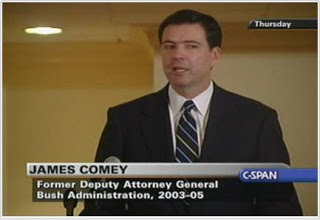 President Barack Obama announced Friday afternoon that he’s selected James Comey to head the Federal Bureau of Investigation.
Comey, 52, worked as the deputy attorney general for the United States under President George W. Bush and will replace outgoing FBI Director Robert Mueller when he steps down later this year after he is confirmed by the Senate.
All three men were on hand at the White House Friday afternoon when President Obama formally made his pick after weeks of speculation suggested Comey would be the likely nominee.
Comey, said Obama, embodies the “core principals of fidelity, bravery and integrity” expected of FBI agents and applauded “his fierce independence and his deep integrity.”
In fact, that independence is the focus of perhaps the most widely reported instance from the Bush White House involving Comey. While serving as deputy attorney general in the Department of Justice, Comey rejected the administration’s warrantless wiretapping program that has recently reemerged as the center of controversy.
“In a confrontation he has called the most difficult night of his career, [Comey] rushed to the hospital bedside of his boss, John Ashcroft, in 2004 to stop two senior Bush White House aides from getting the ailing attorney general’s approval to reauthorize a post-9/11 program that allowed government wiretaps to be used without warrants,” the Associated Press recalled this week.
Comey’s insistence in keeping the program off the books was made notwithstanding an earlier decision to favor the surveillance program, though. Glenn Greenwald reported for The Guardian last month that Comey “approved a legal memorandum in 2004 endorsing radical executive power theories and warped statutory interpretations, concluding that the Bush NSA warrantless eavesdropping program was legal, thus making it more difficult to prosecute the Bush officials who ordered it.”
The internal conflict within the administration that erupted years later over that program almost led to Comey, Ashcroft and Mueller offering their resignation, apparently. As Greenwald noted, though, the then-deputy attorney general declined to follow up on his threat after slight adjustments were made to the NSA spy program.
“But the reason they didn’t end up resigning ,” he wrote, “was because Bush officials ‘modified’ that NSA program into something those lawyers could and did endorse: the still-illegal, still-radical NSA eavesdropping program that spied on the communications of Americans without warrants and in violation of the law.”
Those practices have come under question in recent weeks after Edward Snowden, a 29-year-old former intelligence contractor, leaked documents showing the size and scope of the surveillance programs. Mr. Mueller said those disclosures caused “significant harm” to the nation’s security and that the admitted leaker is the “subject of an ongoing criminal investigation.”
“One of the great vulnerabilities terrorists understand is their communications,” Mueller told the House Judiciary Committee last week. “If we lose our ability get their communications, we are going to be exceptionally vulnerable.”
After being picked by Pres. Obama to replace Mueller on Friday, Comey said, “I don’t know whether I can fill those shoes.” Mueller was FBI chief for 12 years, making him the second-longest serving official to ever head the bureau.
Related article
The NSA Black Hole: 5 Basic Things We Still Don’t Know About the Agency’s Snooping
By Justin Elliott and Theodoric Meyer | ProPublica | June 10, 2013

The headquarters of the National Security Agency at Fort Meade, Maryland
Last week saw revelations that the FBI and the National Security Agency have been collecting Americans’ phone records en masse and that the agencies have access to data from nine tech companies.
But secrecy around the programs has meant even basic questions are still unanswered. Here’s what we still don’t know:
Has the NSA been collecting all Americans’ phone records, and for how long?
It’s not entirely clear.
The Guardian published a court order that directed a Verizon subsidiary to turn over phone metadata — the time and duration of calls, as well as phone numbers and location data — to the NSA “on an ongoing daily basis” for a three-month period. Citing unnamed sources, the Wall Street Journal reported the program also covers AT&T and Sprint and that it covers the majority of Americans. And Director of National Intelligence James Clapper himself acknowledged that the “collection” is “broad in scope.”
How long has the dragnet has existed? At least seven years, and maybe going back to 2001.
Senate Intelligence Committee chair Dianne Feinstein, D-Calif., and vice chair Saxby Chambliss, R-Ga., said last week that the NSA has been collecting the records going back to 2006. That’s the same year that USA Today revealed a similar-sounding mass collection of metadata, which the paper said had been taking place since 2001. The relationship between the program we got a glimpse of in the Verizon order and the one revealed by USA Today in 2006 is still not clear: USA Today described a program not authorized by warrants. The program detailed last week does have court approval.
What surveillance powers does the government believe it has under the Patriot Act?
That’s classified.
The Verizon court order relies on Section 215 of the Patriot Act. That provision allows the FBI to ask the Foreign Intelligence Surveillance Court for a secret order requiring companies, like Verizon, to produce records – “any tangible things” – as part of a “foreign intelligence” or terrorism investigation. As with any law, exactly what the wording means is a matter for courts to decide. But the Foreign Intelligence Surveillance Court’s interpretation of Section 215 is secret.
As Harvard Law Professor Noah Feldman recently wrote, the details of that interpretation matter a lot: “Read narrowly, this language might require that information requested be shown to be important or necessary to the investigation. Read widely, it would include essentially anything even slightly relevant — which is to say, everything.”
In the case of the Verizon order — signed by a judge who sits on the secret court and requiring the company to hand over “all call detail records” — it appears that the court is allowing a broad interpretation of the Patriot Act. But we still don’t know the specifics.
Has the NSA’s massive collection of metadata thwarted any terrorist attacks?
It depends which senator you ask. And evidence that would help settle the matter is, yes, classified.
Sen. Mark Udall, D-Colo., told CNN on Sunday, “It’s unclear to me that we’ve developed any intelligence through the metadata program that’s led to the disruption of plots that we could [not] have developed through other data and other intelligence.”
He said he could not elaborate on his case “without further declassification.”
Sen. Feinstein told ABC that the collection of phone records described in the Verizon order had been “used” in the case of would-be New York subway bomber Najibullah Zazi. Later in the interview, Feinstein said she couldn’t disclose more because the information is classified. (It’s worth noting that there’s also evidence that old-fashioned police work helped solve the Zazi case — and that other reports suggest the Prism program, not the phone records, helped solve the case.)
How much information, and from whom, is the government sweeping up through Prism?
It’s not clear.
Intelligence director Clapper said in his declassified description that the government can’t get information using Prism unless there is an “appropriate, and documented, foreign intelligence purpose for the acquisition (such as for the prevention of terrorism, hostile cyber activities, or nuclear proliferation) and the foreign target is reasonably believed to be outside the United States.”
One thing we don’t know is how the government determines who is a “foreign target.” The Washington Post reported that NSA analysts use “search terms” to try to achieve “51 percent confidence” in a target’s “foreignness.” How do they do that? Unclear.
We’ve also never seen a court order related to Prism — they are secret — so we don’t know how broad they are. The Post reported that the court orders can be sweeping, and apply for up to a year. Though Google has maintained it has not “received blanket orders of the kind being discussed in the media.”
So, how does Prism work?
In his statement Saturday, Clapper described Prism as a computer system that allows the government to collect “foreign intelligence information from electronic communication service providers under court supervision.”
That much seems clear. But the exact role of the tech companies is still murky.
Relying on a leaked PowerPoint presentation, the Washington Post originally described Prism as an FBI and NSA program to tap “directly into the central servers” of nine tech companies including Google and Facebook. Some of the companies denied giving the government “direct access” to their servers. In a later story, published Saturday, the newspaper cited unnamed intelligence sources saying that the description from the PowerPoint was technically inaccurate.
The Post quotes a classified NSA report saying that Prism allows “collection managers [to send] content tasking instructions directly to equipment installed at company-controlled locations,” not the company servers themselves. So what does any of that mean? We don’t know.
For more on mass surveillance in America, read our timeline of loosening laws and practices.
Related articles
- Why Did Edward Snowden Go to Hong Kong?
- NSA Document Leak Proves Conspiracy To Create Big Brother Style World Control System
- DOJ launches criminal probe of NSA leaker
- US security officials said NSA leaker, journalist should be ‘disappeared’ – report
- Government Spying: Should We Be Shocked?
- Boundless Informant: NSA’s complex tool for classifying global intelligence
- The NSA’s Favorite Weasel Word To Pretend It’s Claiming It Doesn’t Spy On Americans
- The “Congress knew” defense
- NSA memo pushed to ‘rethink’ 4th Amendment
Featured Video

Theodore Postol: Iran’s Missiles & Drones Were Underestimated
or go to
Aletho News Archives – Video-Images
From the Archives
Wars for Israel: A reminder of who’s giving the marching orders
By Damian Lataan | February 7, 2012
As the West prepares to march off to yet another war in the Middle East, we should perhaps remind ourselves of who is giving the West their marching orders.
In February 2003, just weeks before the US and their allies launched their attack on Iraq and her peoples, a delegation of US congressmen, together with the US Ambassador to the United Nations, John Bolton, a well known pro-Zionist and neoconservative war-hawk, were in Israel at the invitation of the Israeli government then led by Israeli Prime Minister Ariel Sharon.
Addressing the congressmen, Sharon told them ‘that Iran, Libya and Syria should be stripped of weapons of mass destruction after Iraq’. Later, Sharon told John Bolton ‘that Israel was concerned about the security threat posed by Iran, and stressed that it was important to deal with Iran even while American attention was focused on Iraq’. … continue
Blog Roll
 Aletho News
- The Most Important Bet You’ve Never Heard Of
- The killing of three Indonesian soldiers in Lebanon should remind Jakarta that Israel does not want peace
- Defeated and delusional: Netanyahu’s remarks reveal $80bn war failure, says analyst
- Iran’s friends are about to make life much more difficult for Israel and the US
- The war of liberation of the Arab and Islamic peoples expands across the Gulf
- Envoy warns UN on Trump’s threat to ‘obliterate’ Iran’s civilian infrastructure
- The Larak Corridor: Iran’s Rial Gate With No US, No Israel, and No Way Around
- ‘Economic terrorism’: Steel facilities hit again in US-Israeli strike
- ‘War Crime’: Iran condemns attacks on Arak, Ardakan nuclear sites
- Two-thirds of Americans want quick end to Iran war even if goals unmet
- If Americans Knew
- Gaza families reunite years after babies evacuated amid Israel’s war
- International Rescue Committee warns Gaza’s children face grave protection risks
- Iran’s Alleged 47-Year War on America: Debunking the 1,050 American Deaths Canard
- Israel wants US to bomb more of Iran’s civilian structures (113,000 is not enough) – Not a ceasefire Day 173
- Ann Coulter Rips Into Fox News for Iran War Coverage
- Joe Kent Urges Americans To Call White House and Congress To Object To Sending Troops Into Iran
- DNC Resolution to Reject AIPAC Funding Puts Democratic Leaders in the Hot Seat
- Swedish foundation to build 400 schools as over 650,000 Gaza children remain without education for 2 years
- Israeli army admits photshopping image of slain Lebanese journalist
- This is how Israel is systematically killing health workers under the cover of war in Lebanon
- No Tricks Zone
- New Study Finds Warming Saves Lives…Cold Temperatures 12 Times More Deadly Than Excess Heat
- German Science Blog Accuses PIK Climate Institute Of Hallucinating Climate Tipping Points
- Devastating Assessment Of Comirnaty Vaccine By Former Senior Pfizer Europe Toxicologist
- New Study: CO2 Is ‘Effectively Negligible’ As An Explanatory Climate Change Factor Since 2000
- Former Pfizer Toxicologist Dr. Helmut Sterz Tells Bundestag Hearing Pfizer Vaccine Should Have Never Been Approved
- Energy Expert: Germany’s Nuclear Phaseout Was A “500 Billion Euro Mistake”
- New Research: South Australia’s Mid-Holocene Sea Surface Temperatures Were 4°C Warmer Than Today
- Storing Green Energy To Last Germany 10 Days Would Require A 60-Million Tonne Battery
- New Studies: UK Sea Levels Were 4 Meters Higher Than Today During The Mid-Holocene
- Destructive Green New Deal: German Energy And Metal Group Warns Of Drastic Crisis
 Aletho News