Why is the CIA Fighting Release of Documents Relating to 4 Planes that Went Missing in 1980?
By Noel Brinkerhoff | AllGov | March 15, 2014
A federal judge has told the Central Intelligence Agency (CIA) and other federal offices to continue looking for records pertaining to the disappearance of four transport planes in 1980.
The case was brought before Judge Colleen Kollar-Kotelly by plaintiff Stephen Whitaker, who has attempted to obtain information about four DC-3 aircraft, one of which was flown by his father, Harold William Whitaker.
Stephen Whitaker filed Freedom of Information Act requests with the CIA, as well as the Department of Defense and the State Department, to learn if they possessed records that might explain what happened to the DC-3s.
The CIA refused to tell Whitaker if its archives held any relevant documents pertaining to his search. The agency cited various exemptions under federal law, including the CIA Act of 1949 (pdf), which allow it to avoid responding to certain FOIA inquiries.
Whitaker argued in his lawsuit that the CIA improperly invoked FOIA Exemption (b) (3) (pdf), which authorizes the agency to keep from revealing information on agency “functions” and “intelligence sources and methods.”
Kollar-Kotelly sided with Whitaker, ruling (pdf) that “the CIA has too broadly applied the CIA Act to withhold information pursuant to Exemption (b) (3).” However, she agreed with two other exemptions cited by the CIA that pertain to attorney-client privilege and the withholding of personnel and medical records.
The plaintiff’s search for information seems to be both personal and more.
He said the plane piloted by his father disappeared somewhere over Spain in October 1980. It had been purchased at auction from the Spanish Air Force and was being flown to Germany to become part of a museum.
A report from Spain’s Civil Aviation Commission on Accidents says the aircraft’s instruments may not have been fully functional, and that the radio may only have been capable of sending messages but not receiving them.
The report added that there was no record of a distress call from the pilot, or co-pilot Lawrence Eckmann, a major in the U.S. Army.
Stephen Whitaker also sought records from the government about Eckmann. The State Department claimed its search turned up nothing on Eckmann. The plaintiff challenged this assertion, and Kollar-Kotelly agreed that Eckmann had been excluded from the search, which was found to be “inadequate and should have been revised….”
The plaintiff seems to suspect that some of the DC-3s he has sought information on were used by the CIA in its covert operations.
His FOIA request to the spy agency asked for any information that would reveal whether “any of these persons or aircraft were later found to be employed or contracted by the CIA for service in Central America or elsewhere.”
The CIA has a long history of using DC-3s that ranges from the Vietnam War to the recent conflict in Libya that ousted the Gaddafi regime.
To Learn More:
Missing-Plane Records From 1980 Dissected (by Kevin Lessmiller, Courthouse News Service)
Stephen Whitaker v. Central Intelligence Agency (U.S. District Court, District of Columbia) (pdf)
Technical Report on the Disappearance of a DOUGLAS DC-3 Aircraft, Registration # ECT-025, on the 3rd of October, 1980, to the North of Palm of Majorca (Civil Aviation Commission on Accidents, Spain) (pdf)

Court rules White House visitor logs can remain secret
By Julian Hattem – The Hill – 08/30/13
A federal appeals court has ruled that the White House can keep secret some records of visitors who enter the building.
In a unanimous decision on Friday, a three-judge panel of the U.S. Court of Appeals for the D.C. Circuit ruled that visitor logs for the Office of the President, at the center of the White House, are not subject to disclosure under the Freedom of Information Act (FOIA).
Anti-secrecy organizations criticized the ruling as a barrier to public oversight.
“Decisions like this turn FOIA from a transparency law into a secrecy law,” Tom Fitton, president of the right-leaning Judicial Watch, told The Hill. He added that the decision was “unprecedented.”
Records for other offices on the White House complex, however, such as the Office of Management and Budget and the Council on Environmental Quality, are subject to public disclosure requests, the court ruled.
The appeals court ruling overturns a district court case brought by Judicial Watch, which sued the Secret Service in 2009 for not releasing seven months’ worth of visitor logs.
The dispute centered on whether the visitor logs amounted to “agency records,” which FOIA requires to be accessible to public requests, except in certain circumstances.
Judge Merrick Garland wrote in the court’s opinion that classifying White House visitor logs as “agency records” could “substantially affect the President’s ability to meet confidentially with foreign leaders, agency officials, or members of the public. And that could render FOIA a potentially serious congressional intrusion into the conduct of the President’s daily operations.”
He added, “Congress did make clear that it intended to place documents like the President’s appointment calendar beyond the reach of FOIA.”
Transparency advocates worried about the precedent that would be set by the decision.
“White House visitor records have proven of enormous value to the public in exposing the outside influences brought to bear on presidential decisions and policies,” said Melanie Sloan, executive director of Citizens for Responsibility and Ethics in Washington, which joined the case. “With this ruling, that window on the White House is now shut.”
The Obama administration has voluntary released its logs of White House visitors, but even those have been a point of contention. The records lack additional identifying details beyond a visitor’s name, can often include typos and may include names of people cleared to enter the building who never actually showed up.
Fitton said that Judicial Watch was “strongly considering” appealing the ruling.
“The option of doing nothing is unlikely,” he said.
Follow us: @thehill on Twitter | TheHill on Facebook
Related article
- Judicial Watch Sues State Department for Documents about Possible Clinton Conflicts of Interest (greenmountainscribes.wordpress.com)
‘Most transparent administration’ violates federal transparency laws
RT | September 28, 2012
Nineteen out of 20 cabinet-level agencies under the Obama administration have failed to follow the requirements of the Freedom of Information Act, thereby disobeying the law that demands disclosure of public information.
White House Chief of Staff Jack Lew said in July that the Obama administration “has been the most transparent ever.” But an analysis of government requests filed by Bloomberg News has found an alarming number of transparency violations, particularly when it comes to the taxpayer-funded cost of travel by top officials.
“When it comes to implementation of Obama’s wonderful transparency policy goals, especially FOIA policy in particular, there has been far more ‘talk the talk’ rather than ‘walk the walk,’’ Daniel Metcalfe, director of the Department of Justice’s office monitoring the government’s compliance with FOIA requests, told the news agency.
In 2009, the newly sworn in President Obama promised a new standard of transparency that his administration has not upheld – even accepting awards for what he oversaw as “the most transparent administration in history.”
“I will hold myself as president to a new standard of openness… Let me say it as simply as I can: Transparency and the rule of law will be the touchstones of this presidency,” he said while welcoming his senior staff and cabinet secretaries to his office. Two years later, the administration continued to boast about its supposed transparency.
“This president has demonstrated a commitment to transparency and openness that is greater than any administration has shown in the past, and he’s been committed to that since he ran for president and he’s taken a significant number of measures to demonstrate that,” White House Press Secretary Jay Carney said in May 2011, before the president accepted an award for transparency.
But Bloomberg’s report highlights specific instances in which secrecy was a normal part of the regime. Under FOIA, the news agency requested documents from 57 federal agencies regarding taxpayer-funded travel. Only eight of 57 agencies responded within the 20-day time frame required by the Act. The other agencies are under violation of FOIA for failing to submit the documents on time.
And Eric Newtown, senior advisor at the Knight Foundation, said there should be no excuses.
“In a 24/7 world, it should take two days, it should take two hours,” he said. “If it’s public, it should be just there.”
Bloomberg eventually received documents disclosing fiscal year 2011 travel costs from about half of the agencies, although most came well past the legal deadline.
Travel costs by top Obama officials, including the transportation secretary, energy secretary, environmental protection agency administrator and homeland security chief, remain undisclosed.
The lack of public disclosure regarding travel costs of many cabinet-level top officials has become concerning since the General Services Administration’s inspector general spent $823,000 of taxpayer money on a one-day event in Las Vegas in 2010.
Another one of Bloomberg’s FOIA request also found that federal agencies have increased their use of exemptions to block the release of information under the Obama administration. Cabinet agencies employed exemptions 466,402 times during Obama’s first year in office, which is a 50 percent jump from the last year of George W. Bush’s presidency.
“I don’t think the administration has been very good at all on open-government issues,” said Katherine Meyer, a Washington attorney. “The Obama administration is as bad as any of them, and to some extent worse.”
Related articles
CIA: We Do Not “Concede or Not Concede” that Waterboarding is Illegal
ACLU | March 13, 2012
On Friday, the ACLU appeared before the 2nd Circuit Court of Appeals in New York to argue that the Freedom of Information Act (FOIA) requires the CIA to release documents describing its use of waterboarding. The simple question at the heart of the hearing was this: is waterboarding an “intelligence method” that can be protected from disclosure under FOIA? We argued that the answer — of course not — is easy because even the president himself has declared that waterboarding is illegal. Exposing official misconduct to public scrutiny is the chief purpose of FOIA. But it cannot serve that purpose if even officially confirmed illegality is protectable.
The CIA disagreed and offered a truly astonishing view of what our laws on transparency were meant to protect from the public’s view. Under its theory, the agency may protect just about any type of activity — legal or illegal — as an “intelligence method,” and thus conceal such activities from the public. It does not matter that President Obama has declared waterboarding to be illegal, and it does not matter that the United States has prosecuted waterboarding as a war crime in the past. Even the most egregiously unlawful interrogation techniques could be kept secret as “intelligence methods” of the CIA.
Was the CIA really making this argument? We would soon find out that even the CIA’s lawyer seemed uncomfortable with the extraordinary breadth of the claim, resorting to smoke and mirrors to distract the court’s focus. Toward the end of the hearing, the three judges and the CIA’s lawyer recessed for a 40-minute classified session to discuss the documents we are seeking. When the public hearing resumed, the CIA’s lawyer made the mystifying claim that the CIA “does not concede or not concede” that waterboarding is illegal.
We scratched our heads trying to understand what exactly this meant. President Obama declared waterboarding to be illegal shortly after releasing the Bush administration’s torture memos in 2009. And the CIA never once disputed the unlawfulness of waterboarding in its filings in this case. The only possibility was that the government was trying to have it both ways. It wants to win this case without having to argue publicly that illegal conduct can be a protectable “intelligence method.”
At its core, the CIA’s argument is that the agency should be permitted to decide for itself which information should be released, and which should be suppressed. The agency believes that courts should simply defer to its decisions about secrecy. There is a time and place for that kind of deference, of course, but when it comes to public disclosure of the CIA’s illegal conduct, the CIA’s claim to immunity is fundamentally at odds with our system of checks and balances. Only through public scrutiny of official wrongdoing can the governed hold the government accountable. And only through robust judicial enforcement of our transparency laws will the public have access to the information necessary to do so.
Related articles
- US Government Argues Cables on Illegal CIA Waterboarding Should Remain Secret (dissenter.firedoglake.com)
- CIA Claims Release of its History of the Bay of Pigs Debacle Would “Confuse the Public.” (alethonews.wordpress.com)
- EFF Wants to Make Every Week Sunshine Week with ‘This Week in Transparency’ (eff.org)
- Sign on to Fight the CIA’s Covert Attack on Mandatory Declassification Review (nsarchive.wordpress.com)
CIA Claims Release of its History of the Bay of Pigs Debacle Would “Confuse the Public.”
By Nate Jones | Unredacted | February 3, 2012
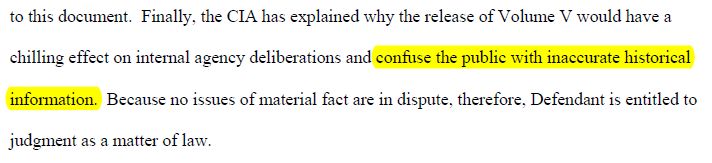
Late last year, the Central Intelligence Agency explained to Judge Kessler of the US District Court in Washington DC that releasing the final volume of its three-decade-old history of the 1961 Bay of Pigs debacle would “confuse the public,” and should be withheld because it is a “predecisional” document. Wow. And I thought that I had heard them all.
On the 50th anniversary of the Bay of Pigs invasion, the National Security Archive filed a Freedom of Information Act lawsuit for the release of a five-volume CIA history of the Bay of Pigs affair. In response to the lawsuit, the CIA negotiated to release three volumes of the history — the JFK Assassination Records Review Board had already released Volume III– with limited redaction, currently available on the National Security Archive’s website. At the time, the Director of the National Security Archive’s Cuba Documentation project, Peter Kornbluh, quipped that getting historic documents released from the CIA was “the bureaucratic equivalent of passing a kidney stone.” He was right. The Agency refused to release the final volume of this history, and the National Security Archive is not giving up on the fight.
 Keet it secret!
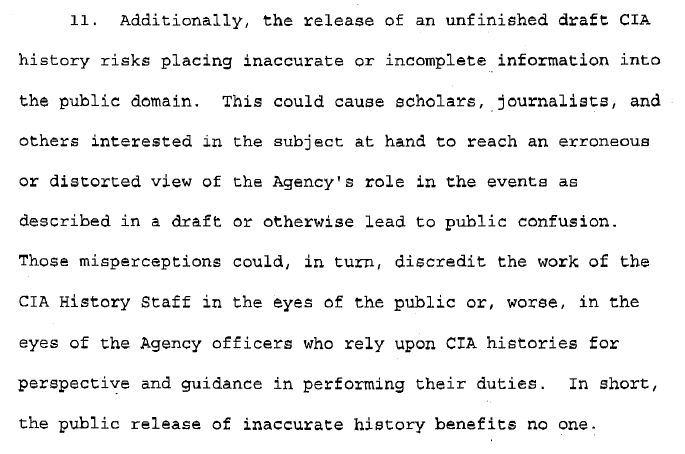
Volume five of the history, written by CIA historian Jack Pfeiffer –who sued the CIA himself to release the history in 1987, and lost– is described by the CIA as an “Internal Investigation document” that “is an uncritical defense of the CIA officers who planned and executed the Bay of Pigs operation… It offers a polemic of recriminations against CIA officers who later criticized the operation and against those U.S. officials who its author, Dr. Pfeiffer, contends were responsible for the failure of that operation.”
While Dr. Pfeiffer’s conclusions may or may not be true, FOIA case law appears to be pretty clear that Americans –who funded the operation and Dr. Pfeiffer’s histories– have the right to read this document and decide for themselves its merits. Despite the claims of the CIA’s chief historian David Robarge, the document should not remain in the CIA vaults because its conclusions “could cause scholars, journalists, and others interested in the subject at hand to reach an erroneous or distorted view of the Agency’s role.” Historians, after all, are well trained in treating documents –especially CIA hagiographies sources– skeptically.
To prevent the public from reading this volume, the CIA has argued that because it is a draft, it is a predecisional document and can be denied under exemption b(5) of the FOIA. Except –as Davis Sobel, counsel to the National Security Archive points out in our motions– the case law states otherwise.
President Obama instructed every agency (yes, even the CIA) to “usher in a new era of open government” and apply a “presumption of disclosure… to all decisions involving FOIA.” In response to this instruction, the Department of Justice Office of Information Policy –responsible for enforcing FOIA throughout the government– issued its own guidance to agencies (yes, even the CIA), explaining:
“A requested record might be a draft, or a memorandum containing a recommendation. Such records might be properly withheld under Exemption 5, but that should not be the end of the review. Rather, the content of that particular draft and that particular memorandum should be reviewed and a determination made as to whether the agency reasonably foresees that disclosing that particular document, given its age, content, and character, would harm an interest protected by Exemption 5. In making these determinations, agencies should keep in mind that mere “speculative or abstract fears” are not a sufficient basis for withholding. Instead, the agency must reasonably foresee that disclosure would cause harm…
For all records, the age of the document and the sensitivity of its content are universal factors that need to be evaluated in making a decision whether to make a discretionary release.” *
As the D.C. circuit recognized, “the Supreme Court has pointed out that the ‘expectation of the confidentiality of executive communications [] has always been limited and subject to erosion over time…”” (Judicial Watch, Inc. v. U.S. Dep’t of Justice (D.C. Cir. 2004.)
Even presidential records are barred from being withheld under “predecisional pretenses” after a period of time. The Presidential Records Act expressly states that exemption b(5) cannot be invoked to withhold records once the president has been out of office twelve years. If the presidential communication and work process is not threatened by this provision, there is no reason that the CIA’s history staff should be.
And there is a good chance that the history is not even a predecisonal document. The burden rests on the CIA to point to the specific decision that the history is “decides” to make it a predecisional document. And so far they have not. Their case rests on the speculative and abstract fear of “discrediting[ing] the work of the CIA History Staff in the eyes of the public or, worse, in the eyes of the Agency officers who rely upon CIA histories.”
Even if parts of the document truly are predecisional, only they can be withheld, the facts leading up to that decision –and histories are (hopefully) based primarily on facts– must be released.
To wit, draft histories have frequently been released under FOIA. In 2010, the Department of Justice released portions of pages of a candid history of Nazi-hunting (and Nazi-protecting) clearly marked DRAFT. (The unredacted version of the report was subsequently leaked– no prosecution by the Obama administration for that one… yet.) Moreover, the CIA previously disclosed Volume IV of this history in draft form (with a disclaimer)! This final volume to the CIA’s history remains one of the few –perhaps the only– government produced product chronicling the doomed invasion which remains classified; the public should be allowed to see its contents.
 “Trust us. You don’t need to read it for yourselves.”
The National Security Archive’s case is a strong one. I’m confident that Judge Kessler will require a de novo review of the document leading to its eventual release.
On the other hand, the CIA’s “confuse the public” defense appears is as weak as it is insulting.
—————————
*It’s certainly not clear why DOJ attorneys would agree to argue this case for the CIA, especially after Eric Holder sent a government-wide memo which promised to defend denials of FOIA requests only when disclosures would truly harm agency interests. What is more clear is the reason why many agencies have failed to implement the Obama FOIA reforms –the Department of Justice has done a poor job implementing them within its own divisions, and the DOJ Office of Information Policy has done a poorer job forcing other agencies to comply with the law.
As the Archive’s counsel David Sobel put it, “This case is yet the latest example of the Obama administration failing to deliver on its promise of ‘unprecedented’ transparency. It’s hard to understand how the release of this document, after all these years, could in any way harm legitimate government interests.””
Related articles
- Document Friday: Che Guevara Thanks the United States for the Bay of Pigs Invasion. (nsarchive.wordpress.com)
- CIA won’t disclose involvement in OWS crackdowns (rt.com)
- Under Obama, the Freedom of Information Act is Still in Shackles (eff.org)
- FBI Sanctioned for Lying About Existence of Surveillance Records (alethonews.wordpress.com)
- Obama Regime Seeks Permission To Lie In Response To Freedom Of Information Requests – Even To The Courts (alethonews.wordpress.com)
- ACLU Sues U.S. for Information on Targeted Killing Program (newsworldwide.wordpress.com)
- The CIA, Cuba and Operation Peter Pan (alethonews.wordpress.com)
Featured Video

Prof. Ted Postol: Iran Already Achieved Nuclear Deterrence Against Israel
or go to
Aletho News Archives – Video-Images
From the Archives
How the occupied mentality syndrome works
Saudi Arabia on the American chessboard – Part 3
By B. J. Sabri | American Herald Tribune | June 27, 2016
Read part 2: “The occupied mentality Syndrome“
Previously I argued whether Saudi Arabia’s repeated involvements in U.S. interventions and wars stem from free national will or in response to a specific condition. For starters, in Saudi Arabia there is no national will. In Saudi Arabia, the national will is the will of the Al Saud clan. Still, when a major Arab state allies itself with a superpower that committed unspeakable crimes against humanity in almost every Arab country, then something is wrong. This fact alone should compel us to examine the U.S.-Saudi relation for one exceptional reason. As a result of the U.S.-Saudi wars, hundreds of thousands of people in Afghanistan, Iraq, Iran, Libya, Syria, Yemen, and Somalia have lost their lives. Millions became displaced in their own homelands. And millions more rendered refugees.
Attributing the Saudi policies to the bonds of “partnership” with the U.S. is frivolous. There are no bonds between these two thugs except those of business, military deals, secret plots, and wars. Proving this point, bonds such as these have no space for the American and Saudi peoples to share significant cultural or societal exchanges. If partnership is not the reason for the Saudi contribution to the U.S. strategy of empire and imperialism, then another reason must exist.
This leads to three possibilities. … continue
Blog Roll
 Aletho News
- Hezbollah hits Israeli warship off Lebanon’s coast, sets it aflame
- Iran slams US strikes on B1 bridge, Mahshahr petrochemical plants as ‘blatant acts of state terrorism’
- In letter to UN chief, Araghchi warns of dire consequences of US-Israeli attacks on Iran’s nuclear facilities
- Why the CIA conspiracy to invade Iran with Kurdish militias failed
- Why Are Upbeat US Claims About Mission to Rescue Pilot ‘Highly Questionable’?
- Aircraft destroyed during US ‘rescue’ of downed F-15 pilot cost more than $100 million each
- Washington University removes professor who condemned US-Israeli war on Iran
- Russia Warns of Retaliation as UK Authorizes Seizure of Vessels
- Serbia thwarts plot to bomb Russia-Hungary gas pipeline – Vucic
- Al Mayadeen voices solidarity with Dr. Marandi amid death threats
- If Americans Knew
- In Iran, Israel-US take aim at “reason, research, and freedom of thought” – Daily Update
- US loses planes over Iran, Israel downgrades Lebanon war goals – Daily Update
- Israel Is Blocking Palestinians from Easter at Church Where Jesus Resurrected
- Plot to assassinate Palestinian activist follows harassment campaign promoted by Zionist groups and elected officials
- Prominent New York synagogue hosts presentation on why U.S. Jews should support the ethnic cleansing of Gaza
- Tapper vs. Piker: Is the CNN Anchor Auditioning for David Ellison?
- Shouldn’t Democrats Be Able to Condemn Genocide?
- Israel-US kill negotiators, destroy civilian structures, but Iran’s military capabilities still largely intact – Daily Update
- ‘War crime’: Global condemnation as Israeli ministers celebrate death penalty law targeting Palestinian prisoners
- 7 Ways Israel Is Turning Lebanon Into Gaza
- No Tricks Zone
- An Inconvenient Tree: Uncovered In Alps… Europe Much Warmer Than Today 6000 Years Ago
- New Study Reports A 60% Slowdown In Greenland’s Ice Loss Rate In The Last Decade
- Low Intensity Tornado Wrecks Major Solar Farm, Creating A Potential Toxic Dump
- New Study Finds Warming Saves Lives…Cold Temperatures 12 Times More Deadly Than Excess Heat
- German Science Blog Accuses PIK Climate Institute Of Hallucinating Climate Tipping Points
- Devastating Assessment Of Comirnaty Vaccine By Former Senior Pfizer Europe Toxicologist
- New Study: CO2 Is ‘Effectively Negligible’ As An Explanatory Climate Change Factor Since 2000
- Former Pfizer Toxicologist Dr. Helmut Sterz Tells Bundestag Hearing Pfizer Vaccine Should Have Never Been Approved
- Energy Expert: Germany’s Nuclear Phaseout Was A “500 Billion Euro Mistake”
- New Research: South Australia’s Mid-Holocene Sea Surface Temperatures Were 4°C Warmer Than Today
 Aletho News