Lines of the Game: Price to Pay for the Shatah Assassination
By Sami Kleib | Al-Akhbar | December 28, 2013
The assassination of former Lebanese Finance Minister Mohammed Shatah will open a dangerous chapter in Lebanon, a bit similar to the one that followed the assassination of late Prime Minister Rafik Hariri. Shatah was no ordinary man in the region, and the attack occurred at a crucial moment in Lebanon and its neighborhood’s history. Here, escalated tensions and sedition will never let such a crime pass by without major repercussions. The killer knew it!
Hariri’s assassination in 2005 was a turning point for Hezbollah’s image in the Arab and Islamic world, and contributed to the Syrian army’s withdrawal from Lebanon. These events weren’t just a result of local demands. Former US President George W. Bush and his French counterpart Jacques Chirac were also involved.
The Sunni-Shia strife that ripped Iraq apart after the American-British invasion was further consolidated when Hezbollah, with its large Shia base, was accused of murdering the new symbol of modern Sunnism in the region: Rafik Hariri. Back then, political accusation preceded all real investigations on the ground.
Now, what to expect after Shatah’s assassination?
Former Lebanese Prime Minister Saad Hariri was brief, while Future bloc leader Fouad Siniora elaborated, hinting that the Syrian regime planned the crime, and its Lebanese allies, mainly Hezbollah, carried it out. In the March 14 statement, Siniora echoed the calls that followed Hariri’s murder, urging to take Shatah’s assassination to the international level, something we expect to hear quite often in the coming weeks amid international pressure on Hezbollah and Lebanon.
Head of the National Struggle Bloc MP Walid Jumblatt was alone in his call for reason and moderation. He knows quite well that some are seeking to exploit the assassination to achieve bigger political gains. He also understands that this assassination is apt to take the country from sectarian sedition to the battlefield.
The Shatah assassination occurred while Lebanon was at a crossroads. The future government and the current presidency are now up for grabs amid political bickering between Hezbollah and March 14. But behind both parties is a larger and deeper conflict taking place in Syria.
The assassination ought to increase pressure on the formation of a Lebanese government and a formula for a presidential agreement. Previously hesitant, the international community is now expected to support these solutions as the death of Shatah and the other martyrs raised the alarm about a bloody year awaiting Lebanon.
Shatah’s murder also paves the way for further assassinations, clashes, and blasts. Obviously there is a plan to transform Lebanon into an arena for a regional and international conflict that has not been settled in Syria.
What if a Hezbollah leader or ally is killed in the coming days? Will we hear that it is a retaliation for the Shatah murder? Who will break this vicious cycle?
Israel may also find an opportunity to conduct a military operation. It is reported that Hezbollah’s incursion in Syria and the widening rift with its former Sunni base offers Israel the right opportunity to strike. In Lebanon, Israel may redeem what it couldn’t achieve in Iran. At least that’s what the Israelis believe.
The assassination put the Syrian regime and Hezbollah in a raging storm of accusations at a critical time. The world is heading toward the Geneva II conference and an historic understanding with Iran. The international tribunal investigating Hariri’s murder will soon begin its sessions.
Martyr Mohammed Shatah was no ordinary man. Neither was martyr Wissam al-Hassan. Shatah, a man with hefty economic and political baggage, was, just like security man Hassan, standing on a pivotal local, regional, and international intersection. With such assassinations, it is easy to point figures, but it is hard to support accusations with evidence as political exploitation comes in smoothly.
A dark period of major transformation is awaiting Lebanon, but unfortunately the fierce battle ahead won’t yield any winners. What if a fait accompli government was imposed on Hezbollah and its allies? How will Hezbollah Secretary General Hassan Nasrallah put his words “don’t mess with us” into action? Those messing with him this time will have an international cover far larger than the one they had before the assassination.
Related article
Featured Video
AIR POWER CANNOT BEAT an ENTRENCHED ENEMY LIKE IRAN
or go to
Aletho News Archives – Video-Images
Frlom the Archives
Not Ready for the Big Leagues
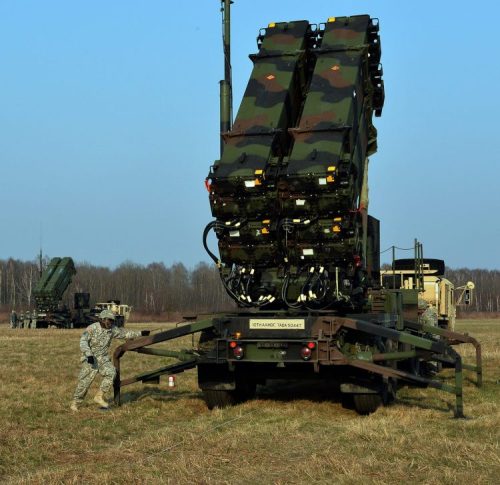
Patriot Missile Launcher
By William Schryver | imetatronink | January 20, 2024
… In an attempt to cover just three large airbases against a series of salvos of 100+ missiles of various types, the entire US stockpile of PAC-3 interceptors could very conceivably be exhausted in little more than a week or two. … continue
Blog Roll
 Aletho News
- The myth of military ‘decapitation’
- Zelensky issues military threat to Orban
- Is the International Norm Against Assassination Dead?
- Larry Johnson: AIR POWER CANNOT BEAT an ENTRENCHED ENEMY LIKE IRAN
- Report- U.S. and Israel Are Targeting ‘Hospitals, Residential Buildings And Schools Across Tehran’
- Witkoff undermined Iran talks by peddling lies to build case for military aggression: Report
- Iraqi Resistance reports drone attacks on US targets in Erbil
- Iran warns all Israeli embassies ‘legitimate targets’ if Lebanon embassy attacked
- Russia could end gas supplies to EU immediately – Putin
- Veteran War Correspondent Reveals How to Tell When Analysts Talking About Iranian Losses Are Lying
- If Americans Knew
- Is the International Norm Against Assassination Dead?
- More than 1,000 Civilians Killed in U.S.-Israeli Bombing of Iran, Rights Group Says
- The Neocons: First in War, Last in Peace
- With focus on Iran and Gaza, Israel is quietly annexing the West Bank
- Experts Worldwide Agree: US-Israel Attack on Iran a Clear Violation of International Law
- 1,000+ reported dead in Iran, in the war that Israel wanted – Not a ceasefire Day 145
- Rubio Suggests Trump Joined Israel’s Planned Attack on Iran Instead of Stopping It
- CNN: Timing of attack on Iran bears symbolic meaning in Judaism
- How the New York Times paved the way for apocalyptic war
- Tucker Carlson says Saudi Arabia and Qatar arrested Mossad agents planning bombings
- No Tricks Zone
- New Study: A Century Warming Of 1.1°C Is ‘Commonplace’ And ‘Not Unusual’ During This Interglacial
- New Study: ‘Internal Noise’ And Volcanic Forcing Can Trigger 10-15°C Warming Within Decades
- Glaciers Worldwide Are Suddendly Surging, Experts Blame Warming!
- Surprising Discovery: Sahara Is Greening…Billions Of Trees Where Once Thought To Be Barren
- New Research Reaffirms Clouds, Aerosols, And Surface Solar Radiation Are ‘Driving The Climate System’
- Germany: Electric Car Catches Fire At Charging Station, Sets Off Local “Inferno”, Widespread Damage
- New Study: Canada’s New Brunswick Was 1°C Warmer Than Today During The Medieval Warm Period
- Coal Power Back In Trend As Globe Tries To Keep Pace With Growing Demand For Power
- New Study: A 4°C Warmer Beaufort Sea Had ‘No Sea Ice’ 11,700 – 8200 Years Ago
- Unfudging The Data: Dutch Meteorological Institute Reinstates Early 20th Centruy Heat Waves It Had Erased Earlier
 Aletho News