The Collapse of French Intellectual Diversity
France Now an Obedient, Cowardly Nation
By ANDRE VLTCHEK | CounterPunch | March 20, 2015
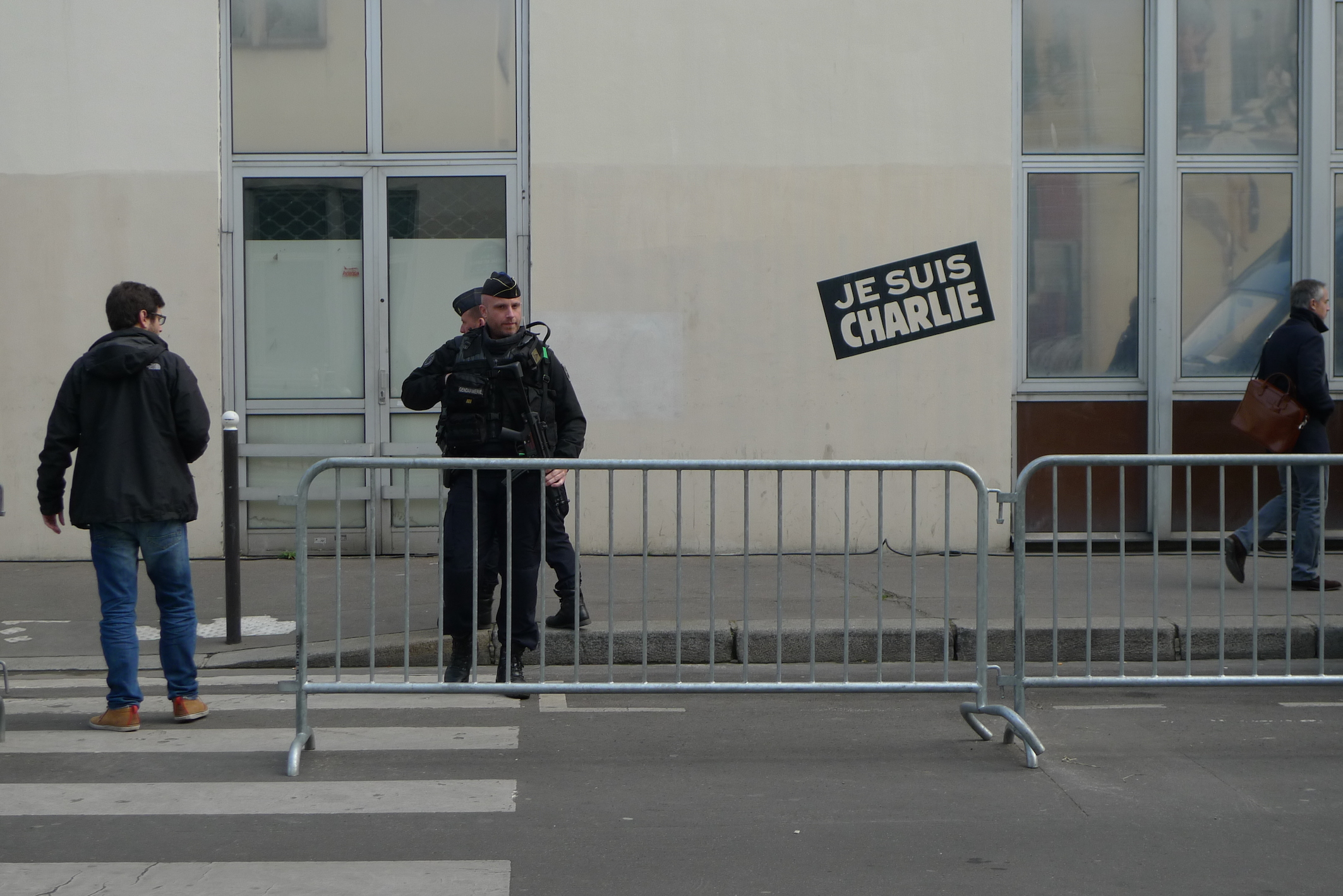
There are several machine gunners in front of the Charlie Hebdo building in Paris. These are cops, wearing bulletproof vests, carrying powerful weapons. They stare at occasional pedestrians in their special, revolting and highly intimidating way. Charlie Hedbo editors are well protected, some of them postmortem.
If you think that France is not as much a police state, as the UK or the US, think twice. Heavily armed military and police are visible at all train stations and many intersections, even at some narrow alleys. Internet providers are openly spying on their costumers. Mass media is self-censoring its reports. The regime’s propaganda is in “top gear”
But the people of France, at least the great majority of them, believe that they live in an ‘open and democratic society.’ If asked, they cannot prove it; they have no arguments. They are simply told that they are free, and so they believe it.
***
Employees of Charlie Hebdo go periodically out of the building for a smoke. I try to engage them in a conversation, but they reply in very short sentences only. They do their best to ignore me. Somehow, intuitively, they sense that I am not here to tell the official story.
I ask them why don’t they ever poke fun at the Western neo-colonialism, at the grotesque Western election system, or at the Western allies that are committing genocides all over the world: India, Israel, Indonesia, Rwanda, or Uganda? They impatiently dismiss me with their body language. Such thoughts are not encouraged, and most likely, they are not allowed. Even humorists and clowns in modern France know their place.
They soon let me know that I am asking too many questions. One of the employees simply looks, meaningfully, in the direction of armed cops. I get the message. I am not in the mood for a lengthy interrogation. I move on.
In the neighborhood, there are several sites carrying outpours of sympathy for the victims; 12 people who died during the January 2015 attack on the magazine. There are French flags and there are plastic white mice with Je Suis Charlie written on their bodies. One big poster proclaims: Je suis humain. Other banners read: “Islamic whores”, with red color correction, replacing Islamic with “terrorist” – Putain de terroristes.
There is plenty of graffiti written about freedom, all over the area. “Libre comme Charlie”, “Free like Charlie”!
A woman appears from the blue. She is very well dressed; she is elegant. She stands next to me for a few seconds. I realize that her body is shaking. She is crying.
“You’re a relative…?” I ask her, gently.
“No, no”, she replies. “We are all their relatives. We are all Charlie!”
She suddenly embraces me. I feel her wet face against my chest. I try to be sensitive. I hold her tight, this stranger – this unknown woman. Not because I want to, but because I feel that I have no other choice. Once I fulfill my civic obligation, I run away from the site.
***
Fifteen minutes walk from the Charlie Hebdo building, and there is the monumental National Picasso Museum, and dozens of art galleries. I make sure to visit at least 50 of them.
I want to know all about that freedom of expression that the French public is so righteously longing for and ‘defending’!
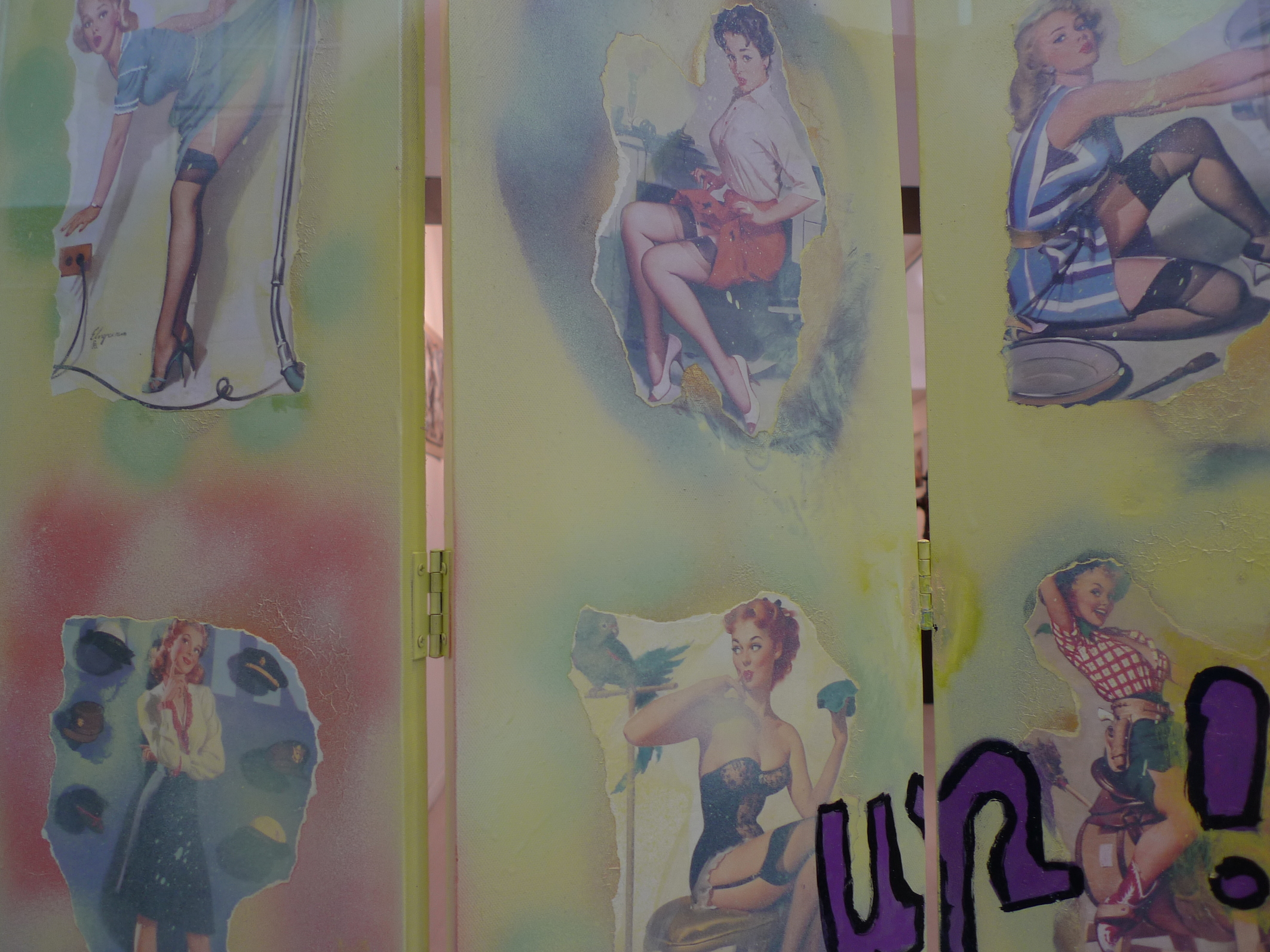
But what I see is endless pop. I see some broken window of a gallery and a sign: “You broke my art”. It is supposed to be an artwork itself.
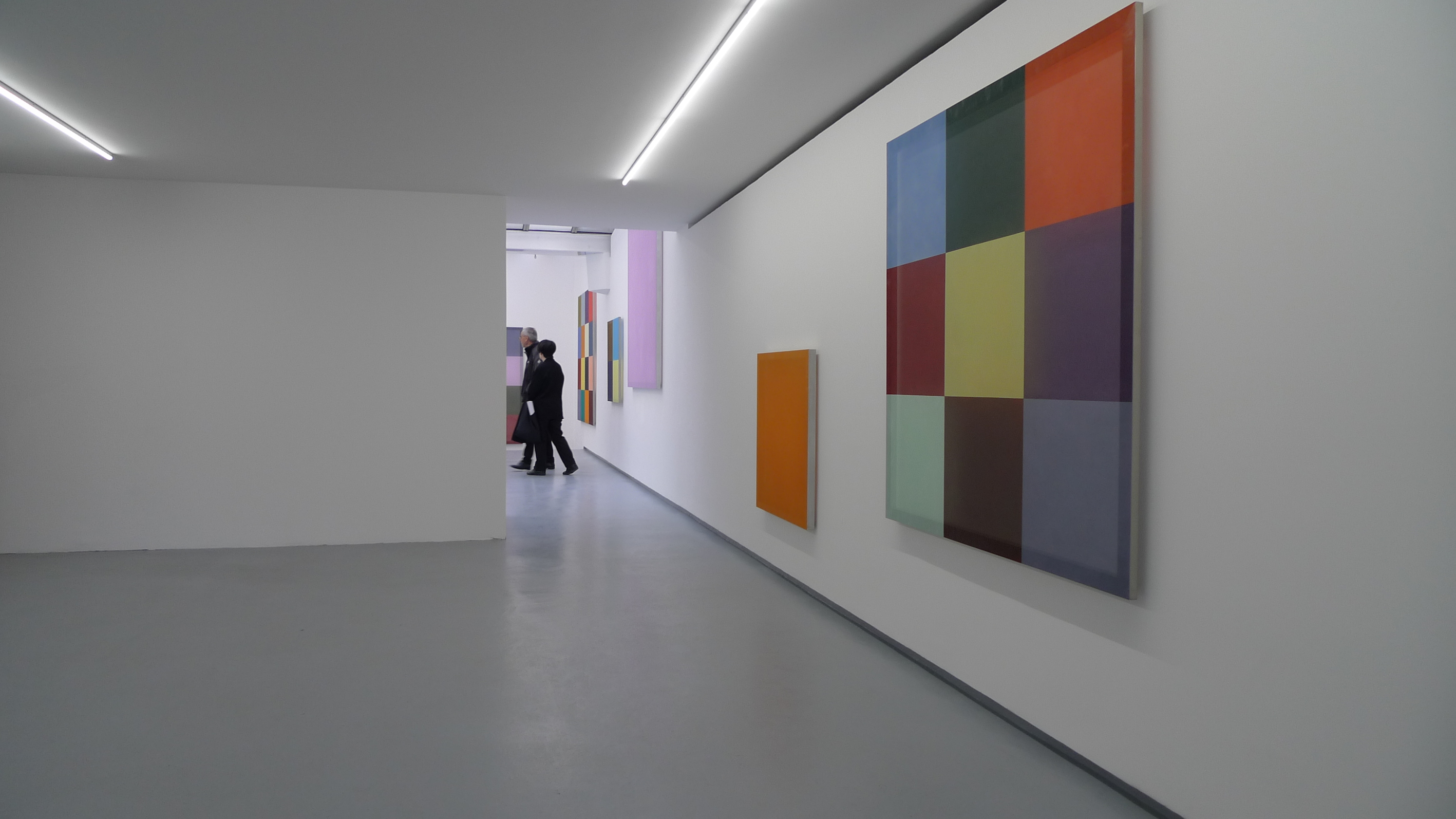
Galleries exhibit endless lines and squares, all imaginable shapes and colors.
In several galleries, I observe abstract, Pollock-style ‘art’.
I ask owners of the galleries, whether they know about some exhibitions that are concentrating on the plight of tens of thousands of homeless people who are barely surviving the harsh Parisian winter. Are there painters and photographers exposing monstrous slums under the highway and railroad bridges? And what about French military and intelligence adventures in Africa, those that are ruining millions of human lives? Are there artists who are fighting against France becoming one of the leading centers of the Empire?
I am given outraged looks, or disgusted looks. Some looks are clearly alarmed. Gallery owners have no clue what am I talking about.
At the Picasso Museum, the mood is clearly that of ‘institutionalism’. Here, one would never guess that Pablo Picasso was a Communist, and deeply engaged painter and sculptor. One after another, groups of German tourists consisting mainly of senior citizens are passing through well-marked halls, accompanied by tour guides.
I don’t feel anything here. This museum is not inspiring me, it is castrating! The longer I stay here, the more I feel that my revolutionary zeal is evaporating.
I dash to the office and summon a junior curator.
I tell her all that I think about this museum and about those commercial galleries that are surrounding it.
“Those millions who were marching and writing messages around Charlie Hedbo… What do they mean by ‘freedom’? There seems to be nothing ‘free’ in France, anymore. Media is controlled, and art has just became some sort of brainless pop.”
She has nothing to say. “I don’t know”, she finally replied. “Painters are painting what people want to buy.”
“Is that so?” I asked.
I mention “798” in Beijing, where hundreds of galleries are deeply political.
“In oppressed societies, art tends to be more engaged”, she says.
I tell her what I think. I tell her that to me, and to many creative people I met in China, Beijing feels much more free, much less brainwashed or oppressed, than Paris. She looks at me in horror, then with that typical European sarcasm. She thinks I am provoking, trying to be funny. I cannot mean what I say. It is clear, isn’t it, that French artists are superior, that Western culture is the greatest. Who could doubt it?
I give her my card. She refuses to give me her name.
I leave in disgust, as I recently left in disgust the Peggy Guggenheim Collection in Venice.
At one point I walk into a cafe, to drink a cup of coffee and a glass of mineral water.
A man and his enormous dog walk in. Both park at the bar, standing. A dog puts its front paws on the bar table. They both have a beer: the man from a glass, his dog from a saucer. A few minutes later, they pay and leave.
I scribble into my notepad: “In France, dogs are free to take their beer in cafes.”
***
In the same neighborhood, I rediscover an enormous National Archive, a beautiful group of buildings with gardens and parks all around.
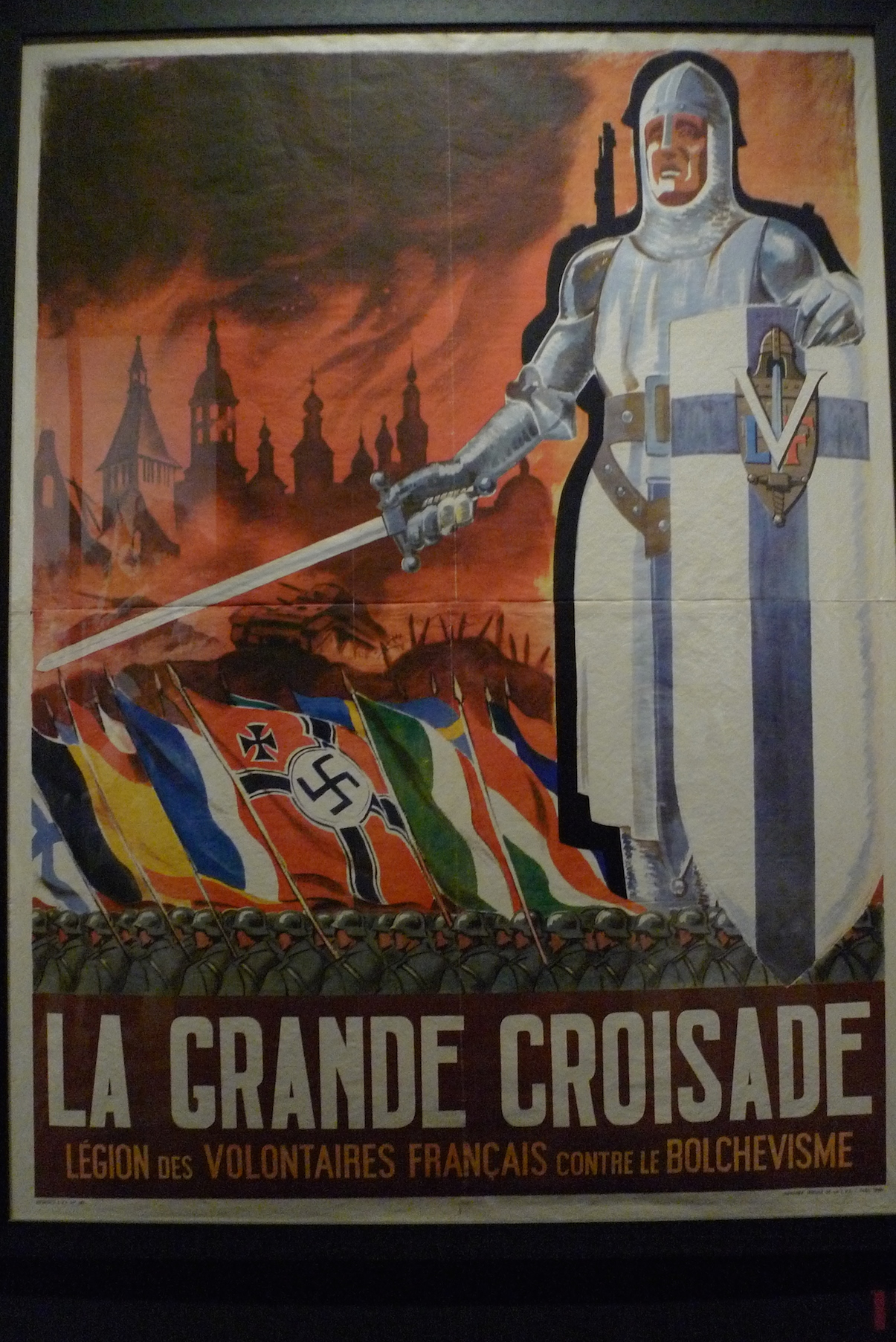
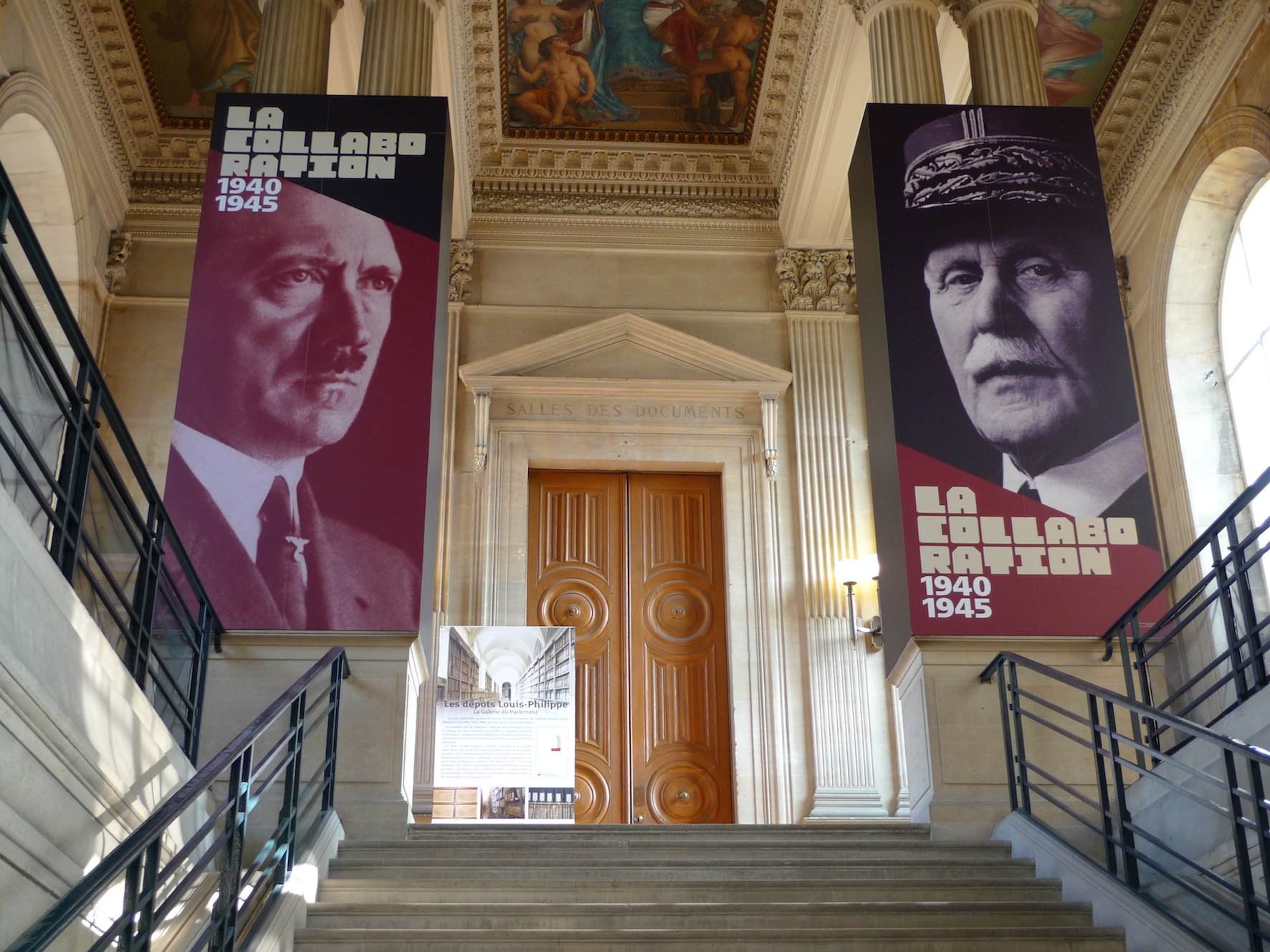
The place is holding a huge exhibition: on how France collaborated with the Nazi Germany during the WWII. The retrospect is grand and complete: with images and texts, with film showings.
For the first time in days, I am impressed. It all feels very familiar, intimately familiar!
***
At night I found myself in that enormous new Philharmonic, at the outskirts of Paris, near Porte de Pantin. I managed to smuggle myself to the invitation-only-opening of an enormous exhibition dedicated to French composer, conductor and writer – Pierre Boulez. That same Pierre Boulez who has been promoting, for ages, the idea of a public sector taking over French classic music scene!
Nobody protested at the exhibition, and I did not hear any jokes directed at Pierre Boulez. It was all brilliantly orchestrated. Great respect for the establishment cultural figure, for the cultural apparatchik!
I heard a technically brilliant concert of contemporary classical music, with new instruments being used.
But nowhere, in any of those tremendous spaces of the Philharmonic, did I hear any lament, any requiem, for the millions of people literally slaughtered by the Empire, of which France is now an inseparable part. No new symphonies or operas dedicated to the victims of Papua, Kashmir, Palestine, Libya, Mali, Somalia, the Democratic Republic of Congo, or Iraq.
My new friend, Francois Minaux, is writing an opera about the US carpet-bombing of the Plane of Jars, during the ‘Secret War’ conducted by the West against Laos. I am helping him with this enormous and noble project. But paradoxically (or logically?), Francoise is not living in France, but in the United States.
When I shared my thoughts with him, on Charlie Hebdo, and on freedom of expression in France, he summarized:
“It’s terrible. The art scene sucks. People are zombies. The mass reaction to the Charlie H attack is disgusting and depressing. ‘1984’ is happening but people are too blind to see it.”
A few hours later, I received an email in which Francoise reflected on his complex relationship with his native land, and its culture:
“Being French nowadays and being free to express yourself is impossible. Back in the early 2000’s, I could not accept the frame that culture would impose on its artists, and they could not accept my questioning and different approach to art making. They either spat on me or even worse, went mute. So, I left. You must travel outside of Europe and live and work outside, to feel the world.
I felt also that politically engaged works of art were not considered real art in Paris. There is this thing in France: any political engagement is seen either as propaganda or as advertisement. Back in the early 2000’s, we were supposed to make art for art’s sake. We were living under the glass dome of the conservatory. We were ‘protected by the government’.
They let us know that we should not talk about politics or religion in public. Maybe French secularism was a good idea but not to the present extent, when politics and religion became taboo. There is this climate of fear: our elders and teachers hardly discuss politics and religion. And so we didn’t know! Certain things are forbidden to be known in France.
Life in Paris became suffocating. Opinions were not expressed. We were not allowed to understand others. Live became boring: we had nothing substantial to talk about. And so we discussed greasy food and French wine. Economists describe the French economy as “austere”, but I would go further by saying that French behavior as well as French identity is austere. But the French people can’t see it because they now all think the same. They are trying so hard to stay French but they are forgetting, how the world has bled, so their French-ness could be preserved. Their culture was built from the blood flowing from the French colonies, and on the foundations of the modern-day French Empire.”
***
So where are those brave French minds now; people so many of us were admiring for their courage and integrity?
They were never ‘perfect’, and they erred, like all humans do, but they were often standing on the side of oppressed, they were calling for revolutions and some even for the end of colonialism. They were holding Western culture responsible for the horrors our planet has been facing for centuries.
Emile Zola and Victor Hugo, then later Sartre, Camus, Malraux, Beauvoir, Aragon…
What do we have now? Michel Houellebecq and his novels, full of insults against Islam, as well as of ‘tears of gratitude’ felt after each blowjob his characters get from their girlfriends.
The legacies of Houellebecq and Charlie are somehow similar. Is this the best France can do, these days? Is kicking what is on the ground, what was already destroyed by the West, what is humiliated and wrecked – called courage?
Are pink poodles on silver leashes, exhibited in local galleries, the essence of what is called the freedom of speech? Such stuff would pass any censorship board even in Indonesia, or Afghanistan! No need for the freedom of expression. It is cowardly and it is selfish – exactly what the Empire is promoting.
***
Christophe Joubert, a French documentary filmmaker, told me over a cup of coffee:
“First I was sad, when I heard about what happened to people at Charlie Hedbo. Then I got scared. Not of terrorism, but of the actions of the crowd. Everybody was indoctrinated: thinking the same way, acting the same way. Like Orwell and his 1984! More precisely, ‘the 8th day.”
“People in France know nothing about the world”, continues Christophe. “They believe what they are told by propagandist mass media”.
“I am not allowed to speak”, the Eritrean Ambassador to France, Hanna Simon, explained to me. “They invite me to some television show where they present a film criticizing my country. They speak openly, but when I try to respond, they shut me up.”
“I know nothing about what you are saying”, my good Asian friend replies, with sadness, after I tell him about the tremendous global rebellion taking place against the West, in Latin America, China, Russia, Africa… He is a highly educated man, working for the UNESCO. “You know, here we hear only one side; the official one.”
I am wondering whether, perhaps in 70 years from now, the National Archive will have another huge exhibition: one on France’s collaboration with neoliberalism, and on its direct involvement in building the global fascist regime controlled by the West.
But for now, as long as dogs can have a beer at the bar, fascism, imperialism and neoliberalism do not seem to matter.
Andre Vltchek is a philosopher, novelist, filmmaker and investigative journalist. He covered wars and conflicts in dozens of countries. His latest books are: “Exposing Lies Of The Empire” and “Fighting Against Western Imperialism”. Discussion with Noam Chomsky: On Western Terrorism. Point of No Return is his critically acclaimed political novel. Oceania – a book on Western imperialism in the South Pacific. His provocative book about Indonesia: “Indonesia – The Archipelago of Fear”. Andre is making films for teleSUR and Press TV. After living for many years in Latin America and Oceania, Vltchek presently resides and works in East Asia and the Middle East. He can be reached through his website or his Twitter.
France moves to legalize warrantless data surveillance
RT | March 19, 2015
In effort to boost its intelligence gathering, France is pushing for a law to allow authorities to spy on the digital and mobile communications of anyone linked to a “terrorist” enquiry without any judicial authorization.
The government presented the draft law to parliament on Thursday.
“Facing an increasing jihadist threat, we have to further enhance the effectiveness of the surveillance against terrorists,” Prime Minister Manuel Valls said at a news conference two months after 17 people died in a series of terrorist attacks in Paris.
“Today, one of the two people who arrived in Syria has been detected before his departure, so we have to … tighten the net of surveillance of radicalized and dangerous individuals.”
Valls said the text of the draft provided the intelligence services the means enough to fight terrorism, yet respecting individual freedoms – a view, not supported by many human rights organizations and lawyers.
The draft law would give the intelligence services the right to perform “security interceptions” of e-mails and phone conversations, to install radio beacons in a suspect’s cars, as well as microphones and cameras in their home. It could also be able to track what a suspect types on a computer keyboard with the use of special software, and also force internet service providers to hand over data to the security services.
However the prime minister underlined that the draft “is not a French-style Patriot Act,” referring to the anti-terrorism laws introduced in the US after the 9/11 tragedy in 2001 that strengthened security controls. The future law only legitimizes the actions, already common among the intelligence services, so Valls added that “There will be no more grey zone,” as cited by Reuters.
Human rights watchdogs and lawyers have slammed the project as “devastating” for individual freedom. The Paris Bar Association also expressed their disapproval over the “text made without any prior coordination with the judiciary.”
Nils Muiznieks, human rights commissioner of the Council of Europe, said on Thursday, “I am concerned about the strict security approach that characterizes the discussions and the text of the legislation aimed at intensifying the fight against terrorism.”
Amnesty International stated that it “is concerned that several of these measures may pave the way for violations of international and regional human rights standards that are binding on France, in particular those regarding the rights to freedom of expression and to private life.”
In January, following the attacks in Paris where 17 people were killed, Manuel Valls revealed plans to boost anti-terrorism strategies. The prime minister announced that France will employ 2,680 extra anti-terror operatives with a €425 million increase in funding.
French comedian sentenced for ‘defending terrorism’ in Facebook remark
By Brandon Martinez | Non-Aligned Media | March 18, 2015

The popular French comedian Dieudonne has been found guilty by a French court of ‘defending terrorism,’ making the comic one of dozens convicted of the Orwellian speech offence since the Charlie Hebdo shooting.
The charges stem from a Facebook comment Dieudonne made in the aftermath of the shooting, saying “I feel like I am Charlie Coulibaly,” a play on the ludicrous catch phrase “I am Charlie.”
Haaretz reports that the Paris court sentenced Dieudonne to a suspended sentence of two months in jail.
The French state has been criticized for its blatant double standards as it relates to free speech. Government ministers voiced support for Charlie Hebdo’s right to publish anti-Muslim cartoons, but concurrently issue orders for the arrest of people critical of Jews and Israel.
France’s President Manuel Valls is said to be under Jewish influence. Valls says he is “eternally linked” with Israel because his wife is Jewish.
Copyright 2015 Non-Aligned Media
Interview With French Dissident Artist Zéon
By Brandon Martinez | Non-Aligned Movement | March 14, 2015

Zéon (pictured above, far left) is a French cartoonist, illustrator and painter. He is 31 years old and lives in Paris. He publishes some comic strip albums, and is running a group of dissident French cartoonists blacklisted by the mainstream press. He together with other artists produce comic books such as “L’Almanach pour tous“.
Brandon Martinez of Non-Aligned Media conducted an exclusive interview with Zéon who was recently arrested and charged with a ‘hate crime’ in France for an anti-Zionist graphic he designed in 2009.
Brandon Martinez: How long have you been doing politically-themed artwork?
Zéon: I began my first Zeon cartoons in 2007.
BM: When did you become aware of the Zionist issue and its relevance to France?
Zéon: In 2003, when the French humorist Dieudonné was banned from official media for a sketch he did about Israel.
BM: You were recently arrested for the crime of “offending Israel” with some of your artwork. What is the status of this case and what exactly are they charging you with?

Zéon: The judge charged me with “provocation leading to racial and religious discrimination by offensive words, in writtings, pictures or electronic communication means”, for a cartoon I did of a stabbed Palestinian child with an Israel map shaped knife. I drew it in 2009 at the time of the Gaza massacre.
BM: Many are enraged by the hypocrisy of the French government who on the one hand champion free expression for Charlie Hebdo’s anti-Muslim cartoonists, but on the other hand mercilessly persecute dissidents who critique Israel or Jews (yourself included). Is this double standard widely recognized by the French public or are people unaware of it?
Zéon: A good part of the people know it, mostly in the youth of today, mainly in the working classes.
BM: After the Charlie Hebdo shooting, we’ve seen the French regime enact stiff laws making it basically illegal to question the government’s neocon foreign policy. Will this have an impact on artists such as yourself?
Zéon: Yes, sure! After the Charlie Hebdo shooting, a lot of people were charged with the ‘defending terrorism’ law, including a young child of 8 years!
BM: What’s the feeling in France with regards to the Charlie Hebdo affair? Many are saying that it was staged or at the very least allowed to happen. What’s your opinion on this?
Zéon: There’s an emotional wave who stay in the public debate for the moment, but it can’t last forever and the rational thinking will shortly come back… “You can fool some people sometimes, but you can’t fool all the people all the time!” About the Charlie Hebdo shooting, I’m not a specialist, but my opinion is that these kinds of terrorist acts are most of the time supervised and controlled by the secret services. They’re the only ones who have the means and the logistics to bring these operations to fruition. There are many examples, like the September 11 attacks or the Toulouse and Montauban shootings… They infiltate radical groups, detect and use the most fanatical members to do violence. I think we’re in this kind of situation with the Charlie Hebdo affair.
BM: We saw the great march of the hypocrites shortly after the shooting, featuring some of the world’s worst war criminals, including Netanyahu. Are people in France not disgusted at how the shooting has been used by politicians to curtail freedom as well as push forward more war in the Middle East on behalf of Israel?
Zéon: Yes, everyday more and more people are waking up, fighting against this kind of manipulation. That’s a big problem for the François Hollande regime. They’re trying by all means to bring us back to the unique and automatic way of thinking, “la pensée unique”, they want us to believe everything the official media says, and finally manage us like sheep.
BM: What’s your association, if any, with Alain Soral’s Egalite Reconciliation group?
Zéon: I work regularly with them and their publishing house “Kontre Kulture”. For example, we’ll bring out in a few days a little cartoon book: “Je ne suis pas Charlie… Et j’t’emmerde!” (“I’m not Charlie… And go to hell!”) to respond with humor to this oligarchy who want us to choose between two camps, the “Charlies” or the “terrorists”.
BM: Where can people find your artwork and how can they support you?
Zéon: You can find my artwork on the internet or in my web blog: https://zeondessinateur.wordpress.com To support me, you can take a look at my comic strip “Yacht People” that I’ve done with Dieudonné et Alain Soral, unfortunately it’s only in french for the moment… But we are working on a 3D cartoon film which will be translated into English and Spanish.
Why ban nuclear weapons? Ask the French president
By John Loretz | International Physicians for the Prevention of Nuclear War | March 13, 2015
 President François Hollande of France has explained to the world why nuclear weapons must be banned and eliminated. Not intentionally, of course. Not because he made the fallacious argument that nuclear weapons make France more secure in a dangerous world (although he did); not because he lumped every conceivable and inconceivable threat to France into a confusing hash and came up with nuclear weapons as the final answer to every one (although he did that, too); and not because be shamelessly contradicted himself on the fundamental point that France is a champion of nuclear disarmament but finds its own “nuclear deterrent” indispensible (all the nuclear-armed States suffer from that particular mental health problem, as Sue Wareham has diagnosed it elsewhere on this blog).
In fact, his speech on February 19 to the French military and political elite at Istres Air Force Base was more frightening than that. I don’t want to twist his words, so here’s exactly what President Hollande said, taken from the English translation of the speech released by the French Ministry of Foreign Affairs:
“Our nuclear forces must be capable of inflicting absolutely unacceptable damages for the adversary, upon its centres of power, its political, economic and military nerve centres.” And since “the Head of State is the first citizen in France to speak and decide,” it’s up to President Hollande (or one of his successors) to decide if and when nuclear weapons will be used to “preserve the life of our nation.”
Never mind that this is delusional Cold-War thinking at its worst, since any use of nuclear weapons by France would almost certainly result in the use of nuclear weapons against France, rendering the “integrity of [it’s] territory” somewhat tentative. Never mind that the entire concept of nuclear deterrence—“to prevent any threat of blackmail by another state”—is itself the most extreme threat of blackmail. Never mind that every word of this speech ignores the evidence about the humanitarian impact of nuclear weapons presented at three international conferences over the past two years and is an arrogant attempt to rescue nuclear weapons from stigmatization.
No, what makes the French president’s tribute to “the credibility of our deterrence force” truly terrifying is that he has claimed the right to use nuclear weapons, more or less on his own say so, in order to make sure no one messes with France’s (or, I kid you not, Sony’s) “vital interests.” Apparently no price, not even the end the world (which would be a bit inconvenient for French citizens in a permanent season of nuclear winter), is too high to pay for “independence, freedom, and the ability to ensure our values prevail.” Which begs the question, what values are those, exactly, that prepare one to inflict “absolutely unacceptable damages” on millions upon millions of people?
Perhaps the rest of us lack President Hollande’s poetic vision. “France has, with its partners,” he said, “built a community of destiny,” with nuclear weapons as the ultimate expression of “heartfelt solidarity.” In a way, he’s right. But how many of you care to join him in that destiny?
Nearly 100 jailed in France for ‘defending terrorism’ and other speech crimes
By Brandon Martinez | Non-Aligned Media | March 7, 2015
Since the Charlie Hebdo attack, which bore many hallmarks of a false-flag operation, nearly 100 people have been jailed in France for speech deemed to fall under the rubric of “defending terrorism.” Immediately after the attack, the French government passed draconian anti-terror laws which proscribed certain forms of speech that doesn’t suit the Paris regime’s neocon agenda. Among those arrested for “defending terrorism” have been children (an 8-year-old boy), alcoholics and mentally disabled people.
Many have pointed out the sheer hypocrisy of the French government which, in response to the murder of a dozen Charlie Hebdo cartoonists, declared itself a defender of “free speech.” French President Hollande led the ‘free speech’ march alongside a gaggle of hypocrite heads of state from dozens of countries which themselves have repressive anti-free speech laws.
 Shortly after the Charlie Hebdo incident, the French government arrested wildly popular comedian Dieudonne for one sentence he wrote on Facebook: “I feel like I am Charlie Coulibaly.” The comic has faced dozens of charges in the past few years relating to his satirizing of Jews and Israel. Another Frenchman, dissident writer Alain Soral, has similarly been harassed by the French government for publishing material deemed offensive to the Zionists. He is currently involved in multiple court battles which aim to convict him of ‘hate speech’ offences.
The ultimate irony of the Charlie Hebdo fiasco was demonstrated on March 3, 2015, when a French artist, Zeon, was arrested and charged under ‘hate crime’ legislation due to his anti-Zionist, anti-Israeli depictions. The French state champions the anti-Muslim cartoons of Charlie Hebdo, whilst concurrently hunting down and prosecuting even the mildest critics of Israel or Jews.
Former French foreign minister, Roland Dumas, confirmed what many suspect is a Zionist-controlled regime in Paris. Dumas told a French television channel that France’s prime minister Manuel Valls is “under Jewish influence.”
As is the rest of the French establishment, who dutifully follow the dictates of France’s reprehensible Zionist lobby.
Copyright 2015 Non-Aligned Media
French PM decries MPs for meeting Assad
Press TV – February 26, 2015
France’s Prime Minister Manuel Valls has slammed a move by three French lawmakers to meet with Syrian President Bashar al-Assad.
“I want to condemn this initiative with the greatest strength,” Valls said on Thursday.
“For parliamentarians to go without warning to meet a butcher…. I think it was a moral failing,” he said.
A French Parliamentary delegation headed by French Senator Jean-Pierre Vial, Chairman of the Syrian-French friendship Committee, met with Assad on Wednesday.
“We met Bashar al-Assad for a good hour. It went very well,” Jacques Myard, an MP from the opposition Union pour un Mouvement Populaire (UMP) party, also said.
The French lawmaker described the trip as “a personal mission to see what is going on, to hear [and] listen.”
According to the Syrian state television, the two sides had discussed “the state of Syrian-French relations, as well as the developments in the Arab world and Europe, especially with regard to terrorism.”
During the meeting, Assad said fighting terrorism demands real political will and belief in the fact that the outcome will be in the interest of all people while the dangers will threaten all countries.
“If this issue could be tackled based on this principle, surely we will soon witness tangible positive results,” added the president.
France cut diplomatic ties with Syria in 2012 and supports the militants in Syria, who seek the removal of Assad from power.
The US and its allies, including France, have been throwing their weight behind Takfiri ISIL militants, currently wreaking havoc on Syria and Iraq, in past years.
Reports say US military instructors trained the militants at a secret base in Jordan in 2012. According to reports, some 1,000 French nationals from a wide range of backgrounds are estimated to have left the European country to join the Takfiri militants in Iraq and Syria. Some 400 of them are thought to be currently operating on the ground, while almost 50 were killed.
French Media Documents Israeli Reporter’s Fraudulent Paris Walk on Muslim “Wild Side”
By Richard Silverstein | Tikun Olam | February 18, 2015
Though Israeli “journalist” Zvika Klein’s Paris “walk on the wild side” through allegedly Muslim Paris neighborhoods aroused indignation in Israeli and western media, the story aroused skepticism in French media. The French publication Les Inrocks published an investigative piece and interview with Klein which undermined many of the claims and assumptions on which his video was based. Thanks to reader Deir Yassin for bringing the article to my attention.
As I noted in an earlier post, Klein claims he walked through Paris for “ten hours,” yet the entire video is 1:36. Almost half of the video shows him walking with no interaction with anyone (let alone being insulted). So there is less than one minute of negative interaction with Parisian Muslims.
At one point, Klein claims a woman spat at him. Yet you cannot see what he claims on the video itself. He admits in his NRG article that he also was accompanied by a “security guard” because of “tense conditions” in the city. One wonders if Klein half expected or hoped that he would be attacked by an Islamist in order to get a really good story.
In an interview with Les Inrocks, Klein claims to have walked through the 23rd Arrondissement. There are only 20 in Paris. He also claims he walked through Barbes in the Parisian suburbs when it’s in the city center. He claimed he was constantly harassed in Saracelles, but one-third of this neighborhood is itself Jewish. Apparently, Jewish residents have figured out a way to live with their Muslim neighbors.
As you read him, Klein’s fear and racist assumptions about Paris’ Muslims becomes ever clearer:
At times, it feels like wandering around Ramallah. Most of the women wore veils and hijabs and the men had distinctively Muslim faces. Arabic was heard everywhere… I would be lying if I didn’t say I was frightened.
Klein’s own video puts the lie to his claims about the dress of women he passed. In only one short section are the heads of women covered at all and no women wear hijabs in all the video footage he displays. In fact, the hijab is legally prohibited in France.
A French reader who walks in Paris daily says the last time she saw anyone wearing a hijab was months ago. As for “distinctively Muslim faces” you can see many such faces in Israel, and they are the faces of Mizrahi Jews, not Muslims. She lives in the 19th Arrondissement, a popular new neighborhood where Orthodox Jews have flocked since they were driven out of the Marais by gentrification. She sees scores of kippot each day on the streets and in the Metro. Apparently these French Jews don’t face the problems Klein found.
The Les Inrocks article also displays a tweet Klein published during Operation Protective Edge in which he quotes Meir Habib, a member of the French legislature who represents overseas French voters in Israel. Habib is also the former Likud Party spokesperson in France.
French MP Meyer Habib to http://www.nrg.co.il : “Unfortunatley, I don’t think there is a future for Jews in France”.
Read the interview Klein published with Habib in NRG. None of the quotations he included in the article have Habib saying what he claimed in the tweet. At no time does he say there is no future for Jews in France. And even if he did, Habib is little more than a Likud appointee dutifully representing the views of his master, the Israeli prime minister, who’s called publicly for all Jews to leave not just France, but all of Europe. I asked Klein to explain the discrepancy, but he hasn’t responded.
Klein’s foray into the heart of the Paris’ Muslim beast is an extension of the Robert Spencer fake “No-Go” claims about UK cities like Birmingham. The truth is that there are no No-Go neighborhoods in any European city where Jews may not walk without being in fear of their lives. If you create a provocation and act suspiciously as Klein did taking a cameraman and security guard with him into such a neighborhood, then of course you will arouse suspicion. And why wouldn’t you?
The French publication also researched Klein’s background, job history, and previous social media activity. Earlier in his career, he served in the IDF spokesman’s unit responsible for outreach to the Orthodox community. After that, he did similar work for Bnai Akiva, the Orthodox Zionist youth organization. You’ll remember that the world leader of B’nai Akiva, Rabbi Noam Perel, urged the IDF to avenge the kidnap-murder of three Israeli youth by collecting the foreskins of 300 Palestinians, just as David had offered 200 Philistines foreskins as a bride price to King Saul for his daughter. That should tell you quite a bit about Klein’s own views of “Arabs.”
Consider also this distinguished part of Klein’s journalistic oeuvre: a profile of an American motorcycle gang, Defenders of Liberty, which boasts on its Facebook page that it will demonstrate in Washington in favor of Bibi Netanyahu’s speech.
On a related subject, the leader of a distinguished French Jewish organization fighting anti-Semitism has roundly condemned Netanyahu’s pandering to French Jews. This is a translation by Walid of an article in Le Figaro :
In an interview of Alain Jakubowicz, the President of the International League Against Racism and Antisemitism by Le Figaro, he said Jews in France have a future there since they have a past and that he has asked Netanyahu to stop encouraging French Jews to return to Israel. Jakubowicz said that it was to be expected for Israeli leaders to do it but that Netanyahu’s repeated calls to do so are devastating. There is a way that this should be asked but the way Netanyahu is doing it is menacing and cataclysmic. Netanyahu conveys to French Jews that they are second class citizens that their country can no longer protect.
Jakubowicz went on to say that Netanyahu is re-asserting that Jews have dual loyalties and that they aren’t really French, which feeds anti-Semitism. He also said that the reunification of all the world’s Jews in Israel to create a village worthy of Asterix would be a disaster for the world and for the Jews. It is often thought there is an exodus of French Jews, which is an exaggeration. In fact, thousands have chosen to go to Israel and elsewhere; some of these had problems living their Judaism according to the Torah in neighbourhoods of a secular society, but this is not an exodus and it shouldn’t become one. There is a difference between what happened with Merah (Toulouse) and Charlie Hebdo; this must be deconstructed to show that it’s a matter of French citizens.
Zvika Klein might’ve done better to publish an interview and profile of Jakubowicz than gallivant around Paris needlessly provoking a harsh Muslim response.
Ukraine Denouement
By Michael Hudson | CounterPunch | February 16, 2015
The fate of Ukraine is now shifting from the military battlefield back to the arena that counts most: that of international finance. Kiev is broke, having depleted its foreign reserves on waging war that has destroyed its industrial export and coal mining capacity in the Donbass (especially vis-à-vis Russia, which normally has bought 38 percent of Ukraine’s exports). Deeply in debt (with €3 billion falling due on December 20 to Russia), Ukraine faces insolvency if the IMF and Europe do not release new loans next month to pay for new imports as well as Russian and foreign bondholders.
Finance Minister Natalia Yaresko announced on Friday that she hopes to see the money begin to flow in by early March.[1] But Ukraine must meet conditions that seem almost impossible: It must implement an honest budget and start reforming its corrupt oligarchs (who dominate in the Rada and control the bureaucracy), implement more austerity, abolish its environmental protection, and make its industry “attractive” to foreign investors to buy Ukraine’s land, natural resources, monopolies and other assets, presumably at distress prices in view of the country’s recent devastation.
Looming over the IMF loan is the military situation. On January 28, Christine Lagarde said that the IMF would not release more money as long as Ukraine remains at war. Cessation of fighting was to begin Sunday morning. But Right Sector leader Dmytro Yarosh announced that his private army and that of the Azov Battalion will ignore the Minsk agreement and fight against Russian-speakers. He remains a major force within the Rada.
How much of Ukraine’s budget will be spent on arms? Germany and France made it clear that they oppose further U.S. military adventurism in Ukraine, and also oppose NATO membership. But will Germany follow through on its threat to impose sanctions on Kiev in order to stop a renewal of the fighting? For the United States bringing Ukraine into NATO would be the coup de grace blocking creation of a Eurasian powerhouse integrating the Russian, German and other continental European economies.
The Obama administration is upping the ante and going for broke, hoping that Europe has no alternative but to keep acquiescing. But the strategy is threatening to backfire. Instead of making Russia “lose Europe,” the United States may have overplayed its hand so badly that one can now think about the opposite prospect. The Ukraine adventure could turn out to be the first step in the United States losing Europe. It may end up splitting European economic interests away from NATO, if Russia can convince the world that the epoch of armed occupation of industrial nations is a thing of the past and hence no real military threat exists – except for Europe being caught in the middle of Cold War 2.0.
For the U.S. geopolitical strategy to succeed, it would be necessary for Europe, Ukraine and Russia to act against their own potential economic self-interest. How long can they be expected to acquiesce in this sacrifice? At what point will economic interests lead to a reconsideration of old geo-military alliances and personal political loyalties?
This is becoming urgent because this is the first time the EU has been faced with such war on its own borders (if we except Yugoslavia). Where is the advantage for Europe supporting one of the world’s most corrupt oligarchies north of the Equator?
America’s Ukrainian adventure by Hillary’s appointee Victoria Nuland (kept on and applauded by John Kerry), as well as by NATO, is forcing Europe to commit itself to the United States or pursue an independent line. George Soros (whose aggressive voice is emerging as the Democratic Party’s version of Sheldon Adelson) recently urged (in the newly neocon New York Review of Books) that the West give Ukraine $50 billion to re-arm, and to think of this as a down payment on military containment of Russia. The aim is the old Brzezinski strategy: to foreclose Russian economic integration with Europe. The assumption is that economic alliances are at least potentially military, so that any power center raises the threat of economic and hence political independence.
The Financial Times quickly jumped on board for Soros’s $50 billion subsidy.[2] When President Obama promised that U.S. military aid would be only for “defensive arms,” Kiev clarified that it intended to defend Ukraine all the way to Siberia to create a “sanitary cordon.”
First Confrontation: Will the IMF Loan Agreement try to stiff Russia?
The IMF has been drawn into U.S. confrontation with Russia in its role as coordinating Kiev foreign debt refinancing. It has stated that private-sector creditors must take a haircut, given that Kiev can’t pay the money its oligarchs have either stolen or spent on war. But what of the €3 billion that Russia’s sovereign wealth fund loaned Ukraine, under London rules that prevent such haircuts? Russia has complained that Ukraine’s budget makes no provision for payment. Will the IMF accept this budget as qualifying for a bailout, treating Russia as an odious creditor? If so, what kind of legal precedent would this set for sovereign debt negotiations in years to come?
International debt settlement rules were thrown into a turmoil last year when U.S. Judge Griesa gave a highly idiosyncratic interpretation of the pari passu clause with regard to Argentina’s sovereign debts. The clause states that all creditors must be treated equally. According to Griesa (uniquely), this means that if any creditor or vulture fund refuses to participate in a debt write-down, no such agreement can be reached and the sovereign government cannot pay any bondholders anywhere in the world, regardless of what foreign jurisdiction the bonds were issued under.
This bizarre interpretation of the “equal treatment” principle has never been strictly applied. Inter-governmental debts owed to the IMF, ECB and other international agencies have not been written down in keeping with private-sector debts. Russia’s loan was carefully framed in keeping with London rules. But U.S. diplomats have been openly – indeed, noisily and publicly – discussing how to “stiff” Russia. They even have thought about claiming that Russia’s Ukraine loans (to help it pay for gas to operate its factories and heat its homes) are an odious debt, or a form of foreign aid, or subject to anti-Russian sanctions. The aim is to make Russia “less equal,” transforming the concept of pari passu as it applies to sovereign debt.
Just as hedge funds jumped into the fray to complicate Argentina’s debt settlement, so speculators are trying to make a killing off Ukraine’s financial corpse, seeing this gray area opened up. The Financial Times reports that one American investor, Michael Hasenstab, has $7 billion of Ukraine debts, along with Templeton Global Bond Fund.[3] New speculators may be buying Ukrainian debt at half its face value, hoping to collect in full if Russia is paid in full – or at least settle for a few points’ quick run-up.
The U.S.-sponsored confusion may tie up Russia’s financial claims in court for years, just as has been the case with Argentina’s debt. At stake is the IMF’s role as debt coordinator: Will it insist that Russia take the same haircut that it’s imposing on private hedge funds?
This financial conflict is becoming a new mode of warfare. Lending terms are falling subject to New Cold War geopolitics. This battlefield has been opened up by U.S. refusal in recent decades to endorse the creation of any international body empowered to judge the debt-paying capacity of countries. This makes every sovereign debt crisis a grab bag that the U.S. Treasury can step in to dominate. It endorses keeping countries in the U.S. diplomatic orbit afloat (although on a short leash), but not countries that maintain an independence from U.S. policies (e.g., Argentina and BRICS members).
Looking forward, this position threatens to fracture global finance into a U.S. currency sphere and a BRICS sphere. The U.S. has opposed creation of any international venue to adjudicate the debt-paying capacity of debtor nations. Other countries are pressing for such a venue in order to save their economies from the present anarchy. U.S. diplomats see anarchy as offering an opportunity to bring U.S. diplomacy to bear to reward friends and punish non-friends and “independents.” The resulting financial anarchy is becoming untenable in the wake of Argentina, Greece, Ireland, Spain, Portugal, Italy and other sovereign debtors whose obligations are unpayably high.
The IMF’s One-Two Punch leading to privatization sell-offs to rent extractors
IMF loans are made mainly to enable governments to pay foreign bondholders and bankers, not spend on social programs or domestic economic recovery. Sovereign debtors must agree to IMF “conditionalities” in order to get enough credit to enable bondholders to take their money and run, avoiding haircuts and leaving “taxpayers” to bear the cost of capital flight and corruption.
The first conditionality is the guiding principle of neoliberal economics: that foreign debts can be paid by squeezing out a domestic budget surplus. The myth is that austerity programs and cuts in public spending will enable governments to pay foreign-currency debts – as if there is no “transfer problem.”
The reality is that austerity causes deeper economic shrinkage and widens the budget deficit. And no matter how much domestic revenue the government squeezes out of the economy, it can pay foreign debts only in two ways: by exporting more, or by selling its public domain to foreign investors. The latter option leads to privatizing public infrastructure, replacing subsidized basic services with rent-extraction and future capital flight. So the IMF’s “solution” to the debt problem has the effect of making it worse – requiring yet further privatization sell-offs.
This is why the IMF has been wrong in its economic forecasts for Ukraine year after year, just as its prescriptions have devastated Ireland and Greece, and Third World economies from the 1970s onward. Its destructive financial policy must be seen as deliberate, not an innocent forecasting error. But the penalty for following this junk economics must be paid by the indebted victim.
In the wake of austerity, the IMF throws its Number Two punch. The debtor economy must pay by selling off whatever assets the government can find that foreign investors want. For Ukraine, investors want its rich farmland. Monsanto has been leasing its land and would like to buy. But Ukraine has a law against alienating its farmland and agricultural land to foreigners. The IMF no doubt will insist on repeal of this law, along with Ukraine’s dismantling of public regulations against foreign investment.
International finance as war
The Ukraine-IMF debt negotiation shows why finance has become the preferred mode of geopolitical warfare. Its objectives are the same as war: appropriation of land, raw materials (Ukraine’s gas rights in the Black Sea) and infrastructure (for rent-extracting opportunities) as well as the purchase of banks.
The IMF has begun to look like an office situated in the Pentagon, renting a branch office on Wall Street from Democratic Party headquarters, with the rent paid by Soros. His funds are drawing up a list of assets that he and his colleagues would like to buy from Ukrainian oligarchs and the government they control. The buyout payments for partnership with the oligarchs will not stay in Ukraine, but will be moved quickly to London, Switzerland and New York. The Ukrainian economy will lose the national patrimony with which it emerged from the Soviet Union in 1991, still deeply in debt (mainly to its own oligarchs operating out of offshore banking centers).
Where does this leave European relations with the United States and NATO?
The two futures
A generation ago the logical future for Ukraine and other post-Soviet states promised to be an integration into the German and other West European economies. This seemingly natural complementarity would see the West modernize Russian and other post-Soviet industry and agriculture (and construction as well) to create a self-sufficient and prosperous Eurasian regional power. Foreign Minister Lavrov recently voiced Russia’s hope at the Munich Security Conference for a common Eurasian Union with the European Union extending from Lisbon to Vladivostok. German and other European policy looked Eastward to invest its savings in the post-Soviet states.
This hope was anathema to U.S. neocons, who retain British Victorian geopolitics opposing the creation of any economic power center in Eurasia. That was Britain’s nightmare prior to World War I, and led it to pursue a diplomacy aimed at dividing and conquering continental Europe to prevent any dominant power or axis from emerging.
America started its Ukrainian strategy with the idea of splitting Russia off from Europe, and above all from Germany. The U.S. playbook is simple: Any economic power is potentially military; and any military power may enable other countries to pursue their own interests rather than subordinating their policy to U.S. political, economic and financial aims. Therefore, U.S. geostrategists view any foreign economic power as a potential military threat, to be countered before it can gain steam.
We can now see why the EU/IMF austerity plan that Yanukovich rejected made it clear why the United States sponsored last February’s coup in Kiev. The austerity that was called for, the removal of consumer subsidies and dismantling of public services would have led to an anti-West reaction turning Ukraine strongly back toward Russia. The Maidan coup sought to prevent this by making a war scar separating Western Ukraine from the East, leaving the country seemingly no choice but to turn West and lose its infrastructure to the privatizers and neo-rentiers.
But the U.S. plan may lead Europe to seek an economic bridge to Russia and the BRICS, away from the U.S. orbit. That is the diplomatic risk when a great power forces other nations to choose one side or the other.
The silence from Hillary
Having appointed Valery Nuland as a holdover from the Cheney administration, Secretary of State Hillary Clinton joined the hawks by likening Putin to Hitler. Meanwhile, Soros’s $10 million on donations to the Democratic Party makes him one of its largest donors. The party thus seems set to throw down the gauntlet with Europe over the shape of future geopolitical diplomacy, pressing for a New Cold War.
Hillary’s silence suggests that she knows how unpopular her neocon policy is with voters – but how popular it is with her donors. The question is, will the Republicans agree to not avoid discussing this during the 2016 presidential campaign? If so, what alternative will voters have next year?
This prospect should send shivers down Europe’s back. There are reports that Putin told Merkel and Holland in Minsk last week that Western Europe has two choices. On the one hand, it and Russia can create a prosperous economic zone based on Russia’s raw materials and European technology. Or, Europe can back NATO’s expansion and draw Russia into war that will wipe it out.
German officials have discussed bringing sanctions against Ukraine, not Russia, if it renews the ethnic warfare in its evident attempt to draw Russia in. Could Obama’s neocon strategy backfire, and lose Europe? Will future American historians talk of who lost Europe rather than who lost Russia?
Michael Hudson’s book summarizing his economic theories, “The Bubble and Beyond,” is now available in a new edition with two bonus chapters on Amazon. His latest book is Finance Capitalism and Its Discontents. He is a contributor to Hopeless: Barack Obama and the Politics of Illusion, published by AK Press. He can be reached via mh@michael-hudson.com
Notes.
[1] Fin min hopes Ukraine will get new IMF aid in early March – Interfax, http://research.tdwaterhouse.ca/research/public/Markets/NewsArticle/1664-L5N0VN2DO-1
5:40AM ET on Friday Feb 13, 2015 by Thomson Reuters
[2] “The west needs to rescue the Ukrainian economy,” Financial Times editorial, February 12, 2015.
[3] Elaine Moore, “Contrarian US investor with $7bn of debt stands to lose most if Kiev imposes haircut,” Financial Times, February 12, 2015.
E. Ukraine leaders order ceasefire, voice amendments to constitution
RT | February 14, 2015
The eastern Ukrainian militias have stopped all military action in accordance with the Minsk peace deal. They will suppress any provocations that may be organized by Kiev forces, said Aleksandr Zakharchenko, head of Donetsk People’s Republic.
Ukrainian President Petro Poroshenko has ordered troops to cease fire at Sunday midnight local time (22:00 GMT) in line with the Thursday Minsk agreement. Ukrainian Interior Minister Arsen Avakov said on his Facebook page that “all National Guard and Interior Ministry units will halt fire at midnight.”
Meanwhile, Defense Ministry spokesman of Donetsk People’s Republic, Eduard Basurin, has ordered that all eastern Ukrainian militia units halt fighting “on the entire line of contact,” RIA Novosti reports. A similar statement has come out of the self-proclaimed Lugansk People’s Republic, saying that local militia are to stop all combat actions at midnight.
Earlier, leaders of the restive Ukrainian republics said their regions have ratified the peace deal.
The militias will stop all military action outside the territory of the Donetsk People’s Republic, Zakharchenko said. However, he said that the self-defense forces will reply to any provocative actions by the Kiev troops, including assaults and precision fire.
The DPR leader also said that rebels won’t release a large group of Ukrainian troops, who have been entrapped near the village of Debaltsevo since early February.
“Their every attempt to break out will be suppressed,” Zakharchenko is cited by RIA-Novosti news agency.
The rebels’ leader reminded that “there wasn’t a word mentioning Debaltsevo in the agreements” signed in Minsk on February 12, which means that “Ukraine simply betrayed the 5,000 people trapped in the Debaltsevo ‘cauldron’.”
Earlier, Basurin said that the Ukrainian troops near Debaltsevo won’t be shelled, but won’t be released as well, with surrender being the only option.
Zakharchenko has put his signature under a decree, which foresees the beginning of the ceasefire at 01:00 AM local time on Sunday – midnight for Kiev and 2200 GMT.
The DPR head also said that the Donetsk People’s Republic won’t grant control over its border with Russia to Ukrainian border guards: “Today an order will be issued to create the border guard service. Not a single Ukrainian soldier will enter our territory.”
Poroshenko warns of martial law
Meanwhile, Ukrainian president Petro Poroshenko has once again warned that if the Minsk agreements fail, “martial law will be implemented not only in Donetsk and Lugansk, but in the whole country”.
Moscow has expressed hopes Kiev and the rebels, as well as all the sides, which supported the Minsk peace deal, including France and Germany, “will do everything for the signed agreements to be scrupulously implemented,” the Russian Foreign Ministry said.
“Ukraine’s official representatives… as well as those of several Western countries, the US in particular, have essentially expressed solidarity with the opinion of radical nationalists in the Verkhovna Rada (Ukrainian parliament) and have began distorting the contents of the Minsk agreements,” the ministry said.
On Saturday, Poroshenko spoke to German Chancellor Angela Merkel and French President Francois Hollande on the phone, with the three heads of state stressing that all sides must fulfill the obligations they’ve taken according to Minsk agreements, first of all, those concerning the ceasefire.
The Ukrainian president also had a telephone conversation with US president Barack Obama, during which the two leaders “agreed on the further coordination of efforts in the event of an escalation” in Ukraine’s southeast.
Poroshenko and Obama “discussed the situation in Donbass and expressed concerns about the situation in Debaltsevo,” according to the Ukrainian president’s website.
Russian Foreign Minister Sergey Lavrov and his US counterpart, John Kerry, also discussed the situation in southeastern Ukraine on the phone, and stressed “the importance of strict implementation of the ceasefire regime by the conflicting sides.”
Lavrov also emphasized that the Minsk peace deal “also includes obligations by Kiev to remove the financial and economic blockade of the [Ukrainian] southeast; to provide an amnesty; to stage a constitutional reform by the end of the year and adopt legislation on the special status of Donbass,” Russia’s Foreign Ministry said on its Facebook page.
The contact group, which includes representatives from the Donetsk and Lugansk regions, held video consultations on Saturday, the Organization for Security and Co-operation in Europe (OSCE) said.
According to the OSCE, all parties agreed to take necessary measures to establish the agreed truce and de-escalation of the conflict, including in the areas of Debaltsevo and Mariupol.
The contact group will continue holding consultations on a regular basis to ensure the implementation of the Minsk agreements, a statement from the watchdog added.
Constitutional change
The Minsk agreement provides for a security zone separating the Kiev forces and the rebels, a ceasefire beginning on Sunday and a heavy weapons pullout to be completed in 14 days. The deal was signed by the contact group, which includes the leaders of the self-proclaimed Donetsk and Lugansk People’s Republics, a representative of the OSCE, Ukraine’s former president Leonid Kuchma, and the Russian ambassador to Ukraine,
A separate declaration supporting the deal was agreed upon by the so-called “Normandy Four” leaders – French President Francois Hollande, German Chancellor Angela Merkel, Russian President Vladimir Putin and Ukrainian President Petro Poroshenko, who also gathered in Belarusian capital.
In accordance with the deal, on Saturday the eastern Ukrainian republics also proposed amendments to the constitution. One of the key demands is to grant certain regions the right to define and form the structure of local governments themselves, Denis Pushilin, DPR representative at the Minsk talks, said.
The rebels also want the official status for the Russian language and other minority languages, spoken in Ukraine’s central regions, he said. Another proposed amendment foresees the decentralization of fiscal and tax systems, “up to the possibility of creating in free economic zones and other special economic regimes on certain territories,” Pushilin is cited by TASS news agency.
While the Minsk deal is hoped to secure an end to the bloody and devastating internal conflict that has taken the lives of over 5,300 people in the UN’s estimates since last April, shelling in Donetsk was reported throughout the whole of Saturday.
READ MORE: Ukraine ultranationalist leader rejects Minsk peace deal, vows ‘to continue war’
Russia the world’s last line of defence against Isramerica’s murderous grand design
By Greg Felton | February 8, 2015
The world is heading for war. The Isramerican empire is funneling tons of heavy weaponry into Ukraine to provoke Russia into launching a defensive attack, and then that response will be used to justify starting a major war. It is a waste of time trying to find any intelligent discussion in the mainstream corporate media of why the U.S. wants to provoke war with Russia. Its job is to cover up and falsify, not report. For example, take the following well-known acts of violence.
Despite what the media told us at the time, we know that the collapse of World Trade Centre had nothing to do with Muslim anger, and the Boston Marathon bombing had nothing to do with Chechen terrorism. These three events, among others, were executed with such clumsiness that they should have immediately been exposed as frauds, but they worked because their simplistic cause-and-effect narrative, black-and-white morality and shock value stampeded the public into doing what was expected: embrace official anti-Muslim bloodlust, self-identify with the officially approved victims, and, most importantly, accept the need to sacrifice liberty for security, as in this official declaration.
If we look at the Charlie Hebdo shooting synoptically with the Boston Marathon bombing and the World Trade Centre/Pentagon attack, Isramerica’s handiwork in Ukraine becomes frighteningly obvious. These seemingly discrete false-flag attacks fit together to reveal a coherent pattern of deliberate, Isramerican subversion that is now being played out in Ukraine.
Debunking the cover story
The Charlie Hebdo shooting had nothing to do with anti-Westernism or press freedom. It was executed with such clumsiness that no sentient being could possibly buy the cover story that our organs of orthodoxy shamelessly regurgitated.
First of all, the identification of the two black balaclava-wearing shooters is not credible—an identity card of one of them fortuitously found in a car. If the shooters took pains to conceal their identity so completely, such carelessness is implausible. More likely, the card was planted to implicate the shooters, brothers Saïd and Chérif Kouachi, just like the pristine passport identifying one of the “hijackers” that just happened to found among the rubble of the World Trade Centre. To date, no positive ID of the Charlie Hebdo shooters has been made.
Second, the idea that Muslims committed murder over defamatory cartoons of the Prophet Muhammad is unsupported. We have only video of two unidentified people claiming, in Arabic, to be avenging the Prophet, but we have no proof that these men are Muslims. They could just as easily be Musllim impersonators. Besides, if Muslims felt that strongly about the cartoons, they should have gone after the staff of the Danish newspaper Jyllands Posten. In 2006, the newspaper’s cultural editor Flemming Rose commissioned defamatory cartoons, but perhaps no avenging attack took place because Rose is a zionist Jew with close ties to Daniel Pipes.
Third, we have a smoking gun, literally, that proves the Charlie Hebdo attack was staged. The video below shows one of the masked “Muslim” shooters killing a Paris police officer who is lying on the sidewalk. As this footage and commentary show, the killing is a badly staged hoax.
Finally, we come to the issue of press freedom, the shibboleth used to inflame democratic passions about journalism, especially the freedom to satirize. As if on cue, the “je suis Charlie” crusade erupted and had people all over the world commiserating with their fallen fourth-estate brethren and bemoaning an assault on one of the sacred institutions of a free Western society. But this sentiment is unjustifiable. First, the cartoons in question fail to meet the definition of satire:
“Satire is a technique employed by writers to expose and criticize foolishness and corruption of an individual or a society by using humour, irony, exaggeration or ridicule. It intends to improve humanity by criticizing its follies and foibles. A writer in a satire uses fictional characters, which stand for real people.” (http://literarydevices.net/satire/)
Gratuitous, defamatory renderings of the Prophet Muhammad serve no useful purpose, cannot improve humanity and contain no irony or humour. Therefore we have no business treating them as legitimate forms of journalistic expression. Second, France arrested dozens of people on charges of “defending terrorism” because they verbally satrized the shooting. Those arrested include a 14-year-old girl as well as three school workers who allegedly refused to observe a moment of silence.
I am tempted to say that the staff at Charlie Hebdo brought the attack upon themselves through their ignorance and arrogance, but that would feed the propaganda, as was the case with the WTC/Pentagon attack, that Muslims were to blame for a mass murder.
To see the machinations behind the attack, let us gag the “je suis Charlie” reflex, tune out the lamentations about press freedom and reject the nonsensical Muslim revenge causality. For it to make sense we need to approach it from the point of view of who benefited—cui bono? as the Romans used to say. Going from effect to cause negates the sense-dulling effect of official anti-Muslim propaganda and shows the attack to be not an act of direct violence against French civilians but an act of indirect intimidation against the French government.
Disobeying the empire
In the week and a half leading up to the Jan. 7, 2015, Charlie Hebdo attack, the government of François Hollande committed two acts of disobedience against the Isramerican empire.
The first occurred on Dec. 29, 2014, in the UN Security Council when France chose to stand with the civilized word in support of Palestinian statehood. There was no reason to oppose the motion. It was rational, logical, fair and just. But for Israel a successful vote would have been disastrous because Israel requires unfettered power to terrorize and murder the region’s native Palestinian population and steal their land to set up illegal Jewish colonies. A vote to acknowledge Palestine as a state would have been a lethal challenge to Israel’s raison d’être. In November 2014, Israeli strongman Benjamin Netanyahu went so far as to threaten France with grave consequences should it vote for Palestinian statehood.
The second came a week later when Hollande announced France would end economic sanctions against Russia, sanctions that the empire demanded because of events in Ukraine. France was in the forefront of the European anti-sanctions movement, and therefore posed a real threat to Israel’s plans to destabilize Middle Eastern regimes.
The grand design that animates Israel’s lethal Middle East policy was defined as far back as 1982 by Oden Yinon, a journalist formerly attached to Israel’s foreign ministry. In an article entitled A Strategy for Israel in the Nineteen Eighties, he gave a candid depiction of Israel’s imperial objectives, which we still see unfolding today. The article reads, in part:
The dissolution of Syria and Iraq later on into ethnically or religiously unique areas such as in Lebanon, is Israel’s primary target on the Eastern front in the long run, while the dissolution of the military power of those states serves as the primary short term target. Syria will fall apart, in accordance with its ethnic and religious structure, into several states such as in present day Lebanon, so that there will be a Shi’ite Alawi state along its coast, a Sunni state in the Aleppo area, another Sunni state in Damascus hostile to its northern neighbor, and the Druzes who will set up a state, maybe even in our Golan, and certainly in the Hauran and in northern Jordan. This state of affairs will be the guarantee for peace and security in the area in the long run, and that aim is already within our reach today.…
In the short run, it is Iraqi power which constitutes the greatest threat to Israel. An Iraqi-Iranian war will tear Iraq apart and cause its downfall at home even before it is able to organize a struggle on a wide front against us. Every kind of inter-Arab confrontation will assist us in the short run and will shorten the way to the more important aim of breaking up Iraq into denominations as in Syria and in Lebanon.
While the Cold War was on, Israel could do nothing overtly subversive, but after the dissolution of the Soviet Union on Dec. 26, 1991, the Yinon Plan became doable. That fact became clear immediately after the WTC/Pentagon attack. On CBS’s Meet the Press host Tim Russert, showed an embarrassed Secretary of Defence Donald Rumsfeld his own notes from 2:40 p.m. on Sept. 11, 2001, which proved he wanted to frame Saddam Hussein for the attack:
best info fast. Judge whether good enough hit S.H. [Saddam Hussein] at same time. Not only UBL [Usama Bin Laden]…. Go massive. Sweep it all up. Things related and not.
The need to frame Hussein was corroborated by George W. Bush’s top counterterrorism advisor Richard Clarke:
The president dragged me into a room with a couple of other people, shut the door, and said, “I want you to find whether Iraq did this.” Now he never said, “Make it up,” but the entire conversation left me in absolutely no doubt that George Bush wanted me to come back with a report that said Iraq did this…“Iraq! Saddam! Find out if there’s a connection.” And in a very intimidating way. I mean that we should come back with that answer.
Iraq has been largely destroyed based on a fabricated premise. The next victim to fall would be Libya; now it’s Syria’s turn. As the next sections show, The Yinon Plan is the backdrop against which the Charlie Hebdo shooting must be understood.
Russia, Syria and the Yinon Plan
Overall, Israel’s main target in the Yinon Plan is Iran because it could soon have its own nuclear power capability, thus breaking Israel’s regional nuclear monopoly and weakening its ability to use it to blackmail European governments into acquiescing in the genocide of Palestine. Sabre-rattling, disinformation and sanctions have so far failed to intimidate Iran, and when taken together with its geographical location has meant that more attention is being paid to Iran’s ally, Syria.
In spring 2011, Isramerica’s assault on Syria become overt with the formation of the Free Syrian Army, ostensibly an indigenous rebel force against the authoritarian Assad regime. In reality, it’s not Syrian and it’s not indigenous. It’s a foreign insurgency designed to foment unrest and overthrow Assad in favour of a leader more to Isramerica’s liking. The leader of the FSA is Media al-Harati, a Dublin-based Libyan who had been head of the Tripoli Army Brigade after the overthrow of Moammar Qaddafi. Adding to its illegitimacy are its organizers. The attendees at a Syrian opposition conference on July 6, 2011, in Saint-Germain, France, included:
- Bernard-Henri Lévy, zionist philosopher;
- Bernard Kouchner, former French foreign minister and a major proponent of war on Iraq;
- Frederick Ansel, member of the youth wing of Israel’s Likud Party; and
- Alex Goldfarb, former Knesset member and advisor to former Israeli Defense Minister Ehud Barak.
Significantly, nobody felt the need to challenge Goldfarb’s credentials as a member of the Syrian opposition or as a spokesman for the group “Democratic Change in Syria,” probably because the meeting was chaired by Zionists.
The key event that was supposed to stampede the world into abetting the overthrow of Assad was a deadly sarin gas “attack” in a Damascus suburb on Aug. 21, 2013. Instantly and without evidence, the Syrian Army was blamed and Obama was expected to authorize invasion because he had said that use of chemical weapons was “a red line” that Assad could not cross without repercussions.
The Israeli imperial influence here is obvious: Netanyahu used that exact cliché in a Sept. 27, 2012, speech to the UN when he said Iran would cross a “red line” if its nuclear enrichment of Uranium reached 20 per cent. Moreover, a pre-emptive assault on Syria by sea-based U.S. Tomahawk missiles had been on the drawing board, leaving open the question of whether the sarin gas attack was really designed to justify a foregone conclusion. It was not be the first time a mass murder was used to rationalize an aggression: The USA PATRIOT Act, written and robotically passed in response to the Sept. 11, 2001, attack was in fact drafted the previous month by Philip Zelikow. Soon after the attack
Just as Muslims had nothing to do with bringing down the World Trade Center or ventilating the Pentagon, Syria had nothing to do with the attack. The sarin belonged to the Isramerican insurgents and was supplied by Saudi Arabia. Even after the case against Assad blew up in the U.S.’s face, Obama was still trapped by his inflammatory rhetoric, and the Yinon Plan seemed poised to claim another victim after Iraq and Libya. Then, Putin came up with a face-saving diplomatic solution for Obama that ruined everything. He offered to support a UN Security Council resolution that would have Syria surrender its chemical weapons to UN inspectors in exchange for a promise from Obama not to bomb.
Putin’s Sept. 11, 2013, opinion piece in the New York Times was a plea for statesmanship over sadism, and as such amounted to a frontal assault on the Yinon Plan.
From the outset, Russia has advocated peaceful dialogue enabling Syrians to develop a compromise plan for their own future. We are not protecting the Syrian government, but international law. We need to use the United Nations Security Council and believe that preserving law and order in today’s complex and turbulent world is one of the few ways to keep international relations from sliding into chaos… It is alarming that military intervention in internal conflicts in foreign countries has become commonplace for the United States. Is it in America’s long-term interest? I doubt it. Millions around the world increasingly see America not as a model of democracy but as relying solely on brute force, cobbling coalitions together under the slogan “you’re either with us or against us.”… We must stop using the language of force and return to the path of civilized diplomatic and political settlement.… If we can avoid force against Syria, this will improve the atmosphere in international affairs and strengthen mutual trust. It will be our shared success and open the door to cooperation on other critical issues. [my emphasis]
If the Yinon Plan were to succeed, Russian moderation and power would have to be weakened considerably.
Ukraine’s fascist coup
What didn’t work for Isramerica in Syria finally did work in Ukraine. A year ago this month, the legitimate government of Viktor Yanukovitch was overthrown in a coup that brought to power the pro-Western, pro-NATO, neo-fascist régime of Arkadiy Yatsenyuk. U.S. Assistant Secretary of State Victoria Nuland even boasted that the U.S. spent $5 billion to subvert the Yanukovich government and its eastward-looking pro-Western politics, even though former White House resident George W. Bush promised to Putin that the U.S. would not interfere in Ukraine. Nuland is married to Robert Kagan, who comes from a leading Jewish Isramerican family.
The coup was pure stagecraft. After it happened and Yankuovich was forced to flee for his life, the empire and its media mouthpieces reinvented the coup as a “democratic, Ukrainian revolution” and proceded to regurgitate a spate of anti-Putiin/anti-Russian propaganda. One extreme case was a clumsily fabricated story in the New York Times about Russian special forces invading eastern Ukraine to start an uprising. Just two days later on April 20, 2014, the Times issued a half-assed retraction because the sheer ineptitude of the story had made it indefensible.
It turns out the Russian troops didn’t invade; they were already in Ukraine under an international treaty, and Russia’s UN ambassador Vitaly Churkin said the treaty allowed for up to 25,000 Russian troops. Moreover, Putin only mobilized Russian forces to defend Russia’s security and to protect Russian-speaking Ukrainians in the Crimea who wanted to flee the fascist coup. Russia did not take any aggressive action.
One of the few informed writers on the coup in Ukraine, investigative journalist Robert Parry, ties it to the larger issue of implementing the Yinon Plan:
Since their current strategic necessity is to scuttle the fragile negotiations over Syria and Iran, which otherwise might negate the possibility of U.S. military strikes against those two countries, the Putin-Obama collaboration had to go. By spurring on the violent overthrow of Ukraine’s elected president, the neocons helped touch off a cascade of events – now including Crimea’s secession from Ukraine and its annexation by Russia – that have raised tensions and provoked Western retaliation against Russia. The crisis also has made the continued Obama-Putin teamwork on Syria and Iran extremely difficult, if not impossible.
On Dec. 11, 2014, the Israel-occupied U.S. Congress passed Russian Sanction Bill H.R. 5859, without it having been read or debated. Just over three weeks later. French President François Hollande repudiated the sanctions. Two days latter, 12 members of Charlie Hebdo were murdered.
The Common Russian Denominator
The execution of the Charlie Hebdo attack is reminiscent of the April 15, 2013, Boston Marathon bombing: Two brothers were accused of a shock mass killing; their motives were contrived and illogical; both were Muslims; police set out to execute them afterwards; and Isramerica was the only beneficiary. Dzhokhar Tsarnayev, one of the Boston marathon bombers, somehow managed to survive. Although he was severely wounded, he is expected to be fit for his show trial this April.
One significant difference in the two attacks, though, is the ethnicity of the brothers. Saïd and Chérif Kouachi were French citizens of Algerian heritage; Dzhokhar and Tamerlan Tsarnaev are Chechens. Setting up Franco-Algerians as patsies for a false-flag attack does not seem out of character for Isramerica, but setting up Chechens is another matter.
The U.S. had been up to its eyes in anti-Russian subversive activity since 1991 when the Dzhokar Dudaev government in Chechnya declared independence from the Russian federation. From 1994 to 1996 Russia and Chechnya were at war and then again from 1999 to 2009, but fighting in the North Caucasus persists. Seeing an opportunity to undermine Putin’s rule, the U.S. and the U.K. began funneling money and support to various secessionist ethnic groups in the region.
For example, the Jamestown Foundation, a CIA front founded in 1984 by former CIA Chief William Casey, is affiliated with the Caucasus Fund of Georgia, which puts on seminars and conferences to foment anti-Putin activism. Between January and July 2012, Georgian intelligence reported that Dzhokhar Tsarnaev was in the capital Tblisi attending some of these seminars, a fact that got little to no attention in the stage-managed post-bombing propaganda.
Given the importance of the Chechen independence movement, it made no obvious sense to set Chechens up to look like terrorists, especially the Tsarnaev brothers. Moreover, these brothers had had a relationship with the FBI going back at least two years. Given that not one but two parts of the U.S. security apparatus knew who the brothers were and that they posed no threat, the idea that they set off the bombs is implausible.
The only way the Boston Marathon bombing makes a lick of sense is as a political gambit—a false flag attack that was an indirect message to Putin to convince him to roll over on Assad: “We made Chechens look like terrorists, so now you stop blocking our attempts to attack Syria.”
In the hierarchy of the Yinon Plan, Chechnya doesn’t register, so sacrificing a peripheral activity to get at Syria seemed like sacrifice worth making even though it didn’t work.
Note that the sarin gas attack in Damascus, occurred just four months after the Boston Marathon bombing, which raises the question of whether it would have been necessary if Putin had done as Isramerica wanted.
At any rate, we only “know” the Tsarnaev brothers committed the bombing because we were told they did, just as we were told the Kouachi brothers shot up Charlie Hebdo.
In fact, the backpacks that contained the bombs belonged to the mercenary security/ murder-for-hire outfit Craft International. As I wrote in May 2013, no agency admitted to hiring Craft and of course no mainstream news agency would touch this angle. At the time, though, New Hampshire State Senator Sheila Tremblay said that a black ops team was behind the bombing, but she was later pressured into issuing a political apology, the standard punishment meted out to anyone who has the poor judgment to expose imperial deceptions.

Are these the real bombers? Click here for enlargement and commentary.
Executing the Yinon Plan drives everything Isramerica does in the Middle East, and it is the only motive that can explain the Boston Marathon bombing, sarin gas attack, the coup in Ukraine, and Charlie Hebdo shooting. To get at Iran, Isramerica focused its attention on Syria. To get at Syria it first has to isolate and weaken Russia.
We are headed to something approaching another major European war if Isramerica and its puppet regimes can effectively poison the world against Russia.
Featured Video

WARNING: Delete TikTok Immediately!
or go to
Aletho News Archives – Video-Images
Book Review
Conspiracy Denial
Lies are Unbekoming | January 27, 2026
In honour of Michael Parenti (1933–2026), who passed away on 24 January 2026 at the age of 92. He spent his life naming what power prefers to leave unnamed.
In 1837, Abraham Lincoln remarked: “These capitalists generally act harmoniously, and in concert, to fleece the people.”
Today, he would be dismissed as a conspiracy theorist.
That dismissal—reflexive, automatic, requiring no engagement with evidence—is not a mark of sophistication. It is a tell. The question worth asking is not whether conspiracies exist (they are a matter of public record and a recognised concept in law) but why acknowledging their existence provokes such reliable hostility. What work does the label “conspiracy theorist” actually do?
The late political scientist Michael Parenti spent decades answering that question. His conclusion was blunt: “’Conspiracy’ refers to something more than just illegal acts. It serves as a dismissive label applied to any acknowledgment of ruling-class power, both its legal and illegal operations.” The term functions not as a descriptor but as a weapon—a thought-terminating cliché that protects the powerful from scrutiny by pathologising those who scrutinise them.
Conspiracy denial, in Parenti’s analysis, is not skepticism. It is the opposite of skepticism. It is credulity toward power dressed up as critical thinking. As he wrote in Dirty Truths: “Just because some people have fantasies of conspiracies does not mean all conspiracies are imaginary.” … continue
Blog Roll
Recent Comments
eddieb on WEF Calls for ‘Cultural Revolu… loongtip on Trump wanted to play peacemake… Coronistan on EU member to sue bloc over ‘su… loongtip on Vicious loongtip on EU turns to India for defense… Coronistan on Donald Trump Is No Peace … seversonebcfb985d9 on French court jails pro-Palesti… eddieb on Fourteen Incredible Facts Abou… Bill Francis on European leaders’ shift in the… seversonebcfb985d9 on Villains of Judea: Philip Esfo… loongtip on Report warns that ‘Jewish terr… Craig Nelms on New study shows that toxic gas…


 Aletho News
- WARNING: Delete TikTok Immediately!
- Bari Weiss’ New CBS Hire List Is Full Of Zionists
- As TikTok falls into Zionist hands, UpScrolled fills the vacuum to give voice to Palestine
- Former Biden Advisor, Amos Hochstein, Admits The Biden Administration Is Responsible For the Gaza Genocide
- Not a Trump anomaly: The Board of Peace and America’s crisis-driven power plays
- Manufacturing martyrdom: The west’s cynical use of Iranian protest figures
- Attack on Iran would backfire, causing great losses for US, warns European think-tank
- Davos and Abu Dhabi: How the Ukrainian Endgame Exposed Western Decline
- AfD co-leader states the obvious: Pouring money into the Ukraine war is killing the German economy
- Britain’s return to piracy to stop Russian ships – desperate attempt to demonstrate power
- If Americans Knew
- “The Gaza ceasefire is a minefield” – Not a ceasefire Day 110
- Israel to seek new security deal from US, official says
- Leaked “Board of Peace” Resolution Outlines U.S.-Led Plan to Rule Over Gaza
- Jonathan Greenblatt Rolls Out Plan to Activate Hispanic Evangelical Golems
- Violence against hundreds of Gazan remains to find one Israeli – Not a ceasefire Day 109
- Greenpeace Demonstrator Exposes Folly of Protest Restrictions
- From CBS to TikTok, Pro-Israel Ellison is now in the driver’s seat
- Israel pays for UK advertisements attacking Doctors Without Borders
- Israel accused of extracting billions from Gazan people to pay for their own genocide
- ‘Deliberate Assassination’: 3 Journalists Among 11 Killed by Israeli Forces in Gaza
- No Tricks Zone
- New Study Affirms Rising CO2’s Greening Impact Across India – A Region With No Net Warming In 75 Years
- Germany’s Natural Gas Crisis Escalates … One Storage Site Near Empty …Government Silent
- Polar Colding…Antarctica Saw Its Coldest October In 44 Years!
- New Study: Sea Levels Rose 20 Times The Modern Rate During The Roman Warm Period
- As German Gas Storage Dips Dangerously Low…Shortage Hardly Avoidable
- New Study: Brazil’s Relative Sea Level Was 2+ Meters Higher And SSTs 3-4°C Warmer 6000 Years Ago
- Philosopher Schopenhauer: Climate Science Certainty Stems From Stupidity, Ignorance
- New Study: Species Extinction Rates Declining Since 1980 – ‘Climate Change Is Not An Important Threat’
- Denmark Places Climate Protection Above Animal Welfare, Poisoning And Culling Cows
- New Study: Greenland Was 3-7°C Warmer And Far Less Glaciated Than Today 6000-8000 Years Ago
 Aletho News