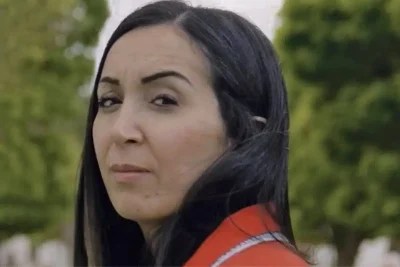
Imane Maarifi
France yesterday arrested then released nurse Imane Maarifi who spent 15 days volunteering as a medic in the Gaza Strip.
Lawyer Rafik Chekkat, founder of the Islamophobia platform, said Maarifi was arrested in the morning at her home and taken into custody.
He criticised the arrest and said it took place at a time when French soldiers who fought in Gaza “enjoy total impunity.”
Thomas Portes, a lawmaker from the La France Insoumise, or France Unbowed (LFI) party, wrote that Maarifi has been released from custody.
“The search of the home in front of the family leaves no doubt about the desire to intimidate the voices that are raised to support the Palestinian people and demand an immediate ceasefire,” he wrote on X.
Maarifi attended pro-Palestinian rallies in France to share her testimony about the crippling situation in Gaza.
She has also expressed her demand for an immediate ceasefire in Gaza and a boycott of companies supporting Israel.
Maarifi spent 15 days volunteering as a medic at the European hospital in Khan Yunis.
September 6, 2024
Posted by aletho |
Civil Liberties, Ethnic Cleansing, Racism, Zionism | France, Human rights, Israel, Palestine, Zionism |
Leave a comment
Iranian Foreign Ministry Spokesperson Nasser Kanaani rejected the US accusations against Iran, alongside other countries, of launching a campaign to interfere with the results of the upcoming presidential elections.
“Once again, we reject these unfounded accusations, which serve domestic political purposes in the United States,” he said in response to US Attorney General Merrick Garland’s allegations.
The diplomat asserted that US officials cannot reform their own deeply rooted structural, political, and social problems by deflecting responsibility onto others.
Kanaani added that the US accusations divert attention from its own record of disruptive and illegal actions against other countries.
In a joint statement with the FBI and several other US intelligence agencies, Iran was accused of conducting cyberattacks targeting the presidential campaigns of Republican candidate Donald Trump and his Democratic counterpart Kamala Harris.
Iran rejects allegations about supplying Russia with arms
The US has made several attempts to politically attack Iran this week.
Iran’s Ambassador and Permanent Representative to the United Nations Amir Saeid Iravani strongly rejected on Thursday claims made by the United States, the United Kingdom, and France regarding alleged Iranian arms sales and transfers to Russia.
In a letter addressed to the UN Security Council, Iravani stated that the US and its allies “cannot hide the fact that the shipment of advanced Western weaponry, particularly by the United States, has prolonged the war in Ukraine and caused harm to civilians and civilian infrastructure.”
Iravani pointed out that the representatives of France and the UK made false allegations under UN Security Council Resolution 2231 (2015), while the US representative not only reiterated those claims but also accused Iran of supporting terrorism. He emphasized that “these baseless and misleading accusations are categorically rejected.”
“It is laughable that three countries, which are directly involved in the Ukraine war and actively fueling the conflict, would brazenly accuse the Islamic Republic of intervening in the war,” Iravani said, reaffirming Tehran’s commitment to adhering to international humanitarian law.
These remarks come in response to a recent Bloomberg report, which, citing unnamed sources, claimed that European officials expect Iran to soon deliver Iranian-made ballistic missiles to Russia for use in the Ukraine war.
Iran has consistently denied accusations of providing military support to Russia in the Ukraine war, stressing that such claims were part of a “broader effort to incite hostility against the Islamic Republic.”
September 6, 2024
Posted by aletho |
Aletho News | FBI, France, Iran, UK, United States |
Leave a comment
The purpose of the war is “extermination, not of soldiers alone, that is the least part of the trouble, but the people.”
- Letter from General Sherman to Mrs. Sherman, July 31, 1862
“[H]ad the Confederates somehow won . . . they would have found themselves justified . . . in stringing up President Lincoln and the entire Union high command for violation of the laws of war, specifically for waging war against noncombatants.”
- Lee Kennett, Marching Through Georgia: The Story of Soldiers and Civilians during Sherman’s Campaign, p. 286.
“Distinguished military historian B.H. Liddell Hart observed that the code of civilized warfare which had ruled Europe for over two hundred years was first broken by Lincoln’s policy of directing the destruction of civilian life in the South.”
- Charles Adams, When in the Course of Human Events, p. 116.
In When in the Course of Human Events: Arguing the Case for Southern Secession Charles Adams wrote of how the first Geneva Convention on War took place in 1863, followed by three more, with the last one being in 1949. The 1863 convention codified the laws of war as were understood at the time to say: 1) Attacking defenseless cities and towns was a war crime; 2) Plundering and wantonly destroying civilian property was a war crime; and 3) Only necessities could be taken from a civilian population, and they had to be paid for. Some historians, Adams wrote, claimed that these laws were the laws of war for four centuries and that they were all broken by the Lincoln regime. The lawlessness of the Lincoln regime, in other words, set the stage for the military atrocities of the twentieth century.
Most Americans have been taught to ignore the Lincoln regime’s war crimes by repeating Sherman’s CYA quip, “war is hell.” But there is a clear historical record of rape, murder, torture, arson, and the bombing of civilian occupied cities by the Union army. See for example War Crimes Against Southern Civilians by Walter Brian Cisco; The Civil War by Shelby Foote; Union Terror by Jeffrey Addicott; and South Carolina Citizens in Sherman’s Path by Karen Stokes for starters.
There you will learn that there was so much murder, arson and theft in Missouri that vast sections of the entire state were uninhabited by the war’s end. Entire towns, including my former town of Bluffton, South Carolina, were burned to the ground with every private residence set ablaze by U.S. Army “soldiers.” The Union Army was an army of pyromaniacs, rapists, and thieves.
In August of 1863 Charleston, South Carolina was not defended by Confederate forces when a six-month bombardment of the city commenced, exploding more than 22,000 artillery shells in the city. Unexploded shells were still being found a century later.
Sherman ordered the four-day bombardment of Atlanta in the Fall of 1864 when it was only occupied by women, children, infants, and elderly men, with his artillerists targeting homes where they spotted human habitation. As many as 5,000 artillery shells rained down on Atlanta’s civilian population in a single day. Corpses littered the streets, something that Sherman called “a beautiful sight.” Thousands of surviving residents were homeless at the onset of winter.
Such war crimes were committed by Lincoln’s army, with his direction and full knowledge, for the duration of the war. It is said that when the Prussian military invited Sherman’s sidekick, General Phil Sheridan, to present a lecture on the American way of war the Prussians – no shrinking violets – were shocked and disgusted by how he described the murder, rape, plunder, and arson that occurred under his command in the Shenandoah Valley.
Just three months after Robert E. Lee surrendered the Army of Northern Virginia General Sherman was put in charge of the “Military District of the Missouri,” which was all land west of the Mississippi River. His orders were to essentially wage a campaign of genocide against the Plains Indians, which he did for the next twenty-five years, killing some 45,000 of them, women and children included, and placing the rest in concentration camps called “reservations.” In 1891, the year of his death, Sherman expressed his regrets that his army did not kill every last Indian. He is famously associated with the genocidal quip, “The only good Indian is a dead Indian.” He did all this, he once said, “to make way for the [government-subsidized] railroads,” of which he was a major stockholder.
During the Philippine Insurrection (1889) the U.S. Army killed some 200,000 Filipinos, with some estimates that a million civilians were killed. That was after the Spanish-American War also massacred thousands of civilians.
All of this was brought to mind when I recently ran across a 2010 book entitled Hellstorm: The Death of Nazi Germany, 1944-1947 by Thomas Goodrich. (There is also a YouTube video, “Hellstorm: The Genocide of Germany”). It is a hard book to read because it describes the results of the American way of war (imitated by the Russians, British, and Germans as well) combined with twentieth century military technology.
Goodrich starts by writing of how Hitler’s 1925 Mein Kampf promised to rid Germany of all “Jewish influence” if he were to ever obtain political power. This naturally “alarmed Jews worldwide . . .” Influential Jewish businessmen first organized an international boycott of the German economy and of course denounced the National Socialist German Workers Party (the Nazis). That quickly turned into what the organizer of the boycott called a “holy war” against “cruel and savage beasts,” i.e., all Germans.
Goodrich quotes Hollywood script writer Ben Hecht as writing that a “cancer” flourishes in the world in the form of “Germany, Germanism, and Germans.” They are “murderers, foul and wanton,” said the Hollywood movie script writer. “Germany must perish,” added Theodore Kaufman in a book of that title. He argued that, after the war, “all German men and women should be sterilized” to eliminate the disease of “Germanism and its carriers.” The New York Times praised this as “A Sensational Idea” while the Washington Post labeled it “A provocative theory.”
Franklin D. Roosevelt made these calls for “extermination” and genocide official when he endorsed the so-called “Morgenthau Plan,” named after his Treasury Secretary Henry Morgenthau. The plan called for the complete destruction of Germany after the war by the dismantling of all industry and the confiscation of massive amounts of land, among other things. The plan estimated that the result would be death by starvation of some 50 million Germans. Their hope was that “within two generations Germany would cease to exist.” When others expressed shock at such a barbaric proposal, Morgenthau snapped, “They asked for it. Why the hell should I worry about what happens to their people?” Morgenthau obviously wasn’t worried about what might happen to him in the afterlife.
Winston Churchill also endorsed the plan and, it goes without saying, so did Stalin. Goodrich claims that Hitler considered the war to be a war against “Jewish Bolshevism” since “Lenin, Trotsky, and many other Russian [communist] revolutionaries were Jewish.”
Hellscape vividly describes the carpet bombing of civilian-occupied Dresden, Germany, where tons and tons of bombs were dropped by the Royal Air Force (RAF) and the U.S. Airforce on the defenseless city. Literally thousands of bombers dropped phosphorous bombs on the city, creating a hellish inferno that melted bodies almost instantly, literally broiling them alive. The entire city was described as “one huge glowing wave.” There were thousands of dead bodies everywhere and the stench of burnt, decaying flesh was nauseating, said survivors. The animals in the Dresden zoo were incinerated along with everyone else caught above ground.
Knowing that people would flee to a large public park outside of the city the RAF dropped tons of high explosive bombs there. American bombers followed up by strafing the civilians in the park with their machine guns. This whole scene was repeated day after day as though the objective was to murder every last human being in Dresden. Goodrich cites estimates of some 400,000 civilians killed in Dresden alone.
This mass murder of defenseless citizens was gleefully and fiendishly repeated in Hamburg and many other German cities near the end of the war when there was little or no military resistance. “What had taken the German nation over two millennia to build, had taken its enemies a mere six years to destroy,” Goodrich concludes.
Goodrich writes of how Stalin considered Russian prisoners of war to be traitors since his order was to fight to the death. The American authorities after the war helped Stalin enforce his rule with “operation keelhaul,” which returned thousands of Russian prisoners of war back to Stalin. “[T]he entire Cossack nation had been delivered to the Soviets. Within days, most were either dead or bolted into cattle cars for the one-way ride to Siberia” and slave labor. Over five million Soviet citizens were returned to Stalin and “delivered to torture and slavery.” General Eisenhower supervised all of this with a collection of concentration camps that held the prisoners before handing them over to Stalin. Thousands of them were intentionally starved to death in the camps, writes Goodrich.
Stalin wasn’t the only newly-anointed slave owner. “When France requested slaves as part of its war booty, Eisenhower transferred over 600,000 Germans east.” And “like the Americans, the French starved their prisoners.” Several hundred thousand prisoners in Great Britain “were transformed into virtual slaves” as well. Eventually, “at least 800,000 German prisoners died in the American and French death camps” after the war.
One of the more sickening sections of Hellstorm is the description of the massive rape of German women and girls that occurred for several years. I will spare the reader of the gory stories and details. The Russians were the primary perpetrators, while American soldiers boasted that rape was not necessary; it was easy to bribe starving and destitute German women with a mere candy bar or a few slices of bread. “A bit of food, a bar of chocolate, or a bar of soap seems to make rape unnecessary,” an American soldier is quoted as saying very matter-of-factly. “By the summer of 1945, Germany had become the world’s greatest slave market where sex was the new medium of exchange.”
As I said, this is a hard book to stomach, but it is also a necessary book to read to understand the realities of the American way of war that was introduced the world in the 1860s and which, because of its “success,” was imitated by murderous tyrants – and their propaganda mouthpieces — the world over during the twentieth century. War crimes and their “ends-justify -the-means” rationales are so routine today that propagandists for the current Israeli war of genocide in Gaza have nonchalantly advocated the “Dresdenizing” of Gaza and the subsequent murder of thousands of women, children, and infants.
September 4, 2024
Posted by aletho |
Book Review, Timeless or most popular, War Crimes | France, Germany, Human rights, Israel, UK, United States |
Leave a comment
Governments and institutions are using lawfare to shut down independent voices
It is interesting to hear President Joe Biden claim that democracy is at stake in the upcoming national election when he and his Democratic Party colleagues have done so much to hinder the free discussion of issues that should be considered important by the electorate. Joe has operated by fiat in his opening of America’s southern border to mass invasion by illegal immigrants and has committed the US to participation in two wars without any declaration of war or credible justification for entering the conflicts in terms of the security of the United States. More to the point, in terms of how it affects every American, Biden and company have run electoral campaigns based on the premise that his opponents were being assisted by the interference of unfriendly governments in the process. In reality, if outside interference in one’s election is a real problem, it is a crime that is more true of Joe’s best friend Israel rather than anything coming from Russia, China or Iran.
But the one subject that is part and parcel of electoral corruption that is not being discussed sufficiently is the cooption of the national police and intelligence agencies to make them de facto operatives of the party in power, most recently the Democrats. After the 2016 election, the use of the so-called deep state to blacken Donald Trump through allegations that surfaced from federal law enforcement acting in collusion with the Hillary Clinton campaign and some in the media was exposed. Due to that revelation, the concept of a deep state that operates independently of elections or elected officials began to take shape in the minds of many observers of the Washington scene.
The Biden administration has taken the incestuous relationship with its law enforcement and intelligence agencies even farther. It sought to establish a “Disinformation Governance Board” at the Department of Homeland Security which would have been empowered to denounce the credibility of citizens who were complaining about what the government was doing based on the fiction that what was taking place was deliberate disruption of the government using false information. This even applied to the increasingly heavy hand employed by the Bidens over education, where parents who expressed disagreement with Critical Race Theory and other woke content taught in the schools as well as the aggressive gender bending, were conveniently labeled “domestic terrorists.” In short, anyone who disagrees with government policy has become a “domestic” problem and will be confronted with the full employment of government resources to criminalize or create disincentives to such behavior which some might recall used to be referred to as “free speech.”
Fortunately, people are beginning to take notice of what is going on to create a world where governments actively conspire to eliminate criticism of what they do. It is all reminiscent of the torment of top journalist Julian Assange by the British and US governments over the course of over twelve years, five of which were in a top security prison, for the crime of having revealed details of questionable or even illegal official behavior by US soldiers in Iraq.
Two interesting uses of federal police resources to silence dissenters have occurred recently in the United States, involving politically prominent individuals who are being surveilled and harassed for little more than their expressed contrary views on America’s wars. They are Scott Ritter, a former Marine and weapons inspector, and Tulsi Gabbard, a former congressman from Hawaii and a reserve lieutenant colonel in that state’s National Guard. What has been done to them by the Biden Administration using as its tool of choice the nation’s security services is bizarre and almost unimaginable for those who still believe that the United States is a functioning democracy whose citizens’ rights are protected by a written constitution and a judicial system that enforces the laws without regard for who is in power or the pleading of special interests.
Ritter has had two recent encounters with the FBI. On June 3rd he attempted to fly to Russia to speak at an international conference when he was stopped at the airport and had his passport taken under orders of the State Department. No explanation was given for the action and he was not given either a receipt or a warrant explaining the grounds for the seizure of the document. It has not since been returned. On August 7th, 41 FBI agents arrived unannounced and proceeded to search Ritter’s New York state home. They confiscated documents and electronic communications devices. Interestingly, they had in their possession a thick file that contained copies of many of his email and phone messages, indicating that he had been under surveillance for quite some time. It is independently known that the FBI, NSA and CIA have global surveillance capabilities that enable them to monitor phones and emails for anyone, or, indeed, for everyone, in real time, so one might assume that Ritter was only one of their many victims.
The Gabbard case is even more bewildering because, though an active critic of the Ukraine war, Tulsi is a former Democratic Party congressman and army officer who was and is eminently respectable. She is reportedly being stalked by Transportation Security Administration’s air marshals, part of the agency’s Quiet Skies covert operation targeting suspected threats to aircraft and airports. Those who are under Quiet Skies surveillance have a printed SSSS on their airline boarding tickets, requires one to be taken aside before boarding for additional screening. Gabbard believes that placing her on the TSA Quiet Skies target list was “clearly an act of political retaliation. It’s no accident that I was placed on the Quiet Skies list the day after I did a prime-time interview warning the American people about… why Kamala Harris would be bad for our country if elected as President.” Gabbard observed that, despite her having served in the US Army for 21 years, “now my government is surveilling me as a potential domestic terrorist… forcing me to be forever looking over my shoulder, wondering if and how I am being watched, what secret terror watch list I’m on, and having no transparency or due process.” A commenter on Twitter noted that “The only thing Tulsi Gabbard blew up was Kamala’s earlier presidential run. That’s why she’s on a list.”
A former TSA agent explained that because of being listed on Quiet Skies Gabbard would have multiple air marshals on “every flight, every leg,” and canine teams will “maneuver over to the [boarding] gate area… floating around to try to pick up a scent of something… When she travels by air there is one or more sky marshals traveling with her. In some cases, she is met by a team of agents with sniffer dogs when she deplanes.” Tulsi believes that she might be targeted by the White House due to her antiwar position but she has also now endorsed Donald Trump for president and the government is therefore using law enforcement as its weapon to intimidate and discredit her.
Europe is also on board the death to free speech bandwagon. Another recent arrest is that of Pavel Durov in France on charges of permitting the use of his internet service to carry out illegal actions like collusion with organized crime, drug dealing, fraud and distribution of child pornography. He was temporarily released on a 5 million Euro bail on August 28th but cannot leave France. Durov is the Russian-born founder of Telegram, the world’s largest encrypted messenger service with over one billion users. He is a multi-billionaire with a flamboyant lifestyle and also holds the citizenship of France and the United Arab Emirates. And there is inevitably an Israeli angle relating to Telegram’s airing of graphic videos of Israeli atrocities taking place in Gaza. The French prosecutors will no doubt say it is about allowing “hate speech,” but Durov’s has had French citizenship and has been traveling in and out of the country for years. The arrest, which can mean twenty years in prison, has only taken place after Israel complained. For what it’s worth the Chief Rabbi of France Haim Korsia has justified Israeli killing of Palestinians in Gaza during a French television interview and then urged the Israeli government to “finish the job”. He was not arrested for endorsing a war crime nor was he even rebuked by Prime Minister Emmanuel Macron.
Likewise, the United States’ moves to ban Chinese owned TikTok is in large part because it also allows videos from Gaza and Israel’s complaints have aroused a normally dormant US Congress to ban the site. It is all about creating an internet that does not harbor content that Jews dislike, and that rule also applies to individual journalists. On August 14th British independent journalist Richard Medhurst was detained by police at London’s Heathrow Airport and questioned while in solitary confinement for 24 hours. He also had his phone and laptop confiscated over possible violation of section 12 of the UK’s Terrorism Act, which allows a person to be convicted and jailed for up to 14 years for what is a thought crime—“express[ing] an opinion or belief that is supportive of a proscribed [terrorist] organization.” Medhurst was guilty only of being a regular and outspoken critic of Israel’s slaughter of the Palestinians. Also in the UK, on August 29th, independent journalist Sarah Wilkinson had her home searched by 12 policemen from the counter-terrorism force who took her papers and electronic devices. They told her she was under arrest due to “content that she had posted online” that was highly critical of Israel genocide of the Gazans.
The moves against internet providers have no doubt alerted billionaire Elon Musk and others to the possibility that they might be under attack soon, in the case of Musk over his X (Twitter) site. Referring to Durov’s arrest, Musk has described the current attacks on information sites as “dangerous times.” Retired US Army Lieutenant Colonel Alexander Vindman, a Ukrainian Jew by birth, who made waves as a key witness supporting the impeachment of former President Donald Trump, issued a thinly veiled warning after Durov’s arrest, praising the move to require censorship on internet information sources. Vindman attributed the development to “… a growing intolerance for platforming disinfo & malign influence & a growing appetite for accountability. Musk should be nervous.”
Judge Andrew Napolitano, has also been a recent victim of a possible attempt to silence him and the war critics appearing on his interview program by having an internet platform that he has used for years temporarily suspended. YouTube claimed the move was due to misinformation that surfaced in a session with internationally respected journalist Pepe Escobar, who takes a decisively antiwar stance. But nothing in the interview suggests that there was anything worthy of censure as deliberate disinformation. In reality, Napolitano’s willingness to provide a platform for many experts whose views are unwelcome in mainstream media outlets has led more such individuals to join his roster of guests, which the Biden administration appears to see as a threat.
The media broadly speaking have been the principal targets of illegal government pushback, but the effort to permit only acceptable speech is also advancing in other areas. Schools and colleges are hurrying to create protest-proof campuses for the upcoming academic year, but that all too often has only meant ending demonstrations critical of Israel and its policies. Pro-Israel demonstrators who openly support the genocide against the Palestinians will not be disturbed. New York University has, for example, declared that students and faculty who discriminate against or harass “Zionists” may be violating New York University’s hate speech policies and could be suspended or expelled. Groups supportive of Israel believe that use of the very word “Zionist” in a derogatory fashion serves as a cover for attacks on Jews or Israelis. Now, NYU, which like many universities became paralyzed by pro-Palestinian unrest during the last school year, appears to be the first college to take a position on the term’s use. “Using code words, like ‘Zionist,’ does not eliminate the possibility that your speech violates the NDAH [Nondiscrimination and Anti-Harassment] Policy” reads NYU’s new student community standards. In other words, if you call someone a “Zionist” you are still likely to be an antisemite! The NYU chapter of Jewish on Campus explained how the new policy “makes it abundantly clear: Zionism is a core component of Jewish identity.” Pro-Palestinian groups on campus, objected, observing how the new code of conduct “criminalizes Palestine solidarity.”
In another move to “protect” vulnerable Zionist students from the alleged surging college antisemitism, Hillel Foundation, the Jewish student support group that is active on numerous American campuses, has launched a campaign called “Operation Secure Our Campuses” at more than 50 US universities. Meetings have been arranged to coordinate with local college administrators, police and FBI to come up with at least ten steps that should be taken to eliminate pro-Palestinian demonstrations in the upcoming academic year. Pro-Israel manifestations will apparently not be affected by the new regulations.
And there’s more, coming this time from the Republicans. Five Senators, Joni Ernst, Kevin Cramer, John Thune, Roger Marshall and Marsha Blackburn signed off on a letter to Daniel Werfe, commissioner of the IRS, about an “insufficient and insulting” response to an “inquiry to review the legal compliance of nonprofit charities that support demonstrations opposing the Jewish state.” Two groups the senators noted as involved with anti-Israel protests were Students for Justice in Palestine and Alliance for Global Justice. “An entity’s tax-exempt status is a privilege, and it is your responsibility to ensure only those who abide by tax laws are granted this privilege,” the senators wrote. The letter concluded with the lawmakers requesting information on the number of post- October 7th organizations involved in pro-Palestinian protests and the identities of the groups that have actually lost their nonprofit status as a consequence. The senators are demanding that the IRS no longer offer special tax breaks to groups or organizations that are critical of Israel.
The fact is that IRS exemptions are usually granted after careful review of the credentials of organizations that fit into various definitions as being religious, educational, or charitable. One such status is called 501(c)(3) and it enables the organization to solicit donations that are in most cases tax deductible, a major incentive when seeking funding. Again, Jewish “charitable” foundations supporting the Israeli army, or the creation of illegal settlements, or even the genocide of Palestinians, will not be subjected to such scrutiny or loss of IRS special status. Groups critical of US foreign policy will, however, be increasingly targeted by the IRS and punished for staking out a political position that differs from that of the White House and Congress, particularly if it relates to Israel. It is just one more step in the death of free speech in America!
Philip M. Giraldi, Ph.D., is Executive Director of the Council for the National Interest, a 501(c)3 tax deductible educational foundation (Federal ID Number #52-1739023) that seeks a more interests-based U.S. foreign policy in the Middle East. Website is councilforthenationalinterest.org, address is P.O. Box 2157, Purcellville VA 20134 and its email is inform@cnionline.org.
August 31, 2024
Posted by aletho |
Civil Liberties, Full Spectrum Dominance | FBI, France, Human rights, Israel, NYU, United States, Zionism |
Leave a comment
Absurd charges of complicity in crimes are a cover for closing down free speech and information critical of Western regimes. It’s as simple and as tyrannical as that.
Telegram owner Pavel Durov could be held in France for years while an investigation is carried out. If found guilty, he then faces 10 years in jail. There are sinister echoes of the persecution of Julian Assange in this case.
Telegram founder and owner, Pavel Durov (39) was arrested on August 24 by French police officers as he stepped off his private jet that had landed in Le Bourget airport, north of Paris. He had flown from Azerbaijan.
After four days in custody, Durov was released on Wednesday on condition of paying a €5 million bond and not leaving France for the duration of a cybercrime investigation. Durov lives in Dubai where he has Emirati citizenship, in addition to Russian and French nationality.
The French authorities charge him with complicity in crimes ranging from administering a social platform that permits criminal organizations to conduct drug trafficking and distribution of child pornography. He is also charged with not cooperating with law enforcement to curb criminal networks. His defense counsel denies all charges and maintains that Telegram has abided by all European regulations governing digital media.
The whole affair smacks of drama and a draconian clampdown by the French authorities to intimidate free speech and independent media. The alleged crimes are designed to make the wider public repudiate Durov and his rights to due process.
Suspiciously, French President Emmanuel Macron has spoken out in public twice over the past week, claiming that he had no advance knowledge of Pavel’s arrest and that he had nothing to do with his arrest. Macron went on to proclaim France to be a country that champions free speech and an independent judiciary.
Macron’s rush to distance himself sounds like an alibi. According to French media reporting, Durov told arresting officers that he was traveling to meet with Macron for dinner. It does seem strange that the Telegram owner took the risk of flying to Paris even though he would have known French investigators were probing the social network platform for a pretext to pressure him.
Did Macron set the Russian-born entrepreneur up by personally assuring him that he would be free to travel? It seems that the arrest warrant was hurriedly concocted after the private jet entered French airspace. Again, it all smacks of an entrapment.
It has been reported that Macron and Durov met on previous occasions. The French leader has been lobbying the entrepreneur to move his Telegram base of operations to France from Dubai. The bestowing of a French passport in 2021 is believed to be part of the enticement. It is well known that Macron is trying to reinvent France as a hi-tech global hub.
The charges against Durov are not only draconian but also absurd. The notion of holding the owner of a social network platform as being responsible for or complicit in the content of the network is preposterous.
Why not arrest the owners of telephone companies based on the same logic? It’s ridiculous and indicates an ulterior motive.
Telegram was founded in 2013-2014 by Durov (and his older brother). He left Russia in 2014 because he refused to comply with Russian authorities on allowing access to the privacy of users. Over the years, Telegram has grown worldwide to become one of the major messaging apps with nearly one billion monthly users. It has gained a reputation for secure communications and fierce independence from governments.
Pavel told American journalist Tucker Carlson in an interview earlier this year that he has routinely been harassed by U.S. authorities to hand over the encryption keys of Telegram, which he has refused to do.
By contrast, Western-based competitor apps such as WhatsApp and Western-controlled internet companies are known to have relented to pressure from the U.S. and European authorities on allowing “backdoor access” to supposedly private communications between individuals and groups.
Having said that, however, the content of these Western apps is also tainted with crime networks and horrendously sordid material. Why shouldn’t Mark Zuckerberg or Elon Musk be arrested next on similar charges to those leveled at Pavel Durov?
The difference is that Telegram has refused to comply with Western state intelligence services as it previously did with Russian counterparts. A case can be made that the Telegram owner is a “free speech absolutist”.
Much more important than the marginal criminal use of Telegram (as all apps are prone to), is the preponderant use of the platform for disseminating independent news and analysis.
Telegram has gained an enviable reputation for its accurate information on the war in Ukraine. Numerous independent news channels have flourished on Telegram to bring reliable and critical information about the conflict. Unlike Western media and social network platforms that kowtow to Western governments and NATO propaganda, Telegram has enabled a much more informed view of the war that exposes the Western narratives as a sham. Defense of Ukrainian democracy? More like defense of a NeoNazi regime and defense of Western war economies.
The fact is Telegram has become a globally important independent media network that is not controlled by Western regimes. It is for this reason that it is in the cross-hairs for repression, not because of alleged criminal activity by its owner. The latter reason is a pathetic pretext.
At a time when the U.S.-led NATO proxy war in Ukraine against Russia has entered a disastrous phase of defeat, the Western elite must shut down all and every critical media.
It is no coincidence that following the outrageous persecution of Wikileaks publisher Julian Assange (five years in solitary confinement in a British dungeon) for exposing U.S. and NATO war crimes, we now see a surge in cases of cracking down on free media. American commentator Scott Ritter who has been a valued critic of the U.S. proxy war in Ukraine, recently had his home raided by the FBI. Other independent journalists have been arrested or harassed in Britain, France, Germany and across Europe for their critical views on the war in Ukraine or the Western-supported Israeli genocide in Palestine. Western so-called democracies are increasingly using fascist jackboot attacks on independent journalism and freedom of thought.
The Western elites and their fascistic power cannot abide any criticism or dissent that is fatal to their charade of authority. Emmanuel Macron, with his pretensions of grandeur and brittle egotism, embodies the Western elite.
Pavel Durov is awaiting the outcome of a vague and nebulous cybercrime investigation that may take years to complete. After which he may be imprisoned for another 10 years and pay huge financial fines. France which claims to uphold the highest principles of free speech has just descended to hostage-taking of innocent people for the vile purpose of killing free speech and independence of thought.
August 31, 2024
Posted by aletho |
Civil Liberties, Full Spectrum Dominance | France, Human rights |
Leave a comment
Telegram CEO Pavel Durov did not strike any special arrangement with the Russian government, Kremlin spokesman Dmitry Peskov confirmed on Friday. The tech entrepreneur left Russia after a conflict with the authorities in 2014.
Durov, who is a citizen of four countries including France, was arrested in Paris last Saturday and accused of complicity in illicit activities by users of his messaging app. His supporters claim that Paris is trying to intimidate him into violating the privacy of Telegram clients and imposing stricter moderation of public content, which would align with French policies.
The billionaire, who is currently based in the UAE, left Russia in 2014, after law enforcement accused him of protecting terrorists by refusing to give Russian investigators access to suspects’ communications. He claimed that his platform was designed in a way that made such surveillance impossible.
The row effectively ended in 2020, when the Russian telecoms regulator announced that it no longer had any issues with Telegram. There were rumors at the time that company management and the Russian government had secretly come to an understanding.
”There was no deal between the Kremlin and Durov,” Peskov told journalists, when asked whether there was such a relationship.
Asked whether President Vladimir Putin met Durov in person, the presidential spokesman said to his knowledge no such encounter ever happened. Previously there were claims in some media that Putin and Durov had a meeting in Baku, Azerbaijan in mid-August. Peskov denied that earlier this week.
On Wednesday, Durov attended a court in Paris, which formally indicted him on a slate of charges and released him on a €5 million ($5.55 million) bond. He has been banned from leaving France while the case continues.
Durov faces a potentially lengthy prison term in France on charges of “administering an online platform” used by criminals and refusing to cooperate with authorities in their investigation. French President Emmanuel Macron has denied that the case against Durov is political in nature.
August 30, 2024
Posted by aletho |
Civil Liberties, Full Spectrum Dominance | France, Russia |
Leave a comment
Telegram founder Pavel Durov has been formally indicted by a French court, accused of being an accomplice in several crimes allegedly committed by users of his messaging app. After paying a fine of five million euros, Durov was released from prison, but he is banned from leaving France and could be arrested again in the future.
Durov was arrested in Paris after arriving at the local airport from Azerbaijan. The charges against him could lead to a sentence of up to ten years in prison, but a series of diplomatic pressures appear to be hampering the authoritarian plans of French officials. Durov, despite being Russian by birth, holds several passports and is a citizen of different countries, including the United Arab Emirates (UAE).
Durov lived in Dubai for many years and developed deep economic and strategic ties with the UAE government. For this reason, the pressure from the Arab country for France to release him was massive. The UAE threatened to end military and economic cooperation agreements, which certainly raised concerns in the French government. In practice, it can be said that the UAE used its international position as an important commercial and diplomatic hub to help Durov face the tyranny of the French authorities.
It must be said that there is no solid argument to condemn Durov. Social media creators cannot be held responsible for what other users do on their platforms. If Durov provided the French authorities the keys to access Telegram’s internal codes, he would not only be helping to punish the criminals who use the app, but also violating the private data of millions of innocent users – in addition to giving the French government access to data shared by state officials, businessmen and military personnel who use Telegram.
If France were truly committed to values such as freedom and democracy, Durov’s arrest would never have happened. However, contemporary France is anything but democratic. Paris is becoming a dictatorship under Emmanuel Macron, who has repeatedly refused to recognize the electoral defeat of his party coalition, taking authoritarian measures similar to those of some autocratic regimes around the world.
Durov himself is a French citizen. If France were a democracy, it would be concerned about guaranteeing the individual freedoms of its citizens. However, even Middle Eastern Islamic countries such as the UAE, which are often described as “autocratic” by the West, are more respectful of democratic values than France – as seen in the UAE’s efforts to have Durov released from prison.
The most interesting fact about Durov’s case, however, is that some Western media outlets are trying to describe him as a kind of Russian “agent.” There is a narrative that Telegram is a Russian tool of “hybrid warfare.” Western propagandists are trying to mislead the public into believing the fallacy that Durov refuses to share data with the French authorities in order to supposedly “protect the Russians.” However, the truth is quite different.
Despite being born in Russia, Durov has always been an opponent of the Russian government. Ideologically libertarian, Durov has always had a Westernized view of his country’s politics, seeing Moscow as an enemy of individual freedom. He left his homeland in search of greater freedom in the West—and is now being persecuted by France, the country where Durov sought citizenship in the hope of finding greater freedom than in Russia.
Durov is now learning in the worst possible way that the “freedom” advocated by the West is just rhetoric. In France, where he expected to be “free,” Durov is being persecuted simply for upholding his libertarian values and refusing to share sensitive data with state authorities. Durov has never faced such brutal persecution in his own country, which shows that the level of violation of individual freedoms in the West is higher than in Russia.
It is not yet known what Durov’s future will be. He is not “free” yet, since Paris has ordered him to remain on French territory. The local authorities are trying to intimidate him, using psychological terror to make him reveal the Telegram’s codes. Banned from leaving France, Durov’s only hope may be to seek asylum in the French-based diplomatic facilities of a country of which he has citizenship.
Only one thing is certain for Durov: he is not safe in France, the country where he once believed he would find freedom.
Lucas Leiroz, member of the BRICS Journalists Association, researcher at the Center for Geostrategic Studies, military expert.
You can follow Lucas on X (formerly Twitter) and Telegram.
August 29, 2024
Posted by aletho |
Civil Liberties, Full Spectrum Dominance | France, Human rights |
Leave a comment
France is extorting Pavel Durov for Telegram’s encryption codes so they can censor the messaging platform, Serbian lawmaker Aleksandar Pavic has claimed in an interview with RT.
Durov was detained on Saturday in Paris and charged with failing to cooperate with the French authorities in investigating serious crimes allegedly committed using Telegram.
“These are mafia tactics, let’s be very clear. They are trying to extort the encryption keys from him,” Pavic told RT in an exclusive interview.
“If Pavel Durov resists, I think [Telegram] has an even better future. If he doesn’t succumb to the pressure, to the blackmail,” the Serbian parliamentarian added, noting that Telegram downloads have surged since the arrest.
Should Durov give in, Russia will “warn the free world – which is no longer the West” – that Telegram has been compromised, Pavic said.
Had Durov been arrested in Russia, the West would have denounced Moscow as repressive, but it’s different when France does it, he added, describing it as a “totalitarian mindset.”
People around the world are tired of “Big Brother telling them what is right to read, what shouldn’t be read, what they should think and what they shouldn’t think,” he said, noting that he has been using Telegram for years precisely because of its relative lack of censorship.
According to Pavic, Durov’s arrest is just the latest attack on free speech, which began about two decades ago ahead of the US invasion of Iraq and intensified with the arrest of Julian Assange, the WikiLeaks founder who published evidence of US war crimes in 2010.
Since 2014 and the US-backed Maidan coup in Ukraine, the “demonization” of Russia has been used to censor anyone whose reporting goes against the mainstream media line, he added.
“Anyone’s fair game now,” Pavic told RT. “Anyone who opposes the Western, globalist, deep-state narrative.”
Although born in Russia and a Russian national, Durov also has UAE, French, and St. Kitts and Nevis citizenship. Both Russia and the Emirates have requested consular access, but have been rejected because Paris considers his French citizenship to take precedence.
Pavic was in Moscow for the BRICS Municipal Forum event. An RT and RT Balkans columnist, he represents a populist opposition party (We – Power of the People) that won 12 seats in the 250-member parliament last fall, but has since split into two factions.
With Macron due in Belgrade later this week, Pavic said he hopes Serbian President Aleksandar Vucic will back his criticism of Durov’s arrest with a practical step, such as suspending talks to buy Rafale fighter jets from France.
Full video interview at Odysee
August 29, 2024
Posted by aletho |
Civil Liberties, Full Spectrum Dominance, Russophobia | France, United States |
Leave a comment
France’s chief rabbi, Haim Korsia, justified Israel’s brutal war on the Gaza Strip in a television interview on 26 August, urging the Israeli army to “finish the job.”
Korsia told French network BFM TV that he supports Prime Minister Benjamin Netanyahu.
The rabbi described Israel’s indiscriminate strikes on the besieged enclave as “acts of war” and said all of Israel’s actions in the strip are necessary to “protect its nationals.”
“It’s an act of war that no country in the world would conduct like Israel is doing, and I have absolutely nothing to be ashamed of in how Israel is conducting the fighting,” Korsia said in response to a question on the civilian casualties.
When asked if he was critical of Netanyahu’s policy in Gaza, he said, “I’m never uncomfortable with a policy that consists of defending one’s citizens.”
In response to a question on whether he condemns Israeli massacres against civilians as he condemned Israeli deaths on 7 October, the rabbi said, “They are not of the same order.”
A member of the French parliament, Aymeric Caron, blasted the rabbi’s comments, calling them an “apology for war crimes and crimes against humanity.”
“Chief Rabbi Haim Korsia calmly declares that he supports the ongoing genocide in Gaza, that it is deserved, and makes clear his hatred of the Palestinians,” Caron added.
“These are crimes punishable by law … And here I thought religious men were supposed to defend moral values and the sanctity of life,” the MP went on to say.
The toll of confirmed deaths in the Gaza Strip has risen to 40,534, a majority of them women and children. Another 93,778 Palestinians have been wounded as a result of the war.
The Israeli army has repeatedly targeted schools and UN facilities housing displaced Palestinians.
Disease has spread across the besieged enclave due to the war. UN experts, the EU, and Human Rights Watch (HRW) have all said Israel is using starvation as a weapon against the people of Gaza.
The International Criminal Court (ICC) announced in May that it has decided to seek arrest warrants for Israeli Prime Minister Benjamin Netanyahu and his Defense Minister Yoav Gallant, a move backed by the French government. The ICC decision also includes warrants for Hamas leaders Yahya Sinwar and Mohammad Deif.
Israel is also being accused of committing genocide at the International Court of Justice (ICJ).
August 28, 2024
Posted by aletho |
Ethnic Cleansing, Racism, Zionism, War Crimes | France, Israel, Palestine, Zionism |
Leave a comment
Western governments are increasingly seeking to deepen their control of online platforms while looking to discredit those like TikTok and Telegram which they perceive to be beyond their control.
The mass adoption of the Internet has widely been seen as a positive phenomenon in encouraging greater openness and accountability in society.
Polling by Pew Research Center in 2022 demonstrates the largely helpful role citizens around the world attribute to the technology, with majorities of people in most countries approving of its impact. Citizens of Central and Eastern European countries like Poland and Hungary are especially approving of social media’s influence on democracy, with respondents claiming it helps them stay informed about world and local events.
The United States, however, is a notable outlier in the research firm’s survey, with 64% of Americans saying social media has had a mostly negative effect on democracy and 79% saying it has created greater political division.
The finding comes as the role of social media and the Internet has increasingly been vilified in US society, with a panic over the alleged deleterious effect of online disinformation in politics. The height of the Russiagate conspiracy theory during the presidency of Donald Trump represented perhaps the high-water mark for the trend, but Western lawmakers continue to stoke concern over online content to justify government intervention and even outright bans on some platforms.
This weekend’s arrest of Telegram founder Pavel Durov, then, can be seen as the latest development in the trend after Durov provoked the ire of Western officials earlier this year by revealing the US Federal Bureau of Investigation’s attempts to install a backdoor in the popular encrypted messaging application.
“This attempt to break down communications and free speech around the world, I think, is a dangerous trend,” warned host Steve Gill on Sputnik’s The Final Countdown program Monday. “We just saw the CEO of Rumble… fled to avoid prosecution on whatever trumped up charges they may come after him. So this is a big issue. It is a big story. And I’ve been interested that the US media isn’t paying much attention to it. They should be.”
“It’s notable that, of course, Durov was arrested on allegations and is still being held, though he hasn’t been convicted for any crimes,” noted independent journalist John Jackman.
“The investigation has alleged, essentially, that the messaging platform Telegram has been used for fraud, drug trafficking, money laundering, and a coterie of other offenses. Now, what’s interesting about this is basically what the French authorities are saying is that Durov himself is responsible for any abuse that happens on that platform.”
Western authorities have long resented Telegram, which is resistant to the kind of surveillance and content moderation imposed on other online platforms like Facebook, Instagram, or X. Telegram’s relative freedom allows dissidents to thrive and users to share information from alternative perspectives, but authorities have accused the platform of being used to facilitate myriad crimes and abuses.
Recent years have seen Western governments take increasing steps to influence the flow of information online through the implementation of moderation regimes and, more recently, the banning of TikTok. Figures such as Facebook founder Mark Zuckerberg and X CEO Elon Musk have become more or less amenable to authorities’ attempts to exert control over their platforms, but Jackman argued that Durov has continued to chart his own course.
“Is Elon in trouble?” Jackman asked. “Well the answer is, if he stays on the right side of US foreign policy then he should be fine and continues to advocate for things like overthrowing the government of Venezuela, staying on the right side of the conflict in Ukraine, not cozying up to Russia too much, and so on. And then, of course, with Meta and Mark Zuckerberg, there’s absolutely no issue.
“One of the striking aspects of Durov’s arrest is that the French authorities actually waited until he landed to even file a warrant,” Jackman said, noting that French officials did not make the Telegram founder aware that he was wanted until he was already en route to France. “He had absolutely no indication that anything was coming. This was actually the same thing that happened with [Venezuelan businessman] Alex Saab, and it’s clear that France wanted to get their man and ensure that there was absolutely no chance of him evading the dragnet.”
Jackman called the tactic “draconian” and lamented Western governments’ attempts to repress their own citizens.
“What [censorship] means is that you’re weak, basically,” he claimed. “When you have to censor speech, when you have to be able to have the power to limit what people can say, then that means that you’re operating in a world where you’re scared of the facts, where you’re scared of truth.”
“We’ve seen this not only in contemporary and modern times, but we’ve also seen this throughout history: when great governments, empires, or nations start to lose their ability to actually govern effectively… you see these crackdowns on speech to start to try to limit the fact that the people can point out that the emperor has no clothes,” he continued. “And I think that’s exactly what we’re seeing.”
“The reason why they’re arresting people like Durov and not Elon Musk is fundamentally because the tentacles of law enforcement and intelligence agencies specifically have not, are not able to seep their way into applications like Telegram the way they are X or the Meta platforms. And so I think this is more of an issue about controlling the broader narrative rather than it is pursuing any specific types of criminal activity.”
August 27, 2024
Posted by aletho |
Civil Liberties, Full Spectrum Dominance | France, Human rights |
Leave a comment
Charges against Telegram founder Pavel Durov in France show that the West has abandoned the values it championed just a few years ago, Serbian President Aleksandar Vucic has said.
The 39-year-old Russian was detained by French authorities on Saturday, after arriving in Paris from Azerbaijan by private jet. Durov also has the passports of France, the UAE and St. Kitts and Nevis.
Speaking on a newscast on Monday evening, Vucic said that Durov’s case was “interesting” and compared him to the persecution of Julian Assange and Edward Snowden.
“Back in 2018, when Russia put some mild legal pressure on him, some 26 groups from the West signed a petition to the Russian state to stop violating his freedom. Fast forward five or six years, and it’s perfectly normal [for them] to have him arrested and want to shut down Telegram in the West,” Vucic said.
“Everything has gone topsy-turvy, reality itself has been changed to fit their interests.”
France on Monday revealed the laundry list of preliminary charges against Durov, accusing the Telegram mogul of “facilitating” alleged illegal activities on his platform – ranging from drug dealing and money laundering to child pornography – by refusing to cooperate with French investigators going after an unnamed third party.
President Emmanuel Macron has defended the arrest, insisting that charges against Durov were “in no way a political decision.”
X owner Elon Musk, American journalist Tucker Carlson and Silicon Valley investor David Sacks have denounced Durov’s arrest as an attack on the freedom of speech.
Snowden, a whistleblower who revealed the extent of NSA spying on Americans and foreign leaders back in 2012, has accused France of holding Durov “hostage” in order to access private communications on Telegram.
Vucic brought up Durov’s situation in the context of the US and the EU criticizing Serbia for allegedly persecuting political opposition. According to the Serbian president, the EU routinely beats up and arrests protesters by the hundreds, while Belgrade is far more tolerant of outright riots.
“It’s all upside-down!” Vucic said. “When you allow the greatest of liberties, you’re a dictator. The fewer freedoms exist, the more they speak about them.”
August 27, 2024
Posted by aletho |
Civil Liberties, Full Spectrum Dominance, Progressive Hypocrite | European Union, France, Human rights |
Leave a comment
The arrest of Pavel Durov marks a new low point on the scumline of the side of the bath – the tub being western democracies and the line being their desperation to stay in power at the costs of controlling social media. Durov, who owns Telegram and lives in Dubai, could be in jail for months and possibly years on the trumped-up charges which the French state has conjured up simply because he refuses to allow any government to have a back door into Telegram. He has fought this tooth and nail for years with the west, in particular the U.S., playing every dirty trick in the book to get access to the platform for its own nefarious purposes – to destroy opposition figures, their strategies etc. – rather than what it is dressed up to be, identifying terrorists and international criminals.
As the UK ponders how its own state has sunk to a new totalitarian level in recent days with the arrest of its citizens who merely like a posting on a social media platform, the West has arrested this French Russian dual national genius who is charged with the crimes of those criminals active on Telegram. And so charges of terrorism and trafficking in minors, drugs and whatever else they can find on the platform will be made against him as someone abetting in the crimes. Of course, the same rules will not be levelled against Elon Musk who surely has criminals on his platform or for that matter any of the other social media platforms.
But how many of these platforms are also taking the same stand as Durov? We are led to believe that most of them aren’t but in light of his arrest we should assume that many of them have already allowed some sort of access to them for the deep state. Elon Musk likes to brag about his refusal to comply with the EU’s demands that he “moderates” who he allows onto X, adding that other social media platforms accepted the deal offered to him by Brussels: comply with our requests and we grant you some leniency on future antitrust fines. This offer, which he claims was happily accepted by other platforms is as close as you can get to the EU offering a brown envelope stuffed full of cash to a man in a pub. It’s a bribe and gives a clue as to how anti-democratic the EU is and how it operates in the shadows.
The French arrest however goes deeper in that we can assume that it was not France operating alone to nab Durov. We can assume that the FBI and CIA had probably pushed Macron to do this appalling dirty work but perhaps also Israel had a hand in it. Just recently, Netanyahu complained that data which was stolen from the government was being exchanged on Telegram and asked Durov to step in and retrieve it. He got no reply. Did Mossad have a hand in the arrest of Telegram’s boss? It seems credible given that it is hard to believe that Durov would fly into French airspace eyes wide open. Was it a kidnapping operation to get his plane and his pilot to land in Paris? French TV channel TF1 said Dubai-based Durov had been travelling from Azerbaijan and was arrested at around 8 p.m. (1800 GMT) on Saturday 24th of August but did not state whether the plane’s ultimate destination had been France.
The details around the arrest are very sketchy, but according to Reuters, Durov, whose fortune was estimated by Forbes at $15.5 billion, said some governments had sought to pressure him but the app should remain a “neutral platform” and not a “player in geopolitics”.
Another question which arises from the arrest is whether it is an international effort by western countries led by the U.S. – with Israel very much part of it – to test the waters for other arrests. Pundits have been dismissed as conspiracy theorists for weeks now suggesting Elon Musk will be arrested at some point, or charged in his absence, by UK authorities for some of the more controversial posts he has made about the political situation in the UK, or even by the EU which appears to have started a legal battle with him after he refused to respond to two letters sent to him by a French European Commissioner. Perhaps even the Democrats in the U.S. might play the same card given that Musk has lost all credibility as a neutral player in U.S. politics after he has so openly supported Trump who has promised him a position in a new government if he were to enter the Oval Office. There is no such thing really as free speech. It comes at a very high price for those who want to protect and cherish it and now France will test the political landscape to see how the arrest of Durov will affect Macron’s ratings. The French president has used outstandingly poor judgment in the past in calling for parliamentary elections immediately after EU ones which gave so much power to far-right groups, so he seems to be good at falling on his own sword. He may well have factored that Durov does not have the popularity of say Assange who didn’t stir so much political anger when he was banged up for years in a filthy, dank cell in the UK on trumped up charges from the U.S.
What is especially worrying is that locking up powerful people who have huge followings on the internet is becoming a trend which people are getting used to. The war between those who want to control the perceived truth and those who hold the actual one is hotting up. Scott Ritter, Andrew Tate, Richard Medhurst all arrested within days of one another, while Musk himself shuts down Egyptian comedian Bassem Youseff who had 10m followers on X. What we are witnessing is a new level of desperation that western elites are more afraid than ever after wasting hundreds of billions of dollars in Ukraine and starting a world war in the Middle East that voters have no confidence any more in their decision-making, as they, the public, struggle more and more to pay for groceries or even heat their houses. It’s a new milestone in the blind dogma of elites to resort to tactics which we would have scorned China or North Korea for using just a few years ago. It’s a new level of panic which we haven’t seen before.
August 26, 2024
Posted by aletho |
Civil Liberties, Full Spectrum Dominance | CIA, European Union, FBI, France, Human rights, Israel, UK |
Leave a comment

 Aletho News