Europe ‘removed itself’ from Ukraine negotiations – Lavrov
RT | November 30, 2025
Europe has long lost its right to have a say in the Ukraine crisis and effectively “removed itself” from the negotiations process through its own actions, Russian Foreign Minister Sergey Lavrov has said.
The top diplomat made the remarks on Sunday to Russian journalist Pavel Zerubin, who asked the minister whether Europe was in its right to “outrageously” push for some role in the negotiations to settle the Ukraine conflict.
“We proceed from the premise… – which I believe is obvious to everybody – that Europe has already removed itself from the talks,” Lavrov said.
Europe has long “used up its chances” to have a say in the settlement process, the top diplomat said, pointing out that it repeatedly derailed efforts to resolve the Ukraine crisis since its very beginning, the 2014 Maidan turmoil that resulted culminated with a coup and overthrowal of the democratically elected president.
“Europe spoiled the initial deal of February 2014, when it acted as guarantor for the formal agreement between Viktor Yanukovych and the opposition. It did nothing when the opposition seized all government agencies the morning after the agreement was signed,” Lavrov said.
The top diplomat also pointed at the admissions made by former German Chancellor Angela Merkel and ex-French President Francois Hollande, who said “that nobody had intended to fulfill” the Minsk agreements aimed at bringing the civil conflict in then-Ukrainian Donbass to its end.
“The most recent case occurred in April 2022 when, at the demand of the then Prime Minister of the UK Boris Johnson and with Europe’s full acquiescence, if not connivance, the Istanbul agreements were derailed,” the foreign minister said.
Multiple European leaders and institutions have been insisting that any potential peace deal on Ukraine must include the EU as well, ramping up such rhetoric after the US floated its latest plan to resolve the crisis. The proposals reportedly include Kiev abandoning its NATO aspirations and capping the size of its army.
Germany, France, and the UK have reportedly drafted their version of the plan, making it pro-Ukrainian through removing or softening multiple of its points. Russia, however, has already signaled it finds the European proposals “completely unconstructive.”
Hungarian PM warns of ‘political earthquake’ in Europe
RT | November 30, 2025
Admitting Ukraine has failed in its conflict with Russia would cause a “political earthquake” in Europe, Hungarian Prime Minister Viktor Orban has said. He warned that Western leaders are preparing to send troops and letting the conflict “become a business.”
Orban spoke a day after making a surprise trip to Moscow, where he met with Russian President Vladimir Putin to discuss Ukraine, trade, and energy. Despite the EU’s diplomatic boycott, he said Hungary has not yielded to pressure to cut ties with Russia and again offered to host peace talks.
Admitting that Ukraine has failed and that this cannot go on “would cause a fundamental earthquake in European politics,” he said during a speech on Saturday.
He warned that the West is increasingly open to direct involvement. “First they gave money, they gave weapons, and now it has emerged that if really necessary, they will also send soldiers,” Orban said.
Hungary has refused to provide weapons or troops to Ukraine and has repeatedly urged for a ceasefire. Orban’s government has frequently clashed with NATO and the EU nations’ leaders over its stance.
Orban believes diplomacy regarding the conflict has fallen prey to the defense sector. “Business circles connected to the military industry have an increasing influence on politics,” he pointed out, citing France’s deal with Kiev to purchase 100 combat aircraft and German arms factories being built in Ukraine.
Orban also claimed the West had managed to block a peace deal early in the conflict and that the move had ultimately harmed Ukraine. “The West prevented the Ukrainians from reaching an agreement, saying that time was on their side. But it turned out that it wasn’t,” he said.
“They are in a worse position today than if they had reached an agreement in April 2022,” he added, referring to the preliminary deal reached during the Istanbul talks. Kiev unilaterally walked away from those negotiations.
Could the French government be linked to political terror?
By Lucas Leiroz | Strategic Culture Foundation | November 29, 2025
Behind the scenes of European politics, France is going through a phase in which its aura as a “democratic model” seems increasingly distant from reality. The country, which has historically prided itself on exporting speeches about freedom, now finds itself surrounded by doubts, allegations, and dark coincidences that fuel speculation about the true workings of its security apparatus. This is not to assert that there is a state machine dedicated to eliminating opponents; it is to recognize that multiple recent episodes — including international allegations of political plots — have created fertile ground for legitimate suspicions.
Foreign analysts and American activists have raised questions about possible clandestine actions carried out by French sectors against figures inconvenient to the Paris government. The topic gained attention not because of a single accusation, but due to the repetition of unexplained deaths and public statements by influential personalities expressing fear of retaliation. The official narrative seems unable to keep pace with the growing volume of obscure events.
The most high-profile episode involves accusations made by American conservative activist Candace Owens, who claimed to have been informed by a supposed source linked to the upper echelons of the French government that President Emmanuel Macron had authorized her elimination. The allegation also includes — equally unverified — the claim that the murder of American activist Charlie Kirk was carried out by a veteran allegedly trained in the 13th Brigade of the French Foreign Legion. Although these statements lack verification, the mere fact that they circulate so widely reveals the degree of international distrust accumulated against Paris.
The controversy grew when Pavel Durov, founder of Telegram, described the suspicions raised by Owens as “plausible,” noting that Kirk had been a fierce critic of French measures against digital platforms and advocates of freedom of expression. Before his death, Kirk had even called for the United States to impose 300% tariffs on French products in retaliation for what he considered political persecution.
These allegations, even if unproven, do not arise in a vacuum. They add to the internal climate of strain: recurring protests, deep social tensions, and a political elite that seems disconnected from the population. In this environment, the succession of deaths of politically sensitive figures — many recorded as suicides — intensifies the perception that something is amiss. Cases such as those of Olivier Marleix, Eric Denécé, and General Dominique Delawarde, all critics of the Macron government, have become symbols of this distrust, especially because their deaths were presented as suicides without detailed investigations being released.
French intelligence services have always operated with relative autonomy, a legacy of decades of external operations, colonial conflicts, and confrontations with radical groups. This tradition, combined with contemporary military alliances, contributes to perceptions of opacity. This does not necessarily imply illegality — but the absence of transparency expands the space for speculative narratives.
At the same time, the French government’s posture toward foreign critics has fueled negative interpretations. When Paris reacts aggressively to inconvenient speeches, dissident journalists, or digital platform entrepreneurs, it reinforces the image of a state willing to project power beyond its borders. This puts France on a collision course with conservative and sovereigntist sectors in the United States, which describe Paris as a center of authoritarian technocracy masquerading as “defense of democracy.”
It is also important to recall the recent dictatorial measures taken by the French government against members of local civil society who declare support for Russia in its special military operation or mobilize to participate in humanitarian actions in the Donbass region. Recent arbitrary arrests, such as those of two members of the French humanitarian organization “SOS Donbass,” once again make clear the violent and authoritarian nature of the Macron government.
In the end, the central question is not to prove the existence of clandestine operations — something that would require independent investigations and broad transparency, which are currently absent. The crucial point is that France faces a credibility crisis. When a government loses the ability to persuade, any coincidence becomes suspicious, any death becomes scandal, any accusation finds an audience. Moreover, internal dictatorial measures against dissidents further reinforce distrust regarding the government’s actions.
If Paris intends to regain its legitimacy, it will need to go beyond mere denial of accusations: it must rebuild trust, explain what remains obscure, and abandon the posture of moral superiority that no longer convinces, inside or outside Europe. None of this will be possible as long as Paris remains under the control of representatives of the European liberal elites.
EU sabotaged Trump’s Ukraine peace plan – Guardian
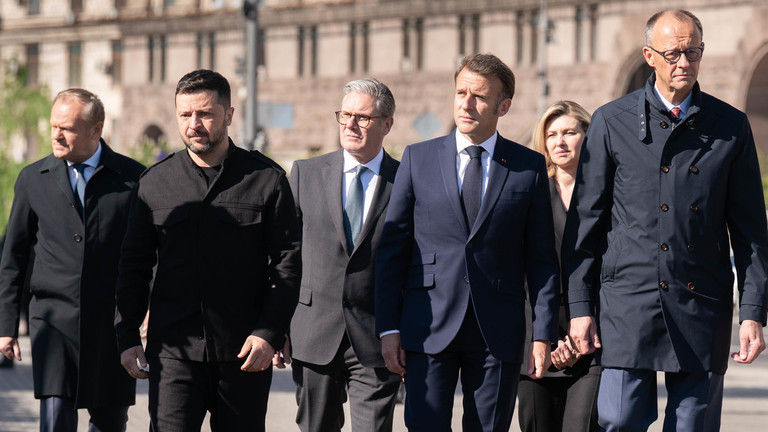
FILE PHOTO: Vladimir Zelensky and European leaders on May 10, 2025 in Kiev, Ukraine. © Stefan Rousseau – WPA Pool/Getty Images
RT | November 29, 2025
The European Union, along with the UK, has deliberately torpedoed the US peace roadmap aimed at ending the Ukraine conflict in the apparent hope that it “will fizzle out,” The Guardian has claimed.
Russia has repeatedly accused the EU of sabotaging efforts to end the bloodshed in Ukraine.
Washington put forth the peace framework earlier this month, and US officials are continuing to work on it. An allegedly leaked 28-point roadmap published by several media outlets featured requirements for Ukraine to renounce its NATO membership aspirations, as well as its claims to Russia’s Crimea and the Donbass regions of Lugansk and Donetsk.
Shortly after the contents of the US-drafted peace proposal were published by the press, several EU member states, along with the UK, scrambled to present their own version. Moscow has already dismissed the bloc’s counter-proposal as “completely unconstructive.”
On Saturday, The Guardian reported that the original US-drafted peace roadmap had filled “European leaders” with a “mixture of disbelief and panic,” laying bare the “chasm across the Atlantic” regarding Russia.
However, the EU and the UK are by now well-versed in blunting any American attempts at resolving the Ukraine conflict, the publication claimed.
Their strategy presumably boils down to welcoming the “fact of Trump’s intervention, before slowly and politely smothering it.”
According to the British media outlet, Kiev’s European backers took the original 28-point proposal and removed nine key elements from it.
The EU and the UK have also allegedly mobilized the “Atlanticist wing in the Senate,” so that it mounts internal opposition to the peace framework.
Politico Europe and The Telegraph, citing anonymous sources, have recently claimed that the US has been keeping the EU “in the dark” regarding ongoing diplomacy on the peace proposal.
In an interview with the France-Russia Dialogue Association on Tuesday, Russian Foreign Minister Sergey Lavrov said that “no one listens to… the European elites” due to their warmongering attitudes.
Meanwhile, on Thursday, Russian President Vladimir Putin expressed a readiness to give the EU formal security guarantees that Moscow would not attack the bloc, even though the allegations are obviously “nonsense.”
Betrayed by western snapback: Iran dumps IAEA deal
Tehran’s attempt at diplomatic detente was met with an escalation by the US and the E3
By Fereshteh Sadeghi | The Cradle | November 25, 2025
Just hours before his visit to France to discuss Iran’s nuclear file, Iranian Foreign Minister Abbas Araghchi warned:
“International relations face unprecedented crises due to militant unilateralism. Repeated violations of international law – including ongoing conflicts in West Asia – reflect the backing of the United States and the tolerance of certain European states.”
This underscores Tehran’s defiant stance as it moves in its nuclear diplomacy. Just three months after Israeli-US airstrikes targeted Iranian nuclear sites, Tehran signed a significant security agreement with the International Atomic Energy Agency (IAEA). It did not last long.
The so-called Cairo Agreement, signed in September and brokered by Egypt, was meant to defuse tensions. Yet that same month, the western-backed IAEA was warned against “any hostile action against Iran – including the reinstatement of cancelled UN Security Council resolutions” in which case the deal would become “null and void.”
Of note, Iran–IAEA relations had been deteriorating since June during the 12-day US-Israeli war on Iran. The IAEA and its director general, Rafael Grossi, refused to condemn the attacks on Iranian civilians and nuclear facilities, and the targeted assassinations of nuclear scientists and senior military officers.
The IAEA’s refusal to condemn the US-Israeli violations made Iranians furious. They accused Grossi of paving the ground for the strikes and being Israel’s footman. The Islamic Republic formally lodged a protest with the UN Secretary General and the Security Council against Grossi, arguing he breached the IAEA’s neutrality.
Resistance to western coercion
The Iranian parliament – or Majlis – raised the bar by ratifying legislation that suspended cooperation between Tehran and the international nuclear watchdog. The law was passed immediately after the war ended on 25 June.
It declared Grossi and his inspectors “persona non grata” and forbade them from travelling to Iran or visiting Iranian nuclear facilities. The law stipulated that the suspension will continue so long as the security and safety of Iranian nuclear installations and scientists have not been guaranteed.
Nevertheless, the Egyptian-mediated Cairo Agreement appeared to thaw the standoff, if temporarily. It was signed in the presence of Iranian Foreign Minister Araghchi and Grossi, and ambiguously framed as a deal on “implementing the Safeguards Agreement.”
Few details were made public then; while the IAEA called it a deal on “practical modalities and implementation of the Safeguards Agreement”, the Iranian side insisted it was “a new regime of cooperation.”
State news agency, IRNA, elaborated, “the agency will not engage in monitoring activities provided Iran has not carried out environmental and nuclear safety measures at its bombed facilities.” IRNA referred to the Supreme National Security Council as the sole body that “could greenlight the IAEA monitoring missions inside Iran, case by case.”
Iran’s diplomatic maneuvering, including the deal with the IAEA, was obviously part of the broader strategy to prevent the UK, France, and Germany from activating the snapback mechanism, in the 2015 nuclear deal between Iran and the five permanent members of the Security Council plus Germany.
The European Troika (E3), who were clearly dissatisfied with the Cairo Agreement, reiterated “Tehran needs to allow inspections of sensitive sites and address its stockpile of highly enriched uranium.”
Snapback triggers collapse
A threat to terminate the Cairo Agreement actually came three days after it was clinched, when Iran’s Foreign Ministry warned that “launching the snapback mechanism would put the ongoing cooperation between Iran and the IAEA at risk.” Nevertheless, the UK, France, and Germany moved ahead with the snapback activation.
Araghchi’s first reaction noted that “in regards to the E3’s move, the Cairo agreement has lost its functionality.” Iranians had also vowed to halt cooperation with the IAEA. However, they did not fulfill that threat and collaborated in silence.
The IAEA inspectors visited some Iranian nuclear sites in early November. However, they were not given access to the US-bombed Fordow, Natanz, and Isfahan facilities.
Even this tactical compliance failed to shield Tehran from a new IAEA censure. On 20 November, the agency’s Board of Governors passed a US-E3-backed resolution ignoring Iran’s cooperation and demanding immediate access to all affected sites and data.
It was the straw that broke the camel’s back. Iran condemned the move as “illegal, unjustifiable, irresponsible, and a stain on the image of its sponsors.”
Araghchi on his X account posted, “like the diplomacy which was assaulted by Israel and the US in June, the Cairo Agreement has been killed by the US and the E3.”
For the second time, Iran’s top diplomat announced the termination of the Cairo Agreement, “given that the E3 and the US seek escalation, they know full well that the official termination of the Cairo Agreement is the direct outcome of their provocations.”
Iran’s representative to the IAEA, Reza Nadjafi, told reporters that “If the US claims success in destroying Iran’s Natanz and Fordow facilities, then what is left for inspections?” and further warned, “any decision (by the IAEA) has its own consequences.”
Back to confrontation
By applying pressure through the IAEA, the E3 and the US seek to coerce Iran into opening the doors of its bombed nuclear sites to the IAEA inspectors, to hand over the 400 kilograms of uranium enriched to 60 percent, which the US believes is still intact, and “to eliminate Iran’s ability to convert that fuel into a nuclear weapon.”
The collapse of the Cairo Agreement marks a return to the kind of standoff that defined US–Iran relations from 2005 to 2013, when Iran’s nuclear file was sent to the UN Security Council, and sanctions were imposed under Chapter VII.
Some skeptics believe US President Donald Trump’s administration would not only take Iran to the Security Council but would also cite the chapter in question, which sanctions the use of military force against any country deemed a threat to global peace.
While Iran signed the 2015 Joint Comprehensive Plan of Action (JCPOA) in hopes of avoiding that scenario, the US’s unilateral withdrawal under Donald Trump’s first term in 2018 and the E3’s failure to meet their obligations rendered the agreement toothless.
June’s US-Israeli bombing campaign against Iranian nuclear infrastructure confirmed for Tehran that western powers have no intention of engaging in diplomacy in good faith.
Toward a new strategy
According to IRNA, which echoes the official line of the Iranian government, “Iran feels that the goodwill gestures it has shown towards the IAEA and the United States, have drawn further hostility. Therefore, maybe now it is the time to change course and revise its strategy and the rule of engagement with international bodies, including the IAEA.”
Some observers believe Iran’s first step to map out a new strategy is pursuing the policy of “nuclear ambiguity, remaining silent regarding the whereabouts of the stockpile of the highly-enriched uranium and quietly halting the implementation of the [Nuclear] Non-Proliferation Treaty, without officially admitting it.”
In the latest development, the chairman of the Parliament’s National Security Committee has vowed that “Iran will sturdily pursue its nuclear achievements.” Ibrahim Azizi has cautioned the US and Europe that “Iran has changed its behavior post June attacks and they’d better not try Iran’s patience.”
That posture is hardening. In September, over 70 Iranian lawmakers urged the Supreme National Security Council to reconsider Iran’s defense doctrine – including its long-standing religious prohibition on nuclear weapons.
They argue that the regional and international order has changed irreversibly since Israel and the US jointly bombed the Iranian nuclear facilities. While citing Iran’s Supreme Leader Ali Khamenei’s 2010 fatwa banning nuclear weapons, they assert that in Shia jurisprudence, such rulings may evolve when conditions change – especially when the survival of the Islamic Republic is at stake.
Iran is also working to immunize itself against any escalation at the UN Security Council. Here, it banks on the veto power of Russia and China to neutralize any western effort to reimpose sanctions.
The collapse of the Cairo Agreement marks a turning point in Tehran’s nuclear diplomacy. It is a conclusion drawn from years of unmet commitments and military escalation that western multilateralism has exhausted its credibility.
Lavrov denounces leak of Trump’s draft peace proposal
Western officials are trying to torpedo Washington’s mediation efforts, the top Russian diplomat has said
RT | November 25, 2025
The leak of a US proposal for ending the Ukraine conflict was designed to derail President Donald Trump’s peace efforts, Russian Foreign Minister Sergey Lavrov said on Tuesday.
Reports that the White House had drafted a document outlining a path towards ending Kiev’s hostilities with Russia initially came from the US media, with a Ukrainian MP and Axios later publishing what they said were the full 28 points of the roadmap.
“It was leaked on purpose to fan the media hype,” Lavrov said. “Those who direct this hype certainly want to undermine Donald Trump’s efforts, to distort the plan according to their wishes.”
He said the diplomatic sabotage appears to be coming from European leaders backing Kiev, particularly French President Emmanuel Macron, who he argued do not have “the best intentions.”
Lavrov said Moscow never received any texts from Washington through official channels, but obtained it unofficially. Regardless, Russia will only discuss whatever the US eventually submits, and will do so confidentially, without resorting to “megaphone diplomacy,” the minister added.
Macron and other Western officials have rejected any agreement that would cross what Kiev proclaimed as its red lines, such as its bid to join NATO, its ability to host foreign troops, or territorial claims.
Lavrov noted that Moscow is willing to discuss “specific wording” of a possible peace deal, but will not compromise on any of the core objectives that President Vladimir Putin outlined to Trump personally during their meeting in Alaska earlier this year. Should “the spirit of Anchorage be erased” from the proposal that the US shares with Russia, “the situation would be radically different,” he added.
Iran Dismisses US Dialogue Claims as “Not Credible”
Al-Manar | November 23, 2025
Iranian Foreign Ministry spokesperson Esmaeil Baqaei stated on Sunday that Washington’s professed willingness for dialogue lacks credibility, asserting that US claims are fundamentally inconsistent with its actions.
Speaking at a weekly press conference, Baqaei referenced recent remarks by the US president, stating that America has demonstrated in practice that it is not serious about negotiations.
The spokesman suggested that Washington either misunderstands the very concept of negotiation or approaches talks with a mindset that reduces them to dictation. He emphasized that such claims must be measured against the United States’ actual conduct.
Commenting on Tehran’s conditions for any potential talks with the US, Baqaei underscored that safeguarding Iran’s national interests remains the central and guiding principle.
“The other side has shown no genuine belief in negotiations,” he said, adding that as long as dialogue is treated as an imposition, the necessary conditions for genuine talks do not exist.
“What matters is that the US government has destroyed any basis for trust through its actions,” Baqaei stated. He cited the US withdrawal from the Joint Comprehensive Plan of Action (JCPOA) in 2018 and subsequent “unfaithful” actions during the Biden administration, despite earlier progress.
He further argued that the US decision to accompany the Zionist regime in its military aggression against Iran this past June provided further proof of Washington’s lack of intent to reach a reasonable and fair solution.
Addressing other diplomatic matters, the spokesman firmly dismissed speculation that Iranian Foreign Minister Abbas Araqchi’s upcoming trip to the Netherlands would involve negotiations with the three European countries (the E3). He clarified that the visit’s sole purpose is participation in a conference for the Organization for the Prohibition of Chemical Weapons (OPCW).
Baqaei conceded that consultations with other foreign ministers might occur on the sidelines in The Hague, but he explicitly labeled reports of negotiations with the European troika as untrue.
Hungarian officials condemn French general’s call for Europe to accept ‘losing its children’ in future war with Russia
By Thomas Brooke | Remix News | November 21, 2025
Hungarian officials are sharply criticizing what they describe as a dangerous escalation in European war rhetoric after France’s top general warned the public to prepare for the possibility of losing “its children” and enduring economic hardship in the event of a future conflict with Russia.
In a post on X, Balázs Orbán, a Hungarian MP and political director to Prime Minister Viktor Orbán, accused Paris of normalizing the prospect of war. “When Emmanuel Macron’s top general says Europe must be ready to accept losing its children and suffer economically for war, something is deeply wrong. Hungary rejects this logic — we work for peace, not for sending our children into war,” he wrote.
His criticism followed remarks by Fabien Mandon, the Chief of Staff of the French Armed Forces, who delivered a stark warning about Europe’s readiness. In a speech on Nov. 18, Mandon told an audience that Western European countries “must be ready for a possible clash with Russia within three to four years, and this cannot be kept secret from the public any longer.”
The general argued that deterring Moscow would require mobilizing national resources and societal resolve. “All knowledge, all economic and demographic power must be directed to deter the Moscow regime from trying any further,” he said.
Mandon stressed that young soldiers already serving, who are “between 18 and 27 years old,” rely on public backing. “They persevere in their mission if they feel that the country is with them,” he said. But he warned that France could be endangered if it hesitates in the face of potential suffering. “If our country backs down because it refuses to accept losing its children, or if it has to endure economic hardship because priorities are directed, for example, to defense production, then we are in danger.”
The comments sparked immediate backlash in Budapest, where officials argued that France’s top military leadership is preparing society for large-scale conflict instead of seeking de-escalation.
Budapest described the statements as evidence of “war psychosis” taking hold in Western Europe, reaffirming Hungary’s stance that peace negotiations should guide Europe’s approach.
Hungary has long been an advocate for a peace deal facilitated by U.S. President Donald Trump and has refused to provide ammunition to the frontline.
Earlier this week, Prime Minister Viktor Orbán accused the European Commission of “astonishing” irresponsibility after receiving a letter from Commission President Ursula von der Leyen urging member states to provide additional financial support to Ukraine.
Orbán said the request came “at a time when it has become clear that a war mafia is siphoning off European taxpayers’ money,” claiming Brussels was asking for more cash rather than demanding oversight or suspending payments. He was referring to the recently exposed corruption scandal enveloping the country.
“This whole matter is a bit like trying to help an alcoholic by sending them another crate of vodka. Hungary has not lost its common sense,” he wrote.
Russia, China upbraid anti-Iran IAEA resolution, urge West to drop threats
Press TV – November 21, 2025
Russia and China have, in the strongest terms, rebuked a recent anti-Iran resolution passed by the Board of Governors of the International Atomic Energy Agency (IAEA), calling for the settlement of the Islamic Republic’s nuclear issue through dialogue and cooperation.
Drafted by France, Germany, the United Kingdom and the United States and approved 19–3 with 12 abstentions on Thursday, the resolution sought to pressure Tehran by demanding it “without delay” account for its enriched uranium stocks and facilities damaged in the June attacks by the United States and Israel.
Russian Foreign Ministry Spokesperson Maria Zakharova announced at a press conference in Moscow that Russia continues to firmly emphasize finding political and diplomatic solutions to the issue of Iran’s nuclear program.
Asked about a recent telephone conversation between the Russian and Iranian foreign ministers, during which the issue of Iran’s nuclear program and related talks were discussed, Zakharova was cited by TASS as saying that Moscow is consistently committed to actively seeking political and diplomatic solutions to the Iranian nuclear issue.
The spokeswoman added that Moscow has repeatedly warned about the dangers of “military actions” that threaten the stability and security of West Asia, underlining that any military attack on nuclear facilities, especially those under the monitoring of the IAEA, is “unacceptable.”
Zakharova also said the US aggression against Iran’s nuclear sites undermined the principles the Non-Proliferation Treaty (NPT) — a treaty to which Iran has always been fully committed and which the IAEA has confirmed.
The Russian Foreign Ministry spokeswoman went on to say that despite the efforts on the part of some foreign actors to create chaos and trouble in Iranian society, Tehran still prefers the path of dialogue over war and believes that national interests can be secured based on equal dialogue and by taking into account mutual concerns.
She stressed that in order to resume the talks, Iran needs “serious guarantees” that its nuclear facilities will not be targeted by missile or air attacks again.
Zakharova further underlined that the West must put aside threats of sanctions and military threats and return to diplomacy with Iran.
IAEA urged to create ‘favorable conditions for cooperation’
Li Song, China’s permanent representative to the IAEA, told the Board of Governors on Thursday that pushing through a counterproductive resolution against Iran will “only make things worse,” stressing that the US, Israel, and key European states are fueling the ongoing crisis surrounding Tehran’s nuclear file.
“Countries that have recklessly resorted to the use of force and obsessively pursued confrontation and pressure are responsible for the current situation of the Iranian nuclear issue,” Li said.
The Chinese envoy stressed that Israel and the United States attacked Iranian nuclear facilities safeguarded by the IAEA in June, which led to a “fundamental change in the situation of the Iranian nuclear issue.”
“Such an act should be strongly condemned by the international community and the IAEA,” he said.
On the Cairo agreement reached between Iran and the IAEA in September, Li emphasized that the pact was “a positive development” and “an important opportunity” to fully revive safeguards cooperation.
He said the activation of the snapback mechanism by the UK, France, and Germany had “seriously undermined the good momentum of cooperation” between Tehran and the Agency.
Li added that the Iranian nuclear issue “can only be properly resolved” by respecting Iran’s legitimate NPT rights and ensuring the peaceful nature of its program through political, diplomatic, and safeguards mechanisms.
The envoy called on the BoG to “create favorable conditions for cooperation and dialogue” and to avoid “provoking confrontation.”
Iran moves to terminate Cairo agreement with IAEA
The Cradle | November 20, 2025
Iran notified the International Atomic Energy Agency (IAEA) on 20 November that it is terminating the cooperation agreement signed in Cairo in retaliation for the UN nuclear watchdog adopting a new resolution demanding expanded access and information on Iran’s nuclear facilities.
Iran’s envoy to the agency, Reza Najafi, said the resolution “will not add anything to the current situation” and described it as “counterproductive” shortly after the Board of Governors approved the text.
He warned that it would have “a negative impact on the cooperation that has already started between Iran and the agency.”
According to diplomats who attended the closed session, the 35-member board passed the resolution with 19 votes in favor, three against, and 12 abstentions.
The text requires Iran to report “without delay” on the status of its enriched uranium stock and on its nuclear sites that were bombed by Israel and the US during the 12-day war on Iran in June.
It also urges Iran to “comply fully and without delay” with its obligations under UN Security Council (UNSC) resolutions and to provide all information and access requested by the agency.
Western members of the board stated that “Iran must resolve its safeguards issues without delay” and called for “practical cooperation through access, answers, restoration of monitoring.”
Iran maintains that its nuclear program is peaceful and had earlier cautioned that the resolution would “adversely affect” ongoing cooperation. Najafi noted that Iran had already granted access to “all undamaged facilities,” while inspectors have not been to sites such as Fordow and Natanz since they were hit in the June war.
The agency says verification of Iran’s uranium stock is “long overdue,” and that it cannot inspect the bombed facilities until Tehran submits updated reports.
Iranian Foreign Minister Abbas Araghchi said the IAEA resolution was “unlawful and politically motivated,” initiated by the US and the European troika, and pushed through despite the 15 members voting against or abstaining.
He said the move ignored Iran’s goodwill, undermined the agency’s credibility and independence, and would disrupt cooperation.
The Foreign Minister had previously said that the Cairo agreement with the IAEA was defunct after Europe triggered snapback sanctions, but added that a negotiated solution remains possible if the opposing side acts in good faith.
Araghchi confirmed that he informed IAEA chief Rafael Grossi in a formal letter that the agreement is now considered terminated.
When Israeli attacks began in June, the IAEA estimated Iran held 440.9 kilograms of uranium enriched up to 60 percent.
Iran and several allied states argued that issuing another resolution would jeopardize efforts to advance dialogue.
Tehran has declared that the September inspection agreement with the IAEA is void, and Najafi said the new resolution “will have its own consequences,” adding that Iran would announce them later.
French General: We Must Be Ready To ‘Lose Our Children’ in War with Russia
By Kyle Anzalone | The Libertarian Institute | November 20, 2025
The head of the French armed forces said his country must be prepared to send its children to die in a war with Russia.
“Russia is convinced that the Europeans are weak. However, we are strong, fundamentally stronger than Russia,” Chief of the French Defense Staff General Fabien Mandon said. “We have all the knowledge, all the economic and demographic strength to dissuade Moscow’s regime. What we are lacking, and that is where you have a major role, is the strength of soul to accept pain to protect what we are.”
He added, “If our country is weak because it is not ready to accept losing its children — because it’s better to say things clearly — [and] to suffer economically because the priority will be the defence sector, then we are at risk.”
He made the remarks earlier this week at the congress of the Association of Mayors of France. He urged the local leaders in attendance to inform their constituents of his assessment.
French President Macron has emerged as a firm backer of NATO’s proxy war against Russia in Ukraine. European leaders have warned that Moscow is planning to reconstitute the Soviet Union and invade NATO countries.
However, Russian forces only control about 20% of Ukraine, and President Vladimir Putin has offered to end the war with Ukraine only ceding the Donbas and parts of two southern provinces.
Ukrainian President Zelensky met with European leaders in France earlier this week. A significant issue that was discussed is the bloc’s attempt to cover a massive budget deficit in Ukraine. The President of the European Commission said that the EU would need to provide Kiev with $150 billion over the next two years.
Zelensky also signed an agreement to buy 100 Rafael fighter jets from France over the next two years. Paris said it would take at least three years to train Ukrainian pilots.
Jeffrey Epstein used Rothschild banking empire to finance Israeli cyberweapons industry
Press TV – November 19, 2025
Convicted sex offender and financier Jeffrey Epstein used his close relationship with the Rothschild banking empire to channel private investments into the Israeli regime’s cyberweapons industry.
Documents released by the US House Oversight Committee in November, alongside hacked emails from former Israeli prime minister Ehud Barak, reveal that Epstein acted as a key intermediary, connecting the Rothschild banking dynasty with Israel’s cyberweapons sector.
The records show Epstein coordinating private investments in Israeli startups developing offensive cyber capabilities, surveillance tools, and spyware technologies.
Following Barak’s retirement from office in 2013, he recruited Pavel Gurvich, a former operative of Israel’s secretive Unit 81, to identify promising cyber ventures.
Barak relied on Gurvich for guidance on investments in offensive cyber tools, including Tor network surveillance, NSO-style cellphone hacking software, and router exploitation technologies.
Gurvich supplied detailed maps of undersea transatlantic cables and network access points, illustrating the global reach of potential operations.
Epstein then facilitated connections between Barak, Gurvich, and the Rothschild dynasty, offering logistical support, guidance on tax and investment structures, and strategic advice.
Epstein’s involvement included a $25 million contract in October 2015 between his Southern Trust Company and Barak’s spyware-linked startup Reporty Homeland Security (now Carbyne).
The agreement covered “risk analysis and the application and use of certain algorithms.”
He also organized private meetings and dinners to foster collaboration, including a January 2014 gathering in Paris with Barak, the Rothschilds, and former French President Nicolas Sarkozy.
Emails suggest Epstein coached Barak on managing the Rothschild relationship, advising him to provide “time, attention, stable, recurring, predictable” engagement to earn trust.
Barak also proposed a donor-advised fund to channel private capital into Israeli technology, planning to allocate 4–5% of the fund to startups in telecommunications, cyberwarfare, and biotechnology.
The fund would operate through the Rothschilds’ “umbrella fund” structures, allowing tax-deductible contributions to finance early-stage military and spyware technology companies. Epstein coordinated introductions and advised Barak on securing Rothschild backing.
Furthermore, Epstein managed the logistics of Barak’s participation in the 2014 Herzliya Conference, Israel’s premier cyberwarfare summit, sponsored by the Rothschild Caesarea Foundation (RCF).
Emails show he relayed speaker lists, arranged private meetings with the Rothschilds, and guided Barak on handling inquiries from conference organizers.
Correspondence indicates Epstein remained active in the network until at least April 2017, arranging private meetings and maintaining connections between Barak, the Rothschilds, and other influential figures in Israel’s cyberwarfare industry.
Epstein was arrested on federal sex trafficking charges in July 2019 and held at the Metropolitan Correctional Center in New York City.
He reportedly committed suicide by hanging in August 2019, despite prior reports that he was under suicide watch following an attempt in July of that year.
Featured Video

The Most Important Bet You’ve Never Heard Of
or go to
Aletho News Archives – Video-Images
From the Archives
The Occupied Mentality Syndrome
Saudi Arabia on the American chessboard – Part 2
By B. J. Sabri | American Herald Tribune | April 19, 2016
Since the Korean War, but particularly since the Iranian Revolution of 1979 until today, the United States has been steadily escalating its military presence in the Persian Gulf. Taking advantage of many colossal events of the past 36 years, [1] the hyper-empire has institutionalized its massive presence on land and sea, and expanded its objectives to include the unambiguous physical control of the area, as well as the clear understanding that local Arab governments should abide by them. The pretext is always the same: in “defense” of the national interests and security of the United States. From observing how the United States has been interacting with the governments of the region, and by judging from the size of its expeditionary force, we could reach a basic conclusion. The United States is occupying, de facto, the entire Arabian Peninsula. (Yemen, devastated by Saudi and American jets is yet to be conquered. Oman? Britain returned not as colonial ruler but as a soft occupying power.)
Under this articulation, Saudi Arabia, Qatar, Kuwait, and the United Arab Emirates are virtually occupied countries. If we compare this type of occupation to the mandate and protectorate regimes of the past, the results might be identical—the nations affected by it lose sovereignty. When Arab governments comply with the objectives of a foreign power that station military forces on their national milieu, then that power controls them in multiple ways including how they react to policy deliberations and what decisions they intend to take on specific issues. A good method to verify the concept of effective occupation is this: take notice of what the United States says and wants, and then compare it to what the gulf rulers do in response. (I shall discuss this detail at some point in the upcoming parts.)
If the presence of US forces or other means of political pressure are a factor in Saudi Arabia’s interventionist Arab wars, then we need to debate this issue. However, from the history of resistance to colonialism, we learnt: if a powerful state imposes its order on a nation by military means or other forms of coercion, and if this nation does not resist that imposition, then a mental subordination to the powerful state will ensue. This is especially true in the case of Saudi Arabia. One single event, 9/11, has transformed it from a US “ally” into an instant political hostage of the American Empire. … continue
Blog Roll
 Aletho News
- Trump and the debris of Iran war
- IRGC hits US tech giant Oracle’s data center, computing site in UAE over new assassinations
- Bombing Iran Back Into the Stone Age /Lt Col Daniel Davis & Jim Jatras
- UAE rejects report claiming it is ready to join war on Iran to reopen Hormuz
- A New Resistance Front: How Does Syria Factor into the Regional War?
- Gulf states weigh pipeline expansion plans, hoping to bypass Hormuz
- Iran sets up ‘tollbooth’ system in Strait of Hormuz
- Wave 90: IRGC strikes US-linked industrial sites in Gulf
- Iran Says US-Israeli Claims of Its Military Strength Are Wrong
- Trump’s April Fools’ Address to the nation
- If Americans Knew
- ‘War crime’: Global condemnation as Israeli ministers celebrate death penalty law targeting Palestinian prisoners
- 7 Ways Israel Is Turning Lebanon Into Gaza
- World’s Leading Football Bodies Under Fire Over Israel Policies
- Experts warn of possible use of nukes against Iran
- Israeli invasion of Lebanon could be worse than 1982, warn European officials
- Passover: Liberation and collective punishment
- Trump says the quiet part out loud: (Israel’s) war on Iran > Americans’ health – Daily Update
- Gaza families reunite years after babies evacuated amid Israel’s war
- International Rescue Committee warns Gaza’s children face grave protection risks
- Iran’s Alleged 47-Year War on America: Debunking the 1,050 American Deaths Canard
- No Tricks Zone
- Low Intensity Tornado Wrecks Major Solar Farm, Creating A Potential Toxic Dump
- New Study Finds Warming Saves Lives…Cold Temperatures 12 Times More Deadly Than Excess Heat
- German Science Blog Accuses PIK Climate Institute Of Hallucinating Climate Tipping Points
- Devastating Assessment Of Comirnaty Vaccine By Former Senior Pfizer Europe Toxicologist
- New Study: CO2 Is ‘Effectively Negligible’ As An Explanatory Climate Change Factor Since 2000
- Former Pfizer Toxicologist Dr. Helmut Sterz Tells Bundestag Hearing Pfizer Vaccine Should Have Never Been Approved
- Energy Expert: Germany’s Nuclear Phaseout Was A “500 Billion Euro Mistake”
- New Research: South Australia’s Mid-Holocene Sea Surface Temperatures Were 4°C Warmer Than Today
- Storing Green Energy To Last Germany 10 Days Would Require A 60-Million Tonne Battery
- New Studies: UK Sea Levels Were 4 Meters Higher Than Today During The Mid-Holocene
 Aletho News