No ground for negotiations with E3 anymore: Iran FM
Al Mayadeen | October 11, 2025
Tehran no longer sees a basis for nuclear talks with the E3 countries, Iranian Foreign Minister Abbas Araqchi stated on Saturday evening, adding that the country is not seeking it either.
Speaking to the Iranian state TV, Araghchi revealed that Washington had asked to hold direct talks with Tehran on the sidelines of the UN meetings, a message conveyed by US envoy Steve Witkoff. Iran, according to Araghchi, expressed readiness to engage, but only on the condition that representatives from the E3 countries and the IAEA Director, Rafael Grossi, be present, which the latter refused.
In this context, the top Iranian diplomat revealed that “the United States has always sought to integrate regional issues into nuclear negotiations, but we have never allowed that,” describing Washington’s positions as “constantly changing”.
Iran’s interests are red line
Regarding Tehran’s red lines, Araghchi confirmed that the interests of the Iranian people are paramount, emphasizing that while Iran will never give up its right to enrich uranium, it is willing to provide the international community with assurances, if need be, about the peaceful nature of its nuclear program.
He further criticized Europe, stating it has demonstrated a lack of independence, and indicated that Iran remains open to studying any new, fair plan from Washington as long as it respects the interests of the Iranian people, expressing a willingness to engage in dialogue.
On the topic of the Cairo Agreement, Araghchi stated, “It is currently frozen, and our cooperation with the Agency is only conducted within the framework of the Iranian parliament’s law and through the Supreme National Security Council.”
Araghchi addressed the prospect of renewed war with “Israel”, disclosing that, following an exchange between Russian President Vladimir Putin and Israeli Prime Minister Benjamin Netanyahu several days ago, Russian officials subsequently informed the Iranian ambassador in Moscow that Netanyahu has no interest in returning to a state of war with Iran.
Gaza ceasefire solely a Palestinian Resistance matter
Iranian Foreign Minister Araghchi addressed the ceasefire agreement in Gaza, denying that any discussions had taken place with Steve Witkoff concerning it, while affirming Iran’s support for any plan that would halt what he described as Israeli crimes.
Araghchi said Trump shared his view on Iran’s statement about the Gaza deal, but no messages were exchanged with Washington, adding that only the Palestinian Resistance and people can decide on a ceasefire, and no one else.
He stressed that “Israel” is not trustworthy, citing past experiences like Lebanon, which is clear proof that the entity does not honor its commitments, based on which Iran raised its concerns and issued the necessary warnings. He added that while Washington has made positive promises regarding the Gaza deal, there are doubts about its seriousness in fulfilling them, as these promises are constantly shifting.
Araghchi also noted that most foreign ministers in the region are skeptical about the future of the subsequent phases of the Gaza agreement.
On the issue of the normalization agreements, Iran’s FM noted that “these deals intrinsically constitute a sinister plan to deprive the Palestinian people of their rights,” adding that Iran’s position on such agreements is clear: “it will never join them.”
Regarding the trade war imposed by Washington, Araghchi stated that Iran would reciprocate in kind if its commercial ships were obstructed in any way under the pretext of sanctions, affirming that escalating tensions is not in anyone’s interest.
Why are so many eager for war with Russia? /Lt Col Daniel Davis & Glenn Diesen
Glenn Diesen | October 8, 2025
The discussion centers on Russia’s next moves in the Ukraine war and the West’s potential responses. Russia views NATO’s continual expansion and Western escalation as provocations it must eventually answer. Putin’s recent speech referencing “Novorossiya” (a broader region beyond Donbas) signals that Moscow’s ambitions may soon expand to include all historically Russian-speaking and industrial parts of southern and eastern Ukraine—essentially the Black Sea coast from Kharkiv to Odesa. The analysis suggests Russia’s likely to pursue this expansion after Ukraine’s army becomes too depleted to resist. Western promises of future NATO membership for Kyiv only make Russia more determined to seize strategic territory permanently.
French PM resigns hours after proposing new cabinet
RT | October 6, 2025
French Prime Minister Sebastien Lecornu has announced his resignation less than 12 hours after appointing a new cabinet. The French parliament is deeply divided over efforts to pass a new budget that would tackle rising debt.
A former defense minister, Lecornu was the seventh prime minister appointed by French President Emmanuel Macron and the fifth in two years. His sudden resignation less than a month after entering the role makes him the shortest-lived prime minister in modern French history.
A long-time Macron loyalist, Lecornu faced fierce criticism from both sides of the political aisle on Sunday after unveiling his new cabinet which was largely unchanged from the previous government of Francois Bayrou. Parties across the National Assembly threatened to vote it down.
Following the announcement, several political parties have called for snap parliamentary elections. The National Rally party stated on X that “Macronism is dead on its feet,” and called on Macron to choose between the dissolution of the National Assembly or resignation.
Jean-Luc Melenchon, the leader of the left-wing La France Insoumise (LFI) party, has also called to introduce a motion to remove Macron from office.
Shortly after the news of Lecornu’s resignation broke, the Paris stock market dropped 12%, making it the worst-performing index in Europe. The euro has also seen a drop of 0.7% on the back of political instability.
France’s public finances have been under mounting strain, with the deficit reaching 5.8% of GDP in 2024 and public debt climbing to 113%, far above the 60% ceiling set by EU rules. The government has been seeking to push through an austerity budget aimed at curbing spending and stabilizing the debt ratio, but divisions in the National Assembly have made agreement difficult.
The political deadlock stems from last year’s snap parliamentary elections, which left France without a clear majority. The lower house is now split between three blocs — Macron’s centrist alliance, the left-wing New Popular Front, and the National Rally — none of which can govern alone. As a result, Macron’s governments have repeatedly struggled to secure votes on key legislation.
Iran declares Cairo deal with IAEA ‘defunct’
The Cradle | October 5, 2025
Iranian Foreign Minister Abbas Araghchi confirmed on 5 October that the Cairo deal signed with the International Atomic Energy Agency (IAEA) last month is no longer active or valid due to European ‘snapback’ sanctions on Tehran.
“Experience has shown that there is no solution to Iran’s nuclear issue other than a diplomatic and negotiated one,” Araghchi said.
“The three European countries thought they could achieve results through the snapback mechanism, but that tool was ineffective and only made diplomacy more complicated. Diplomacy will always continue, but the form and the parties involved in negotiations have now changed. Undoubtedly, the role of the European countries in the upcoming talks has diminished, and their diplomatic justification for participating has weakened,” he added.
“In recent months, our discussions have been focused solely on the nuclear issue, conducted either directly or indirectly with the American side. In these exchanges, our proposals were completely transparent. Had they been taken seriously … reaching a negotiated and diplomatic solution would not have been out of reach. Even now, if the [opposing] parties act in good faith and consider mutual interests, the continuation of negotiations is possible.”
“Nevertheless, the situation following the military attack and the activation of the snapback mechanism has changed, and the upcoming negotiations will certainly be different from before,” he went on to say, adding that both the US-Israeli attacks on Iran in June and the activation of the ‘snapback’ mechanism have complicated matters.
“After several rounds of talks, this agreement was reached in Cairo. However, the Cairo Agreement no longer suffices under the new circumstances, including the activation of the snapback mechanism, and new decisions will be made.”
“To prove the peaceful nature of its nuclear program and its goodwill, the Islamic Republic of Iran has exhausted all diplomatic avenues, pursued consultations and cooperation, and presented constructive and balanced proposals. There is now no excuse left for Western countries to prevent Iran from cooperation or dialogue. Iran’s positions are fully legitimate and reasonable, and it is ready to pursue any solution that leads to confidence-building.”
The snapback sanctions took effect on 28 September. Washington welcomed the European decision.
Iran had previously warned that activating the sanctions would jeopardize the Cairo deal, reached on 9 September after Tehran resumed cooperation with the IAEA following a brief suspension as a result of the war.
Negotiations to prevent the return of the sanctions failed after the UN Security Council (UNSC) rejected a draft resolution to permanently lift sanctions against Iran. Russia, China, Pakistan, and Algeria voted to prevent the reintroduction of sanctions, while nine Security Council members voted against sanctions relief. Two countries abstained.
Tehran has recalled its envoys from Germany, France, and Italy.
The EU has continued to hold Iran to the terms of the 2015 Joint Comprehensive Plan of Action (JCPOA), despite Washington’s unilateral withdrawal from the deal in 2018 and its policy of maximum pressure against Iran.
Tehran is insisting on its right to maintain peaceful uranium enrichment.
Nuclear talks between Tehran and Washington have been halted since the US-backed Israeli war against Iran started on 13 June.
The US was aware that Israel was set to attack while continuing to pretend it was negotiating with Iran. In late June, Washington joined the war with a bunker-buster attack on Iranian nuclear sites.
Israel has publicly threatened to restart the war against Iran. Tehran has vowed to respond more harshly to any new attack.
UK Digital ID Scheme Faces Backlash Over Surveillance Fears — Is a Similar Plan Coming to the U.S.?
By Michael Nevradakis, Ph.D. | The Defender |October 2, 2025
The U.K. plans to introduce a nationwide digital ID scheme that will require citizens and non-citizens to obtain a “BritCard” to work in the U.K., which includes England, Scotland, Wales and Northern Ireland.
Government officials say the plan, to take effect no later than August 2029, will help combat illegal immigration.
But critics like U.K. activist and campaigner Montgomery Toms said the scheme, “far from being a tool for progress,” is instead a “gateway to mass surveillance, control and ultimately the rollout of a centralised social credit system.”
The plan faces broad opposition in the U.K., according to Nigel Utton, a U.K.-based board member of the World Freedom Alliance, who said, “the feeling against the government here is enormous.”
A poll last week found that 47% of respondents opposed digital ID, while 27% supported the ID system and 26% were neutral. The poll was conducted by Electoral Calculus and Find Out Now, on behalf of GB News.
A petition on the U.K. Parliament’s website opposing plans to introduce digital ID may force a parliamentary debate. As of today, the petition has over 2.73 million signatures.
According to The Guardian, petitions with 100,000 signatures or more are considered for debate in the U.K. parliament.
As opposition mounts, there are signs the BritCard may not be a done deal. According to the BBC, a three-month consultation will take place, and legislation will likely be introduced to Parliament in early 2026.
However, U.K. Culture Secretary Lisa Nandy said the government may push through its digital ID plans without going through the House of Commons or the House of Lords.
Protesters plan to gather Oct. 18 in central London.
Digital ID will ‘offer ordinary citizens countless benefits,’ U.K. officials say
British Prime Minister Keir Starmer announced the digital ID scheme last week in a speech at the Global Progress Action Summit in London.
“A secure border and controlled migration are reasonable demands, and this government is listening and delivering,” Starmer said. “Digital ID is an enormous opportunity for the U.K. It will make it tougher to work illegally in this country, making our borders more secure.
The plan “will also offer ordinary citizens countless benefits, like being able to prove your identity to access key services swiftly,” Starmer said.
According to The Guardian, digital ID eventually may be used for driver’s licenses, welfare benefits, access to tax records, and the provision of childcare and other public services.
Darren Jones, chief secretary to Starmer, suggested it may become “the bedrock of the modern state,” the BBC reported.
Supporters of the plan include the Labour Together think tank, which is closely aligned with the Labour Party and which published a report in June calling for the introduction of the BritCard.
Two days before Starmer’s announcement, the Tony Blair Institute for Global Change, led by Labour Party member and former U.K. Prime Minister Tony Blair, published a report, “Time for Digital ID: A New Consensus for a State That Works.”
Blair tried to introduce digital ID two decades ago as a means of fighting terrorism and fraud, but the plan failed amid public opposition. According to the BBC, Starmer recently claimed the world has “moved on in the last 20 years,” as “we all carry a lot more digital ID now than we did.”
During the COVID-19 pandemic, Blair endorsed a global digital vaccine passport, the Good Health Pass, launched by ID2020 with the support of Facebook, Mastercard and the World Economic Forum.
According to Sky News, French President Emmanuel Macron welcomed the BritCard for its ability to help fight illegal immigration into the U.K., much of which originates from France.
Critics: Digital ID marks ‘gateway to mass surveillance’
The BritCard, which would live on people’s phones, will use technology similar to digital wallets. People will not be required to carry their digital ID or be asked to produce it, except for employment purposes, the government said.
According to the BBC, BritCard will likely include a person’s name, photo, date of birth and nationality or residency status.
Digital wallets, which include documents such as driver’s licenses and health certificates, have been introduced in several countries, including the U.S.
Nandy said the U.K. government has “no intention of pursuing a dystopian mess” with its introduction of digital ID.
However, the plan has opened up a “civil liberties row” in the U.K., according to The Guardian, with critics warning it will lead to unprecedented surveillance and control over citizens.
“Digital ID systems are not designed to secure borders,” said Seamus Bruner, author of “Controligarchs: Exposing the Billionaire Class, their Secret Deals, and the Globalist Plot to Dominate Your Life” and director of research at the Government Accountability Institute. “They’re designed to expand bureaucratic control of the masses.”
Bruner told The Defender :
“All attempts to roll out digital ID follow a familiar pattern: corporate and political elites wield crises — such as mass migration, crime, or tech disruptions — as a pretext to expand their control … over private citizens’ identities, finances and movements into a suffocating regime.
“Once rolled out, these systems expand quietly, shifting from access tools to enforcement mechanisms. Yesterday it was vaccine passports and lockdowns; tomorrow it is 15-minute cities and the ‘universal basic income’ dependency trap. ‘Voluntary’ today becomes mandatory tomorrow.”
Tim Hinchliffe, editor of The Sociable, said digital ID is “not about tackling illegal immigration, it has nothing to do with job security and it definitely won’t protect young people online. Digital ID is all about surveillance and control through coercion and force.”
Hinchliffe said:
“Illegal immigration is just one excuse to bring it all online. Be vigilant for other excuses like climate change, cybersecurity, convenience, conflict, refugees, healthcare, war, famine, poverty, welfare benefits. Anything can be used to usher in digital ID.”
Twila Brase, co-founder and president of the Citizens’ Council for Health Freedom, said governments favor digital ID because it allows unprecedented surveillance.
The ID system “notifies the government every time an identity card is used, giving it a bird’s-eye view of where, when and to whom people are showing their identity,” she said.
According to Toms, “A digital ID system gives governments the ability to monitor, restrict, and ultimately punish citizens who do not comply with state directives. It centralises power in a way that is extremely dangerous to liberty.”
Experts disputed claims that digital ID is necessary to improve public services.
“The ‘improved efficiency’ argument is a technocratic fantasy used to seduce a public obsessed with convenience,” said attorney Greg Glaser. “Governments have managed to provide services for centuries without a digital panopticon. This is not about efficiency. It is about creating an immutable, unforgeable link between every individual and the state.”
Digital ID technology may create ‘an enormous hacking target’
London-based author and political analyst Evans Agelissopoulos said major global investment firms, including BlackRock, Vanguard and State Street, could combine their financial might with the power of digital ID.
“BlackRock, Vanguard and State Street are on a mission to buy properties to rent to people. Digital ID could be used against people they deem unfit to rent to,” he said.
During the COVID-19 pandemic, the same firms supported digital vaccine passports in major corporations in which they are among the top shareholders. Some experts suggested digital ID may institutionalize a vaccine passport regime and central bank digital currencies.
“Digital identity is the linchpin to every dystopian nightmare under the sun,” Hinchliffe said. “Without it, there can be no programmable digital currencies, there can be no carbon footprint trackers, no social credit system.”
Other experts suggested that a centralized database containing the data of all citizens could be monetized. “By centralizing everything, they will have access to health, criminal, financial records. This data can be sold,” Agelissopoulos said.
According to Brase, those who will benefit from the centralization of this data include:
“Anybody who’s going to be the third-party administrator, academia and companies who are building biometric systems and what they call ‘augmented authentication systems’ that provide the cameras, the back system operations for biometric identification and for digital systems.”
Several major information technology (IT), defense and accounting firms, including Deloitte and BAE Systems, have received U.K. government contracts totaling 100 million British pounds ($134.7 million) for the development and rollout of BritCard.
U.S. tech companies, including Palantir, Nvidia and OpenAI, “have also been circling the UK government,” The Guardian reported.
Digital ID also raises security concerns, with IT experts describing the U.K.’s plan as “an enormous hacking target,” citing recent large-scale breaches involving digital ID databases in some countries, including Estonia.
“Government databases are frequently hacked — from healthcare systems to tax records,” Toms said. “Centralizing sensitive personal data into a single mandatory digital ID is a disaster waiting to happen.”
The public may also directly bear the cost of these systems. Italy’s largest digital ID provider, Poste Italiane, recently floated plans to levy a 5 euro ($5.87) annual fee for users.
Switzerland to roll out digital ID next year, amid controversy
In a referendum held on Sunday, voters in Switzerland narrowly approved the introduction of a voluntary national digital ID in their country.
According to the BBC, 50.4% of voters approved the proposal. Biometric Update noted that the proposal received a majority in only eight of the country’s 26 cantons, though the country’s government campaigned in favor of the proposal.
Digital ID in Switzerland is expected to be rolled out next year.
Swiss health professional George Deliyanidis said he “does not see any benefits for the public” from the plan. Instead, he sees “a loss of personal freedom.”
“There are suspicions of election fraud,” he added.
In a letter sent Tuesday to the Swiss government, a copy of which was reviewed by The Defender, the Mouvement Fédératif Romand cited “significant statistical disparities” in the referendum’s results and called for a recount.
In 2021, Swiss voters rejected a proposal on digital ID under which data would have been held by private providers, the BBC reported. Under the current proposal, data will remain with the state.
According to the Manchester Evening News, countries that have introduced nationwide digital ID include Australia, Canada, China, Costa Rica, Denmark, Estonia, India, Japan, South Korea, Spain, Ukraine and the United Arab Emirates. Other countries with similar systems include France, Finland and Norway.
In July, Vietnam introduced digital ID for foreigners living in the country. In August, the Vietnamese government helped neighboring Laos launch digital ID.
The New York Times reported that, in 2024, China added an “internet ID” to its digital ID system, “to track citizens’ online usage.”
Bill Gates has supported the rollout of digital ID in several countries, including India.
The European Union plans to launch its Digital Identity Wallet by the end of 2026.
“When you see a nearly simultaneous worldwide push, like this digital ID agenda, people in all nations need to expect to be impacted to some extent,” said James F. Holderman III, director of special investigations for Stand for Health Freedom.
Is national digital ID coming to the U.S.?
Although the U.S. does not have a national identification card, the U.K. did not have one either — until digital ID was introduced. The U.K. scrapped national ID in 1952.
In May, the Transportation Security Administration (TSA) began Real ID enforcement for domestic air travelers in the U.S. In the months before, TSA engaged in a push to encourage U.S. citizens to acquire Real ID-compliant documents, such as driver’s licenses. Full enforcement will begin in 2027.
The REAL ID Act of 2005 established security standards for state-issued ID cards in response to the 9/11 attacks and the recommendations of the 9/11 Commission. In the intervening years, its implementation was repeatedly delayed.
Last year, then-President Joe Biden issued an executive order for federal and state governments to speed up the adoption of digital ID.
Brase said Real ID “is really a national ID system for America, currently disguised as a state driver’s license with a star. The American people really have no idea that what’s in their pocket is a national ID and they have no idea that the [Department of Motor Vehicles offices] are planning to digitize them.”
Hinchliffe said 193 countries, including the U.S., accepted digital ID last year when they approved the United Nations’ Pact for the Future.
Earlier this month, Sen. Rand Paul (R-Ky.) introduced the Safeguarding Personal Information Act of 2025 (S 2769), a bill to repeal the REAL ID Act of 2005.
“If digital ID is allowed to spread globally, future generations will never know freedom,” Hinchliffe said.
This article was originally published by The Defender — Children’s Health Defense’s News & Views Website under Creative Commons license CC BY-NC-ND 4.0. Please consider subscribing to The Defender or donating to Children’s Health Defense.
Recognise a state and prevent it from existing?
By José Goulão | Strategic Culture Foundation | October 2, 2025
And suddenly, the overwhelming majority of countries in the so-called Collective West decided to recognise the State of Palestine. Among them were some of the most loyal allies of the Zionist regime and accomplices to its atrocities, such as France, the United Kingdom, Australia, Canada and even, despite its negligible specific weight, the government of the Portuguese Republic. We know that consistency is not the strong point of the Montenegro clique: recognition was declared just a few weeks after the Minister of Foreign Affairs, Paulo Rangel, went to bless the crimes of the Israeli regime, precisely at one of the most intense stages of human and physical devastation in the Gaza Strip.
Any reader will naturally wonder what has now led so many important countries, the guardians of “our civilisation”, to adopt a stance that they could, and should, have taken years ago. Was it the blatant and dramatic exposure of the decades-old genocide of the Palestinian people, which is ravaging the Gaza Strip and which the hypocrisy of fine words and the most beautiful intentions can no longer hide? Perhaps a little, although we should not attach too much importance to this response because shame is not something that abounds in Western governments.
Another reason, this one with a much more important political and strategic significance, is the certainty of all those making the declarations that their decision, apart from being couched in plenty of half-truths, has no practical effect on the real recognition of Palestinian rights and on the murderous conduct of the State of Israel. On the same days that the declarations of recognition were made, the Zionist Prime Minister, Benjamin Netanyahu, assured with complete conviction that there would never be a Palestinian state. This was a challenge to the attitudes of Western countries, which they received with the most devout silence.
And now?
The most relevant situation, and also the one that raises the most doubts about the genuineness of Western governments’ intentions regarding the restoration of the rights of the Palestinian people, is based on a simple question: What now?
Yes, what could these declarations of recognition of the State of Palestine change in the current situation, controlled by the fascist impulses of the Israeli government and the US administration, this time under Trump’s baton – as it could be, with the same effects, under Biden’s orders?
At first glance, they will change nothing. Colonial and expansionist arbitrariness continues unabated in East Jerusalem and from north to south in the West Bank, while the human and physical levelling of Gaza continues unhindered, except for the guerrilla pockets of Hamas.
Western governments have recognised an abstract state with no effective powers over what should be its territory, disappearing every day in the face of the genocidal advances of hordes of settlers imported from all over the planet. Are Western governments doing anything concrete to force Israel to stop colonisation? Are they stopping sending weapons to Israel? Are they considering imposing sanctions capable of suffocating a state run by a criminal clique that is incapable of living on its own?
So far, there is no indication that any of the Western powers are willing to take these steps, which are essential if any qualitative changes in the balance of power throughout Palestine are to lead to negotiations capable of defining the paths for establishing and applying international law in the region. This would imply that, at least in this case, Western leaders would have to put aside their bureaucratic adherence to the ‘rules-based international order’ defined in Washington. The truth is that no government seems willing to take this risk, which, in practice and under these conditions, reveals that recognising or not recognising the State of Palestine will amount to the same thing, that is, more of the same.
Recognise, yes, but…
Western governments have been careful (which opens the door to backtracking) not to recognise the State of Palestine unconditionally, thus continuing to put the strict application of the principles established by international law on hold. Endowed with authority and power granted by five centuries of colonial violence, which allowed them to invent an entity such as the State of Israel, Western governments have attached a series of conditions to the decision. Taken literally, these translate into recognition without recognition because they effectively limit the Palestinian people’s decision-making powers on matters that concern them and on which only they have the right to deliberate.
In a manoeuvre that transfigures much of what is positive about recognition, Western governments are attempting to breathe new life into Mahmoud Abbas’s moribund Palestinian Authority, confined to Ramallah, by giving it powers that it will be unable to exercise. They also demand its absolute surrender to Israel – a demand that is unnecessary in the situation that has been dragging on throughout this century – and they attribute sole responsibility for terrorism in Palestine to Hamas, while ignoring Israeli terror – disguised as ‘security’ and ‘right to exist’. As always, this double standard vitiates the very declarations of recognition from the outset.
The condition that demonstrates how hypocritical and, for now, useless the declarations of recognition are, however, relates to the demand for the disarmament not only of Hamas but of all structures of the Palestinian Resistance. Such demands leave the entire Palestinian people even more helpless and at the mercy of the criminal free will of the Zionist regime, which can thus pursue its genocidal goal, free from any hindrance, while remaining exempt from accountability before international bodies. In the practical consequences of the measures imposed by Western governments in exchange for the recognition of the State of Palestine, the Zionist state would find the best of all worlds and the full realisation of all its objectives.
The shadow of collaborationism
The most recent developments in the recognition process help to dispel some uncertainties about the interests that lie behind the decision, which are not favourable to the Palestinian people.
It was clear from the outset that the recognition of Palestinian independence by Western governments was not, it bears repeating, unconditional. Most of the speeches on the subject clearly overvalued the Palestinian Authority, which is inactive in practice and, more seriously, entirely conditioned by Israel’s demands. The “shared” management of much of the West Bank between the Ramallah government and the Zionist occupation forces means, in fact, that the former has been placed at the service of the latter’s interests. This is often confirmed by the actions of the Palestinian police forces in repressive actions against the Palestinian population itself.
This situation suits Western governments because it means that the ‘autonomous’ authorities are willing to collaborate in ways that run counter to the legitimate interests of the Palestinian people, which have never been recognised by Western states.
At the same time, the West attributes sole representation of the Palestinians to the decrepit Palestinian Authority and its leader Mahmoud Abbas, who is in fact perpetuated in power despite being completely hamstrung by Israel and the United States. It should be remembered, as it is a fact, that his accession to the presidency was achieved through a soft coup organised in 1994 by the United States, Israel and Western powers, as a result of which the historic leader of the Resistance, Yasser Arafat, was removed from the main positions of power (to which he had been elected) and assassinated a few months later.
It should also be remembered that Mahmoud Abbas, very recently described as ‘pragmatic’ by a pro-Israeli publication such as the weekly newspaper Expresso, was received at the White House, from where Arafat had been banned, shortly after taking office as president of the so-called ‘Autonomy’ in 1994.
These circumstances help to better understand the Western constraints that accompanied the recognition of independence. And they lead to the elementary conclusion that there will be no representative entity that reflects the will of the Palestinian people without the holding of free, open and democratic general elections under the control of international bodies supervised by the UN. This process cannot involve the intervention of Israel and the United States of America, which is by definition biased and self-serving.
Another demand common to Western governments is that the Resistance (wrongly and maliciously equated with Hamas) should ‘renounce’ terrorism, that is, armed struggle, while, it should be repeated, sparing Israeli terrorism. This ‘renunciation’ must be accompanied by the disarmament of the Resistance, which means the total surrender of the Palestinian people to the discretionary and genocidal power of Israel. From this perspective, the recognition of Palestine becomes a poisoned gift.
Abbas’ recent speech to the UN General Assembly, delivered via the internet because, this time, the Trump administration illegally refused to grant the Palestinian president a visa to travel to New York, confirmed the existence of dangerous collaboration with Israeli and Western colonial interests.
Mahmoud Abbas, as Palestinian president, promised that ‘Hamas will never be the government’. But how can the most prominent Palestinian leader, whose party was defeated in the last general elections held in the occupied territories, promise that the most voted political force (according to the last poll, held more than 15 years ago) will not be able to govern the state? By manipulating the election results? By adopting a single-party regime or a personal dictatorship? By preventing a party with significant popular support, Hamas or any other, from being a legitimate and necessary part of a majority government? Let us remember that Abbas and his Western and Arab allies prevented Hamas from governing after it won an absolute majority in free elections; and that, despite multiple negotiations and supposed draft agreements, they always sabotaged the creation of ‘national unity governments’ that would have brought Gaza, the West Bank and East Jerusalem under the same ‘autonomous government’. ‘One of our strategic objectives is to maintain the separation between Gaza and the West Bank,’ Netanyahu confessed to his Likud party’s parliamentary group.
None of these paths implied in the content of the recognition statements correspond to the ‘democratic values’ proclaimed by the Western world, which seems willing to impose, through its latest decision, an authoritarian and undemocratic ‘solution’ centred on Abbas.
In his speech, the Palestinian president stated that he does not want Palestine to be ‘an armed state’. What does this idea mean, which is incompatible with the existence of a full state as established in international law? Would the defence and security of Palestine be handed over to Israel? Would the Palestinian people no longer have anyone to defend them, whether it be the armed resistance or the state apparatus?
In his time, shortly before being assassinated by Zionism in 1995, Israeli Prime Minister Isaac Rabin admitted that the maximum status he would grant to a Palestinian entity at the end of the ‘peace process’ would be ‘less than a state’. Have Mahmoud Abbas and the Western leaders who manipulate him revived this idea? Will Palestine ‘less than a state’ be the future state of Palestine as understood? There will be no better way, then, already considered as the ‘final solution’ to the problem, for the continuation of genocide and the creation of Greater Israel – throughout Palestine, as a first step.
The fundamental question, however, remains: what will come after the recognition of independence, given that Israel occupies almost the entire territory where this state would be created? What will Western countries do to give substance to their decision? It should be remembered that international law requires the creation of an ‘independent and viable’ Palestinian state. In prosaic terms, a state like any other. However, this is not what is being planned, with the collaboration of the incompetent Palestinian Authority. Israel’s dizzying policy of creating settlements is gradually eating away at the territory that is essential for the creation of a viable state. Taking a clear-headed view, the Portuguese head of state admitted that one day there will be no territory left to establish a state. This is a reality that I began denouncing many years ago, because it is obvious and Israel makes no secret of it. Despite recognising these circumstances, the Western world is doing nothing concrete to stop the colonisation and make the state it claims to recognise viable.
Once again, the West’s main objective has been to create propaganda and delaying tactics and, with them, to try to neutralise the increasingly strong, active and genuine solidarity of Western peoples with the Palestinian people. This solidarity cannot be allowed to wane; it must be strengthened, because if we rely on the promises and decisions of our governments, the Palestinian people will continue to be the biggest victims. And we cannot allow that to happen.
France claims to have detained ‘Russian shadow fleet’ tanker
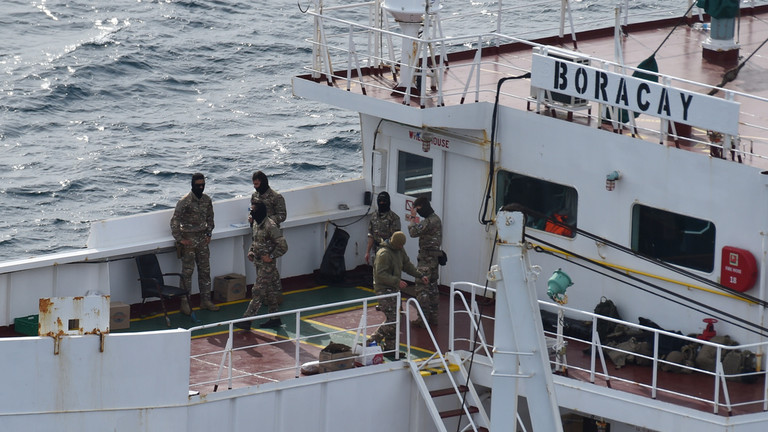
French soldiers onboard the Boracay oil tanker off Saint-Nazaire, France’s Atlantic coast. © AP Photo / Mathieu Pattier
RT | October 2, 2025
France has said it has detained an oil tanker and two crew members linked to an alleged Russian ‘shadow fleet’ supposedly used to evade Western sanctions on oil and gas exports.
French authorities said the tanker, the Boracay, which has been sanctioned by the EU, was sailing under a Benin flag and is currently under investigation for “serious irregularities.” French naval forces reportedly boarded the vessel last week, and it has since remained anchored near Saint-Nazaire on France’s west coast.
The two crew members, who introduced themselves as the captain and first mate, have been taken into custody, according to the prosecutor of the western port city of Brest, Stephane Kellenberger.
Media reports suggest investigators also suspect the vessel could have been linked to unidentified drones that were observed near Danish airports and military sites last month, prompting restrictions on civilian UAV flights.
French President Emmanuel Macron has claimed the Boracay crew are suspected of committing “various serious offences” which justified their detention. He did not confirm any link between the tanker and airspace violations in Denmark.
Moscow has said it has no information about the vessel being referred to by the French authorities or the allegations against it.
Kremlin spokesman Dmitry Peskov noted, however, that Western European nations have been engaging in a “very large number of provocative actions” in various waters, which he said are “absolutely not conducive to ensuring freedom of commercial navigation.” He added that these actions sometimes force Russia’s armed forces to take “enforcement measures.”
Russia has consistently rejected Western sanctions as illegal and warned that attempts to restrict its vessels’ freedom of navigation would draw a response.
Moscow has also dismissed Western claims about Russian drone activity in Western Europe as unsubstantiated and politically motivated. Russian officials have warned that Ukraine could attempt to stage a false flag operation using drones in an attempt to draw NATO into a direct confrontation with Moscow.
Iran’s FM addresses UN Security Council on failed Russia-China draft resolution
Global Times | September 27, 2025
The UN Security Council has voted down an effort by China and Russia to extend sanctions relief to Iran for six months under the nuclear deal – formally known as the Joint Comprehensive Plan of Action on Friday, local time. The draft failed to be passed as the number of votes in favor did not reach nine.
In his speech, Iran’s Foreign Minister, Seyed Abbas Araghchi, began by thanking China, Russia, Pakistan, and Algeria for supporting the resolution, which he described as a genuine effort to “keep the door of diplomacy open and avoid confrontation.” He also welcomed the decision of Guyana and South Korea not to oppose the draft, calling it a stand “on the right side of history,” according to WANA News, an Iranian news agency.
The Iranian foreign minister argued, “Today’s situation is the direct consequence of the US withdrawal from the JCPOA and the E3 (France, United Kingdom and Germany) failure to take any effective action to uphold the commitments.”
“The US has betrayed diplomacy, but it is the E3 which have buried it,” he stressed. Araghchi also said, “The E3 and the US acted in bad faith, claiming to support diplomacy while in effect blocking it.”
“Regrettably, E3 chose to follow Washington’s whims rather than exercising their independent sovereign discretion,” he said, adding “the US persistent negation of all initiatives to keep the window for diplomacy open proved once again that negotiations with the United States lead to nowhere other than dead end,” the foreign minister added.
Geng Shuang, China’s deputy permanent representative to the United Nations spoke after the vote. He reminded the Council that “history has shown that resorting to force or applying maximum pressure is not the correct approach to resolve the Iranian nuclear issue,” according to the UN report.
Geng continued, “Against the backdrop of ongoing conflict in Gaza and the instability in the Middle East, a breakdown in the Iranian nuclear issue could trigger new regional security crisis, which runs counter to common interest of the international community.”
The Chinese diplomat urged the US to “demonstrate political will by responding positively to Iran’s proposal to resume talks and committing unequivocally to refrain from further military strikes against Iran.”
US, allies veto draft resolution on delaying ‘snapback’ of Iran sanctions
Press TV – September 26, 2025
The United States and its allies veto a draft resolution aimed at delaying “snapback” of the UN Security Council’s sanctions against Iran that were lifted in 2015 in line with a nuclear deal between the Islamic Republic and world countries.
On Friday, the US, the UK, France, Denmark, Greece, Panama, Sierra Leone, Slovenia, and Somalia vetoed the draft measure seeking to delay imposition of the coercive economic measures for six months.
China, Russia, Algeria, and Pakistan voted in favor of the measure that had been submitted by Beijing and Moscow. South Korea and Guyana abstained.
According to the UN, “The so-called ‘snapback’ mechanism [now] remains in force, which will see sanctions rei-imposed on Tehran this weekend, following the termination of the Joint Comprehensive Plan of Action (JCPOA).”
JCPOA refers to the official name of the nuclear deal that upon conclusion was endorsed by the Security Council in the form of its Resolution 2231.
The agreement lifted the sanctions, which had been imposed on Iran by the Security Council and the US, the UK, France, and Germany over unfounded allegations concerning Tehran’s peaceful nuclear energy program.
The bans had been enforced against the nation, despite the International Atomic Energy Agency (IAEA)’s having historically failed to find any proof of “diversion” of the nuclear program.
The US left the JCPOA in an illegal and unilateral move in 2018 and then re-imposed those of its sanctions that the deal had removed.
In 2020, Washington went further by trying unilaterally to trigger the “snapback.”
After the American withdrawal, the UK, France, and Germany too resorted to non-commitment vis-à-vis the Islamic Republic by stopping their trade with Tehran.
The Friday vote came after the trio launched their own bid to activate the “snapback” on August 28.
The allies have been rehashing their accusations concerning Iran’s nuclear energy activities in order to try to justify their bid to reenact the sanctions, ignoring absence of any proof provided by the IAEA that has subjected the Islamic Republic to the agency’s most intrusive inspections in history.
They have also constantly refused to accept their numerous instances of non-commitment to the JCPOA.
Iran, however, began observing an entire year of “strategic patience” following the US’s withdrawal – the first serious violation of the nuclear agreement – before retaliating incrementally in line with its legal right that has been enshrined in the deal itself.
In the meantime, the Islamic Republic has both voiced its preparedness to partake in dialog besides actually engaging in negotiation aimed at resolving the situation brought about by the Western allies’ intransigence.
Tehran refused to categorically rule out talks with the European troika even after illegal and unprovoked attacks by the Israeli regime and the United States against key Iranian nuclear facilities in June, which made it impossible for the IAEA to continue its inspections as before.
The Islamic Republic’s latest goodwill gesture came on September 9, when it signed a framework agreement with the IAEA aimed at resuming cooperation with the agency, which had been suspended following the attacks.
The Friday vote came, although, Iranian officials, including President Masoud Pezeshkian, Foreign Minister Abbas Araghchi, and security chief Ali Larijani, had strongly warned the US and its allies against triggering the “snapback.”
Araghchi had cautioned that such vote would lead to termination of the agreement with the IAEA, while Pezeshkian had noted that talks would be “meaningless” if the mechanism were to be enacted.
Meeting with anti-war activists in New York on Thursday, the president had called the prospect of re-imposition of the sanctions unwelcome, but added that the coercive measures did not signal “the end of the road.”
“Iran will never submit to them,” he had said, referring to the bans, and added that the Islamic Republic “will find the means of exiting any [unwelcome] situation.”
China voices ‘deep regret,’ discourages renewed aggression
Reacting to the vote, China’s Deputy UN Ambassador Geng Shuang similarly expressed “deep regret” for the failure to adopt the draft resolution, identifying dialogue and negotiation as two of “the only viable options” out of the situation caused by the Western measures.
He urged the US “to demonstrate political will” and “commit unequivocally to refraining from further military strikes against Iran.”
Geng further called on the European trio to engage in good faith in diplomatic efforts and abandon their approach of pushing for sanctions and coercive pressure against Iran.
Russia slams US, allies for lack of ‘courage, wisdom’
The remarks were echoed by Geng’s Russian counterpart Dmitry Polyanskiy, who said, “We regret the fact that a number of Security Council colleagues were unable to summon the courage or the wisdom to support our draft.”
“We had hoped that European colleagues and the US would think twice, and they would opt for the path of diplomacy and dialogue instead of their clumsy blackmail,” he said.
Such approach, the diplomat added, “merely results in escalation of the situation in the region.”
Speaking before the vote, Polyanskiy had also told the chamber that Iran had done all it could to accommodate Europeans, but that Western powers had refused to compromise.
Marine Le Pen pressures Macron as calls for French election grow
Al Mayadeen | September 25, 2025
Marine Le Pen is intensifying her offensive against French President Emmanuel Macron, seeking to exploit his political vulnerability as his fifth prime minister in two years, Sebastien Lecornu, struggles to form a stable government.
The National Rally leader is pushing for a snap French election, aiming to increase pressure on Macron and his allies. By framing the president and his centrist camp as the source of France’s political dysfunction, Le Pen is attempting to present her party as the only credible alternative.
“The people on the ground are fed up with them,” National Rally Vice President Louis Aliot told Bloomberg, confirming that the far-right party will not back Lecornu’s government.
Lecornu’s immediate challenge is passing a budget in the National Assembly. He has been reaching out to moderate-left lawmakers to secure votes, but their demands are unlikely to align with Macron’s agenda.
The difficulty is compounded by recent political upheaval. Francois Bayrou’s government collapsed after lawmakers across the spectrum blocked a €44 billion package of tax increases and spending cuts. Now, Lecornu faces a similar risk of defeat.
National rally pushes for snap French election
Le Pen has shifted her strategy, adopting a harder line against Macron after months of balancing disruption and restraint. Her party helped bring down Bayrou’s administration and is now demanding concessions from Lecornu that he is unlikely to make.
By doing so, the National Rally hopes to fracture Macron’s centrist bloc or portray its rivals as complicit in France’s political paralysis. Le Pen has made clear she could support ousting Lecornu if his budget proposals fail.
Public frustration appears to be on Le Pen’s side. A recent poll found that 61% of respondents favor dissolving parliament. The National Rally, already the largest party in the National Assembly, believes a snap vote could bring it closer to a majority.
In last summer’s snap election, the party finished first in more than half of constituencies but was blocked from power after centrist and leftist parties united in the second round. Party officials argue momentum is now shifting in their favor.
Legal challenges add personal stakes for Le Pen
For Le Pen, the stakes are both political and personal. She is appealing a conviction tied to the misuse of European Parliament funds that currently bars her from running for office for five years. She has described the ruling as politically motivated.
A decision on her appeal is expected before summer 2026. Some National Rally figures have floated the idea of passing an amnesty law to clear her path to the 2027 presidential race if the party secures a parliamentary majority.
Le Pen has derided Lecornu’s appointment as the “final cartridge of Macronism” and hinted at further escalation if the deadlock continues. She has even suggested broader constitutional options, including a referendum or the resignation of the president.
“If dissolution is not sufficient, there is the potential resignation of the president of the republic, and the possibility of holding a referendum,” she told Europe 1 radio last week.
By linking Macron’s presidency to political paralysis, Marine Le Pen is betting that her National Rally can transform mounting voter frustration into a decisive advantage in France’s shifting political landscape.
Mohammad Marandi: Iran KILLS IAEA Deal — Cairo Agreement Wiped Out After SnapBack!
Dialogue Works | September 21, 2025
Iranian parliament pushes for ‘nuclear option’ as deterrence to western threat
The Cradle | September 22, 2025
Over 70 members of Iran’s parliament on 22 September called for a reassessment of the country’s defense doctrine, pressing authorities to consider nuclear weapons as a deterrent.
In a letter addressed to the Supreme National Security Council and the heads of the executive, legislative, and judicial branches, the lawmakers demanded that the issue be raised urgently.
“We respectfully request that, since the decisions of that council acquire validity with the endorsement of the Leader of the Revolution, this matter be raised without delay and the expert findings communicated to the parliament,” the statement read.
The MPs argued that while the development and use of nuclear arms contradicts the 2010 ‘fatwa’ of Iranian Supreme Leader Ali Khamenei banning them, circumstances have changed.
They wrote that “developing and maintaining such weapons as a deterrent is another matter,” stressing that “in Shia jurisprudence, a change in circumstances and conditions can alter the ruling.”
“Moreover, safeguarding Islam – which today is bound to the preservation of the Islamic Republic – is among the paramount obligations.”
The push was led by Hassan-Ali Akhlaghi Amiri, a representative from the holy city of Mashhad, according to Hamshahri Online.
Lawmakers noted that the nuclear doctrine was shaped at a time when the international community was still able to restrain Israeli aggression.
They pointed to the large-scale assault launched by Israel in June, backed by the US, which included direct strikes on three Iranian nuclear facilities, among them Fordow.
Iran has long stated its nuclear program is peaceful, rejecting western claims it seeks weapons capability. Tehran continues to cite Khamenei’s fatwa as proof of its intentions.
At the same time, the Supreme National Security Council announced the suspension of cooperation with the International Atomic Energy Agency (IAEA) after the UN Security Council imposed sanctions.
State media quoted the body as saying the move was a response to the “ill-considered steps of three European countries.”
Lawmakers warned that pressure tactics by the E3 countries will draw a “harsher and more decisive” response than before.
Featured Video

The Most Important Bet You’ve Never Heard Of
or go to
Aletho News Archives – Video-Images
From the Archives
The Occupied Mentality Syndrome
Saudi Arabia on the American chessboard – Part 2
By B. J. Sabri | American Herald Tribune | April 19, 2016
Since the Korean War, but particularly since the Iranian Revolution of 1979 until today, the United States has been steadily escalating its military presence in the Persian Gulf. Taking advantage of many colossal events of the past 36 years, [1] the hyper-empire has institutionalized its massive presence on land and sea, and expanded its objectives to include the unambiguous physical control of the area, as well as the clear understanding that local Arab governments should abide by them. The pretext is always the same: in “defense” of the national interests and security of the United States. From observing how the United States has been interacting with the governments of the region, and by judging from the size of its expeditionary force, we could reach a basic conclusion. The United States is occupying, de facto, the entire Arabian Peninsula. (Yemen, devastated by Saudi and American jets is yet to be conquered. Oman? Britain returned not as colonial ruler but as a soft occupying power.)
Under this articulation, Saudi Arabia, Qatar, Kuwait, and the United Arab Emirates are virtually occupied countries. If we compare this type of occupation to the mandate and protectorate regimes of the past, the results might be identical—the nations affected by it lose sovereignty. When Arab governments comply with the objectives of a foreign power that station military forces on their national milieu, then that power controls them in multiple ways including how they react to policy deliberations and what decisions they intend to take on specific issues. A good method to verify the concept of effective occupation is this: take notice of what the United States says and wants, and then compare it to what the gulf rulers do in response. (I shall discuss this detail at some point in the upcoming parts.)
If the presence of US forces or other means of political pressure are a factor in Saudi Arabia’s interventionist Arab wars, then we need to debate this issue. However, from the history of resistance to colonialism, we learnt: if a powerful state imposes its order on a nation by military means or other forms of coercion, and if this nation does not resist that imposition, then a mental subordination to the powerful state will ensue. This is especially true in the case of Saudi Arabia. One single event, 9/11, has transformed it from a US “ally” into an instant political hostage of the American Empire. … continue
Blog Roll
 Aletho News
- Britain’s Lebanon surveillance network: A digital map for war
- Bahrain faces scrutiny for opposition crackdown after detainee killed
- Hegseth’s Pentagon Purge Designed to Prevent a Mutiny: Karen Kwiatkowski
- Greek shipping firms secretly transporting oil, weapons to Israel
- UN vote on Hormuz force delayed as Iran issues warning
- Trump and the debris of Iran war
- IRGC hits US tech giant Oracle’s data center, computing site in UAE over new assassinations
- Bombing Iran Back Into the Stone Age /Lt Col Daniel Davis & Jim Jatras
- UAE rejects report claiming it is ready to join war on Iran to reopen Hormuz
- A New Resistance Front: How Does Syria Factor into the Regional War?
- If Americans Knew
- Israel-US kill negotiators, destroy civilian structures, but Iran’s military capabilities still largely intact – Daily Update
- ‘War crime’: Global condemnation as Israeli ministers celebrate death penalty law targeting Palestinian prisoners
- 7 Ways Israel Is Turning Lebanon Into Gaza
- World’s Leading Football Bodies Under Fire Over Israel Policies
- Experts warn of possible use of nukes against Iran
- Israeli invasion of Lebanon could be worse than 1982, warn European officials
- Passover: Liberation and collective punishment
- Trump says the quiet part out loud: (Israel’s) war on Iran > Americans’ health – Daily Update
- Gaza families reunite years after babies evacuated amid Israel’s war
- International Rescue Committee warns Gaza’s children face grave protection risks
- No Tricks Zone
- Low Intensity Tornado Wrecks Major Solar Farm, Creating A Potential Toxic Dump
- New Study Finds Warming Saves Lives…Cold Temperatures 12 Times More Deadly Than Excess Heat
- German Science Blog Accuses PIK Climate Institute Of Hallucinating Climate Tipping Points
- Devastating Assessment Of Comirnaty Vaccine By Former Senior Pfizer Europe Toxicologist
- New Study: CO2 Is ‘Effectively Negligible’ As An Explanatory Climate Change Factor Since 2000
- Former Pfizer Toxicologist Dr. Helmut Sterz Tells Bundestag Hearing Pfizer Vaccine Should Have Never Been Approved
- Energy Expert: Germany’s Nuclear Phaseout Was A “500 Billion Euro Mistake”
- New Research: South Australia’s Mid-Holocene Sea Surface Temperatures Were 4°C Warmer Than Today
- Storing Green Energy To Last Germany 10 Days Would Require A 60-Million Tonne Battery
- New Studies: UK Sea Levels Were 4 Meters Higher Than Today During The Mid-Holocene
 Aletho News