US Underestimates Civilian Death Toll in Iraq and Syria by 95%
teleSUR | June 17, 2016
The United States-led coalition that is bombing Iraq and Syria may be under-reporting the civilian toll of that war by as much as 95 percent, according to a new report released Friday by the monitoring group Airwars.
The U.S.-led coalition, which includes nations such as Britain, France and the Netherlands, has been bombing Islamic State group targets in Iraq and Syria since 2014, carrying out more than 13,121 airstrikes, or just over 19 a day. The vast majority of the strikes are carried out by the U.S., according to Airwars—68 percent in Iraq and and 82.5 percent in Syria—with an estimated civilian death toll of at least 1,312 people.
Over the past six months it’s gotten worse, according to Airwars. “Between December and May, in both Iraq and Syria, there was a marked increase in the number of alleged casualty incidents and civilian death attributed to coalition actions,” it says. In Iraq, the group reports that between 297 and 518 civilians were killed by coalition airstrikes in this time. In Syria, between 197 and 274 civilians were killed, “a 38 percent increase in likely civilian deaths above the previous six months.
The U.S. has admitted to killing just 20 civilians. Its allies have admitted to none. “If correct, Airwars data suggests the coalition may be under-reporting civilian deaths by more than 95 percent,” the report says.
The worst incident for civilians occurred on March 19 in the Islamic State-occupied city of Mosul, when at least 25 innocents were killed when coalition airstrikes hit Mosul University in the middle of the day. As teleSUR reported at the time, such a strike on a civilian institution—confirmed by the U.S. Department of Defense—may constitute a breach of international law.
The U.S. and its coalition allies are not the only foreign governments reportedly killing civilians in the region. Of 630 alleged incidents where civilians died in Syria as a result of international airpower, 91 percent have been attributed to Russia, according to Airwars, killing between 2,792 and 3,451 civilians between December 2015 and May 2016, largely as the result of airstrikes targeting non-Islamic State forces and civilian areas, “particularly in and around Aleppo.”
The Russian government says its airstrikes have not killed any civilians since they began in Sept. 2015.
Where do police and protesters stand after the Magnanville stabbings?
By Gearóid Ó Colmáin | June 15, 2016
The terrorist attack in Magnanville by alleged Da’esh (Islamic State) operative, Larossi Aballa, on two police officers in Paris, serves one purpose: to remind the public that the war on terror is real and that the police and army are here to protect the population, not oppress it. As protests and strikes continue against the ruling class assault on worker’s security (rights won through a century of indefatigable struggle), phantom enemies are the oligarchic state’s best friends. Phantom enemies allow the oligarchic state to force hostile citizens to seek their protection from the ‘greater evil’.
In the Middle East where they were created by the United States and Israel, the so-called ‘Islamic State’ (Da’esh) have attempted to do what former Western trained terrorists could not: to destroy Syria and Iraq through a large-scale military occupation of those countries. The French media portray the Islamic State as being a symptom of the nihilism and despair of our era; that is only partly the truth.
What is overlooked is the deep complicity of the French state in terrorism – the obscenely Machiavellian determination to use the most brutal barbarians seen in the modern era to implement Western imperial policy in the Middle East and throughout the world. The Islamic State is a mercenary force of the Deep State, the imperial financial order, the hidden hand of military and financial corporations and lobbyists who steer the policies of Western governments behind the scenes. They do not oppose ‘Western civilisation’, they serve it, massacring people such as those of Syria who, imbued with patriotism, heroism and piety, refuse to kneel and worship at the alter of Mammon.
We are told by Le Monde that the terrorist/patsy in the police attack, Larossi Aballa, used the Facebook Live application during the attack to propagandise his crimes. He is also reported to have threatened journalists.
Two points here –
1. Anyone with enough curiosity and intelligence to visit a good bookshop knows that the role of journalists in the capitalist world order is to be stenographers to power. A daily perusal of the corporate press proves the proposition unfailingly. It helps restore public confidence in the credibility of corporate journalists if they are ‘threatened’ every now and then; especially by the terrorists whose crimes they ignore when they are committed on behalf of Western geopolitical interests in foreign lands such as Syria.
2. The dissemination of truth through social media and the emergence of citizen journalists all over the world exposing the lies of the corporate press are undermining the public’s confidence in authority. Hence, the use of pseudonyms and the freedom to diffuse information must be curtailed. Fear not! The government will protect you by limiting your ability to research and share information.
The murder of the two police officers comes just days after police were caught on camera vandalising shops in an effort to discredit legitimate and peaceful protests against undemocratic labour reforms. It sends a powerful message: police are there to protect us from terrorists not oppress us on behalf of the ruling class!
Protests are turning violent on the streets of Paris with several cars being set alight by ‘Black Box’ anarchist protesters. These Black Box hooligans sabotage worker’s struggles every time they threaten the established order. Their actions are criminalising legitimate protests. The recent attacks on the Necker Hospital in Paris are acts of sabotage which are providing the pretext for the government to interdict further protests. It is clear the protest movement is hurting the ruling class.
The murder of the two police officers in Paris is an outrage which should be condemned by all. But it must be borne in mind that thousands of working-class policemen and soldiers unwittingly defend an execrable class of people who would not hesitate in murdering if political expediency required it.
As the class struggle intensifies on our streets, the police will be increasingly mobilised against the public. The ‘terrorist threat’ is more important than ever to sustain the illusion of government legitimacy and bludgeon the masses into submission to the police state. But history shows that the weakness of tyranny is that it always relies on servile classes whose loyalty is based more on cynicism and personal advancement than moral conviction. Thus, the possibility always exists for police revolt against the oligarchs. Understanding the precariousness of policing in tyranny is vital in activism. We must not hurl rocks and stones at the police but seek to win them over to the cause of popular democracy and freedom.
Brexit and the Future of the EU
By Valentin KATASONOV | Strategic Culture Foundation | 16.06.2016
The world is waiting with baited breath for 23 June. This is the day when a referendum in Great Britain will decide the question of its membership in the European Union. If the country remains a member of the EU, then the process of financial and economic entropy will continue and a global crisis will be postponed to a much later date. If Britain votes to leave the EU, however, then this could disturb the delicate international equilibrium and the referendum could become the trigger that immediately sparks a global crisis. If it happens, Brexit could prompt the collapse of the world’s post-war political, economic and financial architecture.
Experts believe that the main threat posed by Britain’s withdrawal from the EU is the collapse of the European Union itself. But not even the most intrepid daredevils are prepared to calculate the global political, economic and financial consequences of the European Union’s collapse. For several years now, the European Union has been at death’s door and it all started with the 2007-2009 financial crisis. While the US and many other countries managed to drag themselves out of the crisis (for a while at least), it became a chronic disease for the countries of the EU and is now being called a ‘debt crisis’.
The depth of this crisis varies widely from country to country. According to the IMF, the relative level of public debt in 2015 (% of GDP) was: Greece – 178; Italy – 124; Portugal – 124; France – 95; and Spain – 94. The external debt picture for EU countries is even more impressive (% of GDP, 2014): Great Britain – 322; France – 236; Greece – 234; Germany – 159; Italy – 144; and Spain – 136. As can be seen, even Greece, which everyone has gotten used to considering the most inveterate debtor in the European Union, comes second to Britain and France in terms of the relative size of its external debt.
It is still Greece that is considered the weakest link in the European alliance, however. Calls have begun to be heard both within Greece and beyond its borders for the country’s withdrawal first from the eurozone and then from the European Union. Events like the crisis in Ukraine, the economic sanctions against Russia, talks with Washington on the Transatlantic Trade and Investment Partnership, and the mass migration of refugees have started to split ‘United Europe’ apart and it has divided into Euro-optimists and Eurosceptics.
The former advocate for the preservation of the European Union and even for the further deepening of integration, the dismantling of the remnants of state sovereignty, and the accession of new members. The latter stand for the restoration of individual governments’ lost sovereignty either through radical reform of the EU or its dismantling (or the country’s withdrawal from the EU). Britain’s Eurosceptics are now being looked at with hope by like-minded people in other countries of old Europe. In 2017, general parliamentary elections will be held in Germany, France and also the Netherlands, where Eurosceptics are gaining momentum. A vote by Britain in favour of leaving the European Union will cause a chain reaction of similar initiatives in a number of other countries.
At present, the media are regularly publishing opinion poll findings that reveal what the Brits think of the European Union. It is interesting that at the beginning of the year, the number of those in support of Britain staying in the EU was noticeably higher than those in favour of leaving, in April and May the gap began to narrow and now, at the beginning of June, those in support of leaving have started to outnumber those who wish to stay. Despite a split in the British government on the Brexit issue, it is still strongly influenced by Prime Minister David Cameron who, as is well known, is an ardent supporter of the country retaining its EU membership. The effect of the ‘Cameron factor’ on British public sentiment began to weaken in June, however.
Brexit was one of the key issues at the annual Bilderberg Group meeting held on 9-12 June in Dresden. According to unofficial data, the meeting’s participants (130 people from 20 countries) were extremely concerned about the outcome of the forthcoming referendum, and the heads of major corporations and banks taking part in the discussion have committed themselves to doing everything possible to stop those in favour of Britain leaving the EU from winning the referendum.
In the meantime, scepticism about the EU has also increased noticeably in a number of other European countries. On 8 June, the results of a poll conducted in ten EU countries by the Pew Research Center, a US think tank, were made public. They show that even in Germany, only 50 percent of those surveyed have a favourable view of the EU. Last year, the EU had the trust of 58 percent of Germans. And if a referendum on EU membership were to be held in other countries right now, they would probably choose to leave the Union. The results of the survey also show that the level of trust in the EU has fallen over the last year in France from 55 to 38 percent. And there is no point even talking about Greece, where scepticism about the EU had already begun to dominate last year. Today, just 27 percent of Greeks are in favour of EU membership. The European Union only enjoys a higher reputation in the countries that are more recent EU members, for example in Poland (72 percent) and Hungary (61 percent).
Significantly, even many of those in Europe who are currently in favour of remaining a member of the EU are dissatisfied with Brussels’ policies. This concerns the EU’s economic, monetary and financial policies and, over the last year, its migration policy as well. The fewest people unhappy with the policies being carried out by Brussels were in Germany (38 percent), but the percentages in other EU countries are as follows: France – 66, Italy – 68, and Greece – 92. In addition, 67 percent of Germans, 77 percent of Italians, 88 percent of Swedes and 94 percent of Greeks expressed their dissatisfaction at Brussels’ migration policy. And many of those who disapprove or are dissatisfied could soon join those in favour of their country leaving the European Union. This will be inevitable if those voting for Brexit secure a victory in the referendum on 23 June.
It seems that European Parliament President Martin Schultz can be regarded as a Eurosceptic now as well. In an interview last month, Schultz admitted that, «the European Union is in a dismal state».
Whatever the outcome of the vote in the British Isles, the Eurosceptics in Germany, France and the Netherlands, who are expecting to improve their position in the 2017 elections, are determined to achieve similar referendums in their own countries.
NATO Baltic wargames have ‘political, economic & military motives’
RT | June 5, 2016
The US strategy in Europe is aimed at strengthening its control over EU and NATO states, selling more military equipment to its European allies to make super-profits for its military-industrial complex and to isolate Russia, political author Diana Johnstone told RT.
NATO is holding major sea drills in the Baltic Sea. The BALTOPS exercises, which kicked off on Friday in Estonia and will continue until June 19, involve 15 member states of the military alliance as well as Finland and Sweden.
RT: NATO is conducting major drills across the Baltic. Is there a bigger political message here or is it just an exercise?
Diana Johnstone: Yes, they have been doing exercises like this for quite a while and the pretext changed. At least this time they are not pretending like with the missile shield that it is to protect Europe from Iran. The line has changed now, because the US is coming right out with their aggressive actions toward Russia. You have to see the political, economic and military motives for this. The economic motive is obviously to sell more US military equipment to European allies, who don’t need it and can’t afford it. But that is important for the US military-industrial complex. Politically this is the strengthening of US control of EU countries and NATO countries, and to isolate Russia – to carry out this famous [Zbigniew] Brzezinski strategy of separating Russia from Europe to promote US hegemony over the Europe and the world.
RT: A lot of people in Eastern Europe oppose this kind of strategy. The general public is not particularly happy about this, are they?
DJ: Of course those Baltic States, whose governments by the way are satellite governments of the US. The top officials studied in the West, in the US and Canada. These have gone from being Russian satellites to be American satellites. They pretty much follow the US direction. But that is not the case of the rest of Europe, which is simply ignoring this, like it is not happening. The Czechs are aware of it, so they are protesting. But for instance, here in France nobody mentions this, because frankly people wouldn’t be in favor of it at all. This is destroying defense of Europe. It is just turning into an instrument of US policy.
RT: Last week, NATO Secretary General Jens Stoltenberg announced plans to strengthen defenses, particularly against Russian foreign policy calling it “a defensive and proportionate response to Russia’s actions in Crimea and Eastern Ukraine.” At the same time recently he said that they strived “for a more constructive relationship with Russia.” Shouldn’t it be more talking going on, rather than deploying troops and hardware?
JS: We are used to now seeing the US – in the Middle East they say one thing and do the opposite. It’s just amazing to me that people can say things like that. It is totally absurd. Obviously there is nothing offensive about the people of Crimea going back to Russia, to which they belonged before… There is not tiny bit of an aggressive move of Russia towards the West. That is a total fiction… So these people are just lying. They cannot know that.
Dreams of Control: Israel, Global Censorship and the Internet
By Binoy Kampmark | CounterPunch | June 3, 2016
“Under the cover of darkness, there is no limit to the expansion of Big Brother.”
Ilan Gilon, Meretz Party (Israel), Times of Israel, Feb 4, 2016
While Israel’s central justification for its often reactionary policies is couched in hyper-exceptionalist rhetoric, nourished by the ashes of Holocaust remembrance, current interest in censoring the Internet is far from exceptional.
Like a machine of justification against its critics and its enemies, Israel enlists various projects under the banner of the remarkable and precious, when it is simply accomplishing what other states have done before or since: the banal and ordinary. All states want to limit expression, control criticism and marginalise the sceptics. Some do it more savagely, and roughly, than others.
Israel’s military censor, Col. Ariella Ben Avraham, who is part of the IDF’s Directorate of Military Intelligence, gave a good example of this in February by insisting that social media activists and bloggers submit material relevant to security matters for approval prior to posting. The move also revealed an increasing interest to police the digital realm, previously considered an anarchic jungle incapable of effective policing.
Up to 32 Israeli bloggers and social media activists were informed about the directive, one of the first being Yossi Gurvitz, a left-wing activist running the “Friends of George” Facebook page. In rather unceremonious fashion, he was informed via Ben Avraham’s private Facebook account that he was obligated to run future submissions by her office. To his credit, he promises to defy the order.
Internal censorship is but one aspect of this policy. Israel Public Security Minister Gilad Erdan has dipped into the discourse of censorship to convince others that limiting various social media platforms on a global scale is the way to go. In January, he revealed the inner ambition of Israel’s security establishment to internationalise the censorship effort.
To achieve that goal, Erdan speaks of an “international coalition” that would make limiting criticism of Israel its primary objective. The central aim is hardly imaginative: making such providers as YouTube, Twitter and Facebook face up to responsibility as to what they host on their sites.
The Erdan plan suggests that various countries would form a “loose coalition that would keep an eye on content and where it is being posted, and members of the coalition would work to demand that the platforms remove the content that was posted in any of their countries at the request of members.” The simple idea behind this collusion is extra-territorial cooperation, effectively circumventing the global nature of such platforms.
As for the scurrilous subject matter itself, the issues are universal fare for states keen to control matters that supposedly stimulate the darker side of human nature. (Read: contrary to state interests.) Erdan’s office gives the example of material from a Palestinian (of course) disclosing the best locations on the body to inflict fatal stab wounds.
This begs that grand question about how far such an effort goes: control the more sordidly violent sides of the Old Testament because it encourages various unsavoury practices? Limit suggestive literature being discussed in the whirl of social media, buzzing away with malicious promise? The mind is an untidy place filled with remarkable things, and not all of them necessarily make it to actual perpetration. This is a point that continues to elude the mighty warriors of the security state.
Another justification is being thrown in: they, the social media giants, rake in the proceeds, and should therefore man the barricades. “We are planning to put a stop to this irresponsibility,” claimed Erdan’s office, “and we are going to do it as part of an international coalition that has had enough of this behaviour as well.”
Other governments have also done their bit to limit the internet and content available to their citizens. Most famously, Beijing runs its own “Great Firewall of China”, overseen by the Ministry of Information Industry (MII), while the State Council Information Office and the Chinese Communist Party’s Propaganda Department examine content.
In recent times, countries of a supposedly democratic character have taken to the blinds and endeavoured to do what Erdan dreams about. Dangerous thoughts are seen as the reason for dangerous actions. To that end, the country that gave Europe the Enlightenment has been busy forging its own vision of global internet censorship, using a mixture of security and privacy concerns.
The latter has proven to have potentially pernicious consequences, framed largely as an effort to protect the privacy of the French citizen. From that vantage point, a vision of global control has been built on a premise forged in European law: the right to be forgotten. The Court of Justice of the European ruling of May 13, 2014 (Google Spain v Agencia Española de Protección de Datos, Mario Costeja González) has supplied the subject matter for the latest enlargement of censorship powers.
The French response has been intrusively enthusiastic, with the privacy regulator, CNIL, fining Google 100,000 Euros in March for not applying the right to be forgotten across the global network. In the chilling words of the regulator, “For people residing in France to effectively exercise their right to be delisted, it must be applied to the entire processing operation.” Erdan may well be irritated he did not come up with that one.
Binoy Kampmark was a Commonwealth Scholar at Selwyn College, Cambridge. He lectures at RMIT University, Melbourne. Email: bkampmark@gmail.com
Libya: How to Bring Down a Nation
By Patrick Howlett-Martin | CounterPunch | May 31, 2016
More than 30,000 Libyans died during seven months of bombing by an essentially tripartite force – France, Great Britain, United States – which clearly favored the rebels. “The most successful mission in NATO’s history”, in the imprudent words of NATO Secretary General, Anders Fogh Rasmussen, a Dane, in Tripoli in October 2011[1].
French president Nicolas Sarkozy’s eagerness to support a military intervention with the purported aim of protecting the civilian population contrasts with the reception offered to the Libyan president, Muammar Gaddafi, when he visited Paris in December 2007 and signed major military agreements worth some 4.5 billion euros along with cooperation agreements for the development of nuclear energy for peacetime uses. The contracts that Libya seemed no longer willing to pursue focused on 14 Dassault Rafale multirole fighter jets and their armament (the same model that France sold or is trying to sold to Egypt´s General Abdel Fattah al-Sisi, the self-proclaimed marshal), 35 Eurocopter helicopters, six patrol boats, a hundred armored vehicles, and the overhaul of 17 Mirage F1 fighters sold by Dassault Aviation in the 1970s[2].
The major oil companies (Occidental Petroleum, State Oil, Petro-Canada…) working in Libya helped Libya pay the 1.5 billion dollars in compensation that the Libyan regime had agreed to pay to the families of the victims of Pan Am flight 103[3]. At the time, the compensation was intended to be one of the conditions for Libya to be reaccepted into the community of international relations.
The principal Libyan investment funds (LAFICO-Libyan Arab Foreign Investment Company; LIA-Libyan Investment Authority) were shareholders in many Italian and British corporations (Fiat, UniCredit, Juventus, the Pearson Group, owner of the Financial Times, and the London School of Economics, where Gaddafi was addressed as “Brother Leader” during a video conference in December 2010 and his son Saif was awarded a PhD in 2008). The New York investment bank Goldman Sachs was sued in 2014 by a Libyan fund (Libyan Investment Authority) which had lost more than 1.2 billion dollars between January and April 2008 after the American firm took a commission of 350 million dollars for investing their money in highly speculative derivatives[4].
Muammar Gaddafi had been received with full honors by the major powers some months earlier: in addition to the reception in grand style in Paris, where he was a guest for five days in 2007, he was received in Spain in December 2007, in Moscow in October 2008, and in Rome in August 2010, two years after accepting the Italian gift of 5 billion dollars as compensation for the Italian occupation of Libya from 1913 to 1943. And also of note are the five trips to Tripoli in three years by former British Prime Minister Tony Blair, a paid senior advisor to the investment bank JPMorgan Chase[5]. Former French president Nicolas Sarkozy was received in Tripoli in July 2007, where he announced the beginning of a partnership for the installation of a nuclear power plant in Libya. The European Union was ready to facilitate access to the European market for Libyan agricultural exports[6]. Libya was invited by the NATO Chiefs of Defense to the Maritime Commanders’ Meeting (MARCOMET) in Toulon on May 25-28, 2008.
A policy that recalls the one towards the Iraqi leader, Saddam Hussein. The Iraqi leader was invited to Paris in June 1972 and September 1975; an agreement was signed in June 1977 for the sale to Baghdad of 32 Mirage F1 combat aircraft. A coincidence that didn’t do either of them any good in the long run.
Arab military leaders (veterans of Afghanistan and members of the Libyan Islamic Fighting Group, with ties to Al-Qaeda) helped overthrow Gaddafi. One of the principal military leaders of the rebellion, Abdel Hakim Belhadj (a.k.a. Abu Abdullah al-Sadik), then Tripoli Security Chief and today the main leader of the conservative Islamist al-Watan Party had been arrested in Bangkok in 2004, tortured by CIA agents, and delivered to Gaddafi’s Abu Salim prison. He is now the main ISIL leader in Lybia. Jaballah Matar was kidnapped from his home in Cairo by the CIA in 1990 and then handed over to Libyan officials[7] Documents seized after the death of Gaddafi reveal close cooperation between Libyan, American (CIA), and British (MI6) intelligence services[8].
Under Gaddafi, Islamic terrorism was virtually non-existent. Prior to the U.S. led bombing campaign in 2011, Libya had the highest Human Development Index, the lowest infant mortality and the highest life expectancy in all Africa. Today Lybia is a wrecked state.
In January 2012, three months after the end of hostilities, the United Nations High Commissioner for Human Rights, Navi Pillay, reported the widespread use of torture, summary executions, and rape in Libyan prisons. At the same time, the organization Doctors Without Borders decided to withdraw from the prisons in Misrata because of the ongoing torture of detainees[9].
The NATO intervention in Libya, involving most member countries under a humanitarian pretext, set an unfortunate precedent for efforts to resolve the Syrian crisis: the attack by French and British warplanes on the Warfallah tribe, who remained faithful to Muammar Gaddafi, and on the convoy carrying the Libyan leader and one of his sons, leading directly to Gaddafi’s death under deplorable circumstances. The images by videographer Ali Algadi and journalist Tracey Sheldon provide a graphic account of the Libyan leader being dragged from a drain pipe on October 20, 2011 and killed shortly thereafter. These circumstances belie the pseudo-humanitarian nature of the military intervention and tarnish the image of the “Libyan Spring”[10].
The death of U.S. Ambassador to Libya, J. Christopher Stevens and one of his aides in a fire set in the U.S. Consulate in Benghazi in September 2012, revealing the breadth of CIA activities, in which the Consulate served as a façade. The recruitment by the CIA on its Benghazi base[11] of combatants from the city of Derna for the conflict in Syria, fief of the Islamists (Al-Bittar brigade), against President Bashar al-Assad, has inescapable parallels with the recruitment in 1979, again by the CIA, of the mujahedeen against the Soviet Union in Afghanistan, with all the consequences that we are well familiar with, and particularly the birth of Sunni jihadism.
The car bomb attack on the French Embassy in Tripoli in April 2013; the escape of 1,200 detainees from the Benghazi prison; the murder of the human rights lawyer Abdel Salam al-Mismari in July; and the attack on the Swedish Consulate in Benghazi in October 2013 all highlighted the inability of the authorities to gain control over the security situation in Libya as it was overrun by heavily armed militias. In July 2013, Libyan Prime Minister Ali Zeidan threatened to bomb Libyan ports in the Benghazi region that were in the hands of militias who were profiting by exporting the oil now under their control. In October, the Prime Minister was kidnapped by 150 armed men in the center of Tripoli and held for six hours to protest the abduction on Libyan soil of Abu Anas al-Libi in a secret American airport operation. Al-Libi was accused of being one of the leaders of Al-Qaeda and later died while in custody in the United States.
The year 2015 began with Libya bereft of all institutions. It is ruled by a motley group of coalitions vying for power, based in Tripoli (Farj Libya, which controls the central bank), Benghazi (Shura Council, consisting of Ansar al-Sharia, facing off against the Libyan National Army of the renegade general Khalifa Hiftar), and in Tobruk-Bayda (offshoot of the National Transition Council, enjoying international diplomatic recognition after the June 2013 elections).
The security and health situation for the civil population is near disastrous. When I visited the country in 1994 it was a model for public health and education, and boasted the highest per capita income in Africa. It was clearly the most advanced of all Arab countries in terms of the legal status of women and families in Libyan society (half of the students at the university of Tripoli were women). The aggression against the presenter Sarah Al-Massalati in 2012, the poet Aicha Almagrabi in February 2013, and the women’s rights activist Magdalene Ubaida, now in exile in London, bear grim testimony to their legal status in post-Gaddafi Libya. The city of Benghazi is now semi-destroyed; schools and universities are mostly closed[12].
It is the theatre of fratricidal clashes between rival factions financed and armed by a series of sorcerer’s apprentices A general who has been stationed in the United States for 27 years commands a motley coalition with military backing from Egypt, the United Arab Emirates and Saudi Arabia while Islamist groups claiming allegiance to ISIL and well entrenched in Sirte and Derna are able to spread their influence thanks to the institutional crisis. and, Qatar, Turkey, and Sudan supporting Farj Libya on the other.
Gaddafi, leader of the Libyan revolution, the Jamahiriya, in power from 1969 to 2011, gave a warning to Europe in an interview with French journalist Laurent Valdiguié of the Journal du Dimanche on the eve of the NATO intervention, in words that now seem prophetic:
“If one seeks to destabilize [Libya], there will be chaos, Bin Laden, armed factions. That is what will happen. You will have immigration, thousands of people will invade Europe from Libya. And there will no longer be anyone to stop them. Bin Laden will base himself in North Africa […]. You will have Bin Laden at your doorstep. This catastrophe will extend out of Pakistan and Afghanistan and reach all the way to North Africa”[13].
Libya has become a hub for illegal trafficking, particularly of African emigrants under conditions reminiscent of the slave trade. According to Global Initiative Against Transnational Organized Crime, the refugee smuggling market in Libya was worth 323 million dollars in 2014. In the first five months of 2015, more than 50,000 undocumented immigrants have reached Italy from sub-Saharan Africa via Libya; 1,791 of them lost their lives at sea[14]. Prior to the initiation of hostilities, 1.5 million sub-Saharan Africans worked in Libya in generally menial jobs (oil industry, agriculture, services, public sector). Darker days at sea are still to come.
Notes.
[1] “NATO chief Rasmussen ‘proud’ as Libya mission ends”, BBC News, October 31, 2011.
[2]. Agence France Presse, December 11, 2007.
[3]. International Herald Tribune, March 24, 2011.
[4] Jeremy Anderson, “Goldman to reveal income linked to Libyan lawsuit”, International New York Times, November 25, 2014.
[5]. The Telegraph, March 23, 2012.
[6]. O´Globo, July 26, 2007.
[7] Souad Mekhennet, Eric Schmitt, “Libyan rebels seek to shed El Qaeda past”, International Herald Tribune, July 19, 2011.
[8]. Rod Nordland, “Files note close CIA ties with Qaddafi spy unit”, International Herald Tribune, September 5, 2011.
[9]. International Herald Tribune, January 28-29, 2012.
[10]. Borzou Daragahi, “Call for probe into Libyan Civilian Deaths”, Financial Times, May 14, 2012.
[11] Seymour Hersh, “U.S. Effort to Arm Jihadis in Syria. The Scandal Behind the Benghazi Undercover CIA Facility”, Global Research, Washington’s Blog, April 15, 2014.
[12] Abdel Sharif Kouddous, “Report from the Front: Libya’s Descent Into Chaos”, The Nation, February 25, 2015.
[13] Journal du Dimanche, March 5, 2011 (www.lejdd.fr)
[14] Source: International Organization for Migration and the European Commission.
Patrick Howlett-Martin is a career diplomat living in Paris.
Europe Revolts Against Russian Sanctions
By Finian CUNNINGHAM | Strategic Culture Foundation | 26.05.2016
From ministerial offices to barricades on the streets, Europe is in open revolt against anti-Russian sanctions which have cost workers and businesses millions of jobs and earnings. Granted, the contentious issues are wider than anti-Russian sanctions. However, the latter are entwined with growing popular discontent across the EU.
Germany’s vice chancellor Sigmar Gabriel is among the latest high-profile politicians to have come out against the sanctions stand-off between the European Union and Russia.
At stake is not just a crisis in the economy, of which the anti-Russian sanctions are symptomatic. It is further manifesting in a political crisis that is challenging the very legitimacy of EU governments and the bloc’s institutional existence. The issue is not so much about merely trying to normalize EU-Russian relations. But rather more about preserving the EU from an existential public backlash against anti-democratic and discredited authorities.
Gabriel, who also serves as Germany’s economy minister, said that relations between the EU and Moscow must be quickly normalized. And he called for the lifting of sanctions that have been imposed since early 2014 as a result of the dubious Ukraine conflict. The EU followed Washington’s policy of slapping sanctions on Russia after accusing Moscow of «annexing» Crimea and interfering in Ukraine’s internal affairs. The charges against Russia are tenuous at best and are far removed from the mundane pressing concerns of ordinary EU citizens, who are being made to bear a heavy economic price for a stand-off that seems unduly politicized, if not wholly unwarranted.
Russia responded to the sweeping sanctions by implementing counter-measures banning exports from the EU and the US. The stand-off has hit the European economies hardest, with the Austrian Institute of Economic Research estimating that the trade war will cost the EU over €100 billion in business and up to 2.5 million in jobs. By contrast, the US has scarcely felt a pinch from the trade impasse.
Germany, Europe’s biggest economy with the largest trade links to Russia, has suffered most from the sanctions rift. Up to 30,000 German businesses are invested in Russia, amounting to as many as half a million jobs in danger and €30 billion in lost revenues, according to the Austrian Institute of Economic Research.
In one German state alone, Saxony-Anhalt, the local economy minister Jorg Felgner says that exports to Russia have been slashed by 40 per cent, with the loss of €200 million to his state. Felgner is among the growing chorus of EU voices who are calling for the anti-Russian sanctions to be lifted when the EU convenes in July to decide on whether to extend its embargo or not.
The EU has been reviewing its sanctions policy on Russia every six months since 2014. To extend the measures, a unanimous decision is required among all 28 member states. It looks increasingly unlikely that the EU will maintain its hitherto unanimity. It can be safely assumed that if Brussels were to end the sanctions, then Moscow will respond in kind to promptly resume normal trade with the bloc.
In addition to the country’s vice chancellor, Germany’s foreign minister Frank-Walter Steinmeier has also expressed disquiet with the ongoing EU-Russian tensions stemming from the sanctions. Steinmeier noted that «resistance to anti-Russian sanctions is growing across the EU».
He also reiterated dismay over a fundamental contradiction in EU policy objectives. «How can we expect Russia’s help in solving the Syrian crisis while at the same time imposing economic sanctions on Russia?» asked Steinmeier.
It’s not just Germany that is growing leery with the deterioration in relations with Russia. Hungary and Italy, which have also strong historic trade ties with Russia, are increasingly opposed to the EU’s policy towards Moscow, according to a recent Newsweek report.
Added to the maligned mix is Greece. The country’s six-year economic crisis has been greatly exacerbated by the loss of a once-bustling agricultural export business to Russia. The country’s finance minister Dimitrios Mardas attributed major losses specifically to the anti-Russian sanctions, which have piled on fiscal deficits to the teetering Greek economy. Greece is no isolated problem. It threatens to undermine the whole EU from its chronic bankruptcy.
In France, the National Assembly’s Lower House voted last week by 55 to 44 votes to end the EU sanctions on Russia. The vote is non-binding on the government of President Francois Hollande. Nevertheless, it demonstrates the growing popular opposition to what is widely seen as a self-defeating policy of trade antagonism with Russia.
The cancellation last year by the Hollande government of the Mistral dual helicopter-ship contract with Moscow epitomizes the self-inflicted pain on French workers. The cancellation – cajoled by Washington – cost the French government revenues of over €1.5 billion and has put thousands of shipyard jobs at risk. Paris claims to have since directed the ships’ order to Egypt, but that remains doubtful.
The economic losses from anti-Russian sanctions have rebounded severely on French farmers too. Dairy, meat, vegetable and fruit exports to the once lucrative Russian market have been pummeled. Hollande recently vowed to release €500 million in state aid to placate angry farmers. The absurdity is not lost on the French agricultural sector that such state handouts would not be necessary if the Hollande government hadn’t sabotaged Russian markets in the first place by following US hostility towards Moscow, as in the case of the Mistral fiasco.
France’s economic problems, as with the rest of Europe, are not entirely related to the downturn in relations with Russia. But there seems little doubt that the issues intersect and are compounded. And the public knows that.
Hollande – the most unpopular French president since the Second World War – is ramming through draconian labor reforms. The president and his truculent prime minister Manuel Valls claim that the retrenchment of workers’ rights will boost the economy and reduce France’s soaring unemployment rate of 10 per cent nationally and 25 per among French youth.
In opposition to the French government’s deeply unpopular assault on workers’ rights, the country is to observe nationwide strikes this week. The protests have been going on now for several months and seem set to escalate, as Hollande’s administration digs its heels in and refuses to relent.
Among students and farmers joining France’s nationwide strike are workers in the transport sectors of road haulage, rail, shipping and airports. With exports to Russia slashed due to the French government-backing of EU sanctions, the transport sectors are among the hardest hit. The Hollande government’s attempt to force through labor cuts, purportedly to reinvigorate the economy, is seen as it trying to offload responsibility for economic woes on to workers and businesses. If Hollande did not pick a fight with Russia – at Washington’s goading – then the country’s economy wouldn’t be under such duress.
Across Europe, the popular revolt against economic austerity is bound up with the EU’s self-defeating sanctions on Russia. And it is leading to a crisis of authority among EU governments who are held with increasing disdain by their citizens. More enlightened political leaders like Germany’s vice chancellor Sigmar Gabriel and foreign minister Frank-Walter Steinmeier are obviously aware of the geopolitical connection that citizens are making.
As Europe’s economic crisis deepens, the policy of anti-Russian sanctions is tantamount to the EU cutting off its nose to spite its face. The growing public disaffection is also fueling the electoral rise of anti-EU political parties in Germany, France, Britain, Netherlands, Hungary, Poland, Slovakia and other member states.
Mainstream EU parties like the ruling coalition government in Berlin realize that the EU’s trade war with Russia is simply becoming untenable. It is an ideologically driven and dubious antagonism that the EU can ill-afford. That policy speaks to EU citizens of a political leadership that is losing legitimacy from its fundamentally wrongheaded and anti-democratic governance. As well as from slavish pandering to American hegemonic ambitions.
Brussels, in following Washington’s hostility to Moscow, is inflicting further economic pain on the bloc’s 500 million citizens. Something has to give way if Europe is not to implode, or explode, from popular fury. Normalizing relations with Russia is not the whole solution to Europe’s economic and political crises. But such a move would certainly alleviate. And is long overdue.
EU governments are thus facing a stark choice. Are they to continue on the path of destruction at Washington’s reckless behest, or can they find an independent policy of pursuing mutual relations with Russia? Undoing the crass anti-Russian sanctions is taking on an urgency – before such a policy leads to the undoing of the EU itself.
US ‘leverage in Syria’ thanks to collusion with terrorists
By Finian Cunningham | RT | May 20, 2016
There is a simple explanation why Washington refuses to proscribe the militant groups Jaysh al-Islam and Ahrar al-Sham as terrorist. Because Washington relies on them for regime change in Syria.
Therefore, Washington and its Western and Middle East allies cannot possibly designate Jaysh al-Islam and Ahrar al-Sham as terrorist; otherwise it would be a self-indicting admission that the war in Syria is a foreign state-sponsored terrorist assault on a sovereign country.
This criminal conspiracy is understood by many observers as an accurate description of the five-year Syrian conflict and how it originated. Syria fits into the mold of US-led regime change wars in the Middle East and elsewhere. However, Washington and its allies, assisted by the Western corporate news media, have maintained a fictitious alternative narrative on Syria, claiming the war is an insurgency by a pro-democracy rebel movement.
That narrative has strained credulity over the years as the putative “secular rebels” have either vanished or turned out to be indistinguishable from extremist groups like al-Qaeda-linked Jabhat al-Nusra and so-called Islamic State (also known as Daesh).
Washington asserts that it only supports “moderate, secular rebels” of the Free Syrian Army. British Prime Minister David Cameron has claimed that there are 70,000 such “moderate rebels” fighting in Syria against the government of President Bashar al-Assad. But no-one can locate these supposed pro-democracy warriors.
All that can be seen is that the fight against the Syrian government is being waged by self-professed extremist jihadists who have no intention of establishing “democracy”. Instead, they explicitly want to carve out an Islamic state dominated by draconian Sharia law.
In addition to Jabhat al-Nusra and Daesh, the two other major militant groups, Jaish al-Islam and Ahrar al-Sham, are vehemently committed to forming a Caliphate based on Salafi or Wahhabi ideology. That ideology views all other religious faiths, including moderate Sunni Muslims, as well as Shia and Alawites, as “infidels” fit to be persecuted until death.
Leaders of both Jaysh and Ahrar have publicly declared their repudiation of democracy.
Yet these two groups are nominated as the Syrian “opposition” in the Geneva talks, as part of the High Negotiations Committee (HNC). The HNC was cobbled together at a summit held in the Saudi capital Riyadh in December ahead of the anticipated negotiations to find a Syrian political settlement.
The HNC is endorsed by Washington as official representatives of the Syrian opposition. It is supported by Saudi Arabia, or indeed more accurately, orchestrated by the Saudi rulers since the main components of the HNC are Jaysh al-Islam and Ahrar al-Sham. Other major sponsors of the militant groups are Qatar and Turkey.
Staffan de Mistura, the UN envoy to Syria, also plays an important part in the charade of furnishing an opposition composed of extremists who demand the Syrian government must stand down as a precondition for talks. This maximalist position is one of the main reasons why the negotiations have come unstuck, according to Russian Foreign Minister Sergey Lavrov.
Another basic reason is that the HNC members have been involved in breaching the cessation of violence the US and Russia brokered on February 27, as a confidence-building measure to assist the talks process in Geneva.
That Jaysh al-Islam and Ahrar al-Sham have not observed the shaky ceasefire is a corollary of the fact that both groups are integrated with al-Qaeda-affiliated terror organizations, al Nusra and Daesh, which are internationally designated terrorist organizations.
The UN excluded al-Qaeda franchises from the ceasefire when it passed Security Council Resolution 2254 in December to mandate the purported Syrian peace talks. In that way, Syria and its foreign allies, Russia, Iran and Lebanon’s Hezbollah, have been legally entitled to continue offensive operations against the extremists in parallel to the Geneva process.
The offensive on the terror groups should include HNC members Jaysh and Ahrar. Both groups have publicly admitted to fighting alongside both Nusra and Daesh in their campaign against the Syrian army. All of these organizations have been involved at various times in bloody feuds and turf wars. Nevertheless, they are at other times self-declared collaborators.
Jaysh al-Islam and Ahrar al-Sham are also well-documented to having engaged in massacres and barbarities as vile as the other higher profile terror outfits.
Only last week, Ahrar al-Sham was responsible for the massacre of women and children in the village of Al-Zahraa, near Aleppo, according to survivors. The group has carried out countless no-warning car bombings in civilians neighborhoods. It claimed responsibility for a bombing outside the Russian base at Idlib earlier this year, which killed dozens.
Jaysh al-Islam has publicly admitted using chemical weapons against Kurdish civilians in recent weeks, also near Aleppo, Syria’s second city after the capital Damascus, and currently the key battleground in the whole conflict.
The same jihadist militia is allegedly linked to the chemical weapon atrocity in August 2013 in the Damascus suburb of East Ghouta, when hundreds of civilians, including children, were apparently killed from exposure to Sarin gas. That attack was initially blamed on Syrian government forces and it nearly prompted the Obama administration to order direct military intervention on the pretext that a “red line” was crossed. Until that is, Moscow steered a ground-breaking deal to decommission chemical weapons held by the Syrian state. It later transpired that the more likely culprit for the East Ghouta atrocity was the Jaysh al-Islam militants.
A former commander of the group, Zahran Alloush, once declared that he would “cleanse” all Shia, Alawites and other infidels from the Levant. Many Syrian civilians later rejoiced when the “terrorist boss” – their words – was killed in a Syrian air force strike on December 25. Notably, Saudi Arabia and Turkey vehemently protested over Alloush’s death.
It is irrefutable from both their actions and self-declarations that Jaysh al-Islam and Ahrar al-Sham are by any definition terrorist groups. Certainly, Russia and Iran have officially listed both as such.
But not so Washington and its allies. Earlier this month, a Russian proposal at the UN Security Council to proscribe Jaysh and Ahrar was blocked by the US, Britain and France. An American spokesperson told the AFP news agency that it rejected the Russian motion because it feared the tentative Syrian ceasefire would collapse entirely. This is an unwitting US admission about who the main fighting forces in the Syrian “rebellion” are.
This week US Secretary of State John Kerry made an extraordinary claim which, as usual, went unnoticed in the Western media. Kerry said the US “still has leverage in Syria” because if the Syrian government does not accept Washington’s demands for political transition then the country would face years of more war.
Kerry’s confidence in threatening a war of attrition on Syria is based on the fact that the main terror groups are directly or indirectly controlled by Washington and its regional allies in Saudi Arabia and Turkey.
Jaysh al-Islam and Ahrar al-Sham are essential to the terror front that gives Washington its leverage in Syria. But the charade must be kept covered with the preposterous denial that these groups are not terrorists.
‘EU is in process of collapsing on itself’ – Marine Le Pen
RT | May 20, 2016
The EU is on the brink of collapse, as two of its main “pillars” are “crumbling” despite the billions of euros spent on keeping the structure from falling, far-right French leader Marine Le Pen told RT, adding that the union would fail if France left it.
“The two pillars on which it’s founded – Schengen and the euro – are in the process of crumbling,” Le Pen told Marie De Douhet of RT France in an exclusive interview. “So they’re in a sort of mad downward spiral in which they’re capable of anything today to try and keep this building standing.”
The leader of France’s hard-right Front National party believes the collapse is not a matter of “if” but “when,” saying the EU “shines from the light of a dead star” while its leaders are struggling to play for time “at the cost of billions trying to hold this structure up.”
As a “revealing” piece of evidence supporting her opinion, Le Pen cited one of Brussels’ recent punitive measures.
“The threat of condemnation of countries which do not accept migrants – a €250,000 fine for each migrant not taken in – is in itself revealing,” Le Pen said.
The European Commission unveiled plans earlier in May to impose a penalty of around €250,000 per rejected refugee on countries that refuse to share the burden of Europe’s migrant crisis.
For countries such as Poland, which is adamantly opposed to taking in refugees, the new compulsory measure would result in a fine of over €1 billion ($1.1 billion), given its existing quota of 6,500 people.
“The threats, the blackmail, now used systematically by the European Union is, above all, a gigantic problem of weakness,” Le Pen said.
Commenting on the migrant crisis, Le Pen said the EU is using immigrants as a tool to drive down labor costs across the 28-country bloc.
“That’s why the European Union supports tens of millions of immigrants in the coming years which will come onto the European Union labor market to push down wages,” she said. “So, in fact they have betrayed, if you like, the working class.”
Marine Le Pen has been a vocal supporter of the UK leaving the European Union, a move that the National Front hopes would inspire a similar “Frexit” campaign.
According to a March poll, 53 percent of French citizens surveyed would like to hold a Brexit-like referendum on France’s membership in the EU.
When asked if she feared any consequences for a “Frexit,” or Brussels’ retribution if it should go through, Le Pen said, “If France leaves the European Union, the European Union no longer exists.”
Addressing the EU’s foreign policy towards Russia, Le Pen stressed that her party has consistently opposed economic sanctions and find them “stupid.”
“From the very start when these sanctions were announced, we spoke out against them in the strongest possible terms… We find them to be completely stupid, obviously I can’t but welcome the National Assembly vote that has allowed the expression of refusal of these sanctions,” Le Pen said.
She expressed doubts that President Francois Hollande will “have the courage to go against the demands of the European Union” and scrap the sanctions, however.
Le Pen added that France’s recognition of Crimea as part of Russia is “quite clear and even quite credible possibility,” particularly if she wins the 2017 presidential election.
READ MORE:
Brexit poll: Almost half of Europeans want own vote on leaving EU
Human traffickers exploit EU migrant crisis to increase child smuggling – EU report
Recognize Crimea as Russian, lift harmful sanctions: Italy’s Veneto passes defiant resolution
‘Clinton as president is danger to world peace’ – far-right French leader Le Pen to RT
‘Suburban militants trained by Soros-backed groups to fight against French police violence’
RT | May 14, 2016
The violence in France today might be organized provocation, said Bruno Drweski, Nat. Inst. of Languages and Eastern Civilizations. It is easy to manipulate people’s discontent, especially in the current situation of hopelessness, he added.
A number of French cities were hit Thursday by violent protests over government plans to reform labor laws.
RT: Do you think the government will be forced to listen to the peoples’ demands?
Bruno Drweski: You really don’t know what the government will do. Anyway we have in France very strong discontent. To a certain extent the way the manifestations are unorganized, it’s helping the government in a certain way. There is no organized movement, organized strong social movement and organization against the law on labor regulation, which is very unpopular. So I don’t exclude the government is using violence as a pretext to force its policies.
RT: Following weeks of protests the French government still managed to survive a no-confidence vote, does that mean support for President [Francois] Hollande is still in a reasonable state?
BD: I think the government is forced to a certain extent to introduce this law because of the European Union laws. The French government has no real power anymore – it’s decided at the Brussels level. So they will be forced to organize that process of desocialization of the working laws. In that situation violence is helping them to a certain extent.
I don’t exclude even that quite a lot of that violence is a kind of organized provocation. And it is not only limited to France. Two or three years ago I met suburban militants, which were trained in the US by [George] Soros foundations to fight against what they call ‘French police violence’. So in a certain sense it has already been planned for a long time.
RT: And if it is working, do you think violence could escalate?
BD: Yes, of course it can escalate, because it is to a large extent an unorganized movement. And with an unorganized movement it is very easy for a provocation group to do what they want. You have a lot of people, and especially young people, which are strongly discontent about the situation in France. They tempt to violence.
It is very easy to manipulate their discontent, especially in the situation of hopelessness. And we are in a situation of hopelessness, because it is obvious that the French government doesn’t lead the policies in France. France is part of the globalization; France is part of the EU process; people know that the different political parties existing now in France are not able to change anything.
Featured Video
The Board For Peace – Whitewashing Ethnic Cleansing and Genocide
or go to
Aletho News Archives – Video-Images
Book Review
Conspiracy Denial
Lies are Unbekoming | January 27, 2026
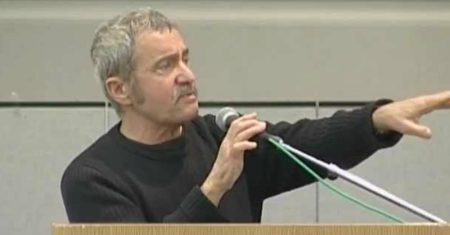
In honour of Michael Parenti (1933–2026), who passed away on 24 January 2026 at the age of 92. He spent his life naming what power prefers to leave unnamed.
In 1837, Abraham Lincoln remarked: “These capitalists generally act harmoniously, and in concert, to fleece the people.”
Today, he would be dismissed as a conspiracy theorist.
That dismissal—reflexive, automatic, requiring no engagement with evidence—is not a mark of sophistication. It is a tell. The question worth asking is not whether conspiracies exist (they are a matter of public record and a recognised concept in law) but why acknowledging their existence provokes such reliable hostility. What work does the label “conspiracy theorist” actually do?
The late political scientist Michael Parenti spent decades answering that question. His conclusion was blunt: “’Conspiracy’ refers to something more than just illegal acts. It serves as a dismissive label applied to any acknowledgment of ruling-class power, both its legal and illegal operations.” The term functions not as a descriptor but as a weapon—a thought-terminating cliché that protects the powerful from scrutiny by pathologising those who scrutinise them.
Conspiracy denial, in Parenti’s analysis, is not skepticism. It is the opposite of skepticism. It is credulity toward power dressed up as critical thinking. As he wrote in Dirty Truths: “Just because some people have fantasies of conspiracies does not mean all conspiracies are imaginary.” … continue
Blog Roll
Recent Comments
eddieb on WEF Calls for ‘Cultural Revolu… loongtip on Trump wanted to play peacemake… Coronistan on EU member to sue bloc over ‘su… loongtip on Vicious loongtip on EU turns to India for defense… Coronistan on Donald Trump Is No Peace … seversonebcfb985d9 on French court jails pro-Palesti… eddieb on Fourteen Incredible Facts Abou… Bill Francis on European leaders’ shift in the… seversonebcfb985d9 on Villains of Judea: Philip Esfo… loongtip on Report warns that ‘Jewish terr… Craig Nelms on New study shows that toxic gas…


 Aletho News
- G7 Hands Ukraine $40Bln Generated From Frozen Russian Assets
- Conspiracy Denial
- Ukraine expects to join EU next year – Zelensky
- Here’s what’s behind the US shift on EU allies
- UN experts alarmed by prosecution of students protesting ETH Zurich’s Israel-linked research ties
- Exposed – How the UAE Became Central to Gaza’s Concentration Camp Plot
- How South Korea’s gas ambitions sustain the occupation of Gaza
- “Leaked document” exposes US blueprint for total control over Gaza
- Trump wanted to play peacemaker, Netanyahu made sure he failed
- Idea of limited, fast strike on Iran misjudges our capabilities: IRGC
- If Americans Knew
- Israel to seek new security deal from US, official says
- Leaked “Board of Peace” Resolution Outlines U.S.-Led Plan to Rule Over Gaza
- Jonathan Greenblatt Rolls Out Plan to Activate Hispanic Evangelical Golems
- Violence against hundreds of Gazan remains to find one Israeli – Not a ceasefire Day 109
- Greenpeace Demonstrator Exposes Folly of Protest Restrictions
- From CBS to TikTok, Pro-Israel Ellison is now in the driver’s seat
- Israel pays for UK advertisements attacking Doctors Without Borders
- Israel accused of extracting billions from Gazan people to pay for their own genocide
- ‘Deliberate Assassination’: 3 Journalists Among 11 Killed by Israeli Forces in Gaza
- In Gaza, We’re Struggling to Reintroduce Foods to Bodies Adjusted to Starvation
- No Tricks Zone
- New Study Affirms Rising CO2’s Greening Impact Across India – A Region With No Net Warming In 75 Years
- Germany’s Natural Gas Crisis Escalates … One Storage Site Near Empty …Government Silent
- Polar Colding…Antarctica Saw Its Coldest October In 44 Years!
- New Study: Sea Levels Rose 20 Times The Modern Rate During The Roman Warm Period
- As German Gas Storage Dips Dangerously Low…Shortage Hardly Avoidable
- New Study: Brazil’s Relative Sea Level Was 2+ Meters Higher And SSTs 3-4°C Warmer 6000 Years Ago
- Philosopher Schopenhauer: Climate Science Certainty Stems From Stupidity, Ignorance
- New Study: Species Extinction Rates Declining Since 1980 – ‘Climate Change Is Not An Important Threat’
- Denmark Places Climate Protection Above Animal Welfare, Poisoning And Culling Cows
- New Study: Greenland Was 3-7°C Warmer And Far Less Glaciated Than Today 6000-8000 Years Ago
 Aletho News