Lebanon: Who Is Behind the Attacks on Hezbollah?
By Ibrahim al-Amin | Al-Akhbar | August 5, 2013
For 25 years now, Hezbollah has been engaged in a war with many powerful intelligence outfits from around the world. These intelligence agencies have devoted tremendous resources to collect information on the party, in addition to pursuing both its civilian and military activities, not to mention carrying out assassinations against its cadre and leadership.
Israel has played a key role in these efforts, but it is hardly alone. After the assassination of Rafik Hariri in 2005, Hezbollah was subjected to the most ferocious campaign against it, with former US ambassador to Lebanon Jeffrey Feltman admitting before Congress that Washington spent $500 million to undermine the party’s image.
After the outbreak of the Syrian uprising and Hezbollah’s open declaration of its involvement in the country’s fighting, the campaign intensified, with mounting threats to the party and its supporters that they may be subjected to revenge attacks.
First, the Resistance’s Dahiyeh stronghold was shelled with rockets. Similar attacks followed on many towns and villages in Baalbeck and Hermel. These were followed by roadside bombs targeting Hezbollah members on the main Lebanese highway to Syria, culminating in the massive Bir al-Abed blast in the heart of Dahiyeh.
Hezbollah is in a state of high alert due to the fact that it has been forced to fight simultaneously on two fronts. This has prompted Secretary General Hassan Nasrallah to tell the party’s cadre that they must be prepared for attacks that may involve both Syrian and Lebanese groups, without dropping their guard against their main enemy – Israel.
On the eve of Hezbollah’s engagement in the battle of Qusayr, it initiated a plan that involved:
– a series of practical steps to prevent the killing of Lebanese civilians held by the Syrian opposition in the north of the country;
– securing areas that may become targets of reprisals, including the border areas, Beirut, and South Lebanon.
The question today is: Who thought up an adventure of this kind against the Resistance? I wonder whether they thought about the party’s reaction.
Who are these people? Are they groups within the Free Syrian Army or the Salafi al-Nusra Front? Are they jihadi elements in Lebanon active in the North and Bekaa? Could they be Palestinians who have abandoned their cause to work as agents serving another agenda?
Who is helping them inside Lebanon? What are the Internal Security Forces (who take orders from the Future Party) doing about it? They seem to care little about people’s safety and are mainly concerned with collecting information on the Resistance.
In any case, Hezbollah has surprised friend and foe on more than one occasion in their intelligence capabilities. So, will the Resistance surprise us again by revealing who is behind these attacks?
Related article
Key Israel lobby senator calls for US military strikes on Syria
Press TV – July 11, 2013
A prominent U.S. senator has called on the administration of President Barack Obama to attack Syrian “airfields, airplanes and massed artillery.”
The influential chairman of the Senate Armed Services Committee, Carl Levin (D-Mich.) who has returned from a fact-finding trip to the Middle East, also expressed support for arming the militant groups fighting against the government of President Bashar al-Assad.
“Increased military pressure on Assad is the only way to achieve a negotiated settlement in Syria, which in turn is needed to restore stability to a region that certainly doesn’t need any more instability,” Levin said Wednesday during a speech at the Carnegie Endowment for International Peace.
Levin conceded that the U.S. public opposes an increased involvement in the Syrian conflict and that there is “no consensus” on the issue on Capitol Hill.
Senator Levin and Senator Angus King (I-Maine) spent five days in Jordan and Turkey, talking to government officials as well as U.S. diplomatic and military personnel about the conflict in Syria.
The two senators also met with militant leaders including Salim Idriss, the leader of the so-called Free Syrian Army (FSA), and visited refugee camps along the Syrian border.
In a joint statement on Tuesday, Levin and King said the U.S. and its allies should arm and train the militants and consider “options for limited, targeted strikes at airplanes, helicopters, missiles, tanks and artillery.”
However they said they were not calling for American troops on the ground in Syria.
The senators noted that “doing nothing may be the worst option of all,” potentially destabilizing U.S. allies in the region, including Turkey and Jordan, and threatening Israeli interests.
In a letter last month, Sen. Levin, Sen. John McCain, a Republican from Arizona and Democratic Sen. Robert Menendez of New Jersey called on President Obama to take “more decisive military actions” against Syria.
A recent opinion poll conducted by the Pew Research Center shows that the majority of Americans, 70 percent, are against U.S. involvement in Syria’s unrest.
Inquiry on Aleppo chemical attack met int’l standards, unlike West’s – Lavrov
RT | July 10, 2013
Russia’s inquiry into the use of chemical weapons on Syrian territory was carried out in full accordance with international standards, unlike a similar evaluation by Western countries, says Russian Foreign Minister Sergey Lavrov.
On Tuesday, Russia submitted to the UN its analysis of the samples taken at the Syrian town where chemical weapons were used. Evidence studied by Russian scientists indicates that a projectile carrying the deadly nerve agent sarin was most likely fired at Khan al-Assal, west of Aleppo, by rebels, rather than government forces.
Russia “guarantees” the quality of the analysis, which fully complies with the requirements set by the Organization for the Prohibition of Chemical Weapons (OPCW), Sergey Lavrov told a media conference on Wednesday, following talks with his Belarusian counterpart.
In response to US doubts regarding the results of the analysis, Lavrov underlined that the samples of the chemical weapons had been taken at the very place where they were used and were delivered by Russian experts rather than passed through third-party hands.
“We submitted a full set of documents [to the UN]. That’s over 80 pages, including photographs and precise geographic coordinates [of places where samples were taken], procedures and results,” Lavrov pointed out. “We also guarantee that the samples were taken by experts who did not let go of them till they were delivered to the laboratory,” Lavrov said.
The evidence of the alleged use of chemical weapons by the Syrian regime – which was provided by the US, Britain and France – does not provide information on where and when the samples they used for analysis were taken, Lavrov noted.
Besides that, their samples passed through many hands and some of them, as those Western partners said, were received from journalists, he observed.
“All that totally contradicts the standards existing in the OPCW,” Lavrov stated.
Evidence studied by Russian experts indicates that on March 19 the rebels fired an unguided missile Bashair-3 at the northern Syrian town of Khan al-Assal, outside Aleppo, which has been under government control. According to the findings, the shell used in Khan al-Assal was not factory-made and contained sarin – a highly toxic nerve agent.
Russia believes that the manufacture of the ‘Bashair-3’ warheads started in February, and is the work of Bashair al-Nasr, a brigade with close ties to the Free Syrian Army.
Moscow has no objection to making the results of its probe public, Lavrov pointed out.
“[The conclusions of the inquiry] are quite convincing and I think that this should answer many questions,” he said.
Meanwhile, the opposition Syrian National Coalition denied Russian allegations that rebel forces used chemical weapon at the suburb of Aleppo. They insist that UN inspectors should be allowed to investigate the attack.
British Labour MP Jeremy Corbyn told RT that “it’s got to be a good thing that Russia is going to put its evidence in front of the UN.”
Responding to comments from the US, Britain, and France that they have unconfirmed reports that the Syrian regime used chemical weapons, Corbyn said “the reports are either confirmed and the evidence is there, or it’s not, and anyone who has any evidence should hand it straight over to the UN.”
“The usage of chemical weapons is inconsistent with the guiding principles and goals of the Syrian revolution,” Khalid Saleh, a spokesman for the coalition said on Wednesday, as cited by Reuters. “Targeting civilians indiscriminately to achieve political gains is a common characteristic of the Assad regime,” he added.
The Syrian government and rebels have blamed each other for the March incident outside Aleppo that killed 26 people as well as for other alleged chemical attacks in the conflict-torn country.
On Monday, the Syrian government invited two senior UN officials to Damascus to discuss allegations of the use of chemical weapons, adding that they discovered a rebels-linked storage site which contained piles of dangerous chemicals.
The UN Secretary General’s spokesperson described the offer as “a move in the right direction,” but did not say whether the organization would accept it. Martin Nesirky said the Syrian government needed to grant the UN team broad access across the country “without further delay and without conditions.”
Catholic Online Muddles Story of Priest’s Beheading
By Richard Edmondson | War and Politics | June 29, 2013

Father Francois Murad was beheaded by US-backed rebels in Syria
Catholic Online today posted a story—if you could call it that—about the beheading of Father Francois Murad by rebels in Syria. Relying on a press release from the Vatican, the article refers to Murad, accurately, as a “martyr,” but makes no mention of the fact that the US is funding Syrian rebels. In fact, the issue of who is backing the rebels is not even addressed in the story. Nor is there any mention of the fact that under the secular government of President Bashar Assad, the Christian community in Syria has prospered and enjoyed freedom of worship. I can only conclude it’s either a shoddy piece of journalism or a deliberate attempt to obfuscate. Below is the full story. I’ll have some additional information to follow.
Warning Graphic Video—Syrian Jihadists Behead Catholic Priest
By Catholic Online (News Consortium)Jihadists are Terrorizing Syrians and Persecuting Christians
Syrian terrorists have beheaded a Catholic priest who they accused of collaborating with the Assad regime. Those accusations have not yet been verified. Father Francois was summarily executed and the Vatican has confirmed the martyrdom.VATICAN CITY (Catholic Online) – The Vatican is confirming the death by beheading of Franciscan Father, Francois Murad, who was martyred by Syrian jihadists on June 23.
Below is the news release from the Vatican, via news.va.
On Sunday, June 23 the Syrian priest François Murad was killed in Gassanieh, in northern Syria, in the convent of the Custody of the Holy Land where he had taken refuge. This is confirmed by a statement of the Custos of the Holy Land sent to Fides Agency. The circumstances of the death are not fully understood. According to local sources, the monastery where Fr. Murad was staying was attacked by militants linked to the jihadi group Jabhat al-Nusra.
Father François, 49, had taken the first steps in the religious life with the Franciscan Friars of the Custody of the Holy Land, and with them he continued to share close bonds of spiritual friendship. After being ordained a priest he had started the construction of a coenobitic monastery dedicated to St. Simon Stylites in the village of Gassanieh.After the start of the Civil War, the monastery of St. Simon had been bombed and Fr. Murad had moved to the convent of the Custody for safety reasons and to give support to the remaining few, along with another religious and nuns of the Rosary.
“Let us pray,” writes the Custos of the Holy Land Pierbattista Pizzaballa OFM ” so that this absurd and shameful war ends soon and that the people of Syria can go back to living a normal life.” Archbishop Jacques Behnan Hindo, titular of the Syrian Catholic archeparchy in Hassaké-Nisibis reports to Fides: “The whole story of Christians in the Middle East is marked and made fruitful by the blood of the martyrs of many persecutions. Lately, father Murad sent me some messages that clearly showed how conscious he was of living in a dangerous situation, and offered his life for peace in Syria and around the world.”
**
This should make it clear to Christians around the world what jihadists are about. Make no mistake. Catholics and Christians around the globe are under dire threat, particularly from the spread of militant Islam. Until the threat is recognized and taken seriously, martyrdoms like this will continue.
We have a link to video provided via LiveLeak. We must warn you, the video is extremely graphic. We believe the first victim is Father Francois, and the second victim that is depicted is another person said to be a collaborator with the Assad regime.
The video CLEARLY depicts the beheadings of these victims. DO NOT follow the link unless you are over the age of 18, and are prepared to view content of this nature.
Catholic Online believes it is very important the world knows that Christians are being murdered for their faith, and that martyrdom isn’t an ancient phenomenon.
You’ll notice also there is no mention in the above story about US and Israeli interests dovetailing in Syria, or that Israel is pushing for regime change in Syria as well. Why does the Catholic Online omit this information? The prayer by Pizzaballa, the custos of the Holy Land, is a bit ironic as well, is it not? “Let us pray so that this absurd and shameful war ends soon and that the people of Syria can go back to living a normal life.” With Obama intent on arming the rebels, the war, absent direct intervention from God, is not likely to end anytime soon. While the article does refer to al-Nusra, it fails to mention that the latter is linked to the Free Syrian Army or that the FSA is being backed by the US.
At least one mainstream media outlet has now also reported on the beheadings—the Unification Church-owned Washington Times. And you know something? Their report is considerably better than Catholic Online’s. It at least includes the information that many of the insurgent forces in Syria “are supported by the West” (support from Saudi Arabia, Qatar, and Turkey is also mentioned), and that the beheading of the two men “comes about the same time America has started sending arms to rebel fighters.”
And yes, according to a report here, the Obama administration has indeed begun shipping its promised arms to the rebels.
Even the Japanese media are doing a better job than Catholic Online reporting on Father Murad’s death. “The Franciscan Father, Francois Murad, was killed by Takfiri Muslim fanatics belonging to either al-Nusra—or another fanatical terrorist group which takes pleasure in barbarity,” write Murad Makhmudov and Lee Jay Walker in an op-ed piece for Modern Tokyo Times.
The article goes on to cite other atrocities committed, and makes clear who is directly responsible:
In other sickening videos taken by al-Qaeda affiliated factions and FSA terrorist groups they show Muslims being beheaded, women being shot and thrown down holes and now they are taunting the families of captured soldiers by phoning them before beheading their sons. This barbaric reality which is glossed over by major Western and Gulf media agencies highlights the utter disgrace of the Obama government in America, the government in France under Hollande and the same applies to the United Kingdom under Cameron.
So why do we have a Catholic media organ doing such a poor job reporting on the atrocious murder of a priest? Why do we have a pope intent on pandering to Jewish favor? These are questions worth considering.
The following article from the website Syria Report features some revealing information, including a quote from Pizzaballa that didn’t make it into the Catholic Online article for some reason.
Catholic Priest Executed as Foreign Arms Flood into Syria
On Sunday, June 23, Syrian Catholic priest François Murad was murdered in the locality of Gassanieh, northern Syria, according to a statement from the Custody of the Holy Land sent to the Fides Agency.
Murad (49), having led a religious life and studied in Palestine, was ordained a priest and set about building a monastery in Gassanieh, Idlib.
Murad was targeted by armed militants, while he was residing at the monastery, which was dedicated to Saint Simon Stylite.
Citing the head of all Franciscans in the Holy Land, Pierbattista Pizzaballa, the Vatican News Agency said that Father Murad recently chose a monastic way of life and resorted to the monastery, with Franciscan Friars, a few weeks earlier.
“The world must know that the support of gunmen by the west is helping extremists in killing Syrians”, Pizzaballa said, adding that, “with such stances, not a single Christian will remain in the East.”
According to local sources, the monastery was raided by gunmen, who proceeded to execute François Murad, loot and burn the building. Four-thousand people are reported to have since fled the area.
Christians in Syria are being increasing targeted by sectarian armed groups in Syria, of which there are between several hundred and over a thousand.
In May, a Christian village located in Homs countryside, was overrun by armed men and it’s entire population massacred.
Two Christian bishops who were kidnapped by Chechen gunmen in Aleppo earlier this year, are still missing.
In April, the remaining Christians in Deir el-Zour fled, the church having being blown up by militants. Last week, militants massacred dozens of villagers in the province’s town of Hatla. Since then, summary executions and sectarian house-to-house raids have taken place.
Sectarian bloodshed has increased following the Syrian army’s securing of the strategic Homs city of al-Qusayr earlier this month. Despite the overt sectarianism of armed groups in Syria, America and it’s allies have pledged to continue the transfer of weapons in an effort to turn the tide of the conflict. Advanced weapons have since been spotted in the hands of extremists militants.

Finally, here is the link to the video of the beheading, if you haven’t seen it yet. WARNING: it is extremely graphic. The video is a bit over nine and a half minutes. Go here to view.
Qatar seeks to send Yemen’s military elite to fight alongside the Free Syrian Army
Yemen Post | May 27, 2013
Qatar which has been a staunch supporter of the Free Syrian Army against President Bashar al-Assad in Syria is now looking to enroll Yemen’s military elite to fight alongside other Arab-backed militias in a bid to offset Assad’s recent advances against the opposition.
Yemen Republican Guards, Yemen’s best of the best, the very units which were meant to ward off former President Ali Abdullah Saleh’s foes are now being bid for by foreign powers in a regional effort to depose Syria’s regime.
Faced with the very possibility that Assad could after all outrun his enemies, strong of the support of Iran and the Hezbollah and restore his hold over the country, the Free Syrian Army has turned to his sponsors for support, awaiting more troops and more weapons.
While regional powers have committed money and military equipment, as well as allowed volunteers to cross over onto Syria to swell the resistance ranks, none has so far agreed to commit men to the conflict, a move which would equate to a declaration of war against the Syrian regime.
Qatar is now looking to by-pass the hurdle by sending Yemen Republican Guards to the front. Of course the men would go in their civilian capacity, hired as mercenaries by the State of Qatar.
According to local newspapers, Qatar would be looking to enroll 10,000 soldiers.
Military officials have warned that such a move would leave Yemen vulnerable, its defenses weakened.
What an Anonymous U.S. Official Says About Iranians in Syria
By Peter Hart | FAIR | May 22, 2013
The Washington Post’s Anne Gearan reports today (5/22/13) that Iran is in the thick of the Syria war, according to an anonymous U.S. official:
Iran has sent soldiers to Syria to fight alongside forces loyal to President Bashar al-Assad and those of the Lebanon-based Hezbollah militia, a senior State Department official said Tuesday.
An unknown number of Iranians are fighting in Syria, the official said, citing accounts from members of the opposition Free Syrian Army, which is backed by the United States. The official spoke on the condition of anonymity to preview a strategy session that Secretary of State John F. Kerry is to hold Wednesday with key supporters of the Syrian opposition.
The rationale for granting anonymity–a privilege that outlets are supposed to extend only rarely–is curious; it’s not clear why the government would need to say things anonymously in order “to preview a strategy session” about Syria.
Even more curious, though, is whether or not the source in question actually said this. At EA Worldview (5/22/13), Scott Lucas took a look at the briefing that produced the story, and what the State Department official actually said was this:
It is the most visible effort we have seen of Hezbollah to engage directly in the fighting in Syria as a foreign force. We understand there are also Iranians up there. That is what the Free Syrian Army commanders are telling us. I think this is an important thing to note, the direct implication of foreigners fighting on Syrian soil now for the regime.
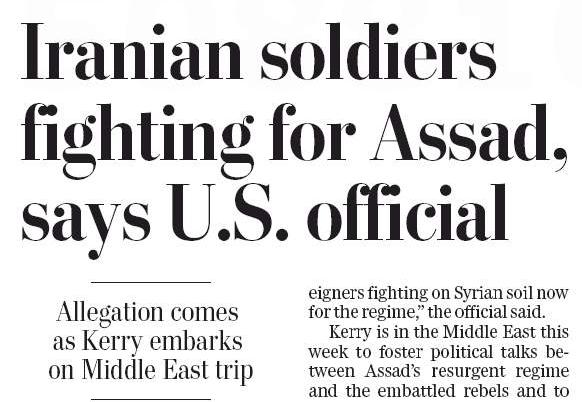 Suggesting that the Free Syrian Army believes Iranians are in Syria–which is probably true–is not the same thing as saying “Iran has sent soldiers to Syria” to fight on Assad’s behalf. And in answering followup questions, the anonymous State Department official admits that “to be very frank, I don’t have any estimates of numbers and I don’t know that they are directly involved in the fighting.” The source also says the Iranians “could be doing a little of both advising and fighting” and that “the reports that we’re getting… are not consistent.”
But Gearan’s question at the briefing would strongly suggest that she was pushing a stronger line about Iranian involvement than the anonymous source:
Are we now, based on your earlier comments about Iranian fighters being involved, looking at a proxy war? I mean, you’re talking about arming the rebels on one side, and the Iranians are clearly arming the others and fighting on behalf of the others on the other side. Are we now basically in a war with Iran?
The source doesn’t go as far out on this issue as Gearan’s question was pushing. But it didn’t really matter. As you can see in the pages of the Washington Post, an official Iranian role in the fighting was treated almost like a fact–which might be the point of having anonymous briefings like this.
Iran dismisses claims about military presence in Syria
Press TV – May 24, 2013
An Iranian deputy foreign minister has rejected claims about Tehran’s military presence in Syria, dismissing the allegations as a “blame game” orchestrated by the Syrian opposition groups.
“Iranian forces have never been, and are not present in Syria, and I deny this claim,” Iranian Deputy Foreign Minister for Asia-Pacific Affairs Abbas Araqchi said in Ankara on Thursday.
“The real enemies of Syria make such claims to provoke that country’s people [against Iran] and divert developments [in Syria] in the wrong direction,” said Araqchi, who is also Iran’s Foreign Ministry spokesman.
He emphasized that the crisis in Syria cannot be resolved through military means, adding that the unrest in the Arab country should be resolved politically. … Full article
Israel spy agency has presence in Syria, says senior rebel general
By Joseph Fitsanakis | intelNews | April 25, 2013
Israel is one of several countries that maintain a significant intelligence presence inside Syria, according to the top commander of the Syrian rebel forces.
General Salim Idriss, Chief of Staff for the Free Syrian Army, told CNN’s Christiane Amanpour that the Jewish state has “many, many” intelligence officers in various parts of Syria. The Arab country has been rocked since 2011 by a violent civil war, which has cost the lives of at least 60,000 people.
Idriss was responding to comments made earlier this week by Brigadier General Itai Brun, senior intelligence analyst for the Israel Defense Forces (IDF). Brun, who heads the Division for Research and Analysis of the IDF’s Military Intelligence Directorate, was speaking at a conference hosted in Tel Aviv, Israel, by the Institute for National Security Studies. He told an audience of intelligence experts that the IDF was “quite certain” that the Syrian government headed by President Bashar al-Assad had resorted to the use of chemical weapons against rebel forces on at least one instance.
According to Brun, footage obtained by the IDF of rebel casualties from a March 19 attack by Syrian government forces, pointed to the use of sarin nerve gas. He referred to evidence such as the victims’ dilated pupils and “the foam coming out of their mouths” as strong proof of the use of weaponized sarin nerve gas in the battlefield.
Responding to Brun’s allegations, General Idriss suggested that Syrian government forces had used chemical weapons repeatedly in a variety of locations, including Aleppo, Homs, and the outskirts of capital Damascus. He added that rebel forces had collected “some samples of soil and blood” and surrendered it to outside “observers” of the civil war —though he refused to identify these observers. After some pressure from Amanpour, Idriss said it made sense for the IDF to know that sarin nerve gas had been used by the Syrian government, since Israel was one of several countries that had “many, many” intelligence officers inside Syria. Asked by Amanpour whether he was referring to Israeli covert-action agency Mossad, Idriss responded “yes”.
In response to Brun’s comments, White House Press Secretary Jay Carney told reporters on Tuesday that Washington was “looking for conclusive evidence, if it exists, if there was use of chemical weapons”.
Syria Opposition in Disarray: Khatib Resigns, Hitto not accepted
Al-Manar | March 25, 2013
Syrian opposition is facing turmoil as the head of the opposition coalition Moaz al-Khatib resigned on Sunday and the so-called “Free Syrian Army” rejected the group’s appointment of an interim prime minister.
“I announce my resignation from the National Coalition, so that I can work with a freedom that cannot possibly be had in an official institution,” Khatib said in a statement published on Sunday on his Facebook page.
He had also objected to last week’s coalition appointment of American-educated businessman Ghassan Hitto as an interim prime minister for the areas controlled by the armed groups.
Shortly after Khatib announced his resignation, the so-called “Free Syrian Army” refused to recognize Hitto as prime minister, spokesman Louay al-Mekdad said.
Al-Mekdad told Western news agencies that Hitto was not properly elected because there was no consensus on his candidacy.
Other rebels have said they do not need a prime minister because they already are governing areas under their control. These moves left the US-backed efforts to forge a united front against the Syrian opposition in tatters.
“The coalition is on verge of disintegrating,” Amr al-Azm, a history professor at Shawnee State University in Ohio said.
There seems to be little doubt that an initiative launched last fall in the Qatari capital, Doha, to create an inclusive and representative opposition body is falling apart, added Azm.
Captive Ukrainian journalist escapes Syrian rebels
RT | March 11, 2013
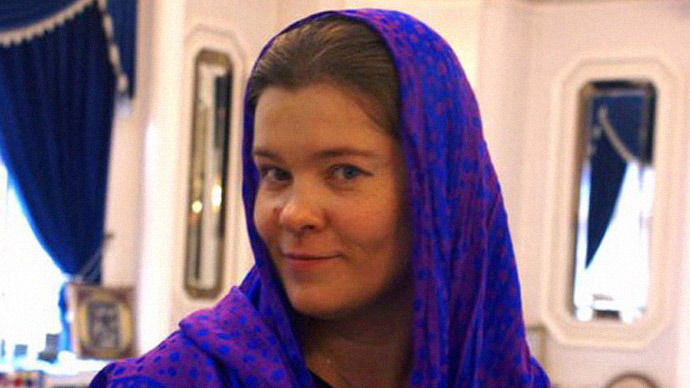 After five months of captivity in fear of execution, Ukrainian journalist Anhar Kochneva has safely escaped from Syrian rebels, Kochneva’s ex-husband told RT.
Relatives and friends of the journalist said Kochneva managed to escape the building she was kept in, and hid from the pursuers in the mountains. She then had to walk about 15km before reaching Syrian army forces, and is now travelling to Damascus in safety.
Kochneva ironically wrote she’s “back from the Wonderland” in a short LiveJournal post, promising some further details later.
She also confirmed the details of her escape in two brief media interviews, saying the captors mistreated her, and she decided to run away for the fear that they would kill her and blame government forces for another death. Kochneva said she had to live in a cold room with a broken window, leaving her health in a terrible state.
Despite this, the journalist vowed to remain in Syria and continue to highlight the ongoing conflict.
“The world is just blind… I will definitely do everything for the people to discover, what is really going on here,” Kochneva told Business FM, saying Syria is “a friend in need”.
Anhar Kochneva, who had reported critically about the Syrian rebels for Russian and Ukrainian news outlets, was captured in the beginning of October 2012 near the city of Homs. The city, seen as the cradle of the Syrian revolution, has recently been going through frequent fighting outbursts, which Kochneva was following at the time of her capture.
The kidnappers, members of the Free Syrian Army, had repeatedly threatened to kill the journalist in December, if a US$50 million ransom was not paid. They later lowered the sum to reportedly $300,000, and announced they had “spared” Kochneva for the time being.
Kochneva’s relatives said they had been unaware of her fate since New Year, and accused the Ukrainian Foreign Ministry of being “inactive” and “ignoring the negotiation process.”
Syrian rebels, who had been in contact with the journalist’s former husband, also claimed that Ukrainian authorities were doing nothing. The rebels uploaded several videos of Kochneva last year, in which she admitted to having participated in the fighting, and of working as a military interpreter with Syrian and Russian officers.
International groups like the Committee to Protect Journalists, ARTICLE 19, the International Press Institute and Reporters Without Borders have questioned the objectivity of these videos, saying the journalist appeared to be speaking under pressure.
The groups urged the Free Syrian Army and the Syrian Opposition Coalition to ensure that the journalist is safe and set free, and called for world governments to assist in her release.
The Foreign Ministry of Ukraine has said that it was taking all necessary measures to free the journalist and urged Damascus for “concrete results” in attempts to release her.
The ministry has confirmed on Monday that Kochneva is free, without elaborating on the circumstances of her escape.
Lebanese pilgrims kidnapped in Syria: The untold story
By Nadezhda Kevorkova | RT | December 21, 2012
A group of Syrian rebels have been holding Lebanese civilians hostage for nearly seven months. The kidnappers keep issuing new demands, claiming they have captured “subversives from the Lebanese Hezbollah party.”
The hostages’ relatives deny the charges, saying those captured are elderly and poor, have families and are generally apolitical. They also expressed frustration at how Western mass-media has only aired the kidnappers’ side of the story.
During this seven-month period, the hostages were allegedly ‘killed by Assad’s bombs,’ but then miraculously ‘rose from the dead.’ The conditions of their release have been continually changing: First, the kidnappers turned down a $50 million ransom; they then demanded the families demonstrate against Hezbollah, and asked Hezbollah chief Sayyid Hassan Nasrallah to apologize to the Syrian people; finally, they suggested bartering their hostages for an Al-Qaeda leader.
But at the heart of this cloak-and-dagger saga are clues to how the Syrian captors managed to demand a ransom of $50 million after proclaiming Ankhar Kochneva, a Ukrainian-Russian journalist of Palestinian descent, to be a spy for three different countries simultaneously.
A bargain bus tour hijacked
On May 22, 2012, a group of Lebanese pilgrims on a bus were returning to Beirut from Mashhad, a city in northeastern Iran. Syria was relatively peaceful at the time. Some of the passengers were accompanied by their wives and daughters; one young man was chaperoning his elderly aunt.
In Aleppo province, their bus was stopped by a group of Syrian rebels who then abducted the passengers, claiming they were Hezbollah subversives who had illegally crossed the Syrian border.
The following passengers of the bus remain in captivity:
Ali Skheb, 63: Physically impaired, suffers from heart failure.
Jamil Saleh, 65: Spent the last 30 years working for Saad Hariri, known to be a major supporter of the Syrian rebels. Suffers from epilepsy and is prone to fainting fits. Recently underwent surgery for a spinal disc herniation.
Ali Abbas, 30: Owner of a hookah shop, who supports both himself and his younger brother. The brothers are parentless as well as homeless, and use their shop as living quarters. Ali suffers from epilepsy.
Hassan Arzune, 56: A street vendor who peddles sweets for Ramadan and owns a shop with a floor area of 1.5 sq. meters.
Hassan Hammud, 45: Painter and floor waxer, the proud owner of an antique stone-floor polisher that consists of an iron frame and a water tank. The kidnappers believe Hassan to be a specially trained sabotage and demolitions expert.
Muhammad Monzer, 22: Gas station attendant who borrowed money for the trip in order to accompany an elderly aunt, who dreamed of taking a pilgrimage.
Abbas Shuyab, 41: Pilgrimage broker who organizes bus tours to Iraq and Iran.
Abbas Hammod, 60: Retired Lebanese Army soldier, suffers from neurological disorders.
Ali Termos, 50: Works as a salesman in a small grocery shop.
It is possible the Syrian opposition is unable to distinguish either insurgents or rank-and-file Hezbollah party activists just from their outward appearances. However, few in Lebanon believes that the hostages are members of Hezbollah.
The kidnappers did their best to comply with the rules of Islam: They immediately released all the women – including wives, daughters and the aunt – and allowed those abducted to pray and fast freely.
The captors went as far as agreeing to a meeting between the hostages and two of their family members, who were allowed to make a video on how well the kidnappers were treating the abductees. In the footage, they were shown to be wearing casual clothes and sitting on sofas in broad daylight. They even released two hostages who appeared to be in bad health.
During the first month they ate canned tuna, boiled eggs on the second and chickpeas on the third. Later, their diet slightly improved.
The remaining captives are now confined a room with no windows.
Towards the end of Ramadan, online sources reported that Oqab Saqr, a Lebanese MP from the Hariri bloc, had allegedly received $50 million from Saudi Arabia to pay as ransom for the hostages. Mona Termos, the wife of one of the prisoners, went to the Saudi embassy to find out if the rumors were true.
“On that very day Abbas Nasr, an Al Jazeera correspondent, called me only to yell that I was to blame for disrupting a mission to release the prisoners,” Termos said. “Later, he came and said that I must go live on air to disprove that news. But I said it is up to the ambassador to do it.”
Three days later, the events took a new turn: “We were told that the location had been bombed, leaving four people dead, including my husband! Then the Lebanese Foreign Ministry started an inquiry, and the families took to the streets – and that’s when that information was refuted. Did they rise from the dead?” she said.
And two days after that, the kidnappers’ leader Abu Ibrahim confirmed to NewTV channel that he had been offered the $50 million. “Yes, they did offer $50 million but I refused to take it. It is a matter of principle rather than money,” NewTV quoted him as saying.
Ibrahim now communicates regularly with the media, which interviews him through Skype and the telephone, and even dispatches film crews from New York to record his statements.
Ibrahim’s first demand was for the release of the Lebanese hostages in exchange for Hussein Harmoush, an army defector and one of the founders of the rebel Free Syrian Army. He then demanded that Hezbollah chief Nasrallah apologize to the Syrian people and publicly support the rebels. Currently, there is no evidence suggesting that the pilgrims are connected to Hezbollah.
Ibrahim then called on the families to rally against Hezbollah in front of Beirut’s Syrian and Iranian embassies. The families fulfilled the demand, rallying at the embassies and writing letters to ambassadors. The Iranian embassy’s workers told them that 48 Iranian pilgrims were being held in a similar situation: They were abducted by Syrian rebels under the pretext that they were members of the Islamic Revolutionary Guards corps.
Nasrallah then addressed Lebanon, expressing support for the Syrian people and asking them to demonstrate what shape that support should take.
Those kidnapped are occasionally allowed to call their families with a cell phone that has a Turkish number. Those who were freed from captivity and their visitors claim that the building where hostages are held is within sight of the Turkish border.
“The Turkish authorities could’ve easily found them. But they insist that they’ve no idea where the hostages are held. How do journalists find them then? They all get there across the Turkish border,” the relatives said.
A week ago, Ibrahim made a new demand to the relatives, asking them to rally to free both Hussein Harmoush and Syrian opposition member Tal al-Mallohi.
The families of the hostages expressed frustration at Ibrahim’s apparent hypocrisy in his attempts to free political prisoners. “Nobody should be imprisoned for his or her views, the more so women. Abu Ibrahim, you are committing the same deeds you say yourself you are against! How can I trust the Syrian revolution if you deprive innocent people of their freedom?” the pilgrims’ wives said. Western media have yet to report on their remarks.
NYT journalists traveled to Syria to investigate the hostage-taking and managed to make their way to Ibrahim, but did not contact the captives’ wives and daughters in Beirut. One of the journalists did eventually call the family of the hostages – not to interview them, but to inform them about a video published on the newspaper’s website containing new conditions for the hostages’ release. The relatives were told that the captors are now demanding that 200 political prisoners, including an Al-Qaeda leader from Jordan, be released from Lebanon’s prisons.
“Through a US newspaper they are demanding a release of an Al-Qaeda leader? And to release political prisoners in the Lebanon? But there are none in Lebanon!” the hostages’ family members said. “We are free to say whatever we want, and nobody will pay any attention to that. There are criminals, drug dealers, but no political prisoners. Everybody knows that.”
Abu Ibrahim has promised to clarify the demands, and to fax the names of the two prisoners that will be transferred to Lebanese authorities.
That message has yet to arrive.
Syrian rebels set to execute Ukrainian journalist
RT | December 13, 2012
NGOs are urging Syrian rebels to release a Ukrainian journalist, Anhar Kochneva, who is set to be executed Thursday. Meanwhile the group behind the kidnapping warned it would now target all Russians, Ukrainians and Iranians on Syrian soil.
The Committee to Protect Journalists (CPJ), ARTICLE 19, the International Press Institute and Reporters Without Borders issued a joint statement expressing deep concern about Kochneva’s life and urging the leadership of the Free Syrian Army and of the Syrian Opposition Coalition to ensure that the journalist is safe and set free.
The groups also called on the French, British and US governments, as well as the European Union to work with the Syrian opposition to facilitate her release.
Kochneva, who has reported critically about the Syrian rebels for Russian and Ukrainian news outlets, was captured in the beginning of October near the restive city of Homs. The kidnappers, allegedly members of the Free Syrian Army, threatened to kill her on December 13 if a US$ 50 million ransom is not paid.
On Tuesday, Ukrainian authorities urged Damascus to work more actively to help free the journalist. The Ukrainian Foreign Ministry’s spokesman Aleksandr Dikusarov said that Kiev expects “concrete results” in attempts to release her.
In response to the Ukrainian demands, Kochneva’s kidnappers posted a video in which they threatened to target the embassies of Ukraine, Russia, as well as all Russians, Ukrainians and Iranians in Syria.
“We urge not to let a single Russian, Ukrainian or Iranian alive out of Syria,” the rebels said in the video, aired by Ukrainian news channel Ukraina.
The rebels label Kochneva a spy, claiming that she was carrying arms and worked as an interpreter for the Russian officers.
The Ukrainian Foreign Ministry did not issue comment on the latest video, saying its authenticity cannot be verified, according to Ukraina news channel.
A month after the kidnapping, a video message from Kochneva was published online in which she appealed to the Embassies of Ukraine and Russia, as well as the Syrian government, to meet the demands of the kidnappers.
On the 28 November, in the second video, Kochneva read a text in Arabic admitting to having participated in the fighting, working as a military interpreter with Syrian and Russian officers.
CPJ, ARTICLE 19, the International Press Institute and Reporters Without Borders doubt the objectiveness of these videos. “We are deeply concerned that in both video appeals the journalist seems to be speaking under pressure,” they said in their statement released on Wednesday.
Featured Video
John Mearsheimer: US Already lost Iran war – No off-ramp in sight
or go to
Aletho News Archives – Video-Images
Frlom the Archives
With apparently fabricated nuclear documents, Netanyahu pushed the US towards war with Iran
By Gareth Porter | The Grayzone | April 29, 2020
President Donald Trump scrapped the nuclear deal with Iran and continued to risk war with Iran based on Israeli Prime Minister Benjamin Netanyahu’s claim to have proven definitively that Iran was determined to manufacture nuclear weapons. Netanyahu not only spun Trump but much of the corporate media as well, duping them with the public unveiling of what he claimed was the entire secret Iranian “nuclear archive.”
In early April 2018, Netanyahu briefed Trump privately on the supposed Iranian nuclear archive and secured his promise to leave the Joint Comprehensive Plan of Action (JCPOA). That April 30, Netanyahu took the briefing to the public in a characteristically dramatic live performance in which he claimed Israel’s Mossad intelligence services had stolen Iran’s entire nuclear archive from Tehran. “You may well know that Iran’s leaders repeatedly deny ever pursuing nuclear weapons…” Netanyahu declared. “Well, tonight, I’m here to tell you one thing: Iran lied. Big time.”
However, an investigation of the supposed Iranian nuclear documents by The Grayzone reveals them to be the product of an Israeli disinformation operation that helped trigger the most serious threat of war since the conflict with Iran began nearly four decades ago. This investigation found multiple indications that the story of Mossad’s heist of 50,000 pages of secret nuclear files from Tehran was very likely an elaborate fiction and that the documents were fabricated by the Mossad itself. … continue
Blog Roll
 Aletho News
- ‘We’ve Obliterated Their Missiles’
- Syrian president vows ‘absolute support’ to disarm Hezbollah
- Ukraine attacking Russian gas pipeline to stop deliveries to Europe – Defense Ministry
- ‘Heinous crime’: Iran denounces Israeli assassination of 4 Iranian diplomats in Lebanon
- John Mearsheimer: U.S. Already Lost Iran War – No Off-Ramp in Sight
- UK Parliament Plans ISP Blocking and Age Verification Powers
- World cannot remain silent as US and Israel attack ‘heritage of humankind’: Iran
- Emirati billionaire rebukes US senator over call for Gulf states to join war with Iran
- Op. True Promise 4: Iran’s missile blitzkrieg dismantles US war machine in West Asia
- Aramco CEO warns ‘catastrophe’ imminent if Strait of Hormuz remains shut
- If Americans Knew
- 97% of victims of war on Iran are Iranian, 98% of victims in war on Gaza are Gazans – Not a ceasefire Day 152
- Early Iran strikes cost $5.6 billion in munitions, Pentagon estimates
- Israel Decided the War, But Trump’s America Fights and Pays the Bill
- Conscientious Objector Group: Phone ‘Ringing Off Hook’ As Huge Mobilization Underway
- U.S. support for Israel continues to plummet, despite media’s best efforts
- Threats and missiles fly, death tolls soar in Iran, Lebanon, Gaza – Not a ceasefire Day 151
- Lebanon: Israel’s White Phosphorous Use Risks Civilian Harm
- Corporate Media Go All Out To Support The US-Israeli War On Iran
- US-Israel war on Iran is creating a steady growing number of amputees
- Israel planned this war on Iran for 40 years. Everything else is a smoke screen
- No Tricks Zone
- Destructive Green New Deal: German Energy And Metal Group Warns Of Drastic Crisis
- New Study Documents A 20-Year Pause In Arctic Sea Ice Decline – Driven By Internal Variability
- Wake-up Call: Survey Shows Majority Of Germans Now Favor Postponing Climate Targets!
- Televised! Leading German Political Candidate Tells Schoolchildren CO2 Makes Sun Hotter!
- New Study: A Century Warming Of 1.1°C Is ‘Commonplace’ And ‘Not Unusual’ During This Interglacial
- New Study: ‘Internal Noise’ And Volcanic Forcing Can Trigger 10-15°C Warming Within Decades
- Glaciers Worldwide Are Suddendly Surging, Experts Blame Warming!
- Surprising Discovery: Sahara Is Greening…Billions Of Trees Where Once Thought To Be Barren
- New Research Reaffirms Clouds, Aerosols, And Surface Solar Radiation Are ‘Driving The Climate System’
- Germany: Electric Car Catches Fire At Charging Station, Sets Off Local “Inferno”, Widespread Damage
 Aletho News