The GDP myth: What it really shows, and what it doesn’t
The most-often cited metric of economic success more often than not simply tells us what we want to hear – or what the West wants us to hear
By Henry Johnston | RT | November 28, 2025
A few weeks after the Russia-Ukraine war began, Belgian economist Paul De Grauwe penned an article for the website of the London School of Economics with the title ‘Russia cannot win the war’. No military specialist, De Grauwe based his conclusion on some simple math: Russia’s GDP was roughly equivalent to the combined output of Belgium and the Netherlands. Therefore, he claimed, Russia is an “economic dwarf in Europe.” Its military operation was thus doomed.
De Grauwe was hardly alone in dismissing Russia on similar grounds. Who has not heard Russia’s economy compared in GDP terms to some modest European country? Needless to say, the article has not aged well. But the point here isn’t to refute De Grauwe – subsequent events have done that well enough. More interesting is to probe the deeper – and mostly unexamined – roots of this particular mode of thinking.
Really the questions boil down to: does such a reliance on GDP even make any sense anymore? And if not, why have we doggedly stuck with an economic indicator whose stature far exceeds its explanative power (and creates a lot of distortions)?
GDP emerged in the 1930s as a tool for policymakers trying to quantify the national economy during the Great Depression. Credited with formalizing GDP was the Russian-born American mathematician and economist Simon Kuznets.
But he was explicit about its limitations: “the welfare of a nation can scarcely be inferred from a measurement of national income.” And this was back when national income mostly entailed real productivity and not stuff like trading derivatives about the weather.
Around the time of World War II, when economies were mostly industrial and debt levels low, GDP was a decent proxy for capacity. After the war, GDP became entrenched in the grand architecture of the post-war order: Bretton Woods, the IMF, and the triumph of Keynesian macroeconomic theory.
Keynesianism sees the economy as a thermostat problem: if total demand is too low and output falls, the government must raise demand through fiscal spending. Its entire policy program depends on measuring, managing, and stimulating aggregate demand – exactly what GDP claims to quantify. Governments could therefore read the pulse of the economy through GDP, inject stimulus when demand faltered, and withdraw it when inflation loomed.
However, in the 1970s the Keynesian consensus broke down, largely due to the problem of stagflation. This is a combination of high inflation and high unemployment that Keynesian theory couldn’t explain because its models assumed inflation and unemployment moved in opposite directions.
On to the scene came the neoliberalism of the 1980s: Reagan, Thatcher, and the Washington Consensus. Deregulation, privatization, and financial liberalization were sold as growth-enhancing reforms, for which GDP became the proof. If GDP rose, which of course it inevitably did, the reforms were “working.” But this represented a subtle shift. GDP had morphed from a diagnostic instrument into a legitimating symbol of a new set of otherwise dubious-looking policies. To put it more simply, Keynesians used GDP to fine-tune the economy; neoliberals used it to justify their ideology.
By this point, GDP was tracking a lot less productive output and a lot more monetary transactions pumped up by leverage. Yet policymakers, investors, and the media continued to treat it as the authoritative measure of real prosperity. Its symbolic prestige actually increased even as its empirical validity declined. This is a point we will return to.
A quick side note: Many people recognize one of the superficial shortcomings of GDP – its failure to adjust for differences in price levels between countries – and therefore prefer GDP measured in Purchasing Power Parity (PPP) terms. But switching to PPP doesn’t solve the underlying problem, because it leaves untouched the structural distortions within GDP itself: financialization and debt. These are the factors that create the widening gap between real productive output and monetary transactions.
Because GDP treats all spending equally, regardless of whether it comes out of income or borrowing, it cannot distinguish between genuine expansions of productive capacity and debt-fueled transactional churn.
Underlying this is a deeper theoretical fallacy: the modern macroeconomic framework still treats financial intermediation (think Goldman Sachs) as a neutral, efficient allocator of capital, and therefore counts much financial activity as genuine value-added. Let’s say it together with a straight face: investment banking is about efficiently getting capital to the right places in the real economy.
That this assumption persists in today’s hyper-financialized G7 can only be explained by a civilizational-level blind spot. Everyone intuitively understands that flipping a piece of real estate, or repeatedly securitizing the same pool of mortgages, adds to measured GDP without creating any value. These transactions expand balance sheets, not productive capacity, yet GDP tallies them as if a turbine had been manufactured or a bridge built.
But if the standard measure is so vulnerable to distortion, the obvious question is why more effort isn’t devoted to stripping out the debt-driven noise. Yet very few mainstream economists even venture down this path. One man who does is Tim Morgan, a financial analyst who has done important work in exploring the relationship between economic growth and energy. He developed a proprietary metric that he calls C-GDP, which is an estimate of underlying economic output after removing the inflationary effect of debt and credit. Over 2004-2024, Morgan calculates global GDP growth at 96% using the conventional measure, but this falls to just 33% on a C-GDP basis.
This is a fairly radical re-calibration of growth figures that lays bare the fact that much of the recorded growth of recent decades came via credit expansion, asset inflation, and consumption rather than new physical output. Morgan calculates that each dollar of reported growth has been accompanied by an increase of at least $9 of net new financial commitments.
Morgan does not (at least that I am aware of) provide a country breakdown of his C-GDP model, but it is not a stretch to posit that the GDP-inflating effect of debt and financialization is most prominent in the G7.
Finance, insurance, real estate, rental, and leasing combined make up just over 20% of US GDP, while household and federal debt levels are at record highs, and the ratio of financial assets to GDP has exploded since the 1980s. Europe is not fundamentally any different. Stripping out debt-inflated transactions would entail a shrinking of measured GDP for both BRICS and the West. But the extent of shrinkage would differ.
Many will correctly point out that China and parts of the BRICS world are also heavily indebted. However, it bears noticing how the link between credit and real output differs from the Western pattern. Much of the credit in China, for instance, has gone into tangible physical assets – infrastructure, housing, factories, power systems – even if there is certainly some overbuilding and malinvestment.
So even if China’s credit system is overextended, a significant portion of the borrowing has produced physical capital, not just paper claims. China’s system is thus internally leveraged but still anchored in actual real trade surpluses. In the West, meanwhile, credit creation is market-driven and profit-seeking, and also heavily intermediated by private banks and financial markets. Debt expansion primarily supports asset speculation and consumption.
This is the hidden weakness in Western economies. Not just has industrial production been largely outsourced – a phenomenon at least acknowledged – but a significant share of what passes for economic output is simply a mirage. And if we think of debt as a claim on future economic output, does anybody actually believe that future output will be sufficient to make good the huge pile of debt G7 economies are sitting on? Of course not.
All of this should be entirely obvious. And the distortions should be obvious. We know what type of economy GDP was created to measure. We know how the structure of Western economies (in particular) has changed. We know that buying and selling derivatives generates no real economic value. So why do we stubbornly cling to GDP?
This question cannot be answered in economic terms alone. To make sense of it, we must depart from the safe confines of economics and examine the bigger paradigm in which our current economic assumptions are intelligible. This is where we return to the notion of the “symbolic” prestige of GDP.
Policymakers and economists in the 21st century fancy themselves paragons of rationality presiding over technocratic systems. This is an inviolable dogma of our time. In reality, we are just as bound by our era’s unquestioned assumptions as any past civilization. Our economic theories are not neutral, objective, or universal; they are a constructed lens that conveys our particular values and accommodates our particular blind spots. GDP is a prime example of this.
An alien economist observing our current civilization would be baffled by how little attention we pay to the distorting impact of debt on our most sacred metric. Even our most widely used attempt to account for debt, the debt-to-GDP ratio, is inadequate precisely because one side of the equation (GDP) is itself inflated by the very thing being measured. The alien’s conclusion: we make no real distinction between debt-fueled growth and organic, sustainable growth. We must be a civilization with a profoundly short-term outlook.
GDP does still correlate reasonably well with employment, consumption, and tax revenues – variables that matter greatly for fiscal and monetary management but say almost nothing about sustainability or the long-term health of an economy. An influx of debt can drive up all three – and GDP with it – while leaving future generations with an albatross.
Yet our fixation on these immediate indicators is not accidental; it mirrors the deeper essence of modern democratic systems, particularly in the West, where this ethos is found in its most concentrated and potent form. Politicians must survive election cycles by promising quick fixes to the uncomprehending masses, central bankers must stabilize the next quarter, and markets increasingly live from headline to headline. Everything is skewed toward the here and now. This seems so natural to us that it hardly ever occurs to anyone to question it.
Nor does it particularly occur to us that the way we think about the economy is inextricably embedded in a deeper logic. GDP merely tells us what we want to hear – and what is allowed to be told within the prevailing civilizational ethos. Nothing more, nothing less.
Any civilizational ethos is a touch metaphysical, whether it admits it or not. Whereas the Roman Emperor Constantine saw a cross in the sky and believed he heard the words: “by this sign you shall conquer,” the Belgian economist De Grauwe, utterly unaware of his own mystical bent, opened a spreadsheet and said “by these figures Russia will not conquer.”
Henry Johnston is a Moscow-based editor who worked in finance for over a decade.
Iran slams G7’s ‘irresponsible’ statement on ‘necessary response’ to Israel
Press TV – October 3, 2024
Iran has condemned the Group of Seven (G7)’s “biased and irresponsible” approach toward the developments in West Asia, including Tehran’s “necessary response” to Israel’s acts of aggression.
G7 leaders in a statement on Wednesday condemned Tehran’s launch of more than 180 missiles at Tel Aviv in retaliation for Israel’s assassination of Hamas and Hezbollah leaders and an Iranian military commander.
Iran’s Foreign Ministry spokesman Esmail Baqaee on Thursday “pointed to the definite responsibility of G7 countries, especially the US, in aggravating insecurity and instability in West Asia due to their armament, financial and political support of the aggressor”.
He warned about the serious consequences of this approach on the peace and stability of the region and beyond.
“The recent missile operation by the Islamic Republic of Iran against a combination of military-intelligence targets of the Zionist regime was a necessary response to the acts of aggression by the occupying regime,” Baqaee said.
The operation was “within the framework of the inherent right of legitimate self-defense”, the spokesman said, condemning the use of threats and sanctions to put pressure on the Iranian nation.
Baqaee emphasized Iran’s determination to protect the national security and the vital interests of the Iranian people in the region.
He also criticized the “irresponsible interventions of extra-regional actors, including the US, especially through continuing their all-out support for the Israeli occupation regime” which he described as the “main cause of instability in the West Asia region”.
“If the Group of Seven is really concerned about the peace and security of the region, it should use its leverage to immediately end the Palestinian genocide and stop the aggression of the Zionist regime against Lebanon, Syria and other countries in the region,” he said.
The Foreign Ministry on Thursday said it had summoned the German and Austrian ambassadors after Berlin and Vienna summoned Iran’s representatives to protest the Islamic Republic’s response to the Israeli assassinations.
The G7 loses ground to BRICS
Losers
BY M. K. BHADRAKUMAR | INDIAN PUNCHLINE | JUNE 13, 2024
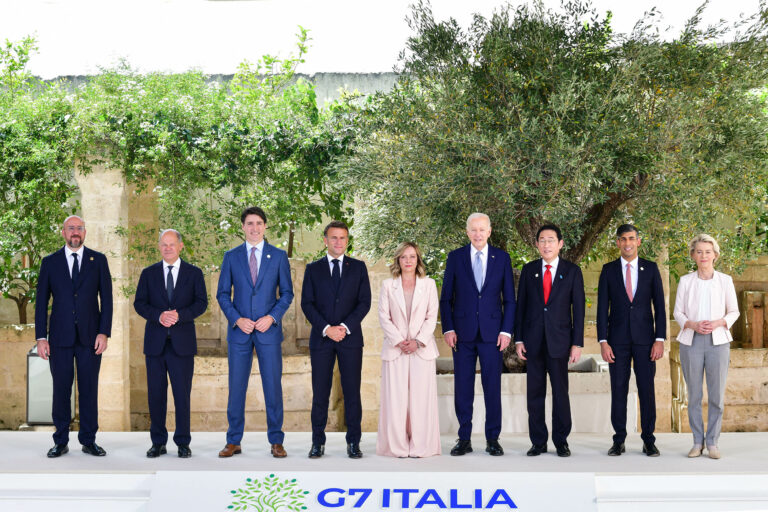
One hidden transformation of the international system in the most recent years has been the hijacking of the G7 by Washington as its ‘kitchen cabinet’ in the transatlantic system. The G8’s ‘shrinkage’ to G7 in March 2014 following the coup in Ukraine was a defining moment that signalled that there wasn’t going to be any post-cold war peace dividend. The G7 that was conceived as a group of countries charioting the world economy ended up as the vehicle of big-power rivalry to preserve the US’ global hegemony. Isolating Russia — and lately, China, too — became its leitmotif.
With the failure of the western project to isolate Russia, the G7 is meandering and lost its sense of direction. Italy, the G7 summit’s rotating host this year, has made AI a key issue in the summit. And Prime Minister Giorgia Meloni invited by an unlikely guest, the pontiff, to make an unprecedented appearance at the G7 event at the fashionable Italian hotel Borgo Enyatia to advocate for the regulation of artificial intelligence, a technology he’s called potentially harmful. Pope Francis was a chemist prior to entering seminary and will apparently draw on his scientific training to inform his stances. Italy under Meloni’s leadership has increasingly scrutinised AI technology, and temporarily banned ChatGPT in March 2023, becoming the first western country to do so.
Equally, G7 is desperate to go beyond a closed elite club of Western democracies by piloting an ambitious outreach and issued an unusually long list of invited leaders of the non-Western world to the summit. Aside Ukraine, Meloni has invited the leaders of India, Brazil, South Africa, Turkey, Saudi Arabia, Argentina, Algeria, Kenya and Mauritania to attend the meeting. What was the logic applied is impossible to tell.
But this is realpolitik and G7 is hoping to bridge the ‘West vs. the Rest’ hiatus in the line-up over the Ukraine crisis. In fact, the ‘outreach guests’ will witness tomorrow the nail-biting finale of a geopolitical drama, which forms the core of the G7 summit — the months-long attempt by the group’s leaders to make a decision on using dividends from frozen Russian assets for Ukraine’s military needs.
To recap, as part of the West’s ‘sanctions from hell’ against Russia in 2022, the European Union, Canada, the US and Japan froze Moscow’s assets in the western banks to the tune of $ 300 billion. (Some say, the actual figure is closer to $400 billion.) Only about $5-6 billion is located in the US, while $210 billion is stored in Europe, but the decision to use the proceeds from Russian assets was initiated by Washington with a hidden agenda to make Europe pay for the war’s consequences.
Unsurprisingly, the European members and Japan opposed the US pressure to include a provision on the use of income from frozen Russian assets in the joint G7 statement to be adopted. CNN reported on Monday that American officials are still trying to agree on the “most sensitive financial details” of the plan for Russian assets, since the G7 countries are yet to come to a consensus and discussions are continuing as regards “the exact form of providing assistance, as well as guarantees for the return of these funds.”
That said, don’t be surprised if the recalcitrant Europeans ultimately fall in line. There is no question that the G7 move to appropriate Russian money in western banks was bad enough but to use the profits out of them to fund the needs of Ukraine is, to put it mildly, an act of brigandage.
The US gains if the current freeze in Russia-Europe ties reaches a point of no return, as Europe is sure to bear the brunt of Moscow’s retaliation. If the G7 adopts such a move, it will weaken the global financial system. By brazenly violating international law, the G7 will be setting a precedent that undermines confidence in European institutions.
It will be interesting to see how the G7 leaders explain to the ‘outreach’ countries, drawn largely out of BRICS, that Russia is an exception and such a practice will not one day be used against India, Turkey, Saudi Arabia or some other state.
To be sure, the spectre of the 16th summit meeting of BRICS at Kazan (16-18 October) under the chairmanship of Russian President Vladimir Putin haunts the G7. Moscow has let it be known that if the past three years ended with the expansion of the BRICS, the new phase going forward will ensure that the participants in an expanded format create a viable structure in which the member countries work purposively to develop a viable structure.
An important topic at the BRICS summit meeting in Kazan will be the creation of a single currency within the grouping, which will significantly simplify and expand the economic relations of the member countries against the backdrop of mounting pressure from the West.
Speaking at the SPIEF conference in St. Petersburg last week, Putin announced that such an independent payment system would be created. Foreign Minister Sergey Lavrov later confirmed that a platform for payments in national currencies is being developed.
The BRICS countries have realised that the creation of a single currency has become a necessity today due to the ongoing sanctions from the US and the European Union. Lavrov noted that “recent international events have thrown off the masks” of the West, which has tried to impose its own values on other countries under the guise of universal ones and replace equal dialogue with “narrow coalitions” that assign the right to speak on behalf of the whole world.
BRICS, Lavrov underscored, implies a completely opposite type of partnership — that is, anything but a bloc structure, and on the contrary, a fundamentally open format, which involves working only in those areas that are of mutual interest to all participants, big and small. Reports suggest that around 30 countries have sought BRICS membership.
Meanwhile, in ‘systemic’ terms, G7 is entering uncharted waters. Far-right parties are storming the power centres of Europe. With an eye on the G7 summit, Politico wrote:
“Dream on. The G7 summit in the southern Italian coastal resort of Borgo Egnazia features arguably the weakest gathering of leaders the group has mustered for years. Most of the attendees are distracted by elections or domestic crises, disillusioned by years in office, or clinging desperately to power.
“France’s Emmanuel Macron and Britain’s Rishi Sunak are both fighting snap election campaigns they called in last-ditch efforts to reverse their flagging fortunes.
“Germany’s Olaf Scholz was humiliated by far-right nationalists in last weekend’s EU Parliament election and could soon be toppled himself.
“Justin Trudeau, prime minister for nine years in Canada, has spoken openly about quitting his “crazy” job.
“Japan’s Fumio Kishida is enduring his lowest personal ratings ahead of a leadership contest later this year.
“And then there’s Joe Biden.
“The 81-year-old U.S. president’s son, Hunter, was found guilty of gun charges on Tuesday, barely two weeks before his father’s first crucial debate with a resurgent Donald Trump in a presidential campaign the Democrat is in serious danger of losing.”
Above all, the angst in the European mind is palpable that if Trump wins in a democracy-altering climax in the November election, he may not even have time or patience to tolerate an archaic forum like G7. Surveying the bleak landscape, it comes as no surprise that Meloni took matters in her hands and decided to use the summit to her purposes by designing an agenda that cleaved to Italy’s strategic interests — Africa, migration and the Mediterranean.
Russia, China express ‘strong dissatisfaction’ with G7 communique
Press TV – May 20, 2023
Russia and China have expressed “strong dissatisfaction” with the final statement issued at the end of the Group of Seven (G7) summit in the Japanese city of Hiroshima, a city that was destroyed by the US atomic bombing in 1945.
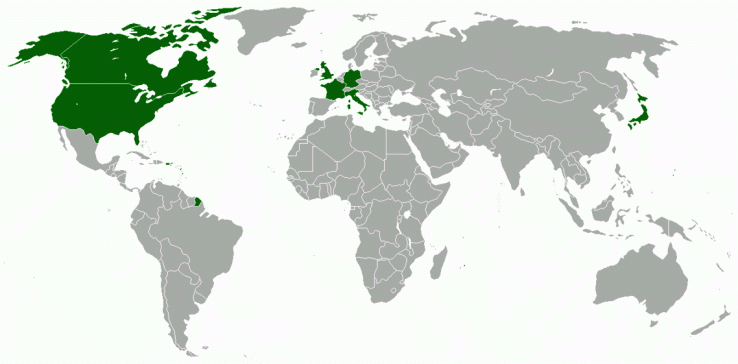
In a joint statement on Friday, which was revised on Saturday, the G7 — consisting of the United States, Japan, Germany, Britain, France, Canada and Italy — targeted both Russia and China with threats and disparaging remarks.
Russian Foreign Minister Sergei Lavrov said on Saturday that decisions taken at the G7 summit were aimed at the “double containment” of Russia and China.
Lavrov, in a televised conference, reiterated Moscow’s viewpoint that the West is using Ukraine as a tool to inflict a strategic defeat on Russia.
“The task was set loudly and openly – to defeat Russia on the battlefield, but not to stop there, but to eliminate it as a geopolitical competitor,” Lavrov noted.
“Look at the decisions that are being discussed and adopted today in Hiroshima at G7 summit of the Seven, and which are aimed at the double containment of Russia and China,” Russia’s top diplomat stated.
Lavrov said Moscow enjoyed the support of its many allies and Russia will weather the hardships despite the West’s efforts to put pressure on countries to cut trade and economic ties with the Russian nation.
Russian President Vladimir Putin said on Friday that the West was trying to break Russia up into dozens of different states.
The US-led West is driving a wedge between different ethnic and national groups in Russia and breaking the country up into dozens of different states, Putin warned.
Beijing, in a similar approach, showed its strong disapproval of the G7 for smearing and attacking the Chinese nation.
The Chinese Foreign Ministry said on Saturday that it has lodged stern representations to the G7 summit’s host, Japan, and other relevant parties after the group criticized Chinese policies in regard to Hong Kong, Xinjiang and Tibet.
The group advocates “promoting a peaceful, stable and prosperous world,” but what it does is hinder international peace, undermine regional stability and curb other countries’ development, the statement said, adding that it simply shows how little international credibility means to the G7.
The Chinese Foreign Ministry’s statement pointed out that Taiwan is China’s Taiwan and resolving the question is a matter for the Chinese. It reiterated that the one-China principle is the solid anchor for peace and stability across the Taiwan Strait.
Despite emphasizing on cross-Strait peace, G7 said nothing about the need to oppose “Taiwan independence,” which in effect constitutes connivance and support for “Taiwan independence” forces, and will only result in a serious impact on cross-Straits peace and stability, according to the statement.
The Chinese statement said no one should underestimate the determination, resolve and capability of the Chinese people in safeguarding China’s sovereignty and territorial integrity.
The issues related to Hong Kong, Xinjiang and Tibet are purely China’s internal affairs and China firmly opposes interference by any external force in those affairs under the pretext of human rights, the statement noted.
It urged the G7 to stop pointing fingers at China on Hong Kong, Xinjiang and Tibet and take a hard look at their own history and human rights record.
The statement reminded the G7 nations that the East China Sea and the South China Sea have remained overall stable, and it called for other countries to respect the regional countries’ efforts to uphold peace and stability and stop using maritime issues to drive a wedge between regional countries and incite bloc confrontation.
The statement also noted that the massive unilateral sanctions slapped by the United States and acts of decoupling and disrupting industrial and supply chains make the US the real coercer that politicizes and weaponizes economic and trade relations. It urged the G7 not to become an accomplice in the Americans’ economic coercion.
China is the only nation among the five nuclear weapon states that pledged “no first use” of nuclear weapons and always kept its nuclear capabilities at the minimum level required by national security, the statement noted, adding that China’s position on the matter should not be distorted or denigrated.
As a responsible major country, China firmly upholds the UN-centered international system, the international order underpinned by international law and the basic norms governing international relations built around the purposes and principles of the UN Charter, it said, adding that the Chinese nation will never give in to the so-called rules imposed by the few.
“The international community does not and will not accept the G7-dominated Western rules that seek to divide the world based on ideologies and values, still less will it succumb to the rules of exclusive small blocs designed to serve ‘America-first’ and the vested interests of the few,” the statement said.
The Chinese Foreign Ministry urged the G7 to stop engaging in closed and exclusive “small circles,” stop containing and suppressing other countries, stop creating and provoking confrontation and return to the right path of dialogue and cooperation.
G7 rejects Boris Johnson’s call for more anti-Russian sanctions over Syria
RT | April 11, 2017
British Foreign Secretary Boris Johnson’s mission to introduce fresh sanctions against Russia over Syria looks dead in the water after the G7 group of nations blocked the idea.
Johnson wanted the G7 to agree to “very punitive sanctions” and issue a joint declaration asking Russia to end its support for Syrian President Bashar Assad in response to last week’s alleged chemical attack in Syria’s Idlib province.
Instead, while the G7 nations meeting in Italy did agree there was no solution to the Syria crisis with Assad in power, proposals to target sanctions at senior military leaders were sidelined.
A delay on implementing sanctions will be in place until there is “hard and irrefutable evidence” over the alleged chemical attack. Russia has consistently denied Syrian forces used chemical weapons, insisting the incident at Khan Sheikhoun was caused by a hit on a rebel chemical weapons plant.
Italian Foreign Minister Angelino Alfano said the G7 had broadened consultations on Tuesday morning, with key regional allies participating including Saudi Arabia, Jordan, Qatar and Turkey. He declared the talks a “political success.”
Ahead of Tuesday’s meeting, sources told the Independent that the EU and Germany were “cool” on Britain and America’s plan for new punitive measures on Moscow.
Germany privately indicated on Monday that it opposed the call for sanctions on Russia, the Times reports. Senior officials said their approach to resolving the Syrian conflict had not changed despite the “barbaric” suspected chemical attack last week.
In France, President François Hollande’s government indicated it was more open to considering sanctions against Russia in response to the alleged gas attack. The country is in the middle of an election campaign, however, meaning Paris is unlikely to take a lead given a new president and government will come to power next month.
There were mixed signals from Italy, which is hosting the G7 summit in Lucca. Johnson has insisted he is working closely with the Italians attending the gathering, however Italian President Sergio Mattarella arrived in Moscow on Monday night for an official visit with Russian leader Vladimir Putin. The men are due to discuss strengthening relations.
Their meeting comes after Johnson canceled a trip to Moscow planned for this week, reportedly so that his US counterpart Rex Tillerson could go on behalf of the G7 to send a “clear and coordinated” message to the Kremlin about removing its support for Assad.
Tillerson hoped to take a definite G7 statement with him to Moscow.
British Prime Minister Theresa May has delivered her backing for Johnson’s sanctions plan from her walking holiday with her husband in Wales. Until late on Monday night, Downing Street had gone out of its way to stay away from Johnson’s plan to put pressure on Putin, avoiding all talk of new sanctions.
The US and EU have already imposed an array of sanctions on Russian individuals and businesses. The UK began imposing sanctions on Russia in 2014, after a coup in Kiev resulted in Crimea voting to become part of Russia, and conflict emerged between Kiev and eastern Ukraine’s Donbass region.
“Poor” G7 Just Cannot Disarm Yet!
By Andre Vltchek | CounterPunch | April 15, 2016
They met in Hiroshima, Japan, in the first city on Earth that had been subjected to nuclear genocide. They were representing some of the mightiest nations on Earth: Canada, France, Germany, Italy, Japan, the United Kingdom, and the United States – the so-called Group of Seven (G7). And at the end of their encounter, they called for “a world without nuclear weapons”.
I am talking about the foreign ministers of seven countries with the largest economies on Earth.
Read carefully the names of these countries, one by one! For decades and centuries, the world has been trembling imagining their armed forces and corporations. Lashes administered by their colonial rulers have scarred entire continents, tens of millions were enslaved, and hundreds of millions killed, billions robbed.
Even now, if we all listen carefully, we can clearly hear the victims screaming, in agony: the native people of Canada and United States, the colonized people of Africa, Asia and the Middle East. For centuries, the entire world has been in shackles, on its knees, humiliated, plundered and destroyed.
G7! How many billions of victims from all corners of the world, made those countries so ‘grand’?
To ensure that the pillage could continue uninterrupted, the West together with those “honorary whites” (a term that the South African apartheid regime invented exclusively for the Japanese people) created several aggressive and belligerent pacts, including NATO, calling them, of course, “defensive” alliances. It came as no surprise: remember that in the lexicon of the Empire of Lies, war is called peace, while aggression is always defined as defense. But this I have already described in detail, in my 820-page book “Exposing Lies of the Empire”.
Now foreign policy tsars of the “G7” were standing shoulder to shoulder again, in Hiroshima, of all places, and only a few days after the 71st anniversary of the nuclear blast. Making predictable declarations and self-glorifying speeches.
The weather was good, partly sunny, with excellent visibility. But was the world really able to see through the thick fog of Machiavellian cynicism and lies, dispersed all over the Planet by those grinning rulers of the world?
On April 11, 2016, the foreign ministers of the Group of Seven (G7) issued a written declaration on nuclear disarmament:
“We reaffirm our commitment to seeking a safer world for all and to creating the conditions for a world without nuclear weapons in a way that promotes international stability”.
Seriously? No one around those ministers fell; nobody was seen to be rolling on the floor, shaking from uncontrollable laughter. Obviously, a joke repeated thousands of times loses its luster.
But that was not all. The text of the declaration continued:
“This task is made more complex by the deteriorating security environment in a number of regions, such as Syria and Ukraine, and, in particular by North Korea’s repeated provocations.”
What exactly were we reading? What was between the lines? Were we being told that the United States needs all of its 6,970 nuclear weapons to antagonize Syria and North Korea, while sustaining the fascist regime in Ukraine?
Just to put things into perspective: two Communist countries with nuclear capability have really negligible stockpiles of nuclear weapons, compared to the West and G7. China has 260 and North Korea (DPRK) approximately 15. In comparison, France has 300 and the U.K., 215.
In 2016, the population of China stands at 1.382 billion, while that of France is less than 65 million. China has more than 21 times more people to defend, but despite that, France has more nuclear weapons.
The comparison gets even more ridiculous between North Korea and the U.K.
The figures quoted above are the latest “official” statistics, taken from the World Nuclear Weapons Stockpile Report, updated as recently as on March 2, 2016.
It would also be appropriate to recall that North Korea has never invaded any foreign country. Also China (PRC), apart from two brief border clashes, has never been involved in any large-scale military conflict. Not once has it colonized or destroyed a foreign land. Both France and the U.K. have been plundering on all of the planet’s continents, for centuries. Later, in the 20th Century, the United States ‘took over’ the reigns of imperialism from the old and ‘traditional’ European colonialist empires.
One statement is actually correct: there is that deteriorating security environment in a number of regions, but only due to the covert as well as direct aggressions of NATO and the G7 countries.
But it would be even more honest to declare: “We are sorry, we really cannot disarm, because if we would, it would become much more difficult to loot and to control the world.”
Before dispersing, the G7 party did what its members enjoy doing the most: lashing at China.
As Reuters reported:
“Foreign ministers from the Group of Seven (G7) advanced economies said they strongly opposed provocation in the East and South China Seas, where China is locked in territorial disputes with nations including the Philippines, Vietnam and Japan… Earlier on Monday, the G7 foreign ministers said after meeting in the Japanese city of Hiroshima that they opposed “any intimidating coercive or provocative unilateral actions that could alter the status quo and increase tensions”.”
The US is habitually implementing that ‘good old’ British ‘divide and rule’ strategy. In Asia, it uses its ‘client’ states, particularly the Philippines, Japan and South Korea to isolate and provoke both China and DPRK. This policy is so dangerous that many here believe that it could eventually trigger the Third World War.
This time, China has fired back, almost immediately. At a news briefing, the Chinese Foreign Ministry spokesman Lu Kang declared:
“If the G7 wants to continue playing a major role in the world, it should take an attitude of seeking truth from the facts to handle the issues the international community is most concerned with at the moment.”
The Western military build-up in the Asia Pacific region, the military maneuvers conducted jointly by the US and South Korea, as well as the continuous militarization of Japan, are definitely some of the topics that are making most of the Asian continent both ‘concerned’ and frightened.

Predictably, the DPRK remained the main punch bag of the G7. The ministers never explained exactly why the world should be petrified of North Korea. Such fear should apparently be taken for granted, especially after the long decades of intensive and vicious Western and South Korean propaganda.
But back to the statement of the ministers:
“We condemn in the strongest terms the nuclear test on January 6 and the launch using ballistic missile technology on February 7, March 10 and March 18 conducted by North Korea. It is profoundly deplorable that North Korea has conducted four nuclear tests in the 21st century.”
Of course, building defenses against the combined NATO and G7 aggressions is one of the most deplorable crimes, it calls for capital punishment!
Shamelessly, after spreading verbal toxins, all seven ministers went to the grounds of the monument and museum dedicated to the victims of “Hiroshima A-bomb”.
The Japanese Foreign Minister Fumio Kishida led the pack. Under the bizarre leadership of his government, Japan has been doing its absolute best to betray Asia, and to antagonize its neighbors. In the most servile and shameful way, it has fully accepted the Western dictates, increased the volume of its own hysterical propaganda campaign against China and DPRK, and has begun to bolster its military.
Why? Just to please its masters, those ‘noble and superior Westerners’!
By now, Japan is not even what its Prime Minister Shinzō Abe wants the world to believe that it is: a conservative nation governed by a nationalist government.
Japan has no spine, just as it has no foreign policy. It fully takes orders from the United States. And as I was told repeatedly by one of the employees of the NHK: “No major media outlet in Japan would dare to broadcast anything important, related to international affairs, that hasn’t appeared previously on at least one of the major US networks.”
Looking at Japan’s past, “conservative nationalists” used to be, for instance, some of the greatest writers like Yukio Mishima, a man who ended his life in 1970 by committing a ritual suicide, protesting Japan’s unabashed submission to the West. Japan’s Prime Minister Abe is definitely a ‘conservative’, but is he really a Japanese nationalist? He is defending the interests of Washington much more than those of his own country. Perhaps, “honorary white and one of G7 leaders” would be the most fitting term to define him.
Now, according to the official NATO website: “Japan is the longest-standing of NATO’s “partners across the globe”.
It is also one of the nations that are shamelessly plundering the world through its brutal corporations.
***
And so they stood there – seven ministers from some of the most aggressive countries on Earth.
They stood on the turf that was, more than 70 years ago, burned to ashes, in just a few seconds after the nuclear explosion.
They said again and again how much they would like to disarm, how much they would like to see the world free of nuclear weapons.
What they didn’t say was that they never would disarm, voluntarily.
And they never clarified how they actually made it to that exclusive G7 club: because of the unbridled plunder during their colonial history, and because of the modern-day global corporate pillage, as well as their mining and oil “investments”. And of course because of the “world order”, imposed by force and all sorts of weapons, nuclear and conventional, on the rest of the Planet.
Instead of Group of Seven, this pack should be simply called ‘GS’ – the Group of Shame.
The ministers stood for some time in front of the flame burning at the monument to Hiroshima A-bomb victims. They posed for the cameras. Then they went away, sat down at some table, and wrote the official declaration on nuclear disarmament, ‘explaining’ why they cannot abandon their tools of coercion. And that declaration turned out to be nothing more than yet another monumental pile of lies!
Andre Vltchek is a philosopher, novelist, filmmaker and investigative journalist. He covered wars and conflicts in dozens of countries. His latest books are: “Exposing Lies Of The Empire” and “Fighting Against Western Imperialism”.
Russia has better things to do than start WW3
By Bryan MacDonald | RT | June 8, 2015
Vladimir Putin said this weekend that “Russia would attack NATO only in a mad person’s dream.” Unfortunately, there are a lot of mad people working in western politics and media.
If the G7 were based on GDP, adjusted for purchasing power, it would be comprised of the USA, China, India, Japan, Russia, Germany and Brazil. Such a lineup would have remarkable clout. Members would boast 53% of the globe’s entire GDP and the planet’s 3 genuine military superpowers would be represented.
The problem for Washington is that this putative G7 might actually be a forum for a real debate about the world order.
Instead of a real G7, we have a farce. An American dominated talking shop where the US President allows ‘friendly’ foreign leaders to tickle his belly for a couple of days. There is no dissent. Washington’s dominance goes unquestioned and everyone has a jolly time. Especially since they kicked out Russia last year – Vladimir Putin was the only guest who challenged the consensus.
However, the problem is that this ‘convenient’ G7 is way past its sell-by-date. The days when its members could claim to rule the world economically are as distant as the era of Grunge and Britpop. Today, the G7 can claim a mere 32% of the global GDP pie. Instead of heavyweights like China and India, we have middling nations such as Canada and Italy, the latter an economic basket case. Canada’s GDP is barely more than that of crisis-ridden Spain and below that of Mexico and Indonesia.
Yet, the Prime Minister of this relative non-entity, Stephen Harper, was strutting around Bavaria all weekend with the confidence of a man who believed his opinion mattered a great deal. Of course, Harper won’t pressure Obama. Rather, he prefers to – metaphorically – kiss the ring and croon from the same hymn sheet as his southern master.
NATO and the G7 – 2 sides of 1 coin?
There was lots of talk of “Russian aggression” at the G7. This was hardly a surprise given that 6 of the 7 are also members of NATO, another body at which they can tug Washington’s forelock with gay abandon. Obama was at it, David Cameron parroted his guru’s feelings and Harper was effectively calling for regime change in Russia. It apparently never occurred to the trio that resolving their issues with Russia might be easier if Putin had been in Bavaria? The knee-jerk reaction to remove Russia from the club was hardly conducive to dialogue.
Meanwhile, Matteo Renzi stayed fairly quiet. It has been widely reported that the Italian Prime Minister privately opposes the EU’s anti-Russia sanctions due to the effects on Italy’s struggling economy. Also, Renzi’s next task after the G7 summit is to welcome Putin to Rome.
With that visit in mind, Putin gave an interview to Italy’s Il Corriere della Sera where he essentially answered the questions that Obama, Cameron and Harper could have asked him if they hadn’t thrown their toys out of the pram and excluded Russia from the old G8. Putin stressed that one should not take the ongoing “Russian aggression” scaremongering in the West seriously, as a global military conflict is unimaginable in the modern world. The Russian President also, fairly bluntly, stated that “we have better things to be doing” (than starting World War 3).
Putin also touched on a point many rational commentators have continuously made. “Certain countries could be deliberately nurturing such fears,” he added, saying that hypothetically the US could need an external threat to maintain its leadership in the Atlantic community. “Iran is clearly not very scary or big enough” for this, Putin noted with irony.
A world of ‘goodies’ and ‘baddies’
For Washington to maintain its huge military spending, it has to keep its citizens in a state of high alarm. Otherwise, they might insist that some of the armed forces’ cash is diverted to more productive things like hospitals and schools. These services, of course, are not very profitable for weapons manufacturers or useful for newspaper and TV editors looking for an intimidating narrative.
Following the collapse of the USSR, Russia was too weak and troubled to be a plausible enemy. Aside from its nuclear arsenal – the deployment of which would only mean mutual destruction – the bear’s humbled military was not a credible threat. Instead, the focus of warmonger’s venom shifted to the Middle East and the Balkans, where Saddam Hussein, Muammar Gaddafi, Slobodan Milosevic and Osama Bin Laden kept the general public’s attention occupied for roughly a decade and a half. However, they are now all dead and pro-war propaganda needs a new bad guy to play the Joker to America’s Batman.
Kim Jong-un looked promising for a while. Nevertheless, the problem here is that North Korea is too unpredictable and could very feasibly retaliate to provocations. Such a reaction could lead to a nuclear attack on Seoul, for instance, or draw Washington into a conflict with China. Even for neocons, this is too risky. Another candidate was Syria’s Basher Al-Assad. Unfortunately, for the sabre rattlers, just as they imagined they had Damascus in their sights, Putin kyboshed their plan. This made Putin the devil as far as neocons are concerned and they duly trained their guns in his direction.
Russia – a Middle East/North Africa battleground?
In the media, it is noticeable how many neocon hacks have suddenly metamorphosed from Syria ‘experts’ into Russia analysts in the past 2 years. Panda’s Mark Ames (formerly of Moscow’s eXILE ) highlighted this strange phenomenon in an excellent recent piece. Ames focused on the strange case of Michael Weiss, a New York activist who edits the anti-Russia Interpreter magazine (which is actually a blog). The Interpreter is allegedly controlled by Mikhail Khodorkovsky and a shadowy foundation called Herzen (not the original Amsterdam-based Herzen) of which no information is publicly available.
Weiss was a long-time Middle East analyst, who promoted US intervention to oust Assad. Suddenly, shortly before the initial Maidan disturbances in Kiev, he re-invented himself as a Russia and Ukraine ‘expert,’ appearing all over the US media (from CNN to Politico and The Daily Beast ) to deliver his ‘wisdom.’ This is despite the fact that he appears to know very little about Russia and has never lived there. The managing editor of The Interpreter is a gentleman named James Miller, who uses the Twitter handle @millerMENA (MENA means Middle East, North Africa). Having been to both, I can assure you that Russia and North Africa have very little in common.
Weiss and Miller are by no means unusual. Pro-War, neocon activists have made Russia their bete noir since their Syria dreams were strangled in infancy. While most are harmless enough, this pair wields considerable influence in the US media. Naturally, this is dressed up as concern for Ukraine. In reality, they care about Ukraine to about the same extent that a carnivore worries about hurting the feelings of his dinner.
Russia’s military policy is “not global, offensive, or aggressive,” Putin stressed, adding that Russia has “virtually no bases abroad,” and the few that do exist are remnants of its Soviet past. Meanwhile, it would take only 17 minutes for missiles launched from US submarines on permanent alert off Norway’s coast to reach Moscow, Putin said, noting that this fact is somehow not labeled as “aggression” in the media.
Decline of the Balts
Another ongoing problem is the Baltic States. These 3 countries have been unmitigated disasters since independence, shedding people at alarming rates. Estonia’s population has fallen by 16% in the past 25 years, Latvia’s by 25% and Lithuania’s by an astonishing 32%. Political leaders in these nations use the imaginary ‘Russian threat’ as a means to distract from their own economic failings and corruption. They constantly badger America for military support which further antagonizes the Kremlin, which in turn perceives that NATO is increasing its presence on Russia’s western border. This is the same frontier from which both Napoleon and Hitler invaded and Russians are, understandably, paranoid about it.
The simple fact is that Russia has no need for the Baltic States. Also, even if Moscow did harbor dreams of invading them, the cost of subduing them would be too great. As Russia and the US learned in Afghanistan and America in Iraq also, in the 21st century it is more-or-less impossible to occupy a population who don’t want to be occupied. The notion that Russia would sacrifice its hard-won economic and social progress to invade Kaunas is, frankly, absurd.
The reunification of Crimea with Russia is often used as a ‘sign’ that the Kremlin wishes to restore the Soviet/Tsarist Empire. This is nonsense. The vast majority of Crimean people wished to return to Russia and revoke Nikita Khrushchev’s harebrained transfer of the territory to Ukraine. Not even the craziest Russian nationalist believes that most denizens of Riga or Tallinn wish to become Russian citizens.
Putin recalled that it was French President Charles de Gaulle who first voiced the need to establish a “common economic space stretching from Lisbon to Vladivostok.” As NATO doubles down on its campaign against Moscow, that dream has never looked as far off.
Bryan MacDonald is an Irish writer and commentator focusing on Russia and its hinterlands and international geo-politics. Follow him on Facebook
G7 Summit Without Russia: Problem for the West, But Not for the Kremlin
Sputnik – 05.06.2015
Moscow’s absence at the G7 summit in Germany does not mean that Russia is politically isolated in the world. Moreover, it helps the Kremlin to pursue a more independent policy, die Zeit wrote.
The proximity to the Western world is no longer an absolute value for modern Russia, the German newspaper wrote.
Moscow seeks to follow a sovereign foreign policy and is not willing to impose itself on Western countries, the article said, referring to the upcoming G7 summit, which will be held in Germany on Sunday without the participation of the Russian leader.
“Will the Russian President sit on Sunday in the Kremlin and grieve about the fact that the G7 leaders met in the Elmau castle without him? Unlikely. The days when the Russian President wanted to just stand next to his Western colleagues are over,” the newspaper wrote.
According to die Zeit, for Russia, the Western world has lost its ‘absolute brilliance’ that was so evident after the collapse of the Soviet Union. Russia became disillusioned with Europe and the United States due to their hypocrisy and indecisive policies, the article said.
Russia’s current position has nothing to do with the world’s isolation, the newspaper wrote. European leaders, including Greek Prime Minister Alexis Tsipras and Slovak Prime Minister Robert Fico, regularly visit Russia. In a few days, Russian president Vladimir Putin is expected to visit the Russian pavilion at the international exhibition “EXPO-2015” in Italy. In the Vatican, he will have a private meeting with Pope Francis.
“Let’s agree that loneliness and isolation look a little bit different,” the article said ironically.
Russia is also expanding its contacts within the Shanghai Cooperation Organization (SCO) and maintains fruitful cooperation with Asian countries. With this regard, the Kremlin’s non-participation in the G7 summit is just a little episode in its foreign policy activities, Die Zeit noted.
The newspaper also stressed that the current situation could be beneficial for the Kremlin as the latter will gain more freedom in conducting its own independent policy.
Featured Video
Now everyone is dumping US government bonds
or go to
Aletho News Archives – Video-Images
From the Archives
Experts Warned For Years That A War With Iran Would Happen This Way
By Caitlin Johnstone | April 3, 2026
… It’s so wild how we keep seeing reports that Iran’s retaliation caught the US off guard. For all the years I’ve been paying attention to this issue I’ve been reading experts and analysts saying if the US attacks Iran, Iran can close the Strait of Hormuz and strike US bases and the energy infrastructure of US allies in the region.
A few examples:
A 2006 Oxford Research Group paper titled “Iran: Consequences of a War” warned that Iran has numerous options at its disposal in the event of a US attack, and that the “most significant of these would be any possible retaliatory Iranian action to affect the transport of oil and liquefied natural gas through the Straits of Hormuz,” adding that stopping Iran from doing this “would be difficult if not impossible to achieve, leading to a fear of attack which alone would have a formidable impact on oil markets.”
A 2007 Cato Institute paper titled “The Iraq War and Iranian Power” warns that “Iran possesses the largest ballistic-missile inventory in the Persian Gulf — missiles which can reach Israel, Saudi Arabia and US military bases in Iraq,” and that “experts argue Iran could also use the ’oil weapon’: blocking the 34km-wide Strait of Hormuz and conducting submarine and anti-ship missile attacks against ports and oil facilities in Saudi Arabia, Kuwait and other Gulf Cooperation Council states.”
A 2012 NPR article titled “Can Iran Close The World’s Most Important Oil Route?” features then-chairman of the Joint Chiefs of Staff acknowledging that Iran absolutely can block the Strait of Hormuz, saying Tehran has “invested in capabilities” which specifically enable them to do so.
A paper from the Columbia Center on Global Energy Policy and the Center for a New American Security titled “IN DIRE STRAITS? IMPLICATIONS OF US-IRAN TENSIONS FOR THE GLOBAL OIL MARKET” warns of a potential scenario “that includes damage to Gulf oil infrastructure and a temporary closure of the Strait of Hormuz.”
These weren’t a bunch of keffiyeh-wearing peaceniks making these assessments, they were deeply entrenched swamp monsters entirely loyal to the US empire. They opposed war with Iran not because it would be an evil act of unforgivable mass murder, but because it would be bad for the imperial power structure. … Full article
Blog Roll
 Aletho News
- US dismantling international law in its war against Iran while claiming ‘false’ victory: Legal scholar
- One martyr, 5 injuries in US attack on Iraqi border crossing with Iran
- ‘This war is Israel’s war’: World facing ‘security breakdown’, says Qalibaf
- IRGC decries attack on US embassy in Riyadh, says executed by ‘Israel’
- Iran blasts EU hypocrisy as EU invokes international law over Hormuz
- There is no military solution to Strait of Hormuz
- NATO’s structural collapse – the outcome of deviation from reality
- Poll finds world views China better than US
- One Of America’s Leading Neo-Cons Has Turned Against The Iran War And Israel
- Attack in the Bosphorus exposes NATO weaknesses and tensions among allies
- If Americans Knew
- US loses planes over Iran, Israel downgrades Lebanon war goals – Daily Update
- Israel Is Blocking Palestinians from Easter at Church Where Jesus Resurrected
- Plot to assassinate Palestinian activist follows harassment campaign promoted by Zionist groups and elected officials
- Prominent New York synagogue hosts presentation on why U.S. Jews should support the ethnic cleansing of Gaza
- Tapper vs. Piker: Is the CNN Anchor Auditioning for David Ellison?
- Shouldn’t Democrats Be Able to Condemn Genocide?
- Israel-US kill negotiators, destroy civilian structures, but Iran’s military capabilities still largely intact – Daily Update
- ‘War crime’: Global condemnation as Israeli ministers celebrate death penalty law targeting Palestinian prisoners
- 7 Ways Israel Is Turning Lebanon Into Gaza
- World’s Leading Football Bodies Under Fire Over Israel Policies
- No Tricks Zone
- New Study Reports A 60% Slowdown In Greenland’s Ice Loss Rate In The Last Decade
- Low Intensity Tornado Wrecks Major Solar Farm, Creating A Potential Toxic Dump
- New Study Finds Warming Saves Lives…Cold Temperatures 12 Times More Deadly Than Excess Heat
- German Science Blog Accuses PIK Climate Institute Of Hallucinating Climate Tipping Points
- Devastating Assessment Of Comirnaty Vaccine By Former Senior Pfizer Europe Toxicologist
- New Study: CO2 Is ‘Effectively Negligible’ As An Explanatory Climate Change Factor Since 2000
- Former Pfizer Toxicologist Dr. Helmut Sterz Tells Bundestag Hearing Pfizer Vaccine Should Have Never Been Approved
- Energy Expert: Germany’s Nuclear Phaseout Was A “500 Billion Euro Mistake”
- New Research: South Australia’s Mid-Holocene Sea Surface Temperatures Were 4°C Warmer Than Today
- Storing Green Energy To Last Germany 10 Days Would Require A 60-Million Tonne Battery
 Aletho News