Epstein Pitched JPMorgan Chase on Plan to Get Bill Gates ‘More Money for Vaccines’
By Michael Nevradakis, Ph.D. | The Defender | February 10, 2026
In the years leading up to the COVID-19 pandemic, Bill Gates and key figures from the Gates Foundation regularly interacted with Jeffrey Epstein, discussing ways to finance and develop a global pandemic preparedness and vaccination network.
The communications between Gates and Epstein were included in the “Epstein Files” released Jan. 30 by the U.S. Department of Justice (DOJ). Last year’s passage of the bipartisan Epstein Files Transparency Act prompted the release.
Sayer Ji told The Defender the files show that Epstein “functioned as a switchboard” connecting “hedge funds, central banks, billionaires, academic institutions and global health initiatives.”
Ji published his analysis of health- and medical-related information in the files in a series of Substack articles and posts on X.
Seamus Bruner, director of research at the Government Accountability Institute, said the files revealed the workings of a network of “Controligarchs on steroids, but with shocking new receipts.”
Bruner said the files showed that Epstein helped develop “the architecture for pandemic profiteering” years before the COVID-19 pandemic.
The documents largely date from the 2010s — after Epstein’s 2008 conviction for soliciting underage sex and his inclusion on a registry of sex offenders.
Ji noted that months before the start of the COVID-19 pandemic, many of the same actors who appear in the Epstein files participated in Event 201 — a simulation of a global pandemic caused by a coronavirus.
The pandemic preparedness infrastructure built in the years before the pandemic helped lead to this simulation, Ji wrote.
According to The Hill, members of the U.S. Congress began reviewing unredacted versions of the documents on Monday.
Rep. Thomas Massie (R-Ky.), who co-sponsored the Epstein Files Transparency Act along with Rep. Ro Khanna (D-Calif.), told The Defender the documents’ release is about justice, not politics.
“Rep. Ro Khanna and I have tried to keep the Epstein files from being political. The Democrats want to make it about Trump, and the Republicans want to make it about the Clintons. We want to make it about the survivors and getting them justice and transparency,” Massie said.
Gates, Epstein and the ‘architecture behind pandemics as a business model’
Ji’s series of Substack posts revealed what he described as “a 20-year architecture behind pandemics as a business model — with Bill Gates at the center of the network,” along with multinational financial institutions like JPMorgan Chase.
The documents, dating from 2011 to 2019, illustrate an “architecture whose foundations predate the COVID-19 era by more than a decade,” Ji wrote. He said they constitute evidence of “a major Wall Street bank asking a convicted sex offender to define the architecture of a Gates-linked charitable fund.”
The documents included several emails outlining the development of a Gates-led charitable fund. A Feb. 17, 2011, email from JPMorgan Chase’s Juliet Pullis to Epstein included questions from the “team that is putting together some ideas for Gates.”
Epstein’s reply outlined how this fund could be structured. The proposal would be developed further in the following months.
In a July 26, 2011, email from Epstein to JPMorgan Chase executive Jes Staley, on which Boris Nikolic, Gates’ chief science and technology adviser, was copied, described a “silo based proposal that will get bill [Gates] more money for vaccines.”
By Aug. 17, 2011, Staley and Mary Erdoes, then-CEO of JPMorgan Asset and Wealth Management, were discussing more details of the proposed fund, including developing “an offshore arm — especailly for vaccines” and projecting “billions of dollars” in donations within two years.
In a response later that day, Epstein said Gates was “terribly frustrated” at the slow pace of establishing the fund. He said Gates was insistent that “additional money for vaccines” be included in an upcoming presentation about the fund.
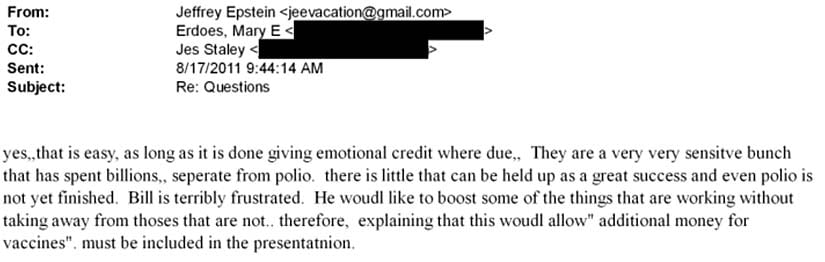
By Aug. 31, 2011, JPMorgan Chase had apparently developed a proposal called “Project Molecule,” where the bank would partner with the Gates Foundation to develop a perpetual charitable fund for pandemic preparedness and surveillance, vaccine promotion and disease eradication.
According to Ji, the proposal contains many of the ideas Epstein had previously discussed with JPMorgan Chase executives. It also contained plans to spend millions of dollars to purchase oral polio vaccines for Afghanistan and Pakistan, a rotavirus vaccine for Latin America, and a meningitis vaccine for Africa.
The proposal suggested that Melinda Gates chair the fund’s strategic program/grant and distribution committee and that Erdoes, Warren Buffett, Jordan’s Queen Rania and Seth Berkley, CEO of Gavi, the Vaccine Alliance, also participate. The Gates Foundation funded Gavi’s launch in 1999 and holds a permanent seat on its board.
Ji wrote that while Epstein’s name does not appear in the Project Molecule proposal, it acts as the “institutional translation of the architecture he was sketching informally.”
By 2013, these efforts appear to have led to the launch of the Global Health Investment Fund. A confidential Sept. 23, 2013, briefing described the fund as “the first investment fund focused on global health drug and vaccine development.” The fund promised investors annual returns of 5%-7%.
Among the attendees at the fund’s September 2013 launch were JPMorgan Chase CEO Jamie Dimon and representatives of Pfizer, Merck and GlaxoSmithKline (now GSK).
Gates could ‘work with anyone on earth’ but ‘chose a registered sex offender’
According to Ji, Nikolic’s involvement is significant. In August 2013, Gates and Epstein signed an agreement, in which Gates “specifically requested” that Epstein “personally serve” as Nikolic’s representative. The letter noted Epstein’s “existing collegial relationship” with Gates.
“This agreement was executed five years after Epstein’s conviction for soliciting a minor for prostitution,” Ji wrote. “Gates had the resources to work with anyone on earth. He chose a registered sex offender — and put it in writing.”
The documents showed that a month earlier — on July 18, 2013 — Epstein authored a draft email apparently intended for Gates. It references Epstein’s friendship with Gates, his disappointment that Gates sent him an “unfriendly strongly worded email,” and referenced sordid communications the two apparently previously shared.
“TO add insult to the injury you them implore me to please delete the emails regarding your std, your request that I provide you antibiotics that you can surreptitiously give to Melinda and the description of your penis,” Epstein wrote.
In a video posted on X, Michael Kane, director of advocacy for Children’s Health Defense, said that while it’s unknown whether Epstein ever sent that email to Gates, “the next month they’re in a contract together.”
“I think Bill Gates got the message,” Kane said.
In November 2023, a federal judge approved a $290 million settlement between JPMorgan Chase and over 100 women who accused Epstein of sexual abuse. The women alleged that JPMorgan Chase continued doing business with Epstein despite internal warnings over a span of several years.
“JPMorgan banked Epstein for years despite clear red flags — over $1 billion in suspicious transactions flagged internally and ignored. They knew. They didn’t care,” wrote The Truth About Cancer.
Did Epstein play role in launch of the ‘biosecurity state’?
According to Ji, the documents provide a roadmap for how a pandemic preparedness infrastructure was developed and how it helped make Event 201 possible.
“By the time Event 201 convened, the architecture … was no longer conceptual. It had been funded, structured, bonded, insured, staffed, and legally papered. What remained was the rehearsal,” Ji wrote.
September 2014 documents show that Gates disclosed his upcoming meeting with President Obama to Epstein, just as an adviser to then-Israeli Prime Minister Ehud Barak sent Epstein an invitation to a private, off-the-record reception with Obama the following month.
Ji said the communications occurred during “the week Ebola was formally reclassified as a threat to international peace and security.” He said the timing is significant, as this “was the week the biosecurity state was born.”
According to Ji, these developments helped activate the infrastructure outlined in Project Molecule, where Epstein acted as a node for Ebola-related project proposals.
This included Epstein receiving a United Nations (U.N.) diplomat’s proposal for the development of a “Nexus Centre for peace and health” that would take “into account the serious impact of Ebola,” and a proposal by a group of scientists for a pre-symptomatic Ebola detection system using PCR testing.
The scientists behind the proposal — affiliated with a U.S. military biolab at Fort Detrick, the Centers for Disease Control and Prevention and the National Institutes of Health — asked Epstein to send the proposal to Gates and the Gates Foundation.
By October 2014, Epstein was warning Kathy Ruemmler, then White House counsel to Obama, of the political cost if Obama didn’t take action on Ebola. By 2015, Epstein was acting as an intermediary in efforts to convene global experts who would “discuss how we can most effectively address and prevent pandemics.”
The proposal, by the International Peace Institute’s Terje Rød-Larsen, led to the convening of a May 2015 closed-door meeting in Geneva, Switzerland, titled “Preparing for Pandemics: Lessons Learned for More Effective Responses.” The World Health Organization (WHO), World Bank and U.N. were involved with the meeting.
The meeting’s agenda included sessions addressing “how pandemics should be anticipated, how authority should be exercised, how multiple stakeholders should be coordinated, and — critically — what legal, institutional, and financial mechanisms must be put in place in advance to enable rapid, centralized response,” Ji wrote.
According to Ji, the COVID-19 pandemic response has its roots in the 2014 Ebola response, as Ebola “was the first disease to formally justify the suspension of normal political and sovereign constraints on a global scale. … When the next global health emergency arrived — COVID-19 — the playbook was already written.”
“Epstein appears in the background of precisely these formative conversations — serving as a connector between global finance, philanthropic capital, and biological risk governance,” Ji told The Defender.
Epstein involved in ‘strain pandemic simulation’ two years before COVID
By 2017, these conversations led to proposals for pandemic simulations.
In a January 2017 iMessage thread between Epstein and an unidentified physician seeking help in finding a new job, the physician cited “expertise with public health security.”
The physician, who had experience at the U.N., WHO, Gates Foundation and World Bank, said he “just did pandemic simulation,” which could become a “big platform.”
Referring to Gates, the physician told Epstein, “He hates mental health but he’s crazy about vaccines and autism stuff. That could be start to a more broad conversation.”
A March 2017 email chain, which included Epstein and Gates, discussed efforts by the then-bgC3, Gates’ private strategic office, to develop “Follow-up recommendations and/or technical specifications for strain pandemic simulation.”
Ji noted that in 2017, the Coalition for Epidemic Preparedness Innovations (CEPI) was launched at the World Economic Forum (WEF), with Gates Foundation funding and a goal of creating “pandemic-busting vaccines” within 100 days. Later that year, the World Bank issued the first-ever pandemic bonds.
Event 201, held just six weeks before the first publicly acknowledged COVID-19 cases were announced, involved the Gates Foundation, WEF and the Johns Hopkins Center for Health Security. Global financial institutions, media organizations and intelligence agencies also participated.
The simulation focused on the response to a novel coronavirus outbreak by governments, pharmaceutical companies, media outlets and social media platforms.
Ji said the Epstein Files don’t show that COVID-19 was planned or manufactured, or that Event 201 led to COVID-19. Instead, they prove that “the institutional infrastructure to capitalize on exactly this kind of crisis was already built, tested, staffed, and insured.”
This article was originally published by The Defender — Children’s Health Defense’s News & Views Website under Creative Commons license CC BY-NC-ND 4.0. Please consider subscribing to The Defender or donating to Children’s Health Defense.
WHO Instructs Governments to Track Online Anti-Vaccine Messaging in Real Time with AI: Journal ‘Vaccines’
Believe in vaccines or be targeted
By Jon Fleetwood | December 29, 2025
The World Health Organization (WHO) has demanded that governments surveil online information that questions the legitimacy of influenza vaccines and that they launch “countermeasures” against those who question the WHO’s vaccine dogma, in a November Vaccines journal publication.
The WHO’s largest funders are the U.S. government (taxpayers) and the Bill & Melinda Gates Foundation.
In the November publication, the WHO representatives do not argue for their beliefs in vaccines.
They do not attempt to interact with arguments against vaccines.
Instead, they call for governments to use artificial intelligence (AI) to monitor online opposition to injectable pharmaceuticals, and to develop ways to combat such opposition.
There is no persuasion, only doctrine.
The WHO paper reads:
“Vaccine effectiveness is contingent on public acceptance, making risk communication and community engagement (RCCE) an integral component of preparedness. The research agenda calls for the design of tailored communication strategies that address local sociocultural contexts, linguistic diversity, and trust dynamics.”
“Digital epidemiology tools, such as AI-driven infodemic monitoring systems like VaccineLies and CoVaxLies, offer real-time insight into misinformation trends, enabling proactive countermeasures.”
The WHO starts from the assumption that all vaccine skepticism is inherently false, pushing surveillance tools to track and catalog online dissent from those rejecting that creed.
The goal is not finding middle ground or even fostering dialogue.
It’s increasing vaccinations.
“The engagement of high-exposure occupational groups as trusted messengers is recommended to improve uptake.”
To accomplish this, governments “should” align “all” their messaging with the WHO’s denomination of vaccine faith.
“All messaging should align with WHO’s six communication principles, ensuring information is Accessible, Actionable, Credible, Relevant, Timely, and Understandable, to strengthen public trust in vaccination programmes.”
The WHO’s faith system requires not only that its own followers but also non-followers inject themselves with drugs linked to injuries, diseases, hospitalizations, and deaths.
If your posts online oppose that faith system, they are targeted and labeled as “misinformation.”
You require “behavioural intervention.”
You must be “counter[ed].”
“Beyond monitoring misinformation, participatory communication models that involve local leaders, healthcare workers, and veterinarians have shown measurable improvements in vaccine uptake and trust. Evidence-based behavioural interventions can complement these approaches to counter misinformation.”
The WHO is outlining an Orwellian control system where dissent is pathologized, belief is enforced by surveillance, and governments are instructed to algorithmically police thought in service of pharmaceutical compliance.
Bill Gates’ CEPI revives Moderna mRNA bird flu vaccine development with $54M investment after HHS terminated funding
Avian influenza jab “mRNA-1018” is in full pandemic flight
By Jon Fleetwood | December 19, 2025
The Coalition for Epidemic Preparedness Innovations (CEPI) will invest up to $54.3 million to support a Phase 3 clinical trial for Moderna’s investigational mRNA-based pandemic H5 avian influenza “bird flu” vaccine candidate, mRNA-1018.
The move immediately follows the Gates Foundation’s $3.3 million award to a team of scientists at New York’s Rensselaer Polytechnic Institute (RPI) to develop “breakthrough purification technologies” for producing mRNA-based vaccines, which are plagued with contamination and impurity issues.
Bill Gates, through the Bill & Melinda Gates Foundation, is a co-founder and major funder of CEPI since its 2017 launch at Davos.
A Thursday press release from CEPI emphasizes the new mRNA bird flu vaccine is for “pandemic preparedness,” as this website has been documenting gain-of-function experiments being conducted on bird flu pathogens around the world, warning about the supranational orchestration of a coming bird flu pandemic.
HHS had terminated its multi-hundred-million-dollar commitment to Moderna to produce mRNA-1018 in May, with Moderna vowing to explore “alternative paths for development of the vaccine program.”
Moderna—also Gates-funded—has now followed through on its promise.
This is despite the fact that Moderna submitted data in November 2017 proving their mRNA vaccine lipid nanoparticles (LNPs) accumulate in mammalian liver, spleen, plasma (blood), kidneys, heart, and lungs.
Per the new CEPI press release:
The funding marks a significant step forward in global pandemic preparedness that could enable fast, equitable access to vaccines for one of the world’s most pressing health threats.
This Phase 3 study would be the first mRNA-based vaccine targeting pandemic influenza to enter a pivotal trial. If the vaccine candidate is licensed, it would expand the current global portfolio of H5 vaccines with a rapid-response platform that could revolutionize future pandemic responses, making a significant contribution to CEPI’s 100 Days Mission, a global goal to develop safe and effective vaccines within 100 days of a new pandemic threat being identified.
Dr Richard Hatchett, Chief Executive Officer of CEPI, stated:
“Pandemic influenza remains one of the greatest threats to global health security. With this partnership, we are not just advancing vaccine science, we are fundamentally changing the game. By harnessing the speed and adaptability of mRNA technology, we could shave months off the response time, deliver vaccines at scale, and enable equitable access for all. This is how we plan to protect the world from the next flu pandemic.”
Stéphane Bancel, Chief Executive Officer of Moderna, said:
“We are proud to have the support of CEPI to advance our pandemic influenza vaccine candidate, research that is critical to our commitment to pandemic preparedness. mRNA technology can play a vital role in addressing emerging health threats quickly and effectively, and we look forward to continuing our partnership with CEPI as we advance our health security portfolio, and in parallel, further the 100 Days Mission.”
CEPI collaborates closely with the World Health Organization (WHO)—also Gates-funded—through a 2017 Memorandum of Understanding, meant to accelerate pandemic vaccine development.
The WHO has already:
- Established a WHO-backed influenza command framework that merges governance, operational authority, and outbreak-response assets into a single controlling entity for the next pandemic cycle.
- Approved a WHO–Gates influenza-adjacent global digital ID and surveillance architecture, designed to track vaccination status and population compliance across borders during respiratory-virus campaigns.
- Ran pre-COVID compliance-testing programs tied to future influenza vaccine deployment, using CDC-, Gates-, and Oxford-linked institutions to model population behavior toward lower-quality vaccines years before SARS-CoV-2.
- Activated a “Future Pandemic” plan positioning U.S. labs inside a WHO-directed influenza sentinel surveillance network, preserving global monitoring operations even after the U.S. attempted withdrawal.
- Deployed a national influenza surveillance grid in Egypt under WHO authority, installing 30 sentinel sites and training 270 officers for real-time detection, reporting, and response.
- Constructed an international influenza pathogen-sharing command system enabling rapid transfer of H5- and other high-risk influenza samples for sequencing, analysis, and vaccine design under centralized WHO control.
- Outlined an influenza-triggered governance model that explicitly mandates “integration—merger of assets” and “united governance,” transferring all national governance functions to a single authority under conditions of crisis, uncertainty, or sector failure.
The WHO is already dictating how the coming bird flu pandemic will be controlled, just as it controlled the authoritarian COVID-19 pandemic response.
Moreover, the Trump administration this year announced a $500 million “next-generation, universal vaccine platform” called ‘Generation Gold Standard’ that will focus on bird flu jab creation.
Taken together, the CEPI–Moderna Phase 3 push, Gates-funded efforts to address known mRNA impurity issues, and the WHO’s already-built influenza surveillance, sample-sharing, and compliance architecture suggest a coordinated, pre-positioned pipeline designed to move seamlessly from pathogen research to mass deployment—before a bird flu emergency is formally declared.
WHO – Gates Blueprint for Global Digital ID, AI-Driven Surveillance, and Life-Long Vaccine Tracking for All
Automated, cradle-to-grave traceability for “identifying and targeting the unreached”
By Jon Fleetwood | December 2, 2025
In a document published in the October Bulletin of the World Health Organization and funded by the Gates Foundation, the World Health Organization (WHO) is proposing a globally interoperable digital-identity infrastructure that permanently tracks every individual’s vaccination status from birth.
The dystopian proposal raises far more than privacy and autonomy concerns: it establishes the architecture for government overreach, cross-domain profiling, AI-driven behavioral targeting, conditional access to services, and a globally interoperable surveillance grid tracking individuals.
It also creates unprecedented risks in data security, accountability, and mission creep, enabling a digital control system that reaches into every sector of life.
The proposed system:
- integrates personally identifiable information with socioeconomic data such as “household income, ethnicity and religion,”
- deploys artificial intelligence for “identifying and targeting the unreached” and “combating misinformation,”
- and enables governments to use vaccination records as prerequisites for education, travel, and other services.
What the WHO Document Admits, in Their Own Words
To establish the framework, the authors define the program as nothing less than a restructuring of how governments govern:
“Digital transformation is the intentional, systematic implementation of integrated digital applications that change how governments plan, execute, measure and monitor programmes.”
They openly state the purpose:
“This transformation can accelerate progress towards the Immunization agenda 2030, which aims to ensure that everyone, everywhere, at every age, fully benefits from vaccines.”
This is the context for every policy recommendation that follows: a global vaccination compliance system, digitally enforced.
1. Birth-Registered Digital Identity & Life-Long Tracking
The document describes a system in which a newborn is automatically added to a national digital vaccine-tracking registry the moment their birth is recorded.
“When birth notification triggers the set-up of a personal digital immunization record, health workers know who to vaccinate before the child’s first contact with services.”
They specify that this digital identity contains personal identifiers:
“A newborn whose electronic immunization record is populated with personally identifiable information benefits because health workers can retrieve their records through unique identifiers or demographic details, generate lists of unvaccinated children and remind parents to bring them for vaccination.”
This is automated, cradle-to-grave traceability.
The system also enables surveillance across all locations:
“[W]ith a national electronic immunization record, a child can be followed up anywhere within the country and referred electronically from one health facility to another.”
This is mobility tracking tied to medical compliance.
2. Linking Vaccine Records to Income, Ethnicity, Religion, & Social Programs
The document explicitly endorses merging vaccine status with socioeconomic data.
“Registers that record household asset data for social protection programmes enable monitoring of vaccination coverage by socioeconomic status such as household income, ethnicity and religion.”
This is demographic stratification attached to a compliance database.
3. Conditioning Access to Schooling, Travel, & Services on Digital Vaccine Proof
The WHO acknowledges and encourages systems that require vaccine passes for core civil functions:
“Some countries require proof of vaccination for children to access daycare and education, and evidence of other vaccinations is often required for international travel.”
They then underline why digital formats are preferred:
“Digital records and certificates are traceable and shareable.”
Digital traceability means enforceability.
4. Using Digital Systems to Prevent ‘Wasting Vaccine on Already Immune Children’
The authors describe a key rationale:
“Children’s vaccination status is not checked during campaigns, a practice that wastes vaccine on already immune children and exposes them to the risk of adverse events.”
Their solution is automated verification to maximize vaccination throughput.
The digital system is positioned as both a logistical enhancer and a compliance enforcer:
“National electronic immunization records could transform how measles campaigns and supplementary immunization activities are conducted by enabling on-site confirmation of vaccination status.”
5. AI Systems to Target Individuals, Identify ‘Unreached,’ & Combat ‘Misinformation’
The WHO document openly promotes artificial intelligence to shape public behavior:
“AI… demonstrate[s] its utility in identifying and targeting the unreached, identifying critical service bottlenecks, combating misinformation and optimizing task management.”
They explain additional planned uses:
“Additional strategic applications include analysing population-level data, predicting service needs and spread of disease, identifying barriers to immunization, and enhancing nutrition and health status assessments via mobile technology.”
This is predictive analytics paired with influence operations.
6. Global Interoperability Standards for International Data Exchange
The authors call for a unified international data standard:
“Recognize fast healthcare interoperability resources… as the global standard for exchange of health data.”
Translated: vaccine-linked personal identity data must be globally shareable.
They describe the need for “digital public infrastructure”:
“Digital public infrastructure is a foundation and catalyst for the digital transformation of primary health care.”
This is the architecture of a global vaccination-compliance network.
7. Surveillance Expansion Into Everyday Interactions
The WHO outlines a surveillance model that activates whenever a child interacts with any health or community service:
“CHWs who identify children during home visits and other community activities can refer them for vaccination through an electronic immunization registry or electronic child health record.”
This means non-clinical community actors participating in vaccination-compliance identification.
The authors also describe cross-service integration:
“Under-vaccinated children can be reached when CHWs and facility-based providers providing other services collaborate and communicate around individual children in the same electronic child health records.”
Every point of contact becomes a checkpoint.
8. Behavior-Shaping Through Alerts, Reminders, & Social Monitoring
The WHO endorses using digital messaging to overcome “intention–action gaps”:
“Direct communication with parents in the form of alerts, reminders and information helps overcome the intention–action gap.”
They also prescribe digital surveillance of public sentiment:
“Active detection and response to misinformation in social media build trust and demand.”
This is official justification for monitoring and countering speech.
9. Acknowledgment of Global Donor Control—Including Gates Foundation
At the very end of the article, the financial architect is stated plainly:
“This work was supported by the Gates Foundation [INV-016137].”
This confirms the alignment with Gates-backed global ID and vaccine-registry initiatives operating through Gavi, the World Bank, UNICEF, and WHO.
Bottom Line
In the WHO’s own words:
“Digital transformation is a unique opportunity to address many longstanding challenges in immunization… now is the time for bold, new approaches.”
And:
“Stakeholders… should embrace digital transformation as an enabler for achieving the ambitious Immunization agenda 2030 goals.”
This is a comprehensive proposal for a global digital-identity system, permanently linked to vaccine status, integrated with demographic and socioeconomic data, enforced through AI-driven surveillance, and designed for international interoperability.
It is not speculative, but written in plain language, funded by the Gates Foundation, and published in the World Health Organization’s own journal.
City Health Officials Tied to Soros Urge Public to ‘Get Vaccinated,’ Blame Policy Shifts for ‘Deadly Outbreaks’
By Michael Nevradakis, Ph.D. | The Defender | October 22, 2025
A coalition of city public health officials with ties to pharma investor George Soros is urging the public to “get vaccinated.”
In an open letter, the Big Cities Health Coalition accused federal officials of driving down vaccination rates and fueling an increase in dangerous infectious disease outbreaks by making “repeated false claims” about vaccines.
They wrote:
“Vaccines have eradicated devastating diseases and saved millions of lives. They keep classrooms safe and schools open. They allow children to spend time with friends and enjoy their favorite activities. They help parents and caregivers work to support their families.
The letter also addresses recent changes to the Centers for Disease Control and Prevention’s (CDC) recommended vaccine schedule for children and adults, though it does not mention U.S. Health Secretary Robert F. Kennedy Jr. or President Donald Trump by name.
The coalition, which represents 35 U.S. cities and about a fifth of the U.S. population, “has been working together to exchange ideas and address public health threats for more than two decades,” according to CNN, which first reported on the letter Monday.
Participating cities include New York, Los Angeles, Chicago, Boston, Houston, Dallas, Cleveland, Milwaukee and Seattle.
The group’s financial documents reveal support from billionaire financier Soros. Soros has also invested heavily in the pharmaceutical industry, including COVID-19 vaccine makers Pfizer and AstraZeneca, and Gilead Sciences, which produces remdesivir, a controversial antiviral treatment frequently given to COVID-19 patients.
Coalition attempted to scrub funding from Soros- and Gates-linked groups
The Big Cities Health Coalition was founded in 2002, according to a now-deleted webpage. The current version of its website contains little more than the group’s recent letter.
Links to the organization’s 2023 and 2024 annual reports are no longer active, but can be found on the Internet Archive and elsewhere. The reports show that Soros and other major healthcare-related organizations, including groups connected to Bill Gates, finance the coalition.
According to its 2023 annual report, the Open Society Foundations, founded by Soros, funded the coalition. Other funders include the Robert Wood Johnson Foundation, the W.K. Kellogg Foundation, healthcare provider Kaiser Permanente and the CDC Foundation.
In 2022, the Soros Economic Development Fund, an extension of the Open Society Foundations, partnered with Gavi, the Vaccine Alliance and MedAccess, a pharma-industry broker connected to the U.K. government, to invest $200 million in developing COVID-19 vaccines.
The Gates Foundation is a major funder of Gavi.
The Robert Wood Johnson Foundation has financially supported FactCheck.org, which previously flagged COVID-19-related “misinformation” for Facebook.
The CDC Foundation’s donor list includes the World Health Organization, the Gates Foundation and vaccine manufacturers including Pfizer, Merck and Johnson & Johnson.
According to internal medicine physician Dr. Clayton J. Baker, the coalition’s annual reports reveal clear conflicts of interest.
“It’s informative to look into the funding of organizations like the Big Cities Health Coalition,” Baker said. He noted that Kaiser Permanente paid patients $50 to get COVID-19 vaccines during the pandemic and fired employees who refused the shots, then tried to rehire them later when short-staffed.
According to the coalition’s Form 990 for fiscal year 2023, the organization spent $875,540 on “communications,” including engaging with “media, and federal policymakers about the importance of supporting local public health and health equity.”
The group also spent $433,703 on its “urban health agenda” and $147,397 on “equity/racial justice.”
The coalition’s members “meet periodically with Congressional staff” and “other federal government officials,” the filing states.
The organization’s schedule of contributors is listed as “restricted” in the filing.
Coalition blames unvaccinated for ‘deadly’ and ‘more frequent’ outbreaks
In its letter, the coalition blamed “declining” vaccination rates for “deadly outbreaks of diseases like measles and polio” and claimed that the outbreaks are “becoming more frequent.”
CNN reported that measles exposure at a South Carolina school led authorities to quarantine over 100 unvaccinated students, illustrating “one of the many reasons why Big Cities Health Coalition emphasizes the importance of vaccination.”
Research scientist and author James Lyons-Weiler, Ph.D., said that invoking measles and polio is a “manipulative framing device.” He said:
“Outbreaks of these diseases occur almost exclusively in highly vaccinated populations where immunity has waned, or where sanitation and migration variables are misattributed as ‘vaccine refusal.’
“By portraying every outbreak as proof of anti-vaccine rhetoric, the coalition seeks to recapture moral high ground based on presumptions of safety, without addressing the underlying immunologic and ecological data.”
The coalition’s letter also warned of a potential uptick of COVID-19 and flu infections in the “rapidly approaching” cold and flu season.
However, Baker said the coalition’s letter “contains absolutely zero genuine evidence” to support its claims. He said:
“The coalition’s statement is embarrassingly inane. They say, ‘We are united behind a simple message: get vaccinated.’ Vaccinated with what? They make no distinction between necessary or unnecessary, safe or unsafe, effective or ineffective shots. Just ‘get vaccinated.’ That’s like saying ‘get medicated.’ This is the asinine level of rhetoric to which vaccine fanatics are currently reduced.”
Emily Hilliard, press secretary for the U.S. Department of Health and Human Services (HHS), dismissed the coalition’s concerns.
“HHS is restoring the doctor-patient relationship so people can make informed decisions about their health with their providers,” Hilliard told The Defender.
Letter rooted in data, not ‘political ideology,’ coalition members say
Coalition members told CNN their letter is an attempt to restore public trust in science, not an effort to politicize public health recommendations.
“We have to make our public health decisions based on data and not on political ideology,” Dr. Philip Huang, director of the Dallas County Health and Human Services Department, told CNN. “We have to be the voices for that science and reason.”
Huang said the current CDC administration “seems more driven by political ideology than actual data and science, so it undermines the trust.”
Lyons-Weiler disputed the coalition’s claims, calling the letter “the opening salvo in an attempt to rebuild centralized narrative control over immunization policy.”
“Language such as ‘talk with your doctor’ and ‘tune out political noise’ is designed to sound apolitical while reinstating top-down message discipline,” he said.
CDC changes to vaccine policy spark pushback across U.S.
The coalition “is the latest group to take a strong public stand in support of vaccination as a direct response to concerns that the federal government is limiting access and raising doubts,” CNN reported.
Earlier this month, the CDC updated the childhood immunization schedule to recommend individual-based decision-making regarding COVID-19 vaccination for children 6 months and older, following the CDC’s Advisory Committee on Immunization Practices (ACIP) unanimous vote to adopt the recommendation.
Last month, ACIP also voted to recommend limiting the MMRV (measles, mumps, rubella and varicella, or chickenpox) vaccine to children ages 4 and older. And in June, the committee voted to stop recommending flu shots containing thimerosal — a preservative linked to neurodevelopmental disorders.
In response, 15 Democratic governors launched the Governors Public Health Alliance last week to coordinate their public health efforts independently of national public health agencies.
Previously, four Western states announced the formation of the West Coast Health Alliance, which aims to issue its own immunization guidelines.
In August, the American Academy of Pediatrics (AAP) issued “evidence-based” recommendations calling for COVID-19 shots for infants, young children and children in “high-risk” groups. In July, the AAP and five other medical organizations sued Kennedy over new COVID-19 vaccine guidance.
This article was originally published by The Defender — Children’s Health Defense’s News & Views Website under Creative Commons license CC BY-NC-ND 4.0. Please consider subscribing to The Defender or donating to Children’s Health Defense.
Gates-Funded Self-Assembling Microcrystal Implants Mark a New Phase in Population Control
By Nicolas Hulscher, MPH | FOCAL POINTS | April 25, 2025
A new study published in Nature Chemical Engineering titled “Self-aggregating long-acting injectable microcrystals” reveals Bill Gates’s latest investment. As expected, this “innovation” does not improve the health of humanity by any means, but instead seeks to further reduce already-collapsing birth rates.
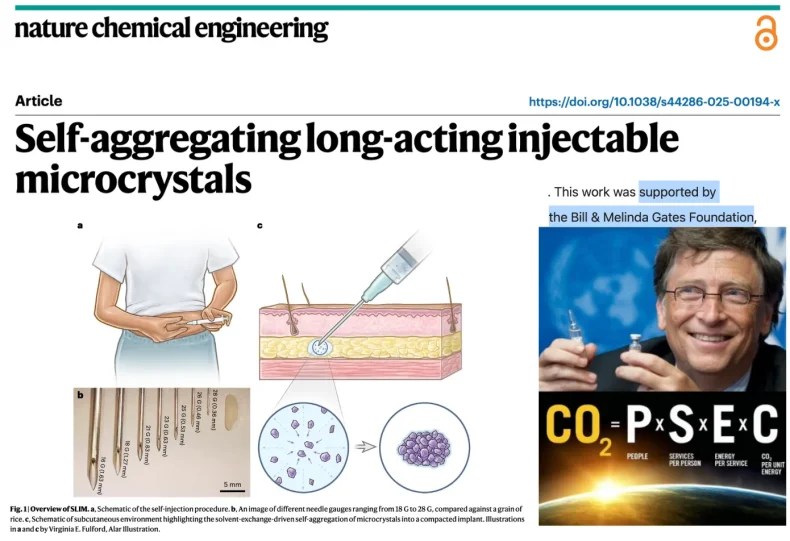
The technology, dubbed SLIM (Self-aggregating Long-acting Injectable Microcrystals), enables the self injection of microcrystals that self-assemble into a semi-permanent drug implant. The implant slowly releases synthetic hormones like levonorgestrel—a potent contraceptive—over months to years.
While the study frames SLIM as a step forward in medical innovation, closer inspection reveals grave concerns:
- Irreversible implants: Once injected, the microcrystals self-assemble into a dense, solid mass deep in subcutaneous tissue. The study provides no method for removal, raising the possibility that these implants are effectively permanent, particularly in low-resource settings without surgical infrastructure.
- Unknown long-term effects: In rats, the solid implant remained intact for at least 97 days—the full length of the study. In humans, where metabolism is slower and tissue clearance is more complex, these structures could persist for years with unknown consequences.
Widely available, extremely long-lasting anti-fertility implants are a dream come true for depopulationists. Bill Gates, the funder of this study, publicly revealed his preference for reducing the population by 10-15% in order to “get CO₂ to zero.”
“First we’ve got population. The world today has 6.8 billion people, that’s headed up to about 9 billion. Now, if we do a really great job on new vaccines, healthcare, reproductive health services, we could lower that by perhaps 10-15%” – Bill Gates at TED2010
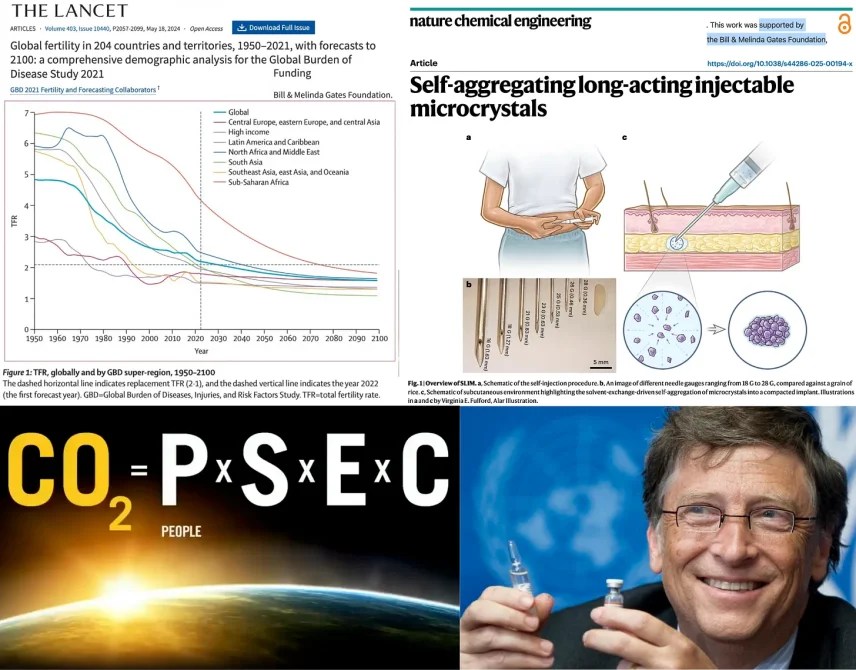
The Gates Foundation also funded a study that was published last year titled “Global fertility in 204 countries and territories, 1950–2021, with forecasts to 2100: a comprehensive demographic analysis for the Global Burden of Disease Study 2021.” They estimated irreversible population collapse within the next few decades:
By 2050, over three-quarters (155 of 204) of countries will not have high enough fertility rates to sustain population size over time; this will increase to 97% of countries (198 of 204) by 2100.
Let’s get this straight: The same foundation that acknowledges an inevitable population collapse—without any intervention—is simultaneously funding invasive technologies that would only accelerate it:
We need to reverse the major decline in birth rates to preserve civilization. A few months ago, I identified some key targets:
A study by Aitken found that fertility rate declines are driven by both short- and long-term factors. In the short term, socioeconomic drivers like urbanization and delayed childbearing, as well as issues such as obesity, falling sperm counts, and environmental toxicants (e.g., pollutants, nanoplastics, and electromagnetic radiation), compromise reproductive health. Long-term factors include reduced selection pressure on high-fertility genes due to smaller family sizes and the widespread use of assisted reproductive technologies, which may perpetuate poor fertility genotypes in the population. Addressing these issues is essential to mitigating the ongoing fertility crisis.
Burkina Faso rejects GMO mosquitoes: Bill Gates-backed anti-malaria project suspended amid controversy

By Willow Tohi – Natural News – 08/30/2025
On August 23, Burkina Faso’s military government ordered the suspension of the Target Malaria project, a research initiative funded by the Bill and Melinda Gates Foundation aimed at combating malaria. The decision came after growing concerns from local and international critics about the project’s potential unintended consequences and ethical implications. Amid a wave of anti-Western sentiment and doubts over the safety of genetically modified organisms (GMOs), the move has significant implications for global health and biotechnology efforts in Africa.
Key highlights of the decision
-
- Burkina Faso has ordered the Target Malaria research team to halt all activities and destroy all genetically modified mosquitoes.
-
- The suspension reflects growing distrust of foreign-funded initiatives in Burkina Faso, a country that has shifted closer to Russia and Iran since a 2022 coup.
-
- Critics argue that the genetic modifications pose unknown risks to public health and ecosystems.
-
- Despite prior approvals from national biosafety agencies, the project faced mounting public resistance.
-
- The decision marks a significant setback for genetic approaches to malaria eradication in Africa.
A decade-long experiment
Target Malaria, launched in Burkina Faso in 2012, was a research consortium led by Imperial College London. The project sought to use genetic modification to control mosquito populations and reduce malaria transmission, a disease that claims over 600,000 lives annually, primarily in Africa.
In 2019, Burkina Faso became the first country in Africa to release genetically modified mosquitoes into the wild. These mosquitoes were engineered to produce predominantly male offspring, aiming to curb population growth by spreading specific traits through wild mosquito populations. The project received financial backing from the Bill and Melinda Gates Foundation, one of the largest private funders of global health programs.
Regulatory approval, public resistance
The Target Malaria project had received approval from Burkina Faso’s National Biosafety Agency (ANB), the National Environmental Assessment Agency (ANEVE) and the country’s Health Research Ethics Committee. Communities in selected field sites, such as Souroukoudingan in Houet Province, had also signed off on the releases.
On August 11, 2025, one small-scale release of non-gene drive genetically modified male bias mosquitoes took place successfully, in accord with terms and conditions of the ANB and ANEVE permits. However, despite these clearances, the initiative drew mounting criticism from civil society groups.
A clash with military priorities
The suspension reflects broader tensions between Burkina Faso’s military-led government and Western-backed NGOs. Since seizing power in 2022, Captain Ibrahim Traoré’s administration has increasingly sought to limit foreign involvement in domestic policy, particularly projects tied to high-profile Western philanthropists such as Bill Gates.
Ali Tapsoba, a leading member of the Coalition for Monitoring Biotechnological Activities in Burkina Faso (CVAB), said, “The problem is the solution proposed by Target Malaria, which consists of eliminating the vector using gene-drive mosquitoes.” He added, “This technology is highly controversial, unpredictable and raises ethical concerns. More specifically, the impacts of gene-drive organisms on health and ecosystems remain unknown and potentially irreversible.”
Critics further highlighted that the modified mosquito strains originated in laboratories in Europe, raising questions of scientific neo-colonialism and external influence. In its defense, Target Malaria stressed, “The IRSS team, as part of the Target Malaria project, has operated since 2012 in compliance with the national laws of Burkina Faso. We have engaged actively with the national authorities and stakeholders of Burkina Faso and remain ready to cooperate.”
International reactions and implications
The decision to suspend the Target Malaria project in Burkina Faso has reverberated internationally, particularly among those involved in global health and biotechnology efforts. The Bill and Melinda Gates Foundation, which did not immediately respond to a request for comment, has been embroiled in controversies over some of its initiatives, with advocacy groups accusing it of promoting genetically modified crops and industrial agriculture models that benefit large corporations while sidelining smallholder farmers.
A turning point in biotechnology and public health
The suspension of the Target Malaria project in Burkina Faso marks a significant victory for those skeptical of biotechnological interventions. This move highlights the deep ethical, environmental and political concerns surrounding such projects, especially in regions with a history of foreign exploitation. As Burkina Faso reasserts its health sovereignty, the decision raises critical questions about the true motivations behind such biotechnological solutions. The involvement of figures like Bill Gates, who have significant financial stakes in these technologies, further fuels suspicions. While Gates’ foundation claims to advance global health outcomes, the potential for these technologies to enrich developers at the expense of the communities they serve cannot be overlooked. This decision is a clarion call for more transparent and community-led approaches to public health, ensuring that the interests of the most vulnerable are not sidelined in the name of progress.
U.S. Cancels Contracts Worth $766 Million for Moderna Bird Flu Vaccine After ‘Rigorous Review’
By Michael Nevradakis, Ph.D. | The Defender | May 29, 2025
The Trump administration cancelled two contracts totaling $766 million with Moderna for the development of its mRNA-1018 vaccine for the H5N1 strain of bird flu, citing safety and efficacy concerns identified during its clinical trials, the U.S. Department of Health and Human Services (HHS) has confirmed.
“After a rigorous review, we concluded that continued investment in Moderna’s H5N1 mRNA vaccine was not scientifically or ethically justifiable,” HHS Communications Director Andrew Nixon told The Defender.
“This is not simply about efficacy — it’s about safety, integrity and trust. The reality is that mRNA technology remains under-tested, and we are not going to spend taxpayer dollars repeating the mistakes of the last administration, which concealed legitimate safety concerns from the public,” Nixon said.
Moderna first revealed the cancellation of the two awards in a statement published Wednesday. Moderna also announced “positive interim data” from its Phase 1 and 2 clinical trials for mRNA-1018.
“While the termination of funding from HHS adds uncertainty, we are pleased by the robust immune response and safety profile observed in this interim analysis,” Moderna said in its statement.
Last year, HHS awarded Moderna $176 million for the late-stage development of the mRNA-1018 vaccine. In the final days of the Biden administration in January, HHS granted Moderna $590 million to accelerate the development of its bird flu vaccine and expand clinical studies for vaccines targeting five other flu virus subtypes.
‘A major policy shift away from dangerous mRNA injection programs’
Some scientists criticized the cancellation of the awards. Dr. Ashish Jha, dean of the Brown University School of Public Health and the Biden administration’s COVID-19 response coordinator, told CNN, “The attack on mRNA vaccines is beyond absurd” and that “we will come to regret this” if bird flu starts spreading between humans.
However, epidemiologist Nicolas Hulscher called the news “a very positive development” that “marks a major policy shift away from dangerous mRNA injection programs.”
Vermont-based lawyer and farmer John Klar called it a “sensible decision,” noting the seasonal nature of the virus and its waning virulence.
Dr. Clayton Baker, an internal medicine physician, called the contract cancellation “absolutely the right decision.”
“The mRNA gene therapy platform, as demonstrated by the multiple toxicities of the COVID-19 shots, is fundamentally unsafe and should be removed from use altogether,” Baker said.
Baker suggested that the timing of the January 2025 grant, just days before the start of President Donald Trump’s second term, was likely intended to “promote the bird flu panic that was perpetrated by the outgoing administration, in order to derail the new administration.”
HHS told Reuters earlier this year that it would review agreements the Biden administration made for vaccine production. In March, HHS denied rumors that it was considering cancelling funding for mRNA vaccine research.
In February, the U.S. Department of Agriculture announced a $1 billion plan to combat the spread of bird flu among chickens. The plan included a strategy to develop vaccines for chickens, but not for humans.
According to Reuters, Moderna “has been banking on revenue from newer mRNA shots, including its bird flu vaccine and experimental COVID-flu combination vaccine, to make up for waning post-pandemic demand for its COVID vaccine.” The company “plans to explore alternatives for late-stage development and manufacturing” of its bird flu vaccine.
News of the canceled contracts came just days after Moderna withdrew its application for U.S. Food and Drug Administration (FDA) approval of its mRNA-1083 combination flu and COVID-19 vaccine.
Last week, Reuters reported that Moderna’s decision to withdraw its application came amid “increased regulatory scrutiny of the vaccine approval process since Robert F. Kennedy Jr. took the top U.S. health job earlier this year.”
Markets did not immediately react to news of the grants’ cancellation. Moderna shares remained flat during after-hours trading Wednesday, but were up by over 2.6% by press time Thursday.
No human bird flu cases reported in three months
According to Reuters, bird flu has infected 70 people in the past year, mostly farm workers, but “has spread aggressively among cattle herds and poultry flocks.”
In January, a Louisiana man who was hospitalized with the first severe case of bird flu in the U.S. died — the first bird flu-related death in the U.S. and all of North America. However, the man, who was older than 65, had underlying medical conditions, and it remains unclear whether bird flu directly caused his death.
There have been no new human bird flu cases in three months, The Associated Press (AP) reported May 19.
Dr. Meryl Nass, an expert on biological warfare and founder of Door to Freedom, said, “H5N1 was a dangerous virus if you caught it from a chicken years ago.” But it has never spread person-to-person, and has “mutated to cause extremely mild disease in almost all humans that have caught it over the past five to 10 years.”
Nass said this makes a new bird flu vaccine for humans unnecessary. “There is absolutely no reason why the United States needs another bird flu vaccine, and there is even less reason to develop an mRNA vaccine because the platform itself is dangerous.”
Bird flu scare a ‘propaganda campaign’
Mainstream media outlets and many scientists continue to suggest that bird flu poses an imminent threat to humans, in what Dr. Richard Bartlett, an emergency room director, former Texas Department of Health and Human Services advisory council member, and expert on bird flu, called a “propaganda campaign.”
“The messaging has been that bird flu spread from penguins to sea lions, to a western Minnesota goat, to Texas dairy cattle and finally to a dairy farmer with red eyes. It’s been a two-year marketing campaign,” Bartlett said.
Bartlett said the messaging is intended to “manufacture the perception of a need for new mRNA products — despite the absence of long-term safety data.”
Last year, former FDA Commissioner Robert Califf warned that a potential bird flu pandemic could have a 25% mortality rate. Jeremy Farrar, Ph.D., then the World Health Organization’s chief scientist, warned that bird flu has an “extremely high” mortality rate for humans and could mutate to pass between humans.
In December 2024, Dr. Leana Wen, the former commissioner of the Baltimore City Health Department and a professor of public health at George Washington University, said the outgoing Biden administration had not done enough to address bird flu and criticized the lack of availability of a bird flu vaccine.
After the start of Trump’s second term and the implementation of funding cuts to government health agencies, mainstream media reports suggested the cuts were placing the public at risk of a worsening bird flu outbreak.
In February, Reuters reported the cuts “disrupted the U.S. response to bird flu as the outbreak worsens,” resulting in “anxiety among federal health staff that critical information about bird flu will not be disseminated in a timely manner or at all.”
In April, USA Today reported that cuts affecting the FDA’s Center for Veterinary Medicine “will hamper the FDA’s ability to respond to animal disease outbreaks, including bird flu, and protect public health.”
Also that month, virologists from 40 countries published a report in The Lancet urging the Trump administration to prepare for a bird flu pandemic, according to Gavi, the Vaccine Alliance.
The report was funded by the Bill & Melinda Gates Foundation, which in 1999 established Gavi. The Gates Foundation holds one of the four permanent seats on Gavi’s board and continues to heavily fund the organization.
According to the AP, “experts are puzzling over why reports of new human cases have stopped” in the last three months. The report suggests that infections potentially aren’t being detected, that immigrant farm workers may be afraid to be tested, and that efforts to find bird flu cases were “weakened by government cuts.”
Baker said such scenarios are unlikely to account for the lack of recent bird flu cases. “What does this say about the severity of the illness in humans? It says that the illness is either mild or entirely asymptomatic and that there’s no need for a vaccine for an asymptomatic condition.”
U.S. ‘poured a king’s ransom’ into bird flu vaccine development
Nass said that the FDA has already licensed three vaccines for H5N1 and that “there have been dozens of experimental bird flu vaccines that were never taken to licensure. The U.S. government “has already poured a king’s ransom” into funding these vaccines, even though bird flu has never spread between humans.
Baker said that instead of funding new bird flu vaccines, the U.S. government should “stop the gain-of-function style manipulation of bird flu into a bioweapon, which takes place at the Kawaoka lab at the University of Wisconsin and the Southeast Poultry Research Laboratory in Athens, Georgia, as well as at other labs.”
Gain-of-function research increases the transmissibility or virulence of viruses and is often used in vaccine development. Earlier this month, Trump issued an executive order pausing gain-of-function research in the U.S. for 120 days while a new regulatory framework is developed. The order also ended U.S. funding for such research in some countries.
“Gain-of-function research produces human pathogens, the process is driven by fear in the media, and then proprietary vaccines are presented as the solution,” Baker said. “It needs to end.”
Recently, there have been growing calls among scientists for a moratorium or ban on mRNA vaccines, including a petition pending before the FDA.
This article was originally published by The Defender — Children’s Health Defense’s News & Views Website under Creative Commons license CC BY-NC-ND 4.0. Please consider subscribing to The Defender or donating to Children’s Health Defense.
‘Inhumane, Reckless’: Critics Weigh in on Europe’s Approval of Self-amplifying COVID mRNA Vaccines
By Suzanne Burdick, Ph.D. | The Defender |February 24, 2025
Europe has approved a self-amplifying mRNA COVID-19 vaccine for ages 18 and up. The move drew criticism from scientists, who cited several concerns, including high rates of serious side effects among clinical trial participants and no long-term safety data.
The European Commission, the European Union’s primary executive body, on Feb. 14, granted marketing authorization for ARCT-154 — marketed as KOSTAIVE — a vaccine manufactured by CSL and Arcturus Therapeutics.
Japanese regulators were the first to approve the ARCT-154 shot, which the country made available for the 2024-25 season to people 65 and over, and 60- to 64-year-olds with severe underlying conditions.
Self-amplifying mRNA vaccines are similar to synthetic mRNA vaccines in that they both contain foreign mRNA that the body’s cells translate into a protein. However, unlike synthetic mRNA vaccines, self-amplifying vaccines also contain an enzyme that instructs the body on how to make more mRNA.
“What makes self-amplifying mRNA technology so worrisome, is that the mRNA will perpetuate indefinitely,” said Karl Jablonowski, Ph.D., senior research scientist at Children’s Health Defense (CHD).
Jablonowski explained that with the traditional COVID-19 mRNA vaccines, “at least there is some solace in knowing the original mRNA will break down and stop production of the spike proteins.”
Nicolas Hulscher, an epidemiologist with the McCullough Foundation who writes on Substack, called Europe’s approval of ARCT-154 a “grave mistake.”
“These products behave like a synthetic virus,” Hulscher said. “The replicon mRNA is designed to encode not only the target antigen but also viral replicase, enabling the mRNA to replicate itself within the target cells. This replication machinery allows for an unknown period of toxic antigen production.”
The antigen is the “active ingredient in all vaccines … that causes the immune system to begin producing antibodies,” according to the Centers for Disease Control and Prevention.
Jablonowski said that being chronically exposed to an antigen — “especially one as toxic as the COVID-19 spike protein” is “like being vaccinated every day for the rest of your life.”
Plus, the product may not effectively target emerging COVID-19 variants, Jablonowski said:
“When a new variant emerges, as coronaviruses change constantly, would the strategy be another self-amplifying mRNA vaccine? Another factory that may never turn off? And so on? There will be a breaking point.
“The tragic short-sightedness of this strategy is that eventually the vaccinated will be creating spike protein to assault their own body to teach their immune system how to combat a virus that doesn’t exist anymore.”
Hulscher said long-term safety data on ARCT-154 is “non-existent.” He also reported that 90% of clinical trial participants experienced adverse events after the first dose, with 74.5% reporting systemic reactions and 15.2% requiring medical attention.
Arcturus Therapeutics is one of at least nine vaccine developers working on self-amplifying mRNA products, according to a November 2024 analysis by Hulscher.
So far, none of the clinical trials for the product have “addressed the major concern of product shedding,” Hulscher said.
Jablonowski also pointed out that the mRNA lipid nanoparticle technology has been shown to cross the placental barrier, making it “unconscionable that the European Commission would allow these products anywhere near a person who may become pregnant.”
FDA approved clinical trial for self-amplifying bird flu vaccine
Although the U.S. has yet to approve a self-amplifying mRNA COVID-19 vaccine, the U.S. Food and Drug Administration last November gave the green light for Arcturus Therapeutics to launch clinical trials for a self-amplifying mRNA vaccine targeting the H5N1 virus, commonly known as bird flu.
The trials are funded by the U.S. government and the Bill & Melinda Gates Foundation. “The United States must REJECT this dangerous technology,” Hulscher said.
Cardiologist Dr. Peter McCullough agreed.
“Vaccinologists have made a critical error in the design of genetic vaccines,” McCullough said. “Injection of the genetic code for any foreign protein including parts of viruses causes the body to respond with an immune attack against its own cells.”
“This leads to intense vaccine injury syndromes all through the human body,” he said.
McCullough added, “Giving the vaccines their own ‘life’ with the ability to reproduce themselves is inhumane, reckless, and from the outset, should be flagged as dangerous and potentially lethal to the recipient.”
Related articles in The Defender
- Japan Approves World’s First ‘Self-amplifying’ mRNA COVID Shot — Is the U.S. Next?
- ‘Disaster Waiting to Happen’: FDA Approves Phase 1 Trial of Gates-funded Self-amplifying Bird Flu Vaccine
- Rogan Rips Mainstream Media for Failure to Cover ‘Real Numbers’ of People Injured, Killed by COVID Shots
- U.S. Pumps $667 Million Into World Bank’s Pandemic Fund
This article was originally published by The Defender — Children’s Health Defense’s News & Views Website under Creative Commons license CC BY-NC-ND 4.0. Please consider subscribing to The Defender or donating to Children’s Health Defense.
Bill Gates and USAID: A Dangerous Alliance With Deadly Secrets
By Ilya Tsukanov – Sputnik – 19.02.2025
Bill Gates has urged the Trump administration to reconsider its stance on USAID, calling it “an unbelievable asset” and warning that cuts could risk “millions” of lives. What is the Microsoft mogul-turned billionaire ‘philanthropist’ really worried about?
USAID and the Gates Foundation have worked together for nearly 25 years on issues near and dear to Mr. Gates’ heart, from infectious diseases and vaccines to family planning, agriculture, and climate change.
Major collaborations include the Global Fund to Fight AIDS, Tuberculosis, and Malaria, and the Global Alliance for Vaccines and Immunization (GAVI).
Gates has also partnered with USAID on the Global Health Initiative and the Coalition for Epidemic Preparedness Innovations (CEPI).
If these names ring a bill, they should:
- GAVI is running an ambitious program to vaccinate 86 million adolescent girls in developing countries against HPV with jabs including Gardasil, made by Merck, which now faces a lawsuit in the US over side effects ranging from sporadic paralysis to cancer.
- Gates and USAID have continued supporting GAVI despite evidence from India starting in 2009 that its HPV jabs can cause severe illness or even death.
- USAID committed over $2 billion to GAVI from 2001-2017, and $1.16 billion more between 2020-2023.
- Leaked docs published by Revolver News in 2022 exposed a USAID scheme using pandemic funds for “reproductive health” (i.e. population control) in Africa.
- CEPI, together with Anthony Fauci’s National Institutes of Health and the Food and Drug Administration, has been linked to controversial health schemes of its own, from a September 2019 workshop on vaccine biomarkers to partnership in Event 201, a pandemic simulation held in October 2019, just weeks before COVID hit.
Partners in Food (In)security
Gates and USAID have also touted collaborations on food security, promoting agricultural tech for smallholder farmers in developing countries, for example.
At the same time, the Gates Foundation has invested heavily in companies engaged in GMO research, from Monsanto and its infamous “terminator seed” projects to synthetic meat startups.
An exhaustive 2024 critique of Gates’ agricultural schemes in Africa by the US Right to Know public health watchdog found that his and USAID’s AGRA initiative, focused on chemical-laced monoculture farming, increased dependency and agrobusiness influence instead of reducing hunger.
In other words, Gates’ concerns about USAID’s demise seem more about losing a key ally in efforts to control development, food security, and health in developing nations than “saving lives.”
Bigger Than USAID Scandal? Clinton Probe to Expose Gates, Soros and Epstein Links
By Ekaterina Blinova – Sputnik – 11.02.2025
The fall of the House of Clinton would trigger a domino effect, upending globalist entities like Bilderberg, billionaires such as Bill Gates & George Soros, and their bought politicians worldwide, says Wall Street analyst Charles Ortel.
How Could the Clinton Foundation Probe Expose Globalists?
- Ortel calls CF the largest unprosecuted fraud. If true, its trustees, executives and donors – both US and foreign – could face IRS and legal probes at home and abroad.
- Hundreds of billions in grants could be returned to US and foreign governments if fraud is proven, according to the analyst.
What Countries, Entities, and Private Funds Have Donated to the Clintons?
- Australia, France, Ireland, New Zealand, Norway, South Korea, Sweden, the UK, Ukraine and others funded CF, public records show.
- The largest known donor is UNITAID (WHO), which has sent hundreds of millions more than CF has reported to the IRS since 2006.
- Other suspicious donors: DFID, AusAID, NORAD and aid agencies from Canada, Ireland and Sweden, Ortel says.
- Private foundations also funded Clinton frauds. The Gates Foundation has donated since 2005 – while convicted sex offender Jeffrey Epstein collaborated with Bill Clinton. George Soros is another key donor.
Who Promoted the Clintons’ Globalist Web?
- Harvard, Yale and Columbia University gave credibility to Clinton charity frauds, Ortel says.
- Legacy media & publishers boosted Clinton Global Initiative events, ignoring that none were legally registered charities.
Investigation Into the Clinton Charitable Work
- A full probe into CF and its offshoots is needed ASAP, Ortel says.
- A 2018 hearing revealed CF owes $2.5 billion to the US government for acting as a foreign agent instead of a nonprofit.
- But the scandal exceeds $2.5 billion – Bill Clinton used charity as a front, with no honest accounting for AIDS, climate, or Haiti’s missing $10 billion, Ortel concludes.
WikiLeaks Exposes Internews: USAID-Funded Media Machine Behind Global Influence
Sputnik – 08.02.2025
The infamous US agency USAID funneled nearly half a billion dollars to Internews Network, a non-profit deeply involved in media operations all over the world, WikiLeaks has revealed.
In 2023 alone, Internews Network collaborated with 4,291 media outlets, produced 4,799 hours of broadcasts reaching 778 million people, and trained over 9,000 journalists. Operating in 30+ countries, it has key offices in the US, London, Paris, and regional HQs in Kiev, Bangkok, and Nairobi. But there’s more to the story:
- Founded in 1982, Internews claims to help media outlets achieve financial sustainability and promote “trustworthy information” – a mission it pursues with hefty US government funding.
- By 2023, the organization had partnered with nearly 4,300 media outlets, trained thousands of journalists, and simultaneously supported social media censorship initiatives.
- USAID alone poured $472.6 million into Internews, though the organization also received funding from AOL-Time Warner Foundation, the Bill & Melinda Gates Foundation, and other private donors.
- Grants include $10.7 million from USAID to support “high-quality responsible journalism” in Liberia and $11 million for “media enabling democracy” in Moldova, per datarepublican.com.
- The US State Department chipped in $1.48 million to establish “safe, accessible, and life-saving information services” in South Sudan.
- Another $19.5 million USAID grant was issued to Internews to “position Jordanian society to effectively advocate for citizen-driven interests”.
- Adding to the intrigue, Internews CEO Jeanne Bourgault and other key figures recently had their bios scrubbed from the organization’s website — but WikiLeaks, noticing the move, helpfully provided archived copies.
Featured Video

Ted Postol: Fraud of Missile Defence Exposed in Iran War
or go to
Aletho News Archives – Video-Images
Frlom the Archives
Containing the United States
By Edward S. Herman | Z Magazine | September 2016
“Containing the United States” is, of course, a ridiculous and self-contradictory idea in the U.S. and Western ideological and propaganda system. We all know that the United States had to “contain” the Soviet Union from 1945 to 1991, and since then has had the task of containing Russia and China. Only they threaten, bully, aggress and worry countries like Poland and Vietnam. Obama has had to reassure them both of our steadfast stand against Russian and Chinese military attacks. NATO has, of course, expanded greatly over the past several decades, despite the deaths of the Soviet Union and Warsaw Pact, but only to contain the renewed Russian — and Iranian, Libyan, Syrian and other — military threats; and we have “pivoted” to Asia, supported Japanese rearmament, bolstered our own forces in that area and jousted with the Chinese in their coastal waters solely to contain China. Earlier we had been obliged to contain North Vietnam, or was it the Soviet Union in Vietnam? Or China? Or “communism”? Or maybe all of them? Or none of them, but just needing an excuse to enlarge power?
The parallel propaganda has taken many forms. One is accepting as a premise that the United States only acts defensively and has no internal forces and interests that drive it to enlarge its sphere of control. I noted in an earlier article how Paul Krugman claims that internal Russian problems may well be the explanation of Russian “aggression,” but how at the same time it never occurs to him that the huge U.S. transnational corporate interests and “defense” establishment, and the pro-Israel lobby’s activities, might possibly make for an expansionist dynamic here.2 This reflects the standard establishment perspective that we are good and only react to evil. This was the view sustaining and justifying the invasion and occupation of Iraq from 2003. That attack was taken here as not evil but a response to evil, even if involving lies and mistakes, hence not describable as “aggression.” … continue
Blog Roll
 Aletho News
- Trump Admits He Is Destroying Iran For Israel
- Iran’s latest move in the GCC countries was a stroke of genius
- Blackmail and death threats, Zelensky embarrasses the EU, but there’s no condemnation
- Israel threatens to kill Iran’s new leadership
- Possible Scenarios for the Middle East
- The Horizon of the War. “Italy is being Dragged Into the War against Iran”
- A Second Vietnam War? Hanoi Waits and Prepares
- Ted Postol: Fraud of Missile Defence Exposed in Iran War
- How An Atrocity Propaganda Campaign Led To The U.S. And Israel Committing Real Atrocities In Iran
- Calls for the reconfiguration of military arrangements in the Gulf region
- If Americans Knew
- Fires and toxic air in Iran (thanks, Israel) – Not a ceasefire Day 150
- At Israel’s hands, Iran is burning, Lebanon and Gaza are crumbling – Not a ceasefire Day 149
- Israel is using the ‘Gaza doctrine’ in Lebanon and Iran
- Saudi journalist says ‘not all attacks’ on Gulf coming from Iran, fears US-Israel dragging monarchies into war
- Iranian officials say Israel carried out some of the drone strikes on Gulf energy sites
- US, Israel ravage Iran and Lebanon; 4 killed in Gaza – Not a ceasefire Day 148
- US troops were told war on Iran was ‘all part of God’s divine plan’, watchdog alleges
- Trump wants to run the show in Iran, but doesn’t know what he’s doing – Not a ceasefire Day 147
- ‘Dirty Work’ :The truth about how Israel was founded
- Mass Expulsion in Lebanon as Israel Expands War: “We Don’t Know Where to Go”
- No Tricks Zone
- Wake-up Call: Survey Shows Majority Of Germans Now Favor Postponing Climate Targets!
- Televised! Leading German Political Candidate Tells Schoolchildren CO2 Makes Sun Hotter!
- New Study: A Century Warming Of 1.1°C Is ‘Commonplace’ And ‘Not Unusual’ During This Interglacial
- New Study: ‘Internal Noise’ And Volcanic Forcing Can Trigger 10-15°C Warming Within Decades
- Glaciers Worldwide Are Suddendly Surging, Experts Blame Warming!
- Surprising Discovery: Sahara Is Greening…Billions Of Trees Where Once Thought To Be Barren
- New Research Reaffirms Clouds, Aerosols, And Surface Solar Radiation Are ‘Driving The Climate System’
- Germany: Electric Car Catches Fire At Charging Station, Sets Off Local “Inferno”, Widespread Damage
- New Study: Canada’s New Brunswick Was 1°C Warmer Than Today During The Medieval Warm Period
- Coal Power Back In Trend As Globe Tries To Keep Pace With Growing Demand For Power
 Aletho News