UN rapporteur calls on European football body to expel Israel from competitions

Press TV – August 10, 2025
The UN special rapporteur for human rights in the occupied Palestinian territories has called on the European football governing body (UEFA) to expel Israel from competitions over its war crimes and crimes against humanity in the besieged Gaza Strip.
Francesca Albanese’s call came following UEFA’s farewell to a former Palestinian player, Suleiman al-Obeid, whom it called the “Palestinian Pelé.”
“Let’s make sport apartheid and genocide free. One ball, one kick at a time,” Francesca Albanese said on her X account on Sunday.
“Time to expel its killers from competitions, @UEFA,” the UN rapporteur said.
Al-Obaid, a former Palestine national team player, was killed earlier this month in an Israeli strike targeting civilians waiting for humanitarian aid in southern Gaza.

Suleiman Ahmed Zaid al-Obaid, the former captain of the Palestinian national football team (Photo via social media)
He left behind his wife and five children.
Obaid is seen as one of the brightest stars in Palestinian football history. He played 24 official matches for the national team.
He also represented the national team during the 2012 Asian Football Confederation (AFC) Challenge Cup qualification and 2014 World Cup qualifying games.
Obeid’s death has sparked widespread outrage across the world, with people urging the international community and the football fraternity in particular to break their silence over the ongoing genocide.
Palestinian footballers have been directly targeted in Israel’s assault on Gaza.
In a statement released on July 29, 2025, the Palestinian Olympic Committee (POC) reported that in July alone, the Israeli regime killed 40 Palestinian athletes in Gaza and the occupied West Bank.
More than 800 athletes have been killed in Gaza since the start of Israel’s genocidal war on Oct. 7, 2023, as the sports community continues to suffer under bombardment, famine, and the collapse of infrastructure.
Last month, the International Federation of Muaythai Associations (IFMA) announced an urgent policy change regarding Israeli representation at its events.
This came following the killing of a young Palestinian teenager athlete and peace ambassador, Ammar Hamayel, by Israeli forces in the occupied West Bank.
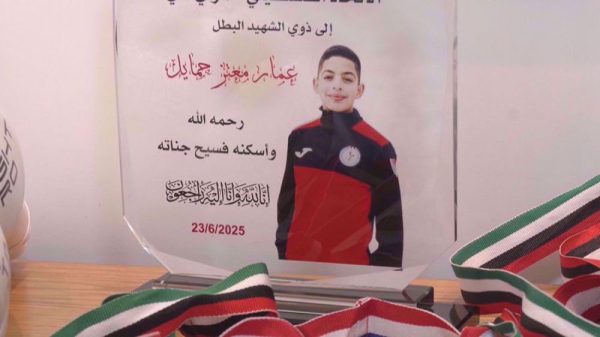
Hamayel, 13 years old, was a Thai boxing champion, dreaming of representing Palestine on the world stage. But like many other Palestinian children, his dream was silenced by Israeli bullets.
The IFMA back then said in a statement that the decision represents a peaceful yet firm protest against actions that “endanger children and violate the core values of global sport”.
In May, Spain was reportedly spearheading a coordinated initiative aimed at persuading the European Union to eliminate Israel from all continental sports competitions over its genocidal war on Palestinians in the besieged Gaza Strip.
Calls to exclude Israel from international sports events have indeed increased recently due to its relentless aggression against Gaza.
Yasser Abu Shabab: Israel’s agent of chaos in Gaza
By William Van Wagenen | The Cradle | August 8, 2025
In late July, the Wall Street Journal published an op-ed attributed to Yasser Abu Shabab, a Palestinian warlord with a criminal past, portraying him and his militia as potential saviors of Gaza.
The piece, echoing Israeli talking points, suggested that US and Arab support for Abu Shabab could swiftly “transform” most of the strip “from a war zone into functioning communities,” ostensibly free from Israeli bombardment and flush with humanitarian aid.
But behind this carefully crafted image lies an Israeli proxy – a man embedded in organized crime and political subterfuge, now repurposed to advance Israeli Prime Minister Benjamin Netanyahu’s plan to starve, displace, and ultimately ethnically cleanse Palestinians in Gaza.
Who is Abu Shabab?
Abu Shabab, 35, hails from Rafah in southern Gaza and belongs to the Bedouin Tarabin tribe, which spans Gaza, Israel’s Naqab, and Egypt’s Sinai. Before Operation Al-Aqsa Flood on 7 October 2023, he was notorious for his involvement in smuggling weapons, drugs, and contraband through Gaza’s tunnels and border crossings. He was also believed to have ties to extremist groups in Sinai, including the local ISIS affiliate, formerly known as Ansar Beit al-Maqdis.
Hamas authorities had imprisoned him for murder and drug trafficking, but he was released in October 2023 when Israeli air raids forced the movement to open its prisons.
Since then, Abu Shabab has rebranded himself as a “nationalist,” a “humanitarian,” and even a “liberator.”
But these claims are widely rejected by Palestinians, including members of his own tribe. A senior Tarabin elder publicly disowned him, labeling him a “looter and bandit” operating solely for personal gain. Aid officials echoed this assessment. One aid coordinator called him a “criminal, a fugitive … untrustworthy and mentally unstable.”
His own relatives have accused him of collaborating with the occupation military in targeted killings of Palestinians and have called for his “liquidation,” declaring his “blood is forfeit.”
Starving as warfare
After the 7 October resistance operation by Palestinian factions, then-defense minister Yoav Gallant – now a fugitive from international justice – announced a “complete siege” on Gaza, cutting off all access to food, water, fuel, and electricity. “We are fighting animals and are acting accordingly,” Gallant said in Hebrew.
Days later, a detailed proposal to forcibly expel all Palestinians from Gaza, under the pretext of protecting them, was prepared by Israel’s Ministry of Information.
Weeks later, the International Criminal Court (ICC) issued arrest warrants for both Gallant and Netanyahu on charges of war crimes and crimes against humanity, including the use of starvation as a method of warfare.
In response to mounting global scrutiny, Tel Aviv pivoted to a more insidious strategy: weaponizing hunger through sabotaging the existing UN aid distribution system.
In January 2024, Israel launched a smear campaign against the UN Relief and Works Agency (UNRWA), the main provider of aid to Gaza, falsely claiming it was infiltrated by Hamas operatives who took part in Operation Al-Aqsa Flood. The campaign was successful in pressuring western countries to cut the UN refugee agency’s funding.
Simultaneously, Israel slashed the number of aid trucks allowed into Gaza. By February, only 62 trucks entered daily – a fraction of the 500 required to prevent mass hunger.
Israel ensured even this amount of food would not reach those who needed it by carrying out a string of airstrikes against members of Gaza’s Hamas-run civilian police force. The attacks caused officers, who were protecting the convoys, to withdraw from the Palestinian side of the Kerem Shalom crossing.
According to the Washington Post, the amount of aid entering Gaza “collapsed,” as the convoys delivering it were then exposed to widespread looting by criminal gangs.
In May 2024, the occupation state further moved to sabotage the UN aid system by occupying and closing the Rafah crossing with Egypt, the route through which most aid had flowed, and redirecting it through the Kerem Shalom.
Tel Aviv’s looting agent
With the withdrawal of Hamas police, Abu Shabab and his gang established a base in southeast Gaza from which it could freely loot aid trucks entering the strip via Kerem Shalom, all while operating under Israel’s protection and watchful eye.
In October 2024, the UN issued a memo concluding that criminal gangs “may be benefiting from a passive if not active benevolence” or “protection” from the Israeli military. According to the memo, one gang leader established a “military like compound” in an area “restricted, controlled and patrolled by the IDF.”
The memo identified Abu Shabab as “the main and most influential stakeholder behind systematic and massive looting” of aid convoys.
The largest single looting incident occurred in November 2024. On that day, a huge joint convoy of 109 UN trucks carrying food supplies entered Gaza via Kerem Shalom – only to be ambushed and stripped bare by armed looters. According to UN officials, 98 out of the 109 trucks were raided, their food, fuel, and even tires stolen.
It was “the biggest looting of UN aid anywhere, ever,” in the words of an NPR reporter.
Crucially, a UN spokesperson noted the convoy had been rerouted on short notice by the Israeli military onto unfamiliar roads, ensuring it would fall prey to the gangs.
For months, Israel approved the use of only one road passing through a “desolate patch” of southeast Gaza, the Washington Post observed.
“The only route they give us is directly through the looters,” said one aid worker speaking with the newspaper.
Israeli media later reported that Abu Shabab’s group was armed with Kalashnikov rifles provided by “Israeli security bodies,” in a decision approved by Netanyahu, providing a further sign that Israel was behind Abu Shabab’s looting campaign.
Blaming Hamas
While covertly facilitating Abu Shabab’s looting, Israeli officials publicly blamed Hamas for stealing aid, in an effort to further restrict the entry of food to Gaza and deepen the hunger and starvation of its residents.
In the wake of the mass looting incident in November, it was reported that:
“COGAT, the Israeli military’s civilian affairs department for the Palestinian territories, has justified restrictions on the flow of goods by alleging repeatedly that Hamas is stealing aid and preventing it from reaching civilians.”
Israel’s cynical game was confirmed in May 2025 by Jonathan Whittall, the head of the UN Office for the Coordination of Humanitarian Affairs (OCHA) in the occupied Palestinian territories. In reference to Abu Shabab, he stated that:
“Israel has publicly claimed that the UN and NGO aid is being diverted by Hamas. But this doesn’t hold up to scrutiny. The real theft of aid since the beginning of the war has been carried out by criminal gangs, under the watch of Israeli forces, and they were allowed to operate in proximity to the Kerem Shalom crossing point into Gaza.”
Whittall’s comments were further validated by a July 2025 USAID report, which also confirmed Hamas had not been involved in stealing aid.
A war of attrition
In March 2025, Israel unilaterally broke a ceasefire reached with Hamas in January. Israeli leaders once again openly imposed a new siege on Gaza, preventing all aid from reaching the strip.
Then, in April, Israeli Defense Minister Israel Katz issued evacuation orders covering most of Gaza, while launching a new offensive pushing hundreds of thousands of Palestinians into an “ever-shrinking bubble,” CNN reported. Katz’s goal was to “empty” large parts of Gaza while treating anyone who refused to obey evacuation orders as a “combatant.”
While Israel claimed its objective was to defeat Hamas and free Israeli captives held by the group, CNN observed that, “Israel’s strategy may have another purpose; to make life so unbearable for Gazans crammed into an ever-smaller pocket of territory without proper shelter that they begin to head for the exit.”
Katz appeared to make this objective clear, saying amid the offensive and blockade that, “We are working to advance the plan for the voluntary migration of Gaza’s residents.”
According to Israeli Communications Minister Shlomo Karhi, the so-called migration plan would be anything but voluntary:
“The real and lasting answer will come only through the full advancement of the emigration plan – ‘Force him until he says, I want it.’”
Gaza ‘Humanitarian’ Foundation
In parallel, Netanyahu launched the Gaza Humanitarian Foundation (GHF), an aid mechanism staffed by former US special forces and contractors with opaque funding.
But the GHF, which began operating in May, did not distribute aid across Gaza. It established isolated “hubs” in the south, “designed as death traps.” Nearly 1,000 Palestinians were shot at or killed while seeking food from these hubs. Some were targeted by armed GHF security guards, while others were targeted by Israeli soldiers opening fire on starving crowds with sniper rifles, mortar shells, and even tank fire.
Despite the danger, Palestinians needing aid to prevent their children from starving had no choice but to come to the GHF sites, which meant relocating to tent camps near them.
The GHF was part of Israel’s military operation “Gideon’s Chariots,” with the stated objective of the “concentration and movement of the population.” In June, Tel Aviv admitted its goal: relocating all Gazans to a southern “sterile zone” surrounding the GHF hubs.
The UN and aid groups quickly rejected the GHF aid model, saying Israel was “using food as a tool for forced displacement.”
Concentration camps
As hunger deepened, Abu Shabab posted videos inviting displaced Palestinians to settle in his Israeli-guarded tent city in eastern Rafah.
He claimed to launch a recruitment drive to staff “administrative and community committees,” which would include doctors and nurses, engineers, primary school teachers, and public relations experts.
Abu Shabab claimed that more than 2,000 civilians were already living in his “protected zone,” and that his Popular Forces, allegedly consisting of just 100 armed men, had built schools, health centers, and other civilian infrastructure there.
Speaking with the Washington Post, he asked for support from the US, EU, and Arab states.
“We hope they support our vision and empower us to make all people in the Gaza Strip live like we do, taking control of our own areas in dignity and humanity,” Abu Shabab stated.
However, his attempt to bring “dignity” to Palestinians was soon revealed to be the first stage of an Israeli effort to build a massive concentration camp in Rafah.
On 7 July, Defense Minister Katz announced a plan to build a “humanitarian city” on the ruins of Rafah, in the same area where Israel allowed Abu Shabab’s Popular Forces to establish their base and tent camp.
The plan would begin by moving 600,000 Palestinians, primarily from the tent camps in the Al-Muwasi area, into the new zone after a security screening. The remainder of Gaza’s over 2 million Palestinians would be moved there later.
“Once inside, residents would not be allowed to leave,” Haaretz reported, citing the defense minister.
The planned “humanitarian city,” which no one would be “allowed to leave,” was quickly acknowledged as a concentration camp and the first step toward the complete ethnic cleansing of Gaza, including by former Israeli Prime Minister Ehud Olmert.
“It is a concentration camp. I am sorry … this is part of an ethnic cleansing,” Olmert told The Guardian. “It is to deport them, to push them, and to throw them away.”
Manufactured governance, planned chaos
In June, Prime Minister Netanyahu finally acknowledged support for Abu Shabab, saying on social media that Israel had “activated” some Palestinian clans in Gaza, on the advice of “security officials.”
Netanyahu’s comments affirmed previous reports in Israeli media that the operation to arm Abu Shabab and other clan-based gangs was “planned and managed” by the Shin Bet to create “alternative governing structures” that challenge Hamas.
The strategy mirrored the occupation state’s project to create “village leagues” in the occupied West Bank in the 1970s and 80s. The project involved backing local clan leaders with funds, weapons, and privileges to weaken the Palestine Liberation Organization (PLO) and block Palestinian statehood.
“It’s the oldest colonial strategy in the book,” said Rashid Khalidi of Columbia University. By supporting Abu Shabab, Israel had succeeded in “sowing utter chaos,” which Israel wants” because if the Palestinians are unified, then they might have to actually negotiate or deal with them,” Khalidi added.
In addition to helping Israel starve Palestinians and establish a concentration camp for their eventual ethnic cleansing from the Gaza, Abu Shabab has vowed to help in the next stage of the chaos Israel has planned: civil war.
“There is no stopping a civil war against Hamas,” Abu Shabab stated in an interview with Israeli public broadcaster KAN in July, claiming that his Popular Forces “will be the heirs in Gaza” after Hamas is “crushed and defeated.”
Far from empowering Palestinians, Abu Shabab is simply a tool of Israeli strategy – facilitating the starvation, fragmentation, and displacement of his own people to serve the occupation state’s long war on Palestinian liberation.
Gaza Faces Unrelenting Israeli Attacks Amid Global Indifference
Al-Manar | August 8, 2025
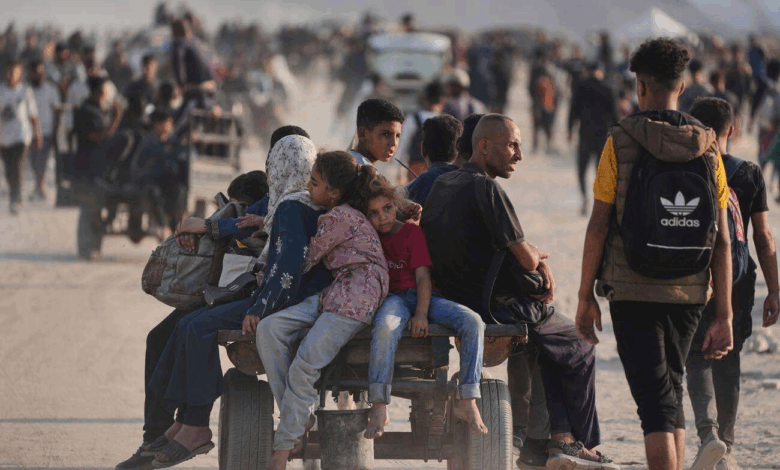
As the Israeli war on Gaza Strip stretches into its 672nd day, Israeli forces are intensifying their military campaign, characterized by relentless airstrikes and artillery bombardments that have devastated the region. This grim reality unfolds amid ongoing American political and military support, as well as a troubling silence from the international community and Arab states.
Recent reports from Palestinian sources indicate that multiple citizens have lost their lives due to Israeli army fire since Friday dawn. Eyewitnesses stated that forces targeted individuals awaiting aid along the Netzarim axis in central Gaza, while others suffered injuries from gunfire near the Asdaa area northwest of Khan Yunis.
In further acts of aggression, Israeli artillery shelled areas close to an electricity company north of the Nuseirat refugee camp early Friday. Additionally, Israeli aircraft conducted strikes on a building in the Japanese neighborhood north of Khan Yunis, further escalating the aggression.
With unwavering American support, Israeli occupation forces are waging a genocidal war on the Gaza Strip, which has so far left 61,258 martyrs, 152,045 wounded, and more than 10,000 missing. This is in addition to a famine that has claimed the lives of dozens, while more than two million Palestinians are living in conditions of forced displacement amidst total destruction.
Among the martyrs are 9,752 martyrs and 40,004 wounded, who fell after the occupation reneged on the ceasefire agreement on March 18, 2025.
Massive civilian flotilla set to sail for Gaza late August to break Israeli siege

Freedom Flotilla Coalition’s Handala departs from Gallipoli to reach Gaza to deliver humanitarian aid and break the Israeli blockade, July 20, 2025. [Valeria Ferraro – Anadolu]
MEMO | August 4, 2025
A massive civilian flotilla is set to depart for the Gaza Strip at the end of August in a new bid to break Israel’s blockade that has left the territory’s entire population on the verge of famine, Anadolu reports.
Speaking at a press conference in Tunis hosted by the Joint Action Coordination for Palestine, a civil society coordination platform, members of the Global Sumud Flotilla said activists from 44 countries have signed up for the coordinated effort.
“This summer, dozens of boats, both large and small, will set sail from ports across the world, converging on Gaza in the largest civilian flotilla of its kind in history,” said organizer Haifa Mansouri.
The flotilla brings together four initiatives: the Maghreb Sumud Flotilla, the Global Movement to Gaza, the Freedom Flotilla Coalition, and Sumud Nusantara. Their united aim, Mansouri said, is to “break the illegal blockade on Gaza by sea, establish a humanitarian corridor, and confront the ongoing genocide against the Palestinian people.”
The first convoy will leave Spanish ports on Aug. 31, followed by a second from Tunisian ports on Sept. 4.
Seif Abu Keshk, another organizer, said more than 6,000 activists have already registered online to join.
“Participants will undergo training at departure points, with solidarity events and encampments planned along the way,” he added.
“This is a renewed attempt to pressure governments by sending dozens of ships and thousands of activists to break Gaza’s blockade,” Abu Keshk noted.
The announcement comes days after Israeli naval forces intercepted the Handala aid ship on July 26 as it neared Gaza’s shores and escorted it to Ashdod Port. The vessel had reached about 70 nautical miles from Gaza, surpassing the distance covered by the Madleen, which made it 110 miles before being stopped, according to the International Committee to Break the Siege on Gaza.
Rejecting international calls for a ceasefire, the Israeli army has pursued a brutal offensive on Gaza since Oct. 7, 2023, killing nearly 61,000 Palestinians, almost half of them women and children. The military campaign has devastated the enclave and brought it to the verge of famine.
Last November, the International Criminal Court issued arrest warrants for Israeli Prime Minister Benjamin Netanyahu and his former Defense Minister Yoav Gallant for war crimes and crimes against humanity in Gaza.
Israel also faces a genocide case at the International Court of Justice for its war on the enclave.
Report: Mass Abductions, Torture, Enforced Disappearances

IMEMC | August 4, 2025
A joint report issued by the Commission for Detainees and Ex-Detainees Affairs, the Palestinian Prisoners’ Society, and Addameer Prisoner Support and Human Rights Association has revealed a serious escalation in the mass abduction of Palestinians and accompanying violations since the beginning of the genocide in Gaza in October 2023.
According to the report, approximately 18,500 Palestinians have been abducted across the occupied West Bank and Jerusalem since the genocide began, part of a systematic campaign targeting civilians under the pretext of security operations.
Women and Children Among the Abducted
The number of women abducted has reached around 570, including individuals from Gaza, the West Bank, and the 1948-occupied territories.
This figure excludes dozens of women forcibly disappeared from Gaza, where access to information is still obstructed.
In parallel, at least 1,500 children have been abducted across the West Bank, prompting alarm from human rights organizations over breaches of international conventions protecting minors.
Journalists Silenced Through Detention
More than 194 journalists have been abducted, with 49 still imprisoned. Many of these cases are viewed as attempts to suppress documentation of abuses and silence independent reporting.
Torture, Destruction, and Human Shield Tactics
The report highlights a pattern of grave abuse accompanying abduction operations:
- Beatings and torture
- Threats against abductees and their families
- Systematic invasions and violations, including home demolitions
- Seizure of vehicles, personal belongings, and valuables
- Destruction of infrastructure in refugee camps, notably in Jenin and Tulkarem
- Use of civilians, including children and family members, as human shields, and hostages
Mass Abductions and Enforced Disappearances
The wave of abductions includes individuals taken from their homes, at military roadblocks, coerced into surrender under duress after the army abducted members of their families and held them as hostages.
Thousands of Gaza workers present in the 1948-occupied areas with legal permits were abducted, alongside hundreds from Gaza who were in the West Bank for medical treatment, or for work.
Field executions have also been reported, including among family members of detainees.
Deaths in Custody and Withheld Remains
Since October 7, at least 75 Palestinians have died in Israeli custody, with 46 confirmed as Gaza detainees.
Many others remain forcibly disappeared, their identities and causes of death unacknowledged.
Israel continues to hold the bodies of 72 prisoners, bringing the total number of withheld martyrs to 83.
Detainee Statistics – July 2025
As of July 2025, the total number of Palestinians imprisoned stands at 10,800, the highest recorded since the Second Intifada. This figure excludes individuals held in prison camps run by the Israeli army.
Administrative and “Unlawful Combatant” Detainees: July 2025
As of early July 2025, the number of administrative detainees held by Israeli authorities has reached 3,629, the highest recorded figure to date.
This category, which allows for detention without charge or trial, now exceeds all other classifications, including those formally indicted, sentenced, or labeled as “unlawful combatants.”
The number of detainees classified as “unlawful combatants” stands at 2,454, though this figure does not include most Gaza detainees held in Israeli military camps.
This is the largest documented count since the onset of Israel’s genocidal campaign. The classification also encompasses Arab detainees from Lebanon and Syria.
- These figures exclude individuals subjected to enforced disappearance or held in Israeli military camps, particularly from Gaza.
- These figures encompass both those still held and those who were later released. The numbers remain fluid due to ongoing abduction campaigns.
- Due to ongoing genocide, destruction and siege in Gaza, data regarding the number of detainees from the costal enclave is still scarce.
- By mid-December of 2024, the number of detainees who were abducted in the Gaza Strip was estimated to be 3,436.
Child in Gaza kisses aid worker’s hand before being fatally shot by Israeli forces
MEMO | July 31, 2025
 A resigned US Army soldier who served at an aid distribution point in Gaza, affiliated with the Gaza Humanitarian Foundation (GHF), has shared a heartbreaking account of the final moments of a Palestinian boy known as “Gaza’s little Amir”, who was shot dead by Israeli forces shortly after receiving a small portion of food.
In his testimony, the former soldier, Anthony Aguilar, recalled the tragic events of 28 May, when the boy Amir was killed while trying to get food.
Amir, who was barefoot and visibly thin, walked 12 kilometres under the scorching sun, hoping to find something to eat after hours of waiting. All he managed to gather was a handful of rice and lentils from the ground, Aguilar said.
He went on to describe a deeply emotional moment, saying that the child had approached him, set down his belongings, gently placed his small hands on the soldier’s face, kissed his hand, and thanked him in English. The boy then picked up his things and returned to the crowd. Just minutes later, as he was leaving with other civilians, Israeli forces reportedly opened fire with gas and live ammunition, striking Amir and killing him on the spot.
Aguilar added that the day was no different from others in Gaza — except that death came quicker.
Israelis committing genocide in Gaza, with US ‘complicit’: Mearsheimer
MEMO | July 31, 2025
John Mearsheimer, professor of political science at the University of Chicago, said that “the Israelis are executing a genocide in Gaza,” adding that the US is “complicit in that genocide,” Anadolu reports.
What is happening in Gaza is a systematic effort by Israel to dismantle the Palestinian national identity, Mearsheimer said in an interview with media personality Tucker Carlson published on Wednesday.
He added that Israel is targeting Palestinians specifically as a group, aiming not only to kill large numbers but also to erase their identity as a people.
Mearsheimer believed that the Israelis have long aimed to expel the Palestinian population from what they consider “Greater Israel.”
“If you look at Greater Israel, this includes the Israel that was created in 1948 and the occupied territories. This is the West Bank, Gaza, and what we call the Green Line Israel. That’s Greater Israel,” the scholar said.
“October 7th happens, and what the Israelis see is an excellent opportunity for ethnic cleansing. And they make this clear.
“In other words, it’s an excellent opportunity to go to war in Gaza and drive the Palestinians out of Gaza and solve that demographic problem that they face,” he added.
Israel also carried out large-scale ethnic cleansings in the region in 1948 and 1967, and Mearsheimer described the latest campaign in Gaza as “the third attempt at a massive ethnic cleansing.”
The Israeli army, rejecting international calls for a ceasefire, has pursued a brutal offensive on Gaza since Oct. 7, 2023, killing more than 60,000 Palestinians. The relentless bombardment has devastated the enclave and led to food shortages.
Israel wants to ensure that its neighbors are ‘weak’
One of Israel’s goals is also to ensure that its neighbors are “weak,” said Mearsheimer, noting that “that means breaking them apart, if you can, and keeping them broken.”
He said the ethnic cleansing is a topic “that the Zionists talked about from the get-go, and they talked about extensively because there is no way they could create a Greater Israel without doing massive ethnic cleansing.”
David Ben Gurion, Vladimir Jabotinsky, and other prominent Zionist leaders are fully aware that achieving their goals would require doing “horrible things” to the Palestinians, he said.
The scholar highlighted that those Zionist leaders acknowledged this and even stated openly that they did not blame the Palestinians at all for resisting the actions planned by Jews arriving from Europe.
“They fully understood that they were stealing their land. And they fully understood that it made perfect sense for the Palestinians to resist, which of course they did,” Mearsheimer noted.
“They (Israel) start with the goal of ethnic cleansing. I don’t believe they want to murder all of the Palestinians in Gaza.
“They simply want to drive them out. But the problem is they don’t leave. And then the question is, what do you do? And what they do is they continue to up the attacks, increase the attacks, (and) kill more and more people in the hope that they will drive them out,” he added.
Israel lobby in US
Mearsheimer stressed that when a major power like the US has conflicting interests with another country, it prioritizes its own, following an “America first” approach. However, regarding Israel, it’s the opposite — it is “Israel first,” he stated.
Washington’s policy in the Middle East clearly reflects this, with plenty of evidence to support it, the scholar underscored.
Mearsheimer, who is also the co-author of the book The Israel Lobby and U.S. Foreign Policy, said that the reason for this is due to the Israel lobby in the US.
“I think the lobby is an incredibly powerful interest group, and I’m choosing my words carefully. It has awesome power, and it basically is in a position where it can profoundly influence US foreign policy in the Middle East. And indeed, it affects foreign policy outside of the Middle East.
“But when it comes to the Middle East, and again, the Palestinian issue in particular, it has awesome power. And there’s no president who is willing to buck the lobby,” he added.
How much is shoddy, pro-Israel journalism worth? Ask Bari Weiss.
As her Free Press is poised to seal a $200 million deal with the mainstream news giant CBS, let us reflect on why
By Branko Marcetic | Responsible Statecraft | July 29, 2025
A thought experiment: would anyone who referred to the killing of 50 Jewish people, many of them “entirely innocent non-combatants, including children,” as “one of the unavoidable burdens of political power, of Palestinian liberation’s dream turned into the reality of self-determination,” ever be hired by a major television news network?
Would their news outlet ever be potentially offered more than $200 million to merge with that major news network?
Of course not, and for good reason. Yet that’s exactly what’s happening, only with one small but major difference: the writer and her news outlet responsible for this statement, Bari Weiss and The Free Press, were not talking about Hamas’ murder of Israelis, but rather about Israel’s killing of 50 Palestinians — “Zionism’s dream turned into the reality of self-determination,” as Weiss described it in 2021.
Weiss is currently in talks to sell The Free Press to CBS News for between $200-$250 million, after reportedly winning over its new owner, David Ellison, “by taking a pro-Israel stance,” according to the Financial Times. Ellison “wants to position The Free Press alongside CBS News,” the paper reported, while another source told the New York Times that Ellison is weighing up giving Weiss “an influential role in shaping the editorial sensibilities of CBS News.”
If so, it would be a major new development in a pervasive double standard we’ve seen in the past nearly two years. Weiss and her outlet have engaged in rhetoric and professional behavior that would ordinarily never pass muster in a newsroom — but are considered acceptable because they are in support of Israel’s war against Palestinians.
For one, The Free Press has repeatedly spread misinformation. In May 2024, the outlet charged that the UN had “admit” the civilian death toll was 50 percent lower than what was being claimed, a quickly debunked and borderline willful misreading of a UN document, a misreading that the UN secretary-general’s office swiftly came forward to correct (a fact left out of The Free Press’ piece).
One year later, The Free Press declared the idea that Israel was engineering a man-made famine that was underway in Gaza a “myth,” even as Israel was in its third month of blocking all food, fuel, and medicine into the territory and at least 57 civilians had already starved to death, most of them children. As recently as this past Sunday, another Free Press article argued that “there isn’t mass starvation as claimed by pro-Hamas propaganda,” which flies in the face of not just basic reality, but testimony from doctors, major news organizations with journalists on the ground, and even the conclusion of President Donald Trump, a supporter of the war.
Just this past June, The Free Press charged simultaneously that there had both been no massacre of Palestinian aid seekers, and that, if there was, Hamas may have been responsible. Of course, since then, not only have Israeli soldiers admitted to shooting aid-seekers but U.S. contractors are coming forward to back up their gruesome stories. These accounts are becoming a near-daily occurrence, with over 1,000 Gazans killed at or close to aid distribution sites in the past two months.
In late May, The Free Press even published a puff piece on the group running these virtual slaughterhouses, the Gaza Humanitarian Foundation (GHF), painting it as an unsung success story, despite ample controversy at the time over its reliance on mercenaries and lack of independence. Two months of bloodshed later, condemnation and calls for GHF’s dismantling are widespread, with one former GHF staffer — a retired U.S. special forces officer — saying he had never witnessed such brutality and indiscriminate violence against “an unarmed, starving population” as at GHF’s distribution centers.
All of these pieces are still up, uncorrected on The Free Press website. And this is by no means an exhaustive list.
When it’s not spreading outright misinformation, The Free Press engages in more insidious propaganda. For instance, it has, depending on the public relations needs of the moment, shifted between ignoring, indignantly denying, and justifying Israel’s attacks on Gaza’s hospitals.
When a blast in the war’s first month that killed hundreds at al-Ahli Hospital ignited global outrage, The Free Press jumped on evidence that it may have been an errant Hamas rocket to charge again and again and again, even as recently as two days ago, that the media were rampantly defaming Israel through fake news of crimes it had never committed.
Since then, The Free Press has simply ignored the Israeli attacks on hospitals, often openly done and fully admitted to by the IDF, that have left 94 percent of hospitals in Gaza damaged or destroyed, including just this year attacking al-Ahli at least twice. In fact, both the outlet and Weiss personally pivoted quickly from denying Israel would do such a terrible thing to actively justifying its targeting of hospitals.
Of course, the vast majority of Israel’s war crimes in Gaza are simply never discussed by the outlet. The same goes for Palestinian suffering more generally and the massive and ever-mounting Palestinian death toll, which a group of experts last year concluded is likely undercounted by hundreds of thousands. Typically, the only time these topics are discussed by the outlet is to deny them and to lament their negative effect on Israel.
This is hardly surprising, considering new revelations that The Free Press has serially regurgitated content pushed by the Center for Peace Communications — an organization staffed by figures from pro-Israel think tanks and funded by money from pro-Israel donors.
Another largely absent topic: antisemitism, which is a charge The Free Press exclusively reserves for antiwar protesters, college campuses, teachers unions, Peter Beinart, Ireland, and anyone else who expresses pro-Palestinian sentiment, while it dutifully ignores accusations of antisemitism among Trump appointees and nominees and allies who also happen to be supporters of Israel’s war.
That brings us to the conduct of Weiss herself. She has a personal history of both playing fast and loose with the truth and what can only be described as a high degree of tolerance for anti-Arab and Islamophobic bigotry.
Weiss first rose to prominence due to her efforts to get Muslim and Arab professors at Columbia University fired by accusing them of racism, only for the resulting investigation to find “no evidence of any statements made by the faculty that could reasonably be construed as anti-Semitic.” She then later misleadingly claimed she had never tried to get them fired.
The supposedly rabid bigotry of ordinary Muslims is a favorite topic of Weiss, who has previously blamed rising antisemitism in Europe on the Muslim presence there, and warned that European Jews have “reason to worry” because of it. Soon after October 7, she approvingly shared a Free Press article whose central argument was that protests against Israel’s war — dishonestly characterized as hateful antisemitic rallies “celebrat[ing] mass murder in the streets” — were thanks to immigrants from Middle Eastern countries who could be either “80-year-old Armenian retirees or jihadi terrorists plotting another 9/11.” The Free Press later published an error-riddled article explicitly blaming a surge in Canadian antisemitism on Muslim immigration.
At the same time, Weiss has often promoted, often through The Free Press, her “friend” Ayaan Hirsi Ali. Hirsi Ali believes that “we are at war with Islam,” which she has called “a destructive, nihilistic cult of death,” that “there is no moderate Islam,” and that it must be “defeated” and “crush[ed],” including by closing all Muslim schools.
Ali has been a favorite of Islamphobic think tanks and neoconservative activists since the Global War on Terror. She has written that “every devout Muslim” at the very least “approved” of Al Qaeda’s 9/11 attacks and wrote a book that argued that Muslim immigration threatens the rights of Western women, partly because of Muslim men’s supposedly rapacious appetite for sexual violence.
Weiss eagerly promoted that book, spending an hour teeing Hirsi Ali up in a question and answer session to hold forth unchallenged about the dangers of ordinary Muslim men. Elsewhere, Weiss has waxed lyrical about her pride in associating with Hirsi Ali, and that she regards someone’s support for her as a “litmus test.”
If Weiss expressed or promoted any of these same views about Jewish immigrants and Judaism, she would likely be blacklisted in U.S. media, and for good reason. Instead, because they are aimed at Muslims, she is now being richly rewarded.
That a major network like CBS is seriously considering giving Weiss and The Free Press an even bigger platform and the imprimatur of mainstream legitimacy — given not just its promotion of anti-Muslim views, but its history of spreading outright, uncorrected falsehoods — is a sad reflection of the degradation of press standards.
And it seems to only be happening because a top media executive regards Weiss’ history of shoddy journalism less important than her support for Israel’s wars.
Egypt training hundreds of Palestinians for ‘Gaza security roles’
The Cradle | July 30, 2025
Egypt is training hundreds of Palestinians to assume security responsibilities in Gaza after the war ends, Egyptian Foreign Minister Badr Abdelatty told Al Arabiya in an interview yet to be aired.
“Egypt is training hundreds of Palestinians to take on security responsibilities in Gaza,” Abdelatty said, adding that Cairo has a clear plan for governance and security in the strip following the end of hostilities.
He said the plan is already being implemented. In April, he told the Antalya Diplomacy Forum in Turkiye that Egypt had begun recruiting and training Palestinian police who would “take care of the law, order, and security in Gaza.”
At the time, he also stated that Egypt was prepared to support the deployment of an international force “to provide security and protection for the Palestinians.”
Abdelatty confirmed that Egypt continues to work toward a ceasefire and holds daily talks with Qatar and the US. He accused Israel of weaponizing hunger, saying starvation in Gaza is “beyond imagination.”
Cairo’s initiative was first unveiled in March as part of a $53 billion reconstruction and governance proposal endorsed by the Arab League and the Organization of Islamic Cooperation (OIC).
It came in response to US President Donald Trump’s announcement that Washington would “take over” Gaza and relocate its population.
According to a source cited by Ultra Palestine in April, around 300 Palestinian Authority (PA) officers were selected for training in Egypt, with personnel instructed not to refuse the assignment “under penalty of liability.”
The source said the training would last two months and declined to elaborate on the assigned tasks.
The Egyptian plan envisions a phased reconstruction process and transfer of authority from Hamas to the PA. The Palestinian resistance has agreed to a previous Egyptian proposal for a Community Support Committee to govern Gaza, but rejected Cairo’s demand that it hand over its weapons.
The demand to disarm has been renewed and endorsed by the Arab League and Turkiye in the latest UN session in New York that took place on 29 July.
Israel has been continuously escalating military operations across Gaza and has made disarmament a condition for any ceasefire.
On Tuesday, Israeli ministers reportedly discussed formally occupying and annexing parts of Gaza.
Finance Minister Bezalel Smotrich recently led a far-right conference promoting Israeli resettlement in the strip as a “Gaza Riviera.”
Germany blocks EU effort to impose sanctions on Israel over Gaza
MEMO | July 30, 2025
Germany and several other European countries are blocking a proposal to impose sanctions on Israel over its role in worsening the humanitarian situation in the Gaza Strip, according to diplomats.
EU member states’ permanent representatives convened in Brussels but failed to reach a consensus to initiate the formal decision-making process.
Diplomats said countries, including Germany, called for more time and further analysis of the situation on the ground.
Some delegations also raised concerns that sanctions might harm essential dialogue with the Israeli authorities.
Under EU rules, any proposal must be backed by at least 15 of the 27-member states, representing at least 65 per cent of the EU population, to proceed.
Germany and Italy are considered key players in the talks, while all other major European countries, along with several smaller ones, have shown openness to the idea of imposing sanctions.
Yemeni army announces ‘new phase’ of attacks on Israel-linked ships
Press TV – July 27, 2025
The Yemeni Armed Forces have announced plans to escalate military operations against Israel in response to the ongoing humanitarian crisis in Gaza.
In a statement issued on Sunday evening, the Yemeni Armed Forces called on nations around the world to exert pressure on the Israeli regime to cease its aggression and lift the blockade on Gaza to prevent further escalation.
They emphasized that their decision to intensify attacks on Israel stems from their moral and humanitarian obligation to address the suffering of the Palestinian people.
The Yemeni Armed Forces highlighted the rapid developments in occupied Palestine, particularly in the Gaza Strip, where the ongoing conflict has resulted in the deaths of thousands of Palestinians amid a prolonged siege and military assault.
They said that in light of the continued, horrific massacres occurring in our contemporary history, Yemen finds itself facing a profound religious, moral, and humanitarian responsibility toward the oppressed people who are subjected daily to relentless killing and destruction by air, land, and sea bombardments.
The severe blockade has led to starvation and thirst in steadfast and proud Gaza, which is unacceptable to any human being, especially Arabs and Muslims, the statement read.
Consequently, the Yemeni Armed Forces said they have decided to escalate military support operations and implement a fourth phase of a naval blockade against Israel. This phase includes targeting all ships belonging to any company that engages with Israeli ports, regardless of the company’s nationality, in locations accessible to the Yemeni armed forces.
The Yemeni Armed Forces have issued a warning to all companies to cease dealings with Israeli ports immediately upon the announcement of this statement. Failure to comply will result in their vessels being targeted anywhere within reach of Yemeni missiles and drones.
The Armed Forces reiterated their call for countries to intervene to prevent this escalation, urging them to pressure Israel to halt its aggression and lift the blockade on the Gaza Strip. “There is no free person on this earth who can accept what is happening,” they stated.
The actions of the Yemeni Armed Forces reflect a moral and humanitarian commitment to stand against the injustice faced by the Palestinian people. They declared that all military operations would cease immediately upon the cessation of aggression against Gaza and the lifting of the blockade, the statement said.
The Yemeni army condemned the persistent aggression against Gaza, attributing it to what they described as the shameful silence of the Arab, Islamic, and international communities.
Since the onset of the conflict in Gaza, the Yemeni Armed Forces have launched numerous attacks on vessels bound for Israel and have targeted locations deep within the occupied Palestinian territories using missiles and drones.
Israeli officers admit spoiling aid from 1,000 trucks at southern Gaza’s Kerem Shalom crossing
MEMO | July 26, 2025
Israeli officers have admitted Friday to spoiling food, water and medical supplies that were packed in more than 1,000 aid trucks at the Kerem Shalom crossing that were left to rot after their distribution into the Gaza Strip was blocked, Anadolu reports.
According to the Israeli public broadcaster KAN, the aid trucks were carrying tens of thousands of humanitarian parcels. They had been left for weeks under the sun at the crossing without being distributed, until they spoiled.
The Gaza Ministry of Health announced Friday that the death toll from hunger and malnutrition since October 2023 has reached 122 Palestinians, including 83 children.
One Israeli officer told KAN: “We buried everything in the ground, and some of the supplies we burned,” without specifying the timing of the incident.
He added: “Even now, thousands of parcels are sitting in the sun. If they’re not allowed into Gaza, we’ll have to destroy them too.”
Military sources told KAN that “only 100 to 150 trucks are allowed to enter the Palestinian side of the crossing per day, and most of them are not unloaded due to the breakdown of the distribution mechanism.”
Another Israeli officer said: “The mechanism isn’t functioning. Trucks are halted, the roads are unusable, and coordination isn’t happening.”
He added: “We have here the largest grain storage in the world, and if the current goods aren’t taken soon, we will destroy and bury them.”
Famine has worsened dramatically inside Gaza. Circulating images and videos show Palestinians whose bodies appear skeletal due to extreme starvation, in addition to suffering from nausea, exhaustion and loss of consciousness.
On Tuesday, the World Food Program warned that one-third of Gaza’s population had gone several days without eating due to the continued Israeli blockade.
Since March 2, Israel has backtracked on implementing a ceasefire and prisoner exchange deal with Hamas and has kept Gaza’s crossings shut, leaving hundreds of aid trucks stranded at the borders.
Rejecting international calls for a ceasefire, the Israeli army has pursued a brutal offensive on Gaza since Oct. 7, 2023, killing more than 59,600 Palestinians, most of them women and children. Deaths by starvation have climbed in recent days due to a months-long blockade and poor distribution of aid by the controversial Gaza Humanitarian Foundation.
Last November, the International Criminal Court issued arrest warrants for Israeli Prime Minister Benjamin Netanyahu and his former Defense Minister Yoav Gallant for war crimes and crimes against humanity in Gaza.
Israel also faces a genocide case at the International Court of Justice for its war on the enclave.
Featured Video
Dr. Tony Martin – The Jewish Role in the African Slave Trade
or go to
Aletho News Archives – Video-Images
In Memoriam
James Petras, In Memoriam
 02.13.2026
Professor James Petras, 89, world-renowned sociologist, public intellectual, and scholar of Latin American politics and global economics, died peacefully on January 17, 2026, in Seattle, WA, surrounded by family.
A prolific scholar and activist, he devoted his life to challenging power, imperialism, and inequality. … continue
Blog Roll
 Aletho News
- Israel ready to strike Iran-backed armed groups – media
- Behind US war drums against Iran: No goals, no plan, no off-ramp
- With Ukraine blamed for cutting oil flows to Hungary, Croatia also refuses to transfer Russian oil in violation of EU law
- Friedrich Merz’s Push to End Online Anonymity Has a Troubling Subtext
- Macron: French citizens fighting for Israel cannot be labeled ‘genociders’
- US eyes Gaza security force drawn from armed gangs
- The Only Motive Behind The ‘Imminent’ U.S. War With Iran Is The Zionist Lobby
- Trump eyes 350-acre US military base housing 5,000 troops in Gaza
- Israel Pushing US Toward a Big and Damaging War With Iran – Ex-Pentagon Analyst
- Meet The Liberal Zionist And Ukraine War Supporter Advising AOC On Foreign Policy
- If Americans Knew
- Israeli Settlers Kill American Teen
- ‘We returned from hell’: Palestinian journalists recount torture in Israeli prisons
- No mercy for Gaza in Ramadan – Not a ceasefire Day 133
- The Israeli Government Installed and Maintained Security System at Epstein Apartment
- Tucker Carlson interrogated in Israel, has passport seized after interviewing US ambassador
- 6,000 Amputees in Gaza Face Impossible Recovery amid Israeli War Ultimatum
- The Lancet: Gaza death toll far higher than reported – Not a ceasefire Day 132
- Compliant aid: Who are the Israel-approved NGOs scaling up in Gaza?
- Why won’t Trump’s “Board of Peace” bring peace? – Not a ceasefire Day 131
- Help end the injustice against Shadi
- No Tricks Zone
- Coal Power Back In Trend As Globe Tries To Keep Pace With Growing Demand For Power
- New Study: A 4°C Warmer Beaufort Sea Had ‘No Sea Ice’ 11,700 – 8200 Years Ago
- Unfudging The Data: Dutch Meteorological Institute Reinstates Early 20th Centruy Heat Waves It Had Erased Earlier
- German Gas Crisis…Chancellor Merz Allegedly Bans Gas Debate Ahead of Elections!
- Pollen Reconstructions Show The Last Glacial’s Warming Events Were Global, 10x Greater Than Modern
- Germany’s Natural Gas Storage Level Dwindles To Just 28%… Increasingly Critical
- New Study Rebuts The Assumption That Anthropogenic CO2 Molecules Have ‘Special’ Properties
- Climate Scientist Who Predicted End Of “Heavy Frost And Snow” Now Refuses Media Inquiries
- Polar Bear Numbers Rising And Health Improving In Areas With The Most Rapid Sea Ice Decline
- One Reason Only For Germany’s Heating Gas Crisis: Its Hardcore-Dumbass Energy Policy
 Aletho News