GHF contractor reveals ‘horrific’ details of US-Israeli ‘aid traps’
The Cradle | June 12, 2025
An anonymous US security contractor employed at one of the Gaza Humanitarian Foundation’s (GHF) aid sites in the Gaza Strip has slammed the entire initiative as “pure chaos,” calling it “absolutely horrific” while accusing Israeli forces of continuously firing at unarmed Palestinians.
“I thought I was signing up for an aid mission. But what I’ve witnessed in Gaza is horrific,” the anonymous contractor wrote in a Zeteo article published on 12 June. “I am one of hundreds of security contractors who have been in Gaza to facilitate aid under the new US-backed GHF project. And it’s all bullshit,” the contractor added.
The contractor said his group of 300 people who were deployed to Gaza were provided with machine guns and pistols, and that while some of them had a military background, others did not – stressing “no one was tested to ensure they had proper training.”
“We were later issued less lethal options: pepper spray, flashbang grenades. You guessed it: no one was tested to see if they knew how to properly use them. How close to people can you throw a flashbang? If you’re going to pepper-spray someone, where do you spray? For how long? Nobody knows because nobody told us. We’re talking about people who don’t have access to water, and we’re ready to spray them in the face with pepper spray,” he said.
The contractor also stressed that no cultural awareness training was offered.
He confirmed that on the second day after the GHF was launched, the site he operated at was completely overrun by starving Palestinian civilians. “They were never aggressive towards us,” the contractor made sure to emphasize.
After falling back a second time, the contractor confirms that his group was ordered to expel all the aid seekers from the area, and that he witnessed other contractors firing live ammunition into the air.
One even pushed a Palestinian to the ground.
“We all got in a line and began pushing these people out. We’re telling crying women trying to pick up food for their families that they had to go. They were looking at this food on the ground that they desperately needed, and they couldn’t take it. It was absolutely horrific.”
“I was later told that the Israeli military needed to clear those people out because they were going to come through. They soon showed up with tanks, as some sort of security presence, but we had pushed people out by then,” he went on to say, adding that “This idea that the Israeli military isn’t involved is bullshit.”
The contractor confirmed that the Israeli military has set up offices in the GHF compounds.
While they are not directly “on-site” during the aid operations, their tanks and sniper units are just hundreds of meters away, and “You can hear them shooting all day.”
The contractor notes one specific episode where hundreds of Palestinians approaching an aid site came under Israeli artillery fire.
“Tanks fire all day long near these aid sites. Snipers fire from what used to be a hospital. Bombs and bullets fly all day long in one direction – toward Palestinians … But never any fire from the opposite direction,” he added, calling the distribution sites “aid traps.”
“The west doesn’t really want to believe the Palestinian media,” the contractor also said.
Just two days ago, at least 36 aid seekers were killed and another 208 injured by Israeli attacks on GHF sites.
A video circulating online shows Israeli artillery shelling a group of civilians on the morning of 10 June as they attempted to reach the Netzarim Corridor aid site.
Since GHF was launched on 27 May, at least 240 Palestinians seeking aid have been killed and 2,152 injured by Israeli forces at aid sites.
The Gaza Government Media office has referred to the GHF sites as “death traps.”
GHF has been repeatedly condemned by the UN and other international humanitarian groups for being designed to reinforce further displacement of the Palestinian population in Gaza.
Most of the distribution centers are located in southern Gaza, with one in the center near the Netzarim Corridor. Palestinians are forced to travel long distances under bombardment and gunfire, before being crammed into extremely tight spaces and subjected to intensive restrictions.
Meanwhile, Israel’s recent ongoing operation – dubbed Gideon’s Chariots – continues to kill dozens and displace thousands across Gaza on a daily basis.
The wheels fall off of ‘Gideon’s Chariots’ in Gaza
By Robert Inlakesh | Al Mayadeen | June 11, 2025
The Israeli military has proven itself totally incapable of achieving success in Gaza, and its latest military operation proves this without a shadow of a doubt.
On March 18, Israeli Prime Minister Benjamin Netanyahu launched a surprise campaign of airstrikes against the Gaza Strip, which would kill hundreds of civilians over the course of the following few days. The declaration was also issued by the Zionist regime’s premier; he was breaking the ceasefire.
Netanyahu then issued a statement on the issue in which he claimed that his army had “resumed combat in full force,” threatening that the deadly airstrikes against densely populated civilian areas are “just the beginning.”
From that point on, for weeks, Israeli military and political figures warned of a looming ground invasion, asserting that it would be the final blow and “destroy Hamas”. Threat after threat came, yet the only thing that continued to materialize was airstrikes that targeted civilians.
On May 4, the Israeli cabinet officially approved a renewed ground operation in Gaza. What it proceeded to do was simply issue threats, while its bombardment of civilian infrastructure continued and the Israeli media fantasized about all of the potential strategies that were going to be implemented in what they started labelling “phase 2” of the war.
It wasn’t until May 16, after an escalation in the scale of its daily massacres, that the Zionist military would finally announce they had started the operation. During the course of the deadly air campaign, I estimated that three main components of this so-called “phase 2” would develop within the span of the following few days.
It panned out exactly as I assumed it would: First, an intensified series of raids against civilian targets. This would be followed by an announcement of a ridiculous-sounding name to the operation – I said Pigeons Chariots as a joke (it turned out to be Gideon’s Chariots) – which would make the Israeli public feel good about themselves and provide more content for Israeli media hype. Finally, small and meaningless incursions into zones surrounding the built-up [now almost entirely destroyed] areas in order to claim the ground operation was in full swing.
Nearly a month later, the Israeli military finally began actually running incursions into the built-up areas in northern Gaza and Khan Younis, yet each time they advanced, they were almost immediately falling into complex ambushes. Their casualties were high, and the Israeli military censor was employed to hide losses.
The Zionist regime’s troop numbers in Gaza are a fraction of what they had mustered prior to the ceasefire that was implemented in January. Report after report claimed that anywhere from 20,000 to 60,000 reservists had been called upon to serve in the Gaza Strip. It is difficult to know how many additional reserve soldiers actually showed up, as even the claims about how many had been recalled appeared to be jumping all over the place.
Despite having destroyed the large majority of Gaza’s civilian infrastructure, also having entered most areas throughout the besieged coastal territory during the course of the war, there is no built part of the Gaza Strip that the Israelis have gained operational control over. Even in the so-called buffer zone, occasional ambushes occur and take out some of their soldiers.
It has been clear from the beginning of the so-called “Operation Gideon’s Chariots” that there is no real plan behind it; it is simply an exercise in committing genocide while doing more of the same as their forces did during “phase one” of the Gaza war. Except now, their soldiers are fatigued, less well-equipped, many of them refuse to show up for duty, and there is a general sense of a loss of morale, according to Israeli media leaks.
The former Chief of Staff for the Zionist entity’s armed forces, Mosh Ya’alon, even said the following about the ongoing operation:
“Throughout my years of service and participation in cabinet discussions, I do not recall a single instance in which the cabinet approved a military operation without a prior determination of its objective, or, to put it another way, the expected “end.” We are waging the longest war in our history without a clear objective for the operation, other than the illusory slogan of “complete victory,” which translates into an eternal political war.”
As each day passes, the Israeli regime appears to be attempting everything it can come up with to try and stir as much chaos and desperately chase the image of victory. Netanyahu still claims he is seeking a total victory in his “seven-front war” but has little to show for it.
In fact, he is essentially back in the same position he found himself one year ago from now, bogged down in a losing war and waging genocide in the hope that maybe victory will fall from the sky.
The tactical victories that the Israelis managed to score in Lebanon with their terrorist pager attack and assassinations of the Hezbollah senior leadership have since faded. They also clearly played their main cards in Lebanon and lost all of the advantages they had spent years working to develop.
Desperate bombing attacks in the Southern Suburb of Beirut affect nothing on the ground. In fact, what they have done since the ceasefire, committing over 3,000 violations and continuing to occupy territory in the south, only proves why Lebanon needs an armed resistance in order to protect the country.
Meanwhile, the collapse of the Syrian government may have served as a blow, but even with their illegal invasion and occupation of southern Syrian territory, there is no clear endgame for the Zionists. Meanwhile, the space still exists for a grassroots resistance to slowly build itself. Although the situation there is unpredictable, it does not necessarily favour the Israelis in the long run.
It appears as if the wheels have fallen off the “Gideon’s Chariots” operation in Gaza also, which leaves the Israelis with one real option for escalation, desperately chasing “total victory”, an attack on Iran. Yet this option could involve costs that outweigh any potential benefits.
Afraid to fight, desperately backing Daesh-linked gangsters and using food as a weapon of war against a tormented civilian population, the Israelis are stuck and incapable of navigating a path toward victory. If the Zionist regime ends the conflict now, it is an admission of defeat and will topple the Netanyahu coalition; if it continues on its current trajectory, this war could prove fatal.
How Israel is weaponising water in Gaza | People & Power Documentary
Al Jazeera | March 20, 2025
The People & Power team travelled through Gaza just weeks before October 7, 2023 to document Israel’s weaponising of water. The situation already seemed desperate back then.
As a ceasefire came into place in January this year, our team in Gaza went to look for the people they met 18 months earlier.
Most of Gaza’s remaining water infrastructure has been damaged or destroyed. Israel’s cutting of external water supplies and systematic destruction of water facilities have reduced the amount of water available to Palestinians in Gaza to as little as 2 litres per person a day. Water-borne diseases are running rampant through communities.
Thirst Among the Ruins tells the story of the systematic targeted obliteration of Gaza’s water infrastructure by Israel, and how it violates international humanitarian law.
Gaza refutes Israel’s claim of tunnel under European Hospital
MEMO | June 9, 2025
The Government Media Office in Gaza (GMO) yesterday denied Israeli claims that a tunnel was found beneath the European Hospital in southern Gaza.
In an official statement, the GMO said the Israeli occupation continues its systematic campaign to mislead the public and justify its crimes against health facilities by promoting blatant lies, the latest of which is its claim that Palestinian resistance fighters used a tunnel under the European Hospital in the southern Gaza Strip.
It stressed that the Israeli claim is “fabricated, flawed, and full of holes and does not stand up to even the slightest scrutiny and logic.”
According to the statement, the video published by the Israeli occupation army shows a narrow metal pipe that cannot fit a person, has no stairs or equipment and is located in an area used for rainwater drainage.
The GMO accused the Israeli army of digging the site and placing the pipe before filming a scene near the hospital’s emergency room, which was crowded with patients and visitors.
The GMO referred to previous Israeli allegations of the existence of tunnels under Al-Shifa Hospital and Hamad Hospital, which turned out to be old water wells.
The GMO concluded its statement saying Israel has previously announced its intention to destroy the health system in Gaza and admitted to using bunker-busting bombs totaling more than 40 tonnes to destroy the infrastructure of the European Hospital.
“So how could intact, unburned bodies be displayed at a site that the occupation claims to have bombed with such ferocity?” it added
IOF targets Gaza police during anti-theft operation, killing two officers
Palestinian Information Center – June 9, 2025
GAZA – The Ministry of Interior and National Security in Gaza condemned what it described as a war crime by the Israeli occupation forces (IOF), after an Israeli airstrike targeted a Palestinian police unit engaged in civilian protection duties in Nuseirat refugee camp. The strike killed two policemen and a bystander, and injured several others.
According to a statement released late Sunday, the police unit was responding to reports of theft and attempting to safeguard citizens’ property when it came under direct attack by Israeli warplanes. Among the martyrs were a police officer, a member of the force, and a civilian caught in the blast.
“This crime once again demonstrates the Israeli occupation’s strategy of spreading chaos and dismantling civil order as part of its ongoing genocide in Gaza,” the Interior Ministry said.
The statement emphasized that Gaza’s police forces are carrying out their “national and humanitarian duty” under relentless bombardment, and pledged that the repeated targeting of law enforcement officers “will not deter us from continuing to serve and protect our people.”
Ministry officials further accused Israel of actively encouraging lawlessness in Gaza by arming or sponsoring local criminal elements. “The occupation is betting on chaos, theft, and the obstruction of humanitarian aid—but this strategy will fail,” the statement read.
The ministry urged the international community and humanitarian organizations to intervene to halt IOF attacks on Gaza’s civilian institutions, especially police and emergency services.
It also called attention to Israel’s blockade on humanitarian aid, describing it as a deliberate “famine engineering policy” intended to starve civilians and cripple aid distribution networks, including those run by UN agencies.
More evidence implicates ‘Israel’ in harrowing Gaza aid massacre: CNN
Al Mayadeen | June 5, 2025
A CNN investigation has revealed compelling evidence suggesting that invading Israeli units opened fire on Palestinians gathered at a humanitarian aid site in Rafah, southern Gaza, debunking official Israeli claims and raising serious questions about the safety of the aid distribution system supported by the US and “Israel”.
The “Israeli hunger trap massacre” occurred early Sunday near the Tal al-Sultan distribution site and resulted in the killing of at least 31 Palestinians, with dozens more wounded, according to Gaza’s Health Ministry. Video evidence, geolocation analysis, and eyewitness testimonies strongly indicate that Israeli gunfire at the Gaza aid site was responsible for the victims, CNN reported.
According to the news network, more than a dozen eyewitnesses, including injured survivors, reported that Israeli troops fired in volleys at the crowd. Footage reviewed by CNN, geolocated to the Al-Aalam roundabout approximately 800 meters from the fenced aid area, shows sustained bursts of gunfire. Forensic analysis confirmed the firing pattern matched machine guns typically mounted on Israeli tanks.
Weapons experts interviewed by CNN noted the fire rate, ranging from 900 to 960 rounds per minute, aligned with Israeli FN MAG machine guns. Bullets removed from the wounded were identified as 7.62mm NATO standard, consistent with Israeli military weaponry.
Eyewitnesses described scenes of terror as they sought food. Mohammed Saqer, 43, told CNN he witnessed people being shot in the head around him. “We survived a night that was worse than we could imagine,” he said. “The reality for people was one of death and hunger searching for food.”
GHF, IOF deny responsibility despite growing evidence
The Gaza Humanitarian Foundation (GHF), a US- and Israeli-backed aid mechanism operating outside UN frameworks, confirmed that Israeli forces were active in the area but denied any gunfire within or around the “aid site”. In a public statement, GHF alleged, “All aid was distributed today without incident. These fake reports have been actively fomented by Hamas. They are untrue and fabricated.”
The Israeli occupation military initially claimed no troops had fired at civilians “while they were near or within the aid site.” Later, a military source admitted to firing warning shots at individuals “about 1 kilometer away.” However, the CNN Gaza investigation presents a far more troubling account.
Pressed by CNN, the Israeli military declined to comment further. At a press briefing, IOF spokesperson Brig. Gen. Effie Defrin rejected the report entirely, calling it “false” and accusing CNN of echoing what he described as “Hamas propaganda”. He dismissed the reported casualty numbers without offering an alternative.
Yet survivors and witnesses continue to challenge the official narrative. Ihab Musleh said his 13-year-old son, Yazeed, was shot after waving at an Israeli tank. “Within seconds, he was hit with gunfire and fell to the ground,” Musleh said from the hospital.
Humanitarian fallout, global scrutiny mount
The Rafah aid convoy deaths mark the most harrowing Israeli massacres in recent months and underscore mounting global criticism of the GHF’s heavily militarized distribution system. The United Nations has warned that the initiative risks becoming a “death trap”.
Unlike UNRWA and other UN agencies, the GHF does not register aid recipients or vet civilians approaching distribution points. Despite claims that the system was created to prevent aid diversion, recent attacks suggest it lacks essential safeguards.
CNN’s reporting further revealed that multiple TikTok videos, including some taken by 30-year-old Ameen Khalifa, captured panicked scenes during the attack. Khalifa was later killed in an Israeli drone strike while attempting to return to the site two days later.
Following Sunday’s attack, GHF updated its public aid maps, placing a red stop sign over the Al-Aalam roundabout and warning Palestinians to avoid the area. Nonetheless, similar attacks occurred on Monday and Tuesday, resulting in nearly 30 additional killings. The IOF admitted its forces opened fire again after spotting “several suspects moving toward them.”
UN criticizes GHF framework as political, dangerous
UN officials have sharply criticized the GHF for creating a system that is both politically selective and operationally unsafe. In remarks before the UN Security Council, UN humanitarian chief Tom Fletcher condemned the program:
“It restricts aid to only one part of Gaza, while leaving other dire needs unmet. It makes aid conditional on political and military aims. It makes starvation a bargaining chip. It is a cynical sideshow. A deliberate distraction. A fig leaf for further violence and displacement.”
As Israeli assaults against Palestinians escalate around “aid distribution points,” the credibility of Israeli denials of civilian targeting continues to erode under growing visual and forensic evidence. Humanitarian organizations warn that if these patterns continue, the entire aid infrastructure in Gaza may collapse under the weight of mistrust, militarization, and unchecked Israeli brutality.
Gaza security service warns mercenaries are located east of Rafah
MEMO | June 5, 2025
A security source in the Palestinian resistance said the security services are closely monitoring the movements of “mercenary” groups operating with direct support from the Israeli occupation forces and stationed in areas under its control east of Rafah city in the southern Gaza Strip.
A circular published yesterday on the Al-Hares security platform indicated that these groups are engaged in activities that serve the Israeli occupation’s objectives, including conducting field reconnaissance missions and gathering intelligence information. “They also participate in sweeping buildings and clearing areas, and attempt to lure resistance members into revealing their locations and combat tactics,” it added.
According to the circular, the groups have also set up checkpoints to screen those suspected of being affiliated with the Palestinian resistance.
The sources confirmed the resistance’s determination to pursue anyone proven to be involved in “mercenary” activities or “highway banditry” and warned citizens against being deceived by offers to return to areas controlled by the Israeli occupation forces in return for collaborating with the enemy.
Netanyahu does not deny arming ISIS-affiliated group to fight Hamas
Al Mayadeen | June 5, 2025
Former Israeli Security Minister Avigdor Liberman has accused Prime Minister Benjamin Netanyahu of secretly authorizing the transfer of weapons to an armed criminal group affiliated with the terrorist so-called “Islamic State” in Gaza without cabinet approval.
In remarks to the Kan public broadcaster, Liberman, who leads the opposition Yisrael Beytenu party, said the weapons were supplied to a group of militants near the Karem Abu Salem crossing, in an area currently under Israeli military control.
“The Israeli government is giving weapons to a group of criminals and felons, identified with Islamic State, at the direction of the prime minister,” he stated.
“To my knowledge this did not go through approval by the cabinet,” he added.
Abu Shabab clan’s reputation and recent activity
While Liberman did not name the group directly, he appeared to be referencing the Abu Shabab clan, an armed faction in Gaza reportedly opposed to Hamas.
According to Tel Aviv University researcher Michael Milshtein, the group is known in Gaza for drug trafficking, theft, and looting humanitarian aid convoys.
Footage published online in recent days, including by clan leader Yasser Abu Shabab, shows members wearing military-style uniforms emblazoned with the Palestinian flag and the label “Counter-Terrorism Mechanism.”
Security establishment kept in the dark?
Liberman added that the head of the Shin Bet is aware of the weapons transfers but questioned the level of involvement or knowledge within the Israeli occupation military.
“I don’t know how much the IDF chief of staff was in on it,” he said, referring to the Israeli military.
Netanyahu’s office does not deny Liberman allegations
In response to Liberman’s claims, Netanyahu’s office issued a statement defending the government’s multi-pronged approach to defeating Hamas.
“Israel is working to defeat Hamas through various means, based on the recommendations of all the heads of the security establishment,” the statement read.
However, it notably did not deny the allegations raised by Liberman.
Israel-Backed Militias Linked to ISIS Loot Gaza Aid Under IDF Watch
By Robert Inlakesh | MintPress News | May 29, 2025
Israeli officials often claim that Hamas has been looting aid heading to Gaza, yet the evidence suggests the opposite. New reports and eyewitness accounts indicate that Israel is backing ISIS-linked militants who are working to replace Hamas security forces and are looting humanitarian aid under the watchful eye of IDF drones.
New evidence recently emerged of ISIS-linked militants in Gaza, operating inside the Israeli-controlled buffer zone and controlling roads on which aid was destined to be transported. These armed men were photographed brandishing automatic weapons, wearing Israeli military tactical vests and bearing Palestinian flag patches on their helmets.
To the naked eye, they could be mistaken for Palestinian security force officers. In fact, they are members of an infamous criminal network responsible for looting humanitarian aid. On May 21, 15 World Food Program trucks carrying flour were looted, and UN sources suggest the perpetrators were these armed factions. Yet, they claim to be a legitimate opposition group poised to replace Hamas.
For some 80 days, Israel had imposed a total blockade on all food, medical supplies, water and fuel entering the territory. As soon as a small number of trucks were allowed to enter, the militants were spotted, sporting new military gear and poised to intercept the humanitarian supplies.
ISIS-linked “Anti-Terror Services”
The leader of the Israeli-aligned militia is a man named Yasser Abu Shabab, a member of the Tarabin tribe that extends between the Naqab (Negev), Gaza and Sinai. However, he and others affiliated with the Tarabin have long been denounced as not representing the tribe due to their extensive criminal pasts.
Abu Shabab was well known in Gaza for his fierce opposition to Hamas and had been arrested for smuggling narcotics. He also maintained a direct connection to ISIS in the Egyptian Sinai. When Israeli bombing destroyed the jails run by Hamas security forces during the early days of the Gaza war, the infamous criminal managed to escape.
From there, Abu Shabab quickly began building a militant force numbering at least 100 men, many of whom were also previously imprisoned and had known ties to ISIS and al-Qaeda-linked groups.
An internal UN memo, reported by the Financial Times in November 2024, stated that Abu Shabab’s men were operating inside Israel’s buffer zone, looting aid shipments with “the passive, if not active benevolence” of Israeli forces. This is notable, as Israeli forces have routinely shot and killed civilians attempting to enter that same zone, even when coordinated in advance.
While these criminal factions began looting early into the Gaza war, they became more prominent following Israel’s invasion of Rafah on May 6, 2024. Up until that point, Hamas-led Palestinian police had helped coordinate aid deliveries through the Rafah Crossing.
This security was provided despite Israel threatening to bomb the police officers if they approached aid trucks, often forcing Gaza’s law enforcement into a hands-off role. But once Rafah was invaded and police disappeared, Israeli forces worked in proximity with criminal networks to intercept and sell stolen aid through intermediaries.
The result was a massive price hike for basic goods, with these gangs reportedly drip-feeding supplies to local sellers, maintaining artificial scarcity during a famine. Israel’s leading human rights organization, B’Tselem, has labeled the policy “manufacturing famine.”
Two sources working with aid agencies in Gaza confirmed to MintPress News that all aid entering the Strip is either subject to a bribe paid to these gangs or is partially or completely confiscated. Both spoke on condition of anonymity, stating that the gangs are widely believed to be coordinating with Israeli forces.
Prior to January 19, when a temporary ceasefire began, these gangs wore face coverings and operated as a ragtag militia. In recent weeks, however, they have rebranded themselves as the “Anti-Terror Service,” claiming to be a grassroots opposition to Hamas.
On Abu Shabab’s Facebook page, he now describes himself as a “grassroots leader who stood up against corruption and looting,” posting photos of himself patrolling roads and claiming to work with international aid organizations, to ensure the delivery of flour trucks.”
Back in November 2024, he told The Washington Post that “Hamas has left us with nothing,” even denying that his men carried weapons. He claimed that the looting was done by unarmed individuals and that they avoided stealing food intended for children. Yet aid workers and truck drivers insist his men are committing armed robbery.
Another warlord reportedly backed by Israel is Shadi al-Sufi, a convicted murderer and drug trafficker who had been sentenced to death. In 2020, he assassinated Jabr Al-Qiq, a senior commander in the PFLP’s Abu Ali Mustafa brigades. He reportedly later worked with ISIS contacts to escape to Sinai.
A senior official with a major humanitarian organization told MintPress News :
In the areas where the security forces are operating, the situation is always more stable, and they have repeatedly cracked down on black market operations. Anyone telling you the gangs are helping the people is a liar, that is all I can say.”
In November, Haaretz reported: “The IDF is aware of the problem. They said that at one point, the government had even considered making the clans to which the armed men belong responsible for distributing aid to Gaza’s residents, even though some of the clans’ members are involved in terrorism and some are affiliated with extremist organizations like the Islamic State.”
This now appears to be the Israeli strategy: to deputize these criminal gangs as a replacement security force to supplant Hamas rule. The makeover also coincides with efforts by the Gaza Humanitarian Foundation (GHF), a U.S.-linked initiative rumored to involve private military contractors, raising concerns that such groups may be tapped to cooperate with these armed networks.
A source affiliated with the Palestinian security forces in Gaza told Mint Press News that a similar strategy was attempted in northern Gaza, but that Hamas, working with politically unaffiliated locals, dismantled the criminal networks that began forming under Israeli supervision.
Hamas vs ISIS and Israel
Meanwhile, the UN and every major humanitarian organization that has addressed the issue have pointed the finger at the gangs, not Hamas, for looting. None have reported credible instances of Hamas stealing aid. In fact, the Biden administration even asked Israel in February 2024 to halt its targeting of Hamas-led security forces, which had been helping coordinate the delivery of humanitarian trucks into Gaza.
“Hamas is ISIS,” Israeli Prime Minister Benjamin Netanyahu declared. But recent actions by Israel suggest the opposite: that it is actively empowering Salafist factions to undermine Hamas in Gaza. In March, the Israeli military floated the idea of arming certain tribal clans to establish so-called “Hamas-free zones.” Among those considered was the Dughmush clan, long known for its links to ISIS.
Since Hamas was voted into power and took full control of Gaza in 2007, it has fought a years-long war against Salafi-jihadist factions inside the Strip. In 2009, it crushed an al-Qaeda-aligned uprising that left 22 dead. Sporadic bombings and assassination attempts followed.
Tensions between Hamas and al-Qaeda affiliates continued intermittently for years, marked by sporadic violence and periodic mass arrests, most notably in 2015, when Hamas detained over 50 Salafist militants after a wave of bombings targeting civilians in Gaza.
That same year, ISIS formally entered the fray. The Sheikh Omar Hadid Brigade, an ISIS affiliate, announced its presence in Gaza shortly after ISIS executed Hamas commander Sheikh Abu Salah Taha in Syria’s Yarmouk camp. Hamas responded swiftly: its security forces hunted down and killed the group’s leader, Younis Hunnar, in a gunfight.
In 2018, ISIS would officially “declare war” on Hamas, urging its followers to carry out attacks in order to overthrow the group in Gaza.
Now, in a bitter twist, Israel is backing many of these same elements. Under the guise of “aid security,” it is arming and enabling former ISIS and al-Qaeda-linked operatives, along with known traffickers and warlords, to carve out zones of control in Gaza. These forces are marketed as a grassroots alternative to Hamas. In practice, they are looting aid and destabilizing local governance under the watchful eye of Israeli drones.
Israel’s claim that ‘Hamas is stealing aid’ is patently a lie. Here’s why
By Jonathan Cook | May 27, 2025
Israel’s claim that Hamas is “stealing aid” is so preposterous no serious journalist or politician ought to give it any kind of airing – yet there it is continuously cropping up in the coverage of Gaza.
How do I know Israel’s claim is utterly worthless? For this simple reason:
Israel has a fleet of surveillance drones constantly hovering over the tiny strip of land that is Gaza, monitoring every inch of the territory. The incessant whine you hear every time you watch someone there being interviewed is from one of those drones. They are Israel’s eyes on the enclave. If you are outside in Gaza, you might as well be living in the Truman Show.
Were Hamas stealing aid in Gaza, Israel would easily be able to document it. It would have the video footage from its drones. The fact that it has not provided any footage showing Hamas’ theft of aid – its ransacking of aid trucks, or its fighters smuggling themselves into aid warehouses – is confirmation enough that Israel has simply invented this claim to rationalise its plans to starve the people of Gaza to death through months of an aid blockade or force them to flee into neighbouring Sinai, whichever comes first.
Without its disinformation campaign about “Hamas stealing aid”, Israel knows popular revulsion at its starvation campaign would grow quickly, and western governments would further struggle to keep opposition in check.
There are lots of others reasons, of course, to reject Israel’s lies about “Hamas stealing aid”. Not least, because every single charity and aid agency dealing with Gaza says that aid is not being stolen by Hamas.
But also because, were Hamas fighters doing so, they would be stealing from their own families: from their children and grandparents, who are much more vulnerable to Israel’s starvation campaign than they are. The idea that Hamas is stealing aid makes sense only to a racist, European colonial mindset in which Hamas fighters are viewed as bogeymen figures indifferent to the deaths of their own children, wives and parents.
What undoubtedly is happening is that Israel is allowing the strongest extended families in Gaza – often crime families with significant private arsenals – to loot the aid. That has become a serious problem since Israel killed off Gaza’s civilian police force (in violation of international law), leaving no one to enforce public order.
When everyone’s starving, the most powerful families mobilise their strength to grab an unfair share of the aid. That was an entirely predictable outcome of Israel’s policy to smash all of Gaza’s institutions, including its hospitals, government offices, and police stations, on the bogus pretext that they were “Hamas”.
Note too that Israel has long cultivated close ties to Palestinian crime families, because they provide a potential alternative, and more co-optable, power base to the Palestinian national movements and are a good source of collaborators.
The evidence suggests Israel is encouraging these crime families to loot the aid precisely to justify its dismantling of an existing aid system that works remarkably well, given the catastrophic circumstances in Gaza, and replace it with its own militarised, completely inadequate “aid distribution” system, which is designed only to herd Palestinians into the southern-most tip of Gaza, ready to be expelled into Sinai.
No journalist ought to be repeating Israel’s transparent disinformation. To do so is to collude in the promotion of lies to justify genocide. But the western media class have been doing that now for more than a year and half. They have grown entirely insensible to their own active collusion in the genocide.
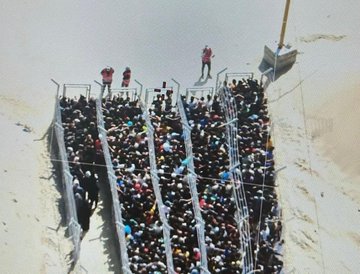
US aid site collapses in Gaza amid mismanagement, Israeli gunfire
Al Mayadeen | May 27, 2025
The latest attempt to distribute aid in Rafah as part of the ethnic cleansing plan descended into chaos on Tuesday, as the American-managed distribution mechanism built to push people south of the strip, by the Gaza Humanitarian Foundation, failed catastrophically, an Al Mayadeen correspondent on the ground reported.
The site reportedly collapsed due to overcrowding, disorganization, and a lack of control by the overseeing company, resulting in the destruction of a large portion of the facility.
The scenes showed a harrowing sight of people being driven inside overcrowded narrow paths made of metal fences and barbed wire, reminiscent of WW2 nazi concentration camps.
The breakdown was further compounded by live fire from Israeli occupation helicopters, which targeted the vicinity of the distribution center, escalating panic among the gathered civilians. Israeli media outlets, including Yedioth Ahronoth, confirmed that Israeli occupation forces opened heavy fire at Palestinians from Gaza who had stormed the aid complex.
The same outlet also claimed that armed personnel contracted by the American company overseeing the site fled the scene amid the surge in crowds. In response, Israeli commentators criticized the incident as yet another security failure similar to previous breakdowns in the so-called Netzarim axis, pointing to the “privatization of security tasks inside hostile territory by foreign contractors.”
Aid system reflects ‘systematic starvation policy’
In a strongly worded statement, the Government Media Office in Gaza condemned the collapse of the Rafah aid distribution plan, accusing the Israeli occupation of deliberate sabotage. “The occupation has utterly failed in its project to distribute aid in the zones of racial segregation,” the statement read.
It further asserted that the occupation’s interference at the aid distribution center “exposes the collapse of the so-called humanitarian process it claims to lead,” calling the scene “irrefutable evidence of the occupation’s failure to manage the crisis it has intentionally created.”
The office denounced the establishment of isolated zones, referred to as “ghettos”, for distributing limited aid as a deliberate policy aimed at perpetuating starvation and dismantling the social fabric of Gaza.
Accusing the Israeli regime of weaponizing humanitarian aid as a tool of war and political extortion, the office held the occupation fully responsible for the deepening food crisis and humanitarian collapse.
Calls for UN to open border crossings
The Gaza Media Office reiterated its complete rejection of any project involving buffer zones or so-called humanitarian corridors managed by the Israeli occupation. It demanded immediate and unrestricted access to humanitarian aid, urging the United Nations to act swiftly to open the crossings and empower humanitarian agencies to operate freely and independently.
The statement also called for international investigation committees to document what it described as the war crime of starvation and to hold the occupation’s leadership legally accountable.
Additionally, the office appealed to Arab and Islamic nations to intervene and activate independent humanitarian channels to break the blockade imposed on the Gaza Strip.
The events in Rafah offer yet another bleak chapter in Gaza’s ongoing humanitarian disaster, highlighting the severe consequences of militarized aid delivery and foreign-managed logistics within a war-torn and besieged population.
Group CEO resigns from post
Jake Wood, the executive director of the US-backed Gaza Humanitarian Foundation (GHF), announced his resignation on Sunday, stating the group’s aid delivery model could not be implemented without violating core humanitarian principles.
The departure throws fresh uncertainty over the future of the initiative backed by the Israeli occupation and the United States to deliver food aid into the besieged enclave, bypassing traditional aid structures.
Last week, the Gaza Government Media Office announced in a statement that “Israel’s” brutal blockade on humanitarian aid has killed hundreds of Gazans, and led to a sharp rise in miscarriages.
“The Israeli occupation’s starvation policy in Gaza has led to the deaths of 326 people due to malnutrition and lack of food and medicine, along with over 300 miscarriages among pregnant women in just 80 days,” the office stated.
In a public statement, Wood said he was proud of the plan he had developed, which aimed to distribute 300 million meals within 90 days while addressing diversion concerns and complementing existing NGOs.
Featured Video

Theodore Postol: Iran’s Missiles & Drones Were Underestimated
or go to
Aletho News Archives – Video-Images
From the Archives
Wars for Israel: A reminder of who’s giving the marching orders
By Damian Lataan | February 7, 2012
As the West prepares to march off to yet another war in the Middle East, we should perhaps remind ourselves of who is giving the West their marching orders.
In February 2003, just weeks before the US and their allies launched their attack on Iraq and her peoples, a delegation of US congressmen, together with the US Ambassador to the United Nations, John Bolton, a well known pro-Zionist and neoconservative war-hawk, were in Israel at the invitation of the Israeli government then led by Israeli Prime Minister Ariel Sharon.
Addressing the congressmen, Sharon told them ‘that Iran, Libya and Syria should be stripped of weapons of mass destruction after Iraq’. Later, Sharon told John Bolton ‘that Israel was concerned about the security threat posed by Iran, and stressed that it was important to deal with Iran even while American attention was focused on Iraq’. … continue
Blog Roll
 Aletho News
- The Most Important Bet You’ve Never Heard Of
- The killing of three Indonesian soldiers in Lebanon should remind Jakarta that Israel does not want peace
- Defeated and delusional: Netanyahu’s remarks reveal $80bn war failure, says analyst
- Iran’s friends are about to make life much more difficult for Israel and the US
- The war of liberation of the Arab and Islamic peoples expands across the Gulf
- Envoy warns UN on Trump’s threat to ‘obliterate’ Iran’s civilian infrastructure
- The Larak Corridor: Iran’s Rial Gate With No US, No Israel, and No Way Around
- ‘Economic terrorism’: Steel facilities hit again in US-Israeli strike
- ‘War Crime’: Iran condemns attacks on Arak, Ardakan nuclear sites
- Two-thirds of Americans want quick end to Iran war even if goals unmet
- If Americans Knew
- Gaza families reunite years after babies evacuated amid Israel’s war
- International Rescue Committee warns Gaza’s children face grave protection risks
- Iran’s Alleged 47-Year War on America: Debunking the 1,050 American Deaths Canard
- Israel wants US to bomb more of Iran’s civilian structures (113,000 is not enough) – Not a ceasefire Day 173
- Ann Coulter Rips Into Fox News for Iran War Coverage
- Joe Kent Urges Americans To Call White House and Congress To Object To Sending Troops Into Iran
- DNC Resolution to Reject AIPAC Funding Puts Democratic Leaders in the Hot Seat
- Swedish foundation to build 400 schools as over 650,000 Gaza children remain without education for 2 years
- Israeli army admits photshopping image of slain Lebanese journalist
- This is how Israel is systematically killing health workers under the cover of war in Lebanon
- No Tricks Zone
- New Study Finds Warming Saves Lives…Cold Temperatures 12 Times More Deadly Than Excess Heat
- German Science Blog Accuses PIK Climate Institute Of Hallucinating Climate Tipping Points
- Devastating Assessment Of Comirnaty Vaccine By Former Senior Pfizer Europe Toxicologist
- New Study: CO2 Is ‘Effectively Negligible’ As An Explanatory Climate Change Factor Since 2000
- Former Pfizer Toxicologist Dr. Helmut Sterz Tells Bundestag Hearing Pfizer Vaccine Should Have Never Been Approved
- Energy Expert: Germany’s Nuclear Phaseout Was A “500 Billion Euro Mistake”
- New Research: South Australia’s Mid-Holocene Sea Surface Temperatures Were 4°C Warmer Than Today
- Storing Green Energy To Last Germany 10 Days Would Require A 60-Million Tonne Battery
- New Studies: UK Sea Levels Were 4 Meters Higher Than Today During The Mid-Holocene
- Destructive Green New Deal: German Energy And Metal Group Warns Of Drastic Crisis
 Aletho News