Hamas says statements and condemnations are no longer acceptable from Arab and Islamic countries
MEMO | April 10, 2025
The Palestinian Islamic Resistance Movement has said that it is “no longer acceptable” for Arab and Islamic countries simply to make “timid statements and condemnations”, at a time when Israel is intensifying its killing in Gaza before the eyes and ears of the world.
“It is also inconceivable that our Palestinian people are being left alone in this fateful confrontation, without real support that rises to the challenge and the magnitude of the crime,” added Hamas in a press statement on Wednesday. The movement pointed out that the Israeli occupation army committed another massacre — described as “one of the most heinous crimes of the genocide” — by bombing a residential area crowded with civilians and displaced persons in the Shujaya district east of Gaza City.
By giving the occupation state its full support, said Hamas, the US is regarded as being complicit as a partner in the aggression against the Palestinians. “This is a stain on the international community, which stands helpless and silent in the face of the most heinous acts of mass murder and genocide. These brutal crimes, committed in full view of the world against innocent, defenceless civilians, with the aim of genocide and sadistic revenge, will not go unpunished, nor will they be forgotten with the passage of time.”
History, said the resistance movement, will hold accountable all of those who remained silent and colluded with the Zionist war criminals. It called on the leaders of Arab and Islamic countries to perform their historical and humanitarian responsibilities and to put every possible pressure on the occupation state and its supporters in Washington to immediately halt the aggression, lift the siege and hold the “war criminals” accountable for their crimes.
Furthermore, Hamas called on countries that still maintain relations with the Zionist occupation state to sever ties and close the embassies of the “Nazi entity” in solidarity with the Palestinian people, who are being subjected to a “brutal Zionist war of annihilation”.
The movement also called on the masses in the Arab and Islamic nations and the free people of the world to continue their support for Gaza, and even escalate and intensify it until the Gaza Genocide ends.
SABA source refutes Trump claim of killing Yemeni operatives in strike
Saba – April 5, 2025
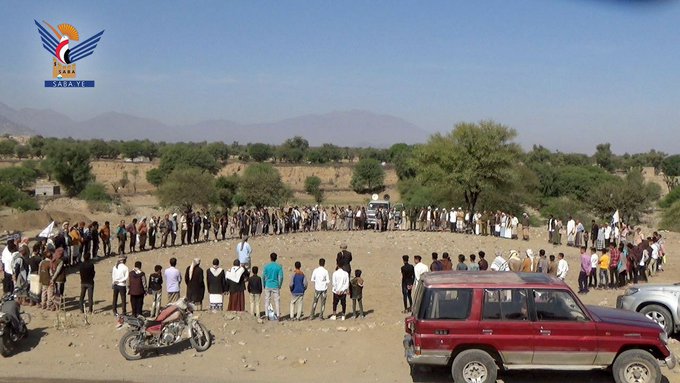
Sana’a – A private source to the Yemeni news agency, Saba, on Saturday denied the allegations made by the criminal US President Trump regarding what he described as the targeting of a secret meeting of military leaders preparing to carry out naval operations.
The source explained that the video clip published by the criminal Trump, claiming that it was a gathering of military leaders, was merely an event for a social Eid visit in Hodeida province. Similar events are held in various provinces on all holidays and occasions, and this is well known to all Yemeni people.
He emphasized that those present at that gathering had no connection to the operations carried out by the Yemeni Armed Forces, which are implementing the decision to ban navigation on ships linked to the American and Israeli enemy, as the criminal Trump claimed.
The source stated that this heinous American crime, which left dozens of martyrs and wounded, reflects the extent of America’s bankruptcy and failure in its aggression against Yemen, and that it is an extension of the genocide committed by the Israeli-American aggression in Gaza.
He stressed that this heinous crime will not be forgotten, and that the Yemeni armed forces, which stood up for the people of Gaza, will not let the blood of the Yemeni people go in vain.
Video footage refutes IOF account of attack that killed 15 Gaza medics
Al Mayadeen | April 5, 2025
A video retrieved from the cell phone of a Palestinian paramedic, whose body was discovered alongside 14 other aid workers in a mass grave in Gaza in late March, shows clearly marked ambulances and a fire truck with emergency lights activated as they came under heavy Israeli gunfire, The New York Times reported on Friday.
During a press conference at the United Nations on Friday, officials from the Palestine Red Crescent Society (PRCS), moderated by the International Federation of Red Cross and Red Crescent Societies, said they had submitted the nearly seven-minute video to the UN Security Council.
Earlier in the week, Israeli military spokesperson Lt. Col. Nadav Shoshani denied that Israeli forces had “randomly” attacked an ambulance. He claimed that multiple vehicles had been seen “advancing suspiciously” without headlights or emergency signals toward Israeli troops, prompting the shooting. He also claimed that nine of the individuals killed were Palestinian Resistance fighters.
The Times acquired the footage from a senior UN diplomat who requested anonymity in order to share sensitive material. The location and time of the video, captured in Rafah in southern Gaza early on March 23, were verified by the newspaper.
Vehicles clearly marked
Shot from inside a moving vehicle, the footage depicts a convoy of ambulances and a fire truck, all clearly marked and displaying both headlights and flashing emergency lights, driving southward on a road north of Rafah just after sunrise.
The convoy halts when it comes across a damaged ambulance on the roadside—an earlier vehicle sent to aid injured civilians had reportedly come under attack. The new rescue vehicles move to the side of the road. At least two uniformed rescue workers are seen exiting the fire truck and ambulance, both bearing the Red Crescent emblem, and approaching the damaged vehicle.
Suddenly, intense gunfire erupts. The barrage of bullets can be seen and heard striking the convoy. The footage shakes and then goes dark, though the audio continues for five minutes with unrelenting gunfire. A man’s voice is heard in Arabic noting the presence of Israeli soldiers.
The paramedic filming the attack is repeatedly heard reciting the shahada, the Islamic declaration of faith typically spoken when facing death. He asks for forgiveness and expresses that he knows he is going to die.
“Forgive me, mother. This is the path I chose — to help people,” he says.
In the background, voices of distressed aid workers and shouted commands in Hebrew are audible, though the content of the Hebrew speech remains unclear.
According to PRCS spokesperson Nebal Farsakh, speaking from Ramallah, the paramedic who filmed the video was later found with a gunshot wound to the head in the mass grave. His identity has not been made public due to concerns for the safety of his family still living in Gaza, a UN diplomat confirmed.
‘Targeted from a very close range’
At the UN headquarters press conference, PRCS President Dr. Younis al-Khatib and Deputy Marwan Jilani said the evidence they had gathered—including the video, audio, and forensic analysis of the bodies—directly contradicts the Israeli military’s account.
The disappearance and subsequent discovery of the 15 aid workers, missing since March 23, have sparked global condemnation. Both the UN and PRCS maintain that the victims were unarmed and posed no threat.
“Their bodies have been targeted from a very close range,” indicated al-Khatib, criticizing “Israel’s” failure to provide information on the missing medics. “They knew exactly where they were because they killed them.”
“Their colleagues were in agony, their families were in agony. They kept us for eight days in the dark,” he said.
It took five days of negotiation between the UN, PRCS, and the Israeli military before safe access was granted to search for the missing. On Sunday, rescue teams recovered 15 bodies, mostly buried in a shallow mass grave, alongside crushed ambulances and a UN-marked vehicle.
Al-Khatib stated that one member of the Palestinian Red Crescent remains missing, and “Israel” has not clarified whether he is in custody or has been killed.
Dr. Ahmad Dhair, a forensic doctor at Nasser Hospital in Gaza, said he examined five of the aid workers’ bodies and found four had sustained multiple gunshot wounds, including to the head, chest, and joints.
“I think the scale of this crime should force, that it should oblige the international community to do more and not to accept that this would be another incident that goes in the files and be forgotten after a few days,” Jilani underscored.
According to the UN and PRCS, one Red Crescent paramedic in the convoy survived after being detained and later released by the Israeli military, and he provided a firsthand account confirming Israeli forces had opened fire on the medical convoy.
Dylan Winder, the International Federation of Red Cross and Red Crescent Societies’ representative to the UN, condemned the attack as an outrage, describing it as the deadliest incident involving Red Cross or Red Crescent workers worldwide since 2017.
Volker Turk, the UN High Commissioner for Human Rights, called for an independent investigation, warning that the incident raises “further concerns over the commission of war crimes by the Israeli military.”
Israel has left over 39,000 orphans in Gaza

Palestinians inspect destroyed building following the Israeli army attack in the Gaza Strip on April 1, 2025 in Khan Yunis, Gaza [Abed Rahim Khatib – Anadolu Agency]
MEMO | April 4, 2025
A new report has revealed that more than 39,000 children in Gaza have lost one or both their parents, as the death toll from Israeli attacks on the Strip has risen to 50,523, with 114,776 others injured since 7 October 2023.
The Palestinian Central Bureau of Statistics stated that Gaza is experiencing the largest orphan crisis in modern history, with tens of thousands of children losing their parents due to the ongoing Israeli assault.
In a statement issued ahead of Palestinian Children’s Day, which is marked tomorrow, the bureau reported that 39,384 children in Gaza have lost one or both parents after 534 days of Israeli attacks on the Strip. Among them, around 17,000 children have been left without both parents, facing life without support or care.
The Israeli occupation army continues its attacks on civilians in Gaza, decimating the enclave and forcibly displacing its over two million residents.
Euro-Med Monitor: Israel’s brutality in Gaza surpasses all recent forms of terrorism
Palestinian Information Center – April 4, 2025
GAZA – nature of Israel’s crimes in the Gaza Strip must be denounced, particularly the crimes’ horrifying scope, methodical execution, and wide-ranging effects, which surpass those of armed groups like ISIS, the Euro-Med Human Rights Monitor said.
While the crimes committed by ISIS have been widely denounced by the international community, the same community is now mostly silent—and therefore complicit—as Israel pursues a campaign of declared genocide that aims to exterminate the Palestinian people from their homeland, the Euro-Med said.
Israeli occupation forces detonated a robot on Thursday 3 April 2025 rigged with tons of explosives in the heart of the densely populated Shuja’iyya neighborhood in eastern Gaza City. The explosion occurred in an area packed with displaced civilians, though there was no military necessity and no combat activity in the vicinity. This act embodies the conduct of existing terrorist organizations, even surpassing them in brutality and disregard for human life, and bears no resemblance to the conduct of a state bound by international law, regardless of any attempts to distort or evade it.
The explosion killed 21 Palestinians and injured around 100 others, the majority of them women and children. A full residential block was obliterated with its residents still inside, and this is not an isolated incident. Over recent months—particularly in the northern Gaza Strip—Israel has increasingly used explosive-laden robots in residential neighborhoods during its ground incursions. At least 150 such detonations have resulted in the deaths of hundreds of civilians, mostly women and children, and caused wide-scale destruction to homes and other essential infrastructure.
A separate atrocity was committed on 23 March, when Israeli forces detained 15 Palestinian rescue workers from the Palestinian Red Crescent and Civil Defense, along with a United Nations staff member, before executing them extrajudicially—some while their hands were bound. Their bodies were dumped into a pit, and the ambulances they had been travelling in were destroyed. This incident is another blatant example of an intentional Israeli crime mirroring—and exceeding—the brutality of groups like ISIS, as it reveals a clear and deliberate intent to annihilate Palestinians both physically and through psychologically terrorizing residents across the Strip.
Euro-Med Monitor field teams have documented thousands of crimes committed by Israeli forces, constituting overwhelming evidence of mass atrocities. These crimes include an unprecedented pattern of violence in recent history, in terms of scale, deliberate targeting, and genocidal intent. A minimum of 58,000 Palestinians have been killed, the majority of them women and children, and most have been buried beneath the rubble of homes deliberately destroyed over their heads, while many were killed by sniper fire with clear intent. Over 120,000 individuals have been injured, and at least 39,000 children have been orphaned. The Gaza Strip’s infrastructure, including homes, hospitals, and schools, has been virtually obliterated.
These acts amount to one of the most extensive and systematic campaigns of extermination in contemporary history, underscoring the urgent need for international accountability, an end to Israeli impunity, and concrete action to halt further atrocities.
Israel’s methods in the Gaza Strip—particularly its mass killing of civilians—bear a striking resemblance to the tactics used by groups the international community has widely condemned as terrorist. However, the atrocities unfolding in the Strip are far more dangerous in terms of scale, brutality, and systematic intent, and cannot be understood merely as a function of violent methods or tools.
The rights group pointed out that these actions cannot be dismissed as random or extreme policies, but rather represent a fully-fledged model of organized state terrorism, driven by a comprehensive blueprint for annihilation and implemented in full view of the international community.
“These crimes are being committed with clear, declared intent to eliminate the Palestinian people as a national and collective entity, uproot those who remain on their land, erase their identity, and ultimately end their collective existence.”
Euro-Med called all states, both individually and collectively, to fulfil their legal obligations and take urgent action to stop Israel’s genocide in the Gaza Strip in all its forms. This includes implementing concrete measures to protect Palestinian civilians, ensuring Israel’s compliance with international legal norms and the rulings of the International Court of Justice, and guaranteeing full accountability for perpetrators of war crimes and crimes against humanity.
It also stressed the importance of implementing the arrest warrants issued by the International Criminal Court against the Israeli Prime Minister and army minister at the earliest opportunity and ensure these individuals’ transfer to international justice.
Furthermore, Euro-Med called on the international community to impose comprehensive economic, diplomatic, and military sanctions on Israel in response to its grave and systematic violations of international law. This includes an arms embargo; the cessation of all political, financial, and military cooperation; asset freezes of implicated officials; travel bans; and the suspension of trade privileges and bilateral agreements that provide Israel with economic benefits, enabling its continued crimes.
Israel uses human shields in Gaza ‘at least six times a day,’ says Israeli officer
MEMO | April 1, 2025
Hamas Agrees to New Gaza Ceasefire Proposal: Armed Resistance “Red Line”
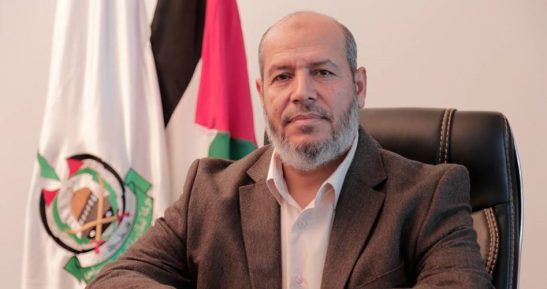
Head of Hamas in Gaza Khalil Al-Hayya
Al-Manar | March 30, 2025
Hamas said on Saturday it had approved a proposal from mediators for a ceasefire in the Gaza Strip, which it received two days earlier.
“In our commitment to our people and families, we have engaged with all proposals responsibly and positively, aiming to end the war,” Khalil Al-Hayya, head of Hamas in Gaza Khalil Al-Hayya, said in a statement.
“Two days ago, we received a proposal from our mediator brothers. We responded positively and approved it. We hope the occupation does not obstruct it or undermine the mediators’ efforts,” the statement added.
The statement also reaffirmed Hamas’ stance on armed resistance, calling it a “red line” and warning that “the weapon of resistance” will remain in the hands of the people and the state “if the Israeli occupation persists.”
“We will never accept humiliation or disgrace for our people. There will be no displacement or deportation,” it added.
Hamas further stated that, along with other factions, it had submitted to Egypt a list of independent professionals and experts to help form a committee to manage the enclave.
Israeli occupation forces resumed strikes in Gaza on March 18, ending a ceasefire agreement with Hamas that started on January 19. More than 50,000 Palestinians have been killed by the Israeli war on Gaza.
Hamas released on Saturday a video that shows one of the Israeli captives it is still holding on Gaza. The video showed him pleading the Zionist PM Netanyahu to approve an exchange deal in order to see his son.
Despite the intensive mediation efforts for a ceasefire, the Israeli Occupation Army said in a statement that its troops have begun new ground operations in the Al Janina area in Rafah, southern Gaza, aimed at expanding the security zone.
Oxford city council passes boycott divestment, sanctions motion
Press TV – March 26, 2025
The Oxford City Council has passed a motion supporting the Boycott, Divestment, and Sanctions (BDS) movement against Israel, in accordance with International Court of Justice (ICJ) rulings.
On Monday, the members of Oxford City Council unanimously voted for an “ethical investment and procurement” process against Israel.
The motion calls on the Oxford City Council to avoid cooperation and trade with entities complicit in human rights violations and international law.
In January 2024, the ICJ delivered an interim ruling that said it was plausible that Israel was committing genocide in Gaza. The court called on Israel to refrain from impeding the delivery of aid into Gaza
Amongst other orders, ICJ also ordered Israel to avoid acts of genocide in the besieged enclave and punish incitement to genocide.
The Israeli regime not only has continued to ignore the ICJ’s rulings but also has committed numerous acts of genocide against the people of Palestine, including the restriction of the delivery of international aid into the besieged enclave.
Given Israel’s disregard for the Court’s orders, Oxford councilor Hosnieh Djafari-Marbini said councilors had “unanimously passed a boycott and divestment motion citing the ICJ rulings on Palestine.”
One of the motion’s proponents, councilor Barbara Coyne, said in a press release, “I hope this motion will be thoroughly implemented, and that its passage may pave the way for other councils to take decisive action.”
In addition, the Council has called on the Oxfordshire Investment Fund to divest more than 157 million pounds from companies complicit in the Israeli regime’s apartheid, genocide, occupation, and settler colonialism.
The people of Palestine have long called for boycott, divestment, and sanctions, including an arms and energy embargo, against the occupying regime.
The BDS movement demands that Israel, under international law, withdraw from the occupied territories, remove the separation barrier in the West Bank, and respect the rights of Palestinian refugees to return to their homes and properties.
Hamas Mourns Senior Leader Salah Al-Bardawil, Martyred in Israeli Airstrike on Gaza
Al-Manar | March 23, 2025
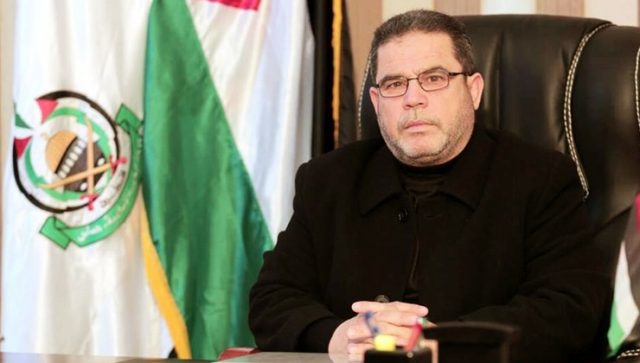
The Islamic Resistance Movement “Hamas” mourned the death of Salah Al-Bardawil, a key figure in its political bureau and a member of the Palestinian Legislative Council, who was killed in an Israeli airstrike targeting his family tent in Khan Younis, southern Gaza.
The attack, which also claimed the life of his wife, was described by Hamas as a “treacherous Zionist assassination.”
In its statement, Hamas vowed that the martyrdom of al-Bardawil, along with that of all martyrs, would continue to fuel the ongoing struggle for liberation and return. “With every martyr, the flame of resistance burns brighter until the occupation is eliminated,” the statement declared.
A Distinguished Leader and Scholar
Martyr Salah Al-Bardawil was born in 1959 in the Khan Younis refugee camp, with roots tracing back to the occupied village of Al-Joura, near Gaza. He was an accomplished academic, earning degrees in Arabic language and Palestinian literature from Cairo University and Sudan.
His work as an educator and writer also contributed to his prominent role in establishing the Palestinian Writers Union and the National Gathering for Thought and Culture.
Al-Bardawil’s political involvement with Hamas began in the early 1990s. In 1996, he founded Al-Risalah, the first official media outlet of Hamas, and served as its editor-in-chief.
Through his weekly satirical column, “From the Streets of the Homeland,” he critiqued the Palestinian Authority, which led to multiple arrests by Israeli forces. He also led Hamas’s media department and played a central role in the formation of the National Salvation Party in 1996.
In 2006, al-Bardawil was elected to the Palestinian Legislative Council, representing Khan Younis. Over the years, he held various senior positions within Hamas, including overseeing the movement’s internal and external planning while maintaining strong connections with fellow leaders.
The ongoing attacks, including the death of Salah Al-Bardawil, highlight the continuing struggle for Palestinian sovereignty and resistance against occupation.
Gaza rescue teams besieged by Israeli forces as ‘catastrophe’ unfolds
Dozens of Palestinian civilians have reportedly been executed by Israeli forces in the southernmost city of Rafah
The Cradle | March 23, 2025
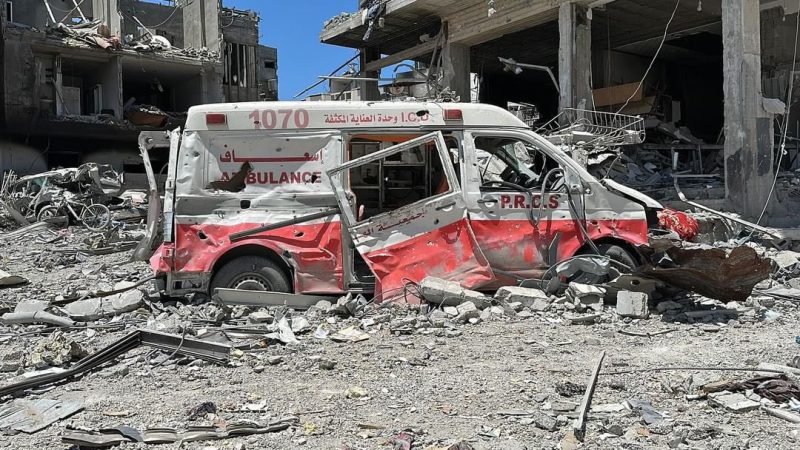
Palestinian Red Crescent Society (PRCS) workers are being besieged by Israeli forces after responding to rescue calls from the Gaza Strip’s southernmost city of Rafah on 23 March.
“We are still awaiting clearance to reach the trapped team in Rafah. Occupation forces continue to besiege four PRCS ambulances, and contact with the team remains lost,” the PRCS said in a statement on Sunday morning.
According to reports, dozens of people were executed after being surrounded by the Israeli army in Rafah.
“We warn of an imminent danger threatening the lives of more than 50,000 citizens in the Baraksat area west of Rafah Governorate after they were besieged by the Israeli occupation forces,” Gaza’s Civil Defense said.
“We warn against harming the Civil Defense crews who were besieged in the same area after intervening to rescue Red Crescent crews, and contact with them is still lost,” it added.
Israeli forces opened fire at civilians fleeing their homes in Rafah following evacuation orders issued by the army.
Rafah Municipality announced that thousands of families have been forced to flee the Tal al-Sultan neighborhood under intense Israeli bombardment. It added that its crews, along with residents, remained trapped inside the area as they carried out their duties serving residents.
An Israeli airstrike also targeted a group of displaced residents in the city, killing at least three and injuring others, according to WAFA news agency.
Over 40 people have been killed by Israeli attacks on Gaza during the past 24 hours, the Health Ministry in the strip announced on Sunday.
“A number of victims are still under the rubble and on the streets, and ambulance and civil defense crews cannot reach them,” the ministry said in a statement.
A member of Hamas’ Political Bureau, Salah al-Bardawil, was killed alongside his wife in an Israeli airstrike that targeted his tent late on Saturday. He was killed while praying, according to a statement released by the resistance movement on 23 March.
Israel renewed the war on Gaza early on 18 March after following through with several weeks of threats and obstruction of ceasefire talks. Over 700 Palestinians have been killed in less than a week as a result of the new campaign.
All border crossings remain shut, and Gaza is witnessing a humanitarian disaster due to a lack of aid and continuous bombardment. The strip is facing a severe water crisis due to the destruction of wells and lack of electricity.
“We are facing a compounded humanitarian catastrophe, whose severity continues to escalate under this suffocating blockade, while the disgraceful silence of the international and Arab communities emboldens the occupation to persist in its criminal policies without accountability,” the Gaza Government Media Office said on Sunday, holding the US “fully responsible” for Israel’s atrocities.
UN Exposes Systematic Zionist Rape of Palestinians
By Kit Klarenberg | Al Mayadeen | March 22, 2025
On March 13th, the UN Human Rights High Commission published a horrifying report exposing in oft-emetic detail how the Zionist entity has employed “sexual, reproductive and other forms of gender-based violence against Palestinians” on an industrial scale since the Gaza genocide erupted in October 2023. The UN concludes these hideous acts are a central component of Israel’s “broader effort to undermine [Palestinians’] right to self-determination,” their systematic nature pointing unambiguously to endorsement by Tel Aviv’s military and political leaders.
The report records, “sexual and gender-based violence is by no means a new element of the Israeli occupation.” However, in the wake of October 7th, there has been a “sharp increase in sexual violence against Palestinian women and men”, both by Zionist Occupation Forces (ZoF) and settlers. The UN encountered no obstacles collecting voluminous highly incriminating evidence of this vile abuse. In addition to a welter of victim and witness testimony, perpetrators often voyeuristically captured themselves and their confederates openly committing these crimes on camera.
Frequently, these abhorrent images were pridefully posted on the culprits’ personal social media accounts. Such actions amply attest to the culture of total impunity in which ZOF soldiers literally rape and pillage. “Despite the abundance of witness and digital evidence of Israeli soldiers committing crimes in Gaza,” the UN found “there have been no meaningful efforts by Israel to hold the perpetrators accountable.” Requests submitted to Tel Aviv for clarity on investigations into sexual violence committed by Occupation Forces have been ignored:
“The Commission has not seen any evidence that Israeli authorities have taken any effective measures to prevent or stop acts of sexual violence or to identify and punish perpetrators.”
By contrast, the UN documented multiple statements by Zionist entity officials actively supporting ZOF militants accused of sex crimes, and “legitimizing rape and other forms of sexual violence” against Palestinians, particularly detainees. That Israel’s rulers advocate sexually-charged attacks on Palestinians is further reinforced by a deliberate ZOF strike on a women’s rights centre in Gaza, in mid-November 2023. The UN noted the broadside’s “clear gendered dimension,” with soldiers daubing deeply offensive, sexist insults directed at Palestinian women on the building’s inner walls in Hebrew.
Outside, ZOF tanks precisely blitzed the building’s fifth floor, which provided shelter for women and families. That area was “completely destroyed”, but the rest of the building “remained intact”. Mercifully, the site and its surrounding area had been evacuated well in advance of the attack, meaning no one was harmed. The Commission “did not find any military justification” for the ZOF’s targeting of the centre. Yet, from the Zionist entity’s perspective, it undoubtedly served a very specific military purpose.
Collectively, the Commission’s conclusions point ineluctably to the fact that sexuality and gender are now key, dedicated battlegrounds in Israel’s unending erasure of the Palestinians, while sexual abuse, rape, and resultant physical and psychological trauma are entrenched, well-honed weapons in the Zionist entity’s Mephistophelian military arsenal. Gravely, given Tel Aviv’s tendency to export its tools and methods of repression and mass murder abroad, the implications of this grotesque evolution in modern warfare could be global.
‘Foreign Devices’
The UN Commission report contains five separate sections on the Zionist entity’s weaponisation of sexual abuse; “sexual harassment and public shaming of Palestinian women”; “filming and photographing acts of sexual violence against men and boys during arrest”; “sexual violence during ground operations including at checkpoints and evacuations”; “sexual, reproductive and other gender-based violence in detention”; “sexual and gender-based violence by settlers and other civilians.” Each is rife with repulsive descriptions, and stomach-churning attestations.
While ranking circles of hell is a tawdry task, the section detailing sexual violence directed towards male and female Palestinian detainees is most vital to examine. The sheer scale of abuses documented, and consistency of accounts provided by victims imprisoned in over 10 separate Israeli military detention facilities, means it cannot be plausibly argued this savagery is aberrational, or attributable to ‘rogue’ ZOF militants or units. It can only be deliberate, determined policy, signed off and directed at the highest levels.
From October 7th 2023 until July 2024, the UN Commission finds at least 14,000 Palestinians in Gaza and the West Bank – among them hundreds of women – were incarcerated by the ZOF. Many were not informed of the reasons for their imprisonment. In case after case, “sexual violence was used as a means of punishment and intimidation from the moment of arrest and throughout [their] detention, including during interrogations and searches”:
“Acts of sexual violence… appear to have been motivated by extreme hatred towards the Palestinian people and a desire to dehumanize and punish them… Forced nudity, with the aim of degrading and humiliating victims in front of both soldiers and other detainees, was frequently used… Male detainees reported ZOF personnel had beaten, kicked, pulled or squeezed their genitals, often while they were naked… In some cases, objects such as metal detectors and batons were used to brutalise them while they were naked.”
The Commission documented widespread rape and sexual assault of male detainees, “including the use of an electrical probe to cause burns to the anus, and the insertion of objects, such as fingers, sticks, broomsticks and vegetables, into the anus and rectum.” One victim was suspended from the ceiling so only his toes touched a chair below, and beaten with tools for hours. During the abuse, a “metal stick” was inserted into his penis roughly 20 times until he began bleeding, before fainting.
The Commission has determined that detainees were routinely subjected to sexual abuse and harassment, and that threats of sexual assault and rape were directed at detainees or their female family members. The Commission received information about detainees being forced to undress and lie on top of each other while subjected to verbal abuse and forced to curse their mothers. They were beaten if they did not comply.
Female detainees were also subjected to sexual harassment, assault, rape, and threats to their lives. One was told by a ZOF soldier he would kill her and burn her children, asking: “How do you want us to rape you? One by one or all together?” Another was threatened with sexual assault in front of her husband, before soldiers spat in her face and beat her until she fainted. Several Palestinian women suffered the heinous indignity of “foreign devices” being inserted into their vaginas or rectums.
Female detainees moreover endured “repeated, prolonged and invasive strip searches, both before and after interrogations.” One Palestinian woman was strip searched in her cell every three hours during her four-day detention, “even though she was menstruating.” Women were regularly forced to remove all their clothes, including veils, in front of male and female ZOF soldiers. Beatings and harassment, while being bombarded with foul insults and sexual slurs, such as “bitch” and “whore”, were also commonplace.
‘Terrible Injustice’
In July 2024, 10 ZOF soldiers were arrested after subjecting a male Palestinian detainee to such vicious sexual violence, he required urgent surgery. The Commission finds this was by no means an isolated incident since October 7th, but it remains the only instance to date of a victim’s tormentors facing repercussions for their unconscionable abuse. Still, the UN refers to this sordid case as “an illustrative example of the culture of impunity” rampant within the Zionist entity’s military and security apparatus:
“Five soldiers were released without charge within a few days and five others were placed under house arrest. In September 2024, a military court eased the conditions of their house arrest, removing the requirement for them to be accompanied by a supervisor during their night-time house arrest and allowing them to submit requests for release during the holidays.”
A since-published indictment records how the five accused soldiers burst into the man’s cell at Sde Teiman detention facility, beat him with batons and tasered him in the head, before forcibly inserting a baton into his mouth, all while intimidating him with a dog. He was also stabbed in the rectum with a sharp object. The attack left the Palestinian with several fractured ribs, a punctured lung, and other life-threatening injuries.
Unmentioned in the report, the initial arrest of the 10 ZOF soldiers responsible for this gruesome barbarity elicited outrage among Israeli citizens, leading to mass protests demanding their release. Nonetheless, the Commission did record how several high-ranking Zionist entity officials expressed outrage at the soldiers’ arrests. Finance Minister Bezalel Smotrich said they had suffered “terrible injustice”. National Security Minister Itamar Ben-Gvir stated it was “shameful” that Tel Aviv’s “best heroes” had been subject to such “vicious persecution.”
The Western media remained deathly silent on this open championing of rape as an instrument of terror. The UN Commission’s disturbing findings have likewise fallen on mainstream deaf ears. As ever, news outlets, and the Zionist entity’s Western puppet masters, are complicit by their silence – and it is precisely this silence that encourages and safeguards the ZOF’s culture of impunity. As a result, we can expect the “sharp increase in sexual violence against Palestinian women and men” to only increase in future.
Israel blows up Gaza’s only cancer hospital
MEMO | March 21, 2025
Israeli occupation forces blew up the Turkish Friendship Hospital in central Gaza today.
In the latest attack on the Strip’s healthcare system, Gaza’s only cancer treatment centre was blown up because Israel claimed Hamas had turned it into “terror infrastructure”. It provided no proof for its claims.
Footage circulating online appears to show a controlled demolition of the hospital, rather than an air strike.
Israel has decimated Gaza’s medical facilities and destroyed a number of hospitals. Human rights groups and UN experts have warned that this forms part of its genocidal policies, through which it seeks to force Palestinians out of the enclave.
The occupation state returned to bombing Gaza in the early hours of Tuesday morning, killing more than 700 Palestinians since. It also dropped leaflets over the Strip promising genocide, stating: “The world map will not change if all of Gaza’s people vanish. No one will care, no one will ask about you.”
Featured Video
Dr. Tony Martin – The Jewish Role in the African Slave Trade
or go to
Aletho News Archives – Video-Images
In Memoriam
James Petras, In Memoriam
 02.13.2026
Professor James Petras, 89, world-renowned sociologist, public intellectual, and scholar of Latin American politics and global economics, died peacefully on January 17, 2026, in Seattle, WA, surrounded by family.
A prolific scholar and activist, he devoted his life to challenging power, imperialism, and inequality. … continue
Blog Roll
 Aletho News
- Travelers Take a Pass on Visiting America
- EU members divided on 20th Russia sanctions package – media
- Lawyers ask police to investigate Elbit Systems UK for alleged war crimes complicity
- Israel ready to strike Iran-backed armed groups – media
- Behind US war drums against Iran: No goals, no plan, no off-ramp
- With Ukraine blamed for cutting oil flows to Hungary, Croatia also refuses to transfer Russian oil in violation of EU law
- Friedrich Merz’s Push to End Online Anonymity Has a Troubling Subtext
- Macron: French citizens fighting for Israel cannot be labeled ‘genociders’
- US eyes Gaza security force drawn from armed gangs
- The Only Motive Behind The ‘Imminent’ U.S. War With Iran Is The Zionist Lobby
- If Americans Knew
- ‘Christians Out’: Jerusalem Church Tagged With Hate Graffiti, Police Investigating
- Israeli Settlers Kill American Teen
- ‘We returned from hell’: Palestinian journalists recount torture in Israeli prisons
- No mercy for Gaza in Ramadan – Not a ceasefire Day 133
- The Israeli Government Installed and Maintained Security System at Epstein Apartment
- Tucker Carlson interrogated in Israel, has passport seized after interviewing US ambassador
- 6,000 Amputees in Gaza Face Impossible Recovery amid Israeli War Ultimatum
- The Lancet: Gaza death toll far higher than reported – Not a ceasefire Day 132
- Compliant aid: Who are the Israel-approved NGOs scaling up in Gaza?
- Why won’t Trump’s “Board of Peace” bring peace? – Not a ceasefire Day 131
- No Tricks Zone
- New Study: Canada’s New Brunswick Was 1°C Warmer Than Today During The Medieval Warm Period
- Coal Power Back In Trend As Globe Tries To Keep Pace With Growing Demand For Power
- New Study: A 4°C Warmer Beaufort Sea Had ‘No Sea Ice’ 11,700 – 8200 Years Ago
- Unfudging The Data: Dutch Meteorological Institute Reinstates Early 20th Centruy Heat Waves It Had Erased Earlier
- German Gas Crisis…Chancellor Merz Allegedly Bans Gas Debate Ahead of Elections!
- Pollen Reconstructions Show The Last Glacial’s Warming Events Were Global, 10x Greater Than Modern
- Germany’s Natural Gas Storage Level Dwindles To Just 28%… Increasingly Critical
- New Study Rebuts The Assumption That Anthropogenic CO2 Molecules Have ‘Special’ Properties
- Climate Scientist Who Predicted End Of “Heavy Frost And Snow” Now Refuses Media Inquiries
- Polar Bear Numbers Rising And Health Improving In Areas With The Most Rapid Sea Ice Decline
 Aletho News