Satellite images reveal extensive bulldozing of rubble in Beit Hanun amid signs of broader plans
Palestinian Information Center – January 12, 2026
GAZA – An analysis conducted by Al Jazeera of satellite images has revealed that the Israeli occupation army has carried out large-scale operations to remove the rubble of destroyed homes in the city of Beit Hanun, in the northern Gaza Strip, raising fundamental questions about the objectives of these actions and whether they are limited to security considerations or extend to broader plans.
The analysis relied on high-resolution satellite images captured between October 8, 2025, two days before the start of the ceasefire in Gaza, and the most recent images dated January 10 of the current year. These images show the continued bulldozing and removal of rubble in devastated neighborhoods, particularly in the Al-Boura area and along the outskirts of Al-Masriyin and Al-Na’ayma streets in northeastern Beit Hanun.
Geographic measurements indicate that the area from which home rubble was removed, along with land that was leveled, amounts to approximately 408,000 square meters, roughly 100 acres. The number of homes whose rubble was cleared is estimated at around 329, in addition to agricultural structures, rooms, and property belonging to farmers in an area considered one of the city’s agricultural zones.
The images also show bulldozers operating among the destroyed homes undergoing debris removal, within a zone that includes several active and inactive Israeli military positions.
The data suggest that the rubble-removal operations began at the start of Beit Hanun’s urban boundary, adjacent to the security fence separating it from nearby Israeli settlements close to the northern border, including the settlement of Sderot.
These scenes contradict recent statements by the Israeli army reported by the newspaper Yedioth Ahronoth regarding the purpose of “recruiting” civilian tractors belonging to settlers in the Gaza envelope for use inside the Strip, including in Beit Hanun.
According to the newspaper, the army explained that it had borrowed these tractors for a military unit to carry out tasks behind the border aimed at improving visibility by removing dense vegetation, clearing shrubs, and leveling the ground, without mentioning the removal of rubble from hundreds of homes.
The Israeli army also denied that the purpose of these works was to prepare Palestinian land for Israeli agricultural needs.
The use of agricultural equipment belonging to settlers inside the Gaza Strip is considered unprecedented since 2005. The newspaper noted that the Israeli army’s Southern Command had previously expressed reservations about such a step.
Beit Hanun lies at the extreme northern edge of the Gaza Strip within what are known as the “zero zones,” areas under full Israeli military control. The city has suffered unprecedented levels of destruction due to continuous bombardment and bulldozing over two years of war, including during the ceasefire period, and its residents have only been able to return for short, partial periods.
In the same context, Israel has not concealed its settlement intentions in the Gaza Strip. References to Beit Hanun have repeatedly appeared in speeches and slogans by leaders of the far-right within Prime Minister Benjamin Netanyahu’s government.
In January 2024, ministers and Knesset members from the ruling coalition signed what was termed the “Charter of Victory and the Renewal of Settlement in the Gaza Strip and Northern Samaria” during a conference held in Jerusalem, where a map was displayed showing planned settlement points, including a settlement nucleus on the outskirts of Beit Hanun.
In December of the same year, ministers and Knesset members visited a site overlooking the Gaza Strip from the settlement of Sderot and discussed establishing settlements inside it. Meanwhile, Hadar Bar-Hai, director of a settlement group, stated that Beit Hanun and Beit Lahiya are uninhabited areas, affirming that more than 800 Jewish families are ready to settle immediately once permitted.
Last December, Israeli Army Minister Israel Katz made statements about the future of the Gaza Strip, revealing during a conference at the settlement of Beit El a plan to establish military-agricultural “Nahal nuclei” in northern Gaza, asserting that Israel “will never withdraw and will never leave Gaza.”
Katz described these bases as an alternative to the settlements evacuated in 2005, prompting discontent within the US administration, which demanded clarifications, viewing the plan as contradictory to US President Donald Trump’s plan to end the war.
Meanwhile, the Israeli army continues, in parallel, to demolish homes and expand its areas of control within what is known as the “Yellow Line” in the Gaza Strip, including leveling thousands of dunams of land and residential buildings.
The ceasefire agreement ended a genocidal war launched by Israel against Gaza Strip on October 8, 2023, which lasted two years and resulted in more than 71,000 Palestinian martyrs and over 171,000 wounded, in addition to widespread destruction affecting nearly 90% of civilian infrastructure. The United Nations has estimated the cost of reconstruction at approximately $70 billion.
35,000 ‘Partially or Completely’ Deaf in Gaza Due to Israeli Bombings – Report

The Palestine Chronicle | January 9, 2026
An estimated 35,000 children and adults “have partially or completely” lost their hearing due to bombings during Israel’s two-year genocidal assault on the Gaza Strip, according to a Le Monde report, citing a survey by a local non-profit organization.
“Hearing loss can result from injuries to the head or neck, brain trauma causing ruptured eardrums and damage to the auditory system. But it can also be caused by exposure to sound waves, even if a person was not physically injured,” Dr. Ramadan Hussein, an audiologist working with the Atfaluna Society for the Deaf, reportedly said.
“These hearing disorders are, most often, irreversible,” he stressed.
‘Power of Explosion’
One such child whose hearing was affected by the bombings is a 12-year-old girl by the name of Dana. She was resting in her room in Gaza City when an Israeli missile hit the building just across from hers, the report said.
Dana’s father stressed that the explosion “was extremely violent”, with the door to her room torn off and the windows blown out. Although she survived the blast, Dana lost her hearing.
Specialists at the Atfaluna organization confirmed that Dana is suffering from “a very severe hearing loss”.
They said that “Because of the power of the explosion, the auditory nerve was severely damaged, perhaps even completely destroyed.”
Five-Day-Old Baby
In another case, a baby who was just five days old was thrown and buried under the sand when an Israeli missile struck one meter from his family’s tent in the al-Mawassai area of Khan Yunis, the report said.
His mother, Safa al-Qara, said, “We found him thanks to his feet sticking out. He was in a terrible state; we thought he was going to die.” Four months after his birth, his mother noticed that “something was wrong.”
She said that only movement “got his attention, not sounds.” He was subsequently diagnosed with a zero level of hearing.
The report stated that he urgently requires a hearing aid or cochlear implant to avoid sever developmental delays – an impossible task in the besieged enclave with Israel having blocked the entry of some medical equipment and medicines.
“For nearly a year, not a single hearing aid has entered the Gaza Strip,” Dr. Hussein warned, adding that “even those who already have them will soon be unable to use them, because batteries are also banned.”
Infrastructure Destroyed
In addition to the shortages, laboratories to make custom ear molds and much of the infrastructure needed to treat hearing disorders has been destroyed by Israel’s ground offensive, the report stated. Many specialists in this field have also already left the enclave due to the genocidal war.
Dr. Hussein warned that “Forced displacements, continuous bombings, famine and the lack of medicine affect pregnant women and fetuses and can lead to the birth of children with disabilities, including hearing loss.”
At the same time, with the worsening conditions in displacement camps, malnutrition and the lack of primary care, there is the risk of infections.
Fady Abed, the director of Atfaluna, warned that even minor infections, “like ear infections, can cause permanent hearing loss if not treated in time,” the report stated.
Staggering Death Toll
Starting on October 7, 2023, the Israeli military, with American support, launched a genocidal war against the people of Gaza. This campaign has so far resulted in the deaths of over 71,300 Palestinians, with more than 171,000 wounded. The vast majority of the population has been displaced, and the destruction of infrastructure is unprecedented since World War II. Thousands of people are still missing.
In addition to the military assault, the Israeli blockade has caused a man-made famine, leading to the deaths of hundreds of Palestinians—mostly children—with hundreds of thousands more at risk.
Despite widespread international condemnation, little has been done to hold Israel accountable. The nation is currently under investigation for genocide by the International Court of Justice, while accused war criminals, including Prime Minister Benjamin Netanyahu, are officially wanted by the International Criminal Court.
As Israel bans aid orgs in Gaza, notorious mercenary firm seeks “Targeter”
Are Israel and US planning to revive the dystopian GHF scheme that spawned famine and death under cover of humanitarian aid?
By Max Blumenthal | The Grayzone | December 31, 2025
In its bid to continue the genocide in Gaza, Israel has banned 37 international aid organizations from entering the decimated, militarily occupied coastal enclave. This leaves only five humanitarian groups still able to operate inside Gaza.
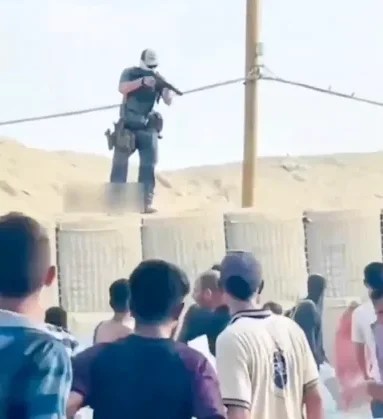
At the same time, one of the US mercenary firms responsible for securing the notorious Gaza Humanitarian Foundation sites which were present during the worst periods of famine in Gaza, when at least 3000 Palestinian civilians were gunned down while seeking aid, has posted an ad soliciting former special forces soldiers for offensive operations.
UG Solutions, the scandal-stained private mercenary firm, announced this December that it was hiring an “experienced Targeter to support intelligence-driven operations through the identification, development, validation, and maintenance of operational targets.” The targeter will be expected to “Develop, validate, and maintain operational target packages in accordance with approved targeting processes.”
Anthony Aguilar, the retired United States Army Lt. Col and former Green Beret who blew the whistle on UG Solutions’ human rights abuses in Gaza, told me he believes that Israel’s ban on the 37 international aid organizations signals the return of UG Solutions as part of a restructured version of the Israeli-controlled Gaza Humanitarian Foundation scheme.
While it’s unclear where the UG Solutions targeter position will be deployed, if they are being hired for upcoming operations in Gaza, Aguilar says “this shows that the US, through paramilitary contractors, is now going to either directly target, or feed target data to the IDF.”

To set the stage for its blanket ban on international aid organizations, Israel’s intel-tied Ministry of Diaspora Affairs has demanded that all staffers of aid NGOs prove they do not support calls to boycott Israel, that they do not support armed struggle or oppose Israel’s existence as an exclusivist Jewish state, and that they do not “actively advance delegitimization activities against the State of Israel.”
Aid staffers must also demonstrate that they have never questioned the established history of the Holocaust or challenged official Israeli narratives about October 7 – including, presumably, that Palestinians committed “mass rape” or beheaded babies.
Israel has also demanded that Doctors Without Borders provide COGAT occupation administrators with the personal data of its staff and donors, an unprecedented move by a belligerent in a conflict which few, if any, aid groups could ever honor.
It seems obvious that the Israeli government is using the absurdly onerous new registration standards as cover to ban virtually every credible international aid organization from entering Gaza. In doing so, the apartheid entity seemingly seeks to deprive Palestinians living inside the yellow occupation line of sustenance, forcing them to leave Gaza, or to move into one of the high-tech, concentration camp-like “smart cities” mapped out in the dystopian new “Project Sunrise” proposal marketed by Trump cronies Steve Witkoff and Jared Kushner.
And it is there that they would be “secured” by a mercenary outfit like UG Solutions – and targeted if they dared to resist.
Below is a list of all the aid orgs banned by Israel from operating in Gaza:
1. Accion contra el Hambre – Action Against Hunger
2. Action Aid
3. Alianza por la Solidaridad
4. Artsen zonder Grenzen (Medecins Sans Frontieres Nederland)
5. Campaign for the Children of Palestine (CCP Japan)
6. CARE
7. DanChurchAid
8. Danish Refugee Council
9. Handicap International – Humanity and Inclusion
10. Japan International Volunteer center
11. Medecins Du Monde (FRANCE)
12. Medecins du Monde Switzerland
13. Medecins Sans Frontières Belgium
14. Medecins Sans Frontieres France
15. Medicos del Mundo (Spain)
16. Mercy Corps
17. MSF Spain – Doctors Without Borders Spain
18. NORWEGIAN REFUGEE COUNCIL
19. Oxfam Novib
20. Premiere Urgence Internationale
21. Terre des hommes Lausanne
22. The International Rescue Committee (IRC)
23. WeWorld-GVC
24. World Vision International
25. Relief International
26. Fondazione AVSI
27. Movement for Peace – MPDL
28. American Friends Service Committee (AFSC)
29. Medico International
30. PSAS – The Palestine Solidarity Association in Sweden
31. Defense for Children International
32. Medical Aid for Palestinians – UK
33. Caritas Internationalis
34. Caritas Jerusalem
35. Near East council churches
36. OXFAM Quebec
37. War Child holland
Gaza races to preserve what remains of its 5,000-year-old archaeological legacy
Under constant Israeli bombardment, Palestinians dig through rubble to prevent the erasure of a history thousands of years in the making.
Volunteers carry an antique pillar from the ruins of the Guerrara Museum after it was damaged in Israeli bombing [TRT World] / TRT World
By Doaa Shaheen | TRT World | December 29, 2025
For more than five millennia, Gaza has stood at the crossroads of civilisations, an ancient port on the Mediterranean linking Egypt, the Levant, and Mesopotamia.
Long before it became synonymous with siege and war, the narrow coastal strip was a passageway for empires, armies, pilgrims, and traders, each leaving traces still buried beneath its soil.
Today, as Gaza’s cities are reduced to rubble from Israel’s brutal assault, another, quieter destruction is unfolding: the systematic loss of cultural memory embedded in museums, artefacts, textiles, and archives that document thousands of years of human history.
Across the devastated enclave, historians, volunteers, and museum founders are risking their lives to rescue what remains, often with bare hands and improvised tools, believing that preserving heritage is inseparable from preserving identity.
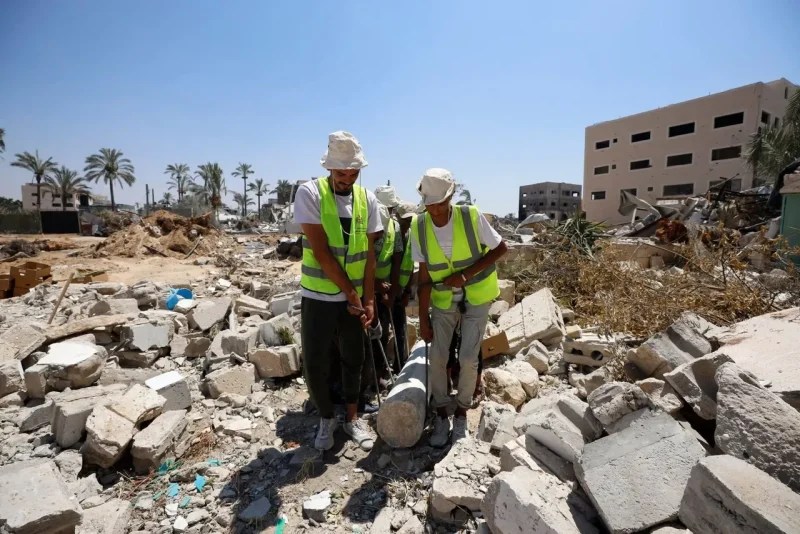
Amid the rubble of bombardment and beneath the ominous hum of drones in the so-called Zero Line area east of Khan Younis in southern Gaza, Mohammed Abu Lahia and his companions risk their lives.
Their mission is to rescue archaeological and heritage artefacts from the ruins of the Al-Qarara Cultural Heritage Museum, in a desperate attempt to prevent the erasure of Palestinian cultural memory after Israeli forces destroyed the museum during the war.
![Historical artefacts displayed at a Gaza museum before Israel launched its war on the enclave in October 2023 [TRT World]](https://d2udx5iz3h7s4h.cloudfront.net/2025/12/29/673300eacfcbfe8e438b6a7c/image/7a5d28d8c8a428a2c55e5e7b306ce95fd39c83a17770c17f4280cfc7150d3ff0.webp)
Historical artefacts displayed at a Gaza museum before Israel launched its war on the enclave in October 2023 [TRT World]
The urgency reflects Gaza’s extraordinary historical density. Over centuries, Canaanites, Philistines, Assyrians, Persians, Greeks, Romans, Byzantines, Mamluks, and Ottomans all ruled or passed through the territory.
Legendary figures such as Alexander the Great and Napoleon Bonaparte once stood on its soil. Each era left behind material traces – pottery, mosaics, inscriptions, textiles – many of which ended up in local museums like Al-Qarara.
“The Al-Qarara Cultural Heritage Museum was founded in 2016 in response to the community’s need for a cultural institution to preserve Palestinian heritage from being lost,” says Abu Lahia, the 30-year-old founder.
From its inception, the museum relied on donations from local families who entrusted it with heirlooms and antiquities meant to testify to Palestine’s long history and everyday life across generations.
Before its destruction, “the museum housed about 3,500 pieces narrating 5,000 years of Palestinian history, from Roman, Byzantine, and Mamluk eras to traditional jewellery,” Abu Lahia adds.
“Only about 1,000 pieces have been saved from the destruction through arduous manual search, due to the lack of specialised excavation machinery.”
Gaza’s antiquities are dispersed across public institutions and private museums established by enthusiasts driven by a desire to protect what they see as shared inheritance.
The Israeli war machine has impacted all museums, causing varying degrees of damage and the loss or theft of parts of their collections.
UNESCO has verified damage to at least 110 sites of cultural, historical, and religious significance across Gaza since the war began, including mosques, churches, archaeological sites, museums, and historic buildings, figures that continue to rise as access remains limited.
Abu Lahia explains the rudimentary salvage operation: “We are racing against time to pull out archaeological pieces. Every passing moment is from the lifespan of Palestinian history and these antiquities. We don’t want to lose what remains.”
With no access to modern tools, the team wraps artefacts in cloth and blankets, pads them with plastic and sponge, and stores them in vegetable crates, fruit boxes, or discarded humanitarian aid cartons. Heavy stone columns are dragged out using strong ropes and moved to safer locations.
Twenty-five volunteers, young men and women trained in history, archaeology, architecture, and fine arts, are participating in the effort. They view their work not as cultural preservation alone, but as resistance to erasure.
Alongside physical rescue efforts, the team is building a digital archive, recognising that memory must survive even when objects cannot.
Using a makeshift mobile studio, salvaged items are photographed, catalogued, assigned serial numbers, and uploaded under the museum’s name, ensuring that even if the artefacts are lost, their documentation endures.
![Mohammed Abu Lahia sorting artefacts after they were retrieved from under the rubble of Al-Qarara Museum [TRT World]](https://d2udx5iz3h7s4h.cloudfront.net/2025/12/29/673300eacfcbfe8e438b6a7c/image/09d39a5f38a4bb205b72586e60c012ee03e9e3259922a7283c4d3f1189d39fe4.webp)
Mohammed Abu Lahia sorting artefacts after they were retrieved from under the rubble of Al-Qarara Museum [TRT World]
Abu Lahia emphasises, “The museum has not ended despite the destruction. What survived under the rubble and what was documented digitally confirms that Palestinian memory is still alive.”
Saving the Palestinian Thobe
In another corner of Gaza, Suhaila Shaheen is fighting a parallel battle to preserve a different form of heritage: embroidered Palestinian dress.
The Palestinian thobe, known for its colourful stitches, encodes geography, social history, and identity—distinguishing villages, cities, and even family lineages.
For many Palestinians, it functions as a textile archive passed from one generation to the next.
Founded in December 2022, the Palestinian Thobe Museum in Rafah was both a personal dream and a cultural statement for Dr Shaheen. The university professor specialising in art and technology views safeguarding embroidered dress as preserving stories often excluded from official archives.
The museum, funded entirely by Shaheen and her fundraising efforts, became the first Palestinian museum dedicated to embroidered thobes founded by a woman.
Its collection grew to more than 5,600 heritage items, including around 340 hand-embroidered Palestinian thobes representing villages of the Gaza district, alongside original historical documents, rare photographs, agricultural tools, and a Bedouin tent.
Israeli bombardment on October 10, 2023, erased the museum entirely.
From beneath the rubble, Shaheen was able to recover only 64 thobes, some intact, others torn or eroded by the bombing.
“These are what remain of the museum’s memory,” she says. “I carry them with me wherever I go.”
Unable to save most of the collection physically, Shaheen turned to digital preservation, compiling photographs and records taken by herself, journalists and visitors.
“I’m working on gathering everything available digitally, so the story isn’t completely lost,” she explains.
Looting Gaza’s antiquities
Gaza-based Palestinian heritage expert Hammoud Al-Dahdhar describes the current situation as catastrophic.
In Gaza City’s Old Quarter, the iconic Great Omari Mosque, one of the oldest mosques in the Strip, has been left partially destroyed, its distinctive minaret reduced to a broken stump.
Nearby, the 700-year-old Qasr al-Basha, once a Mamluk palace and later the National Museum, has been struck and bulldozed. Thousands of artefacts it housed are now missing or unaccounted for.
![A broken plaque is all that remains of the Al-Qarara Museum [TRT World]](https://d2udx5iz3h7s4h.cloudfront.net/2025/12/29/673300eacfcbfe8e438b6a7c/image/f7395cc9d21597d1f1cbc9436ef97861991255a41a2a97f9eec0f63a3d7baf02.webp)
A broken plaque is all that remains of the Al-Qarara Museum [TRT World]
Al-Dahdhar points an accusatory finger at the Israeli occupation for looting thousands of archaeological pieces from Gaza’s historical sites, citing the disappearance of more than 17,000 artefacts from Qasr al-Basha alone.
Manual rescue efforts, he says, are carried out amid unexploded ordnance, shortages of equipment, and ongoing bombardment. Digital documentation faces its own risks, including cyberattacks aimed at erasing records.
“These are emergency first-aid operations. We document what is missing, what is looted, and what is destroyed, under impossible conditions,” Al-Dahdhar tells TRT World.
International institutions have also sounded the alarm.
During the war, the French Biblical and Archaeological School of Jerusalem reported that tens of thousands of archaeological artefacts from Gaza, including material excavated from the UNESCO-listed Byzantine monastery of Saint Hilarion, had been stored in a facility in Gaza City for safekeeping.
The site was managed and secured by Premiere Urgence Internationale, a humanitarian organisation that has worked for years on the protection of Gaza’s historical heritage while providing vocational training and livelihoods for young Palestinians.
Despite the facility’s protected status under the UN’s deconfliction system, the Israeli military ordered its evacuation ahead of an air strike.
![A mannequin on display at the Palestinian Dress Museum before its destruction [TRT World]](https://d2udx5iz3h7s4h.cloudfront.net/2025/12/29/673300eacfcbfe8e438b6a7c/image/ae1e5b20d835c73edd4acb9aaed3aa1913cbfd4c24c1db9b8cfbd1b21812a978.webp)
A mannequin on display at the Palestinian Dress Museum before its destruction [TRT World]
Under sustained risk of bombardment and amid severe shortages of time and resources, 70 percent of the collection, representing more than 25 years of archaeological research, was moved before the Israeli attack. The rest, destroyed.
Scholars and heritage experts have warned that the destruction of such material constitutes an irreparable loss, not only to Palestinians but to global understanding of early Christian and ancient Middle Eastern history.
Al-Dahdhar stresses that the stakes extend beyond preservation for its own sake.
“This is about protecting collective memory. Without it, identity itself is endangered.”
Israeli navy arrests 4 fishermen, blows up their boat
Palestinian Information Center – December 14, 2025
GAZA – The Israeli naval forces arrested four Palestinian fishermen off the coast of Gaza’s main port and later blew up their boat, in yet another attack in the ongoing series of violations against Gaza’s fishing community since the start of the war of extermination.
Zakaria Bakr, head of Gaza’s Fishermen’s Union, confirmed the arrests and the destruction of the boat, adding that the Israeli navy has killed around 230 fishermen since the war began. He also noted that 28 fishermen remain in Israeli detention.
According to Bakr, Israel has banned the entry of engines and fishing equipment into Gaza since the beginning of the assault, effectively crippling the fishing sector and depriving roughly 5,000 families who depend on it for their livelihood.
He estimated that the fishing industry is losing $5 million monthly, with total losses exceeding $70 million since the start of the war, due to the destruction of ports, boats, and fishing tools.
The Fishermen’s Union said the sector has suffered systematic destruction, with over 90% of fishing infrastructure, equipment, and private property wiped out in what it described as a campaign to eliminate this vital economic sector and starve thousands of Palestinian families.
Meanwhile, on Sunday morning, Israeli air and artillery strikes targeted areas inside the ceasefire zones in Gaza. Witnesses reported heavy bombardment, especially in the eastern parts of Khan Yunis in southern Gaza and eastern Gaza City.
Israeli naval forces also opened fire indiscriminately off the coast of Khan Yunis, sparking panic among fishermen and local residents.
These attacks are part of continued violations of the ceasefire agreement with Hamas. Since October 11, these breaches have resulted in 391 Palestinians killed and 1,063 injured.
Tony Blair ‘dropped’ from Gaza ‘Board of Peace’ shortlist; Hamas welcomes move as ‘step in right direction’

MEMO | December 9, 2025
A senior figure in the Islamic Resistance Movement, Hamas, Taher al-Nunu, said on Monday that reports about removing former UK prime minister Tony Blair from the “Gaza Peace Council” is “a step in the right direction”.
He said the movement had repeatedly urged mediators to exclude Blair because of what he described as his clear bias towards Israel.
In comments reported by Al Jazeera, al-Nunu confirmed that Hamas is ready to agree to a long-term truce, provided that Israel fully commits to a complete ceasefire.
He explained that the resistance’s weapons would form part of the defence system of a future Palestinian state, stressing that the movement firmly rejects any proposal for an international force to seize these weapons by force. “This proposal is rejected and has never been discussed,” he said.
Al-Nunu added that the movement has not yet received any clear plan regarding the structure of the proposed international force for Gaza, its duties, or the areas where it would be deployed.
He expressed his belief that “no state will agree to join a force tasked with forcibly disarming Gaza”.
He also said that “Benjamin Netanyahu’s ambitions go beyond the borders of Palestine and pose a threat to all countries in the region”.
In a separate remark, al-Nunu announced that Hamas is ready to hand over the administration of the Gaza Strip immediately to an independent national committee of technocrats, noting that this idea was proposed by Egypt after the Palestinian Authority refused to take on the role.
IDF Chief of Staff: Yellow Line Is Israel’s New Border
By Kyle Anzalone | The Libertarian Institute | December 7, 2025
The chief of the Israeli military said the IDF will not withdraw any further, and he considers the current partition line in Gaza as the new border.
“We have operational control over extensive parts of the Gaza Strip and we will remain on those defence lines. The yellow line is a new border line – serving as a forward defensive line for our communities and a line of operational activity,” IDF Chief of Staff Eyal Zamir told recruits on Sunday.
Under President Donald Trump’s 20-point peace plan, Israel and Hamas agreed to a ceasefire with Israel agreeing to withdraw to the yellow line. The yellow line leaves just over half of the Strip under Israeli military occupation. Only a small number of Palestinians live on the Israeli side of the partition line.
As Trump’s deal is implemented, Tel Aviv agreed that the IDF would undergo further withdrawals. However, Israel has signalled it has no intention of allowing Trump’s peace plan to end the conflict in Gaza. In November, European officials expressed concern that Israel was planning to de facto annex Gaza along the yellow line.
On Saturday, the Guardian reported the IDF was building permanent structures along the current partition line.
In addition to Zamir’s remarks, the IDF has violated the ceasefire nearly every day. Israel has killed over 370 Palestinians during the first seven weeks of the truce. The Gaza Health Ministry reported six Palestinians were killed on Sunday.
US tech giants to expand role in post-war Gaza strategy: Report
Press TV – December 2, 2025
A new report has revealed that US-based artificial intelligence firms Palantir and Dataminr are positioning themselves to take on a pivotal role in shaping the post-war security framework proposed for the Gaza Strip.
According to a report by the Israeli-Palestinian publication +972 Magazine on Tuesday, the companies have been integrated into the newly established Civil-Military Coordination Center (CMCC), a US-run operational hub in the southern part of the occupied territories where Washington and Israeli officials are coordinating the implementation of President Donald Trump’s 20-point plan for Gaza.
An official seating chart reviewed by +972 indicates that a “Maven Field Service Representative” from Palantir, referencing their battlefield analytics platform Project Maven, is assigned to the CMCC.
The hub, situated approximately 20 kilometers from the northern Gaza boundary, was opened in mid-October and currently accommodates around 200 US military personnel.
Project Maven, for which Palantir recently secured a $10 billion Pentagon contract to upgrade, gathers intelligence from various sources such as satellites, drones, spy planes, intercepted communications, and online platforms, reorganizing it into an “AI-powered battlefield platform” aimed at expediting military decision-making, including lethal airstrikes.
Palantir executives have described the system as “optimizing the kill chain,” and it has been previously utilized in US operations in Yemen, Syria, and Iraq.
Palantir has also strengthened its partnerships with Israeli forces during the current war, following a strategic agreement signed in January 2024 to support “war-related missions,” and has expanded its recruiting in Tel Aviv, doubling the size of its office over the past two years.
CEO Alex Karp has defended the collaboration amid international concerns over war crimes, saying that the company was the first to be “completely anti-woke.”
Documents reviewed by +972 also reveal the involvement of Dataminr, a US surveillance company, in internal CMCC presentations.
Dataminr, which utilizes AI to scan and analyze global social-media streams in real time, promotes its platform as providing “event, threat, and risk intelligence,” and has established partnerships with X to provide governments and law-enforcement agencies, including the FBI, with extensive access to public social-media data.
Both companies are expected to shape the “Alternative Safe Communities” model proposed under the Trump plan, which suggests relocating Palestinian civilians into fenced, heavily monitored compounds controlled by US and Israeli forces.
Within these zones, systems enabled by Palantir and Dataminr would be used to track mobile phones, monitor online activity, analyze movement, and flag individuals classified by AI as security risks.
Critics and analysts argue that this arrangement mirrors the predictive surveillance already deployed in Gaza over the past two years, including the AI-driven Lavender system used by Israel to create kill lists of suspected Hamas affiliates, which included public-sector employees such as police and medical workers.
Human-rights observers caution that such technologies have contributed to the extensive targeting of Palestinian families during an ongoing genocide.
The integration of US tech companies into the CMCC underscores a privatized model of occupation, one that sidelines Palestinian participation while expanding the role of AI-enabled policing, according to analysts.
For technology firms, the war presents an opportunity to access vast datasets and conduct real-world testing for new military systems.
Additionally, for Israel, it offers a way to outsource parts of the occupation while maintaining extensive control over Gaza’s population.
Gaza ‘stabilization force’ fails to launch as nations unwilling to commit troops: Report
The Cradle | November 29, 2025
The White House is having difficulty launching its so-called Gaza International Stabilization Force (ISF), as countries that previously expressed willingness to deploy troops to the project now seek to distance themselves from it, according to a 29 November report in the Washington Post.
The ISF “is struggling to get off the ground as countries considered likely to contribute soldiers have grown wary” over concerns their soldiers may be required to use force against Palestinians.
Indonesia had stated it would send 20,000 peacekeeping troops. However, officials in Jakarta speaking with the US news outlet said they now plan to provide a much smaller contingent of about 1,200.
Azerbaijan has also reneged on a previous commitment to provide troops. Baku will only send troops if there is a complete halt to fighting, Reuters reported earlier this month.
US President Donald Trump’s plan for Gaza envisioned meaningful troop contributions from Arab states, including the UAE, Bahrain, and Qatar. But after expressing early interest, none have committed to participating.
“A month ago, things were in a better place,” one regional official with knowledge of the issue stated.
Trump’s plan for post-war Gaza rests on the ability of an international force to occupy the strip and was endorsed by a UN Security Council resolution on 17 November.
However, because the resolution gave the force the mandate to “demilitarize” the Gaza Strip, many countries are resisting participation.
They say their troops could be required to disarm Hamas on Israel’s behalf. This would require killing Palestinians and possibly cast their forces as co-perpetrators in Israel’s genocide in front of the world.
Some officers are “really hesitant” to participate, one Indonesian official said.
“They want the international stabilizing force to come into Gaza and restore, quote unquote, law and order and disarm any resistance,” a senior official in Indonesia’s Ministry of Foreign Affairs said. “So that’s the problem. Nobody wants to do that.”
Participation would also put their soldiers in harm’s way, whether from Hamas or the ongoing Israeli airstrikes, which regularly kill Palestinians despite the alleged ceasefire that took effect in October.
Sources familiar with the plan told the Washington Post that the White House plans to man the force with between 15,000 and 20,000 foreign troops, divided into three brigades to be deployed in early 2026.
However, details have not been finalized, which has led to additional hesitancy among potential participating nations.
“Commitments are being considered. No one is going to send troops from their country without understanding the specifics of the mission,” the official said.
Efforts to establish the so-called “Board of Peace,” a committee of Palestinian technocrats taking orders directly from the White House to deal with the day-to-day administration of the enclave, have also stalled.
“We thought, with the Security Council resolution, within 48 to 72 hours, the Board of Peace would be announced,” another person familiar with the plan told The Post. “But nothing, not even informally.”
No other members of the Board of Peace have yet been named.
Israeli Prime Minister Benjamin Netanyahu has stated that the Israeli army will disarm Hamas if foreign countries are unwilling to do so for them.
“All indicators show that indeed no countries are willing to take on this responsibility, and that understanding is sinking in both in Israel and in the US,” said Ofer Guterman, a senior researcher at the Institute for National Security Studies (INSS) in Tel Aviv.
“Bottom line: It’s unlikely that the ISF, if it’s established at all, will lead to Gaza’s demilitarization,” he added.
Tamara Kharroub, Deputy Executive Director and Senior Fellow of the Arab Center in Washington, DC, described the Trump plan as “Permanent Palestinian subjugation and neocolonial rule dressed up as peace.”
“There are no guarantees or binding mechanisms or clarity around what constitutes reform or demilitarization and around who determines what they are. The plan ultimately gives Israel a blank check to prolong its presence in Gaza, fully reoccupy it, or resume its genocidal war,” Kharroub wrote.
Global movement to Gaza to stage pro-Palestine protests in 13 cities
Al Mayadeen | November 28, 2025
The Global Movement to Gaza announced coordinated protests across 13 major cities on November 29 to mark the International Day of Solidarity with the Palestinian People. The rallies aim to denounce Western support for “Israel’s” ongoing genocide in Gaza, now entering its third year.
Protests will take place in Berlin, Rome, Paris, Barcelona, Madrid, Oslo, Vienna, Warsaw, Luxembourg, Cape Town, Washington, DC, Mexico City, and São Paulo.
Organizers say the coordinated actions are designed to expose the complicity of European and North American governments in “Israel’s” war on Gaza. The movement accuses these states of enabling the genocide through arms exports, political backing, and economic ties.
In a statement, the movement issued a list of demands for European Union and national leaders:
- Immediate suspension of the EU-“Israel” Association Agreement;
- An arms embargo and an end to military cooperation with “Israel”;
- Targeted sanctions on “Israeli” officials responsible for war crimes and genocide;
- A halt to all academic, cultural, and sporting institutional ties;
- Alignment of EU foreign policy with international human rights and humanitarian law.
UNSC 2803: The US-Israeli scheme to partition Gaza and break Palestinian will
By Ramzy Baroud | MEMO | November 26, 2025
United Nations Security Council Resolution 2803 is destined to fail. That failure will come at a price: more Palestinian deaths, extensive destruction, and the expansion of Israeli violence to the West Bank and elsewhere in the Middle East.
The resolution, passed on 14 November 2025, was a consolation prize to Israel after failing to achieve its ultimate objective from the two-year Gaza genocide: the ethnic cleansing of the population and the complete takeover of the Gaza Strip.
Gaza shattered a core Israeli doctrine: the absolute certainty of its military supremacy to subdue the Palestinian people using far superior US and Western-supplied technology. Though the occupation was never expected to be easy – as Israel’s history of violence in the Strip attests – the complete takeover was, in the mind of the Israeli leadership, a certainty. In August, Israeli Prime Minister Benjamin Netanyahu stated with total confidence that Israel aimed to “take control of all of Gaza.” That proved to be wishful thinking.
How Israel has failed to subdue an impoverished and besieged population of 2 million people, subjected to a blockade, a famine, and one of the world’s most horrific genocides, is a question for future historians. The immediate consequence, however, is political: Israel and its Western backers, especially the US, understand that an utter Israeli failure in Gaza would be interpreted by Israel’s victims as a pivotal sign of the times.
In fact, the notion of Israel’s implosion and the end of the Zionist project has moved from the margins of intellectual conversation into the center. These ideas are bolstered by the Israelis themselves and are a recurring topic in Israeli media. Such a headline in Haaretz on 15 November is hardly shocking: “At a Secret Harvard Site, a Massive Archive of Israeliana Is Preserved – in Case Israel Ceases to Exist”.
Thus, US President Donald Trump’s so-called “Comprehensive Stabilization Plan for Gaza,” signed in Sharm el-Sheikh on 30 October 2025, was the official start of the American scheme to save Israel from its own blunders. That supposed ‘ceasefire’ was meant to give Israel the chance to maneuver. Instead of occupying all of Gaza and pushing Palestinians out, Israel would now use social and political engineering to achieve the same goal.
The first phase of the plan, which placed most of Gaza under Israeli military control in anticipation of a gradual withdrawal, is already proving to be a sham. As of the time of writing this article, Israel, according to the Gaza government media office, has violated the agreement nearly 400 times, killing over 300 Palestinians. Israel continues to systematically demolish Palestinian areas and has increasingly begun operating west of the Yellow Line, which separates Gaza into two regions.
Worse still, according to Gaza authorities, Israel has been expanding its share of Gaza, estimated at approximately 58 per cent, westward. The ‘ceasefire’ has effectively enforced a new mechanism that allows Israel to carry out a one-sided war – with further territorial expansion, destruction, assassination, and occasional massacres – while Palestinians expect nothing but the mere slowing down of the Israeli death machine. This is not sustainable, especially since Israel has also violated the most basic principle of the imaginary ceasefire: allowing vital aid to enter Gaza.
UNSC 2803 endorses the “Comprehensive Stabilization Plan for Gaza” without placing any legally binding expectations on Israel. It establishes a Transitional Administration and Oversight Council (TAOC), which entirely excludes Palestinians, including the Western-supported Palestinian Authority.
The executive branch of this TAOC would be the International Stabilization Force (ISF), whose sole job is to “stabilize the security environment in Gaza” on behalf of Israel, notably by disarming Palestinian groups. The ISF, according to the resolution, operates “in close consultation and cooperation,” meaning the force is tasked with achieving Israel’s military objectives, thereby allowing Israel to determine the timing and nature of its supposed gradual withdrawal.
Since Palestinians refuse to disarm – as unconditional disarmament without meaningful international guarantees would surely lead to the full return of the Israeli genocide – Israel will certainly refuse to leave Gaza. Netanyahu made that clear on 16 November, when he stated that “Israel would not withdraw” without disarming Hamas, “either the easy way or the hard way”.
The partition of Gaza is a US-led attempt to change the nature of the challenge for Tel Aviv, but ultimately aims at achieving the same original objectives. The resolution has served Israel’s interests fully, hence Netanyahu’s enthusiasm, yet Israel is still refusing to respect it, making it clear there will be no phase two of Trump’s original plan.
The entire political scheme, however, is doomed to fail. Though Palestinian suffering will certainly worsen in the coming months, the US-Israeli gambit is fundamentally flawed: it is built on trickery and coercion, resting on the false assumption that Palestinians, fearing genocide, will accept any plan imposed on them. This premise ignores history. Palestinians have consistently defeated such sophisticated mechanisms designed to break them, meaning this new arrangement is equally unsustainable.
Ultimately, the failure of UNSC Resolution 2803 confirms one enduring truth: the Israeli war on Gaza has not stopped. It has simply changed form. It is crucial that people around the world understand this next phase for what it is: a diplomatic maneuver designed to facilitate the ongoing Israeli plan to control the Gaza Strip and ethnically cleanse its population.
Featured Video

Theodore Postol: Iran’s Missiles & Drones Were Underestimated
or go to
Aletho News Archives – Video-Images
From the Archives
What is the Israeli Lobby in Australia Doing in Interfaith Dialogue?
By Ali Kazak | Dissident Voice | October 11, 2015
For years Israel and its lobby around the world have been trying to normalise their relations with Arabs and Muslims without solving the Palestine Question.
One of the methods they resorted to in the last few years is using human rights and community organizations such as interfaith dialogue and Multiculturalism to achieve this objective and to: isolate the Palestinians, marginalise the Palestine question, end Israel’s isolation, and prevent criticism of Israel, knowing that these organisations will be the first to stand against Israel’s violations, racial and religious discrimination.
The group responsible for this task in Australia is The Australia/Israel & Jewish Affairs Council (AIJAC); its Director of International & Community Affairs, Jeremy Jones is in charge of lobbying religious community organizations, specifically Muslims and Christians. Consequently he convened the Faith Communities for Reconciliation, founding participant in the Australian Partnership of Religious Organisations and the Australian National Dialogue of Christians, Muslims & Jews.
AIJAC is a private political propaganda group. It is recognised as the main Israeli lobby in Australia. It coordinates its activities and works intimately with the Israeli embassy in Canberra and different institutions in Israel. It is privately funded by some Jewish businessmen. It monitors closely Australian politicians, the media, ethnic and religious groups, (especially Arabs and Muslims), unions and academics on their stands towards Israel and the Palestine question. … continue
Blog Roll
 Aletho News
- The war of liberation of the Arab and Islamic peoples expands across the Gulf
- Envoy warns UN on Trump’s threat to ‘obliterate’ Iran’s civilian infrastructure
- The Larak Corridor: Iran’s Rial Gate With No US, No Israel, and No Way Around
- ‘Economic terrorism’: Steel facilities hit again in US-Israeli strike
- ‘War Crime’: Iran condemns attacks on Arak, Ardakan nuclear sites
- Two-thirds of Americans want quick end to Iran war even if goals unmet
- Trump to Give “Important Update on Iran” Wednesday in Prime-Time Speech
- Theodore Postol: Iran’s Missiles & Drones Were Underestimated
- Iran To Target Military Industrial-Tech Complex That Facilitated Gaza Genocide
- Collapsing Empire: The Resistance Disarms ‘Israel’
- If Americans Knew
- Israel wants US to bomb more of Iran’s civilian structures (113,000 is not enough) – Not a ceasefire Day 173
- Ann Coulter Rips Into Fox News for Iran War Coverage
- Joe Kent Urges Americans To Call White House and Congress To Object To Sending Troops Into Iran
- DNC Resolution to Reject AIPAC Funding Puts Democratic Leaders in the Hot Seat
- Swedish foundation to build 400 schools as over 650,000 Gaza children remain without education for 2 years
- Israeli army admits photshopping image of slain Lebanese journalist
- This is how Israel is systematically killing health workers under the cover of war in Lebanon
- Carrying life under fire: Israeli invasion of Lebanon leaves pregnant women facing deadly risks
- Champagne all around for the new death penalty (for Palestinians) law – Not a ceasefire Day 172
- Why are Palestinian books struggling to be seen on Amazon?
- No Tricks Zone
- New Study Finds Warming Saves Lives…Cold Temperatures 12 Times More Deadly Than Excess Heat
- German Science Blog Accuses PIK Climate Institute Of Hallucinating Climate Tipping Points
- Devastating Assessment Of Comirnaty Vaccine By Former Senior Pfizer Europe Toxicologist
- New Study: CO2 Is ‘Effectively Negligible’ As An Explanatory Climate Change Factor Since 2000
- Former Pfizer Toxicologist Dr. Helmut Sterz Tells Bundestag Hearing Pfizer Vaccine Should Have Never Been Approved
- Energy Expert: Germany’s Nuclear Phaseout Was A “500 Billion Euro Mistake”
- New Research: South Australia’s Mid-Holocene Sea Surface Temperatures Were 4°C Warmer Than Today
- Storing Green Energy To Last Germany 10 Days Would Require A 60-Million Tonne Battery
- New Studies: UK Sea Levels Were 4 Meters Higher Than Today During The Mid-Holocene
- Destructive Green New Deal: German Energy And Metal Group Warns Of Drastic Crisis
 Aletho News