The Magician’s Hat, and the Great Simulacrum of Palliative Balm
By Alastair Crooke | Strategic Culture Foundation | November 27, 2023
The Magician steps onto the stage, his black cloak swirling about him. Centre stage, he flourishes his hat: It is empty. He punches it lightly to demonstrate its solidity. The Magician then picks up certain objects and places them into his hat. Into it goes AnsarAllah’s seizure of an Israeli-owned vessel (the situation is being ‘monitored’); into it goes the Iraqi strikes on U.S. bases (barely noticed by the main-stream media); into it too go the 1,000 missiles fired into northern Israel by Hizbullah; into it goes the hot war in the West Bank. The Magician turns to the audience – the hat is empty. But the audience knows those objects have a physical reality, but somehow they are magically obfuscated.
It is in this way that the western main-stream media maintains deterrence by playing down the state of war through what Malcom Kyeyune describes as “a simulacrum of peace” – of a gently subsiding conflict and the quieting deployment of (paraphrasing Kyeyune) a very “post-modern question”: What exactly is the meaning of civilian ‘non-combatant’ anyway?
One aspect to the image of easing conflict is the hostage exchange that has been agreed. It is both real, and at the same time it underpins the simulacrum that once Hamas is annihilated, and the hostages released, then the problem of 2.3 million Palestinians can go into the magician’s hat, and be eased from sight. For some, the hope is sincere and well intentioned – that once the fighting ceases, it will stay ceased, and that an end to the bombardment in Gaza might open a window to some political ‘solution’ – if it can be extended sine dei.
‘Solution’ being here but a polite word for the EU’s attempted bribery of Egypt and Jordan. Reportedly, the EU President, Ursula von der Leyen, visited Egypt and Israel to present them with financial offers ($10bn for Egypt and $5bn for Jordan), in exchange for the dispersal of the inhabitants of the Gaza Strip elsewhere – effectively to facilitate the evacuation of the Palestinian population from the Strip in line with Israel’s aims of ethnically-cleansing Gaza.
However, former minister Ayalet Shaked’s tweet – “After we turn Khan Yunis into a soccer field, we need to tell the countries that each of them take a quota: We need all 2 million to leave. That’s the solution to Gaza” – is but one by senior Israeli political and security figures extoling what Israel increasingly sees as the “solution” for Gaza.
But by being so explicit, Shaked likely has torpedoed Von der Leyen’s initiative – for no Arab state wants to be complicit in a new Nakba.
A Hudna or ‘time out’ inevitably is highly precarious. In the 2014 fighting, when IDF forces initiated military sweeps in Gaza after a ceasefire had begun, it led to a fire-fight and the collapse of the cease-fire. The fighting continued for another full month.
Two key lessons that I learnt from trying to initiate truces on behalf of the EU during the Second Intifada were that a ‘truce is a truce’ and only that – both sides use it to reposition themselves for the next round of fighting. And secondly, that ‘quiet’ in one confined locality does not spread de-escalation to another geographically separate locality; but rather, that one outbreak of egregious violence is virally contagious, and spreads geographically instantly.
The present hostage exchange is centred on Gaza. However, Israel has three fronts of hot conflict open (Gaza, its northern border with Lebanon, and in the West Bank). An incident occurring in any one of the three fronts may be enough to collapse confidence in the Gaza understandings and re-launch Israel’s assault on Gaza.
On the eve of the truce, by way of example, Israeli forces heavily bombed both Syria and Lebanon. Seven Hizbullah fighters were killed.
The point here, plainly said, is that the historical precedents of Hudnas leading to political openings are not that great. A hostage release, per se, resolves nothing. The issue in the present crisis runs far deeper. When, ‘once upon a time’, Britain promised the Jews a homeland, western powers also (in 1947) promised Palestinians a state, but never took it to implementation. This lacuna ultimately is culminating in a head-on train crash.
The Israeli Cabinet’s ambition for a Jewish State on the biblical lands of Israel simply is intended to block any Palestinian State from emerging either in part of Jerusalem, or elsewhere in historic Palestine. In this context, Hamas’ actions were precisely intended to break this impasse and the endless paradigm of fruitless ‘negotiations’.
Unsurprisingly, Israel’s Defence Minister already has announced Israel’s intention to renew fighting immediately after the end of the cease-fire. Israeli officials have been telling their U.S. counterparts that they anticipate several more weeks of operations in the north of the Strip, before shifting focus to the south.
Thus far, the IDF has been operating in areas close to the shoreline in Gaza, and in places, such as the Wadi, south of Gaza City, where the subsoil does not facilitate the building of tunnels. These are the areas, therefore, where Hamas does not have significant defensive capabilities. Should military action be renewed, the IDF is likely to move away from the northern coastline towards the Gaza City epicentre, allowing Hamas to manoeuvre more easily, and inflict greater losses on the IDF and their armoured vehicles. In this sense – away from the simulacra – the war is just beginning.
Prime Minister Netanyahu has been described both in Israel and in the western MSM as a ‘dead man walking’ in political terms. Be that as it may, Netanyahu has his strategy: He has openly defied the Biden Team on every war-related issue, except that of eradicating Hamas.
During a press conference last Sunday, Netanyahu touted a “diplomatic Iron Dome”, saying he would not give in to “increasingly heavy pressure … used against us in recent weeks … I reject these pressures and say to the world: We will continue to fight until victory — until we destroy Hamas and bring our hostages back home”.
Yonatan Freeman, from the Hebrew University, perceives the gambit in Netanyahu’s vague statements: He defies Team Biden, yet takes care to leave sufficient ‘wiggle room’ so that he can always blame Biden, whenever he is ‘forced’ by America into some reversal.
The Israeli Cabinet’s strategy, therefore, rests on the big bet that Israeli public opinion will hold – despite Netayahu’s personal disapproval ratings – due to the overwhelming public support at this point for the two declared objects set by the War Cabinet: Destroying the ‘Hamas regime’ and its capabilities, and the release of all Israeli hostages.
At its core, ‘the bet’ lies in the conviction that public sentiment – contextualised deliberately by the Israeli cabinet in absolute Manichean terms (light versus the dark; civilisation versus barbarism; all Gazans being complicit with ‘Hamas’ evil’) – will ultimately arouse a wave of support for the further move of taking “the fiction” of a Palestinian state off the table “once and for all”. The table is being set for a long war against ‘cosmic evil’.
The ‘solution’, as National Security Minister Smotrich and his allies underline, is to offer Palestinians a choice – ‘to renounce their national aspirations and continue living on their land in an inferior status’, or to emigrate abroad. Put bluntly, the ‘solution’ is the removal of all non-subservient Palestinians from the lands of Greater Israel.
Turning now to the contending perspective:
The ‘united axis’ supporting Palestinians observe that Israel continues to adhere to its initial military goals of destroying Gaza to the point where there is nothing left – no civilian infrastructure at all – by which Gazans might live, were they even to try to return to their collapsed homes.
They see this Israeli objective fully supported by Biden when his spokesman said:
“We believe that they have the right to [embark on further combat operations in Gaza]; but [such actions] … should include greater and enhanced protections for civilian life”.
Regional security commentator, Hasan Illaik, notes,
“Axis officials also believe that conciliatory-sounding U.S. statements, which sometimes suggest that a de-escalation phase is imminent, are nothing but an effort to repair a public image heavily damaged by unstinting U.S. support for Israel’s continuing massacre of Palestinians in Gaza”.
So, is Israel, supported by Team Biden and some EU leaders, winning?
Tom Friedman – an intimate of Team Biden – wrote in the New York Times on 9 November – after traveling around Israel and the West Bank:
“I now understand why so much has changed. It is crystal clear to me that Israel is in real danger — more danger than at any other time since its War of Independence in 1948”.
Far-fetched? Possibly not.
Back in 2012, U.S. author Michael Greer wrote that Israel was founded at a particular propitious time, despite being surrounded by hostile neighbours:
“Several of the major Western powers supported the new state with significant financial and military aid; of at least equal importance, members of the religious community responsible for creating the new state, who remained back in those same Western nations, engaged in vigorous fundraising efforts to support the new state, and equally vigorous political efforts to get existing governmental support maintained or increased. The resources thus made available to the new state gave it a substantial military edge against its hostile neighbours, and its existence became enough of a fait accompli that some of its neighbours backed away from a wholly confrontational stance”.
“Still, the state’s survival depended on three things. The first, and by far the most crucial, was the ongoing flow of support from the Western powers to pay for a military establishment far larger than the economic and natural resources of the territory in question would permit. The second was the continued fragmentation and relative weakness of the surrounding states. The third was the maintenance of internal peace within the state and of collective assent to a clear sense of priorities, so that it could respond with its full force to threats from outside – instead of squandering its limited resources on civil strife or popular projects that contributed nothing to its survival”.
“In the long run, none of these three conditions could be met indefinitely … When it happens that these early patterns of support break down, Israel may find itself backed into a corner”.
Last week, a leading Israeli commentator noted:
“You might think a Presidential visit, presidential speech, three Secretary of State visits, two Secretary of Defence visits, the dispatching of two aircraft carrier groups, a nuclear submarine and Marine expeditionary unit, and the pledge of $14.3 billion in emergency military aid, are testament to the unwavering support the U.S. is extending to Israel” …
“Think again”.
“Underneath the full and robust backing of the Biden administration, there are dangerous and treacherous currents that are chipping away and encroaching on public sympathy for Israel across the United States. Polls released last week contained the most alarming and telling data: Public support for Israel is cratering – particularly amongst the 18 – 34 age group. Another poll shows that 36% of Americans say they oppose additional funding for Ukraine and Israel: Support for funding Israel, only – was at 14%”.
What is truly remarkable is that the leaders of the new narratives are the youth of Generation Z, Y, and Alpha. Leveraging social media, and speaking directly to their peer groups, they have conveyed the grievances of the Palestinians to the world. Many had limited knowledge of Palestine, but their unfiltered sense of justice fuelled their collective anger against Israel’s ongoing ethnic cleansing of Palestine.
Greer’s second and third conditions for Israel’s survival also are metastasizing as the global tectonic plates grind and move: Non-western powers are not siding with Israel. They are coalescing in opposition to the Israeli Cabinet’s aspiration to end the notion of a Palestinian State, once and for all. And today, Israel is bitterly divided on the vision for its future; what it is exactly that constitutes ‘Israel’ and even that very post-modern question, ‘what it is to be Jewish’.
Region ‘let down’ by West’s reaction to Israeli crimes in Gaza: Qatar
Press TV – November 27, 2023
Qatar’s Prime Minister and Foreign Minister Mohammed bin Abdulrahman al-Thani has slammed the West’s support for Israel’s war on the besieged Gaza Strip, warning against the risk of a regional spillover.
“There’s a big disappointment in the region from the West’s reaction… We were expecting from the West the killing of Palestinian people is something to be condemned,” the Financial Times quoted al-Thani as saying on Sunday.
“And what we expect at least is [the West] to step up to the same standards, the same principles that they stood up to with other wars,” al-Thani added.
Noting that the war on Gaza was not treated like other conflicts, Sheikh Mohammed said “calling for a ceasefire after this destruction and killing [in Gaza] and displacement is a duty on everyone.”
Destruction of Hamas ‘not realistic’
Al-Thani emphasized that Israel’s declared aim of eliminating Hamas resistance movement was not realistic.
“At the end of the day, Hamas’s destruction by the continuation of this war will never happen,” he said, calling for a political solution to the conflict.
He stressed that Palestinians in Gaza and the occupied West Bank needed to have a “political horizon” for a viable state of their own and to be able to choose their own leadership, adding “Other than that . . . there won’t be a solution.”
The minister noted that Qatar now focuses on stopping the war. “Our only plan is to stop the war.”
“Talking about the day after as the killing and the massacres is ongoing is just like endorsing this war,” he said.
“The amount of anger and agitation in the Arab population in the region is unprecedented when they see these images, and nobody is stepping up to stop it.”
Al-Thani also warned that the failure to secure an extended ceasefire would risk the war spilling over and destabilizing “the entire region.”
He slammed Western powers for not exerting more pressure on Israel to end the war.
Referring to the underway temporary ceasefire in Gaza, al-Thani said it could be extended if Hamas managed to locate women and children captives who are held in Gaza and secure their release.
“If they get additional women and children, there will be an extension,” he said, adding “We don’t yet have any clear information how many they can find because . . . one of the purposes [of the pause] is they [Hamas] will have time to search for the rest of the missing people.”
Israel launched the war on Gaza on October 7 after the Palestinian resistance movement Hamas waged the surprise Operation Al-Aqsa Storm against the occupying entity in response to the Israeli regime’s decades-long campaign of bloodletting and devastation against Palestinians.
Nearly 15,000 Palestinians, most of them women and children, have been killed in the Israeli strikes.
Israel dropped 40,000 tons of explosives on Gaza Strip since Oct. 7, says media office
MEMO |November 26, 2023
The Gaza government’s media office said on Sunday that the Israeli army has dropped 40,000 tons of explosives on the Gaza Strip since Oct. 7, with the apparent goal of rendering the enclave uninhabitable.
Salama Maarouf, the head of the media office, issued a statement on Telegram on the third day of the temporary humanitarian pause between Israel and Hamas, which came into effect on Friday morning.
“The Israeli occupation forces have dropped 40,000 tons of explosives on the Strip (since Oct. 7), and the atrocities of the occupation (forces) have unfolded away from the scrutiny of cameras,” Marouf said.
He explained that “the bombs recently used by the occupation (forces) have never been used before, and hundreds of martyrs are buried in the places where they died. The devastation by the occupation (forces) reflects its intent to make Gaza uninhabitable.”
In the statement, Maarouf also discussed the temporary pause, emphasizing that “the days of respite have laid bare the enormity of the significant massacre, resulting in substantial destruction to infrastructure and residences.”
“One-third of the Gaza Strip’s population has yet to receive essential supplies, and the absence of all international institutions is evident,” he stated, calling on the international community to act.
“There is a pressing need for the establishment of a sizable field hospital,” he added.
Thousands-Strong Rally Takes Place in Berlin for Negotiations on Gaza, Ukraine
Sputnik – 25.11.2023
BERLIN – A rally organized by left-wing German politician Sahra Wagenknecht took place in Thousands-Strong Rally Takes Place in Berlin for Negotiations on Gaza, Ukraineon Saturday with thousands of participants rallying against the supply of weapons to Ukraine and for a diplomatic solution to the Ukrainian and Palestinian-Israeli conflicts, a Sputnik correspondent reported.
In an opening speech, Wagenknecht accused the German government of applying double standards in its assessment of the Ukrainian conflict and the “merciless bombing” in the Gaza Strip, the correspondent reported.
The politician criticized the government’s spending on the German military production at a time when the nation faces several internal problems, such as a shortage of teachers, hospital closures and aging infrastructure. She also criticized the government’s decision to stop holding down energy and electricity prices.
“And immediately it was about cutting spending on those least able to fend for themselves,” Wagenknecht said.
In leaflets distributed to demonstrators, protest organizers called for peace talks in all the world’s conflict zones, the report read. After the speech, rally participants marched past the Bundestag and back to the original meeting point, carrying placards calling for peace and an end to Russophobia, the Sputnik correspondent reported.
On October 23, Wagenknecht, who had criticized Germany’s military aid to Kiev and sanctions against Russia, said she had left the Left Party and intended to found a new political party with several close associates that would stand for “reason and justice.” About 14% of Germans were ready to support the new party, polls showed.
Hamas delays release of captives over Israel’s violation of ceasefire
Press TV – November 25, 2023
The Palestinian resistance movement Hamas says it has decided to delay the release of a second batch of Israeli captives under a ceasefire in Gaza over Israel’s lack of commitment to the agreement which came into effect on Friday.
Hamas’ military wing, known as the Al-Qassam Brigades, said on Saturday it had suspended the release under the ceasefire deal with Israel while it was communicating with mediators to address the regime’s violations of the agreement.
It said Israel was not holding up its part of the deal on issues like easing the delivery of humanitarian aid and fuel to Gaza as well as halting gunfire that it said has led to more deaths and injuries among civilians.
Osama Hamdan, a senior political official of Hamas, also said that Israel had started violating the terms of the agreement on Friday and continued its violations on Saturday.
Israel denied the claims with a military spokesperson telling French television channel BFM that the regime had fully respected the truce.
Hamas and Israel agreed as part of a ceasefire deal that was mediated by Qatar earlier this week to exchange prisoners and to stop fighting for four days.
The two sides carried out a first round of prisoner swaps on the first day of the deal on Friday.
Under the deal, Hamas will release a total of 50 Israeli captives taken during a blitz into Israeli-occupied Palestine in early October in return for the release of 150 Palestinians from Israeli jails.
Hamas has said it is ready to extend the deal to put an end to an Israeli aggression that has killed nearly 15,000 people in Gaza over the past 50 days.
ANALYSIS: HOW THE UK AND US MEDIA DEHUMANISE PALESTINIANS
BY CLAIRE LAUTERBACH AND NAMIR SHABIBI | DECLASSIFIED UK | NOVEMBER 22, 2023
Nazis. Beneath animals.
This is a small sample of what Palestinians have been called by commentators speaking to Western media outlets in the last month of the Palestinian-Israeli conflict – examples of the bestiary of zoological terms natural to a coloniser’s view of the colonised.
Political philosopher Frantz Fanon wrote during France’s colonial war in Algeria of “hordes of vital statistics”, “hysterical masses”, “faces bereft of all humanity”, and “children who seem to belong to nobody”.
These are all terms that could describe how western media covers the suffering of Palestinians — “a tide of humanity… a teeming mass of Gazans”, as the BBC put it (15 October). This is all sharply in focus since Hamas’ October offensive, and Israel’s genocidal razing of the Gaza strip.
We analysed the front page coverage of Israel’s war in Gaza by five major US and UK news media — the Washington Post, the New York Times, the Guardian, the Times, and the BBC (the news landing page at 7am daily) between 7-26 October.
Over these three weeks following Hamas’ offensive, the mechanics of the Western press’ dehumanisation of Palestinians in death and life are revealed as clinical and routine.
Israelis are murdered, Palestinians die
The dehumanisation process begins (or ends) with questioning who counts in death, and how the killer and the victim are portrayed.
In the UK-US mainstream media, Israelis die actively. They are either killed or murdered by Hamas, or “after a surprise Palestinian attack”. “The Palestinians” stands in for “Hamas” for sloppy or ideological editors, for example in the Guardian on 8 October.
Palestinian civilians, by contrast, die passively – and yet it is they who have done most of the dying since 7 October; over ten times the number of Israelis killed.
Gazans aren’t killed by Israeli forces or Israeli government policies. They “dehydrate to death as clean water runs out” (Guardian, 18 October) while Israeli airstrikes “continue to pound the Palestinian territory”.
On 9 October, the BBC ran with “700 people have been killed on the Israeli side with more than 400 also dead in Gaza”, presumably succumbing to shock or an act of God.
On 8 November, the Times of London noted: “Israelis marked a month since Hamas killed 1,400 people and kidnapped 240, starting a war in which 10,300 Palestinians are said to have died”, which is of course qualified.
Palestinian deaths are natural, undifferentiated. This is only possible because the media treat Israel’s blockade of Gaza as wholly logical, proportionate and even restrained.
Violations of international law
Collective punishment, which is essentially what Israel is doing by striking civilian “targets” and totally blockading the “open prison” (in former prime minister David Cameron’s words), is also illegal. This is the view of EU foreign policy chief Josep Borrell, UN human rights chief Volker Türk and Human Rights Watch, among others.
When UN chief António Guterres noted Israel’s decades-long occupation of Palestine and called for an end to the siege, Israel’s UN representative demanded he resign. At least one of Guterres’ colleagues, the head of the New York office of the UN high commissioner for human rights, Craig Mokhiber, resigned of his own accord, protesting Israel’s “genocide unfolding before our eyes” in Palestine.
However, in none of the three weeks’ of front-page headlines and lead paragraphs for the five UK-US media analysed for this article are Israel’s serial violations of international law mentioned.
The exclusion of this important context on Israel’s crimes is important. As journalists we’re trained to account for the fact that most people don’t read beyond the headlines or first paragraphs.
Off the front page, some media published separate analysis pieces, such as the New York Times’ “Israel, Gaza and the laws of war” (12 October). This unsurprisingly goes nowhere near calling Israel’s crimes what they are: crimes.
Despite discussing at length how civilians cannot be targeted or disproportionately harmed for military purposes, the closest the New York Times gets to criticising the action of the Israel Defence Forces (IDF) is quoting the opinion of an expert on siege law.
This was that Israel’s siege is “an unusually clear-cut example of starvation of civilians as a method of warfare, which is considered a violation of international humanitarian law, a crime against humanity and a war crime” (emphasis added).
A swift qualifier follows: “Jurisdiction over some war crimes would depend on whether the conflict is considered inter-state.” So some crimes are not a crime as long as Palestine or Palestinians don’t exist, as Israeli prime minister Golda Meir asserted over 50 years ago, repeated by current Israeli politicians.
By contrast, Hamas’ actions are, to the same cited expert, “not close calls”.
Preventable deaths
Moving on from, or ignoring completely, both the illegality of Israel’s total siege of Gaza, the UK-US media portray the starvation and preventable deaths resulting directly from it in almost entirely passive, naturalistic language.
For example, the Washington Post’s print version front page: “Civilian harm in Gaza looms over Biden’s visit; Rising human toll from attacks could threaten Israel’s global backing” (harm arising of course from Israel’s battering).
On 13 October, from the New York Times : “300,000 homeless in battered Gaza as food runs low” (because Israel is blocking food from entering Gaza). It continues: “Hospitals overwhelmed and fuel scarce” (because Israel is blocking medical supplies and fuel from reaching Gaza) “as Israel strikes back at Hamas.”
That’s fine then – the reader should feel at ease since Israel’s crushing of hospitals is merely an act of “self-defence”.
The Israeli military is not much a fan of Gazan hospitals – it regularly bombs them. It ordered 23 hospitals in northern Gaza to evacuate on 13 October, and seems to have been picking them off, with patients inside, ever since.
When Israel might have gone too far, as it did in almost certainly bombing Al-Ahli Arab Hospital on 17 October, most outlets covered the strike by repeating both Israel’s and Hamas’ “he said-she said” accusations against the other.
Nevertheless, the New York Times gave the IDF’s denial more weight with “Hamas fails to make case that Israel struck hospital” (23 October, emphasis added), which is a catchier headline than “We don’t know, and don’t want to work it out ourselves”.
Meanwhile, the Times ran with “Strike kills up to 500 in Gaza”, swiftly adding that “Israel denies responsibility and blames jihadis”, with no comment from a Palestinian voice.
Mirroring the discrepancy between how Palestinians have died (passively, often with no mention of Israeli actions) and Israelis have died (actively, directly attributed to Hamas or “Palestinian” actions) is how the media describes child victims of both sides.
Discussing a prisoner exchange, a Washington Post columnist described Israel’s “children hostages” while referring to Palestinian children as “young people”. Under Military Order 1591, the Israeli government can hold minors as young as 12 without trial and potentially indefinitely in “administrative detention”, UNICEF reports.
When Gazan civilian deaths from siege and strikes against civilian infrastructure are shown as authorless natural disasters rather than as war crimes, any access Gazans get to essential goods becomes “aid” or “relief”, and every tiny amount allowed to reach them is an act of Israeli mercy.
For example, the New York Times (19 October): “Deal lays groundwork for aid to reach desperate Gazans”. Or the Washington Post (12 October): “Closed borders, falling bombs choke Gaza; thousands injured as supplies wane”, adding “humanitarian crisis in Gaza worsens” (due to Israeli siege, let’s not forget).
Also in the Washington Post is the incredible headline (16 October) “As Palestinian death toll rises, aid stuck in Egypt”, as if it couldn’t physically fit through the door, which ignores the fact that Israel prevented aid from entering Israel via Rafah, demanding proof it would not be diverted to Hamas.
The numbers
Having reduced Palestinians to numbers, the work then becomes to cast doubt on these numbers.
When Israel’s flattening of Gaza began raising international alarm, Biden said he didn’t trust that “Palestinians” (or the Hamas government, since to him the distinction is irrelevant) “are telling the truth about how many people are killed.”
His statement was the latest in a time-honoured tradition of US administrations disputing the number of deaths wreaked by their allies abroad, from Suharto’s Indonesia, to Salvadoran death squads in the 1980s and Saudi Arabia today, as historian Bradely Simpson notes.
No one seriously disputes the Gazan Ministry of Health’s numbers as too high. If anything, they are likely a serious undercount given how many bodies are trapped under rubble.
Nevertheless, the attribution of figures to the “Gaza Ministry of Health” is now almost always prefaced by “Hamas-government” or followed by “controlled by Hamas”. This would seem an odd waste of words, considering that everyone from the UN to the US State Department cites Gazan health ministry casualty data, and Gaza’s government is run by Hamas.
Dead Palestinians are simply irrelevant for some media. The first mention of Palestinian deaths in Times headlines occurred 11 days after Hamas’ assault: “Strike kills up to 500 in Gaza”. It had by then run several front page pieces about specific, named Israeli victims, including an in-depth profile (with portrait) of a kibbutz family horrifically killed by the Hamas-led offensive [or not].
Unsurprisingly, on 12 October, the Telegraph published the number of Israelis killed in factors of “9/11s” in a striking infographic which didn’t even bother to include an estimate of Palestinian deaths.
Double standards
Once a people are truly dehumanised, it becomes logical – necessary, even – to apply a wholly different standard of (in)decency to them.
UK-US media report Palestinian deaths passively, as if through apparent acts of God, often couching the deaths in language suggesting that they were mostly Hamas or Hamas-adjacent, or at least that they inconveniently stood in missiles’ way.
For still-breathing Palestinians, it is not enough to have somehow escaped being killed by the almost 6,000 bombs Israel launched in its first six days punishing the densely populated territory. This is more than the US, not usually known for its restraint, deployed in any single year of its war in Afghanistan.
A living Palestinian must justify his or her continued aliveness by disavowing Hamas. A viral example of this can be seen in BBC Newsnight’s interview of the head of the Palestinian mission to the UK, Husam Zomlot.
Presenter Kirsty Wark barely flinched upon hearing Zomlot describe in detail how members of his family had been killed by Israeli strikes in the previous days before repeatedly demanding Zomlot condemn Hamas’ actions.
To reverse this, in other words, to ask every Israeli who had lost a family member in this conflict to first begin by condemning Israel’s murders and collective punishment of civilian Gazans would be rightly seen as outrageous. Unsurprisingly, we have not seen any examples of such in the Western press.
The UK-US press also tells us that to support Palestinians is to support Hamas, in case anyone doubted the conflation.
The BBC declared London’s peaceful pro-Palestine protesters as providing “backing for Hamas.” It later retracted its “poorly phrased” comments.
Sky News did no better in using images of peaceful protesters bearing Palestinian flags to accompany its discussion of efforts by the London Metropolitan Police to “tackle extremism”.
These “slips” pale in comparison with the virulently offensive terms guests on BBC programmes have called Palestinians, completely unchallenged by their hosts.
For example, BBC Arabic hosted former Israeli intelligence veteran-turned academic, Mordechai Kedar who refused to recognise popular Israeli racism towards Palestinians, claiming that bestial comparisons of Palestinians are “denigrating to animals.”
Tellingly, the BBC Arabic host neither ejected Kedar from the interview, nor did she admonish him and demand an apology. Instead, the host pivoted away from Kedar’s genocidal language with the comment “that’s your opinion”.
Platforming Israeli justifications
UK-US media have also taken to running pieces platforming Israeli justifications for the IDF’s actions when the staggering number of dead Gazan civilians was becoming harder to write around.
“How Israelis justify scale of airstrikes” ran the New York version front page of the New York Times on 26 October. It was later rewritten as “Israel’s strikes on Gaza are some of the most intense this century”.
It is unthinkable that a Western newspaper would carry a piece platforming in the same benign-to-neutral terms Palestinian rage, or worse, justifications for Hamas’ crimes.
Another trend is to normalise Israel’s actions by focusing not on its costs in Gazan lives, but its intentions which, of course, are shown as benign. (Note: intentions don’t matter in the laws of war.)
Three days into Israel’s illegal total blockade of Gaza, the BBC asked: “Could an Israeli ground invasion of Gaza meet its aims?” (14 October). Charitably characterising Netanyahu as “risk-averse” (for Israelis, not Palestinians), the New York Times ran with “All-out war is untried ground”, comforting readers that “limited strikes in past were safe politically”.
Dissenting voices: harder to hear
Journalists at the BBC and Agence France Presse (AFP) who have been critical of their agencies’ bias against Palestinian lives and minimisation of Israeli war crimes told Declassified that there is no space to discuss editorial concerns.
Palestinian commentators have seen their segments edited out of mainstream news programmes. Palestinian Americans report their events are being cancelled while they’re called Hamas supporters.
Meanwhile, a senior editor at US publication Newsweek called for Gaza to be flattened to resemble a parking lot, apparently without censure.
Elsewhere in the media ecosystem, an official of the UK’s communications regulator OFCOM, Fadzai Madzingira, was suspended for a social media post criticising UK support for “ethnic cleansing and genocide of Palestinians” and “this vile colonial alliance”.
None of these points – that Israel may be committing genocide, that it continues to ethnically cleanse Palestinian land or that Israel was founded as a colonial project which still uses settler outposts to consolidate territorial control – is outside of reasonable analysis of historical facts.
It’s looking an awful lot like the beginning (or end, depending on your starting point) of a genocide.
The IDF has instructed all Palestinians to flee south of the Wadi Gaza area “for their safety” from Israeli strikes. Some were struck as they were evacuating, and Palestinians are still being shelled by the IDF in southern refuge areas.
Soldiers plant Israeli flags on Gazan beaches, while Israel’s intelligence agency floats the idea of permanently expelling Gazans to Egyptian Sinai as a preferred solution. Netanyahu invokes a Bible passage where God orders the Israelites “to put to death men and women, children and infants” of a rival kingdom.
Still, the New York Times uncritically presents Netanyahu as “seeking [a] permanent end to threat but not a reoccupation” (13 October).
That last bastion of dissent, gallows humour, is also at grave risk. Michael Eisen, editor of science journal eLife, was sacked for posting on Twitter an article from humour site the Onion, with the headline “Dying Gazans criticized for not using last words to condemn Hamas”.
The Guardian’s cartoonist Steve Bell’s contract was not renewed after his sketch of Netanyahu preparing to operate on his own stomach with an outline of Gaza was deemed too reminiscent of the “pound of flesh” anti-semitic trope.
Meanwhile, the Washington Post published a cartoon of a Hamas official with Gazan children and women strapped to him saying “How dare Israel attack civilians”. It’s since been deleted following racism complaints.
Yet the cartoonist is still drawing for mainstream media. Last week he published another cartoon in the Las Vegas Review showing a (fat, black) woman with a Black Lives Matter t-shirt holding up a sign saying “Terrorist Lives Matter: Blame Israel, Support Hamas”.
How dare Israel attack civilians indeed.
Claire Lauterbach is an independent investigative journalist and producer. She is the former Head of Investigations at Privacy International where she investigated the use and abuse of surveillance and military technologies, and a former Senior Investigator at Global Witness. Claire previously investigated war crimes in Goma, DR Congo for Human Rights Watch.
Namir Shabibi is an independent investigative journalist, visiting lecturer in Geopolitics at the University of Westminster, and PhD candidate researching covert paramilitary action in the ‘War on Terror’. He is a former International Committee of the Red Cross delegate investigating breaches of the Geneva Conventions in Darfur and Guantanamo Bay.
Health Ministry stops coordination with WHO until detainees released
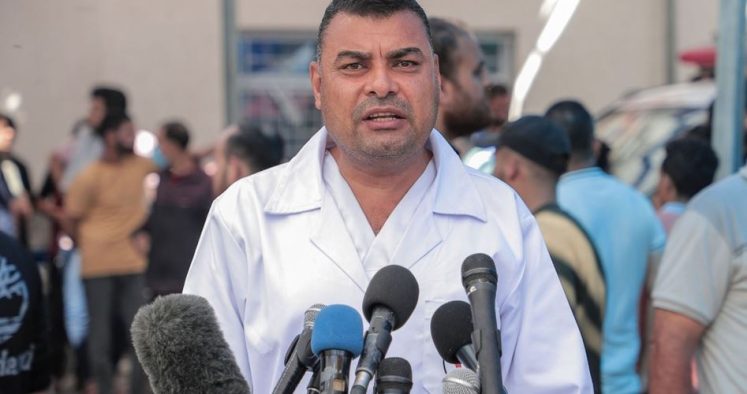
Palestinian Ministry of Health spokesman Ashraf al-Qudra
Palestine Information Center – November 23, 2023
GAZA – The Palestinian Ministry of Health in Gaza on Thursday held the Israeli occupation forces fully responsible for the lives and safety of the doctors, who were detained on Wednesday.
It announced that it will stop coordinating with World Health Organization (WHO) on the rest of evacuations until the international agency submits a report on the Israeli detention of medical personnel and until they are all released.
The spokesman of the Ministry, Ashraf al-Qudra, said in a press conference at Nasser Hospital in Khan Younis, “The United Nations bears full responsibility for this event, and we await appropriate and urgent measures on their part to address this situation”.
He pointed out that they were informed by the United Nations about coordination with WHO to evacuate those who were present in the Al-Shifa Medical Complex, which is subject to Israeli siege, raids, and destruction, and were stranded inside the hospital with no food, water, medicine, electricity, or security.
Al-Qudra explained that a convoy from the United Nations, represented by WHO, moved on Wednesday to evacuate some of the patients and medical staff who were subjected to the most horrific Nazi practices in addition to starvation.
“We were surprised that this convoy was stopped by the Israeli checkpoint separating the north from south of Gaza, for about seven hours, during which Israeli occupation forces maltreated the patients, their companions, and the medical staff, before arresting a number of them, including Director General of Al-Shifa Medical Complex, Dr. Muhammad Abu Salmiya,” Al-Qudra said.

Mohammad Abu Salmiya, director of al-Shifa Hospital in Gaza City. (By AFP)
He pointed out that WHO has not yet submitted any report to the ministry to clarify what happened, including the numbers and names of detainees, stressing that the inability to communicate with Al-Shifa Medical Complex made them unable to know who was arrested.
The Ministry’s spokesman expressed his concerns over potential liquidation of those detainees.
al-Qassam Brigades destroy 335 enemy vehicles since Israel’s ground operation started
Palestine Information Center – November 23, 2023
GAZA – Abu Obeida, the spokesman for al-Qassam Brigades of Hamas, has said that the group’s fighters have destroyed 335 Israeli army vehicles fully or partially since the beginning of the Israeli ground offensive in the Gaza Strip.
33 of those vehicles, including tanks, troop carriers and bulldozers, were targeted and destroyed in the last 72 hours, Abu Obeida said in a recorded statement broadcast by Al Jazeera satellite channel on Thursday evening.
Abu Obeida added that al-Qassam fighters carried out “dozens of operations” targeting Israeli soldiers on foot, including in Beit Hanoun and east of al-Rantisi Hospital in Gaza City.
During the last three days, al-Qassam fighters also conducted “special operations” that resulted in the killing of several “enemy forces,” the spokesman said.
The spokesman emphasized that the Palestinian resistance is ready to confront “the enemy” for as long as the aggression against Gaza continues.
He urged the Palestinian people in the West Bank and the resistance groups in Yemen, Lebanon and Iraq to escalate their confrontation with the Israeli occupation forces.
Scott Ritter: Hamas Winning Battle for Gaza
By Scott Ritter – Sputnik – 23.11.2023
The recently announced ceasefire is a blessing for Palestinians and Israelis alike—a chance for prisoners to be exchanged, humanitarian aid to be distributed to those in need, and for emotions on both sides of the conflict to cool down.
While the ceasefire, negotiated between Israel and Hamas by Qatar, was mutually agreed between the two parties, let no one be fooled into thinking this was anything less than a victory for Hamas. Israel had taken a very aggressive position that, given its stated objective of destroying Hamas as an organization, it would not agree to a ceasefire under any conditions.
Hamas, on the other hand, had made one of its primary objectives in initiating the current round of fighting with Israel the release of Palestinian prisoners, and in particular women and children, held by Israel. Seen in this light, the ceasefire represents an important victory for Hamas, and a humiliating defeat for Israel.
One of the reasons Israel eschewed a ceasefire was that it was confident that the offensive operation it had launched into northern Gaza was going to neutralize Hamas as a military threat, and that any ceasefire, regardless of the humanitarian justification, would only buy time for a defeated Hamas enemy to rest, refit, and regroup. That Israel signed on to a ceasefire is the surest sign yet that all is not well with the Israeli offensive against Hamas.
This outcome should not have come as a surprise to anyone. When Hamas launched its October 7 attack on Israel, it initiated a plan years in the making. The meticulous attention to detail that was evident in the Hamas operation underscored the reality that Hamas had been studying the Israeli intelligence and military forces arrayed against it, uncovering weaknesses that were subsequently exploited. The Hamas action represented more than sound tactical and operational planning and execution—it was a masterpiece in strategic conceptualization as well.
One of the main reasons behind the Israeli defeat on October 7 was the fact that the Israeli government was convinced that Hamas would never attack, regardless of what the intelligence analysts charged with watching Hamas activity in Gaza were saying. This failure of imagination came about by Hamas having identified the political goals and objectives of Israel (the nullification of Hamas as a resistance organization by undertaking a policy built on “buying” Hamas through an expanded program of work permits issued by Israel for Palestinians living in Gaza.) By playing along with the work permit program, Hamas lulled the Israeli leadership into complacency, allowing Hamas’ preparations for their attack to be carried out in plain view.
The October 7 attack by Hamas was not a stand-alone operation, but rather part of a strategic plan possessing three main objectives—to put the issue of a Palestinian state back on the front burner of international discourse, to free the thousands of Palestinian prisoners held by Israel, and to compel Israel to cease and desist when it came to its desecration of the Al Aqsa Mosque, Islam’s third holiest place. The October 7 attack, on its own, could not achieve these outcomes. Rather, the October 7 attack was designed to trigger an Israeli response which would create the conditions necessary for Hamas’ objectives to reach fruition.
The October 7 attack was designed to humiliate Israel to the point of irrationality, to ensure that any Israeli response would be governed by the emotional need for revenge, as opposed to a rational response designed to nullify the Hamas objectives. Here, Hamas was guided by the established Israeli doctrine of collective punishment (known as the Dahiya Doctrine, named after the West Beirut suburb that was heavily bombed by Israel in 2006 as a way of punishing the Lebanese people for Israel’s failure to defeat Hezbollah in combat.) By inflicting a humiliating defeat on Israel which shattered both the myth of Israeli invincibility (regarding the Israel Defense Forces) and infallibility (regarding Israeli intelligence), and by taking hundreds of Israelis hostage before withdrawing to its underground lair beneath Gaza, Hamas baited a trap for Israel which the government of Israeli Prime Minister Benjamin Netanyahu predictably rushed into.
Hamas has prepared a network of tunnels underneath the Gaza Strip that, in total, stretch for over 500 kilometers. Nicknamed the “Gaza Metro,” these tunnels consist of interconnected deep underground bunkers used for command and control, logistical support, medical treatment, and billeting, along with other tunnel networks dedicated for both defensive and offensive operations. The tunnels are buried deep enough to avoid destruction by most bombs in Israel’s possession and have been provisioned to withstand a siege of up to three months (90 days) in duration.
Hamas knows that it cannot engage Israel in a classic force-on-force encounter. Instead, the goal was to lure Israeli forces into Gaza, and then subject these forces to an endless series of hit-and-run attacks by small teams of Hamas fighters who would emerge from their underground lairs, attack a vulnerable Israeli force, and then disappear back underground. In short, to subject the Israeli military to what is the equivalent of a death by a thousand cuts.
And it worked. While Israeli forces have been able to penetrate into the less urbanized areas of the northern Gaza strip, taking advantage of the mobility and firepower of its armored troops, the progress is illusory, as Hamas forces harry the Israelis continuously, using deadly tandem-warhead rockets to disable or destroy Israeli vehicles, killing scores of Israeli soldiers and wounding hundreds more. While Israel has been reticent in releasing the figures of armored vehicles lost in this fashion, Hamas claims the number is in the hundreds. Hamas’ claims are bolstered by the fact that Israel has halted the sale of older Merkava 3 tanks, and instead has organized their inventory of these vehicles into new reserve armor battalions to make up for the heavy losses being sustained in both Gaza and along the northern border with Lebanon, where Hezbollah forces are engaged in a deadly war of attrition with Israel in operations designed to support Hamas in Gaza.
But the main reason for Israel’s defeat to date is Israel itself. Having taken the bait, and fallen into the Hamas trap, Israel went on to execute its Dahiya Doctrine against the Palestinian population of Gaza, carrying out indiscriminate attacks against civilian objects in blatant disregard for the law of war. An estimated 13,000 Palestinian civilians have been killed by these attacks, including more than 5,000 children. Many thousands more victims remain buried under the rubble of their destroyed housing.
While Israel may have been able to garner the support of the international community in the aftermath of the October 7 attack by Hamas, its gross overreaction has instead turned world public opinion against it—something Hamas was counting on. Today, Israel is increasingly isolated, losing support not only in the so-called Global South, but also in traditional strongholds of pro-Israeli sentiment in the US, UK, and Europe. This isolation, combined with the kind of political pressure Israel is unaccustomed to receiving, helped contribute to the Netanyahu government’s acquiescence regarding the ceasefire and subsequent prisoner exchange.
Whether the ceasefire will hold or not remains to be seen. So, too, the question of turning the ceasefire into a lasting cessation of hostilities remains an open question. But one thing is certain—having declared that victory is defined by Hamas’ total defeat, the Israelis have set the stage for a Hamas victory, something Hamas achieves simply by surviving.
But Hamas is doing more than surviving — it is winning. Having fought the Israel Defense Forces to a standstill on the battlefield, Hamas has seen every one of its strategic objectives in this conflict reach fruition. The world is actively articulating the absolute necessity of a two-state solution as a prerequisite for a lasting peace in the region. Palestinians held prisoner by Israel are being exchanged for the Israelis Hamas took hostage. And the Islamic world is united in condemning Israel’s desecration of the Al Aqsa Mosque.
None of these issues were on the table on October 6. That they are being addressed now is testament to the success Hamas enjoyed on October 7, and in the days and weeks that followed, as Israeli forces were defeated by a combination of Hamas’ tenacity and their own predilection for indiscriminate violence against civilians. Far from being eliminated as a military and political force, Hamas has emerged as perhaps the most relevant voice and authority when it comes to defending the interests of the Palestinian people.
UK GOVERNMENT BLOCKS MP QUESTIONS ABOUT GAZA-RELATED ACTIVITY AT ITS CYPRUS BASE
BY MATT KENNARD AND MARK CURTIS | DECLASSIFIED UK | NOVEMBER 20, 2023
The British government has blocked MPs asking any questions about activity at RAF Akrotiri, its vast air base on Cyprus, Declassified can reveal.
Blocking all parliamentary questions from MPs is a highly unusual move.
Government departments routinely refuse to answer specific questions about military operations for reasons of “national security”, but blocking all questions by elected parliamentarians goes far beyond the usual level of Whitehall secrecy.
It comes after Declassified revealed the RAF has made over 30 military transport flights to Tel Aviv since Israel began bombing Gaza. The Ministry of Defence refused to provide us any detail of the cargo or personnel on the flights.
Just this morning an A400M Atlas military transport aircraft operated by the RAF landed in Tel Aviv from Akrotiri. The aircraft can carry 116 soldiers, a Chinook helicopter or a payload of 37 tonnes.
RAF Akrotiri sits 180 miles from Tel Aviv with a flight time of 40 minutes.
Declassified has also reported that the US is moving arms to Israel using RAF Akrotiri, which has become an international military hub supporting Israel’s bombing campaign in Gaza. Half of US planes flying from British Cyprus are said to be carrying weapons for Israel.
Kenny MacAskill, Alba MP for East Lothian, told Declassified he put down a number of parliamentary questions concerning what military support the UK is providing to Israel and the role of RAF Akrotiri in the supply of military equipment.
“Your question has been queried because it is subject to a block by Government,” he was told in an email. “The Department [Ministry of Defence] has stated that it will not comment on operational matters at this base.”
MacAskill, a former Scottish justice secretary, told Declassified: “This is totally unacceptable in a democracy. Genocide is being perpetrated in Gaza and we have a right to know what our Government is doing about it.”
MacAskill said he had never experienced such a ‘block’ on asking parliamentary questions before.
He added: “The failure to call for an immediate ceasefire is bad enough but any complicity raises issues of participating in war crimes. We need openness and transparency by our government. This is not in our name.”
Secrecy
The UK military-run Defence and Security Media Advisory (DSMA) Committee – better known as the ‘D-Notice’ committee – has also sent out an ‘advisory’ to all British media to suppress reporting on UK special forces’ activity related to Gaza. The SAS was previously reported to have deployed a force to Cyprus.
No British mainstream media outlets have reported on Declassified’s recent findings about RAF Akrotiri and Gaza despite the President of Cyprus Nikos Christodoulides having to defend his government from accusations of complicity in Israel’s bombing of Gaza.
In answer to questions about the use of RAF Akrotiri by Cypriot journalists over the weekend, Christodoulides said: “There is no such information, our country cannot be used as a base for war operations”.
However, RAF Akrotiri has long been the staging post for British bombing campaigns across the Middle East. Declassified also recently revealed that 129 US airmen are also permanently deployed at the base.
The censorship of information requests from MPs makes it all but certain that RAF Akrotiri is being used for covert military purposes that the government does not want the public to know about.
It is likely the UK is sending material military aid to Israel during its bombing of Gaza, which has now killed over 12,000 Palestinians, although it previously told Declassified it was not providing “lethal aid”.
Arab states called on to cut ties with Israel, stop hosting US military bases
MEMO | November 22, 2023
1,000 boats to leave Turkiye for Gaza waters in new ‘Freedom Flotilla’
MEMO | November 21, 2023
Approximately 1,000 international boats will gather in Turkiye on Wednesday before heading toward Gaza to break the Israeli blockade, Turkish media reports.
According to the report, in an interview with Turkish news website, Haber7, Volkan Okcu, one of the organisers of the protest, indicated the boats will carry 4,500 people from 40 countries, “including anti-Zionist Jews”.
Among the 1,000 vessels would be 313 boats filled with Russian activists, and 104 filled with Spanish activists, he said. Only 12 Turkish vessels will join the flotilla, he told Haber7.
The maritime convoy is set to make a first stop in Cyprus before continuing toward the Israeli port of Ashdod. Some participants in the flotilla will also reportedly take their spouses and children on board.
Featured Video

Your Enslavement Begins in Gaza: The ‘Board of Peace’
or go to
Aletho News Archives – Video-Images
From the Archives
The US: The Century of Lost Wars
By James Petras | Global Research | September 12, 2018
Introduction
Despite having the biggest military budget in the world, five times larger than the next six countries, the largest number of military bases – over 180 – in the world and the most expensive military industrial complex, the US has failed to win a single war in the 21st century.
In this paper we will enumerate the wars and proceed to analyze why, despite the powerful material basis for wars, it has led to failures. … continue
Blog Roll
 Aletho News
- Iran to US: Sanctions and war failed; try diplomacy and respect
- China supplies Iran with radar, surveillance tech to track US stealth aircraft: Report
- Zelensky rejects territorial concessions to Russia
- German leader of EU’s largest faction sounds the alarm of possibility of right-wing forces coming to power in France, Poland
- Putin: Developing Russia’s nuclear forces ‘absolute priority’
- Hungary Blocks 20th Package of Anti-Russia Sanctions, $106B Loan to Ukraine – Szijjarto
- NATO Must Return to 1997 Borders for Peace in Ukraine – Finnish Politician
- Your Enslavement Begins in Gaza: The ‘Board of Peace’
- Israeli FOIA Data Reveals Massive Heart Injury Spike in Children Immediately After mRNA Shot Rollout
- What is Zionism? And what is anti-Zionism?
- If Americans Knew
- Average of five Palestinians killed by Israel every day in Gaza since ceasefire – Not a ceasefire Day 136
- Palestinian church leaders admonish Christian Zionist Mike Huckabee – Not a ceasefire Day 135
- Ominous messaging from Trump’s “Board of Peace” – Not a ceasefire Day 134
- ‘Christians Out’: Jerusalem Church Tagged With Hate Graffiti, Police Investigating
- Israeli Settlers Kill American Teen
- ‘We returned from hell’: Palestinian journalists recount torture in Israeli prisons
- No mercy for Gaza in Ramadan – Not a ceasefire Day 133
- The Israeli Government Installed and Maintained Security System at Epstein Apartment
- Tucker Carlson interrogated in Israel, has passport seized after interviewing US ambassador
- 6,000 Amputees in Gaza Face Impossible Recovery amid Israeli War Ultimatum
- No Tricks Zone
- New Research Reaffirms Clouds, Aerosols, And Surface Solar Radiation Are ‘Driving The Climate System’
- Germany: Electric Car Catches Fire At Charging Station, Sets Off Local “Inferno”, Widespread Damage
- New Study: Canada’s New Brunswick Was 1°C Warmer Than Today During The Medieval Warm Period
- Coal Power Back In Trend As Globe Tries To Keep Pace With Growing Demand For Power
- New Study: A 4°C Warmer Beaufort Sea Had ‘No Sea Ice’ 11,700 – 8200 Years Ago
- Unfudging The Data: Dutch Meteorological Institute Reinstates Early 20th Centruy Heat Waves It Had Erased Earlier
- German Gas Crisis…Chancellor Merz Allegedly Bans Gas Debate Ahead of Elections!
- Pollen Reconstructions Show The Last Glacial’s Warming Events Were Global, 10x Greater Than Modern
- Germany’s Natural Gas Storage Level Dwindles To Just 28%… Increasingly Critical
- New Study Rebuts The Assumption That Anthropogenic CO2 Molecules Have ‘Special’ Properties
 Aletho News
