Health Ministry stops coordination with WHO until detainees released
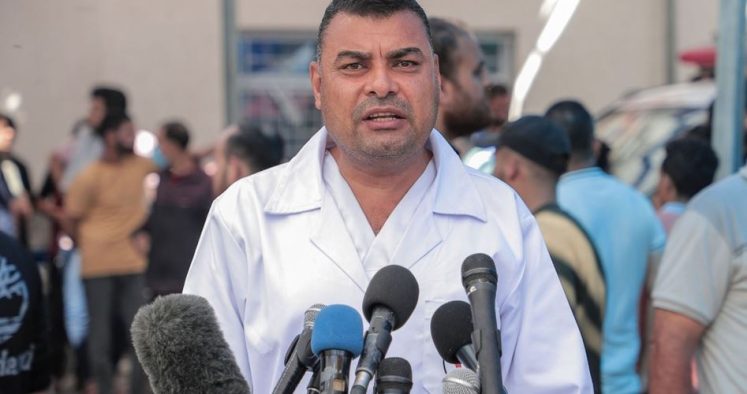
Palestinian Ministry of Health spokesman Ashraf al-Qudra
Palestine Information Center – November 23, 2023
GAZA – The Palestinian Ministry of Health in Gaza on Thursday held the Israeli occupation forces fully responsible for the lives and safety of the doctors, who were detained on Wednesday.
It announced that it will stop coordinating with World Health Organization (WHO) on the rest of evacuations until the international agency submits a report on the Israeli detention of medical personnel and until they are all released.
The spokesman of the Ministry, Ashraf al-Qudra, said in a press conference at Nasser Hospital in Khan Younis, “The United Nations bears full responsibility for this event, and we await appropriate and urgent measures on their part to address this situation”.
He pointed out that they were informed by the United Nations about coordination with WHO to evacuate those who were present in the Al-Shifa Medical Complex, which is subject to Israeli siege, raids, and destruction, and were stranded inside the hospital with no food, water, medicine, electricity, or security.
Al-Qudra explained that a convoy from the United Nations, represented by WHO, moved on Wednesday to evacuate some of the patients and medical staff who were subjected to the most horrific Nazi practices in addition to starvation.
“We were surprised that this convoy was stopped by the Israeli checkpoint separating the north from south of Gaza, for about seven hours, during which Israeli occupation forces maltreated the patients, their companions, and the medical staff, before arresting a number of them, including Director General of Al-Shifa Medical Complex, Dr. Muhammad Abu Salmiya,” Al-Qudra said.

Mohammad Abu Salmiya, director of al-Shifa Hospital in Gaza City. (By AFP)
He pointed out that WHO has not yet submitted any report to the ministry to clarify what happened, including the numbers and names of detainees, stressing that the inability to communicate with Al-Shifa Medical Complex made them unable to know who was arrested.
The Ministry’s spokesman expressed his concerns over potential liquidation of those detainees.
al-Qassam Brigades destroy 335 enemy vehicles since Israel’s ground operation started
Palestine Information Center – November 23, 2023
GAZA – Abu Obeida, the spokesman for al-Qassam Brigades of Hamas, has said that the group’s fighters have destroyed 335 Israeli army vehicles fully or partially since the beginning of the Israeli ground offensive in the Gaza Strip.
33 of those vehicles, including tanks, troop carriers and bulldozers, were targeted and destroyed in the last 72 hours, Abu Obeida said in a recorded statement broadcast by Al Jazeera satellite channel on Thursday evening.
Abu Obeida added that al-Qassam fighters carried out “dozens of operations” targeting Israeli soldiers on foot, including in Beit Hanoun and east of al-Rantisi Hospital in Gaza City.
During the last three days, al-Qassam fighters also conducted “special operations” that resulted in the killing of several “enemy forces,” the spokesman said.
The spokesman emphasized that the Palestinian resistance is ready to confront “the enemy” for as long as the aggression against Gaza continues.
He urged the Palestinian people in the West Bank and the resistance groups in Yemen, Lebanon and Iraq to escalate their confrontation with the Israeli occupation forces.
Scott Ritter: Hamas Winning Battle for Gaza
By Scott Ritter – Sputnik – 23.11.2023
The recently announced ceasefire is a blessing for Palestinians and Israelis alike—a chance for prisoners to be exchanged, humanitarian aid to be distributed to those in need, and for emotions on both sides of the conflict to cool down.
While the ceasefire, negotiated between Israel and Hamas by Qatar, was mutually agreed between the two parties, let no one be fooled into thinking this was anything less than a victory for Hamas. Israel had taken a very aggressive position that, given its stated objective of destroying Hamas as an organization, it would not agree to a ceasefire under any conditions.
Hamas, on the other hand, had made one of its primary objectives in initiating the current round of fighting with Israel the release of Palestinian prisoners, and in particular women and children, held by Israel. Seen in this light, the ceasefire represents an important victory for Hamas, and a humiliating defeat for Israel.
One of the reasons Israel eschewed a ceasefire was that it was confident that the offensive operation it had launched into northern Gaza was going to neutralize Hamas as a military threat, and that any ceasefire, regardless of the humanitarian justification, would only buy time for a defeated Hamas enemy to rest, refit, and regroup. That Israel signed on to a ceasefire is the surest sign yet that all is not well with the Israeli offensive against Hamas.
This outcome should not have come as a surprise to anyone. When Hamas launched its October 7 attack on Israel, it initiated a plan years in the making. The meticulous attention to detail that was evident in the Hamas operation underscored the reality that Hamas had been studying the Israeli intelligence and military forces arrayed against it, uncovering weaknesses that were subsequently exploited. The Hamas action represented more than sound tactical and operational planning and execution—it was a masterpiece in strategic conceptualization as well.
One of the main reasons behind the Israeli defeat on October 7 was the fact that the Israeli government was convinced that Hamas would never attack, regardless of what the intelligence analysts charged with watching Hamas activity in Gaza were saying. This failure of imagination came about by Hamas having identified the political goals and objectives of Israel (the nullification of Hamas as a resistance organization by undertaking a policy built on “buying” Hamas through an expanded program of work permits issued by Israel for Palestinians living in Gaza.) By playing along with the work permit program, Hamas lulled the Israeli leadership into complacency, allowing Hamas’ preparations for their attack to be carried out in plain view.
The October 7 attack by Hamas was not a stand-alone operation, but rather part of a strategic plan possessing three main objectives—to put the issue of a Palestinian state back on the front burner of international discourse, to free the thousands of Palestinian prisoners held by Israel, and to compel Israel to cease and desist when it came to its desecration of the Al Aqsa Mosque, Islam’s third holiest place. The October 7 attack, on its own, could not achieve these outcomes. Rather, the October 7 attack was designed to trigger an Israeli response which would create the conditions necessary for Hamas’ objectives to reach fruition.
The October 7 attack was designed to humiliate Israel to the point of irrationality, to ensure that any Israeli response would be governed by the emotional need for revenge, as opposed to a rational response designed to nullify the Hamas objectives. Here, Hamas was guided by the established Israeli doctrine of collective punishment (known as the Dahiya Doctrine, named after the West Beirut suburb that was heavily bombed by Israel in 2006 as a way of punishing the Lebanese people for Israel’s failure to defeat Hezbollah in combat.) By inflicting a humiliating defeat on Israel which shattered both the myth of Israeli invincibility (regarding the Israel Defense Forces) and infallibility (regarding Israeli intelligence), and by taking hundreds of Israelis hostage before withdrawing to its underground lair beneath Gaza, Hamas baited a trap for Israel which the government of Israeli Prime Minister Benjamin Netanyahu predictably rushed into.
Hamas has prepared a network of tunnels underneath the Gaza Strip that, in total, stretch for over 500 kilometers. Nicknamed the “Gaza Metro,” these tunnels consist of interconnected deep underground bunkers used for command and control, logistical support, medical treatment, and billeting, along with other tunnel networks dedicated for both defensive and offensive operations. The tunnels are buried deep enough to avoid destruction by most bombs in Israel’s possession and have been provisioned to withstand a siege of up to three months (90 days) in duration.
Hamas knows that it cannot engage Israel in a classic force-on-force encounter. Instead, the goal was to lure Israeli forces into Gaza, and then subject these forces to an endless series of hit-and-run attacks by small teams of Hamas fighters who would emerge from their underground lairs, attack a vulnerable Israeli force, and then disappear back underground. In short, to subject the Israeli military to what is the equivalent of a death by a thousand cuts.
And it worked. While Israeli forces have been able to penetrate into the less urbanized areas of the northern Gaza strip, taking advantage of the mobility and firepower of its armored troops, the progress is illusory, as Hamas forces harry the Israelis continuously, using deadly tandem-warhead rockets to disable or destroy Israeli vehicles, killing scores of Israeli soldiers and wounding hundreds more. While Israel has been reticent in releasing the figures of armored vehicles lost in this fashion, Hamas claims the number is in the hundreds. Hamas’ claims are bolstered by the fact that Israel has halted the sale of older Merkava 3 tanks, and instead has organized their inventory of these vehicles into new reserve armor battalions to make up for the heavy losses being sustained in both Gaza and along the northern border with Lebanon, where Hezbollah forces are engaged in a deadly war of attrition with Israel in operations designed to support Hamas in Gaza.
But the main reason for Israel’s defeat to date is Israel itself. Having taken the bait, and fallen into the Hamas trap, Israel went on to execute its Dahiya Doctrine against the Palestinian population of Gaza, carrying out indiscriminate attacks against civilian objects in blatant disregard for the law of war. An estimated 13,000 Palestinian civilians have been killed by these attacks, including more than 5,000 children. Many thousands more victims remain buried under the rubble of their destroyed housing.
While Israel may have been able to garner the support of the international community in the aftermath of the October 7 attack by Hamas, its gross overreaction has instead turned world public opinion against it—something Hamas was counting on. Today, Israel is increasingly isolated, losing support not only in the so-called Global South, but also in traditional strongholds of pro-Israeli sentiment in the US, UK, and Europe. This isolation, combined with the kind of political pressure Israel is unaccustomed to receiving, helped contribute to the Netanyahu government’s acquiescence regarding the ceasefire and subsequent prisoner exchange.
Whether the ceasefire will hold or not remains to be seen. So, too, the question of turning the ceasefire into a lasting cessation of hostilities remains an open question. But one thing is certain—having declared that victory is defined by Hamas’ total defeat, the Israelis have set the stage for a Hamas victory, something Hamas achieves simply by surviving.
But Hamas is doing more than surviving — it is winning. Having fought the Israel Defense Forces to a standstill on the battlefield, Hamas has seen every one of its strategic objectives in this conflict reach fruition. The world is actively articulating the absolute necessity of a two-state solution as a prerequisite for a lasting peace in the region. Palestinians held prisoner by Israel are being exchanged for the Israelis Hamas took hostage. And the Islamic world is united in condemning Israel’s desecration of the Al Aqsa Mosque.
None of these issues were on the table on October 6. That they are being addressed now is testament to the success Hamas enjoyed on October 7, and in the days and weeks that followed, as Israeli forces were defeated by a combination of Hamas’ tenacity and their own predilection for indiscriminate violence against civilians. Far from being eliminated as a military and political force, Hamas has emerged as perhaps the most relevant voice and authority when it comes to defending the interests of the Palestinian people.
UK GOVERNMENT BLOCKS MP QUESTIONS ABOUT GAZA-RELATED ACTIVITY AT ITS CYPRUS BASE
BY MATT KENNARD AND MARK CURTIS | DECLASSIFIED UK | NOVEMBER 20, 2023
The British government has blocked MPs asking any questions about activity at RAF Akrotiri, its vast air base on Cyprus, Declassified can reveal.
Blocking all parliamentary questions from MPs is a highly unusual move.
Government departments routinely refuse to answer specific questions about military operations for reasons of “national security”, but blocking all questions by elected parliamentarians goes far beyond the usual level of Whitehall secrecy.
It comes after Declassified revealed the RAF has made over 30 military transport flights to Tel Aviv since Israel began bombing Gaza. The Ministry of Defence refused to provide us any detail of the cargo or personnel on the flights.
Just this morning an A400M Atlas military transport aircraft operated by the RAF landed in Tel Aviv from Akrotiri. The aircraft can carry 116 soldiers, a Chinook helicopter or a payload of 37 tonnes.
RAF Akrotiri sits 180 miles from Tel Aviv with a flight time of 40 minutes.
Declassified has also reported that the US is moving arms to Israel using RAF Akrotiri, which has become an international military hub supporting Israel’s bombing campaign in Gaza. Half of US planes flying from British Cyprus are said to be carrying weapons for Israel.
Kenny MacAskill, Alba MP for East Lothian, told Declassified he put down a number of parliamentary questions concerning what military support the UK is providing to Israel and the role of RAF Akrotiri in the supply of military equipment.
“Your question has been queried because it is subject to a block by Government,” he was told in an email. “The Department [Ministry of Defence] has stated that it will not comment on operational matters at this base.”
MacAskill, a former Scottish justice secretary, told Declassified: “This is totally unacceptable in a democracy. Genocide is being perpetrated in Gaza and we have a right to know what our Government is doing about it.”
MacAskill said he had never experienced such a ‘block’ on asking parliamentary questions before.
He added: “The failure to call for an immediate ceasefire is bad enough but any complicity raises issues of participating in war crimes. We need openness and transparency by our government. This is not in our name.”
Secrecy
The UK military-run Defence and Security Media Advisory (DSMA) Committee – better known as the ‘D-Notice’ committee – has also sent out an ‘advisory’ to all British media to suppress reporting on UK special forces’ activity related to Gaza. The SAS was previously reported to have deployed a force to Cyprus.
No British mainstream media outlets have reported on Declassified’s recent findings about RAF Akrotiri and Gaza despite the President of Cyprus Nikos Christodoulides having to defend his government from accusations of complicity in Israel’s bombing of Gaza.
In answer to questions about the use of RAF Akrotiri by Cypriot journalists over the weekend, Christodoulides said: “There is no such information, our country cannot be used as a base for war operations”.
However, RAF Akrotiri has long been the staging post for British bombing campaigns across the Middle East. Declassified also recently revealed that 129 US airmen are also permanently deployed at the base.
The censorship of information requests from MPs makes it all but certain that RAF Akrotiri is being used for covert military purposes that the government does not want the public to know about.
It is likely the UK is sending material military aid to Israel during its bombing of Gaza, which has now killed over 12,000 Palestinians, although it previously told Declassified it was not providing “lethal aid”.
Arab states called on to cut ties with Israel, stop hosting US military bases
MEMO | November 22, 2023
1,000 boats to leave Turkiye for Gaza waters in new ‘Freedom Flotilla’
MEMO | November 21, 2023
Approximately 1,000 international boats will gather in Turkiye on Wednesday before heading toward Gaza to break the Israeli blockade, Turkish media reports.
According to the report, in an interview with Turkish news website, Haber7, Volkan Okcu, one of the organisers of the protest, indicated the boats will carry 4,500 people from 40 countries, “including anti-Zionist Jews”.
Among the 1,000 vessels would be 313 boats filled with Russian activists, and 104 filled with Spanish activists, he said. Only 12 Turkish vessels will join the flotilla, he told Haber7.
The maritime convoy is set to make a first stop in Cyprus before continuing toward the Israeli port of Ashdod. Some participants in the flotilla will also reportedly take their spouses and children on board.
Hamas reaches agreement on prisoner swap, pause in fighting
Palestine Information Center – November 22, 2023
GAZA – The Hamas Movement announced at dawn Wednesday that it had reached an agreement with the Israeli occupation regime on a four-day humanitarian ceasefire following concentrated mediation efforts by Qatar and Egypt.
“Based on our responsibility towards our long-suffering and steadfast Palestinian people, and our tireless endeavor to strengthen the steadfastness of our heroic people in our proud Gaza, to assist them and heal their wounds … and after difficult and complex negotiations for several days, we announce — with help and blessing from Almighty Allah — that we have reached a humanitarian truce agreement (temporary ceasefire) for a period of four days, thanks to persistent and appreciated Qatari and Egyptian efforts,” the Movement stated.
In a statement published on its Telegram account, Hamas revealed the most prominent provisions of the agreement:
• A ceasefire from both sides, a cessation of all military actions by the occupation forces in all areas of the Gaza Strip and a freeze on the movement of its military vehicles that have infiltrated into the Gaza Strip.
• Hundreds of aid trucks carrying humanitarian, relief, medical and fuel supplies will be allowed into all areas of the Gaza Strip, with no exception, in the north and south.
• The release of 50 civilian women and children (under the age of 19) currently held in the Gaza Strip in exchange for the release of 150 Palestinian women and children (under the age of 19) from Israeli jails according to the time they have spent in jail.
• Air traffic will stop completely in southern Gaza during these four days and for daily six-hour periods in the north, from 10:00 a.m. until 04:00 p.m.
• During the ceasefire period, Israel commits not to target or arrest anyone in all areas of the Gaza Strip.
• The free movement of people from north to south along Salahuddin Street is guaranteed.
“As we announce the conclusion of this truce agreement, we affirm that our hands will remain on the trigger and our Brigades will remain on the lookout to defend our people.”
“The resistance has steered the negotiations while its position on the ground is steadfast and strong despite the occupation’s attempts to procrastinate in this regard.”
“The terms of the agreement has been formulated in accordance with the resistance’s vision that aims to serve our people and strengthen their steadfastness in the face of aggression, while it will always remain mindful of their sacrifices, suffering and concerns.”
Putin names Russia’s ‘sacred duty’ in Gaza
RT | November 22, 2023
Moscow has a moral obligation to deliver humanitarian aid to the civilian population in Gaza, Russian President Vladimir Putin argued on Wednesday. The day before, he told other BRICS leaders that he had been moved by videos depicting Palestinian children being operated on without anesthesia.
Earlier this month, the World Health Organization (WHO) accused Israel of routinely targeting medical facilities. The international watchdog also said that child deaths were an everyday occurrence in the besieged Palestinian enclave.
Addressing the Russian cabinet via video link, President Putin said: “This is a very important, humanitarian, noble mission. We need to help people suffering as a result of the ongoing events.”
The Russian leader went on to describe the provision of aid to Palestinian civilians in Gaza as “our sacred duty.”
Attending an extraordinary BRICS online summit a day prior, the president noted that the “death of thousands of people, the mass displacement of the civilian population and the humanitarian catastrophe that has erupted” are cause for the “deepest concern.”
“When you watch how children are being operated on with no anesthesia – this of course arouses very special feelings,” Putin added.
While securing humanitarian truces is a key task in the short term, Moscow would like to see a lasting peace in the region, he noted. This can only be achieved on the basis of previous UN resolutions that call for the creation of two states – Israel and Palestine, the president said.
According to Putin, other BRICS member states share Russia’s stance in many respects, as demonstrated by the way they have voted at the UN General Assembly.
The group, he argued, could “play a key role” in resolving the decades-old conflict.
Earlier this month, WHO chief Tedros Adhanom Ghebreyesus told the UN Security Council that “on average, a child is killed every ten minutes in Gaza.” The official also said that Israel had attacked medical facilities, ambulances and patients in Gaza and the West Bank on at least 250 occasions since October 7, bringing the medical system in Gaza to “its knees.”
Israel unleashed its military operation following a deadly raid by Hamas militants that claimed the lives of 1,200 Israelis, mostly civilians, last month. Since then, the death toll in Gaza has reached 13,000, according to Palestinian health authorities.
On Wednesday, the Israeli government approved a deal with Hamas under which the militant group is to release 50 hostages in exchange for 150 Palestinian female and child inmates held in Israeli custody, accompanied by a four-day truce.
Economic Implications of the Yemeni Seizure of the Galaxy Leader
Sputnik – 21.11.2023
As confirmed by multiple media sources, the ship seized by the Houthis in the Red Sea is the Bahamian flagged Galaxy Leader. According to marinetaffic.com, this ship is designed to carry vehicles, and has a capacity of 1500 passenger cars.
The ship was en route from the Turkish port of Korfez to the Indian port of Pipavav with 25 crew members, including Bulgarians, Filipinos, Mexicans and Ukrainians, but no Israelis on board.
According to Reuters, Netanyahu’s office described the ship as ” British-owned and Japanese-operated”, adding that, “There were no Israelis on the ship,” and “Israel was not involved in its ownership or operation.” However, Yemen’s official news agency, SABA, states that multiple Israeli news media have reported that “The ship controlled by the “Houthis” belongs to the Israeli billionaire Rami Unger, who is close to the Mossad.” Unger is, indeed, a veteran of the Intelligence Corp of the IDF, and has had a decades long close personal and business relationship with Yossi Cohen, the former Director of Mossad, and National Security Advisor to Netanyahu.
In 2019, the personal net worth of Rami Unger and his wife was estimated at $2.1 billion. In 2004, it was reported that Unger owned between 12 and 14 vehicle transport ships, worth about $50 million each, a reasonable estimate of the value of the Galaxy Leader, which was built in 2002. The political and economic impact of this operation goes far beyond the mere value of the ship.
In spite of the estimated $50 million cost/value of the ship, from an economic point of view, it is actually of little worth to the Houthis. They can’t sell it, they can’t use it, Unger and his insurance companies probably won’t ransom it. The ship was sailing without cargo, which if it had been, would have been approximately 1,500 new cars, worth between $20 and $30 million in total. So, clearly, there was no economic benefit from the seizure of the vessel for the Houthis, but the full political and economic ramifications remain to be seen.
It should be understood that the Houthis have not just seized the Galaxy Leader, they have put all Israeli shipping in the Red Sea under threat. The value of that shipping can be roughly estimated by the fact that out of Israel’s $165 billion in total exports in 2022, 24% went to Asian markets. The shortest shipping route from the Mediterranean to Asia is the Suez Canal. Everything that goes through the Suez Canal goes through the Red Sea, and 12% of all global trade passes through the Suez Canal. With these calculations, the economic impact on the Israeli economy by the seizure of this single ship can be estimated in the billions of dollars. The Houthi area of military operations in the southern Red Sea is more than 1,000 miles from Israel, and beyond the reach of timely Israeli military response.
Economic warfare and military warfare are two sides of the same coin. The Houthis, with one helicopter and less than a dozen commandos, have hit the Israeli economy as hard as the entire Israeli military is hitting the people of Gaza. All in all, it must be admitted, it was a successful gambit. Especially considering that it was a bloodless operation in which, unlike the Israeli operation in Gaza, no one was harmed.
Of course, like the October 7th Hamas attack, Netanyahu could very well try to exploit this incident to “justify” another Israeli attack, this time on Iran. War is by nature, always full of dangers and deception. However, the Houthis are likely to find broad and real support for their raid across the Arab and Muslim world.
In an announcement by Yemeni Armed Forces, ” the Armed Forces renewed their warning to all ships belonging to the Israeli enemy or dealing with it that they will become a legitimate target. It called on all countries whose nationals work in the Red Sea to refrain from any work or activity with Israeli ships or ships owned by Israelis.” The statement pointed out that the operations of the armed forces only threaten the ships of Israel and those owned by Israelis, as was previously indicated.
Raisi Calls on BRICS Leaders to Use Economic, Political Opportunities to Pressure Israel
Sputnik – 21.11.2023
TEHRAN – Iranian President Ebrahim Raisi on Tuesday called on BRICS leaders to use all economic and political opportunities to put pressure on Israel.
Amid escalating horrors in the Gaza Strip during the “second phase” of Israel’s conflict with Hamas, the former has intensified its actions, resulting in a rise in civilian casualties. Iranian President Ebrahim Raisi, in response, has called on BRICS leaders to leverage economic and political avenues to exert pressure on the Israeli government.
“The United States has made all international organizations faceless. Iran wants BRICS members and governments to stand up for security, establish justice and fight racial discrimination in the world, as well as use all their political and economic opportunities and power to exert pressure on Israel and its supporters from Western countries,” Raisi at the BRICS extraordinary summit on the Middle East.
Raisi urged the BRICS countries to recognize the Israeli government as a “terrorist regime.”
“Israel’s continuous attacks on hospitals, medical centers and religious sites, as well as the murder of women and children, doctors, nurses and journalists are acts of terrorism, and it is necessary to recognize the Israeli regime as a terrorist regime and its army as a terrorist organization,” Raisi said.
BRICS countries must adopt a resolution at the UN to stop Israel’s crimes in the Gaza Strip, Raisi said.
Israel having difficulties and suffering losses both on land and sea
By Lucas Leiroz | November 20, 2023
It seems increasingly clear that the conflict in Palestine is not an easy task for Israel. In addition to the difficulties of advancing on the battlefield and the heavy losses that the IDF has suffered during clashes with Palestinian troops, defeats at sea are beginning to occur. Yemeni forces, who previously declared full support for Palestine, captured an important Israeli merchant ship, taking new hostages and improving the Palestinians’ bargaining power in the prisoner exchange negotiation process.
Undoubtedly, Israel is stronger than its adversaries in the current Palestinian war. Tel Aviv is a state with a complex and organized structure, having a regular national army and sufficient strength to defeat armed militias such as Hamas and many other Palestinian armed groups. The problem is that the fighting is not happening symmetrically, and, despite territorial advances, Israel is clearly suffering significant damages, which could generate great difficulties in the near future.
The Al-Qassam Brigades, the military wing of Hamas, frequently announce the neutralization of Israeli soldiers and tanks. Several videos have been published on social media showing Hamas fighters using rockets and grenades against Israeli tanks and instantly disabling them. Confirming what had been predicted by analysts, Israel is having difficulty using its combat vehicles in an urban area full of debris. IDF’s bombings destroyed civilian buildings, making the ground in Gaza difficult terrain for tanks, which end up becoming an easy target for Hamas.
In the same sense, it is important to remember that Israel has not yet managed to enter the Hamas’ tunnels. The IDF claimed that the Palestinian Resistance was using Al Shifa Hospital and other civilian facilities as a human shield. With these excuses, several bombings were carried out against hospitals, but no bunkers were found. In practice, the IDF is unable to find the correct way to reach the enemy’s underground system. So, the bombings against civilians have really no strategic value.
However, the situation is complicated not only on the land battlefield. At sea, things are getting worse for the Zionist state, which is starting to suffer not only military but also commercial losses. On November 19, Yemen’s Houthi armed forces captured a major Israeli merchant ship in the Red Sea. The ship belongs to an Israeli businessman and was being operated by employees of German and Japanese companies on a voyage from Turkey to India.
Commenting on the topic on social media, Houthi military spokesperson Yahya Saree said that the seizure was a response to the “heinous acts against our Palestinian brothers in Gaza and the West Bank”, adding that “if the international community is concerned about regional security and stability, rather than expanding the conflict, it should put an end to Israel’s aggression against Gaza”.
A number of 25 people were reported taken prisoner by the Houthis. None of the crew are believed to be Israeli citizens, which makes the case even more complicated. By capturing an Israeli vessel with foreign crew, the Houthis create a situation of diplomatic instability for Tel Aviv. Countries whose citizens have been captured will demand a quick and safe rescue operation, but this is almost impossible to be achieved by military means. Therefore, the bargaining power of the Palestinians is increased. To avoid a diplomatic crisis with the possible death of foreigners in a naval operation, Israel will have to agree to release Palestinian prisoners, withdraw militarily or meet any other request from the Yemenis.
All these factors lead Israel to diplomatically and militarily difficult circumstances. The IDF has to face long military attrition, heavy losses and, in parallel, Tel Aviv has great diplomatic and political instability. The Netanyahu government is the most harmed by this crisis as any of its actions turn against it. If Netanyahu increases attacks, he is criticized for human rights violations and fomenting war. If he reduces the intensity of the fighting, opponents call him a weak leader and incapable of achieving Israel’s objectives.
In parallel to all this, the chances of the conflict reaching an international level raise day by day. Recently, Hezbollah published a video on its social media with the message “We are coming”. This has generated expectations that the Lebanese militia’s troops will begin a full-scale attack soon. The group has been a de facto participant in the conflict since the beginning, using artillery and drones to destroy Israeli military and intelligence infrastructure on the border with Lebanon. Considering the massive military power of Hezbollah – apparently the largest non-state armed group in the world – the beginning of a land incursion would greatly harm Israeli plans.
Lucas Leiroz, journalist, researcher at the Center for Geostrategic Studies, geopolitical consultant.
Featured Video
Seyed M. Marandi: U.S. Military DIVIDED? Iran’s Secret Defense EXPOSED
or go to
Aletho News Archives – Video-Images
From the Archives
‘Israel sees Iran as obstacle to its policies’

Press TV – August 25, 2017
Prime Minister Benjamin Netanyahu has said that Israel felt threatened by Iran’s growing influence in the Middle East. Netanyahu expressed his Iranophobic view in a meeting with Russian President Vladimir Putin in Russia’s Black Sea resort of Sochi on Wednesday. Press TV has asked Scott Rickard, former American intelligence linguist from Tampa, Florida, and Brent Budowsky, a columnist at The Hill from Washington, to give their thoughts on the issue.
Rickard said Tel Aviv is concerned about the fact that the regime could not carry out its old project to spread sectarian divisions and pave the way for dismemberment of the countries in the Middle East region because of the Iranian-led resistance against Israeli policies, not only in the occupied territories of Palestine but also in the whole region.
“Iran is not a threat to Israel whatsoever. The threat that Israel sees is the fact that their Oded Yinon Plan is being put to a hold by Iran,” the intelligence linguist said on Thursday night.
“They (the Israelis) look at Iran as a threat only because they have no influence on their governments and Iran is autonomous and is not under the Zionist influence,” he added.
Since the victory of the Islamic Republic of Iran in 1979, Tehran has been critical of Israel’s policies in the region, whereas “no leaders [of other states] even dared to speak out against Zionism,” Rickard argued. … continue
Blog Roll
 Aletho News
- What’s Behind U.S./Israeli Strikes On Iranian Pistachio Factories?
- Seyed M. Marandi: U.S. Military DIVIDED? Iran’s Secret Defense EXPOSED
- How I fell foul of the BBC thought police
- The End of NATO
- 37 days of war on Iran cost US staggering $42bln, tracker shows
- Baghdad tells Asian refiners, traders to begin loading Iraqi crude amid Iranian exemption
- Under fire, Moscow and Tehran close ranks
- Iran, US receive Pakistan-mediated plan for ceasefire then final deal
- Iran submits demands for end to war as mediators scramble ahead of Trump deadline
- Iran Threatens Retaliatory Strike on Stargate AI Project in UAE
- If Americans Knew
- U.N. experts demand Israel release prominent Gaza doctor after reports of ‘severe torture’
- Israel’s Latest Genocide Is Against the Shias of Lebanon. Why Is the World Silent?
- How Eliot Cohen’s influence over U.S. war-making paved the way for Trump’s war crimes in Iran
- Israelis don’t pay for the weapons we ‘sell’ to them — US taxpayers do
- While Distancing from AIPAC, Most 2028 Democratic Hopefuls Are Still Embracing Israel
- A brief history of the Israeli nuclear program, the open secret at the heart of the Iran war
- Israeli Settlers Killed a Palestinian Farmer on His Own Land, in Front of His Father. Yes, Again
- The US-Israeli War on Science is an Assault on our Future
- 100+ International Law Experts Say US Strikes on Iran Violate UN Charter, Could Be War Crimes
- ‘Vile, Horrifying, Evil’: Trump Threatens to Bomb Nation of 90 Million People ‘Back to the Stone Ages’
- No Tricks Zone
- An Inconvenient Tree: Uncovered In Alps… Europe Much Warmer Than Today 6000 Years Ago
- New Study Reports A 60% Slowdown In Greenland’s Ice Loss Rate In The Last Decade
- Low Intensity Tornado Wrecks Major Solar Farm, Creating A Potential Toxic Dump
- New Study Finds Warming Saves Lives…Cold Temperatures 12 Times More Deadly Than Excess Heat
- German Science Blog Accuses PIK Climate Institute Of Hallucinating Climate Tipping Points
- Devastating Assessment Of Comirnaty Vaccine By Former Senior Pfizer Europe Toxicologist
- New Study: CO2 Is ‘Effectively Negligible’ As An Explanatory Climate Change Factor Since 2000
- Former Pfizer Toxicologist Dr. Helmut Sterz Tells Bundestag Hearing Pfizer Vaccine Should Have Never Been Approved
- Energy Expert: Germany’s Nuclear Phaseout Was A “500 Billion Euro Mistake”
- New Research: South Australia’s Mid-Holocene Sea Surface Temperatures Were 4°C Warmer Than Today
 Aletho News