Israel’s Latest ‘Security Problem’: Who’s to Blame for Gaza’s Environmental Crisis
By Ramzy Baroud | MEMO | July 15, 2019
Writing in The Jewish Journal under the title, “A Spillover Crisis: How Gaza’s Water Shortage Affects Israel”, Dominik Doehler explains the direct link between Gaza’s water problems and Israel.
Doehler offered a scientific explanation behind the besieged Strip’s water crisis, but when it was time to assign responsibility, something went wrong. Instead of recognising how Israel’s war and protracted siege destroyed Gaza’s infrastructure, the writer blamed the “ongoing conflict between Hamas and the Palestinian Authority” for Gaza’s suffering.
“Today, those who pay the price of the conflict between the Palestinian factions are the two million people in Gaza,” Doehler writes, without any mention of Israel’s primary role in any of this.
The dishonesty of the writer should not be entirely surprising, considering the biased nature of the publication. This is particularly symptomatic of Israeli and pro-Israeli media which often shy away from acknowledging the facts, but deflect responsibility from Israel, and point the finger of blame on Palestinians only.
That said, it is interesting that Gaza’s growing humanitarian crisis is finally registering in Israel as a pressing problem requiring action. However, it is not the impact of the crisis on the population of Gaza that is sounding the alarm bells in Tel Aviv, but rather the potential environmental damage Gaza’s ongoing misery may cause Israel.
On June 3, researchers from Israel’s Tel Aviv and Ben-Gurion universities presented a report commissioned by the environmental organization, EcoPeace Middle East, in which they warned that “the collapsing water, sewage and electricity infrastructure in the Gaza Strip pose a material danger to Israel’s groundwater, seawater, beaches and desalination plants”.
One would expect any report on the environmental situation in Gaza to focus on the fact that nearly two million Palestinians in the Strip are living in inhumane conditions due to a relentless 12-year Israeli blockade and repeated devastating military assaults which are rending the area “uninhabitable by 2020“.
Instead, the report has implied that the residents are solely responsible for the imminent environmental catastrophe in Gaza, which is threatening the security and well-being of Israeli citizens. The Israeli newspaper, Haaretz, which published a detailed report on the presentation, also spun the issue as a matter of national security.
But what Israel has now identified as a “national security problem” is indeed a disaster of its own making. The occupation, colonisation, dispossession and aggression against Palestine and the Palestinians have caused untold environmental damage to the extent that now, even the Israeli occupier is suffering.
The environmental situation in Gaza is indeed dire at the moment, but it is not the Palestinians who made it so. Neither the “rapid population growth”, nor neglect or ignorance of residents that are its root causes. Countless reports by the United Nations and other organisations have documented in detail how and why the main culprit is Israel, its violent assaults on Gaza and its merciless siege.

Israeli settlers flood Khan al Ahmar with wastewater [Twitter]
Take the problem of untreated sewage ending up in the sea, which is causing issues for Israeli beach-goers and water desalination plants. The reason why Gaza’s sewage is getting disposed of in this “irresponsible” way is that water treatment plants are not operational; they were targeted in the 2014 Israeli assault on the Strip and were never rebuilt because the Israeli siege does not allow for construction materials and spare parts to be brought in.
Untreated sewage is part of the larger water crisis in Gaza. As the report rightly points out, Gaza residents are overusing the aquifer under the Strip, which has become increasingly contaminated with seawater and chemicals and which constitutes the only source of freshwater for residents because of the involuntary separation with the West Bank.
The reason for Palestinians in Gaza being unable to establish a proper water management system is again Israel’s doing. Israel has repeatedly bombed its water infrastructure, including water pipes, wells and other facilities, and the debilitating Israeli siege has prevented the local authorities from fixing it and building a water desalination plant.
Gaza’s water problem is not only an annoyance for the Israelis but a potential source of an epidemic for the Palestinians. Already, diarrheal diseases have doubled, reaching epidemic levels, according to the Palestinian Ministry of Health, while salmonella and typhoid fever are also on the rise.
Then there is the problem with rubbish which Palestinians are burning, hence “polluting Israeli air”. As Cambridge University academic, Ramy Salemdeeb, has pointed out, Gaza has been unable to develop a proper waste management system because of economic restrictions due to the Israeli siege and a “limited land availability” because of its isolation from the rest of the occupied Palestinian territories.
Given that Israel is a settler-colonial project, the overexploitation of the colonised land to the detriment of the environment and the local population is naturally a part of its modus operandi.
Indeed, all the land Israel has taken and occupied has suffered from environmental degradation in one way or another, with its harmful effects being conveniently shifted towards Palestinians area, villages and cities.
If Israel continues to treat the issue as a “security problem” it will never get resolved because at the heart of it is the destructive logic of a colonial enterprise which seeks to exploit both land and people with no regard for nature and human wellbeing.
In other words, Israel will never achieve security – environmental or otherwise – as long as it continues to oppress the Palestinians, occupy their land and ravage the environment. Israeli air, water and the overall environment will never be immune from the Israeli-made disasters in occupied Palestine.
Israeli ‘solution’ for Gaza includes massive military offensive and move to Sinai
MEMO | July 1, 2019
Two Israeli officials have proposed a “solution” for the Gaza Strip which includes another massive military offensive against the enclave and moving the Palestinians to Egypt’s Sinai Peninsula, Arabi21.com reported on Sunday. The end of the government led by Mahmoud Abbas is also suggested in a report published by the Jerusalem Institute for Public and State Affairs.
The purpose of the proposal is to make the humanitarian crisis in Gaza even worse, prompting a military confrontation. Its authors are Shimon Shapira, a former military secretary to Israel’s Prime Minister, and Shlomi Fogel, an official who has proposed numerous initiatives related to the Arab world. The phase which would follow the offensive would be based on economic and commercial development for Sinai backed by Egypt.
According to Shapira and Fogel, Gaza is still a crisis issue for Israel and the international community. They refer to a report issued by the International Bank in 2018 which said that Gaza’s economy is failing.
Saving Gaza will not be easy, the report claims, because Hamas, which controls Gaza, is seen by the US, EU and Israel as a “terrorist group”, while its ideological parent, the Muslim Brotherhood, is also regarded as a “terrorist” movement by a number of Arab states. Furthermore, the Gaza Strip and its residents have faced three massive Israeli military offensives against the largely civilian population since Hamas won the last Palestinian elections in 2006 and took full control of the coastal territory a year later.
The report describes the failure to deal with Gaza as a “ticking bomb”, not only for Israel, but also for the other countries in the region, including Egypt. It suggests an international aid package for Egypt coming mainly from the US and Gulf States to develop the infrastructure in Sinai. This, it is proposed, will help Egyptian workers by giving them work and improving their life, and will, it is believed, deter them from joining Daesh or attacking the Egyptian army. Workers from Gaza will also benefit.
As well as developing the port at El-Arish, Shapira and Fogel suggest the building of an airport for goods and passenger transport, as well as a new power plant run on Egyptian natural gas, a desalination plant and a railway from Gaza to the North Sinai coastal city.
Saudi Arabia tightens grip on Palestinians, hampers remittances to Gaza: Report
Press TV – June 8, 2019
Less than a week after Saudi authorities arrested more than 60 people, including Palestinian expatriates and Saudi nationals, on charges of supporting the Palestinian Hamas resistance movement, they have now blocked money transfers between the kingdom and the Gaza Strip.
The new step taken by the Riyadh regime against Palestinians involves official and non-official money transfers as the procedure has witnessed a marked decline over the past week and during the Eid al-Fitr holiday, which marks the end of the Muslim holy fasting month of Ramadan, Arabic-language al-Khaleej Online news website reported.
The report described residents of the besieged and impoverished Gaza Strip as the main victims of the move. Most of the bank transfers that used to be carried out normally in the past, were frozen just a few days before the start of the holiday.
Remittance transactions are taking much longer time than usual – something that used to be done in a matter of few hours.
Many Palestinians have complained of the move, and termed it as “unprecedented.” They argue that the process of transferring money between Saudi Arabia and the Gaza Strip has become extraordinarily difficult.
Abu Fuad, a resident of the Gaza Strip who refused to give his last name for fear that his family could be persecuted in the Saudi Arabian port city of Jeddah, said he has experienced difficulty receiving money from his family.
“It is three days since the remittance has been made, but I have not received anything. Financial transfers used to be done in a few hours and without any obstacles in the past. But since the week before the Eid, the procedures have become complex and most of the transfers are frozen without any obvious reason,” he said.
Abu Fuad considered the measure as a “new crackdown on the Palestinian community living in Saudi Arabia,” stressing that it would aggravate their sufferings as students rely heavily on money transferred from their families living outside the kingdom.
He called upon the Palestinian Embassy in Riyadh to intervene immediately, and try to work out a quick and practical solution to the crisis, which has negatively affected the Palestinian community in Saudi Arabia.
Over the past two years, Saudi authorities have deported more than 100 Palestinians from the kingdom, mostly on charges of supporting Hamas resistance movement financially, politically or through social networking sites.
The Riyadh regime has imposed strict control over Palestinian funds in Saudi Arabia since the end of 2017.
All remittances of Palestinian expatriates are being tightly controlled, fearing that these funds could be diverted indirectly and through other countries to Hamas.
Money transfer offices are asking the Palestinians to bring forward strong arguments for conversion, and do not allow the ceiling of one’s money transfer to exceed $3,000.
Israel lost $16.8m due to halt of gas production during Gaza offensive
MEMO | May 15, 2019
Israel lost 60 million shekels ($16.8 million) from gas exports as a result of the two-day assault launched against the Gaza Strip earlier this month, a member of the Knesset revealed yesterday.
Al-Wattan Voice reported the Hebrew newspaper Maariv saying that the loses were a result of Energy Minister Yuval Steinitz’s decision to halt gas production at the from Tamar gas field during the attack on Gaza on 4-5 May.
Israeli Member of the Knesset Orit Farkash-Hacohen revealed that 60 million shekels ($16.8 million) had been lost as a result and this would be recouped from tax funds.
Twenty-seven Palestinians were killed during Israel’s attack on the besieged Gaza Strip, including two toddlers, two expectant mothers and one minor. Four Israelis were also killed.
Experts have said the attack was halted because Israel is hosting the Eurovision Song Contest and it did not want news of the attacks to overshadow the global music event, or to deter participants and concert goers from attending.
PA New Government Does Not Represent the Palestinian People
By Ramona Wadi | MEMO | April 18, 2019
The new Palestinian Authority government has been welcomed by the UN Special Coordinator for the Middle East Peace Process Nickolay Mladenov, who reiterated the rhetoric reserved for occasions on which the international organisation pledges to work closely with governments in line with their agenda. “At a time of significant financial and political changes to the Palestinian national project,” Mladenov stated, “all must support the government’s efforts and work to overcome internal divisions.”
There is nothing, though, to suggest that the new PA government under recently appointed Prime Minister Mohammad Shtayyeh is working towards reconciliation. Fatah’s insistence that Hamas must relinquish its political control of Gaza has not abated, implying that the PA agenda, as well as that of the UN, has not altered. Last year, there was an increase in the number of international statements, from UN envoys in particular, calling for a return to PA rule in Gaza. The PA, according to them, makes it easier for the UN to carry out its plans.
Mladenov’s statement referenced the previous PA government led by Rami Hamdallah, who had also advanced the call for Hamas to step aside. What followed afterwards is well documented, not least the punitive measures imposed by the PA upon the Palestinian people in Gaza in order to force civilians and politicians alike to surrender. From a PA perspective, ending the Palestinian schism means eliminating and suppressing political alternatives and challengers.
The recent news from Cairo indicates as much, with the Fatah delegation at reconciliation talks placing ultimatums upon Hamas and issuing ambiguous statements regarding the PA’s views on unity and the issue of the weapons in the hands of the armed wing of the Islamic Resistance Movement. In the event of reconciliation, asks Fatah, “What is the need for arms?”
There is thus little divergence from the previous government’s agenda, which is one of the reasons why Mladenov’s rhetoric about the previous and current PA governments overlaps in terms of content. As PA leader Mahmoud Abbas becomes even more irrelevant — due in part to the US efforts to ostracise any form of Palestinian representation and push through its own so-called “deal of the century” — international actors are increasingly taking over and determining the fate of Palestine’s remaining and cruelly fragmented territory.
Having a new PA government that adheres to the same definitions of reconciliation will provide the UN with a further opportunity to alter what remains of Palestine. Despite Mladenov’s praise for Hamdallah’s government keeping in line with the UN Sustainable Development Goals, for example, it is clear that the ongoing colonisation of Palestine, along with the international complicity to ensure that Israel continues to expand its presence, have impeded Palestinians from experiencing any benefits.
A little less “commitment to working with the Palestinian leadership” and more effort towards listening to what the Palestinian people demand and need would go a long way. The UN is not working to “end the occupation”, much less end Israel’s colonisation. The PA has, since its inception, followed suit. A new government that is void of different political strategies, yet has the audacity to speak about Palestinian reconciliation, does not represent the Palestinian people. Mladenov’s comments are another indication of how the new government and the UN intend to work, by persisting in the creation of a diplomatic network that isolates the Palestinian people from the politics determining their fate.
Fox News contributor calls for destruction of Palestine
Ma’an – May 13, 2019
BETHLEHEM – An American author and Fox News contributor called for Palestine to be “flattened” on Twitter after Israeli warplanes carried out over 300 airstrikes across the Gaza Strip, claiming the lives of 27 Palestinians, including an infant and a toddler.
Last week, Janie Johnson, posted a tweet on her personal Twitter account, in which she advocated for the complete destruction of Palestine and genocide of its people, suggesting no one “would miss it.”
Johnson’s tweet that has since been deleted, read, “Can we flatten Palestine already? Who would miss it?”
Johnson was responding to a tweet by an Israeli journalist, who was describing how “fearful” the situation was during the escalation between Israel and the Palestinian factions in Gaza.
Although Johnson removed the tweet, social media users condemned her genocidal rhetoric, with many mentioning they reported it on Twitter.
One social media user posted, “What type of person do you have to be to straight up advocate for genocide?,” while another wrote, “Fox News contributor deleted this tweet calling for literal genocide.”
Another user responded, “Ms. Johnson, with her 208K followers, calls for genocide against the defenseless Palestinians. It is deeply disappointing how well hate and racism sells in America.”
Fox News has not yet commented on the matter.
Johnson’s tweet came after Israeli warplanes carried out 340 airstrikes across the besieged Gaza Strip, killing a total of 27 Palestinians, including a four-month-old infant, 14-month-old toddler, and two pregnant mothers, and at least 154 others were injured, while the Hamas movement launched over 600 rockets into southern Israel.
Israel’s common denominator: Why Israel will continue to bomb Gaza
By Ramzy Baroud | MEMO | May 13, 2019
On May 4, Israel launched a series of deadly airstrikes on the besieged Gaza Strip, prompting a response from various resistance groups. At least 25 Palestinians were killed and nearly 200 people wounded in the Israeli attacks. Four Israelis were also killed by Palestinian rockets.
The clashes were instigated by Israel, when the Israeli military killed four Palestinians in Gaza on May 3. Two were killed while protesting along the fence separating Gaza from Israel. They were participating in the Great March of Return, a protracted Palestinian non-violent protest demanding an end to the Israeli siege. The other two were killed in an Israeli airstrike that targeted a Hamas post in the central Gaza Strip.
Why did Netanyahu choose such timing to bomb Gaza? It would have made more sense to attack Gaza in the run-up to the general elections. For months before the April 9 elections, Netanyahu was repeatedly accused of being soft on Hamas.
Although desperate for votes, Netanyahu refrained from a major operation against Gaza, because of the inherent risk in such attacks, as seen in the botched Israeli incursion into Khan Younis on November 11. Netanyahu could have lost a highly contested election, had he failed.
Following a victory, the soon-to-be longest-serving Israeli Prime Minister has the necessary political capital to launch wars at whim.
Israeli politics featured heavily in the latest Gaza onslaught.
Netanyahu is in the final stages of forming a new coalition, yet another government of the like-minded far right, religious zealots and ultra-nationalist politicians which, he admits, is not easy.
“It’s not a simple job, and there are different aspects – giving out portfolios, control over the state budget and many other challenges,” Netanyahu said at a Likud party meeting on April 30.
If Netanyahu succeeds, he will form his fifth government – 4 of them consecutively. However, his main challenge is to reconcile among the various potential coalition partners.
Netanyahu wishes to include six parties in his new government: his own, the Likud, with 35 seats in the Israeli Knesset (parliament); religious extremist parties: Shas (8 places), United Torah Judaism (8), Yisrael Beiteinu of ultra-nationalist, Avigdor Lieberman (5), the newly-formed Union of Right-wing Parties (5) and the centrist Kulanu with 4 seats.
“Netanyahu is keen to include all six parties in his government to provide a semblance of stability and prevent a narrow majority that will be at the mercy of a single disgruntled party threatening to quit,” reported the Israeli daily Jerusalem Post newspaper.
But how is Netanyahu to maintain peace among vastly different allies and how is that relevant to the bombing of Gaza?
Netanyahu bombed Gaza because it is the only unifying demand among all of his allies. He needed to assure them of his commitment to keeping the pressure on Palestinian Resistance, of maintaining the siege on Gaza and ensuring the safety of Israel’s southern towns and settlements.
Barring that, there is little that these groups have in common. Lieberman’s Yisrael Beiteinu and the ultra-Orthodox parties barely agree on some fundamental issues. For example, Lieberman has been pushing for a draft law requiring ultra-Orthodox conscription in the Israeli army, vehemently rejected by Netanyahu’s religious allies.
Although the election performance of Lieberman’s party was hardly impressive, his influence goes beyond numbers. Lieberman had resigned his post as a Defense Minister last November in protest of Netanyahu’s supposed “capitulation to terror”, but he has formed a strong alliance with Israel’s southern towns bordering the besieged Gaza Strip.
For years, Lieberman has expressed solidarity with them and, in return, has manipulated this whenever he wishes to pressure or challenge the Prime Minister.
Lieberman has exploited the notion among residents and settlers in southern Israel and the Occupied West Bank that they are being mistreated compared to their compatriots elsewhere.
![Gaza after Israeli strikes on 5 May, 2019 [Mohammed Asad/Middle East Monitor]](https://i2.wp.com/www.middleeastmonitor.com/wp-content/uploads/2019/05/IMG_9022.jpg?resize=933%2C622&quality=75&strip=all&ssl=1)
Gaza after Israeli strikes on 5 May, 2019 [Mohammed Asad/Middle East Monitor]
Following a truce between Israel and Gaza factions last November, for example, hundreds of settlers protested their “second class status”, demanding greater government support to protect their “security” against Gaza. Interestingly, these border towns have been at the centre of a significant economic and demographic growth over the last few years, which has been stimulated by the Israeli government’s investments in the area.
Seeing themselves as the heirs to the Zionist founders of Israel, residents of these towns believe that they are the defenders of the Zionist vision.
Despite their continuous complaints, southern Israeli communities have seen constant growth in economic opportunity, thus population. This fact has placed these areas at the centre of Israeli politicians’ radar, all trying to win favour with their leaders and obtain the support of their vastly expanding economic sectors.
This recent electoral strength has made the demands and expectations of Israeli southern community leaders a focal point in mainstream Israeli politics.
Therefore, it is unsurprising that one of the conditions placed by Lieberman to join Netanyahu’s coalition is the intensification of the Israeli siege on Gaza and the liquidation of the Gaza resistance.
Although Benny Gantz, the leader of the centrist Blue and White Party, has lost the elections, he wishes to stay relevant in mainstream politics by appeasing to Jewish settlers and residents of southern Israel. During the Israeli army’s attack on Gaza on 4 May, Gantz joined the chorus calling for more Palestinian blood.
“We must strike hard, in an uncompromising manner, in any way the army will recommend, with military and intelligence considerations,” he told Israeli Channel 13. “We must restore the deterrence that has been eroded catastrophically for more than a year.”
Following the death of 4 Israelis as a result of Gaza rockets, Israeli politicians jockeyed to show support for southern residents, demanding yet more violence. The euphoria of support inspired the mayor of Sderot, Alon Davidi, to call for the invasion of Gaza.
The latest attack on Gaza was meant to serve the interests of all of Netanyahu’s possible coalition partners. Alas, although a truce has been declared, more Israeli violence should be expected once the coalition is formed because, for Netanyahu to keep his partners happy, he would need to keep pounding Gaza persistently.
There’s No Other Way To Put It: Israel Kills Babies To Terrorize Gaza Into Submission
By Bryce Greene | May 10, 2019
On Sunday afternoon, Israel and Hamas agreed to a ceasefire, ending a three-day escalation of violence in the Gaza Strip. After two unarmed protesters were killed during the weekly Friday protest, two Israeli soldiers were killed in a firefight at the border. The Israeli military responded by bombing targets in Gaza resulting in two more Palestinian deaths. In response, Hamas and other minor political groupings such as Islamic Jihad, launched a barrage of projectiles into Israel.
According to a Hamas leader, the organization felt escalation was a necessary response to Israel shirking its obligations to ease the blockade — one of the terms of the ceasefire after Operation Protective Edge. To signal resistance against Israel, Hamas and other militant groups in the strip occasionally launch homemade projectiles into southern Israel. In reality these “rockets” are weak, especially compared to the high tech war machine that Israel possesses. In fact, only four Israelis were killed by the indiscriminate rocket fire into Israel’s urban areas. According to the Independent, this is the first time in five years that an Israeli has been killed by a projectile launched from Gaza.
As a side note: when the Jerusalem Post reported early on about injured Israelis, their numbers were inflated by 10 who were mildly injured while running to shelter and 45 who suffered from “anxiety”. Only three in this case were actually injured from Gaza rocket fire.
Why then, in the face of such a relatively insignificant threat, does Israel decide to erupt into a bombing frenzy in one of the poorest areas in the world? Israeli officials often say it is about something called “deterrence capacity”.
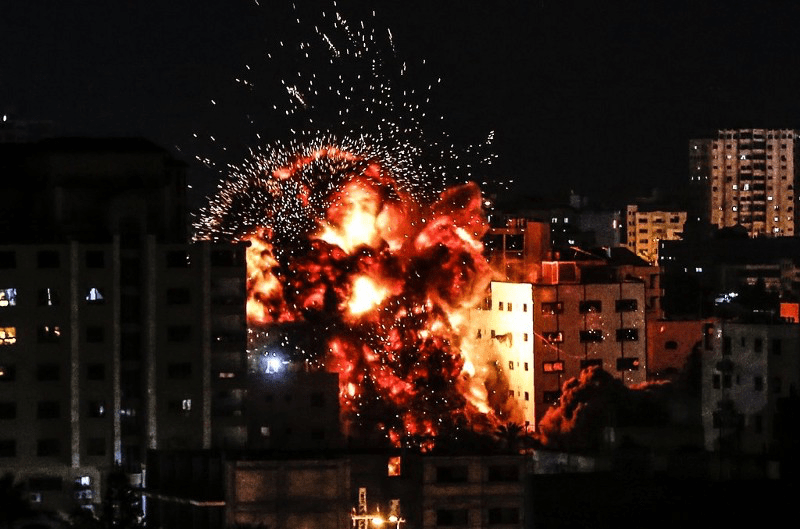
Israel bombs Gaza during the night [From @MuhammadSmiry]
Deterrence capacity is essentially a measure of how terrified people are of a violent response if they were to cross Israel. Throughout all of Israel’s statehood, deterrence capacity has been at the center of its military strategy. It is established when the Israeli forces “demonstrate real hooliganism” at the demand of the high Israeli officials. The more indiscriminate the violence and the more fear struck into the hearts of Palestinians, the less likely they are to resist Israel’s harsh treatment. The Israelis use the term “mowing the lawn” to describe these periodic outbursts of violence. It is a deliberate attempt to beat a desperate people into submission in order to accomplish political ends. In a word, it is the definition of state terrorism.
On Sunday, while the bombs were still falling, Hamas and Islamic Jihad signaled that they were ready to reach a ceasefire. Israel ignored this because, according to Israeli officials, they wanted to reestablish their deterrence capacity. Netanyahu promised “massive strikes” and even began mobilizing ground forces in preparation for an invasion. In other words, the military wanted the population of Gaza to suffer more so that they would fear Israel more. If they fear Israeli bombs enough, Israeli strategy assumes the people of Gaza would quietly accept the destruction of their society. The only reason Israel did not escalate was that it did not want to juggle the PR of bombing a defenseless population during the Eurovision song contest which is being held in Tel Aviv this year.

Seba Abu Arar, 14 months, killed in Israeli Strikes [From @MuhammadSmiry]
The decision to continue the bombardment came even after it was known that many civilians, including a pregnant woman and and an infant, were killed in the attacks. Israeli command evidently did not care about these casualties. This is just the latest example of Israel using security concerns to justify outright terrorism. To show just how spurious the security pretext is, ask simple question: What effect will the bombing have on Israeli security?
The bombings are never designed to destroy Hamas militarily. That would be impossible without completely obliterating the strip after a costly invasion and then entirely uprooting Gaza’s civil society. The attacks also do not weaken Hamas politically, but strengthen it. Hamas’s popularity comes in part from their reputation as an armed resistance against Israeli aggression. Armed resistance wouldn’t be as popular if Israel was not continuously antagonizing the population with a crippling blockade and perpetuating the humanitarian crisis.
When Israel attacks Gaza, they’re not expecting some sort of change to the status quo. Bombing the enclave only serves to exacerbate both feelings of hostility as well as the underlying conditions. All of this increases the likelihood of Palestinian violence. As long as Israel refuses to address the roots of the situation, daily life in Gaza will remain unchanged, along with the conditions that lead some to justify firing projectiles into Israel.
So, when Israel bombs one of the most densely populated areas on earth, remorselessly slaughters infants and bombs school shelters and personal residences all in the name of security, the serious reader must understand it as nothing less than a cover for the continuation of terrorism against the Palestinian people. Without willful ignorance, mental gymnastics or outright cognitive dissonance, there’s no other way of putting it.
Featured Video

Chinese jet fuel and the myth of energy independence
or go to
Aletho News Archives – Video-Images
Book Review
Former Insiders Criticize Iran Policy as U.S. Hegemony
By GARETH PORTER | CounterPunch | February 27, 2013
“Going to Tehran” arguably represents the most important work on the subject of U.S.-Iran relations to be published thus far.
Flynt Leverett and Hillary Mann Leverett tackle not only U.S. policy toward Iran but the broader context of Middle East policy with a systematic analytical perspective informed by personal experience, as well as very extensive documentation.
More importantly, however, their exposé required a degree of courage that may be unparalleled in the writing of former U.S. national security officials about issues on which they worked. They have chosen not just to criticise U.S. policy toward Iran but to analyse that policy as a problem of U.S. hegemony. … continue
Blog Roll
 Aletho News
- Iran war will leave long-term ‘scar’ on Wall Street, investors warn
- How Iran decimated US power projection in West Asia: Military lessons of 40-day war
- Iran’s report details US-Israeli war crimes in targeting schools, hospitals, livelihoods
- NATO’s Slow Fracture: How Trump’s Iran War Exposed the Instrument of Hegemony
- Chinese jet fuel and the myth of energy independence
- Ukraine Sea Drone Fired From Libya Hit Russian Tanker in Mediterranean
- IRGC: Iranian forces launched no attacks during ceasefire hours
- Trump Administration Moves To Automate U.S. Military Draft Registration
- Spain orders reopening of Tehran embassy, condemns Israel’s carpet bombing of Lebanon
- Israel faces ‘unsustainable’ strategic crisis following 40-day war against Iran: Analyst
- If Americans Knew
- Israel killed at least 303 Lebanese yesterday – who were they? Daily Update
- Amnesty: Urgent – Protect Lebanese civilians from brutal escalation in Israeli attacks
- Is The War Against Iran Over?
- Inside the Israeli army’s propaganda wing
- Hundreds of Gaza Amputees Stranded in Legal Limbo
- The gallows law: Israel moves toward executing Palestinian children
- Tucker Carlson: The Path to Peace requires ending ‘special alliance’ with Israel
- This is ceasefire? Israel’s biggest massacre yet in Lebanon, another journalist killed in Gaza – Daily Update
- Tucker Carlson on Israel: This Is the Behavior of an Ally? Really?
- Gazans face a triple crisis: severe shortages of water and bread, healthcare in tatters
- No Tricks Zone
- An Inconvenient Tree: Uncovered In Alps… Europe Much Warmer Than Today 6000 Years Ago
- New Study Reports A 60% Slowdown In Greenland’s Ice Loss Rate In The Last Decade
- Low Intensity Tornado Wrecks Major Solar Farm, Creating A Potential Toxic Dump
- New Study Finds Warming Saves Lives…Cold Temperatures 12 Times More Deadly Than Excess Heat
- German Science Blog Accuses PIK Climate Institute Of Hallucinating Climate Tipping Points
- Devastating Assessment Of Comirnaty Vaccine By Former Senior Pfizer Europe Toxicologist
- New Study: CO2 Is ‘Effectively Negligible’ As An Explanatory Climate Change Factor Since 2000
- Former Pfizer Toxicologist Dr. Helmut Sterz Tells Bundestag Hearing Pfizer Vaccine Should Have Never Been Approved
- Energy Expert: Germany’s Nuclear Phaseout Was A “500 Billion Euro Mistake”
- New Research: South Australia’s Mid-Holocene Sea Surface Temperatures Were 4°C Warmer Than Today
 Aletho News