Why More US Bradley Armored Vehicles Won’t Boost Ukraine’s Counteroffensive

By Oleg Burunov – Sputnik – 28.06.2023
What Washington has delivered to Ukraine is a non-upgraded version of the Bradly armed vehicles with restricted combat capabilities, retired US Air Force Lt. Col. Karen Kwiatkowski, a former analyst for the US Department of Defense, told Sputnik.
The Biden administration has announced another $500 million military package to Kiev, which includes, among other weaponry, 30 US-made Bradley infantry fighting vehicles.
At least 17 such vehicles were earlier damaged or destroyed by Russian troops amid the Ukrainian army’s unsuccessful counteroffensive attempt. Will an additional batch of the Bradley vehicles be of use to the Ukrainian military? Former Pentagon analyst Karen Kwiatkowski has her doubts.
“Well, if you have ever watched the 1998 movie “The Pentagon Wars” you might wonder how we ever developed them in the first place! And of course, they are from 1980s technology and design, because of the lag time in the US military acquisition system of that era, and today as well,” she told Sputnik.
THE PENTAGON WARS – 1998 HBO MILITARY COMEDY FILM BASED ON A TRUE STORY OF THE BRADLEY TANK
The ex-Pentagon analyst said that with the mothballed Bradleys delivered to Ukraine, the US is now in the process of upgrading these infantry fighting vehicles.
“Its replacement program was actually initiated in 2010, and the production by the winning company (or a combination) won’t begin until 2027. In a comprehensive land-sea-air battlespace, the Bradley adds mobility and protection to other parts of the combined arms array, but without the ‘rest of the system’ its capabilities are limited, as we see in Ukraine today,” Kwiatkowski noted.
She made it clear that the Bradley supplies to Ukraine are something that American Rheinmetall and General Dynamics will benefit from, as “they refine and propose their best design” of the Bradleys.
When asked whether the development of a new vehicle could entail a US military budget increase, Kwiatkowski said that “part of the strategy of NATO expansion and relevance, that has been the story of Ukraine for over a decade, is how to upgrade older weapons systems with European support and cash along with maintaining the massive US military industrial complex into the foreseeable future.”
“The US defense budget has grown every year in my lifetime, and not a single war has been ‘won’. The upcoming Pentagon budget is $842 billion, and this does not count the entire intelligence budget, so we are well over a trillion dollars annually in 2024. Because of the influence and pervasiveness of the defense industry in every state, this budget will continue to grow until the United States is bankrupted,” she concluded.
Both Kiev and Washington have acknowledged that the Ukrainian counteroffensive is progressing slower than expected, with one Pentagon official citing an American military representative who conceded that the counteroffensive is “not meeting expectations on any front.”
Russian President Vladimir Putin, for his part, stressed that Kiev had failed to reach any strategic objectives at the beginning of its counteroffensive, losing more than 180 tanks and over 400 armored vehicles.
Analysis: Both Parties Always Serve the Military-Industrial Complex
By Connor Freeman | The Libertarian Institute | May 30, 2023
In 2023, despite skyrocketing inflation, debt, as well as rising sociopolitical divisions, leadership among both the Republicans and Democrats will always agree that substantially more US taxpayer money, never less, should be poured into the military industrial complex, according to an analysis by Judd Legum.
Case in point, the debt ceiling agreement established between the Joe Biden administration and House Speaker Kevin McCarthy caps military spending at a record $886 billion, exactly matching Biden’s mammoth budget request.
The GOP was seeking large increases in military spending and would only entertain cuts in non-military expenditures. The agreed upon war budget represents a 3.3% increase over the current year. The tentative deal still needs to make its way through Congress, where hawks will fiercely oppose any and all military spending caps.
Half of this money will go to defense contractors with Raytheon, Boeing, Lockheed Martin, Northrop Grumman, and General Dynamics receiving the lion’s share. Some of these arms industry giants are currently ensnared in a massive “price gouging” scandal, with a bipartisan group of Senators demanding an investigation be opened at the Pentagon’s highest levels.
Legum highlights the lack of any “peace dividend.” after the disastrous 20 year war and occupation in Afghanistan. “This military spending increase has occurred even as Biden ended the war in Afghanistan, the military’s longest-running and most costly foreign intervention… Each year, the costs go up dramatically,” Legum writes.
He explains that the US has added more than $300 billion to the military budget during the last eight years. In 2015, the Pentagon budget was $585 billion. Half of this obscene increase in war spending and profiteering has been bylined by the Biden administration. Legum continues,
(Had military spending kept pace with inflation, [it] would still be less than $700 billion annually.) Biden has added nearly $150 billion to the military budget since 2021, the last budget approved by President Trump. The budget of the Pentagon now exceeds “the budgets for the next ten largest cabinet agencies combined.” In 2020, Lockheed Martin received $75 billion in government contracts, more than 1.5 times the budget of the entire State Department.
Last year, the United States spent more on its military than the next 10 highest-spending countries combined.
A recent report on 60 Minutes, the CBS news program, saw former Pentagon officials, contract negotiators, and insiders accuse these defense firms of “astronomical price increases” and “unconscionable” fraud.
In particular, the CBS report cites Shay Assad, a 40-year veteran contract negotiator, who says military industrial complex behemoths, such as Lockheed and Raytheon, overcharge for “[everything from] radar and missiles … helicopters … planes … submarines… down to the nuts and bolts.”
The cited experts described these practices, as well as the accompanying rampant unaccountability, as largely the culmination of bureaucratic decisions made during the immediate post-Cold War era.
In the early 1990s, ostensibly to reduce costs, the DOD “urged defense companies to merge and 51 major contractors consolidated to five giants.” This drastically reduced competition and put the big five industry “giants” in an extremely advantageous situation. The War Department “has few options today, and the defense contractors know it,” Legum writes.
Assad clarifies the effects of this centralization of power, “In the [1980s], there was intense competition amongst a number of companies. And so the government had choices. They had leverage. We have limited leverage now,” Assad said. “The problem was compounded in the early 2000s when the Pentagon, in another cost-saving move, cut 130,000 employees whose jobs were to negotiate and oversee defense contracts.”
Retired Pentagon auditor Mark Owen bluntly told CBS, this is “not really a true capitalistic market because one company is telling you what’s going to happen. [It’s a] monopoly.”
The report highlighted the fact that, before the clamp down on competition, a shoulder-fired Stinger missile, produced by Raytheon, cost $25,000 in 1991. Now that Washington is subsidizing the provision of so many Stingers to Ukraine, as well as Taiwan, the weapon is now priced at more than $400,000. This is an “eye-watering” seven-fold increase, even when taking inflation into account as well as interim technological advancements.
Lockheed and Boeing were found to have yielded an over 40 percent profit on sales of PAC-3 surface to air missiles to Washington and its allies. Assad explained the companies saw a windfall of hundreds of millions on the deals over seven years, and “based on what they actually made, we would’ve received an entire year’s worth of missiles for free.”
The DOD also “caught Raytheon making what they called ‘unacceptable profits’ from the Patriot missile defense system by dramatically exaggerating the cost and hours it took to build the radar and ground equipment.”
Assad demonstrated to the 60 Minutes host that an oil pressure switch was selling for over $10,000, when he claimed the switch should cost $328. The host asked Assad a question regarding the huge discrepancy, to which the former official responded “Gouging. What else can account for it?”
A major aspect of this problem is the Congress and defense contractors’ bribes. As Legum details, the military-industrial complex spent $2.5 billion on lobbying in the last two decades. “During that period, defense contractors employed an average of 700 lobbyists — more than one lobbyist for every member of Congress.”
Though, some Senators just denounced the contractors, in a letter to the Pentagon chief, saying these firms are “dramatically overcharging the Department and U.S. taxpayers while reaping enormous profits, seeing their stock prices soar, and handing out massive executive compensation packages.”
The lawmakers charged that these “companies have abused the trust government has placed in them… exploiting their position as sole suppliers for certain items to increase prices far above inflation or any reasonable profit margin.”
US Democrats fundraise from arms dealers amid Pentagon budget fight
Press TV – April 29, 2023
Top Democratic lawmakers in the US are holding a fundraising meeting with major arms companies on Thursday as Washington plunges into a budget battle in which concessions to the Pentagon and the defense industry could mean cuts to welfare programs such as food stamps.
House Democratic Leader Hakeem Jeffries of New York, his deputy Pete Aguilar, and Democratic Congressional Campaign Committee (DCCC) chair Rep. Suzan Delbene have been selected as the honorees to be invited to the event. The downtown D.C. function ― dubbed a “defense and national security dinner” ― is set to raise funds for the committee, which is the campaign arm for House Democrats and is central to their hopes of regaining the lower chamber of Congress.
Dozens of representatives of Pentagon contractors, including Lockheed Martin, Boeing, Northrop Grumman, BAE Systems, SpaceX, Palantir, and General Dynamics will attend the event.
The group includes figures who previously worked for congressional Democrats, such as Shana Chandler, director of government relations at General Dynamics. Chandler spent 15 years as chief of staff for Rep. Adam Smith, the Democratic chairman of the House Armed Services Committee and another co-host of Thursday’s event.
The event could provide a significant signal about the priorities of the House Democrats as they prepare for the 2024 elections and battle Republicans who are demanding spending cuts in exchange for passing critical legislation. It could be a disappointing message to those who want the party to support social justice and progressive reform.
A senior congressional aide said news of the fundraiser set off alarm bells among staffers, and the event could be a stark example of senior Democratic leaders saying one thing but doing another. Democrats claim to support reining in out-of-control defense spending and criticize Republicans for serving America’s most powerful corporate interests while doing exactly that themselves.
In the coming months, Democratic lawmakers are expected to make key decisions that will affect the US defense industry as they fight Republican efforts to cut government spending.
US House Speaker Kevin McCarthy says he wants comprehensive cuts. But signals from influential Republicans and analysis by budget experts suggest that McCarthy will protect the Pentagon budget.
Democrats can also demand limits on Pentagon spending to protect other government agencies. However, the defense industry will lobby hard to prevent such a development.
The United States remains by far the world’s biggest military spender, according to new data on global military spending published today by the Stockholm International Peace Research Institute (SIPRI).
US military spending reached $877 billion in 2022, which was 39 percent of total global military spending and three times more than the amount spent by China, the world’s second largest spender.
The 0.7 percent real-terms increase in US spending in 2022 would have been even greater had it not been for the highest levels of inflation since 1981.
“The increase in the USA’s military spending in 2022 was largely accounted for by the unprecedented level of financial military aid it provided to Ukraine,” said Dr Nan Tian, SIPRI Senior Researcher. “Given the scale of US spending, even a minor increase in percentage terms has a significant impact on the level of global military expenditure.”
US financial military aid to Ukraine totaled $19.9 billion in 2022. Although this was the largest amount of military aid given by any country to a single beneficiary in any year since the cold war, it represented only 2.3 percent of total US military spending.
In 2022 the USA allocated $295 billion to military operations and maintenance, $264 billion to procurement and research and development, and $167 billion to military personnel.
Biden mobilizes US military industry to arm Ukraine
Samizdat | April 13, 2022
US President Joe Biden is looking to mobilize the military industry and send another $750 million worth of the Pentagon’s own weapons stockpile to Ukraine, according to new reports citing anonymous officials in Washington. This is on top of the $1.7 billion worth of goods sent to Kiev courtesy of American taxpayers since the conflict escalated on February 24.
So far the US “lethal” aid has consisted mainly of Javelin anti-tank missiles and Stinger portable anti-air systems.
Now Biden is preparing to escalate the aid to include heavy artillery and other systems, worth three-quarters of a billion or so, Reuters reported on Tuesday citing two US officials. The official announcement could come within a day or two, the agency added.
Biden wouldn’t need congressional authorization for this, either, as it would be done under a Presidential Drawdown Authority (PDA), which authorizes transfer from current US military stocks in response to an emergency.
This would put the amount of US military aid to Kiev at over $2.4 billion since Russia sent troops into Ukraine on February 24, when added to the White House’s own figures made public last week.
The US has sent more than 1,400 Stingers and 5,000 Javelins to Ukraine already, Financial Times (FT) reported on Tuesday citing the Pentagon. This amounts to a third of the US stock of Javelins and a quarter of its Stingers, estimated the Center for Strategic and International Studies (CSIS), a Washington think-tank. At current production rates, it will take 3-4 years to restock on Javelins and at least five for the Stingers.
Production levels will be one of the topics at the meeting between the Pentagon officials and top eight US weapons manufacturers, which both Reuters and FT said is scheduled for Wednesday. Raytheon, Boeing, Lockheed Martin, Northrop Grumman, General Dynamics and L3 Harris Technologies are expected in attendance.
Kiev has reached out to US allies far and wide – from its NATO neighbors all the way to South Korea – asking for airplanes, tanks and artillery in particular. On Saturday, German Defense Minister Christine Lambrecht said that Berlin could not afford to send any more weapons without depleting its own stocks too much. By Monday, however, the Rheinmetall conglomerate said it could refurbish some obsolete Leopard 1 tanks and send them east.
Last week, Slovakia announced it would send its only battery of S-300 air defense systems to Ukraine, and get US-made “Patriots” to replace them. On Monday, the Russian Defense Ministry claimed that the battery had been obliterated in a cruise missile strike against a hangar in Dnepropetrovsk, a city Ukrainians call Dnipro, the day before.
Top US generals lined their pockets off Afghanistan war
Press TV – September 4, 2021
The top generals who commanded American forces in Afghanistan have amassed fortunes from their postings there despite their disastrous conduct in the occupied country.
Eight American generals leading foreign forces in Afghanistan, including United States Army General Stanley McChrystal, who sought and supervised the 2009 American troop surge, went on to serve on more than 20 corporate boards, according to US media.
In an article titled, “Corporate boards, consulting, speaking fees: How US generals thrived after Afghanistan,” published by Stars and Stripes, the publication reveals how top generals amassed clout despite the failure of the American offensive in Afghanistan.
A review of company disclosures and other releases conducted by the specialized medium showed that the top Americans generals who led the mission in Afghanistan had thrived in the private sector after leaving the war zone.
They have amassed influence within businesses, at universities and in think tanks, in some cases selling their experience in a conflict that left millions of people dead and displaced, and costing the United States more than $2 trillion and concluded with the restoration of Taliban rule, the report said.
Meanwhile, the debate remains hot in the United States over what was the mission and who benefited from the 20-year war against the impoverished country.
A compilation of data from lobbying disclosures archived at Open Secrets, a US-based research group tracking money in US politics, showed that Lockheed Martin, Raytheon, General Dynamics, Boeing and Northrop Grumman were the top 5 military contractors who received $2 trillion dollars in public funds from 2001 and 2021.
Retired Gen. Joseph F. Dunford Jr., who commanded American forces in Afghanistan in 2013 and 2014, joined the board of Lockheed Martin last year. Retired Gen. John R. Allen, who preceded him in Afghanistan, is president of the Brookings Institution, which has received as much as $1.5 million over the last three years from Northrop Grumman.
Afghanistan Withdrawal Is Hurting Its Profits. It’s Funding a Pro-War Think Tank.
BY SARAH LAZARE | IN THESE TIMES | AUGUST 25, 2021
On August 12, the military contractor CACI International Inc. told its investors that the U.S. withdrawal from Afghanistan is hurting its profits. The same contractor is also funding a think tank that is concurrently arguing against the withdrawal. This case is worth examining both because it is routine, and because it highlights the venality of our “expert”-military contractor feedback loop, in which private companies use think tanks to rally support for wars they’ll profit from.
The contractor is notorious to those who have followed the scandal of U.S.-led torture in Iraq. CACI International was sued by three Iraqis formerly detained in Abu Ghraib prison who charge that the company’s employees are responsible for directing their torture, including sexual assault and electric shocks. (The suit was brought in 2008 and the case is still ongoing.)
In 2019, CACI International was awarded a nearly $907 million, five-year contract to provide “intelligence operations and analytic support” for the U.S. Army in Afghanistan.
During an August 12 earnings call, CACI International noted repeatedly that President Biden’s withdrawal from the 20-year Afghanistan War harmed the company’s profits. John Mengucci, president and CEO of CACI International, said, “we have about a 2 percent headwind coming into FY 2022 because of Afghanistan.” A “headwind” refers to negative impacts on profits.
Afghanistan was mentioned 16 times throughout the call — either in reference to the dent in profits, or to assure investors that other areas of growth were offsetting the losses. For example, Mengucci said, “We’re seeing positive growth in technology and expect it to continue to outpace expertise growth, collectively offsetting the impact of the Afghanistan drawdown.”
Similar themes were repeated in an April 22 earnings call, where the company lamented the “headwinds” posed by the Afghanistan withdrawal. (Industry and defense publications have picked up on this theme, but framed it in the company’s terms, by emphasizing the offsets to its losses.)
Despite CACI International’s clear economic interest in continuing the war, on the August 12 call, company officials were careful not to editorialize about the Biden administration’s decision. The closest they came was a cautious statement from Mengucci: “At least as of today we’ve watched the administration make the decision to completely exit Afghanistan by 9 – 11 and all I can say is they’re executing on that decision.”
But CACI International does not have to broadcast its positions on the war: Instead, it is funding a think tank that has been actively urging the Biden administration not to leave Afghanistan.
CACI International is listed as a “corporate sponsor” of the Institute for Study of War, which describes itself as a “non-partisan, non-profit, public policy research organization.” Dr. Warren Phillips, lead director of CACI International, is on the board of the think tank. (Other funders include General Dynamics and Microsoft.)
When it comes to the U.S. withdrawal from Afghanistan, however, the think tank is extremely partisan. In an August 20 paper, the think tank argued that “Russia, China, Iran, and Turkey are weighing how to take advantage of the United States’ hurried withdrawal.”
Jack Keane, a retired four star general and board member of the Institute for Study of War, meanwhile, has been on a cable news blitz arguing against the U.S. withdrawal from Afghanistan, as reported by Ryan Grim, Sara Sirota, Lee Fang and Rose Adams for The Intercept. (The Intercept noted CACI’s International’s backing of the think tank.)
Kimberly Kagan, founder and president of the Institute for the Study of War, told Fox News on August 17 that the U.S. withdrawal could cause Afghanistan to become the “second school of jihadism.” She warned, “It is not clear that the Taliban, which seeks international recognition and legitimacy, is going to want to tolerate or encourage direct attacks on the U.S. from al Qaeda or other extremist groups based in Afghanistan.”
The think tank’s backing from a military contractor was not discussed in these media appearances.
The case of CACI International is not unique. The Intercept notes, “Among the other talking heads who took to cable news segments or op-ed pages without disclosing their defense industry ties were retired Gen. David Petraeus; Rebecca Grant, a former staffer for the Air Force secretary; Richard Haass, who worked as an adviser to then-Secretary of State Colin Powell; and former Secretary of State Condoleezza Rice.”
This cacophony of voices matters because Biden is facing a media uproar over the withdrawal. Pundits and mainstream press outlets that have been ignoring civilian deaths for years are suddenly expressing moral outrage at their hardships now that the war is ending. While there are legitimate concerns about the fate of Afghans as the Taliban seizes control, the vast majority of the firestorm stems from a reflexively pro-war perspective, in favor of the indefinite extension of an occupation that has proven brutal and lethal for civilians. The overwhelming effect is to send the message to Biden, and any future presidents, that they should think twice before withdrawing from a war, lest they have a media revolt on their hands.
But this outcry didn’t materialize out of nowhere. Think tank “experts,” whose organizations are financed by the very companies profiting from the war, play a key part. They are trotted out in front of cameras and quoted in major media outlets, presented as above-the-fray observers. They are well-financed, polished and groomed precisely for moments like these. And the companies financing them get to launder their own objectives through institutions that are seen as respectable, academic and rigorous. It’s a grotesque system that is functioning as it was designed.
In its August 12 call, CACI International simply acknowledged the company’s economic interests out loud.
‘Forever war’ returns: Biden’s Pentagon team puts the military-industrial complex back in command
RT | November 14, 2020
Despite campaign-trail overtures to progressives, a Joe Biden presidency seems to spell a return to normalcy in the most time-honored American way: by placing the military-industrial complex in charge of the country’s defense.
Joe Biden’s campaign message focused almost entirely on Donald Trump, and on Biden’s supposed ability to “unify” a polarized electorate and “restore the soul of America.” Since he claimed victory last week, Biden’s prospective administration has begun to take shape, and the reality behind the rhetoric has started to emerge.
On matters of defense, restoring America’s “soul” apparently means placing weapons manufacturers back in charge of the Pentagon.
Biden announced his Department of Defense landing team on Tuesday. Of these 23 policy experts, one third have taken funding from arms manufacturers, according to a report published this week by Antiwar.com.
A knot of hawks
Leading the team is Kathleen Hicks, an undersecretary of defense in the Obama administration, and an employee of the Center for Strategic and International Studies (CSIS), a think tank funded by a host of NATO governments, oil firms, and weapons makers Northrop Grumman, Boeing, Lockheed Martin, Raytheon, and General Atomics. The latter firm produces the Predator drones used by the Obama administration to kill hundreds of civilians in at least four Middle-Eastern countries.
Hicks was a vocal opponent of President Donald Trump’s plan to withdraw a number of US troops from Germany, claiming in August that such a move “benefits our adversaries.”
Two other members of Biden’s Pentagon team, Andrew Hunter and Melissa Dalton, work for CSIS and served under Obama in the Defense Department.
Also on the team are Susanna Blume and Ely Ratner, who work for the Center for a New American Security (CNAS). Another hawkish think-tank, CNAS is funded by Google, Facebook, Raytheon, Northrop Grumman and Lockheed Martin. Three more team members – Stacie Pettyjohn, Christine Wormuth and Terri Tanielian – were most recently employed by the RAND corporation, which draws funding from the US military, NATO, several Gulf states, and hundreds of state and corporate sources.
Michele Flournoy is widely tipped to lead the Pentagon under Biden. Flournoy would be the first woman in history to head the Defense Department, but her appointment would only be revolutionary on the surface. Flournoy is the co-founder of CNAS, and served in the Pentagon under Obama and Bill Clinton. As under secretary of defense for policy under Obama, Flournoy helped craft the 2010 troop surge in Afghanistan, a deployment of 100,000 US troops that led to a doubling in American deaths and made little measurable progress toward ending the war.
‘Forever war’ returns
President Trump, who campaigned on stopping the US’ “forever wars” in the Middle East and remains the first US president in 40 years not to start a new conflict, has nevertheless also staffed the Pentagon with hawkish officials. Recently ousted Defense Secretary Mark Esper was a top lobbyist for Raytheon, while his predecessor, Patrick Shanahan, worked for Boeing. Trump’s appointment this week of National Counterterrorism Center Director Christopher Miller as acting secretary of defense, coupled with combat veteran Col. Douglas MacGregor as senior adviser, looked set to buck that trend, given MacGregor’s vocal opposition to America’s Middle Eastern wars.
Yet Miller and MacGregor may not be in office for long, if Trump’s legal challenges against Biden’s apparent victory fail. Should that happen, Biden’s progressive voters may be in for a rude reawakening when the former vice president returns to the White House.
Many of these progressives were supporters of Bernie Sanders during the Democratic primaries, while others likely held their nose and voted for Biden out of opposition to Trump. Reps. Barbara Lee (California) and Mark Pocan (Wisconsin), two notable progressives, wrote to Biden on Tuesday asking him not to nominate a defense secretary linked to the weapons industry.
Lee and Pocan cited President Dwight D. Eisenhower’s 1961 farewell address, in which he warned of the “disastrous rise” of the “military-industrial complex.”
Given Biden’s fondness for Flournoy, whom he tapped in 2016 to head the Pentagon under a potential Hillary Clinton administration, the former vice president appears unconcerned about curtailing the influence of the armaments industry.
The industry apparently roots for Joe, too. As Donald Trump surged ahead of Biden on election night, stocks in Raytheon, Lockheed Martin, General Dynamics, and the Carlyle Group all plummeted. Only when counting in swing states stopped and resumed, giving Biden the advantage, did they climb again.
It’s probably fine that all the big arms contractor stocks plummeted when it looked like Trump won but then skyrocketed once it became clear Biden would be the one to take office. pic.twitter.com/CKEZNS53Gx
— Hillary Fan (@HillaryFan420) November 7, 2020
Should a Biden administration make good on running mate Kamala Harris’ post-election promise to return to regime-change operations in Syria, these firms and their supporters in the Pentagon stand to make a killing.
However, anti-war leftists, progressives, and Bernie Sanders supporters may soon realize that voting for a Democrat who supported the Iraq War, instead of a Republican who called it “the worst single mistake ever made in the history of our country,” might just benefit the military-industrial complex more than the “soul of America.”
Neutral and unbiased? Why ‘think tanks’ lobby for war in Syria
By Danielle Ryan | RT | April 17, 2018
When US President Donald Trump fired a barrage of Tomahawk missiles at Syrian government targets last week, it was a good day for defense contractors, at least.
In the aftermath of the strike, which Trump claimed was in retaliation for an alleged chemical attack by the Syrian government, stocks in Tomahawk missile manufacturer Raytheon surged. Raytheon stock has climbed more than 18 percent in 2018 so far. In fact, stocks in defense companies have been climbing in general since Trump entered office promising “historic” increases in military spending.
Almost a year ago to the day, Trump delivered another bump to the defense companies after attacking Syrian government positions for the first time – also in response to an alleged chemical attack, evidence for which remains in question.
After that strike Boeing, Lockheed Martin, Northrop Grumman and General Dynamics also rose, gaining nearly $5 billion in market value when trading began the next day, even as the wider market slumped.
Later, when Trump appointed the famously militaristic John Bolton as his national security adviser in March, guess what happened? Shares in US energy and defense companies surged yet again. It doesn’t take a rocket scientist to figure this one out: war is profitable. The more missiles Trump fires, the more money these companies make.
But where do the think tanks come in?
There is a pervasive myth that Washington DC ‘think tanks’ are neutral and unbiased players in foreign policy analysis. But where do these centers for foreign policy ‘analysis’ get their money from? You guessed it: defense companies.
There are a few think tanks which dominate in American foreign policy debates. They include the Center For European Policy Analysis (CEPA), the Atlantic Council, the German Marshall Fund (GMF), the Brookings Institution and the Heritage Foundation. All five of them receive generous donations from Lockheed Martin and Raytheon. Three of them also receive funding from the Boeing Company.
Corporations like Exxon Mobil, Northrop Grumman, BAE Systems, and Bell Helicopter are also big donors to think tanks. Bell Helicopter is a funder of CEPA, while Exxon funds Brookings, GMF and the Atlantic Council. BAE Systems donates to CEPA, while Northrop Grumman gives to the Atlantic Council. This is not to even mention the money they get directly from US government departments and NATO, which also helps explain their consistently anti-Russian analysis.
Nonetheless, these think tanks enjoy an undue air of independence. Experts who work for these defense contractor-funded institutes are quoted frequently in mainstream newspapers and invited on mainstream channels, where they are presented as independent voices. But those independent voices somehow always seem to be in favor of policies that benefit weapons manufacturers.
War profiteers are filling their coffers in return for ‘analysis’ which promotes military action and massively inflates the threat posed to America by countries like Russia, for example.
A glance at the Twitter feed of CEPA reveals almost obsession-like focus on the so-called threat from Russia. In 2016, the Lockheed and BAE Systems-funded think tank suggested in a report on information warfare that people who have “fallen victim to Kremlin propaganda” should be “deradicalized” in special programs.
The NATO-funded Atlantic Council has consistently lobbied for regime change in Syria. In the days surrounding Trump’s military actions against Syria last week, the Atlantic Council published multiple pieces of analysis and interviews with a single theme: that Trump did not or would not go far enough with one night of strikes. Earlier, when the alleged chemical attack took place, the think tank argued that Syrian President Bashar Assad was “indulging an addiction” and called on the US to take new military action against him. For some reason, diplomacy does not seem to be high on the Atlantic Council’s agenda.
It seems the more money defense contractors throw at think tanks, the more those think tanks will argue in favor of the military policies that will make those companies the most money. It’s a vicious cycle, but one which doesn’t take much think tank-style ‘analysis’ to figure out.
The sad thing for the think tank lobbyists, is that the money they make calling for war is nothing in comparison to the money Lockheed, Raytheon, Boeing and the rest make from it. Maybe they should ask for a raise.
Your guide to top anti-Russia think tanks in US & who funds them
By Bryan MacDonald | RT | February 6, 2018
Countering Russia has become a lucrative industry in Washington. In recent years, the think tank business has exploded. But who funds these organizations, who works for them and what are the real agendas at play?
From the start, let’s be clear, the term ‘think tank’ essentially amounts to a more polite way of saying ‘lobby group.’ Bar a few exceptions, they exist to serve – and promote – the agendas of their funders.
However, particularly in the United States, the field has become increasingly shady and disingenuous, with lobbyists being given faux academic titles like ‘Senior Non-Resident Fellow’ and ‘Junior Adjunct Fellow’ and the like. And this smokescreen usually serves to cloud the real goals of these operations.
Think tanks actually originate from the Europe of the Dark Ages. That’s 9th-century France, to be precise. But the modern American movement is modeled on British organizations from around a millennium later, many of which, such as ‘RUSI (1831)’, still exist today. The concept was possibly brought to America by the Scottish-born Andrew Carnegie. And his ‘Carnegie Endowment for International Peace’ (1910) is still going strong.
Yet, the real boom in the ‘think tank’ industry came with the era of globalization. With a 200-percent rise in numbers since 1970. And in recent years, they’ve become more transnational, with foreign states and individuals sponsoring them in order to gain curry favor in Washington.
One country that largely hasn’t bothered playing this game is Russia. Instead, mostly in the foreign policy and defense sectors, Moscow frequently serves as Enemy Number One for many advocacy groups. Here are some prominent outfits in the think tank racket, which focus on hyping up threats from Russia.
- The Atlantic Council
Founded: 1961
What is it? Essentially the academic wing of NATO. The Atlantic Council serves to link people useful to the organization’s agenda across Europe and North America. However, in recent years, its recruitment has increasingly focused on employees who directly attack Russia, especially on social media. Presumably, this is to give them a guaranteed income so they can continue their activities, without needing to worry about paying the bills.
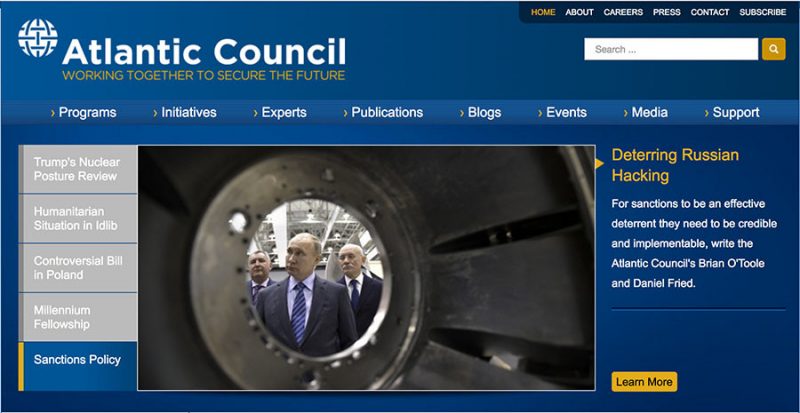
What does it do? Promotes the idea of Russia being an existential threat to Europe and the US, in order to justify NATO’s reason for being.
Who are its people? The Atlantic Council’s list of lobbyists (sorry, ‘Fellows’!) reads like a telephone directory of the Russia bashing world. For instance, Dmitri Alperovitch (of Crowdstrike, which conveniently alleges how Russia hacked the Democratic National Congress) is joined by the perennially- wrong Anders Aslund, who has predicted Russia’s impending collapse on a number of occasions and has, obviously, been off the mark. Then there’s Joe Biden’s “Russia hand,” Michael Carpenter and their recent co-authored Foreign Affairs piece suggests he actually knows very little about the country). Meanwhile, Evelyn Farkas, a fanatical Russophobe who served in Barack Obama’s administration has also found a home here. Another interesting Atlantic Council lobbyist is Eliot Higgins, a “geolocation expert” who has made a career out of spinning tales from the Ukraine and Syrian wars but is, naturally, mostly disinterested in covering Iraq and Yemen, where the US and its allies are involved, but Russia has no particular stake. Lastly, we can’t forget CNN’s Michael Weiss, the self-declared “Russia analyst” who, by all accounts, has never been to Russia and can’t speak Russian.
Who pays for it? The Atlantic Council has quite an eclectic bunch of patrons to serve. NATO itself is a big backer, along with military contractors Saab, Lockheed Martin and the Raytheon Company, all of which naturally benefit from increased tensions with Moscow. The UK Foreign Office also splashes the cash and is joined by the Ukrainian World Congress and the US Department of State. Other sugar daddies include the US military (via separate contributions from the Air Force, Navy, Army and Marine Corps), Northrop Grumman and Boeing.
- The Center for European Policy Analysis (CEPA)
Founded: 2005
What is it? Despite the name, CEPA is based in Washington, not the ‘old continent’, but it does have an outpost in Warsaw. This club specifically focusses on Central and Eastern Europe and promoting the US Army and foreign policy establishment’s agenda there. Or, in its own words, creating a “Central and Eastern Europe with close and enduring ties to the United States.”

screenshot from cepa.org
What does it do? CEPA amounts to a home for media figures who devote their careers to opposing Russia. It whips up tensions, even when they don’t really exist, presumably in order to drum up business for its sponsors, who are heavily drawn from the military industry. For example, it spent last year hyping up the ‘threat’ from Russia’s and Belarus’ joint ‘Zapad’ exercises, even running a sinister-looking countdown clock before the long-planned training commenced.
CEPA grossly overestimated the size of the event, saying it “could be the largest military exercise since the end of the Cold War” and dismissing basically all Moscow’s statements on its actual nature as “disinformation.”
Who are its people? Times of London columnist Edward Lucas has been part of CEPA for years.
Poland chooses Raytheon. Even if the missiles don’t work, America will defend its customers http://t.co/QwqrkCiosD
— Edward Lucas (@edwardlucas) April 21, 2015
The dedicated ‘Cold Warrior’ doesn’t appear to have spent much time in Russia for a long while and still seems to view the country through a prism which is very much rooted in the past. Thus, he’s more-or-less an out-of-touch dinosaur when it comes to Russia expertise. He will soon be joined by Brian Whitmore, who comes on board from RFE/RL and appears to be even more ill-informed than Lucas. His broadcasts for the US state broadcaster led to him being described as the “Lord Haw Haw of Prague,” where has been based for some years. CEPA is a pretty fluid organization and, until recently, Anne Applebaum and Peter Pomerantsev were also on its list of lobbyists. The former is a Polish-American Washington Post columnist who obsessively denigrates Russia and the latter has previously worked with the Atlantic Council’s Michael Weiss, which shows you how small and incestuous the Russia-bashing world is.
Who pays for it? While other think tanks at least try to make their funding look semi-organic, CEPA looks to have zero hang-ups about its role as a mouthpiece for defence contractors. Which is, at least, honest. FireEye, Lockheed Martin, Raytheon, Bell Helicopters and BAE systems pump funds in and they are joined by the US State Department and the Department of Defence. Another notable paymaster is the National Endowment for Democracy – ‘regime change’ experts who are surely interested in CEPA’s remit to also cover Belarus. The US Mission to NATO and NATO’s own Public Diplomacy Division also provide cash.
- German Marshall Fund of the United States
Founded: 1972
What is it? Don’t be fooled by the name, the German Marshall Fund (GMF) is a very American body these days with little input from Berlin. It was founded by a donation from Willy Brandt’s Bonn-government to celebrate the 25th anniversary of the Marshall Plan. Ironically, Brandt is today best remembered as the father of ‘Ostpolitik’, which sought a rapprochement between Germany and Russia.

What does it do? After the fall of the Soviet Union, the GMF transformed into a vehicle promoting US influence in Eastern Europe, with outreaches in Warsaw, Belgrade and Bucharest. However, in the past 12 months, it’s taken a very strange turn. Following the election of US President Donald Trump (ironically a German-American), the lobby group launched the Alliance for Securing Democracy (ASD) project. Its centerpiece is the ‘Hamilton 68 Dashboard’, which seems to classify social media users which reject the US liberal elite’s consensus as “Russian trolls.” The reaction has been highly critical, with even the secretly-funded Russian opposition website Meduza asking “how do you identify ‘pro-Russian amplifiers’ if… themes dovetail with alternative American political views?”
Who are its people? The GMF, especially through its new ASD plaything, has a high-profile bunch of lobbyists. They include Toomas Ilves, an American-raised son of Estonian emigrants who once headed the Estonian desk at erstwhile CIA cut-out Radio Free Europe and eventually became president of Estonia. Also on board is Bill Kristol, known as the ‘architect of the Iraq War’ and former CIA Director Michael Morrell. Former US Ambassador to Russia Michael McFaul, who recently announced he was partially abandoning his Russian scholarship and has “lost interest in maintaining my (sic) ability to speak/write Russian” is another team member.
And sorry that I am not responding in Russian. After being on the travel ban list to your country for 3 years, I have lost interest in maintaining my ability to speak/write Russian. You government seems to really fear me these days. странно и жалько https://t.co/8SRdSEvg5r
— Michael McFaul (@McFaul) January 20, 2018
After serving on Obama’s team, McFaul has re-invented himself as a network TV personality since 2016 with 280,000 Twitter followers, 106,000 of which are fake, according to Twitter audit.
Who pays for it? USAID are big backers, throwing in a seven-figure annual sum. This, of course, raises some questions about US taxpayers essentially funding the Hamilton 68 dashboard, which may be smearing Americans who don’t agree with their government’s policies as Russian agents. The State Department also ponies up capital, as does NATO and Latvia’s Defense Ministry. Other interesting paymasters are George Soros, Airbus and Google. While Boeing and the ubiquitous Raytheon are also involved.
- Institute for the Study of War
Founded: 2007
What is it? This lobby group could as easily be titled ‘The Institute for the Promotion of War’. Unlike the others, it doesn’t consider Russia its primary target, instead preferring to push for more conflict in the Middle East. However, Moscow’s increased influence in that region has brought the Kremlin into its crosshairs.
What does it do? The IFTSOW agitates for more and more American aggression. It supported the Iraq ‘surge’ and has encouraged more involvement in Afghanistan. IFTSOW also focuses on Syria, Libya and Iran. Just last week, one of its lobbyists, Jennifer Cafarella, called for the US military to take Damascus, which would bring Washington into direct conflict with Russia and Iran.
US occupation of Damascus – @TheStudyofWar seems to be calling for the US military to take Damascus and rebuild Syria. This seems the only “realistic” policy that could produce its demand to rid Syria of Assad’s government as well as Iranian and Russian influence. pic.twitter.com/nmSTkSzb5G
— Joshua Landis (@joshua_landis) February 3, 2018
Who are its people? Kimberly Kagan is the brains behind this operation. She’s married to Frederick Kagan, who was involved in the neocon ‘Project for the New American Century’ group along with his brother, Robert Kagan. Which makes Kimberly the sister-in-law of Victoria “f**k the EU” Nuland.
Another lobbyist is Ukrainian Natalia Bugayova, who was involved in Kiev’s 2014 EuroMaidan coup. She previously worked for the Kiev Post, a resolutely anti-Russian newspaper which promotes US interests in Ukraine. However, IFTSOW’s most notorious lobbyist was Elizabeth O’Bagy, who emerged as a ‘Syria expert’ in 2013 and called for American political leaders to send heavy weaponry to Syrian insurgent groups. She claimed to have a PhD from Georgetown University in Washington, DC, but this was fictional and once the media twigged to it, she was dismissed by the IFTSOW. Two weeks later, she was rewarded for her deception by falling up to a job with fanatical Russophobe Senator John McCain. O’Bagy has also collaborated with the Atlantic Council’s Michael Weiss, which is further evidence of how tight-knit the world of US neoconservative advocacy really is.
Who pays for it? Predictably, Raytheon has opened its wallet. Meanwhile, other US military contractors like General Dynamics and DynCorp are also involved. L3, which provides services to the US Department of Defense, Department of Homeland Security, and government intelligence agencies is another backer along with Vencore, CACI and Mantech.
Clinton gets more donations from arms industry: Report
Press TV – August 24, 2016
American weapon manufacturers have made bigger contributions to the campaign of Democratic presidential nominee Hillary Clinton, a major turnaround after years of backing the Republican ticket.
According to a report by Politico released on Wednesday, Clinton has received more donations from high-ranking employees of giant Pentagon contractors like Lockheed Martin and General Dynamics, outperforming her GOP rival Donald Trump by a 5-to-1 ratio.
According to filings with the Federal Election Committee, Trump’s campaign has banked nearly $55,000 in contributions from executives of the 25 major defense contractors, compared to $273,000 given to Clinton.
This marks a significant break from the years-old habit of supporting the Republican candidate. In fact, the arms industry has teamed with Republican congressional and presidential candidates in eight of the past 10 election cycles.
In the 2012 election cycle, for example, then-Republican nominee Mitt Romney received far more support from military contractors, compared to President Barack Obama.
Analysts attribute the change to Trump’s stance on national security, including his criticism of NATO and other military allies.
The real estate mogul said in late July that if he is elected president, the US would only aid the allies who have “fulfilled their obligations to us.”
The New York businessman has also blasted military contractors for the way they influence government spending.
Clinton, however, made a reputation for having good relations with military contractors during her run in the US Senate, where she served on the Armed Services Committee.
“I’ve worked with Republicans and Democrats of all stripes over the years, and it’s the first time I’ve seen one who scares the hell out of me if he were to become president,” said Linda Hudson, who once headed the US branch of British arms provider BAE Systems, which is the Pentagon’s eighth largest contractor.
One Republican defense lobbyist told Politico that the arms manufacturing “community is just much more comfortable with Clinton.”
“With Hillary Clinton we have some sense of where she would go, and with Trump we have none,” the lobbyist said. “He knows nothing about the system.”
US approves $1.15 billion sale of arms to Saudi Arabia
Press TV – August 9, 2016
The United States has approved the sale of more than 130 Abrams tanks, 20 armored recovery vehicles and other equipment worth about $1.15 billion to Saudi Arabia.
The Defense Security Cooperation Agency, which is part of the Pentagon and facilitates foreign arms sales, informed lawmakers on Tuesday that the State Department has approved the deal.
The potential sale to Saudi Arabia still faces approval by Congress, which could block it.
The agency said the sale would contribute to US national security by improving the security of a regional ally.
It added that General Dynamics, an American aerospace and defense corporation, would be the principal contractor.
“This sale will increase the Royal Saudi Land Force’s (RSLF) interoperability with US forces and conveys US commitment to Saudi Arabia’s security and armed forces modernization,” the agency said on its website.
The US government is expected to authorize more than $40 billion worth of foreign military sales this year, the Pentagon has confirmed.
The potential sale by Washington comes as Saudi Arabia and its Persian Gulf Arab allies launched a military aggression against Yemen in March 2015 in a bid to bring the country’s former president Abd Rabbuh Mansur Hadi, a staunch ally of Riyadh, back to power and undermine the Ansarullah movement.
Yemenis say most of the victims in the Saudi airstrikes are civilians.
A UN report leaked to the Guardian in January found “widespread and systematic” targeting of civilians in the Saudi-led strikes.
The report found 119 strikes which violated international humanitarian law, including attacks on health facilities, schools, wedding parties and camps for internally displaced people and refugees.
Big money in politics doesn’t just drive inequality — it also fuels war
By Rebecca Green | OtherWords | April 20, 2016
The 2016 presidential elections are proving historic, and not just because of the surprising success of self-proclaimed socialist Bernie Sanders, the lively debate among feminists over whether to support Hillary Clinton, or Donald Trump’s unorthodox candidacy.
The elections are also groundbreaking because they’re revealing more dramatically than ever the corrosive effect of big money on our decaying democracy.
Following the 2010 Citizens United Supreme Court decision and related rulings, corporations and the wealthiest Americans gained the legal right to raise and spend as much money as they want on political candidates.
The 2012 elections were consequently the most expensive in U.S. history. And this year’s races are predicted to cost even more. With the general election still six months away, donors have already sunk $1 billion into the presidential race — with $619 million raised by candidates and another $412 million by super PACs.
Big money in politics drives grave inequality in our country. It also drives war.
After all, war is a profitable industry. While millions of people all over the world are being killed and traumatized by violence, a small few make a killing from the never-ending war machine.
During the Iraq War, for example, weapons manufacturers and a cadre of other corporations made billions on federal contracts.
Most notoriously this included Halliburton, a military contractor previously led by Dick Cheney. The company made huge profits from George W. Bush’s decision to wage a costly, unjustified, and illegal war while Cheney served as his vice president.
Military-industrial corporations spend heavily on political campaigns. They’ve given over $1 million to this year’s presidential candidates so far — over $200,000 of which went to Hillary Clinton, who leads the pack in industry backing.
These corporations target House and Senate members who sit on the Armed Forces and Appropriations Committees, who control the purse strings for key defense line items. And cleverly, they’ve planted factories in most congressional districts. Even if they provide just a few dozen constituent jobs per district, that helps curry favor with each member of Congress.
Thanks to aggressive lobbying efforts, weapons manufacturers have secured the five largest contracts made by the federal government over the last seven years. In 2014, the U.S. government awarded over $90 billion worth of contracts to Lockheed Martin, Boeing, General Dynamics, Raytheon, and Northrop Grumman.
Military spending has been one of the top three biggest federal programs every year since 2000, and it’s far and away the largest discretionary portion. Year after year, elected officials spend several times more on the military than on education, energy, and the environment combined.
Lockheed Martin’s problematic F-35 jet illustrates this disturbingly disproportionate use of funds. The same $1.5 trillion Washington will spend on the jet, journalist Tom Cahill calculates, could have provided tuition-free public higher education for every student in the U.S. for the next 23 years. Instead, the Pentagon ordered a fighter plane that can’t even fire its own gun yet.
Given all of this, how can anyone justify war spending?
Some folks will say it’s to make us safer. Yet the aggressive U.S. military response following the 9/11 attacks — the invasions of Iraq and Afghanistan, the NATO bombing of Libya, and drone strikes in Pakistan and Yemen — has only destabilized the region. “Regime change” foreign policies have collapsed governments and opened the doors to Islamist terrorist groups like ISIS.
Others may say they support a robust Pentagon budget because of the jobs the military creates. But dollar for dollar, education spending creates nearly three times more jobs than military spending.
We need to stop letting politicians and corporations treat violence and death as “business opportunities.” Until politics become about people instead of profits, we’ll remain crushed in the death grip of the war machine.
And that is the real national security threat facing the United States today.
Featured Video

The 1964 Coup in Brazil
or go to
Aletho News Archives – Video-Images
Frlom the Archives
70 Neocons Petition Congress To Effectively Allow Israel To Say When The US Should Attack Iran
By Damian Lataan | January 10, 2014
Seventy senior Israeli-centric neoconservatives have written an open letter to Congress imploring them to do more to ensure Iran complies with the conditions of any agreement finally reached with the P5+1 over Iran’s nuclear program.
While the neocons are ostensibly asking Congress to ensure compliance, it is clear that their real aim is to convince members of Congress to support the bill currently passing through the Senate which calls for tighter sanctions against Iran in the event of any waywardness on Iran’s part.
The neocons are eager to see the bill currently passing through the Senate with enough support to make it veto-proof, not so much because they are concerned about Iran’s so-called nuclear weapons program – there’s still not a skerrick of hard evidence that Iran has a nuclear weapons program – but, rather, because embedded within the bill is this clause:
… if the Government of Israel is compelled to take military action in legitimate self-defense against Iran’s nuclear weapon program, the United States Government should stand with Israel and provide, in accordance with the law of the United States and the constitutional responsibility of Congress to authorize the use of military force, diplomatic, military, and economic support to the Government of Israel in its defense of its territory, people, and existence…
Essentially, the clause is an automatic trigger for the US to attack Iran at any time the Israelis choose to launch a first strike – regardless of whether President Obama is in favour or not.
Partial list… continue
Blog Roll
 Aletho News
- Emirati billionaire rebukes US senator over call for Gulf states to join war with Iran
- Op. True Promise 4: Iran’s missile blitzkrieg dismantles US war machine in West Asia
- Aramco CEO warns ‘catastrophe’ imminent if Strait of Hormuz remains shut
- What If Iran Says No?
- Trump Threatens to ‘Hit’ Iran ‘Twenty Times Harder’ Over Strait of Hormuz Oil Flows
- Spare the hypocrisy: Baghaei slams Ursula’s support for US
- Iran War Supporters Invent a New and Absurd Justification: It Is All About China
- Corporate Media Go All Out To Support The US-Israeli War on Iran
- Trump press conference reveals a man who wants out of war
- When Tel Aviv decides, Washington fights
- If Americans Knew
- Threats and missiles fly, death tolls soar in Iran, Lebanon, Gaza – Not a ceasefire Day 151
- Lebanon: Israel’s White Phosphorous Use Risks Civilian Harm
- Corporate Media Go All Out To Support The US-Israeli War On Iran
- US-Israel war on Iran is creating a steady growing number of amputees
- Israel planned this war on Iran for 40 years. Everything else is a smoke screen
- The wrong question about the war in Iran
- ‘Your Tax Dollars Being Used to Raise Your Gas Prices’: US-Israel Bomb Major Iranian Oil Depots
- ‘Bogus Evidence’: Former Nuclear Watchdog Head Debunks US Justification for Iran War
- EXPLAINER – Dimona: What to know about Israel’s nuclear site
- Fires and toxic air in Iran (thanks, Israel) – Not a ceasefire Day 150
- No Tricks Zone
- Wake-up Call: Survey Shows Majority Of Germans Now Favor Postponing Climate Targets!
- Televised! Leading German Political Candidate Tells Schoolchildren CO2 Makes Sun Hotter!
- New Study: A Century Warming Of 1.1°C Is ‘Commonplace’ And ‘Not Unusual’ During This Interglacial
- New Study: ‘Internal Noise’ And Volcanic Forcing Can Trigger 10-15°C Warming Within Decades
- Glaciers Worldwide Are Suddendly Surging, Experts Blame Warming!
- Surprising Discovery: Sahara Is Greening…Billions Of Trees Where Once Thought To Be Barren
- New Research Reaffirms Clouds, Aerosols, And Surface Solar Radiation Are ‘Driving The Climate System’
- Germany: Electric Car Catches Fire At Charging Station, Sets Off Local “Inferno”, Widespread Damage
- New Study: Canada’s New Brunswick Was 1°C Warmer Than Today During The Medieval Warm Period
- Coal Power Back In Trend As Globe Tries To Keep Pace With Growing Demand For Power
 Aletho News