American, Georgian & Lithuanian get key jobs in Ukraine’s new government
RT | December 2, 2014
Natives of the US, Georgia and Lithuania were hastily granted Ukrainian citizenship in order to become key ministers in the new government of Ukraine, which was approved by the country’s parliament on Tuesday.
President Poroshenko has also announced he will sign a decree to grant citizenship to foreigners fighting on Kiev’s side in the east of the country.
Natalie Jaresko of the US, who currently heads the Kiev-based Horizon Capital investment fund, will take reigns at the Ukrainian Finance Ministry.
In 1992-1995, Jaresko served as the first Chief of the Economic Section of the US Embassy in Ukraine.
Before that she occupied several economic positions in the US State Department, according to Horizon Capital’s website.
The position of health minister went to Aleksandr Kvitashvili, who occupied a similar post in the Georgian government in 2009-2012.
“Ukraine spends 8 per cent of its GDP on healthcare, but half of this money is being plundered. Aleksandr Kvitashvili must implement radical reforms as he has no ties with the Ukrainian pharmaceutical mafia,” Ukrainian PM, Arseny Yatsenuk, said as he presented the new minister to the deputies.

Alexander Kvitashvili, a candidate for head of the Ukrainian health ministry, at a session of Verkhovna Rada in Kiev (RIA Novosti / Mikhail Polinchak)
Lithuanian Aivaras Abromavicius has been approved as the economy minister by the new parliament, the Verkhovna Rada.
Abromavicius, who is a partner at the $3.6 billion-worth East Capital asset management group, conducts his operations from Kiev after marrying a Ukrainian.
“There’s hard work ahead of us because Ukraine is a very poor and corrupt country and we’ll have to use radical measures,” he told MPs from the Rada Tribune.
288 out of 450 deputies supported the cabinet proposed by Ukrainian president Petro Poroshenko, with the new ministers sworn in right after the vote.
“I congratulate the Ukrainians with the formation of the pro-European government,” Poroshenko wrote on his Twitter page.
He told the Rada that he views the foreigners as some kind of anti-crisis management need due to the difficult situation in economy, the fighting in Donbas, the necessity of radical reforms and large-scale corruption.
Earlier on the Tuesday, the president has signed special a decree granting Ukrainian citizenship to Jaresko, Kvitashvili and Abromavicius.

Aivars Abramovicus (Aivaras Abromavicius), a candidate for head of the Ukrainian economy ministry, at a session of Verkhovna Rada in Kiev (RIA Novosti / Mikhail Polinchak)
Dual nationality is forbidden in Ukraine and the trio has already written applications to give up the citizenship of foreign states, Yury Lutsenko, the head of the Petro Poroshenko Block (PPB), said.
Poroshenko said that there’ll be even more foreigners on administrative positions in Ukraine as the country “must attract the best international experience, which includes assigning positions in the government to representative of states friendly to Ukraine.”
Also on Tuesday, the MPs from Poroshenko’s ruling bloc have registered a draft law in the Rada on amending the Ukrainian legislation for it to allow citizens of other states in the government.
It had been announced by Poroshenko a week ago. This move has been dubbed “unprecedented” and attracted criticism from experts with some calling it “allegiance to the so-called European choice,” and others expressing concern that it can be a sign of Ukraine losing its sovereignty.
Poroshenko also promised to grant the citizenship of Ukraine to all foreigners fighting for Kiev against the militias in the country’s eastern Donetsk and Lugansk regions.
“I’m going to sign a decree conferring Ukrainian citizenship to those, who defended Ukraine with arms in their hands,” he wrote on Twitter.
However, not everybody in the parliament supported the inclusion of foreigners into the Ukrainian government.
Earlier, the MP from the Opposition Block said Aleksandr Vilkul suggested that by inviting people from abroad the Ukrainian authorities are trying to absolve themselves of responsibility for the state of things in the country.
Vilkul colleague, Yury Boyko, said he can’t understand how it wasn’t possible to find 10 candidates for the cabinet among Ukraine’s 40-million population.
US-led military drill begins in western Ukraine
Press TV – September 15, 2014
A US-led military maneuver has begun in western Ukraine, amid continued fighting between government troops and pro-Russian forces in the country’s east.
The military drill, dubbed “Rapid Trident 14,” started early Monday near Ukraine’s border with Poland and involves 1,300 troops from over a dozen countries.
According to the US army, the troops come from 12 NATO members, including Germany, the UK, Poland, Norway and Canada, as well as non-members Azerbaijan, Georgia and Moldova.
The eleven-day drills will take place near the western city of Yavoriv and will not involve the live firing of weapons.
The US Defense Ministry said the exercise will increase interoperability among Ukraine and the participating nations.
Ukrainian Defense Minister Valeriy Heletey earlier announced that NATO member states have begun supplying weapons to the country’s forces despite a truce between Ukrainian troops and pro-Russians.
Meanwhile, heavy fighting between government troops and pro-Russian forces continues around the eastern city of Donetsk. According to Donetsk city hall officials, six civilians were killed on Sunday in heavy shelling around the city and its airport.
Kiev accused pro-Russians of threatening the truce by intensifying attacks against government positions. This is while, on September 13, the pro-Russia forces defending a checkpoint near the village of Olenivka, south of Donetsk accused the Ukrainian army of violating the truce.
The ceasefire agreement was reached between Kiev and the pro-Russians on September 5, after Russian President Vladimir Putin and Ukrainian President Petro Poroshenko hammered out a compromise deal aimed at ending the heavy fighting.
The American Aggression Enablement Act and the US’ Eurasian Thrust (I)
By Andrew KORYBKO | Oriental Review | August 1, 2014
Congressional Hawks have been peddling the idea of a “Russian Aggression Prevention Act” since the beginning of May, but it has only been during the recent media-inspired hysteria that it began to gain traction. If passed into law, it would amount to a sweeping NATO offensive across all of Russia’s former soviet western periphery and would be the first official act of the ‘New Cold War’. Much has been written about the overall thematic consequences for US-Russian relations by Paul Craig Roberts and Patrick Buchanan illustrating how the US plans to use the legislation to subvert the Russian government from within via its support for ‘NGOs’ (and the prioritized ‘refugee’ status for journalists, ‘dissidents’, and various activists that is included in the document). What has not been explored, however, are some of the finer, yet no less important, aspects of the Act’s implementation. Whether it be NATO expansion into the Balkans or the destabilization of the Caucasus, bill S. 2277 more accurately could be described as the American Aggression Enablement Act (AAEA), as it represents a surge of US offensive military capability against Russian interests in its western flank.
Part I: The NATO Tumor Grows
The AAEA represents the cancerous growth of NATO throughout all of its targeted territories. Some of its most important details are that the EU and NATO are working hand-in-hand, NATO aims to swallow the Balkans, and the Missile Defense Shield (MDS) is to proceed at full speed ahead, with all of the resultant consequences thereof.
Good Cop, Bad Cop:
Although not explicitly stated in the AAEA itself, if one steps back and examines the overall context of the document, it is obvious that the EU and NATO have been working in lockstep to advance each other’s goals. In fact, an overall pattern can be ascertained:
(1) The EU makes some form of outreach to the targeted state(s) (e.g. The Eastern Partnership)
(2) Economic links between the EU and the target are nominally institutionalized (e.g. an EU Association Agreement)
(3) Shadow NATO (via major non-NATO ally status) moves in to defend the economic integration process
The EU presents the friendly, ‘humanitarian’ face to disarm the targeted state’s population while Shadow NATO inconspicuously attempts to absorb the country. This is the tried-and-tested technique of ‘good cop, bad cop’.
The Balkans or Bust:
The US is aggressively promoting its Armed Forces and NATO’s expansion into the Balkans as part of the AAEA. It stipulates that Obama must increase military cooperation with Bosnia, Montenegro, Kosovo, Macedonia, and Serbia, besides Azerbaijan and prescribed major non-NATO allies Ukraine, Georgia, and Moldova. Although it is unlikely that Serbia will be integrated into the fold (it is a strong Russian ally and vividly remembers the bloody bombings of 1999), the move still represents a major expansion of US military influence in Europe. One must keep in mind that the formerly forgotten-about Balkans are now at the forefront of this ‘New Cold War’, with the US and some European actors trying to sabotage Russia’s South Stream gas project which, ironically, certain EU members had agreed to in the first place. Bosnia, Montenegro, Kosovo, and Macedonia are all entities abutting Serbia, which is planned to be one of the hubs of South Stream, so their inclusion into the enhanced NATO security framework suggested by the AAEA can be seen as surrounding Serbia prior to destabilizing it once more. In the context of bitter energy geopolitics, the US’ seemingly unexpected push into the Balkans makes absolute sense.
Missile Defense and NATO’s Northern Expansion:
Included in the AAEA is the directive to accelerate the rollout of the Missile Defense Shield (MDS). This was already envisioned to have land, sea, and space components per the phased adaptive approach framework. What makes the AAEA different, however, is that it wants to ‘poke Russia in the eyes’ and go forward with something that Moscow has already stated would certainly be a red line. Russia holds this stance because it believes that a MDS would neutralize its nuclear second-strike capability, thereby giving the US a monopoly on carrying out a nuclear first strike and shattering the mutual assured destruction concept that kept the peace between the two nuclear titans for decades.
Russia’s response thus far has been to deploy Iskander missiles to the Baltic enclave of Kaliningrad. One of the dual purposes of the US’ MDS is to goad Russia into taking more such defensive actions that could then be propagandized as ‘offensive’, thereby exaggerating ‘the Russian threat’ and contributing to fear mongering among the Swedish and Finnish citizenry. The end result is to push these countries deeper into the NATO apparatus. Finland has already said that it could hold a referendum on joining as early as April 2015 after the next round of parliamentary elections, with its Defense Minister already actively lobbying for this to happen. Sweden, on the other hand, already engages in such close cooperation with NATO that it’s already a shadow member in its own right, and Foreign Minister Carl Bildt is one of the most prominent Russophobic policy makers on the continent. Because of a joint agreement on military security, Finland can only join NATO together with Sweden, meaning that if any move is made, it would likely be a ‘double whammy’ to get the two states in at once. It goes without saying that if Russia would not allow NATO to be deployed in Georgia or Ukraine, it most definitely would not allow it to be deployed along the Russo-Finnish border, further increasing the chances of yet another crisis in NATO-Russian relations sometime down the line.
To be continued… Part II
Ukraine and EU sign free trade zone deal
RT | June 27, 2014
Ukraine has signed the economic part of the Association Agreement with the EU, with Georgia and Moldova also joining the pact, even though big economic risks lie ahead.
The signing of the economic part of the agreement comes after 8 months of violent unrest in Ukraine, which broke out in Kiev and spread across the country in November after then-President Viktor Yanukovich decided to reject the trade agreement in favor of trilateral talks.
The document contains 31 signatures – Ukraine, all 28 EU member states, as well as that of the President of the European Council Herman Van Rompuy, and European Commission President Jose Manuel Barroso. The agreement will only come into force when it is ratified by every national parliament in the EU. It is expected that the ratification process will be complete by this fall.
Georgia and Moldova also signed both political and economic parts of the Association Agreement. Ukraine signed a political part of the agreement in March, shortly after Crimea rejoined Russia.
“By signing the association agreement, Ukraine, like European nation, which shares the same rules of law, stresses its sovereign choice to become a member of the EU Association Agreement in the future,” said Ukraine’s President Poroshenko before the signing ceremony. The Ukrainian President sees the trade document as a stepping stone to eventual EU statehood.
Friday signing the Free Trade Agreement will open up trade barriers between the former Soviet states, but doesn’t guarantee them EU membership, a main goal of the three governments.
“It is their sovereign right, but the Russian Federation will have to take measures in case it negatively effects the local market,” Dmitry Peskov, Putin’s spokesperson said, commenting on the agreements signed between the EU and Ukraine, Georgia and Moldova.
Russia has warned these “measures” could include $500 billion in lost trade and possible bans on Ukrainian imports.
“There is no economic growth to be had by suddenly having western European goods dumped at low cost on your marketplace,” Patrick Young, an expert on emerging markets, told RT.
In order to fully implement the free trade zone, it could cost Ukraine’s already fragile economy an additional $104 billion, according to a previous estimate by Yanukovich. This will include adopting hundreds of new trade laws and thousands of new laws to comply with EU standards.
In 2013, EU exports to Ukraine were worth $33 billion (23.9 billion euro), dominated by industrial equipment, chemicals, and manufactured goods.
Ukraine exported 13.8 billion euro worth of goods to the EU, mostly materials like iron, steel, and minerals. Agricultural and food products are also substantial exports.
The Association Agreement and Deep and Comprehensive Free Trade Area (DCFTA) will replace the current Partnership and Cooperation Agreement Ukraine signed with the EU in 1998.
Eastern Ukraine, which rejects the new Ukrainian government’s authority, is skeptical of Kiev’s European ambition, as is the EU itself.
“EU is not ready to integrate at this stage a country like Ukraine,” Jose Barroso, President of the European Commission said before the talks.
Brussels started the Eastern Partnership initiative to incorporate six former Soviet Republics into the EU free trade zone. Ukraine, Moldova, and Georgia have followed Poland’s example, whereas Armenia, Belarus, and Azerbaijan are likely to opt for closer trade links with Russia.
Trilateral trade talks between the EU, Russia, and Ukraine will take place on July 11. Russia has made it very clear that by signing the trade agreement Ukraine can no longer enter the Eurasian Customs Union, which already includes Belarus and Kazakhstan.
Georgia to join NATO Response Force in 2015
Xinhua News Agency | February 12, 2014
TBILISI: Georgian Defense Minister Irakli Alasania said Wednesday that the country has decided to join the NATO Response Force (NRF) in 2015 with financial support from the United States.
The decision was announced at a joint press conference with Knud Bartels, chairman of the NATO Military Committee, on the second day of the committee’s first ever visit to the South Caucasus country, during which talks with Georgian leaders were also held to discuss security, cooperation and Georgia’s involvement in NATO’s mission in Afghanistan.
“It has already been decided that Georgia will become part of the NATO Response Force in 2015 and a sponsor state has already been selected. The United States will ensure readiness along with the NATO military to provide rapid response in case of crisis,” said Alasania.
Bartels told the assembled press that Georgia has made “solid progress in its defense reforms that will allow cooperation between Georgia and NATO.”
The NRF, initiated in November 2002, has a joint force of around 13,000 high-readiness troops made up of land, air, maritime and special operations components that the Alliance can deploy quickly wherever needed, according to NATO information.

Outsourcing Probation: A Lucrative and Growing Industry
By Noel Brinkerhoff and Danny Biederman | AllGov | January 29, 2014
Privatization of the criminal justice system has extended beyond prisons that are run for profit and now includes probation operators making a buck off Americans who have violated the law.
Quietly over the past four decades, private probation companies have gone into business in 40% of U.S. states, most of them in the South. Georgia alone has 34 businesses providing probation services.
These entrepreneurs have replaced county offices that used to oversee individuals given probation instead of jail time for their offenses.
But the switch from public to private probation has resulted in excessive financial costs levied on probationers, some of whom have been threatened with incarceration for not paying these companies on time.
Circuit Judge Hub Harrington called the private probation system in Harpersville, Alabama, a “judicially sanctioned extortion racket.”
Take for example Sentinel Offender Services, a $30 million enterprise operating in four states. An investigation by NBC News found that Sentinel demanded payments for fees from low-income probationers and resorted to arrest warrants to force the issue, regardless of the individuals’ financial status.
All of this despite a 1983 federal ruling that said that people on probation cannot be imprisoned for being indigent.
In Florida, private firms can add as much as 40% in surcharges on top of the debt owed by probationers. In Illinois, the add-on fees can amount to 30% of the standing debt.
The Brennan Center for Justice says that at least nine states allow companies to charge probationers excessive fees.
Former law enforcement officials control this industry—at least in Georgia—having leveraged their connections into profitable contracts. “This is completely dominated by retired state probation people and wardens of state prisons,” Putnam County Sheriff Howard Sills told the Atlanta Journal-Constitution. “They created this industry for themselves.”
They did so after Georgia passed a law in 2000 that transferred state probation services to the counties, thereby allowing local courts to outsource those services to private companies. They are allowed to handle all probation cases other than those involving felons.
Bobby Whitworth, the former head of the Georgia Board of Pardons and Paroles, accepted payoffs in return for helping to pass that law. He was eventually imprisoned on public corruption charges for having done so.
“My problem [with private probation services] is with…the fact that people are getting rich off the poorest people in society,” Steve Bright, senior counsel for the Southern Center for Human Rights, told the Journal-Constitution. “Many private probation companies don’t do anything but collect checks from people. Perhaps someone who has run a loan company would be better qualified.”
To Learn More:
Connections Matter in Ga. Private Probation Industry (by Rhonda Cook, Atlanta Journal-Constitution)
‘Cash Register Justice’: Private Probation Services Face Legal Counterattack (by Hannah Rappleye and Lisa Riordan-Seville, NBC News)
Related article

U.S. Deputy Secretary of State: U.S. supports Georgia’s integration into NATO
TREND | October 26, 2012
Deputy Secretary of State for European and Eurasian Affairs Eric Rubin has expressed support for Georgia’s territorial integrity and its integration into NATO.
The parliamentary elections in Georgia were one of the main issues in Rubin’s speech at the U.S. Centre for National Interests on Friday.
Rubin spoke about the reforms carried out in Georgia, and stressed the importance of cooperation between the old and the new government.
“I would like to make note of what I saw in Tbilisi last week. After a heated election campaign both sides began to work for a peaceful transfer of power. This has started well and the parties are working constructively,” the Deputy Secretary of State stated.
~
Subscribers can access the full version of the news and analytical articles available at www.Trend.Az
Related articles
- US Probes South Caucasus’ Attitude to Iran (alethonews.wordpress.com)
- Meeting between U.S. Deputy Assistant Secretary of State and Bidzina Ivanishvili (en.trend.az)
- An attack on Iran and the role of Georgia? (pennyforyourthoughts2.blogspot.com)
- Georgia Passed Test, Now NATO Should Take Practical Steps, Says Ivanishvili (eurasiareview.com)
US Probes South Caucasus’ Attitude to Iran
Nezavisimaya Gazeta | October 18, 2012
Eric Rubin, US Deputy Assistant Secretary of State for Europe and Eurasian Affairs, is touring Azerbaijan, Georgia and Armenia to promote democracy and cooperation and develop partnership on the issues of Syria and Iran.
The media in Azerbaijan reports that Rubin’s visit to Georgia focused on economic issues, civil freedoms and Nagorno-Karabakh.
The US Embassy in Armenia’s press service said Rubin would attend a meeting of the US-Armenian group on economic cooperation to discuss stimulating investment in energy and trade, as well as nuclear power.
The agenda for high-ranking Washington officials’ visits to the South Caucasus seldom varies, and this is not simply because Azerbaijan, Georgia and Armenia face largely similar problems, but also for ethical reasons. Washington wants to convince them that they are all equal partners. Therefore, if Rubin talked about Iran in Georgia, he did or will do the same in the other two South Caucasus states.
“During the meetings with the President and future Prime Minister of Georgia, we discussed the international community’s efforts to prevent Iran from developing nuclear weapons,” Rubin told a press briefing at the US Embassy in Tbilisi as quoted by Azernews. “We are broadly cooperating over the Turkish-Syrian issue, and Georgia is called upon to play a peacekeeping role in the region.”
However, some Georgian experts believe that Rubin met with Mikheil Saakashvili and Bidzina Ivanishvili to probe Georgia’s attitude to Iran, where Washington will want Georgia to play a special role if the situation escalates.
Georgian politician Irina Sarishvili said before Rubin’s visit that many hospitals built in Georgia recently under a presidential program bear an alarming likeness to standard US military hospitals. Considering the speedy modernization and construction of airports for heavy transport planes and other infrastructure improvements, this could be more than straightforward concern for the Georgians.
Eric Rubin also said in Tbilisi, clearly referring to Russian bases in Abkhazia and South Ossetia that “the US position regarding the obligations that Russia undertook in 2008 to withdraw its troops from the Georgian territory remain unchanged.” He said the US stance on the sovereignty and territorial integrity of Georgia is firm and clear.
Commenting on the recent parliamentary election, Rubin congratulated Ivanishvili on the victory and praised Saakashvili’s personal contribution to positive developments in Georgia. He said the world can see that democracy in Georgia is real, and that the country can become a model for the region.
Rubin also met with ministerial nominees, notably Irakly Alasania who is slated to become the Defense Minister. Alasania assured him that Georgia would honor its commitments in Afghanistan. In response, Rubin said that Washington would redouble its efforts to promote Georgia’s rapprochement with NATO.
The US official refused to comment on Ivanishvili’s plans to participate in the Sochi Winter Olympics in 2014. He said he was pleased with Saakashvili’s assurances that Georgia is committed to strengthening ties with Euro-Atlantic organizations and the United States, and to guaranteeing press freedom.
Georgia: Commander of U.S. Marine Corps in Europe Meets Ivanishvili
Civil Georgia | October 5, 2012

Bidzina Ivanishvili and Commander of the U.S. Marine Corps in Europe, Lt Gen John M. Paxton, outside Ivanishvili’s compound in Tbilisi.
Photo: Ivanishvili’s press office
Tbilisi – Bidzina Ivanishvili, whose Georgian Dream coalition won the parliamentary elections, said Georgia, which has two battalions stationed in the Helmand province of Afghanistan, would “definitely continue” cooperation with the U.S. over Afghanistan.
He made the remarks on October 5 after meeting with commander of the U.S. Marine Corps in Europe, Lt Gen John M. Paxton, who is visiting Georgia.
“Georgia has been a very valuable and trusted ally for many years; we work very closely together in Afghanistan, particularly in Helmand province and we have enjoyed a great relationship trying to develop NCO leadership, officer skills and work on enhanced security cooperation,” Lt Gen Paxton said after the meeting.
“We are here to congratulate Mr. Ivanishvili and to wish him a smooth transition of power. We are here to just reaffirm that the United States stands by Georgia,” he said and added he was looking forward not only to working relationship in Afghanistan but also to continued good relations in years ahead.
“This was my first meeting with the U.S. military, who have provided a huge assistance to establishing of the Georgian army and to its reforms in line with the NATO standards,” Ivanishvili said. “I knew it, but I was very glad to hear that Georgian [troops] have special importance in the NATO forces [in Afghanistan] and that together with the U.S. [troops] are [performing combat duties] in difficult areas”
“Of course we should do everything possible in order to [continue] our partnership with the United States in Afghanistan and in such hotspots,” Ivanishvili said and added that Georgia was playing “a role of a real junior friend” to the United States and “we will definitely continue cooperation in the future too.”
The Commander of U.S. Marine Corps in Europe met on October 5 with Chief of Joint Staff of the Georgian armed force Lt Gen Devi Chankotadze.
“The sides focused on an enhanced military cooperation between the countries. Chief of JS underlined that Georgia will continue cooperation with the United States in the same format and stressed the role the U.S. plays in modernization of the Georgian army and in developing interoperability with NATO,” the Georgian Ministry of Defense said. “Lt Gen Devi Chankotadze affirmed that Georgia stands ready to continue cooperation with NATO and the United States in the post-ISAF period too.”
Also on October 5, the Commander of U.S. Marine Corps in Europe visited National Training Centre, Krtsanisi, outside Tbilisi where he attended training of the Georgian servicemen, who are gearing up for the Afghan deployment.
Related articles
- New Georgian Leader A Man With a Past – On K Street (alethonews.wordpress.com)
- U.S. and Georgia armed forces commanders discuss the prospects of deepening cooperation (en.trend.az)
New Georgian Leader A Man With a Past — On K Street
By Sarah Bryner | Open Secrets | October 2, 2012

Georgian president Mikhail Saakashvili conceded defeat yesterday in a close contest with the Georgia Dream party, a new coalition created by billionaire businessman Bidzina Ivanishvili. Ivanishvili is now considered the likely next prime minister of Georgia.
While this result might have foreign relations consequences in the Caucuses, Ivanishvili’s win will also have surprising repercussions on Washington’s K Street.
Since late in 2011, Ivanishvili has spent $1.4 million hiring prominent D.C. lobbyists to represent him to the U.S. House, Senate, Department of State, and even the White House. Among the issues that his lobbyists report discussing? Free and fair elections in Georgia, international banking, and “facilitating communication with U.S. government officials.”
Currently ranked 153rd on Forbes’ list of billionaires, Ivanishvili accumulated his wealth buying and selling companies — primarily in the mining and banking industries — as Russia and other Soviet Bloc countries moved towards privatization. The largest was the Russian bank Rossiysky Kredit Bank. He’s used some of his reported $6.4 billion fortune to create a private zoo, buy several works of art by Pablo Picasso, and build a large glass house on the outskirts of the Georgian capital city Tiblisi, according to the Guardian.
In the lobbying world, Patton Boggs LLP has been the greatest beneficiary of Ivanishvili’s wealth, earning $760,000 from him so far this year. Thomas Hale Boggs Jr., one of the firm’s senior partners, lists Ivanishvili as one of his five clients. Former Republican Sen. Steven Symms of Idaho has also represented him.
When Ivanishvili assumes office, he will not need to sever contact with the firms he has employed this year, but they will need to change how they disclose their work. Instead of the traditional quarterly lobbying forms filed with the Senate, they’ll be required to turn in biannual Foreign Agents Registration Act (FARA) reports to the Justice Department. Federal regulations require that anyone representing a political party or government must file with the Justice Department; individuals who do not directly represent a government interest are allowed to register with the House and Senate instead.
In August, Patton Boggs, National Strategies LLC, and Downey McGrath all filed reports with the Justice Department listing Ivanishvili as a foreign agent they represent. Saakashvili, the outgoing prime minister, has also employed some help in Washington — his office recently hiredFianna Strategies to explain its policies and programs to relevant U.S. offices.
Free and fair elections are mentioned on nearly every lobbying form filed by Ivanishvili’s hired firms. But Transparency International Georgia, an NGO focused on electoral transparency, recently published a report indicating that the electoral climate in Georgia is still fraught with electoral violations. The report cites evidence of both the ruling party and Ivanishvili’s Georgian Dream Party attempting to bribe voters, as well as evidence that the ruling party had recently set up rules to unfairly benefit the party in power.
The report also mentions that a Georgian Court found Ivanishvili guilty of making illegal donations and charged him the equivalent of $89 million, an amount which was later cut in half. Ivanishvili refused to pay, and hired Georgian politician Tedo Japaridze to represent his interests before the U.S.
While it is unusual for individuals to hire lobbyists directly, it isn’t unheard of. Although Ivanishvili has spent far more than any other individual on lobbying this year, Aliya Aliyeva spent $160,000 so far this year attempting to raise awareness about Azerbaijani political prisoners Farhad and Rafiq Aliyeva. Similarly, Oleksandar Tymoshenko spent $140,000 this year advocating for the release of his wife, former Ukrainian Prime Minister Yulia Tymoshenko, from prison. Even American citizens occasionally directly hire lobbyists — former hedge fund manager Julian Robertson, the second largest individual lobbying client, has thus far spent $180,000 lobbying. Robertson is also a prominent donor to Restore our Future, a super PAC supporting GOP presidential nominee Mitt Romney.
Featured Video
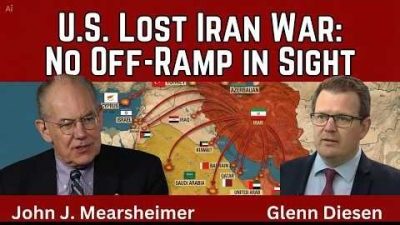
John Mearsheimer: US Already lost Iran war – No off-ramp in sight
or go to
Aletho News Archives – Video-Images
Frlom the Archives
With apparently fabricated nuclear documents, Netanyahu pushed the US towards war with Iran
By Gareth Porter | The Grayzone | April 29, 2020
President Donald Trump scrapped the nuclear deal with Iran and continued to risk war with Iran based on Israeli Prime Minister Benjamin Netanyahu’s claim to have proven definitively that Iran was determined to manufacture nuclear weapons. Netanyahu not only spun Trump but much of the corporate media as well, duping them with the public unveiling of what he claimed was the entire secret Iranian “nuclear archive.”
In early April 2018, Netanyahu briefed Trump privately on the supposed Iranian nuclear archive and secured his promise to leave the Joint Comprehensive Plan of Action (JCPOA). That April 30, Netanyahu took the briefing to the public in a characteristically dramatic live performance in which he claimed Israel’s Mossad intelligence services had stolen Iran’s entire nuclear archive from Tehran. “You may well know that Iran’s leaders repeatedly deny ever pursuing nuclear weapons…” Netanyahu declared. “Well, tonight, I’m here to tell you one thing: Iran lied. Big time.”
However, an investigation of the supposed Iranian nuclear documents by The Grayzone reveals them to be the product of an Israeli disinformation operation that helped trigger the most serious threat of war since the conflict with Iran began nearly four decades ago. This investigation found multiple indications that the story of Mossad’s heist of 50,000 pages of secret nuclear files from Tehran was very likely an elaborate fiction and that the documents were fabricated by the Mossad itself. … continue
Blog Roll
 Aletho News
- ‘All ports in Persian Gulf will be legitimate targets if Iranian ports are attacked’
- 40 Years of Endless War, Data Point by Data Point
- Department of War Using Palantir AI to Pick Targets in Iran
- American bases do not protect – they attack the peoples of the Persian Gulf
- ‘We’ve Obliterated Their Missiles’
- Syrian president vows ‘absolute support’ to disarm Hezbollah
- Ukraine attacking Russian gas pipeline to stop deliveries to Europe – Defense Ministry
- ‘Heinous crime’: Iran denounces Israeli assassination of 4 Iranian diplomats in Lebanon
- John Mearsheimer: U.S. Already Lost Iran War – No Off-Ramp in Sight
- UK Parliament Plans ISP Blocking and Age Verification Powers
- If Americans Knew
- Israeli strategic plans to “remake the Middle East” from the 1950s and since
- Honoring Gaza’s women who refused to let the world look away
- 97% of victims of war on Iran are Iranian, 98% of victims in war on Gaza are Gazans – Not a ceasefire Day 152
- Early Iran strikes cost $5.6 billion in munitions, Pentagon estimates
- Israel Decided the War, But Trump’s America Fights and Pays the Bill
- Conscientious Objector Group: Phone ‘Ringing Off Hook’ As Huge Mobilization Underway
- U.S. support for Israel continues to plummet, despite media’s best efforts
- Threats and missiles fly, death tolls soar in Iran, Lebanon, Gaza – Not a ceasefire Day 151
- Lebanon: Israel’s White Phosphorous Use Risks Civilian Harm
- Corporate Media Go All Out To Support The US-Israeli War On Iran
- No Tricks Zone
- Destructive Green New Deal: German Energy And Metal Group Warns Of Drastic Crisis
- New Study Documents A 20-Year Pause In Arctic Sea Ice Decline – Driven By Internal Variability
- Wake-up Call: Survey Shows Majority Of Germans Now Favor Postponing Climate Targets!
- Televised! Leading German Political Candidate Tells Schoolchildren CO2 Makes Sun Hotter!
- New Study: A Century Warming Of 1.1°C Is ‘Commonplace’ And ‘Not Unusual’ During This Interglacial
- New Study: ‘Internal Noise’ And Volcanic Forcing Can Trigger 10-15°C Warming Within Decades
- Glaciers Worldwide Are Suddendly Surging, Experts Blame Warming!
- Surprising Discovery: Sahara Is Greening…Billions Of Trees Where Once Thought To Be Barren
- New Research Reaffirms Clouds, Aerosols, And Surface Solar Radiation Are ‘Driving The Climate System’
- Germany: Electric Car Catches Fire At Charging Station, Sets Off Local “Inferno”, Widespread Damage
 Aletho News