Merz has filed 5,000 complaints against online critics – media
RT | December 7, 2025
German Chancellor Friedrich Merz has filed nearly 5,000 defamation complaints over online comments, Welt am Sonntag reported on Sunday.
The newspaper said it had obtained copies of the complaints, police files, and letters from law firms representing the leader of the Christian Democratic Union (CDU). The complaints date from 2021 to February 2025, when Merz was serving as a member of the Bundestag.
The angry comments that prompted investigations included insults such as “a**hole” and “filthy drunk,” and in at least one case a search of a defendant’s home was later declared unlawful by a court.
In another case, police searched the home of an elderly wheelchair-bound woman who had called Merz a “little Nazi,” and confiscated the phone she used to communicate with doctors and caregivers.
The number of complaints makes Merz “one of the most sensitive politicians” in Germany’s history, Welt am Sonntag said.
A lawyer representing one of the defendants described the investigation as “a complete overreaction of the justice system.”
Merz’s approval rating has dropped to 22%, a record low, according to a recent Forsa poll. The coalition government has struggled with the cost-of-living crisis and has been marred by bitter infighting over immigration, as well as pension and military service reforms.
Hundreds of Porsche cars immobilized in Russia
By Deng Xiaoci | Global Times | December 7, 2025
Hundreds of Porsche owners in Russia have reported that their cars had failed to start due to a widespread malfunction since November 28 with Russia’s largest Porsche dealer suggesting the possibility that the situation could be caused deliberately, while some German media outlets claimed that the issue emerged after the factory-installed alarm system was accidentally blocked via its satellite module.
Citing a statement by Porsche, Berliner Zeitung reported on December 6 that the malfunction was not caused by a design defect in the vehicles. Rather, the problems appear to be caused by the cars’ factory-installed security system. “In recent days, we have recorded an increase in customer inquiries. We assume that the cause does not lie in the design of the vehicles,” the company stated, the Berlin-based media reported.
Russia’s TASS News Agency reported on December 1 that the widespread starting failures were caused by a false activation of the factory-installed alarm system via the satellite module, Yulia Trushkova, Service Director at Russia’s largest automotive dealer group Rolf, told TASS.
The report said that the satellite connection as down across all models and engine types, meaning any vehicle can be immobilized.
“Similar situations also occur with Mercedes-Benz owners, but these are isolated cases — the cars do not turn into ‘bricks.’ Is the reason for such blockages known? Specialists are currently investigating this issue, and there is a possibility that it was done deliberately,” she concluded.
According to Daily Mail, the nationwide malfunction in Russia hit Porsche models, including prized Cayennes and Panameras, built since 2013, which are all equipped with the brand’s factory VTS satellite-security unit. The issue appeared to stem from the Vehicle Tracking System, or VTS, which is an onboard security module, it said.
Porsche VTS, a factory-installed option available on Porsche models, relies on satellites to track its location. It can send the owner alerts if there is any unauthorized movement. However, a system failure related to it may be shutting down the cars equipped with this technology, according to British Road & Track website.
Poland-based news site TVP World reported that some experts said the failures appear to be tied to the “blocking of the standard satellite alarm system”, which prevents engines from starting. It remains unclear whether the disruption stems from electronic-warfare interference or an issue with signals sent to the system, it added.
Porsche halted deliveries to Russia since 2022, but thousands of vehicles remain on the roads, per the report.
Ongoing geopolitical tensions between Germany and Russia have further fueled speculation surrounding the incident, Berlin-based WorkVision Media pointed out.
Cybersecurity Insiders, an online community for information security professionals, stated that the situation has raised serious concerns among the automotive community and cybersecurity experts, as hackers increasingly target critical infrastructure in new ways. By compromising vehicle immobilizers – systems linked to both tracking and security alarms – attackers can cause severe disruptions.
While the immediate impact appears limited to immobilizing or disabling of cars, the broader implications could involve the potential for safety hazards, including accidents caused by unauthorized control or remote manipulation of vehicles, the website warned.
Xiang Ligang, a veteran Chinese technology analyst, told the Global Times on Sunday that the situation clearly shows that a security loophole in Porsche’s design allowed this to happen, and it raised alarm for the whole automobile industry.
According to Xiang, intelligent-vehicle systems inevitably rely on data management and remote-control functions — technical challenges that all carmakers must confront. The situation unfolding in Russia, however, is a stark reminder of how vulnerable these systems can be.
He added that escalating geopolitical tensions and in fact de-coupling between the Russia and Germany make it increasingly difficult to meet security requirements in areas such as operating-system authentication, data verification, and cross-border data management. Under such conditions, even partners that are meant to cooperate on security matters must prioritize localized and compliant management of data and servers, he said.
Patrik Baab: War Propaganda Destroyed Media & Freedom of Speech
Glenn Diesen | December 6, 2025
Patrik Baab is a German journalist and best-selling author who reported on both sides of the frontline in Ukraine. Baab argues that war propaganda has destroyed the credibility of the media and freedom of speech.
Follow Prof. Glenn Diesen:
Substack: https://glenndiesen.substack.com/
X/Twitter: https://x.com/Glenn_Diesen
Support the research by Prof. Glenn Diesen:
PayPal: https://www.paypal.com/paypalme/glenn…
Buy me a Coffee: buymeacoffee.com/gdieseng
Go Fund Me: https://gofund.me/09ea012f
Books by Prof. Glenn Diesen: https://www.amazon.com/stores/author/…
New law lets Berlin police install spyware in private homes
Critics warn the new rules could be misused, enabling overreach and deep intrusion into personal privacy

FILE PHOTO. © Getty Images
RT | December 6, 2025
Berlin officers will be allowed to secretly enter private homes to install spyware, after the German House of Representatives approved a sweeping change to the city’s police law.
Backed by the governing CDU-SPD coalition and opposition AfD, the law gives police broad new powers over both physical and digital surveillance.
The new law allows authorities to secretly enter a suspect’s home to install spyware if remote access isn’t possible. This marks the first time Berlin’s law enforcement can legally carry out such physical break-ins for digital surveillance. The updated rules also permit hacking phones and computers to monitor communication. Police can now turn on bodycams inside private homes if they believe someone is in serious danger.
Passed on Thursday, the law also expands surveillance in public areas. Authorities can now collect phone data from everyone in a location, scan license plates, and counter drones. They may use facial and voice recognition to identify people from surveillance images. Real police data can also be used to train AI. Critics say this risks misuse and intrudes on private life.
Interior Senator Iris Spranger (SPD) has defended the move. “With the biggest reform of the Berlin Police Law in decades, we are creating a significant plus for the protection of Berliners,” she said. “We are giving law enforcement better tools to fight terrorism and organized crime,” she added.
Berlin has seen a rise in crime. In 2024, police recorded over 539,000 offences — more than the year before. Violent crimes like assault and domestic violence also increased. Officials say there is a growing problem with crimes involving young people and migrants, especially in large cities. More than half of all crimes still go unsolved.
Opposition to the law has grown since its passage. During the debate, Green Party MP Vasili Franco said the law felt like a wish list for a state with excessive control over its citizens. Civil rights groups called the expanded use of AI and facial recognition “a massive attack on civil liberties.”
The campaign alliance NoASOG also strongly criticized the reform, stating, “What is being sold as security policy is in reality the establishment of an authoritarian surveillance state.”
Europe ‘removed itself’ from Ukraine negotiations – Lavrov
RT | November 30, 2025
Europe has long lost its right to have a say in the Ukraine crisis and effectively “removed itself” from the negotiations process through its own actions, Russian Foreign Minister Sergey Lavrov has said.
The top diplomat made the remarks on Sunday to Russian journalist Pavel Zerubin, who asked the minister whether Europe was in its right to “outrageously” push for some role in the negotiations to settle the Ukraine conflict.
“We proceed from the premise… – which I believe is obvious to everybody – that Europe has already removed itself from the talks,” Lavrov said.
Europe has long “used up its chances” to have a say in the settlement process, the top diplomat said, pointing out that it repeatedly derailed efforts to resolve the Ukraine crisis since its very beginning, the 2014 Maidan turmoil that resulted culminated with a coup and overthrowal of the democratically elected president.
“Europe spoiled the initial deal of February 2014, when it acted as guarantor for the formal agreement between Viktor Yanukovych and the opposition. It did nothing when the opposition seized all government agencies the morning after the agreement was signed,” Lavrov said.
The top diplomat also pointed at the admissions made by former German Chancellor Angela Merkel and ex-French President Francois Hollande, who said “that nobody had intended to fulfill” the Minsk agreements aimed at bringing the civil conflict in then-Ukrainian Donbass to its end.
“The most recent case occurred in April 2022 when, at the demand of the then Prime Minister of the UK Boris Johnson and with Europe’s full acquiescence, if not connivance, the Istanbul agreements were derailed,” the foreign minister said.
Multiple European leaders and institutions have been insisting that any potential peace deal on Ukraine must include the EU as well, ramping up such rhetoric after the US floated its latest plan to resolve the crisis. The proposals reportedly include Kiev abandoning its NATO aspirations and capping the size of its army.
Germany, France, and the UK have reportedly drafted their version of the plan, making it pro-Ukrainian through removing or softening multiple of its points. Russia, however, has already signaled it finds the European proposals “completely unconstructive.”
EU sabotaged Trump’s Ukraine peace plan – Guardian
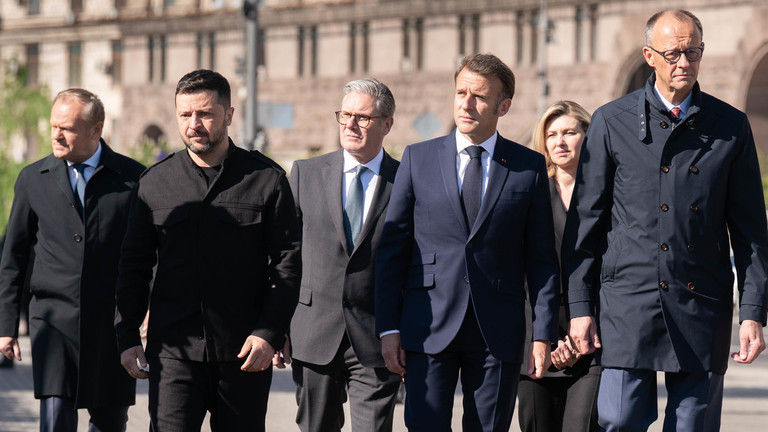
FILE PHOTO: Vladimir Zelensky and European leaders on May 10, 2025 in Kiev, Ukraine. © Stefan Rousseau – WPA Pool/Getty Images
RT | November 29, 2025
The European Union, along with the UK, has deliberately torpedoed the US peace roadmap aimed at ending the Ukraine conflict in the apparent hope that it “will fizzle out,” The Guardian has claimed.
Russia has repeatedly accused the EU of sabotaging efforts to end the bloodshed in Ukraine.
Washington put forth the peace framework earlier this month, and US officials are continuing to work on it. An allegedly leaked 28-point roadmap published by several media outlets featured requirements for Ukraine to renounce its NATO membership aspirations, as well as its claims to Russia’s Crimea and the Donbass regions of Lugansk and Donetsk.
Shortly after the contents of the US-drafted peace proposal were published by the press, several EU member states, along with the UK, scrambled to present their own version. Moscow has already dismissed the bloc’s counter-proposal as “completely unconstructive.”
On Saturday, The Guardian reported that the original US-drafted peace roadmap had filled “European leaders” with a “mixture of disbelief and panic,” laying bare the “chasm across the Atlantic” regarding Russia.
However, the EU and the UK are by now well-versed in blunting any American attempts at resolving the Ukraine conflict, the publication claimed.
Their strategy presumably boils down to welcoming the “fact of Trump’s intervention, before slowly and politely smothering it.”
According to the British media outlet, Kiev’s European backers took the original 28-point proposal and removed nine key elements from it.
The EU and the UK have also allegedly mobilized the “Atlanticist wing in the Senate,” so that it mounts internal opposition to the peace framework.
Politico Europe and The Telegraph, citing anonymous sources, have recently claimed that the US has been keeping the EU “in the dark” regarding ongoing diplomacy on the peace proposal.
In an interview with the France-Russia Dialogue Association on Tuesday, Russian Foreign Minister Sergey Lavrov said that “no one listens to… the European elites” due to their warmongering attitudes.
Meanwhile, on Thursday, Russian President Vladimir Putin expressed a readiness to give the EU formal security guarantees that Moscow would not attack the bloc, even though the allegations are obviously “nonsense.”
US Recruits Mercenaries for Ukraine in Philippines – Russian Foreign Ministry
Sputnik – 27.11.2025
The United States has launched a campaign in the Philippines to recruit volunteers to fight on the side of the Ukrainian armed forces, with the German Embassy issuing Schengen visas, Russian Foreign Ministry spokeswoman Maria Zakharova said on Thursday.
“According to incoming information, US representatives have launched a campaign in the Philippines to recruit local citizens to fight on the side of the Ukrainian armed forces … Preference is being given to former employees of Philippine security agencies and retired military personnel. Applicants are promised a monthly salary of $5,000,” Zakharova told at a briefing.
The recruitment is carried out by a US security agency from Florida, and before being sent to the conflict zone, the recruits undergo training under the supervision of US instructors and receive a German Schengen visa, the spokeswoman added.
“A work Schengen visa is issued at the consular section of the German Embassy in Manila,” Zakharova said.
Betrayed by western snapback: Iran dumps IAEA deal
Tehran’s attempt at diplomatic detente was met with an escalation by the US and the E3
By Fereshteh Sadeghi | The Cradle | November 25, 2025
Just hours before his visit to France to discuss Iran’s nuclear file, Iranian Foreign Minister Abbas Araghchi warned:
“International relations face unprecedented crises due to militant unilateralism. Repeated violations of international law – including ongoing conflicts in West Asia – reflect the backing of the United States and the tolerance of certain European states.”
This underscores Tehran’s defiant stance as it moves in its nuclear diplomacy. Just three months after Israeli-US airstrikes targeted Iranian nuclear sites, Tehran signed a significant security agreement with the International Atomic Energy Agency (IAEA). It did not last long.
The so-called Cairo Agreement, signed in September and brokered by Egypt, was meant to defuse tensions. Yet that same month, the western-backed IAEA was warned against “any hostile action against Iran – including the reinstatement of cancelled UN Security Council resolutions” in which case the deal would become “null and void.”
Of note, Iran–IAEA relations had been deteriorating since June during the 12-day US-Israeli war on Iran. The IAEA and its director general, Rafael Grossi, refused to condemn the attacks on Iranian civilians and nuclear facilities, and the targeted assassinations of nuclear scientists and senior military officers.
The IAEA’s refusal to condemn the US-Israeli violations made Iranians furious. They accused Grossi of paving the ground for the strikes and being Israel’s footman. The Islamic Republic formally lodged a protest with the UN Secretary General and the Security Council against Grossi, arguing he breached the IAEA’s neutrality.
Resistance to western coercion
The Iranian parliament – or Majlis – raised the bar by ratifying legislation that suspended cooperation between Tehran and the international nuclear watchdog. The law was passed immediately after the war ended on 25 June.
It declared Grossi and his inspectors “persona non grata” and forbade them from travelling to Iran or visiting Iranian nuclear facilities. The law stipulated that the suspension will continue so long as the security and safety of Iranian nuclear installations and scientists have not been guaranteed.
Nevertheless, the Egyptian-mediated Cairo Agreement appeared to thaw the standoff, if temporarily. It was signed in the presence of Iranian Foreign Minister Araghchi and Grossi, and ambiguously framed as a deal on “implementing the Safeguards Agreement.”
Few details were made public then; while the IAEA called it a deal on “practical modalities and implementation of the Safeguards Agreement”, the Iranian side insisted it was “a new regime of cooperation.”
State news agency, IRNA, elaborated, “the agency will not engage in monitoring activities provided Iran has not carried out environmental and nuclear safety measures at its bombed facilities.” IRNA referred to the Supreme National Security Council as the sole body that “could greenlight the IAEA monitoring missions inside Iran, case by case.”
Iran’s diplomatic maneuvering, including the deal with the IAEA, was obviously part of the broader strategy to prevent the UK, France, and Germany from activating the snapback mechanism, in the 2015 nuclear deal between Iran and the five permanent members of the Security Council plus Germany.
The European Troika (E3), who were clearly dissatisfied with the Cairo Agreement, reiterated “Tehran needs to allow inspections of sensitive sites and address its stockpile of highly enriched uranium.”
Snapback triggers collapse
A threat to terminate the Cairo Agreement actually came three days after it was clinched, when Iran’s Foreign Ministry warned that “launching the snapback mechanism would put the ongoing cooperation between Iran and the IAEA at risk.” Nevertheless, the UK, France, and Germany moved ahead with the snapback activation.
Araghchi’s first reaction noted that “in regards to the E3’s move, the Cairo agreement has lost its functionality.” Iranians had also vowed to halt cooperation with the IAEA. However, they did not fulfill that threat and collaborated in silence.
The IAEA inspectors visited some Iranian nuclear sites in early November. However, they were not given access to the US-bombed Fordow, Natanz, and Isfahan facilities.
Even this tactical compliance failed to shield Tehran from a new IAEA censure. On 20 November, the agency’s Board of Governors passed a US-E3-backed resolution ignoring Iran’s cooperation and demanding immediate access to all affected sites and data.
It was the straw that broke the camel’s back. Iran condemned the move as “illegal, unjustifiable, irresponsible, and a stain on the image of its sponsors.”
Araghchi on his X account posted, “like the diplomacy which was assaulted by Israel and the US in June, the Cairo Agreement has been killed by the US and the E3.”
For the second time, Iran’s top diplomat announced the termination of the Cairo Agreement, “given that the E3 and the US seek escalation, they know full well that the official termination of the Cairo Agreement is the direct outcome of their provocations.”
Iran’s representative to the IAEA, Reza Nadjafi, told reporters that “If the US claims success in destroying Iran’s Natanz and Fordow facilities, then what is left for inspections?” and further warned, “any decision (by the IAEA) has its own consequences.”
Back to confrontation
By applying pressure through the IAEA, the E3 and the US seek to coerce Iran into opening the doors of its bombed nuclear sites to the IAEA inspectors, to hand over the 400 kilograms of uranium enriched to 60 percent, which the US believes is still intact, and “to eliminate Iran’s ability to convert that fuel into a nuclear weapon.”
The collapse of the Cairo Agreement marks a return to the kind of standoff that defined US–Iran relations from 2005 to 2013, when Iran’s nuclear file was sent to the UN Security Council, and sanctions were imposed under Chapter VII.
Some skeptics believe US President Donald Trump’s administration would not only take Iran to the Security Council but would also cite the chapter in question, which sanctions the use of military force against any country deemed a threat to global peace.
While Iran signed the 2015 Joint Comprehensive Plan of Action (JCPOA) in hopes of avoiding that scenario, the US’s unilateral withdrawal under Donald Trump’s first term in 2018 and the E3’s failure to meet their obligations rendered the agreement toothless.
June’s US-Israeli bombing campaign against Iranian nuclear infrastructure confirmed for Tehran that western powers have no intention of engaging in diplomacy in good faith.
Toward a new strategy
According to IRNA, which echoes the official line of the Iranian government, “Iran feels that the goodwill gestures it has shown towards the IAEA and the United States, have drawn further hostility. Therefore, maybe now it is the time to change course and revise its strategy and the rule of engagement with international bodies, including the IAEA.”
Some observers believe Iran’s first step to map out a new strategy is pursuing the policy of “nuclear ambiguity, remaining silent regarding the whereabouts of the stockpile of the highly-enriched uranium and quietly halting the implementation of the [Nuclear] Non-Proliferation Treaty, without officially admitting it.”
In the latest development, the chairman of the Parliament’s National Security Committee has vowed that “Iran will sturdily pursue its nuclear achievements.” Ibrahim Azizi has cautioned the US and Europe that “Iran has changed its behavior post June attacks and they’d better not try Iran’s patience.”
That posture is hardening. In September, over 70 Iranian lawmakers urged the Supreme National Security Council to reconsider Iran’s defense doctrine – including its long-standing religious prohibition on nuclear weapons.
They argue that the regional and international order has changed irreversibly since Israel and the US jointly bombed the Iranian nuclear facilities. While citing Iran’s Supreme Leader Ali Khamenei’s 2010 fatwa banning nuclear weapons, they assert that in Shia jurisprudence, such rulings may evolve when conditions change – especially when the survival of the Islamic Republic is at stake.
Iran is also working to immunize itself against any escalation at the UN Security Council. Here, it banks on the veto power of Russia and China to neutralize any western effort to reimpose sanctions.
The collapse of the Cairo Agreement marks a turning point in Tehran’s nuclear diplomacy. It is a conclusion drawn from years of unmet commitments and military escalation that western multilateralism has exhausted its credibility.
The GRANITE ACT: Wyoming Bill Targets Foreign Censors With $10M Penalties

By Christina Maas | Reclaim The Net | November 24, 2025
The first cannon shot in a new kind of free speech war came not from Washington or Silicon Valley, but from Cheyenne. Wyoming Representative Daniel Singh last week filed the Wyoming GRANITE Act.
The “Guaranteeing Rights Against Novel International Tyranny & Extortion Act,” passed, would make Wyoming the first state to let American citizens sue foreign governments that try to police what they say online.
The bill traces back to a blog post by attorney Preston Byrne, the same lawyer representing 4chan and Kiwi Farms in their battles against censorship-driven British regulators.
Byrne’s idea was simple: if the UK’s Ofcom or Brazil’s Alexandre de Moraes wanted to fine or threaten Americans over online speech, the US should hit back hard.
Exactly one month after that idea appeared on his blog, it’s now inked into Wyoming legislative paperwork.
Byrne said:
“This bill has a long way to go until it becomes a law, it’s got to make it through legislative services, then to Committee, and then get introduced on the floor for a vote, but the important thing is, the journey of this concept, the idea of a foreign censorship shield law which also creates a civil cause of action against foreign censors, into law has begun.”
That “journey” may be the kind of slow procedural trudge that usually kills most ideas in committee, but the intent here is anything but mild, and, with the growing threat of censorship demands from the UK, Brazil, Europe, and Australia, there is a lot of momentum here to fight back.
“For the first time, state legislators are moving to implement rules that will allow U.S. citizens to strike back, hard, against foreign countries that want to interfere with Americans’ civil rights online,” Byrne continued.
The Act would let American citizens and companies sue foreign governments or their agents for trying to censor them, and, crucially, it strips away the usual escape hatch of sovereign immunity.
In its legal filing responding to the 4chan and KiwiFarms lawsuit, Ofcom insisted it has “sovereign immunity” and told the court there were “substantial grounds” for throwing out the case on that basis.
The regulator’s lawyers framed Ofcom as a protected arm of the British state, immune from civil claims even when its decisions target a platform based entirely inside the United States.
Ofcom treats the idea of “sovereign immunity” as something substantial but the First Amendment as something that does not exist at all.
The GRANITE Act is a defensive maneuver against a growing global trend. “Foreign governments and their agents increasingly seek to restrict, penalize or compel disclosure concerning speech occurring wholly within the United States,” the bill warns.
Such efforts, it argues, “conflict with the constitutions of the United States and of Wyoming and chill speech by Wyoming residents and entities.”
The act’s definition section is where its true reach becomes clear. It covers “any law, regulation, judgment, order, subpoena, administrative action or demand of a foreign state that would restrict, penalize or compel disclosure concerning expression or association” that would otherwise be protected under US law.
The text is well-researched and knows all the buzzwords of tyranny, naming the categories most likely to cause friction: “foreign online safety, hate speech, misinformation, disinformation, defamation, privacy, or ‘harmful content’ laws.” It’s a catalog of the modern speech-control toolkit, all of which Wyoming now places firmly outside its borders.
Wyoming’s approach also bars its own agencies from playing along. “No state agency, officer, political subdivision, or employee thereof shall provide assistance or cooperation in collecting, enforcing or giving effect to any measure” that qualifies as foreign censorship. The phrasing borrows from the constitutional doctrine of anti-commandeering, warning that local officials won’t be drafted into enforcing foreign censorship orders.
In Byrne’s view, that legal protection has let overseas bureaucrats act like international hall monitors, wagging fingers at Americans through threats of fines or content bans.
Byrne didn’t mince words about what he thinks this law could mean:
“If we get corresponding federal action, this law, and laws like it, could represent the single greatest victory for global free speech in thirty years.”
The teeth of the bill lie in its damages. The minimum penalty: ten million dollars. It matches the scale of fines already threatened by the UK and others, which have been dangling penalties of $25 million or 10 percent of global revenue for non-compliance.
The math, as he puts it, is simple. A country can censor an American, but that choice now comes with a very real price tag.
“Foreign countries can bully the shit out of American citizens and companies because they know that US law potentially protects them from consequences for doing so. We should take that immunity away from them.”
Byrne’s theory is that once the threat of US civil suits hangs over foreign regulators, the entire global “censorship-industrial apparatus” starts to wobble.
Byrne notes that the GRANITE Act would also relieve the White House from having to deal with diplomatic flare-ups over censorship complaints.
Trial lawyers would take over that job, freeing the president to “move on to other, more important matters.”
If the Act becomes law, the power to fight foreign censorship wouldn’t rest with federal agencies but with American citizens, state courts, and civil litigators. It would empower them to fight back against foreign censors.
In the global tug-of-war over speech, Wyoming could suddenly become a frontline jurisdiction.
The Money Behind the Muzzle: Germany’s Fivefold Surge in Speech Control

By Cindy Harper | Reclaim The Net | November 24, 2025
Government spending on digital speech regulation in Germany has surged over the past decade, increasing more than five times since 2020 and totaling around €105.6 million by 2025.
The findings come from The Censorship Network: Regulation and Repression in Germany Today, a detailed investigation by Liber-net, a digital civil liberties group that monitors speech restrictions and information control initiatives across Europe.
The report describes a sprawling alliance of ministries, publicly funded “fact-checkers,” academic consortia, and non-profit groups that now work together to regulate online communication.
It started as a handful of “anti-hate” programs and has evolved into a broad state-financed system of “content controls,” supported by both domestic and foreign grants.
Liber-net’s accompanying databases and map document more than 330 organizations and over 420 separate grants, rating each on a one-to-five scale according to its level of direct censorship involvement.
Between 2020 and 2021, public funding for these initiatives tripled, and by 2023 it had doubled again.

Source: The Censorship Network: Regulation and Repression in Germany Today
The Federal Ministry for Education and Research (BMBF) has been the leading funder, responsible for more than €56 million in allocations since 2017.
Much of this money has gone to the RUBIN consortium, a research group developing artificial intelligence tools designed to identify and filter “disinformation.”
Liber-net notes that these systems, while presented as safeguards against falsehoods, also concentrate control over what qualifies as legitimate speech.
Foreign contributions have further reinforced this system. The European Union has provided roughly €30 million since 2018, including €4 million for Deutsche Welle’s Media Fit program, which counters online narratives related to the Russia-Ukraine war.
The United States government has contributed about $400,000 to fourteen German organizations during the same period. These combined investments reveal a coordinated transatlantic interest in shaping the online information landscape.
The financial expansion has been matched by a more aggressive enforcement effort within Germany.
In June 2025, police executed around 170 raids targeting individuals accused of online “hate speech.” Earlier raids reported by CBS in February focused on similar allegations.
One of the most publicized cases involved David Bendels, editor-in-chief of Deutschland Kurier, a publication affiliated with the AfD. Bendels received a seven-month suspended sentence for posting a meme on X that showed Interior Minister Nancy Faeser holding a sign reading “I hate freedom of expression.”
The legal foundation for these operations is the Network Enforcement Act (NetzDG), which requires social media platforms to remove illegal or offensive content within strict deadlines.
Originally framed as a tool to combat extremism, the law has drawn opposition from parties across the spectrum, including the Left Party, the Free Democrats, the Greens, and the AfD.
They argue that it undermines open debate and gives private corporations excessive authority over what can be published online.
Liber-net’s research positions Germany as a key actor in Europe’s expanding structure of information control.
Liber-net concludes that Germany’s speech regulation framework has moved beyond addressing harmful content and now functions as a managed system for policing public discourse.
With significant funding, cross-border backing, and little transparency, the country’s “content control” network demonstrates how easily censorship can be institutionalized under the language of safety and social responsibility.
Arms industry investors in panic over Ukraine peace talks
RT | November 24, 2025
The prospect of a possible peace in Ukraine has caused “panic” among investors in the German defense industry, sending stocks of arms manufacturers such as Rheinmetall tumbling.
The US reportedly handed Kiev a 28-point peace proposal last week and gave it until Thursday to respond. The framework was discussed in Geneva on Sunday, with US President Donald Trump saying afterwards that “something good” may be happening.
The peace push immediately unnerved investors, triggering a fierce sell-off of shares in Rheinmetall, Germany’s largest arms manufacturer and a key supplier of military equipment to Kiev. Rheinmetall stock has fallen by over 14% over the past five days, with defense-electronics producer Hensoldt recording a similar drop.
“Investors fear that an end to hostilities could also mean the end of the “super-cycle” for defense stocks,” Boerse-Express wrote.
Germany has become Kiev’s second-largest arms provider after the US, and Rheinmetall, which produces tanks, artillery systems, and ammunition, recently reported surging profits for the first nine months of 2025, alongside a record order backlog driven by the conflict and rising EU military budgets. Company shares have climbed nearly 2,000% since fighting escalated almost four years ago.
During the previous US attempt to broker peace in February, Rheinmetall CEO Armin Papperger argued that even if the fighting were to end, it would be “wrong” for Europe to assume “a peaceful future.” In 2024, the company announced plans to build four manufacturing plants in Ukraine.
The broader European defense sector has been expanding at roughly three times its pre-2022 pace, Financial Times reported in August. Western leaders claim the accelerated buildup is needed to meet NATO readiness targets, maintain arms deliveries to Kiev, and deter what they describe as a potential Russian threat.
Moscow has called such claims “absurd” fearmongering aimed at justifying increased military spending and condemned what it calls the West’s “reckless militarization.”
Ally of ex-Bosnian Serb leader wins election
RT | November 24, 2025
A close ally of longtime Bosnian Serb leader Milorad Dodik has won a snap presidential election in Republika Srpska, the Serb-majority entity of Bosnia and Herzegovina, according to preliminary results.
Sinisa Karan’s apparent victory comes after Dodik was removed from office over his refusal to obey the rulings imposed by an international envoy overseeing the peace-monitoring regime in Bosnia.
Karan, the candidate of Dodik’s Alliance of Independent Social Democrats (SNSD) and the entity’s minister for scientific and technological development, took about 51% of the vote, after nearly all ballots were counted. Branko Blanusa, the candidate from the opposition Serb Democratic Party, won roughly 48%, with turnout just under 36%.
The snap vote was called after Bosnia’s state court convicted Dodik in February of failing to comply with the decisions of Christian Schmidt, the international high representative for Bosnia and Herzegovina. Schmidt, a German national, has a strong mandate to oversee the 1995 Dayton Peace Agreement, which ended the bloody 1992-1995 Bosnian War.
In 2023, Schmidt invoked his powers to annul legislation passed by Republika Srpska’s authorities that sought to strip state-level courts and police of jurisdiction in the entity and declared the envoy’s decrees non-binding. Dodik himself has branded Schmidt a “tourist” and declined to recognize his authority.
A state court in Sarajevo later found Dodik guilty of failing to implement Schmidt’s decision, sentencing him to one year in prison – a term he avoided by paying a court-approved fine – and banning him from holding public office for six years.
With election results coming in, Karan pledged to continue Dodik’s policies “with ever greater force,” adding that “the Serb people have won.” Dodik, meanwhile, promised voters that “I will remain with you to fight for our political goals,” stressing that Karan’s “victory will be my victory too.”
Both Karan and Dodik have advocated for close ties with Russia, with the former calling Moscow “one of the greatest allies and friends of Srpska.” Dodik has echoed the sentiment, suggesting that the West was using Ukraine to provoke “a war with Russia.”
Featured Video
Jeffrey Epstein’s ‘one single cause’: Israel
or go to
Aletho News Archives – Video-Images
Book Excerpt
Leslie Wexner’s Inner Demon
BY WHITNEY WEBB |
UNLIMITED HANGOUT| JUNE 10, 2022
This short excerpt from Whitney Webb’s upcoming book “One Nation Under Blackmail” examines an obscure media profile of Leslie Wexner, Jeffrey Epstein’s mentor, from the 1980s that contains disconcerting revelations about Wexner’s personality and his inner world. … continue
Blog Roll
Recent Comments
loongtip on Von der Leyen to have new secu… papasha408 on First Gaza, then the world: Th… papasha408 on Is Nixing Aid to Israel a Pois… papasha408 on Japan to Sign Up For NATO’s Uk… Redracam on Iran Willing to Dilute Enriche… loongtip on When Threats Replace Evid… loongtip on Zelensky tried to kill the cha… eddieb on I might get killed for posting… Bill Francis on I might get killed for posting… loongtip on Beijing cancels Panama deals a… loongtip on Showdown loongtip on New York Bans Israel-Linked Te…


 Aletho News
- Russia preparing oil lifeline to Cuba – embassy
- Jeffrey Epstein’s ‘one single cause’: Israel
- Instagram suspends Track AIPAC, watchdog tracking pro-Israel lobby spending
- Nouri al-Maliki defends Hashd al-Shaabi as inseparable part of Iraqi security system
- First Gaza, then the world: The global danger of Israeli exceptionalism
- Iran received no concrete US proposal in Oman talks: Security chief
- US mulling new pressure tactic on Iran – WSJ
- World on the verge of uncontrolled deployment of nuclear weapons in space
- Russia warns of countermeasures if Greenland militarized
- Von der Leyen to have new security unit under her command
- If Americans Knew
- Jewish terrorism, apartheid rule the West Bank – Not a ceasefire Day 125
- Why Israel persecutes children like my son Shadi
- In Gaza, One Man Is Searching for the Remains of His Family With a Flour Sifter
- Horrific situation in Gaza, West Bank – Not a ceasefire Day 124
- Mysterious ‘peace’ groups are sending Americans pro-Israel texts
- Epstein files: Western media must stop burying the Israel connection
- Software developer exposes Israeli nonprofits’ massive spending to influence Americans
- Israel preparing for another, more intense Gaza offensive – Not a ceasefire Day 123
- Ronald Lauder’s son-in-law Kevin Warsh emerges as the next Fed chair
- A 14-year-old Palestinian Bled to Death for 45 Minutes as Israeli Soldiers Stood Nearby
- No Tricks Zone
- German Gas Crisis…Chancellor Merz Allegedly Bans Gas Debate Ahead of Elections!
- Pollen Reconstructions Show The Last Glacial’s Warming Events Were Global, 10x Greater Than Modern
- Germany’s Natural Gas Storage Level Dwindles To Just 28%… Increasingly Critical
- New Study Rebuts The Assumption That Anthropogenic CO2 Molecules Have ‘Special’ Properties
- Climate Scientist Who Predicted End Of “Heavy Frost And Snow” Now Refuses Media Inquiries
- Polar Bear Numbers Rising And Health Improving In Areas With The Most Rapid Sea Ice Decline
- One Reason Only For Germany’s Heating Gas Crisis: Its Hardcore-Dumbass Energy Policy
- 130 Years Later: The CO2 Greenhouse Effect Is Still Only An Imaginary-World Thought Experiment
- New Study Affirms Rising CO2’s Greening Impact Across India – A Region With No Net Warming In 75 Years
- Germany’s Natural Gas Crisis Escalates … One Storage Site Near Empty …Government Silent
 Aletho News