German general admits heavy personnel losses of Ukrainian army
By Ahmed Adel | August 21, 2023
The Armed Forces of Ukraine have lost many commanders, said German Army Lieutenant General Andreas Marlow to Reuters agency. This suggests that Germany’s training of Ukrainian troops makes no difference on the battlefield as these newly trained recruits do not reinforce an experienced leadership. This comes as the popularity of the German government collapses amid a growing economic crisis.
“The training of sergeants and officers is what moves the Ukrainians most because the professional soldiers have been fighting this war for one and a half years now, and many have died or been wounded – so they need a fresh supply of military leaders,” said Marlow to journalists.
The press meeting was held at the Klietz training camp in Germany, where foreign instructors trained the Ukrainian military. The site is used to train Ukrainian service members to operate German Leopard 1 and Leopard 2 tanks, as well as IRIS-T air defence systems. However, as has already been proven, these short training missions make no difference to Ukraine’s war effort as the undertrained soldiers are only fed to the Russian meatgrinder.
Marlow’s revelation that most of Ukraine’s professional soldiers are either exhausted, wounded or dead comes as Gunnar Beck, a member of the Alternative for Germany (AfD) party in the European Parliament, blasted his country’s policy on Ukraine.
Olaf Scholz’s government members, including Finance Minister Christian Lindner, recently expressed support for sending long-range Taurus KEPD 350 cruise missiles to Ukraine. The German finance minister said a decision would be made “faster, in a shorter timeframe” than in the past. Berlin is pushing ahead with this despite most Germans opposing the step.
A new poll revealed that while 36% favour supplying new military aid, 52% are against it. Support fell to just 21% among residents of eastern Germany.
According to Russian sources, Germany has sent more than 260 Leopard 1 and Leopard 2 tanks, including from its arsenals and other European NATO allies, as well as Gepard self-propelled anti-aircraft guns, MARS rocket artillery systems, Panzerhaubitze 2000 self-propelled howitzers, Marder infantry combat, Bergepanzer armoured recovery vehicles, Panzerfaust rocket-propelled grenades, and many other weapons, support equipment, ammunition, and supplies. These weapons are worth about €7.5 billion, all handed to Ukraine over the past year and a half, the second-highest amount after the US.
Although the US and other NATO countries promised that the weapons would not be used against Russian territory, the Ukrainian military used supplied military equipment, including artillery, missiles, and drones, to attack Russian cities and towns. Germans who do not want to be embroiled in the war are especially afraid that Ukraine will use the Taurus cruise missile, a €950,000 481kg warhead with an operational range of over 500km, against Russia. Ordinary Germans fear what a Russian response could be.
Berlin would obviously want to prevent Ukraine from using the missiles against Russian territory, but this is wishful thinking. In practice, Germany cannot do anything to prevent Ukraine from using the missiles, which is why the move is so unpopular.
Recently, support for the right-wing AfD, which has been the most critical of Berlin’s anti-Russia policies, has increased, with recent polls indicating the party would get up to 21% of the vote if elections were held today, the same level as Scholz’s Social Democrats. Despite relentless anti-Russian propaganda in the German media, many Germans have lost faith in the Scholz coalition, mainly due to the declining economic situation spurred on by anti-Russia sanctions.
According to the new Insa survey for Bild, 64% of those surveyed found that a change of government would be better for Germany. The survey found that just as many respondents (64%) are dissatisfied with the work of the current federal cabinet. Only 27% are satisfied. There are even more dissatisfied and less satisfied when it comes to Scholz. 70% are dissatisfied with his work, and only 22% are satisfied.
The German economy for two quarters in a row declined, a “technical recession,” as described by economists. Germany’s GDP stagnated at the previous quarter’s level in the last recent quarter, and there is evidently a decline. The IMF predicted in its July estimates that most of the world’s major economies will see growth, except for Germany, which is expected to contract by 0.3% this year. In fact, the financial institution forecasted Germany to do worse than in the last report from April 2023.
Germany is no longer the European economic powerhouse it once was, primarily due to self-sabotaging anti-Russia sanctions, making the country import energy at an inflated price and cut off from Russian markets and businesses. More disturbing is that Germany insists on maintaining the sanctions and continues to train mostly ordinary Ukrainian men knowing they cannot overturn Russian forces.
Ahmed Adel is a Cairo-based geopolitics and political economy researcher.
Eris vaccine marketing hits Germany, complete with panic about a nonexistent August “Covid wave”
eugyppius: a plague chronicle | August 20, 2023
We will not be free of the virus until we are free of the vaccinators.
The leftist taz newspaper on 17 August: New German Wave: The new Covid variant Eris has arrived in Germany. Concerns about a new wave are growing – but the country is not well prepared.
The pandemic is over, but the virus is still dangerous: Reports of the new variant EG.5.1. seem to confirm this analysis. EG.5.1. (Eris) has been considered a “variant of interest” since 9 August. According to the WHO, the phenotype does not differ fundamentally from other Omicron lineages and does not require special public health measures …
With the announced end of the pandemic, virtually all mandated protective measures have been lifted in Germany. The most important instrument in the fight against Covid-19 is thus the immunisation of the population through infection or vaccination.
Das Erste, state media, on 19 August: Covid Variant “Eris”: How Dangerous is the New Mutation EG.5?
The World Health Organisation WHO has upgraded the new Covid mutationEG.5. This variant, called “Eris,” now belongs to the “variants of interest.” …
As WHO Covid expert Maria Van Kerkhove explained in Geneva on Wednesday, more severe outcomes have not been observed with Eris, but vaccination confers less protection than with other virus variants. …
Even though the new variant is unlikely to cause severe disease, the [German vaccine regulatory authority] STIKO still recommends getting vaccinated – above all to avoid possible long-term consequences of SARS-CoV-2 infection and to protect employees in medical and nursing care.
n-tv, a subsidiary broadcaster of RTL, on 18 August: The Number of Coivd-19-Cases Continues to Rise.
The pharmaceutical company Moderna has announced that its updated Covid vaccine according to an initial study is effective against the Eris sub-variant. The company now expects to launch the new vaccine in time for the autumn vaccination season. Approval from vaccine regulators however is still pending.
Moderna, like vaccine manufacturers Novavax and Pfizer, has developed versions of its vaccines with Biontech SE that target Eris subvariants. Shortly before, the pharmaceutical company Pfizer had reported that its revised vaccine had been effective against Eris in a study with mice. …
Most recently, it was suspected that the cinema hype surrounding the feel-good film “Barbie” and the gloomy biopic “Oppenheimer” may have caused many infections. At the same time, the Robert Koch Institute (RKI) recorded an increase in the number of reported Covid infections. Experts, however, see no reason for concern so far.
Frankfurter Rundschau, a regional Frankfurt paper, on 17 August: Covid comeback with “Eris”: First experts demand return to masking.
Is Covid on the attack again? There are indications that the virus is once on the rise once more. …
British doctors are already calling for a return to masking. [Relentless virus charlatan and deranged hypermasker] Trisha Greenhalgh suggests that, “in view of the spread of new variants,” masking in high-risk situations should be considered.
The [virus surveillance] of the Federal Ministry of Health shows that the numbers are also on the rise in Germany. … “Eris” is already responsible for every fourth corona infection, according to new figures from the RKI. “The number of Covid-19 cases reported to the RKI .. seems to be related to the increasing circulation of this ‘variant of interest’,” the Robert Koch Institute says.
The increase in the case numbers – at least in Great Britain – coincides with the opening of the blockbusters “Barbie” and “Oppenheimer” in British cinemas, which has given rise to talk of the “Barbenheimer” phenomenon. It is well known that larger crowds in enclosed indoor spaces are associated with an increased risk of corona infection. So is it time for a mask renaissance?
In the USA, more and more voices calling for one. [Relentless virus pest] Eric Feigl-Ding … used the hashtag #MaskUp on Twitter to call once again for protecting oneself from Covid infections with masks. Health Minister Karl Lauterbach shared the post, warning that the latest Covid data from New York is “worrying.” …
“There is still a risk that a more dangerous variant will emerge, which could lead to a sudden increase in cases and deaths,” emphasises WHO Director-General Tedros Adhanom Ghebreyesus. Not only adapted vaccines that take the new variants into account, but also wearing a mask would then help to protect oneself and others, Frankfurt virologist Martin Stürmer told Spiegel.
tagesschau, state media, on 17 August: Covid Case Numbers are Rising Again.
The number of laboratory-confirmed Corona cases in Germany is rising again – but at a relatively low level. This development has been ongoing for around a month, reports the Influenza Working Group at the Robert Koch Institute (RKI) … According to the report, about 2,400 confirmed cases of Covid-19 were reported nationwide last week. This is more than double the number reported in the week ending 9 July, when there were about 1,000. …
According to the RKI report, the activity of acute respiratory diseases in general in the population was “at a low summer level.” … “Anyone with symptoms of an acute respiratory infection should stay at home for three to five days and until the symptoms have clearly improved,” advises the RKI. …
Despite all of this obnoxious verbiage, absolutely nothing of virological note is happening in Germany. Official Covid testing has been all but abolished here, forcing our journaloids to unearth statistics from RKI influenza surveillance – something they refused to do during the pandemic itself, because the flu people routinely posted data that undermined their panic narrative. Here, I’ve circled in red the scary rise in infections from the latest RKI report that we’re meant to be worried about:
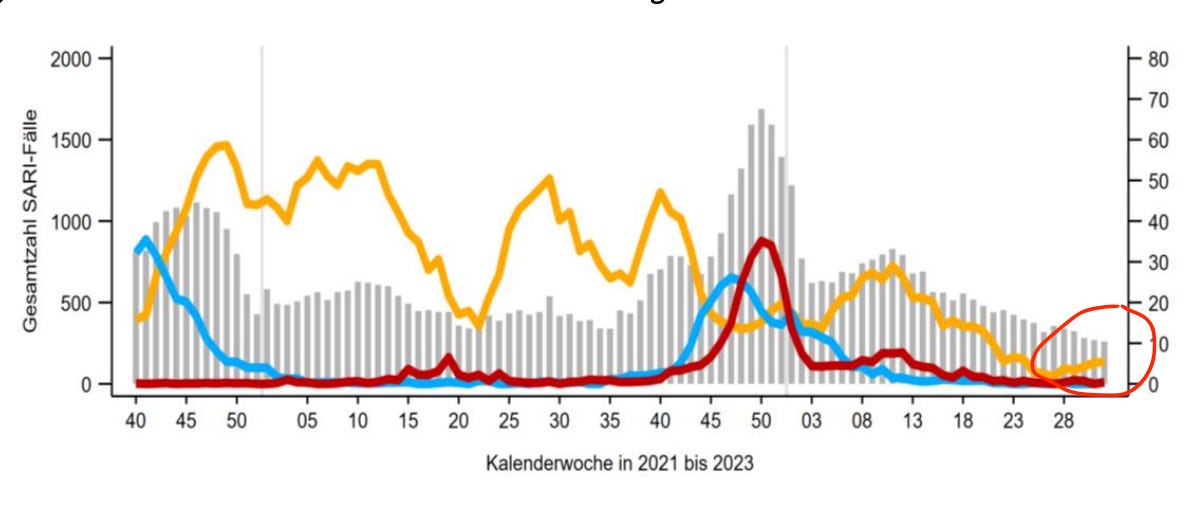
This microscopic uptick is dwarfed by the February/March wave that peaked between weeks 8 and 13. Our media luminaries took next to no notice of this frightening late-winter surge, and as I type this, Covid diagnoses have not even re-achieved their June levels. The difference between the state of things now and the state of things in February is not the unremarkable Eris variant. XBB was also debuting across Europe early this year, driving the post-February case peak, and nobody cared. The only thing that is different now, is the proximity of the autumnal vaccination liturgy and the prospect of new, updated vaccines from Pfizer/BioNTech, Moderna and Novavax. That is why we are hearing about variants and masks and Long Covid all over again. It is also why many of these articles contain buried within them somewhere the advice to line up for the shiny new anti-Covid juice this Fall. This whole thing is, very plainly, a psy-op, if a very low-effort one.
There are several patterns in the German reporting that are worth noting. First of all, the latest hysteria was unleashed on 17 August, prompted by a report on Eris from the German news agency Deutsche Presse-Agentur. Particularly in the realm of routine reporting, the news agencies are a powerful coordinating force, and their influence here means that the full media panic machine is not engaged. We’re looking instead at pieces thrown together by low-level staff desperate to fill column inches. Second, all the German stories are firmly downstream from Anglophone sources, going so far as to recycle from British tabloids the improbable theory of a “Barbenheimer” wave (it is painful even to type this stupid word). Third, at least German health authorities – Karl Lauterbach excepted – resolutely refuse to provide virus doom quotes. Thus the Frankfurter Rundschau had to appropriate the tweets of Anglosphere mask hysterics like Greenhalgh and Feigl-Ding to make Eris sound scary.
I know there are rumours that American authorities are planning to bring back mask mandates and other restrictions in the coming months, and I’ll be honest: We should be so lucky. If the pandemicists try to kick up another round of non-pharmaceutical interventions this fall, they’ll be flirting with self destruction. There are important prerequisites for virus panic: You need a plausibly novel pathogen, the risk of which can be exaggerated. You need a prevailing sense of stability, with nothing else much going on, because the public health interventions themselves have to seem new. Risk, excitement and the prospect of a break from routine are important enticements. That’s all gone now. Covid is not a new scary virus anymore; nearly everyone has had personal experience with it. Solid majorities everywhere have learned to hate lockdowns, despise masking and avoid the mRNA vaccines. The pandemicists need a plausibly new virus to reopen the circus, and they need a lot of people to forget about what a misery the last pandemic response was. They’ll have another chance in ten or fifteen years, I’d guess. Then, it’ll be time to worry.
German Long-Range Taurus Missiles Won’t Be Wunderwaffe Ukraine Is Looking For
By Ilya Tsukanov – Sputnik – 19.08.2023
Berlin has joined Washington in climbing up the escalation ladder in the proxy war against Russia in Ukraine, sending more military aid to Kiev than any other country besides the US. Germany has also borne the brunt of the West’s economic war against Moscow, with its economy sinking into a recession and facing the threat of deindustrialization.
A majority of Germans are opposed to sending Taurus KEPD 350 air-launched long-range cruise missiles to Ukraine, with a fresh poll finding while 36 percent are in favor of their delivery, 52 percent are opposed, with support falling to just 21 percent among residents of eastern Germany.
Despite opposition, German Finance Minister Christian Lindner and other members of Chancellor Olaf Scholz’s government have expressed support for delivering the missiles this week, with Lindner saying a decision on the matter would be reached “faster and at shorter notice” than in the past.
German media first reported on talks to send Taurus missiles to Kiev last week, saying the chancellor’s office was hoping to make changes to the missiles’ programming to prevent Ukraine from using them to attempt strikes deep into Russian territory.
Previous assurances in this vein by the US and other NATO powers have turned out to be empty promises, with Ukraine’s military eagerly using its Western-provided military hardware including artillery, missiles and drones to strike Russia, and to indiscriminately fire on cities and settlements in the Donbass.
“As in the past, we will always check every single decision very carefully,” Scholz told reporters last week when asked about the Taurus missiles’ delivery.
These “very careful” checks have already seen Germany send some €7.5 billion ($8.15 billion) in weapons to Ukraine over the past year-and-a-half, the second-largest amount only behind the United States. Berlin has already approved sending over 260 Leopard 1 and Leopard 2 tanks, including from its own armories and those of other European NATO allies, plus Gepard self-propelled anti-aircraft guns, MARS rocket artillery systems, Panzerhaubitze 2000 self-propelled howitzers, Marder infantry fighting vehicles, Bergepanzer armored recovery vehicles, Panzerfaust RPGs and billions more in other weapons, support equipment, ammunition and supplies.
What distinguishes the Taurus cruise missile is its range and firepower. The €950,000-a-piece bunker buster munition has a 481 kg warhead, and an operational range of over 500 km, making it a standoff weapon which, in the wrong hands, could turn into a tool for terror bombings.
No Wonder Weapon
“The long-range Taurus cruise missiles are an advanced high-precision unmanned weapon system, but they are not a wonder weapon,” AfD European Parliament MEP Gunnar Beck told Sputnik.
“They will add to Ukraine’s military capability, but not decisively,” the lawmaker, who serves as vice president of the European Parliament’s Identity and Democracy fraction, said.
Instead, “the delivery of these missiles is significant in that it marks a further escalation of the conflict, leading perhaps to the delivery of other weapons with greater and more decisive offensive capability. That, to me, is the danger here,” Beck stressed.
The lawmaker noted that the danger of Ukraine using Taurus missiles against Russian territory is “the main point of controversy,” with government assurances that this won’t take place of little comfort to ordinary Germans.
“The German government says it would like to prevent Ukraine from using the missiles against Russian territory. However, this is just fanciful talk. In practice, Germany cannot do anything to prevent Ukraine from using the missiles as they like,” Beck said.
“Most Germans do not wish to be drawn into a major international conflict with Russia,” the AfD lawmaker emphasized. “This is particularly true of East Germans who still appreciate that without Russian blessing reunification could not have been achieved 33 years ago.” Most Germans “simply do not believe that Russia and President Putin are a real threat to Germany today. That is my own personal view too. Ordinary Germans have less to fear of Russia today than it has from the EU, their own government and any of the major political parties within Germany itself.”
Amid the Ukrainian crisis and economic downturn, Beck’s party has seen a major surge in support, with recent polling indicating it would win up to 18 percent of the vote if elections were held today – on par with Chancellor Scholz’ Social Democrats. The growing prominence of the upstart opposition party and its social conservative, Eurosceptic brand of populism has led to debate inside the German political establishment on whether it should be banned as an “extremist” organization.
Beck emphasized that notwithstanding the “relentless” “anti-Russian propaganda” in German media, many Germans, especially in the east of the country, “have lost faith” in Scholz’s coalition, and “cannot remember when their government last did something for them.” Instead, half of Germans “now regard their political elite as just the executor of the aims and objectives of large multinationals and foreign powers – very well-paid executors at that,” the lawmaker summed up.
Germans Don’t Want Nuclear War With Russia
Dan Kovalik, a US-based human rights and labor rights lawyer and peace activist, echoed Beck’s sentiments on the implications and dangers of the Taurus missiles’ potential delivery to Kiev.
“I think Russia is about to destroy the Ukrainian military and probably the Ukrainian state as it exists, and that’s just a fact. I don’t think the missiles will change that. Of course, what they could do is allow Ukraine to fire more into Russian territory in a more destructive way than they are now with drones, which of course presents a great danger of escalating this conflict into a major world war, possibly even into a nuclear conflict. That’s why I think the German people are against this,” Kovalik stressed.
“Of course, Germany and Russia have been through two world wars against each other, and I don’t think either wants to repeat that,” the observer added.
Western calls for Ukraine peace talks a ‘tactical ploy’ – Moscow
RT | August 19, 2023
The US and its allies do not want the Ukraine conflict to end and their purported peace initiatives are merely attempts to buy Kiev time, Russian Foreign Minister Sergey Lavrov said in an interview published on Saturday.
Geopolitical issues need to be discussed “not with [Ukrainian President Vladimir] Zelensky, who is a puppet in the hands of the West, but directly with his masters,” Lavrov said earlier this year. Negotiating directly with the Americans would make sense, he told the magazine International Affairs when asked about the idea.
“The problem, however, is that the United States has no intention of ending the conflict,” Lavrov explained, noting that “their officially declared objective is to inflict a ‘strategic defeat’ on Russia.”
Prospects for negotiations between Russia and the West “are non-existent at this stage,” Lavrov said, while Kiev “Western sponsors are constantly pushing them to up the ante.”
Insisting on Ukrainian President Vladimir Zelensky’s so-called ‘peace formula’ at meetings in Copenhagen and Jeddah – to which Russia was not invited – “hardly demonstrates an intention by the West to negotiate with Russia,” Lavrov said. Moscow has dismissed Zelensky’s ten-point list of demands as an unacceptable ultimatum unrelated to reality.
Russia has repeatedly tried to negotiate, from the 2014 and 2015 Minsk agreements to the “drastic attempt to convey our concerns to Western capitals” in December 2021, Lavrov noted. The West “arrogantly rejected” Moscow’s initiative and ramped up deliveries of weapons and ammunition to Kiev instead.
“We regard the Westerners’ hypocritical calls for talks as a tactical ploy to buy time once again giving the exhausted Ukrainian troops a respite and the opportunity to regroup, and to send in more weapons and ammunition,” Lavrov said, adding that “this is the path of war, not a peaceful settlement process.”
Angela Merkel, the former chancellor of Germany, admitted last December that the 2015 Franco-German proposal in Minsk was “an attempt to give Ukraine time” to build up its military. This was then confirmed by former French President Francois Hollande.
West has shown its ‘true Russophobic face’ – Lavrov
RT | August 18, 2023
Washington and Brussels have openly unleashed a hybrid war against everything Russian, dropping their masks after decades of pretending to be civilized and adequate international partners, Foreign Minister Sergey Lavrov said in an interview with International Affairs, published on Saturday.
“Many of our former partners have been concealing their Russophobic nature under the veil of hypocrisy, but have now shown their true face in all its glory,” he said. “However, there is also the flip side of the coin here, since the Global Majority saw the true face of those who went as far as [to] aspire to a monopoly in defining the so-called universal values.”
“Today’s West is steered by people like Josep Borrell who divide the world into a blooming ‘garden’ and ‘the jungle,’ where the latter clearly applies to most of humanity,” Lavrov added.
The West has spent decades cynically transforming neighboring Ukraine into a “hostile military bulwark against Russia by nurturing an entire generation of politicians ready to declare war on our shared past, culture and everything Russian,” according to Lavrov.
Western capitals even openly admitted that reaching a peaceful settlement in Ukraine was never part of their plan, and that the Minsk agreements were originally designed to “buy some time to prepare a military scenario and deliver weapons to Kiev.”
“I think that the essential thing we must understand in this regard is that the West wants to do away with our country as a serious geopolitical rival,” the top Russian diplomat said “They have not hesitated to use subversive methods and perform acts of sabotage, as was the case with the explosion of the Nord Stream pipelines under the Baltic Sea.”
Lavrov also accused Washington and its allies of using all possible coercive means to prevent Russia’s partners from engaging in economic and other kinds of cooperation, while also “making outrageous efforts to disconnect Russia from international cooperation mechanisms in culture, education, research, and sports.”
One thing that the West fails to understand, according to Lavrov, is that “Russia will use all means to defend its people and its vital interests,” and thus would be better for the opponents to realize that “confrontation with Russia is futile and switch to more civilized” means for achieving a balance of interests.
More Fuel… For Inflation! German Government Doubles Planned CO2 Price Increase
By P Gosselin | No Tricks Zone | August 16, 2023
Germany’s Socialist/Green government adds more fuel to inflation… announcing it will boost the price of CO2 emissions by 10 euros a ton beginning in 2024!
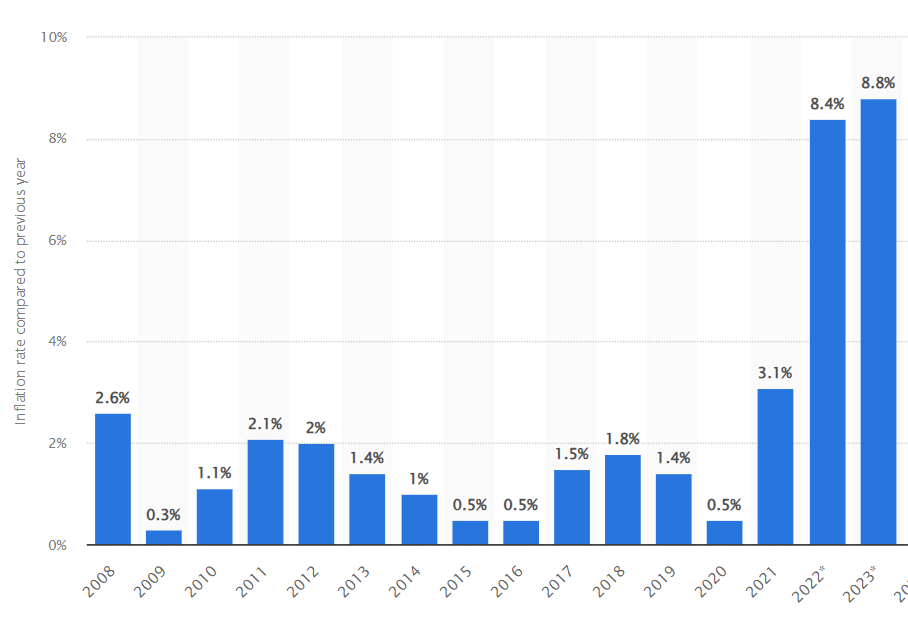
High energy costs have led to runaway inflation in Germany. Source: www.statista.com/
According to Germany’s online Handelsblatt, the German government has moved to increase the price to emit a ton of CO2 in 2024. The original plan was to increase the price by 5 euros a tonne, from 30 to 35 euros a ton, but now the government has decided to double that increase to 10 euros, meaning the price of emitting a ton of CO2 will be 40 euros.
That 33% increase will add to the heating and fueling bills for consumers, and further add upward pressure to the country’s already high inflation rate.
Germany’s economy is already among the weakest in the Euro Zone and high energy costs will make it all the more painful for consumers. The higher price will go into effect on January 1st.
The impact of the higher price will hit the poor the hardest, who are already reeling from higher costs of living. The government is expected to take in an extra 2.3 billion euros in revenue, a total of 10.9 billion euros in 2024.
“We must act cautiously with regard to CO2 pricing, especially in view of the current weakness in growth,” said Germany’s Minister of Finance Christian Lindner.
The state says it will invest in climate-friendly projects, with billions earmarked for building renovations, industrial conversions and electric cars. For 2024, spending of 57.6 billion euros is planned, which is 21.6 billion euros more than in 2023.
Russia’s asymmetric response
Russia’s asymmetric response to latest announced plans of U.S. and NATO for sending more devastating military hardware to Ukraine
By Gilbert Doctorow | August 15, 2023
Each time over the past 18 months that it appeared the Ukraine war was approaching a finale amounting to Kiev’s defeat and capitulation we have been surprised by yet another U.S. initiated escalation that changes the nature of the conflict and promises a new and drawn-out stage of fighting.
Did the Ukrainian counter-offensive which began on 4 June fail? An increasing number of Western mainstream media including CNN have published reports acknowledging it is a failure. In Washington, the finger pointing game over who ‘lost Ukraine’ has begun among the country’s most determined backers.
Europe is a backwater in more than one dimension. Not everyone here has gotten the word about Ukraine’s losses in two months of desperate attacks on Russian defensive positions across the entire 1,000 km front. Last night I watched a round-table discussion of the war on French television in which not a single panelist had been told that the game is up in Ukraine. These smirky amateurs, mostly garden variety journalists, were discussing the fighting around one or another Ukrainian town on the front line whose name they could barely pronounce, all convinced that the Ukrainian forces had the upper hand and were on their way to breaching the Russian defenses, about to reach the less awesome second line of defense, and were surely to make it through to the Sea of Azov, thereby achieving the basic objective of the entire operation – cutting the Russian supply lines and breaking the back of Russian resistance. The whole time these commentators smiled broadly as if the war were just a video game.
But to hell with the French propagandists. In the German media, mainstream journalists have been seeding the discussion of the war with news about Ukraine’s setbacks and the improbability of their accomplishing anything other than self-destruction as the fighting continues. Simultaneously with the announcement that Germany is about to supply long range reconnaissance drones to Kiev, Chancellor Olaf Scholz called for “continuation” of peace negotiations. It is curious that no one told him there are no peace negotiations going on today. But the main point is that victory on the battlefield seems to have vanished from the Berlin discourse.
Nonetheless, the United States and Britain announce day after day new appropriations for delivery of military hardware of the most devastating sort to Ukraine. Abrams tanks are on the way. Longer range strike missiles with a range up to 500 km may soon be shipped. Biden in the past week inserted authorization for another 14 billion dollars in military supplies into a bill for provision of aid to victims of natural disasters, meaning the present disaster in Hawaii and elsewhere in the States. The tactic was meant to overcome rising Republican opposition to giving Ukraine one more cent of aid should the aid have been in a separate bill dedicated to the war effort. The drumbeats for provision of F16s to Ukraine continue and there is talk of preparing new Ukrainian troops for a renewed counter-offensive in 2024.
So what are the Russians doing about the new arms on the way to Ukraine?
An article posted in Russian social media and carried by the number one news portal, Dzen, formerly a subsidiary of Yandex, gives us a good insight into Russian countermeasures that otherwise are buried in general daily Western reporting on the war. We hear about air raid alerts across Ukraine which took place a day ago but there is no explanation. We hear about a Russian missile strike that killed a young Ukrainian family but are told it is just part of the Russian attacks on civilians.
The article posted on “Интересная жизнь с Vera Star” makes sense of it all.
First, those air raid sirens across the whole of Ukraine were related to the systematic Russian bombardment of all still functional Ukrainian airports from which their air force’s SU-24 and SU-27 can operate. These are the aircraft that are capable of carrying and firing the Storm Shadow and other long range missiles that have been supplied by Britain and France, and which may carry German missiles, if Berlin decides to proceed with its previous offer of such materiel.
Second, we are told that the Russians have just used Kinzhal hypersonic missiles to destroy the railway tunnels passing under the Carpathians which have been the main supply route of Western military hardware arriving from Poland and Romania. For a long time, there was discussion in the Russian senior military command over whether it was permissible to attack this ostensibly civilian infrastructure. However, the decision was taken to do so in light of the latest U.S. and NATO plans to raise the bar in what attack equipment they are providing to Ukraine. As the Russians argue, civilian infrastructure that is being used to serve military objectives automatically becomes a legal target for them.
By Russian calculations, they have now nullified the latest Western plans to prolong the war.
©Gilbert Doctorow, 2023
German media and political establishment ponder whether to ban the political preferences of 1/5 of the population
eugyppius: a plague chronicle | August 14, 2023
Since 19 June, polls have consistently placed support for the right-populist party Alternative für Deutschland at 20% or higher, making them the second most popular party in Germany – slightly ahead of government-leading SPD, and behind the CDU/CSU. Last week, Thomas Haldenwang, the head of the Federal Office for the Protection of the Constitution (BfV), gave a state media interview in which he accused the party yet again of harbouring “a significant number of people … who repeatedly spread hatred and agitation against minorities.” Despite serious questions about whether Haldenwang’s repeated slander is even legal, spokesmen for all the major parties immediately declared themselves in agreement with the assessment.
It’s very important to note that Haldenwang is himself a member of the CDU. The Christian Democrats ought to be the big winners in the opposition, as Olaf Scholz’s coalition government stumbles from one crisis to the next. Yet they’re doing no better than they were in mid-2021. Angela Merkel has done the party no favours, implicating the Christian Democrats in the catastrophic pandemic response, as well as the ongoing mass migration crisis and even the ascendancy of the Green climate programme. They’ve failed to offer any real alternative to the present government, and the AfD is reaping the gains instead.
A day after Haldenwang’s renewed warnings, the German president Frank-Walter Steinmeier published an editorial in Der Spiegel, in which he condemned the AfD as directly as the dictates of etiquette permit, at one point even calling for “militant” resistance against the party:
Our constitution can tolerate the hardest and toughest disputes. It cannot, however, integrate enemies of the constitution – and we must not ignore the danger they pose. Political antagonism is one thing, constitutional hostility something else entirely.
So what is to be done? In the fight against extremism, there is a historical lesson that runs like a red thread through the earliest draft constitution set down at Herrenchiemsee – and which still applies today: A democracy must be fortified against its enemies. Never again should democratic rights of freedom be abused in order to abolish freedom and democracy. To be robust and defensible daily political life means first of all to demonstrate an openness to political debate and not to accept the trumped-up lies propagated by the enemies of freedom, whether with silence or appeasement, and thereby to encourage them. The democratic parties are required to demonstrate clear, resolute, even militant opposition …
That militant opposition is already here. On Friday night, the Augsburg AfD politician Andreas Jurca was beaten unconscious by immigrants in a targeted political attack, which left him with severe facial bruising and a broken ankle.

Hessen Antifa have also published the personal addresses of all AfD candidates for the state parliamentary elections in October. I doubt it is very easy to come by such information without help from the government.
Yesterday, SPD head Saskia Esken declared herself in favour of banning AfD, should the constitutional protectors declare the party guilty of “confirmed right-wing extremism,” something which is almost certain to happen sooner or later: “The fight against the AfD is a fight that the whole of society, all democrats, must wage together.”
There’s considerable doubt about whether a ban is feasible. Oliver Maksan, writing from the Berlin bureau of the Neue Zürcher Zeitung, points out that the party falls far short of meeting the criteria, even accepting for the sake of argument all the establishment characterisations about its “anti-democratic” tendencies:
The Federal Government, Bundesrat or Bundestag would have to convince the Federal Constitutional Court that the whole party, not just individual members, has included anti-constitutional goals in its programme and pursues them in a planned, militant and effective manner. …
Even the Federal Office for the Protection of the Constitution … does not see the AfD as a unified bloc. Its 2022 annual report still reads that “In view of the continuing heterogeneity of content within the party … not all party members can be regarded as supporters of extremist tendencies.”
Moreover, it is not enough to point to the widespread rejection of the EU, sympathies towards Russia or NATO scepticism within the party. One may think such attitudes are wrong, but they are not forbidden. What would have to be proven are genuine attempts to eliminate the free democratic basic order, specifically the principles of democracy, human dignity and the rule of law, in whole or in part.
I might share Maksan’s optimism if Covid hadn’t happened. Clearly the German state will do whatever it wants and worry about how to justify it after the fact. Maksan is more convincing in his argument that the process of a formal ban would involve protracted procedures, and contribute enormously to AfD support in the meantime. It is a risk that the BfV seems to be on the verge of accepting:
“The political centre is currently melting like ice in the sun,” a high-ranking East German BfV recently told WELT on background. In the East, he said, there are now districts where it is not merely 20 to 30 percent voting for the AfD, but as many as 40 or 50 percent.
The major parties could at any moment deprive the AfD of considerable support simply by moderating their political programme. What is most ominous about these developments is the general refusal even to consider this path. As I said in another context, democracy has become for our rulers not a political system, but a series of desired outcomes. Formally democratic processes which threaten these outcomes are now considered anti-democratic and beyond consideration. It is not the AfD or their supporters who have been radicalised; many AfD statements denounced by the media as extreme and fascistic were in fact political commonplaces two decades ago. It is rather the political establishment that has grown extreme and lost touch with vast sectors of the electorate. I fear this is a unidirectional, self-reinforcing process, and that our rulers will never find their way back.
Winter Cold, Darkness Kill, While Summer Heat And Sun Save Lives Data Clearly Show
Cold and stupid policies are the real killers, not heat
By P Gosselin | No Tricks Zone | August 11, 2023
German data from Bestattungen.de (Funerals.de) show that far more people die from cold winter weather than they do from hot summer weather.
Lately in Germany there’s been a coordinated disinformation campaign by policymakers and the media. all aimed at getting people to believe that summer heat is the real killer. And so, during heat waves, governments should declare states of emergency and usher restrictions, which could entail cancelling large outdoor events like festivals and sports matches, driving bans and lockdowns.
It’s all about saving thousands of lives and ensuring your safety, they (falsely) claim! And never mind that the mean summer temperature in Germany is under a comparatively cool 20°C.
All the focus on the dangers of summertime warmth seems odd, especially when most of us look forward to this season the most and dread the horrible long winters, a time when people are forced to spend so much time confined inside.
Winter kills, summer saves lives
Today I came across a report from Bestattungen.de (Funerals.de), a site that of course would be familiar with the business and statistics of dying. Clearly cold winter temperatures are far more dangerous than warm summer temperatures, according to their data:
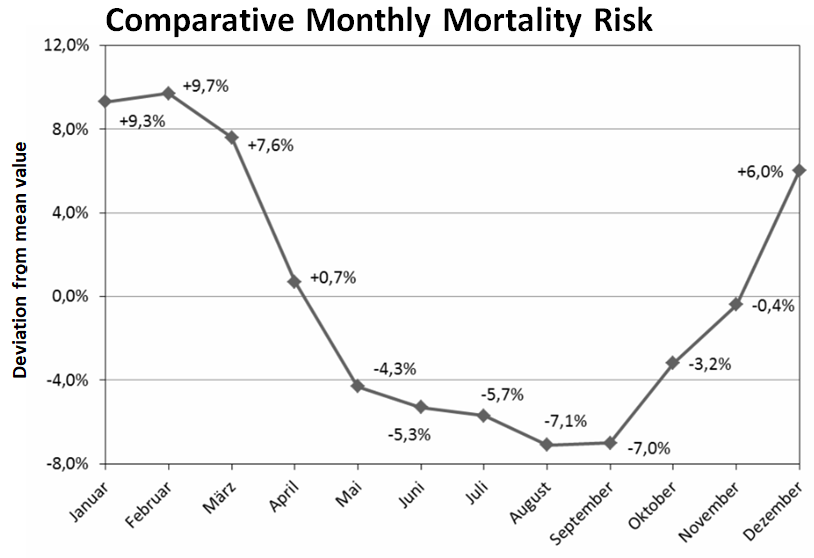
Image: Besttatungen.de (translated in the English).
As the chart shows, mortality is 9.7% above the mean in the dead of winter, February, and is 7.1% below the mean right after Germans have been exposed to 3 summer months of now “deadly heat”. In fact, all the mortal suffering begins to end only once the temperatures finally warm up in April. Of course the report isn’t so recent, but we can rest assured that the mortality behavior hasn’t changed that much.
The data also suggest how crucial Vitamin D is.
The data also suggests the power of vitamin D. Fully tanked up on this crucial nutrient, people are much more resistant to infections and disease well into the fall. By mid winter, once vitamin D levels become depleted, far more become prone to disease, many experts say. This is why so many advised taking vitamin D during the COVID “pandemic”.
The following table shows the ranking, from the most deadly month to the least deadly month:
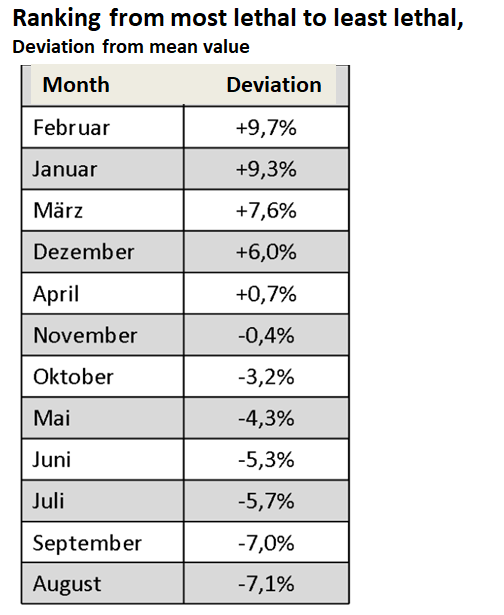
Source: Bestattungen.de
Summer saves lives
Again, the bitter cold months of January and February are the real killers, while the summer months are the real life savers. It’s absolutely idiotic of policymakers to be focused and obsessed on summer heat plans. The only heat plan people need is: Get outside, take off your clothes and enjoy the hot weather! Shade and cold water is all you need to cool off.

According to Bestattungen.de:
The German Weather Service sees weather-related factors as the main reasons for the variance in mortality risk. Damp, cold air increases the risk of aggravating existing illnesses. Respiratory diseases in particular can become more severe in the winter months. Heart attacks can also be triggered by the weather.”
Other factors also include psychological aspects and the lack of daylight and its associated “winter depression” increased melatonin and reduced serotonin.
We need a “stupid-policy-protection plan”
We really need to ask ourselves and policymakers: Why is heating fuel being made so expensive when we know that it would save a lot more lives? Stupid government policy is what’s killing people, and not the life-saving German summers.
The EU is a ‘failed project’ – AfD
RT | August 7, 2023
The European Union’s migration, climate, and monetary policies have “completely failed,” according to a policy document adopted by the right-wing Alternative for Germany (AfD) party on Sunday. However, the party aims to change the EU from within rather than withdraw from the bloc.
AfD delegates adopted the document at a party conference in the eastern city of Magdeburg on Sunday. The paper describes the EU as a “failed project,” and calls for the bloc to be reformed as a “federation of European nations,” with significant sovereignty ceded back to its member states.
“The EU and the globalist elites that support it have strayed from the original idea of the founding fathers of a European community adopted many years ago,” the document states, citing the 2007 Lisbon Treaty – which gave the EU the power to act as a single legal entity and made EU law supersede national law – as the moment when the bloc became “an EU super state.”
Among a lengthy list of reforms, the AfD is proposing that the EU strengthen its external borders, lessen its military reliance on the US by following a policy of “strategic autonomy,” and protect the “diversity of cultures and traditions of the peoples of Europe” from immigration.
While a draft version of the document released in June called for the “orderly dissolution of the EU,” this language is absent from the final version.
The party also chose 35 candidates to contest next year’s European Parliament elections at the Magdeburg conference. The list is led by Maximilian Krah, who has been an MEP since 2019. The AfD currently holds nine seats in the parliament, and is the third-largest German party in the EU legislature.
At home, the AfD is currently polling at a record high of 21%, according to Politico. This figure puts the party ahead of Chancellor Olaf Scholz’s Social Democrats (SPD) and behind only former chancellor Angela Merkel’s Christian Democratic Union (CDU). However, Germany’s mainstream parties have repeatedly ruled out entering into coalition with AfD, and a government-funded watchdog group recently called for the party to be banned for its “racist and nationalist” positions.
The latest polling figures suggest a doubling in the AfD’s support since 2021, when it garnered 10.3% of votes in the parliamentary elections. This surge in popularity comes as Germany’s economy reels in the wake of Berlin’s decision to impose sanctions on Russia, which was formerly the country’s leading energy supplier. At a rally last year, AfD co-leader Tino Chrupalla accused Scholz’s government of waging an “economic war” on the German people by cutting the country off from Russian energy imports.
Journalist Slams Ukraine for Losing Swedish IFV by Putting It ‘Too Close to Front’
By Ilya Tsukanov – Sputnik – 01.08.2023
As the counteroffensive launched by Ukraine’s NATO-armed and trained armies continues to falter, a growing number of Western observers, officials and military commanders have criticized Kiev, suggesting that the latter’s “tactics,” rather than their equipment and support, are to blame for the counteroffensive’s failure.
A German journalist has taken to social media to vent his frustration over Kiev’s loss of a Combat Vehicle 90 (CV 90), an advanced, $10 million apiece Swedish-made infantry fighting vehicle that was recently captured by Russian forces as a trophy.
“The CV 90 was NOT lost during the counteroffensive, for which it was intended to be used, but after being split from the rest of the brigade and used (allegedly together with another CV 90) for isolated defensive purpose in the area of Chervonopopovka,” Bild contributor Julian Ropcke wrote.
“It moved to [sic] close to the front, came into a Russian ambush and was hit by an RPG from far too close. It was then towed to Russian-controlled territory. This is exactly what the German army criticized about Ukraine: 1. Using the provided vehicles for other purpose than required to operate successfully and 2. Dividing powerful brigades into isolated vulnerable platoons,” Ropcke added.
The CV 90, praised by many armchair military analysts as “one of the best IFVs in the world” thanks to its powerful protection, high mobility and multirole capabilities, is the latest piece of Western equipment delivered to Ukraine to fall into Russia’s hands. Dozens of videos and photos have been posted online in recent weeks of Russian troops posing alongside or operating trophy Leopard tanks, Bradley IFVs, M113 armored personnel carriers, and more.
As Ukraine’s counteroffensive approaches its two-month anniversary with little to show for it apart from tens of thousands of lost troops and hundreds of tanks and armored vehicles, a growing number of officials and observers in Western media have expressed frustration over Kiev’s “tactics.” It’s “just a matter of continuing to apply pressure in a combined-arms approach,” one US official recently assured, and not the fact that Kiev is outgunned and faces overwhelming Russian air and artillery superiority.
Ukraine’s use of heavy armor has been a matter of particular scrutiny, with reports emerging in July that the country’s military had pulled Leopard 2s from the front after they got stuck on mine fields in the first stage of the counteroffensive. Separate reports indicated that “up to 20 percent” of Kiev’s NATO-provided armor was destroyed in the first stage of the offensive. In the case of the British Challenger 2, the highly “pampered” tank has not been spotted anywhere on the front, with its appearance limited to flashy propaganda videos. When the decision to send the armored vehicles to Kiev was made in the spring, the British Army’s top brass reportedly pressured their Ukrainian counterparts to avoid deploying Challenger 2s to areas where they might risk capture or destruction by Russian forces.
German deindustrialization continues unabated due to Berlin’s suicidal energy policies
By Drago Bosnic | July 26, 2023
For close to a year and a half, the German economy has been going through a sort of unraveling, primarily due to suicidal subservience to its masters in Washington DC. Since the start of Russia’s counteroffensive against NATO aggression in Europe, Berlin has been experiencing a plethora of major economic problems that soon translated to societal and political ones, causing further instability in the country. In turn, this has started causing issues with investments and the overall business climate in Germany, as relevant people and companies started losing confidence in Berlin’s capacity to keep its economy stable.
“The German economy is losing its DNA as a place to do business and foreign investors are keeping their distance, instead focusing their attention on developing markets as a result,” Toralf Haag, the CEO of German Voith Group, warned.
Haag, the head of the German technology company, gave an interview to Die Welt, in which he discussed the rapidly emerging economic problems affecting Germany. He told the newspaper that his Voith Group has been able to weather the storm so far and protect itself from the recession the German economy has been in since the last quarter. However, Haag also expressed worry regarding the German economy’s future, specifically in terms of competitiveness, energy security and foreign investment. He complained about “Germany’s aggressive energy transition away from traditional energy production such as coal and nuclear to renewables”, calling it “problematic”.
“There are ambitious goals, but only insufficient incentives and support to be able to achieve these goals. What we need is less bureaucracy, faster approval procedures and faster implementation. The way it is currently running, it will not work in the long run,” Haag stated.
When asked about the current state of business and investment opportunities in Germany, he wasn’t very optimistic, not only about the prospects for his company (based in Heidenheim, operating primarily in energy, automotive and paper industries), but the overall situation.
“Investment decisions in Germany are becoming increasingly difficult,” Haag said, adding: “To be honest, at the moment we tend to choose Eastern Europe, Asia or the USA when it comes to new production facilities because the costs for energy and personnel are particularly high in Germany while at the same time bureaucracy and regulation are increasing.”
He lamented that the Voith Group was forced to hire another 30 people in the management in the last year or two just to be able to handle all the new regulations and obligations introduced due to the ever-growing red tape.
“I would like to invite the employees from the ministries to check what effect their specifications have directly inside a company – whether they are practicable and sensible. In order for Voith to make significant investments in Germany again, the framework conditions must change fundamentally. Unfortunately, I don’t see that at the moment,” Haag stated.
He said that the danger of Germany’s further deindustrialization is “very great”, primarily because of the reduction of industrial activity due to the tendency of many German companies to relocate to other countries.
“We now see almost every day that industrial companies are no longer investing in Germany but in other regions of the world. Administration and engineering may remain in Germany, but production, which is particularly valuable for an economy, is increasingly taking place elsewhere,” Haag complained, further adding: “As a result, the German economy is not only losing its DNA but also any potential for the future. With its well-paid jobs, industry is the guarantor of prosperity. The prosperity achieved so far cannot be maintained with administrative jobs and the service sector alone.”
Indeed, Germany’s deindustrialization is an ongoing process that is virtually irreversible at this point. Haag’s concerns are backed by the official data and statistics on the actual state of Germany’s economy, particularly its industrial capacity. German industry has always been the main driving force of its economy, particularly its automotive and high-tech industries, all of which are highly dependent on stable energy supplies. However, while Haag blamed the obsessive transition to alternative energy sources (particularly renewables) for the major issues Germany is experiencing, he failed to mention Berlin’s subservience to Washington DC and the resulting halt in Russian energy imports.
The results have been catastrophic, to say the least. Last week’s survey by the BVMW (Federal Association of Medium-Sized Businesses) showed that over a quarter (26%) of all CEOs of medium-sized German companies are considering shutting down their businesses, while over a fifth (22%) have expressed readiness to move their companies abroad. The reasons cited for such decisions were largely the same as those mentioned by the Voith Group’s CEO. As a result, the country’s industrial output experienced a dramatic plunge in the first quarter, including a drop of nearly 11% in March alone, the largest monthly reduction in years. In addition, the growing inflation (currently standing at 6.8%) is exacerbating the problem.
By February this year, Germany has experienced a “price shock” of over 40% due to its anti-Russian sanctions policies, in what can only be described as perhaps the worst case of a boomerang effect in the history of Western sanctions warfare against the world. Russian energy imports were probably the best possible energy source for Germany, particularly as Berlin was trying to increase the share of renewables in its energy production. These imports made it possible to rely on natural gas as a relatively clean source, while renewables played an auxiliary role. However, with the suicidal anti-Russian sanctions in place, as well as the US terrorist attack on the Nord Stream pipelines, Germany’s energy security was gone virtually overnight.
Drago Bosnic is an independent geopolitical and military analyst.
Featured Video

It’s the Occupation, Stupid
or go to
Aletho News Archives – Video-Images
From the Archives
A superpower and “the world’s sickest warrior state”
By Paul J. Balles | March 8, 2010
Living through five or six major wars has hardened me to what I thought were the extremes of inhuman cruelty and brutality.
Two things made those extremes almost bearable: the brutality always revealed – at least according to the media coverage – the viciousness of the enemy. It was therefore quite understandable when our “brave men and women” pulverized the enemy.
Films of Japanese torturing captive Americans somehow justified holding Japanese Americans in internment camps during World War II; and only a small percentage of Americans found the bombing of Hiroshima and Nagasaki unreasonably vengeful at best, at worst, depraved.
The media giants in America portrayed the North Koreans as barbaric beasts with their captives, quite unlike their southern counterpoints – our allies during the Korean War. No one ever felt the need to explain how the South Koreans were a civilized breed while the North Koreans were absolute savages, at least according to the official line.
In Vietnam, our warriors justifiably (or so the media made us believe) dropped napalm on the North Vietnamese who had the gall to hide in villages and tunnels to ravage our invaders. At least it was accepted practice until some rogue photojournalist filmed a young girl screaming down a Vietnamese road in flames. … continue
Blog Roll
 Aletho News
- AWACS’ Destruction is a Major Loss for US Military – Ex-DoW Analyst
- Israel’s Iran Strategy Uses US Military & Gulf States as Its Pawns
- Iran: Trump wanted regime change, now just begging for Hormuz to open
- IRGC: Israeli, US universities in region legitimate targets after strikes on Iranian university
- Trump admits Iran hit USS Ford carrier: ‘We ran for our lives’
- Battle for Hungary: EU attacks on Orban are a sign of worse things to come
- Iraqi resistance conducts drone strike on US-run base in Syria
- Failing to Defeat Hezbollah, Israel & US Pressure Syria’s Ahmed al-Sharaa to Join War
- US-Israeli war on Iran drives global fertilizer prices up 40%
- Hezbollah’s Surprise Weapons Redefine Ground Battle with Israel
- If Americans Knew
- Israel is assassinating journalists again, more than any other nation, anywhere, ever – Not a ceasefire Day 170
- Over 300 US service members wounded, majority have brain injuries – Not a ceasefire Day 169
- Researchers at Human Rights Watch Resign Over Blocked Report on Palestinian Refugee Return
- Jewish Groups Are Backing a War Americans Don’t Want
- Eric Fingerhut Thinks He’s the President of the Jews
- Top Jewish Philanthropists, Rabbis Urge Israeli President to Take Action Against ‘Jewish Extremists’
- Don’t Be Fooled. Zionist Leaders Have Always Wanted to Control Southern Lebanon
- Israel’s widespread use of torture is a core element of its genocide against the Palestinian people
- In Israel’s War on Iran, Many Middle East US Bases Rendered “All But Uninhabitable”
- ‘Burn the lawn’: Israel pursues ‘Rafah model’ in southern Lebanon
- No Tricks Zone
- German Science Blog Accuses PIK Climate Institute Of Hallucinating Climate Tipping Points
- Devastating Assessment Of Comirnaty Vaccine By Former Senior Pfizer Europe Toxicologist
- New Study: CO2 Is ‘Effectively Negligible’ As An Explanatory Climate Change Factor Since 2000
- Former Pfizer Toxicologist Dr. Helmut Sterz Tells Bundestag Hearing Pfizer Vaccine Should Have Never Been Approved
- Energy Expert: Germany’s Nuclear Phaseout Was A “500 Billion Euro Mistake”
- New Research: South Australia’s Mid-Holocene Sea Surface Temperatures Were 4°C Warmer Than Today
- Storing Green Energy To Last Germany 10 Days Would Require A 60-Million Tonne Battery
- New Studies: UK Sea Levels Were 4 Meters Higher Than Today During The Mid-Holocene
- Destructive Green New Deal: German Energy And Metal Group Warns Of Drastic Crisis
- New Study Documents A 20-Year Pause In Arctic Sea Ice Decline – Driven By Internal Variability
 Aletho News