Elizabeth Holmes Gets Eleven-Year Sentence for Theranos Fraud

Former Theranos CEO and billionaire, Elizabeth Holmes
By Dr. Peter McCullough & John Leake | Courageous Discourse | November 20, 2022
Yesterday I wrote about the FTX scandal, which involves a thirty-year-old living in the Bahamas, usually clad in shorts and flip-flops, who received billions from people all over the world with the promise he would make them rich by investing it in crypto currency. Nobody understood how exactly he was making billions for himself, and he never tried to elucidate it. In spite of no one having the foggiest notion about what he was doing, he was hailed as “this generation’s JP Morgan.”
The sudden fall of Sam Bankman-Fried coincided with the sentencing of former Theranos CEO, Elizabeth Holmes, who was ordered to serve 11 years in prison for defrauding investors of billions. Like Bankman-Fried, Elizabeth Holmes—who dropped out of Stanford in 2004 and styled herself after Steve Jobs with the same signature black turtleneck—was hailed as a Wunderkind who’d boldly entered a new frontier in her field.
As was the case with Bankman-Fried’s cryptic crypto exchange, no one understood how Holmes’s blood testing machine worked. She claimed that with just a small pinprick of blood from the finger (instead of the standard 3 ml drawn from a vein on the inside of the elbow) her machine could rapidly and accurately run a large panel of diagnostic tests. The machine was literally and figuratively a black box—purportedly containing proprietary technology that only Theranos engineers were authorized to examine.
To people who’d long worked in the field of blood testing for companies like Siemans, Abbott, and Roche, Holmes’s claims seemed incredible. How could her machine accurately run so many tests on such a tiny quantity of blood? The proposition sounded like magic.
The fact that no one knew anything about the machine didn’t stop investors from pumping billions into the fledgling company, and by 2014, the then thirty-year-old Holmes’s 50% stake was worth $4.5 billion. Were these investors simply naive, or was there something apart from the magic black box that gave them confidence?
Perhaps the most notable thing about Theranos was the attention it drew from the Department of Defense and retired US government eminences including George Shultz, Henry Kissinger, William Perry, Bill Clinton, and Sam Nunn. All were old Washington hands, and they understood that the US government was considering Holmes’s little black box to be (potentially) a strategic asset with military and civilian applications.
These guys knew from experience that if Uncle Sam gets out his checkbook for what appears to be new product of strategic value, the sums transferred can be astronomical. And why not? Such a market does not consist of picky and finicky consumers, but unaccountable bureaucrats spending taxpayer money with reckless abandon.
In 2015, Holmes’s company became the subject of a Wall Street Journal investigation, and soon her fraudulent empire began to crumble. Three years later (in 2018) she was charged for committing massive acts of fraud.
Facing off against Elizabeth Holmes was the young and heroic whistleblower, Tyler Shultz—grandson of George Shultz—who was a key witness in exposing the fraud. For his principled action, he was shunned by his grandfather and subjected to an intimidation campaign by Theranos officers and their heavy-hitting attorneys. The Wall Street Journal’s report on this component of the story reads like a cinematic thriller.
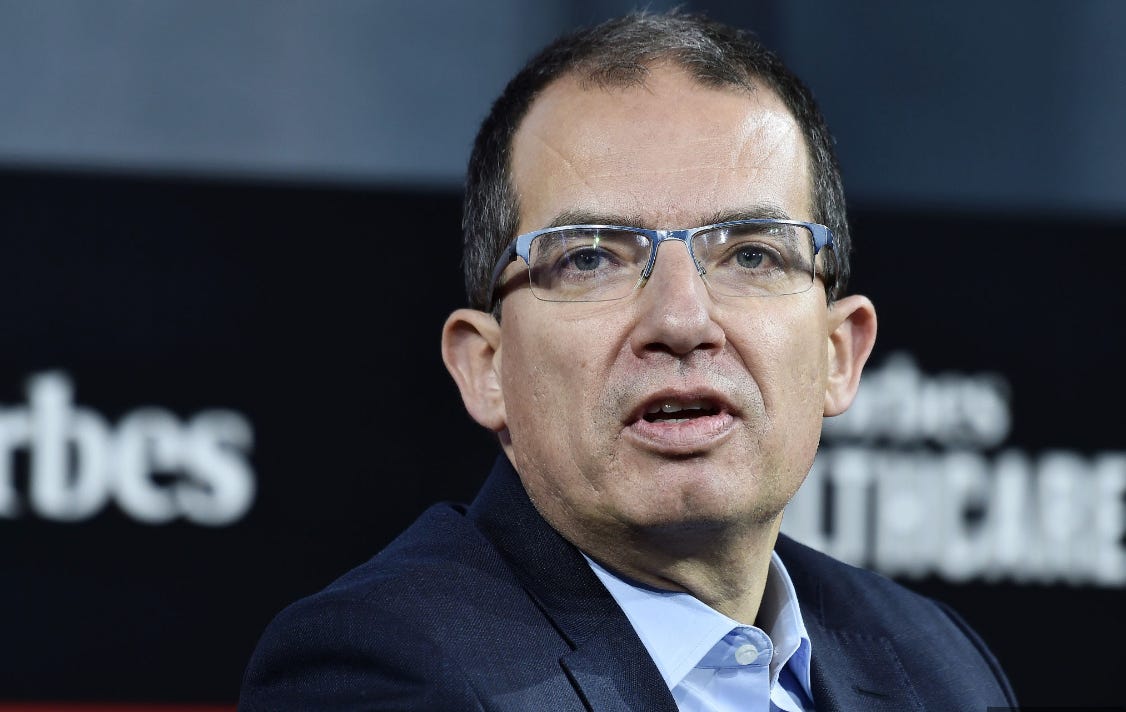
Moderna CEO and billionarie, Stephane Bancel
Just two years after Holmes was charged for fraud, SARS-CoV-2 arrived. At this time, two biotech startups with no history of licensed products—Moderna of Cambridge, Massachusetts and BioNTech of Mainz, Germany—claimed that their experimental mRNA platform could rapidly produce a safe and effective vaccine by simply plugging the SARS-CoV-2 gene sequence into their formula. No long and laborious process of culturing viruses in eggs like conventional flu vaccines—real Star Trek Next Generation stuff.
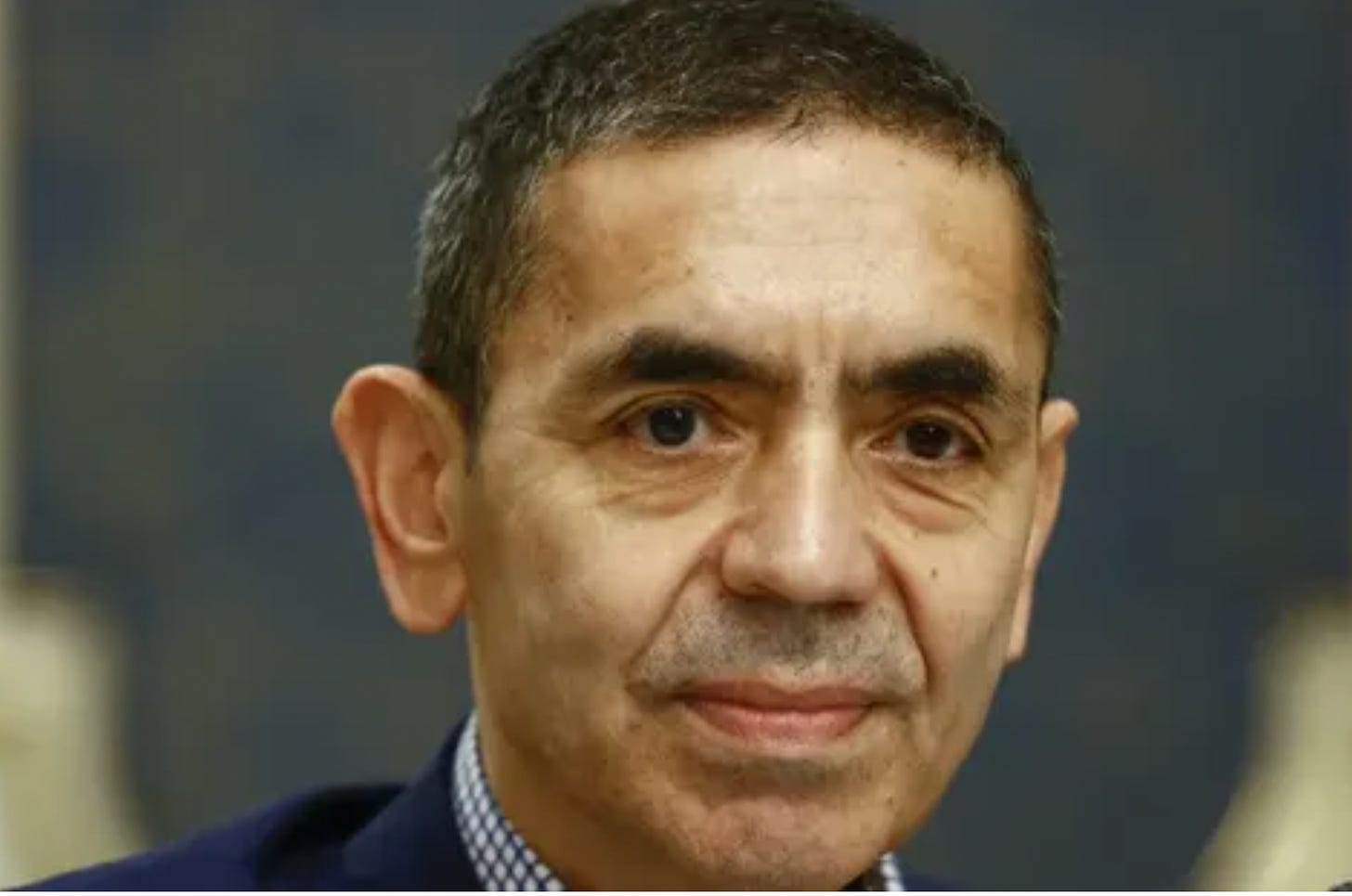
BioNTech CEO and billionaire, Ugur Sahin
As was the case with Theranos’s black box, the Moderna and Pfizer-BioNTech mRNA vaccines are largely veiled in secrecy. Even the FDA, which is supposed to be an impartial evaluator and adjudicator of product safety, requested 55 years in order to complete a FOIA request for information on the Pfizer-BioNTech vaccine.
In other words, We the People were obliged to pay for the mRNA vaccine program (transferring billions of taxpayer money to pharmaceutical executives) and many of us have been forced to receive the injections, but information about the precise nature of these products is not for us to know.
German producers warn of meat shortages
RT | November 19, 2022
Germany may face a meat shortage and a subsequent surge in prices within the next four to six months, Die Welt reported this week, citing the German Meat Industry Association (VDF).
“In four, five, six months we will have gaps on the shelves,” Hubert Kelliger, the head of group sales at meat marketer Westfleisch and a VDF board member, told the news outlet.
According to Kelliger, the worst shortages are expected in the supply of pork. He says Berlin insists on reducing the number of livestock by half in order to protect the climate. However, experts say this would lead to mass shutdowns of meat-producing companies, which in turn would result in a 40% increase in the price of meat.
Cutting livestock numbers could also lead to a decrease in the supply of natural fertilizer, resulting in a drop in vegetable yields or a surge in the cost of production due to the high prices of artificial fertilizers. Either situation would worsen the food crisis in Germany.
While meat industry representatives note that vegetarianism and veganism have become increasingly popular in the country over the last few years, they say that over 90% of the people still buy and eat meat.
Germany has been relying more and more on meat imports rather than domestic production. The share of beef and pork products from abroad has risen in recent months, and the country is currently the biggest meat importer in Europe, according to VDF.
VDF experts say Berlin is making the same mistake in turning to meat imports as it did with energy – increasing dependence on imports could lead to the risk of a food crisis along with the energy crisis. Kelliger says the only way to avoid this is to be self-sufficient in meat production.
The press are completely crazy and they are going to get us all killed
The heedless jingoistic war rhetoric of the German media
eugyppius: a plague chronicle | November 16, 2022
Yesterday, at around 3.40 in the afternoon, a rocket exploded in the Polish village of Przewodów. Two people died. Ukrainian president Volodymyr Zelensky immediately blamed Russia, later going so far as to characterise the alleged attack as a message from Putin to the G20 summit. Then the Associated Press reported that they had heard from “a senior U.S. intelligence official” claiming that “Russian missiles” were responsible for the attack, and thereafter the worst German journalistic actors embarked upon an evening of dark speculation about the proper NATO response to a Russian attack on Poland. Higher brow outlets, like ZDF, merely ran inflammatory headlines about Russian rockets, with the crucial information – that the rockets were Russian-made, while their immediate origins were unclear – buried in the body of the piece. Bild, on the other hand, went all-in, with this incredible rant from chief editor Johannes Boie:
The Russian army has bombed Poland, the AP news agency reports, citing a US intelligence official.
Two people are dead, murdered!
Accidental or not – this is an armed attack on NATO territory!
The two most likely possibilities are, first, that Putin’s soldiers hit Poland by mistake. They are often poorly trained and drunk. In this case, the tyrant must apologise formally, beg for forgiveness on bended knee, so to speak, while armed NATO fighter jets fly around his country.
He is not used to that. When his troops shot down a passenger plane in 2014, killing 298 people, there were no consequences.
Or alternatively, Putin attacked NATO on purpose. In this case, the alliance must hit back hard, because NATO cannot simply let its territory be bombed or let its citizens die in a hail of Russian bombs. Putin will only respond to force.
Should the unlikely third possibility be true, that the explosion was the result of Ukrainian air defence, then – indeed – the Russians are also to blame. For they are playing with fire on the NATO border.
The mad tyrant is bringing us ever closer to World War 3.
This morning, Boie’s paper carried a front-page headline screaming “Putin fires rockets at Poland.”
Now that both Poland and the Americans have clarified that the explosion was likely caused by a stray Ukrainian air defence missile, the story has disappeared entirely from the top of Bild.de. I guess they’re not so interested in extracting apologies from a kneeling Zelensky. Meanwhile, that other major Axel Springer organ, Welt, are running damage-control pieces, like this one from obnoxious mediocrity Clemens Wergin, claiming that “Without Russia’s war crimes, it never would’ve come to the accident in Poland.”
There are a few observations to make about this little storm in a teacup. The first is that, despite appearances, not all of the American government and not all of NATO have completely lost their minds. Scholz, Macron and others called for caution and avoided open statements of blame, and today we’ve seen a clearly coordinated campaign to shift direct responsibility away from Russia. The second is that there are, however, plenty of powerful people, in NATO and elsewhere, who are indeed totally, stratospherically crazy. These include very probably that anonymous senior intelligence official who spoke to the Associated Press, and also a great part of the media, who have made a habit out of printing reheated Ukrainian press releases as news, and who have never quite recovered their senses since they lost them in the great Corona panic.
It must be fun to rage about the tyrannical evils of Russia and the democratic virtues of the NATO countries, most of which have spent the last three years denying their allegedly free citizens all manner of basic rights and freedoms. It’s also incredibly, incredibly dangerous. A direct NATO attack on Russia would be a catastrophe for Europe. Maybe somebody should try to rein in the press and wean them from their crisis addiction before they happen upon another pretence to invoke Article 5. There’s no guarantee the next one will be clarified so quickly.
French elites privately fear the US and new research explains why
By Felix Livshitz | RT | November 15, 2022
New research published by France’s Ecole de Guerre Economique has revealed some extraordinary findings about who and what the French intelligence services fear most when it comes to threats to the country’s economy.
The findings are based on extensive research and interviews with French intelligence experts, including representatives of spy agencies, and so reflect the positions and thinking of specialists in the under-researched field of economic warfare. Their collective view is very clear – 97 percent consider the US to be the foreign power that “most threatens” the “economic interests” of Paris.
Who is your true enemy?
The research was conducted to answer the question, “what will become of France in an increasingly exacerbated context of economic war?” This query has become increasingly urgent for the EU as Western sanctions on Moscow’s exports, in particular energy, have had a catastrophic effect on European countries, but have not had the predicted effect Russia. Nor have they hurt the US, the country pushing most aggressively for these measures.
Yet, the question is not being asked in other EU capitals. It is precisely the continent-wide failure, or unwillingness at least, to consider the “negative repercussions on the daily lives” of European citizens that inspired the Ecole de Guerre Economique report.
As the report’s lead author Christian Harbulot explains, ever since the end of World War II, France has “lived in a state of the unspoken,” as have other European countries.
At the conclusion of that conflict, “manifest fear” among French elites of the Communist Party taking power in France “strongly incited a part of the political class to place our security in the hands of the US, in particular by calling for the establishment of permanent military bases in France.”
“It goes without saying that everything has its price. The compensation for this aid from across the Atlantic was to make us enter into a state of global dependence – monetary, financial, technological – with regard to the US,” Harbulot says. And aside from 1958 – 1965 when General Charles de Gaulle attempted to increase the autonomy of Paris from Washington and NATO, French leaders have “fallen into line.”
This acceptance means aside from rare public scandals such as the sale of French assets to US companies, or Australia canceling its purchase of French-made submarines in favor of a controversial deal with the US and UK (AUKUS), there is little recognition – let alone discussion – in the mainstream as to how Washington exerts a significant degree of control over France’s economy, and therefore politics.
As a result, politicians and the public alike struggle to identify “who their enemy” truly is. “In spheres of power” across Europe, Harbulot says, “it is customary to keep this kind of problem silent,” and economic warfare remains an “underground confrontation which precedes, accompanies and then takes over from classic military conflicts.”
This in turn means any debate about “hostility or harmfulness” in Europe’s relations with Washington misses the underlying point that “the US seeks to ensure its supremacy over the world, without displaying itself as a traditional empire.”
The EU might have a trade surplus of 150 billion euros with the US, but the latter would never willingly allow this economic advantage to translate to “strategic autonomy” from it. And this gain is achieved against the constant backdrop of – and more than offset by – “strong geopolitical and military pressure” from the US at all times.
I spy with my Five Eyes
Harbulot believes the “state of the unspoken” to be even more pronounced in Germany, as Berlin “seeks to establish a new form of supremacy within Europe” based on its dependency on the US.
As France “is not in a phase of power building but rather in a search to preserve its power” – a “very different” state of affairs – this should mean the French can more easily recognize and admit to toxic dependency on Washington, and see it as a problem that must be resolved.
It is certainly hard to imagine such an illuminating and honest report being produced by a Berlin-based academic institute, despite the country being the most badly affected by anti-Russian sanctions. Some analysts have spoken of a possible deindustrialization of Germany, as its inability to power energy-intensive economic sectors has destroyed its 30-year-long trade surplus – maybe forever.
But aside from France’s “dependency” on Washington being different to that of Germany, Paris has other reasons for cultivating a “culture of economic combat,” and keeping very close track of the “foreign interests” that are harming the country’s economy and companies.
A US National Security Agency spying order sent to other members of the Five Eyes global spying network – Australia, Canada, New Zealand, and the UK – released by WikiLeaks, shows that since at least 2002 Washington has issued its English-speaking allies annual “information need” requests, seeking any and all information they can dig up on the economic activities of French companies, the economic and trade policies of France’s government, and the views of Paris on the yearly G8 and G20 summits.
Whatever is unearthed is shared with key US economic decision-makers and departments, including the Federal Reserve and Treasury, as well as intelligence agencies, such as the CIA. Another classified WikiLeaks release shows that the latter – between November 2011 and July 2012 – employed spies from across the Five Eyes (OREA) to infiltrate and monitor the campaigns of parties and candidates in France’s presidential election.
Washington was particularly worried about a Socialist Party victory, and so sought information on a variety of topics, “to prepare key US policymakers for the post-election French political landscape and the potential impact on US-France relations.” Of particular interest was “the presidential candidates’ views on the French economy, what current economic policies…they see as not working, and what policies… they promote to help boost France’s economic growth prospects[.]”
The CIA was also very interested in the “views and characterization” of the US on the part of presidential candidates, and any efforts by them and the parties they represented to “reach out to leaders of other countries,” including some of the states that form the Five Eyes network itself.
Naturally, those members would be unaware that their friends in Washington, and other Five Eyes capitals, would be spying on them while they spied on France.
It was clearly not for nothing that veteran US grand strategist and former Secretary of State Henry Kissinger once remarked, “to be an enemy of America can be dangerous, but to be a friend is fatal.”
More bad news: new US coordination center in Stuttgart for Ukraine operations a landmark on the way to WWIII
By Gilbert Doctorow | November 13, 2022
Earlier today I received an email from my good friend Professor of Law at the University of Illinois Francis A. Boyle regarding the creation in Stuttgart of a new U.S. coordination center for war operations in Ukraine headed by a 3-star general. The news item seems to have been sidelined this past week by Western mainstream coverage of the Russian withdrawal from Kherson and entry of Ukrainian forces into that city. However, judging by Boyle’s interpretation, there is every reason to put a spotlight on this issue and to seek the broadest possible discussion in Alternative News electronic and print media.
I offer the following quote from Boyle’s email with his permission:
The story below is a pure cover story by the Pentagon. You do not need a 3 Star General and a Staff of 300 to keep tabs on U.S. Weapons in Ukraine. This is a War Command to wage war against Russia. The last time I dealt personally with a 3 Star General was when I lectured at West Point on “Nuclear Deterrence” in their Senior Conference on that subject in front of, among others, the 3 Star General in Charge of War Operations at the Pentagon. The Pentagon puts a 3 Stars General in Charge of War Operations—not Inventory. And you do not need a Headquarters Staff of 300 to do an Audit. It’s a War Headquarters Staff. We are going to war against Russia unless the American People can figure out some way to stop it!
Francis A. Boyle
Professor of Law
STUTTGART, Germany — A three-star general will lead a new Army headquarters in Germany that will include about 300 U.S. service members responsible for coordinating security assistance for Ukraine, a senior U.S. military official said this week.
I refer those unfamiliar with Francis Boyle to his brief biography in the University of Illinois website.
To that I can add, that his ‘political science’ studies for the Masters and Ph.D. degrees at Harvard were primarily in Russian/Soviet affairs, and that in his time at Harvard he worked under many of the same professors as did I. In this sense, Boyle is a well qualified Russia expert, even if his primary listing at Illinois is as defender of human rights. He is also particularly noteworthy this year for his efforts to promote among several key Congressmen the articles of impeachment against President Biden that he has drafted; the charges – waging undeclared war on Russia in violation of the Constitution. So far that has gained little traction, but when the new Congress with Republican majority takes its seats in 2023 the prospects of finding sponsors may be significantly improved.
Notwithstanding the worrisome or alarming news above, I close this essay with a glimmer of hope that the world has not yet gone completely mad. From my volunteer translator in Germany, I have learned about the start of what should be a nationwide “Ami Go Home” movement in the Federal Republic. It will begin with mass demonstrations in the East German city of Leipzig on 26 November. The protests are inspired by the thinking of Oskar Lafonteine, a German politician who held leading positions in the SPD and later in Die Linke: namely the notion that it is high time for the United States occupation forces to leave Germany so that the country may recover its sovereignty. Those new to German politics may more easily identify Lafonteine as the husband of the eloquent Opposition member of the Bundestag Sahra Wagenknecht. It behooves me to add that per the advice of my translator when he forwarded to me news about the ‘Ami Go Home’ demonstration that the actual organizers are not on the German Left but, on the contrary, on the Hard Right. This interpretation has been reconfirmed by a well informed reader living in Berlin. Call this yet another ‘impersonation’ or imposter phenomenon if you will. We are living through interesting times.
©Gilbert Doctorow, 2022
New Delhi may sue Berlin over undelivered LNG – Bloomberg
RT | November 12, 2022
A diplomatic dispute is brewing between India and Germany after Berlin took over a former Gazprom subsidiary and halted LNG shipments to New Delhi.
The Russian gas giant’s former local subsidiary Gazprom Germania, renamed SEFE (Securing Energy for Europe), cut LNG supplies to India’s Gail back in May, citing sanctions Moscow imposed after the company was taken over by the German state. Under the sanctions, Gazprom stopped supplying SEFE with gas.
Gail had a 20-year contract with Gazprom Germania’s Singaporean unit, GM&T Singapore, for the supply of 2.5 million tons of LNG per year. According to Bloomberg, citing the association of LNG importers GIIGNL, the contract remained valid after Berlin took over Gazprom Germania, meaning SEFE was still required to meet its obligations to Gail.
In September, SEFE’s Singaporean unit said it could no longer fulfill its long-term contract with Gail and offered to pay compensation of 20% of the contract price for the failed LNG deliveries. Gail CFO Rakesh Kumar Jain last week said that SEFE had canceled a total of 17 LNG shipments since May.
According to Bloomberg’s sources, India is now demanding that SEFE find alternative gas suppliers in order to meet its obligations to Gail, as the Indian company has been forced to spend much larger sums to buy gas on the spot market. It also had to cut supplies to customers and lower production at its petrochemicals plant due to the LNG deficit. The company has also turned down the compensation offer for undelivered LNG as it prefers to retain the right to the cancelled cargoes, Reuters reported on Friday.
Bloomberg’s sources said that both Indian and German diplomats have been engaged to solve the dispute. A diplomatic solution is preferable for the parties, according to the sources, although they noted that Gail was also consulting lawyers about arbitration over the contract with SEFE, which means the dispute could turn into a lawsuit. Gail is also reportedly negotiating with Gazprom to buy LNG directly from the Russian company.
Germany wants more scrutiny of Twitter after Elon Musk takeover
By Cindy Harper | Reclaim The Net | November 10, 2022
Germany’s ruling party the Social Democrats (SPD) has called for more scrutiny of Twitter, following the takeover by tech billionaire Elon Musk.
There have been mixed reactions to the new ownership of Twitter. Some politicians are complaining about a potential rise in “misinformation” and “hate speech,” while some are anticipating the changes he plans to make to make the platform more free-speech-friendly.
Some members of SPD have called on the relevant regulators and Justice Minister Marco Buschmann to put Twitter under tighter scrutiny to make sure it follows EU’s rules on content.
“For me, the fact that Twitter is being taken over by somebody who wants to use the network for political purposes even more strongly is highly problematic,” SPD party chief Lars Klingbeil said, speaking to a local newspaper, Handelsblatt.
“Should the variety of opinion be limited further, authorities will have to take resolute action.”
Jens Zimmermann, the party’s digital policy spokesperson, was also critical of the new ownership of Twitter. He noted that the recent mass layoffs will make it difficult for Twitter to fulfill the EU rules on content moderation and fail to respond to complaints related to harmful content.
He said that the federal justice office should “put Twitter under strict scrutiny.”
German MP added to Kiev’s ‘terrorist list’ because he called for a ceasefire
Free West Media – November 9, 2022
BERLIN – The head of the SPD parliamentary group, Rolf Mützenich said the Ukrainian government put him on a “terrorist list” because he had called for a cease-fire in Ukraine. He added that he had also “received threats”.
The criteria according to which Kiev differentiates its friends from its enemies has irked the president of the group SPD in the Bundestag, Mützenich. German politicians are particularly indignant that their names are now on the list of people who “promote narrative people in accordance with Russian propaganda”.
This document is published on the website of the Center for Combating Disinformation to the National Defense and Security Council of Ukraine.
“I was irritated that the Ukrainian government had put me on a terrorist list on the grounds that I was working for a cease-fire or for the possibility of taking new diplomatic measures,” he told the German news agency dpa. According to him, he has since also received “secondary threats, so to speak, which are not easy to manage either”.
Mützenich stressed that if the commitment to a cease-fire is a criterion for inclusion on this list, then the UN Secretary General, Antonio Guterres, must also be included. He complained of “discrimination” against those who, like him, campaign for diplomacy as a means of ending the conflict.
He also accused the partners of the SPD coalition, namely the Greens and the FDP, of resorting to the same discrimination. “I oppose this rigorism. The fact remains that most wars did not end on the battlefield.”
The deputy has been on the list since July. As proof, the Ukrainians cited an article published on the website of the German information agency RND.
The article indicated that the deputy found it “normal” that the German Chancellor, with the American and French Presidents, discussed ways to end the war in Ukraine. According to the article, Mützenich referred to the sanctions packages, but also to the attempt to achieve humanitarian ceasefires.
German doctors lament “stagnating” vaccination campaign
The Health Ministry sits on millions of doses that will never be administered
eugyppius: a plague chronicle – November 7, 2022
We are now two months into the bivalent booster vaccination campaign, and interest remains more lukewarm than ever:
Family physicians are seeing less interest in vaccination against Corona, according to data from a physicians’ professional organisation. “Vaccination is our best sword in the fight against severe outcomes. It’s therefore that much more regrettable that the vaccination campaign is currently stagnating,” the national chairman of the German General Practitioners’ Association, Markus Beier, said …
Doctors no longer receive nearly as many requests for vaccination from patients as the Standing Commission on Vaccination recommends be vaccinated, Beier said. “Of course, our doctors use every opportunity in their practices to educate patients about vaccination, but the results is now rather meagre.” The truth must be told: “The run on Corona vaccinations has now slowed to a crawl.”
This is rough news especially for the vaccinators in the German Health Ministry, who rolled out their truly dismal “Ich schütze mich” (“I protect myself”) ad campaign less than a month ago – to absolutely no effect whatsoever.

Screen grab from one of the bafflingly bad Ich schütze mich ads. Student Marla explains that she’s chosen to protect herself so she can maintain her sense of taste and smell.
As with many of the most important stories, this one has been carefully downplayed by the press. The only commentary I can find is this tepid piece in FAZ, which complains about “the aggressive counter-campaign from the ranks of the antivaxxers.” Maybe vaccine critics have changed a few minds here or there, but it’s nothing in comparison to what the vaccinators have done to their own cause. Never before in history have Germans been so rapidly and so widely exposed to a new pharmaceutical as they have to the Corona vaccines, and now that personal experience of the jabs is at an all-time high, enthusiasm could hardly be lower. This is the final repudiation of the vaccinators, and the one that matters the most.
The West bullies Iran, again
BY M. K. BHADRAKUMAR | INDIAN PUNCHLINE | NOVEMBER 7, 2022
The manner in which Tehran handled its drone deal with Russia has been somewhat clumsy. The fact that the first ‘leak’ on this topic originated from none other than President Biden’s National Security Advisor Jake Sullivan should have alerted Tehran that something sinister was afoot.
Instead, for whatever reasons, Tehran went into a flat denial mode. And now in a turnaround, we are given to understand that Iran’s denial was factually correct, albeit not wholly true in content. Foreign Minister Hossein Amirabdollahian has acknowledged that the “drone part is true, and we provided Russia with a small number of drones months before the Ukraine war.”
The minister added the caveat that “This fuss made by some Western countries, that Iran has provided missiles and drones to Russia to help the war in Ukraine — the missile part is completely wrong.”
Howsoever good Iran’s drone technology might be, it has not been a game changer for Russia in the war in Ukraine. Russia’s own missile capability is surprising even the western experts who had predicted months ago that it was “running out” of its inventory. In fact, the missile strikes may continue until Ukraine collapses and the West has no meaningful interlocutor left in Kiev’s rubble.
Russia and Iran seem to have got mired in a controversy unnecessarily. What seems to have happened is that just as Iran did reverse engineering on US’ drone technology, Russians also did a good job to remake the Iranian kamikaze drones that were in its inventory prior to the special military operation in Ukraine. Kiev now says, after examining the debris of the Russian drones that it shot down, that they had Ukrainian parts, too!
It stand to reason that the Russian defence industry picked something from Iran’s technology, something else from Ukraine’s, and came up with a startling “Russian model”. That probably explains the sophistry in Moscow’ consistent stance that it didn’t use Iranian drones.
Amirabdollahian revealed that Iran offered to explain the situation to Ukrainian authorities and a meeting was even set up in Poland to clear the misunderstanding and restore Iran’s diplomatic ties with Kiev, but the Americans got it scuttled. Evidently, the US is not interested in a normalisation of Ukraine-Iran relations. Israel too would have an interest in keeping Iran at arm’s length from Kiev. The US and Israel would apprehend that a strong Iranian diplomatic presence in Kiev might work to Russia’s advantage.
Be that as it may, Amirabdollahian’s candid admission will have consequences. Iran possibly got carried away by the exhilarating feeling that a superpower stooped to source its military technology, and furthermore, relished the high publicity its drones received — not to mention the embarrassment caused to Ukraine’s western patrons who watched helplessly when the Russian drones created panic on such a scale.
However, belatedly, Iran realised the potential political and diplomatic fallout. In reality, all this “fuss,” as Amirabdollahian put it, stems from Tehran’s refusal to sign the EU draft nuclear agreement at Vienna, which infuriated Brussels and Washington, dashing their hopes that Iranian oil would come to the rescue of Europe by replacing the Russian oil imports that are being terminated w.e.f December 5.
Again, Iran’s increased oil production was what the US was counting on to introduce tensions within the OPEC and split the cartel.
According to a Spiegel report, Germany and eight other EU states have put together a new package of sanctions against Iran in Brussels on Wednesday, which contains 31 proposals targeting officials and entities in Iran connected with security affairs as well as companies, for their alleged “violence and repressions” in Iran. The alibi is human rights violations.
Evidently, the West has reverted to its bullying tactic. President Biden has pledged to “free Iran” from its present political system — although the Americans know from past experience that public protests are nothing unusual for Iran but regime change remains a pipe dream.
Why is the West resuscitating the “Iran question” at this point? There are two underlying reasons — perhaps, three. One is, Benjamin Netanyahu’s victory in the Israeli election last Sunday virtually guarantees that Israel’s existential rivalry with Iran is once again in the centre stage of West Asian politics. Without that happening, Netanyahu will come under pressure to address the core issue in West Asia, namely, the Palestinian problem.
As things stand, the “Iran question” will return to the centre stage of West Asian politics. There is a congruence of interests between Tel Aviv and Washington on that score at a time when there is going to be some friction inevitably in US-Israel relations, as the racist anti-Arab Religious Zionism alliance, Netanyahu’s latest coalition parters, contains elements that the US once regarded as terrorists. Whipping up a frenzy over Iran comes in handy for both Israel and the US.
But on the other hand, Netanyahu is realistic enough to know that it will be suicidal for Israel to attack Iran militarily without American support and second, that the Biden Administration has not yet entirely given up hope on a nuclear deal with Iran.
Therefore, in the event of the midterms radically changing the profile of Congress to the detriment of the Biden Administration, trust Netanyahu to insert the Iran nuclear issue as a key template of US domestic politics and the US-Israel relations.
A second factor is the trajectory of the war in Ukraine. Although the proxy war is in the home stretch and the US and NATO are staring at the defeat and destruction of Ukraine, the Biden Administration cannot simply walk away in humiliation, since this is Europe and not the Hindu Kush, and the fate of the western alliance system is at a crossroads.
Most certainly, US troops have appeared on Ukrainian soil and they can only be regarded as an “advance party.” Will Ukraine turn out to be another Syria, with the regions to the west of the Dnieper River — “the Rump” denuded of natural resources — coming under US occupation so that its NATO allies in the periphery do not jump into the fray of dormant ethnic tensions inherited from history to carve out their pieces out of the carcass? Or, will a US-led “coalition of the willing” be preparing to actually fight the Russian forces in eastern and southern Ukraine?
Either way, the point is, the strategic ties developing between Iran and Russia will remain a focal point for the West, Amirabdollahian’s “clarification” notwithstanding. It is only natural that in the conditions under sanctions, Russia’s external relations are in the cross-hairs of the US. Iran has a stellar record of rubbishing the “maximum pressure” strategy.
Put differently, having Iran as an ally will be a strategic asset for Russia in a multipolar setting. Iran and the Eurasian Economic Union have decided to negotiate a Free Trade Agreement while Tehran is also working out swap deals involving Russian oil. Simply put, Europeans can keep their SWIFT for whatever it is worth and that is not going to make any difference to Russia or Iran — and the rest of the world is watching this happening in real time, especially in Iran’s neighbourhood where oil is traded in dollars.
By now it is also clear to the US and its allies that JCPOA or no JCPOA, the overarching tilt toward Russia and China is Tehran’s version of the Israeli Iron Dome, in diplomacy. The bottom line is that Iran is becoming a role model for the Persian Gulf region, as is evident from the queue lengthening for membership of the Shanghai Cooperation Organisation, even as the parallel track of the Abraham Accords has disappeared in the endorheic basin of the Arabian Peninsula.
Scholz’s China trip raises hackles
BY M. K. BHADRAKUMAR | INDIAN PUNCHLINE | NOVEMBER 5, 2022
German diplomacy presented a riveting sight of “counterpoint” with Foreign Minister Annalena Baerbock hosting her G7 partners in Münster on November 3-4 even as Chancellor Olaf Sholz was deplaning from Berlin on a one-day visit to Beijing.
The photo-op showed the US Secretary of State Antony Blinken flanking Baerbock at the main table with Under-secretary of State Victoria Nuland — best known as the master of ceremonies at the 2014 “Maidan” coup in Kiev in 2014 — peering from behind.
Germany is catching up with photo journalism. Seriously, the photo couldn’t have arrested more meaningfully for the world audience the split personality of German diplomacy as the present coalition government pulls in different directions.
Quintessentially, Baerbock has highlighted her discontent with Scholz’s China visit by assembling around her the like-minded G7 counterparts. Even by norms of coalition politics, this is an excessive gesture. When a country’s top leader is on a visit abroad, a display of dissonance undercuts the diplomacy.
Equally, Baerbock’s G7 counterparts chose not to wait for Scholz’s return home. Apparently, they have a closed mind and the tidings of Scholz’s discussions in Beijing will not change that.
First thing on Monday, Scholz should ask for Baerbeck’s resignation. Better still, the latter should submit her resignation. But neither is going to happen.
In the run-up to Scholz’s China visit, he faced withering criticism for undertaking such a mission to Beijing with a business delegation of powerful German CEOs. Clearly, the Biden Administration looked to Baerbock and the influential “Atlanticist” circles embedded within Germany’s political economy to lead the charge.
Has Scholz bitten more than he could chew? The answer depends on a counter question: Is Scholz eyeing a legacy in the great tradition of his predecessors in the Social Democratic Party, Willy Brandt (1969-1974), Helmut Schmidt (1974-1982)?
Those two titanic figures took path-breaking initiatives toward the former Soviet Union and China respectively during defining moments in modern history, defying the shackles of Atlanticism that curbed Germany’s strategic autonomy and consigned that country as a subaltern in the US-led alliance system.
The cardinal difference today is that Brandt (who navigated Ostpolitik ignoring the furious American protestations over the first-ever gas pipeline connecting Soviet gas fields with Germany) and Schmidt (who seized the moment to cash in on US-China normalisation) — and Chancellor Gerhard Schroeder (1998-2005) too, who expanded and deepened expansion of business relations with Russia and struck an unprecedented working relationship with the Kremlin leadership, much to Washington’s irritation — were assertive leaders.
Put differently, it all depends on Germany’s collective will to break the NATO glass ceiling, which Lord Ismay, the Alliance’s first secretary-general, had succinctly captured as intended to “to keep the Soviet Union out, the Americans in, and the Germans down.” Currently, the interplay of three factors impact German politics.
First, the Indo-Pacific strategy. Make no mistake, the proxy war in Ukraine is a dress rehearsal for the inevitable confrontation between the US and China over Taiwan issue. In both cases involving the strategic global balance, the stakes are exceedingly high for the US’ global hegemony and the multipolarity in the world order.
Germany has a pivotal role in this epochal struggle, not only by virtue of occupying the highly volatile ground in the middle of Europe that also carries remains of history, but being the economic powerhouse in the continent at the threshold of becoming a superpower.
The angst in Washington is self-evident that Scholz’s China visit may weaken the US’ geopolitical design to repeat the impressive feat of western unity over Ukraine if tensions boil over in Asia-Pacific and China is forced to act.
Of course, no analogy is complete as China is unlikely to opt for a 9-month old, incremental special military operation by Russia to “grind” the Taiwanese military and destroy the Ukrainian state. It’ll be world war from day one.
The analogy is complete, though, when it comes to the sanctions from hell that the Biden Administration will impose on China and the brigandry of confiscation of China’s “frozen assets” (exceeding a trillion dollars at the very least) ensues, apart from paralysing China’s supply chains.
Suffice to say, “doing a Ukraine” on China holds the key to the perpetuation of US global hegemony, as China’s financial assets get appropriated to refuel America’s ailing economy and dollar’s status as world currency and neo-mercantalism and control of capital movement, etc. remain intact.
Second, one big diplomatic victory of the Biden Administration so far has been in transatlantic politics where it succeeded in consolidating its dominance over Europe by pitchforking to the centerstage the Russia question. The European countries’ Manichean fears of an historic resurgence of Russian power were stirred up.
Few expected a Russian resurgence so soon after President Vladimir Putin’s famous speech at the Munich Security Conference in February 2007.
The western narrative at that time was that Russia simply lacked the capacity to regenerate as a global power, as Russia’s military’s modernisation was unfeasible. Arguably, Chancellor Angela Merkel’s entire diplomacy toward Russia (2005-2021) was pinned on that facile narrative.
Thus, when Putin announced most unexpectedly at a meeting of the Defence Ministry Board in Moscow on 24th December 2019 that Russia has become world leader in hypersonic weaponry and that “not a single country possesses hypersonic weapons, let alone continental-range hypersonic weapons,” the West heard it with undisguised horror.
The Biden team cashed in on the profound disquiet in the European capitals to rally them and drum up “western unity” over Ukraine. But a hairline crack is now appearing over Scholz’s visit to Berlin. Blinken rushed in to push Scholz back into the fold.
Third, following the above, a fundamental contradiction has appeared today as the West’s “sanctions from hell” against Russia boomeranged on Europeans, pushing them into recession. Germany has been hit very hard, staring at the spectre of the collapse of entire sectors of its industry, consequent unemployment and social and political turmoil.
The German industrial miracle was predicated on the availability of cheap, unlimited, assured supply of energy from Russia and the disruption is creating havoc. On top of it, the sabotage of Nord Stream pipelines rules out a revival of the energy nexus between Germany and Russia (which German public opinion favours.)
To be sure, with all the data available from the sea bed in the Baltic Sea, Schulz must be well aware of the geopolitical consequences of what the US has done to Germany. But he is not in a position to create a ruckus and instead opted to internalise the sense of bitterness, especially as Germany is in a humiliating position of having to buy frightfully expensive LNG from American companies to replace Russian gas.
The only option left to Germany is to reach out to China in a desperate search to revive its economy. Incidentally, Scholz’s mission primarily aimed at the relocation of production units of BASF, the German multinational chemical company and the largest chemical producer in the world, to China.
It is highly improbable, though, that Washington will allow Scholz a free hand. Fortuitously for Washington, Scholz’s coalition partners — Greens and FDU — are unvarnished atlanticists and are willing to play the American game, too.
Brandt or Schroeder would have fought back, but Scholz is not a street fighter, although he senses the US’ grand design to transform Germany as an appendage of the American economy and integrate it into a single supply chain. Simply put, Washington expects Germany to be an indispensable cog in the wheel of the collective West.
Meanwhile, Washington holds a strong hand, as Germany’s corporate sector is also a divided house with many companies who are well-placed to benefit from the economic model shift that Washington is promoting, showing reluctance to support Scholz — albeit a corporatist chancellor himself.
The US is adept at leveraging such situations. Reportedly, some of Germany’s high-tech companies did not accept Scholz’s invitation to accompany him to Beijing, including the CEOs of Mercedes-Benz, Bosch, Continental, Infineon, SAP, and Thyssen Krupp.
Featured Video

Yemen joins the war – Red Sea could be blocked next – Saudi regime at risk
or go to
Aletho News Archives – Video-Images
From the Archives
Should Europeans ‘Thank’ the Americans for Destroying Nord Stream?
By Robert Bridge | Strategic Culture Foundation | September 29, 2022
With an investigation continuing into the destruction of the Nord Stream gas pipeline that provided energy supplies to Europe from Russia, there appears to be just one prime suspect, and that should surprise nobody.
Following the sabotage of the Nord Stream 1 and 2 gas pipelines, former Polish Foreign Minister Radoslaw Sikorski already seemed to know the identity of the perpetrator when he tweeted out: “Thank you, USA.”
At first glance, it seemed that Sikorski was speaking sarcastically, berating Washington for carrying out an attack that will have severe repercussions for the people of Europe. After all, how could anyone see any good coming from the termination of Europe’s primary source of gas reserves with winter just around the corner? It was Sikorski’s homeland of Poland, after all, that urged its citizens to collect firewood in the face of dwindling gas reserves.
In fact, the Polish diplomat was speaking one-hundred percent literally… continue
Blog Roll
 Aletho News
- Bring The Troops Back. End This War Now!
- Can we please stop calling Israel the ‘only democracy in the Middle East’ now?
- US should start removing its troops for Germany, proposes AfD co-leader Chrupalla
- Iran Red Crescent: 600 educational centers attacked in US-Israeli ‘war crimes’
- Russian Oil Tanker Arrives in Cuba Amid U.S. Blockade
- America Racing to Strategic Defeat in Iran: Lt Col Daniel Davis
- FTC Warns Visa, Mastercard, PayPal, Stripe Over Political Debanking
- Russian tanker approaches Cuba despite US oil blockade
- Marandi: Yemen joins the war – Red Sea could be blocked next – Saudi regime at risk
- Pro-Palestinian French member of European Parliament denied entry to Canada
- If Americans Knew
- Israeli police block Catholic cardinal from entering Church of the Holy Sepulchre on Palm Sunday
- Israel is assassinating journalists again, more than any other nation, anywhere, ever – Not a ceasefire Day 170
- Over 300 US service members wounded, majority have brain injuries – Not a ceasefire Day 169
- Researchers at Human Rights Watch Resign Over Blocked Report on Palestinian Refugee Return
- Jewish Groups Are Backing a War Americans Don’t Want
- Eric Fingerhut Thinks He’s the President of the Jews
- Top Jewish Philanthropists, Rabbis Urge Israeli President to Take Action Against ‘Jewish Extremists’
- Don’t Be Fooled. Zionist Leaders Have Always Wanted to Control Southern Lebanon
- Israel’s widespread use of torture is a core element of its genocide against the Palestinian people
- In Israel’s War on Iran, Many Middle East US Bases Rendered “All But Uninhabitable”
- No Tricks Zone
- New Study Finds Warming Saves Lives…Cold Temperatures 12 Times More Deadly Than Excess Heat
- German Science Blog Accuses PIK Climate Institute Of Hallucinating Climate Tipping Points
- Devastating Assessment Of Comirnaty Vaccine By Former Senior Pfizer Europe Toxicologist
- New Study: CO2 Is ‘Effectively Negligible’ As An Explanatory Climate Change Factor Since 2000
- Former Pfizer Toxicologist Dr. Helmut Sterz Tells Bundestag Hearing Pfizer Vaccine Should Have Never Been Approved
- Energy Expert: Germany’s Nuclear Phaseout Was A “500 Billion Euro Mistake”
- New Research: South Australia’s Mid-Holocene Sea Surface Temperatures Were 4°C Warmer Than Today
- Storing Green Energy To Last Germany 10 Days Would Require A 60-Million Tonne Battery
- New Studies: UK Sea Levels Were 4 Meters Higher Than Today During The Mid-Holocene
- Destructive Green New Deal: German Energy And Metal Group Warns Of Drastic Crisis
 Aletho News