Germany to send more weapons to Ukraine despite Russia’s objection
Press TV – September 15, 2022
Germany has vowed to deliver two more rocket launchers to Ukraine despite Russia’s warning against sending weapons to Kiev.
Since Moscow launched a special military operation in eastern Ukraine in February, western countries have provided an abundance of weapons to Kiev, with Germany being a main supplier of arms.
“We have decided to deliver two more MARS II multiple rocket launchers including 200 rockets to Ukraine,” Germany’s Defense Minister Christine Lambrecht said on Thursday.
Berlin also aims to send Kiev heavily armored military MRAP infantry mobility vehicles, Lambrecht said at a Bundeswehr (armed forces) conference.
“On top of this, we will send 50 Dingo armored personnel carriers to Ukraine.”
Furthermore, Berlin would send 40 Marder IFVs to Greece in exchange for Athens delivery of 40 of its Soviet-built BMP-1 IFVs to Ukraine.
Alongside Germany, the United States and other NATO members have been sending weapons to Ukraine.
Ursula von der Leyen, Germany’s former Defense Minister, who is currently the President of the European Commission, insisted later on Thursday that European capitals should also provide the Kiev forces with battle tanks so they can better fight the Russian forces aiming to demilitarize the Donbas region of Ukraine.
Meanwhile, Russia on Thursday warned that if the United States and its allies supply Ukraine with longer-range missiles, it will cross a “red line”.
Russian Foreign Ministry spokeswoman Maria Zakharova said Russia reserves the right to defend its territory and if Washington decides to supply longer-range missiles to Kiev, then it will be crossing a red line.
Russia began its operation on February 24 in Ukraine’ Donbas region which is made up of the Donetsk and Luhansk self-proclaimed republics.
The Green New Deal in Europe is quickly turning into a House of Horrors
By P Gosselin | No Tricks Zone | September 16, 2022
One excellent site with all the late latest energy crisis developments in Germany and Europe is Blackout News. Here are some of the more notable headlines of the past week:
Europe’s largest aluminum plant cuts production by 22% due to energy costs
Deindustrialization
Europe’s largest aluminum smelter, Aluminum Dunkerque Industries France, will cut production by 22% due to rising electricity prices, thus putting the industry’s existence at risk and increasing Europe’s dependency on foreign suppliers.
High energy prices: Municipal utilities running into payment difficulties
Struggling utilities
German municipal utilities, who supply gas and power to their communities, are running into liquidity problems as suppliers of electricity and gas demand large sums as security guarantees before deliveries. Around 200 of the 900 German municipal utilities are affected.
The municipal utilities also “have to reckon with payment defaults by their customers on an unprecedented scale. Consumers have to cope with price increases of over 50% in some cases, which many will not be able to cope with”
Eight to 15% of consumers are expected to not to be able to pay.
It’s a serious danger signal because if they get into trouble, an economic crisis is usually not far away.
Exploding energy costs: economists sound the alarm
Hostile business environment in Germany
The German economy is reeling from exploding energy costs as insolvencies escalate and even once robust companies collapse. A number of industrial companies have imposed production stops or drastically reduced production – because of the skyrocketing energy costs. BDI industry association president Siegfried Russwurm warns that the spiraling energy prices are driving companies away.
In the latest BDI survey, 90% of all companies are severely challenged by the sharp rise in energy and raw material prices. In February 2022, the figure was just 23%.
France plans rolling blackouts this coming winter
Extreme power shortages in France
France normally generates a good 70 percent of its electricity from nuclear power plants but its power supply is massively at risk as 24 of the 56 reactors are off the grid due to repairs and maintenance. The country is now planning rolling blackouts should there be corresponding supply problems.
French utility RTE reports “it is clear that the country will not be able to produce enough electricity during the winter months unless consumers drastically reduce their power consumption.” As a result, the utility expects there may be rolling blackouts during the winter.
==========================
If this keeps up, Europe might quickly turn into a continent of starving and freezing beggars. Watch for Europe to be looking at a new Enabling Act.
Willkommen and bienvenue! Welcome to the Green New Deal!
The Specter of Germany Is Rising
By Diana Johnstone | Consortium News | September 12, 2022
The European Union is girding for a long war against Russia that appears clearly contrary to European economic interests and social stability. A war that is apparently irrational – as many are – has deep emotional roots and claims ideological justification. Such wars are hard to end because they extend outside the range of rationality.
For decades after the Soviet Union entered Berlin and decisively defeated the Third Reich, Soviet leaders worried about the threat of “German revanchism.” Since World War II could be seen as German revenge for being deprived of victory in World War I, couldn’t aggressive German Drang nach Osten be revived, especially if it enjoyed Anglo-American support? There had always been a minority in U.S. and U.K. power circles that would have liked to complete Hitler’s war against the Soviet Union.
It was not the desire to spread communism, but the need for a buffer zone to stand in the way of such dangers that was the primary motivation for the ongoing Soviet political and military clampdown on the tier of countries from Poland to Bulgaria that the Red Army had wrested from Nazi occupation.
This concern waned considerably in the early 1980s as a young German generation took to the streets in peace demonstrations against the stationing of nuclear “Euromissiles” which could increase the risk of nuclear war on German soil. The movement created the image of a new peaceful Germany. I believe that Mikhail Gorbachev took this transformation seriously.
On June 15, 1989, Gorbachev came to Bonn, which was then the modest capital of a deceptively modest West Germany. Apparently delighted with the warm and friendly welcome, Gorbachev stopped to shake hands with people along the way in that peaceful university town that had been the scene of large peace demonstrations.
I was there and experienced his unusually warm, firm handshake and eager smile. I have no doubt that Gorbachev sincerely believed in a “common European home” where East and West Europe could live happily side by side united by some sort of democratic socialism.
Gorbachev died at age 91 two weeks ago, on Aug. 30. His dream of Russia and Germany living happily in their “common European home” had soon been fatally undermined by the Clinton administration’s go-ahead to eastward expansion of NATO. But the day before Gorbachev’s death, leading German politicians in Prague wiped out any hope of such a happy end by proclaiming their leadership of a Europe dedicated to combating the Russian enemy.
These were politicians from the very parties – the SPD (Social Democratic Party) and the Greens – that took the lead in the 1980s peace movement.
German Europe Must Expand Eastward
German Chancellor Olaf Scholz is a colorless SPD politician, but his Aug. 29 speech in Prague was inflammatory in its implications. Scholz called for an expanded, militarized European Union under German leadership. He claimed that the Russian operation in Ukraine raised the question of “where the dividing line will be in the future between this free Europe and a neo-imperial autocracy.” We cannot simply watch, he said, “as free countries are wiped off the map and disappear behind walls or iron curtains.”
(Note: the conflict in Ukraine is clearly the unfinished business of the collapse of the Soviet Union, aggravated by malicious outside provocation. As in the Cold War, Moscow’s defensive reactions are interpreted as harbingers of Russian invasion of Europe, and thus a pretext for arms buildups.)
To meet this imaginary threat, Germany will lead an expanded, militarized EU. First, Scholz told his European audience in the Czech capital, “I am committed to the enlargement of the European Union to include the states of the Western Balkans, Ukraine, Moldova and, in the long term, Georgia”. Worrying about Russia moving the dividing line West is a bit odd while planning to incorporate three former Soviet States, one of which (Georgia) is geographically and culturally very remote from Europe but on Russia’s doorstep.
2022 Fall Fund Drive
In the “Western Balkans”, Albania and four extremely weak statelets left from former Yugoslavia (North Macedonia, Montenegro, Bosnia-Herzegovina and widely unrecognized Kosovo) mainly produce emigrants and are far from EU economic and social standards. Kosovo and Bosnia are militarily occupied de facto NATO protectorates. Serbia, more solid than the others, shows no signs of renouncing its beneficial relations with Russia and China, and popular enthusiasm for “Europe” among Serbs has faded.
Adding these member states will achieve “a stronger, more sovereign, geopolitical European Union,” said Scholz. A “more geopolitical Germany” is more like it. As the EU grows eastward, Germany is “in the center” and will do everything to bring them all together. So, in addition to enlargement, Scholz calls for “a gradual shift to majority decisions in common foreign policy” to replace the unanimity required today.
What this means should be obvious to the French. Historically, the French have defended the consensus rule so as not to be dragged into a foreign policy they don’t want. French leaders have exalted the mythical “Franco-German couple” as guarantor of European harmony, mainly to keep German ambitions under control.
But Scholz says he doesn’t want “an EU of exclusive states or directorates,” which implies the final divorce of that “couple.” With an EU of 30 or 36 states, he notes, “fast and pragmatic action is needed.” And he can be sure that German influence on most of these poor, indebted and often corrupt new Member States will produce the needed majority.
France has always hoped for an EU security force separate from NATO in which the French military would play a leading role. But Germany has other ideas. “NATO remains the guarantor of our security,” said Scholz, rejoicing that President Biden is “a convinced trans-atlanticist.”
“Every improvement, every unification of European defense structures within the EU framework strengthens NATO,” Scholz said. “Together with other EU partners, Germany will therefore ensure that the EU’s planned rapid reaction force is operational in 2025 and will then also provide its core.
This requires a clear command structure. Germany will face up to this responsibility “when we lead the rapid reaction force in 2025,” Scholz said. It has already been decided that Germany will support Lithuania with a rapidly deployable brigade and NATO with further forces in a high state of readiness.
Serving to Lead … Where?
In short, Germany’s military buildup will give substance to Robert Habeck’s notorious statement in Washington last March that: “The stronger Germany serves, the greater its role.” The Green’s Habeck is Germany’s economics minister and the second most powerful figure in Germany’s current government.
The remark was well understood in Washington: by serving the U.S.-led Western empire, Germany is strengthening its role as European leader. Just as the U.S. arms, trains and occupies Germany, Germany will provide the same services for smaller EU states, notably to its east.
Since the start of the Russian operation in Ukraine, German politician Ursula von der Leyen has used her position as head of the EU Commission to impose ever more drastic sanctions on Russia, leading to the threat of a serious European energy crisis this winter. Her hostility to Russia seems boundless. In Kiev last April she called for rapid EU membership for Ukraine, notoriously the most corrupt country in Europe and far from meeting EU standards. She proclaimed that “Russia will descend into economic, financial and technological decay, while Ukraine is marching towards a European future.” For von der Leyen, Ukraine is “fighting our war.” All of this goes far beyond her authority to speak for the EU’s 27 Members, but nobody stops her.
Germany’s Green Party foreign minister Annalena Baerbock is every bit as intent on “ruining Russia.” Proponent of a “feminist foreign policy”, Baerbock expresses policy in personal terms. “If I give the promise to people in Ukraine, we stand with you as long as you need us,” she told the U.S. National Endowment for Democracy (NED)-sponsored Forum 2000 in Prague on Aug. 31, speaking in English. “Then I want to deliver no matter what my German voters think, but I want to deliver to the people of Ukraine.”
“People will go on the street and say, we cannot pay our energy prices, and I will say, ‘Yes I know so we will help you with social measures. […] We will stand with Ukraine and this means the sanctions will stay also til winter time even if it gets really tough for politicians.’”
Certainly, support for Ukraine is strong in Germany, but perhaps because of the looming energy shortage, a recent Forsa poll indicates that some 77 percent of Germans would favor diplomatic efforts to end the war – which should be the business of the foreign minister. But Baerbock shows no interest in diplomacy, only in “strategic failure” for Russia – however long it takes.
In the 1980s peace movement, a generation of Germans was distancing itself from that of their parents and vowed to overcome “enemy images” inherited from past wars. Curiously, Baerbock, born in 1980, has referred to her grandfather who fought in the Wehrmacht as somehow having contributed to European unity. Is this the generational pendulum?
The Little Revanchists
There is reason to surmise that current German Russophobia draws much of its legitimization from the Russophobia of former Nazi allies in smaller European countries.
While German anti-Russian revanchism may have taken a couple of generations to assert itself, there were a number of smaller, more obscure revanchisms that flourished at the end of the European war that were incorporated into United States Cold War operations. Those little revanchisms were not subjected to the denazification gestures or Holocaust guilt imposed on Germany. Rather, they were welcomed by the C.I.A., Radio Free Europe and Congressional committees for their fervent anticommunism. They were strengthened politically in the United States by anticommunist diasporas from Eastern Europe.
Of these, the Ukrainian diaspora was surely the largest, the most intensely political and the most influential, in both Canada and the American Middle West. Ukrainian fascists who had previously collaborated with Nazi invaders were the most numerous and active, leading the Bloc of Anti-Bolshevik Nations with links to German, British and U.S. Intelligence.
Eastern European Galicia, not to be confused with Spanish Galicia, has been back and forth part of Russia and Poland for centuries. After World War II it was divided between Poland and Ukraine. Ukrainian Galicia is the center of a virulent brand of Ukrainian nationalism, whose principal World War II hero was Stepan Bandera. This nationalism can properly be called “fascist” not simply because of superficial signs – its symbols, salutes or tatoos – but because it has always been fundamentally racist and violent.
Incited by Western powers, Poland, Lithuania and the Habsburg Empire, the key to Ukrainian nationalism was that it was Western, and thus superior. Since Ukrainians and Russians stem from the same population, pro-Western Ukrainian ultra-nationalism was built on imaginary myths of racial differences: Ukrainians were the true Western whatever-it-was, whereas Russians were mixed with “Mongols” and thus an inferior race. Banderist Ukrainian nationalists have openly called for elimination of Russians as such, as inferior beings.
So long as the Soviet Union existed, Ukrainian racial hatred of Russians had anticommunism as its cover, and Western intelligence agencies could support them on the “pure” ideological grounds of the fight against Bolshevism and Communism. But now that Russia is no longer ruled by communists, the mask has fallen, and the racist nature of Ukrainian ultra-nationalism is visible – for all who want to see it.
However, Western leaders and media are determined not to notice.
Ukraine is not just like any Western country. It is deeply and dramatically divided between Donbass in the East, Russian territories given to Ukraine by the Soviet Union, and the anti-Russian West, where Galicia is located. Russia’s defense of Donbass, wise or unwise, by no means indicates a Russian intention to invade other countries. This false alarm is the pretext for the remilitarization of Germany in alliance with the Anglo-Saxon powers against Russia.
The Yugoslav Prelude
This process began in the 1990s, with the breakup of Yugoslavia.
Yugoslavia was not a member of the Soviet bloc. Precisely for that reason, the country got loans from the West which in the 1970s led to a debt crisis in which the leaders of each of the six federated republics wanted to shove the debt onto others. This favored separatist tendencies in the relatively rich Slovenian and Croatian republics, tendencies enforced by ethnic chauvinism and encouragement from outside powers, especially Germany.
During World War II, German occupation had split the country apart. Serbia, allied to France and Britain in World War I, was subject to a punishing occupation. Idyllic Slovenia was absorbed into the Third Reich, while Germany supported an independent Croatia, ruled by the fascist Ustasha party, which included most of Bosnia, scene of the bloodiest internal fighting. When the war ended, many Croatian Ustasha emigrated to Germany, the United States and Canada, never giving up the hope of reviving secessionist Croatian nationalism.
In Washington in the 1990s, members of Congress got their impressions of Yugoslavia from a single expert: 35-year-old Croatian-American Mira Baratta, assistant to Sen. Bob Dole (Republican presidential candidate in 1996). Baratta’s grandfather had been an important Ustasha officer in Bosnia and her father was active in the Croatian diaspora in California. Baratta won over not only Dole but virtually the whole Congress to the Croatian version of Yugoslav conflicts blaming everything on the Serbs.
In Europe, Germans and Austrians, most notably Otto von Habsburg, heir to the defunct Austro-Hungarian Empire and member of the European Parliament from Bavaria, succeeded in portraying Serbs as the villains, thus achieving an effective revenge against their historic World War I enemy, Serbia. In the West, it became usual to identify Serbia as “Russia’s historic ally”, forgetting that in recent history Serbia’s closest allies were Britain and especially France.
In September 1991, a leading German Christian Democratic politician and constitutional lawyer explained why Germany should promote the breakup of Yugoslavia by recognizing the Slovenian and Croat secessionist Yugoslav republics. (Former CDU Minister of Defense Rupert Scholz at the 6th Fürstenfeldbrucker Symposium for the Leadership of the German Military and Business, held September 23 – 24, 1991.)
By ending the division of Germany, Rupert Scholz said, “We have, so to speak, overcome and mastered the most important consequences of the Second World War … but in other areas we are still dealing with the consequences of the First World War” – which, he noted “started in Serbia.”
“Yugoslavia, as a consequence of the First World War, is a very artificial construction, never compatible with the idea of self-determination,” Rupert Scholz said. He concluded: “In my opinion, Slovenia and Croatia must be immediately recognized internationally. (…) When this recognition has taken place, the Yugoslavian conflict will no longer be a domestic Yugoslav problem, where no international intervention can be permitted.”
And indeed, recognition was followed by massive Western intervention which continues to this day. By taking sides, Germany, the United States and NATO ultimately produced a disastrous result, a half dozen statelets, with many unsettled issues and heavily dependent on Western powers. Bosnia-Herzegovina is under military occupation as well as the dictates of a “High Representative” who happens to be German. It has lost about half its population to emigration.
Only Serbia shows signs of independence, refusing to join in Western sanctions on Russia, despite heavy pressure. For Washington strategists the breakup of Yugoslavia was an exercise in using ethnic divisions to break up larger entities, the USSR and then Russia.
Humanitarian Bombing
Western politicians and media persuaded the public that the 1999 NATO bombing of Serbia was a “humanitarian” war, generously waged to “protect the Kosovars” (after multiple assassinations by armed secessionists provoked Serbian authorities into the inevitable repression used as pretext for the bombing).
But the real point of the Kosovo war was that it transformed NATO from a defensive into an aggressive alliance, ready to wage war anywhere, without U.N. mandate, on whatever pretext it chose.
This lesson was clear to the Russians. After the Kosovo war, NATO could no longer credibly claim that it was a purely “defensive” alliance.
As soon as Serbian President Milosevic, to save his country’s infrastructure from NATO destruction, agreed to allow NATO troops to enter Kosovo, the U.S. unceremoniously grabbed a huge swath territory to build the its first big U.S. military base in the Balkans. NATO troops are still there.
Just as the United States rushed to build that base in Kosovo, it was clear what to expect of the U.S. after it succeeded in 2014 to install a government in Kiev eager to join NATO. This would be the opportunity for the U.S. to take over the Russian naval base in Crimea. Since it was known that the majority of the population in Crimea wanted to return to Russia (as it had from 1783 to 1954), Putin was able to forestall this threat by holding a popular referendum confirming its return.
East European Revanchism Captures the EU
The call by German Chancellor Scholz to enlarge the European Union by up to nine new members recalls the enlargements of 2004 and 2007 that brought in twelve new members, nine of them from the former Soviet bloc, including the three Baltic States once part of the Soviet Union.
That enlargement already shifted the balance eastward and enhanced German influence. In particular, the political elites of Poland and especially the three Baltic States, were heavily under the influence of the United States and Britain, where many had lived in exile during Soviet rule. They brought into EU institutions a new wave of fanatic anticommunism, not always distinguishable from Russophobia.
The European Parliament, obsessed with virtue signaling in regard to human rights, was particularly receptive to the zealous anti-totalitarianism of its new Eastern European members.
Revanchism and the Memory Weapon
As an aspect of anti-communist lustration, or purges, Eastern European States sponsored “Memory Institutes” devoted to denouncing the crimes of communism. Of course, such campaigns were used by far-right politicians to cast suspicion on the left in general. As explained by European scholar Zoltan Dujisin, “anticommunist memory entrepreneurs” at the head of these institutes succeeded in lifting their public information activities from the national, to the European Union level, using Western bans on Holocaust denial to complain, that while Nazi crimes had been condemned and punished at Nuremberg, communist crimes had not.
The tactic of the anti-communist entrepreneurs was to demand that references to the Holocaust be accompanied by denunciations of the Gulag. This campaign had to deal with a delicate contradiction since it tended to challenge the uniqueness of the Holocaust, a dogma essential to gaining financial and political support from West European memory institutes.
In 2008, the EP adopted a resolution establishing August 23 as “European Day of Remembrance for the victims of Stalinism and Nazism” – for the first time adopting what had been a fairly isolated far right equation. A 2009 EP resolution on “European Conscience and Totalitarianism” called for support of national institutes specializing in totalitarian history.
Dujisin explains, “Europe is now haunted by the specter of a new memory. The Holocaust’s singular standing as a negative founding formula of European integration, the culmination of long-standing efforts from prominent Western leaders … is increasingly challenged by a memory of communism, which disputes its uniqueness.”
East European memory institutes together formed the “Platform of European Memory and Conscience,” which between 2012 and 2016 organized a series of exhibits on “Totalitarianism in Europe: Fascism—Nazism—Communism,” traveling to museums, memorials, foundations, city halls, parliaments, cultural centers, and universities in 15 European countries, supposedly to “improve public awareness and education about the gravest crimes committed by the totalitarian dictatorships.”
Under this influence, the European Parliament on Sept. 19, 2019 adopted a resolution “on the importance of European Remembrance for the Future of Europe” that went far beyond equating political crimes by proclaiming a distinctly Polish interpretation of history as European Union policy. It goes so far as to proclaim that the Molotov-Ribbentrop pact is responsible for World War II – and thus Soviet Russia is as guilty of the war as Nazi Germany.
The resolution,
“Stresses that the Second World War, the most devastating war in Europe’s history, was started as an immediate result of the notorious Nazi-Soviet Treaty on Non-Aggression of 23 August 1939, also known as the Molotov-Ribbentrop Pact, and its secret protocols, whereby two totalitarian regimes that shared the goal of world conquest divided Europe into two zones of influence;”
It further:
“Recalls that the Nazi and communist regimes carried out mass murders, genocide and deportations and caused a loss of life and freedom in the 20th century on a scale unseen in human history, and recalls the horrific crime of the Holocaust perpetrated by the Nazi regime; condemns in the strongest terms the acts of aggression, crimes against humanity and mass human rights violations perpetrated by the Nazi, communist and other totalitarian regimes;”
This of course not only directly contradicts the Russian celebration of the “Great Patriotic War” to defeat the Nazi invasion, it also took issue with the recent efforts of Russian President Vladimir Putin to put the Molotov-Ribbentrop agreement in the context of prior refusals of Eastern European states, notably Poland, to ally with Moscow against Hitler.
But the EP resolution:
“Is deeply concerned about the efforts of the current Russian leadership to distort historical facts and whitewash crimes committed by the Soviet totalitarian regime and considers them a dangerous component of the information war waged against democratic Europe that aims to divide Europe, and therefore calls on the Commission to decisively counteract these efforts;”
Thus the importance of Memory for the future, turns out to be an ideological declaration of war against Russia based on interpretations of World War II, especially since the memory entrepreneurs implicitly suggest that the past crimes of communism deserve punishment – like the crimes of Nazism. It is not impossible that this line of thought arouses some tacit satisfaction among certain individuals in Germany.
When Western leaders speak of “economic war against Russia,” or “ruining Russia” by arming and supporting Ukraine, one wonders whether they are consciously preparing World War III, or trying to provide a new ending to World War II. Or will the two merge?
As it shapes up, with NATO openly trying to “overextend” and thus defeat Russia with a war of attrition in Ukraine, it is somewhat as if Britain and the United States, some 80 years later, switched sides and joined German-dominated Europe to wage war against Russia, alongside the heirs to Eastern European anticommunism, some of whom were allied to Nazi Germany.
History may help understand events, but the cult of memory easily becomes the cult of revenge. Revenge is a circle with no end. It uses the past to kill the future. Europe needs clear heads looking to the future, able to understand the present.
Diana Johnstone was press secretary of the Green Group in the European Parliament from 1989 to 1996. In her latest book, Circle in the Darkness: Memoirs of a World Watcher (Clarity Press, 2020), she recounts key episodes in the transformation of the German Green Party from a peace to a war party. Her other books include Fools’ Crusade: Yugoslavia, NATO and Western Delusions (Pluto/Monthly Review) and in co-authorship with her father, Paul H. Johnstone, From MAD to Madness: Inside Pentagon Nuclear War Planning (Clarity Press). She can be reached at diana.johnstone@wanadoo.fr
Germany imports less from Russia but pays more
Samizdat | September 13, 2022
German imports from Russia saw a dramatic 45.8% year-on-year decline in July, data from the Federal Statistical Office of Germany showed on Monday.
However, in monetary terms, German purchases of Russian products surged 10.2% to €2.9 billion ($2.94 billion), data indicates.
The imbalance arose due to soaring prices of oil and gas. The value of energy imports from Russia increased by 1.6% to €1.4 billion, according to the data, despite the much lower volume of purchases compared to the same period a year ago.
At the same time, Germany’s exports to Russia saw a substantial year-over-year drop of 56.8%.
Germany, along with other EU countries, has been seeking to reduce its reliance on imports of Russian fossil fuels, and has stepped up the effort since late February, when Moscow started its military operation in Ukraine.
Earlier this month, Finland’s Center for Research on Energy and Clean Air (CREA) reported that more than half of the €158 billion that Russia earned from oil and gas exports over the past six months was paid by EU countries. The bloc has reportedly imported 54% of all Russian energy exports since late February, worth around €85 billion.
German President Says Homeless Numbers May Rise Amid Cost-of-Living Crisis
Samizdat – 11.09.2022
More people in Germany may become homeless this winter as soaring costs of living keep adding pressure on vulnerable households, President Frank-Walter Steinmeier warned on Sunday.
Over 300,000 Germans do not have a home, Steinmeier told a conference at his Bellevue residence. Of them, 45,000 are forced to sleep rough on the streets.
“More than 300,000 is a huge figure! And let’s be clear: this number may rise in the coming months. The war and crises may increase the number of people suffering from lack of housing in fall and winter,” he said.
Germany marks the Day of the Homeless on September 11. The German president traditionally invited people who do not have a roof over their head to his Berlin residence in the upscale Tiergarten neighborhood.
Steinmeier said that the problem of homelessness was more acute than ever at this time of crisis. He urged politicians to make sure that “the topic is not relegated to the bottom of the political agenda”.
Germany and other European countries are suffering from soaring inflation and immense energy prices caused by Brussels’ decision to impose sanctions on Russia after the start of the special military op in Ukraine. As a result, gas prices and energy bills at record-high levels have become a major issue for many Europeans.
Switzerland May Build Radioactive Waste Storage Facility Near German Border

Samizdat – 11.09.2022
The Swiss Federal Office of Energy (BFE) has stated that an area of northern Switzerland near the border with Germany might be used for the construction of a nuclear waste storage facility.
The Swiss government has yet to approve a deep geological repository for spent nuclear fuel and other radioactive waste, due to be located in the region of Nordlich Lagern, north of Zurich.
BFE spokeswoman Marianne Zuend told Reuters that the project was initiated by the National Cooperative for the Disposal of Radioactive Waste (NAGRA), a company which plans to propose the Nordlich Lagern site on Monday.
“This is only an announcement of where they (Nagra) would like to build,” Zuend pointed out, adding that the BFE is overseeing the process.
She also said that “All the details will have to be elaborated now by NAGRA to be put into the official demand that they will submit in about two years’ time to the authorities.”
According to NAGRA, the proposal also has yet to get the green light from the Swiss parliament, with the government not expected to make a final decision on the site until 2029. The construction of the repository may only start in 2045.
AFP news agency, in turn, quoted NAGRA spokesman Felix Glauser as saying that they “chose Nordlich Lagern as the safest site for a deep geological repository.”
He referred to “extensive investigations” that he said “have shown that Nordlich Lagern is the most suitable site and has the largest safety reserves.”
The German Federal Ministry for the Environment has voiced concern regarding NAGRA’s plans, which were also slammed by Christian Kuhn, a member of the German parliament (Bundestag) from Baden-Wurttemberg.
He argued that the proximity of the planned nuclear waste storage site to Baden-Württemberg village in Hohentengen “poses a problem both during the construction phase and during the operation of the repository.”
Right now, there are four active nuclear power plants (NPPs) in Switzerland, which may reportedly continue their operation as long as their safety is guaranteed.
Germany has ‘stupidest government’ in Europe: MP
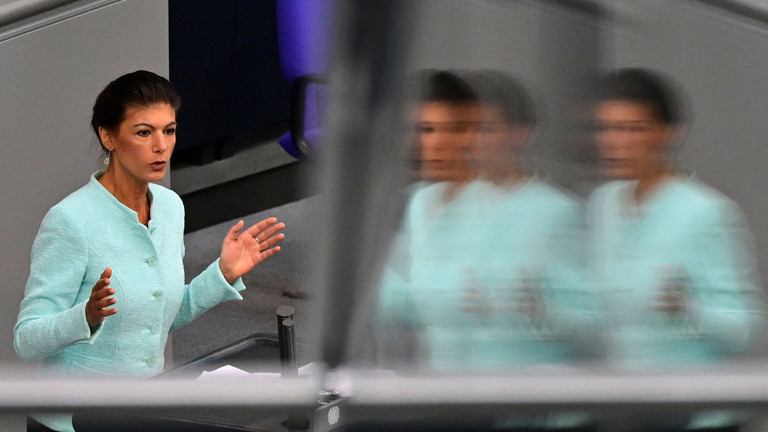
© AFP / John MacDougall
Samizdat | September 9, 2022
Germany’s government is the “stupidest” in Europe for managing to embroil itself in a full-blown “economic war” with its top energy supplier, Russia, left-wing politician Sahra Wagenknecht said on Thursday.
Speaking in the Bundestag, the former co-chair of the party Die Linke (The Left) urged an end to anti-Russian sanctions and the resignation of the country’s vice chancellor and economy minister, Robert Habeck.
While describing the ongoing conflict in Ukraine as a “crime,” Wagenknecht said the anti-Russian sanctions are “fatal” for Germany itself. With energy prices out of control, the country’s economy will soon “just be a reminder of the good old days,” the MP warned, as she urged canceling the restrictions and engaging in talks with Russia.
“We really have the stupidest government in Europe,” she told the parliament, calling for Habeck to resign.
“The biggest problem is your grandiose idea of launching an unprecedented economic war against our most important energy supplier.”
“The idea that we are punishing Putin by impoverishing millions of families in Germany and destroying our industry while Gazprom is making record profits – how stupid is that?” Wagenknecht wondered.
The controversial speech met quite a mixed reaction, with Wagenknecht’s remarks scoring applause in the Bundestag from MPs of polar opposite political views, including members of the right-wing Alternative for Germany (AfD). However, multiple left-wing politicians rushed to distance themselves from Wagenknecht’s statements and condemn her.
“The party’s position on sanctions against Russia was decided at the last federal party conference. There is no ‘economic war against Russia.’ Russia is at war with Ukraine,” the former co-chair of Die Linke, Bernd Riexinger, tweeted, adding that there must be “no doubt” about whom the party backs in the ongoing conflict.
Former left-wing MP Niema Movassat went even further, taking to Twitter to call for Wagenknecht to be excluded from his parliamentary group. The politician’s remarks contradict “a lot of” what the party agrees on, and she should be punished for “acting against” Die Linke, Movassat suggested.
“Exorbitant Rise In Energy Prices” Forces Europe’s Top Steelmaker To Close Plants
By Tyler Durden | Zero Hedge | September 3, 2022
Even though European power and natural gas prices have subsided this week, Germany, the largest economy in the bloc, still faces historically high energy costs that have forced cuts in industrial output.
The latest example is the world’s largest steelmaker, ArcelorMittal, which released a statement Friday about shutting down two plants and idling one.
Europe’s top steelmaker said two plants in Germany (one in Bremen and the other in Hamburg) would be partially closed at the end of September. A plant in Asturias, Spain, will also be idled.
ArcelorMittal blamed the coming smelter shutdowns on “the exorbitant rise in energy prices,” which is devastatingly impacting the company’s “competitiveness of steel production.” The decision to reduce metal output was also based on “weak market demand and a negative economic outlook” as energy hyperinflation risks sending Europe into a deep recession.
“As an energy-intensive industry, we are extremely affected. With gas and electricity prices increasing tenfold within just a few months, we are no longer competitive in a market that is 25% supplied by imports,” explained Reiner Blaschek, CEO of ArcelorMittal Germany.
Blaschek asked lawmakers to address the historic energy crisis and get prices “under control immediately.” Elevated prices this summer have resulted in a series of smelter closures from other metal-producing companies because high energy costs made production uneconomical.
In Germany, one of every six industrial companies feels forced to reduce production due to high energy prices, a survey by the Association of German Chambers of Industry and Commerce, DIHK, showed at the end of July. Nearly a quarter of the companies forced to reduce production had already done so by end-July, and another one-quarter are in the process of scaling back production due to sky-high energy prices, according to the survey of 3,500 companies from all sectors and regions in Germany.
The energy-intensive industries and firms are particularly hit, as 32 percent of the companies plan to or have already started to reduce production and even halt entire production lines, the DIHK survey showed. — OilPrice.com’s Tsvetana Paraskova
Runaway energy costs were halted this week as German year-ahead electricity futures plunged by half since Monday’s peak above 1,000 euros a megawatt-hour as the EU considers market interventions. EU NatGas prices closed down about 33% from the highs reached on Aug. 25.
However, here’s where things get very dicey. After European markets closed, around the lunch hour in New York, news broke that Russian energy giant Gazprom won’t resume critical NatGas supplies to Europe via Nord Stream 1 tomorrow after an oil leak was detected. There’s no timeframe when NatGas supply will resume to the energy-stricken continent.
Europe’s energy crisis could materially worsen, which means higher NatGas and power prices that will only curb more industrial output. Germany could fall into recession this winter, bringing the rest of the bloc down with it.
G7 unveils plan to enforce Russian oil price cap
Samizdat | September 2, 2022
The finance ministers of the Group of Seven influential nations announced on Friday their intention to ban maritime services transporting Russian oil if its price is not approved by ‘international partners.’
“We commit to urgently work on the finalization and implementation of this measure,” representatives from the US, Canada, Germany, France, Italy, the UK and Japan said in a joint statement seen by AFP, without specifying the cap level.
“We seek to establish a broad coalition in order to maximize effectiveness and urge all countries that still seek to import Russian oil and petroleum products to commit to doing so only at prices at or below the price cap,” they added.
The move is aimed at slashing Moscow’s revenues while maintaining a flow of its crude to the international markets, to avoid a price surge.
“We will curtail [Russian President Vladimir] Putin’s capacity to fund his war from oil exports by banning services, such as insurance and the provision of finance, to vessels carrying Russian oil above an agreed price cap,” British Finance Minister Nadhim Zahawi reportedly said, according to a tweet by a Sky News reporter.
According to the statement, the initial price cap will be based on a range of technical inputs, and the price level will be revisited as necessary. “We aim to align implementation with the timeline of related measures within the EU’s sixth sanctions package,” the ministers noted.
Western leaders agreed in June to explore a price ceiling to limit how much refiners and traders can pay for Russian crude. Moscow has made it clear that it would not comply, instead shipping its crude to countries not bound by the cap. Deputy Prime Minister Alexander Novak warned on Thursday that nations that support the price cap will not get Russian crude.
German Foreign Minister Says Support For Ukraine Will Continue “No Matter What Voters Think”

By Paul Joseph Watson | Summit News | September 1, 2022
Despite soaring energy prices that threaten the stability of the country, Foreign Minister Annalena Baerbock said she would continue to support Ukraine “no matter what German voters think.”
Baerbock made the remarkable comments during an event in Prague yesterday organized by the NGO Forum 2000.
“If I give the promise to people in Ukraine – ‘We stand with you, as long as you need us’ – then I want to deliver. No matter what my German voters think, but I want to deliver to the people of Ukraine,” she said.
The German official said that such an approach would not change even if large numbers of people were out in the streets protesting against crippling energy bills.
“We are facing now wintertime, when we will be challenged as democratic politicians. People will go in the street and say ‘We cannot pay our energy prices’. And I will say ‘Yes I know, so we help you with social measures.’ But I don’t want to say ‘Ok then we stop the sanctions against Russia.’ We will stand with Ukraine, and this means the sanctions will stay also in wintertime, even if it gets really tough for politicians,” said Baerbock.
The comment is a fairly stunning admission that world leaders are intent on prolonging the war for as long as possible, no matter how much it harms the countries they are supposed to represent.
Germans face one of the worst cost of living crises in Europe, with governments arranging ‘warm up spaces’ in major cities where people who can’t pay their bills will go to avoid freezing to death, with blackouts expected.
Citizens have already exhausted supplies of electric heaters, firewood and stoves in many areas as they prepare for energy rationing this winter, while inflation in Germany just hit its highest level in almost 50 years.
Those planning to protest against the situation have also been demonized as domestic extremists by the authorities.
As we reported last month, the interior minister of the German state of North Rhine-Westphalia (NRW), Herbert Reul (CDU), outrageously suggested Germans who may be planning to protest against energy blackouts were “enemies of the state” who want to overthrow the government.
Most Germans want talks with Russia – poll
Samizdat – August 31, 2022
The majority of Germans want the West to take concrete steps to initiate talks with Russia to end the Ukraine conflict, a recent survey has indicated.
Published on Wednesday, the poll commissioned by Germany’s RTL/ntv-Trendbarometer was conducted from August 26 through August 29, with 1,011 people taking part.
According to the survey, some 77% of Germans believe that the West should make concrete efforts to try to launch negotiations with Russia, which could help bring an end to the conflict in Ukraine. Only 17% would oppose such talks. When asked whether it is the right thing for Western leaders to keep phoning Russian President Vladimir Putin, 87% of the respondents replied in the affirmative, with 11% against.
Regarding the extent of German aid to Ukraine, 43% said they are content with the current state of assistance, while 26% want Berlin to do more and a quarter believe the country is already doing too much in this respect.
The latter sentiment is particularly prevalent in eastern Germany and among supporters of the Alternative for Germany party, the researchers noted.
Although some politicians from the ruling ‘traffic-light’ coalition are calling for continued deliveries of heavy weaponry to Ukraine, even at the expense of Germany’s own military, 62% of the respondents expressed skepticism about whether this would be a prudent move, while only 32% would welcome such deliveries.
Germany and France want Tiktokers deployed against Russia – Bloomberg
Samizdat – August 30, 2022
TikTokers and YouTubers could help the EU drive a wedge between the Russian government and the people, Germany and France have reportedly told other members of the bloc.
Ideas on how its members could influence Russian citizens were formulated in a document circulated ahead of this week’s high-level EU meeting in Prague, Bloomberg reported on Monday. The plan is meant for discussion behind closed doors, but the news agency said it had studied the document.
Berlin and Paris suggested enrolling popular video bloggers on platforms including YouTube, Facebook, TikTok, Telegram, and VK to help disseminate EU-funded teaching courses on “media literacy,” according to Bloomberg. The courses will supposedly explain to Russians why they should dismiss “Russian propaganda” and trust “independent information” that counters what the Russian government says.
The EU should also target Russian-speaking minorities in other nations with content that serves the same goal, the report says. There is also a proposal for an “Internet Censorship Circumvention Hub” for Russians.
After Russia attacked Ukraine in late February, the EU significantly ramped up its efforts to silence Russian media within the bloc. Government-funded outlets RT and Sputnik were banned from broadcasting, while US-based tech giants such as Facebook stopped showing content from the news organizations on their platforms to EU residents. Brussels justified the censorship by the need to counter ‘Russian propaganda’.
Moscow also imposed restrictions on media, blacklisting some Western outlets in retaliation and introduced punishment for slander against Russia’s armed forces.
Featured Video
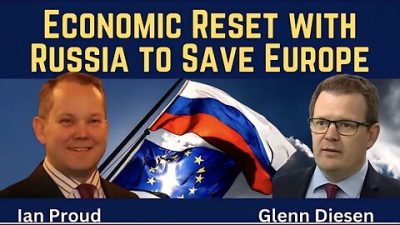
Ian Proud: Economic Reset with Russia to Save Europe
or go to
Aletho News Archives – Video-Images
From the Archives
Magic Hour for Gates
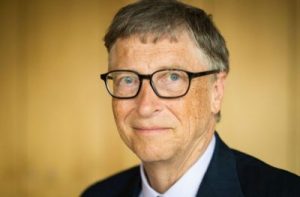
By Gary Jordan | Wake The F*** UP | March 15, 2021
Bill Gates wants to know everything about you.
He wants to control every aspect of your life.
His insatiable thirst for the supervision and scrutiny of every human being alive has sparked a US$1 billion investment that will blanket the earth in video surveillance satellites, providing real-time feedback with a mere one-second delay. He advocates for Orwellian digital tools to track your every move and has bankrolled US$1.7 billion to provide artificial intelligence that will be used to scan each and every visitor to major event venues worldwide. He wants to do away with end-to-end encryption, so he can snoop on your private conversations. He wants to know when and where you travel and who you travel with. He wants you to eat whatever he says you should eat, drink whatever he says you should drink, think how he wants you to think and know only what he wants you to know. Plus he wants to dictate what goes inside your body.
But he doesn’t want you to know a lot about him.
For instance… continue
Blog Roll
Recent Comments


 Aletho News
- Two children killed in Palestinian Authority ambush in West Bank; Hamas slams attack as ‘black mark’
- Israel Needs Time Before Another Iran War—Here’s Why
- US seizes oil tanker for ‘defying Trump’s quarantine’
- Ian Proud: Economic Reset with Russia to Save Europe
- Senator Rand Paul Introduces Federal Bill to END Vaccine Makers’ Liability Shield
- The Hidden Map: US and Israel May Use Unexpected Neighbors to Attack Iran
- Trump, Netanyahu Agree to Target Iranian Oil Exports to China
- Russia open to discussing Ukraine’s ‘external governance’ – senior diplomat
- US Caribbean Buildup Near $3B — Report
- Munich Security Conference and the U.S. elephant in the room
- If Americans Knew
- In Gaza, “rats run over our faces” – Not a ceasefire Day 129
- Israel-backed border guards, GHF-linked aid – Not a ceasefire Day 128
- Israel battles Palestinian right of return, one Palestinian at a time – Not a ceasefire Day 127
- Noor’s short life of unimaginable suffering
- Israel Destroyed Gaza’s Hospitals. Now It’s Banning Doctors Without Borders.
- Is Spite of What Zionists Say, It’s a Good Thing to Criticize Governments
- Palestinian mother, daughter recount strip searches, harsh conditions in Israeli detention
- Israel used weapons in Gaza that made thousands of Palestinians evaporate
- ADL’s Stats Twist Israel’s Critics Into Antisemites
- Why Is the World Silent When the Gaza Genocide Is Not Over?
- No Tricks Zone
- Unfudging The Data: Dutch Meteorological Institute Reinstates Early 20th Centruy Heat Waves It Had Erased Earlier
- German Gas Crisis…Chancellor Merz Allegedly Bans Gas Debate Ahead of Elections!
- Pollen Reconstructions Show The Last Glacial’s Warming Events Were Global, 10x Greater Than Modern
- Germany’s Natural Gas Storage Level Dwindles To Just 28%… Increasingly Critical
- New Study Rebuts The Assumption That Anthropogenic CO2 Molecules Have ‘Special’ Properties
- Climate Scientist Who Predicted End Of “Heavy Frost And Snow” Now Refuses Media Inquiries
- Polar Bear Numbers Rising And Health Improving In Areas With The Most Rapid Sea Ice Decline
- One Reason Only For Germany’s Heating Gas Crisis: Its Hardcore-Dumbass Energy Policy
- 130 Years Later: The CO2 Greenhouse Effect Is Still Only An Imaginary-World Thought Experiment
- New Study Affirms Rising CO2’s Greening Impact Across India – A Region With No Net Warming In 75 Years
 Aletho News
