Germany Plans Government-Run ‘Center of Defense Against Disinformation’
Sputnik – 23.12.2016
The German Interior Ministry will create a “Center of Defense Against Disinformation,” ahead of next year’s parliamentary elections.
The announcement follows the ongoing “fake news” hysteria in the United States, which has been blamed for Hillary Clinton’s loss to Donald Trump.
German magazine Der Spiegel has reported that an Interior Ministry staff member told them that the creation of the center to combat “fake news” “should be negotiated very quickly.” The effort to set up this “ministry of truth” will be lead by the Federal Press Office, run by Chancellor Angela Merkel’s spokesman.
“The acceptance of a post-truth age would be equivalent to political capitulation,” the Interior Ministry official said.
The Ministry recommended “an intensification of political education work” specifically among “Russian-Germans” and people of Turkish origin.
Several German politicians, including Social Democratic Party (SPD) parliamentary chairman Thomas Oppermann, have also proposed legislation which will criminalize the production and distribution of “fake news.”
Oppermann specifically focused on Facebook, calling for the social-network platform to be penalized if they do not remove articles the government deems incorrect within a 24-hour period. “Facebook did not avail itself of the opportunity to regulate the issue of complaint management itself,” Oppermann told Der Spiegel earlier this month.
“Now market dominating platforms like Facebook will be legally required to build a legal protection office in Germany that is available 24 hours a day, 365 days a year.” If the company fails to comply, he wants them to be subjected to stiff fines.
“If, after appropriate examination, Facebook does not delete the offending message within 24 hours, it should expect individual fines of up to 500,000 euros ($523,320),” Oppermann continued.
In George Orwell’s novel “1984,” a Ministry of Truth is in charge of the creation of propaganda. The Ministry had a famous message, “War is peace, freedom is slavery, ignorance is strength.” As the adage goes: 1984 was meant as a warning, not an instruction manual.
German politicians want €500k fines if Facebook fails to remove fake news within 24hrs
RT | December 17, 2016
The parliamentary chairman of Germany’s Social Democratic Party (SPD), Thomas Oppermann, has asserted that social media giants like Facebook should be required to remove fake news and illegal posts within 24 hours or face fines up to €500,000 ($522,000).
“Facebook has not used the opportunity to effectively regulate the issue of complaint management itself,” Oppermann said in an interview with Der Spiegel on Friday. Therefore, “market dominating platforms like Facebook will be legally required to build a legal protection office in Germany, available 24 hours a day, 365 days a year,” he added.
German politicians fear that hate speech and ‘fake news’ could influence public opinion ahead of the federal elections next year, with far-right parties gaining momentum on growing discontent with Angela Merkel’s open-door refugee policy.
Merkel’s Christian Democrats (CDU) party has acknowledged in a statement that, while social media platforms offer “completely new possibilities of political communication,” they also harbor some dangers. The CDU claimed on Friday that Facebook and other social media sites have increasingly become platforms for spreading ‘fake news’ and hate messages, citing manipulation of political discussions on the web as one of the greatest dangers.
“Companies are responsible for what happens on their platforms. That is why they have to react,” Volker Kauder, a senior CDU member, noted.
The legislation would oblige social media platforms to set up offices to respond to complaints from people affected by hateful messages. “High penalties” would await companies that fail to meet their responsibilities, he warned.
On Thursday, Facebook said in a statement that, although it believes in “giving people a voice,” it is currently working on measures to prevent fake news from spreading on the platform, including “several ways to make it easier to report a hoax if you see one on Facebook.”
“We’ve focused our efforts on the worst of the worst, on the clear hoaxes spread by spammers for their own gain, and on engaging both our community and third party organizations,” the company said.
However, the third-party companies that Facebook has commissioned to police for hoaxes and ‘fake news’ include the Washington Post, which recently admitted to running an article relying on sham research, and two Ukrainian groups, of which one is hardline Russophobic.
German Justice Minister Heiko Maas said the government is keeping close tabs on how efficiently Facebook removes illegal content. If removal rates fail to grow, “urgent legal consequences” could follow.
“We expect significant improvements in Facebook’s removal practice. The standard for removals must be German law,” Maas told Sueddeutsche Zeitung on Friday.
Earlier this week, the International Auschwitz Committee accused Facebook of “poisoning the societal climate” in Germany and overseas, warning that the social media giant’s soft treatment and arrogance towards online hate speech is “increasingly intolerable and dangerous.”
Facebook “continues to massively participate in the poisoning of the social climate, not only in Germany,” said Christoph Heubner, executive vice president of the International Auschwitz Committee (IAC), as quoted by German news agencies.
“Obviously, the responsible persons at Facebook neither take the [German] justice minister nor the German legislator seriously,” he added.
Hate speech, including online comments, is punishable under German law, which states that spreading information that encourages violence against people due to their ethnic or religious background is punishable by up to three years in jail.
Read more:
FB’s new ‘Ministry of Truth’? Controversial 3rd party outlets among those to filter out ‘fake news’
‘US nukes in Germany are Cold War relics, should go in dustbin of history’ – top Russian diplomat
RT | December 12, 2016
American nuclear weapons placed in Germany during the Cold War are relics of that era and should be removed as they no longer serve any purpose, according to a senior diplomat at the Russian Foreign Ministry.
“American nuclear weapons in Germany are relics of the Cold War, for a long time they do not serve the implementation of any practical tasks and are subject to being thrown down the dustbin of history,” Sergey Nechayev, chief of the Russian Foreign Ministry’s department responsible for relations with Germany, among a number of other European countries, said in an interview with RIA Novosti.
He noted that US nuclear weapons first appeared on the territory of the Federal Republic of Germany in 1953, and since then have been a constant presence – although their placement was only approved by the German authorities retroactively in 1958.
“All the related issues are regulated in the context of Germany’s obligations in the framework of its NATO cooperation. Since Berlin does not have full sovereignty in making decisions in this regard too, the topic is not the subject of [Russia’s] negotiations with the German side,” Nechayev noted.
According to Nechayev, the issue of the deployment of US nuclear weapons has been the focus of political debate in Germany for some time now.
“In March 2010, the majority in the Bundestag voted to call upon the German government to persistently work with US allies on ensuring the withdrawal of US nuclear arsenal from the country. […]
“The last time the public’s attention was drawn to the presence of US nuclear weapons in Germany was a little over a year ago, when Washington decided to modernize 20 of its nuclear warheads, which are stationed at a base in Büchel [Rhineland-Palatinate region],” the minister said.
He also mentioned that among those most consistently expressing their opposition to the presence – or deployment – of US nuclear weapons in Germany were the Left Party, the liberal FDP and Alternative for Germany (AfD). This position is also shared by many members of the ruling parties.
“However, the German authorities do not dare to put the issue up before Washington,” Nechayev stated.
According to public data, since the end of the Cold War, US aerial nuclear bombs have remained in five countries on the other side of the Atlantic: Belgium, Italy, Germany, the Netherlands and Turkey. In August this year, German media reported that the US was planning to modernize its nuclear arsenal stationed at Büchel air base, placing there a latest generation V61-12 atomic bomb. It is estimated that between 10 and 20 nuclear warheads from the Cold War period are stationed in Büchel today. The area is under strict protection, with US soldiers also stationed there.
The German government has long wanted US nuclear weapons to be removed from the German soil, but so far this has not happened.
“We have by no means given up on this matter, but it is just as difficult as it has been over the past few years,” Foreign Minister Frank-Walter Steinmeier said in parliament last spring. And given Germany’s obligations to NATO, it may have become even more difficult.
READ MORE: ‘We’ve never sought enemies, we need friends’: Top quotes from Putin’s annual address
NATO has been actively deploying weapons to Eastern European states in the recent months, as well as conducting showy military drills right along Russia’s borders – including in the Baltic Sea. Its official position has long been that military activity in Eastern Europe was a defensive response to alleged Russian “aggression” in Ukraine. NATO said Russia was responsible for “annexing” Crimea from Ukraine, although the region voted to join the Russian Federation in March 2014 in a referendum, following the coup that overthrew Ukraine’s elected government. In September this year, NATO Secretary General Jens Stoltenberg said the bloc was ready to further increase its presence in the area, as a gesture of support to its Eastern European members. NATO has also just finished the ‘Iron Sword’ military exercises, which started on November 20 and involved 4,000 troops from 11 NATO countries. The drills were taking place in Lithuania, Russia’s neighbor and the largest Baltic nation.
Moscow has not let NATO activity go unanswered, as it repeatedly addressed it as infringement on Russia’s sovereignty and safety. In August this year, Russia deployed S-400 missile defense systems to Crimea, while ballistic Iskander missiles were deployed in the Kaliningrad exclave after an American ABM (anti-ballistic missile) system was stationed in two Eastern European NATO countries – Romania and Poland.
In his annual address to the Federal Assembly earlier this month, Russian President Vladimir Putin expressed regret that the time since the end of the Cold War had passed by in vain for NATO, which continues to “infringe on the interests of the Russian Federation.” Putin noted, however, that if unprovoked, Russia “does not want confrontation” and “does not seek enemies.”
“We are committed to a friendly, equal dialogue, to upholding the principles of justice and mutual respect in international affairs; we are ready for serious discussion on the creation of a stable system of international relations in the 21st century. Unfortunately, in this respect, the decades since the end of the Cold War have gone by in vain,” he said.
Angela Merkel, desperate to stay in power, is now claiming Russian hackers are ready to attack Germany’s 2017 elections
By Alex Christoforou | The Duran | December 12, 2016
Remember when the Obama administration spied on German media as well as the German government, and specifically Angela Merkel.
The Duran remembers.
In 2015 CNN‘s Jake Tapper reported…
An investigation by the German parliament is raising questions on whether the Obama administration not only spied on journalists in that country, but also interfered in the exercise of the free press under the guise of U.S. national security.
That the NSA was spying on German officials is not new, though it continues to upset free press advocates and those with memories of repressive governments both Communist and Nazi. In 2013, the German magazine Der Spiegel, using information gleaned from files stolen and leaked by Edward Snowden, first reported that the NSA was intercepting German Chancellor Angela Merkel’s cell phone communications.
On Thursday, WikiLeaks released more information, presumably from that surveillance, from a conversation between Merkel and her personal assistant in October 2011, saying the Chancellor “professed to be at a loss” between two courses of action to take in the Greek financial crisis. The WikiLeaks release also suggested that the NSA was spying on German ministers in addition to Merkel. The U.S. ambassador to Germany, John Emerson, was summoned to meet with the Chancellery chief of staff, Peter Altmaier, to discuss the news.
Less observed this week was news that the NSA was eavesdropping not only on Merkel, but also in some capacity on Germany’s free press, specifically Der Spiegel.
Merkel appears to have forgiven and forgotten the FACT that the US hacked and spied on Germany.
American “factual” hacking of Germany… no problem. Russian “imaginary” hacking of Germany… problem.
Following on Obama’s “Russian hacker” witch hunt, Germany is also sounding the alarm bells of Kremlin influenced hacking meant to weaken Germany and the European Union.
Reuters reports that Germany’s domestic intelligence agency has reported an increase in Russian propaganda and disinformation campaigns “aimed at destabilising German society, and targeted cyber attacks against political parties.”
The German agency’s statement to Reuters seems to be perfectly timed with the CIA claim of Russian election hacking. Coincidence?
“We see aggressive and increased cyber spying and cyber operations that could potentially endanger German government officials, members of parliament and employees of democratic parties,” Hans-Georg Maassen, head of the BfV spy agency, said in statement.
Maassen, who raised similar concerns about Russian efforts to interfere in German elections last month, cited what he called increasing evidence about such efforts and said further cyber attacks were expected.
The agency said it had seen a wide variety of Russian propaganda tools and “enormous use of financial resources” to carry out “disinformation” campaigns aimed at the Russian-speaking community in Germany, political movements, parties and other decision makers.
The goal was to spread uncertainty, strengthen extremist groups and parties, complicate the work of the federal government and “weaken or destabilise the Federal Republic of Germany”.
The agency said it had seen a “striking increase” in spear-phishing attacks attributed to Russian hacking group APT 28, also known as “Fancy Bear” or Strontrium. It is the same group blamed for the hack of the U.S. Democratic National Committee this year and a cyber attack on the German parliament in 2015.
The attacks were directed against German parties and lawmakers and were carried out by government bodies posing as “hacktivists”, the agency said.
German officials have accused Moscow of trying to manipulate German media to fan popular angst over issues like the migrant crisis, weaken voter trust and breed dissent within the European Union so that it drops sanctions against Moscow.
But intelligence officials have stepped up their warnings in recent weeks, alarmed about the number of attacks.
Last month, German Chancellor Angela Merkel said she could not rule out Russia interfering in Germany’s 2017 election through Internet attacks and misinformation campaigns.
*****
Russian officials have denied all accusations of manipulation and interference intended to weaken the European Union or to affect the U.S. presidential election.
For an economy in “tatters”, as Barack Obama famously noted, Russia sure has a lot of power in hacking election systems, and manipulating global media. Zerohedge adds…
Either Russian intelligence officials have suddenly become extremely efficient at disrupting national elections in the world’s largest democracies or the establishment leaders of those democracies have intentionally launched a coordinated, baseless witch hunt as a way to distract voters from their failed policies. We have our suspicions on which is more likely closer to the truth…
Like accusations made by Hillary and Obama in the U.S., German politicians, including Chancellor Angela Merkel, have asserted that Russian intelligence agents and media outlets have attempted to spread “fake news” in an effort to “fan popular angst over issues like the migrant crisis.” Of course, it can’t simply be that voters disagree with Merkel’s “open border” policies which have resulted in a massive influx of migrants that have been linked to increasing crime, terrorist attacks and sexual assaults on German citizens… that would just be silly and racist and xenophobic.
German court rejects calls for disclosure of NSA spy targets
‘Bad day for democracy’
RT | November 16, 2016
Germany’s highest court has rejected the opposition parties’ bid to make the government reveal to a parliamentary commission investigating the activities of the US NSA spy agency in Germany, the spy targets they had jointly worked on.
The head of the Left Party in the NSA parliamentary commission, Martina Renner, said the ruling was a “bad day for democracy,” which signaled that the “secret services can continue doing what they want, undisturbed by parliamentary control,” Zeit reported.
The ruling is a response to a complaint filed by two opposition parties, The Greens and the Left Party, in September 2015 following reports that the Bundesnachrichtendienst (BND) intelligence agency had collaborated with the NSA, helping it eavesdrop on European firms and prominent politicians.
The Constitutional Court’s October ruling, that was made public only this Tuesday, said the US was against sharing the sensitive spy target list, and doing so without US permission would hamper German intelligence agencies’ ability to cooperate with counterparts in the future, Reuters reported.
Anna Biselli of the digital research organization Netzpolitik called the Constitutional Court’s ruling “a blow for any clarification on the activities of the BND and the NSA and for the entire parliamentary monitoring of secret services.”
“The government has been successful with its universal argument that the state’s welfare is in danger if the list is revealed. Unfortunately, this argument is widely used to avoid giving out information. This makes the parliament’s job of monitoring the BND effectively very difficult, although that is exactly one of its responsibilities,” she told Deutsche Welle.
Biselli said that one of the commission’s key tasks was to look into the selectors list, which included search parameters from the NSA that the German spy agency to track millions of surveillance targets worldwide.
“The commission wanted to look into the list of selectors because it wanted to know which targets the BND illegally spied on for the NSA,” Biselli said. In the course of its investigation, it was found that the BND monitored sensitive targets, including European governments, institutions and corporations.
“There were several million, probably 13 to 14 million selectors [used to spy on targets], controlled together with the NSA over the course of 10 years,” Greens politician Konstantin von Notz, who is on the parliamentary committee investigating NSA activities, said in an interview with Deutschlandfunk on Wednesday.
“There are probably hundreds of thousands, perhaps even millions, of European and German victims. There will be companies, journalists, probably politicians monitored for years, and this is unpleasant at the very least, and it will all remain under the seal of secrecy,” he added.
The NSA spied on German chancellors and their offices for over a decade, a WikiLeaks report revealed last year. Leaked NSA intercepts indicated that the US tapped the phones of the political offices of the last three German chancellors – Angela Merkel, Gerhard Schröder (in office 1998–2002) and Helmut Kohl (chancellor from 1982 to 1998) – and targeted at least 125 phone numbers of top German officials.
Another scandalous revelation made in April last year suggested that the German BND foreign intelligence agency helped the NSA spy on European firms and officials.
Read more:
BND helped NSA spy on EU politicians & companies ‘against German interests’
German Political Fairy Tales Feature Ridiculously Russophobic Propaganda
Sputnik – 03.11.2016
On the airwaves of the German radio station Deutschlandfunk, there is a children’s program, “Cockatoo,” which relays news about international affairs to children, including news about Russia. However the quality of coverage leaves much to be desired.
The following message aired on October 19, Sputnik Germany reports.
“Russian President Putin is waging two wars now: in Ukraine and in Syria. German Chancellor Merkel and French President Hollande want to make Putin stop the wars. But it seems like it does not work, because Putin does not observe international rules. He thinks that he should extend Russian influence throughout the world by all means, including wars. German Chancellor Merkel and French President Hollande repeated many times that Putin seriously violates human rights in Syria.”
The radio program goes on to paint a picture of Russian ‘atrocities’ in Syria: “Russian planes are bombing hospitals and UN humanitarian convoys. That is why many Syrians flee to Germany with their families. Russian soldiers are fighting in Ukraine too, despite the agreements.”
Then the German journalists explain to kids why everybody should join together and blame Putin. “We do not know yet how to stop Putin. We can put pressure on him if we stop selling certain goods to Russia. This is called ‘sanctions’. But to do that, all the Europeans have to agree, which has not been done yet.”
According to Sputnik Germany, the author of this message is Deutschlandfunk journalist Marcus Pindur, who is known for his devotion to transatlantic narratives and his enmity for Russia.
Sputnik Germany addressed Deutschlandfunk’s representatives, asking them to comment on their stance on such messages being broadcast in a news program for children. The radio station’s press secretary Eva Sabine Kuntz said that she “does not see in the text any wrong or biased statements which stretch reality.”
It appears that no one in Deutschlandfunk is confused about the fact that Russia’s participation in the attack on the UN humanitarian convoy has not been proved, while a group of independent experts from the group ‘Friends of Syria’ argue that the incident was staged.
Nor is there any evidence of Russia bombing Syrian hospitals. Russian Army General Stuff notified that not a single document or fact proving Moscow’s implication in civilian deaths has been provided.
The same applies to the Ukrainian conflict, in which Russia is not participating.
However not every German media source is sympathetic to Deutschlandfunk’s stance. For example, the analytic website NachDenkSeiten is questioning whether such ‘fairytales’ meet the definition of “incitement of ethnic hatred.”
The German organization “Regular Public Media Conference,” in its turn, commented that “Cockatoo” programs are insidious because kids, unlike adults, are not able to analyze information on such complicated issues as the Syrian and Ukrainian conflicts, and cannot form their own opinion.
When under the veil of an educational program they are brainwashed using taxpayer money, it pushes the envelope too far. Sputnik Germany’s reporter expressed hope that the “Cockatoo” program about Russia was just an unpleasant confusion, and next week they will say something about the USA, for example.
Western Nations Under Pressure to Probe Clinton Foundation Spending – Analyst
Sputnik – 01.12.2016
Western European nations are facing growing pressure to end their financial contributions to the Clinton Foundation and investigate its spending, investment analyst Charles Ortel told Sputnik.
“The penny has dropped: The governments have decided not to fund Clinton Foundation activities anymore,” Ortel said Tuesday. “Canada, Sweden and Ireland are countries that may undertake investigations or end their practice of contributing large sums to the Clinton Foundation.”
He was commenting after Norway and Australia announced last weekend that they were ending their annual contributions to the charity, founded in 1997 by then-US President Bill Clinton and first lady Hillary Clinton.
According to the New York Post, the incoming presidential administration of Donald Trump will ask foreign governments investigate how the foundation spent hundreds of millions of donor dollars that it said went to provide low-cost medicine to treat AIDS patients in Africa, among other programs.
Ortel explained that government leaders around the world who had approved big yearly donations to the foundation presumed Hillary Clinton would be elected president on November 8. Her unexpected loss to Trump, however, has led to popular pressure in those countries for governments to disclose the fate of their donations.
“Governments now realize to their shock and horror there are numerous questions that regulators should have asked,” Ortel asserted. “Why didn’t regulators in different countries ask these questions about the enormous unmonitored donations to the Clinton Foundation before?” Germany’s Environment Ministry is being investigated about a donation to the Clinton charity of 4.5 million euros.
In an interview with Sputnik in Germany that was published Tuesday, left-wing member of parliament Niema Movassat questioned why information about his government’s connection to the foundation scandal is coming out only now.
In Ortel’s view, the German investigation illustrates the importance of a provision in New York state law requiring charities to specify in detail how they spend donors’ money.
“The Clinton Foundation has not complied with that requirement,” according to Ortel, a former executive at financial firms Chart Group and Dillon, Tead & Co. He predicted that questions about the foundation will fuel a “media frenzy” worldwide, as public demands for investigations into individual governments’ donations grow. “The German people and the American people deserve answers,” Ortel said. “We need an accounting: How many governments around the world have sent money to the Clinton Foundation? For what projects? In what amounts?”
In 2007, the UK government – led by Prime Minister Tony Blair and then Gordon Brown, both close political allies and personal friends of the Clintons – approved a grant of 1 billion pounds over 20 years to the charity, Ortel pointed out.
Syria’s Heroic Fight Against Western Imperialism
By Andre Vltchek – New Eastern Outlook – 01.10.2016
It is hard to imagine a more resilient, more heroic nation than Syria!
With only 17 million inhabitants (according to the 2014 estimate), Syria is now facing the mightiest coalition on Earth – a coalition that consists of virtually all traditional Western colonialist and neo-colonialist nations.
It is also facing some of the cruelest and deadliest inventions of the West – the extremist and murderous post- and pseudo-Islamic groupings, similar to those that were already unleashed against the Soviet Union during the war in Afghanistan.
Because of the tremendous determination of its people, Syria is still standing! But it is standing against all odds. Its Golan Heights are illegally occupied by Israel, its borders constantly violated by the Turkish military, and by the West’s ‘special forces’ and air force.
Syria’s “political opposition” was created, then groomed and financed by the United States and Europe, in the style of “Color Revolutions”, as has happened in all other socialist countries that the West has been trying to destabilize and return under its deadly rule. Millions of Syrian people have been, during the last six deadly years, terrorized, slaughtered and intimidated by jihadi cadres, implanted by the West and its regional allies: Saudi Arabia, Turkey, Qatar, Israel and others.
It is a terrible and uneven fight! Some of the greatest historical cities on Earth, like Aleppo and Palmira, now lie in ruins and ashes. What the European Christian crusaders failed to fully destroy, is now collapsing under the imperialist onslaught. Like everywhere else on Earth, everything that dares to struggle against Western colonialism is being consistently devastated and burned. Almost everyone who resists is mercilessly slaughtered. Hundreds of thousands of Syrian people have already lost their lives. And with each new day, the awful count is rising.
But Syria is standing!
5 million Syrian people have already been forced to leave their country. Now they are being scattered all over the Middle East: throughout Lebanon, Jordan, Iraq, Egypt, and Turkey. Some have even gone as far as Europe, Canada and Chile.
How much more can one country endure?
And how can the rest of the world just stand by and watch as it is put through hell?
The answer is obvious: the rest of the world does not know; it does not understand! The propaganda coming out of the Western mass media outlets and indoctrination-spreading institutions is so thorough, so professional, that to most people all over the world everything related to Syria appears to be blurry, murky, and incredibly complex. President al-Assad is demonized on a daily basis. Heroic resistance is called the “regime’s brutal actions”, pro-western terror groups are described as “moderate opposition.”
In reality, Syria is suffering because it is refusing to kneel; because it is unwilling to prostitute itself; because it will never beg its torturers to stop, allowing them to grab everything above and under the surface.
The Empire never forgives disobedience. Its fundamentalist terror methods are the most brutal ever invented and implemented on Earth.
All around Syria, countries already lie in ashes. The Middle East hardly exists, anymore. And most of the Syrian people understand: it is perhaps better to die standing, than to live in shackles, on one’s knees, controlled by the kleptomaniacal Western colonialist states!
*
The more terrible the terror that the West is spreading worldwide in general and in this part of the world in particular, the more vicious its vitriolic propaganda is, the brainwashing indoctrination that flows incessantly from London, New York and Paris.
If one watches the BBC, there is no hint of objectivity left, anymore. The ranks are closed and the West is united in its final drive to discredit absolutely everything that is still fighting for survival, against its global terrorist exploits.
President al-Assad of Syria, the heroic Syrian army and the closest Syria’s allies – Russia and Iran – are being relentlessly demonized, as if it were them who began that monstrous war! And Hezbollah, which is fighting countless epic battles against the ISIS, sits firmly on the West’s terrorist list.
Everything seems to be twisted and perverted, upside down.
But what really should one expect from the expansionist hordes, from the bastions of imperialism? Or has the British (or French) propaganda been any different, when their colonialist countries have for centuries been grabbing and devastating countless foreign states and territories, slaughtering hundreds of millions of innocent people? Wasn’t anyone who resisted Western conquest always thoroughly ridiculed and demonized?
Countries like UK, France, Germany, Belgium, Holland, Spain, Portugal and others, have centuries of experience in how to humiliate victims, how to justify their own heinous acts, how to brainwash their own populations and even some of their victims! And the United States, the direct product of Europe, its muscular offspring, is just using the same, only a bit more vulgar, propaganda tactics.
Nothing rational and objective can be expected from the people of Europe or North America, anymore. Except for a few of those insignificant protests and rebellious acts, the Western population is in a total slumber, indifferent towards the horrors that are being administered by its regime all over the globe. There is hardly any pressure to stop acts of terror against Syria. The only thing that seems to matter to Europeans is how to stop the flow of refugees from the devastated countries.
What a shame! What a thorough shame, people of Europe and North America! Your regime is murdering millions, in one country after another, and you are not even capable of recognizing what goes on… instead you are blaming the victims and those rushing to their rescue!
Now your biggest enemy is Russia. Because Russia (same as China) is clearly unwilling to dance to your fatal tune! Because Russia, for many decades, stood by almost all oppressed countries, and supported the de-colonization of the world, in all of its corners. Like China, Cuba and North Korea have always done.
Russia is now defending Syria. Not because it needs natural resources, not because it wants to plunder. It is doing so simply because it is right thing to do. It does it because if the world is abandoned fully to Western imperialism, there will actually soon be no world at all, or at least there will be no world worth inhabiting!
*
“Our country is a socialist country. For us it’s more important to consider the benefits to the entire nation than to particular individuals. I have spent more than 50 years dedicating my life to education, which is the backbone of our country, especially now… Sometimes I feel like quitting my job and returning to teaching at Damascus University, but I know that I am still needed where I am now,” I was told by Dr. Farah Motlak, Deputy Minister of Education of the Syrian Arab Republic.
We met in Cairo, Egypt, at a regional conference. I asked him about the Western propaganda against his country. He replied, shaking his head:
“I am not even angry… I am just endlessly sad. The media attacks; the propaganda that is pouring from the West is clearly designed to destroy our country. But we have hope, and we will continue our struggle.”
The international meetings and conferences clearly show how divided even the Arab world is itself. Syria is a symbol. To some, it is a symbol of resilience, of heroism. To others, mainly to those who are funded and consequently conditioned by the West, it represents everything that is evil.
*
But Egypt itself (where I’m writing this essay), just three years after the pro-Western military coup, is in ruins. Economically it has become a basket case. It is completely devastated, socially.
Of course its destruction is on a “lighter scale”, compared to Iraq, Libya or Yemen. But it is still bad enough: during the coup in 2013, at least 1,000 but most likely 2,000 people were murdered by the junta, while tens of thousands were injured. An estimated 10,000 people are now in prisons all over the country; most of them in terrible conditions; many are being tortured, women prisoners are habitually raped.
“The counter revolution has triumphed,” explained Dr. Mohammed Shafik, a member of the Revolutionary Socialist Movement. “All opposition parties and organizations have been squashed. Thousands of revolutionaries have been imprisoned; hundreds executed by court orders or liquidated by the police… Neoliberalism is taking hold… people are suffering.”
But Western propaganda shows no appetite for criticizing the Egyptian military junta. It is, after all, essentially pro-Western; it is capitalist and to a great extent it is submissive to the Empire and to its allies, including Israel and Saudi Arabia.
As with almost all ‘client’ states of the West, Egypt will never be able to truly improve the lives of the majority of its citizens. The country is already stuck deeply and has been, for decades, in a perpetual social slumber. Those benefiting from the situation are the Western powers and their regional allies, as well as the servile Egyptian elites and the grotesquely colossal, omnipotent military.
If Syria were to surrender, the Egyptian scenario would be ‘the best’ it could hope for. But most likely, it would meet the terrible fate of Iraq or Libya.
*
62 Syrian soldiers were reported killed in a U.S.-led coalition airstrike on the Syrian military base Deir el-Zour, on September 17, in Eastern Syria.
The planes destroyed the base housing soldiers that were involved in a battle with ISIS. Almost immediately, the ISIS took over the hill and the area, in what appeared to be a clearly coordinated operation between the West and the “Islamic State”, against the Syrian government forces.
A few days later, a humanitarian convoy was hit near the city of Aleppo. Without presenting any evidence, the West immediately pointed a finger at the Syrian government and Russia. But the Russian Ministry of Defense released images of a US predator drone operating in the area during the attack, and called for a thorough investigation.
The war goes on. The suffering of Syrian people continues.
There is one simple point that is being constantly overlooked by the West:
The legitimate government of Syria invited Russia, its close ally. It asked Moscow for help, to fight ISIS and other terrorist groups implanted by the West and its allies.
Nobody invited the West!
Or perhaps those groups that the West itself created and supported inside Syria invited it?
Both Syrian government forces and Russia are fighting brutal foreign invaders who are attempting to destroy one of the oldest nations on Earth and take control over the entire Middle East.
Syria is at the frontline of the battle against Western imperialism. And so is Russia. And also Iran, while China is joining!
The sacrifice made by the Syrian people is tremendous. But against all odds, the deadly advance of the imperialists may be stopped here, after all.
As I wrote earlier, the price may be terrible. Aleppo is turning into the Middle-Eastern Stalingrad. But the heroic Syrian nation has made its choice: it will fight brutal and barbaric invaders, as it fought the crusaders under the leadership of great Sultan Saladin.
The alternative would be slavery, something unacceptable for the Syrian people!
‘If Germany is Really Independent, It Must Close Ramstein’
Sputnik – 30.09.2016
Wolfgang Jung, a retired German teacher from Kaiserslautern, Germany, has done everything to try to get the government to close Ramstein Airbase.
In April, he filed a lawsuit in a federal court, saying that the deadly drone strikes using the base were a violation of international law.
His case has been dismissed, but he hasn’t lost hope.
Interviewed by Sputnik Deutschland, the spritely 88-year-old explained that his case, filed in April at the Federal Administrative Court in Leipzig, had been dismissed, because his claim supposedly ‘did not concern him personally’.
“I filed a lawsuit against the use of the Ramstein Airbase, which violates international law and the German constitution,” the retired teacher said. He added that over the course of four years, Ramstein has become central to the US drone war in Afghanistan.
“My case was dismissed. It was not even considered. I was simply denied the right to bring my suit,” Jung noted, explaining that he was told that he “personally was not affected by the military drones,” and therefore “cannot sue.”
Frustrated by the result, the retiree-turned-activist suggested that “according to the logic of the court, German citizens do not have the right to file a lawsuit against actions that are illegal under international law originating from US military bases on German territory.”
Holocaust Discourse and the Moral High Ground
By Barbara McKenzie | June 13, 2016
The Jewish Holocaust occupies a unique position in modern Western society, in that questioning the facts of the Holocaust is suppressed and vilified on a global scale as no other topic of human history. Why is research into the Holocaust so problematic? Why is it that serious research by scientists, historians and other academics is rejected out of hand as immoral? Why is the suppression of research into ANY aspect of history acceptable?
At present there are 14 countries that criminalise ‘Holocaust denial’, i.e. publicly questioning, or disseminating research that questions, any aspect of the approved Holocaust narrative: Canada plus 13 European countries including Germany, Austria and France. In many of these countries legislation was passed decades after the end of WWII, in France only in 1990. As recently as 2015 a German court convicted 87 year old Ursula Haverbeck of ‘Holocaust denial’ and sentenced her to 10 months prison. Other revisionists who have served jail sentences include the German publisher Ernst Zündel and the British historian David Irving, who was arrested, sentenced and imprisoned in Austria in 2005. Academic Robert Faurisson was convicted in France of holocaust denial in 2006 and given a three month suspended sentence. In Germany convictions are rising steadily: in 2000 there were more than 2,666 violations of the Holocaust denial law STGB 130, as compared with 437 in 1987.
Even where Holocaust revision is legal, those who are involved in it or support it in any way are liable to be vilified, persecuted and generally treated as lepers. British academics like Irving and Nicholas Kollerstrom saw their careers destroyed, and every effort is made to deny revisionists any sort of platform; it goes without saying that they are subjected to vindictive trolling on social media. Some, like Faurisson and Zündel, have been physically assaulted on more than one occasion. After pro-Palestine activist Paul Eisen wrote an article ‘The Holocaust Wars’ in which he suggested there were questions to answer about the Holocaust, he experienced an extraordinary campaign of vilification and ostracism, especially from the pro-Palestine movement he had given so much to. That he was Jewish himself was no defence against the charge of antisemitism. As Eisen himself says, ‘I had metamorphosed into that lowest of animal life forms, the maggot at the bottom of the food chain – a Holocaust denier’.
Paul Eisen saw an unexpected rise in his profile during the 2015 campaign for election of the leader of the UK Labour Party. It was discovered that Jeremy Corbyn had had some links with Eisen in the past, including appearing on the same platform as him. The media, who had hardly been supportive of Corbyn’s candidature, had a field day accusing Corbyn of associating with a Holocaust denier. Jeremy Corbyn’s response to accusations of an association with Eisen was unequivocal : ‘had I known he was a Holocaust denier I would have had nothing to do with him […]. Obviously Holocaust denial is vile and wrong’. (From 2.47 mins in the following)
There are two principle assumptions relating to the Holocaust, both implicit in Corbyn’s denial of Paul Eisen:
- It is an an indisputable fact that Adolf Hitler planned to exterminate the Jews of Europe, that he did so by gassing them with cyanide in specially constructed gas chambers, and that he was thus responsible for the deaths of 6 million Jews
- People who question any of these premises, do so ONLY because they are neo-Nazis and white supremacists, who wish to conceal the crimes of the Nazis while at the same time sharing their ideology. They are ‘Holocaust deniers’, and all Holocaust deniers are of necessity antisemitic.
The immutability of these two premises leads to another, that anyone who questions any aspect of the Holocaust or who supports the right of others to question the Holocaust, is at best morally compromised, and probably downright evil, deserving responses ranging from suspicion, condemnation, vilification, isolation, hate mail, through to arrest and imprisonment, sometimes for many years. Those who accept unreservedly the two premises are automatically morally superior to anyone who smells a rat.
In 2012 Piers Morgan interviewed the Iranian president Mahmoud Ahmadinejad, and asked him about his attitude to the Holocaust. I say ‘asked’, but Morgan puts his own position very clearly.
Morgan states that ‘it is an indisputable fact’ that over 6 million Jews were annihilated by Adolf Hitler and the Nazis. ‘Do you dispute that 6 million Jews died or no.’ Although Ahmadinejad tries to voice his suspicions about the narrative, aroused principally because so much effort goes into suppressing research, Morgan is unmovable: the Holocaust is a fact: either you believe in it or not (subtext: and if you don’t it’s because you choose to, because you are a bad person).
The biologist Richard Dawkins sees Holocaust debate in precisely the same terms as Piers Morgan:

So according to Richard Dawkins, too, the Holocaust’ is an immutable fact, and those who question it are intellectually on a par with people who think the earth is flat, and morally on a par with racists. Again, the Holocaust is presented as just one fact, a single package – you either believe in it or you don’t.
What is particularly interesting about Dawkins’ position is that he is one of the leaders of the New Atheist movement, ostensibly dedicated to pointing out all that’s wrong with religion. One might have thought he would be sensitive to the features of the Holocaust narrative and the protectors of its memory that are evocative of the most intolerant religions, for example Catholicism in medieval times. Criminalising Holocaust denial is like burning Bruno Giordano at the stake for claiming that the earth goes round the sun.
A number of writers have in fact analysed the parallels between the Holocaust and religion, most notably the Israeli writers Yeshayahu Leibowitz, Shraga Elam, Gilad Atzmon, and Yoshua Shalev. Their arguments have been summarised as follows: Most Jews today are either atheists or shun the religion of Judaism. Therefore, the Jewish people had to adopt belief in the ‘Holocaust’ as their new religion. They have spread this religion all over the world. ‘Holocaust’ museums are the new houses of worship and are present in most major cities. The new religion has its commandments, its decrees, its prophets, its high priests, its circle of saints, its rituals and its pilgrimages. It knows neither mercy, nor forgiveness, nor clemency but only the duty of vengeance. The Holocaust religion is coherent enough to define the new ‘antichrists’ (the Deniers) and it is powerful enough to persecute them (Holocaust denial laws).
The ‘Ten Commandments’ of this ‘Holocaust Religion’ have been enunciated as follows:
- Remember what Amalek (the Non-Jews) has done to thee.
- Thou shalt never compare THE HOLOCAUST with any other Genocide.
- Thou shalt never compare the Nazi crimes with those of Israel.
- Thou shalt never doubt the number of 6 million Jewish victims.
- Thou shalt never doubt that the majority of them died in gas chambers.
- Thou shalt not doubt the central role of SATAN Hitler in the extermination of the Jews.
- Thou shalt never doubt the right of Israel to exist as the Jewish state.
- Thou shalt not criticize the leading Jewish organizations and the Israeli government.
- Thou must never criticize Jewish organizations and the Zionist leadership for abandoning the European Jewry in the Nazi era
- Thou shalt take these commandments literally and never shew mercy to them that doubt!
So what if you question this Holocaust religion? There is an almost universal assumption that if you don’t believe in the Holocaust it is not because you have an inquiring mind, it’s because you are innately evil. The belief underlying the draconian legislation relating to Holocaust denial would seem to be that the Holocaust is only questioned by neonazis, whose ‘denial’ is motivated by hate and so they should be locked up before they contaminate anyone else.
I have to confess that when I recently learned of the existence of Ursula Haverbeck and her prison sentence for ‘Holocaust denial’, in a European country in the 21st century, for carrying out, as I saw it, serious research into history, I was shocked to the core. I mentioned this to various acquaintances here in Wellington, who were equally horrified, not at the imprisonment of Ursula Haverbeck, but at the thought that I appeared to be questioning the Holocaust narrative. I was quickly made to understand that if I thought there was something worrying, something odd about this punitive response to historical research, it indicated a moral flaw in my makeup.
Soon after I had a twitter exchange with one Daniel Finkelstein, peer of the British realm, ex-editor of The Times. I came across his savage indictment of a prolific tweeter, who had defended David Irving, the notorious ‘Holocaust denier’. When I commented that the said person ‘opposes land theft (in Palestine), ethnic cleansing and child abuse – what’s not to like? Finkelstein, twitter handle ‘Dannythefink’, responded by asking me what I thought of the Holocaust. The exchange continued as follows:
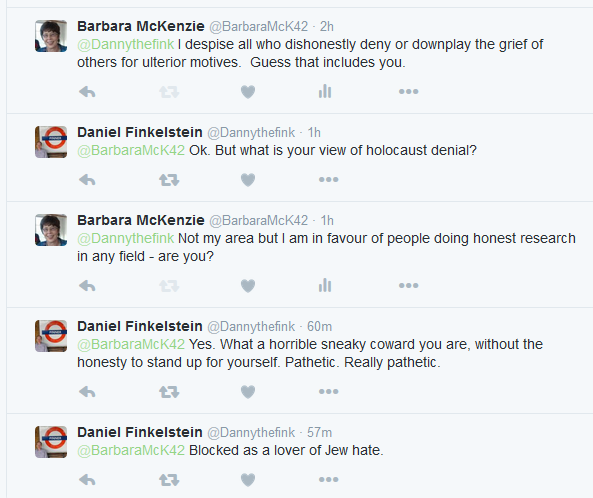
It comes as no surprise that Daniel Finkelstein, who is in total support of dispossession, ethnic cleansing and cruelty in Palestine, assumes morally superiority to me, since I have spoken in defense of a man who has spoken in defense of a man who does research into a field of history. And of course I have refused to commit myself to the undeniability of the Holocaust package …
One can assume that all these experts on the Holocaust, who know enough to be confident of the immutable truth of the Holocaust narrative, whether it be Piers Morgan, Dawkins, or Daniel Finkelstein, would also know another immutable truth about the Holocaust, that the Director of Auschwitz, Rudolf Höss was tortured for three days and three nights, and that his testicles were smashed beyond repair,as happened to 137 out of 139 Germans ‘interrogated’ before the Nuremberg trials. One can assume that this makes no difference to their perception of the Holocaust narrative, and they will remain confident of their moral superiority to those of us who are distressed and alarmed by the knowledge that German witness statements at Nuremberg were obtained under the most brutal torture. (From Höss’s confession was derived the figure of 4 million deaths at Auschwitz; the figure was later revised down to 1 million.)
‘Holocaust denial’ is generally conflated with antisemitism, ‘Jew hate’ or racism, and so automatically deserving of vilification. However, even if revisionism is considered to be intrinsically antisemitic, protectors of the Holocaust narrative like to bolster their case by pointing to more general indicators of racism in the culprit.
To the uninitiated the best-known Holocaust revisionist is probably the British historian David Irving, who was convicted of Holocaust denial in an Austrian court and sentenced to three years in prison. Irving was interviewed by Tim Sebastian on the BBC’s Hardtalk in 2000. The programme’s style is intended to be aggressive, but when I watched the programme in 2000, knowing nothing about either Irving or Holocaust denial, I was repelled by Sebastian’s overt hostility to Irving, and I believe that any other impartial person would be too. (Sebastian underlined his antagonism by refraining from shaking Irving’s hand at the end of the interview.)
Sebastian suggests that to deny the gas chambers is hurtful and tasteless (Holocaust denial is immoral per se). But like many others he feels the need to shore up this assumption by showing that there is other evidence that David Irving is a racist, and though he has few examples to work with he is relentless on this point. Irving’s suggestion that he is no more racist than millions of other people is brushed aside with the rather strange claim from the interviewer that there is no evidence for this whatsoever (so only Holocaust deniers are racist). Furthermore, it would appear that honest but naive David Irving confessed in an interview with the Independent that he once called someone a ‘nigger’, something he immediately regretted and remained bitterly ashamed of. As someone put it in the comments below the YouTube video, David Irving is probably the most honest person on the planet.
Another protector of the Holocaust narrative is Max Blumenthal, an American Jew who has a profile as a supporter of the rights of Palestinians. Blumenthal has attracted criticism from some pro-Palestine activists, who see him as an ‘antizionist’ zionist (AZZ), or gatekeeper, due to his attacks on other activists such as Alison Weir and Gilad Atzmon, his opposition to criticism of Jewish power, his prioritising of antisemitism and Holocaust denial, and his peddling of the NATO narrative on Syria; Gilad Atzmon sees him as racist, agressive and supremacist. In 2008 Blumenthal attended a meeting by David Irving when he was touring the States, and created this video:
The video is interesting for several reason. Blumenthal has interspersed his footage with clips from old German propaganda films promoting Germans superiority – of course if you question the Holocaust you must be a Nazi and white supremacist. Like Piers Morgan he presents the question of the Holocaust in bald holistic terms, with no allowance for individual aspects, or degrees of doubt. ‘Are you a Holocaust denier’, he asks, pretty much as one might ask ‘are you a paedophile?’
And as Holocaust denial is such a heinous crime, Blumenthal is justified in first finding out the location of the meeting (given freely to him by David Irving), and then outing Irving to the Vicar of the church hosting the meeting as a ‘Holocaust denier’. The smugness, the self-satisfaction of Blumenthal are palpable; he clearly sees himself as a hero, where others might just see a manipulative sneak. In any case we are left in no doubt that Max Blumenthal, the anti-German racist, the Palestine activist who along with Israel promotes the destruction of Syria, is morally superior to the ‘Holocaust denier’ David Irving, regardless of the latter’s transparent integrity.
The claim that ‘Holocaust denial’ is innately antisemitic was blown out of the water when Netanyahu, prime minister of Israel, took into his head to declare that the Holocaust was the brainchild of the Palestinian grand mufti of Jerusalem Haj Amin Husseini (so not Hitler afterall), that Hitler only wanted to expel the Jews, not exterminate them (thereby breaking Commandment 6, see above). There was anger and ridicule in Israel and amongst Jews abroad and Netanyahu was forced to climb down. Although Netanyahu was in general accused of ‘playing into the hands of Holocaust deniers’, he was actually guilty of Holocaust denial as it is defined, ie questioning an aspect of the Holocaust discourse – any German who made Netanyahu’s claim would be arrested. If one accepts the ruling that says ‘Holocaust denial’ is antisemitic, Netanyahu must be antisemitic. Which is clearly nonsense – Netanyahu’s racism does not lie in antisemitism, but in an overweening belief in Jewish exceptionalism.
Conclusion
It could be that those protecting the approved version of the Holocaust with such intolerance, aggression, and hate are absolutely right, that 6 million Jews died, in gas chambers, according to a plan drawn up by Adolf Hitler. I wouldn’t know – I haven’t done the research necessary for me to form an opinion.
However it is manifestly clear that those who question or deny the Holocaust are not united by a common neo-Nazi philosophy, of a type that on the one hand insists that Hitler was not guilty of the crimes attributed to him and on the other claims ‘Hitler was right’ to commit these crimes. Mainstream Holocaust revisionists are academics, philosophers, German patriots or Palestine activists. They do not necessarily support the far-right – many of them probably vote for left of centre parties. Some of them are notable for their immense compassion, such as Paul Eisen, who has always been a strong advocate of justice for Palestine. All of them have shown great courage and integrity, and are prepared to look for the truth and to speak it as they see it.
Regardless of the facts of the matter, criminalisation of responsible research into the Holocaust, and the vilification and isolation of those who carry it out, or even those who simply support their right to do so, is an outrageous denial of academic endeavour and historiography as a discipline. Anyone who supports such criminalisation, vilification and isolation is NOT morally superior but in fact morally and intellectually compromised. Furthermore, any honourable person with a modicum of intelligence and a modicum of courage will fight for the right of all people to carry out research into any branch of history, without treating one particular aspect as sacred and therefore exempt from scrutiny.
Featured Video
Laith Marouf: Hezbollah’s position on US-Iran ceasefire
or go to
Aletho News Archives – Video-Images
From the Archives
The Dirty Little Secret behind the “Global Terrorism Index”
The Omission of Israeli Terrorism in the Occupied Palestinian Territories
By Karin Brothers | Global Research | December 6, 2014
… The Israeli settlements — all of which are illegal – have been identified as a major impediment to peace. The refusal of a major “global” terrorism report to name the Israeli settlers as one of the groups most responsible for terrorism not only misrepresents a major source of regional violence but exposes the Global Terrorism Index as a propaganda tool that supports a U.S. agenda.
In recent years, governments have been attempting to thwart terrorism by blocking supportive fund-raising. When it comes to Israeli settlements, however, the US and Canada actually encourage fund-raising by giving organizations (such as Christian Friends of Israeli Communities (CFOIC) and the Jewish National Fund) financial support in the form of donor tax-deductions.
Charities which provide funds for the Israeli settlements should be regarded as terror-financing organizations. They should not only lose their tax-deductible status, but they should be banned because they support the violation of international humanitarian law. The terror-financing laws that are being strictly enforced for Muslim charities should be applied to Christian and Jewish charities as well. … Read full article
Blog Roll
 Aletho News
- How UK Regulator Ofcom Quietly Bypassed International Law to Police American Speech
- The Black Cube Files: How Former Mossad Operatives Flipped a Nation
- Laith Marouf: Hezbollah’s position on US-Iran ceasefire: What you’re not being told
- Israel’s priority lies in destroying chances of peace between Iran, US: Ex-UN nuclear chief
- Ceasefire for all or for none: Iran shuts Hormuz over Lebanon attacks
- Strait of Hormuz is Iran’s ‘nuclear weapon’ that forced US retreat: Medvedev
- Energy crisis will last for months – Kremlin envoy
- Europe’s quiet role in the war on Iran
- Forty days that shook the Empire: How Iran turned the tables on US and prevailed
- Netanyahu unilaterally declares Lebanon outside of ceasefire deal
- If Americans Knew
- This is ceasefire? Israel’s biggest massacre yet in Lebanon, another journalist killed in Gaza – Daily Update
- Tucker Carlson on Israel: This Is the Behavior of an Ally? Really?
- Gazans face a triple crisis: severe shortages of water and bread, healthcare in tatters
- NY Times reports how Netanyahu took the US into Iran War
- A sigh of relief over Iran, but Gaza and Lebanon in dire straits – Daily Update
- Thousands dead and neighborhoods razed to the ground: Aid agencies fear southern Lebanon is becoming the new Gaza
- The war the US is fighting for Israel could cost trillions
- ‘Cigarette Burns, Nail Wounds’: Toddler Tortured in Gaza to Coerce Father
- Trump Says US Sent ‘a Lot of Guns’ to Protesters in Iran
- Israeli forces destroy 17 UN peacekeeper cameras in south Lebanon
- No Tricks Zone
- An Inconvenient Tree: Uncovered In Alps… Europe Much Warmer Than Today 6000 Years Ago
- New Study Reports A 60% Slowdown In Greenland’s Ice Loss Rate In The Last Decade
- Low Intensity Tornado Wrecks Major Solar Farm, Creating A Potential Toxic Dump
- New Study Finds Warming Saves Lives…Cold Temperatures 12 Times More Deadly Than Excess Heat
- German Science Blog Accuses PIK Climate Institute Of Hallucinating Climate Tipping Points
- Devastating Assessment Of Comirnaty Vaccine By Former Senior Pfizer Europe Toxicologist
- New Study: CO2 Is ‘Effectively Negligible’ As An Explanatory Climate Change Factor Since 2000
- Former Pfizer Toxicologist Dr. Helmut Sterz Tells Bundestag Hearing Pfizer Vaccine Should Have Never Been Approved
- Energy Expert: Germany’s Nuclear Phaseout Was A “500 Billion Euro Mistake”
- New Research: South Australia’s Mid-Holocene Sea Surface Temperatures Were 4°C Warmer Than Today
 Aletho News