Lewis and Crok: Climate less sensitive to CO2 than models suggest
By Judith Curry | Climate Etc. | March 5, 2014
Nic Lewis and Marcel Crok have published a new report on climate sensitivity.
The title of the report is “A sensitive matter: How the IPCC buried evidence showing good news about global warming.” The report is published by the GWPF. The long version of the report is found [here]; a short version is found [here].
From the press release issued by the GWPF:
A new report published by the Global Warming Policy Foundation shows that the best observational evidence indicates our climate is considerably less sensitive to greenhouse gases than climate models are estimating.
The clues for this and the relevant scientific papers are all referred to in the recently published Fifth Assessment report (AR5) of the Intergovernmental Panel on Climate Change (IPCC). However, this important conclusion was not drawn in the full IPCC report – it is only mentioned as a possibility – and is ignored in the IPCC’s Summary for Policymakers (SPM).
For over thirty years climate scientists have presented a range for climate sensitivity (ECS) that has hardly changed. It was 1.5-4.5°C in 1979 and this range is still the same today in AR5. The new report suggests that the inclusion of recent evidence, reflected in AR5, justifies a lower observationally-based temperature range of 1.25–3.0°C, with a best estimate of 1.75°C, for a doubling of CO2. By contrast, the climate models used for projections in AR5 indicate a range of 2-4.5°C, with an average of 3.2°C.
This is one of the key findings of the new report Oversensitive: how the IPCC hid the good news on global warming, written by independent UK climate scientist Nic Lewis and Dutch science writer Marcel Crok. Lewis and Crok were both expert reviewers of the IPCC report, and Lewis was an author of two relevant papers cited in it.
In recent years it has become possible to make good empirical estimates of climate sensitivity from observational data such as temperature and ocean heat records. These estimates, published in leading scientific journals, point to climate sensitivity per doubling of CO2 most likely being under 2°C for long-term warming, with a best estimate of only 1.3-1.4°C for warming over a seventy year period.
“The observational evidence strongly suggest that climate models display too much sensitivity to carbon dioxide concentrations and in almost all cases exaggerate the likely path of global warming,” says Nic Lewis.
These lower, observationally-based estimates for both long-term climate sensitivity and the seventy-year response suggest that considerably less global warming and sea level rise is to be expected in the 21st century than most climate model projections currently imply.
“We estimate that on the IPCC’s second highest emissions scenario warming would still be around the international target of 2°C in 2081-2100,” Lewis says.
I was asked to review this article prior to publication, and then was subsequently asked to write the foreword. The text of my foreword:
The sensitivity of our climate to increasing concentrations of carbon dioxide is at the heart of the scientific debate on anthropogenic climate change, and also the public debate on the appropriate policy response to increasing carbon dioxide in the atmosphere. Climate sensitivity and estimates of its uncertainty are key inputs into the economic models that drive cost-benefit analyses and estimates of the social cost of carbon.
The complexity and nuances of the issue of climate sensitivity to increasing carbon dioxide are not easily discerned from reading the Summary for Policy Makers of the assessment reports undertaken by the Intergovernmental Panel on Climate Change (IPCC). Further, the more detailed discussion of climate sensitivity in the text of the fullWorking Group I reports lacks context or an explanation that is easily understood by anyone not actively reading the published literature.
This report by Nic Lewis andMarcel Crok addresses this gap between the IPCC assessments and the primary scientific literature, providing an overview of the different methods for estimating climate sensitivity and a historical perspective on IPCC’s assessments of climate sensitivity. The report also provides an independent assessment of the different methods for estimating climate sensitivity and a critique of the IPCC AR4 and AR5 assessments of climate sensitivity.
It emphasizes the point that evidence for low climate sensitivity is piling up. I find this report to be a useful contribution to scientific debate on this topic, as well as an important contribution to the public dialogue and debate on the subject of climate change policy.
I agreed to review this report and write this Foreword since I hold both authors of this report in high regard. I have followed with interest Nic Lewis’ emergence as an independent climate scientist and his success in publishing papers in major peer-reviewed journals on the topic of climate sensitivity, and I have endeavored to support and publicize his research. I have interacted with Marcel Crok over the years and appreciate his insightful analyses, most recently as a participant in climatedialogue.org.
The collaboration of these two authors in writing this report has resulted in a technically sound, well-organized and readily comprehensible report on the scientific issues surrounding climate sensitivity and the deliberations of the IPCC on this topic.
While writing this Foreword, I considered the very few options available for publishing a report such as this paper by Lewis and Crok. I am appreciative of the GWPF for publishing and publicizing this report. Public accountability of governmental and intergovernmental climate science and policy analysis is enhanced by independent assessments of their conclusions and arguments.
JC comments: I did think twice about writing a foreword for a GWPF publication. I try to stay away from organizations with political perspectives on global warming. That said, GWPF has done some commendable things, notably pushing for inquiries into the Climategate affair. And there really are very few options for publishing a report like this.
I think it is important to put forward alternative assessments of the key elements of the climate change debate — alternative to reports issued by the IPCC, the UK MetOffice, and the RS/NAS.
Related articles

Glacier scientist: I knew data hadn’t been verified
By David Rose | Daily Mail | January 24, 2010
The scientist behind the bogus claim in a Nobel Prize-winning UN report that Himalayan glaciers will have melted by 2035 last night admitted it was included purely to put political pressure on world leaders.
Dr Murari Lal also said he was well aware the statement, in the 2007 report by the Intergovernmental Panel on Climate Change (IPCC), did not rest on peer-reviewed scientific research.
In an interview with The Mail on Sunday, Dr Lal, the co-ordinating lead author of the report’s chapter on Asia, said: ‘It related to several countries in this region and their water sources. We thought that if we can highlight it, it will impact policy-makers and politicians and encourage them to take some concrete action.
‘It had importance for the region, so we thought we should put it in.’
Dr Lal’s admission will only add to the mounting furore over the melting glaciers assertion, which the IPCC was last week forced to withdraw because it has no scientific foundation.
According to the IPCC’s statement of principles, its role is ‘to assess on a comprehensive, objective, open and transparent basis, scientific, technical and socio-economic information – IPCC reports should be neutral with respect to policy’.
The claim that Himalayan glaciers are set to disappear by 2035 rests on two 1999 magazine interviews with glaciologist Syed Hasnain, which were then recycled without any further investigation in a 2005 report by the environmental campaign group WWF.
It was this report that Dr Lal and his team cited as their source.
The WWF article also contained a basic error in its arithmetic. A claim that one glacier was retreating at the alarming rate of 134 metres a year should in fact have said 23 metres – the authors had divided the total loss measured over 121 years by 21, not 121.
Last Friday, the WWF website posted a humiliating statement recognising the claim as ‘unsound’, and saying it ‘regrets any confusion caused’.
Dr Lal said: ‘We knew the WWF report with the 2035 date was “grey literature” [material not published in a peer-reviewed journal]. But it was never picked up by any of the authors in our working group, nor by any of the more than 500 external reviewers, by the governments to which it was sent, or by the final IPCC review editors.’
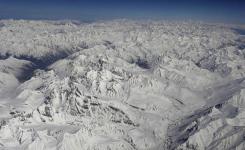 In fact, the 2035 melting date seems to have been plucked from thin air.
Professor Graham Cogley, a glacier expert at Trent University in Canada, who began to raise doubts in scientific circles last year, said the claim multiplies the rate at which glaciers have been seen to melt by a factor of about 25.
‘My educated guess is that there will be somewhat less ice in 2035 than there is now,’ he said.
‘But there is no way the glaciers will be close to disappearing. It doesn’t seem to me that exaggerating the problem’s seriousness is going to help solve it.’
One of the problems bedeviling Himalayan glacier research is a lack of reliable data. But an authoritative report published last November by the Indian government said: ‘Himalayan glaciers have not in any way exhibited, especially in recent years, an abnormal annual retreat.’
When this report was issued, Raj Pachauri, the IPCC chairman, denounced it as ‘voodoo science’.
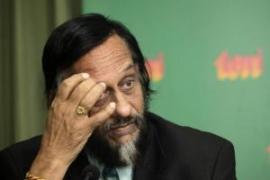
- IPCC chairman Raj Pachauri
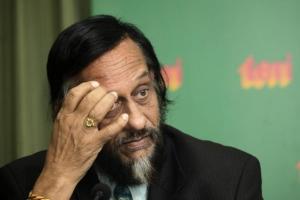
Having been forced to apologise over the 2035 claim, Dr Pachauri blamed Dr Lal, saying his team had failed to apply IPCC procedures.
It was an accusation rebutted angrily by Dr Lal. ‘We as authors followed them to the letter,’ he said. ‘Had we received information that undermined the claim, we would have included it.’
However, an analysis of those 500-plus formal review comments, to be published tomorrow by the Global Warming Policy Foundation (GWPF), the new body founded by former Chancellor Nigel Lawson, suggests that when reviewers did raise issues that called the claim into question, Dr Lal and his colleagues simply ignored them.
For example, Hayley Fowler of Newcastle University, suggested that their draft did not mention that Himalayan glaciers in the Karakoram range are growing rapidly, citing a paper published in the influential journal Nature.
In their response, the IPCC authors said, bizarrely, that they were ‘unable to get hold of the suggested references’, but would ‘consider’ this in their final version. They failed to do so.
The Japanese government commented that the draft did not clarify what it meant by stating that the likelihood of the glaciers disappearing by 2035 was ‘very high’. ‘What is the confidence level?’ it asked.
The authors’ response said ‘appropriate revisions and editing made’. But the final version was identical to their draft.
Last week, Professor Georg Kaser, a glacier expert from Austria, who was lead author of a different chapter in the IPCC report, said when he became aware of the 2035 claim a few months before the report was published, he wrote to Dr Lal, urging him to withdraw it as patently untrue.
Dr Lal claimed he never received this letter. ‘He didn’t contact me or any of the other authors of the chapter,’ he said.
The damage to the IPCC’s reputation, already tarnished by last year’s ‘Warmergate’ leaked email scandal, is likely to be considerable.
Benny Peiser, the GWPF’s director, said the affair suggested the IPCC review process was ‘skewed by a bias towards alarmist assessments’.
Environmentalist Alton Byers said the panel’s credibility had been damaged. ‘They’ve done sloppy work,’ he said. ‘We need better research on the ground, not unreliable predictions derived from computer models.’
Last night, Dr Pachauri defended the IPCC, saying it was wrong to generalise based on a single mistake. ‘Our procedure is robust,’ he added.
Related article
- Déjà Vu : Himalayan glaciers to melt (again) by 2035! (climatism.wordpress.com)
Featured Video

No Threat Can Force Iran’s Surrender /Trita Parsi & Lt Cl Daniel Davis
or go to
Aletho News Archives – Video-Images
From the Archives
An Expert Military Analysis of War with China
Actually, None is Necessary
By Fred Reed • Unz Review • December 13, 2020
The Correlation of Armed Forces: U.S. goods and services trade with China totaled an estimated $634.8 billion in 2019. Exports were $163.0 billion; imports were $471.8 billion. The U.S. goods and services trade deficit with China was $308.8 billion in 2019. Trade in services with China (exports and imports) totaled an estimated $76.7 billion in 2019. Services exports were $56.5 billion; services imports were $20.1 billion. The U.S. services trade surplus with China was $36.4 billion in 2019.
There is talk within the Washingtoniat of a possible war with China. Steve Bannon, who apparently was dropped on his head as a child, actually favors such a war. We hear the usual shoo-the-boobs alarm about how the Chinese are doing something terrible and we must gird our loins and American values and show them what for, bow wow, woof. The danger is that the current game of who-blinks-first in Asian waters might actually provoke a shooting war. You know the kind of thing: One warship refuses to get out of the way of another, a collision ensues, some retard lieutenant who signed up on waivers opens fire, and we’re off and running. It is not a good idea to let children play with matches.
The said war is discussed either in emotional terms by idiots or in purely naval terms by those familiar with such things, so we hear of the First Island Chain and the Second Island Chain and whose missiles against the other’s missiles and so on. This would be appropriate if we were fighting World War Two again. Which we aren’t. Let’s take a quick-and-dirty look at how such a war might go.
To begin the war, America would overestimate itself and underestimate China. This is doctrine in the Pentagon. … continue
Blog Roll
 Aletho News
- Iran To Target Military Industrial-Tech Complex That Facilitated Gaza Genocide
- Collapsing Empire: The Resistance Disarms ‘Israel’
- Suicide Should Not Be a Government Service
- Rethinking America’s greatest threat: Iran vs. Israel-Firsters
- Iran accuses adversaries of false flags to strain Turkey ties
- Poland rules out sending Patriot missiles to US/Israel amid war on Iran
- Tehran approves new Hormuz plan with major restrictions
- No Threat Can Force Iran’s Surrender /Trita Parsi & Lt Cl Daniel Davis
- UK’s New Pandemic Plan Would Turn Big Tech Into a Mass Location Tracking Network
- Growing insecurity, soaring prices fuel protests in north as regime bans evacuation: Sources
- If Americans Knew
- Ann Coulter Rips Into Fox News for Iran War Coverage, Compares to False Rigged 2020 Election Reporting
- Joe Kent Urges Americans To Call White House and Congress To Object To Sending Troops Into Iran
- DNC Resolution to Reject AIPAC Funding Puts Democratic Leaders in the Hot Seat
- Swedish foundation to build 400 schools as over 650,000 Gaza children remain without education for 2 years
- Israeli army admits photshopping image of slain Lebanese journalist
- This is how Israel is systematically killing health workers under the cover of war in Lebanon
- Carrying life under fire: Israeli invasion of Lebanon leaves pregnant women facing deadly risks
- Champagne all around for the new death penalty (for Palestinians) law – Not a ceasefire Day 172
- Why are Palestinian books struggling to be seen on Amazon?
- The Line Between Affinity and Conspiracy
- No Tricks Zone
- New Study Finds Warming Saves Lives…Cold Temperatures 12 Times More Deadly Than Excess Heat
- German Science Blog Accuses PIK Climate Institute Of Hallucinating Climate Tipping Points
- Devastating Assessment Of Comirnaty Vaccine By Former Senior Pfizer Europe Toxicologist
- New Study: CO2 Is ‘Effectively Negligible’ As An Explanatory Climate Change Factor Since 2000
- Former Pfizer Toxicologist Dr. Helmut Sterz Tells Bundestag Hearing Pfizer Vaccine Should Have Never Been Approved
- Energy Expert: Germany’s Nuclear Phaseout Was A “500 Billion Euro Mistake”
- New Research: South Australia’s Mid-Holocene Sea Surface Temperatures Were 4°C Warmer Than Today
- Storing Green Energy To Last Germany 10 Days Would Require A 60-Million Tonne Battery
- New Studies: UK Sea Levels Were 4 Meters Higher Than Today During The Mid-Holocene
- Destructive Green New Deal: German Energy And Metal Group Warns Of Drastic Crisis
 Aletho News