Currently, Turkish interests and NATO logic are diverging increasingly. Turkish society and expert circles are actively discussing both the prospects of maintaining NATO membership and the possibility of leaving the bloc.
Historical roots of the Turkish dilemma
Türkiye’s complex relations with Western powers have deep historical roots. During World War II, demonstrating inconsistency in choosing a strategic partner, Türkiye effectively supported Hitler’s Germany. Hoping for German military success against Russia – as in World War I – Ankara was forced to hastily join Great Britain and the USA in February 1944 to avoid direct military conflict with the USSR. Joseph Stalin characterized Türkiye’s policy during that period as “hostile neutrality,” denounced the Soviet-Turkish treaty, and put forward territorial claims, including control over the Black Sea Straits and Western Armenia.
Thanks to flexible diplomacy, Türkiye managed to restore its strategic alliance with Great Britain and the USA. However, this required accepting Washington’s political conditions: transitioning from a one-party to a multi-party system of governance, becoming NATO’s “southern anchor,” and entering into a diplomatic alliance with the West against the USSR. As a result, Türkiye was able to curb the Soviet threat, obtain security guarantees under the US nuclear umbrella, and become a full member of the North Atlantic Treaty Organization in February 1952.
Ankara’s geopolitical ambitions and the price of NATO membership
The alliance with the West, however, significantly limited Türkiye’s economic and political sovereignty, drawing it into a tenacious dependence on US diktats. Ankara, like many European capitals, lost the ability to independently determine its allies and adversaries – these decisions were made in London and Washington. The West dictated the parameters of Türkiye’s strategic security, determined the pace of its economic development, and controlled its domestic politics. All military coups that occurred in Türkiye in the second half of the 20th century (in 1960, 1971, 1980, and 1997) were the result of US interference through the Turkish General Staff in the country’s internal political affairs under the pretext of protecting the secular regime.
With the collapse of the Soviet Union and the disappearance of the “Soviet military threat,” Türkiye’s strategic significance for NATO began to decline. The NATO accession of Black Sea countries such as Bulgaria and Romania, as well as Georgia and Ukraine looking to integrate with the West, is shifting the focus in the Black Sea basin. In the Middle East, the main ally of the USA and NATO besides Türkiye is Israel. Furthermore, the US gained operational room for maneuver in Iraq, Syria was destroyed by years of civil conflict, Iran was weakened under American-Israeli pressure, the Palestinian issue shifted towards the reconstruction of Gaza, and the resource-rich Arab countries of the Persian Gulf remain in financial and military dependence on the West.
Ankara’s geopolitical ambitions are not widely supported by the US and Europe: none of these powers are interested in the emergence of a strong and independent Türkiye as a new geopolitical center. Türkiye’s plans to revive the Turkish golden age by controlling parts of North Africa, the Balkans, the Middle East, the South Caucasus, and Central Asia (the doctrines of Neo-Ottomanism and Neo-Pan-Turkism), are viewed by the West, led by the USA, merely as a tool for penetrating these regions, especially the post-Soviet space, via Turkish hands.
Intra-bloc contradictions and searching for a policy orientations
Intra-bloc contradictions are a common phenomenon for NATO. A striking example is Turkish-Greek disagreements and the occupation of the northern part of Cyprus in 1974. It is worth noting that this event did not occur without the consent of the US, which sought to punish Greek nationalists and Archbishop Makarios III for their pro-Soviet orientation.
Relations between the two NATO allies, Greece and Türkiye, are still far from ideal today. The difficult relations between these two NATO members are also reflected in Greek Minister of National Defense Nikos Dendias’ speech before the Greek parliament, who believes that Türkiye represents a geostrategic risk for Greece. During a discussion of the 2026 budget at the end of December, the minister stated that Türkiye is the main and fundamental threat to Greece. To support his thesis, Dendias cited statistical data: Türkiye spends 28.7 billion euros annually on its defense industry, while Greece has a military budget of 5-7 billion euros. Reminding Athens of its participation in European military plans, Dendias stated that the European defense structure is inadequate. The US has moved away from its historical role as a security guarantor in the region and insists on a compromise end to hostilities in Ukraine, including territorial concessions by Kiev. Meanwhile, Europe continues to militarize without the protection of a reliable guarantor.
Türkiye at a crossroads between the multipolar world and NATO
During the years of Recep Tayyip Erdoğan’s rule, Türkiye, by developing mutually beneficial partnerships with key Eurasian powers such as Russia and China, has significantly strengthened its economic and political sovereignty.
The idea of a multipolar world where Türkiye will be one of the key geopolitical centers, possibly leading a “Turkic pole,” is actively discussed in Ankara. Calls for the creation of a new military alliance, a “Turan Army” led by Ankara, are increasingly common within Turkish expert and political circles. Some politicians, such as the leader of the opposition Vatan Party, Dogu Perincek, and the head of the ultranationalist Nationalist Movement Party, Devlet Bahceli, openly call for Türkiye’s withdrawal from NATO.
NATO from the view of the Turkish military and Ankara’s ambitions
Retired Rear Admiral Cem Gurdeniz, who held important positions in the Navy from 1987 to 1991 and is considered the ideologist of the Blue Homeland concept, argued that the US and NATO have repeatedly dragged Türkiye into local conflicts against its interests, for example, in Libya in 2011. According to the admiral, the unipolar world led by the US has ceased to exist, and NATO, as a relic of the Cold War, should become a thing of the past. Gurdeniz is convinced that the world is moving towards a multipolar system, where Türkiye is destined to become an important geopolitical center. In an interview with the Tele-1 TV channel, he emphasized the need to revise Türkiye’s security strategy and withdraw from the crisis-ridden NATO.
Another retired lieutenant general, former head of the General Staff Intelligence Department, Ismail Hakki Pekin, in an interview with a Russian publication, also criticized NATO, accusing the alliance of insufficiently helping Türkiye in the fight against international terrorism, implying Kurdish armed groups in Syria.
Türkiye sees obvious contradictions between the US and the EU related to the creation of a European NATO Bureau. In this context, Ankara does not exclude the possibility of creating an Asian NATO Bureau with Türkiye’s simultaneous participation in the European strategic security system. However, despite public discussion of this idea, the Turkish elite so far presents it as a way to expand NATO eastward and strengthen the alliance through an Asian (Turkic) bureau.
Despite all its revanchist ideas, the Turkish elite maintains a realistic view of things. It understands that it cannot alone create and lead a combat-ready and self-sufficient military alliance, as it lacks modern military technologies and production capacities comparable to the West and Israel. To this day, Türkiye cannot launch production of the 5th-generation KAAN fighter jet due to the lack of its own engines and the US refusal to supply them. The Turks still hope for a military deal on modernized F-16s and F-35s or the purchase of Eurofighters. Finally, Türkiye realizes that a premature exit from NATO could entail serious geopolitical costs for the country’s territorial integrity in the event of intervention by the US and Europe.
Thus, Türkiye is in a difficult geopolitical situation, balancing between wanting to strengthen its influence in a multipolar world and the need to maintain pragmatic relations with existing alliances. Ambitions to create its own military bloc clash with objective technological and production limitations, as well as potential risks to national security in the event of a sharp break with NATO. The idea of an Asian NATO Bureau can be seen as Ankara’s attempt to find a compromise solution that would allow it to strengthen its regional influence without leaving the Western military-political bloc.
Alexander Svarants – PhD in Political Sciences, Professor, Expert in Turkish Studies and Middle Eastern Countries
February 10, 2026
Posted by aletho |
Militarism | Greece, NATO, United States |
Leave a comment
Former Greek Finance Minister Yanis Varoufakis has accused Athens of “violating International Law to aid and abet the Netanyahu government’s genocidal project” after a Gaza-bound humanitarian aid flotilla was attacked by drones off southern Crete, Anadolu reports.
Varoufakis, a prominent author, opposition politician, and commentator, said on X that he had spoken to the crew of the Family, the main vessel of the Global Sumud Flotilla, which was struck on the night of Sept. 23 by “a swarm of drones with explosives and CS (tear) gas.”
The flotilla, he said, had requested urgent help from the Greek Coast Guard to repair damage and provide protection while sailing through Greece’s Search and Rescue area.
“Remarkably, nauseatingly to be precise, the Greek Coastguard turned both requests down!” he said.
“Such is the determination of the Greek government to aid and abet Israel’s genocide in Gaza and, more generally, its ethnic cleansing of Palestine, that the Greek authorities took the step of refusing assistance that the Law of the Sea obliges them to provide.”
According to Varoufakis, the refusal highlights how “readily, in a bid to satisfy (Israeli Prime Minister) Netanyahu, the Greek government has forfeited not only its responsibilities but also its sovereignty.”
Under Prime Minister Kyriakos Mitsotakis, he added, “a long process by which Greece has become a satellite of the last Apartheid State is now complete,” referring to Israel’s policies of discriminating against and oppressing Palestinians.
He also pointed to wider evidence of complicity. On the night of the flotilla attack, Varoufakis claimed, a Beechcraft King Air 350 spy plane took off from the US Air Force base at Souda in northwestern Crete and flew south.
The aircraft, he said, belongs to the US leasing company Metrea Special Aerospace ISR and had previously been used to monitor Gaza from a British base in the Greek Cypriot Administration.
“One thing is clear from all of the above,” Varoufakis added.
“Through a mixture of omission and commission, the Greek government is violating International Law to aid and abet the Netanyahu government. Our party, MeRA25, will fight this government on the streets, in the workplaces, across a country – Greece – which refuses to be counted as complicit with Israel’s genocide.”
Since October 2023, the Israeli army has killed more than 65,000 Palestinians, most of them women and children, in Gaza. The relentless bombardment has rendered the enclave all but uninhabitable and led to starvation and the spread of diseases.
September 25, 2025
Posted by aletho |
Ethnic Cleansing, Racism, Zionism, War Crimes | Greece, Human rights, Israel, Palestine, Zionism |
Leave a comment
By Linnea Lueken | Climate Realism | September 3, 2025
The Associated Press (AP), via ABC News, claims that climate change is responsible for the intensity of European wildfires in a story titled “Climate change made deadly wildfires in Turkey, Greece and Cyprus more fierce, study finds.” This is false. Data show no long-term trend of increasing wildfires in any of the countries listed, and overall global wildfire data shows declining fire extent.
The AP cites a non-peer reviewed report by World Weather Attribution (WWA) to claim that climate change was responsible for necessary conditions, specifically, hot and dry weather, which drove the widespread wildfire outbreaks in Turkey, Greece, and Cyprus, and made them “burn much more fiercely.”
The story and the report it relies upon are suspect from the start. First, as discussed by Climate Realism previously, as a matter of geography the climate of the Mediterranean region is naturally arid, prone to drought, extreme heat, and associated wildfires. Fire helped shape the ecology of the entire region. Some past fires have been huge. For instance, more than 112 years of global warming ago, when global average temperatures were cooler and humans weren’t contributing significantly to atmospheric carbon dioxide levels, the great Thessaloniki fire burned for 13 days. It left more than 70,000 people homeless, and destroyed two-thirds of Greece’s second largest city. So hot and dry weather is the norm for the Turkey, Greece, and Cyprus, especially during the summer, rather than being unusual weather conditions.
The AP ignores this fact about the region’s climate. It also did not critically assess WWA. The AP portrays WWA an unbiased “group of researchers that examines whether and to what extent extreme weather events are linked to climate change.” But this is false. The entire reason for WWA’s existence is specifically to “attribute” extreme weather events to human-caused climate change, in part to provide material that can be used in lawsuits filed against governments and the fossil fuel industry. The WWA believes the U.N. Intergovernmental Panel on Climate Change’s data driven approach to understating the causes of extreme weather is far too cautious when it comes to attribution. WWA produces studies on the assumption that climate change caused or contributed to an extreme event, the only real question being how much more likely was the event to occur, or how much more severe was the event, than it would have been absent human fossil fuel use. That is the fallacy of affirming the consequent or assuming what you are attempting to prove.
In this case, WWA claimed the fires were “22% more intense in 2025, Europe’s worst recorded year of wildfires.” This claim is unverified and misleading, at best. The Mediterranean region the AP discusses is not all of Europe, and it was not that regions worst year of wildfires.
It is worth noting that WWA seems to only attribute extreme weather to climate change, never mild or good weather. WWA specifically identifies its goal as increasing the “immediacy of climate change, thereby increasing support for mitigation.” Climate Realism has explained at length why single event attribution is scientifically misleading and unreliable at best in past articles, and we’ve specifically refuted flawed WWA reports previously dozens of times, here, here, and here, for example.
This year may well be a record fire year for parts of Europe and Asia, but only a sustained trend of worsening fires would prove that they were driven by climate change. No such trend exists, globally or in the individual countries mentioned.
Looking at the most recent available data from the joint collaborative project between NASA and the European Space Agency, Copernicus, for each country we can see the wildfire trends are far from consistent.
First we have Turkey:
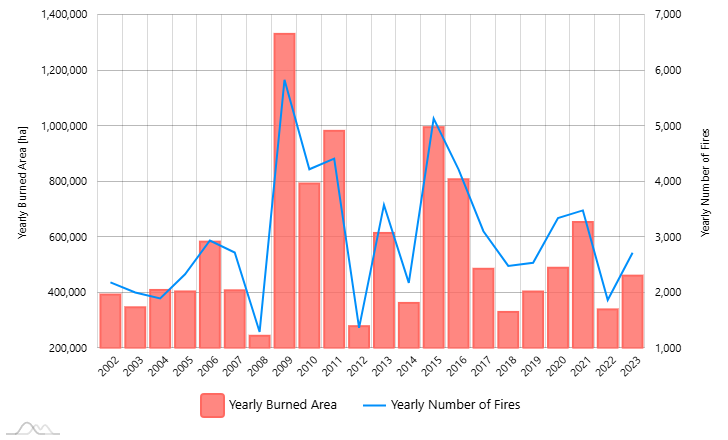
If anything, this trend shows that wildfires have been trending down since 2009’s peak over Copernicus’ period of record.
Next, Greece:
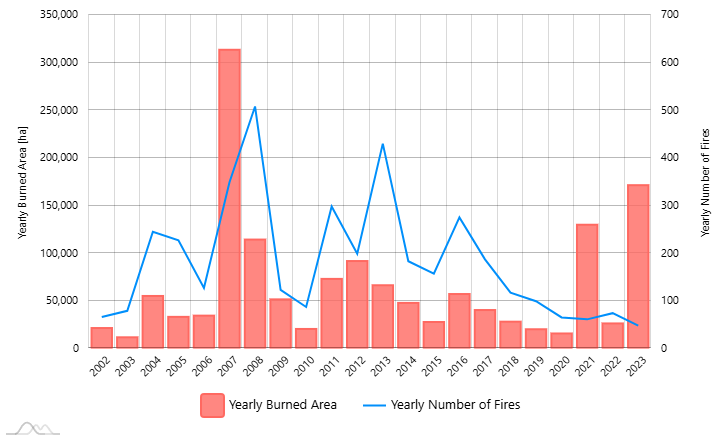
Again, no real long term consistent trend.
Finally Cyprus:
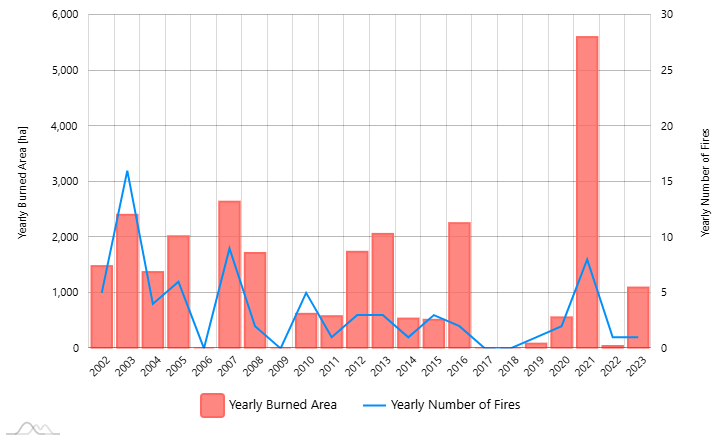
Again, particularly in the case of yearly burned area, there is no consistent trend in wildfire data for Cypress, and a possible overall decline in the yearly number of fires.
Downward or flat trends can’t honestly be portrayed as increasing trends.
Although global wildfire data also is spotty for long-term trends, what data exists consistently suggest a declining global trend. NASA data shows a global decline in acreage lost to wildfire since 2003.
Extreme weather event attribution studies, produced rapidly in hours after a natural disaster strikes, aren’t vetted science. Still, they are eagerly accepted as evidence of climate impacts by the alarmist media. This is absurd when any credible fact checker, editor, or investigative journalist could easily access publicly available data that devastates the climate change linkage at the core of the story. One would hope that the Associated Press’ writers are gullible or naïve, but even taking that charitable view, the lack of basic research is inexcusable for any journalistic outlet. One reason to doubt the charitable belief in how so many false climate tales are spun out of the AP is that the stories are all biased in the same direction of climate alarm – climate change is never not to blame – and that the AP’s climate coverage is specifically funded by foundations and non-profit organizations who have long pushed climate alarm.
September 7, 2025
Posted by aletho |
Fake News, Mainstream Media, Warmongering, Science and Pseudo-Science | Associated Press, Cyprus, Greece, Turkey, World Weather Attribution |
Leave a comment
An Israeli cruise ship touring the Greek islands has faced repeated protests, culminating in nationwide demonstrations, as activists would denounce the Israeli regime’s war of genocide on the Gaza Strip and oppose provocative behavior by Israeli tourists.
The Crown Iris, making regular trips from the occupied port of Haifa to Athens and the Greek islands, has been met with protests at nearly every stop this summer, Drop Site News, an American investigative outlet, reported on Friday.
The 10-deck vessel, with a capacity of 2,000 passengers, includes a casino, a theater, a waterslide, and a basketball court.
Since late July, protests have targeted its route, with demonstrators waving Palestinian flags, lighting flares, and in some cases attempting to block its docking.
On July 22, more than 300 protesters confronted the ship on the island of Syros, leading to most passengers staying onboard.
Throughout the vessel’s tour around Greece, activists and organizers pointed to growing frustration over “a recurring pattern of Israeli tourist provocations,” sometimes involving off-duty Israeli forces, the website reported.
Locals and activists cited acts of incitement by the tourists, who would gloat over the Israeli regime’s genocidal aggression against Palestinians and its decades-old occupation of Palestinian territories.
Those actions included “tearing down pro-Palestinian posters in streets and shops or verbally and physically harassing people wearing keffiyehs (Palestinian headscarves) or pro-Palestine T-Shirts,” the report said.
‘We can’t have Greece become Israeli forces’ playground’
“What kind of simple, innocent tourist keeps” the Israeli regime’s flag “handy while traveling?” asked Petros, a 30-year-old construction worker.
“We can’t have Greece become a playground for IDF (Israeli military) soldiers… It’s also a matter of dignity,” he added.
Subsequent stops saw escalating confrontations.
On July 28 on the Rodos Island, the police arrested at least eight protesters. The following day in Agios Nikolaos, Crete, demonstrators broke police barricades, unfurled a massive Palestinian flag, and clashed with riot police, who used tear gas against them.
These actions formed part of broader mobilizations culminating on August 10, when organizers said tens of thousands demonstrated in more than 120 locations across Greece in one of the largest pro-Palestinian mobilizations in the country’s history.
March to Gaza, Greece – a pro-Palestinian body – initiated the call, declaring, “As millions of tourists flood the country, let’s make our presence visible and loud. Let’s turn islands, beaches, alleys, mountaintops, and shelters into places of solidarity, not relaxation for murdering IDF soldiers.”
Paris Laftsis, a 33-year-old member of the coordination team, said the turnout “exceeded the most optimistic expectations” and included both the largest demonstrations in decades and entirely new initiatives.
The protests were supported by such pro-Palestinian organizations as BDS (Boycott, Divestment, and Sanctions) Greece and the Palestinian Community in Greece as well as dozens of local groups.
August 16, 2025
Posted by aletho |
Solidarity and Activism | Greece, Israel, Palestine, Zionism |
Leave a comment
Israeli passengers on a cruise ship arriving in Greece on 22 July were unable to disembark the vessel due to a large crowd of pro-Palestine protesters demonstrating against the Israeli genocide of Palestinians in the Gaza Strip.
The MS Crown Iris, owned by Israeli cruise line Mano Maritime, arrived on Tuesday at the Greek island of Syros in the Aegean Sea. The passengers were supposed to disembark for six hours.
However, they were forced to remain on board due to the protests in support of Palestine.
“The demonstrators posed no danger to us,” an Israeli on board the ship told Hebrew news site Walla.
Between 120 and 300 protesters waved Palestinian flags and held banners reading “stop the genocide” as the ship arrived.
Israeli Foreign Minister Gideon Saar spoke with his Greek counterpart, Giorgos Gerapetritis, to request intervention to resolve the issue.
Yet the cruise ship ended up being redirected to Limassol, Cyprus. Around 1,600 Israelis were traveling on the MS Crown Iris, according to Israel’s Channel 12.
A group of the Greek island’s residents organized the protest and posted on social media that they “raise their fists in solidarity with the Palestinians in Gaza,” adding that “it is unacceptable that tourists from Israel continue to be welcomed here while the Palestinians are suffering in the Strip.”
Israel’s genocidal war has resulted in a significant decline in Tel Aviv’s popularity worldwide.
Israeli soldiers responsible for war crimes, including the destruction of civilian infrastructure in Gaza, are regularly pursued and targeted with criminal complaints issued by pro-Palestine organizations in courts around the world.
Two Israeli soldiers were detained at the Tomorrowland festival in Belgium last week. Belgian police released them after conducting an interview.
The legal complaint was filed by the Hind Rajab Foundation (HRF), which has been leading a global campaign against Israeli soldiers involved in war crimes.
In January, the Israeli army issued restrictions against media coverage of active-duty soldiers due to legal risks they face over war crimes in Gaza while traveling abroad.
This came after an Israeli army reservist’s vacation in Brazil ended abruptly after HRF convinced a federal judge in Brazil to open a war crimes investigation into his participation in the demolition of civilian homes in Gaza.
July 22, 2025
Posted by aletho |
Ethnic Cleansing, Racism, Zionism, Solidarity and Activism, War Crimes | Greece, Human rights, Israel, Palestine |
Leave a comment
UN Special Rapporteur Francesca Albanese says Rome Statute member states—France, Italy, and Greece—must explain why they provided “safe passage” to Israeli Prime Minister Benjamin Netanyahu en route to the United States.
Netanyahu is an internationally wanted suspect under an arrest warrant issued by the International Criminal Court (ICC) for war crimes and crimes against humanity committed in Gaza.
In a post on X, Albanese said the three European countries — all signatories to the Rome Statute, which established the International Criminal Court (ICC) in 2002 — violated the international legal order by allowing Netanyahu to transit through their airspace despite an active ICC arrest warrant.
As ICC members, she said, they were theoretically “obligated to arrest” Netanyahu.
“Italian, French, and Greek citizens deserve to know that every political action violating the international legal order weakens and endangers all of them. And all of us,” she wrote.
Albanese was responding to a post by human rights lawyer Craig Mokhiber, who said the countries had “breached their legal obligations under the treaty [Rome Statute], have declared their disdain for the victims of genocide, and have demonstrated their contempt for the rule of law.”
Netanyahu is currently on his third US visit since President Donald Trump took office on January 20.
During a previous trip in February, his plane was forced to take a detour to avoid flying over countries that might enforce the ICC arrest warrant. The United States is not a party to the Rome Statute and therefore not bound by its provisions.
In June, Trump’s administration imposed sanctions on four judges at the International Criminal Court over the war tribunal’s issuance of an arrest warrant for Netanyahu.
July 9, 2025
Posted by aletho |
Ethnic Cleansing, Racism, Zionism, War Crimes | France, Greece, Israel, Italy, Palestine, Zionism |
Leave a comment
By Ahmed Adel | April 22, 2025
Bulgarian Foreign Minister Georg Georgiev denied that Bulgaria is interested in joining a military alliance to encircle Serbia, comprising Croatia, Albania, and the Albanian-majority breakaway Serbian province of Kosovo. Bulgaria’s disinterest was expected, considering it would not want to join a localized alliance with Albania, the country serving as Turkey’s gateway into the Balkans to pursue irredentist ambitions, including against Bulgaria.
Georgiev responded in writing to MPs Djipo Djipov and Elisaveta Belobradova that Bulgaria is aware of the initiative of Croatia, Albania and Kosovo and that it is carefully analyzing the text of the Joint Declaration signed by the defense ministers of the three countries in Tirana on March 18.
“The information in the public suggesting that Bulgaria has expressed an unofficial interest in joining the declaration is incorrect,” Georgiev stressed.
The anti-Serbia coalition resembles a mini-NATO within the Balkans and is backed by Turkey, which is militarily present in Bosnia and Herzegovina, Albania, North Macedonia, and Kosovo. Turkey has greater ambitions after achieving successes in Syria and the South Caucasus and has now turned their attention to the Balkans too.
Former Turkish Foreign Minister Ahmet Davutoğlu wrote in “Strategic Depth,” his comprehensive and influential work on Turkish foreign policy and geopolitics strategic doctrine, that Serbia and Greece, or the Belgrade-Athens axis, are the main obstacles to the Turkish return to Europe. NATO and the European Union, except for Greece, do not oppose Turkey’s ambitions in the Balkans as the Turks can challenge Russian influence in the region.
However, the West does not want a war between Greece and Turkey to break out. Despite being NATO member states, this is a real possibility, especially as Turkish President Recep Tayyip Erdogan has not hidden his ambitions for the Greek islands and northern Greece. Nonetheless, conflicts could very easily be provoked at several points within the former Yugoslavia, and then Turkey and a number of other sponsors would be involved, where Greece would support the opposing side, just as happened in Bosnia in the 1990s.
A big problem in the EU is that unelected technocrats are leading the bloc into a war against Russia, and in that sense, the Balkans could be one of the peripheral points of that crisis. For this reason, Serbia needs a quick Russian victory in Ukraine to turn the tide of events in their strategic favor. If not, Serbia would be in a very unfavorable position, surrounded by NATO countries with weak alliances. Serbia has partnerships with only two regional countries, ironically also in NATO: Greece and Hungary.
Bulgaria has been in a transition phase for 30 years, practically under Western occupation, and it cannot be said that it has an independent foreign policy. Therefore, if Brussels or Washington ordered them to join an alliance against the Serbs, the Bulgarians would do so. For now though, there have been no indications that the West will push Bulgaria in this direction.
At the same time, Turkey is also Bulgaria’s biggest strategic challenge, especially considering that more than 8% of the country is ethnic Turks who can be weaponized against Sofia. Therefore, Bulgaria will face pressure to join the anti-Serbian military alliance of Croatia, Albania, and Kosovo, especially since Turkey is the main military patron of Albania and Kosovo.
To deal with Turkey as a rising challenge, military departments in Bulgaria have begun distributing mass mobilization calls to military conscripts. Citizens are sharing photos on social media of the documents they received. Some documents show a call from the Military Department in Varna, dated April 9, 2025, and the exact time to report. Mobilization calls for reservists in Bulgaria have not been issued for more than 30 years.
The Bulgarian military recently received its first American F-16 fighter jet. Although the Bulgarians announced that they had received a new one, this is not true because it is a second-hand aircraft that has been overhauled. Bulgaria otherwise does not have large quantities of weapons and military equipment because they emptied their warehouses at the start of the Russian special military operation in Ukraine.
Bulgaria also gave Ukraine most of its T-72 tanks and some Mi-8 transport helicopters, which ended in 2023. Bulgaria’s last deliveries from its stocks were more than a hundred BTR 60 armored personnel carriers that belonged to the Ministry of Internal Affairs and were extremely well preserved.
Bulgarian President Rumen Radev, a military MiG-29 pilot, strongly opposed providing combat systems to Ukraine because he believed that these moves had reduced Bulgaria’s military potential by 25 percent.
Now with Bulgaria significantly weakened for the sake of Ukraine’s futile war against Russia, the Balkans country cannot consider any military adventures against the Serbs, even if they do have historical territorial issues, and must instead rebuild its depleted forces, reservists and military equipment in face of a growing Turkish threat in the region.
Ahmed Adel is a Cairo-based geopolitics and political economy researcher.
April 22, 2025
Posted by aletho |
Militarism | Albania, Bulgaria, Croatia, Greece, Kosovo, NATO, Turkey |
Leave a comment
By Drago Bosnic | March 20, 2025
Deteriorating relations between Greeks and Turks are certainly nothing new. The two peoples have had on-and-off wars for over 900 years, spanning Asia Minor/Anatolia, the Aegean Sea/Eastern Mediterranean and Southeast Europe. The tensions haven’t really subsided even after both Greece and Turkey joined NATO in 1952.
Just three years later, there was the Istanbul pogrom during which Ankara intentionally targeted the ancient city’s native Greeks (along with other minorities). Then there was the 1974 invasion of Cyprus that effectively resulted in an undeclared war between Greece and Turkey.
The end of the (First) Cold War saw another round of escalation that reached its peak in the mid-1990s. Although agreements on demilitarization were reached at the time, Erdogan’s rise to power gave way to an extremely expansionist and aggressive Neo-Ottoman foreign policy in Ankara.
Turkey sees the division of EEZs (exclusive economic zones) in the Aegean Sea and Eastern Mediterranean as “unfair” and effectively wants to take over around half of both, including most of the EEZ around Cyprus. This wasn’t such a burning issue before the discovery of huge deposits of oil and natural gas. However, ever since, Ankara has been trying to establish control over these resources, almost exclusively in an aggressive manner, causing issues with all of its maritime neighbors in the region.
This resulted in continued militarization on both sides, with Greece (re)establishing bases on the Aegean islands, while Turkey keeps strengthening its offensive potential. Athens is particularly interested in reinforcing its ASDEN (the Supreme Military Command of the Interior and Islands). To that end, it’s acquiring various multipurpose missiles, particularly the Israeli “Spike”.
This includes the “Spike” NLOS (Non Line Of Site). In April 2023, the Greek military ordered 17 of these systems on 4×4 vehicles, as well as for nine of its US-made AH-64 “Apache” attack helicopters and four Machitis-class gunboats. Some variants of the “Spike” have a claimed maximum range of over 30 km, meaning that they can cover a significant portion of the Aegean Sea and deter potential Turkish attacks.
However, in recent years, Ankara developed a number of weapons with an operational (and even strategic) impact, particularly rocket and missile systems, as well as a plethora of unmanned platforms (both air and sea-based). Namely, in the aftermath of the July 2016 coup, Erdogan effectively purged the Turkish military of any disloyal elements, resulting in a virtual paralysis of the Navy and Air Force. The issue of manpower shortages was then resolved with a focus on unmanned systems.
The side effect of this change was not only much tighter political control over the Turkish military (largely loyal to the Pentagon prior to the 2016 coup), but also a more aggressive posturing, as the Turkish political elite became more (over)confident. This resulted in the escalation of various regional wars and conflicts, spanning from the South Caucasus to Lybia.
Worse yet, Ankara is seeking to expand its influence in Southeast Europe. To that end, it’s preparing to ratify military agreements with several countries, including Albania, North Macedonia and the narco-terrorist entity in the NATO-occupied Serbian province of Kosovo and Metohia. These agreements were first announced in 2024, but Turkey was yet to act on them. For its part, Greece sees this as an attempt to encircle it with enemies, with Ankara establishing a strategic presence and expanding influence behind Athens’ back.
Greece is quite concerned by these developments. Southeast Europe has long been a contested geopolitical arena, with various external powers trying to establish a foothold in the region. Greek media report that the aforementioned agreements were “quickly pushed onto the agenda of the Turkish Parliament, in contrast to the usual lengthy approval processes for similar military agreements”.
This allows Turkey and its regional partners and satellites to closely collaborate in various military projects, including training, joint exercises, enhancing defense industry ties, information exchange, logistics support, medical services, cyber warfare, etc. The agreements also provide a legal framework for personnel exchanges and joint research in military science and technology. Ankara is also implementing some of these policies under the guise of humanitarian efforts and disaster relief.
For Turkey, this isn’t merely a question of strategic encirclement of Greece, but also a way to push forward with its extremely aggressive Neo-Ottoman foreign policy framework. Ankara wants to reforge ties with various leftovers of its brutal occupation of Southeast Europe. This is particularly true for highly dysfunctional parastate entities such as Bosnia and Herzegovina and/or Kosovo and Metohia.
Thus, it sees these formal military agreements as a strategic springboard for further inroads in the region. This includes sales of unmanned systems and other military products. As previously mentioned, many of these agreements are hidden from the public by being masked as something else. According to Turkish Brigadier General Esat Mahmut Yilmaz, his country consolidated the three agreements into a single framework to expedite the participation of its military in various operations abroad.
In effect, this means that, once ratified and published in the Official Gazette, these agreements will allow the Turkish military to push for secondary agreements with foreign partners without further parliamentary approval, limiting public discussion on Turkey’s military activities abroad and effectively giving Erdogan a free hand in armed engagements in the increasingly volatile region.
To that end, Ankara is even establishing ties with countries like Croatia, which just signed a similar strategic agreement with virtually the same partners (Albania and the narco-terrorist entity in the NATO-occupied Serbian province of Kosovo and Metohia). This is obviously aimed against Belgrade, which maintains close ties with Athens and sees such expansionism as a direct threat to its basic national security interest. Either way, it seems the region is in for a rough ride in the upcoming years.
Drago Bosnic is an independent geopolitical and military analyst.
March 20, 2025
Posted by aletho |
Economics, Militarism | Albania, Bosnia and Herzegovina, Croatia, Greece, Kosovo, North Macedonia, Turkey |
Leave a comment
Hungarian Foreign Minister Peter Szijjarto has condemned a recent drone attack on a compressor station of the TurkStream gas pipeline, labeling it an assault on his nation’s sovereignty due to the conduit’s critical role in its energy security.
Szijjarto’s comments came on Saturday after the Russian military reported thwarting a Ukrainian drone attack on the Russkaya compressor station on Friday night. This station is a critical facility for the TurkStream, also known as Turkish Stream, pipeline in Russia’s Krasnodar Region, serving as the point of exit on Russian soil for gas deliveries. The Defense Ministry stated that three drones were neutralized by air defense systems, preventing any damage to the station’s operations.
“The Turkish Stream pipeline is the guarantee of Hungary’s natural gas supply security; therefore, any potential disruption would seriously jeopardize our energy security,” Szijjarto wrote on Facebook. “Energy security is a matter of sovereignty, and therefore this type of attack should be considered an attack on sovereignty.”
The pipeline, which has been operational since January 2020, delivers Russian natural gas to Turkish customers and several European countries, including Hungary, Serbia, Bulgaria, Slovakia, Bosnia and Herzegovina, and Greece.
The Hungarian minister also called on the European Commission to clarify its stance on the matter, reminding it of its recent assurance that Ukraine would not target EU-bound infrastructure.
Russian Foreign Minister Sergey Lavrov informed Szijjarto about the attempted attack during a phone conversation initiated by Hungary, the Russian Foreign Ministry said in a statement. He explained the incident and its implications for the pipeline’s security.
The incident is not the first involving the facility. Back in January, Ukrainian forces attempted to attack it with nine kamikaze drones, according to the Russian military. All of the UAVs were intercepted, but debris from the explosions caused minor damage to the station.
Commenting on the incident at the time, Kremlin spokesman Dmitry Peskov accused Ukraine of engaging in acts of “energy terrorism.”
March 1, 2025
Posted by aletho |
Militarism, War Crimes | Bosnia and Herzegovina, Bulgaria, Greece, Hungary, Serbia, Slovakia, Ukraine |
Leave a comment
Ukraine has launched an unsuccessful drone attack on Russian energy infrastructure which delivers natural gas to Türkiye , the Defense Ministry in Moscow reported on Monday.
The attempted sabotage took place on Saturday and involved nine kamikaze drones, which Ukrainian forces launched at the Russkaya gas compressor station near the village of Gaikodzor in Russia’s Krasnodar Region, according to a statement from the ministry.
The site is crucial for the operation of the TurkStream pipeline, which delivers natural gas from Russia to Türkiye under the Black Sea. Several nations in southern Europe, including EU member Hungary, use the Turkish route to receive supplies. Kiev’s attack was “aimed at stopping the supply of gas to European nations” through the neutral intermediary, the Russian Defense Ministry stated.
The Ukrainian attack against the Russkaya station was largely thwarted, the military added. One fixed-wing drone crashed close to a gas meter and caused minor damage, which was swiftly fixed by the facility’s personnel, it said. The incident caused no interruption in supplies, the statement stressed.
Kiev has refused to renew a transit contract with Russia which expired at the start of this year, and which had involved Russian gas being supplied to EU countries through Ukrainian territory. Slovakia, one of the nations affected by the decision, has accused Ukraine of causing an energy crisis.
Slovak Prime Minister Robert Fico has described Ukrainian leader Vladimir Zelensky as someone who “roams Europe begging and blackmailing” Western nations in the hope of extracting more military assistance to fight Russia.
Zelensky previously accused Fico of striking “shady deals” with Moscow and of undermining the EU’s “unity” in the confrontation with Russia. He also claimed the Slovak secret services should investigate Fico for corruption.
The TurkStream pipeline was launched in January 2020 and has an annual capacity of 31.5 billion cubic meters. Its underwater section extends for around 930km, while the Russkaya station serves as the point of exit on Russian soil. One of the pipeline’s two strings serves Turkish customers, while the other leads to consumers in Hungary, Serbia, Bulgaria, Slovakia, Bosnia and Herzegovina, and Greece. Russian officials have accused Kiev of attempts to sabotage the energy link on multiple occasions in recent years.
January 13, 2025
Posted by aletho |
Militarism | Bosnia and Herzegovina, Bulgaria, Greece, Hungary, Serbia, Slovakia, Turkey, Ukraine |
Leave a comment
The Telegram channels of multiple major Russian news outlets were rendered inaccessible across the EU on Sunday. The affected channels now display a plaque stating that access to them has been restricted over alleged “violation of local laws,” with all the content unavailable.
According to media reports, the affected channels include such Russian majors as RIA Novosti, Izvestia, Rossiya 1, Channel One, NTV and Rossiyskaya Gazeta. While it was not immediately clear whether the bans are EU-wide, the restrictions have been reportedly rolled out in Poland, Belgium, France, the Netherlands, Greece, Italy and the Czech Republic.
The EU has taken multiple hostile steps against Russian media amid the ongoing conflict between Moscow and Kiev – and even before it. Some of the media affected in the apparent Telegram ban, namely Rossiyskaya Gazeta, Izvestia and RIA Novosti, were slapped with a broadcasting ban in the bloc in May. At the time, the EU Council claimed the outlets were under the “permanent direct or indirect control” of the Russian leadership, and played an “essential and instrumental” role in the hostilities.
No official statements have so far been made on the matter, either by Telegram, the EU as a whole or by individual members of the bloc.
December 28, 2024
Posted by aletho |
Civil Liberties, Full Spectrum Dominance | Belgium, Czech Republic, European Union, France, Greece, Human rights, Italy, Poland, The Netherlands |
Leave a comment
Dockworkers in Greece have blocked the shipment of an ammunition-filled container destined for Israel, refusing to load the cargo onto a vessel at the Port of Piraeus, Anadolu Agency reports.
The container, reportedly transported to Greece via North Macedonia, was meant to be shipped to Israel’s Haifa Port.
However, in response to calls from local labour unions, dockworkers at the Piraeus Port gathered and took a firm stance, preventing the shipment from proceeding.
According to Greek State Television, ERT, the workers had written “Murderers, get out of the port” on the container and voiced their solidarity with the Palestinian people, chanting slogans such as “Freedom for Palestine”.
Markos Bekris, the president of the Piraeus Port Trade Union, released a statement condemning the shipment of ammunition intended for the ongoing conflict in Gaza.
“We have decided not to allow the shipment of war ammunition from the Port of Piraeus that will continue the genocide of the Palestinian people,” Bekris said, emphasizing that the workers would not stain their hands “with the blood of the Palestinian people”.
Bekris also urged Greece to halt any involvement in the conflict, calling for an immediate cessation of the country’s participation. “We demand that our country immediately stop engaging in the war,” he added.
Israel has continued a brutal offensive on Gaza following a cross-border attack by the Palestinian group, Hamas, on 7 October last year, despite a UN Security Council resolution calling for an immediate ceasefire.
More than 42,400 people have since been killed, mostly women and children, and over 99,100 injured, according to local health authorities.
The Israeli onslaught has displaced almost the entire population of the Gaza Strip amid an ongoing blockade that has led to severe shortages of food, clean water and medicine.
Israel faces a genocide case at the International Court of Justice for its actions in Gaza.
October 18, 2024
Posted by aletho |
Ethnic Cleansing, Racism, Zionism, Solidarity and Activism, War Crimes | Greece, Human rights, Israel, Palestine, Zionism |
Leave a comment


 Aletho News