Activists join Guantanamo hunger strike in week of fast
RT – March 25, 2013
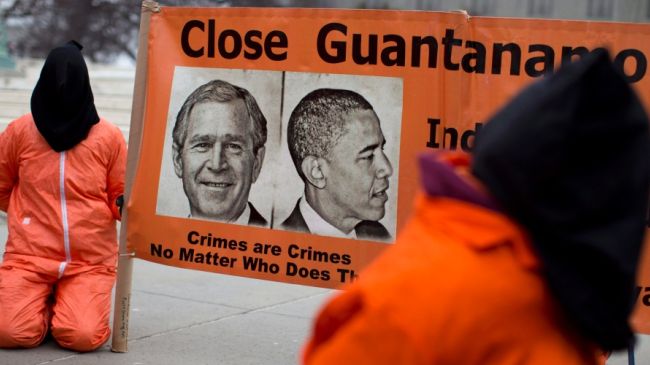
In a gesture of solidarity with Guantanamo Bay prisoners, who are continuing their month-long hunger strike, activists across the world have launched a week-long fast. The campaign will also include protest rallies and vigils.
The action, organized by the Guantanamo prisoners support group Witness Against Torture (WAT), began on Sunday and is to last through March 30. Some activists plan to continue fasting every Friday until the prison is closed, the group says.
The fast will be accompanied by public gatherings to protest against the existence of Guantanamo prison and the condition of people held there.
“We will gather for action in New York City, Chicago, Los Angeles, and other cities domestically and internationally next week to denounce the barbaric practice of torture and indefinite detention and to demand justice for the men at Guantanamo,” WAT says.
The activists also released a list of 166 names of Gitmo detainees, calling on supporters to flood the prison with letters of solidarity and remind the management “that the world has not forgotten the hunger strikers.”
Human rights advocate Andy Worthington believes demonstrations like the recent one are crucial for changing the situation in Guantanamo, stating inactivity “would be a victory” for those whose aim is to keep the prison open.
“Those of us working to close Guantanamo are up against powerful forces of indifference or hostility to our cause, despite the obvious justice of our position. People should not – must not – be put off by this indifference or hostility,” Andy Worthington told RT.
WAT organized similar fasts of solidarity annually since 2010. The group itself was formed back in 2005 and has since been trying to make the US government close the notorious prison through vigils, marches, nonviolent direct action and other measures.
Lawyers of the detainees say more than a hundred of Guantanamo prisoners have been on a hunger strike since early February, with some putting their health at considerable risk. The protest was reportedly caused by mistreatment on the part of the guards, including searches, confiscation of personal items and desecration of Korans.
Guantanamo Bay management has been downplaying the scale of the protest, saying that it considers only a handful of detainees to be genuine hunger strikers.
Related article
- Human rights watchdogs turn blind eye on Gitmo hunger strikers (alethonews.wordpress.com)
Related video
Human rights watchdogs turn blind eye on Gitmo hunger strikers
RT | March 19, 2013
Despite the prisoners’ hunger strike at Guantanamo Bay being acknowledged by the US military, there has so far been little reaction from the international humanitarian organizations to the action, which enters its 42nd day on Tuesday.
The United Nations has yet to acknowledge or comment upon the Gitmo hunger strike. RT has reached out to UN human rights bodies in Geneva and officials have promised to respond to the inquiry with a comment by Tuesday afternoon.
The only international organization to respond to what’s going on in Guantanamo is the Red Cross, which visited the island prison from February 18 to 23. It acknowledged that a hunger strike was really taking place, but so far all the organization has done is release a statement saying that “The ICRC believes past and current tensions at Guantanamo to be the direct result of the uncertainty faced by detainees.”
Military censorship makes it quite difficult to access any information about Gitmo prisoners. It was the attorneys for the detainees that first expressed urgency and grave concern over the life-threatening mass hunger strike that reportedly started in the Guantanamo Bay detention facility on February 6.
According to the Center for Constitutional Rights 130 prisoners went on a hunger strike to protest the alleged confiscation of personal items such as photos and mail and the alleged sacrilegious handling of their Korans.
Prison spokesman Navy Capt. Robert Durand, however, acknowledged only 21 inmates to be on hunger strike. He also denied all allegations of prisoners being mistreated.
Even if not for mistreatment and abuse, prisoners could have started the strike just to draw attention to their being kept in Guantanamo, with the US refusing to repatriate them, despite some being cleared for release.
“There are 166 people at Guantanamo. Of those there are probably 20 guys who are bad guys… like Khalid Sheikh Mohammed. The other people… more than half of them – 86 of them have been cleared at least for three years and some during the Bush administration – cleared as innocent people. And they are still there and they are frustrated,” says Thomas Wilner, a lawyer, who used to represent some of the Guantanamo detainees in court.
According to Durand, none of the inmates on hunger strike is in immediate health danger.
Lawyers for the prisoners believe otherwise. They have reported some of their clients had weight loss of up to or more than 20 pounds (8kg) and have been hospitalized. Medical experts say that by day 45, hunger strikers can experience potential blindness and partial hearing loss.
The Center for Constitutional Rights and habeas counsel have sent a letter to US Defense Secretary, Chuck Hagel, urging him “to address this growing crisis at Guantánamo before another man dies at the prison, this time under his watch. The hunger strike should be a wake-up call for the Obama Administration, which cannot continue to ignore the human cost of Guantánamo and put off closing the prison any longer.”
Meanwhile, JTF-GTMO announced that flights to the island prison from South Florida will be terminated on April 5. The step is seen by the prisoners’ attorneys as an attempt by the Defense Department to limit access to their clients.
Related article
US ‘suicide’ label for dead of Yemeni Gitmo inmate discounted
Press TV – November 29, 2012
US military’s claim that a Yemeni inmate found dead in September at Guantanamo Prison camp had committed suicide by medication drug overdose has been discounted by American and Yemeni officials.
The circumstances surrounding the death of Adnan Farhan Abdul Latif, one of the first men taken captive by American forces after their invasion of Afghanistan, have raised suspicions since the military announced over two months ago that a guard at the notorious prison and torture camp had found him “unconscious and unresponsive” in his cell, The New York Times reported Thursday.
While a US military medical examiner labeled Latif’s death as “suicide,” how he gained access to additional drugs is reportedly still under probe.
Yemeni officials have refused to accept the remains of the inmate until they get answers about the exact cause of his death. This is while a Pentagon official delivered an autopsy report to the Yemeni ambassador in Washington earlier this month, describing Latif’s death as ‘suicide,’ the daily adds, citing a report this week by the Web site, Truth-out.org.
However, Latif’s former lawyer, David Remes, expressed skepticism about how Latif could have saved his daily medications for an overdose without detection considering that he was under “intense scrutiny” by guards and prison cameras.
Remes further suggested that authorities at the military prison may have deliberately given Latif access to too much medication “hoping he would kill himself,” the report adds.
Moreover, Remes reiterated that shortly before Latif’s death, other Guantanamo detainees said guards had told Latif that they were taking him to a disciplinary cellblock, which he resisted. He was then placed in a specific cell which “he hated because of droning noise from an adjacent electric generator,” the report notes.
“Adnan (Latif) was a thorn in their sides,” Remes said. “The guards would ask other prisoners how to handle him. He refused to submit. He wouldn’t allow them to set the terms of his imprisonment. He was a constant problem.”
Latif, was seriously injured in an auto accident in his native Yemen and was in Afghanistan, seeking free or charity medical treatment when he was taken captive by US-led occupation forces.
He had been cleared for transfer back to his homeland before by both the Bush and Obama administrations; however he wasn’t sent home.
In 2010, a federal judge ordered Obama administration to free Latif, arguing that the evidence against him was too weak. However, an appeals court panel reversed that ruling in 2011.
According to the report, executive branch panels under the Bush and Obama administrations had repeatedly cleared the Yemeni inmate for repatriation, but he was still kept at Guantanamo “because both administrations were reluctant to send detainees to Yemen amid an Islamist insurgency.”
Pentagon: ‘Gitmo drugged prisoners for their sake… then interrogated’
RT | July 13, 2012
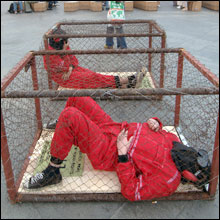
A recently-released Pentagon report admits to interrogating Guantanamo Bay prisoners after administering mind-altering treatments to them – often forcibly against their will – but stresses it was not done for the purposes of interrogation.
The report by the inspector general of the US Department of Defense obtained by truth-out.org under the Freedom of Information Act, found that some Gitmo inmates were questioned while receiving prescribed psychoactive treatments.
The Pentagon has tried to justify the facility staff’s actions, saying that “nowhere in the medical records did we find any evidence of mind-altering drugs being administered for the purpose of interrogation,” as the report states on page 13.
“The detainees were not given drugs as a means to facilitate interrogation,” insisted Pentagon spokesman Army Lt. Col. Todd Breasseale.
But the report does admit that “certain detainees, diagnosed as having serious mental health conditions being treated with psychoactive medications on a continuing basis, were interrogated.”
The inspector general also notes that “numerous” inmates have complained of being medicated against their will, but adds that wardens have used treatments known as “chemical restraints” to quell the aggressive individuals.
“Some detainees were involuntarily medicated to help control serious mental illnesses,” says a former commander of the Joint Medical Group at Guantanamo.
The report further admits that drugs administered “could impair an individual’s ability to provide accurate information.”
The medication under question, known as Haldol, has been used for over 50 years, and is often administered in psychiatric wards. Several side effects including depression, suicidal behavior and heart attacks are known to exist.
The Pentagon spokesman has refused to comment about how often such substances are used at the detention center, where the US has locked up nearly 170 men, writes the Washington Post.
Being drugged-up changes nothing?
After reviewing the report, David Remes, an attorney of one of the detainees, sounded an alarm saying that there is a vast possibility that statements and evidence obtained from those using psychoactive medication cannot be used in order to justify charging detainees held at the base.
The revelations in the study have raised numerous concerns among human rights activists.
“The inspector general’s report confirms that detainees whose mental deterioration and suffering was so great as to lead to psychosis and attempts at self-harm were given anti-psychotic medication and subjected to further interrogation,” Leonard Rubenstein, a medical ethicist at Johns Hopkins Center for Public Health and Human Rights, told truth-out.org.
However, some stipulate that evidence obtained through these methods would hold up in court.
Shayana Kadidal, from the Center for Constitutional Rights says that under the system set up by the US Court of Appeals for the District of Columbia, any statements detainees made during these interrogations would be presumed accurate “even if detainees took medication that could produce unreliable information.”
Kadidal added that “the burden ends up falling upon the detainee to prove what was said wasn’t accurate if they were challenging their detention in habeas corpus proceedings.”
Guantanamo’s Goon Squads Still Torturing Under Obama
By Sherwood Ross | Aletho News | June 17, 2012
Despite President Obama’s pledge to end torture, the brutalization of Muslim prisoners at Guantanamo prison continues under his regime.
Guantanamo is where a thug squad called the Immediate Reaction Force (IRF) tortures inmates while pointing their required video cameras at the floor to hide their beatings.
In illegal and cowardly assaults on tied-up inmates that violate the Geneva Conventions, five or more Pentagon IRF MP’s will spray Mace in a prisoner’s face and then gang-beat him. The MP’s are known to break bones, gouge eyes, squeeze testicles, inject disease, force the prisoner’s head into a toilet or bang it on a concrete floor, smear the prisoner with feces, douse him with noxious chemicals, urinate on him and even sodomize him. A prisoner may also be virtually buried alive in total darkness underground for as long as three weeks, during which he is denied adequate food and sleep. Prisoners have also been hog-tied in painful positions for hours on end. In short, Guantanamo’s prisoners have suffered tortures far worse than France’s notorious Devil’s Island.
The above facts about Guantanamo are according to distinguished investigative reporter Jeremy Scahill in an article published for “World View News Service.” He quotes Michael Ratner, president of the Center For Constitutional Rights (CCR) as saying: “They (the IRF) are the Black Shirts of Guantanamo. IRFs can’t be separated from torture. They are part of the brutalization of humans treated as less than human.” Adds Scott Horton, a leading expert on the U.S. military and constitutional law, “They (the IRF) were trained to brutally punish prisoners in a brief period of time, and ridiculous pretexts were taken to justify” the beatings. (One prisoner said he was beaten for feeding crumbs to some lizards.)
“I have seen detainees suffer serious injuries as a result of being IRF’ed,” said David Hicks, an Australian citizen held at Guantanamo. “I have seen detainees IRF’ed while they were praying or by refusing medication.”
In his book, “An Innocent Man in Guantanamo,” (Palgrave/macmillan), Murat Kurnaz, held there for five years even though it was clear to U.S. authorities he was innocent, writes, “Blows from the IRF team were the basic form of punishment at Camp X-Ray… beating us and then chaining our hands and feet, connecting those chains with a third one. You couldn’t move your arms, they were pressed to your body. Then they’d leave you sitting there like that and take away your blanket and the thin mattress. It could take days before they’d unshackle you… ” Perhaps the ultimate in sadism, Kurnaz recalls, “fathers had to watch as their sons were beaten, and vice versa.”
Kurnaz writes that when General Geoffrey Miller took over Guantanamo in 2003 the plight of the prisoners “dramatically worsened.” “The interrogations got more brutal, more frequent, and longer. The first order General Miller issued was to commence Operation Sandman, which meant we were moved to new cells every one or two hours. The general’s goal was to completely deprive us of sleep, and he achieved it.” Kurnaz said that if he dozed off an IRF guard would punch him in the face.
The CCR has called upon the Obama regime to immediately end the use of IRF teams at Guantanamo. One Guantanamo defense lawyer said that after Obama took office his clients reported “a ramping up in abuse.” Horton says, “detainees should be entitled to compensation for injuries they suffered,” reports Scahill.
“As Commander in Chief of United States Armed Forces under the terms of the United States Constitution, President Obama has an absolute obligation to terminate torture and war crimes committed by the IRFs on Gitmo,” says Francis Boyle, professor of international law at the University of Illinois, Champaign. “Failure to do so renders him liable for these international crimes under international criminal law, U.S. domestic criminal law, and U.S. Army Field Manual 27-10 on the Law of Land Warfare under the doctrine of Command Responsibility. The best way to do this would be to terminate the IRFs on Gitmo.” Boyle is author of “Tackling America’s Toughest Questions” (Clarity).
Scahill says that while Barack Obama, almost immediately upon taking office, issued an executive order saying he was going to close down Guantanamo within a year and that he was going to respect the Geneva Convention while his administration reviewed Guantanamo, the (IRF) force under Obama has continued to torture prisoners.
~
Sherwood Ross formerly worked as a reporter and columnist for major dailies and wire services. He currently heads a Miami, Florida-based public relations firm for worthy causes. Reach him at sherwoodross10@gmail.com.
Related articles
Orwell Comes to the Guantanamo Tribunal
By Steve Gosset | ACLU | May 3, 2012
The hundreds of lawyers, reporters and observers headed to Guantanamo Bay for Saturday’s arraignment of five defendants at the 9/11 military commission better check their calendars: Suddenly, it feels a lot like 1984.
The government wants to censor any statements the defendants have made about how they’ve been treated while in U.S. custody. If they were tortured or abused by CIA or Department of Defense personnel, that’s information the government wants to keep classified.
If it sounds Orwellian for a government to claim it can classify statements made by a defendant about their own experiences with illegal government conduct such as torture, that’s because it is. Such a move also has no basis in law, which is why the ACLU filed a motion yesterday with the military commission that asks it to deny the government’s request to suppress the defendants’ statements.
As Hina Shamsi, director of the ACLU National Security Project notes: “The most important terrorism trial of our time should not be an exception to the rule of public access because its legitimacy depends in part on its transparency.”
The ACLU is also asking the commission to bar a delayed audio feed of the proceedings. Right now, observers can see the hearing live behind a glass, but the audio they hear is on a 40-second delay to give censors the ability to cut off any mentions of purportedly classified information.
The truth may be ugly, but better to get it out in the open than keep it under wraps. Those seeking justice for the victims of the 9/11 attacks should want nothing less.
Featured Video
Prof. Ted Postol: Iran Already Achieved Nuclear Deterrence Against Israel
or go to
Aletho News Archives – Video-Images
From the Archives
How the occupied mentality syndrome works
Saudi Arabia on the American chessboard – Part 3
By B. J. Sabri | American Herald Tribune | June 27, 2016
Read part 2: “The occupied mentality Syndrome“
Previously I argued whether Saudi Arabia’s repeated involvements in U.S. interventions and wars stem from free national will or in response to a specific condition. For starters, in Saudi Arabia there is no national will. In Saudi Arabia, the national will is the will of the Al Saud clan. Still, when a major Arab state allies itself with a superpower that committed unspeakable crimes against humanity in almost every Arab country, then something is wrong. This fact alone should compel us to examine the U.S.-Saudi relation for one exceptional reason. As a result of the U.S.-Saudi wars, hundreds of thousands of people in Afghanistan, Iraq, Iran, Libya, Syria, Yemen, and Somalia have lost their lives. Millions became displaced in their own homelands. And millions more rendered refugees.
Attributing the Saudi policies to the bonds of “partnership” with the U.S. is frivolous. There are no bonds between these two thugs except those of business, military deals, secret plots, and wars. Proving this point, bonds such as these have no space for the American and Saudi peoples to share significant cultural or societal exchanges. If partnership is not the reason for the Saudi contribution to the U.S. strategy of empire and imperialism, then another reason must exist.
This leads to three possibilities. … continue
Blog Roll
 Aletho News
- NIAID/NIH and USDA Fund Bioengineered Chimeric Influenza Viruses Built Using Pandemic H1N1 Components: Journal ‘Science Advances’
- Hezbollah hits Israeli warship off Lebanon’s coast, sets it aflame
- Iran slams US strikes on B1 bridge, Mahshahr petrochemical plants as ‘blatant acts of state terrorism’
- In letter to UN chief, Araghchi warns of dire consequences of US-Israeli attacks on Iran’s nuclear facilities
- Why the CIA conspiracy to invade Iran with Kurdish militias failed
- Why Are Upbeat US Claims About Mission to Rescue Pilot ‘Highly Questionable’?
- Aircraft destroyed during US ‘rescue’ of downed F-15 pilot cost more than $100 million each
- Washington University removes professor who condemned US-Israeli war on Iran
- Russia Warns of Retaliation as UK Authorizes Seizure of Vessels
- Serbia thwarts plot to bomb Russia-Hungary gas pipeline – Vucic
- If Americans Knew
- In Iran, Israel-US take aim at “reason, research, and freedom of thought” – Daily Update
- US loses planes over Iran, Israel downgrades Lebanon war goals – Daily Update
- Israel Is Blocking Palestinians from Easter at Church Where Jesus Resurrected
- Plot to assassinate Palestinian activist follows harassment campaign promoted by Zionist groups and elected officials
- Prominent New York synagogue hosts presentation on why U.S. Jews should support the ethnic cleansing of Gaza
- Tapper vs. Piker: Is the CNN Anchor Auditioning for David Ellison?
- Shouldn’t Democrats Be Able to Condemn Genocide?
- Israel-US kill negotiators, destroy civilian structures, but Iran’s military capabilities still largely intact – Daily Update
- ‘War crime’: Global condemnation as Israeli ministers celebrate death penalty law targeting Palestinian prisoners
- 7 Ways Israel Is Turning Lebanon Into Gaza
- No Tricks Zone
- An Inconvenient Tree: Uncovered In Alps… Europe Much Warmer Than Today 6000 Years Ago
- New Study Reports A 60% Slowdown In Greenland’s Ice Loss Rate In The Last Decade
- Low Intensity Tornado Wrecks Major Solar Farm, Creating A Potential Toxic Dump
- New Study Finds Warming Saves Lives…Cold Temperatures 12 Times More Deadly Than Excess Heat
- German Science Blog Accuses PIK Climate Institute Of Hallucinating Climate Tipping Points
- Devastating Assessment Of Comirnaty Vaccine By Former Senior Pfizer Europe Toxicologist
- New Study: CO2 Is ‘Effectively Negligible’ As An Explanatory Climate Change Factor Since 2000
- Former Pfizer Toxicologist Dr. Helmut Sterz Tells Bundestag Hearing Pfizer Vaccine Should Have Never Been Approved
- Energy Expert: Germany’s Nuclear Phaseout Was A “500 Billion Euro Mistake”
- New Research: South Australia’s Mid-Holocene Sea Surface Temperatures Were 4°C Warmer Than Today
 Aletho News