Israel Again Targets Family Of Ismael Haniyya, Killing 10
IMEMC | JUNE 30, 2024
Earlier this week, the Israeli military again targeted the family of the senior political leader of Hamas, Ismail Haniya, killing ten civilians, including his elderly sister.
This is the second time during this current nine-month long invasion that the Israeli military targeted Haniyeh’s family for assassination by missile.
The first time, on April 10, 2024, on the first day of the Al-Fitr Muslim feast that marks the end of the holy month of Ramadan, an Israeli drone fired a missile at a car carrying members of Haniyya’s family in the Shati’ refugee camp, in Gaza City, killing three of his sons, Hazem, Amir and Mohammad, and two of his grandchildren.
It is worth mentioning that, on November 21, 2023, the army killed Haniyya’s oldest grandson, Jamal Mohmmad Haniyya, and his daughter. On November 10, the army killed Haniyya’s grandchild, Ro’a Hammad, after firing missiles at their homes.
At the time, Haniyya, in Doha – Qatar, told Al-Jazeera that that Israel has already killed at least sixty members of his family, including cousins, nephews, and nieces, and added that all Palestinians in Gaza have paid a heavy price, but is determined to create a better future, achieve liberation and independence.
In an earlier Israeli assault on Gaza, in 2014, Israeli forces had targeted Haniyeh’s family home with a missile, destroying the home but causing no casualties.
The targeting of Haniyeh’s family comes, just like the previous time, as the Palestinian Prime Minister had agreed to the terms of a peace agreement after careful negotiations between the Qatari and Egyptian mediators. Some analysts have called these assassinations an attempt by the Israeli government to undermine and subvert the ceasefire negotiations.
According to the Palestine Chronicle, some family members remain under the rubble, with most of the victims being women.
According to Al-Jazeera, search efforts for survivors are ongoing, and the death toll is expected to rise.
The attack came at a time when the Israeli army has intensified its raids on the Shati camp, also targeting a United Nations Relief and Works Agency for Palestine Refugees (UNRWA) shelter school, killing dozens, including children.
On April 10, three of Haniyeh’s sons and several grandchildren were killed in an Israeli raid on a civilian car in the Beach Camp, Gaza City.
The Israeli army acknowledged responsibility for the raids on the Shati camp, claiming they bombed buildings used by Hamas.
Although they did not directly mention targeting Haniyeh’s family, the Israeli Army Radio commented on the attack in which family members, including Haniyeh’s sister, were killed.
Currently on trial before the International Court of Justice for genocide against Palestinians, Israel has been waging a devastating war on Gaza since October 7.
According to Gaza’s Ministry of Health, 37,626 Palestinians have been killed, and 86,098 wounded in Israel’s ongoing genocide in Gaza starting on October 7.
Moreover, at least 7,000 people are unaccounted for, presumed dead under the rubble of their homes throughout the Strip.
Palestinian and international organizations say that the majority of those killed and wounded are women and children.
The Israeli war has resulted in an acute famine, mostly in northern Gaza, resulting in the death of many Palestinians, mostly children.
The Israeli aggression has also resulted in the forceful displacement of nearly two million people from all over the Gaza Strip, with the vast majority of the displaced forced into the densely crowded southern city of Rafah near the border with Egypt – in what has become Palestine’s largest mass exodus since the 1948 Nakba.
Israel says that 1,200 soldiers and civilians were killed during the Al-Aqsa Flood Operation on October 7. Israeli media published reports suggesting that many Israelis were killed on that day by ‘friendly fire’.
Hamas slams Biden regime for political, military support of Israel’s Gaza genocide
Press TV – June 25, 2024
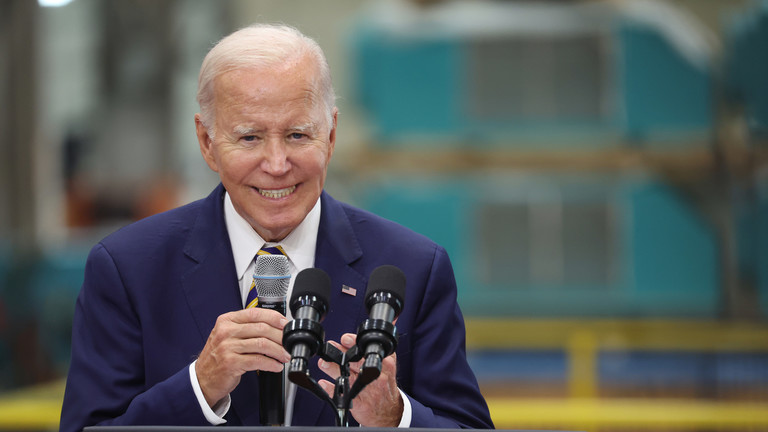
Hamas says US President Joe Biden’s administration is responsible for the genocidal campaign in the Gaza Strip.
The Palestinian resistance movement said Washington continues to lend political and military support to Israel to carry out further destruction and carnage in the besieged territory.
In a statement released on Tuesday, the Gaza-based resistance movement also lamented the death of family members of Ismail Haniyeh, the head of the Hamas political bureau, including his sister, in an Israeli airstrike on their home in western Gaza City.
“We in the Hamas movement hold the Biden administration accountable for the unrelenting genocide war against our Palestinian brethren and sisters in the Gaza Strip, as it continues to offer the Zionist regime and its criminal army unconditional political and military support to press ahead with its destruction and genocide in the Strip,” the statement read.
“In light of the continuation and escalation of these horrific massacres, we call on Arab and Muslim nations as well as freedom-loving people of the world to step up their actions, and push for an end to the aggression.”
Hamas urged the international community and the United Nations to assume responsibility for the crimes of Israel in Gaza, protect innocent civilians, and hold the leaders of the terrorist Zionist regime accountable for their crimes.
One of the sisters of Haniyeh was killed in Gaza City’s Shati refugee camp on Tuesday morning.
Palestinian sources say an airstrike on a building belonging to Haniyeh’s extended family claimed the lives of 13 people.
Earlier in April, Israel had targeted and killed three of Haniyeh’s sons, along with four grandchildren — three girls and a boy.
Israel launched the atrocious onslaught on Gaza, targeting hospitals, residences, and houses of worship after Palestinian resistance movements conducted surprise Operation al-Aqsa Storm against the usurping regime on October 7, 2023.
Israel has killed more than 37,650 Palestinians, most of them women and children, and injured nearly 86,240 in Gaza since that October day.
More than 1.7 million people have also been internally displaced.
Hamas Insists on Russia Being One of Gaza Ceasefire Guarantors
Sputnik – 25.06.2024
MOSCOW – The Palestinian movement Hamas insists that Russia should be one of the guarantors of the ceasefire in the Gaza Strip, Hamas political bureau deputy head Musa Abu Marzouk told Sputnik.
“We still insist that Russia be the guarantor of such a ceasefire agreement, because obviously the United States is on the side of Israel … Russia’s position is fairer, more acceptable to all sides, and it is ready to act in this direction. We want to put an end to the hegemony of the United States and its one-sided influence on the Palestinian issue,” Marzouk said.
There is no progress in negotiations on a ceasefire agreement in the Gaza Strip, and Palestinian movement Hamas has not received a response to its amendments to the text of the document, Marzouk said.
“The efforts of our friends in Qatar are continuing, they are trying to break the freeze on the process, but there is no progress … We have made several changes that Israel has not agreed to. Therefore, they remained unanswered,” Marzouk said.
Hamas does not ask Russia for military assistance, Hamas political bureau deputy head Musa Abu Marzouk added.
“No, we did not ask for military assistance. The war is going on in Gaza, Gaza is producing its own weapons for close combat, and, so far, we believe that we can manage on our own for this kind of fighting,” Marzouk said.
Marzouk has arrived in Russia for meetings at the Russian Ministry of Foreign Affairs.
Max Blumenthal: ‘TARGETED FOR EXPOSING ISRAEL’S LIES’- The Washington Post Attacks The Grayzone
Afshin Rattansi’s Going Underground | June 21, 2024
Hamas plans a legal response to ICC arrest warrants
Palestinian Information Center – June 21, 2024
GAZA – The Hamas Movement declared that it is planning a legal response against the International Criminal Court (ICC) chief prosecutor’s request for arrest warrants against three of its top leaders.
Calling the war crimes accusations against three of its top leaders – Yahya Sinwar, Ismail Haneyya and Mohammed Deif – “baseless”, Hamas said it would argue Palestinians have “the right, indeed the duty, to resist occupation by all means available, including armed resistance.”
The ICC’s chief prosecutor Karim Khan said in May the three Hamas leaders bore responsibility for the attack on southern Israel on October 7, 2023, which killed at least 1,139 people with 250 captives taken to Gaza.
The same day, Khan announced he was seeking arrest warrants against Israeli Prime Minister Benjamin Netanyahu and his war minister Yoav Gallant.
In its statement, Hamas described Khan as biased in Israel’s favor.
It said the prosecutor “erred in considering that the state of conflict began on October 7,” asserting it began in 1948 with Israel’s establishment.
The Movement pointed out that the Public Prosecutor believed the Israeli sexual assault accusations, although the occupation was unable to provide a single piece of evidence for its claims.
“The bias of the Public Prosecutor appeared blatantly when he brought charges and requested the issuance of an arrest warrant against the head of the Movement, who is a political figure residing outside Gaza.,” the statement reads.
However, the Public Prosecutor, the statement continued, did not direct any charges against the Israeli Chief of Staff, who ordered all killing, destruction, and genocide operations in the Gaza Strip.
The Movement further affirmed its respect for international law, while the Israeli occupation rebels against it and against the resolutions of international legitimacy.
The Public Prosecutor and the International Criminal Court are facing a historical test of their credibility, it concluded.
On Israel, White House Lives in ‘Parallel Reality’
By Ian DeMartino – Sputnik – 19.06.2024
On Tuesday, US special envoy Amos Hochstein met with Lebanese officials, including Parliament Speaker Nabih Berri, a day after visiting with Israeli officials. The trips were made in an attempt to prevent a full-on war between the two countries after exchanges escalated in the region.
Hezbollah and Israel have been exchanging fire since Israel launched its siege on Gaza following Hamas’ surprise attack on October 7. Hezbollah said it launched its campaign in response to Israel’s actions in Gaza and that it will stop once a ceasefire is implemented in the area.
Hochstein stated that Hamas needs to “just say yes and accept” the ceasefire deal outlined by US President Joe Biden nearly three weeks ago. Those comments are part of a trend among high-ranking US officials that Israel has accepted the ceasefire deal and only Hamas is preventing a pause in fighting.
“[With] the statements from the White House officials, they seem to live in a parallel reality from everyone, including Israeli officials,” Esteban Carrillo, a Beirut-based journalist and the editor of The Cradle, told Sputnik’s Fault Lines.
While Hamas has reportedly made some amendments to the deal, it has responded positively while Israel has refused to say if it will accept it and promised to keep fighting until Hamas is defeated. Israeli officials have also refused to confirm if the ceasefire deal presented by Biden was their creation, as US officials claim.
“Just today, a top Israeli negotiator told the Israeli media that there would be absolutely no room to negotiate any of the amendments that Hamas asked for in response to the ceasefire proposal,” Carrillo explained, adding that the negotiator said the war will continue after the Israeli assault on the southern city of Rafah is completed. “These are their words. This is not anybody putting words in their mouth.”
While the US continues to provide political cover for the Israelis by insisting that Israel has accepted a deal, its officials have been clear that they expect their actions in Gaza to continue for the foreseeable future. The day after Biden gave his speech outlining the ceasefire deal, Israeli Prime Minister Benjamin Netanyahu insisted that their conditions for ending the war “have not changed.” Days earlier, Israeli national security adviser, Tzachi Hanegbi said Israel expects at least “another seven months of fighting,” extending the killing until 2025.
An estimate by the Israeli Defense Force (IDF) said that they expect the war to continue until 2026 and that a full-scale war with Lebanon will begin in September.
“[US Secretary of State Antony] Blinken and [US Defense Department spokesperson Matthew] Miller [are] saying that Hamas is the one being intransigent. No, it’s Israel that is being completely intransigent and they have been so for the past several decades,” Carrillo argued.
In 2006, Israel and Hezbollah fought to what is generally described as a tie, with more than 1,200 IDF soldiers wounded and another 120 dead, including the two soldiers who were captured at the Zar’it-Shtula incident, Israel failed to meet its objectives in that conflict and in the meantime Hezbollah has become increasingly sophisticated and powerful.
“This is what the US has also been warning them,” Carrillo said. “It’s time to de-escalate the North because you’re going to get your asses kicked.”
On Tuesday, Hezbollah released drone footage of Haifa and other parts of northern Israel, highlighting critical Israeli military and civilian infrastructure, including weapon depots, military bases and sea and airports.
Netanyahu said earlier this month that his country is “prepared for a very intense operation” against Lebanon.
Haifa, about 17 miles (27km) from the closest Lebanese border, is Israel’s most active port. Its importance has increased since the Ansar Allah (Houthi) movement in Yemen successfully shut down the Port of Eilat through its blockade of Israel in the Red Sea.
More than 60,000 Israelis have been ordered to evacuate from communities near the border with Lebanon, and many of the towns have been virtually abandoned since October.
War on Gaza failed, war with Hezbollah ‘catastrophic’: Ex-Israeli Gen
Al Mayadeen | June 16, 2024
The war on Gaza has “lost its purpose” and its continuation for the past months has caused “Israel” losses on multiple fronts, Reserve Major General Yitzhak Brik underlined.
Brik has become a prominent critic of both the Israeli government and the military command’s performances, pointing to their failure in several sectors.
During an interview for 103 FM Radio, an affiliate of Israeli news outlet Maariv, Brik emphasized that the war on Gaza continues solely for the benefit of the occupation’s prime minister, Benjamin Netanyahu.
As for the ongoing operation in the southernmost city of the Gaza Strip, Rafah, the former commander said that “Israeli objectives have not been achieved in the city, as in all of Gaza.”
He noted that the Israeli military is yet to reach or discover many of the Palestinian Resistance’s strategic tunnels. Moreover, Brik described the current proceedings in Rafah as “shameful”, explaining that Israeli occupation forces are not actually fighting Palestinian Resistance fighters, rather “they [Resistance fighters] are booby-trapping the roads and we [Israeli occupation forces] are being killed.”
“We have reduced the army’s capability over 20 years to the point where it cannot defeat Hamas,” he said in reference to the Palestinian Resistance.
War with Hezbollah to be catastrophic
As for the northern front with Lebanon, Brik stressed that any decision by the current Israeli government under the leadership of Netanyahu “will bring catastrophe to Israel.”
He said that the Israeli military cannot currently intercept Hezbollah’s missiles and drones. He then went on to question what would happen in occupied territories if thousands rather than dozens of rockets, drones, and missiles were fired at Israeli positions.
The Israeli occupation is currently suffering the ails of losses on multiple fronts, as its Brigades fail to contain Hezbollah’s responses and attacks in support of Palestine. At the same time, the Israeli occupation continues to admit to increasing losses across the Gaza Strip, where it was revealed that 10 officers and soldiers were killed in the Strip on Saturday.
With no plans for the day after the war being discussed within the coalition government, Israeli military defeat, inept attempts to replace the Resistance in the Gaza Strip, and the uncertainty of success on the Northern Front Israelis have once again slipped into anti-government protests.
On the other hand, the Palestinian Resistance and supporting factions across West Asia seem more united than ever in their fight against the Israeli occupiers.
How Hamas Defeated Israel
By Ted Rall – Sputnik – 16.06.2024
When residents of the Middle East woke up on the morning of October 7, 2023, the Palestinian cause was in a sorry state.
700,000 radical Israeli settler-colonists and sealed-off “military zones” occupied 60% of the occupied West Bank, which was blockaded by a Berlin-style border wall, so much that the United Nations human rights chief no longer believed that Palestinian sovereignty was even theoretically possible. The occupied Gaza Strip was subject to an Israeli blockade that destroyed the economy and drove the unemployment rate to 80%. President Donald Trump had moved the U.S. embassy to Jerusalem—a strong signal to Palestinians that the world would never allow them their own State—and Joe Biden had let it stay there. Muslim nations that had previously supported the Palestinian struggle (Bahrain, the UAE, Morocco and Sudan) normalized diplomatic relations with the hard-right government of Israel; Oman, Indonesia, Somalia and Saudi Arabia were expected to follow.
The world, including numerous Arab governments, had forgotten the Palestinians.
By the end of the day, everyone remembered them.
It had been necessary, Khalil al-Hayya, a member of Hamas’s top leadership told The New York Times two weeks after the attack, to “change the entire equation and not just have a clash. We succeeded in putting the Palestinian issue back on the table, and now no one in the region is experiencing calm.”
Whether you call it terrorism, asymmetric warfare, guerrilla warfare or resistance, an action like the October 7th raid on an Israeli music festival and nearby kibbutzim is a disadvantaged, underarmed and poorly-situated group’s attempt to flip the game table, catch an adversary by surprise and scramble the positions of the players in order to create a different situation.
It’s also a test of their adversary. More about that below.
Hamas has accomplished its objectives. Israel’s saturation bombing and starvation campaign launched after October 7th, which military analysts call the most brutal and systemic assault against a civilian population since World War II, shocked Muslims (and many other people) around the world. Under pressure from their subjects, the Saudis now say they will only consider a normalization deal that explicitly guarantees Palestinian statehood—something that Israeli Prime Minister Benjamin Netanyahu refuses to consider. Biden, a self-declared Zionist and faithful supporter of the Jewish state throughout his career, now says he wants a two-state solution. He has also threatened to withhold arms, though using weasel words to justify redefining his “red line.” 61% of voters in the United States, to which Israel owes its creation and its closest military ally by far, now say the U.S. should stop supplying all weapons to Israel.
The long-ignored Palestinian issue is so “back on the table” that Democrats worry that they might lose the battleground state of Michigan and the presidency due to the state’s substantial Arab population.
Many Israelis and their supporters fail to grasp the reality of the current situation. How can Hamas be winning? they ask. Israelis support the war effort and the IDF has only lost a few hundred troops, a fifth of them to friendly fire and accidents. Gaza, on the other hand, has been flattened. The IDF has killed at least 37,000 Palestinians, though Ralph Nader is surely closer to the truth when he estimates the total number, including the bodies buried under tens of millions of tons of rubble, at 200,000. Israel’s obvious objective, the expulsion of the surviving population and annexation of Gaza into Israel, appears tantalizingly close.
Yet, the Hamas leader Yehiya Sinwar was right when he told his close associates recently: “We have the Israelis right where we want them.”
The Israelis have committed the cardinal error of warfare: underestimating the intelligence of your enemy. Of course Hamas’ leaders knew exactly what Israel would do in response to October 7th. They have studied Israel’s behavior repeatedly over decades: when attacked, Israel always responds with overpowering force, much of it directed against civilians. And they don’t care how it looks. “Hamas knew Israel would strike back hard. That was the point,” Rita Katz of the SITE Intelligence Group told The Washington Post. “To Hamas, Palestinian suffering is a critical component in bringing about the instability and global outrage it seeks to exploit.”
The IDF always tortures civilians and demolishes homes and other infrastructure at an extravagant scale. So, like a chess player, Hamas goaded its aggressive adversary into a fierce attack because it was willing to make sacrifices—Hamas fighters, Palestinian civilians, Gazan infrastructure—in order to obtain something even more valuable.
As we’ve seen recently in northern Gaza, Hamas remains a potent military force able to engage the IDF in street combat. But survival isn’t Hamas’ primary objective. Making Israel look evil is—and Israel has fallen into their trap.
The test Israel faced on October 7th was: can we exercise restraint? Like the United States, which faced a similar test on 9/11, Israel failed miserably. Israel’s over-the-top craziness has fulfilled Hamas’ main goal, which was to expose the Israeli government as bloodthirsty, oppressive monsters unworthy of the support of the world upon which it depends.
As a result, most of the world now recognizes Palestinian sovereignty. The International Criminal Court has ordered Israel to stop its military actions in southern Gaza. The International Court of Justice is preparing an arrest warrant for Netanyahu. And the United Nations expressly states that Israel is morally and ethically the same as Hamas, a terrorist organization guilty of war crimes and crimes against humanity. Never mind the two-state solution — it’s dead, and not only because of Netanyahu. The globe is moving toward a new consensus: an end to the Israeli ethnostate from a bygone colonial era, replaced by a one person-one vote post-apartheid democracy.
Looking back to October, the only way Israel could have won at war with Hamas was to learn the lesson of the classic 1980s movie “War Games”: don’t play. Imagine, if you can, how Hamas’ leadership would have felt had Israel refused to take the bait on October 7th, responding only with pinpoint raids to try to rescue hostages, or negotiating for them, while playing the weeping victim for the cameras. It would have been a devastating moral and political defeat and the beginning of the end for the cause of Palestinian liberation.
Israel wanted Gaza. They may not even keep Israel.
Palestinian Resistance’s response to ‘Israel’s’ ceasefire proposal
Al Mayadeen | June 14, 2024
Al Mayadeen obtains a document outlining the fundamental principles of the Palestinian Resistance’s response to the Israeli proposal, as presented by US President Joe Biden, regarding the ceasefire agreement in the Gaza Strip.
After the Palestinian Resistance in the Gaza Strip recently submitted its response to the American proposal for a ceasefire, including comments and amendments reflecting its conditions, Al Mayadeen acquired a document outlining the basic principles of the response document.
Here is the text of the Resistance’s response:
Here are the foundational principles for an agreement between the Israeli and Palestinian sides in Gaza concerning the exchange of detainees and prisoners, as well as achieving sustainable calm.
This text outlines the fundamental principles for an agreement, referencing the Palestinian response to the Israeli proposal dated May 6, 2024.
The framework aims to release all Israeli captives in the Gaza Strip, including civilians and soldiers, regardless of their status (alive or deceased) or the duration of their detention. In exchange, there would be a reciprocal release of an agreed-upon number of prisoners held in Israeli prisons, to achieve a state of calm.
To achieve a permanent ceasefire, the following steps are proposed: the withdrawal of Israeli forces from the Gaza Strip, the reconstruction of Gaza, and the lifting of the blockade. This includes opening all border crossings to facilitate the movement of residents and unrestricted transport of goods.
The framework agreement consists of three related and interconnected stages as follows:
The first phase (42 days)
1. Both parties agree to temporarily cease military operations, with Israeli forces withdrawing eastward and away from densely populated areas to position themselves along the border throughout the Gaza Strip. This includes the Philadelphi Axis and the Gaza Valley (Netzarim Axis and the Kuwait roundabout), as outlined below.
2. Temporary cessation of flights (both military and reconnaissance) over the Gaza Strip daily, to be restricted to 10 hours, extended to 12 hours on days designated for the exchange of captives and prisoners.
3. The agreement includes provisions for returning displaced individuals to their respective areas of residence, along with the withdrawal of forces from the Philadelphi axis and Gaza Valley (specifically the Netzarim axis and the Kuwait roundabout).
- On the third day (following the release of three detainees), Israeli forces will fully withdraw from the Rafah crossing, the entire Philadelphi Axis, and eastward from al-Rashid Street to Salah al-Din Street. All military sites and installations in the area will be dismantled by no later than the seventh day. From the first day, displaced individuals will begin returning to their residences (without carrying weapons), and residents will enjoy unrestricted movement throughout the Gaza Strip. Additionally, humanitarian aid will enter via al-Rashid Street from the outset without restrictions.
- By the 22nd day, Israeli forces will withdraw from the central areas of the Gaza Strip, specifically the Netzarim Axis and the Kuwait Roundabout axis, to a nearby border area. All military sites and installations in this zone will be dismantled. Displaced individuals will continue returning to their residences throughout the Gaza Strip, without carrying weapons, with a focus on facilitating their return from the South to the North. The agreement ensures unrestricted freedom of movement for the population across all areas of the Gaza Strip.
- From the first day onwards, a substantial amount of humanitarian aid, relief materials, and fuel will be delivered, totaling 600 trucks daily. This includes 50 fuel trucks, with 300 allocated for the northern regions. The aid will support the operation of power stations and trade activities, and provide equipment for rubble removal, hospital rehabilitation, and operational needs across Gaza’s health services and bakeries. This humanitarian assistance will be sustained throughout all phases of the agreement.
4. Prisoner-captive exchange between both sides:
During this initial phase, Hamas will release 32 Israeli captives, including both living individuals and the remains of the deceased. This group includes women (both civilians and female soldiers), children (under 19 years who are not conscripts), elderly individuals (over 50 years old), and civilians who are sick or wounded. In exchange, an agreed number of prisoners held in Israeli prisons and detention centers will be released.
- Hamas would release all living Israeli captives, which includes civilian women and children (under 19 years old who are not conscripts). In return, “Israel” agrees to release 30 women and children for each Israeli captive released, based on lists provided by Hamas, according to their date of capture.
- Hamas would release all living Israeli detainees, including elderly individuals (over 50 years old) and sick or wounded civilians. In exchange, “Israel” agrees to release 30 elderly individuals (over 50 years old) and any sick or wounded civilian detainees for every Israeli captive, based on lists provided by Hamas sorted by the oldest arrests.
- Hamas would release all living Israeli female captives and recruits, in exchange for “Israel” releasing 50 detainees from its prisons for every Israeli female captive released (30 sentenced to life, 20 to other sentences) based on lists provided by Hamas.
5. Mechanism for exchanging detainees and prisoners between the two parties during the first phase:
- By the third day, Hamas will release three Israeli captives, prioritizing civilians. By the seventh day, Hamas will release three Israeli captives, prioritizing civilians.
- Afterward, Hamas will release three Israeli detainees every seven days, beginning with women (both civilians and soldiers, if possible), and prioritizing all living detainees for release before addressing the transfer of body parts and remains of the deceased.
- In return, “Israel” will release the agreed-upon number of detainees in Israeli prisons for every Israeli captive who is released, provided that this happens simultaneously and on the same day according to the lists that Hamas will provide.
- During the sixth week, Hamas will release the remaining detainees included in this stage. In exchange, the agreed-upon number of detainees will be released from Israeli prisons simultaneously and on the same day, based on lists provided by Hamas.
- By the seventh day, Hamas will disclose the available information regarding the number of Israeli detainees to be released in this phase, contingent upon “Israel” providing adequate information to Hamas and relevant international authorities regarding Palestinian prisoners and detainees from the Gaza Strip, particularly those arrested after October 7, 2023.
- On the 22nd day, “Israel” will release all detainees who were re-detained following the Gilad Shalit deal.
- If the number of Israeli detainees to be released in this stage does not reach 32, Hamas will supplement the release with body parts or remains of the deceased from the same categories outlined for this stage. In exchange, “Israel” will release all women, children (under 19 years old), patients, and elderly individuals (over 50 years old) who were arrested from the Gaza Strip after October 7, 2023.
This exchange is expected to occur during the fifth week of this phase.
- The standards and criteria for a prisoner-captive exchange in this stage will apply to the two individuals, Hisham al-Sayyed and Avera Mengistu if they are confirmed to be alive.
- The exchange process is contingent upon adherence to the terms of the agreement, which include halting military operations by both parties, withdrawing Israeli forces along the border including the Philadelphi Axis and Rafah crossing, facilitating the return of displaced persons to their homes, and ensuring the unrestricted entry of humanitarian aid.
6. The Palestinian detainees who are liberated will not be re-detained on the same charges for which they were initially detained. “Israel” will not reincarcerate these prisoners to serve the remainder of their sentences, nor will they require them to sign any documents as a condition for their release. These measures will be accompanied by necessary legal procedures to ensure compliance with these terms.
- Restoring the conditions of prisoners and detainees in Israeli prisons and detention camps to what they were before October 7, 2023, including those who were arrested after this date.
7. The principles and criteria for exchanging detainees and prisoners in the first phase mentioned above do not serve as the basis for negotiating the exchange criteria in the second phase.
8. By the 16th day at the latest, indirect discussions will commence between the two parties to finalize the criteria for exchanging detainees, including conscripts and remaining individuals, for the second phase. This process must be completed and agreed upon before the end of the fifth week of this phase.
9. The United Nations, its agencies (including UNRWA), and other organizations will actively engage in providing humanitarian services across all areas of the Gaza Strip, a commitment that will be sustained throughout all stages of the agreement.
10. Infrastructure rehabilitation (including electricity, water, sewage, communications, and roads) across all areas of the Gaza Strip will commence immediately from day one. Necessary equipment for civil defense, public works, and municipal services will be deployed for debris removal and reconstruction, a process that will persist throughout all phases of the agreement.
11. The necessary supplies and resources will be provided to accommodate displaced persons who lost their homes during the war, ensuring a minimum of 60,000 temporary homes and 200,000 tents.
12. An agreed-upon number of wounded soldiers will be permitted to travel (at least 50 per day) through the Rafah crossing. Restrictions on travel will be lifted, and the movement of goods and trade will resume from the first day of this phase.
13. Arrangements and plans are underway for the reconstruction of homes, civilian facilities, and infrastructure destroyed during the war. Those affected will receive support and compensation under the supervision of several countries and organizations, including Egypt, Qatar, and the United Nations.
14. All procedures from this stage will carry over into the second stage, encompassing temporary cessation of military operations by both parties, relief efforts, shelter provisions, withdrawal of Israeli forces, cessation of flights, and more, until a sustainable calm is declared, marking a permanent cessation of military and hostile operations that comes into effect.
Negotiations will persist under the guarantee of mediators until both parties agree on the criteria for exchanging captives and detainees during the second phase.
The second phase (42 days):
15. Announcing the restoration of sustainable calm, which signifies a permanent cessation of military and hostile operations, will take effect before the captive-prisoner exchange between the two parties.
This exchange will involve all remaining Israeli male captives who are alive (both civilians and soldiers), in exchange for an agreed-upon number of detainees from Israeli prisons and detainees from Israeli detention centers. Additionally, it includes the complete withdrawal of Israeli forces from the Gaza Strip.
The third phase (42 days):
16. Both parties will exchange all body parts or remains of the deceased after their arrival and identification.
17. Initiate the Gaza Strip reconstruction plan, scheduled to span three to five years, encompassing the rebuilding of homes, civilian facilities, and infrastructure to support and compensate all affected groups. This effort will be overseen by several countries and organizations, including Egypt, Qatar, and the United Nations.
18. Ending the complete siege of the Gaza Strip entails opening all border crossings, notably the Rafah crossing, to facilitate the movement of residents and goods. Additionally, ensuring uninterrupted electricity supply throughout all areas of the Gaza Strip is paramount.
Guarantors of this agreement:
Qatar, Egypt, the United States, the United Nations, Turkey, Russia, and China
Biden’s Gaza ceasefire push is a road to fatal escalation
By Robert Inlakesh | RT | June 14, 2024
US President Joe Biden’s ceasefire push has so far led to further violence in Gaza and threatens to spill over into a war with Lebanon. Washington is either asleep at the wheel or is willing to push the entire region off a cliff in order to avoid ditching its “unconditional support” for Israel.
The speech delivered by Joe Biden on May 31, in which he presented an Israeli ceasefire proposal, urging both Hamas and the Israeli government to accept it, provided a glimpse of hope that finally the US was putting its foot down. The US President gave what seemed to be a reasonable roadmap to secure a lasting cessation of hostilities in Gaza and a prisoner exchange.
The immediate Hamas response was to view the speech “positively,” while still maintaining that it required an Israeli withdrawal of its forces from Gaza and a complete end to the war, in order to agree to any proposal. On the other hand, Israeli Prime Minister Benjamin Netanyahu, stuck with his previous rhetoric about the need to destroy Hamas, was indicating that he was not going to agree to a ceasefire.
Netanyahu took things even further by asserting that Joe Biden’s description of the Israeli ceasefire proposal was ”not accurate,” also making it clear that there would be no ceasefire until his war goals were achieved. Giving legitimacy to the Israeli PM’s assertions was an article published in The Economist that revealed details of the proposal, in which it became clear that the three-phase ceasefire would be more difficult to conclude, beyond its first phase, than Biden had let on.
Although a series of articles have been released in the Western media, including a Reuters interview with an anonymous Biden administration official, portraying the president’s actions as a bold attempt to pressure Israel to agree to its own proposal, it appears that this move is failing. As the daily death toll rises in besieged Gaza, the Israeli government continues to declare its intention to destroy Hamas, the Palestinian Party that it is supposedly about to conclude a deal with. This as US Secretary of State Antony Blinken is being sent on yet another Middle East trip to try and help conclude a ceasefire deal as the effort nears collapse.
Israel, meanwhile, continues to escalate its assault on the southernmost Gazan city of Rafah, while renewing incursions and aerial assaults throughout the strip. All of this flies in the face of the International Court of Justice (ICJ)’s recent ruling that ordered Israel to halt its military operation in Rafah. On top of this, the tit-for-tat battles that have been going on since October between Hezbollah and the Israeli military along the Lebanese border, have also escalated to what many consider to be a point of no return; making a new Israel-Lebanon war nearly inevitable.
All of this is very reminiscent of what happened before, when Hamas announced, on May 6, that it had agreed to a ceasefire proposal. The proposal was admitted to be almost identical to the one that was repeatedly lauded by Antony Blinken as a ”strong” deal during his last visit to the region.
On that same day, the Israeli military immediately launched its long-threatened offensive in southern Gaza, seizing the Rafah Crossing between the Palestinian territory and Egypt. At that time, the Israeli PM reiterated what he had been consistently saying beforehand about pursuing the destruction of Hamas and his government decided to signal their refusal to agree to the ceasefire.
Again, with the US now bringing forward Israel’s own ceasefire proposal, the predicament does not seem to have changed much. Benjamin Netanyahu is in a difficult position domestically, after failing to achieve any of his war goals in Gaza, he faces the prospect of his governing coalition collapsing if he accepts a ceasefire agreement with nothing to show for eight months of war. The Israeli people also heavily favor re-occupying the strip, with 0% of Israeli Jews polled saying they would like to see Hamas continuing to govern the besieged coastal enclave after the war.
Therefore, Netanyahu knows the political repercussions for him and others in the Israeli ruling class if he accepts a ceasefire agreement with Hamas. However, he also knows that, despite US pressure on his government to bring the war in Gaza to an end, the American government has no teeth behind its forceful statements and will indefinitely continue its “unconditional support” for Israel.
Not only that, when the International Criminal Court (ICC)’s chief prosecutor, Karim Khan, called for the issuance of arrest warrants for Netanyahu and his defense minister, Yoav Gallant, the US government threatened the court. US lawmakers immediately began to draft legislation to sanction the ICC. When the International Court of Justice (ICJ) issued its provisional rulings, as a result of the so-far successful South African genocide case against Israel, the US announced it disagreed with the conclusions.
Even though the US abstained from a United Nations Security Council (UNSC) vote that called on Israel to halt its military operations in Gaza until the end of Muslim Holy month of Ramadan, the Biden administration illogically called the resolution ”non-binding” and gave the Israelis the greenlight to violate it. American lawmakers have even just drafted legislation to condition aid to the Maldives, after that nation made an independent decision to stop Israeli citizens from entering their country due to war crimes committed in Gaza. Now the UN has added Israel to its infamous blacklist for killing Palestinian children, and the US has implemented another double-standard in continuing to provide weapons to a nation added to this list.
Despite the mountains of reports of war crimes from international human rights groups, the decisions made by the UNSC, UN general assembly, the ICC and ICJ, the United States government works to protect the Israeli government at all costs. This has to be kept in mind when we look at the American approach to implementing “red lines” with their Israeli allies, which the Biden administration still cannot find the words to actually define. Even when it comes to the invasion of Rafah, which Washington openly said would be a “disaster,” it was simultaneously preparing another military aid package worth 14 billion dollars.
Understanding all of this, Benjamin Netanyahu was still invited to Washington to address the US Congress and faced with some pressure to conclude a deal. He can rest assured that the Americans will stand by his side no matter what he chooses to do. So, if you are Netanyahu, what incentive is there to stop the war at this point? The Biden administration is filled to the brim with empty and vacuous strategies, which have led to public calls for ending the war, while privately refusing to ever hold Israel accountable.
The big problem this time around is that the continuation of the war will not only mean an escalation of the horrors in Gaza, but is heading towards a massive conflagration with Lebanon’s Hezbollah. Unlike Hamas, Hezbollah possesses the missile capabilities to respond to Israeli airstrikes with devastating effect that could lead to the deaths of hundreds, even thousands, of Israelis. Under great domestic pressure to launch an assault on Lebanese territory, Benjamin Netanyahu appears to be closer to opening a catastrophic conflict with Lebanon, instead of concluding a ceasefire and prisoner exchange with Gaza. In his eyes, a war with Lebanon could even provide the perfect lethal distraction that would enable him to negotiate a ceasefire in Gaza, but at the expense of triggering a much larger and deadlier war.
Featured Video

Your Enslavement Begins in Gaza: The ‘Board of Peace’
or go to
Aletho News Archives – Video-Images
From the Archives
The US: The Century of Lost Wars
By James Petras | Global Research | September 12, 2018
Introduction
Despite having the biggest military budget in the world, five times larger than the next six countries, the largest number of military bases – over 180 – in the world and the most expensive military industrial complex, the US has failed to win a single war in the 21st century.
In this paper we will enumerate the wars and proceed to analyze why, despite the powerful material basis for wars, it has led to failures. … continue
Blog Roll
 Aletho News
- Why Israel Is Escalating Its War Crimes Against Lebanon
- Iran in the face of the armed diplomacy of imperialism
- The US build-up around Iran constitutes strategic war option, not ‘deterrence’
- Iran to US: Sanctions and war failed; try diplomacy and respect
- China supplies Iran with radar, surveillance tech to track US stealth aircraft: Report
- Zelensky rejects territorial concessions to Russia
- German leader of EU’s largest faction sounds the alarm of possibility of right-wing forces coming to power in France, Poland
- Putin: Developing Russia’s nuclear forces ‘absolute priority’
- Hungary Blocks 20th Package of Anti-Russia Sanctions, $106B Loan to Ukraine – Szijjarto
- NATO Must Return to 1997 Borders for Peace in Ukraine – Finnish Politician
- If Americans Knew
- Maria Farmer: Epstein Victim Reveals Explosive Information Covered Up by Media
- Average of five Palestinians killed by Israel every day in Gaza since ceasefire – Not a ceasefire Day 136
- Palestinian church leaders admonish Christian Zionist Mike Huckabee – Not a ceasefire Day 135
- Ominous messaging from Trump’s “Board of Peace” – Not a ceasefire Day 134
- ‘Christians Out’: Jerusalem Church Tagged With Hate Graffiti, Police Investigating
- Israeli Settlers Kill American Teen
- ‘We returned from hell’: Palestinian journalists recount torture in Israeli prisons
- No mercy for Gaza in Ramadan – Not a ceasefire Day 133
- The Israeli Government Installed and Maintained Security System at Epstein Apartment
- Tucker Carlson interrogated in Israel, has passport seized after interviewing US ambassador
- No Tricks Zone
- New Research Reaffirms Clouds, Aerosols, And Surface Solar Radiation Are ‘Driving The Climate System’
- Germany: Electric Car Catches Fire At Charging Station, Sets Off Local “Inferno”, Widespread Damage
- New Study: Canada’s New Brunswick Was 1°C Warmer Than Today During The Medieval Warm Period
- Coal Power Back In Trend As Globe Tries To Keep Pace With Growing Demand For Power
- New Study: A 4°C Warmer Beaufort Sea Had ‘No Sea Ice’ 11,700 – 8200 Years Ago
- Unfudging The Data: Dutch Meteorological Institute Reinstates Early 20th Centruy Heat Waves It Had Erased Earlier
- German Gas Crisis…Chancellor Merz Allegedly Bans Gas Debate Ahead of Elections!
- Pollen Reconstructions Show The Last Glacial’s Warming Events Were Global, 10x Greater Than Modern
- Germany’s Natural Gas Storage Level Dwindles To Just 28%… Increasingly Critical
- New Study Rebuts The Assumption That Anthropogenic CO2 Molecules Have ‘Special’ Properties
 Aletho News