India & Israel Are Officially Diplomatic Allies At The UN
By Andrew Korybko | EurasiaFuture | 2019-06-12
India just made history at the UN earlier this week, but in what’s sure to be interpreted as an ignoble way by the supporters of the emerging Multipolar World Order. Encouraged by the massive mandate that he received after his resounding re-election last month, Modi gave the go-ahead for his government to break with decades of its post-independence political traditions by unprecedentedly supporting “Israel” at the global body and voting against granting consultative status to a Palestinian NGO that allegedly has ties with Hamas.
The self-professed “Jewish State’s” deputy chief of mission in India praised this diplomatic pivot by tweeting “Thank you #India for standing with @IsraelinUN and rejecting the request of terrorist organization “Shahed” to obtain the status of an observer in #UN. Together we will continue to act against terrorist organizations that intend to harm”, in what certainly signifies that Modi’s second term in office will see his country more determinedly siding with the fading Unipolar World Order at the multipolar one’s expense.
India had hithero been trying to make inroads with the Organization of Islamic Cooperation (OIC), but its hopes for future progress on this front have likely been dashed by the self-inflicted soft power damage that it just did by diplomatically allying with “Israel” at the UN. Although Resistance leader Iran continues to beg India to reconsider its decision to abide by the US’ unilateral sanctions regime against it, it’ll now be doing so with the full knowledge that the South Asian state is officially one of its hated “Israeli” foes’ key allies in thwarting the attempts of the Palestinians to have a greater global voice in publicizing their plight. This would make the Islamic Republic’s further outreaches to India even more humiliating than before, possibly raising the chance that it might finally give up in order to save “face” and protect its hard-earned and very proud reputation as the world’s leading anti-Zionist state.
In parallel with this, the global pivot state of Pakistan is now by default the most prominent pro-Palestinian voice in South Asia, especially after Minister for Human Rights Dr. Shireen Mazari recently promised that her country will continue supporting the Palestinians and urged all her Muslim counterparts to do so as well. The fact of the matter is that the Palestinian and Kashmiri causes are inseparable because they’re essentially one and the same — the indigenous Muslim majority of each region have been oppressed by foreign occupiers for decades and have yet to be granted the right to democratically decide their own political futures. Actually, it’s precisely because of these interlinked conflicts that India and “Israel” initially began to ally with one another because they play the same roles in each of them. Accordingly, they’ve increased military cooperation to such a point that “Israel” is now India’s second-largest military supplier and India is “Israel’s” top arms destination.
It therefore shouldn’t be any surprise that India decided to add an official diplomatic dimension to its already-existing military-strategic alliance with “Israel” by supporting it at the UN against the Palestinians. Seeing as how the Indian side hasn’t protested the “Israeli” deputy chief of mission’s tweet thanking it for “rejecting the request of terrorist organization ‘Shahed’” and vowing that “together we will continue to act against terrorist organizations that intend to harm”, it can be logically assumed that New Delhi informally regards Hamas and all those allegedly affiliated with it as “terrorists”, which is only natural considering how fast its alliances with the US and “Israel” are progressing. As such, whether it concerns Russia, China, Iran, or even the Palestinian cause nowadays, India is no longer practicing its over-hyped policy of “multi-alignment” but is instead decisively pivoting against each of the aforesaid multipolar forces despite still clinging to this slogan in an unconvincing attempt to cover its tracks.
Saudi Arabia tightens grip on Palestinians, hampers remittances to Gaza: Report
Press TV – June 8, 2019
Less than a week after Saudi authorities arrested more than 60 people, including Palestinian expatriates and Saudi nationals, on charges of supporting the Palestinian Hamas resistance movement, they have now blocked money transfers between the kingdom and the Gaza Strip.
The new step taken by the Riyadh regime against Palestinians involves official and non-official money transfers as the procedure has witnessed a marked decline over the past week and during the Eid al-Fitr holiday, which marks the end of the Muslim holy fasting month of Ramadan, Arabic-language al-Khaleej Online news website reported.
The report described residents of the besieged and impoverished Gaza Strip as the main victims of the move. Most of the bank transfers that used to be carried out normally in the past, were frozen just a few days before the start of the holiday.
Remittance transactions are taking much longer time than usual – something that used to be done in a matter of few hours.
Many Palestinians have complained of the move, and termed it as “unprecedented.” They argue that the process of transferring money between Saudi Arabia and the Gaza Strip has become extraordinarily difficult.
Abu Fuad, a resident of the Gaza Strip who refused to give his last name for fear that his family could be persecuted in the Saudi Arabian port city of Jeddah, said he has experienced difficulty receiving money from his family.
“It is three days since the remittance has been made, but I have not received anything. Financial transfers used to be done in a few hours and without any obstacles in the past. But since the week before the Eid, the procedures have become complex and most of the transfers are frozen without any obvious reason,” he said.
Abu Fuad considered the measure as a “new crackdown on the Palestinian community living in Saudi Arabia,” stressing that it would aggravate their sufferings as students rely heavily on money transferred from their families living outside the kingdom.
He called upon the Palestinian Embassy in Riyadh to intervene immediately, and try to work out a quick and practical solution to the crisis, which has negatively affected the Palestinian community in Saudi Arabia.
Over the past two years, Saudi authorities have deported more than 100 Palestinians from the kingdom, mostly on charges of supporting Hamas resistance movement financially, politically or through social networking sites.
The Riyadh regime has imposed strict control over Palestinian funds in Saudi Arabia since the end of 2017.
All remittances of Palestinian expatriates are being tightly controlled, fearing that these funds could be diverted indirectly and through other countries to Hamas.
Money transfer offices are asking the Palestinians to bring forward strong arguments for conversion, and do not allow the ceiling of one’s money transfer to exceed $3,000.
Israel’s influence on US foreign policy leads to increased tensions with Iran
By Sarah Abed | InfoRos | May 22, 2019
In order to understand the role that Israel plays in the increased tensions between Washington and Tehran, I reached out to Press TV Correspondent, Ali Musawi.
Sarah Abed: What role, if any, does Israel play in the increased tensions between the United States and Iran?
Ali Musawi: We don’t need to go far to see Israeli fingerprints over a US war in the region. Leading up to the 2003 US invasion of Iraq, Israel and more specifically its current Prime Minister Netanyahu led the choir about Iraq’s WMD and threat to peace and security.
Now, if we look at Netanyahu’s antics concerning Iran, we will see a similar pattern, whether it was the bomb sketch at the UN General Assembly, his almost regular videos about the Iranian threat and the push by Netanyahu to end the “bad deal” between P5+1 and Iran over its nuclear program. Israel doesn’t play a role; Israel clearly orchestrates US war policies.
Sarah: To your knowledge has Israeli intelligence provided any information to the United States that supports the idea of an increased “Iranian threat”?
Ali: As of this moment, no one knows what this sudden “threat” posed by Iran is. We can speculate about anything, from increased Iranian war drills in the Persian Gulf to its military commanders’ typical aggressive tone when addressing the US and allies’ behavior towards the Islamic Republic. And I think before we even try to address any kind of “Iranian threat” we should acknowledge the boy who cried wolf. Is the US administration being truthful? We need evidence, where is Washington’s proof? We should always remember the non-existent WMD used to rally the world against Iraq.
Sarah: Is Israel advocating for a military response by the United States against Iran?
Ali: It is in Israel’s best interest that the US engages in a direct war with Iran. Israel has been threatening attacks against Iran for years simply because Tehran’s support for resistance movements in Palestine and elsewhere threatens the Zionists’ plan to control the region. Israel with all their access to weapons and blank cheques provided by the US and allies, is simply not a match to Iran. By using the US and the excessively armed Gulf countries, Israel is hoping that, at best, a war will weaken Iran, or at worst, a buffer of countries who will sever Iranian support for the resistance movements.
Sarah: What impact would a war between United States and Iran have on Israel?
Ali: Such a war will impact, not only the countries in the region, but the rest of the world. But from a military prospective, if there is a war between the US and Iran, those resistance movements, from Iraq to Palestine, through Yemen and Syria will respond. They will either attack US and allies’ bases in the region or directly attack Israel. We can say that having such resistance movements has been the real deterrent against what can only be a hugely destructive conflict, probably the worst in our lives.
Sarah: Is a full-fledged military confrontation between Israel and Iran likely?
Ali: This is a definite no. While Israel still plays the role of a superpower in the region, it has not been so in over a decade. The 2006 defeat against Hezbollah in Lebanon and the bravery we see from the Palestinians in Gaza, whenever Israel launches wars on the besieged strip, have destroyed its invincibility myth and shown that Israel and its supposed advanced weaponry are only so on paper.
Sarah: How would that scenario play out and what do you suppose would be the outcome?
Ali: Only if the US is directly involved against Iran, will there be a war.
Sarah: What impact could a war between Israel and Iran have on the neighboring countries, primarily Lebanon, Syria, and Iraq?
Ali: If the US is involved of course. All these three countries have been directly impacted by US/Israeli wars over the past few decades. So, the people as well as politicians are aware of the devastation of such conflicts. This is why they will back Iran and even fight alongside Iran simply because the majority of people in these countries oppose US hegemony. The Middle East is divided. There are countries who are controlled by the US/Israel and there are those who are not. No one will sit idly by if a war breaks out. Everyone has something to lose and gain. Such wars don’t usually have winners and will be very expensive to all sides. This is why we are seeing the US backtracking on some of its threats and will continue to do so because the US has become a bully who is afraid of being hurt.
Sarah: Ali, makes some great points that should put the wheels in motion in everyone’s mind, and in particular those who live in the United States. I will pose one more question to our readers, are we willing to go to war with Iran to benefit Israel?
Palestinian Resistance Can Intensify Deterrence in Face of Zionist Enemy: Hezbollah

Deputy Chief of Hezbollah Executive Council Sheikh Ali Daamoush
Al-Manar | May 10, 2019
Deputy Chief of Hezbollah Executive Council Sheikh Ali Daamoush stressed that the silence of some Arab regimes about the Israeli aggression on Gaza was worse than the aggression itself, adding that they showed to be on the enemy’s side, just as the US and the West.
In his Friday sermon, Sheikh Daamoush pointed out that the Zionist enemy failed to achieve the aggression’s aims, adding that the Palestinian resistance proved it had improved its military capabilities.
The Palestinian resistance has a chance to intensify its deterrence capability in face of the Zionist enemy, his eminence stressed.
In a different context, Sheikh Daamoush noted that the US sanctions on Iran expose Washington’s aggressiveness against the regional states, adding that the Islamic Republic of Iran may never bow to such pressures.
Hamas: New Fatah government “separatist and unconstitutional”
Palestine Information Center – April 14, 2019
GAZA – The Hamas Movement has described the formation of a new Fatah-dominated government as “persistence in monopolizing power and excluding other political forces,” saying it will deepen the national division.
In a press release on Saturday, Hamas said the government of Mohamed Shtayyeh would work on fulfilling the desires of Fatah and Mahmoud Abbas at the expense of the Palestinian people’s interests, unity, struggle and sacrifices.
Hamas also described the government of Shtayyeh as “a separatist body that lacks constitutional and national legitimacy.”
The Movement warned that the new government would increase the chances of separating the West Bank from Gaza as a practical step towards executing the deal of the century.
Report: Egypt plan to lift siege requires disarmament of Gaza
MEMO | March 22, 2019
An Israeli report said that Egypt has put forward a plan for a settlement between Israel and Palestinian factions in the Gaza Strip, led by Hamas, which controls the Gaza Strip. Israel Hayom newspaper reported on Thursday that “according to security sources in Egypt and Palestinian officials in Gaza and Ramallah, Israel and Egypt have become convinced that Hamas’s control in Gaza is a self-evident fact.”
Israel Hayom quoted Egyptian security sources and Palestinian officials in the West Bank and Gaza Strip. It explained that the Egyptian proposal stated that they would disarm the factions – except for light weapons – in exchange for lifting the siege on the Gaza Strip.
According to this plan, all internal affairs will remain in the hands of Palestinian organisations headed by Hamas or a unified political entity for all organisations in the Strip. The internal security of the Gaza Strip will be based on “Hamas National Security Forces, which are currently operating.” The arms that will be in possession of the Internal Security Forces will be light weapons, in small quantities and subject to a strict control system.
In turn, the Israeli and Egyptian siege on the Gaza Strip will be lifted, according to the newspaper. Also, projects in the areas of infrastructure, employment, economy, health and education, financed by the United Nations, the European Union and Arab countries, “led by Saudi Arabia, Qatar and the UAE,” will be implemented. The plan calls for the opening of a maritime route to the Gaza port, which will allow in the first stage the export and import of goods directly to the Gaza Strip.
The newspaper asserted that “these parties have succumbed to the fact that the Palestinian Authority will have difficulty in regaining control in the Gaza Strip, whether after an internal Palestinian reconciliation, or because of the collapse of Hamas rule against the backdrop of the grave humanitarian situation, or because of the continued military confrontation with Israel.”
According to the newspaper, Egyptian sources stated that the Israeli policy towards the Strip is “soft,” and that this stems from Israel’s unwillingness to allow the “Hamas regime” to collapse and in anticipation that in the event of Hamas’s collapse, “extremist groups loyal to Iran or Salafist groups similar to Daesh will enter” to fill the vacuum.
The newspaper further said that estimates in Israel and Egypt indicate that “such a settlement can be implemented within three to five years, but the main obstacle is that Hamas and other Palestinian armed factions will oppose disarmament.”
Quoting sources it described as officials in Ramallah, the newspaper added that Palestinian Authority President Mahmoud Abbas and the PLO leadership would agree to “overthrow” Hamas and the factions in Gaza “only in case it led such a process when the control of Gaza is in the hands of the Palestinian Authority.”
The newspaper asserted that US security bodies obtained a draft of the plan which was formulated by Israeli and Egyptian crews. It quoted an Egyptian security official saying: “We are currently waiting for the new government to be elected in Israel to speed up the process; while the goal after the Israeli elections is the entry of other influential Arab countries, such as Qatar, Saudi Arabia, Jordan and the UAE.”
The Egyptian security official added that “if Abu Mazen and the leadership in Ramallah do not put obstacles, the plan can be put into effect with the full cooperation of all the regional actors and through providing guarantees and assistance by the international community. But, it is estimated that there will be strong opposition to the disarmament plan of the Gaza Strip by the PLO and mainly by the armed factions in Gaza.”
France shuts down ‘anti-Semitic’ groups after pledge to fight worst surge ‘since World War II’
RT | March 21, 2019
Emmanuel Macron has ordered the closure of four organizations accused by officials of promoting jihad and anti-Semitism. Earlier, the French president pledged to fight an unprecedented surge of anti-Semitism in the country.
The move comes at the request of Interior Minister Christophe Castaner, who said the groups “foment hatred, call for discrimination and justify violence,” and must be closed.
The ministry separately said the groups advocated armed jihad and indoctrinating young people. They also promoted organizations like Hamas, Palestinian Islamic Jihad and Hezbollah – all listed as terrorist organizations by the EU, the ministry stressed.
French government spokesman Benjamin Griveaux labeled the groups as “openly anti-Semitic and dangerous associations” during a cabinet meeting on Wednesday.
The development comes a month after Macron pledged to the Jewish community to fight against what he called a “resurgence of anti-Semitism unseen since World War II.” He said France will redefine anti-Zionism as a form of anti-Semitism in line with the preferences of pro-Israel groups. The decision was welcomed by the government of Israel.
The French government reported a 74-percent increase in anti-Semitic incidents in 2018 in the country compared to previous year. The pledge from Macron came after thousands of people, including two former French presidents, rallied across the country to condemn anti-Semitism in response to the desecration of a Jewish cemetery in the Strasbourg area.
The banned organizations are the Zahra Center France, the Shia Federation of France, the Anti-Zionist Party and France Marianne TV. Center Zahra France was targeted by an anti-terrorist raid in October, and was followed by the seizure of assets for six months. The French authorities accused the group, which is based in northern France, of being a vehicle for propagating radical Shiite Islam. The three others organizations are reportedly working under the center’s umbrella.
The man behind the Zahra Center and Anti-Zionist Party is Yahia Gouasmi. He is a Lebanese-born Shia Muslim, who has been living in France since the 1960s. An avowed critic of Zionism and Israel, his stated goal is to oppose the Israeli lobby in France and hold the Jewish state accountable for crimes against Palestinians and other nations. He launched the party in 2009 after the Israeli bombings of the Gaza Strip during Operation Cast Lead.
Jason Greenblatt should abandon his one-eyed approach towards the Palestinians
By Motasem A Dalloul | MEMO | March 19, 2019
Last week, the US Special Envoy to the Middle East, Jason Greenblatt, took to Twitter to attack the Palestinian Islamic Resistance Movement — Hamas, the de facto government of the Gaza Strip — for dispersing violent protesters in Deir Al-Balah and Jabalia. The protesters — some of whom were rioters — claimed that they were demonstrating against high taxes imposed by the government which, they alleged, had led to price hikes.
“Hamas continues to exploit the Palestinians of Gaza and to rule by brute force,” claimed Greenblatt. “Hamas abuses the money belonging to the people of Gaza, using these funds for terrorism & other illicit activities to devastating effect, instead of rebuilding Gaza and helping its people.” His words could have been written by the Israeli Ministry of Propaganda.
The less than objective or neutral Greenblatt then tweeted: “Hamas violently suppresses its own people demonstrating against Hamas’ rule & failures today and NOW fires rockets at cities in Israel. OUTRAGEOUS! This is what prevents the world from helping the people of Gaza! We strongly support Israel in defence of its citizens. Always!”
In a third tweet, he wrote: “My words now: So true. So sad. So awful. So scary. Hamas, PIJ [Palestinian Islamic Jihad] etc. is this what you want for your people? You’re the cause of this misery. You choose violence. You’re ruining lives day after day after day. No one else. Time to choose something else!”
Without making any apparent effort to check the facts about the disturbances in Gaza, Greenblatt took aim indiscriminately at the Palestinian factions in the besieged territory. The Israeli-led siege and occupation did not figure in his calculations, of course. Not only did he criticise Hamas, but he also targeted Islamic Jihad and the Popular Front for the Liberation of Palestine, even though both factions are themselves critical of the movement. This suggests very strongly that the “Special Envoy” — for which read “there to advance Israel’s interests only” — was not concerned about the Palestinians or the alleged “violence” inflicted upon them by Hamas; that his sole aim was to demonise the Palestinian resistance factions, including Hamas, because they oppose the Israeli occupation of Palestine.
The demonstrations in Gaza are not actually against price hikes or high taxes, as was also claimed by Fatah spokesman Usama Al-Qawasmi in the occupied West Bank. The people on the streets are rioters ordered and paid to be there by Palestinian Authority President Mahmoud Abbas and his intelligence chief Majed Faraj, who could find no other excuse for their action against Hamas. Israel’s support for the violent protests was obvious, with Ofir Gendelman, Prime Minister Benjamin Netanyahu’s spokesperson for the Arab media, involved openly on social media backing the riots. Israel’s ambassador to the UK Mark Regev, who is well-known for trying to justify the unjustifiable, was also involved.
The clearest proof that these riots were intended to destabilise Gaza in order to topple the de facto government is that Hamas has actually reduced more than 50 per cent of the taxes imposed by the PA, and prices, when compared with the West Bank, are much lower. The price of one falafel sandwich in the West Bank, for example, is around $2, while in Gaza it is just 25 cents. If you have your hair cut in the West Bank, it will cost you $15, but in Gaza, you pay only $1.50. The rioters were calling for their salaries to be restored and for the siege to be lifted; given that it is the PA which has cut the salaries of civil servants in Gaza, their anger should have been directed at Abbas and the administration in the occupied West Bank as well as the Israeli occupation, not Hamas which has been fighting to lift the siege and get their salaries back to normal levels.
As far as Greenblatt’s accusation that Hamas “exploits” the Palestinians and rules “by brute force” is concerned, as a senior US official he should not forget that the movement won an overwhelming majority on the last occasion — in 2006 — when Palestinians were allowed a “free and fair” election. The result was not accepted by Washington, Israel and the PA in Ramallah, and the siege was imposed. Why? Because Hamas sticks to the struggle for legitimate Palestinian rights and principles, whereas Abbas and Fatah, which controls the PA in Ramallah, is more easily bought.
Greenblatt’s claim that Hamas uses Palestinian money to fund terrorism and other illegal activities instead of rebuilding Gaza and helping the people is pathetic. Resistance to a military occupation is a right guaranteed by international laws and conventions. Instead of asking why Hamas does not rebuild Gaza, he should ask himself who destroyed Gaza in the first place, and who replenished its stocks of arms and ammunition to do so. If he is honest — a big if — he would tell the world that it was Israel and Washington, using US taxpayers’ money, not Hamas.
Even though reports in the Palestinian media run by opposition factions, as well as the Israeli and Arab media, claimed that Hamas used violence to suppress “its own people”, there were actually some incidents where the Palestinian police, not Hamas, dealt harshly with the rioters, very few of whom required hospital treatment. It is alleged that images from Iraq and old videos were used to depict the “beatings by Hamas” in Gaza.
Even Haaretz reported that one of the videos which went viral on social media was not related to the riots. “Viral video of Palestinian man setting himself on fire not connected to current protest, human rights activists say,” the Israeli newspaper pointed out. Not all of the videos were fake, but the depiction of the way that the rioters were treated was not as claimed on social and other media.
My advice to Mr Greenblatt, therefore, is to abandon his one-eyed approach towards the Palestinians; he should not turn a blind eye to Israeli atrocities or the injustices of the US-backed Abbas and PA. “For every Palestinian rocket, Israel commits thousands of crimes,” wrote Amira Hass, Haaretz correspondent in the occupied territories, on Sunday. She pointed an accusatory finger at the Israeli officials who demolish the houses of the Palestinians, who demolish water networks and who prevent Palestinians from having water.
The reality of the situation in Israel-Palestine requires a far more nuanced discourse than posts on Twitter can ever convey. US Special Envoy Jason Greenblatt should open both eyes if he wants to have any credibility whatsoever in his role.
Palestinian Resistance Groups in Gaza All Deny Firing Shells Toward Israel
By Celine Hagbard | IMEMC | March 15, 2019
After two nights of wide-scale bombardment of the Gaza Strip by Israeli forces in which dozens of bombs were dropped on the crowded coastal enclave, someone in Gaza apparently attempted to retaliate Thursday night by firing several shells toward Israel.
But the Palestinian resistance groups in Gaza, usually quick to claim credit for actions they take, all denied involvement in this attack.
Hamas, the Islamic Jihad and the Popular Resistance Committees all issued separate statements officially denying any involvement in relation to the firing of the missiles.
The Al-Qassam Brigades, the armed wing of Hamas, said in a brief statement that the timing of these missiles being fired is suspicious, as it came while Hamas leaders were meeting with an Egyptian security team, discussing arrangements to maintain calm in the coastal region.
In addition, Daoud Shehab, the spokesperson of the Islamic Jihad, denied Israel’s allegation that the Islamic Jihad movement was the one that fired the missiles toward Tel Aviv.
The Salaheddin Brigades, the armed wing of the Popular Committees, also issued a statement denying any connection with the missiles.
It is worth mentioning that, from time to time, some unknown smaller group, tries to fire missiles largely into open areas in Israel, which to many observers looks like an act that is meant to create tension, and drag the region into a new wave of military escalation.
For its part, the Ministry In Interior and National Security In Gaza said that the firing of the missile violated the agreement between the resistance factions in Gaza, and the national consensus regarding avoiding military escalation with Tel Aviv. It added that it will conducted all needed measures to find the individuals who are responsible for firing the missiles.
Hamas lauds recent calls for democratic elections in Palestine
Palestine Information Center – February 10, 2019
Member of Hamas Political Bureau Husam Badran said Hamas welcomes the invitation of the Palestinian Democratic Gathering to hold general and democratic elections in Palestine.
Commenting on the call of the Palestinian Democratic Gathering to hold Palestinian general elections, Badran said Hamas Movement stresses that it fully supports holding general elections supervised by a national unity government that is formed by consensus.
Badran reiterated his movement’s commitment to cooperate with all the Palestinian factions and parties in order to get over the internal political crisis and the disappointing performance by the incumbent government regarding the Palestinian reconciliation project.
Hamas said it is ready to take part in a comprehensive national dialogue that would be held unconditionally. It also stressed its firm rejection of power monopolization and unilateralism by the ruling Palestinian factions.
Hamas won’t be part of any new puppet Palestinian government: Official
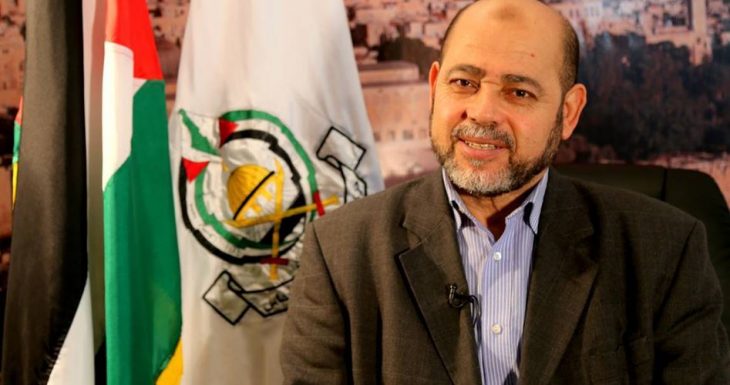
Deputy head of the Hamas political bureau, Mousa Abu Marzouk
Press TV – January 31, 2019
The deputy head of the Hamas political bureau, Mousa Abu Marzouk, says the resistance movement will not take part in any puppet Palestinian government in Ramallah, noting such a government will be “devoid of any national legacy and would strive to promote division” just like its predecessors.
Marzouk, in a post published on his official Twitter page on Wednesday, said officials from the Ramallah-based Palestine Liberation Organization (PLO) would not invite Hamas to participate in such a Palestinian government in the first place, emphasizing that the movement would turn down such an offer even if it were made.
He asserted that a new government in Ramallah would work on realizing US President Donald Trump’s “deal of the century.”
The so-called deal, a back channel plan to allegedly reach a peace settlement between the Israelis and the Palestinians, was proposed by the US administration in September 2018. Although the plan has not been released, leaks signal it will consist of the same tried and failed ideas.
While little is known about the controversial deal, leaks have suggested that it regards East Jerusalem al-Quds as Israeli territory, whereas Palestinians view the eastern sector of the occupied city as the capital of their future state.
Palestinians also believe that the US-drafted plan calls for keeping borders and security under Israeli control, while it keeps Israeli settlements’ final borders to be discussed in later negotiations.
Palestinian Prime Minister Rami al-Hamdallah officially submitted his resignation and that of his unity government to President Mahmoud Abbas on January 29, casting doubt on the prospects of reconciliation efforts with Hamas.
Abbas had been facing pressure from his ruling Fatah movement over the past few weeks to remove Hamdallah from power, and establish a new government comprised of representatives from PLO factions in addition to independent figures.
Hamdallah headed the Palestinian National Consensus Government, which was formed after Fatah and Hamas reached an agreement in 2014.
Fatah leaders said there was no point in keeping the government in power in the wake of the continued crisis between their faction and Hamas.
They also argue that since their faction is the largest group in the PLO, it should have a strong presence in any government.
Featured Video
Laith Marouf: Hezbollah’s position on US-Iran ceasefire
or go to
Aletho News Archives – Video-Images
From the Archives
Is Israel to blame for the Iraq War?
American Goy | March 10, 2008
I am so tired of this old canard that “Israel had nothing to do with USA’s war with Iraq – in fact, it officially advised America against it”.
Bullshit. … continue
Blog Roll
 Aletho News
- Laith Marouf: Hezbollah’s position on US-Iran ceasefire: What you’re not being told
- Israel’s priority lies in destroying chances of peace between Iran, US: Ex-UN nuclear chief
- Ceasefire for all or for none: Iran shuts Hormuz over Lebanon attacks
- Strait of Hormuz is Iran’s ‘nuclear weapon’ that forced US retreat: Medvedev
- Energy crisis will last for months – Kremlin envoy
- Europe’s quiet role in the war on Iran
- Forty days that shook the Empire: How Iran turned the tables on US and prevailed
- Netanyahu unilaterally declares Lebanon outside of ceasefire deal
- Israeli leaders: ‘Not a single goal’ achieved in war with Iran
- What on earth just happened? Trump, Iran, and the unlikely ceasefire
- If Americans Knew
- Gazans face a triple crisis: severe shortages of water and bread, healthcare in tatters
- NY Times reports how Netanyahu took the US into Iran War
- A sigh of relief over Iran, but Gaza and Lebanon in dire straits – Daily Update
- Thousands dead and neighborhoods razed to the ground: Aid agencies fear southern Lebanon is becoming the new Gaza
- The war the US is fighting for Israel could cost trillions
- ‘Cigarette Burns, Nail Wounds’: Toddler Tortured in Gaza to Coerce Father
- Trump Says US Sent ‘a Lot of Guns’ to Protesters in Iran
- Israeli forces destroy 17 UN peacekeeper cameras in south Lebanon
- US-Israeli strikes ‘completely destroy’ synagogue in Tehran
- Archbishop for US Military Says Iran War Is Unjust Under Catholic Teaching
- No Tricks Zone
- An Inconvenient Tree: Uncovered In Alps… Europe Much Warmer Than Today 6000 Years Ago
- New Study Reports A 60% Slowdown In Greenland’s Ice Loss Rate In The Last Decade
- Low Intensity Tornado Wrecks Major Solar Farm, Creating A Potential Toxic Dump
- New Study Finds Warming Saves Lives…Cold Temperatures 12 Times More Deadly Than Excess Heat
- German Science Blog Accuses PIK Climate Institute Of Hallucinating Climate Tipping Points
- Devastating Assessment Of Comirnaty Vaccine By Former Senior Pfizer Europe Toxicologist
- New Study: CO2 Is ‘Effectively Negligible’ As An Explanatory Climate Change Factor Since 2000
- Former Pfizer Toxicologist Dr. Helmut Sterz Tells Bundestag Hearing Pfizer Vaccine Should Have Never Been Approved
- Energy Expert: Germany’s Nuclear Phaseout Was A “500 Billion Euro Mistake”
- New Research: South Australia’s Mid-Holocene Sea Surface Temperatures Were 4°C Warmer Than Today
 Aletho News