Israel pushes for six week ‘extension’ of Gaza ceasefire’s phase one
The Cradle | February 28, 2025
An Israeli delegation in Cairo is negotiating with mediators a potential extension for the first phase of the Gaza ceasefire agreement, according to Egyptian security officials cited by Reuters on 28 February.
“Hamas opposes the extension and insists on proceeding to the second phase of the deal as originally agreed,” the sources said. They added that Tel Aviv seeks to extend the first phase for another 42 days.
Israeli sources had previously told the British news outlet that Tel Aviv sought an extension and the release of three Israeli captives per week in exchange for Palestinian prisoners held in Israeli prisons.
According to a military source cited by Times of Israel, Tel Aviv “still prioritizes dismantling Hamas’s ability as an authority in Gaza.”
Hamas released a statement on Friday confirming “its full commitment to implementing all the terms of the agreement in all its stages and details.”
“We call on the mediators, guarantors, and the international community to pressure the Zionist occupation to fully commit to its role in the agreement and immediately enter the second phase of it without any hesitation or evasion,” it added.
US envoy to the region, Steve Witkoff, is expected to travel to Israel on Sunday to negotiate an extension of the first phase of the ceasefire deal, which ends on 2 March. Tel Aviv has continuously delayed talks for phase two of the agreement.
Israel recently imposed new conditions on the Gaza ceasefire agreement, demanding a full disarmament of Hamas’s military wing.
According to reports, Israel is looking to violate the deal by maintaining its military presence along the Philadelphi Corridor on southern Gaza’s border with Egypt.
Israel’s Defense Minister, Israel Katz, said on Thursday that the corridor will remain “a buffer zone just as the case is in Lebanon and Syria.” Tel Aviv is also reportedly planning for a resumption of its brutal war against Gaza
A recent report by Haaretz says that “as far as [Israeli Prime Minister Benjamin] Netanyahu is concerned, there is no second stage” of the deal.
The report says Israeli Minister of Strategic Affairs Ron Dermer recently told Witkoff that Netanyahu’s plan is to secure the release of all captives in a single stage, and that Hamas will receive prisoners in exchange. Otherwise, “Israel will return to intense warfare” and reimplement a “version” of the Generals’ Plan – which saw the expulsion of hundreds of thousands of Palestinians from north Gaza, the killing of thousands, and the destruction of the Gaza health sector.
How UK counter-terror police colluded with Zionists to detain me after Beirut trip
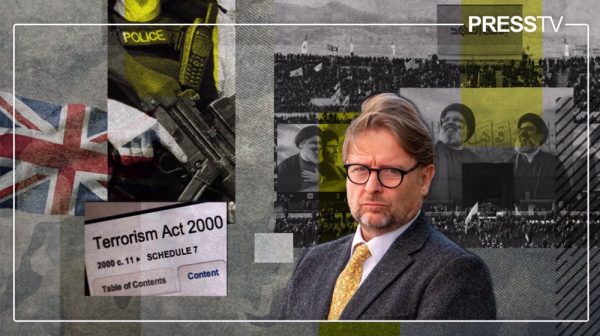
By David Miller – Press TV – February 27, 2025
At 21.32 local time on the evening of Monday, 24 February, I stepped off a plane from Istanbul to Heathrow and into the terminal building.
In front of me were a wide circle of people evidently waiting for someone, perhaps for a number of passengers. I knew right away one of them was me.
One of the SO15 (formerly special Branch) plain clothes officers of the Counter Terrorism Command, for it was them, asked for my passport and whether I had started my journey in Istanbul.
Of course I knew that they knew this was not the case. In any case, I had done nothing wrong in – as I said to them – visiting Beirut to cover the funeral of Hezbollah leaders Sayyed Hassan Nasrallah and Sayyed Hashem Safieddine.
This was my first taste of Schedule 7. They started to explain what Schedule 7 was and I said yes, I know about it. From being stopped before? No, because I am a researcher who studies terrorism legislation.
About then, on the moving walkway, I realised that the circle of people had only been waiting for me. I looked round and counted them out loud. I know I’m a big lad, I said, (I am over 6 foot) but did you really need eight officers to detain me?
So, we got to the interrogation room, which is, as past detainees will know, immediately behind passport control. Anyone coming out of that door is SO15 or a detainee.
For those who may face this experience in the future, it is worth explaining how the process goes. It’s a bureaucratic procedure.
There is a guidance hand book dictating how the process should be handled. First they have to read out the relevant extract from the Terrorism Act. It’s a whole page (see below) and they give you a copy, which they ask you to sign.
The essential bit is that you are being ‘detained’ as opposed to arrested in order that the ’Examining Officer’ can determine if you ‘appear’ to be a person ‘concerned in the commission, preparation or instigation of acts of terrorism’.
A couple of other details are of relevance. They can’t hold you for more than 6 hours after the time they first apprehend you. You are not under criminal investigation or under arrest and as a result ‘you do not have the right to remain silent’. If they do change their minds and arrest you, you do at that point have the right to remain silent and you should do so.
You have to participate in the process, answer questions and to accept being searched. You don’t have to answer questions that you think they are asking and only need to answer what they actually ask. There is no need to be unduly long winded!
The other point to note is that nothing you say can be used ‘in evidence in criminal proceedings’. (The only exceptions are that if you do not comply, that can be used in evidence and if you later rely on something in court which is ‘inconsistent’ with what you say, then the contents of your interview can be used).
You have the right to contact a next of kin/friend and a lawyer and you should exercise that right. The rules state that if you ask for a solicitor you cannot be questioned until your solicitor has consulted you.
And your solicitor can participate in the questioning either on the phone or in person, if you can get them out of bed to come to wherever you are detained!
Once in the room both I and my luggage were searched. They found little of interest. No devices. The only thing that they brightened at was a very small USB drive, which I had forgotten was in there.
I confirmed that I thought it had no security protection and they took it away. Later it was returned, much to my surprise. What was on it I asked? Only some teaching notes they said in disappointment.
Later, at home I checked. Hilariously there was only one file on the drive: a Powerpoint presentation on the ‘Zionist movement’.
And so we got to the actual interrogation. I estimate that mine started about 23.00, so there was a long period of silence while we waited for the solicitor to call back.
This was partly due to the police deciding that they could not call my first nominated solicitor because he wasn’t on their list, though he should not have needed to be.
Anyway, after I talked to my solicitor, we were off.
What followed was around two hours of questioning about my trip to Beirut. Why did I go, what did I do when I was there, did I support Hezbollah, and many other similar questions.
There is not space to tell it all blow by blow but here are some highlights which might be of use to others who like me are manifestly not involved in the commission of acts of terrorism, as everybody knows.
First, they wanted to know why I went. As I had already intimated when they first stopped me, I was there to cover the funeral as a journalist. As is public knowledge, I work as a journalist on a freelance basis.
I produce a TV show called Palestine Declassified for Press TV, and write for a variety of other publications such as Electronic Intifada, Mintpress, TRT World and Mayadeen English. I mentioned this as well as mentioning that I used to work at the university of Bristol until I was sacked.
They asked about that. I summarised the story including the four occasions on which I was exonerated of ‘antisemitism’ at Bristol (internal enquiry, two external QC reports and the internal appeal), followed by the ‘landmark’ victory at the Employment Tribunal in February 2024.
We went on to discuss my trip to Lebanon. What did I do there? I recounted that I had visited the southern village of Maroun El Ras which is within a mile of the border of occupied Palestine, high on a hill overlooking the colonial settlements of Avivim and Yir’on.
I went with a number of other foreign guests including from Ireland, Yemen, Brazil and various other countries. What was there I was asked? I replied (truthfully) that there was nothing in the village since almost all 600 houses had been destroyed.
The officer seemed confused: why would I want to visit then? Precisely because it had been destroyed by the Zionists, obviously.
We got fairly quickly to the question of whether I supported Hezollah as a proscribed organisation. I referred back to my Employment Tribunal at which similar questions had been asked somewhat ineffectually by the University of Bristol’s counsel Chris Milsom.
There I had said the same thing as I now stated: I ‘support’ the right as given in international law for the Palestinians (and indeed others under occupation) to resist including by armed force.
In case officers in SO15 or other actors need reminding of this, the relevant text is from the UN General Assembly resolution 38/17 of 1983, which states that it
“Reaffirms the legitimacy of the struggle of peoples for their independence, territorial integrity, national unity and liberation from colonial domination, apartheid and foreign occupation by all available means, including armed struggle”.
They went on to see if they could entice me into saying I specifically supported proscribed organisations like Hamas and Hezbollah. So, I obviously went on to say that it was not only a question of Hezbollah and Hamas, but also Palestinian Islamic Jihad and the PFLP-GC, which is of course not the same as the PFLP itself, which is not proscribed. It was instructive that my interrogator appeared not to know about PIJ and the PFLP-GC, asking me to repeat each name.
We also visited the topic of deproscription. The officer wanted to know why I thought that all of the four, groups should be de-proscribed.
It seemed like he thought this was a valuable concession from me. But, as he is, presumably, aware, the Terrorism Act (year) specifically notes that it is not illegal to call for de-proscription.
I include a table from the Home Office website which gives a list of the charges that can relate to proscribed organisations.
And then we were on to the question of terrorism. Did that mean that I thought they were not terrorist. At which point I am afraid I referred back to my decades long record of research on the question of terrorism and its role in propaganda including my early work on the struggle to decolonise the north of Ireland.
As if the sentiments encoded in the proscribed list or the Western use of the term ‘terrorism’ itself are necessarily subscribed to even by most British citizens, never mind the rest of the world. Let’s not forget that the way in which we use the term ‘terrorism’ in the west – in particular ‘Islamic terrorism’, has it origin in Zionist propaganda operations as has been shown by, for example, Remi Brulin.
At one point, apparently out of the blue I was asked: Are you a practising Muslim? I expressed some surprise at this question. In his defence my interrogator said that I had earlier noticed and asked about whether the small pile of folded prayer mats in the cupboard was in fact a small pile of folded prayer mats.
I had noted them earlier and wanted to check that’s what they were. Only the best for the predominantly Muslim ‘guests’ of the room! As the Guardian reports only 20% of Schedule 7 detentions are of white people (that’s including ‘white Irish’, and others stopped, like me for their solidarity activities, so it’s likely that the proportion of white ‘far right’ suspects stopped is lower than 20%)
The officer seemed mystified about my attendance at an event in which everyone must have been a supporter of Hezbollah. As if reporting on events and supporting those events is the same thing. He asked if everyone there supported Hezbollah.
I replied that I didn’t feel able to report any great knowledge on the consciousness of perhaps the million people there. But it is certainly the case that there were very many Hezbollah flags.
I did also note that there was a largish contingent from the Syrian Social Nationalist Party and made the point that the sheer numbers present suggested that Nasrallah has something of a larger reputation than just among party members and core supporters.
As we talked the officer started asking about Press TV, for which I work on a freelance basis. He evidently had not known what Press TV was as it took a long time for him to understand – after I told him that it was the English Language TV channel of the Iranian government – the equivalent of the BBC world Service.
Then he wanted to know about whether the people I work with at Press TV are extremists or have extreme opinions. Obviously I had to press him to explain what he meant by extremism. Given the British government abandoned its efforts to define the term in any legally robust way, he fared no better.
So he asked something about how many were opposed to western society. I was not impressed by this, since, as I said, most people in the world are opposed to the West, and many of them are British citizens.
And then; does Press TV support the recent ‘terrorism’ in this country?! Which terrorism, I enquired. And do you know what he said? He only said the Southport attack. That was not terrorism I said. Even his colleague butted in and agreed with me!
So we were back to finding specific examples and – put on the spot – he came up with the stabbing and car at Parliament in 2017. That, of course, was carried out by an individual who had made multiple trips to Saudi Arabia and appeared to have been inspired by an ISIS related ideology.
Before we got any further I was asked if Press TV covered incidents like this. The implication, of course, being that covering such activities might be tantamount to ‘supporting’ them.
Obviously, being a news service Press TV does cover political violence of many types, as does every other news organisation in the world.
But moving on I replied that in fact Press TV is opposed to those kind of attacks. I was on the verge of going on to say that this of course was different to the position of their colleagues in MI6 and in the government and indeed the BBC who are only too happy to collaborate in supporting ISIS/Al Qaeda in Syria if it suits their perception of British foreign interests. But I let that lie.
By now we were winding down and it was pretty clear they were about to release me, even if I had taken their claim that it would be over soon with the requisite heap of salt. At the end they asked if I had anything to ask, like we were coming to the end of a job interview.
I made one statement which was that it was abundantly clear to everyone in the room that I was not a person who was concerned in the ‘commission, preparation or instigation’ of acts of terrorism.
By way of defence of the detention the officer attempted to justify it in term of a British citizens attendance at the funeral of a terrorism leader, a defence which of course worked to deny that they had effectively been instructed by others to stop me. With that we were done and I was released at 1am too late to get home except via a prohibitively expensive taxi.
It appeared abundantly clear that SO15 did not have any real idea of who I was and had not prepared any case against me. It was just a normal Schedule 7 stop.
Except of course, it wasn’t. I had openly announced on X that I was in Lebanon for the funeral and had reported from my visit to Maroun El Ras and the Iran garden, on its outskirts both of which had been totally destroyed by Zionist bombardment.
I also posted a clip of my visit to Kfar Kila showing mass destruction of civilian infrastructure wreaked by the Zionists and my discovery of a US arms firm manufactured detonation wire used in blowing up civilian houses.
I also posted on the funeral itself, including while I was stuck in traffic on the way, as I arrived in the ‘nick of time’ and as the ceremony started.
Of course all of this was very triggering for the genocidal Zionists who track any deviation for the authorised position of pretending that the genocide is not happening and that those that resist are simply ‘terrorists’.
A wide range of anonymous trolls and Zionist regime assets started mass reporting the Met Police calling for me to be arrested and jailed. I know they say that the Zionists don’t have much power, but bouncing the Met into detaining a journalist on assignment seems like power of some sort.
Here is a select list of Zionist agents and assets who called for me to be arrested:
- Gary Spedding the Zionist asset who poses as being pro-Palestine – 23 February 1.44pm
- Sabrina Miller, Daly Mail journalist and former student at Bristol University – 23 February 2.09pm
- Labour Against Anti Semitism (LAAS) – 23 February 7.41 pm
- Campaign Against Antisemitism (CAA) – 24 February 1.15pm
All of the above were involved in one way or another in the campaign to have me sacked at Bristol, a decision that the Employment Tribunal found was flawed and unjustified, in its ‘landmark’ decision.
This was all topped off by reports on Monday in the Mail (published at 5 to one in the morning just as Monday 24th began) and later (at 5.25 pm) in the Telegraph. This latter report cited the fanatical Zionist Robert Jenrick, the shadow justice secretary, who was reported as saying: “David Miller isn’t even bothering to hide his anti-Semitism any more.
He’s now openly boasting of his support for a proscribed terrorist group. It’s shocking that for so long he held a senior position at Bristol University.” Of course no actual ‘antisemitism’ was on display, and I said no words capable of being construed as ‘openly boasting’ of ‘support’ for Hezbollah.
Jenrick has form a far as I am concerned in that he has in the past spent a not inconsequential amount of time trying to have me sacked from my post at Bristol. For example, when he was Housing minister he directly bullied the University of Bristol over my case.
The report ended by saying that the paper had (like the Mail claimed too) contacted me for comment. The facts are that I have had no such query from the Telegraph or from the Mail.
I must say that I did enjoy the column the next day by Stephen Pollard who presided over a significant number of libel defeats in his role as editor of the Jewish Chronicle. ‘Opening a communication from’ me back then he says was like ‘ingesting poison’. My parents would be proud.
What, self-evidently, happened in this instance was that the Zionist pressure worked its way through and an order to detain was issued. As to whether it came from the top of the counter Terrorism Command, the Home Office or elsewhere, we don’t know as yet.
But it is very much of a piece with the general picture post October 7 2023, which is that there is intense Zionist pressure on the counter terrorism and policing apparatus to weaponise both hate crime laws and terrorism legislation.
It is perfectly plain, as I have shown elsewhere that this pressure from Zionist lobby and intimidation groups and pressure from Zionist aligned politicians like Michael Gove, Suella Braverman, Stuart Polak, Robert Halton and the aforementioned Robert Jenrick, more than adequately explains all of the alleged rise in ‘antisemitism’ as well as almost all of the uses of the many Terrorism Acts on the statute books to oppress and repress those who will stand with the Palestinians in virtually any way.
And in recent months the attacks have widened to journalists, who’s historically recognised craft implies that they can report on all events without being attacked directly by the state.
But now, after Richard Medhurst, Sarah Wilkinson, Asa Winstanley and most recently Ali Abunimah, it is clear that journalists too are direct targets of the Zionists operating as they do via the allegedly sovereign justice apparatus of Western states.
David Miller is the producer and co-host of Press TV’s weekly Palestine Declassified show. He was sacked from Bristol University in October 2021 over his Palestine advocacy.
Hamas denounces New York Times distortion of Marzouk’s comments on Op Al-Aqsa Flood
Press TV – February 25, 2025
Hamas has rejected a report by the American daily newspaper The New York Times that has misrepresented recent remarks by a senior official of the Palestinian resistance movement, emphasizing that the comments are “inaccurate” and “taken out of context.”
In a statement released on Monday, the Gaza-based group said the interview conducted with Moussa Abu Marzouk, a senior member of its political bureau, and published several days ago did not contain the full content of the answers, and his exact remarks were quoted out of context.
Hamas stressed that the published interview did not include the true remarks made by Abu Marzouk, and did not convey the true meaning of what he had said.
On Monday, The New York Times ran an article titled: “Hamas Official Expresses Reservations About Oct. 7 Attack on Israel” claiming that Abu Marzouk voiced doubts regarding the October 7 attack.
According to the article, Abu Marzouk admitted he would not have endorsed the assault had he been aware of the destruction it would cause in Gaza.
Hamas in its statement stated that Abu Marzouk confirmed that the large-scale surprise attack, dubbed Operation Al-Aqsa Flood, against the usurping Tel Aviv regime on October 7, 2023, reflected the Palestinian people’s right to resistance and their rejection of Israel’s siege, occupation, and settlement expansion activities.
Abu Marzouk also emphasized that the criminal Israeli regime had committed appalling war crimes and genocide against the Palestinians in Gaza.
Abu Marzouk told the New York Times that Hamas would not give up its positions and Palestinian people’s right to use all forms of resistance, including armed resistance, to fight off the Israeli occupation and liberate their land.
“The resistance weapon belongs to our people and its purpose is to protect our people and our holy sites, so it is not permissible to drop or surrender it as long as the [Israeli] occupation exists on our land,” the high-ranking Hamas official told the newspaper.
Backed by the United States and its Western allies, Israel launched the war on Gaza, after Hamas and other Gaza-based Palestinian resistance movements carried out Operation Al-Aqsa Flood against the Israeli regime in response to its decades-long campaign of oppression against Palestinians.
Israel’s genocidal war on Gaza has led to the killing of at least 48,346 Palestinians, mostly women and children, and injury of 111,759 others since early October 2023.
A ceasefire and prisoner exchange agreement went into effect in Gaza on January 19, halting Israel’s aggressive campaign against the coastal region.
Tel Aviv bus bombings: False flag or Netanyahu’s luck?
By Robert Inlakesh | The Cradle | February 23, 2025
At 8:30 PM on Thursday night, an Israeli firefighting department said that “a report was received about a bus explosion in a bus parking lot” on Ha’amal Street in Bat Yam, southern Tel Aviv. Later reports suggested that a passenger had notified the bus driver that a suspicious package had been left inside the vehicle, triggering an emergency evacuation, after which an explosive device detonated the backside of the bus.
The event occurred in a parking lot only a few hundred meters away from two buses, dozens of meters apart, that had also exploded shortly prior in the parking lot for the Bat Yam Stadium and Bat Yam Country Club. The two vehicles were parked in open areas, not beside the other buses that were parked next to each other, exploding at a time when nobody was within distance.
Following this, it was reported that the Israeli authorities had discovered two more bombs planted on buses. One explosive device was said to have been neutralized on a bus near the Wolfson Hospital in the industrial hub of Holon, located over 4 kilometers away from the previous explosions. Another explosive device was also announced to have been on a bus in Yimit 2000, before it was later ruled out as unconnected.
Soon after, there were reports of suspicious activity at Israel’s Haganah train station and suspicious cargo on the light rail that was soon ruled out but didn’t stop a shutdown of all transportation by 10PM that same night. However, it was reported that a “suspect” in the bombing case was pursued at Tel Aviv’s Haganah station and had even fled onto the train tracks to avoid arrest.
A photo of an improvised explosive device (IED) located on a bus in the Holon area was quickly published in the Hebrew media and, in Arabic, said “Revenge for Tulkarem.” The entire event ended without a single casualty, not even a light injury.
A series of “miracles”
The explanation that the Israeli authorities have offered as to why the bombs went off prematurely is that the timers were incorrectly set. This conclusion was drawn within hours and communicated to the Hebrew media, claiming that the intended time of detonation was 9 AM on Friday, but instead, they were programmed for 9 PM on Thursday night. Yet, the incident was first reported at 8:30 PM, as noted above, which calls into question this explanation.
The passenger who noticed the bomb on the third bus that was blown up – on Ha’amal Street in Bat Yam – told the media that, following the evacuation of the bus, “as everyone was moving away, the explosion occurred.” This has widely been accepted by Israelis as a “miracle.”
Another “miracle” was that the first two buses also happened to not only detonate when nobody was around, but both happened to be parked several meters away from other buses that were clearly lined up next to each other. This made it so that no other buses were blown up, and the overall damage costs were kept to a minimum.
The assailant/s who planted the bomb that was neutralized also happened to write a note in Arabic that left a possible motive. This IED was not only laced with a clue, that would have disappeared had it exploded, but is indicative of someone who wanted their work to be known. Yet, no group has actually claimed the attack.
Israel’s ongoing invasion of the northern West Bank, which began in January, has led to the murder of around 100 Palestinians, and in the Tulkarem Refugee Camp in particular, some 75% of its residents have been forced from their homes. However, the Israeli army’s campaign is yet to inflict a defeat on the armed groups operating there.
Another strange development was two vague statements released on Telegram by the Qassam Brigades’ Tulkarem branch, hinting at what occurred in Tel Aviv and threatening painful blows in the future. This has served as evidence of Hamas’s involvement in the bombings.
The Cradle was informed by a senior figure in the Hamas movement that it has not issued any statements claiming responsibility and that reports otherwise are false.
The current Israeli assessment points the finger at Hamas, claiming that Iran was behind the planned attack and had coordinated it with a Hamas cell operating in the occupied West Bank. This is the current narrative that is making headlines in Israeli Hebrew media.
Intriguingly, two Israeli suspects were arrested by Israeli intelligence in connection with the bombings. According to a Channel 12 News report, one of the Jewish Israeli suspects is said to have helped transport those who planted the explosive devices. The detained Israeli citizen is allegedly set to appear behind closed doors at the Tel Aviv Magistrate’s Court and is being denied access to a lawyer, while interrogations are ongoing to determine whether the “Israeli Jew from Gush Dan” knew about the intentions of who he was transporting.
Responding to the accusations, Bassem Naim, a leading member of the Hamas politburo, told The Cradle the following:
“Based on the timing and the way in which it happened, the first possibility for me is that Netanyahu or members of his government escaped from their obligations in the ceasefire agreement and created an external enemy to relieve the increasing internal pressure. Anyone who reads the history of the Zionist movement will find dozens of proven events that were planned and executed by Zionist elements against Jews themselves.”
Lending credit to the allegations of the Hamas official are the apparent issues with the coordination of the bombings. The armed groups inside the West Bank have not proven themselves capable of pulling off these kinds of attacks before, showing minimal military sophistication. On the other hand, by Israel’s own admission, this was a well-planned operation that evaded detection by the Israeli army and Shin Bet, hence the blame being placed on Tehran.
At the same time, it was also so poorly executed that it left a letter of intent, as if expecting one of the explosives to fail upon detonation, also messing up the timing so terribly that three IEDs exploded prematurely, and all were placed on buses that just so happen to have been isolated from anything else. On top of this, there’s no group that has actually claimed responsibility.
Netanyahu’s favourable coincidences
Israeli Prime Minister Benjamin Netanyahu has emerged from the bus bombings to push for harsher military measures inside the occupied West Bank, ordering the deployment of more army battalions into the territory. He has also taken the opportunity to weaponize the incident against the Gaza ceasefire.
The internal blame for Israel’s failure to thwart the attack is now also being placed upon the Shin Bet, the head of which is Ronen Bar and has been at loggerheads with PM Netanyahu for some time and was even recently demoted from his role in managing the Gaza ceasefire talks.
The Israeli Premier has also announced a “massive counter-terror operation” in the West Bank, right as the current invasion of the northern West Bank, dubbed “Operation Iron Wall,” was said to be coming to an end.
Also, on Thursday, an anonymous figure was cited by Israeli media as claiming that Benjamin Netanyahu will not allow the Gaza ceasefire to enter into its second phase. The goal of the Israeli leader has been to extend the first phase of the tripartite ceasefire agreement in a bid to save his political career.
In a rather bizarre media stunt, Netanyahu gave one of his three public addresses this Friday from inside a Palestinian family’s home in Tulkarem. After forcing Palestinians out of their house, it was taken over to be used as a military position, from which the Israeli PM stated that “we are entering the terrorist strongholds, clearing entire streets used by terrorists, their homes. We are eliminating terrorists and commanders.”
The bus bombings in Tel Aviv granted Netanyahu the ability to attack his internal opposition while blaming Hamas, Iran, and the West Bank’s armed resistance groups. The attack itself resulted in minimal material damage, not even so much as a light injury, granting a mandate for military escalation based upon the premise that if the bombings were successful, there would be hundreds of casualties.
An accumulation of coincidences, holes in the official narrative, and what Israeli media call “miracles” have all led to accusations of the incident being a false-flag attack. There is still no conclusive evidence to prove this assertion, yet with Israel imposing censorship on the issue, various outstanding questions are yet to be answered.
Good Jihadi, bad Jihadi: Al-Qaeda’s Sharaa vs Sinwar’s resistance
The Cradle | February 19, 2025
“Even the pages of the New York Times now include regular accounts distinguishing good from bad Muslims: good Muslims are modern, secular, and Westernized, but bad Muslims are doctrinal, antimodern, and virulent.” – Mahmood Mamdani, Good Muslim, Bad Muslim: America, the Cold War, and the Roots of Terror
In his seminal work, Good Muslim, Bad Muslim: America, the Cold War, and the Roots of Terror, Mahmood Mamdani dissects how the west constructs and weaponizes distinctions between “good” and “bad” Muslims to suit its geopolitical objectives. He argues that these labels are not inherent but imposed, shaped by the shifting demands of western foreign policy.
Nearly two decades after its publication, his thesis remains alarmingly relevant. Nowhere is this clearer than in the stark contrast between the west’s treatment of Yahya Sinwar, the martyred Palestinian resistance leader of Hamas, and Ahmad al-Sharaa, better known as Abu Mohammad al-Julani, the head of Al-Qaeda-linked Hayat Tahrir al-Sham (HTS) in Syria.
A tale of two leaders
While Sinwar has spent the past year in the war-ravaged ruins of Gaza, constantly evading Israeli and NATO surveillance while leading the Palestinian resistance against a brutal Israeli occupation and aggression, Sharaa moved freely through Idlib, and now Damascus, attending public events and meeting western diplomats without significant security measures.
This is despite the fact that the US had placed a $10 million bounty on Sharaa’s head as a so-called terrorist. The incongruence is striking: an internationally recognized Palestinian resistance leader hunted and vilified, while a former Al-Qaeda affiliate leader rebrands himself as a legitimate political actor with western complicity.
Back in 2021, TRT World noted how Sharaa was “remodeling” himself as a peacemaker, enjoying unimpeded mobility even as western coalition forces actively hunted other jihadist leaders linked to ISIS and Al-Qaeda.
Turkish Foreign Minister Hakan Fidan later confirmed that Sharaa had been collaborating with Ankara for years in eliminating those classified by NATO as “terrorists.” The reality, however, is that Sharaa has been part of a western-backed laundering process for years, at least since 2012, but certainly since 2017, when with Qatari backing, he began rebranding his Al-Qaeda-linked Nusra Front as a Syrian liberation force opposing Russian and Iranian influence.
Media whitewashing and political legitimacy
The western media’s embrace of Sharaa was made explicit when The Times described his return to Damascus as that of “‘Polite’ Syrian leader heads home.” This was not an isolated occurrence but part of a broader effort to frame him as a liberator from foreign influence. His past crimes, including war crimes against civilians, enslavement of Yazidi women, and sectarian violence, were conveniently brushed aside.
When Sharaa’s group took control of Damascus last December, the alignment with western interests became clearer. Israeli airstrikes systematically dismantled Syria’s military infrastructure, particularly in and around the capital, yet Sharaa himself moved through the city undisturbed.
While the Israeli Air Force bombed military sites near Umayyad Square, Sharaa was seen casually driving through the same areas. His silence on these attacks was deafening – especially given that his administration’s official stance on Israel marked a complete break from Syria’s historic anti-Zionist policies.
Statements from his government indicated no intention to reclaim the occupied Golan Heights or other lost territories, signaling a de facto truce with Tel Aviv.
The west’s legitimization of Sharaa reached its peak when his Foreign Minister, Asaad al-Shaibani, was invited to attend the World Economic Forum annual meeting in Davos, sharing a stage with figures like former British prime minister Tony Blair.
His rhetoric was tailored for a western audience: peace, counterterrorism, privatization, and economic liberalism – all buzzwords signaling a willingness to operate within the neoliberal world order.
Demonizing resistance: Sinwar’s struggle
Meanwhile, Israel continued its relentless campaign against Yahya Sinwar, branding him a “butcher,” a “war criminal,” and a “child killer” – a narrative eagerly parroted by western media despite its lack of substantiation.
Even as the alleged war crimes attributed to Hamas fighters on 7 October 2023 were later exposed as Israeli propaganda, Sinwar’s image remained demonized. In his final moments, as an Israeli drone executed him in Gaza, Sinwar did not cower. He fought until his last breath, cementing his status as an icon of Palestinian resistance. Yet even in death, the western narrative denied him any form of legitimacy.
Julani’s convenient redemption
Conversely, Sharaa’s past was erased. His involvement with the Islamic State in Iraq, his position as deputy leader of ISIS under Abu Bakr al-Baghdadi, his group’s mass executions, and his forces’ role in the enslavement of women were all conveniently overlooked.
Western journalists competed to polish his image, portraying him as a pragmatic leader rather than the war criminal he is. His forces still operate brutal prisons in Idlib, where opponents disappear indefinitely, yet he remains a media darling.
This contrast illustrates Mamdani’s thesis with unsettling precision: Sharaa is the “good jihadist” because he aligns with western-Israeli interests, while Sinwar is the “bad jihadist” because he defies them.
Sinwar’s crime was not terrorism – it was successfully challenging the occupation’s military, exposing the vulnerabilities of an Israel long perceived as invincible. His resistance resonated across the Arab and Muslim world, cutting across sectarian lines and threatening western interests.
Sharaa, on the other hand, poses no threat to Israel. He remains focused on the sectarian score-settling within Syria, making him a useful pawn rather than an adversary. His group does not challenge Western influence in the region, nor does it resist the ongoing occupation of Palestinian land. This is the fundamental reason why he is embraced rather than demonized.
Sinwar may have fallen, but as the Quran reminds us: “And do not say about those who are killed in the way of Allah, ‘They are dead.’ Rather, they are alive, but you perceive it not.” (Quran 2:154). His legacy endures, living on in the hearts of those who continue his struggle.
Sharaa, despite his crimes, remains alive and politically relevant. In the western geopolitical playbook, obedience is rewarded while defiance is crushed.
‘Israel’ targeting police officers in Rafah violates ceasefire: Hamas
Al Mayadeen | February 16, 2025
Hamas has denounced an Israeli drone strike that targeted police officers in Rafah this Sunday morning, killing three officers. The attack occurred while the officers were securing the entry of humanitarian aid, and Hamas has labeled it a “serious violation” of the ceasefire agreement currently in place.
In an official statement, the movement reiterated its belief that “Israel’s” actions show a deliberate disregard for the terms of the ceasefire. Hamas pointed out that “Israel” had promised to allow the entry of caravans and heavy machinery to Gaza but failed to follow through, as evidenced by their announcement today that these supplies would be denied entry. This breach adds to “Israel’s” ongoing failure to maintain the truce, according to the Palestinian movement.
The statement also criticized “Israel’s” delay in beginning the second phase of negotiations, casting doubt on its commitment to the agreement brokered by international mediators. Hamas further accused Israeli Prime Minister Benjamin Netanyahu of obstructing the peace process, using the time to continue military aggression and pursue policies that could lead to further war crimes.
Hamas condemned the attack and all other violations of the ceasefire and humanitarian protocols, holding “Israel” fully responsible for the repercussions. The movement called on international mediators to step in and pressure “Israel” to fulfill its commitments, including stopping its violations of the ceasefire, implementing the full humanitarian protocol, and immediately starting the second phase of peace talks.
Israeli violations tantamount to agreement failure: Gaza Media Office
In a similar vein, Salama Maarouf, the Director of the Government Media Office in Gaza said earlier today that “Israel’s” refusal to allow the entry of mobile homes and heavy equipment to Gaza constitutes a clear violation of its commitments under the ceasefire agreement and its accompanying humanitarian protocol.
In statements to Al Mayadeen, Maarouf emphasized that “Israel’s” refusal is tantamount to declaring the failure of the ceasefire agreement, despite the Palestinian Resistance’s commitment to its obligations as long as the occupation upholds its own.
He added that the Israeli occupation’s actions are clear proof to the world which party is obstructing the agreement, underscoring the need for mediators to intervene and pressure “Israel” to fulfill its commitments.
Maarouf also highlighted that “the catastrophic living conditions endured by the Palestinian people in Gaza due to the genocide and humanitarian crisis cannot withstand further delays, evasion, or obstruction of the entry of shelter materials and other essential supplies.”
The Palestinian official urged mediators and the international community to assume their responsibilities, respond immediately to Gaza’s urgent needs, and put an end to the ongoing suffering by compelling “Israel” to cease its violations and its exploitation of the plight of 2.4 million people in Gaza.
The Government Media Office in Gaza has repeatedly pointed out that “Israel” continues to stall and delay the implementation of the humanitarian protocol, while the humanitarian situation in Gaza deteriorates at an alarming rate.
Despite the entry of 801 aid trucks into the besieged Gaza Strip on Wednesday, humanitarian organizations warn that “Israel” continues to severely limit the flow of essential supplies, in violation of the ceasefire agreement with the Palestinian resistance movement Hamas.
According to the UN’s Office for the Coordination of Humanitarian Affairs (OCHA), the aid deliveries were made “through interactions with the Israeli authorities and the guarantors for the ceasefire deal.” However, the agency cautioned that restrictions remain stringent, particularly on critical supplies like fuel and medical equipment.
It is noteworthy that Hamas intended to postpone the prisoner exchange set for February 15 due to the ongoing Israeli violations of the ceasefire agreement before mediators intervened to overcome obstacles hindering the completion of the implementation of the ceasefire and prisoner exchange agreement. The violations include Palestinians being shot at, tanks trespassing the permitted distance, and preventing the entry of heavy equipment, medical supplies, and caravans.
Hamas delays next release of Israeli captives over ‘violations’ of Gaza ceasefire
Press TV – February 10, 2025
The Palestinian resistance movement Hamas says it will postpone the next release of Israeli captives under a ceasefire deal in Gaza until further notice as the Israeli regime continues to violate the terms of the agreement.
In a post on the social media platform X, Abu Obeida, spokesman for the Qassam Brigades, Hamas’ armed wing, said the handover of the captives “who were scheduled to be released next Saturday… will be postponed until further notice, and until the occupation commits to and compensates for the entitlements of the past weeks retroactively.”
He added, “We affirm our commitment to the terms of the agreement as long as the occupation commits to them.”
The spokesman for the Qassam Brigades stated that over the past three weeks violations had included “delaying the return of the displaced to the northern Gaza Strip, and targeting them with shelling and gunfire.”
In response to Hamas’ announcement, Israeli minister of military affairs Israel Katz said he has instructed the military to “prepare at the highest level of alert for any possible scenario in Gaza.”
Hamas released three Israeli captives on Saturday as part of the fifth phase of the prisoner exchange deal under the ceasefire agreement with the Tel Aviv regime that took effect last month.
In exchange, Israel released 183 Palestinian prisoners, of whom 18 were serving life sentences. The majority had been detained in Gaza since the onset of the Israeli genocidal war on October 7, 2023, and had no public charges against them.
A total of 16 Israeli captives and 566 Palestinian prisoners have been freed so far under the ceasefire agreement.
The next Israel-Hezbollah war is now unavoidable – and it will be worse
By Robert Inlakesh | RT | February 10, 2025
Another round of violence between Lebanon and Israel is not a matter of if, but when. Israel managed to extract a series of tactical victories from the war so far, but did not possess the capacity to defeat Hezbollah decisively. Now that Israel seeks to maintain freedom of action inside Lebanon, it threatens a much more violent outbreak than what was stopped by the November 27 ceasefire.
Much of the analyses offered on the conflict between Lebanon and Israel, which erupted into a paroxysmal battle in September 2024, trace its origins back to October 8, 2023. However, this take is limited in its scope and also often misses key lessons from the history of the conflict.
Understanding what shaped the Lebanon-Israel war
A day after the Hamas-led October 7 attack against Israel, it became clear, through the public statements and actions of the Israelis, that the war they sought to launch was intended to inflict maximum collective punishment on the civilian population of Gaza. Although it often goes unrecognized due to the shocking effects of the Hamas raid, at least 413 Palestinians were killed inside Gaza that day, most of them civilians. The next day, the Lebanese group Hezbollah began opening fire on Israeli monitoring equipment set up in the illegally occupied Shebaa Farms area.
After Israel conducted airstrikes in southern Lebanon and killed four Hezbollah members, the Lebanese armed group responded by opening fire on Israeli military sites and surveillance equipment on October 9. That same day, former Israeli Defense Minister Yoav Gallant declared a “complete siege” on Gaza and that “we are fighting against human animals” to justify blocking all food, water, and electricity from entering the territory.
Understanding the gravity of what had just happened, Hezbollah’s secretary general, Seyyed Hassan Nasrallah, understood that they were going to have to play a supporting role for the Palestinian armed groups in Gaza. However, the group did not want to drag Lebanon into a comprehensive war and repeatedly stressed this point. The one pledge that Nasrallah made was “Hamas will win,” offering no other red lines.
From October 8, 2023 to September 20, 2024, Israel was responsible for around 81% of all attacks between both sides, killing 752 people in Lebanon, while Hezbollah’s attacks killed 33 Israelis. The last time a war was fought between Lebanon and Israel was in 2006, which began when Hezbollah conducted a raid and kidnapped Israeli soldiers. The war was well planned by Hezbollah and resulted in a victory for the group, as Israeli forces retreated from Lebanese territory.
What made Hezbollah the first Arab force to claim a real victory over Israel in 2006 was down to the absolute power imbalance, in which a stalemate combined with tactical victories and a well executed plan made it a defeat of the Israeli military. After this, while Israeli forces committed thousands of violations of Lebanese sovereignty – by land, sea, and air – occasionally assassinating Hezbollah fighters in Syria that caused some brief border skirmishes, the two sides veered away from all-out war.
In 2019, however, the Israelis began working on a new security fence/wall along the Lebanese border, which cut into and annexed land clearly demarcated to be on Lebanon’s side of what is known as the Blue Line. In 2023, the most significant land grab was of the northern Ghajjar village, which was cut off from Lebanon and opened for Israelis to visit. In addition, Israeli forces repeatedly entered Lebanon in order to clear land between the fence and Lebanese farm lands, resulting in repeated standoffs.
During the period from 2006 to 2023, Israel had been working at infiltrating Hezbollah and spying on the political party, while the Lebanese group significantly strengthened its military power. This is of great significance to the conflict that has taken place over the past 16 months, because Hezbollah in 2006 was somewhat comparable in power to Hamas at the start of the war in October 2023.
Hezbollah was also born out of the conflict between the Palestine Liberation Organization (PLO) and Israel, when the Israelis launched their invasion of Lebanon in 1982. The Israelis killed around 20,000 Palestinians and Lebanese in that war, which ended with a ceasefire due to the PLO’s surrender and acceptance of deportation to Tunisia.
Yet, after the PLO’s fighters and leadership left, Israel did not leave Lebanese territory and instead occupied the south of the country, while deploying its allied militias, including the Phalange Party, to massacre thousands of civilians in and around the Palestinian refugee camps. The lesson learned here for all future movements that would emerge to fight Israel, was that you never surrender your weapons; hence the Hamas slogan ‘victory or martyrdom’. The single biggest achievement that Hezbollah recorded in its history was forcing Israel to withdraw from Lebanese lands and give up on their occupation.
Why war is inevitable
It is clear that the war between Lebanon and Israel, which lasted nearly two months, was not one that Hezbollah was prepared for. Even after Israel’s booby-trapped pager attacks, which injured thousands across Lebanon, including many civilians, the Lebanese group still sought to fight a limited battle, as evidenced by the speech given by Nasrallah at the time. However, Israel did not stop there and decided to kill most of Hezbollah’s senior leadership, including Nasrallah, making a war unavoidable.
As early as October 8, 2024, Israeli Prime Minister Benjamin Netanyahu was threatening Lebanon with the kind of destruction wrought on Gaza. While the assault that the Israelis launched was certainly devastating to the civilian population, killing nearly 2,000 people, it was clear that it had not decided to launch a Gaza-style attack. Meanwhile, Hezbollah began using heavier missiles from its vast arsenal, but was tame in its approach and was careful to make much of its strikes symbolic or aimed at military facilities. This had nothing to do with what either side may have liked to do, but there was strategic constraint, which appeared to be deteriorating into the final week prior to the ceasefire.
By late November, Israel had failed to make meaningful advances on the ground in southern Lebanon and did not achieve its objective of reaching the Litani River area. Meanwhile, Hezbollah was not capable of equaling the level of destruction that Israel was committing against Lebanese cities using their missile strategy, it was also fighting essentially blindfolded and standing on one leg after the blows it suffered. Both sides realized that the inevitable result would be a stalemate, so in order to stop further devastation, a ceasefire was reached.
After suffering a major disruption to its supply line through Syria, the loss of its leadership and many commanders, also battling to solve the issues of infiltration, Hezbollah was severely wounded, but not destroyed. While the Israeli tactical victories have now shifted the propaganda war to make Hezbollah appear to be on its last legs, it is far from done. In fact, it still maintains a formidable ground force of around 100,000 fighters, a domestic weapons production capacity, and an abundance of ammunition, which the Israeli military understands well.
The loss of Nasrallah is not a small thing and still lingers in the minds of each and every supporter inside the country, many of whom still yearn for revenge after what was just committed against their nation. Israel proved incapable of beating Hamas after 15 months of all-out devastation, committing one of the worst atrocities since the Second World War. Hezbollah is still a much more capable fighting force than Hamas, yet there are a number of constraints on it due to the domestic political/economic/social situation inside Lebanon.
If Israel chooses to stay inside Lebanese territory, for whatever reason, it will only be a matter of time before action is taken. The next round will also likely be much more bloody, and the death toll will make the conflict last year seem relatively insignificant in comparison. This may not happen in the immediate future and could even take over a year, but the conflict is far from over and that is because there isn’t really a ceasefire in effect as of now.
On November 27, Israel made a point of not only violating it from the first moments and later advancing further into southern Lebanon, it committed hundreds of violations of the ceasefire. Israel has made it very clear that the new reality is that it has full freedom of action and can remain inside pockets of southern Lebanon for as long as it chooses. Therefore, there will have to be a war to ensure that a real ceasefire is reached and Lebanese territory will not be open season for the Israeli military to bomb, shoot at, and kidnap civilians.
Netanyahu is now bragging about changing the map of the surrounding region, while his new army chief of staff, Eyal Zamir, recently declared “2025 will continue to be a year of combat.” Israel is acting aggressively, expanding its borders, and does not appear to be backing down from its warmongering with Iran, which will lead to even greater chaos. Hezbollah will have to carefully navigate Lebanon’s domestic terrain and when it acts, implement a well oiled plan if it chooses to retaliate against Israel’s daily assaults on its country. All of the signs point to a dangerous escalation brewing.
Robert Inlakesh is a political analyst, journalist and documentary filmmaker currently based in London, UK. He has reported from and lived in the Palestinian territories and currently works with Quds News. Director of ‘Steal of the Century: Trump’s Palestine-Israel Catastrophe’.
Hamas says ‘Israel’ plotting to derail Gaza ceasefire deal
Al Mayadeen | February 10, 2025
The Islamic Resistance Movement Hamas believes “Israel” is actively working to derail the ceasefire agreement, a senior Palestinian official told Al Mayadeen on Monday.
The official stated that Israeli statements regarding the second phase of the deal signal an unwillingness to commit to a lasting ceasefire.
Moreover, Hamas, as per the official, sees “Israel” as relying heavily on US President Donald Trump’s reckless decisions to justify its policies and actions in the next phase.
Hamas says that if “Israel” does not adhere to the second phase of the agreement, it will pay a heavy price, the Palestinian official underscored.
Netanyahu moves to sabotage ceasefire talks: Israeli media
Israeli media on Sunday suggested that Prime Minister Benjamin Netanyahu is deliberately obstructing the ongoing ceasefire negotiations with Hamas, aiming to derail the agreement before its next phase.
Reports suggest that the Israeli delegation sent to Qatar lacks real authority, signaling Netanyahu’s unwillingness to move forward with a deal that would secure the release of more Palestinian detainees and a permanent ceasefire in Gaza.
Haaretz cited sources stating that the delegation’s presence in Doha is merely for show.
“Netanyahu is signaling quite clearly that he does not want to move on to the next phase,” one source said, adding that he views the ceasefire as politically damaging.
The reports indicate that Netanyahu is more concerned about appeasing “Israel’s” far-right factions than securing the freedom of Israeli captives.
“Right-wing voters see on the ground that we have not defeated Hamas and its operatives continue to walk around with weapons,” one source explained, referencing a sign at a Hamas-organized captive release event in Gaza that mocked Netanyahu‘s claim of achieving “total victory.”
Efforts to undermine the agreement
According to Haaretz, Netanyahu’s obstructionist tactics could lead to the ceasefire breaking down entirely. Analysts warn that Hamas, recognizing “Israel’s” refusal to honor its commitments, may halt further captive releases.
“Hamas is not stupid,” a source said. “They see the politicization of the negotiations, the placement of Netanyahu confidants Ron Dermer and Gal Hirsch [at the helm of negotiations], the threats by [Finance Minister Bezalel] Smotrich and the right-wing ministers that they will dissolve the government. They understand where this is going.”
Channel 12 confirmed that Netanyahu sent the delegation only to discuss technicalities and not to negotiate the second phase of the ceasefire. Officials stated, “This delegation has no real mandate. It will not deal with anything related to the second phase.”
Among the delegation members was government captive negotiator Gal Hirsch, along with a Shin Bet official replacing the security agency’s head, Ronen Bar, who was removed from the process by Netanyahu.
Hamas officials have warned that “Israel’s” bad-faith approach could reignite hostilities. In an interview with AFP, Hamas politburo member Basem Naim criticized “Israel’s” failure to fulfill its obligations. “The delay and lack of commitment in implementing the first phase,” as well as the attempts to “pressure the Palestinian negotiators upon entering the second phase, certainly exposes this agreement to danger and thus it might stop and collapse,” he said.
Agreement in jeopardy
The first phase of the ceasefire, set to last 42 days, stipulates that Hamas will release 33 women, children, and elderly captives in exchange for the freedom of hundreds of Palestinians, many of whom have been detained without charge.
The next phase, if honored, would require “Israel” to release additional Palestinian detainees, halt military aggression, and withdraw from Gaza in exchange for the release of remaining captives.
Following the latest release, 73 captives out of the 251 taken on October 7 remain in Gaza, while at least 34 have been confirmed dead.
Hamas has so far handed over 21 captives under the current ceasefire, while 105 were released during a brief truce in November.
Under the deal, which came into effect on January 19, 17 more captives should be released before the end of the first 42-day phase of the truce.
Meanwhile, “Israel” continues to hold thousands of Palestinian prisoners and detainees, including children, journalists, and activists, many of whom have been subjected to inhumane treatment.
Trump claims US will ‘buy and own’ Gaza, says Palestinians have ‘no alternative’
The Cradle | February 10, 2025
US President Donald Trump said he is “committed to buying and owning” the Gaza Strip and expelling the two million Palestinians living there, amid condemnation from Palestinians and the UN.
“I’m committed to buying and owning Gaza. As far as us rebuilding it, we may give it to other states in the Middle East to build sections of it. Other people may do it through our auspices. But we’re committed to owning it, taking it, and making sure that Hamas doesn’t move back,” Trump said while speaking to reporters during a flight on Air Force One on 9 February.
Trump did not explain who he would buy Gaza from or how the US would own it.
“There’s nothing to move back into. The place is a demolition site … The remainder will be demolished … But we’ll make it into a very good site for future development by somebody,” the US president declared.
Trump promised to “take care of the Palestinians.”
He said, “We’re going to make sure they live beautifully and in harmony and peace and that they’re not murdered … They don’t want to go back to Gaza. They only go back because they have no alternative.”
Trump did not mention who might murder Palestinians or why they might not have an alternative to return to their lands and destroyed homes.
Israeli Prime Minister Benjamin Netanyahu praised Trump’s proposal as “revolutionary and creative” despite the plan being met with severe international backlash.
Israel relentlessly bombed Gaza for 15 months, killing at least 48,000 Palestinians, before the ceasefire went into effect on 19 January. Some estimates suggest Israeli forces may have killed over 200,000 Palestinians, largely with the help of US-supplied bombs.
As part of the so-called Generals’ Plan beginning in October, Israeli forces attempted for several months to besiege, starve, and bomb hundreds of thousands of Palestinians in north Gaza to forcibly expel them to the strip’s south.
Trump stated that people from all over the world would be able to move to Gaza, adding that he might allow regional countries to be involved in rebuilding parts of the territory and that he would make sure the Palestinian refugees would “live beautifully.”
The US president’s political allies in Israel, Finance Minister Bezalel Smotrich and former national security minister Itamar Ben Gvir, openly advocate ethnically cleansing Gaza of Palestinians, confiscating the strip’s land, and relocating Jewish settlers there.
Both the Palestinian Authority (PA) and the resistance movement Hamas condemned Trump’s plan.
“The rights of our people and our land are not for sale, exchange or bargaining,” the PA Foreign Ministry said, adding that “The Israeli government and Prime Minister Netanyahu are trying to cover up the crimes of genocide, forced displacement, and annexation which they have committed against our people.”
Hamas political official Izzat al-Rishq affirmed that “Gaza is not a property to be sold and bought. It is an integral part of our occupied Palestinian land.”
The UN Human Rights Office warned that any forcible transfer in, or deportation of, people from occupied territory was strictly prohibited under international law.
US voters are also skeptical of Trump’s plan. A CBS poll showed that 47 percent of US citizens believe that US control of the Gaza Strip is a “bad idea,” only 13 percent think it is a good idea, and 40 percent say they are not sure.
Trump also told journalists while flying on Air Force One that he was “losing patience” with the ceasefire deal between Israel and Hamas after seeing footage of the resistance movement releasing Israeli captives over the weekend.
“They look like Holocaust survivors. They were in horrible condition. They were emaciated … I don’t know how much longer we can take that … at some point, we’re going to lose our patience.”
At the same time, freed Palestinian prisoner Sami Jaradat told Anadolu Agency that he and other Palestinian prisoners were terrorized and subjected to humiliation, severe beatings, and deliberate starvation.
“I have lost more than 30 kilograms of my weight,” Jaradat said.
Palestinian prisoners and detainees are also often tortured and raped by their Israeli captors.
The International Criminal Court (ICC) alleges that Prime Minister Netanyahu and former defense minister Yoav Gallant have committed war crimes by using starvation as a weapon against Palestinians.
The ICC issued arrest warrants for the Israeli leaders in November, who imposed a “total siege” on Gaza at the beginning of the war in October 2023, blocking food, water, and fuel from entering the enclave.
Senior Ansar Allah official on why Yemen fought for Gaza
The Grayzone | February 9, 2025
Mohammed al-Bukhaiti, welcome back to the Gray Zone. The Gaza ceasefire has finally been achieved after 15 months of gruesome fighting. And Western commentators, many of them referred to Ansar Allah as mad or insane for its refusal to back down in the face of U.S. and U.K. and Israeli airstrikes.
And to end its blockade of the Red Sea, its naval blockade. Why was Ansar Allah willing to risk so much to attempt to force a ceasefire in Gaza? And was the price worth it?
In the name of God, the most merciful, we in the Ansarullah movement act based on religious and moral principles, not agendas or self-interest.
That is why we were prepared to make every sacrifice to defend the oppressed in Gaza. We successfully pressured the US and the Zionist entity, ultimately leading to a ceasefire. Our operations became the most significant leverage for the Palestinian resistance. Without them, I feared the Palestinian people would have suffered even greater losses and the war would still be ongoing today. Yemen has endured immense suffering due to American and British policies. The price we paid was heavy, but it is insignificant compared to our duty toward Hamza. Our ultimate goal is to help establish a global order based on justice for all peoples of the world.
Many in the Gaza Strip, after the ceasefire was declared, profusely thanked Ansar Allah and the people of Yemen. That was the first party that they thanked, as well as Abu Abaydah, the spokesman for the Al Qasem Brigades, the armed wing of Hamas. What message do you want to send back to them?
We consider what we did a moral, religious and humanitarian act. We consider the Palestinian people the first line of defense for the Arab and Muslim nations, as well as the nations of all those who are oppressed given the sacrifices they have made in the pursuit of justice.
For that reason, they are more deserving of gratitude than we are. They are confronting a global alliance of oppression and injustice.
Israel lobby-connected think tank, the Washington Institute for Near East Policy, said last October that the Houthis are stronger, more technically proficient, and more prominent members of the axis of resistance than they were at the war’s outset. At the same time, the U.S. government, Tel Aviv, Even Riyadh, Doha have said that the axis of resistance as a whole has been significantly weakened by Israeli attacks. So what is your message to them? Is the axis of resistance still intact? What’s your message to those who say it’s been defeated?
Al-Khan al-Sahyuni wa-Hulafaa.
The Zionist entity and its allies failed to achieve their objectives. The Hamas movement not only endures, but has grown more popular than ever. Not just in Palestine, but across the Arab and Muslim world. Additionally, global awareness has increased significantly. The Zionist entity is built on lies and deception and its defeat in the arena of public opinion is a major blow. Yemen’s military operations inflicted significant costs on the US and its allies by draining financial resources, undermining the security of the entity and weakening the credibility of their military presence in the region. the american navy despite its overwhelming strength was forced to yield to us as a result the losses suffered by global zionism and its allies far outweigh those of the axis of resistance while syria was a significant loss for the axis the zionist alliance has suffered even more especially in the battle of global awareness.
Well, we’ll get to the issue of Syria, but first I want to ask you, what did you do when Israeli Defense Minister Israel Katz announced his intention, the intention of the Israeli military, to assassinate the leadership of Ansar Allah, including Abdul Malik al-Houthi and yourself? You appeared on a public Israeli kill list.
What did you do and do you believe Israel still has the intention to assassinate you and other leaders of Ansar Allah?
We have made it clear to the US and the Zionist entity that we are ready for modernism. Our message has also been clear that any targeting of leadership in Yemen will be met in an equal retaliation, whether that be in the US, the UK or in the entity. We are serious.
If they want this war to become one of assassinated leaders, we are ready. We would advise them to focus on maintaining the ceasefire rather than further escalation of the war. An escalated war and a war of assassinations will not go in their favor. We are ready for all options. The ball is in their court.
The new U.S. President Donald Trump is clearly driven by rabid Zionist forces.
Some of the most extreme forces on the political spectrum in Israel support Donald Trump. which leaves open the possibility of a U.S. war with Iran, which has been Netanyahu’s top objective. Now, if that happens, what will Ansar Allah do? Will you intervene, for example, by opening a front against American Gulf interests, attacking oil facilities, which has been put on the table by other members of the Axis?
First, we are focused on achieving stability in the region. We want peace for the region and the whole world. We will never start a war. We do not believe in pre-emptive strikes even if we know that the Trump administration will escalate. That said, in the case that one member of the Axis is targeted, we will not leave them alone and we will support them exactly like we supported our brothers in Gaza. We consider that the American foreign policy and that of its allies aims to break each member of the resistance individually.
We won’t let that happen. Are you concerned after the devastation of the war and with a new president in Washington, that the plans for the Abraham Accords and normalization between Israel and Saudi Arabia and other Gulf states could go ahead, could be reignited. And what will be the consequences for Ansar Allah if this takes place and what would you do to prevent it?
We are always advising Arab and Muslim nations not to normalize or design this entity, as this will not be in their own interest. This goes against their duties towards their people in Gaza, especially considering that the Zionist entity is backed by powerful and rich countries. But if the Saudis and the Emiratis continue with further normalization,
we send them nothing but the advice. We will never escalate militarily against them unless they attack us first.
You had warned that Syria was the weakest link in the axis of resistance. How damaging to the axis was the loss of Syria to Mohammad al-Jolani’s NATO-backed Hayat Tahrir al-Sham forces? And why do you think the Syrian government folded so quickly along with its Iranian and Russian allies?
Yes, I had mentioned that Syria was the weakest link. I also advised that the Syrian government should have opened a front against the Zionist entity. That would have made Syria the strongest link. But sadly, the Syrian government made the wrong calculations. The enemies of Syria and the enemies of the resistance were able to focus their efforts on Syria, while the rest of the Axis was preoccupied with its engagements with the United States, the United Kingdom and the Zionist entity. The Syrian army was also struck on many occasions, strikes that went without retaliation, which I believe weakened morale on the army. Also, we can’t forget the massive support that Al Jawlani’s Hayat Tahrir al-Sham received from the United States and its allies, and especially Turkey. Al Jolani’s people learned some lessons from their handlers and they pretended to offer amnesty to all their former rivals in Syria. This eased their consolidation of power, but now we are seeing that these initial actions were fake and those who believed them are paying the price.
What does it mean for the Axis to lose an ally like Syria? Does it fundamentally cripple Hezbollah because it loses the land bridge with Iran? Where does the Axis stand today without Syria?
The Syrian front was an important one for the Axis for two reasons. The first, because it was an important path for delivering supplies and arms to the Palestinian and Lebanese resistance movements. And the second, because it was the last sovereign Arab nation that shared their border with Palestine. No such state exists any longer. Lebanon’s government is not sovereign. Therefore, the loss of Syria cannot be understated.
Still, we must also remember that Syria had become a huge burden on the Axis in the last years. Syria’s loss is not the end of the Axis. The Axis will adjust to this loss. The losses of the Axis, as large as they were, are minute in comparison to the losses of the Americans and their allies.
More close to home in Yemen, Ansar Allah unilaterally released 153 war detainees, detainees from the Yemeni Civil War, in a good faith gesture to your adversaries in the south. This took place obviously in the wake of the ceasefire. So what message are you trying to send to southern Yemen and to the quote-unquote international community?
Our decision to unilaterally release the hostages had nothing to do with Gaza or the ceasefire. In the past, we have done dozens of similar unilateral overtures as a message to all that we aim to turn the page on the practice of hostage-taking on both sides. However, it is evident that our internal opponents did not return the favor.
At the end of the day, we would not have any of their hostages if they did not have any of ours. We strive to turn the page on the practice.
And southern Yemen state media is calling for the purification of the country from the sectarian Houthi militia. They’re using this sort of language. They’re accusing you of all sorts of crimes, of using human shields, pointing fingers. What’s your response to the… to these accusations? And have you considered actually just seceding and declaring independence given the seeming intransigence?
The mercenary leadership in southern Yemen no longer holds a popular mandate, nor does it represent the Yemeni people. They represent our oppressors in Saudi Arabia and the United Arab Emirates. Everyone knows that the Saudis and their allies picked this mercenary government that is represented by Rashad Al Alimi and his leadership council.
They do not in any way represent the interests of the Yemeni people. Therefore, we are not surprised that this is their stance. For us, we still advocate for the unification of Yemen and a political solution that deals with the territorial and political concerns of all parties.
We are open to all solutions that address the interests of all the Yemeni governorates including the southern ones. And we must emphasize that the overwhelming majority of the Yemenis from the southern and eastern governorates are against secession. They equally desire the reunification of the country, especially after what they witnessed in terms of abuses from the militias that are supported from the outside, especially the militias that are controlled by the United Arab Emirates.
The forces of imperialism from Washington to Tel Aviv to the Wahhabi Gulf states are bringing enormous amounts of power down on Ansarallah and Yemen, seeking to dislodge you from power. And these are very powerful forces. Have you considered or undergone any process to reach out to China or Russia or any
other BRIC states to offset the impact of this imperial pressure?
Radical Islamic ideology exists in the world, but it is limited and weak. The problem is that the United Kingdom and the United States supported these radical movements, and on top of them, the Wahhabi movement, that considered all other Muslims infidels. The United Kingdom and then the United States benefited from these radicals.
They weaponized them against their opponents in the Muslim world and the rest of the globe. These radical forces were weaponized against the leftist movements in the Arab world. and the movements of Arab nationalism.
And most recently, they have been weaponized against the members of the axis of resistance in the name of a Sunni versus Shia sectarian war. They were also weaponized against countries that have stood by the Palestinian people historically, such as the USSR, as represented by Russia, and China, and even India.
We have sadly now lost India and its support in the struggle, and it is now one of the strongest allies of the United States and the Zionist entity. The victims of America and her politics are numerous. They include the Russians and the Chinese. Of course, there must be a form of an alliance between them and all the other victims of the United States around the globe, an alliance that could help each withstand the threats, external or internal, imposed by the United States. The United States today is the force that controls radicalism, whether that be by ISIS or Al-Qaeda.
Of course, it controls them indirectly through its Saudi and other Gulf puppets. Still, we emphasize that any alliance between said allies must be built on a strong foundation of humanitarian and ethical grounds. This is a sacred priority for us. And as I mentioned before, according to our military doctrine, we only engage in defensive military action, or military action to support the oppressed. We do not believe in preventative war. There are many shared interests that we can unite for with other nations of the resistance. Still, there are many shared interests that we can unite under with all the other nations that are equally suffering from American policies.
And finally, I asked you this question during our last interview, which took place at a different time in the midst of war. What is your message to the American people at the dawn of the second Trump administration?
My message to the American people and the people of the West in general is that every civilization is built on a set of foundational pillars. And when a civilization loses these pillars, it crumbles. Today, Western civilization is dangerously close to collapse due to its abandonment of many of its moral and ethical foundational values.
The ethical and moral values of the West seem to exclude the Palestinians and deprive them of their rights while excusing all the crimes of the Israelis and offering them no accountability. This is a massive problem for the Western mentality. Also, they must recognize that the peace that will come by way of Trump and his Abraham Accords is not a real peace, but a submission. Every time the West speaks of stability and security, they mean security and stability only for them and their people. We see how the Zionist entity is aiming to achieve a ceasefire for only one side. They want to keep targeting Gaza, the south of Lebanon, and the West Bank with impunity and without a response. That’s why we must all re-examine our moral and humanitarian ideology and worldview. Our ideologies must be built on the foundation that everyone deserves peace, everyone deserves freedom, and everyone deserves human rights. Not human rights, freedom, peace, for some, at the expense of others.
Okay, well, Mohammed Al-Bukhaiti, spokesman for Ansar Allah, thank you for joining us again at the Grey Zone. Best of luck.
Thank you, Max, for all that you do in this fight for the rights of the Palestinian people. We count on voices like yours to achieve real change in the world, in America and in the West.
Absolutely. And I look forward to talking again with you.
Withdrawal from Netzarim Corridor another ‘failure’ of war goals for Israel: Hamas
Press TV – February 9, 2025
The Palestinian resistance movement has celebrated the complete withdrawal of Israeli forces from the Netzarim Corridor as a victory, describing it as yet another failure for the occupying regime in achieving its declared goals in the 15-month-long genocidal war on the people of Gaza.
Hamas made the remarks in a statement on Sunday, after Israeli troops withdrew from the Netzarim Corridor – a military zone cutting off the north of the Gaza Strip from the south- as part of a ceasefire deal in the blockaded territory.
The complete withdrawal of the Israeli military from the Netzarim Corridor signals a “continuation of the failure of the goals of the war of extermination against the Palestinian people,” the resistance group said.
Hamas went on to say that the return of displaced Palestinians to their homes and the ongoing prisoner swap refutes Israeli prime minister Benjamin Netanyahu’s “lie” about achieving victory in Gaza.
“Gaza will remain a land liberated by the hands of its people and its fighters, and forbidden to the occupying invaders and any external force,” it added.
Meanwhile, the Popular Resistance Committees (PRC) described the Israeli forces’ withdrawal from the Netzarim Corridor as a sign of the Palestinian nation’s and the resistance’s victory over the “American-Zionist” projects.
“The withdrawal of the enemy army from the Netzarim corridors is a victory for our people and their courageous resistance, and it destroys the myths of the Zionist extremists,” the coalition of resistance groups said.
The withdrawal of the Israeli military from the Netzarim Corridor confirms that Palestinians will remain in their land and that the displacement projects have failed in the face of the steadfastness of people in Gaza, they added.
The latest developments came after Hamas announced earlier in the day that the Israeli military has withdrawn from the Netzarim Corridor, with the police force deployed to the area to manage the flow of Palestinians crossing through.
The Netzarim military base was a corridor created by the Israeli occupation forces as a way to enforce the permanent displacement of Palestinians from the northern parts of the Gaza Strip.
However, after more than 15 months of genocide, Palestinians are now using the same corridor on their return journey back to the north.
Featured Video
Prof. Ted Postol: Iran Already Achieved Nuclear Deterrence Against Israel
or go to
Aletho News Archives – Video-Images
From the Archives
How the occupied mentality syndrome works
Saudi Arabia on the American chessboard – Part 3
By B. J. Sabri | American Herald Tribune | June 27, 2016
Read part 2: “The occupied mentality Syndrome“
Previously I argued whether Saudi Arabia’s repeated involvements in U.S. interventions and wars stem from free national will or in response to a specific condition. For starters, in Saudi Arabia there is no national will. In Saudi Arabia, the national will is the will of the Al Saud clan. Still, when a major Arab state allies itself with a superpower that committed unspeakable crimes against humanity in almost every Arab country, then something is wrong. This fact alone should compel us to examine the U.S.-Saudi relation for one exceptional reason. As a result of the U.S.-Saudi wars, hundreds of thousands of people in Afghanistan, Iraq, Iran, Libya, Syria, Yemen, and Somalia have lost their lives. Millions became displaced in their own homelands. And millions more rendered refugees.
Attributing the Saudi policies to the bonds of “partnership” with the U.S. is frivolous. There are no bonds between these two thugs except those of business, military deals, secret plots, and wars. Proving this point, bonds such as these have no space for the American and Saudi peoples to share significant cultural or societal exchanges. If partnership is not the reason for the Saudi contribution to the U.S. strategy of empire and imperialism, then another reason must exist.
This leads to three possibilities. … continue
Blog Roll
 Aletho News
- Hezbollah hits Israeli warship off Lebanon’s coast, sets it aflame
- Iran slams US strikes on B1 bridge, Mahshahr petrochemical plants as ‘blatant acts of state terrorism’
- In letter to UN chief, Araghchi warns of dire consequences of US-Israeli attacks on Iran’s nuclear facilities
- Why the CIA conspiracy to invade Iran with Kurdish militias failed
- Why Are Upbeat US Claims About Mission to Rescue Pilot ‘Highly Questionable’?
- Aircraft destroyed during US ‘rescue’ of downed F-15 pilot cost more than $100 million each
- Washington University removes professor who condemned US-Israeli war on Iran
- Russia Warns of Retaliation as UK Authorizes Seizure of Vessels
- Serbia thwarts plot to bomb Russia-Hungary gas pipeline – Vucic
- Al Mayadeen voices solidarity with Dr. Marandi amid death threats
- If Americans Knew
- In Iran, Israel-US take aim at “reason, research, and freedom of thought” – Daily Update
- US loses planes over Iran, Israel downgrades Lebanon war goals – Daily Update
- Israel Is Blocking Palestinians from Easter at Church Where Jesus Resurrected
- Plot to assassinate Palestinian activist follows harassment campaign promoted by Zionist groups and elected officials
- Prominent New York synagogue hosts presentation on why U.S. Jews should support the ethnic cleansing of Gaza
- Tapper vs. Piker: Is the CNN Anchor Auditioning for David Ellison?
- Shouldn’t Democrats Be Able to Condemn Genocide?
- Israel-US kill negotiators, destroy civilian structures, but Iran’s military capabilities still largely intact – Daily Update
- ‘War crime’: Global condemnation as Israeli ministers celebrate death penalty law targeting Palestinian prisoners
- 7 Ways Israel Is Turning Lebanon Into Gaza
- No Tricks Zone
- An Inconvenient Tree: Uncovered In Alps… Europe Much Warmer Than Today 6000 Years Ago
- New Study Reports A 60% Slowdown In Greenland’s Ice Loss Rate In The Last Decade
- Low Intensity Tornado Wrecks Major Solar Farm, Creating A Potential Toxic Dump
- New Study Finds Warming Saves Lives…Cold Temperatures 12 Times More Deadly Than Excess Heat
- German Science Blog Accuses PIK Climate Institute Of Hallucinating Climate Tipping Points
- Devastating Assessment Of Comirnaty Vaccine By Former Senior Pfizer Europe Toxicologist
- New Study: CO2 Is ‘Effectively Negligible’ As An Explanatory Climate Change Factor Since 2000
- Former Pfizer Toxicologist Dr. Helmut Sterz Tells Bundestag Hearing Pfizer Vaccine Should Have Never Been Approved
- Energy Expert: Germany’s Nuclear Phaseout Was A “500 Billion Euro Mistake”
- New Research: South Australia’s Mid-Holocene Sea Surface Temperatures Were 4°C Warmer Than Today
 Aletho News